



Abstract
Social distancing restrictions due to the Covid-19 pandemic were declared in Finland in March 2020. Libraries followed Government recommendations resulting in limited library service delivery across a variety of sectors. This research investigates challenges experienced by public, special and academic libraries in the Helsinki metropolitan area focussing on library staff reflections of digital literacy services offered during the pandemic. A multiple case study, with an emergent mixed methods research design was utilised. All data was gathered online due to Covid-19 restrictions: Quantitative data originated from an online survey of library staff; library websites were also audited. Qualitative data originated from semi-structured interviews. Triangulation of the data enabled a clear understanding of digital literacy challenges and responses. Overall, the mixed methods design and the data collection techniques, encouraged reflection upon experience, which in return informed a rich picture of the multiple case study. Results demonstrated that digital literacy challenges existed, particularly related to reaching library customers requiring digital support. Finnish libraries did not differentiate information literacy from digital literacy, as both were perceived as part of library service. Library staffs’ reflections corroborated similar research, for example, the impact of teleworking, on technology use and social aspects of working from home. Recommendations include undertaking further research on special libraries and promoting reflective practice as a mechanism for better understanding the views of library staff.
Introduction
Worldwide, libraries’ responses to challenges caused by the Covid-19 pandemic were fast, supportive, informative, adoptive, adaptive, and effective (ALA, 2020; Connaway et al., 2021; Eblida, 2020a; IFLA, 2020; Kostagiolas and Katsani, 2021; Witt, 2021). Challenges and responses depended on libraries’ resources and the population served (Ameen, 2021; Mehta and Wang, 2020; Ortega-Martínez et al., 2021; Smith, 2020). Restrictions included closure of library buildings, and an increased usage of online services and digital resources. Libraries’ core challenges included being pressured to pivot online services, using new technologies, and performing more with less time and resources (Hicks, 2020: 1).
The general picture of restrictions and measures taken by Finnish libraries mirrored those mentioned above. Covid-19 mitigation procedures in Finland started in mid-March 2020, relaxed during the summer, and returned in the late autumn of the same year (Libraries, 2020). Since Finnish libraries have offered access to online and digital services for some time, library staff and customers have a greater awareness of digital services requiring increased levels of digital literacy.
This paper aims to identify digital literacy challenges experienced by Finnish libraries in the Helsinki metropolitan area during the first year of the Covid-19 pandemic, together with associated responses. Information professionals’ reflective practice was analysed using a mixed methods design, and key findings from quantitative and qualitative methods were triangulated to answer a series of research questions. Hence, this research offers a picture of libraries’ digital services and customers’ needs during the Covid-19 pandemic, which is relevant to Finland but also applicable internationally. Additionally, since this research used reflexivity, it helps to inform other research in the future.
Rationale
The Finnish library network is an essential part of social development and equality (Minedu, 2016) with libraries being organised into two large organisations. Public libraries are represented by the Finnish Library Association (FLA). Academic libraries and special libraries are identified as research libraries, and represented by the Finnish Research Library Association (STKS). Despite their specialisations, all these libraries play an important role in Finnish society because they are all open to the public and aim to provide a wide range of services according to customers’ needs (Tuominen and Saarti, 2012).
Digital services made available by public libraries include access to digital resources from databases; digital books through external platforms for reading and listening; e-magazines and e-newspapers; and online access to music and films through other platforms (Helmet, 2021a, 2021b; Library, 2021a, 2021b). Academic and special libraries offer digital services through their own library management systems (LMS), e-books reader service providers, reference management systems and LibGuides or databases (e.g. see Aalto University, 2021; Parliament of Finland, 2022; University of Helsinki, 2022).
From the outset of the Covid-19 restrictions in Finland, public, academic and special libraries changed their terms of service, accordingly, ranging from being open-to-all spaces, to partly open or completely shut down; for collecting reservations or choosing books from the shelves. In March 2021, mostly all the contact and reservations were done online, via the telephone or email. The restrictions started to lessen from the second week of May 2021(City of Helsinki, 2021; Libraries, 2020).
The aim of this study is to investigate digital literacy challenges experienced by Finnish public, academic and special libraries located in the Helsinki metropolitan area. The three library types are particularly important for Finnish society, therefore, this project considered the similarities and differences between them, focussing on the Helsinki metropolitan area (Espoo, Helsinki, Kauniainen and Vantaa). The following research question was addressed: What digital literacy challenges arose during the Covid-19 pandemic for Finnish libraries, how did they relate to customer needs, and how did libraries respond?
The objectives were:
Literature review
Finnish libraries and the Covid-19 pandemic
One crucial role shared by all libraries was that of health information services (Huang et al., 2021; Saarti, 2021). Nonetheless, it is important to look at differences in responses to the pandemic that exist between types of libraries in Finland. With the Covid-19 restrictions, higher educational institutions (HEIs) shut down and established online distance learning. According to Syvälahti (2020) and Saarti (2021), Finnish academic libraries’ digital pedagogy developed as the strategy for online teaching/training. As academic libraries serve the wider academic institution, it is important to view their responses to Covid-19 restrictions from a university-wide and library perspective. Findings from international studies show a clear requirement for agreement on supporting university students holistically and digitally, whilst ensuring academic quality, through university-wide efforts for students, academics and information professionals’ digital literacy (Boczar and Jordan, 2022; Crawford et al., 2020; Mehta and Wang, 2020; Otike et al., 2022; Tejedor et al., 2020; Temiz and Salelkar, 2020).
Amongst Finnish special and academic libraries, there were different challenges and responses. For instance, establishing initial adequate communication; all teaching moving completely online; using online applications for meetings and teaching; some libraries were already used to part-time distance working, while others made changes to their LMS during the Covid-19 restrictions (Virrankoski et al., 2020). On the emotional side, although information professionals could interact with colleagues online, they missed the social aspects of work, for example, the commute and meeting face-to-face with colleagues (Virrankoski et al., 2020: 22). These experiences resonate with findings reporting perspectives from library leaders around the world (Abrigo and Torres, 2022; Connaway et al., 2021).
An early study on Covid-19 and Finnish public libraries suggests that Finnish public library funding was key in the digitalisation process, and the ability to make necessary adjustments during the Covid-19 pandemic. For instance, the growth of municipal top-down decision-making processes in conjunction with libraries’ existing digital capabilities. Library closures were followed by budget changes and staff relocations at a municipal level (Haasio and Kannasto, 2020: 9–11). Public libraries also reorganised themselves during the Covid-19 pandemic according to imposed budget measures, mirroring developments at an international level (Ameen, 2021; Dalmer and Griffin, 2022; Matthews, 2020; McMenemy et al., 2022; Reid and Bloice, 2021; Shin et al., 2022).
Furthermore, libraries in bigger cities (with greater budgets, staff and resources) such as the Helsinki metropolitan area were more agile in their response than those in rural areas (with less budgets, staff and resource). Hence, those already undergoing strong digitalisation of services, received more attention. Libraries also created new services responding to users’ information needs (Haasio and Kannasto, 2020: 12–13). In addition to adapting their normal services, public libraries also provided health information services to their customers, mirroring academic libraries (Alajmi and Albudaiwi, 2021). Library staff motivations varied according to job security. Libraries with less budget and staff reductions, which were also highly digitalised prior to the Covid-19 pandemic, responded in a more agile manner to the challenges (Haasio and Kannasto, 2020: 13–15). This reflects the essential relationship between library budget and strong digitalisation during the Covid-19 era (Connaway et al., 2021; Eblida, 2020a: 14–16; Smith, 2020: 425; Witt, 2021).
Finnish library staff wellbeing is also important to this study. During the Covid-19 pandemic workers experienced health and safety and job-related security concerns, together with technology-related stress, and emotional exhaustion, such that social support from colleagues was essential to feel connected with their work environment (Savolainen et al., 2021).
Library professionals’ identities
Professional identity refers to ‘an individual’s sense of self related to their occupation, work or professional life’ (Walter, 2008, in Fraser-Arnott, 2019: 432). Such identity has been influenced by transformations in the library profession, nurtured through professional training and current practice (Bhimani, 2016; Fraser-Arnott, 2019; Seadle, 2016; Whitworth, 2016). LIS training programmes focus on competences, and ‘preferred qualities of professionals’ (Huvila et al., 2013: 199), thereby assisting the shaping of professional identity (Kosmala and Herrbach, 2006, in Huvila et al., 2013: 200). Library professionals in Finland viewed resilience and adapting to change, and co-operational skills as required characteristics of the profession (Maarno, 2019).
Changes in professional library roles have been a response to Information Communication Technology (ICT) developments and are influenced by global and local challenges including governmental, financial, societal and information itself (Pickard et al., 2016; Tredinnick, 2019). The librarian-as-teacher is a key aspect in this study due to the formalisation of instruction, particularly of information and digital literacies (Baer, 2021; Bhimani, 2016: 17–19; Pierson et al., 2019: 424–425).
Professional identity is influenced by the type of library where staff work (Pierson et al., 2019). For instance, in the Finnish context, it means that staff at public libraries serve the largest user group and have multiple roles and services (Minedu, 2016, 2017). Finnish special libraries are grouped together with academic libraries, as research libraries (STKS, 2021). Academic and special libraries, although open to all, have had a very specific user group: students, teachers, and affiliated and non-affiliated researchers; and library staff have had a discipline-specific focus for collections and training (Seadle, 2016: 32–34).
Information and digital literacies
The notion of information literacy (IL) as coined by Zurkowski in 1974 has evolved due to changes in society and the progress of ICT (Andretta, 2005: 5). The ACRL definition of IL instruction refers to gaining insight of information production and its creation for contribution to the knowledge society at large, which can be in any form, including digital (ALA, 2015). IL instruction is understood as an essential component of lifelong learning (Houlihan et al., 2017; Lau, 2006; Walton and Pope, 2011; Whitworth, 2016). Furthermore, UNESCO adds that IL is essential for a better informed and empowered citizen (Harding, 2008; Lloyd, 2010: 111; Widdowson and Smart, 2013: 160). Digital literacy (DL) is flexibly defined and considered a lifelong learning process, with strong linkages to IL (Martzoukou, 2013).
Regarding academic libraries, HEIs are encouraged to develop their own definition and approach to IL (ALA, 2006). Internationally, HEIs follow the ACRL’s Framework for Information Literacy for Higher Education (ALA, 2015), including Finland (Kakkonen and Virrankoski, 2010; Syvälahti and Asplund, 2017). In Finnish universities and universities of applied sciences, IL instruction is mostly compulsory and built into the curriculum (Asplund et al., 2013; Helminen, 2012; Hormia-Poutanen et al., 2011; Sipilä et al., 2018).
Public libraries, in contrast, are challenged at the level of IL recognition with the creation of formal training programs being complex for them (Crawford, 2014; Lloyd, 2010; Widdowson and Smart, 2013). IL advocacy and recognition at policy level is crucial to support its development in public libraries (Lloyd, 2010: 115–117).
Public libraries achieve IL in a less formal approach. For instance, Matteson and Gersch (2020) found that librarians provide situational guidance and support to their customers regarding their information needs. Moreover, public libraries offer ICT access and training, one-to-one reference interviews, and have partnerships with schools, volunteers, and various types of organisations (Crawford, 2014; Harding, 2008: 281–285; Lloyd, 2010: 125–127; McLean, 2008: 63–64; ). In Finland, by policy, IL has been included within media literacy, with public libraries playing an important role (Kotilainen and Kupiainen, 2014: 12–14).
Finnish media literacy
Media literacy is defined as ‘all skills relating to using and consuming as well as understanding of media and skills related to creating media content’ (Salomaa and Palsa, 2019: 10). The Finnish approach was initially a policy response to IFLA’s position on media and information literacy (MIL), however it evolved into media literacy (Kotilainen and Kupiainen, 2014). Hoechsmann (2012: 144–150) provides an important warning to such approach, suggesting that the promotion of media literacy interventions as a top-down approach, may fail to address the actual learning and information needs of people, required infrastructure and access to current technology.
The concept of media literacy has been redefined in Finland, whereby various institutions, organisations, and viewpoints are relevant in the development of the media literacy policy and practices (Salomaa and Palsa, 2019). The essential role of libraries in media literacy and education of the Net Generation is widely acknowledged (Oblinger and Oblinger, 2005; Salomaa and Palsa, 2019). Examples of that exist in the actual practice of public and academic libraries, such as promoting video games (from basic retro-controllers to virtual reality), and maker spaces (Minedu, 2016; Tevaniemi et al., 2015).
The Finnish angle suggests the unification of literacies, which is not new. For instance, Bawden argued 20 years ago for an all-encompassing and less divided definition of IL with ‘understanding, meaning and context [. . .] central to it’ (Bawden, 2001: 251), and Buschman (2009) criticised the uncritical shifting perceptions of IL (pp.95–97).
Methodology
This research was a descriptive, multiple case study (Yin, 2018: 55–64). In order to investigate the ways in which Finnish libraries responded to the challenges brought up by national Covid-19 restrictions, this research focused on three cases: the public, academic and special libraries in the Helsinki metropolitan area. It is a case study because it is limited to the Finnish context, and researched the phenomenon of Finnish library responses to the Covid-19 pandemic regarding digital literacy (Takahashi and Araujo, 2020: 102), resulting in the development of key theoretical conclusions (Eisenhardt, 2021). The research was fully conducted online due to the Covid-19 restrictions and resulted in Internet-Mediated Research -IMR- as defined by Hewson et al. (2003), in Hewson, 2017).
Research design
The design (see Figure 1) consisted of a hybrid approach to a mixed methods case study by intersecting methods within a multiple case study (Plano Clark and Ivankova, 2016: 143–144). The quantitative and qualitative methods informed each other’s processes from the outset and their samples were interdependent (Pluye et al., 2018: 2). The data collection was emergent due to the dominant qualitative component (Creswell and Creswell, 2018: 182).
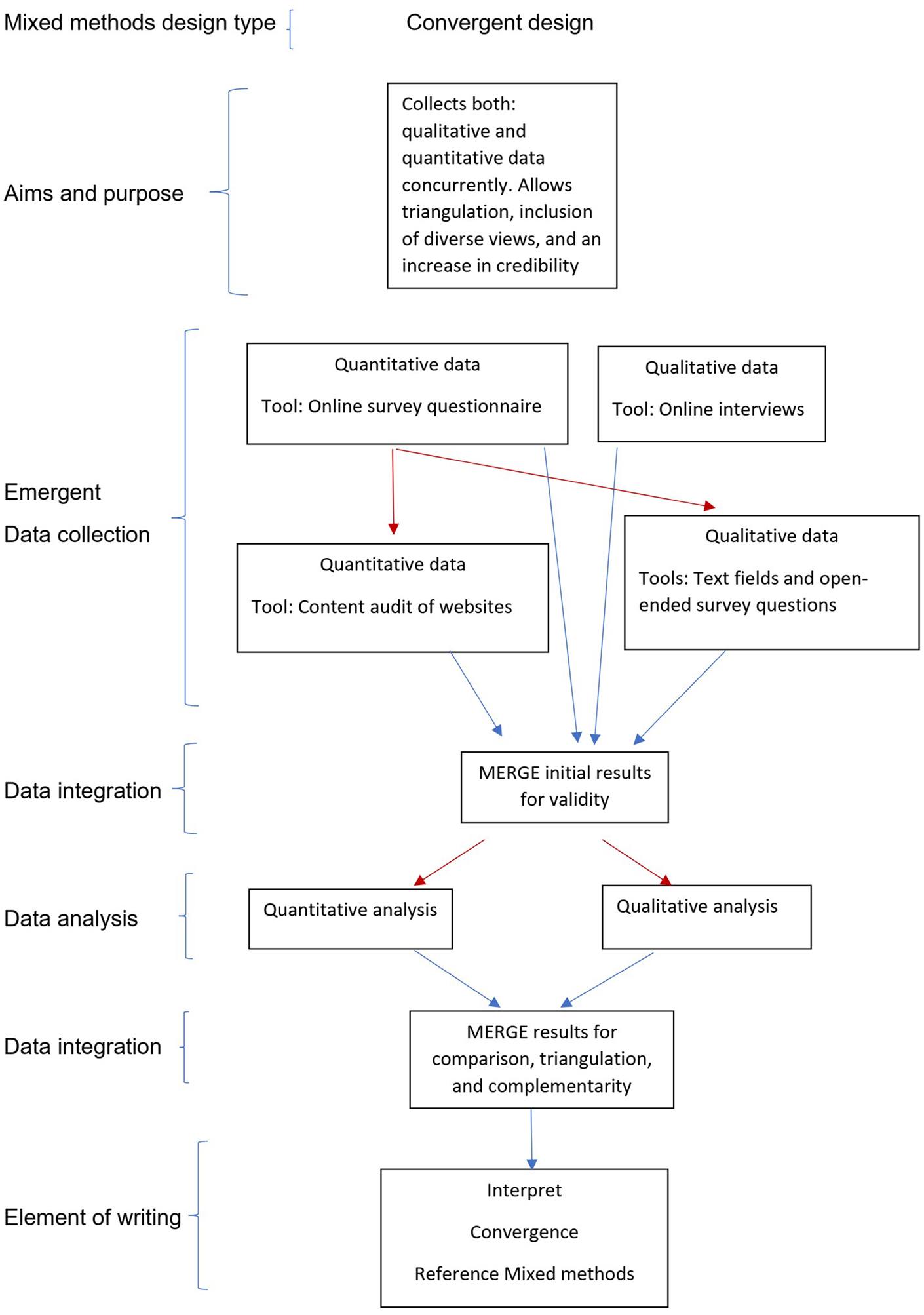
Mixed methods design. Adapted from Harrison et al. (2020: 486. Informed by Greene et al. (in Creswell and Creswell, 2018: 245), Creswell and Plano Clark (in Plano Clark and Ivankova, 2016: 111) and Creswell and Creswell (2018: 217–221).
Sampling
Due to Covid-19 restrictions, sampling was adaptive (Neuman, 2011: 270). The target population was defined as all the public, special and academic libraries in the Helsinki metropolitan area. This geographic area has the highest density of population in Finland (City of Helsinki, 2020). Desk research helped to identify how libraries were organised and created a contact list. The target population was obtained from an online directory detailing Finnish libraries (Libraries, n.d.). Whilst the websites of academic and special libraries had their staff lists available, public libraries in the Helsinki metropolitan area work under a large organisation named Helmet (Helsinki Metropolitan libraries), and their staff lists are not fully or consistently accessible. Therefore, initial contact details for each one of the four public city libraries (Espoo, Helsinki, Kauniainen and Vantaa) were provided by the director of the Finnish Library Association.
The first phase of the research used purposive sampling initially to select knowledgeable library staff, such as library directors (Creswell and Creswell, 2018: 150–152) who then provided contact details for relevant potential participants, including staff in customer-facing and digital support roles within their libraries, therefore, transitioning to snowball sampling (Pickard, 2013: 64–66). Directors who carried out customer-facing rolesalso participated in this study. All communication took place via email, starting with invitations to participate.
Invitations were sent to 11 academic libraries; 15 special libraries; and four umbrella city public libraries, encompassing over sixty branch libraries. A total of 21 libraries responded. The five interviewees were selected as they were the only ones who volunteered following conclusion of the questionnaire, and through correspondence with those who agreed to take part in follow-up interviews. Three were from academic libraries (coded as A1, A2, A3); one from a special library (S1); and one from a public library (P1). The participants represented library staff’s roles primarily focussed on the provision of information and digital literacy/support to customers (see Table 1). The analysis of websites examined one large umbrella public library website, and the websites of six academic libraries, and five special libraries.
Final sample demographics.
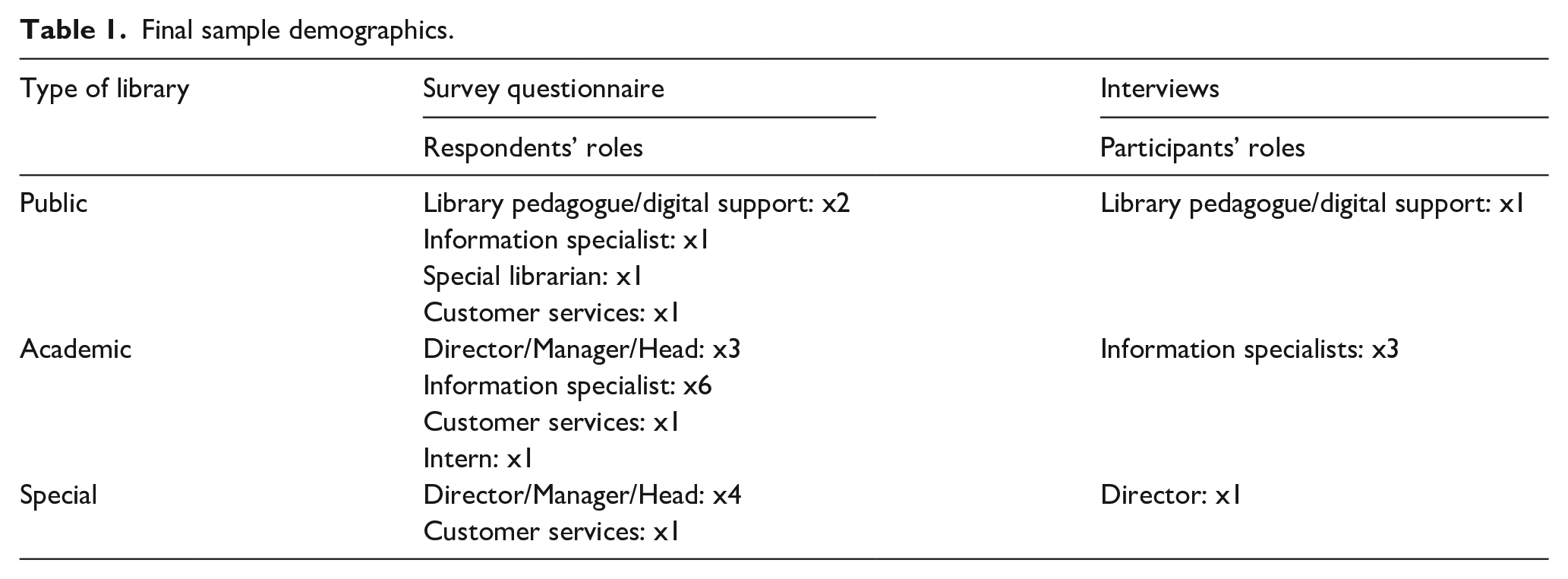
The final sample of library types in the survey responses, roughly showed a proportion of 2:1:1 in terms of public, academic, and special libraries. These three library types represent the libraries available in Finland to which the whole community has access, which is important to this study. Reaching out to participants was challenging because during the Covid-19 pandemic library professionals were working remotely and online, although many shared their time collaborating with this study despite coping with pandemic responses.
Reflective practice
Library professionals’ participation involved using reflective practice, and its intentionality within the data collection process was communicated to them (Reale, 2016: 22–26). In this context, reflection means that participants would hopefully see their ‘[. . .] situation in the holistic sense of the word, from all angles, and [. . .]’ evaluate themselves from within their experience of Covid-19 and the workplace (Reale, 2016: 25).
There is a strong body of knowledge on reflective practice within the library profession and IL teaching (Andretta, 2005, 2008; Booth and Brice, 2004; Corrall, 2017; Grant, 2007; Jacobs, 2008, 2016; Reale, 2016; Whitworth, 2012). It is generally understood as part of the professional identity in health sciences and teaching (Booth and Brice, 2004; Coghlan and Brydon-Miller, 2014), and essential to evidence-based practice (Brice et al., 2004: 284). However, it is precisely within the instruction/teaching role of library staff that reflective practice acquires relevance (Andretta, 2005: 107; Corrall, 2017: 35–42; Reale, 2016: 39–40).
Reflective practice is based on the notion of reflection-in-action by Schön (1991: 50–69), interpreted as the complex interaction between tacit knowledge of a person’s own profession (knowing-in-action), informing their reflection on their professional performance at a given time and place. Schön’s (1991: 61–69) concept is furthermore understood here as happening in several modes within the same profession whereby the reflective practitioner draws upon their knowing-in-practice, rendering it an individual exercise. This is highly pertinent as the research looked at three different types of libraries where ways of working and professional identity varied.
However reflective practice is complex to understand and apply due to the idea of temporality, for example, when and in which conditions a practitioner reflects on their practice; and it is not possible to do so at every moment (Schön, 1991: 275–283). Since this research investigated library practice prior to and during the Covid-19 pandemic, the practice-in-action entails a recall of combined past/present practice. Nonetheless, the following idea assisted in clarifying the approach: The action-present (the period of time in which we remain in the “same situation”) varies greatly from case to case, and in many cases there is time to think what we are doing. (Schön, 1991: 278, original emphasis)
Grant (2007: 158–160) supports this position, suggesting it is feasible to provide analytical accounts of reflection on past experiences, from which clear thematic classification is derived.
Quantitative methods
Quantitative data was collected via a web-based survey questionnaire, together with a content audit (Sperano, 2017) of the participating libraries’ websites. The latter was done for confirmation of data, validity, and to enhance the survey data (Bryman, 2006: 104–110; Hitchcock and Onwuegbuzie, 2020: 71–72).
The online questionnaire was chosen for data collection because it was optimal for reaching participants since they were more dispersed than ever before due to the Covid-19 restrictions (Pickard, 2013: 207–213). A combination of 27 closed questions addressed the five objectives of research. To give the respondents fixed alternatives in their responses and shorten the response time, it included dichotomous, multiple choice and rank order questions, with few secondary open questions for additional comments. It was structured in four sections: demographics, library digital services before and during the Covid-19 pandemic, and experiences related to digital literacy (Pickard, 2013: 209–211). A pilot took place prior to its release, and amendments were made accordingly. The questionnaire was made available for completion during the spring of 2021 by using the Jisc online survey tool. Although responses were anonymised, for the purposes of objectives 1 and 4, it was necessary to know the type of library and its location, which also served to verify if the final sample was representative (Creswell and Creswell, 2018: 148–151).
The content audit of library websites was carried out through a Digital services and support checklist, a tool built for this study (Sperano, 2017). This aimed at contributing towards objectives 1 and 4. It was based on six of the 19 points from EBLIDA’s Checklist for library associations and libraries in the face of the Covid-19 crisis (Eblida, 2020b). The objective of the checklist was to audit website updates on the library’s position, controlling the diffusion of the virus, sharing information on digital offer and library service to the public, free digital services, specific opening hours and helpdesk to assist with use of digital services, and targeted e-book services to customers. This was done by taking screenshots of the webpages, soon after the survey took place.
Qualitative methods
Qualitative data was obtained through online synchronous semi-structured interviews, deemed suitable for focussing on the reflective practice of library professionals (Pickard, 2013: 196, 203). Interviews were arranged and carried out through the multimedia application Microsoft Teams. The interview script consisted of 17 questions comprising four sections: preliminary questions (own role), digital service/support/literacy prior to the Covid restrictions, and since the Covid restrictions, and closing questions (looking towards a post-Covid-19 era). The focus was on meeting objectives 4 and 5, by examining the responses and solutions that tackled DL challenges, in addition to identifying micro-level experiences of library staff through examination of reflective practice. To draw out library staff reflections, use of Gibbs (2013: 44–56) reflective learning cycle was employed, and questions were carefully constructed to ensure that interviewees would think about their lived experiences before/during the Covid-19 restrictions. Gibbs’ cycle has been previously employed in research in reflective practice in LIS (Burgoyne and Chuppa-Cornell, 2018; Corrall, 2017; Wales, 2018). A pilot took place, and minor recommendations were used for improvement.
Prior to the interview, participants were given an opportunity to go through the questions in advance, to enable preparation (Burgoyne and Chuppa-Cornell, 2018: 821–823; Goldingay et al., 2016: 336–342). The script was also shared on the Microsoft Teams screen to ensure transparency, thereby allowing interviewees visibility of the questions, and facilitating return to previous questions for subsequent reflection. This allowed participants to understand ‘matters of personal concern’ (Gibbs, 2013: 53), which is important within the reflexive loop (Reale, 2016). With the participants approval, the interviews were audio recorded via a mobile phone app and notes taken. Transcriptions were shared with participants for the verification of accuracy and validation, ensuring accurate qualitative data (Neuman, 2011: 456–457; Pickard, 2013: 107), in addition to contributing to further self-reflection (Gibbs, 2013: 51). Additional qualitative data originated from the text boxes available in the survey questionnaire aimed at objectives 3 and 4.
Data analysis
Initially, the data from the survey was analysed depending on library type. This was followed by creating cross-analysis between responses by library type to identify differences and similarities. Whilst the final sample was small and data saturation was not achieved, internal validity was applied through examination of the websites of the participating libraries (Creswell and Creswell, 2018: 186). Although a basic analysis, this provided an initial picture of library staff’s perceptions of changes due to the Covid-19 restrictions.
This paper excludes data analysis from the ranking questions on the use of physical and digital services because these questions encountered certain resistance from the participants as such data are not collected by their libraries. Participants expressed through email correspondence and in the free-text box at the end of the survey that this information was too speculative.
An inductive strategy was used for interpreting the qualitative data, the interviews were coded from the ground-up and themes were created according to the information provided by the interviewees (Yin, 2018: 169–170). The interviews were transcribed and coded using NVivo 12Pro, which resulted in 35 themes, further analysed and reorganised into 16 larger themes.
Triangulation was used for integration to identify overriding themes, corresponding to various sources of evidence, as part of case study research (Yin, 2018: 114, 126–130). Although it took place alongside the data collection process, since patterns started to arise, triangulation was achieved to create three composite models aiming at all the research objectives (Plano Clark and Ivankova, 2016: 118–119). This was done through creation of initial schemas where integration of the quantitative and qualitative data analysis took place, to subsequently build the final models supported by the theory used here.
Ethics
Potential ethical issues were addressed prior to the research, during and after the data collection processes. Based on recommendations by Connaway and Powell (2010: 88–93); Gorman and Clayton (2004: 43–44); and Creswell (2014: 92–101) the following issues were relevant.
Regarding quantitative data collection, the purposes of the study were communicated in the email invitation, which included a Participants Information Sheet. Permissions were obtained to circulate the invitation to library colleagues, and each participant agreed to proceed. This was done by, first, emailing the heads of the libraries who then either, forwarded the invite or provided a list with names and email addresses of members of staff to whom the invite could then be sent. Anonymity was guaranteed and managed from the outset (Gorman and Clayton, 2004: 44).
Regarding qualitative data gathering, the interviewees were already familiar with the research project. They received an additional email describing the interview process, and the script file. Finally, they completed a Consent Form, developed in line with policies at the researcher’s academic institution. Anonymity was guaranteed.
Results
The aim of this research was to find out if Finnish libraries met digital literacy challenges, in addition to new needs from their customers in relation to digital literacy during the Covid-19 pandemic; and then to consider ways in which libraries have responded to such challenges. Three library types, public, special and academic, formed a multiple case study set in the Helsinki metropolitan area.
Data was initially analysed per method employed, so all the data from each tool was carefully observed in relation to the theory, which brought up the initial results from the research. Furthermore, in response to the research design, these results represent the first stages of the quantitative and qualitative methods integration, detailed through the themes that emerged following data analysis. The comprehensive themes, as sections hereafter, are: digital services before the pandemic, digital services during the Covid-19 pandemic, digital literacy during the Covid-19 pandemic, and life at work.
Digital services before the pandemic
Survey data shows that all libraries had a digital library already in place. Similarly, 95.2% of the libraries reported having databases. Therefore, all libraries provided digital services to library patrons prior to the Covid-19 pandemic, consistent with library digitalisation (Brophy, 2007; Rubin, 2010). Figure 2 shows that public and academic libraries had a slightly wider variety of digital services available than special libraries before the pandemic.
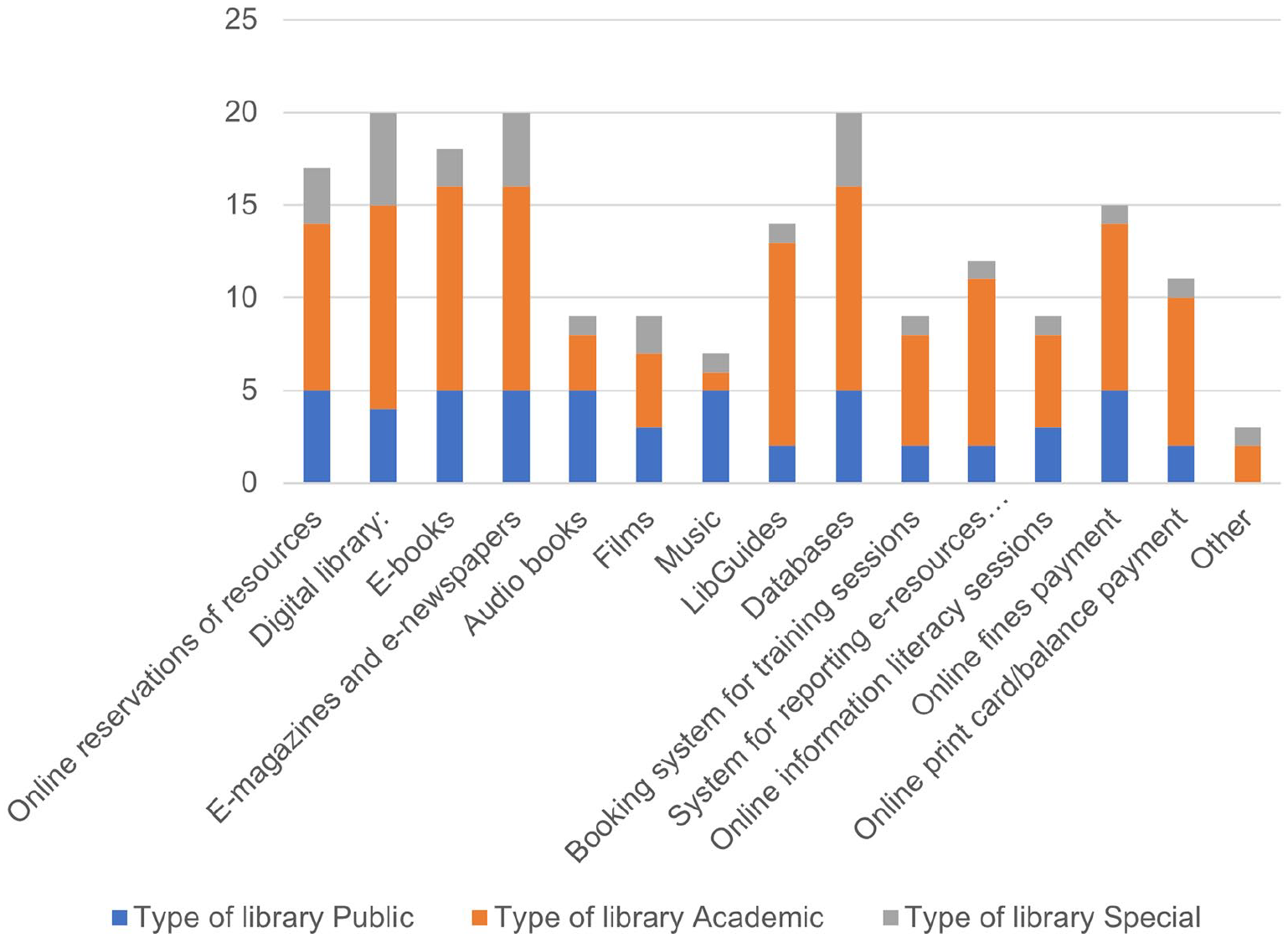
Cross-tabulation of library type and digital services available before the restrictions.
Interviews also backed this up, with participants reporting having digital services and support already, viewing IL and DL as part of such services. Academic libraries had particularly well-structured IL provision, although DL did not seem structured in a similar manner. The latter may be due to Finnish libraries sharing a similar position perceiving DL as a service that they already provide, perhaps as part of the encompassing notion of media literacy (Godwin, 2008; McLean, 2008; Webber, 2008).
We’ve had this kind of service that if any individual at the university, whether he or she is a student or a professor/teacher, we can organise that kind of session [DL training], and we met that person at the [library]. (A1) With digital skills, we really don’t offer training ourselves, as in ‘I’ll come and teach you’. What we do, if we find the right partner for cooperation, is that they can come and teach. And we then offer the premises. [. . .] (P1)
The boundaries between the literacies are blurry in the Finnish practice as its informed by policy (Kotilainen and Kupiainen, 2014; Salomaa and Palsa, 2019). In fact, academic libraries teach IL on and with online tools which requires a level of DL teaching/training. For instance, A3 reported that they already were teaching IL online due to the distant nature of their university’s masters courses. Discipline specific customers’ IL/DL needs were important for academic and special libraries.
Public libraries used partnerships to meet distinctive IL/DL needs, for example, a bank helped provide support on online banking; an organisation dedicated to supporting older customers would tailor provision accordingly. Also, S1 reported that providing support to non-affiliated researchers was important. Therefore, professional identity regarding customer groups and their information needs permeated their view on the topic (Bhimani, 2016; Maarno, 2019; Pierson et al., 2019).
Digital services during the Covid-19 pandemic
Results from the Digital services and support checklist provided initial information regarding participating libraries websites. Firstly, on how their websites managed communicating about library responses to the Covid-19 restrictions. Secondly, on the online level of information and access to physical and digital resources, presented below.
The main results from communication were that the six academic libraries, five special libraries and the helmet website (representing public libraries) offered thorough communication about the Covid-19 situation in Finland, and on how their organisation was supporting the community. All libraries, but two, informed their users about available physical services. The Helmet website additionally informed about access to a limited printed collection organised at their libraries’ lobbies. One special library additionally informed about their available information and archive services.
These results show well-managed online communication by the participating libraries consistent with the Finnish report submitted to EBLIDA (Maarno, 2020). Furthermore, the ALA (2020) and IFLA (2020) suggested that providing online information was essential for customers’ awareness and for learning about what their library was doing to keep them safe, and about their available services.
The survey examined service changes at the libraries due to Covid-19 pandemic (Figure 3). Many of the changes identified in the libraries aligned to their target customer group. For example, academic libraries served mostly students and researchers, therefore they provided high levels of IL and DL online training; whilst public libraries focussed on IL and DL training via telephone and face-to-face, and had higher levels of online social events, and distance book clubs. Special libraries reported a wider variety of changes, due to a mixture of customers that resembled both academic and public qualities. These results were consistent with those reported by Syvälahti (2020), Virrankoski et al. (2020) and Libraries (2020).
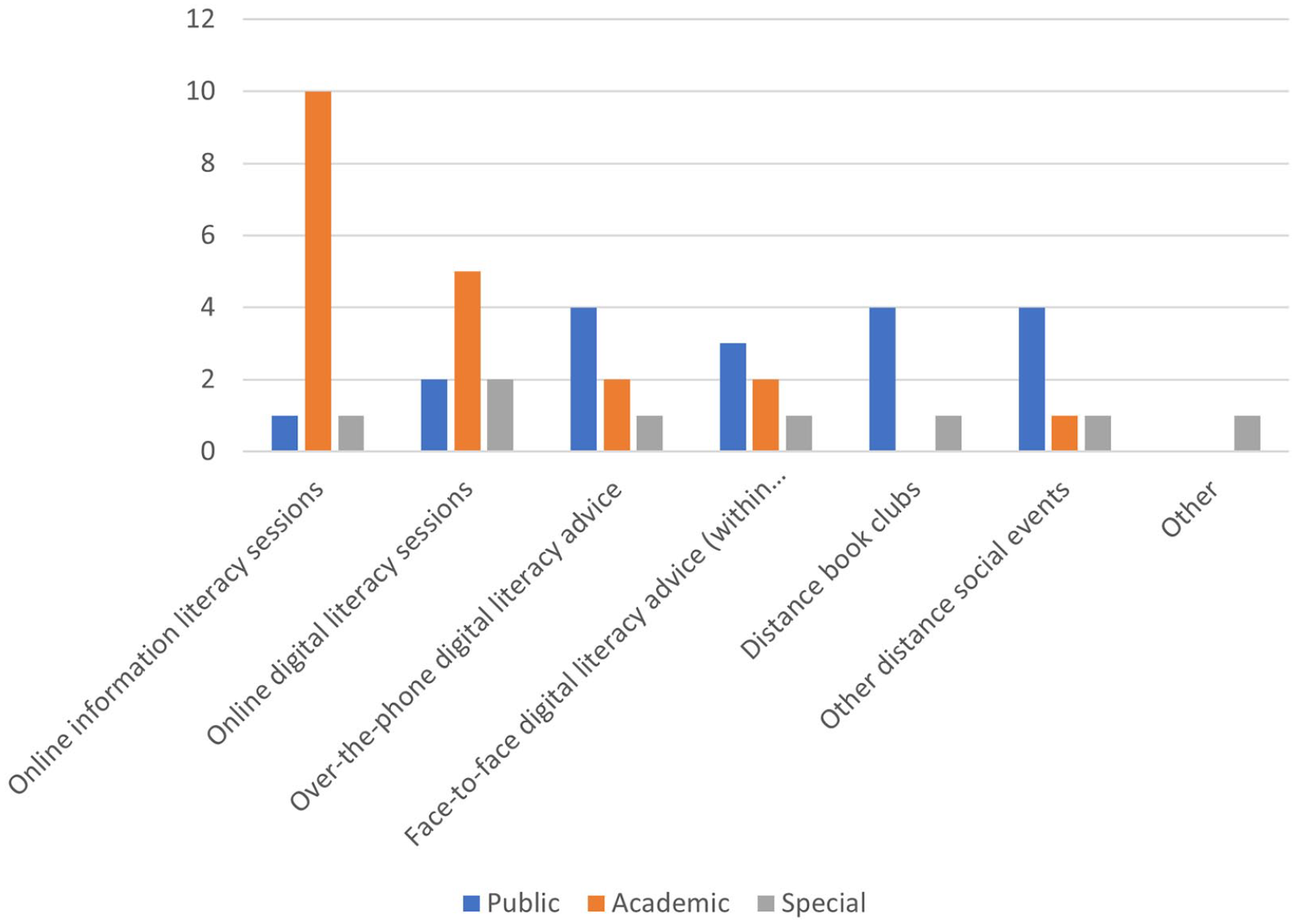
Changes since the Covid-19 pandemic by library type.
Additional results from the Digital services and support checklist confirmed that all libraries offered adequate information about access to physical and digital services (see Table 2). Only two libraries were completely shut down; with one still offering a click and collect service to customers. Access to online services varied according to the type of library and customers’ information needs, as affiliation was required to use licensed materials. Access to digital content from the public library was available to all customers.
Checklist of access available to the participating libraries until April 2021.
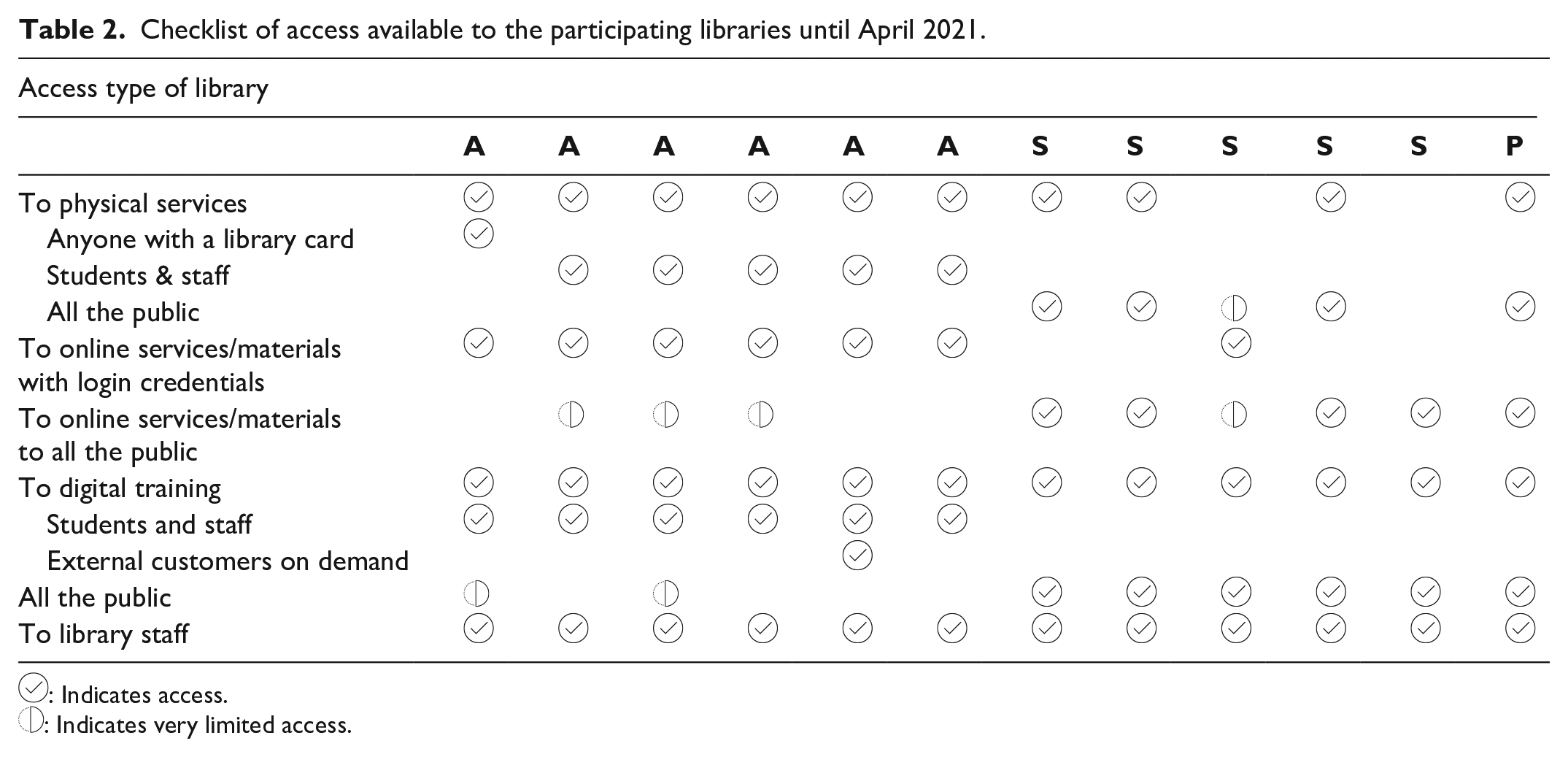
 : Indicates access.
 : Indicates very limited access.
The reasons for service changes (see Figure 4) reflected a combination of library staff initiative and a response to users’ needs. This clearly demonstrated the active role of many libraries in serving customers during the Covid-19 pandemic (Maarno, 2020; Mehta and Wang, 2020; Virrankoski et al., 2020; Zawacki-Richter, 2021). Additionally, it demonstrates the high level of autonomy that Finnish libraries and their staff hold on their websites and service provision, which is not the case elsewhere as reported by Reid and Bloice (2021: 36–49).
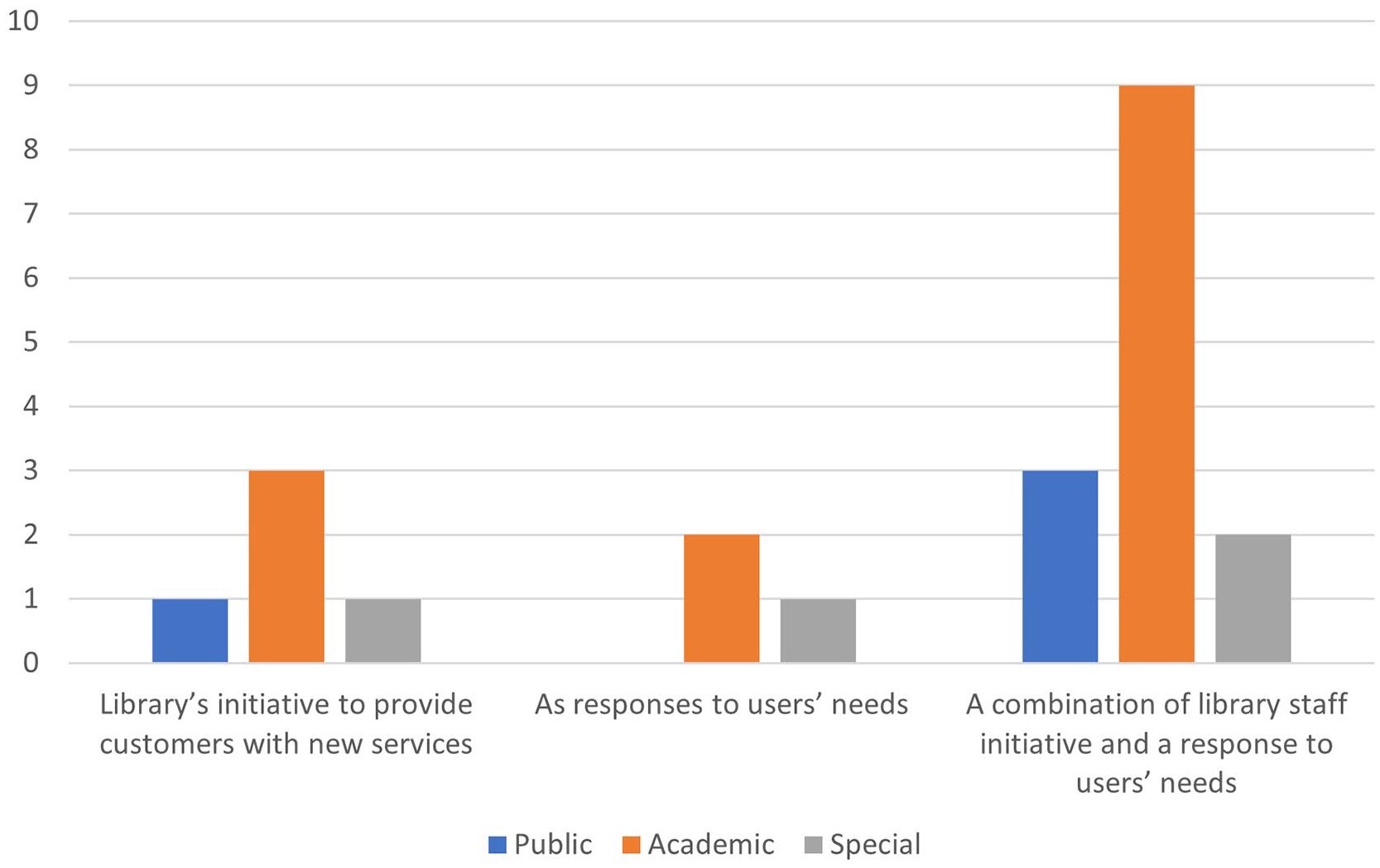
Causes for the changes by library type.
Regarding perceptions of customers’ engagement with the digital changes, participants reported that they were mostly engaged, corroborating the service goal of libraries to respond to changing customer needs (Tuominen and Saarti, 2012). However, reasons for non-engagement were also identified, related to aspects to do with the digital divide (Haasio and Kannasto, 2020), in addition to Covid-19 exhaustion amongst customers.
Some of our customers don’t have access to the internet at all. (Special library) Covid-19 restrictions have been causing exceptional period which has been unpredictable. First, we thought it would last only 3 months in 2020, but it has continued over a year now. People are just living and waiting for better times. (Academic library)
Interview responses identified a rapid adaptation period of 2 days to the restrictions imposed by the Finnish government. Staff and customer safety and continuing with service provision were key priorities. While there were variations in the available physical services, ranging from shut down to reservation and collection service, the remaining services were adapted online. New technologies, for example, Zoom and Microsoft Teams applications, were learnt by library staff for teaching, alongside e-paedagogical skills. Older technologies, that is, social media, were exploited more.
Reported changes regarding customers’ needs in academic libraries included the demand for e-materials from disciplines that did not require them as much before. Additionally, support from e-publishers seemed relevant as some made available e-material for free, which was viewed as a marketing exercise. For public libraries changes included the increased use of the already available e-library, and the creation of online social events in place of physical events. This mirrored the reviewed literature (e.g. IFLA, 2020; McMenemy et al., 2022; Reid and Bloice, 2021; Virrankoski et al., 2020). However, online social events were considered a challenge because they were perceived as a poor relation to face-to-face social gatherings.
The latter resonated with comments from A1, A2 and A3, whose job entailed IL teaching. They saw the lack of face-to-face teaching as a challenge by expressing concerns about students’ real learning even though they were assessed on their learning. A3 also mentioned as a positive change that students seemed to recognise information professionals’ actual relevance.
A big change happened in the nursing/health science students and their teachers. So, before our health sciences teachers never contacted us and said that 'we need electronic books. [. . .] The very basic textbooks, so that it kind of made a cultural change. And other fields of study, we really paid attention to buy electronic books [. . .] (A3)
S1 reported effects of the restrictions on non-affiliated researchers, who depended on their library services for their information needs. The concept of professional identity helped with analysing this (Fraser-Arnott, 2019; Lloyd, 2010; Maarno, 2019; Pierson et al., 2019). Since the role of a public library is highly social, it was easier for P1 to elaborate on that as an issue. The standpoint of academic and special libraries on teaching may be a frame of meaning for the social aspects of teaching (Crawford et al., 2020; Stafford, 2020). Social belonging was one of the most important findings, regarding customers’ needs and library staff work life needs.
The biggest challenge has been how to reach our customers.
It’s not a digital one, but something that has come with this pandemic that I think about quite often is that social aspect of it [. . .] (P1) And that has been rather important at this time, that we can offer the [subject librarian services] services online (S1)
Overall, the participating libraries offered a variety of digital support and services following Covid-19 restrictions. Nonetheless, having actual online access in the first instance was a challenge for some customers. Hence, through the lens of the digital divide where not all customers have internet/smart devices/digital skills (Laterza et al., 2020), the following questions arise: who are those customers without internet access? And how could they make their digital needs known?
Digital literacy during the Covid-19 pandemic
The survey asked whether library customers’ digital literacy needs had changed since the start of the Covid-19 restrictions. Most of the respondents felt customers’ needs had changed. It is noticeable that academic libraries perceived such changes the most, mirroring reports from academic libraries outside Finland (Martzoukou, 2021; Otike et al., 2022; Temiz and Salelkar, 2020 ). Also, four of the five public libraries responded likewise mirroring national and international experiences (Haasio and Kannasto, 2020; Libraries, 2020; Smith, 2020).
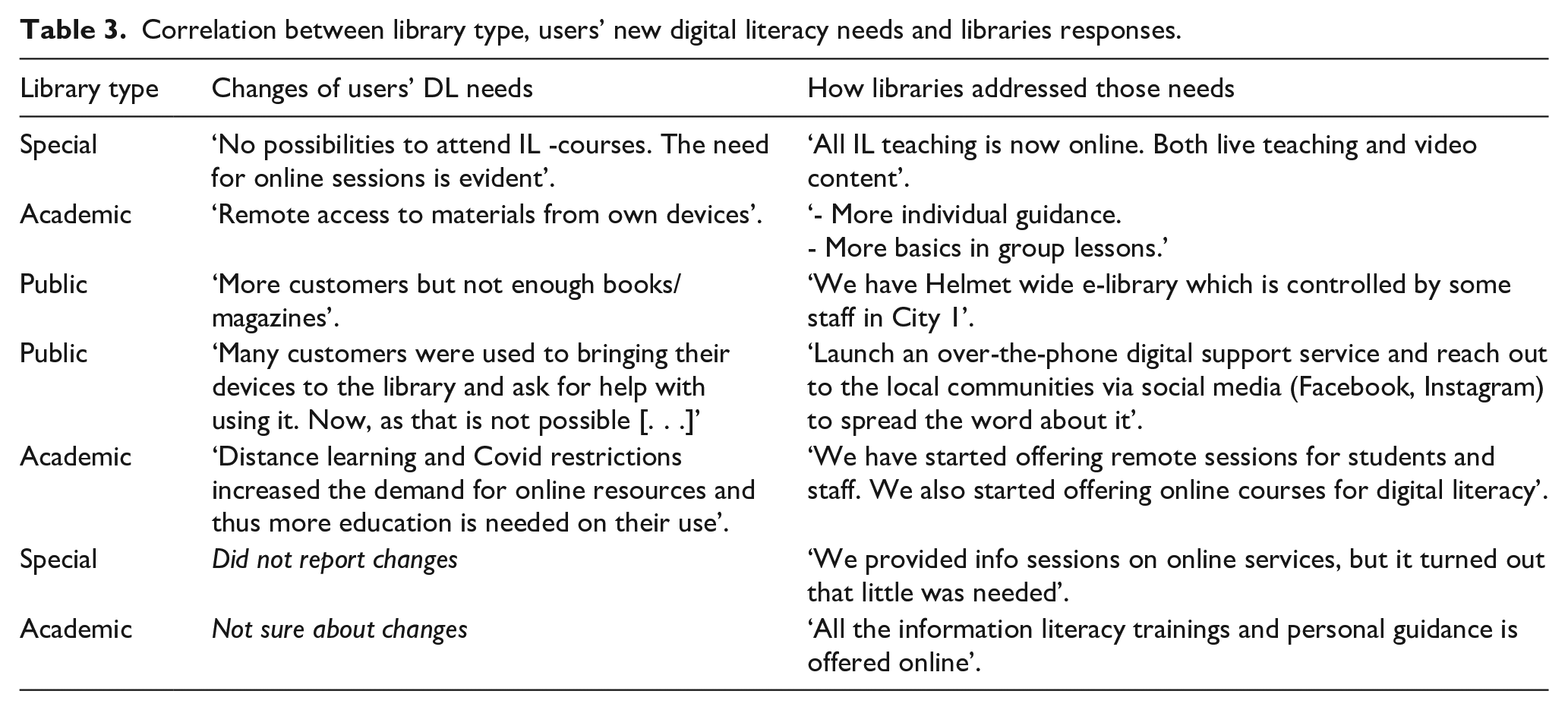
Observable changes in customers’ needs and how libraries addressed them, were investigated. Table 3 presents selected quotes from the responses showing that where a digital support or DL need had been expressed by the customers or observed by library staff, an adequate response was put forward. It is inevitable that work of library staff increased due to the nature of online service ranging from fulfilling old and new everyday duties remotely, to being available online all the time with their own colleagues (Hicks, 2020; Libraries, 2020; Martzoukou, 2021; Virrankoski et al., 2020).
Correlation between library type, users’ new digital literacy needs and libraries responses.
Survey participants indicated that a complex picture of library service provision existed, where printed materials remained essential to customers, despite well-developed online resources. A post-Covid-19 view may be that a hybrid-service mode, which was the response to the restrictions, will remain (Martzoukou, 2021; Matthews, 2020).
Participants interviewed had different perceptions of DL since it was not seen as happening de facto, for example, P1 reported it as digital support. For A1, A2, A3 and S1 it seemed to be business as usual but moved online. Interestingly, university lecturers/teaching staff’ DL was addressed positively, and achievement of goals in relation to digitalisation of services, their use and customer satisfaction were reported as important. This again can be framed within the notion of professional identity.
As mentioned earlier, there were changes in communication between university teaching staff and information professionals. In some cases, it became efficient and supportive; in others it increased the workload of library staff. This highlights the relevance of faculty and library liaison (Brophy, 2007: 31–34).
A holistic approach to DL was reported by P1, since their work included media literacy, improvement of digital support to customers via a phone service and developing a digital support strategy for library staff. Similar processes were reported by the other interviewees. Altogether, the Covid-19 restrictions caused not just a quick response from libraries, but also an assessment of practice (Crawford et al., 2020; Libraries, 2020; Martzoukou, 2021; Virrankoski et al., 2020).
Life at work
A final theme relates to life at work. Firstly, interviewees reported satisfaction with adapting to change, working remotely and providing services to their customers. They expressed awareness of their ability to learn new skills, digitally and pedagogically. This resembles reflection for self-discovery and on situations challenging predefined expectations (Grant, 2007: 159–160). They all appreciated the assistance that technology provided to their work, and discussions existed around teaching remaining remote or hybrid post-Covid-19.
I’ve had to learn to do things myself, and to ask for help. But I think it’s also good because it’s good that the teacher knows. And you don’t have to ask somebody else to ‘please do this for me’. It’s good to do the things, and also try, what works, what doesn’t work.
So, it’s been quite a journey this spring. At least I have learnt from the different mistakes (A2)
Remote working challenged greatly the social aspects of work, where A1 and A2 reported missing their colleagues and everything related to being at the office. S1 thought differently because they took turns in serving the customers (including the library director), which is something that they pride on despite remaining a challenge. However, for others it had benefits, for example A3 and P1 reported that they appreciated not having to commute a long distance to work. Therefore, although they appreciated the benefits of online collaboration, there was a tendency for limited socialisation, and challenges with conducting work meetings for example (A3). These different experiences mirror those reported in Virrankoski et al. (2020) and Savolainen et al. (2021).
Cause all my work, I can do remotely. Or, then if I would like to check the print collections, that I don’t do remotely. I can choose print books for purchasing. I can choose e-books online, subscribe to streaming services online, I can update the LibGuides online. . . I really work remotely all my time. And I don’t like it. (A1) What is not so nice is that I don’t see my colleagues. (A2) That’s how I felt myself. And many people, or many of my colleagues, have been very happy to have so much remote work, not to have to deal with the time at the campus (A3) I really like remote work. I like the freedom of just making a cup of tea in the middle of working and. . . all that. And I feel like I get a lot done this way also. (P1)
All interviewees perceived that their organisations were well prepared for future challenges and would draw upon lessons learnt. They were also receptive to the use of future new technologies. This shows the adaptability of the library profession, which has characterised it for long time (Martzoukou, 2021; Smith, 2020; Witt and Smith, 2019). Although P1 reported that creating new services had not been as fast as they would have wanted, changes were possible within their rather large organisation -all the public libraries in one city. This reflected the situation of public libraries more generally (Haasio and Kannasto, 2020; Matthews, 2020).
We have used Zoom in the. . . but it doesn’t matter what is the application. We would have whatever is the meeting application that we use. Whatever that is available to us, we will use that. And yes, we understand that our services must be either partly or fully online in the future. (S1) At least we have now gained a lot of experience on what would happen if we suddenly have to close our doors. So, surely if it should happen again for whatever reason, knock on wood, then at least there would be much more ready concepts of what can be done. (P1)
Finally, Covid-19 exhaustion was a key feature of their experiences, for example, from longing to be with their colleagues, to online meeting overload, to wanting to restart physical services. Again, resilience was key to getting through the challenges brought up by the pandemic (Eblida, 2020a; IFLA, 2020).
Of course, everybody has had problems, we had problems, but they solved them. I’m so proud of my team, ‘they did it’, ‘we did it’. (S1) I have felt really proud of my colleagues, in these situations. (P1) [. . .] But at this time, I think that we are all exhausted about this, and we are frustrated about now knowing when this ends [. . .] (S1)
Public library staff were particularly overwhelmed by their everyday duties in addition to Covid-19 pandemic related responsibilities, and consistent with the literature on the topic (Matthews, 2020; Smith, 2020).
Figure 5 offers interpretation of the participating libraries’ challenges and responses to the Covid-19 restrictions from interviews undertaken. Whilst each library type had their own challenges, similarities appeared. This is interpreted as information professional’s roles and goals of service provision were influenced by their experiences during the Covid-19 restrictions, which bound them as a whole profession. Thus, key differences are defined by type of library, professional’s role, and perception of the professional self. For example, special and public libraries worked on ways for improving customer reach, to show them that they ‘were still in businesses’, as P1 reported. For some academic libraries, ensuring IL learning through online teaching was a concern. Relevant similarities are found in the challenges and responses, as well as in the perceptions of the social aspects of work, which at the time when the research took place consisted of Covid-19 exhaustion and resilience not only to prevail, but to reassess the professional practice and take action.
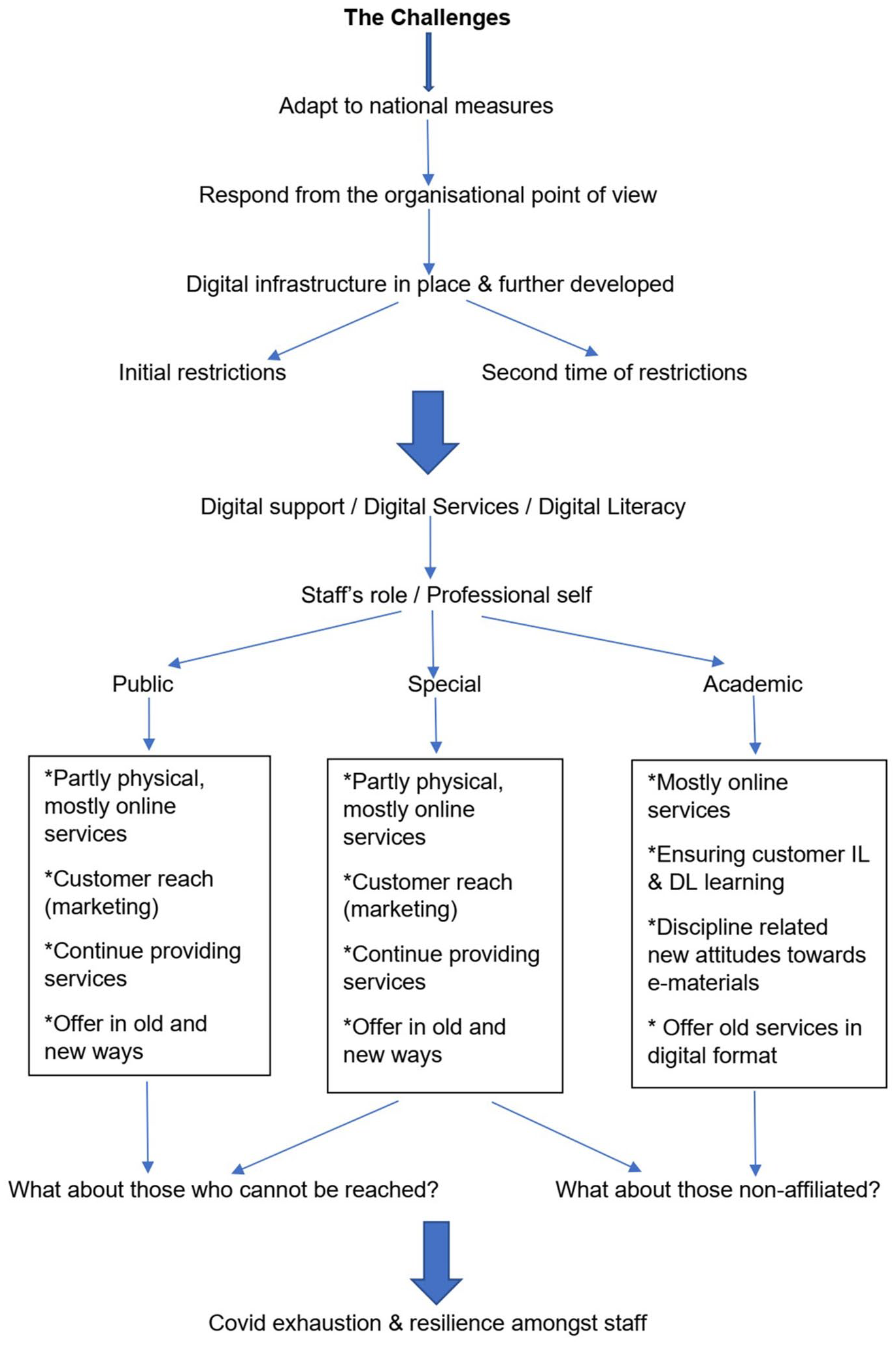
Libraries challenges and responses.
Discussion
The results provide a detailed picture answering the research question. Firstly, the challenges faced depended on library type and were those reported in the wider literature. Academic and special libraries did not distinguish between digital literacy and information literacy, and public libraries addressed it as digital support. The Finnish policy context defines both as media literacy, which was reflected in the practice of the research participants. Key responses included digital preparedness, fast and effective communication, organisational and managerial support, teamwork, librarianship as professional identity of information service and resilience.
Secondly, New customer needs included being informed about whether their libraries were still in business and what actions were taken. All libraries moved to remote working and provided services online. Additionally, academic libraries addressed their budget for e-materials and increased requests. Public libraries increased their variety of online services, favouring social interactions; and expanded their provision of digital support services to improve access for disadvantaged customers.
The integration of the methods also brought together the three library types (Bryman, 2006; Hitchcock and Onwuegbuzie, 2020; Lieber and Weisner, 2010; Pluye et al., 2018). Three models were developed from the results (Figures 6–8) considering the wider context, library types and responses to the Covid-19 pandemic. Firstly, the Context model (Figure 6) frames the IL, digital services, and support prior to the Covid-19 restrictions; and libraries’ approach to the challenges. This is based on survey and interview responses representing a strong professional identity in relation to type of library. Participants clearly identified their customer groups, their needs, and digital support required (Pierson et al., 2019). That was also confirmed through the websites’ audit, showing consistency.
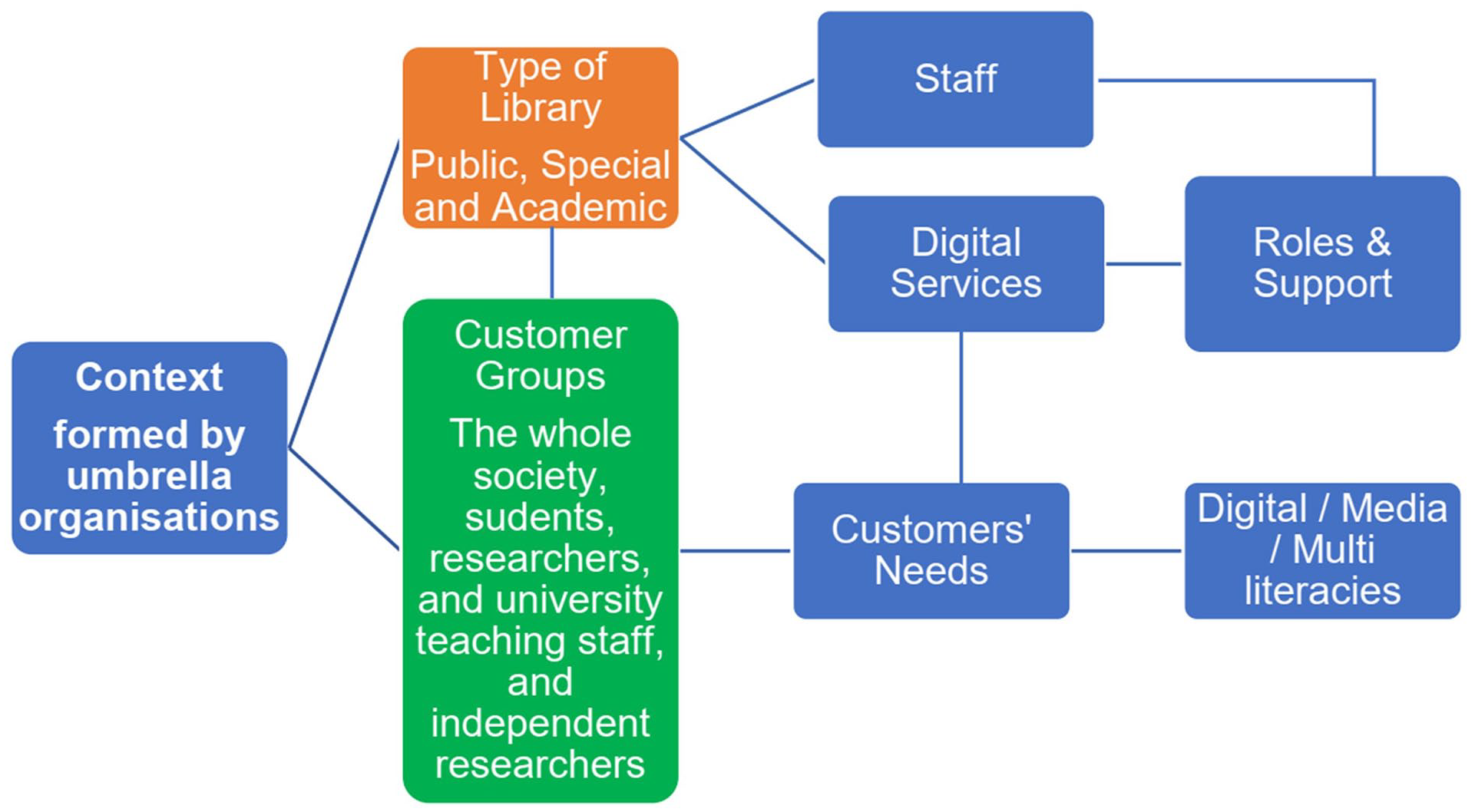
Context model.
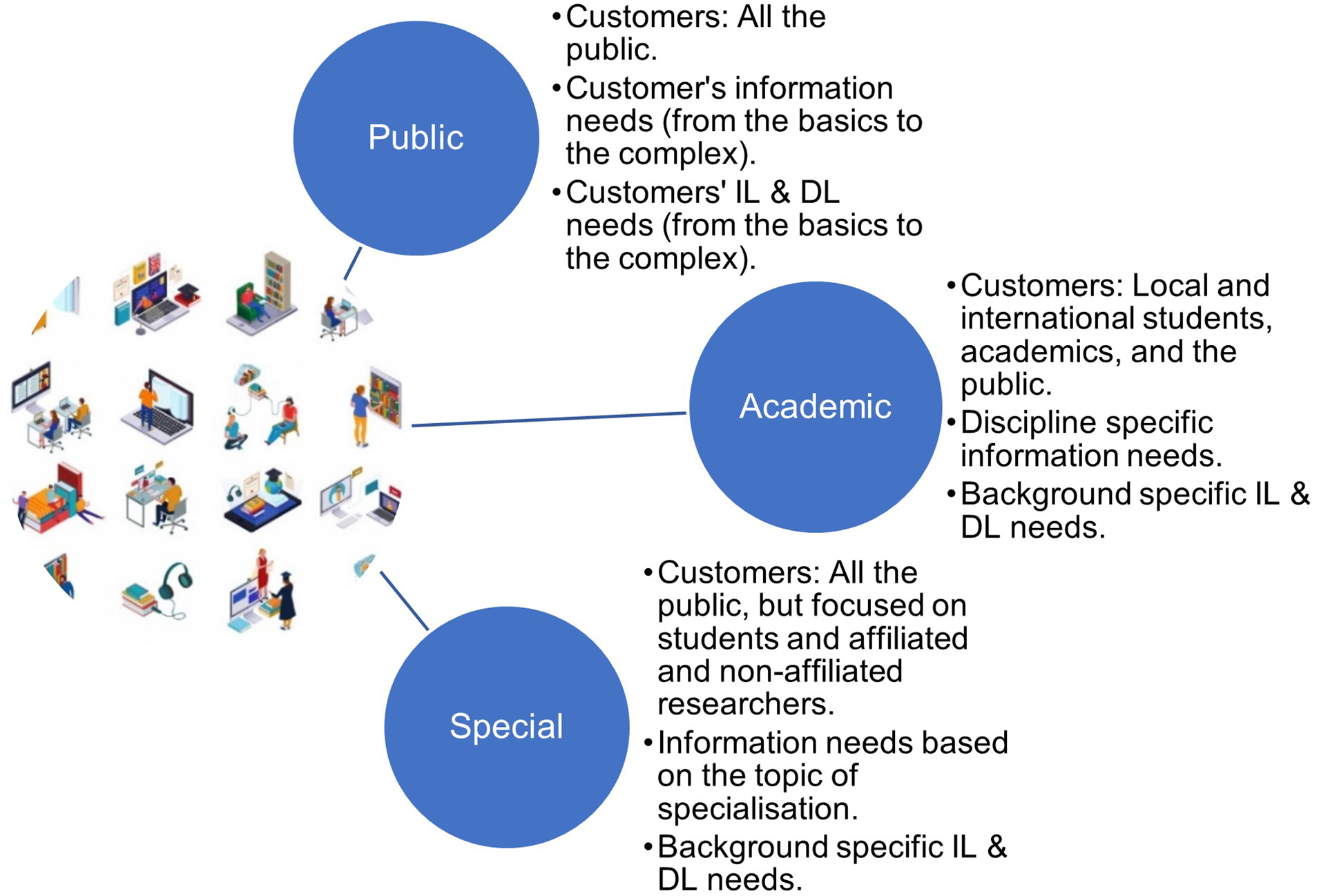
Library type context.
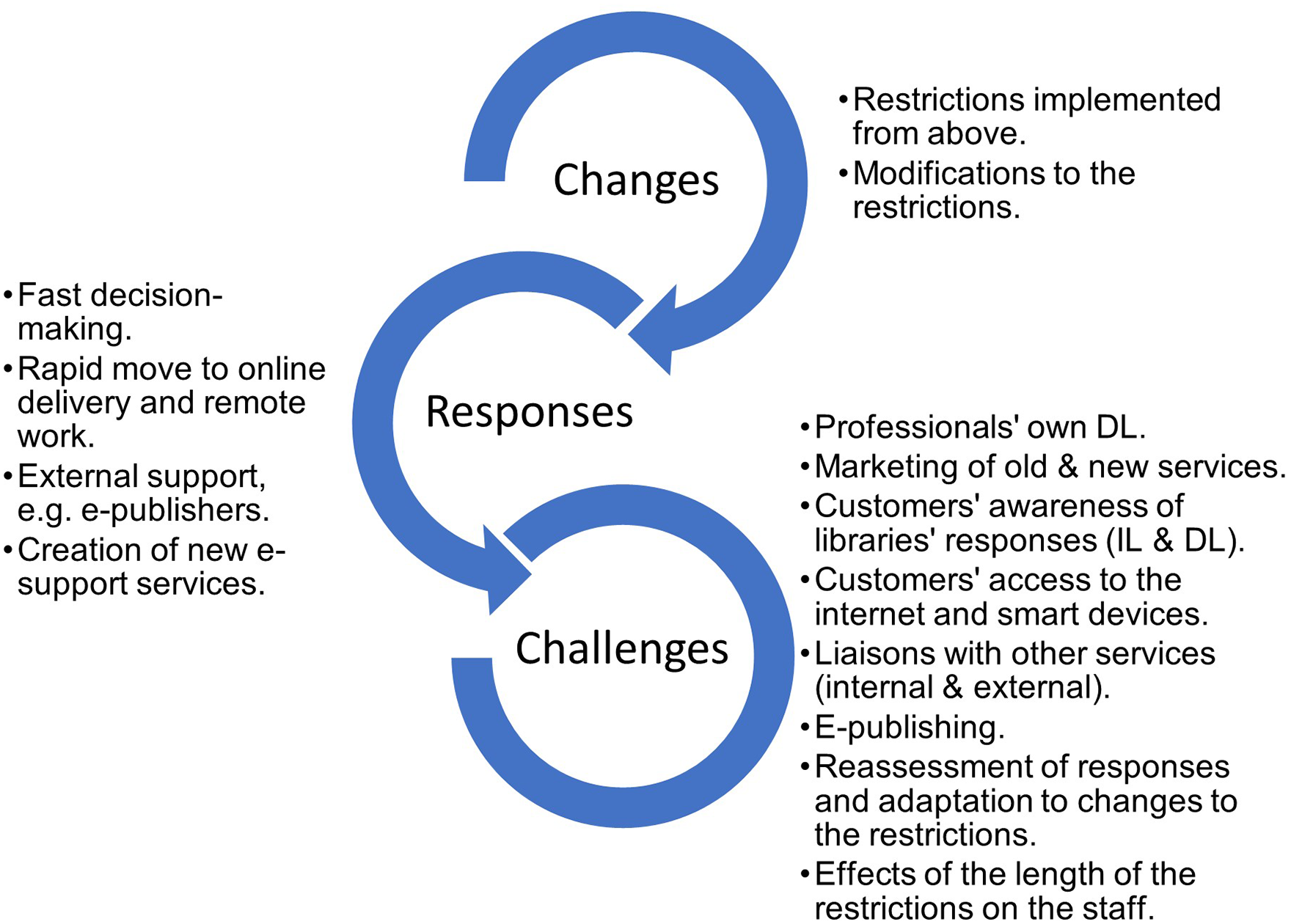
Responses’ cycle.
Secondly, the Library type context (Figure 7) represents each type of library’s standpoint. This was key to understanding their specific challenges and responses, while they all shared similarities, allowing generalisations. For instance, all libraries provide IL and DL support in a variety of ways; nonetheless, according to IL teaching tradition, academic libraries have a more formal and structured approach (e.g. ALA, 2015; Andretta, 2005; Hicks, 2018). However, as this research has found, public and special libraries began to formalise and structure their digital support much more because of Covid-19 restrictions. Understanding general and specific contexts is important because they happen simultaneously (Brophy, 2007; IFLA, 2020; Lloyd, 2010).
Finally, the Responses’ cycle (Figure 8) summarises the key results from this multiple case study, and identifies two challenges related to change, response to the change, and challenges that result. Change comprises the initial restrictions from the Finnish government; followed by agile responses from libraries and their umbrella organisations, where applicable. All participating libraries responded by moving all the work and services remotely and online. Throughout, participants expressed that their libraries were fit-for-purpose, as the move was smooth because there were already established online services and staff had the right equipment for working remotely. Moreover, staff were knowledgeable in digital resources and services, and developed new skills accordingly. This aligns with research on library professional adaptability (e.g. Seadle, 2016; Tredinnick, 2019) and on libraries responses to the Covid-19 pandemic (ALA, 2020; IFLA, 2020; Witt, 2021).
Responses to change required consideration of how to operate remotely and online. Libraries resourced online applications for IL teaching and DL support to customers, work meetings (formal and informal), and for work chat (formal and informal), to keep a sense of normality, and co-presence at work.
Participants reported a sense of achievement in relation to supporting their customers, however customer reach and actual participation in the DL teaching and digital support was perceived as challenging (Crawford et al., 2020; Hicks, 2020; Smith, 2020). Participants also reported awareness that their library responses were not fixed and that there were more opportunities to improve their DL and digital support provision.
Challenges resulted from this change and grew and changed as the pandemic developed. For instance, professionals’ and customers’ DL was addressed. Moreover, marketing of old and new library services (physical and online) was essential so customers would gain awareness and use them. Nonetheless, customer use of devices, access to online information and thus to the available services, was questioned by professionals.
It is worth noting that participants’ experience and feelings about remote work are an important part of the service delivery experience. As the Covid-19 pandemic unfolded, restrictions remained longer than expected, which brought various positive and negative feelings from service providers, whose expectations had altered as the Covid-19 pandemic unfolded. The dominant feeling was of pride regarding individual and team achievements, and mostly positive despite their awareness of the rigidity of the situation, reflecting a clear resilience amongst the profession (Eblida, 2020a; IFLA, 2020).
Limitations
Since this is a descriptive case study, it is important to consider possible limitations regarding internal and external validity (Connaway and Powell, 2010: 80–81). Both types of validity were addressed by supporting the data analysis with a literature review and the triangulation of methods, thus through use of theory and pattern matching (Yin, 2018: 42–46, 175). However, this research may be limited due to the small size of the sample, as a result of the challenging times caused by Covid-19 and the resulting library staffworkload. As such data saturation was not fully achieved in order to guarantee that enough consistent data had been gathered (Creswell and Creswell, 2018: 186), and it could be argued that data is missing (Hitchcock and Onwuegbuzie, 2020), and there could potentially be response bias (Creswell and Creswell, 2018: 157).
However, despite these limitations the research has important value, with analytic generalisations made in this study being intended for theoretical propositions, as is the goal of case study research (Yin, 2018), rather than being applicable to the entire library population of Finlandor libraries globally. This research is valuable too because of the method used during social distancing by using reflective practice as a way to gain qualitative insight.
Conclusion
The implications and relevance of this research are observed alongside the objectives as follows:
The participating libraries encountered similar challenges to those reported in the wider literature, the initial one was: how to continue serving their customers under new health and safety measures, originating from the restrictions from March 2020. The second one was: uncertainty since restrictions fluctuated until the spring of 2021. Both key challenges were due to the novelty of the Covid-19 pandemic and the national direction. It is certain that globally much has been learnt from this experience and libraries are better prepared for future complex situations.
Besides of the relevance the policy-practice relationship regarding media literacy in Finland, challenges met depended on the library type. Nonetheless, these can be categorised in two levels of access: customer access to technology and ensuring access to customers.
Customer needs were not so generalisable, due to the nature of library customer service. For instance, online support of socially oriented events at public libraries; and acquisition of e-materials for subjects or patrons that have not requested them prior to the Covid-19 in academic and special libraries. Yet, altogether, e-materials were in high demand for all libraries as well as digital training for library staff.
The solutions demonstrated the libraries’ ability to adapt to the challenges met. In summary, moving to remote work seemed agile, academic libraries addressed their budget for e-materials and increased their requests; special and public libraries increased their variety of online services. In addition, public libraries also expanded their provision of digital support services to improve access for disadvantaged customers.
Participants’ reflection illustrated the significance that the role of their professional identity played in their practice. Furthermore, this was highly influenced by the Finnish cultural-character concept of sisu, or inner strength formed by tenacity, grit, perseverance, hardiness, and resilience. All of this means that the act of reflection has to be contextualised in each research project where it is applied.
Finally, including public, academic, and special libraries alongside staff from diverse roles, enabled a broad perspective of responses and demonstrated that despite some differences, all library professionals stepped up to provide for their customers during the Covid-19 pandemic. Future research would benefit from examination of the work of special libraries to learn from their experience, as this research was enhanced by their collaboration. Throughout the conversations held during this research, it was noted that library staff already have exercised a great deal of reflection due to the Covid-19 demands. The use of reflective practice as a research tool for LIS professionals is highly beneficial as a research tool, but also as a means of better understanding the reasons behind library responses.
Footnotes
Funding
The author(s) received no financial support for the research, authorship, and/or publication of this article.
