



Abstract
This investigation compares how COVID-19 vaccination supporters and refusers make use of rhetorical strategies to judge the credibility of information sources in online discussion. To this end, the Aristotelian tripartite approach to rhetoric, that is, ethos, pathos and logos was utilized. The empirical findings draw on the analysis of 2257 posts submitted to Suomi24—a Finnish online discussion in May—October 2021. The findings indicate that both vaccine supporters and vaccine refusers mainly drew on the pathos- and ethos-related rhetorical strategies such as appeal to blameworthiness and ad hominem arguments while judging the credibility of information sources. Coronavirus vaccination appeared to be a highly contested topic giving rise to polarized debates, deep mistrust and mutual accusations between opposing parties. The rhetorical strategies were used to attack opponents’ views on the credibility of information sources, rather than making attempts to create mutual understanding of their value for arguments used in online discussion.
Introduction
The COVID-19 pandemic has resulted in the growing consumption of health-related information from social media (e.g. Laato et al., 2020). Exposure to such information has both positive and negative aspects. On the one hand, people may have free access to publications issues by health authorities; on the other hand, there are rumors distributed in online discussion platforms. Along with the prolongation of the coronavirus pandemic, the uptake of vaccines against COVID-19 disease has become a major health issue. From the first beginning, the argumentation for and against coronavirus vaccination has been polarized into debates between two main camps: vaccine supporters and vaccine opponents (Savolainen, 2021). The polarization manifests itself particularly in debates occurring in social media platforms. In this context, one of the central issues is how the participants of online discussion assess the credibility of vaccine-related information. The credibility judgments are rendered difficult because for the lay persons with no medical training or insight into epidemiological matters, it is hard to follow arguments about the safety of the vaccines, for example (Ihlen et al., 2021). Therefore, their judgments about coronavirus vaccines are largely dependent on popular level information available in sources such as newspaper articles, television news, and social media forums. On the other hand, experts may have diverse views on the effectiveness of the coronavirus vaccines due to the emergence of new virus variants such as Omikron. Uncertainties such as these provide a fertile ground for persuasive communication about the credibility of vaccine-related information particularly in social media forums like Youtube, Twitter, and online discussion groups.
Rhetorical appeals offer a powerful method of persuading people to believe that information sources of certain types are more credible than others. In an online debate, for example, a participant may make attempts to convince others of that a recent report published by the World Health Organization (WHO) provides compelling evidence for the benefits of coronavirus vaccination. On the other hand, he or she may warn that the rumors about the ineffectiveness of the should not be taken seriously because they are distributed by dedicated vaccine refusers. The main goal of the present investigation is to elaborate further the above setting by examining how the participants of online discussion make use of rhetorical appeals to defend or refute the credibility of vaccine-related information sources. More specifically, the use of rhetorical appeals will be examined by focusing on dialogs between vaccine supporters and vaccine refusers. This offers a novel perspective on the ways in which the credibility of information sources is defended or refuted in conversation.
To explore the use of rhetorical appeals in more detail, the present investigation makes use of the classic Aristotelian tripartite approach to rhetoric: ethos, pathos, and logos (Herrick, 2018: 82–84). While drawing on ethos-related appeals, the participant of online discussion makes attempts to convince others of that an information source is credible because its author is a virtuous and honest person. Appeals serving the ends of pathos are directed to sympathy or antipathy felt by fellow participants, for example, contempt toward a person who intentionally spreads false rumors (Herrick, 2018: 82–84). Finally, through logos, a contributor to online discussion aims at a fellow participant’s intellect by appealing to reason. Such appeals focus on the content of the message and emphasize the importance of facts and logical explanations. The above setting can be refined further by identifying diverse rhetorical strategies indicative of the ways in which the modes of persuasion characteristic of ethos, pathos and logos are accomplished in practice. Such strategies include, for example, appeal to the authority (ethos), argument ad hominem (pathos) and appeal to quantity (logos). To examine the use of such strategies in more detail, an empirical investigation was conducted by analyzing a sample of COVID-19 vaccination related posts submitted to Suomi24—a Finnish online discussion forum during the period of 21 May–22 October 2021. The empirical findings offer a unique contribution to research on information sharing and use by demonstrating how the credibility of information sources is defended and refuted in online dialogs between opposing groups of people.
The rest of the article is organized as follows. First, to create background, pertinent literature to the research topic is reviewed, followed by the specification of the research framework, research questions, and methodology. The main part of the manuscript is occupied by the report of the empirical findings. The last sections discuss the research findings and draw conclusions about their significance.
Literature review
Approaches to rhetorical analysis
Rhetoric is a semantically open concept that defies any attempts of final definition. Rhetoric can be understood, for example, as “the study of the strategies of effective oratory; the use of language, written or spoken, to inform or persuade” (Bizzell and Herzberg, 2000: 1). Early rhetorical analysis concentrated on the examination of oratorical texts. Contemporary study of rhetoric also embraces other forms of oral and written discourse, including digital texts (Eyman, 2015). Since the times of Ancient Greece, Aristotelian rhetoric represents one of the most influential approaches to persuasive communication (Meyer, 2017). Aristotle specified three proofs taught specifically by the art of rhetoric (Herrick, 2018: 82–84). First, logos is the study of inference making or reasoning. It is assumed that the speaker can convince his or her audience by means of rational appeals, for example, by referring to compelling medical facts about the effectiveness of vaccines. Second, pathos serves the end of “putting the audience in the right frame of mind” by drawing on emotional appeals (Herrick, 2018: 82). More specifically, pathos gives persuasive messages their power to move an audience to action. For example, fear appeals presented by a speaker may warn about severe health risks if people refuse the coronavirus vaccine. Finally, Aristotle regarded ethos, the apparent credibility of a source, as “almost the most important means of persuasion” (Zarefsky, 2008: 630). As ethos draws on ethical and moral appeals, the speaker must exhibit practical intelligence, virtue and good will. If the speaker displays practical intelligence and a virtuous character, but fails to communicate his or her good will, the audience may doubt whether he or she is able to give good advice about vaccination, for example.
Researchers have identified a number of ethos-, pathos-, and logos-related rhetorical strategies which may be used in persuasive communication. One of the most well-known strategies serving the ends of ethos is appeal to authority. This strategy is based on the assumption that an assertion is true and credible because of the position of the person presenting a claim. Examples of pathos-related strategies include ad hominem, that is, attacking the arguer instead of the argument by pointing out a negative characteristic of the arguer (Fogelin, 1974: 87–89). Rhetorical strategies serving the ends of logos include, for example, appeal to consequences of action. In this case, the conclusion is supported by a premise that asserts positive or negative consequences from some course of action (Walton, 2008: 27). Further examples of ethos-, pathos and logos-related strategies will be presented later on while specifying the research framework of the present investigation.
Rhetorical studies of online communication
There is a growing research interest in the ways in which rhetorical strategies are used in information sharing occurring in social media platforms. Anand et al. (2011) examined a corpus of over 4600 blog posts in order to identify instances where an agent attempts to convince another party to adopt a novel belief, attitude, or commitment to act. Fourteen types of persuasion tactics were identified. They included, for example, reason, that is, providing a justification for an argumentative point based upon additional argumentation schemes such as causal reasoning, and social generalization, that is, making generalizations about how some particular class of people tendentially behaves.
Somewhat later, Bronstein (2013) found that that ethos ranked as the most credible appeal, followed by logos and pathos in the posts submitted to Facebook by two U.S. President candidates, that is, Barack Obama and Mitt Romney. The categories of Aristotelian rhetoric were also used in Savolainen’s (2014) study examining how ethos-, pathos-, and logos-related strategies are employed in Q&A (question and answer) discussion about global warming. He identified altogether 12 rhetorical strategies such as appeal to blameworthiness, appeal to ridicule, and appeal to quantity. The findings indicate that the answerers most frequently drew on strategies related to logos and ethos, while the strategies serving the ends of were less popular. More recently, Chen et al. (2021) made use of the Aristotelian categories while examining the usage of persuasion strategies and its influence on the propagation of misinformation-containing posts in Sina Weibo, a Chinese microblogging website. The findings revealed that pathos-related strategies were used most frequently to persuade people by means of misinformation-containing posts in contrast to regular posts.
Finally, Gallagher and Lawrence (2021) analyzed rhetorical appeals and tactics used in New York Times readers’ online comments on vaccines. Pro-vaccine comments frequently used pathos-related appeals such as ad hominem arguments levied at those who refuse vaccines. Comments of this type operate in opposition to vaccine skeptical comments about trusting individual forms of knowledge, such as personal experience. The findings suggest that the clash between the pro-vaccine and vaccine skeptical perspectives is a potent source of creating partisan thinking rather offering opportunities for persuasion. The participants repeating their rhetorical appeals for or against vaccines tend to destroy the opportunity for a fruitful dialog because the opposing arguments are no longer worthy of refutation.
Advocating and opposing vaccination
The ways in which people approach vaccination issues range from strong vaccine support to vaccine hesitancy and vaccine refusal (Dubé et al., 2021: 177). People advocating vaccines are often referred to as “pro-vaxxers,” while vaccine refusers are categorized as “anti-vaxxers” (Savolainen, 2021). Vaccine-hesitant individuals form a heterogeneous group of people that can be placed in the middle of the continuum. Vaccine hesitators are reluctant to accept a vaccine or at the moment refuse some of the vaccines (Dubé et al., 2021: 177). From the perspective of the present investigation, the terminological issue is relevant because the participants of online discussion debating about COVID-19 vaccination include both vaccine supporters and vaccine refusers, as well as vaccine hesitators. As the study focuses on the extreme ends of the above continuum, the opposing groups will be referred to henceforth as pro-vaxxers and anti-vaxxers.
Many of the arguments for vaccine refusal are based on the assumptions that vaccines are ineffective and involve safety risks (Dubé et al., 2021: 182). Vaccine refusal can also be explained by negative experiences with health services and distrust in health care providers (Kärki, 2022). Vaccine refusal may also be preferred due to the belief that the illness is not severe, and fear of needles or pain of vaccination (Yaqub et al., 2014). People opposing COVID-19 vaccines often argue that they have been rushed through the approval process and might therefore be unsafe because they have not been fully tested. The list of reasons for vaccine hesitancy or refusal also includes mistrust in the mainstream media propagating the benefits of vaccination (Thelwall et al., 2021).
Penţa and Băban (2014) shed additional light on the nature of pro-vaccine versus anti-vaccine arguments. They examined human papillomavirus (HPV) vaccine representations in Romanian online discussions by analyzing over 2200 posts submitted in 2007–2012. The findings indicate that vaccine supporters relying on evidence-based arguments or cancer-related experiences battled with anti-vaxxers who mostly drew on pseudo-scientific information and affect-based testimonials. Pro-vaxxers characterized the HPV vaccine as a helpful discovery and “life-saver” (Penţa and Băban, 2014: 25). According to their views, the vaccination is just “the normal thing to do.” In contrast, vaccine-critical participants asserted that the HPV vaccine is “more dangerous than the disease itself” and that it is “poisonous” (Penţa and Băban, 2014: 22). Therefore, an integral part of the anti-vaccine discourse was the elicitation of negative emotions such as anxiety and blame. Given the polarized setting, it is no surprise that the dialogs between vaccine supporters and opponents often led to personal attacks.
More recently, Savolainen (2021) examined how the credibility of the content of mis-or disinformation, as well as the believability of authors creating such information are assessed by pro-vaxxers in a Reddit online discussion group focusing on vaccines. It appeared that while assessing the credibility of authors generating or distributing vaccine-related mis/disinformation, the most important criteria are ethos-related characteristics, most notably, his or her reputation, expertise and honesty in argumentation. In the judgment of the credibility of the content of mis/disinformation, logos-related factors such as objectivity of information and plausibility of arguments are highly important. The findings highlight that the author’s negative qualities such as poor reputation, incompetency and dishonesty are particularly significant because they tend to elicit doubts about credibility of the information content.
Research framework and research questions
The studies reviewed above were used in the elaboration of the research framework and research questions dealing with the ways in which the participants of online discussion rhetorically assess the credibility of information sources used to support their claims about COVID-19 vaccines and/or vaccination. First, studies on vaccine hesitancy offered a useful distinction between pro-vaxxers and anti-vaxxers (Dubé et al., 2021). Second and most importantly, to identify relevant rhetorical strategies, the study conducted by Savolainen (2014) was used. As COVID-19 vaccination represents a controversial topic of similar kind, the above strategies appeared be highly relevant for the present investigation, too. However, the list of 12 strategies identified by Savolainen (2014) was slightly modified by excluding two logos-related categories, that is, appeal to temporality, and reframing issues because these strategies appeared to be marginal in the debates on COVID-19 vaccination. The rhetorical strategies used in the present study are specified in Table 1.
The specification of rhetorical strategies (modified from Savolainen, 2014: 102; the illustrative examples of are taken from the research material of the present study).
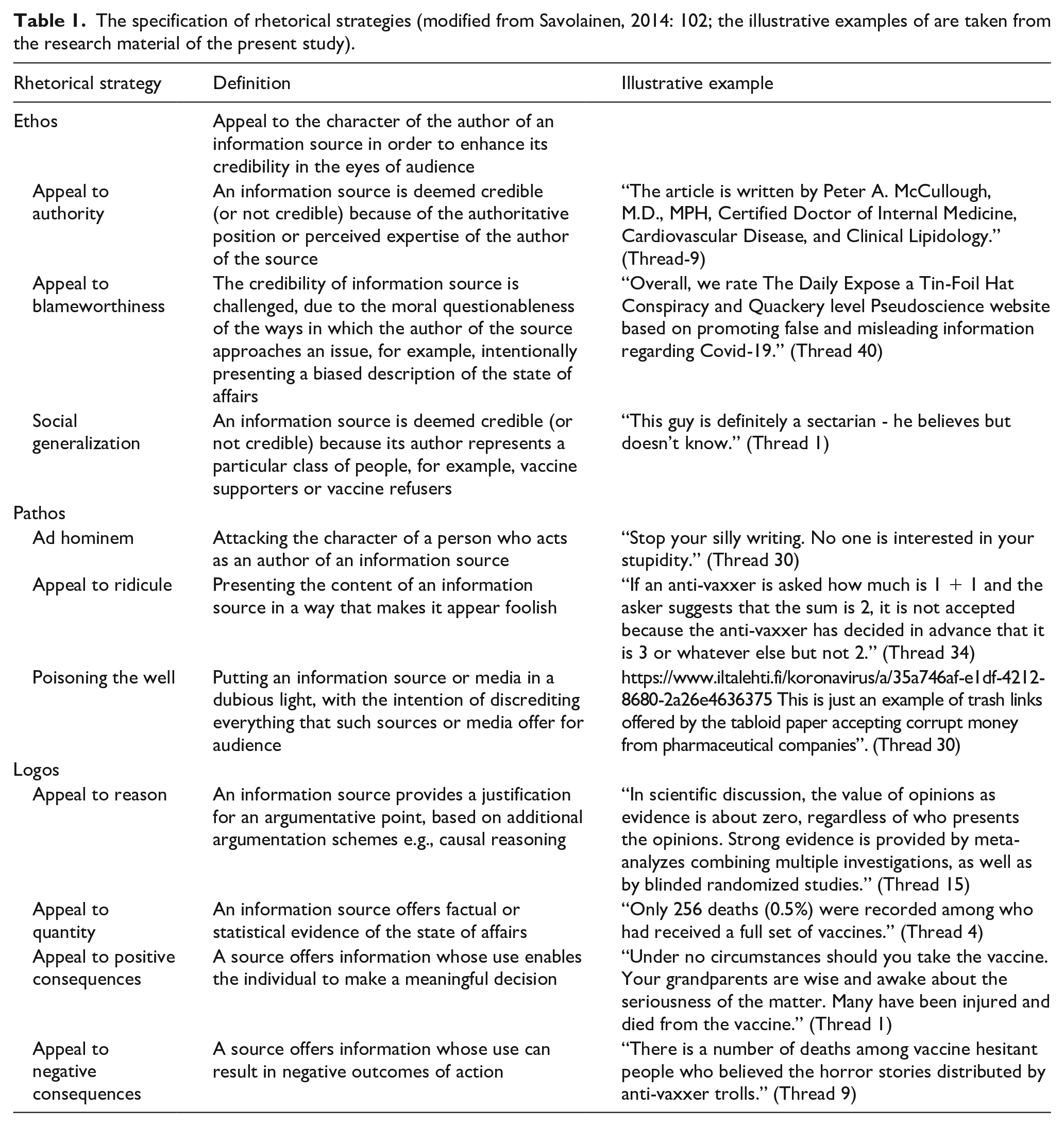
In Table 1, an individual strategy is assigned to ethos, pathos or logos, based on the main function it serves in the context of a rhetorical appeal dealing with the credibility of an information source. In this context, credibility is understood as a construct which is constituted by two key qualities: trustworthiness and expertise (Hilligoss and Rieh, 2008: 1469). Information is trustworthy when it appears to be reliable and unbiased. Expertise indicates that the author of an information source is capable of providing information that is both accurate and valid. On the other hand, the categories specified in Table 1 are not totally exclusive since an individual rhetorical strategy may incorporate elements that are relevant to another category, too. For example, social generalization may not solely serve the ends of ethos; it can also contain “pathetic” elements in that labeling the author of an information source as a representative of vaccine refusers may elicit negative emotions toward that author.
In addition, seven types of information sources whose credibility is judged in online discussion are specified. The source types were identified inductively from the empirical material of the present study as follows:
i. Scientific sources such as articles published in peer-reviewed medical journals provide evidence by reporting the findings of basic and applied research.
ii. National and international health agencies, for example, the Finnish Institute for Health and Welfare (THL) and the World Health Organization (WHO) advocate for health care by distributing information about public health risks and their prevention.
iii. Health professionals such as doctors and other medical specialists provide information about the nature of diseases and their prevention and treatment.
iv. News communicates selected information on current events which are reported through the mainstream printed media, broadcast, or the Internet to a mass audience.
v. Persuasive material advocates a particular (ideological) viewpoint in order to influence public opinion. Examples of sources of this type include the website organized by Tokentube (https://tokentube.net) and the Finnish Uusi MV-Lehti (https://mvlehti.net/).
vi. Personal sources such as friends and relatives, as well the participant him- or herself offer vaccine-related information based on personal experiences or opinions.
vii. Other sources include a variety of miscellaneous sources that are unrelated to the issues of vaccination but are used to support a personal opinion, for example, a piece of music presented in a YouTube video.
Drawing on the specification of rhetorical strategies and information sources, the research framework is presented in Figure 1.
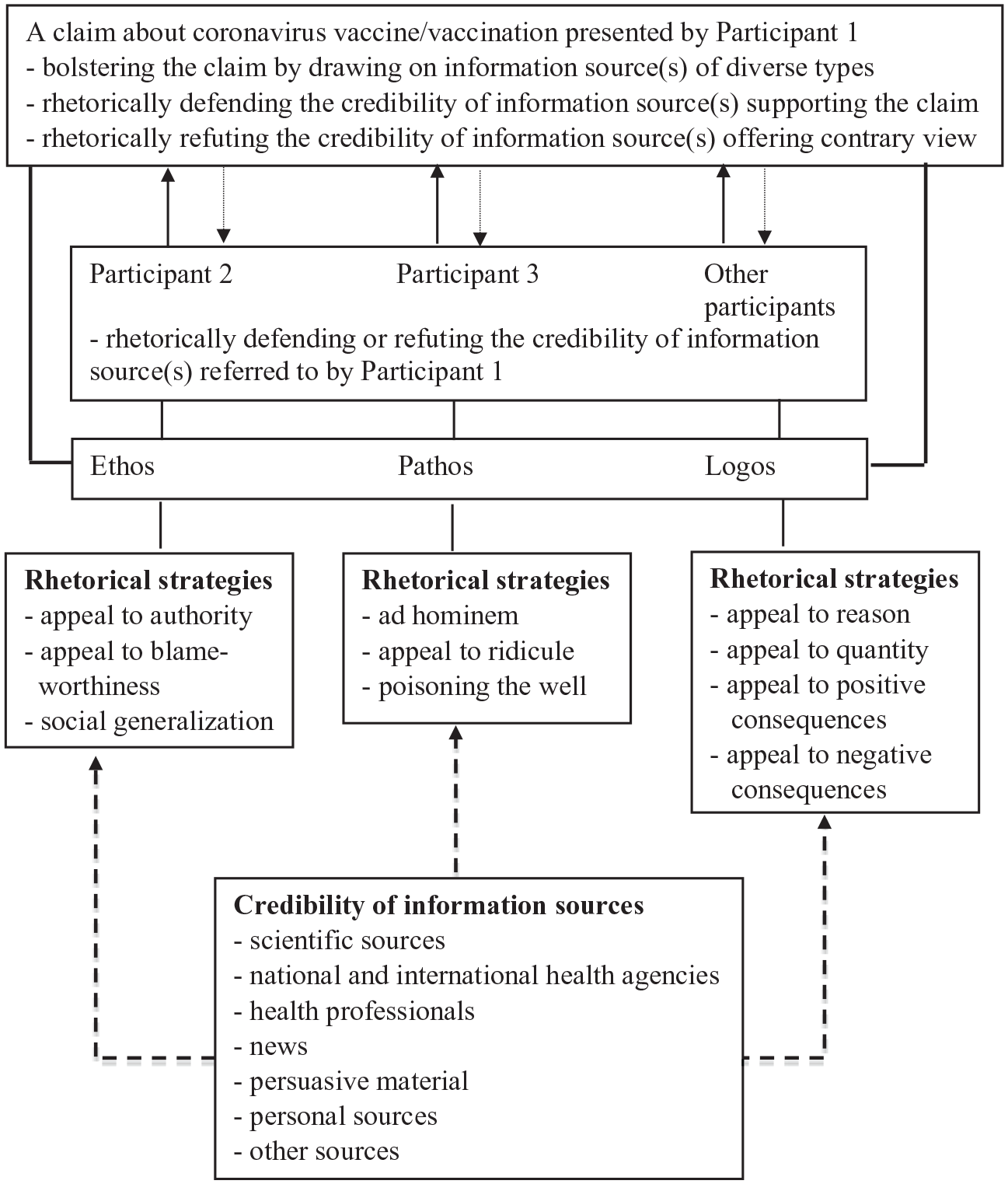
The research framework of the study.
Figure 1 presents a simplified scheme of the ways in which the participants of online discussion rhetorically defend or refute the credibility of information sources. One of the participants, either pro-vaxxer or anti-vaxxer first presents a claim concerning coronavirus vaccines or vaccination and then supports his or her claim by drawing on information sources of diverse kind, for example, a piece of news presented in a mainstream media, or a Tokentube video offering persuasive material about the risks of coronavirus vaccines. In this context, the participant can rhetorically defend the credibility of an information source by asserting, for example, that it is based on the findings of a recent medical article. He or she may also rhetorically refute the credibility of another information source by asserting that its author is a quack who knows nothing about coronavirus vaccines. Other participants then react to the credibility judgments presented Participant 1. To this end, they engage in dialog with Participant 1 and may rhetorically defend or refute his or her credibility judgments from the viewpoint of ethos, pathos and/or logos. For example, an ethos-related judgment may deal with the degree to which an information source advocated by Participant 1 appears authoritative in the eyes of Participant 2. Furthermore, Participant 2 can evaluate the information source from the viewpoint of pathos by drawing on strategies such as appeal to ridicule in order to demonstrate that the content of an information source cannot be taken seriously. Finally, rhetorical strategies serving the ends of logos may include appeal to quantity, for example, demonstrating that an information source praised by Participant 1 is based on anecdotal evidence only. The dialog may continue if Participant 3 or other contributors (including Participant 1) present additional comments of the credibility of information sources referred to in the debate.
Research questions
Drawing on the above framework, the present study addresses the following research questions.
RQ1: How frequently do pro-vaxxer and anti-vaxxer participants of online discussion make use of rhetorical strategies to judge the credibility of information sources dealing with coronavirus vaccines and/or vaccination?
RQ2. In which ways do the participants employ such strategies to rhetorically judge the credibility of information sources dealing with coronavirus vaccines and/or vaccination?
To strengthen the focus of the study, the analysis of the rhetorical strategies was concentrated on cases in which the participants of online discussion explicitly judge the credibility of information sources. A focused approach is necessary because in online debates about vaccines, rhetorical strategies are also used for other purposes, for example, just ridiculing anti-vaxxer people or inciting fear among vaccine hesitators, without offering any vaccine-related information, however. In cases such as these, the person denigrating others does not act as an information source whose credibility could be judged by other participants. It is evident that a broader analysis of rhetorical strategies used for purposes other than information sharing would require a separate study.
Empirical data
The empirical data were gathered from Suomi24 (Finland24). It is one of the largest non-English discussion forums in Europe, offering an open-access corpus on posts discussing a variety of topics. The survey conducted by Harju (2018) revealed that the users of Suomi24 consider it as a platform where ordinary people can express their views that often go unheard in the mainstream media. Suomi24 is divided into 21 main subforums under headings such as “Family,” “Entertainment and Culture” and “Health.” The latter includes many subgroups, for example, “Vaccinations.” The users can submit posts anonymously, but the discussion threads are moderated in order to prevent incivility.
To identify relevant discussion threads, the search functionality of Suomi24 was employed by using two Finnish search terms, that is, koronarokotus (corona vaccination) and koronarokote (coronavirus vaccine). Altogether 85 discussion threads focusing on the above topics were identified. The threads were read cursorily to obtain an indicative picture of the nature of discussions. After the preliminary reading, threads containing less than 10 posts were excluded because it became evident that they fail to offer sufficiently nuanced material for the rhetorical analysis. Finally, by this criterion, 40 newest discussion threads containing altogether 2927 posts were downloaded for the study. The posts were submitted during the period of 21 May–22 October 2021, at a time when the debate over coronavirus vaccination was lively around the world. Because the main emphasis is placed on qualitative analysis and the study does not aim at statistical generalizations, the above sample appeared to be sufficient for the purpose of the current investigation. In the sample, the shortest thread contained 13 and the longest 536 posts; on average, a thread contained 73 posts. Almost all posts were submitted by anonymous participants; only a handful of the contributors used nicknames. The preference for full anonymity is understandable because COVID-19 vaccination is a controversial and emotional topic.
The coding and analysis of empirical data
The coding of the research material was started by focusing on information sources referred to by the participants. Each source was assigned with a code using the list of information sources depicted above. An individual source was coded only once for a criterion category once it was identified for the first time in the post. In long posts in particular, it was not unusual that the same information source was mentioned several times. In these cases, once an information source was coded for a criterion category, other instances were simply ignored. Multiple codes were assigned to the same post if the participant referred to more than one information source, for example, a piece of news and a health professional. As the references to information sources were explicit, no ambiguities were faced in their coding.
The coding was continued by identifying rhetorical strategies used by the participants. In the preliminary coding, the list of rhetorical strategies specified in Table 1 were used. However, the coding was kept open for the possibility of identifying new categories from the material. As no such additional categories were identified, the coding was finalized using the scheme depicted in Table 1. More specifically, the coding focused on how the participants made use of rhetorical strategies while presenting judgments about the credibility of information sources. Again, multiple codes were assigned to the same post if the participant employed more than one strategy, for example, appeal to blameworthiness and ad hominem. However, typically, only one code per rhetorical strategy was used within a post.
The coding was an iterative process in which the data were scrutinized several times by the author. The 2927 posts were assigned with altogether 2306 codes; of them, 1774 referred to information sources and 532 to rhetorical strategies. The number of codes is lower than the total number of posts because many of them contained no references to information sources or rhetorical strategies. In the sample of 2927 posts, 1013 posts (34.6%) indicated that their authors had adopted a positive view on COVID-19 vaccination and that many of them had already taken one or two shots of the vaccine; the authors of such posts were named as pro-vaxxers. In contrast, 1244 posts (42.5%) revealed that their authors had taken an explicitly negative approach to vaccination and that they refuse to take the vaccine. Therefore, these authors were named as anti-vaxxers. Finally, 670 posts (22.9%) were neutral in that they did not explicitly support or reject COVID-19 vaccination. However, about a dozen of these posts indicated vaccine hesitancy because their authors were still considering the pros and cons of vaccination. Most importantly, however, the majority posts belonging to this category were off the topic, for example, joking about politicians. As the present study concentrates on the ways in which pro-vaxxers and anti-vaxxers evaluate the credibility of vaccine-related information sources, the posts classified as “neutral” were excluded from the study. Therefore, the analysis focuses on the subsample of 2257 posts submitted by pro-vaxxer and anti-vaxxer participants.
To strengthen the validity of the study, the initial coding was checked iteratively by the present author. Because the investigation does not aim at statistically representative generalizations of how rhetorical strategies are employed in online discussions, the requirement of the consensus on coding decisions based on inter-rater reliability can be compromised without endangering the reliability of the study. According to Miles and Huberman (1994: 65), check-coding the same data is useful for the lone researcher, provided that code-recode consistencies are at least 90%. Following this idea, check-coding was repeated several times, and the initial coding was carefully refined. Check-coding revealed a few boundary cases regarding the categories of Appeal to blameworthiness, Ad hominem, and Poisoning the well. These cases were resolved by scrutinizing the content of the post in the context of the debate. The refining of the coding was continued until there were no anomalies.
To answer the first research question, the data were scrutinized by means of descriptive statistics. To this end, the percentage distributions were calculated for the rhetorical strategies per ethos, pathos and logos used by pro-vaxxers and anti-vaxxers. To answer the second research question, qualitative content analysis was conducted. The constant comparative method was used to capture the variety of articulations of the rhetorical strategies and the ways in which they were used in online discussion (Lincoln and Guba, 1985: 339–344). More specifically, the participants’ judgments on the credibility of information sources were systematically compared per individual criteria indicative of the use of ethos-, pathos- and logos-related strategies. In this way, it was possible identify similarities and differences in the ways in which the participants, for example, drew on social generalization while assessing whether the authors generating persuasive video material should be taken seriously. As the qualitative data appeared to be saturated enough, it was possible to draw a sufficiently coherent and credible picture of the nature of rhetorical strategies used in the discussion about COVID-19 vaccination.
Since the contributors to Suomi24 discussions are expected to be aware of the fact that their posts will become publicly available, no attempts were made to contact the participants to obtain permission for the use of their posts in the present study. However, when using the illustrative extracts taken from the posts, the anonymity of the participants is protected. An individual post submitted by a participant, either anonymous or nicknamed is referred to by a neutral identifier. For example, P-72-T-30 refers to the 72nd post within discussion thread 30.
Findings
Quantitative overview
In the 40 discussion threads, pro-vaxxer participants made altogether 515 and anti-vaxxer participants 659 mentions to information sources of various types. The quantitative picture of the mentions is presented in Table 2 below.
Percentage distribution of source types referred to by pro-vaxxer and anti-vaxxer participants.
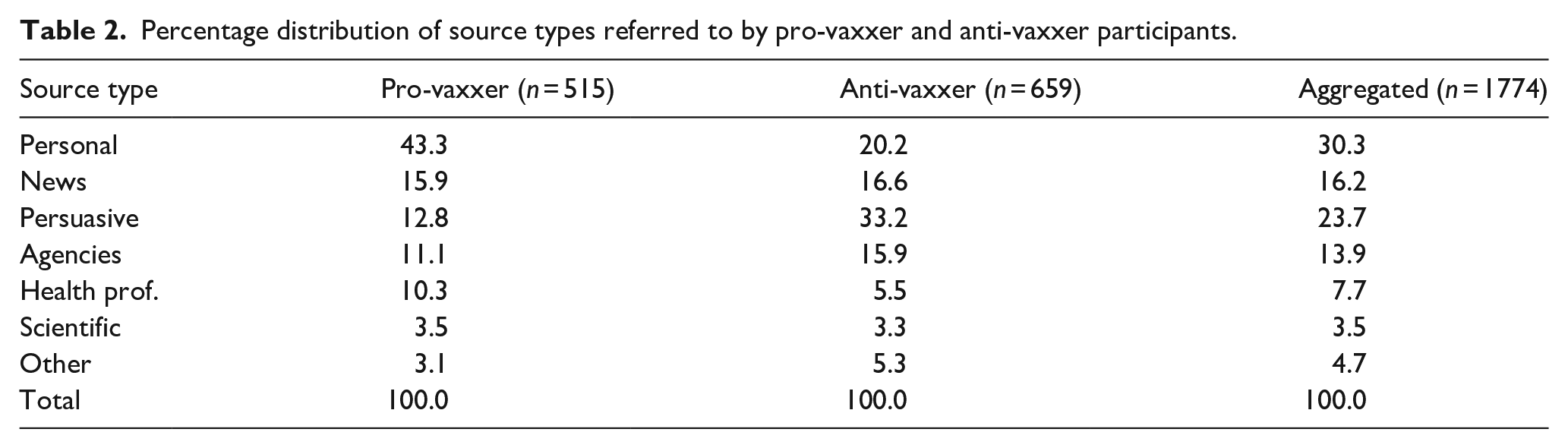
Table 2 indicates that taken together, the participants referred most frequently to personal sources and persuasive material, followed by news and national or international health agencies. Pro-vaxxers were particularly active to refer to personal sources, though mostly in a negative sense because they were keen to criticize such sources advocated by anti-vaxxers. Pro-vaxxers were also more active to refer to health professionals. To compare, anti-vaxxers favored more strongly persuasive material; in addition, they often drew on personal sources to support their claims. Looking at the information sources as a whole, the chi-square test indicated that there were statistically significant differences between pro-vaxxers and anti-vaxxers regarding the use of sources of information (((χ2 = 112.9943, p = 0.000). As Table 2 suggests, this is mainly due to the different preferences for two source types between the above groups. Personal sources were more strongly favored by pro-vaxxers, while persuasive sources were preferred more strongly by anti-vaxxers.
In a quantitative comparison, there appeared to be no remarkable differences between the ways in which pro-vaxxers and anti-vaxxers made use of rhetorical strategies while judging the credibility of information sources. The results of the chi-square tests indicated that regarding the use of ethos-related strategies, that is, Blameworthiness, Social generalization and Appeal to authority, pro-vaxxers were more active than anti-vaxxers to draw on these strategies (χ2 = 6.9899, p = 0.030351; the result is significant at p < 0.05). In contrast, there were no statistically significant differences between these groups regarding the use of pathos-related strategies (χ2 = 4.664, p = 0.097104) and logos-related strategies ((χ2 = 4.685, p = 0.196373). Table 3 offers a detailed picture of the use of such strategies.
Percentage distribution of the use of rhetorical strategies among pro-vaxxer and anti-vaxxer participants.
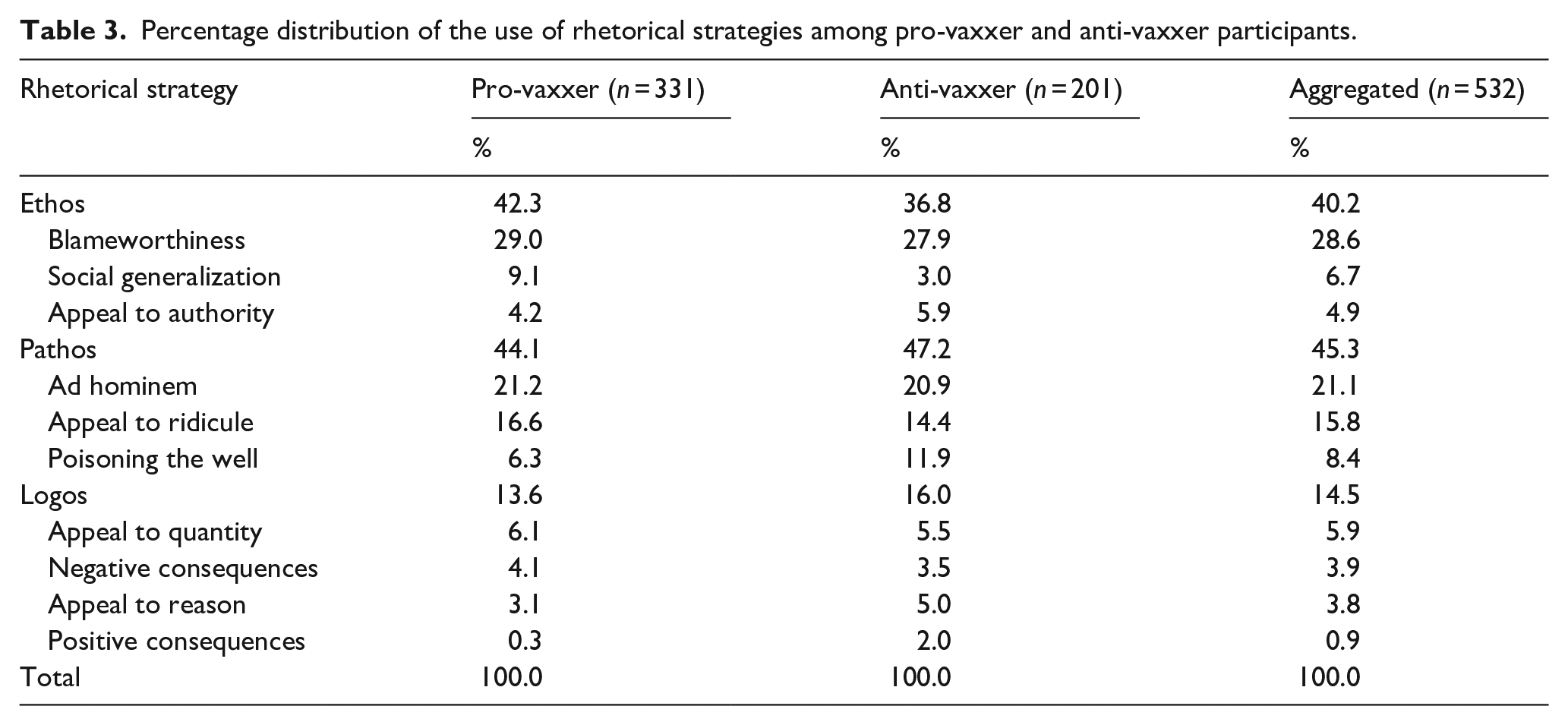
Table 3 demonstrates that taken together, pathos-related strategies were most popular, followed by strategies serving the ends of ethos and logos. Of individual strategies, both groups drew most frequently on appeal to blameworthiness and ad hominem. Looking at the main differences between the two groups, it is striking that pro-vaxxers were more active to draw on social generalization, while anti-vaxxers favored more strongly the strategy of poisoning the well. All in all, the popularity of pathos- and ethos-related strategies such ad hominem and appeal to blameworthiness suggests that the tone of discussion was characterized by emotional reactions and mutual accusations. The quantitative picture will be elaborated further by reporting the findings of the qualitative analysis. Ethos-related strategies will be discussed first, followed by strategies serving the ends of pathos and logos.
The use of rhetorical strategies
Ethos
Appeal to authority is a rhetorical strategy suggesting that an information source is credible because its author occupies an esteemed position in organizational hierarchy or possess expertise in a domain. On the other hand, the authoritativeness of a source can be questioned by claiming that its author lacks required expertise. In the following, attention will be directed to the most typical ways in which the participants appealed to authority. The illustrative extracts are taken from the context in which pro-vaxxers and anti-vaxxers engaged in dialog. Typically, an anti-vaxxer opened the debate by presenting a claim and then supported it by referring to an information source deemed authoritative. Thereafter, a pro-vaxxer made an attempt to put the author of the information source in a dubious light.
Anti-vaxxer: According to a detailed review published in May 2021 by U.S. researchers Stephanie Seneff and Greg Nigh, corona vaccines developed in a hurry can have many unforeseen and unintended consequences. (P-42-T-18) Pro-vaxxer: Stephanie Seneff is a PhD with no expertise in biology, chemistry, medicine, or any other related subject. She believes she is a master of every discipline but she doesn’t have relevant education and skills. Dr. Nigh is a naturopath who has studied herbal medicine and oriental medicine. He has BA degree in the English language and MA in the Humanities. Once again, when anti-vaxxers draw on “professionals” like these, I`m really bewildered :D (P-45-T-18)
Similar to many other dialogs between pro-vaxxers and anti-vaxxers, the debate often boiled down to the dispute about whether the authors of information sources advocated by anti-vaxxers could be deemed competent. Typically, as both parties clung to their own views, the dialog inevitably ended in a blind alley. Anti-vaxxers, in turn, made attempts to question the authority of medical experts who advocate the official pro-vaccination policy. Pro-vaxxers responded by defending the authority of sources of this kind. One of the nationally well-known experts whose authority was questioned is Professor Mika Salminen, virologist and the director of the Department for Health Security at the Finnish Institute for Health and Welfare (THL).
Anti-vaxxer: How does THL’s Mika Salminen know that the official information is correct? (P-21-T-23) Pro-vaxxer: Unlike you, he receives all peer-reviewed studies and official information from different countries. (P-22-T-23) Anti-vaxxer: But this does not prove that the information is correct. (P-23-T-23) Pro-vaxxer: The best information that humanity has so far. Grapevine knowledge can never outdo it. (P-24-T-23)
As the quantitative overview presented in Table 3 indicates, appeal to blameworthiness was the most popular rhetorical strategy among vaccine supporters as well as vaccine refusers. Appeal to blameworthiness means that an information source is judged as not credible, due to the moral questionableness of the ways in which its creator approaches an issue at hand, for example, presenting a biased description of the risks involved in vaccine uptake. Pro-vaxxers accused their opponents for the advocacy of information sources whose authors fabricate misleading information about vaccines and their side effects. In turn, anti-vaxxers questioned the credibility of authors advocated by pro-vaxxers by contending that they provide a one-sided picture of vaccines, due to bribery and commercial interests. Typically, the dialog was dominated by mutual accusations and counterattacks.
Anti-vaxxer: Have you taken into account THL’s connections to the bribes offered by vaccine companies? That’s how it goes: “you sing the songs of those whose bread you eat.” Don’t be naive. (P-13-T-29) Pro-vaxxer: You are naive because you believe the lies distributed by MV-Lehti [MV Magazine]. (P-14-T-29)
As discussed in more detail below, the strategy based on mutual accusations is closely related to “poisoning the well,” that is, attempts to show that an information source is doubtful because it offers biased information due to bribery (as claimed by anti-vaxxers) or because forums such as Uusi MV-Lehti (New MV Magazine) are often considered as sources of propagandistic information and fake news. Another major context in which appeal to blameworthiness was employed was the critique of the mainstream media. Anti-vaxxers were eager to blame the major newspapers and broadcasting corporations for the distribution of one-sided information. Therefore, as “propaganda agents,” these media were accused for “brainwashing.”
Anti-vaxxer: You repeat the same messages, similar to the opening post. You always ply links, similar to those offered by propaganda agents. Are you paid well for your hopeless attempts to brainwash people? (P-4-T-13)
It was also typical to the debates that pro-vaxxers appealed to blameworthiness by accusing their opponents for advocating information sources which draw on unsubstantiated claims presented in conspiracy theories.
Anti-vaxxer: The cure rate before vaccination was over 99.98%. Only among the oldest people 80+ years it was 94.5%. If there have been changes in those percentages, they are only due to two variables: the vaccine and the variants caused by the vaccine. (P-9-T-15) Pro-vaxxer: That 99.98% nonsense comes from the same Yankee woman who insisted that every vaccinated person dies within 42-365 days after the vaccine uptake. She sells her books for $200 to stupid anti-vaxxers and spreads crazy claims of other kind to increase the sale of her books. (P-10-T-15)
Finally, as a particular ethos-related strategy, pro-vaxxers and anti-vaxxers made use of social generalization. This strategy suggests that an information source can be judged as credible or not credible because its author represents a particular class of people, for example, vaccine supporters or vaccine refusers. Again, a strong polarization between the above groups was identified particularly in cases where the participants assessed the credibility of personal information sources.
Pro-vaxxer: It’s sad to note that there are at least mildly mentally damaged propeller hats, full of the web. (P-55-T-4) Anti-vaxxer: Those who have taken the injection are very aggressive, claiming that those refusing a voluntary shot are members of a secret community. In fact, they are talking about themselves and their own cult, the new corona religion! (P-6-T-1)
While appealing to social generalization, anti-vaxxers used labels such as “vaccine lobbyist,” and “medicine troll” in order to categorize the authors of personal information sources advocated by pro-vaxxers. In turn, pro-vaxxers made attempts to undermine the credibility of personal information sources favored by anti-vaxxers by labeling them as representatives of “vaccination cowards” and “dimwits.” It is evident that accusatory categorizations such as these strengthen the mistrust in personal information sources attacked the participants. Pro-vaxxers also categorized personal sources advocated by anti-vaxxers as self-made experts who erroneously believe that they possess relevant knowledge about the nature of coronavirus vaccines and the ways they affect the human body.
Pro-vaxxer: The discussion threads are full of do-it-yourself virology metal/plumber experts. The less knowledge they have, the more they insist that “one can find science in one’s own head.” (P-79-T-23)
All in all, the ways in which the participants used ethos-related strategies demonstrated that online debates about COVID-19 vaccination and vaccines tend to result in polarized settings where the credibility of the authors of information sources is undermined by using accusatory and defamatory expressions. As discussed in more detail below, such expressions often appeared together with ad hominem arguments and appeal to ridicule.
Pathos
As the quantitative overview indicated, the use pathos-related strategies were highly popular when pro-vaxxers and anti-vaxxers judged the credibility of information sources. Of individual strategies, ad hominem was used to attack the character of a person who acts as an author of an information source. Ad hominem attacks were particularly common in cases in which a participant acted as a personal information source by advocating his or her views, based on assumptions derived from conspiracy theories.
Pro-vaxxer: It’s an honour to talk with a genius like you asserting that the entire research community and health authorities are distorting research in its entirety. The conspiracy Oscar winner has now been elected (P-49-T-40)
As noted above, appeal to blameworthiness was often associated with ad hominem argument. The participants used accusatory labels such as “troll” in order to put the personal information sources in a dubious light.
Anti-vaxxer: As a drug troll, the only prescription you can offer is this: just believe the authorities and you’ll be saved. (P-13-T-36) Pro-vaxxer: You crackpot, the only thing you can offer is to believe dimwits and you’ll be saved. (P-14-T-36)
Appeal to ridicule is a closely related strategy because it is based on the attempts to disparage the content of the source in a way that makes it appear foolish. Typically, ridiculing comments were directed to online sources advocated by anti-vaxxers.
Anti-vaxxer: The vaccine does not protect against the disease. This video is worth watching if you are considering whether your child should take a shot.
https://tokentube.net/v/2494567932/Kannattaako-12-15-vuotiaan-ottaa-koronarokote-
(P-3-T-18) Pro-vaxxer: A video put on Tokentube cannot be taken seriously. I watched those videos with a smile on my face. The only value of these videos is to entertain people who are aware of their stupidity. (P-13-T-18)
Similarly, poisoning the well aims at the disqualification of the information sources on which the opponents draw in their argumentation. To achieve this, the participant discredits everything that such sources or media offer for audience. The research material included numerous examples of cases in which anti-vaxxers made attempts to undermine the credibility of major Finnish newspapers, most notably Helsingin Sanomat and the Finnish Broadcasting Corporation (Yle). It was claimed that these media offer biased information and fake news propagating COVID-19 vaccination. The strategy of poisoning the well was also applied to disparage Finnish tabloid papers Iltalehti and Ilta-Sanomat (the names of both mean “Evening Post”).
Pro-vaxxer: The intensive care physician says, “We can’t stand it anymore.” According to her, the medical staff is totally exhausted.
https://www.iltalehti.fi/koronavirus/a/35a746af-e1df-4212-8680-2a26e4636375
(P-71-T-30) Anti-vaxxer: Buahhaahaa! You believe in that kind of claptrap, articles published in Iltalehti. It just stirs up fear among people to acquire more ads and make money. (P-72-T-30)
In turn, pro-vaxxers concentrated on the denigration of persuasive material asserting, for example, that COVID-19 vaccines are life-threatening. Among the online forums advocated by anti-vaxxers, The Expose attracted particularly harsh criticism from the quarter of pro-vaxxers.
Anti-vaxxer: The latest figures from the UK PHE vaccine follow-up report on COVID cases show that people aged 40-70 who have been vaccinated twice have lost 40% of their immune function compared to unvaccinated people. Source: The Expose. (P-22-T-40 Pro-vaxxer: Your source The Expose is one of the worst fake news websites. Don’t believe lies it distributes . . . have a look at this: https://mediabiasfactcheck.com/the-daily-expose/ I quote here a little bit of the text: “Overall, we rate The Daily Expose a tin-foil hat conspiracy and quackery level pseudoscience website based on promoting false and misleading information regarding Covid-19.” (P-47-T-40)
In the above example, the “well” of the source was poisoned by drawing on the devastating assessment published by Media Bias/Fact Check, an American fact-checking website. Moreover, attempts were made to ruin the reputation of The Expose by warning that it offers “virus links” (P-37-T-40). More generally, as the above examples suggest, poisoning the well is perhaps the most “toxic” weapon used in the “information war” between vaccine supporters and vaccine refusers. While an ad hominem attack just puts an individual author in a comic light, poisoning the well can lead to more far-reaching consequences by destroying the reputation of information sources of certain type.
Logos
Compared to ethos- and pathos-related strategies, the participants seldom drew on appeals serving the ends of logos. This bias is indicative of the accusatory and emotionally charged tone of the debates. Of individual logos-related strategies, appeal to reason was used to provide justification for the credibility of an information source by proposing that it is based on sound argumentation, or that alternatively, it is lacking from a source. Pro-vaxxers tried to refute the credibility of information sources advocated by their opponents by contending that these sources offer information that is based on faulty logic. Appeal to reason was also utilized in cases in which attempts were made to demonstrate that information sources supporting or refuting a claim are not reviewed adequately. Instead, they are used by selecting details that serve the ends of a partisan view.
Anti-vaxxer: It is not a question about faith but facts. Corona vaccinations exemplify a complete fiasco and gullible guinea pigs are now suffering the consequences.
https://www.iltalehti.fi/ulkomaat/a/fbf247d2-5cb1-467b-a6c7-9f29b41ca0df
https://www.iltalehti.fi/ulkomaat/a/a48ed2fa-a59c-42c5-8e41-73933a1a7561
(P-18-T-15) Pro-vaxxer: This is an anti-vaccine logic: just quote a piece of news claiming that non-vaccinated do not receive herd protection, but the vaccine protects against a serious disease. Then quote another piece of news that says nothing about that the vaccine’s effectiveness against the disease is reduced, only that the vaccine doesn’t protect against the newest variant of the virus. Conclusion: “Corona vaccinations exemplify a complete fiasco.” (P-19-T-15)
Appeal to quantity is a closely related rhetorical strategy which is used to convince people of that an information source is credible because it is based on numerical or statistical evidence. Again, both parties made use of this strategy to demonstrate that an information source used to support a claim is trustworthy or that a source advocated by the opponent lacks quantitative evidence.
Pro-vaxxer: No one has asserted that vaccines offer 100% protection, but 95% or something like that. Out of the millions vaccinated, a total of 22 people became ill, so the protection is very close to one hundred percent. (P-7-T-39) Anti-vaxxer: Wow, you have really accurate “information”! You think that out of millions vaccinated, 22 died of the vaccine and that all of them are elderly or sick? Where are such data available? (P-8-T-39)
In most debates, the question about whose data about the coronavirus vaccines are correct remained unanswered. There were only competing interpretations of the statistical data presented in diverse sources. On the other hand, this is understandable because the pandemic is a developing rapidly and the vaccination rates differ between countries and among patient populations. All in all, the unavailability of comparable statistics gave room for skeptical voices doubting the effectiveness of coronavirus vaccines.
Given the paucity of strong evidence for or against coronavirus vaccines, it is not surprising that the credibility judgments seldom appealed to positive consequences resulting from the use of information sources. Appeal to positive consequences seeks to support the view that the credibility of an information source depends on the extent to which it enables the individual to make a decision with positive outcomes. From this perspective, pro-vaxxer participants praised research-based information offered by national and international health agencies. In contrast, anti-vaxxers recommended that vaccine hesitators should rely on their own judgments and experiential information obtained from other people. One of the discussion threads were initiated by a vaccine hesitant participant who was uncertain about the credibility of a personal information source while considering her vaccination decision.
There will be corona vaccination in my school (I’m at the 9th grade). My grandparents told me not to take any “stuff” because they are trying to reduce the population. (P-1-T-1) Anti-vaxxer: Hey. Under any circumstances you should not take the vaccine. Your grandparents are wise and aware of the seriousness of the matter. Many people have been injured and died from the vaccine. (P-23-T-1)
In highly polarized debates, views of positive consequences resulting from the use of an information source tend become diametrically opposite. What is meaningful for a vaccine refuser is irrational for a vaccine supporter. There is no intermediate stance because an individual either takes the vaccine or refuses it (or postpones his or her decision until he or she has obtained additional information).
Finally, the opposed views were reflected in the ways in which the participants judged the credibility of information sources depending on whether their use would result in negative consequences, for example, the ignorance of risks involved in vaccine uptake. As noted above, pro-vaxxers were keen to warn others about the biases of persuasive material advocated by anti-vaxxers. In contrast, the latter strongly criticized mainstream media for the censorship of information that challenges the pro-vaccination campaigns. Pro-vaxxers were particularly concerned about the use of misleading information sources in cases in which people refuse vaccination, due to the fear of getting sick of the vaccines.
Anti-vaxxer: It’s an experimental “drug” mixture of mRNA and really has a deadly content. Now look, even exposure to SM-102, which is a neurotoxin and a banned substance, leads to a hospital visit. The vaccine companies are not responsible for this - they do not compensate. The only thing is that there have been thousands of times more victims but the issue is being belittled in the media. (P-13-T-20) Pro-vaxxer: You write a lot of drivel. Do you understand your responsibility in this matter? I think most people are aware of nonsense of that kind: completely inappropriate deception, but not everybody notes it. Someone may miss the corona vaccination and become seriously ill or die. Could you stop your stupid writing. (P-14-T-20)
Similar to the use of ethos- and pathos-related strategies, logos-related appeals led to opposing conclusions about the credibility of information sources. Rhetorical appeals were used in a black and white manner to demonstrate that the opposing party is wrong, with no intention to attain a mutual understanding of the consequences of using vaccine-related information.
Discussion
The present study elaborated the picture of the ways in which people rhetorically defend or refute the credibility of information sources in online discussion. The first research question dealt with the frequency by which pro-vaxxer and anti-vaxxer participants make use of rhetorical strategies. The findings indicate that both parties most frequently drew on pathos- and ethos-related appeals, while the role of logos-related strategies remained quite marginal. Of individual strategies, appeal to blameworthiness, ad hominem arguments and appeal to ridicule were particularly popular in both groups. This suggests more generally that while debating controversial topics, the credibility judgments of information sources tend to be dominated by accusations and disparaging expressions.
The second research question focused on the ways in which the participants employ rhetorical strategies to defend or refute the credibility of information sources. The qualitative analysis revealed that the use of ethos-related strategies offers a powerful tool to denigrate the credibility of information sources by labeling them as morally dubious, due to the advocacy of pro- or anti-vaccination ideas. Reflecting the tone of discussion, ethos-related strategies were seldom used in a positive sense to strengthen the trustworthiness and expertise of the authors of information sources because the main attention was directed to the refutation of the credibility claims presented by the opponents. Even more clearly, strategies serving the ends of pathos were used in a militant manner by attacking the authors of information sources, with the intent to sow distrust in persuasive material and mainstream media in particular. Logos-related strategies were employed to demonstrate that information sources advocated by the opposing group should not be taken seriously because they draw on faulty logic and insufficient statistical evidence. Finally, appeals to positive or negative consequences resulting from the use of information sources of certain types were mainly employed to warn people about the risks involved in vaccine uptake or vaccine refusal. Depending on the pro- or anti-vaccination view advocated by the participant, such risks are presented in the opposite light, with no intermediate position.
The novelty value of the findings can be reflected by making a few comparative notions. Savolainen (2014) used a similar research approach while examining how persuasive communication appears in Q&A discussion about global warming. Different from the results of the present study, the Q&A participants drew most frequently on logos-related strategies while the strategies serving the ends of ethos and pathos were used less frequently. The difference may be partly due to a stricter moderation policy applied in Yahoo! Answers Q&A site. In Suomi24 discussion groups, the moderation tends to be quite liberal in that up to a certain limit, even derogatory expressions characteristic of ad hominem arguments and appeal to blameworthiness are allowed. On the other hand, Q&A discussions on global warming were more clearly intended to serve the ends of information seeking rather than the exchange of personal opinions. Therefore, in Q&A discussions, more emphasis was laid on logos-related strategies such as appeal to reason and appeal to quantitative evidence.
The findings of the present investigation can also be compared to the results of Savolainen’s (2021) study on how pro-vaxxers assess the believability of mis/disinformation in Reddit online discussion about COVID-19 vaccination. As expected, the credibility of anti-vaxxers as creators or disseminators of vaccine-related information was very low in the eyes of pro-vaxxer contributors. Anti-vaxxers were characterized as people with poor reputation because they lack adequate knowledge of the nature and effects of coronavirus vaccines. Anti-vaxxers were also found dishonest because they deliberately draw on false or biased evidence in order to exaggerate the risks of coronavirus vaccines. Finally, from the pro-vaxxers’ point of view, the recommendations presented by the anti-vaxxers tend to have low use value for those considering vaccination decision; in the worst cases, vaccine refusal advocated by the anti-vaxxers can endanger the health of people with chronic condition. The critical judgments presented by the Redditors come very close to those voiced by Finnish pro-vaxxers. However, different from Savolainen’s (2021) study, the present investigation offers a broader view on online discourse because in Finnish debates, pro-vaxxers and anti-vaxxers engaged in dialogs about the credibility of information sources, while the Reddit discussions were confined to the views presented by pro-vaxxers only. On the other hand, as the present study demonstrates, opportunity for dialog between the parties did not generate additional value for the vaccination discourse. The potential for constructive dialogs was missed because the debates strengthened rather than weakened the barriers between the opposing parties.
The findings of the present study support the results depicting the nature of online debates about HPV vaccine in Romanian discussion groups (Penţa and Băban, 2014). Both Romanian and Finnish pro-vaxxers approached the vaccination as just “the normal thing to do” and criticized information sources advocated by the anti-vaxxers. Similar to the present investigation, Penţa and Băban (2014) found that pro-vaxxers sought support to their views by drawing on information distributed by health agencies, while anti-vaxxers favored personal sources, for example, parents who rejected the vaccine. Anti-vaccine activists also made references to pseudo-scientific authors and advocated anti-vaccination blogs and videos. Similar to the present study, Gallagher and Lawrence (2021) found that pro-vaccine comments posted to New York Times online discussion platform contained ad hominem arguments levied at those who refuse vaccines or used appeals to science to correct beliefs in vaccine skepticism.
Importantly, as Ihlen et al. (2021) have noted, positions indicative of strong vaccine acceptance contra vaccine refusal may fall outside the rhetorical audience because the opposing parties are unwilling to change their mind. Therefore, the rhetorical debate about pros and cons of vaccination may appeal best to vaccine hesitators. Cagle and Herndl (2019: 28–29) have identified two main rhetorical styles, that is, good and bad magic which may be used to persuade people uncertain of their view on an issue. The bad magic style reduces arguments and dismisses opponents as ignorant, ill-willed or recalcitrant, closing off invention and discovery. Characteristic of the bad magic style is not listening to the other, but merely presenting tropes of accusation, denial, and defensiveness. It is evident that the vaccine-related debates occurring in Suomi24 and Reddit discussion forums tend to be characterized by the bad magic style and that it would be difficult for the participants to adopt an alternative style, that is, good magic. It tends to encourage constructive reasoning to explore possibilities rather than argue toward predetermined truths. This approach keeps the debate open to change and embraces uncertainty and complexity. This rhetorically good style responds both to what the other is saying and their affective witnessing to their experience.
As the findings of the present study demonstrate, online debates on the credibility of information sources were far from the ideal of good magic. In the final end, the debates strengthened the partisan beliefs rather than offered a fertile ground for respectful comments and constructive reflection. This gives rise to a practical question of whether it would be possible to make our dialogs better or more constructive on social media. Given the polarized nature of debates on controversial topics such as climate change, immigration and vaccination, there is no easy solution to this “eternal” issue. Realistically, the only effective way to a encourage constructive dialog is the adoption of a sensible moderation policy which systematically removes denigrating or inflammatory content.
Finally, the results of the present study have practical implications for health literacy and health campaigns related to COVID-19 vaccination. Overall, health literacy empowers citizens during the coronavirus crisis to protect their own health and the health of the population, especially vulnerable and high-risk groups. This is important because even an effective vaccine against COVID-19 runs the risk of falling victim of dis/misinformation, resulting in the increase of vaccine hesitancy and refusal. As to concrete ways to advance health information literacy in this domain, the measures suggested by Okan et al. (2022) are particularly relevant from the perspective of the present study. Most importantly, there is a need to provide information guidelines on how to identify disinformation in the form of fake news, for example, including awareness to always check the source of information on various social and media channels. It is vital that such information guidelines help people to identify disinformation and judge about information and source quality. In this regard, there is a number of questions dealing with the credibility of information sources. Most importantly, the information user has to ask: who is the author information and what is the origin of the information source (e.g. medical research article or an opinion presented in a blog)? Moreover, it is important to find out whether the information is up-to-date and why is the information shared (e.g. to provide facts about COVID-19 vaccines or to advocate vaccine hesitancy)?
Conclusion
The most important contribution of the present study to research on information sharing and use is the elaboration of the picture of the ways in which the credibility of information sources is rhetorically defended and refuted in dialogs about controversial issues. The findings highlight that while debating on conflicting topics, the rhetorical strategies tend be used to attack opponents’ views on the credibility of information sources, rather than making attempts to create mutual understanding of the value of sources of information. On the other hand, the generalizability of the above conclusion is limited because the present study focuses on a sample of posts submitted to a Finnish discussion forum. Moreover, the investigation draws on the ideas of a particular approach, that is, Aristotelian rhetoric. Other approaches to rhetorical analysis, for example, digital rhetoric (Eyman, 2015) may place different emphasis on the critical role of the audience interpreting the user-generated data available in social media. This is a significant issue from the perspective of vaccine hesitators, for example, because so far, we have no empirical evidence about the extent to which rhetorical arguments presented in online debates affect people’s vaccination decisions. This question is particularly important in the “post-truth” era which is increasingly characterized by a variety of information sources appearing in a “swirling cacophony of competing viewpoints, perspectives, agendas, and facts” (Gibson and Jacobson, 2018: 183).
Given this perspective, more research is required to capture a broader picture of the ways in which people accept or refute information sources potentially containing mis/disinformation, as opposite to correct and objective information. As evidenced by the debate on COVID-19 vaccination in online forums such as Reddit and Suomi24, accurate (medical) information, pieces of news, persuasive material, and personal sources drawing on an individual’s vaccination experiences appear side by side, with no indicators of their reliability. Further studies on today’s information environments would shed additional light upon the ways in which people may be rhetorically persuaded to believe that they should prefer or ignore information sources of certain types.
Footnotes
Declaration of conflicting interests
The author declared no potential conflicts of interest with respect to the research, authorship, and/or publication of this article.
Funding
The author received no financial support for the research, authorship, and/or publication of this article.
