




Abstract
This study examines how the credibility of information sources with alleged propagandistic elements is assessed in online discussion. More specifically, the investigation is focused on the credibility of information sources dealing with a politically sensitive issue, that is, the ongoing Russo-Ukrainian war. To this end, a sample of 1024 messages posted to Quora discussion groups was scrutinised by means of qualitative content analysis. The findings indicate that overall, the credibility judgements were highly critical. While assessing the credibility of authors generating information sources suspected of propagandistic elements, the most important criteria are the author’s fairness in the interpretation in an issue, his or her honesty in argumentation and the authors’ expertise. In the judgement of the credibility of the source’s information, trustworthiness and impartiality are particularly important. The findings highlight the prevalence of distrust in propagandistic information sources and more generally reflect media scepticism characteristic of the post-truth era.
1. Introduction
The identification of sources offering trustworthy information about contested issues is becoming increasingly difficult in the post-truth era, reflecting the disappearance of shared objective standards for truth [1]. A recent example of issues of this kind is the ongoing Russo-Ukrainian war. Soon after Russia’s attack in February 2022, media outlets around the world started reporting about the conflict from strikingly different points of view. The Western press condemned the invasion, whereas Russia justified its ‘special military operation’ as a mission to remove alleged Nazis from Ukraine [2, p. 65]. For its part, Russia engaged in promoting propaganda about the war, with the goal of manipulating public opinion to undermine support for Ukraine. Therefore, the spreading of propaganda serves the ends of information warfare, suggesting that information is used as a weapon, while the minds of citizens are the ‘battlefield’ [3, p. 976].
Due to the constant flow of news, there is a plenty of information about the Ukraine war, including reports from the battlefield and civilian targets subject to military operations. However, ordinary people may face difficulties in trying to find objective information about the war, free of persuasive and propagandistic content. As armed conflicts between countries are always politically sensitive phenomena, information sources reporting about war-related issues tend to be more or less biased, supporting the views of Ukraine or Russia. The problem is aggravated in that information about the Ukraine war often incorporates propagandistic elements that may be difficult to identify. Reflecting the media scepticism characteristic of the post-truth era, difficult questions arise. Ultimately, could a person trust in any information source reporting about the Ukraine war, or are there criteria by which a source could be considered as credible, at least partly? In this regard, it is important to consider the credibility of the creator or author of an information source, for example, a military expert. Second, the credibility assessment may focus on the source’s information content, for example, a military expert’s assessment of Russia’s military losses. The issues of credibility of this kind are highly important because they deal with the question of the extent to which any elements of war-related information could be considered as objective. The empirical findings of the present study elaborate the picture of information warfare by emphasising that with the growing availability of alternative information sources on the Internet, people have better opportunities to identify the persuasive elements of war propaganda – a major component of information warfare. Therefore, people consuming media across multiple devices and multiple channels tend to be increasingly critical of war-related information, suspected of offering biased views.
In communication and information research so far, there is a paucity of studies examining how people approach information sources that may contain propagandistic elements serving the ends of information warfare [4–6]. The present investigation fills the gap in the above domain and contributes to research on the credibility assessment of information sources. This is achieved by examining how the participants contributing to online discussion on Quora – a major social media platform – assess the credibility of propagandistic information sources dealing with the Ukraine war. To this end, an empirical study was made by scrutinising a sample of posts submitted to Quora within the period of 24 February 2022 to 31 December 2023. More specifically, answers were sought to the following research questions:
RQ1. In which ways do the Quora participants assess the credibility of the authors of information sources which are suspected of containing propagandistic elements?
RQ2. How do the participants assess the credibility of the information content of sources of this kind?
The rest of the article is organised as follows. In section 2, the main features of propaganda and war propaganda are characterised, followed by the review of how prior studies have examined the credibility assessment of propagandist information. In sections 3 and 4, the research framework and research methodology are specified. The empirical findings are reported in section 5. Sections 6 and 7 discuss the research findings and draw conclusions on their significance.
2. Literature review
2.1. The use of propaganda in information warfare
The term information war(fare) is generally used to encompass the full gamut of techniques whereby information is employed to gain a competitive advantage in a conflict or dispute [7, p. 91]. Propaganda is one of the tools of information warfare. Propaganda can be generally defined as:
a systematic form of purposeful persuasion that attempts to influence the emotions, attitudes, opinions, and actions of specified target audiences for ideological, political or commercial purposes through the controlled transmission of one-sided messages (which may or may not be factual) via mass and direct media channels. [8, pp. 232–233]
Propaganda may range from outright lies and distortions, for example, fabricated media stories and deepfake videos, to censorship and information filtering by the media, with the goal of advancing a preferred narrative while discounting or debunking adversarial narratives [9, p. 257]. To reach mass audiences, the transmission of propaganda messages can come from symbolic elites (e.g. presidents) and journalists. Typically, in Western media, propaganda does not announce itself as such [5, p. 1027]. Herman and Chomsky [10] have argued that propaganda achieves the purposes of propagandists through the ways in which issues are framed; emphasis and omission; privileging of certain sources, perspectives, information over possible alternatives and in the uses of language that assist these effects. Therefore, in propaganda claims about Russia and Ukraine, the Western voices, values and preferences are privileged by Western legacy media in particular.
In addition, the public at large can circulate propaganda through their contact networks and social media forums, for example, [11, p. 37]. As a specific type of propaganda, war propaganda targets the population of a country at war, serving the interests of its leaders [12]. Historically, war propaganda has been used to exaggerate one’s successes and minimise one’s losses in order to raise domestic morale. Foreign audiences are also propaganda targets, as the warring parties use it to raise support and to influence international public opinion [13]. Prior research suggests that war propaganda can be highly believable because citizens usually do not have firsthand information about an armed conflict [14].
To justify the invasion to Ukraine, Russia has launched propaganda campaigns claiming, for example, that the neo-Nazi movement occupies a central role in the Ukrainian army [15]. Ukraine’s interest in joining the North Atlantic Treaty Organization (NATO) is another key theme that is used within propaganda campaigns aimed at keeping the Russian public afraid of an impending invasion by NATO [16, p. 866]. In Russia, much of the war propaganda is disseminated through state-funded media outlets such as RT (formerly Russia Today), Sputnik– a Kremlin-backed news agency, newspapers like Komsomolskaya Pravda and social media platforms, for example, Telegram and VKontakte [17]. Ukraine, too, has launched its own propaganda campaigns. As a part of this effort to transfer the conflict to the information arena, President Volodymyr Zelenskyy has emerged as an essential actor through the recording of daily videos striving to unify the country and gain the support of the international community. Moreover, social media forums have been used actively to distribute war propaganda. For example, a video of the 13 heroic defenders of Snake Island was shared online in late February 2022. The story became more powerful once President Zelenskyy declared that the soldiers had died fighting to the last man [18].
As in any military conflict, the seeking of reliable and impartial information about the Ukraine war is difficult for journalists and ordinary citizens. The sourcing becomes a major problem for journalists because access to military information is often restricted or because reporting on the ground is prohibited or too dangerous. On the contrary, social media platforms do not necessarily offer more trustworthy sources [19]. The basic difficulty deals with the identification of sources that are potentially both independent of political and military sources, thus capable of offering credible information, free of propagandistic content. Udris et al. [19] believe that two types of sources that best fulfil both criteria are the well-established Western news media. Nevertheless, the availability of objective information is not without problems because the legacy media may become unwitting promoters of pro-Western views and even pro-Ukrainian propaganda [5]. The partiality of Western media may be strengthened by the fact that as a part of the sanctions against Russia, the European Union, the United States, Canada and many other countries such as Australia have banned the broadcasting of the main television channels such as RT and Sputnik, due to their propagandistic nature [20]. To counter pro-Ukrainian propaganda, Russia, for its part, has blocked major Western media outlets and social media platforms, for example, Facebook, Twitter and Instagram.
2.2. The credibility assessment of propagandistic information
Research explaining credibility has a long history spanning several disciplines [21–24]. As credibility is a multifaceted concept, there is no consensus among researchers about the definition of this construct. Researchers have approached it in diverse terms such as believability, trust, reliability, accuracy and objectivity [21]. In the present investigation, following Choi et al. [25], credibility is generally understood as the subjective perception that certain information corresponds to reality and that a certain information source can reasonably be believed. Credibility can be attached to persons, groups and organisations, as well as information sources of diverse types [22]. When it comes to specific information sources, the credibility judgements are often affected by the nature of an issue at hand [6, p. 120]. An information source is more probably to be considered as credible when it matches what the recipient already thinks. This is particularly true of information about politics [25,26].
Szostek [6] examined the credibility of news and conflicting narratives in Ukraine. The findings indicated that the West-leaning participants hardly ever reported using sources associated with the Russian state, whereas the Russia-leaning participants tended to believe that both Russian and Ukrainian sources were propagandistic. Therefore, many participants believed that the truth could be found ‘in the middle’ of the contradictory messages [6, p. 125]. More recently, Kreft et al., [27] found that Ukrainian people living in the vicinity of the Russian-backed Donetsk People’s Republic had adopted different strategies to assess the credibility of war-related information suspected as propagandistic fake news. For example, the students interviewed in the study unanimously approached traditional media (television and press) as the primary source of fake news. A general strategy among the participants was simply to ignore such news and rely on information available in official websites. Notwithstanding, as Mejias and Vokuev [28, p. 1033] point out, the assessment of the credibility of information spread by Russian media is a demanding task. It is difficult to separate fact from fiction, and nearly impossible to ascertain who is behind a particular propaganda campaign. On the contrary, the strategic narratives characteristic of propaganda do not always aim to make a rational point, and the power of such narratives does not solely rest on their credibility [29, p. 899]. For example, strategic narratives presented by Russian TV’s Channel One can be seen as aiming, in the first place, to appeal to emotions and to ‘blur’ the border between what is real and what is not. Sazonov et al. [30, p. 100] demonstrated that a key method of producing credibility in Russian propaganda is the selection of sources of information. For example, when blaming NATO for fuelling the conflict, Western military experts and journalists are often quoted, thus adding credibility to the information. Thereby, the strategic selection of sources works as a subtle method of propaganda. Summing up, the above findings depicting the nature of Russian propaganda suggest that people’s credibility assessments dealing with the Ukrainian conflict are characterised by suspect of the provision of biased and persuasive information offered by the Russian state in particular. Importantly, the critical view on credibility concerns information producers and mediators, as well as the content of information.
3. Research framework
The literature review suggests that the creation and distribution of propaganda have become an integral element of information warfare. As propagandistic information is often a mixture of facts and fiction available in news reports, television programmes and messages shared in social media forums, information seekers tend to face difficulties in trying to assess the credibility of information sources of this kind. On one hand, they have to evaluate the credibility of the creator or author of an information source, for example, a minister. On the other hand, the credibility of the source’s information content, for instance, a minister’s statement concerning a war-related event in Ukraine may be assessed.
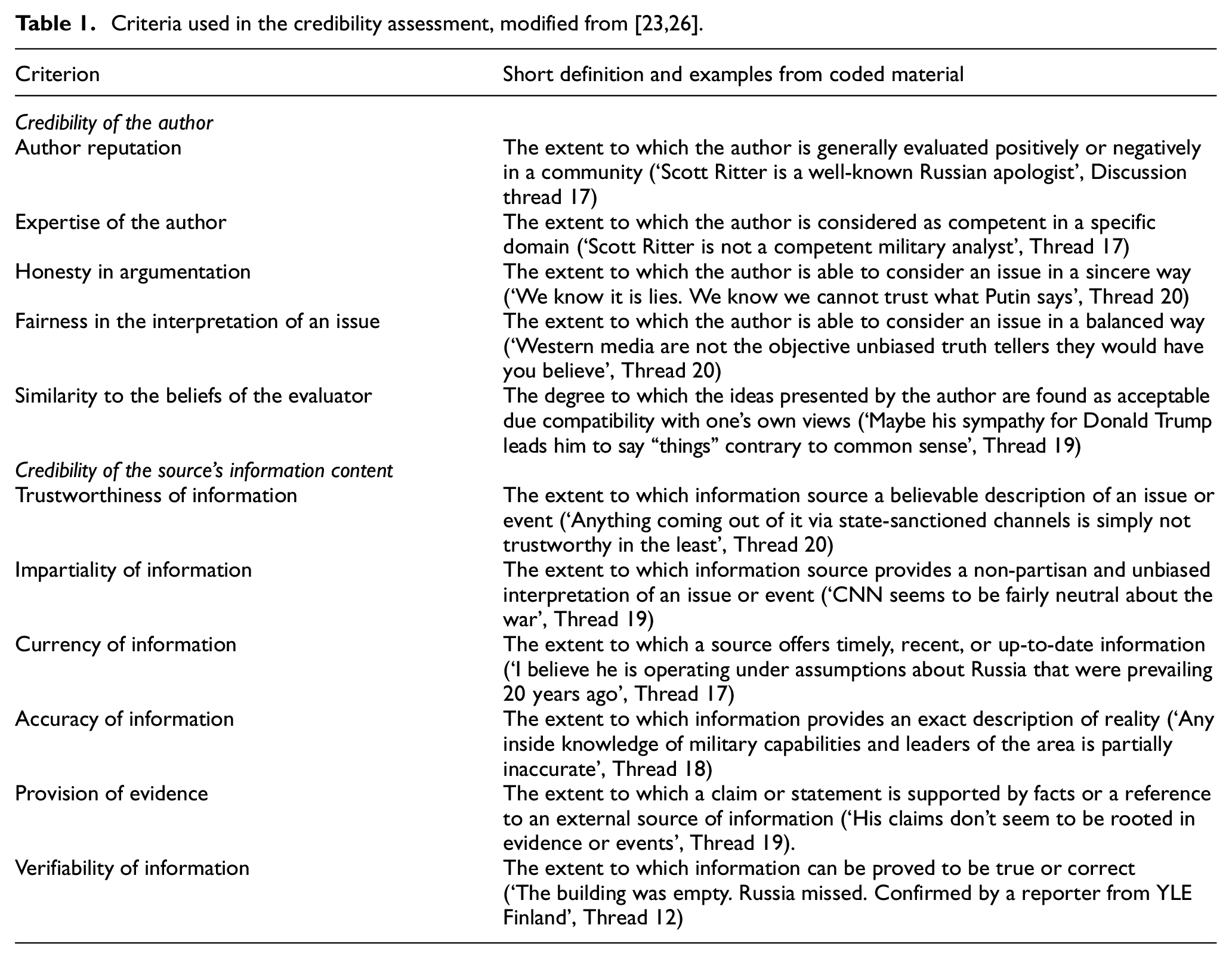
To examine the above issue in more detail, the present investigation analyses how the contributors to Quora online discussion threads assess the credibility of propagandistic information sources dealing with the Ukraine war. The research material was gathered from Quora because it is an established social Q&A platform. It provides free access to a variety of topics related to the ongoing Ukrainian war, including the creation and distribution of propagandistic information representing both pro-Ukrainian and pro-Russian views. The research framework was developed by making use of studies in which Savolainen [23,26] examined the credibility assessment of mis/disinformation related to COVID-19 vaccination, and the perceived credibility of information sources used in the online debate about Finland’s NATO membership. As the Ukraine war – similar to COVID-19 vaccination and Finland’s NATO membership – represents a politically sensitive issue, thus subject to persuasive and propagandistic influence, the categories of credibility assessment used in the above studies were deemed relevant for the present investigation, too. More specifically, Savolainen [23,26] identified a set of categories used in the assessment of the credibility of the author of information sources, for example, Author reputation and Honesty in argumentation, as well as categories describing the credibility of the source’s information content, for example, Accuracy of information and Provision of evidence. The research framework of the present study was substantiated by including three categories used in the assessment of the credibility of the source’s information content. These categories were identified from the empirical material of the present study, that is, Trustworthiness of information, Impartiality of information and Verifiability of information. The categories used in the present investigation are specified in Table 1. The examples illustrating the nature of the categories are taken from the empirical material of the present study, that is, the Quora discussion threads discussing the nature of propagandistic elements of war-related information.
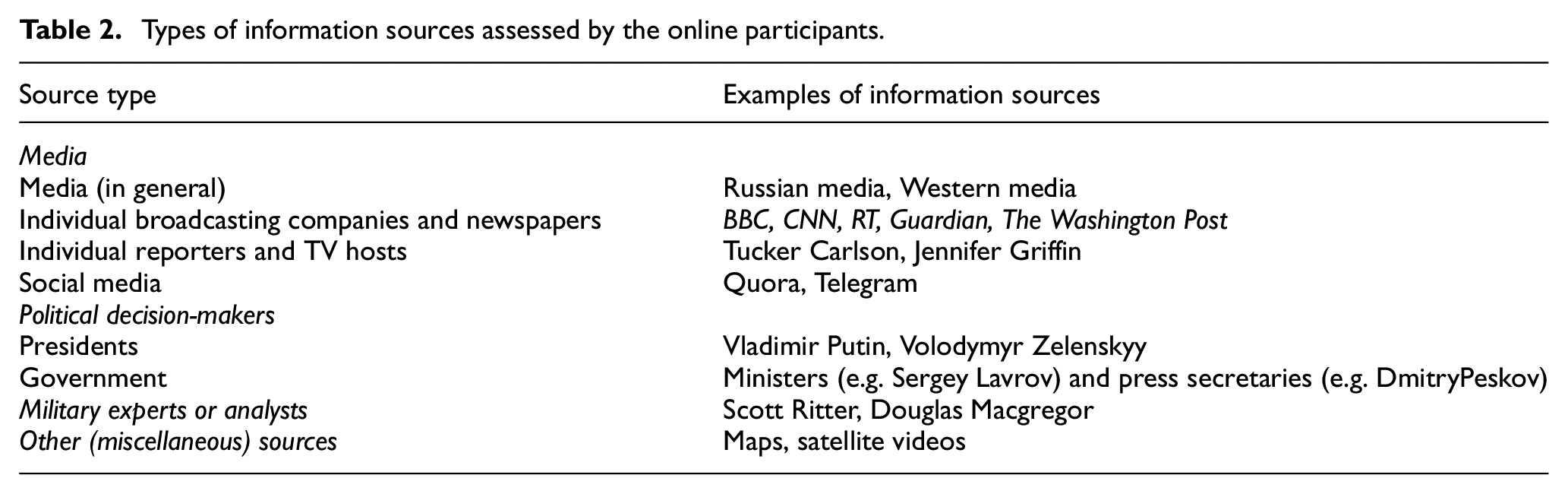
The categories of information sources referred to in online discussion were identified inductively from the empirical material because there were no previous categorisations relevant to the present study. The categories are presented in Table 2.
Types of information sources assessed by the online participants.
Drawing on the above specifications, the research framework of the present investigation is presented in Figure 1.
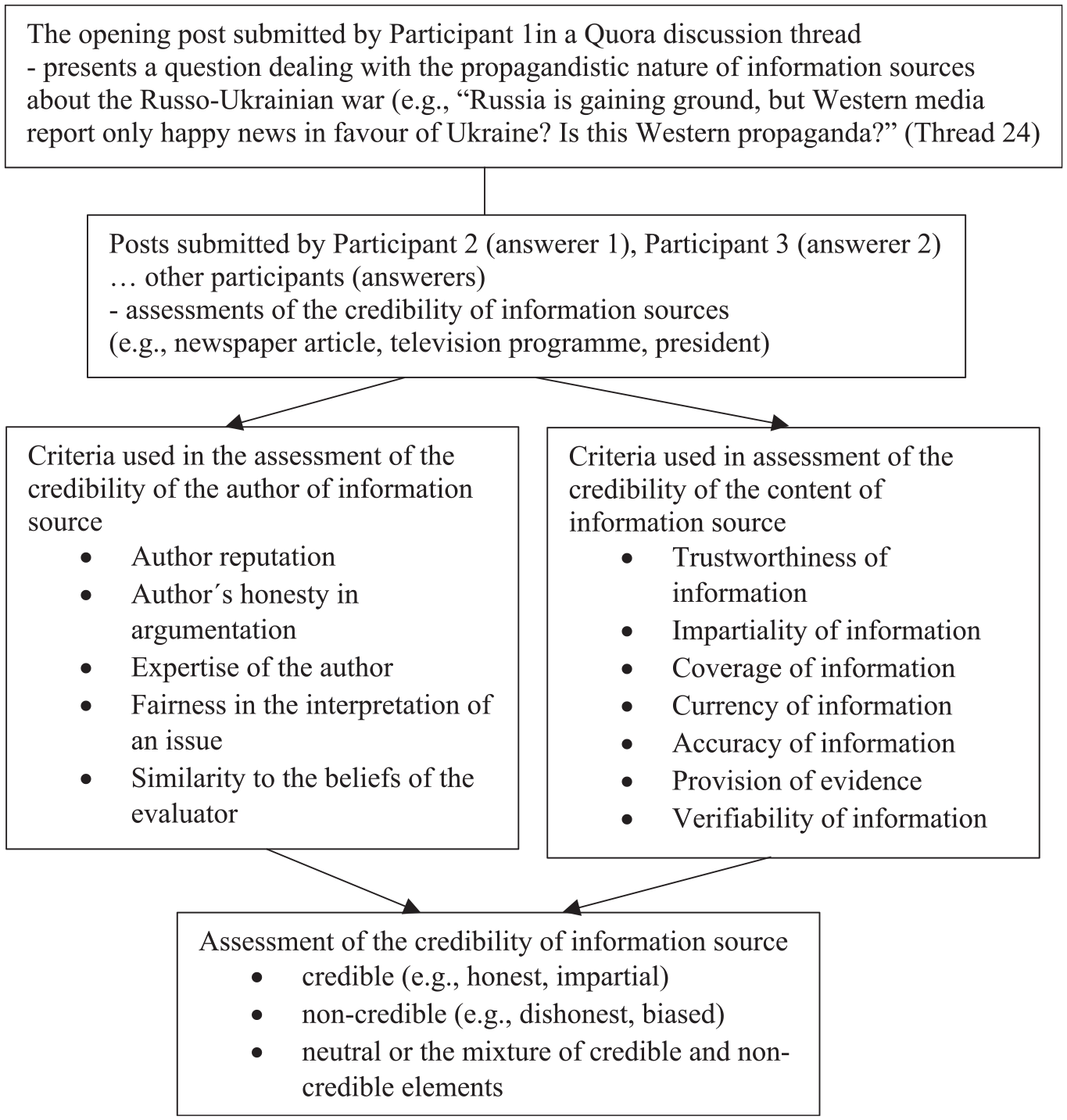
Figure 1 illustrates how the credibility assessments are made in Quora discussion. The discussion is initiated by an opening post submitted by Participant 1. By presenting a question, he or she invites other participants to assess the credibility of an information source allegedly incorporating propagandistic elements. The discussion is continued when other contributors (Participant 2, Participant 3 and so on) answer the above question by presenting their credibility assessments. To this end, they may evaluate the credibility of the author of information source, for example, a military expert by drawing on criteria such as his or her professional reputation and honesty in argumentation. Participants can also evaluate the content of the information source, for example, a military expert’s statement that Russia is gaining ground on the battlefield. To this end, the participants may assess, for example, the trustworthiness of the statement, as well as the evidence indicative of Russia’s military success. A similar process occurs when a new discussion thread focusing on the credibility of other allegedly propagandistic information sources is initiated.
4. Empirical data and analysis
To answer the research questions, the empirical data were gathered from Quora – a major Q&A website (https://www.quora.com/). Quora was found in 2009, and it is headquartered in Mountain View, California. As of December 2023, Quora was visited monthly over 400 million monthly active users [31]. Quora contributors can submit questions and answer them in discussion threads. The most popular topics discussed on Quora include Technology, Movies, Health, Food and Politics. Quora relies on user reporting, but sometimes the content posted by users is checked by human moderators.
There are several discussion threads in Quora dealing with the Ukraine war. The topics of these threads vary widely, ranging from the justification of the war to the debate about individual war events. As the present study focuses on the issues related to the credibility of propagandistic information sources dealing with the war, the topics of discussion threads potentially relevant for empirical analysis were predefined accordingly. To identify relevant research material, the Quora discussion threads focusing on the Ukraine war were first tentatively browsed. Thereafter, using the search terms Ukraine war and propaganda, altogether 122 potentially relevant discussion threads were identified in the beginning of January 2024. These threads were considered relevant because the opening questions contain claims about the propagandistic nature of information sources, manifesting itself in biased approaches to war-related issues. Examples of the questions asked by the opening posters include ‘Why has Western media abandoned professional neutral factual journalism for one-sided pro-Ukraine propaganda and censorship in its Ukraine war coverage?’, and
“How can the average person know what is said in the media about Ukraine is true or false? After all, the US lied about Iraq having weapons of mass destruction and both Russia and US are known to spread war propaganda”.
Of the 122 threads, 38 were excluded because they contained only the opening post. The remaining 74 threads were read tentatively to obtain an overview of the questions and answers submitted by the contributors. Many of these threads were very short, containing only a few posts. Therefore, a decision was made to prefer longer discussion threads with 10+ posts because they offer a more versatile picture of the credibility assessments. By this criterion, 25 discussion threads with altogether 1024 posts explicitly dealing with the credibility assessments were chosen for analysis.
The 1024 posts contained altogether 25 opening questions and 999 answers offered by the online participants. As it is evident that the ways in which the opening questions are presented will influence on how the answerers react to them, the stance on the Ukrainian war adopted by the opening posters was coded using three categories: pro-Russian, pro-Ukrainian and neutral/undefined. In total, 12 out of the 25 opening questions were interpreted as pro-Russian (e.g. ‘Russia is gaining ground, but Western media report only happy news in favour of Ukraine? Is this Western propaganda?’). Only one of the opening questions advocated pro-Ukrainian view (‘Russia has today claimed to have killed hundreds of Ukrainian soldiers in a rocket strike on a barracks. Is this just propaganda?’), while the rest, that 12 opening posts were neutral or undefined in this regard (e.g. ‘Do you believe Western media is telling the whole truth about Russia and Ukraine, or do you believe a lot of it is propaganda?’).
To compare, 49.6% of 999 answers were coded as pro-Ukrainian or anti-Russian (e.g. ‘Ukraine has the luxury of telling the truth. They are a free democracy defending against an illegal invasion. Russia, on the other hand, has to lie about everything.’). Of the answers, 9.9% advocated a pro-Russian or anti-Ukrainian stance (e.g. ‘Dumb media incited hate towards Russia and spews out lies from Kiev as if they were fact. So, dumb people wish Russia to lose and chose to believe any news or rumours that paints Russia in a bad light’). The rest of the answers, that is, 40.5% were coded as presenting a neutral or undefined stance to the Ukrainian war (e.g. ‘The only thing I want is this war is over, the damage and hate will take many decades to heal. Nobody cares about keyboard warriors when people die’). As the share of neutral or undefined stance was high in among questioners as well as answerers, it became evident that a more detailed analysis of the Quora contributor’s stance would not offer added value for the qualitative analysis. Therefore, the above percentages are merely suggestive at a general level that the questions presented in Quora discussion threads focusing on the Ukraine war tend to emphasise pro-Russian views, while the answerers tend to defend the pro-Ukrainian position.
The shortest thread contained 10 posts, while the longest comprised no less than 324 posts. The sample of 1024 posts appeared to be sufficient for the needs of the study because the data became saturated. Altogether, 792 individual participants contributed to the discussion during the period of 24 February 2022 to 31 December 2023. The most frequent contributor submitted six answers, while the majority of the participants, that is, 464 contributors wrote only one post. Although the discussion topics attracted a relatively large number of participants, most of them were occasional contributors who did not delve into the discussion in more detail.
The coding of the empirical data was an iterative process in which the data were scrutinised several times by the author. In the first phase of the coding, the information sources of various types specified in Table 2 were identified inductively from the research material. Thereafter, using the criteria listed in Table 1, the coding was continued by focusing on the ways in which the participants assessed the credibility of the authors of information sources and the credibility of the source’s information content. In long posts, the same criterion, for example, Honesty in argumentation and Impartiality was often identified in several segments of the same post. In these cases, the criterion was coded when it appeared for the first time in the post; other instances of the same criterion were simply ignored. Depending on how the participants evaluated the credibility of an information source, an assessment was coded as positive, neutral and negative. For example, if an author of a source was considered competent in military issues, the source was coded as positive. An example of a negative credibility assessment is the judgement that the content of a statement presented by a minister is biased. Finally, the credibility of a source was coded as neutral if the participant presented no explicit credibility assessment about it. Overall, no significant problems were faced while coding the data. However, there were a few exceptions dealing with the coding of individual information sources labelled as Media (in general). As Table 2 indicated, examples of such information sources include Russian media and Western media. Due to their general nature, the credibility of sources of this type can deal both to the believability of the author of the information source and the source’s information content. In ambiguous cases, the coding problem was solved by case-based reasoning. If a post mainly dealt with the credibility of media as a collective actor, for example, Russian media or Western media, the code was assigned to the credibility of the author of information source. However, if a post made a reference to a particular message, for example, press release issued by Russian media, the code was assigned to the credibility of the content of information source. Moreover, it was not always possible to unambiguously define whether an answerer evaluated the fairness of an author of information source or whether the assessment dealt with the impartiality of the source’s information content. The borderline cases were solved by selecting a code that, in the particular context of the ongoing discussion, best describes the main content of an answer. To strengthen the reliability of the coding, the initial coding was refined by repeated reading of the data. During this process, the methodological recommendation of Miles and Huberman [32, p. 65] appeared to be useful: for the lone researcher, the code-recode consistencies should reach at least 90%. Following this advice, the coding was refined until it was found that the codes appropriately describe the data and that there are no anomalies.
In order to examine the relative share of the coding categories, percentage distributions were calculated. Thereafter, the data were scrutinised by means of qualitative content analysis [33, pp. 339-344]. To this end, the constant comparative method was employed to capture the variety of articulations of the answers presented by the participants. More specifically, this was achieved by identifying similarities and differences in the ways in which the contributors assessed the credibility of the author and the source’s information content. Thereafter, similar and different articulations per credibility criterion were systematically examined within each discussion threads. This approach enabled a detailed analysis of how the contributors evaluated, for example, the honesty of President Putin as an author of information source or how the trustworthiness of information content of the statements presented by the Russian government was assessed.
The posts submitted to Quora are freely accessible to anyone interested. The posts can also be utilised for research purposes, provided that the identity of an individual contributor is protected. To achieve this, the answers used as illustrative evidence in the presentation of the qualitative findings were equipped with technical codes. For example, in the code P496-T19, P496 refers to the answer submitted by the 496th poster in the alphabetical list of the 792 Quora contributors, while T19 refers to discussion thread 19.
5. Findings
5.1. Quantitative overview
While offering answers to the questions presented by the opening posters, the Quora participants made altogether 1174 credibility assessments focusing on information sources of diverse types. Table 3 specifies how positive, neutral and negative assessments were distributed per source type.
The percentage distribution of the credibility assessments of information sources (n = 1174).
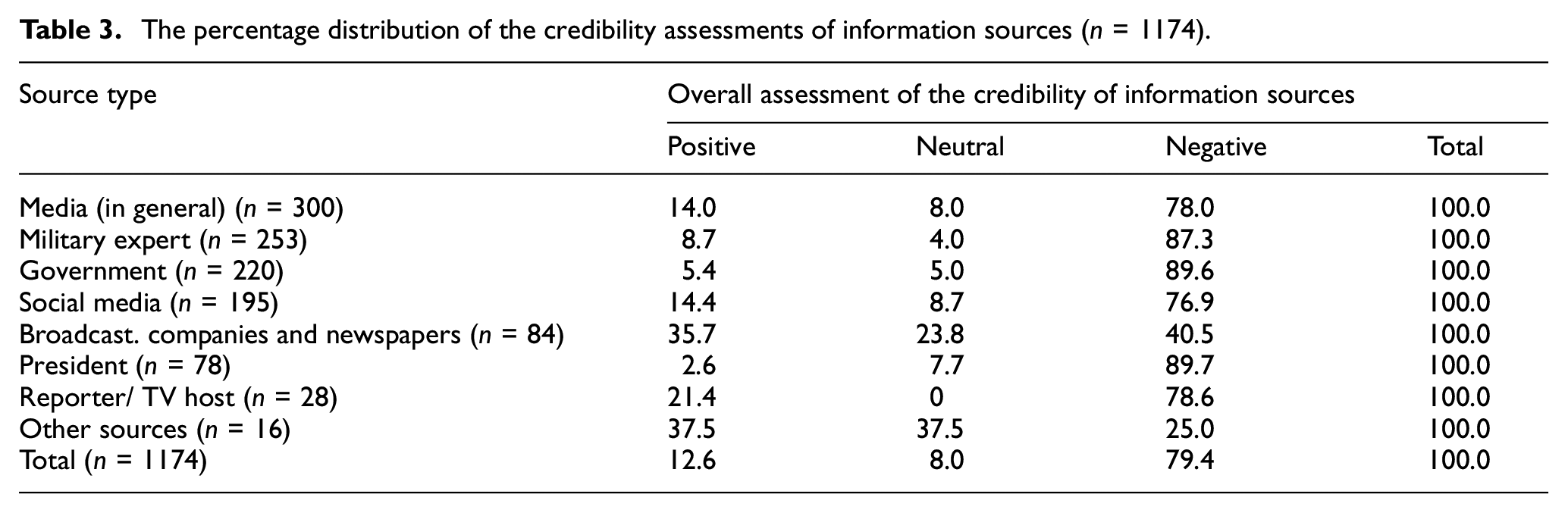
Table 3 indicates that the credibility judgements focused most frequently on media (in general), followed by military experts, government (e.g. ministers) and social media. In addition, references to presidents Putin and Zelenskyy, individual broadcasting companies and newspapers were quite common. The participants quite seldom evaluated the credibility of individual reporters and TV hosts or sources of other types, for example, satellite images. The majority of the credibility assessments, that is, 79.4% were negative, while the share of positive evaluations was 12.6%. The rest of the assessments (8%) were neutral. Overall, the findings indicate that the online participants were quite sceptical about the credibility of sources informing about the Ukraine war. The distrust was strongest towards presidents, government representatives and military experts. To compare, established broadcasting companies such as BBC and CNN and legacy newspapers (e.g. The New York Times and Washington Post) were considered as relatively credible sources.
The quantitative picture can be specified further by leaving out the neutral assessments and looking at how the positive and negative assessments were distributed per credibility criteria (Table 4).
Percentage distribution of the criteria used in the assessment of the credibility of the authors of information sources (n = 828).
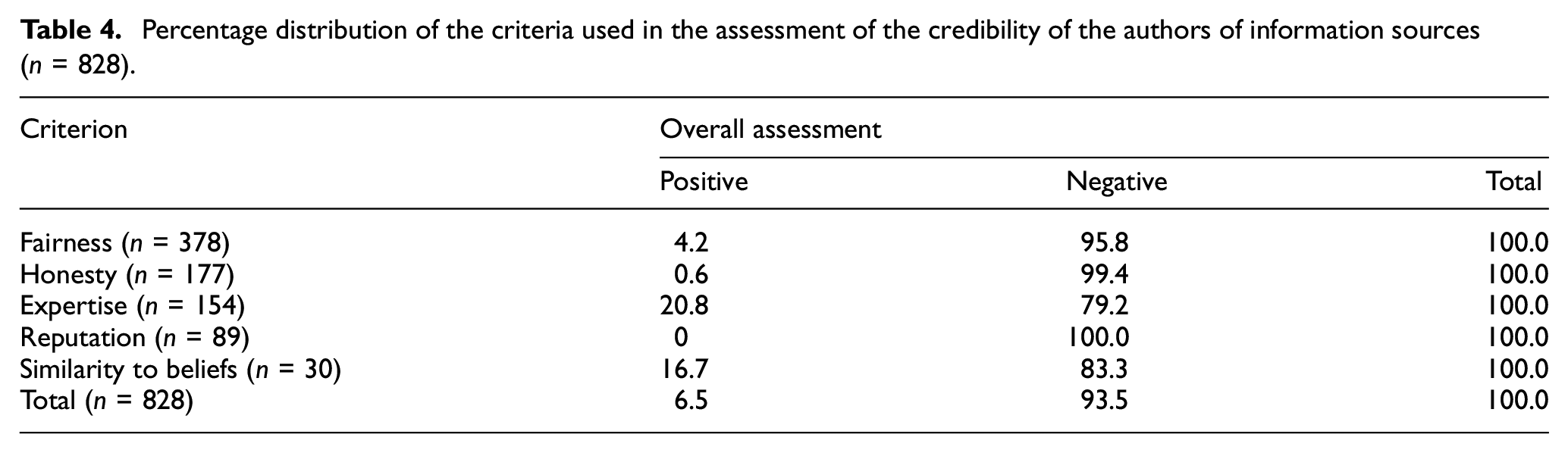
While evaluating the credibility of the authors of information sources, the participants most often used the criteria of fairness, honesty and expertise. Less frequently, they also evaluated the reputation of the authors, as well as the degree to which the ideas presented by the author are found as acceptable due to compatibility with the online participant’s own views. Table 4 indicates that the credibility assessments were highly critical; on average, no less than 93.5% of the evaluations were negative. In particular, the negative assessments dealt with the poor reputation and perceived dishonesty of the authors of information sources. As to the perceived expertise of the authors, the assessments were more balanced in that 20.8% of them were positive. Overall, the findings demonstrate a distrust in the credibility of authors of information sources suspected of containing propagandistic elements.
The participants also evaluated the credibility of the content of information sources. The distribution of the credibility assessments is presented in Table 5.
Percentage distribution of the criteria used in the assessment of the credibility of the source’s information content (n = 363).
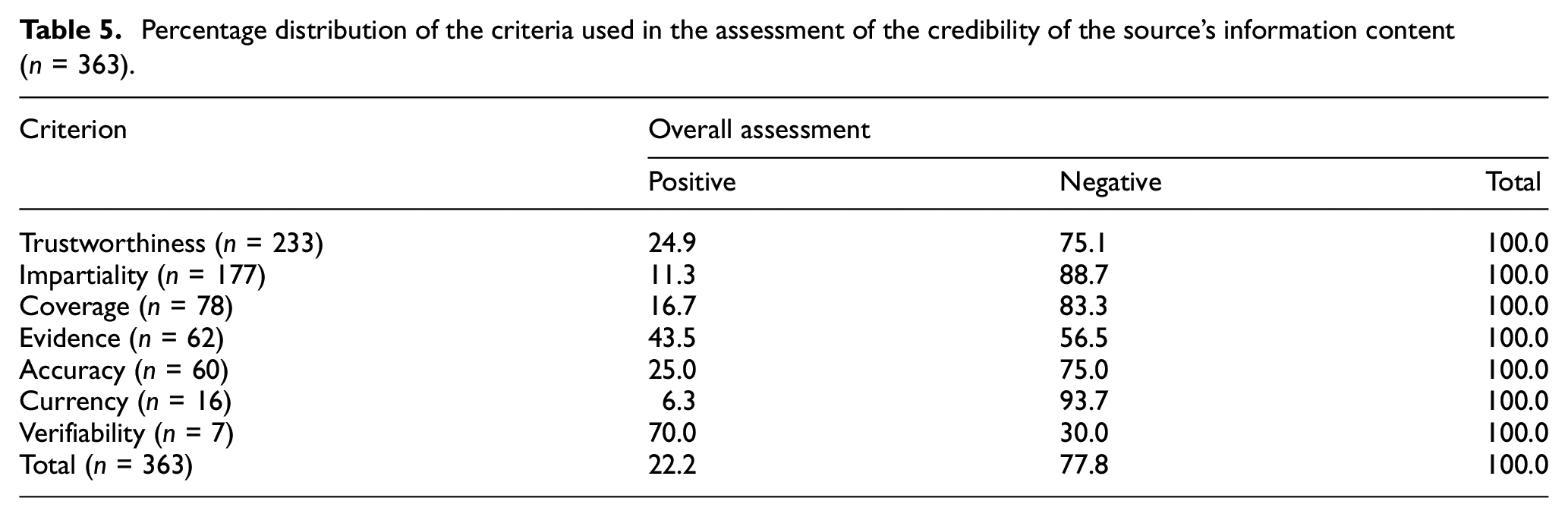
In the assessments, the most frequent attention was directed to trustworthiness and impartiality of source’s information content. Quite often, the participants also assessed the coverage of information, as well as the evidence available in information sources and the accuracy of information. In contrast, the currency and verifiability of information were evaluated quite seldom. Table 5 demonstrates that the majority of the assessment were negative in nature (on average 77.8%). In comparison, however, the evaluations dealing with the source’s information content were less negative than the judgements dealing with the credibility of the authors. The most critical evaluations of the information content on the sources’ currency, impartiality and coverage. As to the evidence supporting information content, the assessments were most balanced since 43.5% of the evaluations were positive and 56.5% negative. Looking together at the assessments dealing with the authors of information sources and the sources’ information content, 86.7% of the judgements were negative and 13.3% positive. This finding suggests that in general, war-related information sources suspected of containing propagandistic elements tend to elicit deep distrust.
5.2. Qualitative features of credibility assessments
The findings of qualitative analysis will be presented by proceeding by source type, starting from media and ending with military experts. Information sources of other types, for example, satellite videos will not be discussed because their role among the sources was marginal. Each source type will be analysed regarding the credibility of the author of information source and the credibility source’s information content.
5.2.1. Media (in general)
Fairness in the interpretation of an issue appeared to be an important criterion while assessing the credibility of authors of information sources. In general, the Quora participants felt that the fairness of media as authors of information sources is questionable because media may serve the ends of propaganda. Closely related, the honesty of media was doubted:
Don’t believe that for a moment, especially when Russian media is talking about how well Russia are doing. So, anything to do with casualty figures, civilian deaths, military deaths, towns under control and all of the rest are probably lies. (P15-T1)
The distrust in media was particularly obvious while commenting the trustworthiness of information content available in Russian media. The critical stance on media was also reflected in the assessments dealing with the impartiality of the information content. In particular, it was believed that the state-controlled Russian media are unable to offer unbiased information content:
All of Russian media should be considered as propaganda. As propaganda, they only reflect the views of Putin. (P613–T14)
From the perspective of the Western media, the question about the impartiality of information content is difficult because it may not be justified to present Russia’s and Ukraine’s views as equally valid. Therefore, for moral reasons, it may be acceptable to prefer information content that supports Ukraine, even though such information can contain propagandistic elements and be against the ideal of independent and objective journalism:
You might have well as asked, ‘Why did not Western media attempt to bring clarity to the Nazi German perspective on Poland or try to show the debate that could be had between people on both sides of the issue?’ Because this is not a political issue that one can debate. This is a right-wrong issue, and anyone who denies that must be a fascist dosed up on Putin’s noxious lies. (P397-T14)
On the contrary, the credibility of information content offered by the Western media may be decreased by that many countries have blocked access to Russian information sources. The narrowing of the media coverage may result in one-sided picture of the war, thus favouring the Ukrainian perspective which is taken for granted:
Here in the UK, the Government has shut down the RT channel which is a pro-Russian outlet. So, we don’t know the Russian viewpoint and therefore cannot examine claims because they have been silenced. (P332-T20)
5.2.2. Broadcasting companies and newspapers
The credibility assessment of individual broadcasting companies and newspapers was mixed. On one hand, reflecting the general distrust in the media, critique was directed to the biased ways in which media companies interpret war-related issues:
You are fed propaganda. Both sides do it. In the end, there is no mainstream Western or other ‘news’ source which is not propaganda. (P443-T-22)
On the other hand, the content generated by western legacy media was generally considered as trustworthy and relatively free of propaganda:
The Economist is excellent and convenient to read. With 10 millions+ readers, they can afford to produce quality (although some junk also). But there is Der Spiegel in Germany, Le Monde in France, The Washington Post in the US, The Guardian, and many others. The information is there. (P339-T20)
Similarly, the judgements concerning the impartiality, coverage and verifiability of the information content generated by established broadcasting companies were quite positive:
I have been watching CNN during much of the Ukraine invasion. They are constantly reminding us, whether footage or stories can be independently confirmed or not. They do report stories that they hear – sometimes without being able to confirm them – but they clearly state that this is the case. They are doing a really good job with the coverage. (P372-T1)
5.2.3. Reporters and TV hosts
Different from the evaluations of media in general, the credibility of individual reporters was more often put in a positive light, due to their perceived fairness in the interpretation of war-related events. On the contrary, the assessments were divided because TV hosts such as Tucker Carlson were criticised heavily for their biased approaches serving the ends of Russia:
Fox News reporter in Ukraine, Jennifer Griffin, has to spend the first five minutes of her report correcting the pro-Putin propaganda. (P255-T1) If you want to hear Russia’s and Putin’s side, tune into Fox News to hear Tucker Carlson’s daily defence of Putin’s invasion. (P54-T20)
Individual reporters were also criticised for their dishonesty while attempting to convince the audience that they are offering an authentic picture of the ongoing war. However, the cheating of the audience serves the ends of war propaganda:
Then you have the journalists who go in front of a camera and pretend that they are in a dangerous area. The worst reporters are the ones wearing their body armour and helmets and making serious faces while they are reporting only two hundred meters away from their luxury hotel in Kyiv. (P-39-T2)
The degree to which the information content produced by individual reporters was considered free from war propaganda depends on the extent to which the reporters can describe an event in an unbiased way and gather authentic material from the battlefield:
The reporters inside Ukraine are the most reliable because they are seeing what is going on first hand. (P388-T23)
5.2.4. Social media
Similar to reporters and TV hosts, the credibility assessments of people generating content to social media forums were mixed. It was believed that these people are less dependent on the partisan preferences of individual media companies and thus free to offer propaganda-free information. However, most of the participants were sceptical about the fairness of content producers contributing to online forums:
All social media platforms, including Quora are infested with Russian trolls, bots and propagandists who are trying to spread the ‘Russia’s side of the story’. (P571-P20)
The critical comments on the fairness of content generators were reflected in the distrust in their honesty because the propagandistic motives to share information in online forums were questioned. Similarly, the competence of the content creators was doubted. Sarcastic references were made by ridiculing ‘keyboard warriors’ who consider themselves as military experts. Negative evaluations were also common while assessing the credibility of information content available in social media forums. Low trust in information content is reflected in the judgements dealing with the impartiality of user-generated data.
The ‘news’ about the war has been propaganda from the very start. For that matter we have some people here on Quora doing their best in this regard. (P295-T3)
The credibility of information content available in social media is also decreased by the fact that it is not supported by sufficient evidence, thus undermining the credibility of information. Finally, the poor verifiability of information content gave rise to doubts about the spreading of propagandistic messages and images:
Ever wondered why you can find our guys posting about hundreds of destroyed armoured vehicles, tanks and destroyed Ukraine soldiers and prisoners of war, while Ukraine never shows any evidence of progress on their side. (P122-T10)
5.2.5. Government
The credibility of authors of information sources representing government, for example, ministers, is dependent on the extent to which the online contributors found such authors as politically acceptable. As to their perceived fairness, the judgements were particularly negative when the credibility of the representatives of the Russian or Ukrainian government was discussed:
If you report exactly what Russia’s foreign minister has said in his official statements on the subject, it could not sound any worse than if it came straight from a Ukrainian propaganda outlet. (P102-T-23)
The critical stance on political information sources was also reflected in the negative evaluations of the honesty of government representatives. Severe doubts were presented regarding their ability to consider war-related issues in a sincere way. Particularly, the Russian decision makers were accused of outright lying:
Very good rule of thumb is that is when Shoigu or Lavrov says something, it is a lie. (P575-T16)
Similarly, severe doubts were expressed about the credibility of information content generated by the government representatives. On the contrary, it was believed that at least a part of information distributed by the Ukrainian government is relatively trustworthy. Again, however, negative assessments prevailed:
Western media often says, ‘according to the Russian Ministry of Defence’. This means the Russian Ministry of Defence has said something, but it cannot be confirmed by a reliable source. So, that is, in fact, what a Russian propagandist said. Is it true? Probably not. (P637-T21)
Critical views were also reflected in the assessments of the impartiality of source’s information content. It was believed that it tends to serve the ends of war propaganda, independent of whether the information is distributed by the Russian or Ukrainian government.
Because of this focus on credibility, we know the drivel coming out of the Kremlin is just that. (P372-T1) According to Ukrainian government reports, Russia is without military equipment and soldiers. Do you really believe that Russia lost 94.2% of its 900,000 army forces? More than 100% of its initial tank forces, 3.873 destroyed tanks of initial 3.300? (P527-T10)
5.2.6. Presidents
Most of the credibility judgements focused on President Putin. Almost without exceptions, the participants believed that Putin’s inherent task is to propagate his political ends:
For the last 9 years Putin has put Russians through a massive disinformation campaign, with the aim of dehumanizing Ukrainians. (P745-T7)
From this perspective, it is unsurprising that Putin was considered as a dishonest source of information. Many of his statements were equalled with blatant lies. On the contrary, the distrust was also exhibited while assessing the statements presented by President Zelenskyy:
Putin only understands communication as a web of lies to obscure your true intentions. So, as a rule, Putin does not speak plainly or tell the truth, at least not openly or immediately. (P362-T20) The most recent report as Zelensky handed out medal in hospital they said that there were 200 wounded every day but said nothing about the number of dead a day. I know such numbers cannot be sustained. (P88-T25)
5.2.7. Military experts
Finally, while assessing the credibility of military analysts as authors of information, the main attention was directed to two well-known US military experts familiarised with the Ukraine war, that is, Scott Ritter, former US Marine Corps intelligence officer, and Douglas Macgregor, retired US Army Colonel. Both of them were assessed highly critically, due to the belief that they propagate Russia’s views. Many of the critical judgements dealt with their professional reputation and fairness in the interpretation of military issues:
Scott Ritter is not a prime military analyst but a Russian propagandist. (P328-T17) Macgregor is a paid political commentator. He appears on Fox News and Russian media. The shows want the ‘pro-Russia guy’, or the ‘rabidly pro-Ukraine guy’. Audiences want drama, disagreement, and heated arguments. Macgregor gives them what they want. (P59-T19)
The above answer suggests that the appearance on certain television channels signals the propagandistic approach adopted by the author of an information source. In this regard, contributions to Fox News or Russian media such as RT were interpreted negatively because they not only suggest a political preference but also the possibility of a bought opinion. Many of these assessments were based on the assumption that military experts lie in order to please their sponsors. Given the negative evaluation of the fairness and honesty of the military analysts, it is unsurprising that their expertise was doubted:
Ever since the 2022 invasion began, Colonel Macgregor has predicted Russia would win the war within days. The days turned into weeks, the weeks into months and here we are, 18 months later, and the Ukrainians are on offense. I do not have any confidence in his predictions. (P496-T19)
The low credibility in military experts as authors of information sources was also reflected in the evaluations of the information content produced by military analysts. The judgements about the trustworthiness of information content were negatively coloured. The assessment of the credibility of information content is also dependent on how well the military experts can support their statements by offering evidence. In this regard, the evaluations were divided:
I used to listen to Ritter, as well as Macgregor, but I just got fed up with the constant unsourced, unevidenced and false narratives that they were constantly pushing. The issue is Macgregor claims to have ‘inside sources’ and yet half the time he does not say who they are or what they are. So, essentially the audience just has to trust him that these ‘inside sources’ are telling him these things or that he even has inside sources and is not just creating these figures. (P512-T18)
6. Discussion
The unique contribution of the present study is the elaboration of the ways in which people assess the credibility of information sources suspected of containing propagandistic elements. The main findings are summarised in Table 6.
Summary of the main findings.
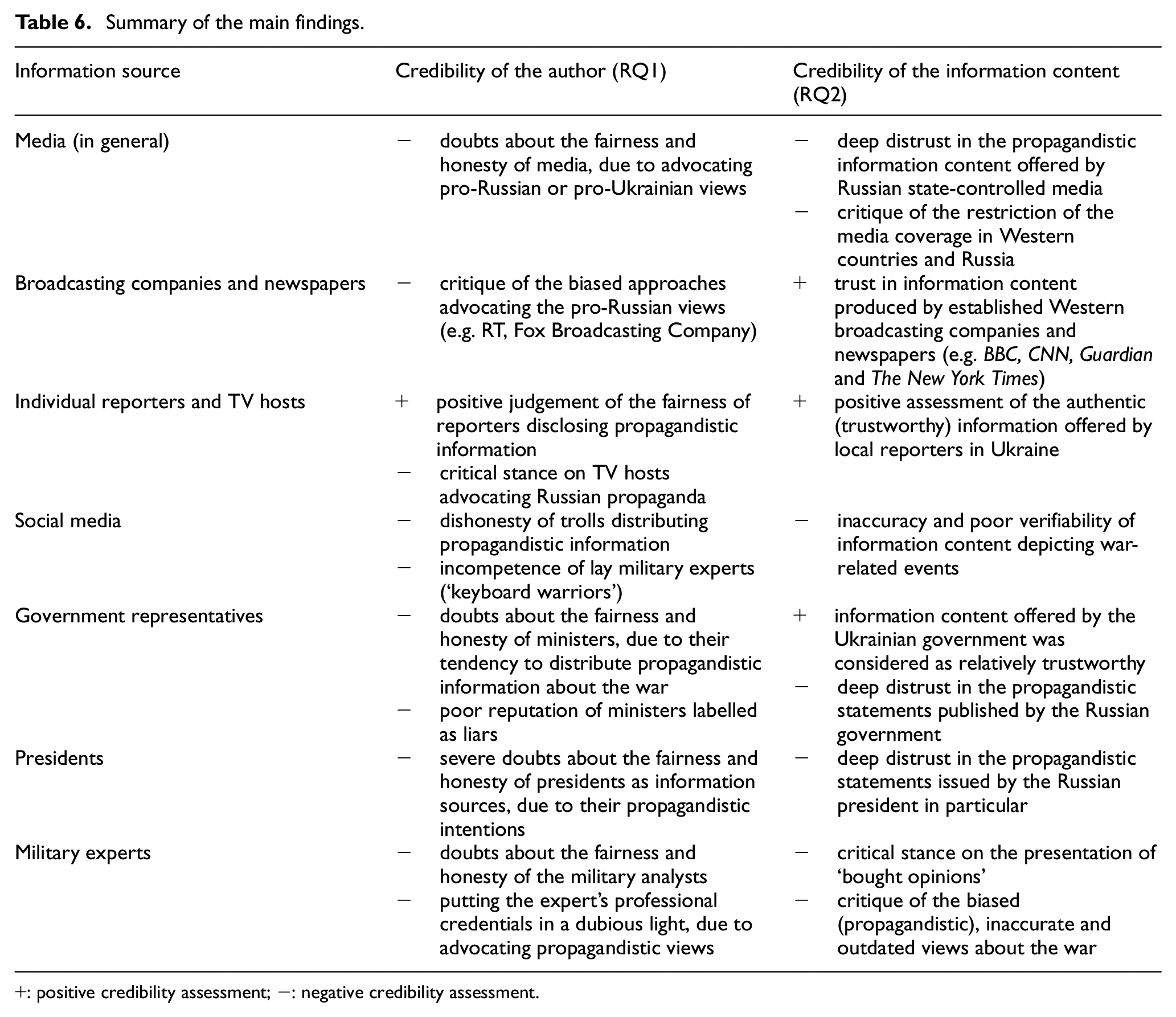
+: positive credibility assessment; −: negative credibility assessment.
Table 6 indicates that overall, information sources which are suspected of containing propagandistic elements were evaluated negatively by the Quora contributors. The critical assessments were emphasised while evaluating the credibility of sources supporting the Russian viewpoint to the Ukraine war. The negative approach was particularly evident in cases in which the answerers suspected that the opening question is intentionally formulated to advocate the Russian view. Negative assessments were emphasised more strongly while evaluating the credibility of the authors of information sources. In this regard, the judgements dealing with the fairness and honesty of the authors were particularly important. Similarly, most credibility assessments focusing on the content of information sources were negative, particularly regarding their trustworthiness and impartiality. The findings suggest that online participants tend to be well aware of the persuasive intentions of propagandistic information sources, and in most cases, they reject them. On the contrary, despite the media scepticism characteristic of the post-truth era and doubts about the propagandistic intentions of the Western media, Quora users still trust, at least partly in certain source types, most notably established broadcasting companies such as BBC and CNN, as well as legacy newspapers such as The New York Times, The Washington Post and Guardian. This finding supports the conclusion drawn by Udris et al. [19] suggesting that the well-established Western news media are most probably to offer propaganda-free information about war-related issues. In contrast, political information sources (government representatives and presidents) are trusted least because due to their partisanship they are most directly associated with propagandistic intentions.
The discussion of the novelty value of the findings is rendered more difficult because there is a paucity of similar studies. However, a few comparative notions can be made. Although ‘anti-vaxxers’ distributing mis/disinformation about COVID-19 vaccines cannot be labelled as authors of ‘propagandistic’ information, similar to those propagating Russian or Ukrainian views on the ongoing war, there are similarities between these groups of people. Savolainen [23] found that the contributors to online discussion evaluated ‘anti-vaxxers’ as people with poor reputation, intentionally spreading information which is not supported by sufficient evidence. Similarly, as Savolainen [26] demonstrated, the credibility assessments dealing with people presenting strong opinions about politically sensitive issues such as Finland’s NATO membership tend to be categorical. Such judgements are negatively coloured, and they focus on the poor reputation, dishonesty and lacking expertise of the authors of information sources. As the findings of the present study suggest, the authors of propagandistic information sources are evaluated in a similar fashion, often associated with moral disapproval.
The findings of the present study differ from the observations of Chernobrov and Briant [34]. They suggest that propaganda represents a sophisticated power beyond an average person’s comprehension. Therefore, ordinary people tend to be incapable of recognising and fighting propaganda, thus suggesting that audiences play passive roles of information recipients and easily manipulated objects. Different from the above conclusions, the findings of the present study suggest that Quora users can identify propagandistic elements of information sources and approach them critically. On the contrary, this task was easier for the Quora participants because they were invited to assess the credibility of information sources which were explicitly suspected of containing propagandistic elements. In everyday contexts, it may be more difficult for ordinary people to identify propagandistic elements of information sources because such elements tend to remain implicit.
The findings of the present investigation support the conclusions drawn by Alyukov [4] about Russian citizens’ reception of the regime propaganda. He found that citizens evaluate propaganda’s credibility selectively, depending on their political alignment. In the present study, most participants adopted a highly critical stance towards Putin’s political agenda; this was also reflected in the rejection of information sources originating from the Russian government. Similar to Alyukov’s [4] observations, the Quora participants expressed distrust in state-controlled media. On the contrary, the impartiality of Western media outlets was doubted because they may advocate the pro-Ukrainian views. Therefore, in practice, it may be impossible to obtain completely objective and propaganda-free information about the ongoing war because all sources are more or less inclined to support Ukraine or Russia. Not even statistical data about military issues are not free of propaganda because the data can be manipulated to minimise one’s losses, for example, the number of casualties.
Nevertheless, a person can consider certain sources as sufficiently credible, even though they can contain propagandistic elements. The acceptance of an information source is more probable if it is in line with his or her political views, either pro-Ukrainian or pro-Russian. From this perspective, the credibility judgement of an information source is ultimately dependent on one’s political values. As the negative assessments prevailed among the Quora participants, it is evident that the credibility judgements about sources with propagandistic elements are primarily driven by doubt and distrust, rather than the willingness to analytically consider the pros and cons of a source. However, as Szostek [6, p. 125] demonstrated, ordinary people can make judgements of this kind. She examined the credibility of news and conflicting narratives during the ‘information war’ in Ukraine. It appeared that some of the participants avoided a categorical approach and believed that the truth could be found ‘in the middle’ of the contradictory messages, at ‘the golden mean’. In the present study, assessments of this type were relatively rare, thus suggesting that people evaluating information sources with propagandistic elements tend to be unwilling to make compromises.
7. Conclusion
The present investigation filled gaps in information research by detailing how the contributors to online discussion assess the credibility of information sources that may contain propagandistic elements serving the ends of information warfare. The key contribution of the study is the conceptual and empirical elaboration of the judgements dealing with the credibility of the author of information sources and the credibility of the source’s information content. The findings highlight that people tend to reject information sources explicitly suspected of containing propaganda. In particular, the authors of propagandistic information sources are evaluated negatively, due to their partisan approach and perceived dishonesty. Moreover, the source’s propagandistic information content tends to be judged as untrustworthy and biased. The post-truth era is characterised by media scepticism and doubt [1]. People’s distrust in war propaganda represents an extreme case in this regard, particularly when the credibility of Russian propagandistic sources is judged. As the present study focused on a limited sample of Quora discussion threads concentrating on a specific topic, that is, the Ukraine war, the findings cannot be generalised to concern credibility assessments dealing with propagandistic information. Another factor affecting the generalisability of the empirical findings is that Quora’s users predominantly come from the United States, India and the United Kingdom [35]. This might also explain why posts supporting the Russian stance received numerous negative credibility evaluations in the discussion threads. Given the above limitations, more research is required to refine the picture of credibility assessments dealing with information about contested issues. One of the tasks of further research is to scrutinise in more detail the nature of answers offered in online discussion by devoting attention to how the responses differ regarding the nature of the propagandistic content published in information sources of diverse types, for example, the statements of government representatives and military experts. There is also a need to conduct comparative investigations on how people assess the propagandistic elements of information sources dealing with other politically sensitive topics such as general elections and climate change. Finally, the picture of credibility assessment could be elaborated by examining why online contributors assess the credibility of propagandistic elements of information in the ways they do. To achieve this, there is a need to interview online users because the posts submitted to discussion threads are not necessarily indicative of their motives to prefer positive or negative credibility judgements on an issue.
