




Abstract
This study explores the employment-related information seeking behaviour of Bangladeshi immigrants in Canada. Using a mixed-methods approach, the study conducted semi-structured interviews with 60 Bangladeshi immigrants in Ontario, Canada, and obtained 205 survey responses. The study highlights the centrality of employment-related settlement among Bangladeshi immigrants in Ontario and reports many immigrants not being able to utilize their education and skills after arrival in Canada. The results show that Bangladeshi immigrants utilize various information sources for their employment in Canada, including friends and professional colleagues, online searchers, and settlement agencies. Although Bangladeshi immigrants utilized a large array of information sources for meeting their employment-related information needs, many interview participants emphasized that the employment-related benefits they received was because of their access to friends and professional colleagues in Canada. The survey results echoed the interview findings. The cross-tabulation results on post-arrival information sources and occupation status as well as first job information sources and occupational status in Canada show a significant association among the use of the information source “friends and professional colleagues in Canada” and immigrants’ occupational status. The study highlights the benefits of professional colleagues among immigrants in employment-related settlement contexts. It also reports the challenges faced by many immigrant professionals related to employment-related settlement because of the lack of access to their professional friends and colleagues in Canada. The author urges the Federal Government of Canada, provincial governments, and settlement agencies working with newcomers to offer services that would connect highly skilled immigrants with their professional networks in Canada, in order to get proper guidance related to obtaining a professional job or alternative career. The author calls for further studies on employment-related information seeking by immigrants to better understand the role information plays in their settlement in a new country.
Keywords
Introduction
Immigration plays a significant role in shaping Canada’s future in terms of population growth, economic growth, and innovation (Boyd and Cao, 2009; Conference Board of Canada, 2010). Canada regularly welcomes a large number of immigrants across the globe with diverse socioeconomic backgrounds, a majority of whom are skilled immigrants and their dependents. Not surprisingly, a central concern for newcomers to Canada is employment, as it affects their overall settlement and social inclusion after arrival (Esses et al., 2013a, 2013b; George and Chaze, 2009; Kaushik and Drolet, 2018; Murphy, 2010). Immigrants look for employment-related information before and after arrival (Allard, 2015; Caidi et al., 2014; Khoir, 2016; Mason and Lamain, 2007; Rayes et al., 2016; Shuva, 2020a). Skilled immigrants in Canada, a specific class of immigrants, expect to be able to work in their respective professions (George et al., 2012; Murphy, 2010; Shuva, 2020a; Zaman, 2010). Studies (e.g. Ahmed, 2006; Khan and Watson, 2005; Simich et al., 2006; Zaman, 2010) report the mismatch between immigrants’ expectations about life in Canada, including the assumption of settling into professional jobs and their actual experiences. At times, this results in depression, frustration, and anxiety about their move and affects their settlement and integration (George and Tsang, 2000; Simich et al., 2006).
Although there are some recent studies on the information behavior 1 of immigrants including refugees, very little is known about the information behavior of skilled immigrants and their dependents, 2 including how they seek settlement information, the challenges they face landing in a professional job, and their employment-related information seeking, especially in the Canadian context. Generally, we need comprehensive studies of how skilled immigrants and their dependents seek information related to their settlement in a new country, in particular, their employment-related information needs and seeking. Using the Bangladeshi community 3 as a case, the findings of this study inform our understanding of how immigrants, particularly skilled immigrants and their dependents, seek and gather employment-related information in Canada.
Problem statement
Canada, like many other immigrant receiving countries will continue to welcome newcomers from across the globe. A recent report by the Government of Canada shows that Canada aims to welcome over 1 million immigrants by 2021, with the majority of them as skilled immigrants (Immigration, Refugees and Citizenship Canada (IRCC), 2018a). Although Canada welcomes a large number of skilled immigrants and dependents regularly, there are many studies that report that immigrants face various employment-related issues, including the lack of recognition of foreign credentials and employment discriminations in the Canadian context (e.g. Creese and Wiebe, 2012; Dietz et al., 2015; Esses et al., 2006, 2014; George et al., 2012; Guo, 2009; Li, 2001; Picot and Sweetman, 2012; Reitz, 2007a, 2007b, 2013).
Although there are some studies that report the information behavior of immigrants including refugees, there is a lack of research on the employment-related information needs and seeking among immigrants, especially in the Canadian context. Studies in Canada such as by Allard (2015) on transnational information practices of immigrants from the Philippines to Winnipeg, Quirke (2014) on the settlement experiences of Afghan youth newcomers in the contexts of leisure and settlement, Silvio (2006) on the information needs of Southern Sudanese youth in the city of London, Ontario, and Caidi et al. (2019) on the settlement information experiences of older Chinese immigrants in Australia and Canada, shed some light on various aspects of immigrants’ information needs and seeking. A very recent study by Mabi (2020) on 25 Black African immigrants in Metro Vancouver emphasizes the importance of meaningful employment in newcomers’ settlement in Canada and describes participants utilizing various employment-related information sources such as institutions in Canada and online sources for meeting their information needs. The study reports that although a large number of employment-related settlement services are offered by settlement agencies in Vancouver, the participants reported utilizing only a few of these. Rayes et al. (2016) emphasize the centrality of the employment aspects among international medical graduates (IMGs) and the sources and strategies they use to meet their information needs for labor market integration in Canada and the United States. Caidi et al. (2014) highlight the role online discussion forums play to help IMGs to integrate into the host country healthcare system. Despite some recent studies (e.g. Rayes et al., 2016) on newcomers’ employment-related information seeking that highlight the role of information and informational skills in their integration into a new society, we still have a significant lack of understanding of immigrants’ employment-related information seeking. This article, part of a larger project exploring the settlement information behavior of Bangladeshi immigrants in Canada (see, Shuva, 2020a), aims at addressing the following research questions:
Research question 1: How do newcomers seek information in pre- and post-arrival contexts?
Research question 2: How do immigrants go about searching for employment-related information?
Research question 3: What sources of information are useful for newcomers’ employment-related settlement in a new country?
Literature review
Employment as a central settlement concern of immigrants
A major concern for newcomers to Canada is employment, as it affects the overall settlement and social inclusion after arrival (Esses et al., 2013b; George and Chaze, 2009; Kaushik and Drolet, 2018; Murphy, 2010; Rayes et al., 2016). In Library and Information Science (LIS), various studies report the employment-related concerns among various immigrant groups (e.g. Allard, 2015; Caidi et al., 2014; Khoir, 2016; Mason and Lamain, 2007; Rayes et al., 2016).
In the Canadian context, the majority of the recent newcomers to Canada are skilled immigrants with a university level of education, many of them expect to be able to work in their professions when they arrive in Canada. Several studies report employment-related challenges citing the lack of recognition of foreign credentials (e.g. George et al., 2012; Li, 2001), employment discrimination (e.g. Creese and Wiebe, 2012; Dietz et al., 2015; Esses et al., 2006), and language barriers (Esses and Medianu, 2012; Stampino, 2007). The need for employment-related services in both the pre- and post-arrival periods to better prepare newcomers for the Canadian job market is evident in studies such as Esses et al. (2013b) and Wilkinson and Bucklaschuk (2014).
Although studies in LIS by Caidi et al. (2014), Khoir (2016), and Mason and Lamain (2007) report the need for employment-related information among immigrants, the centrality of employment aspects in newcomers’ settlement in a new country has not yet received much attention in LIS studies on immigrants, especially in the Canadian context. Only a handful of recent studies on newcomers focused on employment-related information seeking and the concerns newcomers have while settling in Canada, most with a small number of participants. In the North American context, recent studies such as Mabi (2020), Shuva, 2020a, and Rayes et al. (2016) report the centrality of employment aspects in newcomers’ settlement into a new country. Shuva (2020a) examines employment as one of the core settlement information needs for Bangladeshi immigrants in Ontario in the pre- and post-arrival contexts and reports a huge mismatch between participants’ expectations about life in Canada before arrival and their actual experience after arrival. Mabi (2020) also highlights the importance of employment for 25 Black Africans in Vancouver. The participants in Mabi’s study also reported the mismatch between their employment-related expectations and the reality in Canada. The importance of employment is also found in Allard and Caidi (2018), where Filipino migrants to Winnipeg, Canada, reported looking for career-related information after arrival. Some of the participants in Allard and Caidi’s study also found official information sources more helpful for their employment than their social networks. Another study by Rayes et al. (2016) on 20 IMGs in Canada and the United States highlights occupational status and employment-related integration as the central concerns for their participants. IMGs in this study reported using various strategies to navigate through new information environments to gather information related to getting employed in the health sector. The authors conclude by highlighting the importance of information literacy skills in newcomers’ employment-related settlements. Similar to Rayes et al. (2016), a study on foreign-trained health professionals’ labor market integration in the North American context by Caidi et al. (2014) also highlights the centrality of career-related information needs among the participants of five online forums. Using content analysis, the authors describe the significant role online discussion forums play in forum participants’ integration in the local health care system. LIS studies on immigrants outside of North America such as Khoir (2016); Mason and Lamain (2007) also highlight employment as one of the major concerns for their participants.
Despite some studies in LIS reporting employment as one of the core settlement concerns, we do not have a comprehensive understanding of immigrants’ employment-related information seeking in their settlement contexts. We do not know to what extent newcomers utilize various information sources and their impact on newcomers’ employment-related settlement. This study fills some gaps in our understanding of immigrants’ employment-related information seeking behavior.
Family, friends, and personal networks as one of the core settlement and everyday life information sources
It appears to be a nearly universal finding that humans prefer to consult family and friends and other informal information sources over formal information sources in meeting various information needs (Case and Given, 2016; Harris and Dewdney, 1994). An important book on information behavior by Case and Given (2016) reports the preferences of human information sources among various groups such as consumers, farmers, and patients. The authors confirm that in information behavior studies, “a frequent finding is that people still turn to other people for information, and that online networks have made it easier than ever to share information with others” (Case and Given 2016: 346).
Immigrants relying on their family, friends, and personal networks for their settlement information are well evident in studies on immigrants’ information needs and seeking (e.g. Allard, 2015; Esses et al., 2013b; Khoir, 2016; Komito and Bates, 2011; Lingel, 2011). In the Canadian context, a study by Allard (2015) found a heavy dependence on family and friends’ networks among Filipino immigrants in Winnipeg in meeting their various information needs in the pre- and post-arrival contexts. Likewise, Quirke’s (2014) study on information practices of Afghan immigrants and refugee youth in Toronto reports that family and friends are primary information sources. In the US context, a study by Flythe (2001) shows that the Hispanic/Latino population in Durham County, North Carolina, resolves many basic information needs through friends and family, community centers, and churches. In Australia, a recent study by Khoir (2016) shows that one of the chief sources of information for Asian immigrants in Southern Australia is their personal networks, including friends and family in Australia.
A large-scale study on settlement and integration in Alberta, British Columbia, Manitoba, and Saskatchewan by Esses et al. (2013b) shows that family and friends are the top information source for settlement information. A study by Shuva (2015) on 22 Bangladeshi immigrant women in Toronto indicates a heavy reliance on family and friends among the participants, especially their husbands, for meeting their everyday life information needs. Earlier, a pioneering study by Chu (1999) features immigrant children as information mediators in meeting the cultural, linguistic, and informational needs of their parents. A very recent collaborative study on the information experiences of older Chinese migrants to Australia and Canada by Caidi et al. (2019) reports participants consulting their children for meeting various information needs in the pre- and post-arrival contexts.
Studies on immigrants’ information behavior still emphasize family, friends, and personal networks as a prominent information source for newcomers; however, we do not know what role they play in newcomers’ employment-related settlement in a new country. Does having access to professional colleagues help newcomers land in their occupation? What kind of information help do newcomers receive consulting their friends and professional colleagues? How does access to informal networks help newcomers with their employment-related settlement? This study addresses some of these questions.
Immigrants’ social networks and settlement benefits
A large number of studies are conducted globally that report that immigrants, including refugees, receive various benefits because of their social networks in the host country. A recent study by Martén et al. (2019) on the economic integration of refugees in Switzerland claims that refugees receive substantial benefits from their ethnic social networks in terms of their employment in the host country. Earlier, an empirical study by Beaman (2012) also emphasizes the value of social networks for newly arrived refugees in the United States in getting access to the local job market.
In the Canadian context, a study by George and Chaze (2009) with 50 South Asian immigrant women in Toronto highlights various settlement benefits for newcomers such as help with decision making and problem-solving and emotional/moral support from their informal networks in Canada. A recent study by Teixeira and Drolet (2018) shows that immigrants can receive significant assistance with various aspects of their settlement from their established ethnic family and friends networks, in areas mainly related to housing and jobs. Another study in the Canadian context on Syrian refugees in Quebec by Hanley et al. (2018) reports participants significantly depending on ethnic social networks and receiving considerable employment and housing support from their ethnic family and friends. Although there are several studies that suggest newcomers receiving various settlement benefits such as help related to finding accommodation, getting jobs, opening bank accounts, filing taxes, and learning about educational opportunities because of their access to social networks in the host country, we do not know much in informational terms about the benefits of newcomers’ social networks in their employment-related settlement in the new country. This study explores the employment-related information seeking by Bangladeshi immigrants in Canada.
Research methods
This study employed a mixed-methods approach to comprehensively understand the employment-related information seeking by Bangladeshi immigrants in Canada. Using a sequential exploratory design approach, after ethics approval, 4 the study first obtained qualitative data through semi-structured interviews, and then based on the initial findings of the qualitative data, it collected quantitative data through surveys.
Data collection
Interviews
Utilizing convenience and purposive sampling approach, semi-structured interviews were conducted with 60 participants (21 face-to-face; 37 by telephone; and 2 via Skype) from May 2017 to February 2018. The interview participants were mainly recruited through the help of members of the author’s personal network (families, friends, and their extended networks). The author also attended various Bangladeshi community programs organized in Toronto, Guelph, London, Mississauga, and Hamilton. A recruitment poster was published in Bengali in the Bangla Mail (http://thebanglamail.com/)—one of the most widely circulated weekly Bangladeshi newspapers published in Toronto. An interview schedule was developed for the larger study with questions on various aspects of Bangladeshi immigrants’ pre- and post-arrival information behavior, including their perceptions of life before arrival, employment, education, use of settlement services, and life satisfaction. Although the overall scope of the original study is much larger (see Shuva, 2020a for a detailed discussion on the methods of the larger study), this article features findings on the employment-related information behavior based on the analysis of the interview and survey data. The interview participants of this study were given the option to be interviewed in Bengali (the mother tongue of Bangladeshi people except some for Indigenous groups) or English. Of 60 interviews, only 9 were conducted in English and the rest were conducted in Bengali with frequent use of common English words (e.g. “challenge,” “information,” “immigration,” “job”). In this study, people were eligible to participate in interviews and surveys if they met the following criteria:
had lived for at least 12 years in Bangladesh before coming to Canada;
are at least 18 years of age;
reside in Southern Ontario;
are proficient in either Bengali or English;
are either citizens or permanent residents of Canada (including business immigrants, skilled immigrants, family caregivers, or refugees).
As children of immigrants, including those who were born outside of Canada but moved to Canada with their family at an early age, may have different settlement experiences and may not represent the actual settlement experience of first-generation immigrants, they were excluded from this study.
Surveys
For this study, a survey questionnaire was prepared based on the initial findings of the semi-structured interviews. The study received 205 responses that met all the inclusion criteria to participate in the study. Similar to the interview schedule, the survey questionnaire for the larger study asked for information on various aspects of Bangladeshi immigrants’ settlement information behavior, including the sources they utilized in the pre- and post-arrival contexts, information and communications technology (ICT) usages, the use of settlement services, including those offered by public libraries, employment, education, and their life satisfactions. This article mainly describes the findings that are relevant to the employment-related information behavior of Bangladeshi immigrants in Canada.
Similar to the interviews, various recruitment strategies were placed for surveys, including assistance from Bangladeshi community organizations in Ontario, and a recruitment advertisement published in the Bangladeshi online newspaper CBN24 (https://www.cbn24.ca/) published in Toronto. Although participants of this study were given multiple options to participate in the surveys via email, online (through Qualtrics), and by telephone, most of the participants participated in the surveys via Qualtrics. The author conducted only three surveys via telephone. Although the majority of the interviews were conducted in Bengali, the survey was available only in English.
Demographics
Interviews
The majority of the interview participants were skilled immigrants and principal applicants (63%, see Appendix 1 for detailed demographics of interview participants). Over half of the interview participants had moved to Canada from 2011 onwards. Just over one-third of the interviewees identified as female and two-thirds as male. In terms of age, 85% of the participants were aged between 30 and 49 years. A total of 90% of the participants indicated that they were married at the time of the interview. Over 95% of the participants moved to Canada with university degrees (see Figure 1).
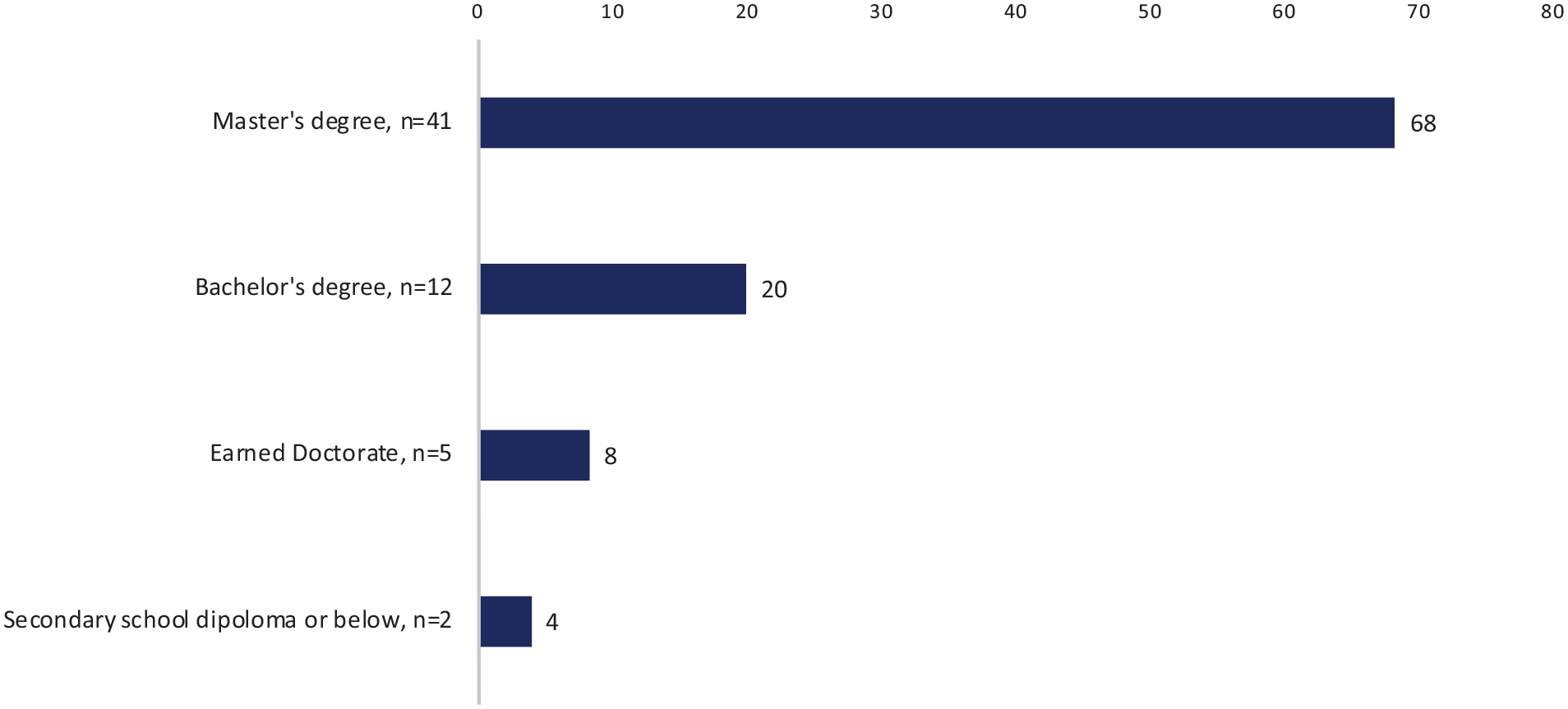
Education (in percentages).
Surveys
Similar to the interviews, the majority of the survey participants were skilled immigrants (61%, see Appendix 2 for a detailed demographics of survey participants). About 43% of the respondents moved to Canada from 2011 onwards. In terms of participant age, about 71% of the respondents were in the age range of 30–49 years. Over 90% of the participants had university degrees (see Figure 2). Most were married, and about 85% of survey participants reported that they had children (see Appendix 2).
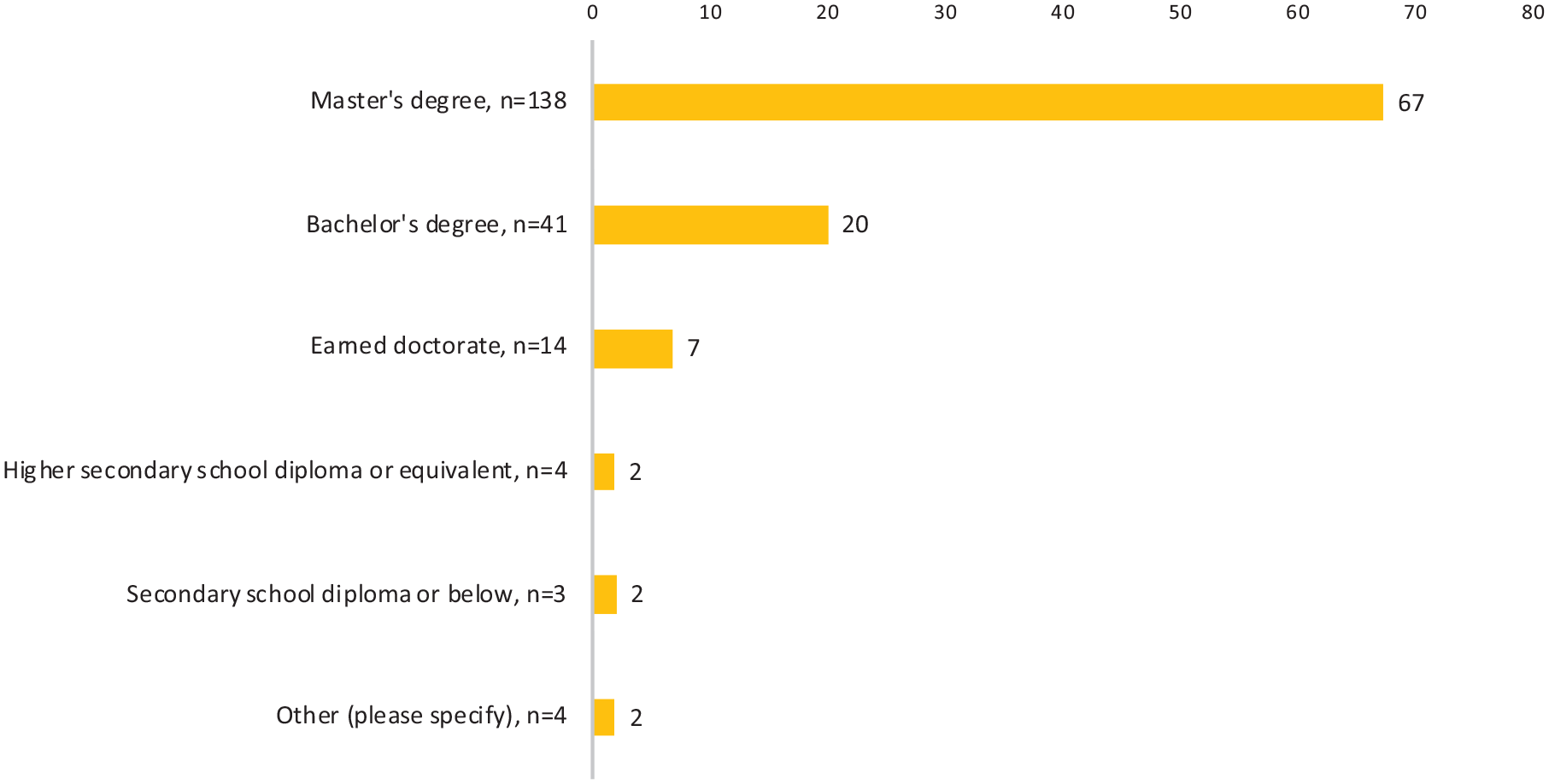
Education (in percentages).
Data analysis
Interviews
Interview data was coded using NVivo12. The author used Braun and Clarke’s (2006) six-phase “thematic analysis” approach for interview data coding and analysis. The author, a Bangladeshi native speaker, transcribed and reread the transcriptions. The initial coding of the interviews was created using the qualitative data analysis tool NVivo 12. During this stage, particular attention was given to address the research questions of the larger study. After that, the author combined codes into potential themes and checked and rechecked potential themes with their relevancy with the coded extracts. In the following phase, the author created and revised potential themes and named and renamed the themes when needed. For example, the initial coding “misconception/perception of life about Canada” was renamed as “lack of information about the reality.” Finally, the codes were organized logically for analysis and presentation.
The author, who speaks Bengali, translated all the quotes from Bengali to English. The translation was done with every effort to retain the participants’ voice. For example, the author kept the English words mentioned by the participants as is, even though in some cases, they were not grammatically correct.
Surveys
The survey data analysis was performed with the help of SPSS software. Survey data are mostly presented using frequency tables, figures, and chi-squares. Chi-square tests were used to identify whether there exists any significant association between variables such as the use of post-arrival information sources and occupational status.
Findings of the study
The findings of this study are divided into two main categories: I—employment as the core settlement concern, underutilization of skills and education, and occupational status and II—settlement information sources, first job information sources, and occupational status. In the interview data, the themes “employment as the core settlement concern” and “underutilization of skills and education” of Bangladeshi immigrants emerged (see Shuva, 2020a for a detailed description of coding and thematic analysis used in the larger study). Under Category I, the article first reports the findings of the surveys and then describes the interview findings that suggest the settlement aspect “employment” as the core concern as well as underutilization of skills and education among Bangladeshi participants. Finally, Category I reports the findings from the survey that mirrored the underutilization of immigrants’ skills by illustrating participants’ occupational status in Canada. In Category II, the article first shows the settlement information sources (both pre- and post-arrival) and the first job information sources of Bangladeshi immigrants. In this category, the article also reports findings on the cross-tabulations on the information sources Bangladeshi immigrants utilized and their occupational status in Canada.
Employment as the core settlement concern and underutilization of skills and education
A majority of Bangladeshi immigrants are highly educated and move to Canada with their dependents as skilled immigrants. In this context, trying to obtain professional positions makes sense. In the following section, the article begins by providing data from surveys on the pre- and post-arrival information needs that highlight employment as one of the core settlement information needs of Bangladeshi immigrants in Canada in the pre- and post-arrival contexts.
Survey participants were asked to report the importance of the pre-arrival and post-arrival need 5 for information based on their own experiences by using a five-point Likert-type scale where 1 = not at all important and 5 = extremely important (see Figures 3 and 4). As shown in Figure 3, employment is among the top five pre-arrival needs of Bangladeshi immigrants. Figure 4 shows employment-related information needs as one of the top three post-arrival information needs. About 82% of the participants indicated “Employment information” such as available jobs in Canada, how to get a job, to be very important, or extremely important in the pre-arrival context (see Figure 3). Similarly, about 89% claimed “Employment information” to be very important or extremely important in the post-arrival context (see Figure 4).
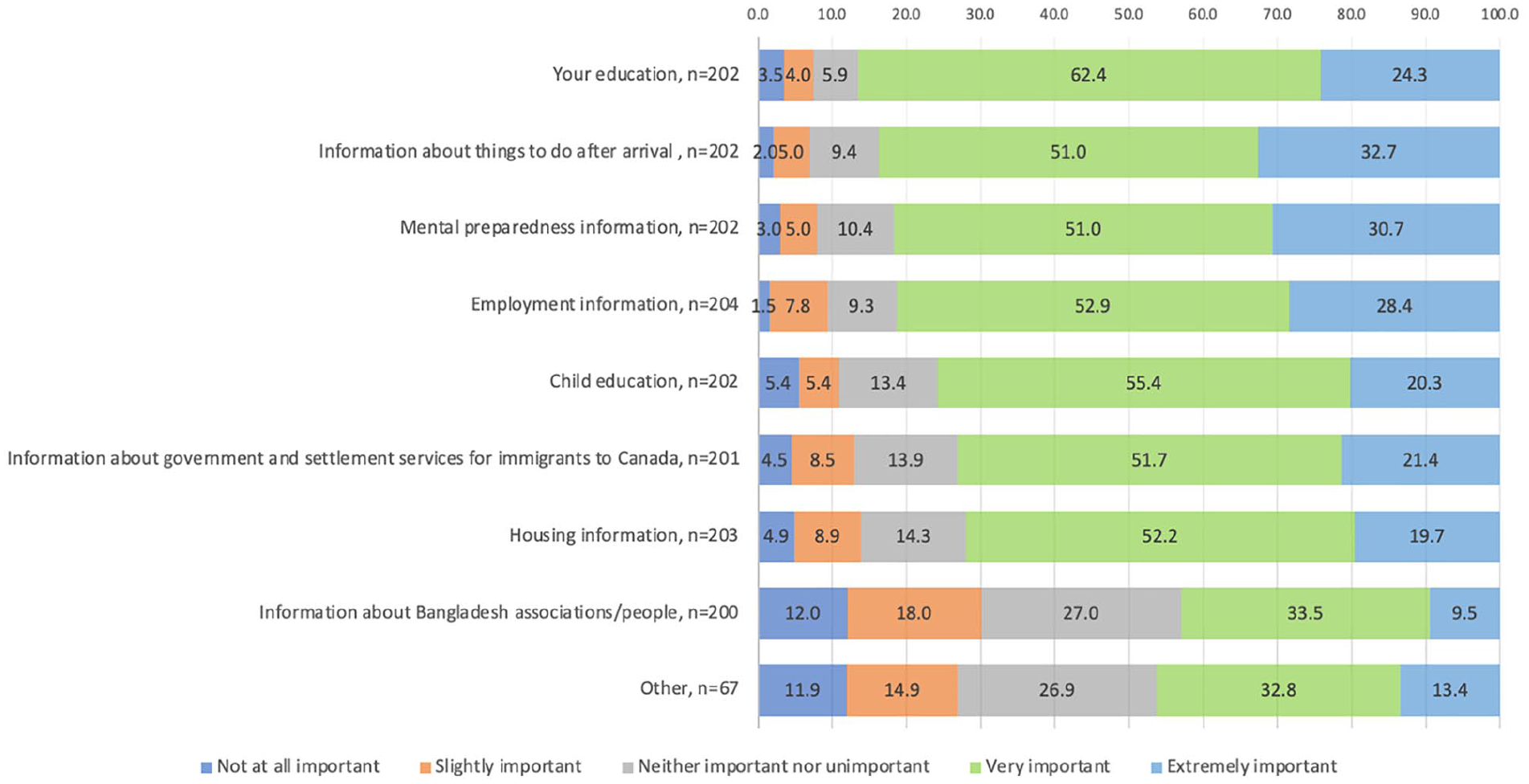
Pre-arrival information needs (in percentages).
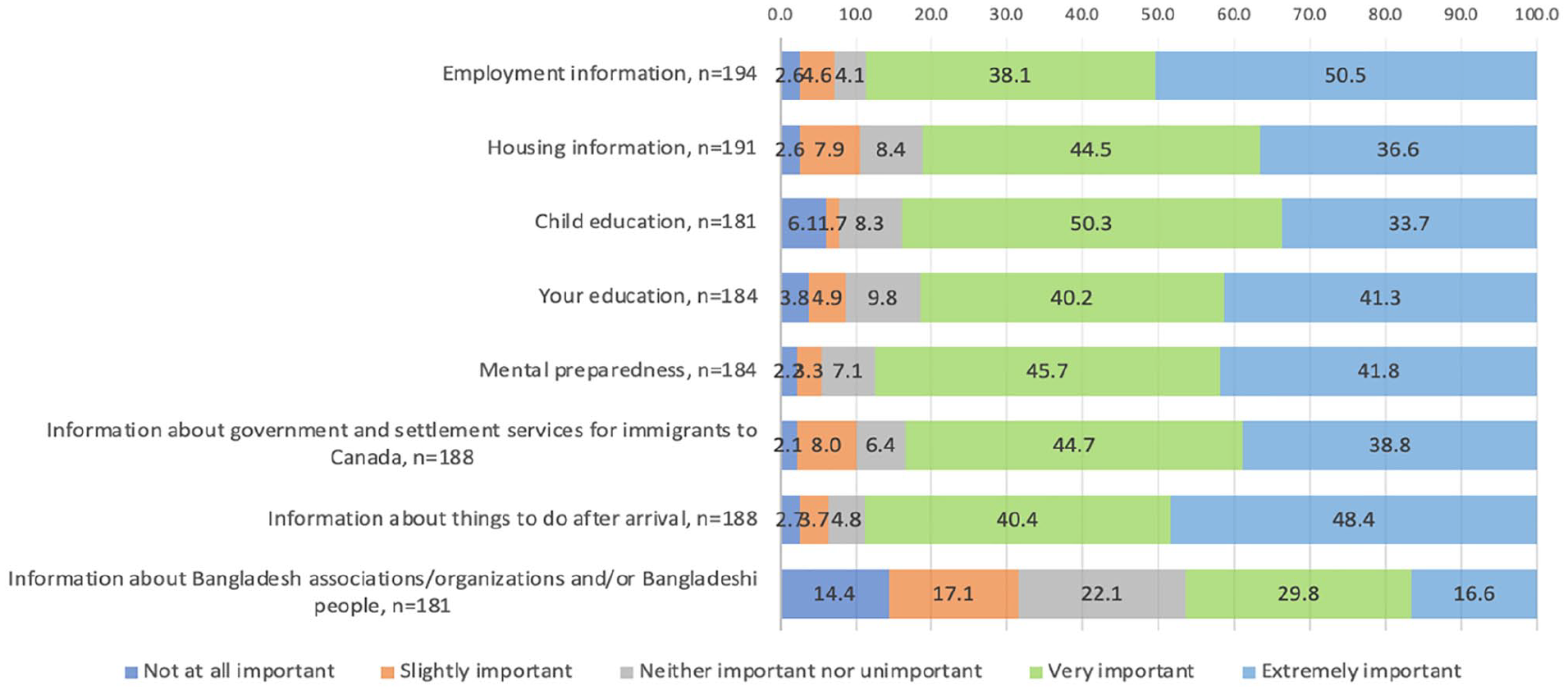
Post-arrival information needs (in percentages).
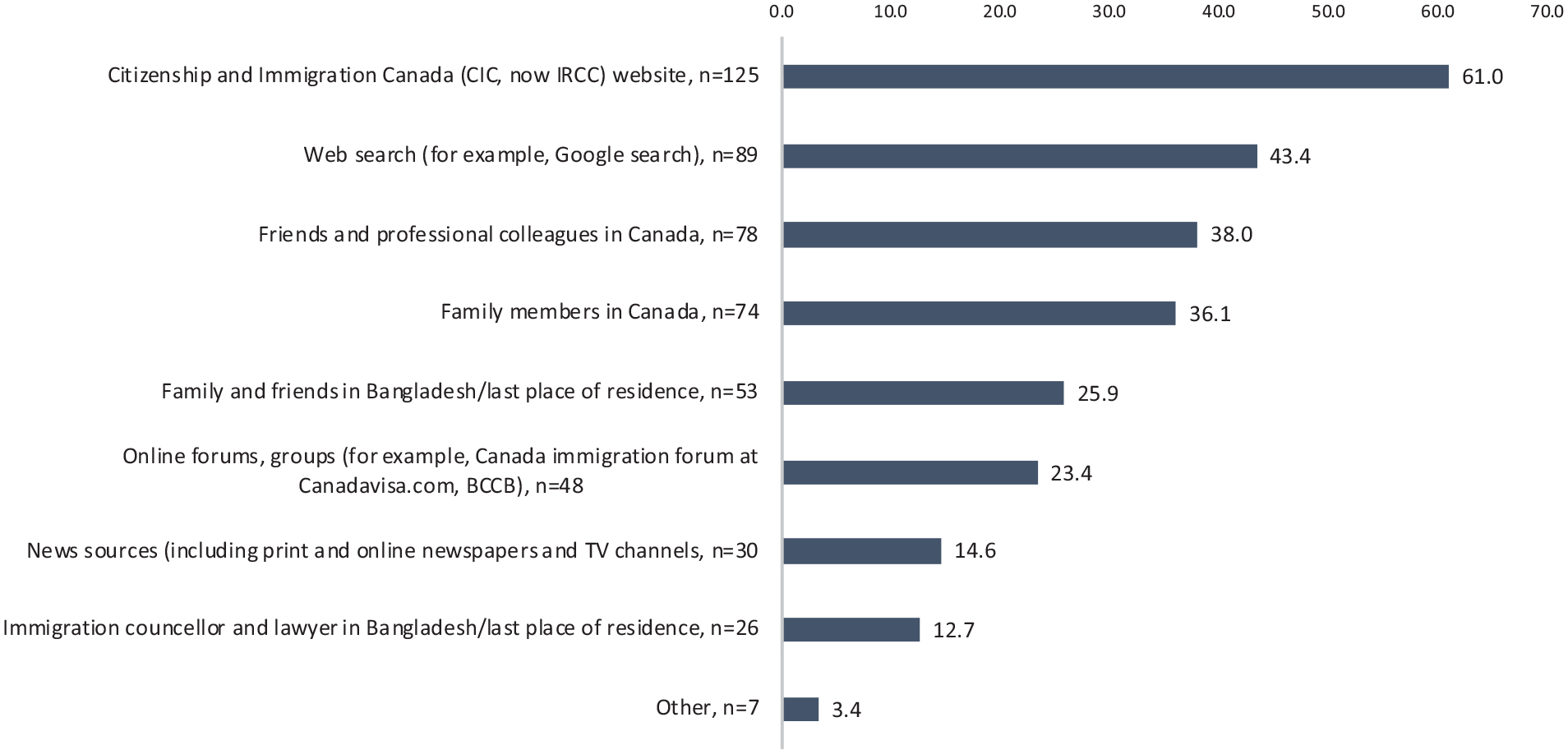
Pre-arrival information sources (in percentages).
In the interviews, not surprisingly, many participants also reported requiring employment-related information to understand the employment system in Canada before arrival and to prepare themselves for the Canadian job market. After arrival, interviewees reported extensively looking for employment-related information.
Interview participants reported employment-related settlement concerns as one of the core concerns of their settlement into Canadian society. They recounted their struggle to create and maintain their professional identity after arrival. Many interview participants who were not able to settle in their professions and had to work in other areas, including doing low-skilled jobs, reported their dissatisfaction with their employment status in Canada. While describing their dissatisfaction, many participants claimed to not know about the employment system and culture in Canada before arrival, leading them to make uninformed decisions about their immigration to Canada. The series of stories told by many interview participants also, directly and indirectly, refer to the lack of pre-arrival information about what it meant to be a skilled immigrant in Canada and the barriers that newcomers face while settling in their profession. Therefore, the accounts told by many participants do not just capture the employment-related concerns and dissatisfactions, but they also show us the role that information could play in constructing reasonable expectations about Canadian lives after arrival. For example, Lopa, an agricultural professional from Bangladesh,
6
(Toronto, 2011) expected to be able to work in the agricultural sector in Canada after arrival. She went through various employment-related challenges and was not even able to get a survival job initially. Lopa never anticipated that she would have to pursue post-secondary education related to pharmaceutical technology after arrival, completely different from what she was trained for. Although she was working as a full-time employee in a pharmaceutical company at the time of the interview, she emphasized her dissatisfaction with not being able to maintain her professional identity in Canada and the lack of information about the Canadian employment system before arrival: If I knew before arrival, the [employment] situation in Canada is like this, I would not come. I would not even plan to move if [I knew] I have to [struggle] for the [professional] job. I thought I will get a related job. I moved here through skilled migration.
Similar to Lopa, Babu (Toronto, 2011), a physician from Bangladesh, quoting his friend, expressed his dissatisfaction with his employment status in Canada and how his status affected his mental health. In his words: I always feel bad. I don’t mentally feel good as when I feel [think] I won’t be able to return to my profession. I still have to think about switching to the second profession, I do not feel good.
Not surprisingly, for many interview participants the employment-related settlement has been the center of their settlement and life satisfaction in Canada. Nipa (Toronto, 2013), a doctor from Bangladesh wanted to work as a physician’s assistant (not even aiming to practice medicine as a doctor in Canada) and described the importance of settling in a professional job: After arrival, what happened is that all my thoughts are related to [settling in] my profession (laughing). . . .Because if that is okay [profession], other things are okay actually. Normal regular life is not difficult [in Canada].
Another participant, Liton (Toronto, 2001), in the following excerpt, describes newcomers’ initiatives to find professional jobs after arrival: You will notice one thing—everyone very much tries to do whatever they did back home initially. And, they do it in a proper way. Later they probably bypass [change].
At the time of the interview, Jahid (Barrie, 2014), a computer professional from Bangladesh, was facing many challenges finding professional work. He describes his eagerness to settle in a professional job in Canada: If you want to stay in the same field [profession] that’s a big challenge. If I try for the odd job or a normal job, I would probably get it. I do not want to enter those jobs at this point in time. I am taking my time as I studied here. If I find [a job] in the same or related field, that would be better for me.
Another participant, Istiaq (Ajax, 2000), tried everything, including attending workshops, consulting settlement services, as well as pursuing a relevant course for getting work as an engineer after his arrival in Canada. He claimed that he is happy with all aspects of his life in Canada except for his professional job status: Professional job satisfaction is never comparable to anything. I am okay now. There is job satisfaction. But you do not get the same level of satisfaction like a professional job.
On the contrary, Dolly (Toronto, 2017), a senior bank official from Bangladesh, after realizing she would not get the same position in Canada and would have to start over, decided not to pursue any career in Canada. At the time of the interview, she was staying home taking care of her children. She told me that she cried almost every day in the first 6 months after she arrived in Canada, thinking that she ruined her professional career in Bangladesh.
Throughout the series of interviews, participants describe episode after episode of depression, frustration, apathy, and confusion. Asif (Mississauga, 2005, English), formerly a banker in Bangladesh, describes the tension he feels between being content with life in Canada, and his dissatisfaction with his work: I already told you this: social security and law and order, I am happy with these. And, whatever about my job, about my job situation, that one I am not satisfied with. Overall, my family is happy. The rest of the [family] member is happy. So, I am thinking it’s okay, whatever, I am happy. Average happy.
A physician from Bangladesh, Nipa (Toronto, 2013), recounts her professional career in Bangladesh and described how not being able to settle in a professional job affects her mental health: [Took a deep breath] Life actually, I like the regular life here. However, if I think about my professional life, I feel really bad. My career there [back home], my future was very bright. I did an MS (first part) in [name of the specialization] there. And, I completed FCPS (Fellow of College of Physicians and Surgeons) in surgery first part. [Deep breath]. Then I left everything back home and moved here. I feel bad because of this, sometimes. Although I feel bad . . .feel a little bad then after sometimes it is gone. I sometimes get depressed. That [depression] is related to that [professional status]. I do not feel bad for other things [in Canada].
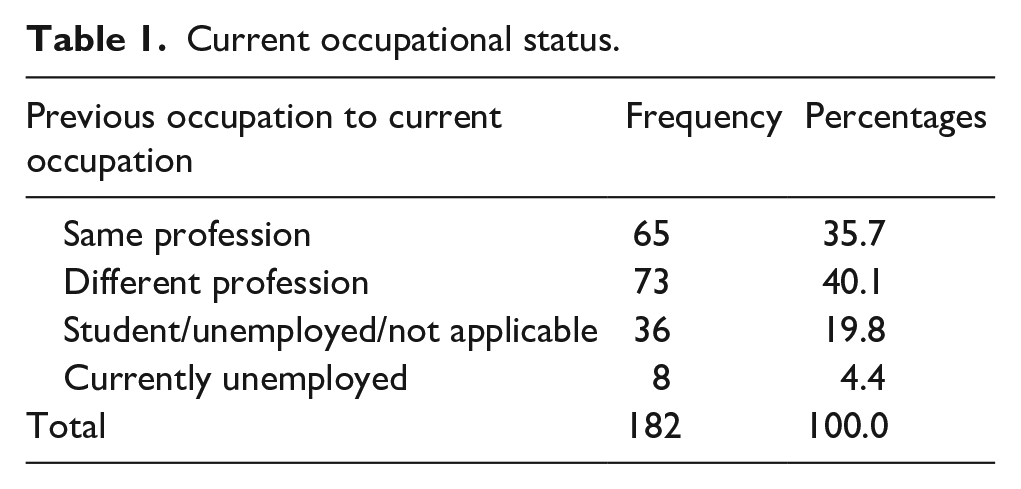
Underutilization of skills and education among Bangladeshi skilled immigrants and their dependents are also evident in the survey data. In the following, the author reports a similar trend among survey participants, where many Bangladeshi immigrants who participated in this study were unable to settle in their professional jobs in Canada. Survey participants were asked to write their previous occupation in Bangladesh or last place of residence, and their current occupation in Canada at the time of the survey. The author coded the survey data on the previous and current occupation to identify how many survey participants work in the same occupation and how many of them changed their occupation after moving to Canada to better understand the utilization of Bangladeshi immigrants’ previous skill and education in Canada.
The data on the previous and current occupation were coded into four categories. If a respondent was a banker before arrival and worked in a bank in Canada, the author considered the person to be working in the same occupation. The author did not consider their specific position focusing instead on the broad occupational sector. For example, if a person was working as a Manager of a bank in Bangladesh but worked as a teller in Canada, the author still considered them to be working in the same profession. Those who mentioned a current profession but did not mention their previous profession were categorized under student/unemployed/not applicable. For example, participant 104 mentioned his current profession as a “lunch supervisor” but did not indicate his previous occupation/profession. Therefore, he was placed under a student/unemployed/not applicable category. Also, participants who were unemployed before arrival in Canada and were still unemployed were also placed under student/unemployed/not applicable category. Participants who were previously working before moving to Canada, but were now unemployed, were placed in the currently unemployed category. For example, participant 6 who was working as an informatics officer before coming here, but at the time of the survey was unemployed, thus is placed under the currently unemployed category.
As is evident in Table 1, a majority of the participants (n = 73, 40.1%) worked in different occupations after moving to Canada. The result suggests a significant loss in the utilization of immigrants’ previous background and skills. Only about one-third of the participants were able to land in a profession similar to their previous job in Bangladesh or their last place of residence.
Current occupational status.
Settlement information sources, first job information sources, and occupational status
The interviewees reported utilizing various information sources for meeting their settlement information needs, including employment-related information needs. Among the sources reported are their friends and professional colleagues in the pre- and post-arrival contexts. Survey participants also reported significantly relying on their friends and professional colleagues 7 in Canada in the pre- and post-arrival contexts (see Figures 5 and 6). In the pre-arrival context, friends and professional colleagues in Canada were among the top three pre-arrival information sources. About 38% of the survey participants reported consulting their friends and professional colleagues for gathering settlement information in the pre-arrival context (see Figure 5). In the post-arrival context, friends and professional colleagues in Canada were the top information source. About 52.2% of the respondents reported using friends and professional colleagues in gathering information on various aspects of their settlement in the post-arrival context (see Figure 6).
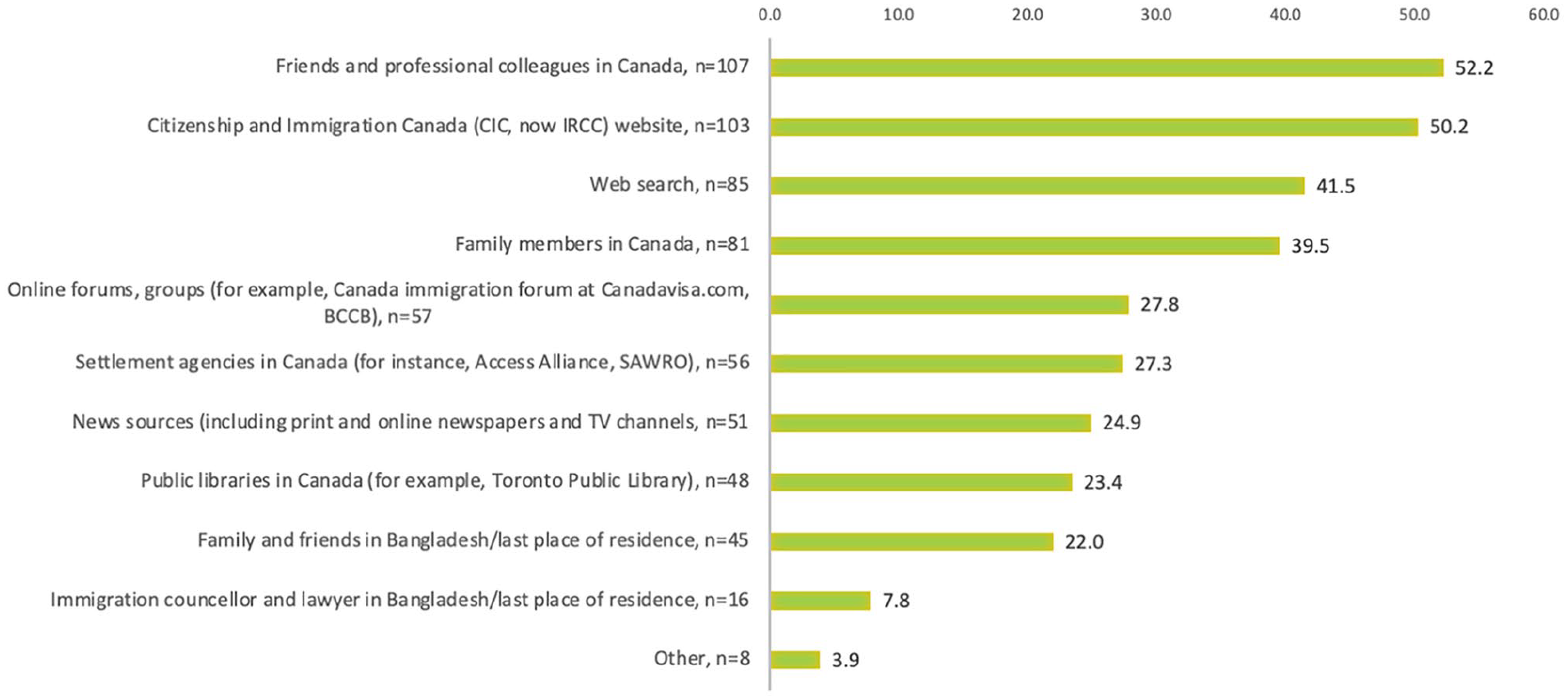
Post-arrival information sources (in percentages.
Among the information sources utilized, many interview participants claimed to obtain numerous benefits related to their occupational status 8 in Canada through their friends and professional colleagues.
For example, Mamun (Toronto, 2002), a pharmacy graduate from Bangladesh, who was working at a pharmaceutical company, claimed to get a professional job in a pharmaceutical company without much hassle because of his professional network: My waiting period for starting a [professional] job was not that long as I had [professional connections] links here. I moved here in August 2012 and started in my professional job, though not at the same level [like back home] in three months, in December. Usually, what immigrants face after arrival due to information gaps [looking for information] such as where should we go, what should we do, where we can get the real information, I had all that information before arrival. I had that information because I have many senior friends or my batchmates [classmates from the University of Dhaka, Bangladesh] here in [Canada].
Bornali (Ottawa, 2003) and her husband moved to a Canadian metropolitan city in 2003 and were struggling to find professional jobs. Their friends, who had been more successful in this regard, recommended that they leave that particular city and look for jobs across Canada. Bornali describes how that piece of information helped them gain professional positions: We were told one thing. They [our friends] told us to leave [name of the city]. Once you leave [name of the city], you will be successful. Then my husband [moved to] [name of the city], he did not know the city at that time. If they did not give us the information, we would do odd jobs. Because we moved there and there was less job competition, we got the jobs. Otherwise, we may not get it.
Another participant, Masud (London, 2012), spent almost 2 years looking for a professional job in the city he was living in after his graduation, but he was not successful in obtaining one. His chances of getting a professional job changed overnight after his friend told him about professional opportunities in his city, known for its mining industry. Masud describes how the information helped him: He was in [name of the city]. He told me there is a big mining industry in his city. I had no idea about that before. . . He first advised me to begin applying for jobs in [name of the city]. He also told me about a job site, one I was not using. [He] told me about a job bank. That was probably a government job site. Based on what he said, I started contacting employment agencies in [name of the city] and started applying for jobs there and, decided to move there shortly. . . And, a week after my decision to move there, I received an interview call from an employer, and I got the job.
A recent immigrant, Shumi (Toronto, 2017), an HR (Human Resources), a professional from Bangladesh learned about a professional bridging program from one of her professional colleagues and pursued the program after her arrival: From my friend [I learned about the program]. He is also in HR. He was my manager [back home]. He was also in HR. He did the bridging program after arrival. So, I also did that bridging program.
Another recent immigrant, Farid (Toronto, 2015), a banking professional in Canada, also experienced the benefits of connecting with professional colleagues: I actually got my first job through my ex-colleague [from Bangladesh]. He moved here two years before I arrived. So, he helped me write up my CV and then he passed it on to my current boss. So, I got the job that way [through help from my professional colleague].
Alam (Ajax, 2014), who regularly used various information sources to meet his everyday life information needs, claimed that unless we receive information from someone who is from the same background and facing the same situations, we need to verify the reliability of the information we gather from other sources. Another recent immigrant, Shomrat (Toronto, 2017), claimed that consulting professional networks over friends and relatives is beneficial as there is less chance of information being “customized.” He received extensive professional advice from his professional networks before and after his arrival in Canada.
Not all Bangladeshi participants had access to professional networks in their settlement contexts. Some interviews describe what it means to not have strong professional networks in Canada. A physician from Bangladesh, Nipa (Toronto, 2013), claimed that not getting professional information in Canada similar to that in Bangladesh was a challenge for her information acquisition in Canada: Nipa: Actually, as we are Bangladeshi, it was easy to get things [information] from here and there [in Bangladesh]. It is tough [to get professional information] here as I know only a few professional people [in Canada]. And, whatever they share those [with others]. It takes time to know any professional updates, I mean we do not get it immediately. Like this. This is just. . . [an information challenge]. Nafiz: So, you face challenges getting profession-related information? Nipa: Yes, face challenges.
Another physician from Bangladesh, Babu (Toronto, 2013), claimed how not having professional colleagues affected his and his wife’s (a Bangladeshi physician) professional employment-related settlement in Canada, because of the lack of information related to settling in a professional job. He claimed that as they did not have professional friends in Canada, they did not get professional guidance on what to do to settle in a professional job in Canada. He also reported not receiving any information about the reality of life in Canada and the numerous challenges newcomers face with their settlement before arrival. He claimed that if he had been aware of the challenges that newcomers face, he would not have moved to Canada, leaving a prestigious job in Bangladesh.
As many interview participants reported the benefits of having professional colleagues in finding professional jobs, the author conducted some cross-tabulations on the survey data on the post-arrival information sources and occupational status of Bangladeshi immigrants. The results of the cross-tabulations show that there is no significant association between the post-arrival information sources utilized by the participants and their occupational status, except for the use of friends and professional colleagues in Canada (p-value = 0.014, see Table 2). In other words, the information source captured by the concept of friends and professional colleagues in Canada has a significant association with the current occupational status of the participants, unlike any other post-arrival information sources. Furthermore, looking at the survey data on friends and professional colleagues as a post-arrival information source and the occupational status, it is clear that the proportion of those who got work in the same occupations is high for those who utilized friends and professional colleagues as their post-arrival information source (37%) compared with those who did not (32.9%, see Table 3). Moreover, Table 3 also shows that about one-third of the survey participants who did not have access to friends and professional colleagues in Canada can be categorized as being a student/unemployed, which is quite a high number compared with those who utilized friends and professional colleagues (16%).
Post-arrival information sources and same/different/other occupations (cross-tabulations).
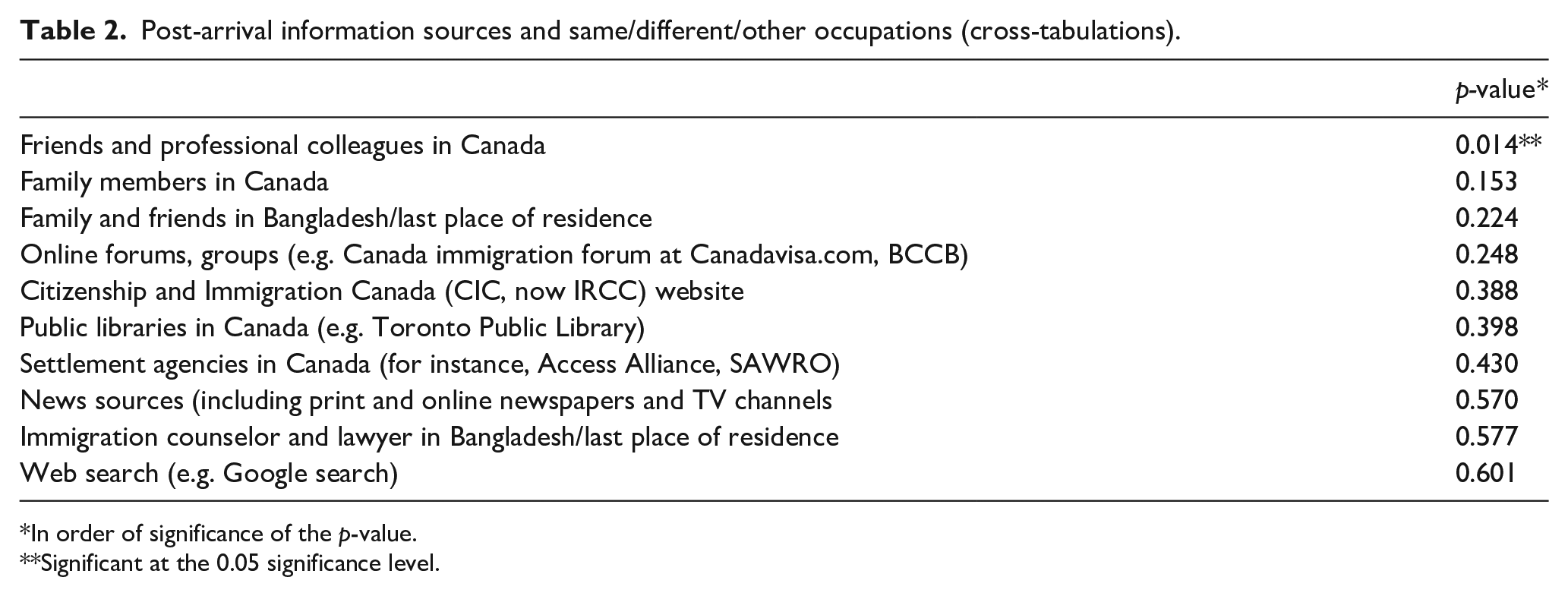
In order of significance of the p-value.
Significant at the 0.05 significance level.
Friends and professional colleagues and occupational status in Canada.

To capture a more complete understanding of the effect of an information source on one’s employment status, survey participants were also asked to report on the first job information source in Canada, in addition to the general post-arrival information sources they reported earlier. In other words, participants were asked to indicate the information sources they utilized when searching for their first job in Canada after arrival. Figure 7 shows the first job information sources as mentioned by the survey participants.
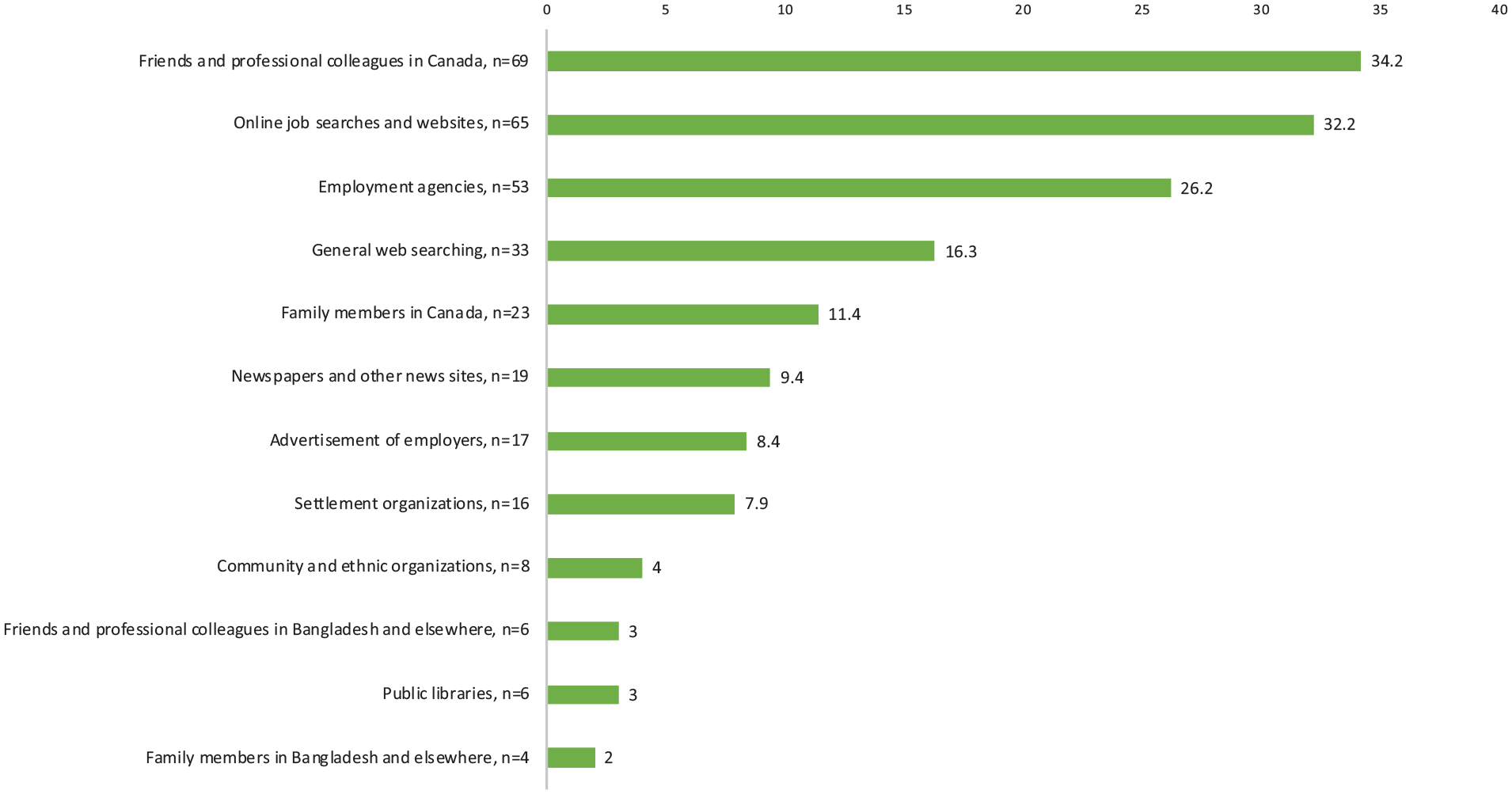
First job information sources (in percentages).
As is evident in Figure 7, the top three first job information sources include friends and professional colleagues in Canada (34.2%), online job searches and websites (32.2%), and employment agencies (26.2%).
Similar to the cross-tabulations on the post-arrival information sources and the occupational status of Bangladeshi immigrants, the author also conducted some cross-tabulations on the association between first job information sources and occupational status in Canada. The results mirror the previous tests on post-arrival information sources and occupation status, as first job information sources do not have any association with the occupation status of the participants except for information sources represented by friends and professional colleagues in Canada (p-value = 0.004, see Table 4). Furthermore, looking at the survey data on friends and professional colleagues as first job information sources and the occupational status (see Table 5), the data suggest that the proportion of those who got work in the same occupations is high for those who utilized friends and professional colleagues as their first job information sources (47%) compared with those who did not (29%). Also, the proportion of participants settling in other categories (student/unemployment) is significantly lower for those who utilized friends and professional colleagues as their first job information source compared with those who did not (31.4%).
First job information sources and occupational status (professional status) in Canada (cross-tabulations).
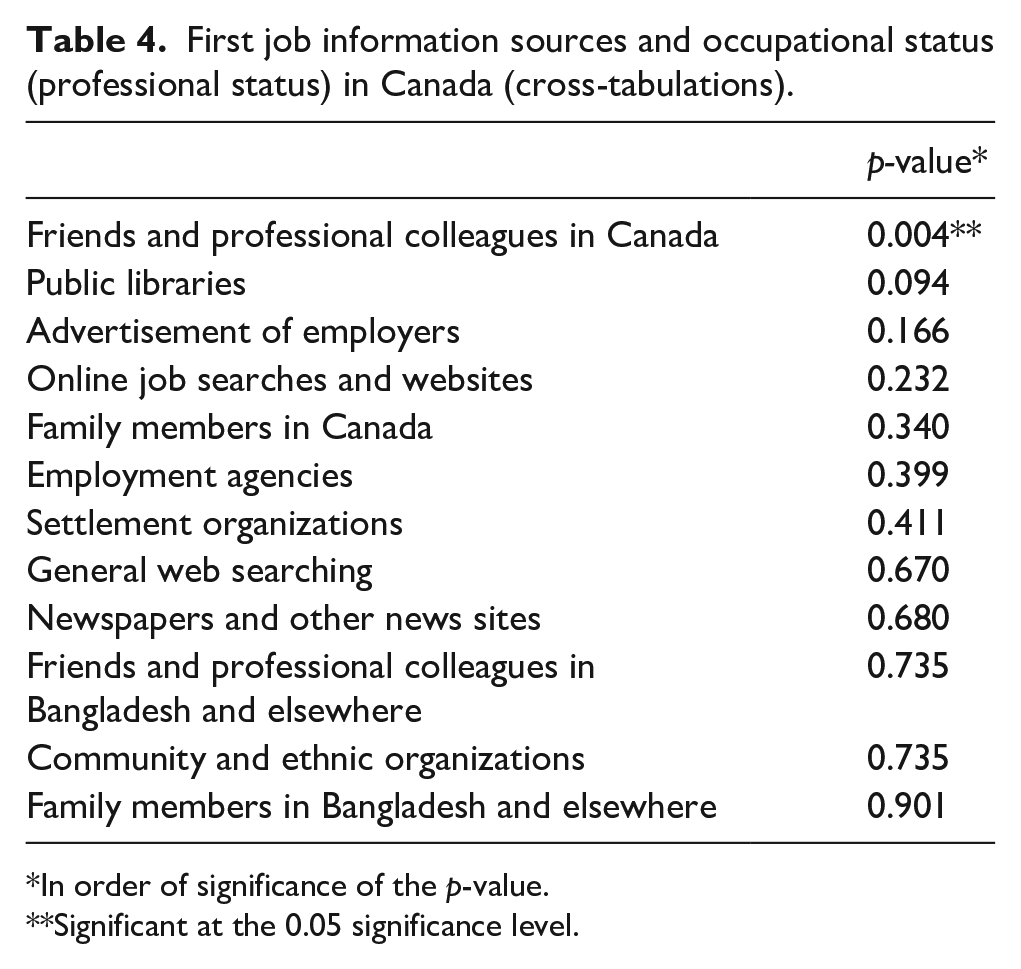
In order of significance of the p-value.
Significant at the 0.05 significance level.
Friends and professional colleagues as a first job information source and occupational status.

Overall, the interview and survey findings show that friends and professional colleagues as a post-arrival information source play a significant role over other information sources in helping newcomers obtain work in similar occupations. The finding is not surprising but it is, nonetheless, an important finding that has not been highlighted by previous information behavior studies on immigrants, in particular, in the LIS context.
Discussion
This study finds that Bangladeshi immigrants require various settlement information in the pre- and post-arrival contexts, and utilize a broad array of settlement information sources, including formal and informal information sources such as Citizenship and Immigration Canada (CIC, now IRCC), web search, friends and professional colleagues, family members in Canada, and online forums and groups. However, a heavy dependence on information networks such as friends and family in meeting the settlement information needs in the pre- and post-arrival contexts is also evident in this study. Similar dependency among newcomers and immigrants on informal information networks for meeting settlement information needs are also evident in studies on immigrants globally by Allard (2015), Esses et al. (2013b), Fisher et al. (2004), Khoir (2016), Komito and Bates (2011), Lingel (2011) and Rayes et al. (2016). Therefore, the answer to the research question of how newcomers seek information in the pre- and post-arrival contexts is that Bangladeshi immigrants in this study seek settlement information from a variety of information sources in meeting their information needs in the pre- and post-arrival contexts.
With regard to employment-related information seeking, the participants of this study reported utilizing various employment-related information sources for obtaining their first job, including friends and professional colleagues in Canada, online job searches and websites, employment agencies, general web searches, and family members in Canada. Similar to the pre- and post-arrival information sources, for employment-related information, both survey and interview participants reported depending heavily on their informal information networks such as friends and professional colleagues. Many interview participants of this study also reported receiving various benefits such as access to professional guidance and connecting with potential employers, because of their access to their professional networks in Canada.
Although this study highlights the importance of professional colleagues in newcomers’ settlement in Canada, other informal information networks such as family and broader co-ethnic community members may not always be useful in newcomers’ employment-related settlement in a new country. A recent study by Shuva (2020b) reports immigrants having negative information experiences while consulting their informal networks, including friends, family, and the broader ethnic community network. In many cases, the participants of Shuva’s study received demotivating, discouraging information from the broader co-ethnic community networks in Canada. Previous studies such as the work of Marshall et al. (2020) with young Polish women in the United Kingdom and Audunson et al. (2011) with immigrant women in Norway also show immigrants avoiding their co-ethnic community networks because of their distrust and negative experiences. Some participants of Allard and Caidi’s (2018) study also reported not receiving career-related benefits from their social networks, while they did receive benefits from utilizing official information sources. Further studies are warranted to understand the culturally situated settlement information behavior of various immigrant groups and the usefulness of formal and informal information networks in their settlement in a new country.
The centrality of the employment-related settlement among skilled immigrants and their dependents are evident in this study. However, many participants reported not being able to utilize their education and skills in Canada, leading to frustrations and dissatisfaction with their employment-related settlement in Canada. Although there have been some studies on various immigrant groups such as Allard (2015), Khoir (2016), and Silvio (2006) in LIS that looked at the settlement information behavior of newcomers and immigrants, the importance of employment-related settlement has not received much attention previously. Although studies across the globe such as Allard (2015), Khoir (2016), Silvio (2006), and Mason and Lamain (2007) report immigrants utilizing various information sources to meet their settlement information needs, mainly in the post-arrival context, we still do not know much about the usefulness of the information sources in their employment-related settlement in a new country. This study empirically shows the benefits of using friends and professional colleagues in newcomers’ employment-related settlement in a new country. Many interview participants reported obtaining various employment-related benefits in Canada because of their access to professional colleagues. The interview findings are also echoed in the survey findings that show a significant association among the use of friends and professional colleagues as settlement information sources (in the pre- and post-arrival contexts) and occupational status. Previous studies such as that of George and Chaze (2009) and Hynie et al. (2011) also report that newcomers received many benefits such as accommodation, finding employment, and mental support from their social networks in the host country, including co-ethnic friends and family members. Therefore, the answer to the research question of what sources of information are useful for newcomers’ employment-related settlement in a new country is that not all settlement information sources are useful for newcomers’ employment-related settlement. The information source “friends and professional colleagues” seemed to be beneficial for newcomers’ employment-related settlement as they are usually able to help newcomers by providing employment-related information/advice and connect with potential employers. The usefulness of various information sources needs to be researched further in the LIS and interdisciplinary contexts to understand the value of formal and informal information sources in the contexts of immigrants’ settlement, in particular, their employment-related settlement.
Although a significant number of Bangladeshi immigrants did report using professional networks for their employment-related settlement in Canada, many participants did not have access to professional networks in Canada. They faced many challenges gathering information and guidance on settling in a professional career in Canada. The finding related to the unique challenges skilled immigrants and their dependents face due to the lack of access to the professional networks has significance for Canadian federal investments that support newcomers with pre- and post-arrival settlement. A recent report by IRCC (2018b) shows the very low usage of pre-arrival settlement services among eligible immigrants worldwide. Similarly, studies by Esses et al. (2013a, 2013b), Sethi (2015), Islam (2014) also report a significant number of immigrants not utilizing post-arrival settlement services after arrival in Canada. Shuva (2020a) reports that one of the core reasons that immigrants do not use or do not recommend settlement services to other immigrants was due to the lack of need-based employment-related settlement services. Some participants of Shuva (2020a) considered settlement services a waste of time as they were not able to guide them through initiatives to land a professional job in Canada. A recent study by Mabi (2020) also reports participants utilizing very few employment-related settlement services in Canada and highlights the importance of providing relevant settlement services. Therefore, the Federal Government of Canada, provincial governments, and settlement agencies offering services to skilled immigrant groups need to identify the unique needs of skilled immigrants and their dependents and help them connect with professional networks in Canada. Helping newcomers create professional networks in Canada would be a “win–win” situation for both newcomers and the Federal Government of Canada. On one hand, newcomers will be able to get better suggestions and guidance for achieving their professional goals in the Canadian context from their professional networks, and on the other hand, they will be able to better contribute to the Canadian economy by utilizing their previous education and skills in Canada. Further studies are warranted to understand how settlement agencies, including Canadian public libraries offering newcomers’ settlement service, can play a better role for newcomers with their professional goals, especially those having no access to friends or professional colleagues in Canada.
Conclusion
This study reports the centrality of employment in newcomers’ settlement in a new country. The Bangladeshi immigrants in this study reported requiring various information needs in the pre- and post-arrival contexts; however, employment has been one of their core settlement needs. Not surprisingly, as most of the participants of this study and their dependents were skilled immigrants with a university education before arrival in Canada, they expected to be able to settle in their professional jobs after arrival in Canada. Many interview participants of this study described their frustration of not being able to utilize their previous education and skills and settle in their professional jobs. They reported utilizing various information sources such as friends and professional colleagues, online job searchers, and employment agencies in the post-arrival context. Among the sources they utilized the study revealed that access to friends and professional colleagues in Canada was beneficial for Bangladeshi immigrants’ employment-related settlement. The findings related to the benefits of having friends and professional colleagues in the host country for newcomers’ have implications in LIS, especially in the context of newcomers’ employment-related settlement. In LIS, previous studies on immigrants tend to focus on reporting the information sources newcomers utilize over their usefulness or effect on newcomers’ employment-related settlement. This study highlights the importance of exploring the benefits of various settlement information sources on newcomers’ settlement in a new country, and not just reporting the sources. Further research in interdisciplinary contexts would be necessary to understand the actual benefits newcomers to a new country receive because of their access to various formal and informal information networks.
Although the findings of this study report a significant relationship among newcomers’ settlement information source “friends and professional colleagues” and their occupational status in Canada, caution should be made when interpreting the data. The findings of this study are not generalizable because of the selection of non-probability sampling strategies. Also, because of the limitations of time and resources the study was not able to comprehensibly study some vulnerable Bangladeshi immigrant groups such as immigrants with limited education and English language proficiency; therefore, we do not know the benefits of friends and professional colleagues for vulnerable immigrant groups. Moreover, the study would have captured the benefits of professional colleagues in Canada much better if it would have divided the term friends and professional colleagues into two categories as (1) friends and (2) professional colleagues. Future studies should divide friends and professional colleagues into two separate categories and gather a comprehensive understanding of their impact on newcomers’ employment-related settlement in a new country.
Given the lack of our comprehensive understanding of the settlement information behavior of diverse immigrant groups, the author calls for further studies on immigrants’ settlement information behavior, in particular, employment-related information behavior of immigrants and the role information plays in their settlement in a new country. Further studies like this would be useful for countries like Australia, Canada, New Zealand, the United Kingdom, and the United States, which actively recruit skilled immigrants and their dependents regularly to better understand newcomers’ employment-related expectations about life in a new country, their settlement needs, challenges they face utilizing their skill and education in the host country, and the various settlement information sources they use as well as their effect on their employment-related settlement. The studies on newcomers’ employment-related information behavior would be useful for various governments welcoming immigrants across the globe to make appropriate policies (such partnering with co-ethnic professional networks) and introduce timely, need-based services for diverse immigrant groups with socioeconomic status and huge employment-related expectations. Future studies might address the following questions: What is the employment-related settlement information behavior of newcomers with diverse socioeconomic backgrounds? What information sources are useful in settling in a professional or alternative job in a new country? What role does co-ethnic community play (do not play) in newcomers’ employment-related settlement? What role do government sectioned settlement agencies play (or can play) in helping newcomers settle in their professional job or switch to an alternative career in a new country environment?
Footnotes
Appendix
Survey demographics.
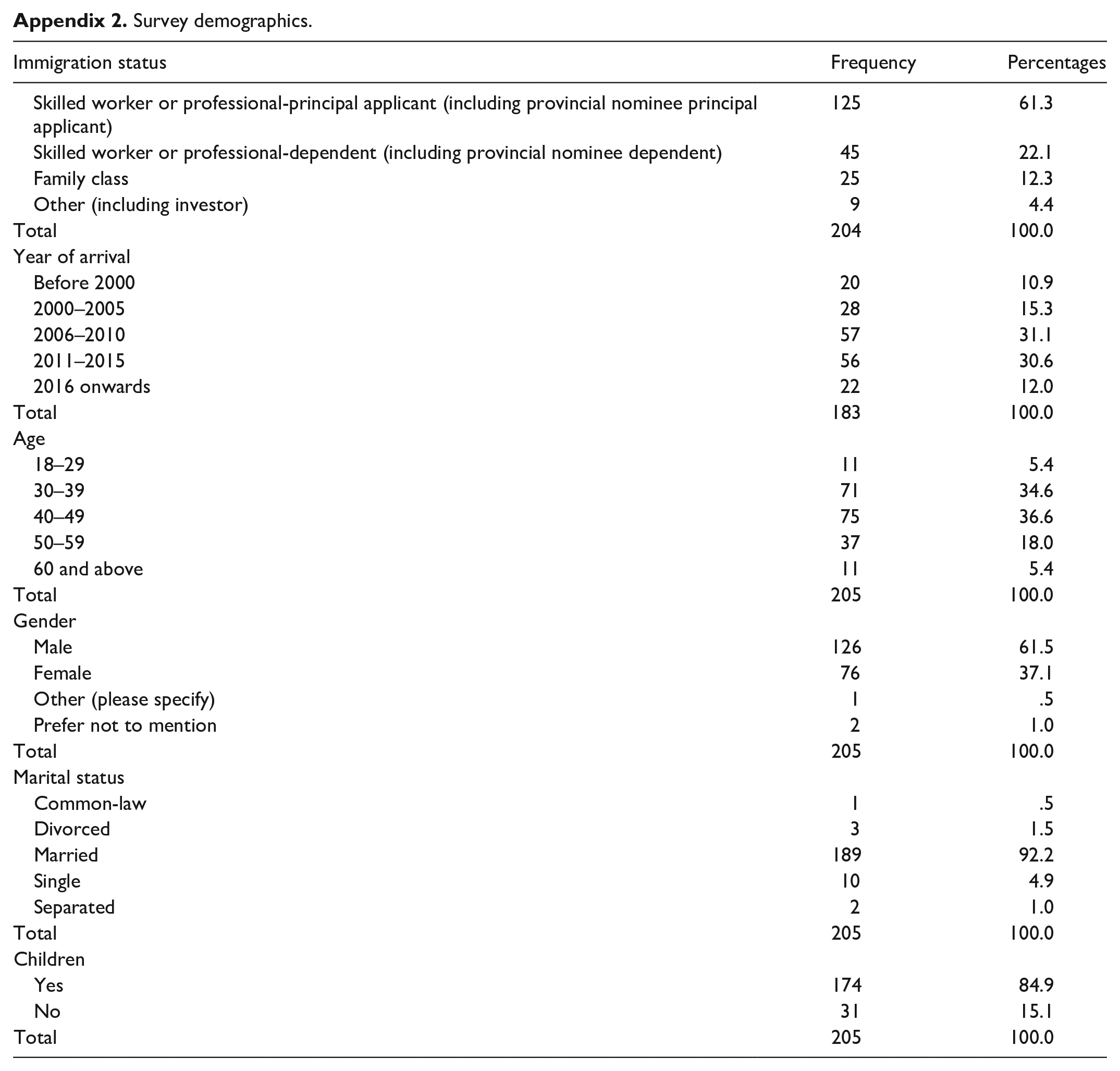
| Immigration status | Frequency | Percentages |
|---|---|---|
| Skilled worker or professional-principal applicant (including provincial nominee principal applicant) | 125 | 61.3 |
| Skilled worker or professional-dependent (including provincial nominee dependent) | 45 | 22.1 |
| Family class | 25 | 12.3 |
| Other (including investor) | 9 | 4.4 |
| Total | 204 | 100.0 |
| Year of arrival | ||
| Before 2000 | 20 | 10.9 |
| 2000–2005 | 28 | 15.3 |
| 2006–2010 | 57 | 31.1 |
| 2011–2015 | 56 | 30.6 |
| 2016 onwards | 22 | 12.0 |
| Total | 183 | 100.0 |
| Age | ||
| 18–29 | 11 | 5.4 |
| 30–39 | 71 | 34.6 |
| 40–49 | 75 | 36.6 |
| 50–59 | 37 | 18.0 |
| 60 and above | 11 | 5.4 |
| Total | 205 | 100.0 |
| Gender | ||
| Male | 126 | 61.5 |
| Female | 76 | 37.1 |
| Other (please specify) | 1 | .5 |
| Prefer not to mention | 2 | 1.0 |
| Total | 205 | 100.0 |
| Marital status | ||
| Common-law | 1 | .5 |
| Divorced | 3 | 1.5 |
| Married | 189 | 92.2 |
| Single | 10 | 4.9 |
| Separated | 2 | 1.0 |
| Total | 205 | 100.0 |
| Children | ||
| Yes | 174 | 84.9 |
| No | 31 | 15.1 |
| Total | 205 | 100.0 |
Acknowledgements
The author thanks the anonymous reviewers for their careful assessment of the paper. The author also expresses his sincere gratitude to the participants of this study, and for the support of the Bangladeshi community organizations in completing the larger project.
Declaration of conflicting interests
The author(s) declared no potential conflicts of interest with respect to the research, authorship, and/or publication of this article.
Funding
The author(s) received no financial support for the research, authorship, and/or publication of this article.
