




Abstract
The discourses of information literacy practice create epistemological assumptions about how the practice should happen, who should be responsible and under what conditions instruction should be given. This paper employs a discourse analysis method (Potter, 2008) to identify discourses of information literacy and the learner from within higher education focused professional texts. Texts analysed include 4 recent English-language models of information literacy and 16 textbooks. Analysis suggests that within higher education, information literacy is shaped by 2 conflicting narratives. The outward facing narrative positions information literacy as an empowering practice that equips learners with the knowledge and skills that they need within complex and fast-paced information environments. The inward facing narrative positions learners as incompetent or as lacking the ability to operate within higher education. This deficit perception consequently threatens the sustainability of information literacy practice by reframing empowerment as a process of top-down behaviour modification. This paper represents the first in a research programme that interrogates the epistemological premises and discourses of information literacy within higher education.
Keywords
Introduction
Discourses that surround information literacy create epistemological assumptions about the shape of practice, who benefits and under what conditions instruction should be given. In the higher education (HE) sector, these discourses are referenced (in part) through professional documents that play a key role in guiding research and practice in the field, and include institutional models of practice, textbooks and explanatory materials. However, few studies have attempted to examine these professional documents in detail and, more specifically, the discourses that are presented therein. The study reported here attempts to peel back these layers to understand how these documents position information literacy as well as one of the key stakeholders within this arena—the learner. The goal is to interrogate institutional approaches to the practice of information literacy within higher education (ILiHE) and to reflect on its sustainability as a core practice of student learning. While institutional approaches to information literacy may be effective for many groups of librarians (e.g. Gross et al., 2018), the central role that these documents play within professional teaching narratives means that it is vital that researchers continue to critically interrogate both the messages that they promote and the ensuing impact on practice and its practitioners.
This research represents one phase of a broader programme of study that is unpacking the discourses of HE related to information literacy, students as learners and librarians as professional practitioners. The study reported here has a specific focus on the ways in which information literacy and learners are positioned within professional texts. Future phases will interrogate the librarian’s role. To this end, the questions that we are responding to in this paper are as follows:
How does the discourse of ILiHE position information literacy practice in professional guidelines, models and texts?
How does the discourse of ILiHE position learners in professional guidelines, models and texts?
These discourses are examined through a careful reading of key HE-focused information literacy documents. Information literacy documents, which include institutional guidelines and professional texts, play a fundamental role in shaping information literacy discourse within the HE sector. Institutional guidelines for information literacy, for example, which are designed and promoted by professional associations, outline core models and understandings of information literacy as well as suggested curricula for instruction. Centring on describing ‘shared academic values’ (Association of College and Research Libraries (ACRL), 2020), these documents formally articulate instruction librarians’ professional expertise, both to themselves as well as to people outside their profession. They also determine practice by controlling how this expertise is understood by members of a profession (cf. Hicks and VanScoy, 2019: 34), for instance, by shaping job descriptions and ongoing training, and external stakeholders, by generating ‘conversations across governing bodies in higher education’ (Drabinski, 2015). The influence of these documents underscores their endorsement by professional associations, who represent ‘mature professional culture’ as well as profession-specific practical knowledge (Hicks and VanScoy, 2019: 36). Professional culture is further shaped by professional texts, which include educational materials such as textbooks and practical teaching manuals. These texts, which are designed to guide the creation of appropriate teaching activities, shape information literacy discourse by reinforcing basic principles of professional knowledge as well as directing ongoing professional development.
The broad range of purposes to which information literacy professional documents are put have led us to characterise information literacy discourse in terms of inward and outward facing narratives. In this study, we view outward facing narratives as establishing the ‘story of information literacy’ or as the means through which librarians articulate their purpose and role to external stakeholders and the community with whom they work. In contrast, we understand inward facing narratives as internal storylines that focus on issues faced by the organisation and are often used to justify current practices. Together, the inward and outward facing narratives drive the operationalisation of information literacy practice within a specific sector. Significant research has been carried out into the ways in which information literacy has been understood and taught within HE (e.g. Elmborg, 2006; Gross et al., 2018). However, this paper suggests that a focus on disentangling inward and outward facing narratives will facilitate a more detailed understanding of information literacy discourse and the ways in which it enables and constrains practice. More importantly, an examination of the points of tension between these narratives will shed light on the sustainable aspects of ILiHE or its ongoing contribution to the project of HE.
Literature review
Professional practice has been identified as one of the three dominant foci of the information literacy narrative, along with policy-making-texts and empirical or theoretically grounded research (Pilerot and Lindberg, 2011). Within the professional practice strand of literature, guidelines and models for advancing information literacy education have played an important role in shaping the dominant discourse. Early HE information literacy models (e.g. ACRL, 2000; SCONUL, 1999) that emerged in response to educational reform movements in the latter half of the twentieth century (ALA, 1989), centred professional practice upon establishing and assessing the ‘specific indicators that identify a student as information literate’ (ALA, 1989). However, the growth of empirical information literacy research (e.g. Bruce, 1997; Lloyd, 2005), the increasing impact of educational theory upon HE teaching activities (e.g. Cooperstein and Kocevar-Weidinger, 2004) and the rise of critical information literacy (e.g. Elmborg, 2006; Jacobs, 2008) meant that by the early 2000s, opposition to these early models constituted ‘a significant portion of the theoretical “voice” of IL thinking’ (Buschman, 2009: 96). This criticism subsequently led to the establishment of a second, constructivist wave of information literacy models for HE settings (Hicks and Lloyd, 2016). Encompassing revisions to old models (ACRL, 2016; SCONUL, 2011) as well as the creation of new models, that is, ANCIL (Secker and Coonan, 2011a, 2011b); Metaliteracy (Mackey and Jacobson, 2011), these guidelines aimed to update and ‘rehabilitate’ (Coonan, 2011: 20) information literacy instruction for dynamic and changing information environments. In further drawing attention to information literacy concepts rather than competencies, these guidelines marked a meaningful shift in focus for a field that has typically emphasised positivist methods of instruction.
The advent of these new information literacy models has had a number of interesting repercussions upon the professional discourses that shape the HE sector. Most prominently, institutionally sponsored moves to encompass constructivist models of information literacy have been credited with revitalising inward-facing information literacy narratives. The feedback and commentary (over 1000 pages) that the creation of the ACRL Framework provoked (ACRL, 2014), demonstrates how changes to information literacy models have brought questions of pedagogy to the forefront of professional discourse, including critical, feminist and anti-racist approaches (e.g. Pagowsky and McElroy, 2016; Pashia and Critten, 2019). At the same time, the emphasis upon conceptual ideas rather than teaching practices has also led to a growing publishing industry of textbooks that are designed to help librarians translate these models into assessment and teaching practices (see Appendix 1). The same difficulties have further catalysed a resurgence of interest in the VALUE Rubric for information literacy, a standards-based model that was published by the Association of American Universities and Colleges in 2013 (AACU, 2013). The plethora of new professional documents has also had an impact on outward-facing narratives of information literacy. For some librarians, points of alignment between the ACRL Framework (ACRL, 2016) and the Framework for Success in Postsecondary Writing (Council of Writing Programme Administrators et al., 2011) have sparked a powerful future direction for educational discourse (Maid and D’Angelo, 2016; Norgaard and Sinkinson, 2016). Others, however, argue that in an environment ‘where compliance and accountability are standards-based’, the imposition of models of information literacy that reject standards-based education risk ceding and diminishing librarians’ power in conversations about student learning in HE (Drabinski and Sitar, 2016: 60).
Surprisingly, there has been little broad analysis of the implications of these developments or the content of these documents, including the ways in which they position information literacy. To date, Martin’s (2013) examination of four British information literacy models constitutes one of the few attempts to study these documents in detail. While she notes a shared tendency to position information literacy as holistic, flexible and part of lifelong learning within the UK, her work pre-dates recent US models of practice. There has also been a noticeable lack of research that has attempted to appraise these new models of information literacy, beyond a number of small-scale critiques of the ACRL Framework (e.g. Bombaro, 2016; Hicks and Lloyd, 2016; Morgan, 2015; Rapchak, 2019; Seale, 2016; Wilkinson, 2014). A handful of studies have carried out comparative examinations of national and international information literacy policy documents (also see Drabinski, 2015, for an examination of two historic ACRL documents). Whitworth’s (2011) study of six national policy documents notes that information literacy is often framed functionally but his work remains limited to first-generation understandings of information literacy and policies that incorporate a focus on primary and secondary schooling as well as HE. Pilerot and Lindberg (2011) observe a parallel focus on linear processes and fixed text and information technology (IT)-based skills within their examination of two United Nations Educational, Scientific and Cultural Organization (UNESCO) sponsored information literacy documents, although, as with Whitworth’s study, their work is focused on general rather than HE specific documents. These oversights provide an important justification for the study reported here.
The learner has featured even less prominently within research that examines information literacy models and documents. Historically, the focus on measurable, behaviour-focused information literacy assessment practices meant that learners did not fare particularly well within professional practice literature. Marginalised groups, in particular, have tended to be singled out, with international students being variously labelled as passive, uncritical and superficial learners (Hicks, 2016) and first-generation students positioned as criminals and problems to be solved (for a review see Ilett, 2019). Although this discourse is dated, Ilett’s article illustrates how versions of this discourse continue to appear over 30 years later. Most recently, a series of articles has drawn attention to the implications of this discourse. Building on earlier research that explores what students do rather than what they do not do in relation to a dominant group (e.g. Green, 2010; Hicks, 2019; Reyes et al., 2018), librarians have employed strengths-based pedagogy (Folk, 2018; Heinbach et al., 2019; Krutkowski, 2017; Morrison, 2018) to identify and challenge deficit thinking narratives within HE-focused information literacy instruction. While this work, which also challenges concepts of grit and a growth mind-set (Tewell, 2020), draws attention to the experiences of specific groups of students, there has been little corresponding examination of the ways in which learners are presented within the institutionally focused professional documents that guide the construction of instructional opportunities.
Although information literacy research has been slow to acknowledge the issues that cultural stereotyping and the devaluing of student ways of knowing poses within the classroom, recent steps to address these issues have certain underexplored parallels with Library and Information Science research that critically reflects on both the construction and assumptions of user-centred research. Of particular relevance to the current study is work that has illustrated how a focus on individual, internal cognition has led to the construction of ‘ignorant’ (Frohmann, 1992) ‘needy’ (Olsson, 2005) and ‘worthy’ (McKenzie, 2019) users. Tuominen’s (1997) work tracing the impact of these assumptions within Kuhlthau’s information-seeking process further draws attention to the mechanisms of power and the questions of control that underscore the positioning of specific social groups. It is in studies that have explored young library users, however, that these ideas can perhaps be seen most vividly. While youth are seen as constituting an ‘important’ user group, research neatly demonstrates how pedagogical discourses position them as ‘troublesome’ (Hedemark et al., 2005) or as ‘problem patrons’ (Chelton, 2001) due to non-standardised library usage. Echoes of these ideas can also be seen in Given’s (2002) work, where an exploration of mature student information needs inadvertently reveals how academic discourses position traditionally aged (18- to 24-year-old) students as unmotivated, immature and, occasionally, unethical. The implications of these ideas on the construction of professional understanding provides another important rationale for this study.
Theoretical framework
The study reported here uses positioning theory (Davies and Harré, 1990; Harré and Van Langenhove, 1999) as a framework to understand how the discourses that frame ILiHE construct and position the concept of information literacy, and the learner within HE. Positioning theory focuses on ‘how people use words (and discourse of all types) to locate themselves and others’ (Moghaddam and Harré, 2010: 2). Emerging through the work of Davies, Harré and van Langenhove, positioning theory draws upon the idea that people speak and act from a position, which is defined as ‘a cluster of rights, duties, and obligations’ (Harré and Slocum, 2003: 108). The recognition that it is with words that we ‘ascribe rights and claim them for ourselves and place duties on others’ (Moghaddam and Harré, 2010: 3) means that positioning is also seen as a productive process that involves both the social construction of ‘culturally imagined types’ (Holland and Leander, 2004: 130) and the moral codes that structure these narratives. Located within a constructivist framework, positioning theory forms a useful way to understand interactions between actors and the discursive texts related to their practices. Within the context of the current study, the use of positioning theory facilitates insight into the ways in which the discourses of ILiHE create a specific type of interaction and way of doing information literacy within HE. As Slocum-Bradley (2010: 81) points out, it is only by understanding ‘how we construct social reality, we can construct more consciously to sustain norms that promote the ends we profess to desire’.
Positioning theory has been employed within a handful of librarianship and information science (LIS) studies to explore the impact of discursive positioning upon information seeking and behaviour (Given, 2002; McKenzie, 2004). Typically adopted to demonstrate how information needs are constructed and negotiated through conversation, the use of positioning theory has revealed how performative (first order) and accountive (second and third order) positioning impacts a person’s opportunities to engage with information. An acceptance of medical professional positioning in both McKenzie (2004) and Rivano Eckerdal’s (2011) studies of health contexts, for example, is seen to support information seeking by legitimising identities and storylines. Along the same lines, a failure to recognise the adult learner discourse in Given’s (2002) study of academic context demonstrates how positioning can also frustrate information behaviours. Beyond information use, these studies also hint at the impact of positioning on professional practice; a midwife’s use of storytelling to establish a student’s legitimacy in McKenzie’s (2004) study of pregnancy illustrates the important role that positioning plays in constructing competent practice. Julien and Given’s (2003) examination of the ways in which instruction librarians position teaching faculty on a professional mailing list provides another indication of the impact that the categorisation of certain user groups can have upon the design of teaching opportunities. However, while these studies expose the subtle ways in which discursive practices shape social life, there has been little exploration of the impact of positioning on professional discourse and the documents in which practitioners’ knowledge is codified. The limited emphasis on power and moral positioning creates another key rationale for the current research programme.
Methods
The study employed a discourse analysis method to identify discourses related to information literacy and the learner from within HE focused professional texts. Discourse analysis refers to ‘a cluster of related methods for studying language use and its role in social life’ (Potter, 2008: 218). Centring on exploring the ways in which discourse, which encompasses ‘all forms of spoken interaction, formal and informal, and written texts of all kinds’ (Potter and Wetherell, 1987: 7), creates and sustains social life (Potter, 2008: 219), discourse analysis acknowledges the social construction of reality as well as the multiplicity of this construction. Within this research, discourses are conceptualised as complex networks of relationships that interweave between and enmesh people, texts and ideas, leading them to enact practices within agreed-upon boundaries. In the context of information literacy, discourse shapes the ways of knowing that are legitimised within practice, including the characteristics of information literacy or the principles and assumptions that guide action as well as the possibilities for the practice to be shared with others in HE settings. The important role that professional documents play in shaping these narratives means that a discourse analytical approach facilitates useful insight into the discursive understandings that guide and frame the ways in which information literacy is constructed within HE.
Discourse analysis has not been widely used as a research method within information literacy literature. While a discourse analytic approach has been positioned as one of the three major theoretical perspectives used in information literacy research (Limberg et al., 2012), studies have tended to critically examine epistemological assumptions within information literacy narratives (e.g. Kapitzke, 2003; Pawley, 2003) rather than specifically employing a discourse analysis method. Exceptions include Walton and Cleland (2014) and Cope (2009), who used a discourse analysis method to examine questions of power within the classroom, and Sample (2017), who explored US definitions of information literacy. Discourse analysis methods have also been used within the broader field of LIS to unpack representations of library users (e.g. Hedemark et al., 2005; McKenzie, 2019) as well as close readings of institutional documents, including library mission statements (e.g. Aldrich, 2007; Crawford Barniskis, 2016), strategic plans (e.g. McKay, 2017), and service philosophy statements (e.g. Moffett and Weare, 2018), among other texts. The complexity of organisations means that discourse analysis has formed a useful way to understand both a library’s values as well as the activities that are ‘allowed’ within professional practice (Crawford Barniskis, 2016: 135). Relatedly, critical discourse analysis has been applied within examinations of reference and information service professional competency documents (Brook et al., 2015; Emmelhainz et al., 2017; Hicks and VanScoy, 2019). Noting that competency documents codify specific professional behaviours, critical discourse analysis proved to be an effective way to uncover ‘gendered language and ideas’ (Emmelheinz et al., 2017: 39), the enforcement of racial boundaries and White Institutional Presence within academic libraries (Brook et al., 2015) as well as normative and simplistic understandings of expertise (Hicks and VanScoy, 2019).
Sample and data analysis
The study reported here employed a discourse analysis method to identify and interrogate discourses related to information literacy and learners from within HE focused professional texts. Texts that were analysed included preambles to four major English-language information literacy models that have been published since 2010: the ACRL Framework for Information Literacy (2016), Metaliteracy (Mackey and Jacobson, 2011), SCONUL’s 7 Pillars of Information Literacy (2011), and Secker and Coonan’s ANCIL model (2011). These models and guidelines were selected because of the prominent role that they play in shaping the United States and United Kingdom narrative of professional practice, and their institutional backing. They were also selected because the authors consider that they constitute part of a second wave of constructivist-focused information literacy models. This sampling criteria meant that the AACU (2013) VALUE rubric was excluded from consideration.
The study also analysed introductions to 16 books that specifically explored one of the four studied information literacy models. Titles were identified through an examination of the Worldcat database as well as relevant publisher websites, for example, Facet. Books were included in this subset of literature if they were published in English between 2010 and 2020, and specifically examined one of these models of information literacy. Books that examined threshold concepts were included in this sample because of the influence that this pedagogical idea had upon the ACRL Framework. Analysis focused on model preambles and book introductions (rather than the complete text) because of these sections’ focus on framing key information literacy concepts rather than classroom practice. Excluded from the sample were books that provided a general overview of information literacy or classroom instruction. Academic articles and conference proceedings were also excluded from the sample because of their typical focus on instructional design rather than the concept of information literacy. The final data set for analysis consisted of 148 pages of text.
Data analysis occurred in two phases. During the first phase, each author independently coded model preambles and book introductions for the ways in which both the concept of information literacy and the learner were positioned within each document. Forming an iterative and emergent process, this stage of the analysis centred on a close reading and re-reading of each text as well as an attempt to identify initial patterns, including differences and shared features (Potter and Wetherell, 1987: 168). Texts were also analysed ‘in their own right’ (Potter and Wetherell, 1987: 160), or for how the language in each document was used to establish and position key concepts rather than authorial motivation and intention. This process subsequently paved the way for more intensive second phase of the analysis, where the researchers came together to discuss their initial coding structures as well as the emerging coherency of the analysis. Data were then re-analysed by each researcher to produce the overarching discourse and its six subsidiary codes. These findings are presented below as indicative of the discourses that are represented within professional communications related to information literacy within the HE sector.
Limitations
Limitations of the study centre on the exclusion of empirical and critical articles from the study corpus. The emphasis on professional discourse means that this study is also limited by the focus on librarians’ representations of information literacy rather than other stakeholders’. However, given the prevalence and scope of institutional narratives of information literacy within current professional discourse, this study forms an important first attempt to disentangle competing beliefs and assumptions that shape information literacy teaching practices. The growing information literacy textbook industry, as well as the typical exclusion of textbooks from research that has employed a content or discourse analysis approach to explore information literacy (e.g. Sample, 2017), formed another reason to focus on this genre.
Findings and analysis
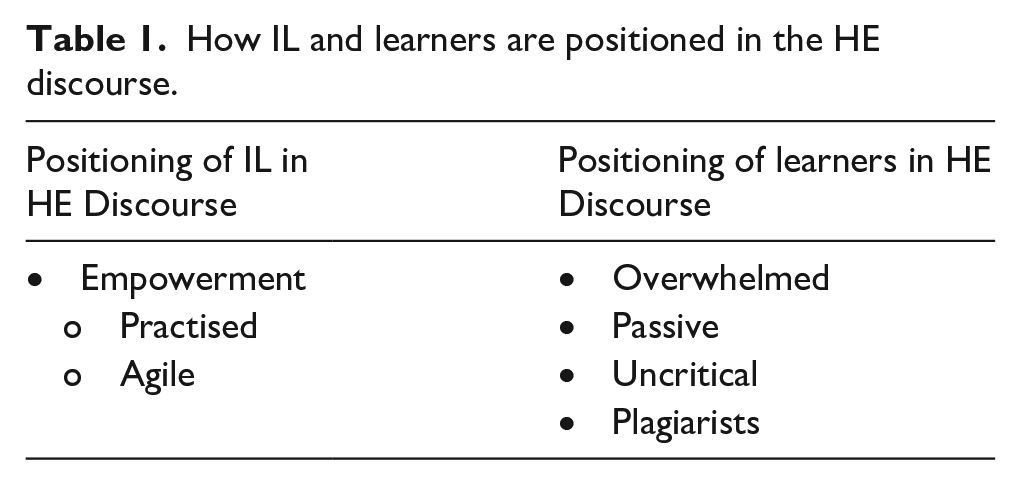
Analysis of the preambles to information literacy models and book introductions suggest the emergence of two distinct narrative (see Table 1). The outward-facing narrative positions ILiHE in terms of empowerment and as creating authority over increasingly diverse ways of knowing. In contrast, the inward-facing narrative positions learners as deficient or as lacking the capacity to navigate and succeed in complex HE information environments. These parallel discourses act to enable and constrain information literacy practice in HE.
How IL and learners are positioned in the HE discourse.
How is IL positioned as a practice in HE?
The documents that were analysed within this study reveal that information literacy is described as both practised and agile. Practised information literacy refers to the perceived timeless and generic shape of information activities. These ideas situate information literacy as a set of fixed ‘core’ (ACRL, 2016: 2; Bravender et al., 2015b: 3; SCONUL, 2011: 2), ‘foundational’ (ACRL, 2016: 2) or ‘fundamental’ skills and abilities (Bravender et al., 2015a: viii) that are seen to ‘underpin student learning’ (Secker and Coonan, 2011a: 4). The emphasis on central concepts consequently positions information literacy as timeless or as extending ‘beyond the structure and jargon of a particular time or place’ (Bravender et al., 2015b: 3) as well as ‘scalable, reproducible and accessible’ (Metaliteracy, n.d.) within a variety of contexts. It also means that information literacy is understood as something that can be mastered progressively as students engage with basic and subsequently more advanced concepts (Burkhardt, 2017: 6). Interestingly, these ideas suggest a continued reliance on skills-based understandings of information literacy that is at odds with librarians’ push towards constructivist thought.
The agile theme positions information literacy as transferable, transformative and reflective practice that centres on critical thinking and openness within changing information environments. In this theme, shifting (Hosier et al., 2014) and fast-moving (Webber, 2014: xvi) information environments mean that information literacy is understood to form a ‘flexible’ (ACRL, 2016: 2; Secker and Coonan, 2011a: 4) rather than a prescriptive (ACRL, 2016: 2) concept. The broad scope means that responsibility for information literacy is seen to be shared among campus partners (ACRL, 2016: 3; Secker and Coonan, 2011a: 4); it forms a concern for ‘everyone in the education sector’ (Secker and Coonan, 2012: xvii) rather than ‘the sole responsibility of librarians’ (Jacobson, 2018: xv). The emphasis on collaboration also means that information literacy is recognised to be ‘cyclical’ (Godbey et al., 2017: 3) or ‘non-linear’ (SCONUL, 2011: 4) rather than ‘something learned once and for all’ (Jacobson and Mackey, 2016: xv). These understandings of information literacy are more closely aligned with constructivist educational theory.
These two themes consequently fed into the major category of empowerment, which refers to the idea that information literacy, whether it is practised or agile, will ‘empower’ learners with the skills, attitudes, behaviours and understandings that they will need to make appropriate and informed choices within both current and future endeavours. While there is a certain tension between these two themes, a similar narrative of supporting and enabling practice was identified in each discourse. Along these lines, information literacy is seen to empower learners by providing them with ‘with a robust framework for handling new information situations’ (Secker and Coonan, 2011b: 4) across a range of educational contexts, learning spaces and lifelong learning experiences (Jacobson and Mackey, 2019: xix; Hosier et al., 2014). These ideas also gain strength through the connections that are made to other narratives of progress and empowerment; thus, the potential of information literacy is reinforced through its positioning within ‘educational reform movements’ (ACRL, 2016: 2) and broader life-changing educational experiences (Secker and Coonan, 2011a: 5). This overarching category of empowerment, which is constituted through agile and practised information literacy consequently establishes the contextual foundations of the practice in academic and educational sectors by authorising a specific epistemology (way of knowing) as well as legitimising knowledge claims. They also form the basis by which student practicing is evaluated and, in some cases, metrically assessed (e.g. Pinto, 2010).
How are learners in HE positioned by the IL discourse?
In contrast, book introductions analysed in this study position learners as lacking the capacity to learn the information skills associated with the practice of information literacy. Within this narrative, students are seen to be struggling under the weight of their deficit, which variously positions them as overwhelmed, passive, uncritical and plagiarisers.
Learners are positioned as overwhelmed when they are assumed to be unable to cope with an ‘oversaturated information ecosystem’ (Harmeyer and Baskin, 2018: xix) that drowns them in information (Hosier et al., 2014): students need to learn how to deal with the ocean of information that surrounds them. (Burkhardt, 2017: 10)
This framing positions information overload as limiting students’ ability and capacity to learn, thereby creating the conditions that produce learners who are either unable or unwilling to engage with concepts of information literacy.
Learners are positioned as passive when they display apathy or indifference (Oberlies and Mattson, 2018: xiv, xvii). Along these lines, learners are labelled as unmotivated when they are seen to devalue information literacy ideals: someone might be aware that they should carefully evaluate the information they find . . . yet not care enough to actually do it. (Hosier et al., 2014)
Learners are also seen to lack persistency (Burkhardt, 2017: 10) and to be stuck in a liminal state (Godbey et al., 2017: 4). Perceived indifference is further seen to be linked to an inability to deal with discomfort (Francis, 2017: 2) as well as the tendency to be overly dependent upon others: young people appear increasingly unable to carry out independent research, reluctant to argue and to challenge big ideas and to take risks to discover new knowledge. (Secker and Coonan, 2012: xvi)
Student passivity means they are subsequently positioned as uncritical of information sources as well as the actions of others. Within this theme, students’ lack of expertise within information environments creates a narrative of inflexibility and rigidity: students must be exposed to these ideas in multiple courses and challenged to make them their own. (Jacobson, 2018: xv) this process requires the researcher to be flexible . . . and to keep an open mind. (Burkhardt, 2017: 9)
An assumed lack of criticality further positions learners as ignorant of the skills and knowledge that they will need to be successful within today’s information environments: before an encounter with a threshold concept, the novice is in a blissful state of ignorance. (Godbey et al., 2017: 3)
More commonly, students are positioned as being blind to variation, or unable to distinguish between nuances within information environments: It means . . . not just reverting to long-standing habits only because they are familiar. (Hosier et al., 2014) Students tend to see all information sources as equal unless instructed otherwise. (Burkhardt, 2017: 7)
These issues subsequently lead to the labelling of students as plagiarisers, or as people who lack the capacity to understand the ethical obligations of academic practice. This framing positions students as disrespectful of other’s intellectual property as well as prone to making irresponsible decisions: ethical use of information is a concept that students struggle to understand. (Burkhardt, 2017: 7)
Together, ideas of passivity, plagiarism and a lack of criticality combine to construct a vivid and dominant picture of learners within HE settings.
Discussion
Information literacy discourse in HE is composed of both outward and inward-facing narratives. In the documents analysed as part of this study, the outward-facing narrative of information literacy positions the practice as empowering students by facilitating critically reflexive information interactions. In contrast, the inward-facing narrative positions students in HE as lacking the experience and motivation to learn and fulfil the rules of academic practice. The contrast between these narratives is conspicuous, but not unexpected. Deficiency could be interpreted as the rationale for the delivery of information literacy instruction; the development of requisite information skills and understandings will empower the learner to unlock their potential and make more informed and discerning decisions. This framing positions empowerment as a self-evident and human-centred good (McLaughlin, 2016: 124) that enables people (or communities) to ultimately ‘maximize the quality of their lives’ (Adams, 2008: 17). It further recognises information literacy in terms of progress (Seale, 2016), an approach to learning that aligns with classic narratives of betterment that have been traced within library discourse (e.g. McKenzie, 2019; Ross, 2009). From this perspective, patrons who take advantage of what the library, and more specifically what information literacy instruction has to offer, will be able to improve both themselves and their lot in life. Similar ideas are also visible within other ‘helping’ professions, such as social work (McLaughlin, 2016: 53).
However, this emancipatory message becomes violently skewed when student deficiency forms the basis for practice. Empowerment is a complex concept that has been evoked in a variety of different disciplines and social contexts for a variety of different purposes (McLaughlin, 2016). Linked to the workings of power, its contemporary usage has been explicitly examined in work designed to pursue political and personal change, in particular emancipatory education models (Freire, 1970) as well as Black Feminist (Hill Collins, 1990) and disability activist (Jankowski, 1997) attempts to articulate concerns. The concept of empowerment has since been institutionalised through its inclusion in contemporary political narratives (McLaughlin, 2016), a development which has obscured the roots of the concept as well as its original meaning. However, in developing from the wish to raise awareness of and resistance to oppression, the concept of empowerment can most broadly be understood as a consciousness-raising activity that centres on the shaping of collective political understanding and action (McLaughlin, 2016). Correspondingly, and from an information literacy perspective, empowerment narratives that have their roots in human inadequacy cannot be seen as aligned with the liberatory, anti-oppressive origins of the term. Instead, the predication of empowerment on what students are perceived to be lacking subtly establishes moral and intellectual distinctions between those who are enlightened and those who are not (Furedi, 2013). Emancipation consequently becomes reimagined as a form of top-down behaviour modification designed to ‘educate the masses out of their “false” consciousness’ (McLaughlin, 2016: 65) rather than social and political struggle. It also becomes centred upon the bestowal of power by benevolent authority figures rather than ideas of self-organisation and social action. These issues have a number of implications for information literacy instruction.
Most problematically, the emphasis on ‘correct’ choices is both antithetical to and undermines the constructivist focus of new information literacy models and guidelines. One of the most noticeable differences between first- and second-generation models of information literacy models is the influence of constructivist thought; learners have prior knowledge and experiences and learning forms an active process of understanding and meaning-making. However, the association of empowerment with behaviour change positions learners as irrational as well as unable to be trusted in their decision-making; somewhat paradoxically, human agency is positioned as both the solution and the problem that needs to be modified (McLaughlin, 2016: 124). The elevation of expert understandings further reframes information literacy in terms of compliance rather than exploration and inquiry. Lloyd (2005) has argued that HE narratives do not accommodate the wealth of learning experiences that students bring to their information practices, including informal learning as well as the use of non-textual sources of information. The association of empowerment with the avoidance of ‘wrong’ views consequently continues to side-line processes of meaning-making. These ideas further lay the groundwork for tension when learners are not privy to the ways in which practice is operationalised and legitimised within a specific context (Elmborg, 2006; Kapitzke, 2003).
A focus on human defect also limits the scope of information literacy’s empowerment narrative by locating problems in the behaviour of individuals rather than in the material and social conditions within which people are embedded (Chandler, 2013: 1). Empowerment narratives are often assumed to be both positive and human-centred; the promotion of human agency is seen to help people take control of their lives as well as to be in a position to make better decisions. However, when freedom is assumed to be achieved through the correction of behaviour, the empowerment narrative becomes reframed as an individual rather than a structural problem; priority is placed on changing individuals’ reasoning rather than addressing institutional interests and their systems of power. The prioritisation of a person’s inner world over an external world of political and structural change consequently positions information literacy instruction as a form of ‘victim-blaming’ (cf. Wainwright, 1996: 78) that encourages people to both acquiesce and adapt to the conditions that disempowered them in the first place. The illusion of empowerment is further undermined through the emphasis on encouraging students to conform to ‘processes and decisions over which they have little meaningful control’ (McLaughlin, 2016: 58); in effect, information literacy instruction becomes reimagined as reconciling people to powerlessness (cf. Langan, 1998: 215).
More broadly speaking, the tension between these competing narratives suggests that the landscape of ILiHE is composed of an intricate bricolage of several discursive spaces. This is represented in Figure 1.
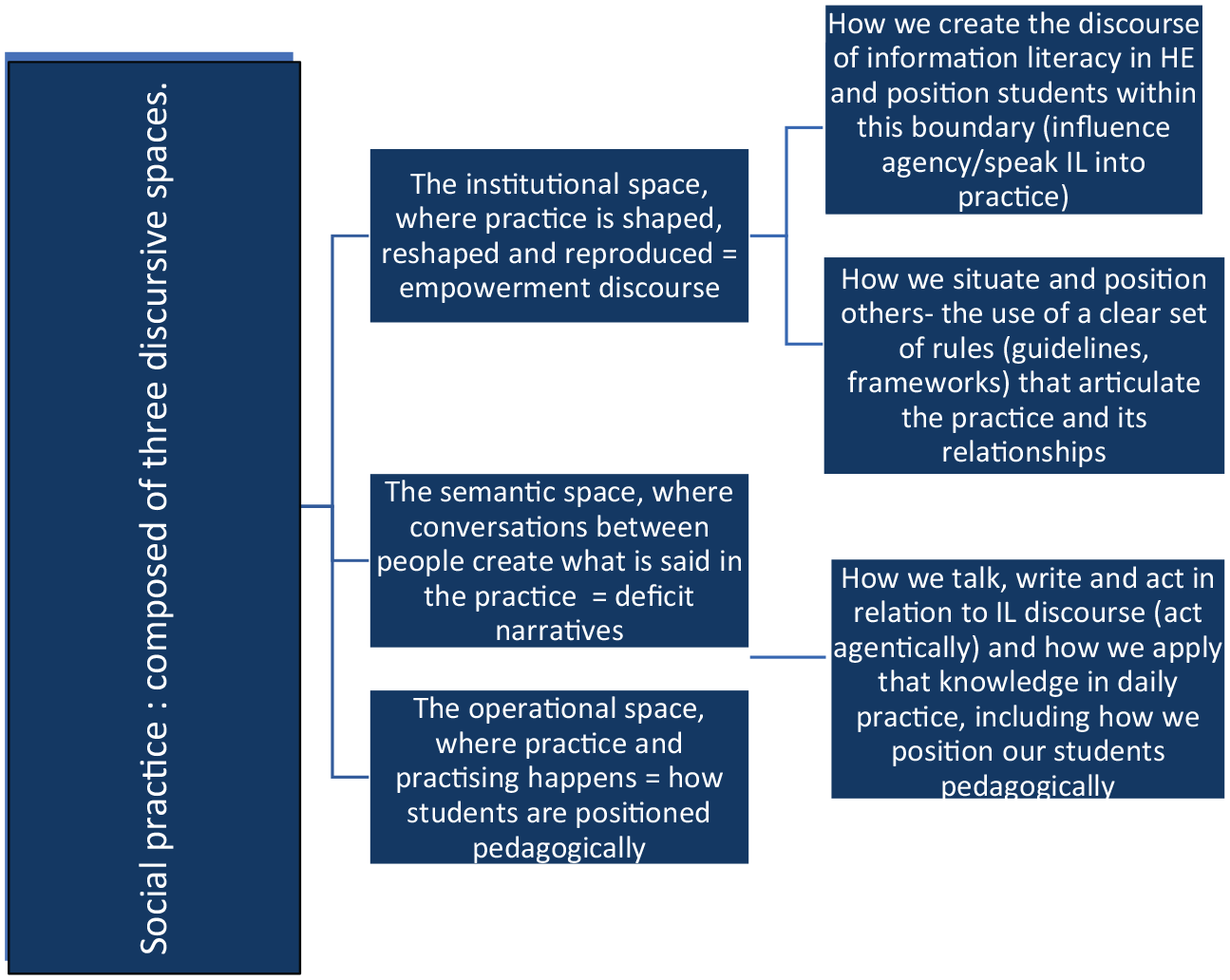
The discursive spaces of information literacy.
When broken down, this larger discursive landscape is represented via small discourses and associated narratives that constitute:
The institutional space, which draws from the broader education environment and where practice is shaped, reshaped, reproduced and represented in line with institutional discourse. The landscape established here creates a legitimising space through the value of information literacy within HE and confers (through operationalisation) a specific epistemology and way of knowing which reflects sayings, performances and relations of an established HE system.
The semantic space, which is created by conversations between people- some who ‘buy’ into the value of the institutional discourse and some who contest it. This discourse also creates the space where students are positioned.
The operational space, which references the site where practice happens and where students are positioned pedagogically by academic librarians.
Suggesting that positioning happens across several inter-related spaces, each with specific outcomes, these ideas also hint at the complex interweaving of arrangements that serve to both constrain and enable the ways in which information literacy is enacted within the HE sector. Further work will examine these ideas in more detail.
Conclusion
In previous research, Lloyd (2005) has argued that The current dominant paradigm of information literacy . . . produces a deficit model of information literacy which does not take into account the importance of informal learning or other sources of information which are accessed through communication or action. This reduces the power of information literacy and the way in which information education is undertaken by students and undergraduates. (p. 87)
Fifteen years on from this statement, there is little evidence present in the texts reviewed as part of this study to suggest that the practising of ILiHE and the narrative that influences these practices has altered. These ideas are worrying given the constructivist underpinnings of recent information literacy models; despite some evidence that information literacy has started to be seen as both reflexive and as non-linear, the positioning of students as inexperienced and lacking runs directly counter to the work of Dewey, Piaget, Vygotsky and other constructivist educational theorists. More problematically, this account suggests that if the practice of information literacy is to remain sustainable within higher educational contexts, authors (of texts, preamble, standards and guidelines) must recognise that current positioning creates specific epistemological conditions that have the potential to marginalise rather than to empower learners and the myriad ways of knowing that reflect learning in the 21st century. They must also acknowledge that these contrasting narratives limit the capacity of a practice that is, after all, fundamental to formal and informal learning as well as a socially inclusive global citizenry.
These findings represent an early attempt to interrogate information literacy discourses from within the HE sector, and further work should be done in conjunction with practitioners to explore how these critiques can be acknowledged and addressed in the design of information literacy instruction opportunities. The inclusion of textbook chapters in this research implies that future work should examine professional training and development models, including the growth of the information literacy textbook genre and the availability of reflexive instructor-focused educational provision. Findings from this research should also feed into the revision of information literacy models.
The research reported here constitutes one phase of a broader programme that unpacks the HE discourses that shape the practice of information literacy, student as learners and librarians as professional practitioners. Findings from the current study indicate the need to interrogate the concept of empowerment and its appropriation as an information literacy concept in far more detail. Future research will include an interrogation of the politicisation of empowerment and deficiency narratives, including broader questions about whom or what is empowered, under what conditions or circumstances deficiency is evaluated, and which discourses prevail (Lloyd, 2012; Walton and Cleland, 2014). Future research will also examine the role of the librarian and the ways in which professionals, as key stakeholders in information literacy practice, are positioned within institutional narratives.
Footnotes
Appendix 1
Declaration of conflicting interests
The author(s) declared no potential conflicts of interest with respect to the research, authorship, and/or publication of this article.
Funding
The author(s) received no financial support for the research, authorship, and/or publication of this article.
