



Abstract
Learning outcomes form a type of arrangement that holds the practice of information literacy within higher education in place. This paper employs the theory of practice architectures and a discourse analytical approach to examine the learning goals of five recent English-language models of information literacy. Analysis suggests that the practice of information literacy within higher education is composed of 12 common dimensions, which can be grouped into two categories, Mapping and Applying. The Mapping category encompasses learning outcomes that introduce the learner to accepted ways of knowing or what is valued by and how things work within higher education. The Applying category encompasses learning outcomes that encourage the learner to implement or integrate ideas into their own practice, including to their own questions, to themselves or to their experience. Revealing what is prioritised as well as what is less valued within the field at the present time, these findings also raise questions about supposed epistemological differences between models, the influence of research, and the language employed within these documents. This paper represents the third and final piece of work in a research programme that is interrogating the epistemological premises and discourses of information literacy within higher education.
Keywords
Introduction
As a practice, information literacy is held in place by practice architectures that are enmeshed in the social site (cf. Mahon et al., 2017). Within the higher education context, these practice architectures draw attention to the material, discursive and social arrangements that structure information literacy practice rather than the individual attributes (e.g. dispositions or the inherent qualities of the mind) that a learner may bring to the classroom. Learning outcomes, which are frequently included as part of institutional models and guidelines of practice, form a key example of an arrangement that shapes how information literacy is organised within the higher education context. Enumerating what is considered important to know or do within professional understandings of information literacy, learning outcomes are realised semantically, through establishing the agreed upon boundaries of information literacy practice and socially, through structuring the shape and activities of appropriate information literacy instruction teaching (cf. Mahon et al., 2017). An analysis of learning outcomes consequently provides insight into how the practice of information literacy in higher education (ILiHE) is prefigured as well as how it unfolds.
The study reported here specifically examines the learning outcomes that are presented across five key models of information literacy with the goal of establishing how the practice of information literacy is composed within higher education. The purpose of this approach is to unpack the social structures that make the practice possible as well as to foster ongoing conversation about the sustainability of ILiHE. A secondary goal is to interrogate the aims and structures of key models of information literacy, which, despite claims to the contrary, often appear to resemble each other in conceptual and practical ways. Unpacking these connections are particularly important as institutions start to blend information literacy models to create their own guidelines of practice (e.g. University of Cambridge, 2019). At the same time, the confusing granularity of the studied learning outcomes meant that this analysis, which was carried out manually through use of the eponymous basket, became a frustrating and onerous task that raises questions about the purpose of key teaching and learning documents in the field.
Previous research from this programme of study (Hicks and Lloyd, 2021a, 2021b) has examined the positioning of information literacy, learners and librarians within information literacy models and guidelines. This segment of the research specifically focuses on the learning goals that are included within each model. Representing the third paper in a broader programme of research, this study is guided by the following questions:
What learning goals and outcomes compose the practice of ILiHE?
How do these learning goals and outcomes enable and constrain information literacy practice within higher education?
In this paper, the arrangements that shape ILiHE practice are examined through a close reading of higher education focussed information literacy models and guidelines. Models of information literacy play a particularly important role within the higher education sector through the work that they do to establish ‘shared academic library values and principles of performance’ (ACRL, n.d.) and provide guidance and leadership for librarians and other partners who are involved with information literacy promotion and teaching initiatives. Typically created and endorsed by large professional associations, models may also be produced through the work of individual researchers and practitioners (e.g. Eisenberg and Berkowitz, 1990; Herring, 1996). Together, these guidelines shape suggested curricula for instruction as well as librarian working culture, including job descriptions, ongoing training and performance evaluation criteria. There are multiple terms that are used to describe these documents, including pedagogical framework, a curriculum and or rubric. In this research these terms will sit under the umbrella term of information literacy model or guideline.
Learning goals or outcomes play a particularly important role within models and guidelines of information literacy. Referring to ‘what is essential that students know or be able to do after the course or program’ (Battersby, 1999: 1), learning outcomes typically comprise the knowledge and skills that a learner is expected to be able to develop through instruction, including affective and metacognitive goals. Within information literacy models, learning outcomes and goals are used to detail the core skills and behaviours that are seen to underpin the activities of an information literate person. They are also used, in some models, to guide the assessment of student progress towards information literacy achievements. The vital role that learning outcomes play in guiding reflection on meaningful course content (Battersby, 1999) as well as competent performance highlights the importance of studying this aspect of information literacy documents in more detail. As above, the variety of terms used to distinguish statements of knowledge and skills within information literacy models means that this research uses the phrase ‘learning goals or outcomes’ as its overarching umbrella term (see limitations for a further explanation).
Literature review
Information literacy models and guidelines have played an important role within Western higher education systems since 1989, when the ALA Presidential Committee on Information Literacy was charged with designing ‘one or more models for information literacy development appropriate to formal and informal learning environments throughout people’s lifetimes’. These recommendations subsequently formed the basis for the publication of ACRL’s Information Literacy Competency Standards in 1999, the same year that the UK’s SCONUL released its Information Skills Model. Other national models swiftly followed, many of which were derived from the ACRL Standards (e.g. ANZIL, 2004; Cortés-Vera et al., 2002). The publication of these documents, which mirrored developments in the United States’ school library sector, which had published its first standards in 1998 (AASL & AECT, 1998), outlined ‘basic’ information competences (SCONUL, 1999) with the goal of integrating ideas of critical thinking and other ‘essential’ learning outcomes into the HE curriculum (Iannuzzi, 2013). However, by the early 2000s, opposition to these early models had started to constitute ‘a significant portion of the theoretical “voice” of IL thinking’ (Buschman, 2009: 96). Growing empirical research had begun to question the simplistic and linear shape of these documents (e.g. Bruce, 1997; Kuhlthau, 2004; Lloyd, 2005), while the advent of new pedagogical thinking had started to challenge their behaviourist focus (e.g. Cooperstein and Kocevar-Weidinger, 2004; Elmborg, 2006). These ideas gradually coalesced to pave the way for the creation of a second wave of constructivist-focussed information literacy models (Hicks and Lloyd, 2016). Roughly dating from 2010 onwards, these new information literacy models and guidelines are perceived to mark a significant departure from previous understandings of practice.
Models that were developed during this second wave of information literacy development tended to either be based on revisions to an earlier set of guidelines or to constitute a new body of work, as outlined in Table 1. One of the first to be published was the SCONUL Seven Pillars of Information Literacy, which was a revision of the group’s 1999 Information Skills model. Consisting of the eponymous seven pillars of information literacy, each of which represents a specific area of information literacy and is linked with core markers of ability (skills and competencies) and understanding (attitudes and behaviours), the model was updated and expanded in 2011 to emphasise the importance of context and iterative dimensions of practice. Nonetheless, the methods used to establish this model remain unclear, being variously linked to a survey of usage that was carried out among UK HE institutions in 2008/9 (SCONUL, 2009) and, in the case of the 1999 model, an ‘informal e-mail based survey’ (SCONUL, 1999). The same year saw the publication of a new UK model, A New Curriculum for Information Literacy (ANCIL) (Secker and Coonan, 2011). The product of a funded research programme at the University of Cambridge, the ANCIL model was established to develop a practical curriculum for undergraduate information literacy education, and emphasised learner transition as well as higher-order activities and affective components of learning (Secker and Coonan, 2011). Comprising 10 strands, each of which is supported by learning outcomes as well as example activities and assessment, ANCIL was developed using a modified Delphi approach with experts from the field of education as well as information studies (Secker, 2011).
Characteristics and origins of English-language models of information literacy in higher education published since 2010.
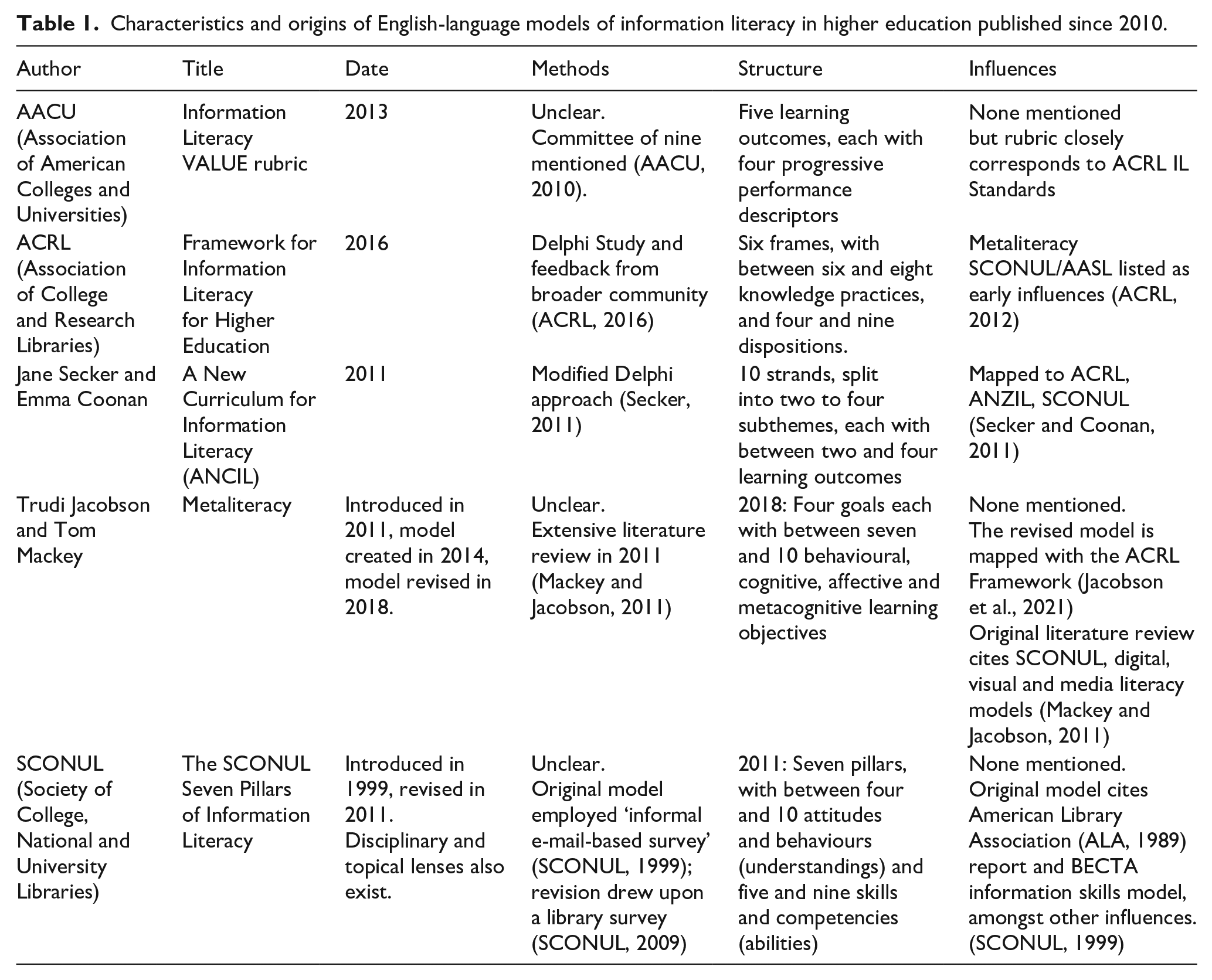
In the United States, the 2010s saw the publication of three new models of information literacy: Metaliteracy (2014/2018), the ACRL Framework (2016) and the VALUE rubric (AACU, 2013). The concept of metaliteracy emerged from a librarian-instructor partnership in 2011 as a way to integrate emerging technologies and multiple literacies under one information literacy umbrella (Mackey and Jacobson, 2011). Consisting of four goals, each of which are associated with behavioural, cognitive, affective and metacognitive learning objectives, the Metaliteracy pedagogical framework was created in 2014 and revised in 2018. While the original concept of metaliteracy was framed by a literature review of related literacies, including media, visual and digital literacy (Mackey and Jacobson, 2011), the methods used to create and revise the model remain unclear. The ACRL Framework for Information Literacy for Higher Education (2016) is one of the most recently published information literacy models. Originally conceived as a revision of the ACRL Standards, it has since been reconceptualised to centre core information literacy concepts and affective dimensions of learning rather than ‘a prescriptive enumeration of skills’ (ACRL, 2016). Comprising six frames, which are each linked to knowledge practices and dispositions, the framework was established through a Delphi study, as well as feedback from interested parties.
This decade also saw the publication of AACU (2013) Information Literacy VALUE Rubric, which formed part of a body of work that aimed to establish a basic framework of higher education learning expectations. A rubric that incorporates performance descriptors, the document was created by a development team of ‘faculty experts’ through a benchmarking exercise (AACU, 2013). However, the emphasis on decontextualised and prescriptive skills, which closely resembles the language and the content of the original ACRL Standards (1999), means that the VALUE rubric remains distanced from the prevailing constructivist-focussed direction that information literacy is taking.
Since their creation, these models have been widely implemented within North American and UK systems of higher education and have been welcomed by teaching librarians (e.g. Gross et al., 2018; SCONUL, 2009) and teaching faculty, particularly in the area of writing and composition studies (e.g. D’Angelo et al., 2016). However, somewhat surprisingly, given the role that models play within teaching librarianship, there have been few attempts to examine and critique these guidelines. While Walton (2011) berates SCONUL Seven Pillars (2011) for its largely ‘cosmetic’ revisions, including a continued failure to address the social and emotional dimensions of IL, the Metaliteracy (2014/2018), ANCIL (Secker and Coonan, 2011) and SCONUL (2011) models remain, for the most part, relatively unstudied. An exception is the ACRL Framework (2016), which has been critiqued for being ‘elitist’ (Bombaro, 2016), for relinquishing its professional authority through the elimination of shared educational standards (Drabinski and Sitar, 2016) and for its ‘investment’ in liberalism or universality and individual freedom (Seale, 2016). Librarians and scholars have also criticised the Framework (ACRL, 2016) for its reliance on threshold concepts, which are seen to both promote and obscure unexamined educational assumptions (Morgan, 2015; Wilkinson, 2014), and for its positioning of information literacy as an ‘autonomous entity’ rather than as a complex, sociocultural practice (Hicks, 2018; Hicks and Lloyd, 2016: 338).
There has been a similar lack of research that provides a comparative examination of later information literacy guidelines. Justine Martin (2013) provides one of the few exceptions in her 2013 examination of four British models, including the Seven Pillars and ANCIL. Noting that the UK guidelines shared a similar focus on metacognitive learning as well as the contextual shape of practice, Martin’s report necessarily excludes a further comparison with later US work. Similarly, Andretta’s (2005) contrasting of information literacy models is limited to pre-2010 guidelines, while examinations of the Framework have been restricted to mapping with the IL Standards (e.g. Hovious, 2015) as well as comparisons with other ACRL documents (Drabinski, 2015). At the same time, it is clear that there is considerable scope for extending Martin’s work, as well as exploring information literacy models from a more critical perspective. An examination of document authors, for example, reveals a number of overlaps; one of the authors of the Metaliteracy framework served on the ACRL Framework committee (ACRL, 2016), while the authors of the Seven Pillars were consulted in the creation of ANCIL (Secker, 2011). Certain models are also frequently cited as inspiration in later work, with the SCONUL model, for example, being linked to both Metaliteracy (Mackey & Jacobson, 2011) and the ACRL Framework (ACRL, 2012). These issues are underscored by the relative homogeneity of methods used to construct guiding work; the preponderance of Delphi studies, for example, runs the risk of reducing information literacy guidelines to ‘highly abstracted products of librarian-on-librarian meta-analysis’, or, more simply, collective navel-gazing (Morgan, 2015: 186). The failure to engage with alternative empirical research methods, coupled with the self-referential shape of key professional influences, further speaks to the importance of examining the arrangements that shape understandings of information literacy within the higher education sector.
Theoretical framework
The study uses the theory of practice architectures to interrogate the learning goals and outcomes that are presented within recent models of information literacy. Theory of practice architectures is a practice theory that accounts for how social practices are composed and made possible (Kemmis and Grootenboer, 2008). Emerging from the field of education, and, in particular, the work of Stephen Kemmis, the theory of practice architectures, like other practice theories, establishes practice as the ‘starting point for theorizing human affairs’ (Nicolini, 2013: 162). However, in contrast to other prominent practice theorists, the theory of practice architectures contends the sayings, doings and relatings that hang together to compose a practice both shape and are shaped by the intersubjective arrangements of a social site (Mahon et al., 2017). Making a practice possible, these arrangements are identified as cultural-discursive arrangements, which prefigure the sayings in a practice, material-economic arrangements, which shape the doings of practice, and social-political arrangements, which make the relatings of a practice possible (Mahon et al., 2017). The theory of practice architectures consequently positions social life as realised intersubjectively through language, as bodies and in relation to power structures (Kemmis et al., 2014: 32). In further recognising that arrangements hold practice in place, the theory of practice architectures also understands that practice is both enabled and constrained through these same ideas of language, work and power. Highlighting the consequences of human agency, the theory of practice architectures becomes positioned as a resource for examining educational practice (Mahon et al., 2017).
As a relatively new theory, the theory of practice architectures is still underexplored within information research, being mostly confined to recent information literacy work carried out by Lloyd (2014, 2020). Within these studies, a focus on practice architecture is seen to facilitate insight into the ‘dialogic and cultural activities’ that are used to inform working practice, as well as the ways in which information sources are situated within a landscape (Lloyd, 2014: 100). Along these lines, the information literacy practices of aged-care workers are seen to be shaped through the shared language of the setting, as represented by compliance-focussed institutional information resources; embodied and corporeal knowledge, which reference the doings of practice; and intersubjective or shared understandings of practice, which constitute its relatings (Lloyd, 2014). The theory of practice architectures has also been positioned to shed insight into the informational disruption that refugees face as well as the various ways in which they learn to ‘go on’ within a new setting (Lloyd, 2020: 10). However, this work has focussed on every day and workplace settings rather than the higher education sector. The same limitations have been noted within information research that has employed a broader practice theoretical lens (e.g. Haider, 2011; Lloyd, 2010a; Moring, 2012; Pilerot, 2014; Veinot, 2007), with a few exceptions (e.g. Hicks, 2019, 2020; Schreiber, 2014). This emphasis, which has inhibited a broader examination of the semantic, material and social spaces that constrain and enable the enactment of information literacy practice within an academic setting, provides a further impetus for this research.
Methods
Discourse analysis was employed to examine the learning goals and outcomes that are presented within recent higher education-focussed information literacy models and guidelines. Discourse analysis constitutes ‘a cluster of related methods for studying language use and its role in social life’ (Potter, 2008: 218). Drawing from the idea that a discourse represents ‘a particular way of talking about and understanding the world (or an aspect of the world)’ (Jørgensen and Phillips, 2010: 1), discourse analysis emerges from the premise that reality is accessed through language, and that the same linguistic markers create and sustain social life (Potter, 2008: 219). From a Foucauldian perspective, discourse analysis further offers the potential to interrogate the power relations that order specific settings, as well as to challenge aspects of reality that have come to be seen as normal (Cheek, 2008: 356). In an information literacy context, discourses shape legitimised ways of knowing, including what is considered to form the characteristics of practice as well as the priorities of its various stakeholders, including practitioners, accreditors and the creators and publishers of texts. Given the important role that guiding models of information literacy play within higher education, a discourse analysis method was selected in order to interrogate the unspoken rules and assumptions that structure these documents as well as their impact on broader understandings of practice. While discourse analysis is not commonly used within information literacy research (though see Walton and Cleland, 2017), researchers from the field of education have successfully employed similar methods to explore how key professional ideas are and are not represented in the learning outcomes of curricular standards and syllabi (e.g. Rossi et al., 2009; Whitehead et al., 2014).
Sample and data analysis
The study reported here employed discourse analysis to interrogate the learning goals and outcomes of five information literacy models within the higher education sector. These models included the five major English-language models of information literacy for higher education that have been published since 2010; the AACU (2013) VALUE rubric, the ACRL (2016) Framework for Information Literacy, Metaliteracy (Mackey and Jacobson, 2011; Metaliteracy, 2014/2018), the SCONUL (2011) Seven Pillars of Information Literacy and the ANCIL model (Secker and Coonan, 2011). These models were selected because of their widespread adoption in the higher education sector as well as the important part they play in structuring and shaping information literacy research and practice within higher education.
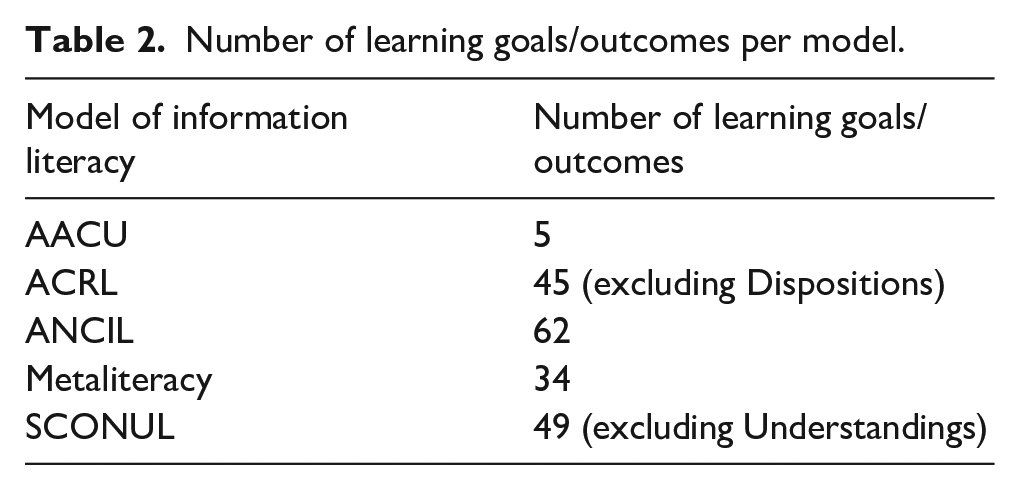
As a first step, the authors extracted the 195 learning goals and outcomes from all five models (see Table 2), each of which was recorded on a separate piece of card (and stored in the eponymous basket). The authors subsequently jointly and manually coded each learning goal using a iterative card sort process. During this phase, the authors worked together to identify the meaning and premise behind each learning outcome, rather than merely relying on verbs or language choice. The need to move beyond assumptions as well as authorial intent (Potter and Wetherell, 1987: 148) was essential in this process due to the differing degrees of granularity and understandings of information literacy within each document. The authors subsequently engaged in a second round of coding to refine the original coding structure, resulting in a total of 12 thematic codes that are presented below.
Number of learning goals/outcomes per model.
Limitations
The study is limited through the decision not to include dispositions (ACRL, 2016) and understandings (SCONUL, 2011) within the analysis of learning outcomes. These criteria, which refer to a learner’s personal attitude, are considered to form a key part of these two information literacy models. However, our study’s focus on the discourses that frame ILiHE, or the material, discursive and social arrangements that structure information literacy practice rather than the individual attributes that learners bring to their learning experience meant that we decided to ultimately exclude these elements from our analysis.
The inclusion of the ACRL Framework’s knowledge practices within this study may form another limitation of this study; the document’s authors assert that the listed knowledge practices are not learning outcomes and encourage librarians to create their own objectives in accordance with local priorities and conditions rather than relying on the Framework for these details (ACRL, 2016). However, the emphasis on learner capacity within the Framework’s associated knowledge practices, which are defined as ‘the proficiencies or abilities that learners develop as a result of their comprehending a threshold concept’ (ACRL, 2016), seemed to align, in our perspective, with the overarching principles of learning outcomes, if not the exact language. As Seale (2016) points out, ‘if the knowledge practices and dispositions are not intended to be prescriptive, why are they necessary? If they are not intended to be exhaustive, why are there so many of them and why are they so carefully and specifically articulated?’ Continued practitioner confusion (e.g. Baggett et al., 2018; Hendrigan et al., 2020) about the relationship between learning outcomes and knowledge practices further justified our decision to include these statements in our study.
Findings
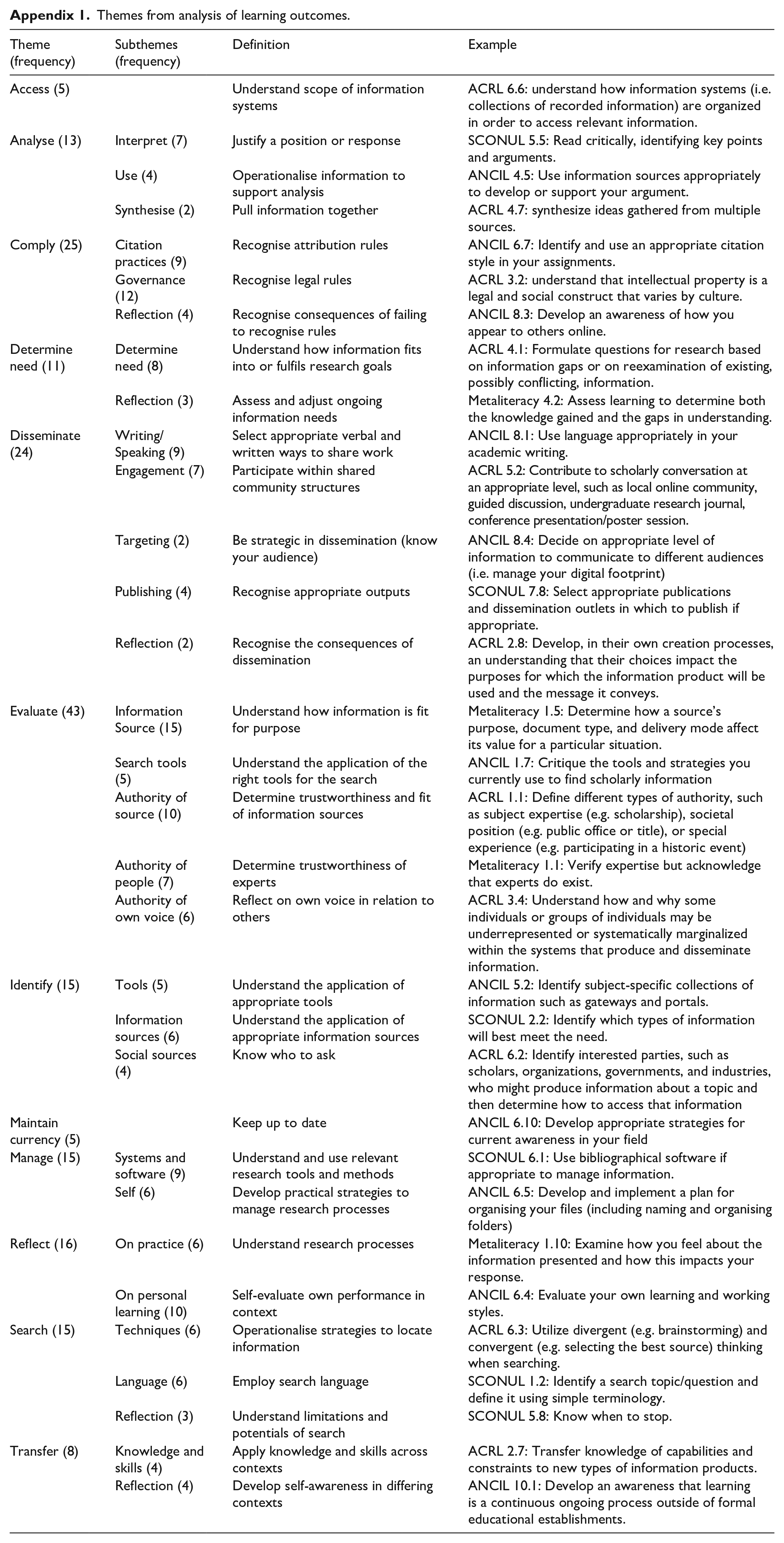
Analysis of the learning goals that are presented within the five recent models of information literacy suggest that the practice of information literacy within higher education is composed of 12 common dimensions (see Appendix 1). These 12 common dimensions are further grouped into two categories, Mapping and Applying. While these activities can stand alone or as part of an individual document, they can collectively be viewed as constituent parts of the practice of information literacy in higher education. Throughout these findings, we have either followed each information literacy model numbering system or imposed our own numbering – see Appendix 2.
The Mapping category encompasses learning outcomes that introduce the learner to accepted ways of knowing or what is valued by and how things work within higher education. Comprised of seven dimensions, including Access, Comply, Disseminate, Evaluate, Identify, Manage and Search, this category inculcates induction into the ways in which information is understood, interpreted and organised within new or specific academic cultures. One of the most prominent emphases within this category is on the mapping of information systems that will contribute to academic success, whether this is the information tools or the information sources that will be useful for academic study. Learning outcomes that involve identify, for example, which refers to understanding the application of tools and information sources, centre on the mapping of appropriate resources for action: ANCIL 5.2: Identify subject-specific collections of information such as gateways and portals. SCONUL 2.2: Identify which types of information will best meet the need.
Along the same lines, learning outcomes that fall under access emphasise the charting of entry points into useful information systems as well as the ways in which these entry ways are enabled or constrained by institutional affiliation or other structural issues: ACRL 3.5: Recognize issues of access or lack of access to information sources
Learning outcomes that encompass search, which could refer to the development of search techniques or search language, similarly focus on developing the means to tap into the relevant research context or mapping strategies that will help the learner to locate information that is appropriate for the higher education context: ACRL 6.3: Utilize divergent (e.g., brainstorming) and convergent (e.g., selecting the best source) thinking when searching. SCONUL 1.2: Identify a search topic/question and define it using simple terminology.
Beyond information systems, mapping also refers to the charting of community norms or the ways in which participation within new academic cultures is valued and recognised. Learning outcomes that correspond to evaluate, for example, which refers to the assessment of both information sources and tools, centre on determining how information is fit for purpose within a specific context: ANCIL 1.7: Critique the tools and strategies you currently use to find scholarly information ACRL 3.4: Understand how and why some individuals or groups of individuals may be underrepresented or systematically marginalized within the systems that produce and disseminate information.
These ideas are seen more explicitly in learning outcomes that constitute comply and disseminate, both of which centre the surveying of institutional norms related to scholarly communication and governance, such as plagiarism or verbal and written skills: ANCIL 6.7: Identify and use an appropriate citation style in your assignments. SCONUL 7.8: Select appropriate publications and dissemination outlets in which to publish if appropriate.
Lastly, mapping is also apparent in learning outcomes that are related to manage, which centres on an understanding of relevant organisational tools and research methods as well as the construction of strategies that will support and maintain successful information work within the academic context over time.
The Applying category encompasses learning outcomes that encourage the learner to implement or integrate ideas into their own practice, including to their own questions, to themselves or to their experience. Forming a more personally focussed approach to learning, this category comprises five dimensions including Analyse, Determine need, Maintain, Reflect and Transfer. Within this grouping, a number of codes relate to operationalising new understandings, or applying new knowledge to the learner’s own personal academic context or situation. Learning outcomes centred on analyse, for example, refer to the reconstruction of information, including the use of information to justify or support a position taken as well as to synthesise information for a specific goal or purpose: ANCIL 4.5: Use information sources appropriately to develop or support your argument. SCONUL 5.5: Read critically, identifying key points and arguments.
Similarly, learning outcomes grouped under determine need, which directly references many models of information behaviour, have a comparable focus on understanding information fit, or how information aligns with the purpose of the learner’s research or academic project: ACRL 4.1: Formulate questions for research based on information gaps or on reexamination of existing, possibly conflicting, information. Metaliteracy 4.2: Assess learning to determine both the knowledge gained and the gaps in understanding.
Maintain, which refers to staying current, extends these ideas of information fit over time. Future learning is further implicated through learning outcomes that reference transfer, which refers to the application of learning across contexts as well as reflection on action. Centring the development of self-awareness in different settings, transfer illustrates how applying understanding can refer to personal development as well as to immediate and more long-term academic goals: ACRL 2.7: Transfer knowledge of capabilities and constraints to new types of information products. ANCIL 10.1: Develop an awareness that learning is a continuous ongoing process outside of formal educational establishments.
Lastly, the applying category also encompasses learning outcomes that fall under reflect, which refers to meditation upon how research practices play out internally and externally, or in relation to one’s own activities as well as research processes more generally: Metaliteracy 1.10: Examine how you feel about the information presented and how this impacts your response. ANCIL 6.4: Evaluate your own learning and working styles.
While reflection was typically involved within individual activities, for example, reflection on transfer, it was also positioned as a standalone code due to the number of generic reflective components referenced within learning outcomes.
Discussion
Analysis of the learning outcomes presented in these information literacy documents reveal that the practice of information literacy within higher education is composed of numerous common dimensions. Practices are always enmeshed and anchored by the arrangements of the site. The practice of teaching information literacy in higher education by academic librarians is no different and the development of models and instructional frameworks reference the sayings, doings, and relatings that conform to the educational discourses of that sector. Information literacy is anchored by these arrangements and thus emerges as a series of learning outcomes that share common dimensions, languages and agreements about core elements and performances across models and frameworks. As Walton and Cleland (2017: 585) note: “Information literacy does not evolve in isolation to its setting–it emerges in practitioners and the way they operate as a reflection of the knowledge domain bounds a particular setting”.
These arrangements further reveal what is prioritised and valued within the field at the present time. The broad range of themes that are included under the evaluate learning outcome, for example, which include the assessment of people, sources and tools, demonstrates the ongoing impact of changing publication models upon the field, including the growth of social media as well as concepts of ‘fake news’ and misinformation. Similarly, the important role that compliance and dissemination play within the analysis could indicate that changing regulations within more participatory and creative online information environments continue to be a concern. An area of focus that is less surprising is the emphasis on reflection, which is woven throughout numerous learning outcomes as well as forming its own separate dimension. Playing a vital role within constructivist learning theory, reflection or metacognition is also often seen to form a key difference between first- and second-generation models of information literacy.
At the same time, the meta-analysis helps us to draw inferences about the areas of information literacy that are less valued at the current stage in time. Of note is the relative lack of importance that is accorded to search technicalities, such as search language and queries. This is particularly surprising given the important role that finding or locating plays within common definitions of information literacy. The deprioritisation of search may be linked to what Sundin et al. (2017) refer to as the ‘mundane-ification’ of search within everyday life but it can also be seen as problematic given rising understanding of the impact that algorithmic bias has upon search engine results (Lloyd, 2020; Noble, 2018; Haider and Sundin, 2019). Analysis also demonstrates the areas that are more or less valued within individual models and frameworks. An examination of the learning outcomes that are present in the Metaliteracy framework, for example, demonstrates its overwhelmingly emphasis on reflection, compliance, and evaluation to the exclusion of other aspects of information literacy practice. While it is beyond the scope of this paper to examine these differences in detail, it is clear that an examination of what makes an institutional model unique would provide a useful future area of study.
The meta-analysis further enables us to trace the impact of information literacy research on practice. The importance of context, which is frequently highlighted within information literacy research but was often missing from first generation information literacy documents, is overtly referenced in these models through mentions of the varying information environments that learners may find themselves in. The emphasis on sociality provides another example of the influence of research on practice, with several documents referring to the need to manipulate and engage with social sources of information in additional to textual sources. In contrast, reference to the body is still absent from these documents despite the considerable work that has been done to establish its role within information literacy practice (Lloyd, 2010a).
A secondary goal of this research was to carry out analysis across related models, or to interrogate the aims and structures of key models of information literacy in relation to each other. Information literacy models often assert their difference from other sets of guidelines to justify their existence, whether this is a difference in focus, method or national origin. However, this meta-analysis demonstrates that, for all the variances in format and structure, second generation models of information literacy resemble each other in numerous conceptual ways. This may not be surprising given their shared constructivist focus. At the same time, the existence of commonalities, as well as the overlap in creators and the mapping that happens between models, also raises wider questions about homogeneity, or whether information literacy models and frameworks could be seen to constitute an echo chamber where peer pressure or group think underpins the positioning of key ideas.
Further questions are raised by the commonalities that this metanalysis traces between the behaviourist-focussed AACU Value rubric and the four constructivist-shaped information literacy frameworks (ACRL, ANCIL, Metaliteracy, SCONUL). The AACU Value rubric has been seen as emerging from a ‘competing paradigm’ (Cowan, 2014: 28) rather than being aligned with other models and frameworks. The recognition that the rubric’s five categories align neatly and unproblematically with many of the key themes that are present within more constructivist documents unsettles these critiques as well as drawing supposed epistemological differences into doubt.
These ideas are further underscored through the language used in the learning outcomes, which created the feelings of frustration that are referenced in the title of this study. One of the major frustrations emerged through the comparison of learning outcomes, particularly when wording within these documents often seems to paraphrase goals from earlier models rather than representing new and revised ways of thinking. The following learning outcomes, for example, seem to demonstrate very similar wording and focus:
ACRL 4.7: Synthesize ideas gathered from multiple sources;
S7.5: Synthesise and appraise new and complex information from different sources
S2.4: Identify different formats in which information may be provided
ANCIL 1.3: Identify and assess the range of information formats available
While it could be argued that there are only so many ways to word or frame key concepts in the field, this finding does raise useful questions about the influences that each document has on the other.
A second frustration centred on the granularity of language that was used within these texts, where the same verbs were used to encompass a wide variety of meanings and applications. The verb ‘evaluate’, for example, referred to reflecting on personal working styles (ANCIL 6.4) as well as assessing the quality of information, while other learning outcomes coded as centred on evaluation seemed to shy away from explicitly outlining this focus by choosing to employ more generic verbs such as acknowledge (M1.2), select (S3.3) and articulate (ACRL2.1). The range of verbs employed meant that it was often very hard to ascertain what the goal of the learning outcome was. These findings lead us to question whether too much effort is being exerted in proselytising information literacy rather than focusing on understanding the main activities that comprise the core elements of the practice.
Conclusion
This research, which forms the third in a series of papers examining the practice of ILiHE, conducted a meta-analysis of the learning goals that are presented within five of the most recent information literacy models. This analysis, which showed that learning outcomes could be categorised into Mapping and Applying activities, help to ascertain the shape of information literacy practice within higher education as well as to establish what is currently valued in the field and what is not. Analysis across models also reveals a number of problematic issues, including raising questions about the homogeneity of these documents. A final research project is planned that will aim to draw connections and conclusions about ILiHE across all three of the studies that comprise this suite of work.
Findings from this study have implications for librarians and architects of information literacy models, and this research should feed into the creation of future institutional work. Beyond helping to demonstrate areas of practice that have been overlooked, this research provides insight into how the writing of learning outcomes could be improved, including by making the language more specific. This research also calls for the broadening of research methods that are used to create institutional models and guidelines, including a more thoughtful consideration of epistemological shifts and assumptions. Future research could further examine learner, librarian, and teaching partner comprehension of each learning outcome, given the issues that the researchers faced deciphering some of these performance criteria, while this study could further be used to argue for the importance of user testing when new models and frameworks are being developed.
At the same time, the range of commonalities between these information literacy models highlights several angles for future research, including the need to perform a similar meta-analysis for first generation models of information literacy. This would enable a more focussed analysis of the influences over time within information literacy models, as well as the impact of paradigm shifts. Learning outcomes should also be examined in relation to key information literacy texts, such as model introductions and textbooks, to establish how educational ideas are adopted and applied throughout information literacy practice.
Footnotes
Appendix 2: Numbering System for Information Literacy Frameworks
Appendix 1.
Themes from analysis of learning outcomes.
| Theme (frequency) | Subthemes (frequency) | Definition | Example |
|---|---|---|---|
| Access (5) | Understand scope of information systems | ACRL 6.6: understand how information systems (i.e. collections of recorded information) are organized in order to access relevant information. | |
| Analyse (13) | Interpret (7) | Justify a position or response | SCONUL 5.5: Read critically, identifying key points and arguments. |
| Use (4) | Operationalise information to support analysis | ANCIL 4.5: Use information sources appropriately to develop or support your argument. | |
| Synthesise (2) | Pull information together | ACRL 4.7: synthesize ideas gathered from multiple sources. | |
| Comply (25) | Citation practices (9) | Recognise attribution rules | ANCIL 6.7: Identify and use an appropriate citation style in your assignments. |
| Governance (12) | Recognise legal rules | ACRL 3.2: understand that intellectual property is a legal and social construct that varies by culture. | |
| Reflection (4) | Recognise consequences of failing to recognise rules | ANCIL 8.3: Develop an awareness of how you appear to others online. | |
| Determine need (11) | Determine need (8) | Understand how information fits into or fulfils research goals | ACRL 4.1: Formulate questions for research based on information gaps or on reexamination of existing, possibly conflicting, information. |
| Reflection (3) | Assess and adjust ongoing information needs | Metaliteracy 4.2: Assess learning to determine both the knowledge gained and the gaps in understanding. | |
| Disseminate (24) | Writing/Speaking (9) | Select appropriate verbal and written ways to share work | ANCIL 8.1: Use language appropriately in your academic writing. |
| Engagement (7) | Participate within shared community structures | ACRL 5.2: Contribute to scholarly conversation at an appropriate level, such as local online community, guided discussion, undergraduate research journal, conference presentation/poster session. | |
| Targeting (2) | Be strategic in dissemination (know your audience) | ANCIL 8.4: Decide on appropriate level of information to communicate to different audiences (i.e. manage your digital footprint) | |
| Publishing (4) | Recognise appropriate outputs | SCONUL 7.8: Select appropriate publications and dissemination outlets in which to publish if appropriate. | |
| Reflection (2) | Recognise the consequences of dissemination | ACRL 2.8: Develop, in their own creation processes, an understanding that their choices impact the purposes for which the information product will be used and the message it conveys. | |
| Evaluate (43) | Information Source (15) | Understand how information is fit for purpose | Metaliteracy 1.5: Determine how a source’s purpose, document type, and delivery mode affect its value for a particular situation. |
| Search tools (5) | Understand the application of the right tools for the search | ANCIL 1.7: Critique the tools and strategies you currently use to find scholarly information | |
| Authority of source (10) | Determine trustworthiness and fit of information sources | ACRL 1.1: Define different types of authority, such as subject expertise (e.g. scholarship), societal position (e.g. public office or title), or special experience (e.g. participating in a historic event) | |
| Authority of people (7) | Determine trustworthiness of experts | Metaliteracy 1.1: Verify expertise but acknowledge that experts do exist. | |
| Authority of own voice (6) | Reflect on own voice in relation to others | ACRL 3.4: Understand how and why some individuals or groups of individuals may be underrepresented or systematically marginalized within the systems that produce and disseminate information. | |
| Identify (15) | Tools (5) | Understand the application of appropriate tools | ANCIL 5.2: Identify subject-specific collections of information such as gateways and portals. |
| Information sources (6) | Understand the application of appropriate information sources | SCONUL 2.2: Identify which types of information will best meet the need. | |
| Social sources (4) | Know who to ask | ACRL 6.2: Identify interested parties, such as scholars, organizations, governments, and industries, who might produce information about a topic and then determine how to access that information | |
| Maintain currency (5) | Keep up to date | ANCIL 6.10: Develop appropriate strategies for current awareness in your field | |
| Manage (15) | Systems and software (9) | Understand and use relevant research tools and methods | SCONUL 6.1: Use bibliographical software if appropriate to manage information. |
| Self (6) | Develop practical strategies to manage research processes | ANCIL 6.5: Develop and implement a plan for organising your files (including naming and organising folders) | |
| Reflect (16) | On practice (6) | Understand research processes | Metaliteracy 1.10: Examine how you feel about the information presented and how this impacts your response. |
| On personal learning (10) | Self-evaluate own performance in context | ANCIL 6.4: Evaluate your own learning and working styles. | |
| Search (15) | Techniques (6) | Operationalise strategies to locate information | ACRL 6.3: Utilize divergent (e.g. brainstorming) and convergent (e.g. selecting the best source) thinking when searching. |
| Language (6) | Employ search language | SCONUL 1.2: Identify a search topic/question and define it using simple terminology. | |
| Reflection (3) | Understand limitations and potentials of search | SCONUL 5.8: Know when to stop. | |
| Transfer (8) | Knowledge and skills (4) | Apply knowledge and skills across contexts | ACRL 2.7: Transfer knowledge of capabilities and constraints to new types of information products. |
| Reflection (4) | Develop self-awareness in differing contexts | ANCIL 10.1: Develop an awareness that learning is a continuous ongoing process outside of formal educational establishments. |
Declaration of conflicting interests
The author(s) declared no potential conflicts of interest with respect to the research, authorship, and/or publication of this article.
Funding
The author(s) received no financial support for the research, authorship, and/or publication of this article.
