




Abstract
Building students’ literacy skills is a key educative purpose of contemporary schooling. While libraries can play a key role in fostering literacy and related reading engagement in schools, more needs to be known about school librarians’ role in promoting these goals. To this end, this article seeks to identify the nature and scope of the literacy supportive role required of the school librarian in the United Kingdom. It also investigates how this aspect is situated within the broader competing role requirements of the profession. Using a hybrid approach to content analysis including both qualitative and quantitative methods, this article presents in-depth analysis of 40 recent job description documents recruiting school librarians in the United Kingdom to investigate these research aims. The vast majority of documents (92.5%) included literacy supportive roles or characteristics of a school librarian, and recurring salient components included supporting literature selection, having a broad and current knowledge of literature, promoting and modelling reading for pleasure, devising and supporting reading and literature events, promoting a whole-school reading culture, working closely with students to support reading and literacy skill development, and implementing and supporting reading programmes. This literacy supportive role was found to sit within a potentially highly complex and diverse work role which may compete with the literacy supportive role for time and resourcing in school libraries. This research suggests that the role of school librarians in the United Kingdom is both complex and evolving, and that school librarians in the United Kingdom have a valuable literacy supportive role to play in their school libraries.
Keywords
Introduction
Literacy is a valued skill linked to young people’s attainment of academic, vocational and social goals (Australian Bureau of Statistics, 2013; Haasler et al., 2019; McIntosh and Vignoles, 2001), and societal productivity (Keslair, 2017). In contemporary schools, students’ literacy levels are subject to high internal and external scrutiny through reporting and high-stakes testing (Jennings and Lauen, 2016). While literacy is thus highly valued and scrutinised, relatively little consideration is given to the role that school librarians and school libraries play in fostering students’ literacy and related reading engagement (Merga, 2019a).
As explored subsequently in the review of the literature, the presence of qualified school librarians in well-resourced school libraries is associated with benefits for students’ literacy attainment. However, while research suggests that libraries can play a key role in reading promotion in schools through employing a range of reading and literacy supportive activities (e.g. Merga, 2019b; Domínguez et al., 2016), more needs to be known about school librarians’ role in promoting student literacy. To this end, this article investigates the literacy supportive role of the school librarian in the United Kingdom (UK) to begin to address the following research questions:
What is the literacy supportive role of the school librarian in the UK?
How is this role situated within the broader role requirements of UK school librarians?
Literacy, reading and reading engagement
Enhancing students’ literacy performance is a key goal for both primary and secondary schools in the UK as well as other nations. While literacy is a multi-faceted and complex construct covering a breadth of skills, knowledge and practices (Alvermann and Moore, 2011; McKay, 1996), this article focusses on a construct of literacy concerned with functional reading, writing, listening and speaking skills to meet communicative competence requirements needed for academic, vocational and social participation. While this is the construct of literacy privileged in this article, it is not inferred that other related literacies such as information literacy, health literacy, digital literacy and critical literacy lack importance or value. UK literacy scores are high compared to international averages; however, they still lag behind the highest achieving nations (McGrane et al., 2017) indicating room for further improvement. Similarly, other nations consistently strive to enhance the literacy performance of their students. In recent times, the United States (US) has seen poor reading and writing performance in their students, with the performance gap between highest and lowest performing students growing over time (National Center for Educational Statistics, 2019). Australian schools may seek to prevent further slide in their students’ literacy attainment, with steady declines in reading performance recorded since Australia first participated in PISA (Programme for International Student Assessment) testing in 2000 (Organisation for Economic Co-operation and Development (OECD), 2019; Thomson et al., 2016). As such, the role of schools as supports for student literacy is closely examined and highly valued.
While reading offers benefits for development of literacy and other academic skills (e.g. Sullivan and Brown, 2013), it may also offer well-being benefits for students. Research with a primarily adult sample found that reading can be a pleasurable escape with associated benefits for well-being (Merga, 2017), and ‘readers often choose a book for pleasure and then find in it insights related to themselves, their lives, and their problems’ (Howard, 2011: 53). More recent research has found that recreational reading is associated with reduced psychological distress and can be beneficial for mental health (Levine et al., 2020).
Research suggests that school librarians can play an important role in supporting student literacy, particularly in relation to reading engagement. Reading engagement is a ‘multidimensional construct that includes behavioral, cognitive, and affective attributes associated with being deeply involved in an activity such as reading’ (Guthrie et al., 2012: 602). Simply conceptualised, engaged readers find reading enjoyable which stimulates them to read more (Merga, 2019c); pleasure in reading is a strong predictor of reading frequency (Merga and Mat Roni, 2018), which leads to growth in literacy skills (Guthrie et al., 2012; OECD, 2011). There is growing awareness of the relationship between reading attainment and engagement, resulting in ‘increased attention to the concepts of reader engagement and reading for pleasure in both policy and practice’ (Cremin and Moss, 2018: 59).
School librarians and student literacy attainment
Research exploring the benefits of school libraries for literacy have been predominantly conducted in the US, with very little research in this area coming from the UK (Ritchie, 2009). Lance and Kachel (2018) have contributed the most recent comprehensive review of the relationship between well-resourced and staffed libraries and student achievement, particularly in literacy. They contend that ‘the most substantial and consistent finding is a positive relationship between full-time, qualified school librarians and scores on standards-based language arts, reading, and writing tests, regardless of student demographics and school characteristics’ (Lance and Kachel, 2018: 16). More research is needed, however, as much of Lance and Kachel’s (2018) review is based on findings published in reports rather than peer-reviewed articles, and ‘simply put, the sustainability of the school library profession relies upon credible and reliable findings’ (Stefl-Mabry et al., 2019: 19).
Research also suggests that school librarians can play an important role in fostering reading engagement (Merga, 2019c). For example, school librarians may be natural reading models as a love of literature and reading often guides their entry into the profession (Walker and Calvert, 2016), and they create and maintain spaces that make sustained reading possible (e.g. Loh et al., 2017). Further exploratory research is needed to make visible the ways that school librarians foster literacy learning and related reading engagement, as this provision cannot be taken for granted for reasons explored further herein.
Role diversity
Exploring how school librarians foster literacy learning and related reading engagement must involve situating this aspect of their role within its broader, often competing demands. Previous research from Australia (Merga, 2019c, 2020b) suggests that the sheer diversity of the role may act as a barrier to school librarians fully realising their potential as literacy supports in schools. School librarians may not have their efforts recognised, with UK research suggesting that secondary school librarians may be seen as support staff rather than leaders, despite the high level of responsibility some may exercise within their roles (Brackenbury and Willett, 2011).
The UK School Library Association (SLA) provides job descriptions that lend insight into expectations of the role at primary and secondary school level, and these documents were kindly provided to the researcher by SLA staff in 2020. The ‘Generic Job Description: Secondary School Librarian’ deals with reading briefly, stating that in their capacity providing support for staff and students, the school librarians’ job description includes ‘promoting reading and the enjoyment of reading in all its forms’ (SLA, n.d.-a: 2), and the only mention of literacy is limited, and in relation to information literacy.
In contrast, the SLA ‘Job Description: Primary School Librarian’ is far more detailed in relation to reading, listing ‘To support all children on their reading journey and foster a reading for pleasure culture’ as a ‘core purpose’ and describing the following explicitly reading-related facets of the role: To ensure the library provides a suitable and welcoming atmosphere conducive to study and Reading for Pleasure . . . To guide pupils on the choice of literature to meet their curricular and leisure needs and interests . . . To promote Reading for Pleasure throughout the school, including engaging with parents . . . To compile reading recommendations and booklists as appropriate . . . To organise and promote special events, such as: Book Week, World Book Day, Storytelling Week and author visits . . . To run reading clubs at lunchtime or after school as appropriate . . . To network with other partners, e.g. other local schools, SLS, SLA, keeping abreast of national and local reading and literacy initiatives. (SLA, n.d.-b: 1)
Furthermore, in relation to ‘Person Specification Criteria’, the primary school oriented document recommends ‘knowledge of current children’s literature’ and ‘knowledge of children’s reading and literacy organisations to assist with school’s offer to pupils’ (SLA, n.d.-b: 2). Therefore, the SLA documentation more strongly envisions a reading and literacy role being enacted in the primary context than the secondary context. Reading engagement declines as students move through the years of schooling (e.g. Merga, 2019c; Parsons et al., 2018), and the most recent Australian research exploring the attitudes of 15-year-old Australian students found that ‘about 23% in 2000, 26% in 2009 and 32% in 2018 of the students reported that reading was a waste of time’ (Darmawan, 2020: 9). In light of this trend, SLA could consider revising their ‘Generic Job Description: Secondary School Librarian’ in recognition that the reading advocacy and skill development aspect of the school librarian role retains importance for older children.
It is also important to note that the literacy supportive role of UK librarians cannot be automatically conflated with their international counterparts, for in addition to varying contextual factors, the professional qualifications of UK school librarian significantly differ from their US and Australian counterparts who are likely to be degree qualified in both education and librarianship (Merga, 2019a; Kaplan, 2007). In the United Kingdom, almost a third of school librarians are not be qualified librarians or graduates, with only 6% holding qualifications in both education and librarianship (Streatfield et al., 2011). Professional standards are a highly contentious area, and in the Australia and the US, efforts are made to prevent replacement of degree qualified staff with the unqualified alternative, with protections put in place in some states in the US (e.g. California School Library Association (CSLA), 2018).
In addition, there is marked variation in levels of access to libraries within the UK, with 90% of schools in England having school libraries, but only 57% of schools in Northern Ireland (Great School Libraries (GSL), 2019: 8), and there are also differences in how literacy is positioned in school libraries in the UK. These differences are responsive to varying geographic contexts and curriculums (e.g. Irving, 2010). Even within individual library contexts, the roles may vary considerably, as ‘the norms of the school librarian are connected to the norms of the school as an everyday workplace for different people’ (Centerwall, 2019: 147). In the UK, secondary schools are far more likely to have a ‘designated member of library staff to run the library’ than primary schools (GSL, 2019: 5). While UK librarians are typically not qualified educators, they may nonetheless be expected to support student learning, and therefore greater interrogation of the role of school librarians in the UK is indicated.
A role at risk
Finally, greater understanding of what UK school librarians specifically do to support literacy and related reading engagement is essential due to the vulnerability of school libraries in the UK and elsewhere due to funding cuts. Unfortunately, ‘there is no statutory requirement for schools in England to have a school library’ (Teravainen and Clark, 2017: 3). Therefore like school librarians elsewhere who also lack this security, school librarians in the UK run the risk of being viewed as an optional luxury (Dow et al., 2012) that is poorly valued both in schools and society more broadly (e.g. House of Representatives, 2011), rather than a vital requirement to support student literacy learning.
This precarity has had notable impact on school librarian numbers in the UK and elsewhere in recent times, and ‘between 2010 and April 2016 figures suggest that at least 478 public libraries were closed across England, Scotland and Wales’ (GSL, 2019: 7). Declines in library resourcing have also been noted in the US (e.g. Farmer and Safer, 2019), with a loss of almost 9200 full-time equivalent (FTE) school librarians (15%) nationwide from 2009–2010 to 2015–2016, with more than 10,000 total losses since 2000 (Kachel and Lance, 2018: 14). Canadian school libraries have been in decline since the early 2000s, and many Canadian libraries operate without qualified staff (Erickson, 2019). As it is a greying profession, there may be future shortages in staffing availability in the future (Walker and Calvert, 2016).
The vulnerability of the profession has been associated with issues in staff morale elsewhere, and school librarians are not always supported within their school communities (e.g. Merga, 2019c). For example, while schools in Hong Kong are increasingly focussing attention on how school libraries can support reading, ‘school administration and subject teachers’ lack of general understanding about the important role of the school library and teacher librarian in promoting the schools’ reading culture’ (Loh et al., 2019: 5) constitutes a persistent challenge. Findings on professional satisfaction in UK school librarians have been varying. While earlier research suggests that school librarians may typically feel respected by their leadership and well-integrated in their school communities, and ‘school librarians appear, as the literature suggests, to have high levels of resilience, putting up with poor pay, low status, and a lack of resources and yet being satisfied with their jobs’ (Ritchie, 2011: 101), more recent findings suggest that school librarians struggle with ‘insecure employment terms, low pay and a lack of investment in CPD for dedicated library staff’ (GSL, 2019: 5). Therefore, exploring how school librarians may support literacy and related reading engagement can have implications for student learning, as well as staff morale and retention.
Methods
While there has been previous content analysis work around the role of librarians that has been used to identify current workplace needs, role requirements and potential training gaps (e.g. Clyde, 2002), there has been no recent content analysis focussing on the literacy supportive role of school librarians in the UK and how this facet situated in relation to the broader aspects of the role. I collected a corpus of recent (within the last 10 years) job description documents for roles advertised online. Documents were eligible for inclusion in the corpus if they
Were for positions located in the UK
Were published within the last 8 years (2012–2020)
Were at least one page in length
Were openly accessible via Google search
Documents were sourced online between April 2020 and June 2020 through Google using search terms ‘school librarian job description’; ‘school librarian job’ and ‘school librarian position description’. At around 40 documents, it became increasingly difficult to source further current job descriptions, possibly due to reductions in hiring associated with the coronavirus. Ultimately, a corpus of 40 documents was considered an appropriate threshold to allow for a diverse pool of documents while still being sufficiently manageable for the qualitative and quantitative methods intended. Role titles and year are detailed in Table 1.
Data on job description documents.
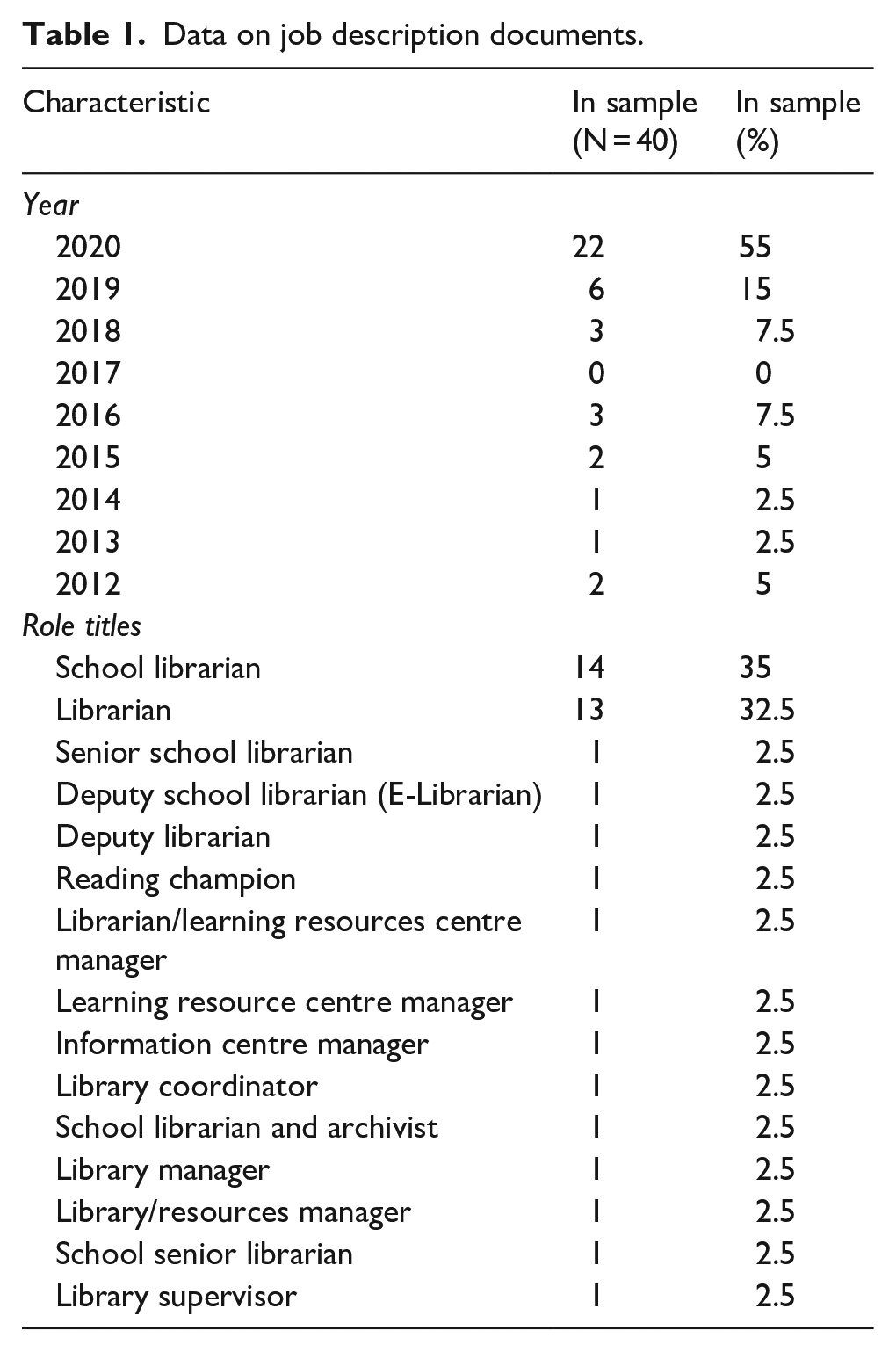
Table 1 suggests that school librarians in the UK are not typically known by that title and that they are given diverse nomenclature. This trend has also been seen in the US, though recent times have seen a shift back towards the name school librarian (Merga, 2019a). Nomenclature is significant, because changes in names can make it difficult for researchers to track fluctuations in the profession, such as staffing losses (Lance, 2018), potentially slowing corrective advocacy.
Documents ranged from 1 to 13 pages in length, with a mean of 3.4. In some cases, job description and person specification forms were presented as separate documents, and where this was the case, the two documents were merged in the count and analysed as one document. Where text has been cited in this article, it is presented either verbatim or in edited verbatim form to bring together text for purposes of cohesion or to correct typographical errors in the documents. Meaning was carefully retained. While the schools and documents are not identified, for the purposes of research auditing and accountability, each of the 40 documents has been assigned a code (S1-40), and where text is cited, reference is made to these codes.
Data were analysed using a number of approaches to content analysis rather than a single uniform approach in order to be responsive to the research questions (Hsieh and Shannon, 2005). To explore the first research question, I used a conventional inductive approach (Kondracki et al., 2002) to identify the ways school librarians fostered literacy learning and related reading engagement. It is important to note that while the process of thematic coding at this stage was inductive, and a product of iterative reading of the data to identify emerging recurring salient themes, I was reliant on my background knowledge and prior research in both literacy and libraries to locate themes related to literacy learning. This is significant because while inductive analysis avoids adhering to ‘a pre-existing coding frame, or the researcher’s analytic preconceptions’; in reality, ‘researchers cannot free themselves of their theoretical and epistemological commitments, and data are not coded in an epistemological vacuum’ (Braun and Clarke, 2006: 83−84). Therefore, my prior knowledge in this field is both a strength and a limitation. I also had previously analysed Australian job description documents, which could have influenced the allocation of codes (see Merga, 2020b).
In addition, it should be acknowledged that the role of school librarian is interpreted in this article primarily through an education lens, rather than a librarianship lens, which has shaped what is privileged in this article. This lens is atypical, as school library research is more typically framed solely for the library/information sciences consumer (Hartzell, 2002; Stefl-Mabry et al., 2016) rather than the educator. The themes sought were activities, strategies, practices or personal attributes that were required of school librarians in relation to reading and literacy, and these recurring themes are presented and discussed in relation to extant supporting research.
To address the second research question, the conventional inductive approach was again employed in order to identify the different roles, characteristics and responsibilities required of these professionals. However, as the question relates to how the literacy supportive role is situated within the broader role requirements of UK school librarians, a summative content analysis approach was subsequently used to give the reader a sense of how different facets of the role were privileged within the corpus. Broader generalisability cannot be inferred beyond the sample, and silences within the sample can be for a range of reasons; an omission of a certain aspect of the role may have more to do with required word count in job advertisement or a particular facet being deemed so universal it was not worth mentioning. Nonetheless, I used this hybrid approach to content analysis in order to use both qualitative and quantitative content analysis for a strategic purpose (White and Marsh, 2006). Findings are presented in a joint display (Guetterman et al., 2015). Close attention to integration of quantitative and qualitative data is increasingly expected in mixed-methods research, and integration is used ‘to blend, weave, combine, and ultimately synthesize two or more types of data together’, commonly in a ‘visual presentation of data using a matrix or joint display (e.g., to study qualitative and quantitative data from the same case in parallel)’ (Johnson et al., 2019: 302). As such, a joint display was selected to optimise integration and present mixed-methods research in a manner reflective of current expectations in this methodology.
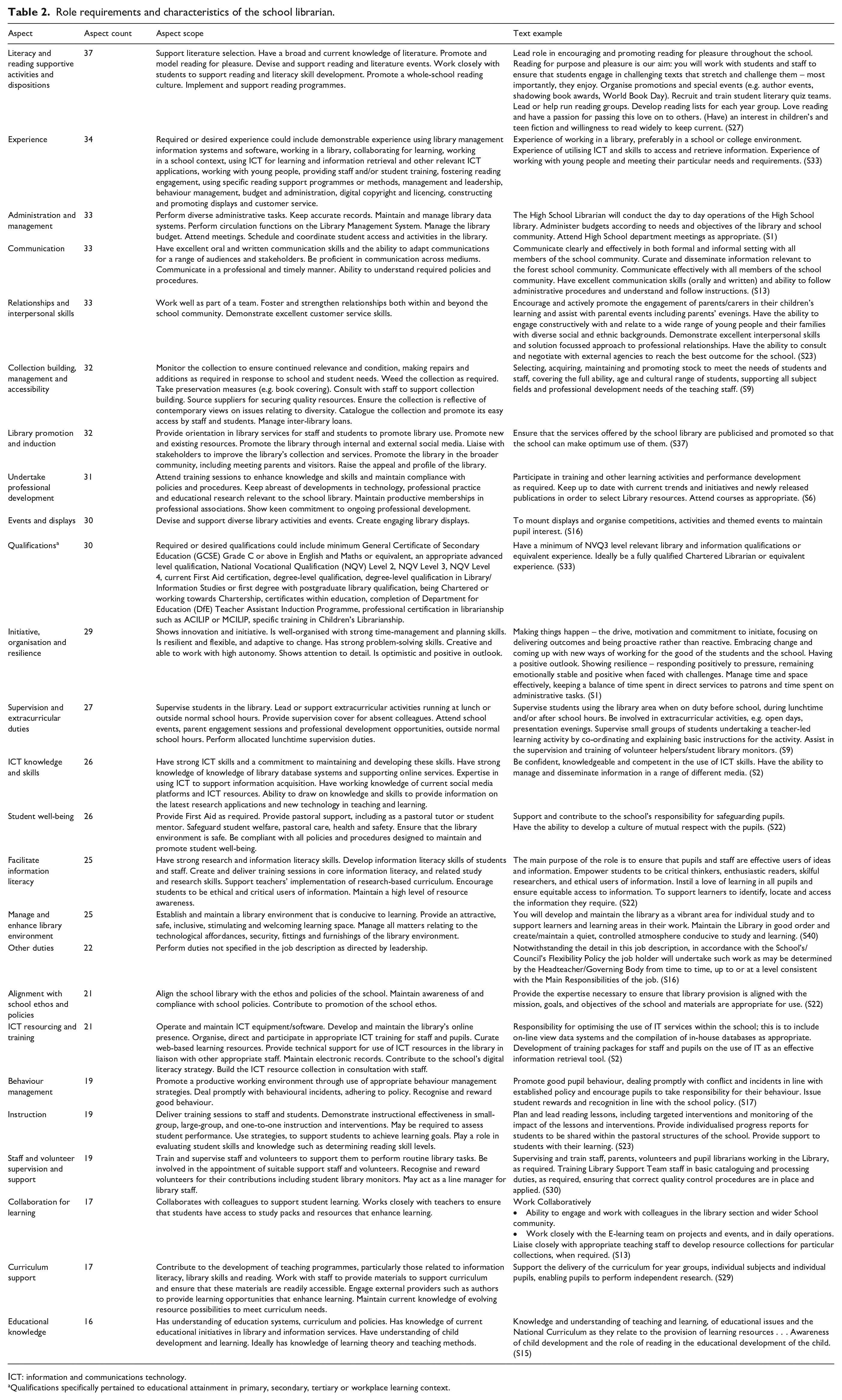
In addition, as the roles, characteristics and responsibilities were so numerous, the decision was made to report only those which were deemed highly salient, recurring across at least 40% of the documents (recurring across at least 16 documents). This meant that at 15 recurrences each, themes ‘library evaluation’ and ‘library policy adherence and development’ were excluded, along with ‘inclusivity’ and ‘support the professional development of others’ at 14 recurrences each. Therefore, the role can be considerably more diverse than presented here. As part of the process, a composite statement of scope was created for each salient aspect. Overlap was common; for example, some of the ‘Events and displays’ were also closely related to ‘Literacy and reading supportive activities and dispositions’, such as participation in World Book Day. Such instances were subject to dual or even multiple coding as required. It is a notable limitation that roles, characteristics and responsibilities that could have benefit for literacy were excluded where specific reference to supporting literacy skills or engagement was not made. For example, collection building, management and accessibility can lead to students having access to appealing materials, and relationships and interpersonal skills can build valuable connections that can lead students to seek reading recommendations. However, if the link was not made between roles, characteristics and responsibilities and literacy skills or engagement in the job description documents enough times to generate salience as per previously specified, it was not included. Finally, a text excerpt was also included in the display so that readers can see how the aspect was presented in its native context, within the aforementioned limitations of textual presentation.
Results and discussion
The literacy supportive role of the school librarian
The vast majority of documents (92.5%) described literacy supportive roles or characteristics of a school librarian, and as per Table 2, this facet was the most common aspect of the role mentioned across the documents. The scope of the literacy supportive role included the following seven recurring elements.
Role requirements and characteristics of the school librarian.
ICT: information and communications technology.
Qualifications specifically pertained to educational attainment in primary, secondary, tertiary or workplace learning context.
Support literature selection
School librarians were expected to support student literature selection, which is important as research suggests that young people may struggle to choose appealing and appropriate reading materials (Merga, 2019c; Merga and Mat Roni, 2017), which can then inhibit their reading frequency. This involved knowledge of the students, ‘to support the whole school drive to improve literacy, working with students to select books that match their level of literacy and areas of interest’ (S40). It could also involve supporting ‘students with additional needs or disabilities to access reading materials’ (S20), illustrating how school librarians can play a valuable role in supporting students who may struggle with reading to find accessible and enjoyable materials, as has been found in previous research (Merga, 2019b).
Have a broad and current knowledge of literature
Supporting literature selection is clearly closely related to having a broad and current knowledge of literature, and previous research suggests that maintaining this knowledge requires significant time and resourcing (as explored in Merga, 2019a, 2020a). This involved being ‘well-read and up-to-date both in digital and print publishing’ (S36), and it was noted that ‘you will need to have a love of reading and be familiar with the types of books that teenagers enjoy so that you can recommend key reading for students’ (S3). As it cannot be assumed that classroom teachers have deep knowledge of children’s literature (e.g. Burgess et al., 2011; Cremin et al., 2008; Kerkhoff et al., 2020), the role of school librarian as expert in this area may fill a noteworthy gap.
Promote and model reading for pleasure
Just as classroom teachers may not have a strong knowledge base in relation to literature for young people, they are also not a reliable model of lifelong readers who enjoy reading for pleasure (Merga, 2016; Vansteelandt et al., 2017), and even where classroom teachers are avid readers, the demands of the curriculum may inhibit their modelling of these behaviours. With fostering reading engagement an expectation of the school librarian role, they ‘promote and foster a life-long love of reading amongst students’ (S35). They may do this directly with students or also engage other significant social influences such as parents and teachers as partners in this endeavour, as they support children’s learning by promoting enjoyment of, and excitement about reading to all children. Engaging with the children, their parents and families to promote the love of reading . . . Work with teaching staff to take a strategic approach to cultivating a love of reading in children. (S15)
They may be positioned as the ‘host’ of the library, ‘eager to share their love for books’ (S31). While this aspect of the school librarian’s role may be taken for granted, reading is a social practice, and students with positive social influences promoting reading in their lives may be more likely to read, and experience the literacy benefits of reading (Merga, 2019c).
Devise and support reading and literature events
Also related to the positive social positioning of reading within the school is the holding of reading and literature events that promote reading for pleasure. More research is needed in this area as evidence of student benefit from participation in these events is primarily anecdotal (e.g. Rubin, 2007), or through the perspectives of librarians or other educators rather than students (e.g. Merga, 2019c). The school librarian’s role in this regard included ‘to help to coordinate whole school events to raise awareness of the importance of books and reading, for example World Book Day’ (S35). It could also involve ‘organising promotional events such as visiting author workshops, promoting national and school literacy days/weeks and facilitating reading groups (e.g. book club)’ (S9).
Promote a whole-school reading culture
A supportive whole-school reading culture is typically viewed an educative context where there is access, opportunity and encouragement for reading (Daniels and Steres, 2011; Loh et al., 2017). While creation of a whole-school reading culture can expose students to an encouraging context that privileges reading, the competing demands of the curriculum and lack of prioritisation by leadership can inhibit the fostering of this culture (Merga and Mason, 2019), and therefore having a school librarian who can advocate for this within schools is important if it is to be valued. It is contended that ‘the school librarian should be a partner in creating and developing a climate to promote and support reading for pleasure across the school’ (S37), and again, this role extends beyond the school, involving ‘promoting reading and the enjoyment of reading in all its forms by organising and participating in activities within school and across the wider community’ (S17).
Work closely with students to support reading and literacy skill development
School librarians in the UK may be expected to support students’ reading and literacy skill development and have expertise in this field. This is reflective of previous Australian research where library staff conducted quite specialised interventions involving dyslexic students (Merga, 2019b). For example, they may be expected to support particular groups of students to develop their reading skills, for example through leading reading groups and reading interventions, as appropriate. Support training for teachers around embedding reading in their lessons and tutor time (guided reading), e.g. checking reading logs, how to have conversations about reading. Support in the development of the guided reading aspect of the pastoral curriculum. Have a track record of celebrating reading and developing a passion for reading in others. Have confidence to lead small intervention and reading group programmes. (S35)
It was interesting to see the school librarian positioned as literacy expert, supporting training for teachers in reading, as this role did not require a degree qualification in librarianship or education, with experience accepted in lieu of qualifications. Once again, these efforts were extended beyond school, requiring the school librarian ‘to support and engage reluctant readers and their families’, and ‘to support and engage pupils in receipt of pupil premium and their families’ (S15).
Implement and support reading programmes
In addition to working closely with students to support reading and literacy skill development, school librarians also implemented and supported specific reading programmes. In this regard, they would ‘contribute to teaching and learning programmes: especially those which develop literacy’ (S38). In some instances, the school librarian would plan and implement a programme in a collaborative vein. Planning and delivering a programme to support the development and teaching of reading and research skills in partnership with teaching staff. Deliver and develop programmes of intervention and support for students who require support with reading and literacy, monitoring progression and impact. Aid in the planning and deliver of data capture from students to determine reading ages and other literacy skills. (S17)
In this instance, the school librarian again required higher-order evaluative schools, including assessment skills typically associated with education professionals. While a degree qualification was not required for this role, the school librarian needed to have ‘training in the literacy/numeracy interventions’ (S17) that enabled them to have sufficient expertise to perform this role.
Reading programmes were often unspecified in nature, or developed within the school, and therefore it was not possible to determine if programmes were truly literacy supportive, in the sense that they fostered the development of both reading skills and positive attitudes towards reading. This qualification is necessarily as ‘restrictive reading programs that provide scant attention to students’ motivation or preferences’ (Ives et al., 2020: 13) are popular with school leadership in many schools. This was reflected in some cases in the sample, where the principal literacy related role of the school librarian was exclusively the implementation of Accelerated Reader (AR). For example, the only literacy-related role mentioned in the job description for S32 was ‘support the implementation of AR’. On contrast, other job descriptions position AR as part of a broader role for fostering reading engagement: has ‘a love of reading and the ability to inspire others to read . . . The librarian is key in overseeing and implementing “Accelerated Reader” in the school . . . Encourage pupils’ reading for pleasure’ (S34). The sole emphasis on AR is problematic as findings about the advantages of AR are inconsistent. It may be associated with high (e.g. Nunnery et al., 2006; Rodriguez, 2007) or modest benefits for literacy performance (e.g. Siddiqui et al., 2016), although these benefits have not been consistently found (e.g. Nichols, 2013; Smith and Westberg, 2011). Indeed, a recent meta-analytic review found that ‘Accelerated Reader does not lead to the gains in reading advertised by the publisher when considering state test scores as an outcome measure’ (Renken, 2018: 75). Therefore, it is premature to position this as the sole literacy supportive strategy employed by school librarians. Positive findings are also complicated by issues in methodology as outlined by Krashen (2003), and conflicts of interest in funding, such as in the case of positive findings where the company behind Accelerated Reading, ‘Renaissance Learning funded this research and was involved in site recruitment and communication’ (Shannon et al., 2015: 20).
Beyond literacy skill measurement, consideration needs to be given to potential negative impacts that such a programme could have on young people’s motivation to read, showing understanding of the relationship between reading motivation and attainment (Merga, 2019c; Guthrie and Davis, 2003), and further research is needed in this area. It has been noted that in their zeal to promote increased reading achievement and to foster lifelong reading habits, many school districts are funneling all of their readers into the for-profit reading management and incentive program. However, reading for the sake of rewards or higher grades marginalizes reading for authentic reasons and sends the message that reading has no intrinsic value to the individual. (Cox, 2012: 15)
AR directs and constrains students’ independent reading selections (Schmidt, 2008). In addition, in their current position statement, the American Association of School Librarians (AASL) (2011) discusses the implications of book levelling programmes that promote high visibility of student reading levels which can be discouraging for struggling readers, exposing vulnerable students’ reading levels to broad scrutiny.
The common competing demands of the role of school librarian
As per Table 2, while literacy and reading supportive activities and dispositions were the most salient aspect of the role across the corpus, there were a range of additional roles and characteristics, some of which would compete with this aspect for time and resourcing in school libraries.
In this corpus, as per Table 2, experience (85%) was privileged over qualifications (75%), and qualification expectations were highly variable. As expected from the aforementioned previous research, degree-level qualifications were more likely to be framed as desirable rather than essential. In addition to literacy and reading supportive activities and dispositions, the prevalent aspects of the role were administration and management, communication and relationship building, collection building, management and accessibility, library promotion and induction, undertaking professional development, and creating and promoting events and displays (all occurring across at least 75% of the sample). In reading of the documents, certain kinds of school librarian emerged. Some strongly emphasised a particular role, such as the reading engagement facilitator, or information and communications technology (ICT) or information literacy expert, to meet the needs of the school, whereas other positions provided a more even expectation across these competencies.
With each of these aspects including diverse activities, Table 2 highlights the complexity of the role. The expectations of supervision and extracurricular activities were present in around two-thirds of the corpus, suggesting that the work requirements of this role may be commonly extended well beyond the typical school hours. In addition, the role required strong commitment to ongoing professional development (80%), as well as unspecified ‘other duties’ which featured in more than half of the documents. Competing roles that school librarians must adopt may also be concealed in these unspecified ‘other duties’. The emphasis on ongoing professional development indicates the role is likely to evolve over time, with school librarians required to remain abreast of advances not just in the literacy and reading space, but also the various other duties and competencies they are supposed to exhibit. This can include such diverse changes as shifts in preferred administrative software, new advances in information technology or revisions to best-practice in literacy intervention pedagogy. In addition, the extent of the literacy supportive component varies greatly in the job descriptions, as can be seen from the 7.5% with no described literacy supportive role, the aforementioned role that solely focussed on AR and the far more comprehensive text example in Table 2.
Conclusion
This research suggests that the role of school librarians in the UK is both complex and evolving, and that they have a valuable literacy supportive role to play in their school libraries. Most of the job descriptions position the school librarian as a leader of reading engagement, and given the known association between reading engagement and literacy skill attainment and maintenance, this role is valuable, and should be valued to support students’ literacy attainment and reading engagement, as well as the professional morale of school library staff. As illustrated in this article, school librarians may be required to enact potentially unique literacy supportive roles that may fall outside the scope and interests of classroom teachers. Further research should explore if the job descriptions align with the enacted role of school librarians.
It certainly seems likely that given the complexity of the role as illustrated in Table 2, that school librarians may be similar to their Australian counterparts (Merga, 2019c, 2020b) in struggling to meet the literacy supportive aspects of their role, and further research needs to explore if this is indeed the case, particularly given the vulnerability of the profession. While as previously acknowledged there is diversity in the roles played by school libraries and their librarians within the UK, the UK needs its own corpus of research to support school librarian and library advocacy rather than extrapolating from Australian and US research based on different professional standards. Further research is needed to explore differences in professional standards for school librarians, teacher librarians and school library media specialists in the UK, the US and Australia, ideally extending the inquiry to other nations such as Canada. It would also be pertinent to investigate how such job descriptions are generated, and which stakeholders shape what is privileged and included in such documents.
While this article suggests that UK school librarians may be expected to make a significant contribution to students’ literacy learning, more needs to be learned about the nature of their role, and how each facet of the role may contribute to student literacy learning and reading engagement. There appears to be considerable variation in the level of literacy-related expertise required of the role. More research is needed to determine if school librarians are adequately trained to meet the educative requirements of the role, particularly in relation to implementation of literacy interventions for struggling literacy learners, to ensure that school librarian preparation programmes and credential/qualification policies align with the enacted role. Future research could also look more closely at the aforementioned noted differences with both geographic and school contexts within the UK itself.
Footnotes
Declaration of conflicting interests
The author(s) declared no potential conflicts of interest with respect to the research, authorship and/or publication of this article.
Funding
The author(s) received no financial support for the research, authorship and/or publication of this article.
