



Abstract
Social networking sites have become indispensable information and communication tools in everyday life. This qualitative study investigated the information-related activities and affordances of a Facebook group for foreign mothers living in Sweden. Four key information activities were identified: posting, monitoring, commenting and searching. These activities show how the group members accessed the information resources embedded within the group in a variety of visible, invisible, active and passive modes. The article concludes with a discussion of how these different modes are facilitated by the affordances of visibility, accessibility, persistence and associations.
Keywords
Introduction
Social networking sites (SNSs) have become indispensable information and communication tools in many people’s everyday lives. Through these sites, people are able to engage in a wide range of interactive activities. A prime example is Facebook, a leading SNS with billions of users, which enables various types of communication within and outside of one’s personal networks. Facebook personal profiles are commonly used to sustain interpersonal communication with established offline networks (for example, family, friends and colleagues) (Smock et al., 2011). However, Facebook groups and pages are often used to connect with communities of strangers to discuss issues of mutual interest (Lupton et al., 2016; Wohn et al., 2011). In this way, the affordances of these pages and groups provide opportunities for engagement among people in diverse information and communicative activities. Affordances are defined in this article as the mutual, reciprocal relations between people’s information goals and needs and Facebook’s capabilities (see Faraj and Azad, 2012).
Research on SNS affordances generally focuses on SNSs as tools for social networking, while their potential functional role as information resources for many people is often overlooked (Sin and Kim, 2013). This can be seen, for instance, in the large body of research focusing on SNS affordances for self-presentation, interpersonal communication and relationship maintenance (Kim et al., 2014). But a growing body of literature indicates that SNSs are being used for more instrumental purposes (Aillerie and McNicol, 2018; Kim et al., 2014; Mudliar and Raval, 2018; Sin and Kim, 2013; Smock et al., 2011). Such research highlights the importance of SNSs as essential information resources for many people. Whereas SNS affordances for informational purposes have gained more attention in the past few years, most of this research has been concerned with information-seeking as an individual activity, primarily within the context of personal profile use by college students and young adults (Ellison and Vitak, 2015; Khoo, 2014; Rains and Brunner, 2015). So far, researchers have either overlooked affordances facilitating group-level information activities on SNSs or examined them mainly within formal or professional settings, which are often governed by formal tasks, hierarchies and routines (Ellison et al., 2015).
Current research illustrates the increasing popularity of Facebook groups, especially as useful information resources for various user groups (Lupton et al., 2016; Mudliar and Raval, 2018; Wohn et al., 2011). Parents are one of the most avid user groups on Facebook, with many parents reporting that they are an active member of at least one parent-oriented Facebook group or page (Duggan et al., 2015; Morris, 2014). In general, parents often categorise Facebook groups as important information resources. This is because Facebook groups enable parents to create shared information spaces where they can freely and directly connect, interact and discuss their specific or shared parenting experiences with many other parents without intermediaries (for example, health and public organisations, companies or sponsors) (Drentea and Moren-Cross, 2011; Lupton et al., 2016; Mansour, 2020; Niela-Vilén et al., 2014).
Previous research reports, for instance, that parents use Facebook groups to support one another and exchange first-hand experiences about pregnancy and early motherhood (Gibson and Hanson, 2013; Lupton, 2017; Morris, 2014), breastfeeding premature newborns (Niela-Vilén et al., 2015) and being a stay-at-home father (Ammari and Schoenebeck, 2016). Additional topics covered include raising children who have special needs (Ammari and Schoenebeck, 2015; Ammari et al., 2014; Roffeei et al., 2015), raising children in a foreign information environment (Mansour, 2020; Mansour and Francke, 2017; Mudliar and Raval, 2018), raising children as LGBT (lesbian, gay, bisexual, transgender) parents (Blackwell et al., 2016) and grieving a deceased child (Christensen et al., 2017; Hård af Segerstad and Kasperowski, 2015).
While current research demonstrates that parents are one group that uses Facebook groups specifically as information resources, there is still limited understanding of what information-related activities take place in these groups. Similarly, there is little research on the affordances supporting engagement in such activities (Aillerie and McNicol, 2018; Ellison and Vitak, 2015; Khoo, 2014; Lupton et al., 2016; Mudliar and Raval, 2018; Rains and Brunner, 2015). Given the increasing importance of Facebook groups as information resources in everyday life, this study reports on findings from qualitative interviews with 20 members from a Facebook group of foreign mothers living in Sweden who use the platform to share parenting information and experiences. The purpose of the study is twofold: (1) to deepen our understanding of information-related activities enabled through a Facebook group and (2) to describe the affordances enabling engagement in these activities. An affordance perspective is employed for the purposes of the current study because it allows for a nuanced understanding of the social and material conditions facilitating engagement in information activities (see Treem and Leonardi, 2012). In order to satisfy the aim of the study, the current article addresses the following questions: (1) How and why do foreign mothers engage in information-related activities through a Facebook group? (2) What affordances enabled engagement in information-related activities in the Facebook group, and how did these affordances facilitate that engagement?
Previous research
Information-related activities have long been examined within the library and information science (LIS) field, under the umbrella terms of ‘information behaviour’ and ‘information practices’ (see Savolainen, 2007). Information activities can be defined as a wide range of activities that people engage in to seek, share and access information to solve specific problems or accomplish tasks, or for entertainment or to satisfy one’s curiosity. Several models and theories have been established to identify and explicate the information activities that people engage in to seek information from other people or through different information systems (for extensive overviews, see Case and Given, 2016; Robson and Robinson, 2013; Savolainen, 2016). In his pioneering study conceptualising information-seeking as a ‘way of life’, Savolainen (1995) proposed two core dimensions of ‘everyday life information seeking’ – namely, practical information-seeking and orienting information-seeking. These dimensions are related to the modes suggested in a later study by McKenzie (2003), where information activities are categorised as active seeking, active scanning, non-directed monitoring and information-seeking by proxy. Further information-seeking modes have been proposed by Bates (2002), who describes information activities as directed or undirected and passive or active. For instance, searching and monitoring are both direct information activities, with the former being active and the latter being passive. Similarly, browsing and awareness are both undirected and active information activities.
The rapid adoption of various communication tools (for example, mobile phones and SNSs) and almost continuous access to information has provided ample opportunities for people to interact with information and with others in many novel ways (Burford and Park, 2014). Previous research points to the increasing popularity of SNSs as information resources for diverse user groups (Duggan et al., 2015; Lampe et al., 2012). Particularly, many people seem to use these sites to search for and share information, personal experiences, tips and advice (Ellison and Vitak, 2015). The popularity of SNSs as information (re)sources might be due to the fact that these sites are largely used to connect with family and friends – groups that are perceived as trusted information sources (Oeldorf-Hirsch et al., 2014). Most importantly, information provided through SNSs is often viewed to be more timely, up to date, relevant and tailored to one’s specific information needs, as opposed to information on more static websites or search engines (Mansour and Francke, 2017; Morris et al., 2010a, 2010b; Mudliar and Raval, 2018; Oeldorf-Hirsch et al., 2014).
The abundance of SNSs and the opportunities they provide to interact with information means that people use different sites to connect with different audiences around different information needs. Oeldorf-Hirsch et al. (2014) report that while students valued information provided by their personal networks on Facebook, they turned to Twitter and search engines for information to deal with unwanted expectations, reciprocal commitments and community norms. Even within the same site, people use different site features to connect with various audiences. For instance, Facebook is used as a ‘tool kit’ to access information and support resources embedded within different networks (Smock et al., 2011; Wohn et al., 2011). Studies by Ellison and Vitak found that while Facebook status updates were used to broadcast public-information requests to one’s network, messages were used to privately seek and share information with a select number of individuals. Meanwhile, groups and pages were used to access information resources embedded within diverse networks (Ellison and Vitak, 2015; Vitak and Ellison, 2013).
Indeed, research now shows that many user groups (for example, grieving parents, stay-at-home fathers, immigrants and patients) join Facebook groups to meet others, discuss information of mutual interest, support one another, and overcome societal stigmas and taboos (for example, Ammari and Schoenebeck, 2016; Hård af Segerstad and Kasperowski, 2015; Lupton et al., 2016). These groups seem to have grown in popularity as information resources due to the diverse (and often similar) and relatable experiences available within them (Ellison and Vitak, 2015; Smock et al., 2011). Many people report that they are more likely to find information that is more relevant to their specific information needs through these groups than through personal networks (Ellison and Vitak, 2015; Jeon et al., 2016; Vitak and Ellison, 2013). While current research demonstrates that many people turn to Facebook groups specifically for information, there is still a limited understanding of the actual information-related activities taking place through these groups and the affordances enabling those activities (see Ellison and Vitak, 2015; Khoo, 2014; Lupton et al., 2016; Mudliar and Raval, 2018).
Further, most research on people’s information-related activities on SNSs focuses on visible information activities (for example, the information they seek or share with others). However, it has been shown that people can be engaged in passive activities that are not visible or directed to address any specific information needs (see also Bates, 2002; McKenzie, 2003). Analysis of large data sets obtained from Renren, a large Chinese SNS, by Jiang et al. (2013) and more recently Metzger et al. (2018) demonstrates that users’ ‘latent’ activities (for example, profile-browsing) were more frequent than their visible activities on the site (for example, posting, sharing or liking). These studies consistently found that the casual activity of profile-browsing increases awareness of the expertise available within one’s networks, which can then be utilised for current or future information needs (for example, jobs or education opportunities).
It is also worth noting that most research within this area has focused on information-seeking as an individual activity, isolated from other relevant information activities (see Savolainen, 2016; Talja, 2002; Talja and Hansen, 2006) – that is, these studies do not acknowledge that people seeking information through these sites can be engaged in other potentially relevant information activities as well, such as information-sharing, information-browsing and information use (Khoo, 2014; Robson and Robinson, 2013; Savolainen, 2016).
To conclude, current research focuses on the information-seeker, and the lack of study of the affordances enabling information-related activities through SNS-based groups indicates the need for empirical and theoretical explorations of this topic. Such research will help to move beyond the exclusive focus on information-seeking as an individual activity, highlighting the ample and novel opportunities available to interact with information, and others, through continuously evolving SNSs.
An affordance perspective
The current study employs an affordance perspective as a theoretical foundation for the interpretation of the empirical material. The concept of affordances was originally coined by James Gibson (1977) in the field of ecological psychology. The concept addresses issues of perception or how we perceive objects (i.e. technology) in relation to actors’ intentions and goals. Given the variety of ways in which we perceive things around us, scholars have introduced various definitions of and approaches to affordances. Faraj and Azad (2012) define technology affordances as the mutuality of actor intentions and technology capabilities, which provides the potential for a particular action. What is important about this mutual relationship is that affordances emerge out of unique combinations of various technology features and people’s diverse needs. Leonardi (2011) uses the term ‘perceptual affordances’ in describing how people reconcile their goals with the features of technology. The concept of affordances can therefore help in explaining why people use similar technologies in different ways or different technologies in similar ways (Ellison et al., 2015; Treem and Leonardi, 2012).
There are different approaches to understanding affordances. One approach, mostly limited to technical fields, is that affordances are intrinsic properties of technologies that do not change across contexts. Here, the user’s task is to make use of these fixed affordances to achieve specific goals (Norman, 1990). Another widely used approach to theorising social media in general, and SNSs in particular, is a relational approach, which is particularly relevant for this study (see Ellison et al., 2015; Faraj and Azad, 2012; Majchrzak et al., 2013; Treem and Leonardi, 2012). A relational approach to affordances emphasises the give and take between technology and the subjective perceptions and goals of individual actors. In this view, affordances ‘are not exclusive properties’ of technology or a person, but are instead enacted in reciprocal relationships between people and the tools that they use (Treem and Leonardi, 2012: 146; see also Faraj and Azad, 2012). In effect, the same technology may provide different affordances to different users, and affordances are only realised through the actual enactment of the mutual, situated relations that exist in the ‘symbolic and social nature of the setup’ (Faraj and Azad, 2012: 253; see also Ellison et al., 2015).
In particular, the affordance perspective allows for exploring the reciprocal relationship between the technical features of SNSs and the purposes and goals of their users. This approach makes possible a more nuanced understanding of how people use SNSs for everyday information-related activities. In the context of SNSs, boyd (2010) presents four main affordances: persistence (content is automatically recorded and archived); replicability (content can be duplicated); scalability (the potential of content visibility); and searchability (content can be accessed and located through search engines). Similarly, Treem and Leonardi (2012) propose four sets of affordances that are common across various SNSs: visibility (of information needs, knowledge, preferences and communication); persistence (sustained accessibility to information); associations (connections between actors and content and among actors themselves); and editability (the ability to change content). These affordances are relational, in the sense that SNS users may employ them as they interact with information.
Hence, affordances are understood in this article in a relational sense that emphasises the entanglement of the social and material in the analysis of data. It is also important to note that, as with many other technologies, SNSs offer novel information activities, but they also may present a new set of challenges that may constrain these activities (for a discussion, see Majchrzak et al., 2013). However, since the aim of the current study is focused on what is possible with SNSs, a discussion of the constraints is beyond the scope here.
Research design
The context of this study is a closed Facebook group connecting foreign mothers living in Sweden. The group was created in 2007 by one mother, who is currently administering it together with four co-administrators. The group was initially confined to a small local group of expat mothers who had moved to Sweden, but later grew to include more than 4000 foreign mothers living across the country. The author of the current article is herself a mother and has been a member of this group since early 2014, which predates the choice of the group as an empirical context. This position has granted the author some sort of insider access to the group, which has facilitated gaining members’ trust when inviting them to take part in the study. The group’s administrators granted approval to approach group members for interview recruitment. Several invitations were posted publicly in the group through 2014, explaining the scope of the research and inviting members to participate. While some members volunteered to participate, others were recruited through snowball sampling (in this case, recommendations by other members) and purposeful sampling (Silverman and Marvasti, 2008). The purposeful sampling involved sending private invitations to recruit participants based on their specific situated experience in the group (for example, administrators or active and regular members) and demographics (for example, education level or sociocultural background). The aim of the purposeful sampling was to diversify the research sample and ensure that the study covered a broad range of experiences that could enrich the empirical data (see Patton, 2015).
The participants’ membership in the group ranged from 5 months to 10 years. Whereas some participants were highly active and frequently participated in the group’s daily information activities by either seeking or sharing information, others described actively following the information activities of other group members without frequent active participation. One participant reported seldom engaging in group activities, but that she checked the group at least once a week. The participants’ ages ranged between 25 and 45. The participants were at different stages of motherhood with between one and three children ranging in age between newborn and 13. Their residency time in Sweden ranged from 6 months to 18 years. The participants came from 10 different countries, but most came from English-speaking countries. The majority of the participants were highly educated, holding at least a Bachelor’s degree. It is important to note that despite the depth and richness of the empirical material, the somewhat homogeneous sample in this study may not be representative of all of the other members’ experiences in the group.
Qualitative interviews were employed to gain insight into the participants’ information activities within the Facebook group. The interviews were carried out between the spring of 2014 and the autumn of 2017. In total, 20 members from the group were interviewed. The data collection was stopped when a point of saturation was reached and no new insights were added after recruiting and interviewing the last participant (Silverman and Marvasti, 2008). The interviews were conducted face-to-face, via Skype, FaceTime and Facebook chat, and over the phone. The average interview time was 45 minutes. The interviews were semi-structured, involving a set of predetermined questions based on the reviewed literature, while maintaining a certain degree of openness during the conversation. This flexibility made it possible to address interesting issues that had not been previously considered. Such insights were used to inform subsequent interviews. In this way, the qualitative interview facilitated the collection of in-depth insights into a broad range of information activities that participants engaged in through the group. Specifically, in-depth interviewing allowed the participants to reflect on and share insights about their engagement in past and current information activities not necessarily visible on the site. The critical incident technique (Williamson, 1998) was employed to aid the participants to recall instances where they had sought, shared or obtained information through the group.
The interviews were recorded, saved and transcribed. Ethical issues were handled in accordance with the recommendations of the Swedish Research Council and with consideration of the Association of Internet Researchers’ Ethics Working Committee recommendations (Markham and Buchanan, 2012). Pseudonyms (P1–P20) will be used throughout the study to protect the identities of the participants. The participants were asked questions such as: What information/advice do you seek/share in the group, and why? Can you tell me about the last time you sought, shared or found information/advice through the group? What was it about? How did you find it?
The analysis was carried out in two stages. The constant comparative technique was used to analyse the data (Lincoln and Guba, 1985), and the qualitative analysis software ATLAS.ti was used to facilitate this process. The first stage of the analysis was informed by the information-related concepts and theories described above. It involved reading the empirical material repeatedly to identify all instances where the participants described having sought or shared information through the group. The analysis process was iterative: new codes were continuously compared to previous ones and were revised or merged, and additional codes and subcodes were added. This process led to the identification of four core information-related activities: posting, commenting, monitoring and searching. The next stage of analysis aimed at understanding the context of the information activities performed and the affordances present. Specifically, the information activities identified above were interpreted through an affordance perspective with an emphasis on examining (1) the relationships between the information activities performed by the participants; (2) the relationships between the specific Facebook features used to perform these activities; and (3) the relationships between these activities and features and the particular context of the group (see Faraj and Azad, 2012). These relationships are understood to be influenced by the relationality of affordance – that is, the mutual manner in which Facebook features and members’ information-seeking and information-sharing goals constitute one another. Specifically, the affordances of social media identified by boyd (2010) and Treem and Leonardi (2012) were used to guide the examination of the possible affordances underlying the information activities identified in this particular Facebook group.
Findings
This section presents the four information-related activities identified based on the analysis of the interview data: posting, commenting, monitoring and searching.
Posting
Posting is a real-time active information-seeking activity, which involves using the group’s ‘post’ feature to publish information requests to the entire group. The participants who described this function recognised that their posts were instantly visible, making it more likely that the group would immediately meet their direct information requests.
The participants offered a number of motivations for seeking information through the group by posting information requests. The participants posted information requests because the information obtained through personal and official information channels in their country of origin was no longer relevant to their current life. The Facebook group afforded accessibility, as the participants were able to have immediate access to a broad community of mothers who shared common experiences and information needs regarding raising a family in Sweden:
Many people in the group are away from the village that should be raising their child, so you can’t turn to your mum, or all those people who you would automatically turn to if you were at home. So, this is, I think to my mind, is the substitute for that, this reaching out and looking for help either because it’s your first baby or because you are in a strange country. You don’t know where I should go. If I was at home, I would go to this doctor, but where do I go here, when I am new to a system that I don’t really understand? (P20)
Unsurprisingly, many of the participants pointed to a lack of proficiency in Swedish as one reason for turning to the group to seek information. However, even when the participants were able to locate information through official information channels, the information was either difficult to follow or failed to fit into their frame of reference. In such cases, the participants posted information requests to the group, where they were able to connect and have direct conversations with many others who had gone through similar experiences. Other group members were able to collectively interpret and communicate information in a more relatable manner:
I’ve gotten a lot of information from [the Swedish social insurance agency]. I have read it 10 times and still it didn’t make any sense to me. Then the [group] has particularly helped with that. I have found it extremely useful back then to get advice and to get some help on how to deal with the system, like, ‘OK, this is what you need to do’, ‘This is how it works’, ‘You need to send these forms to those people’. (P15) I go on there and ask, ‘Has anyone else experienced the same thing and did they find the answer?’ Usually, many people have had the same experience; many foreign people in Sweden will have the same problems. (P5)
Such information was provided both synchronously and asynchronously, and often tailored to the participant’s specific information needs. The participants sought information about childcare, schools, education, restaurants, local events and activities:
I could just ask, ‘Could you give me your top-five restaurants in [city]?’ and then quickly, in half an hour, you could have 10 suggestions, which I think would be better than looking at just Google, because you are getting real people. And, of course, you can narrow it down because you know something about each one of those people from their postings. (P6)
Commenting
Commenting refers to the activity of sharing information with others by utilising the ‘comment’ feature to actively interact with the posts of other members. The Facebook group affords members visibility and accessibility, enabling both information-seekers (see posting) and other members to gain and provide access to information resources embedded within the group. Contributing to the group by sharing information, and thus making it visible to others, represents an active engagement in the information activities of the group.
Most of the participants highlighted the importance of sharing information obtained through first-hand experience, such as personal experience navigating different institutions (for example, schools or preschools) or practical tips and advice. A number of explanations were offered concerning what motivates them to share information with others in the group.
Most of the participants explained that the common experiences of the group members, such as being a mother and raising a family in a foreign country, gave them a shared sense of identity. The participants found it difficult to obtain information and the right support on their own in their early days in Sweden as mothers, and this compelled them to help other mothers to avoid similar difficulties:
There is a sense of togetherness, and I mean from where I come from there is like a saying, ‘It takes a village to raise a child’; in that way, it’s sort of a tiny village. (P2) I want to share and direct people to the right direction, like good resources. People who have difficult experience like I did. (P10)
Further, the members were willing and happy to contribute to the group, driven by norms of reciprocity:
These women are amazing in responding quickly, and extremely supportive, and vice versa. Many times, I feel I am a part of, like, answering when they are looking for something that they don’t know, since I have lived in [city] for 10 years. I am pretty aware of where things are. So, it’s really fun to be able also to participate in a helpful way. (P16)
However, this reciprocal information exchange was not adopted by all. P6 voiced her disappointment in one member who was unwilling to share her expertise with others. She considered this behaviour to be rather inappropriate, given that it is usually the common norm in the group to share with others what one might know:
She didn’t want people constantly asking her questions. But maybe that’s a different context, because that’s how you chat in one of those groups, I guess, because people are there to share! I wanted to feel that I could learn from people there because I often share thoughts or information, like I spend a lot of my time giving opinions, or when people are asking questions, I give them answers. (P6)
Another aspect of information-sharing in the group was related to whether the information request was within one’s domain of knowledge and whether the question had been answered by others:
If someone has a specific question about something I definitely know – like, ‘How do I get my kid to [mother-tongue] lessons or what are the rules about [mother-tongue] education?’ – and because I taught that, and then if I read it, I might answer, if not many people have already answered. (P8)
P8’s example illustrates that users might simply encounter questions that could be within their domain of expertise (see monitoring). They would then evaluate to which topics they might be able to contribute with relevant information (see commenting). This practice highlights the interrelated connections between different information activities, as actors shift from passive interaction with information (see Bates, 2002) to a more active and visible mode, where they are able to interact with others and contribute to the expansion of the information resources of the group.
Tagging
Tagging is a subactivity of commenting, as it refers to the activity of mentioning someone in the comments section following a post. Tagging enables members to easily include other members who may have knowledge relevant to the topics being discussed. Those tagged are subsequently notified and their attention is directed to the information requests. In this way, the group affords members the ability to make associations between members and the knowledge they create (see Treem and Leonardi, 2012).
One participant described an occasion when she asked a question about relocating her family to another city. This decision required local information and input from members who were located in that city. Through tagging, members directly connected her with others located in the area, who were able to provide her with a local perspective:
I went in there and said, ‘Is there anyone in that area I could speak to?’ People said, ‘So and so lives there’, and then they tagged ‘so and so’, and then that person answered, and they were all very kind and spent time [answering my questions]. We had made a decision not to move, but it was a fantastic way for me to gain a bit of insight into my questions. (P7)
P6 described how other members often tagged her in posts when certain topics that fell within her area of expertise were being discussed: ‘Well, everybody knows umm . . . people tag me in that group, because they know if they have a question about nutrition or something like “Can my kid eat this or that?”, then people would tag me’.
Monitoring
Monitoring refers to the activity of continuous engagement with information through observations of information activities in the group without continuous active or direct engagement. Members engaged in this activity far more often than the other activities. This was mostly because the members did not always have direct information needs. Monitoring was not intended to address any specific information needs; rather, the participants described continuously monitoring the group to stay updated on group activities. Members in the group are able to monitor others’ information activities in the group, as those activities are visible, persistent and accessible. The participants closely monitored other group members’ activities for possibly useful or valuable information, as well as ensuring awareness of current local affairs and topics of interest:
I usually sit lurking, you know, for interesting stuff that people might have posted. It does feel a bit like sometimes you can miss something if you don’t. People post about ‘There is something on this weekend’ or ‘This museum is great’ . . . or they recommend a brand of clothing. Because you cannot know everything as a mother, and it is great to learn from other people’s experiences, I think. (P3)
The visibility and persistence of other members’ information activities and the ability to follow and monitor those activities allowed the participants to learn more about the knowledge and expertise within the group. In this way, group members were able to associate individuals with particular areas of knowledge and expertise (also see Mansour and Francke, 2017). This point was illustrated by P19: ‘[When] I read a post that mom is commenting [on], then I remember that she has three kids and then she probably knows about that in that field’. Two core features of the Facebook group play a particularly important role in facilitating engagement in this monitoring activity: the newsfeed and the group’s timeline.
Monitoring the newsfeed
Monitoring the newsfeed refers to engaging in the group’s ongoing synchronous information activities. The ‘newsfeed’ feature is located on the home page of each Facebook user. It aggregates the most recent posts from the user’s broad networks, including people on their friends list and all the Facebook groups and pages they follow. Thus, the newsfeed provides continuously updated information and activities specific to each Facebook user. At the time of data collection, all of the group’s activities appeared on members’ newsfeeds, which enabled the participants to follow and interact with the group’s activities without visiting the group’s main page. When asked how often she visited the group, P1 commented:
I think I never actually go to the group site, but it pops up in my news flow, and like you see it when you check the Facebook first page. I read most of the posts when they come up on the News [Feed] and I just comment on the flow. (P1)
Indeed, many of the participants described the casual activity of skimming the group’s updates through the newsfeed to follow ongoing, potentially useful conversations. This activity allowed the participants to determine whether to engage in conversations within their domain of knowledge, as in the examples of P1 and P8 above. Further, through this activity, the participants could choose to focus on and follow discussions that were particularly relevant to them:
If I see that someone has a child that is approximately the same age as mine and then there is similar issues like ‘Oh, they have just started preschool’. So, I see from there if it might be of interest, then I go and read the rest of the comments. Things that relate to me in that way I can go and read. (P15)
Monitoring the timeline
Monitoring the timeline refers to engaging with the group’s information activities asynchronously. The timeline is located on the home page of each Facebook group. It archives the group’s activities and displays them in chronological order, with the most recent or active posts located at the top and older or inactive posts pushed to the bottom of the timeline. As all of the comments and posts made by members are persistent, the information shared through these posts and comments remains available for current and future members. Many of the participants valued the persistent nature of the group’s conversations, as this provided them with continuous access opportunities to potentially useful information and conversations at any time:
Quite often, I’ve managed to scroll through the discussions and actually find relevant discussions that are really going on, you know, and that is the great thing about it, being on Facebook. It is on text, it is there. It is not like a fun conversation where you spoke and then half an hour later you’ve forgotten what they said. (P14)
Indeed, many of the participants described having easy and immediate access to follow the group’s activities anywhere and at any time through their mobile phones (for example, at a swimming pool, in the park, waiting for a bus or while breastfeeding): ‘A lot of the time, if I am bored or if I am waiting for the bus or something, of course I would scroll through the group, for sure’ (P7).
Searching
Searching refers to the direct activity of purposely searching the group archive to locate a specific topic or piece of information. As members’ information activities in the group are visible, persistent and accessible, most of the participants searched the group to check whether certain information or topics had previously been discussed. P15 shared that she used the ‘search’ feature to locate previous discussions on certain topics and find relevant information in those discussions: ‘On a few occasions, I have used the search thing on the top. For example, with [parental leave], if I need that, I will just type in [parental leave] and it will bring out discussions about that’. Similarly, P7 described using the search feature to locate previous discussions or questions before posting questions directly to the group:
If I want to buy something, I would go and have a look in the group. There is, like, the search function, so I might remember, ‘Oh, I saw something for that ages ago’ and I go and have a look, and that’s it. But then if nothing comes up, I post in there and ask. (P7)
P7’s example illustrates how various information activities are interrelated in practice. For example, through her passive monitoring of other members’ information activities (see monitoring), she could later recall the topic when she needed such information, which she could then locate with the group’s search feature (see searching). If she was unable to locate the information, she still had the opportunity to post to have the group help her to obtain this information (see posting).
Discussion
This section offers a discussion of key issues from the analysis of the empirical data, addressing the research questions outlined earlier in the article.
Information-related activities through the group
The first research question in this study aimed to examine the ways in which members of a Facebook group engage in information-related activities. The findings demonstrate that the Facebook group has supported members’ engagement in information-related activities in two main modes: visible and invisible (see Table 1). Members were able to directly, actively (see Bates, 2002; McKenzie, 2003) and visibly seek information, supported by the possibilities afforded through the Facebook group to post questions and make their specific information needs publicly visible to a larger and heterogenous audience (see posting). Members could also share their knowledge and make it visible to others in the group (see commenting). This sharing encompassed first-hand experience, expertise, and relevant information resources within and outside of the group. Thus, members were not merely consuming information, but were also able to join the discussions and actively contribute and share information resources with others.
Affordances supporting engagement in information-related activities through the Facebook group.
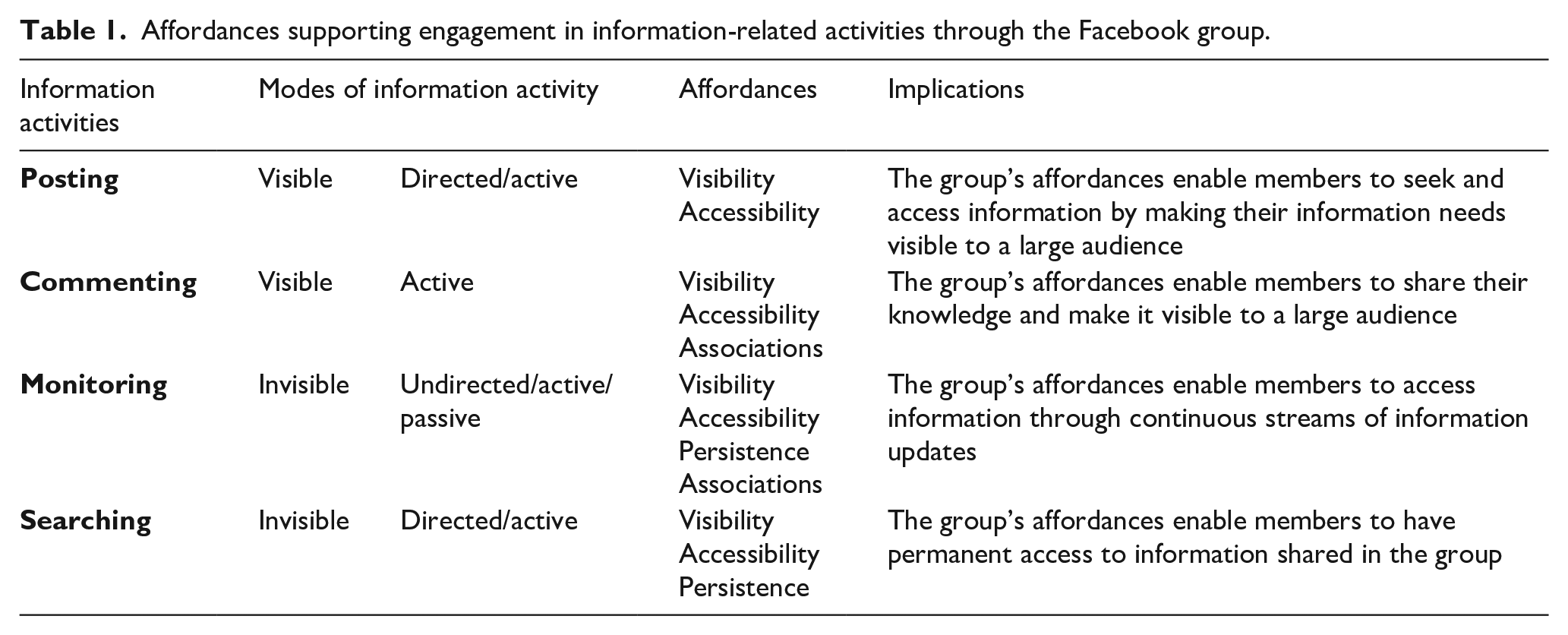
Members also used the group to interact with information in invisible ways, both with and without having a particular information need (see Bates, 2002; McKenzie, 2003; Savolainen, 1995). Members actively searched for specific information available in the group without making their information needs visible to others (see searching). Because the Facebook group offers immediate and continuous access to information, members can invisibly monitor the information activities of the group and individual group members through the newsfeed via passive scrolling or active browsing through the group’s timeline. This allows individual members to stay up to date with different aspects of raising a family in Sweden and learn from the experiences of others (see monitoring). The findings show that whereas members did not always have a direct or explicit information need, they were continuously and actively following group activities to remain aware of the group’s discussions and the information shared within them. This constant exposure has provided members with access opportunities to a broad range of experiences, which has enabled them to learn about an unfamiliar information environment.
The activities through an affordance perspective
The second research question aimed at providing an in-depth understanding of the affordances available in the Facebook group, with a particular focus on the ways these affordances facilitated members’ engagement in information-related activities.
Using a theoretical lens, three main affordances were identified as relevant to this study: visibility, persistence and associations. An additional affordance – accessibility – also emerged as essential in facilitating members’ information activities in the context of this study. This has subsequently led to the identification of two potential modes of engaging in group information activities: visible and invisible. The analysis shows that, taken together, the affordances of visibility, accessibility, persistence and associations make the Facebook group an attractive space to interact with information. These affordances should not be seen as mutually exclusive, but rather contingent on each other, if they are to facilitate access to and interaction with information, as will be further described below. The information activities, affordances and modes identified are presented in Table 1.
Visibility
The affordance of visibility refers to the ability to make one’s information activities visible to a large audience (see Treem and Leonardi, 2012). Visibility plays a central role in facilitating all of the information activities identified, making it a central affordance on which all the other affordances are dependent. In fact, the increased visibility enabled through SNSs is arguably what sets them apart from prior communication tools and face-to-face interactions (boyd, 2010; Treem and Leonardi, 2012).
Particularly, this Facebook group afforded members the opportunity to post their information requests in a real-time manner and make them instantly visible to a large audience (in this case, 4000+ members) (see also Ellison and Vitak, 2015). Due to the instant visibility of members’ activities, a large number of individuals in the group could immediately receive, read and respond to the information requests of others. In this way, the instant visibility of members’ postings has facilitated their access to the information resources embedded within the group by enabling them to reach out and gain access to many knowledgeable members in the group (see accessibility). Specifically, members were often able to engage easily and quickly in instant conversations with other members holding information specific to their situations and needs. The Facebook group also enabled other members to view all of the postings, allowing them to contribute with their expertise when deemed necessary or relevant, and make it visible and available for others (for example, commenting). The public nature of commenting in the group meant that other group members could have active and passive continuous access to information shared by others, which might be useful at the time or a later date.
Due to the visibility of other group members’ posts and comments, all of the group members were offered an equal opportunity to passively access shared information. Members were able to follow the group’s ongoing information activities through the regular stream of updates, which at the time of data collection automatically appeared on members’ personal newsfeeds. Members were able to access information synchronously by following other group members’ ongoing and active information activities, or asynchronously by browsing through other members’ recent or past information activities in the group (for example, monitoring and searching).
Accessibility
Accessibility refers to the affordance of having immediate and constant access to a distributed network of information resources that can be easily accessed at any time. As the findings demonstrate, the Facebook group provided members with the ability to connect with a large network in the host country, facilitating their access to diverse and suitable information and support resources. Due to the large audience and the real-time interaction available through the group, there were always many people available and likely to respond quickly to requests for information (see also Hård af Segerstad and Kasperowski, 2015). The large number of group members increased the information-seeker’s possibilities of finding relevant information in the group. As noted in other studies, a larger network can increase the variety and number of potential information sources available (Ellison et al., 2010). In this way, the Facebook group afforded accessibility, as both information-seekers and other knowledgeable members were able to approach and interact with each other and gain access to the information resources embedded within the group.
Specifically, the Facebook group provided a space to seek and share information, hence giving access to a broad range of more relatable first-hand, shared experiences about everyday life and raising a family in Sweden, which were not available or accessible elsewhere. An important consequence of having such immediate access was that information-seekers were able to directly engage in real-time conversations with other knowledgeable members. In this way, members of the group were able to discuss their specific situations or information needs, and gain immediate and tailored information and advice. Immediate access to other people who are able to provide personalised access to information has also been consistently observed as one of the incentives for seeking information through Facebook and Twitter (see, for example, Ellison and Vitak, 2015; Jeon et al., 2016; Kim et al., 2014; Lampe et al., 2012; Morris et al., 2010a, 2010b; Mudliar and Raval, 2018; Oeldorf-Hirsch et al., 2014; Vitak and Ellison, 2013). However, for the information embedded within a group to be accessible, it is contingent on members’ ability to draw from and facilitate access to this knowledge, either by seeking or sharing it with others within the group. In this way, members in the group did not only consume information, but also co-created and provided access opportunities to distinctive knowledge about raising a family in Sweden, which could only be attained through members in the group (Mansour and Francke, 2017).
Persistence
Persistence means that all of the group activities and information are permanently stored and will not disappear. The affordances of persistence and visibility are closely related. All past information activities persist and are permanently stored in the group, while visibility affords members the ability to access this data at any time, anywhere. This results in both preserving the community’s information resources and offering a large number of individuals equal and continual access to potentially relevant information. As a result, the group can build, sustain and grow its information resources over time (Majchrzak et al, 2013; Treem and Leonardi, 2012).
The visibility and persistence of information afford members a multitude of access opportunities to current and past information activities, facilitated through various Facebook features (for example, search, timeline and newsfeed) (see also Majchrzak et al., 2013; Treem and Leonardi, 2012). This was demonstrated in the findings, as the study participants referenced their use of information previously shared by others. Members were simultaneously able to monitor and browse the group’s timeline to keep up with its information activities, without having any particular information need (see Bates, 2002; McKenzie, 2003; Savolainen, 1995). When the participants had a specific or direct information need (Bates, 2002), they were able to search through previous discussions and locate the desired information. Therefore, persistence plays an important role in facilitating members’ engagement in the invisible, asynchronous information activities in the group (for example, monitoring and searching).
Echoing Majchrzak et al. (2013) and Treem and Leonardi (2012), it could be argued that this might not even be possible if, for instance, similar information activities were carried out through other communication means (for example, face-to-face, email or a telephone call). The visibility and accessibility of these information activities are confined to those directly involved in such activities – in most cases, a limited number of individuals, who will retain access to such information for a limited amount of time. In this regard, the affordance of persistence is contingent on information visibility and accessibility.
Associations
Associations are the inferences and cues that members may draw from other members’ visible activities (see Treem and Leonardi, 2012). The Facebook group affords members the ability to make associations between members and the knowledge and expertise they may have through their information activities in the group. Specifically, given that the Facebook group affords members visibility, including the ability to see others’ posts and comments, individuals can identify ‘who knows what’ in the group (see Leonardi, 2015). Such mapping of expertise can be useful in the long run. This knowledge enables members to identify potential information sources within the group, which can later be consulted for their own information needs. Additionally, this knowledge may enable further connections to members who are able to provide relevant information. As the findings demonstrate, these connections were facilitated through the tagging feature, which enabled members to connect or be connected to individuals seeking or capable of providing specific information. As such, the visibility of members’ activities affords members not only access to useful information (Savolainen, 1995), but also the development of the knowledge necessary to locate and share information with others in the group (Treem and Leonardi, 2012).
Further, the visibility of other members’ content and activities enables members to take cues from these activities, which can provide a rich social context, and is essential in shaping the group’s identity and the information activities of individual members (see also Ellison and Vitak, 2015). Members can see that others share their experiences, creating a sense of identity that encourages members to share information and support one another. A shared community identity is, thus, a vital precedent for seeking or sharing information with others in the community (see Pilerot and Limberg, 2011; Talja, 2002). Access to a large community that someone may associate with through a Facebook group has also been observed as an essential affordance for parents coping with different social stigmas, such as death or being a stay-at-home father (Ammari and Schoenebeck, 2016; Hård af Segerstad and Kasperowski, 2015).
The findings also show that the visibility of others’ contributions nurtures norms of reciprocity, motivating individuals to contribute to the group with their expertise because they have either received help from other members or believe that they will need assistance from the group in the future. The social norms of altruism and reciprocity have also been suggested to shape users’ information-sharing activities on Twitter (Morris et al., 2010a). Cues such as most questions posted in the group receiving rapid responses tailored to the needs of the information-seeker also provide strong incentives for members to post questions to the group. It is reasonable to think that these incentives might disappear if members’ enquiries did not receive an appropriate response – as in the example of the participant who was disappointed by another member who was unwilling to fully disclose her knowledge. This pattern has also been noted in Mudliar and Raval’s (2018) study, where some Facebook group members developed negative feelings because their information enquiries were ignored, discouraging them from seeking further information. These disaffected individuals eventually left the group. These two examples demonstrate the ways in which the same platform might be used differently by two groups of people. These cases indicate how the material affordances of the Facebook group and the social nature of member activities are entangled, sustaining and providing opportunities for members to engage in information-related activities.
Conclusions
This study aimed to develop an understanding of the information-related activities engaged in by members of a Facebook group, including the affordances enabling engagement in these activities. The study reveals that group members were engaged in four interrelated information activities: posting, commenting, monitoring and searching. Four affordances – visibility, accessibility, persistence and associations – worked together to provide members with ample opportunities to engage in information-related activities through the group.
The study provides an analysis of the enactment of these activities in the Facebook group as shared and interrelated, rather than merely individual. Information-seeking and information-sharing were interdependent and collective, rather than two individual and separate activities – a relation that has been underexplored in previous literature on SNSs (see Khoo, 2014; Savolainen, 2016). In fact, the findings show that information-seeking and information-sharing are deeply interrelated, which is essential in enabling and preserving the group’s current and future information activities. It is thus suggested that the information activities carried out through the Facebook group are interrelated, continuous, collaborative, visible and accessible to all current and future group members. Consistent with previous research (for example, Majchrzak et al., 2013; Treem and Leonardi, 2012), it is argued in this study that the increased visibility of the information activities carried out through the Facebook group has helped members to overcome time, space and social network limitations by enabling continuous engagement with and access to the information resources embedded within this large and diverse network.
The affordance perspective and in-depth interviews also provided novel insights into invisible information activities that have been underexamined in previous research (see Jiang et al., 2013; Metzger et al., 2012, 2018). This blind spot might be due to the fact that most research on SNSs has employed either large-scale surveys or content analysis which have focused on users’ direct information-seeking activities on SNSs (see Khoo, 2014). However, the findings demonstrate that whereas users might not be engaged visibly or directly in the information activities on a site, they might still be accessing this information, without necessarily having direct information needs or making their information activities visible to others (see also Bates, 2002; McKenzie, 2003).
The study thus adds to the current literature by suggesting that both visible and invisible modes should be taken into account when examining information-related activities within SNSs. Taken together, these findings further emphasise the need to employ theories and methods that help move beyond the exclusive focus on information-seeking as an individual and direct activity, and instead highlight the wide range of opportunities to interact with information and others offered by social networking environments.
As social networking groups become important information and support resources in the everyday professional lives of many people, this study delivers important insights into the ways these groups are used. Such insights may be useful for professional groups (for example, information and support providers, librarians or system designers) that are interested in what information people access and share via SNS-based groups, and the ways in which individuals interact with this information and others based on the affordances available within these mediated social networks. These insights may be fruitful in developing effective information and support resources targeted at groups such as the one explored in this study (mothers, migrants) or others (for example, patients).
Footnotes
Declaration of Conflicting Interests
The author(s) declared no potential conflicts of interest with respect to the research, authorship and/or publication of this article.
Funding
The author(s) disclosed receipt of the following financial support for the research, authorship, and/or publication of this article: This study was conducted as part of the Learning, Interaction and Mediated Communication in Contemporary Society project funded by the Swedish Research Council (registration number: 349-2006-146). The project is based at the Linnaeus Centre for Research on Learning, Interaction and Mediated Communication in Contemporary Society (LinCS) at the University of Gothenburg and the University of Borås, Sweden.
