




Abstract
Portable spectroscopic technologies are increasingly transforming analytical science by enabling reliable, on-site data acquisition in fields ranging from agriculture and food quality control to medicine, forensics, energy, and even astrophysics. This article presents an overview of the opportunities and challenges arising from the miniaturization of near-infrared (NIR) and Raman devices, highlights selected applications, and outlines the global vision of “spectroscopy without borders.” By bridging the gap between benchtop accuracy and field accessibility, portable instruments empower researchers and practitioners to address urgent societal challenges, particularly in the context of global population growth, food security, and sustainability. This contribution is based on an invited plenary lecture presented at the XLIV—Colloquium Spectroscopicum Internationale—CSI conference in Ulm, Germany, July 27–31, 2025.
Keywords
Introduction
The world population is projected to grow significantly in the coming decades, increasing the demand for food and resources while malnutrition persists in many regions. These parallel developments highlight a paradox: on one hand, sophisticated technologies and abundant resources exist in certain regions; on the other, many communities face shortages and lack access to advanced analytical infrastructures.
Analytical sciences are called to provide solutions that are not only rapid and accurate but also widely accessible and affordable. In this context, portable spectroscopic devices have become more than just convenient tools. They represent a shift toward democratizing science, enabling high-quality data acquisition outside of traditional laboratory environments and bringing cutting-edge technology closer to end-users in the field.
Miniaturization and technological progress
The miniaturization of near-infrared (NIR) and Raman spectrometers has been a central development in recent years. From early benchtop systems such as the NIRFlex N-500 to today’s pocket-sized devices, the technological journey has been remarkable. Handheld and even consumer-grade devices now approach the analytical capabilities of laboratory instruments, while remaining easy to operate and highly mobile.1,2
This rapid progress has been fueled by several innovations. Advances in quantum chemical modeling, chemometrics, and artificial intelligence—especially machine learning techniques like Gaussian process regression and neural networks—have dramatically improved the interpretability of complex spectra. 3 These tools compensate for some of the limitations inherent to smaller devices, allowing researchers to draw meaningful conclusions from data that would previously have been considered incomplete or ambiguous.4,5
Nevertheless, challenges remain. Miniaturized instruments cannot yet capture the full range of vibrational modes accessible to high-end benchtop systems. This means that validation against reference methods remains crucial. Two-dimensional correlation spectroscopy (2D-COS), often described as “the eye of the spectrometer,” has proven particularly powerful in this respect, revealing hidden spectral information and improving the reliability of regression models. 6
Applications across sectors
Portable spectroscopy finds applications from phytochemistry and food analysis to medicine, environment, forensics, and astronomy (Figure 1).
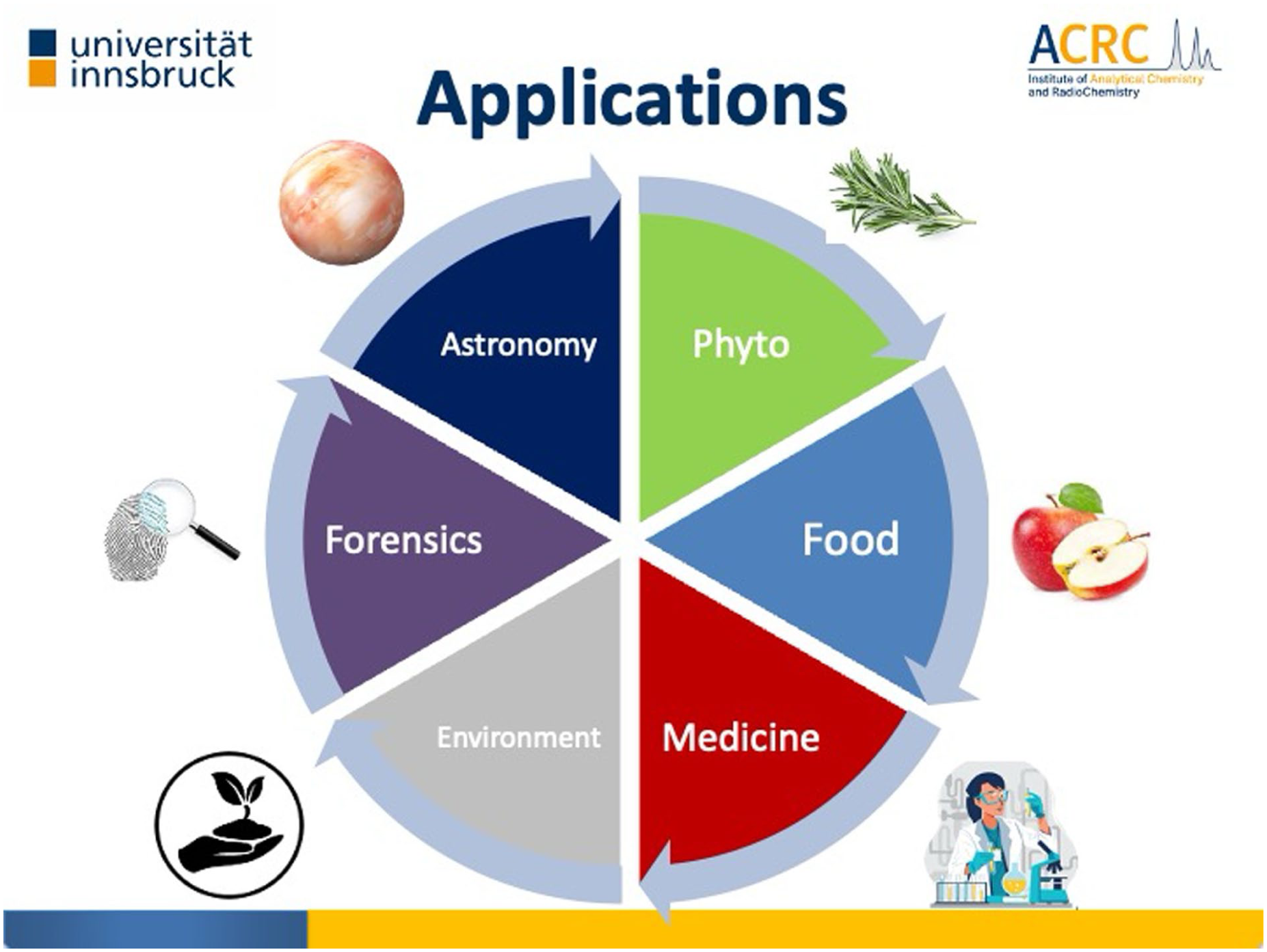
Application fields.
Agriculture and food
Agriculture and food science have been among the earliest beneficiaries of portable spectroscopy. Farmers and producers can now perform real-time quality checks directly in the field or at the point of sale. For example, NIR spectroscopy has been successfully applied to optimize harvest times in Verbena officinalis, ensuring that bioactive compounds are collected at their peak. 7 Similarly, apple producers have used handheld devices to assess antioxidant capacity and soluble solids non-destructively, helping to guarantee both nutritional value and consumer satisfaction. 8
At the high end of the market, black truffles—valued at thousands of euros per kilogram—have been classified and evaluated for quality using portable spectrometers. 9 Even in the field of novel foods, miniaturized devices play a role. Insect protein, which is gaining popularity as a sustainable dietary source, has been analyzed in nutrition bars with the help of low-cost sensors and data fusion approaches, ensuring consistency and safety. 10
Medicine and life sciences
The medical sector also illustrates the potential of portable spectroscopy. Handheld Raman devices have enhanced the diagnosis of bone infections, enabling clinicians to distinguish between different pathogens on site, such as Staphylococcus aureus and S. epidermidis. 11 In parallel, material-enhanced infrared spectroscopy (MEIRS) has allowed for the quantification of lipoproteins in human serum, opening doors to point-of-care diagnostics that are both accurate and efficient. 12
Another pressing issue is environmental exposure to micro- and nanoplastics. Recent research has estimated that humans ingest or inhale tens of thousands of plastic particles annually. Portable spectroscopy is playing an increasingly important role in monitoring this exposure, helping researchers and policymakers better understand health risks and potential interventions. 13
Forensics
Forensic science has always required tools that are fast, accurate, and reliable under field conditions. Portable NIR and Raman systems are ideally suited to this domain. Applications range from estimating the post-mortem interval of skeletal remains to distinguishing human from animal bones using deep learning methods. 14 Beyond biological samples, handheld spectrometers are now being deployed for rapid, on-site analysis of drugs, fibers, banknotes, and other trace evidence, reducing turnaround times and preserving the chain of custody. 15
Energy and environment
Energy and environmental sciences have also embraced portable spectroscopy. Mobile NIR instruments have been customized for the reproducible quantification of ethanol in gasoline blends, supporting both regulatory compliance and consumer protection. 16 At the other end of the spectrum, portable spectroscopy has reached into space science. Remote sensing of astrophysical ices has revealed subtle structural differences between crystalline and amorphous phases, deepening our understanding of planetary formation and interstellar chemistry. 17
Spectroscopy without borders
What unites all these examples is the core principle of “spectroscopy without borders.” Portable devices are no longer niche instruments confined to pilot projects or specialist labs. Instead, they are becoming mainstream tools that extend the reach of spectroscopy across geographical, economic, and disciplinary boundaries.
By bridging laboratory accuracy with field accessibility, portable spectrometers are not only advancing scientific research but also contributing directly to solving some of humanity’s most urgent challenges: ensuring food security, protecting health, supporting forensic investigations, and monitoring environmental sustainability.
This global vision highlights spectroscopy as a truly borderless science—an enabling technology that can empower people wherever they are, from agricultural fields in developing countries to forensic laboratories in major cities, and from hospital wards to space missions.18,19
Footnotes
Declaration of conflicting interests
The author declared no potential conflicts of interest with respect to the research, authorship, and/or publication of this article.
Funding
The author received no financial support for the research, authorship, and/or publication of this article.
