



Abstract
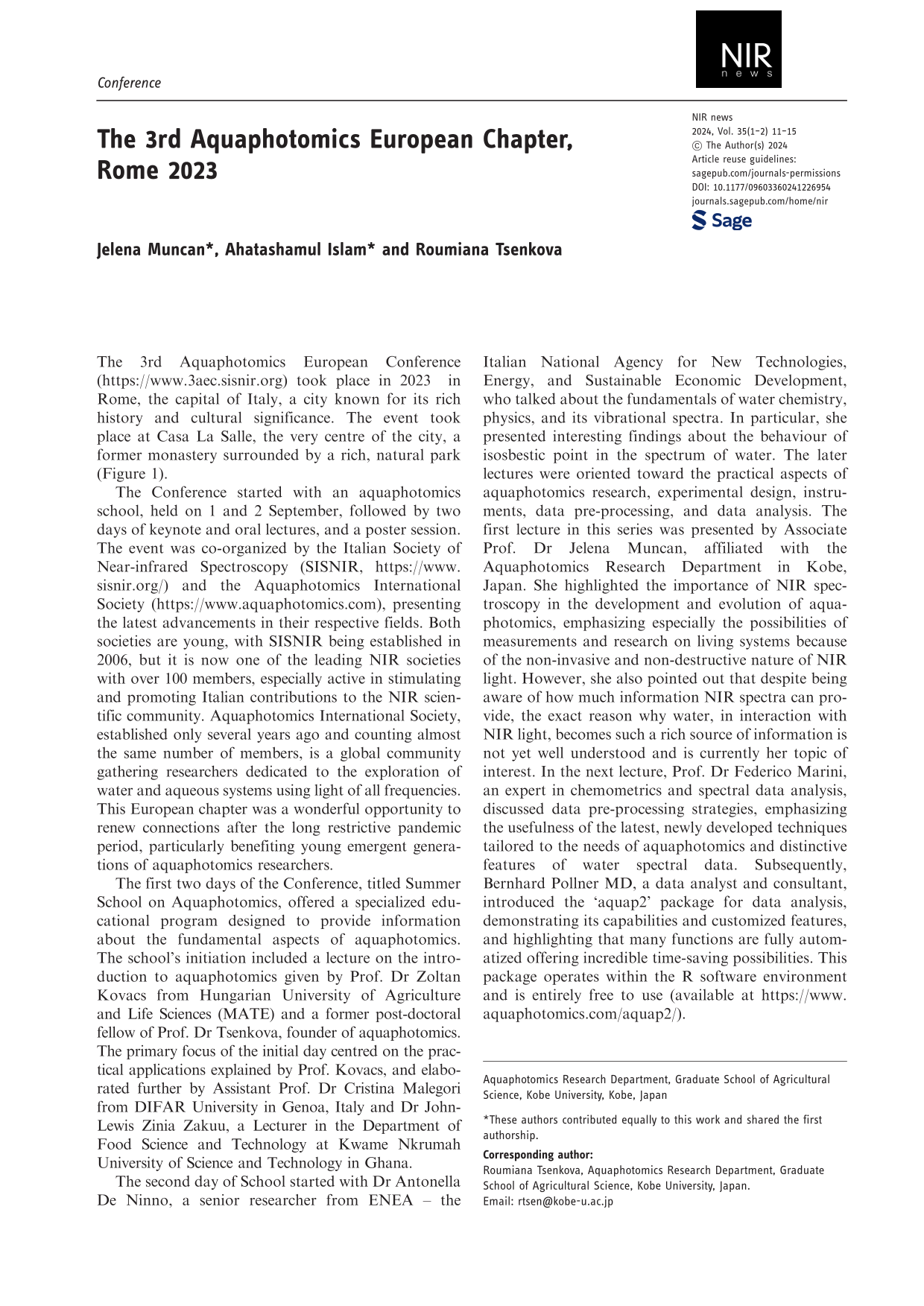
The 3rd Aquaphotomics European Conference (https://www.3aec.sisnir.org) took place in 2023 in Rome, the capital of Italy, a city known for its rich history and cultural significance. The event took place at Casa La Salle, the very centre of the city, a former monastery surrounded by a rich, natural park (Figure 1).

The 3rd Aquaphotomics European Conference, held in Rome, Italy from 1 to 4 September 2023 took place at the historically rich and visually stunning venue of Casa la Salle, a former monastery. Attended by approximately 50 participants representing around 10 countries, majority of them coming from Europe, the Conference also welcomed guests from Asia and Africa.
The Conference started with an aquaphotomics school, held on 1 and 2 September, followed by two days of keynote and oral lectures, and a poster session. The event was co-organized by the Italian Society of Near-infrared Spectroscopy (SISNIR, https://www.sisnir.org/) and the Aquaphotomics International Society (https://www.aquaphotomics.com), presenting the latest advancements in their respective fields. Both societies are young, with SISNIR being established in 2006, but it is now one of the leading NIR societies with over 100 members, especially active in stimulating and promoting Italian contributions to the NIR scientific community. Aquaphotomics International Society, established only several years ago and counting almost the same number of members, is a global community gathering researchers dedicated to the exploration of water and aqueous systems using light of all frequencies. This European chapter was a wonderful opportunity to renew connections after the long restrictive pandemic period, particularly benefiting young emergent generations of aquaphotomics researchers.
The first two days of the Conference, titled Summer School on Aquaphotomics, offered a specialized educational program designed to provide information about the fundamental aspects of aquaphotomics. The school’s initiation included a lecture on the introduction to aquaphotomics given by Prof. Dr Zoltan Kovacs from Hungarian University of Agriculture and Life Sciences (MATE) and a former post-doctoral fellow of Prof. Dr Tsenkova, founder of aquaphotomics. The primary focus of the initial day centred on the practical applications explained by Prof. Kovacs, and elaborated further by Assistant Prof. Dr Cristina Malegori from DIFAR University in Genoa, Italy and Dr John-Lewis Zinia Zakuu, a Lecturer in the Department of Food Science and Technology at Kwame Nkrumah University of Science and Technology in Ghana.
The second day of School started with Dr Antonella De Ninno, a senior researcher from ENEA – the Italian National Agency for New Technologies, Energy, and Sustainable Economic Development, who talked about the fundamentals of water chemistry, physics, and its vibrational spectra. In particular, she presented interesting findings about the behaviour of isosbestic point in the spectrum of water. The later lectures were oriented toward the practical aspects of aquaphotomics research, experimental design, instruments, data pre-processing, and data analysis. The first lecture in this series was presented by Associate Prof. Dr Jelena Muncan, affiliated with the Aquaphotomics Research Department in Kobe, Japan. She highlighted the importance of NIR spectroscopy in the development and evolution of aquaphotomics, emphasizing especially the possibilities of measurements and research on living systems because of the non-invasive and non-destructive nature of NIR light. However, she also pointed out that despite being aware of how much information NIR spectra can provide, the exact reason why water, in interaction with NIR light, becomes such a rich source of information is not yet well understood and is currently her topic of interest. In the next lecture, Prof. Dr Federico Marini, an expert in chemometrics and spectral data analysis, discussed data pre-processing strategies, emphasizing the usefulness of the latest, newly developed techniques tailored to the needs of aquaphotomics and distinctive features of water spectral data. Subsequently, Bernhard Pollner MD, a data analyst and consultant, introduced the ‘aquap2’ package for data analysis, demonstrating its capabilities and customized features, and highlighting that many functions are fully automatized offering incredible time-saving possibilities. This package operates within the R software environment and is entirely free to use (available at https://www.aquaphotomics.com/aquap2/).
In the evening, the Conference officially began with a lecture by Prof. Tsenkova, titled “Aquaphotomics – New Integrative Science, Technology, and Education Platform.” In her vision, aquaphotomics serves as a unifying platform for fundamental research on water–light interaction, technological advancements driven by acquired knowledge, and the imperative to share this information beyond the scientific community, influencing societal values and future trends (Figure 2).
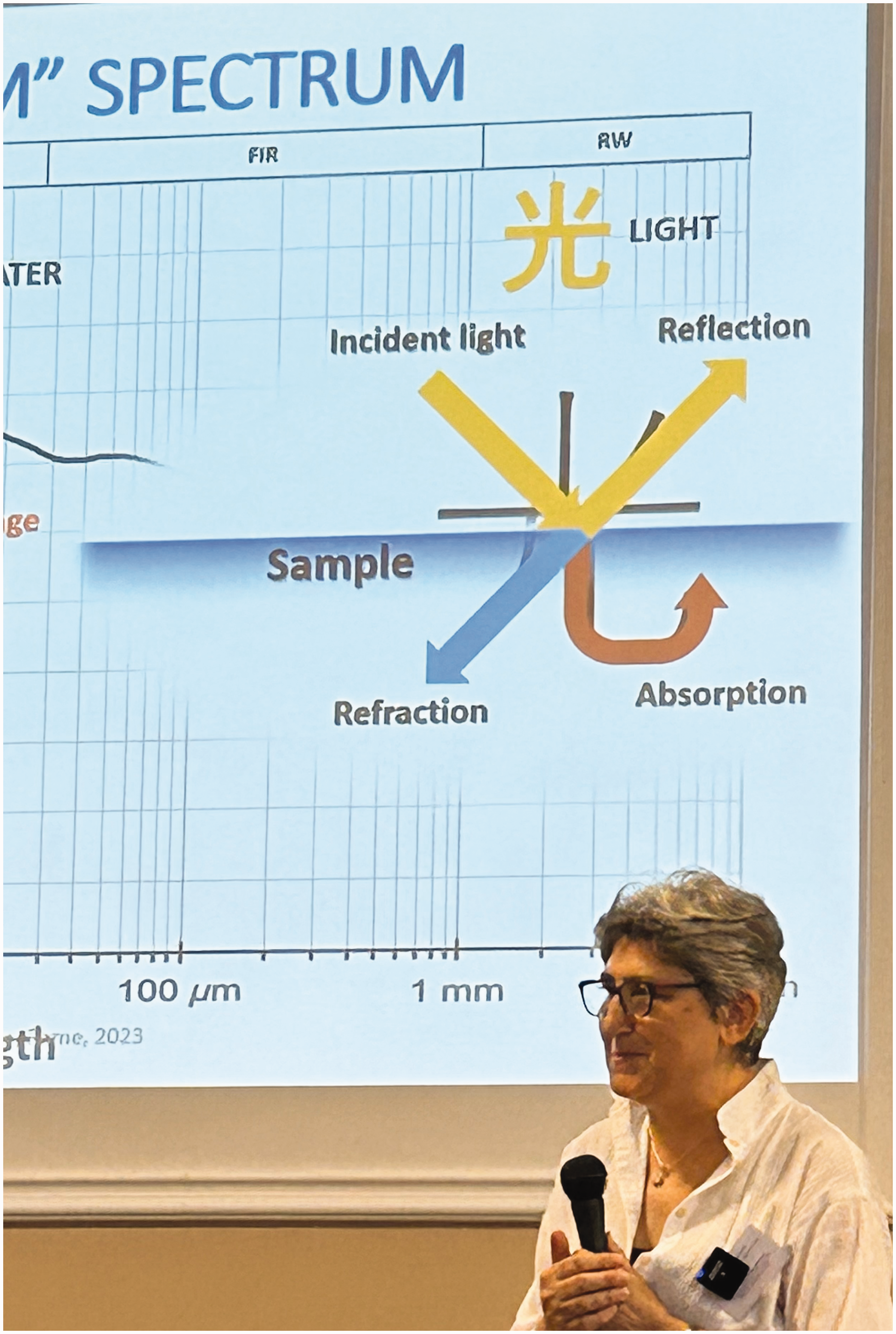
The founder of aquaphotomics, Prof. Dr Roumiana Tsenkova during the opening lecture of the 3rd Aquaphotomics European Chapter, Rome 2023.
The third and fourth days of the conference featured a line-up of keynote speeches, oral presentations, and a session dedicated to poster presentations. A pioneer in aquaphotomics, Dr Tiziana Cattaneo, from CREA, a Research Center for Engineering and Food Transformation in Milan, Italy, delivered the first keynote on “The NIR Water Planet: Italian Experiences”, tracing her research journey and highlighting milestones impacting food production and quality control. Her contributions, including integrating aquaphotomics with cloud services and creating the “Aquacontrol” platform, have advanced food quality assessment. Dr Livio Giuliani, a representative of the European Cancer and Environment Research Center in Brussels, delivered the second keynote at the conference, discussing the impact of calcium cyclotronic resonance on gene expression in iPSC-cardiomyocytes. The most striking message from his lecture was that what we currently think of as non-ionizing irradiation, has effects on the molecular organization of water, ultimately leading to ionization and the creation of coherent water domains. According to Prof. Giuliani and the evidence he presented, this process is at the core of biochemical reactions within cells.
In the following presentation, Associate Prof. Dr Jelena Muncan shared new insights derived from her work on mapping the aquaphotome. She presented the current results, revealing that in the first overtone region of water, there are at least 19 – more than initially believed 12 – water matrix coordinates (WAMACs). Additionally, she noted that more coordinates, around 24 in total, are likely to be discovered. Dr Muncan also discussed how these WAMACs exhibit distinct functionalities in aqueous and living systems due to variations in the available energy for specific tasks. Following that, Professor Dr Stefka Atanassova from Trakia University in Bulgaria shared the outcomes of her research centred on examining the influence of water stress on maize plants. Her presentation uncovered distinctions in absorption spectra, especially in the 1300–1600 nm range associated with water absorption. This investigation showed that aquagrams are excellent visualization tool to illustrate changes in the water spectral pattern during drought, highlighting the potential of aquaphotomics for understanding water stress in plants.
The Conference particularly welcomed new perspectives from emerging researchers. Dr Ermal Nikollari from Sapienza University in Italy presented his research investigating the dielectric permittivity of aqueous electrolyte solutions using THz time-domain and FTIR spectroscopy. This study explored the dielectric response of pure water and aqueous chloride solutions at frequencies over 1 GHz, employing a dual-population model to reveal distinct relaxation modes and explain variations in dielectric constants, static permittivity, and high-frequency residual permittivity. Adding to the conference, Associate Prof. Dr Cerar Janez from the University of Ljubljana in Slovenia presented findings resulting from collaborative research with Prof. Kovacs from Hungary. They explored the limitations of electrostatic theories in predicting the thermodynamic properties of concentrated solutions of aqueous electrolytes and polyelectrolytes. The findings, derived from the application of NIR spectroscopy and aquaphotomics, indicated that this approach might successfully overcome such limitations and provide new insights. They also put forward innovative solutions, including a water-correction method designed to address certain challenges inherent in presenting aquagrams. Yasuhiro Kato, Project Senior Assistant Professor from Keio University, explored the application of aquaphotomics to visualize the water’s state during biological processes, focusing on oxidative stress – a crucial factor in the development of diseases such as neurodegenerative disease like Alzheimer’s or dementia. He shared a segment of the current research, which employed NIR aquaphotomics to investigate the relationship between the reduced and oxidized forms of glutathione, whose ratio is an important indicator of oxidative stress, and their surrounding water structure.
Young researchers played a significant role in this European Conference, with emerging scholars from Italy and Hungary delivering half of the 10 oral presentations. Silvia Grassi of the University of Milan employed a portable Micro NIR instrument to monitor ice formation during meat super-chilling, providing valuable insights for tailoring beef super-chilling protocols. Sara Gariglio, University of Genoa, used aquaphotomics and NIR hyperspectral imaging to create “hydration maps”, examining water management in nonvascular epiphytic communities on chestnut bark and gaining insights into their response to water stress and climate change (Figure 3).
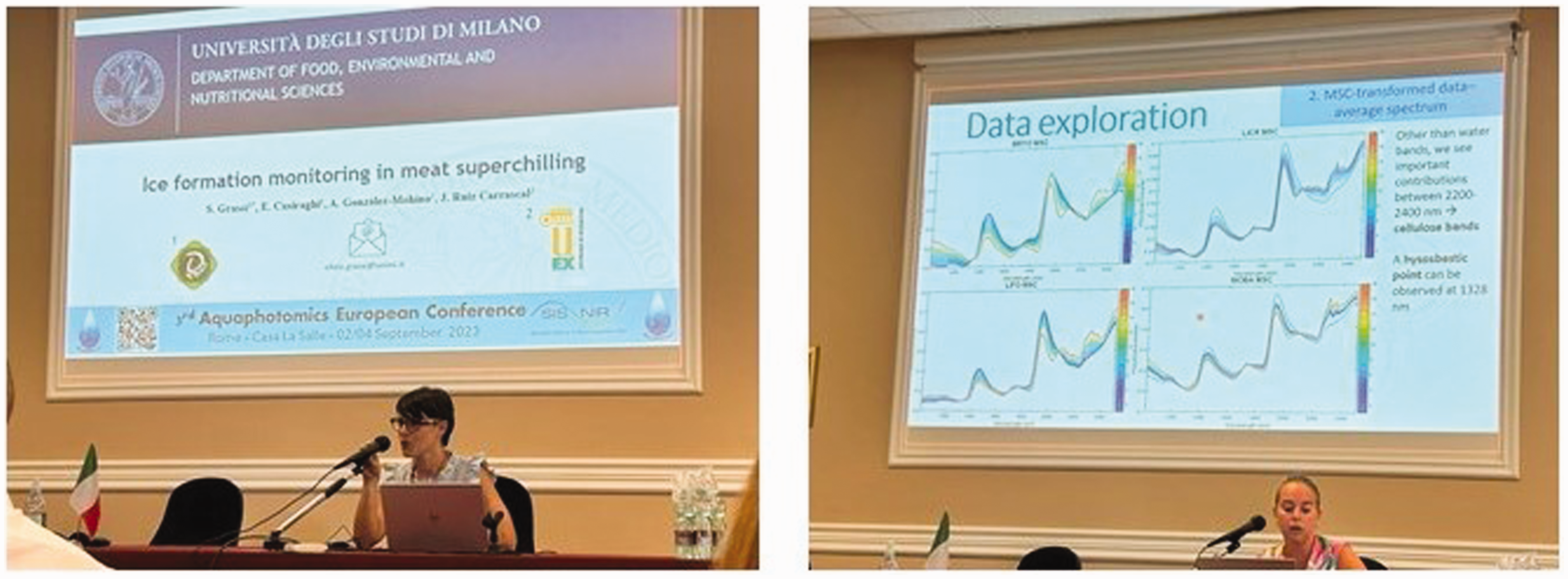
Silvia Grassi, University of Milan (left), and Sara Gariglio, University of Genoa (right), representing the young generations of aquaphotomics researchers in Italy.
Flora Vitalis from MATE in Hungary used NIR spectroscopy to monitor probiotic-containing fruit juice fermentation, achieving accurate classification and prediction of bacterial cultures, fermentation time, and pH (Figure 4, right). Balkis Aoudi, also from MATE, utilized aquaphotomics to effectively discern drying-induced alterations in the spectra of aromatic plants – rosemary, thyme, and marjoram, showcasing its potential for rapid determination of phytochemical content (Figure 4, left). Alexander Stoilov, from Yunosato Aquaphotomics Lab in Japan, demonstrated aquaphotomics’ effectiveness in a variety of applications. Particularly interesting was the application of aquaphotomics in monitoring human body water in the NIR spectral range during relaxation practices, offering the potential for individual identification and state assessment, and also revealing age, gender, and origin-related characteristics.

Balkis Aoudi (left) and Flora Vitalis (right), Hungarian University of Agriculture and Life Sciences (MATE) representing the young generations of aquaphotomics researchers in Hungary.
An engaging poster session manifested diverse contributions, including Prof. Dr Stefka Atanassova from Trakia University, Bulgaria, presenting nondestructive differentiation of fresh and frozen-thawed meat and fish, emphasizing water absorption. Mercy Mukite Barasa from MATE, Hungary, discussed the impact of water content correction on aquagrams’ modes using aqueous solutions of ionic compounds. Fabrizio Frezza from the University of Rome “La Sapienza,” Italy, introduced an automatic procedure to estimate the dielectric properties of human tissues at the microwave band based on water and solid content. Assoc. Prof. Dr Zoltan Gillay also from MATE, Hungary, focused on estrus detection in pigs based on testing urine. Lukács Mátyás from the same university shared insights into monitoring the ultrasound-assisted soaking process of red kidney beans. Yoko Osafune from Recella Co. Ltd, Japan, explored the characteristics of cosmetics derived from deep seawater. Frederic Roscop from Aequil Lab, UK, delved into the effects of EM dynamization on water. Dr John-Lewis Zinia Zakuu from Kwame Nkrumah University of Science and Technology, Ghana, revealed ochratoxin contamination in wine. Assoc. Prof. Dr Jelena Muncan showed that it was possible to quantify the absorbed radiation dose in mice using aquaphotomics immediately after the irradiation exposure.
In the Round Table and the Assembly of the European Aquaphotomics Society sessions, researchers in this field evaluated the current status and prospective trajectories of aquaphotomics on a global and European scale. Participants engaged actively, exchanging perspectives, pinpointing research voids, and deliberating on the prerequisites for advancement. Aquaphotomics has primarily advanced in applications like food quality and inflammation diagnostics, with a notable trend in researching drought stress and understanding stress resistance mechanisms in plants. Existing results suggest a link between genetic modifications and stress resistance, influencing water structure regulation. Italy contributes emerging trends in aquaphotomics with hyperspectral imaging, adding a spatial dimension. Prof. Kovacs leads a potent aquaphotomics research group in Europe, also playing key roles in MATE and the Institute of Food Science and Technology. Through the Stipendium Hungaricum scholarship program, he has assembled a team of highly talented international researchers with immense potential, actively propagating aquaphotomics to various corners of the globe.
The conference was made possible owing to the generous sponsorship from VIAVI Solutions and the Tsuki no Shizuku Foundation (https://www.tsukinoshizuku.org).
The European chapter of this scientific journey concluded with notable advancements, especially among young aquaphotomics researchers, fostering enthusiasm for the discipline’s expansion. Lastly, the next event in the aquaphotomics calendar was also announced – The 5th Aquaphotomics International Conference, a conference celebrating the 20th anniversary since its establishment.
Scheduled to take place in Kobe, Japan, from 16 to 20 November 2024, this significant event is anticipated with earnest interest as researchers worldwide gear up for meaningful discussions and a deeper exploration of water–light interaction-related topics.
More information about this and future events can be found at the official aquaphotomics website (https://www.aquaphotomics.com/events/).
Footnotes
Declaration of conflicting interests
The author(s) declared no potential conflicts of interest with respect to the research, authorship, and/or publication of this article.
Funding
The author(s) received no financial support for the research, authorship, and/or publication of this article.