




Abstract
Introduction:
Achillea tenuifolia Lam (AT) has several biological activities and medicinal properties. In this study, we elucidated the impact of the AT on anxiety-related behaviors, reproductive parameters, antioxidant capacity in male rats subjected to chronic restraint stress (CRS).
Methods:
35 Wistar rats were divided into five groups: control, CRS-control (received normal saline) and three CRS-treated groups received AT extract (100, 150, and 200 mg/kg body weight) for 21 consequences days. To induce CRS rats, the rats were immobilized for 21 days and received the extract orally. On the last day of treatment, anxiety-related behaviors were assessed through the sucrose preference test (SPT) as well as elevated plus maze (EPM) tests. Corticosterone, luteinizing hormone (LH), and follicle-stimulating hormone (FSH), testosterone levels were evaluated to determine reproductive capacity. Sperm parameters including the total count, motility, and viability were also analyzed. Weight of body, testis and seminal vesicles was measured as well.
Results:
The findings revealed that 100, 150, and 200 mg/kg of AT extract had anxiolytic effects in CRS rats, as confirmed by the EPM test and SPT. In addition, AT extract could improve fertile capacity and sperm quality to varying degrees. The level of corticosterone had decreased, whereas the level of LH, FSH and testosterone had increased in CRS-treated rats. Moreover, the reduced level of MDA coincided with an increased rate of antioxidant capacity. Our findings suggest that AT extract could alleviate stress-induced dysfunctions.
Conclusion:
Overall, these observations would infer that AT extract could improve fertility capacity and behavioral impairment in the stress conditions.
Graphical abstract:
Assumption pathway describing the probability underlying mechanism of CRS-induced anxiety and reproductive toxicity and protective effect of AT.

Introduction
Chronic stress is the leading health concern worldwide in which the stressors exert their activity for a prolonged time. Stress activates the sympathetic nervous system and hypothalamic-pituitary-adrenal gland (HPA) axis.1,2 Activated HPA axis has inhibitory effects on the hypothalamic-pituitary-gonadal (HPG) axis through a reduction of testosterone levels and Sertoli cells, which ultimately lead to spermatogenesis disturbances. 3 Clinical studies have highlighted the role of chronic stress on fertility status through alteration in the sex hormone secretion and the structure of reproductive organs. Besides, stress can disrupt quality and content of sperms as well as testis weights in adult male rats. 4 It was declared that the anxiety and depression status could strongly interfere with sexual behaviors in rat models, indicating an interconnection between reproduction and behaviors. 5
Due to high energy requirements during stressful conditions, a remarkable yield of free radicals is generated which leads to deleterious effects on cell membranes and other vital cell components. 6 Also, it is noteworthy to point out that the elevated level of free radicals can profoundly affect morphology, motility, and vitality of sperms. 7 It has been found that oxidative stress plays a critical role in disturbances of the central nervous system, in term of accelerating aging process via shortening of telomere length, resulting in the impairment of behavioral function, exhibiting depression and anxiety symptoms.8–11 In fact under oxidative stress, the production of free radicals exceeds natural host defense systems to neutralize or dispose of them through enzymatic (catalase) and non-enzymatic approaches. 12 A large number of evidence have demonstrated a correlation between adverse effects of oxidative stress and male infertility in terms of sperm production by testis, 13 ejaculate disruption, 14 impairment of the motility of spermatozoon, differentiation of germinal cells to spermatozoa, 15 and inhibition of Leydig cell steroidogenesis. 16 In other words, the adverse effects of stress on the fertility status can be modulated via interfering with a series of events. Based on the information above, alleviation of stress-induced effects is so crucial, in this regard.
For many decades, medicinal plants and related products are used as therapeutic agents to treat a variety of diseases.17–19 Plant-derived antioxidants such as phenolcarboxylic acids, phytic acid, and phytoestrogens are used as a free radical scavenger. Several studies have shown that some plants have protective effects on sperm quality parameters, 20 and exhibit similar antioxidant activities compared to the synthetic agents. 21 However, due to the possible adverse effects of synthetic antioxidants, natural antioxidants would be preferred, 22 thus, there has been a universal interest to use natural antioxidants from a plant source. The beneficial effects of several natural antioxidants have been reported, in terms of attenuating the anxiogenic effects, 23 and reproductive stimulation.24–26 In fact, antioxidants are useful therapeutic interventions for inhibiting the formation of free radicals and subsequent oxidative-induced damages.27–30
Achillea tenuifolia Lam (AT) is a member of the Asteraceae family, which has been used in many cultures for more than 3,000 years. 31 Attractive properties of AT extract include anti-inflammatory, -tumor, -oxidant -microbial, -spasmodic, -sedative, -hypoglycemic, -hypolipidemic and -diuretic activity. 32 Antioxidant activity of AT is attributed to the presence of flavonoids and phenolic components.31,33 Many in-line studies have indicated the effective biological functions of AT are associated with its chemical composition. Besides, a correlation was found between total phenol content and the antioxidant capacity of the AT extract. 34
We hypothesized that AT may alleviate stress-induced fertility disorders and behavioral impairment. To our knowledge, no study has been evaluated the impact of AT extract in reproduction and behavioral activity in the stress condition, so far. This promoted us to study the possible effects of AT extract on behavioral deficits and reproductive parameters in the adult male rats undergone the stress conditions.
Material and method
Extract preparation
The herb of AT was freshly gathered and confirmed by Herbarium and Botany Center of Tabriz University of Medical Sciences (Code Number: Tbz Fph 4042). The plant dried in the shade and powdered at room temperature. After that, 100 gm of powdered-aerial parts of the plant was mixed with 400 ml ethanol/water 70:30 (v: v). Then, the extract was filtered on a flat surface after passing a time period of 48 hours. Ethanol-water evaporated, and the dry extract measured. 35
The designated concentrations were prepared using distilled water. The animals received daily gavage of saline or extract 1 hour before starting CRS.
Radical scavenging capacity and total phenol
The radical scavenging activity of the AT hydro-ethanolic extract was determined by DPPH radical quenching ability. 36 A part of the samples was blended with DPPH solution, followed by keeping at 30 min at room temperature in the dark. The absorbance value was read for each sample at 517 nm. Ascorbic acid was used as a positive control.
The total amount of phenolic compounds of AT extract was measured by the method of Folin-Ciocalteau. 37 Briefly, the Folin reagent was produced in the presence of phenolic compounds in alkaline solution, resuscitated and turned blue in solution. The color intensity was determined by the optical spectrometer in 765 nm.
Gas chromatography mass spectrometry (GC-MS)
To identify the chemical ingredients and active ingredients of AT extract, GC-MS (Agilent, USA) technique was used. The HP5-MS capillary column (60 m×0.25 mm, film thickness 0.25 µm) was used for chromatographic analysis. The ethyl acetate and n-hexane (1:1) were used as a carrier. AT solution about 0.5 microliters was injected into the system and analyzed in which the column temperature held at 70°C for 5 min and then increased to 180 for 2 min (with 10°C slope) and finally heating ramp rate was increased up to 290°C for 5 min. The relative percentages amount of the separated constitutes was measured based on the total ion chromatograms by a computerized integrator. 38
Animal experiment
Male Wistar rats (n = 35), (230–250 g) were purchased from Pasture Institute (Tehran-Iran). The sample size was calculated based on the previously described formula. 39 The animals were kept in at 22 ± 2°C in controlled conditions, 12/12 h light-dark cycle, having access to water and food for 1 week before starting the experiment. The rats were randomly divided into five groups, including nine rats in each group. The control group (sham) was administered normal saline (NS) (2 ml/kg; p.o.) and was kept unstressed. Four groups exposed to CRS for 21 days, as one group was given normal saline (2 ml/kg; p.o.) and served as non-treated CRS (CRS-control) and three other CRS groups received three doses of the extract (100, 150 and 200 mg/kg body weight). The dosage of 100 and 200 mg/kg body weight was used based upon prior investigation, as the dose range of the extract was safe and effective. Besides, to evaluate the correlation between the mentioned doses, the intermediate levels ranged between 100 and 200 mg (150 mg) was chosen. The current ranges of AT extracts are non-toxic.40,41 It is noteworthy to mention that, the extract did not apply alone, in view of the fact that the goal of the study was to elucidate the therapeutic effect of the AT extract in CRS condition. Finally, at the end of stress exposure, animals were weighed and subjected to behavioral tests.
Animal welfare statement
All rats were humanely cared according to the standards of the National Institutes of Health for Laboratory Animals Care and Use (NIH Publication No. 85-23, revised 1996) under the supervision of the Ethics Committee of Islamic Azad University-Tabriz Branch (NO: IR.IAU.TABRIZ.REC.1398.073).
Induction of chronic restraint stress
In brief, animals were kept in well-ventilated plastic containers (50 cm length, 10 cm diameter) for inducing restraint status. This immobilization process was carried out daily for 2 hours (from 10:00 to 12:00 A.M.) for 21 days with no access to any food as well as water during restraint status. The breathing of animals was allowed through a hole in one end of the container. Importantly, the animals were kept with no physical compression and any pain. In similar, control animals were kept in their cage without any access to food and water during restraint status, to equal situation of animals in the CRS group. Following the immobilization process, the stress-induced rats were returned to the cage. Figure 1 is a schematic overview of the study design.
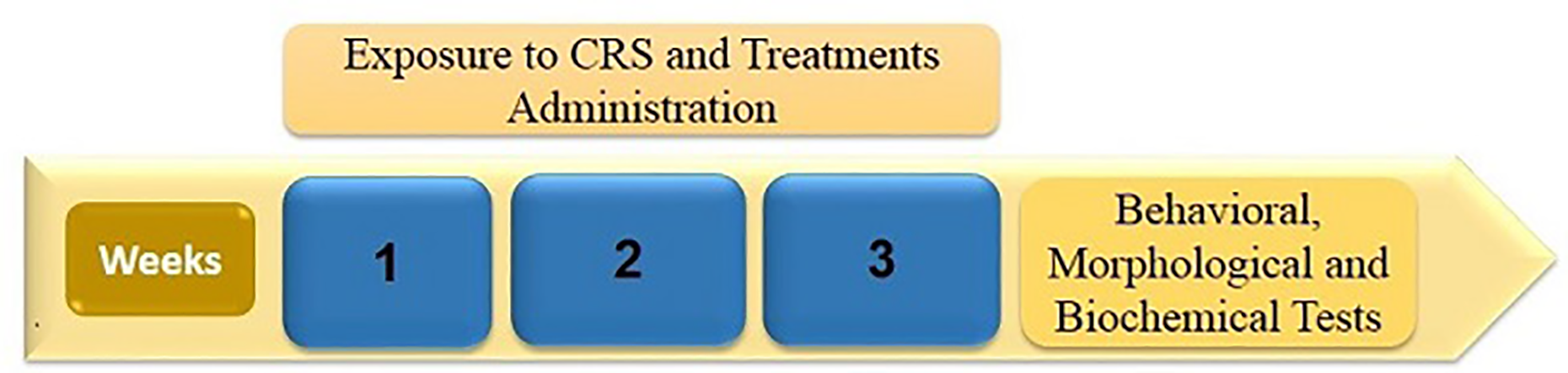
Schematic representation of study procedure. CRS: chronic restraint stress.
Behavioral assessments
Elevated plus maze
The behavioral assessment was performed using the EPM. 42 The EPM apparatus was kept in an isolated area, away from any interference such as noises, movement, or scents. The arms of the maze were positioned 90 cm above the ground, covered by foam pieces. In brief, the rat was housed in the central zone of the maze, facing the open arms. Rats were permitted to explore the maze with no interventions for 5 minutes. The time spent in open arms, the number of total arm entries and the number of open arm entries were analyzed by a blind experimenter. The number of the total arm entries was touted as a locomotor activity index. 43 After behavioral evaluation, the maze was cleaned with 70% ethanol to eliminate the scent of the evaluated rats on the others. All procedures recorded by a digital camera and behaviors were evaluated using Panlab3 software.
Sucrose preference test (SPT)
In order to assess the impact of stress on anhedonia state in animals, the SPT was performed. Sucrose solution (1%) was prepared in two separate bottles and was placed in the cage of animals, 24 hours prior to the initiation of the experiment. On the next day, one bottle was replaced by tap water. The quantity of water and sucrose solution intake was recorded, and the SPT was determined according to this formula: consumed sucrose solution divided to consume amounts of both water and sucrose solutions.
Sampling
After 24 hours of the last behavioral test, ketamine and xylazine (90 and 10 mg/kg, i.p.) were used to anesthetize the animals. 44 Blood was taken from the heart and to harvest serum it was centrifuged at 3000 rpm for 10 min at 4°C. The serum samples were kept in the freezer at −20°C until being used.
Both testes were isolated and cleared from adhering tissues and subcellular fractions and the samples were washed and homogenized by phosphate buffer (pH 7.4). Then, the epididymis was separated for subsequent examinations and the epididymal tail was used to evaluate the sperm parameters. Notably, both testis and seminal vesicles were also weighted and reported.
Hormonal analysis
To determine the effect of AT extract on sex-related hormones, the level of these hormones were measured using DBC ELISA kit as follows: FSH (Cat. No. CAN-FSH-4060, sensitivity:1 IU/L), LH (Cat. No. CAN-LH-4040, sensitivity: 0.2 IU/L), testosterone (Cat. No CAN-TE-250 sensitivity: 0.022 ng/ml), and corticosterone were determined using a kit (Cat. No: ab108821, sensitivity: 0.3 ng/ml).
Sperm preparation to determine sperm parameters
To investigate the potency of AT extract on sperm parameters, motility, count of sperms and, viability was determined. In brief, after weighing both left and right testes in all experimental rats, the mean weight was reported. To evaluate sperm storage, the cauda epididymis was isolated about 1 cm of the epididymal tail. Then, the epididymal contents were aspirated into a pipette followed by weighing it. After that, the samples stored in a 2 ml culture medium (Hams F10) containing 0.5% serum albumin and kept at 37°C. After adding a balanced buffer, the resulting homogenized solution was shaken regularly. The motility was assessed randomly from various fields by loading aspirated samples into the Neubauer hemacytometer and calculated under a light microscope with X400 magnification (Olympus Life Sciences, Japan). The count of motility and non-motility of sperms were determined over 200 spermatozoa per slide, as previously described. 45 Also, the sperms count was measured according to the previous method. In brief, sperm suspension was diluted and loaded (10 µl) into Neubauer hemocytometer. Thereafter, the total numbers of sperm were counted in small squares. The sperms viability was analyzed by staining with Eosin Y solution. Accordingly, sperm samples mixed with 10 µl Eosin and transferred to Neubauer slide, examined under an optical microscope. The dead sperms stained red, whereas the viable sperms did not stain. Overall, 200 sperms were counted for each sample type. The viable sperms were reported as percentage. 46
Tissue oxidant status
Lipid peroxidation level
The level of malondialdehyde (MDA) in testis tissue from each group was determined using thiobarbituric acid reactive substance (TBARS) and Uchiyama protocol. MDA interacts with thiobarbituric acid (TBA) as a TBARS to from a MDA-TBA adduct. Finally, the absorbance was read at 532 nm. 47
Antioxidant enzymes
The superoxide dismutase (SOD) activity was determined according to Marklund method through the prevention of pyrogallol autoxidation at pH 8, as described previously. 48 Catalase (CAT) activity was evaluated by H2O2 consumption and measured at 240 nm using the Claiborne method. 49 A reduced form of glutathione (GSH) was measured based on previously performed by Sedlak and Lindsay. 50
Statistical analysis
The results presented as mean ± SEM (standard error of mean). The data analysis was performed by SPSS16 software using one-way ANOVA and Tukey post hoc test to compare control group (sham) with non-treated CRS (CRS-control), as well as between CRS-control and CRS-treated groups. The statistical significance level was considered p < 0.05. Letter a indicates: p < 0.05, letter b indicates p < 0.01, and letter c indicates p < 0.001.
Results
Phytochemical analysis
The antiradical activity of hydro-alcoholic extract of Achillea Tenuifolia Lam. was determined using DPPH assay. As depicted in Table 1, the result clearly showed that 50 mg/ml of AT extract is capable of absorbing more than 50% of radicals (Table 1). Figure 2 showed the results of GC-MS of the extract.
Antiradical activity and total phenol concentration in Achillea Tenuifolia Lam. hydro-alcoholic extract.


GC-MS of hydro-alcoholic extract of Achillea Tenuifolia Lam. (A) alpha-cadinol, (B) aromadendrene oxide, (C) decadienamide, N-isobutyl, (D) phorbol, (E) methoprene, (F) achillicin, (G) benzenepropanoic acid. The identities of these peaks were confirmed by the determination of relative retention times and spiking with corresponding standards.
Effect of AT extract on behavioral change in CRS rats
EPM was performed to evaluate the levels of anxiety in all experimental groups. CRS-control showed that restraint stress could significantly decrease open arm time and the percentage of open arm entries compared with the control group (p < 0.05). Interestingly, compared to CRS-control, the percentage of open arms entries significantly increased following treatment of AT extract at 150 and 200 mg/kg concentration (p < 0.05, F: 7.81), while all administered doses (100, 150 and 200 mg/kg) increased the open arms times (Table 2) (p < 0.05, F: 59.47). The exploratory activity is analyzed according to spent time in arms and decreased in stressed animals; however, the administration of the extract could improve the activity. The locomotor activity is calculated based on total arm entries that decreased in stressed animals. Overall, AT administration had the potential to improve behavioral function in rats exposed to the stressful situation.
Effect of hydro-alcoholic extract of Achillea tenuifolia Lam. on the anxiety-like behavior in the elevated plus maze.

Results are expressed as mean ± SEM for the number of entries in the total arms, open arms and the time spent in the open. N = 7 per group. Data were analyzed using one-way ANOVA and Tukey post hoc analysis. #p < 0.05 compared with control group. ∗p < 0.05 compared with chronic restraint stress. The F-value was found to be 59.47 for open arm times, F: 7.81 for open arm entries and F: 1.63 for total arm entries. CRS: chronic restraint stress. NS: Normal Saline. AT: Achillea tenuifolia Lam.
Effect of AT extract on SPT
To evaluate behavioral features, SPT was carried out. Obtained result showed that the SP level was significantly decreased in CRS-induces rats (CRS-control) compared with the control group (c: p < 0.001). By using 100, 150 and 200 mg/kg of AT extract, the level of SP significantly increased in CRS-treated as compared with CRS-control (p < 0.01, p < 0.001 and p < 0.001) and F-value: 12.47 (Figure 3). There were no significant differences between CRS-treated rats and control groups (p > 0.05), indicating that the AT extract could improve the consumption of SP near to the control value. This result follows the behavioral improvement seen in the EPM results.

Effect of the AT extract on the percentage of sucrose preference in the restraint-stressed rats. Results are expressed as mean ± SEM. Data were analyzed using one-way ANOVA. **p < 0.01, and ***p < 0.001 compared with chronic restraint stress. Additionally, the F-value is 12.47. CRS-C: chronic restraint stress-Control, AT: Achillea tenuifolia Lam. Letter c indicates p < 0.001 and compared with control group.
Effects of AT extract on the different organs weights
Data indicated the CRS-induced rats had a reduction in the body weight when compared with the control rats (c: p < 0.001). The administration of 100 mg/kg of the extract in rats exposed to immobilization stress, ameliorated the detrimental effects of stress on the weight compared to the non-treated CRS (p < 0.01, F:28.21) (Figure 4(a)), indicating that 100 mg/kg extract of AT had the potential to revert the detrimental effects of stress. No significant difference was observed in the weight of testis and seminal vesicles in rats exposed to the restraint stress, as compared to the control group (Figure 4(b) and (c)). Also, the administration of 100, 150, and 200 mg/kg of AT extract did not affect the weight of testis and seminal vesicles compared to the non-treated CRS rats (CRS-control). These findings implied that AT extract had no protective effect on the weight of testis and seminal vesicles. The short duration of study may be a contributory reason to not influence the reproductive organs, for instance, testis and seminal vesicles.

Effect of the AT extracts on the weight of the body (a), testis (b), and seminal vesicles (c) in rats exposed to restraint stress. Results are expressed as mean ± SEM. Data were analyzed using one-way ANOVA. **p < 0.01 compared with CRS-induced rats. ##p < 0.01, and ###p < 0.001 compared with control group. The F-value was found to be 28.21 for body weight, F: 2.42 for testis and F: 2.08 for seminal vesicles. CRS-C: chronic restraint stress-control. AT: Achillea tenuifolia Lam. Letter c indicates p < 0.001 and compared with the control group.
Effects of AT extract on the serum corticosterone levels
As expected, the exposure of rats to immobilization stress lead to a considerable increment in the level of corticosterone in CRS-control when compared to the control group (c: p < 0.001). It was found that the administration of 100, 150, and 200 mg/kg of the extract decreased the level of corticosterone in CRS-treated rats as compared with the CRS-control (p < 0.001, F: 103.3). Although, administration of the extract had the potential to reduce the level of corticosterone as compared to CRS group, the values were not closed to the control levels (Figure 5). Indeed, following treatment with the extract, the corticosterone level was partially restored somewhat close to the control level. The beneficial effect of the extract is attributed to blunting the detrimental effect of the stress, although not returning to the control level.

Effect of the AT extract on serum corticosterone levels in stressed rats. Results are expressed as mean ± SEM. Data were analyzed using one-way ANOVA. ###p < 0.001 compared with control group. ***p < 0.001, F: 103.3 compared with rats exposed to chronic restraint stress. CRS-C: chronic restraint stress-control. AT: Achillea tenuifolia Lam. Letter c indicates p < 0.001 and compared with the control group.
Effects of AT extract on the plasma testosterone, FSH, and LH levels
As illustrated in Figure 6, there was a reduction in serum testosterone, LH, and FSH in CRS-induced rats in comparison with the control group as follows: c: p < 0.001, b: p < 0.01, and a: p < 0.05. CRS-induced rats which received AT extract had a significant increase in the level of serum testosterone at 100 mg/kg dose (p < 0.05, F: 12.68), LH with a dose of 100 and 150 mg/kg (p < 0.05 and p < 0.01, F: 6.04), and FSH at 100 and 150 mg/kg doses (p < 0.05 and p < 0.05, F: 2.54) as compared with the CRS-control (Figure 6(a) to (c)). There was no statistical change after treatment with 200 mg/kg, even though, improved the level of hormones. It seems lower concentration of the extract had a better impact on the sex-related hormones. The level of FSH and LH in CRS-treated rats reached the control level, supporting the effectiveness of the extract. Although, the level of testosterone was elevated after treating in immobilized rats, but not returned to the control value. These results may be attributed to the potentiality of the extract in minimizing the detrimental effect of the restraint stress on fertility hormones.
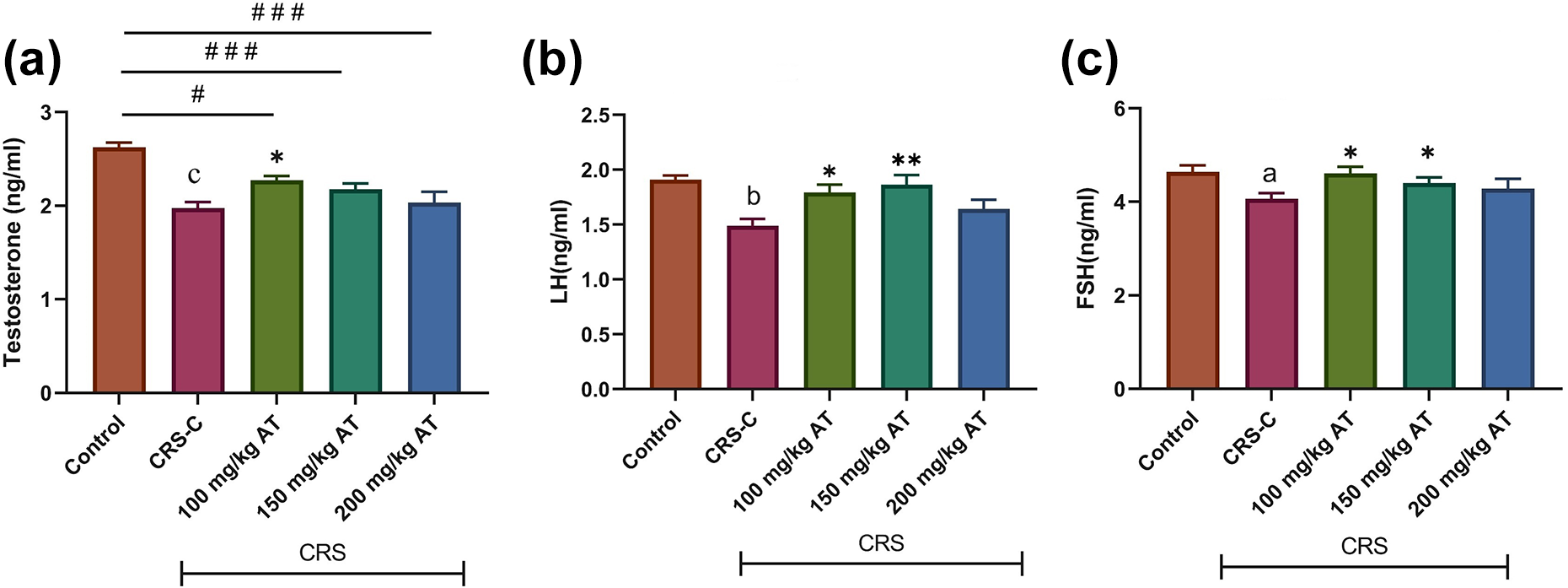
Effect of the AT extract on testosterone (a), LH (b), and FSH (c) hormone levels in stressed rats. Results are expressed as mean ± SEM. Data were analyzed using one-way ANOVA. #p < 0.05, and ###p < 0.001 as compared with control group. *p < 0.05 and p < 0.01 compared with rats exposed to restraint stress. The F-value was found to be 12.68 for testosterone, F: 6.04 for LH and F: 2.54 for FSH. CRS-C: chronic restraint stress-control. AT: Achillea tenuifolia Lam. Letter a indicates: p < 0.05, letter b indicates p < 0.01, and letter c indicates p < 0.001and compared with the control group.

The effect of AT extract on viability (a), Sperm count (b) and motility (c) in rats exposed to immobilization stress. Results are expressed as mean ± SEM. Data were analyzed using one-way ANOVA. #p < 0.05, ##p < 0.01, and ###p < 0.001 compared with control group. *p < 0.05 compared with chronic restraint stress rats. The F-value was found to be 5.32 for viability, F: 4.56 for Sperm count and F: 9.62 for Motility. CRS-C: chronic restraint stress-control. AT: Achillea tenuifolia Lam. ns: non-significant Letter a indicates: p < 0.05, and letter b indicates p < 0.01 and compared with the control group.
Effect of AT extract on motility, viability, total sperm count
The level of motility, viability, and count of sperm were determined in the rats exposed to stress restraint for 21 days. As shown in Figure.7, there was a significant reduction of the sperm parameters in CRS-induced rats compared to those kept in unstressed condition (control group) (a: p < 0.05, a: p < 0.05, and b: p < 0.01). CRS rats that received AT extract with a concentration of 100 mg/kg had an increase in motility and viability when compared with CRS-control (p < 0.05, F: 9.62). However, 150 and 200 mg/kg did not promote motility and viability in rats exposed to stress. Moreover, the count of sperms did not exhibit any changes in all concentrations (p > 0.05, F: 4.56). These observations implied that the extract could blunt the related complications of stress on sperm parameters. Overall, the beneficial effect of the extract is due to the alleviation of the stress-induced effects.
Effects of AT extract on antioxidant and oxidative stress markers in testis
We also investigated whether AT extract could impact on the antioxidant status and oxidative system. To achieve this goal, the expression level of the antioxidant enzyme, and MDA was measured, as shown in Figure 8. In comparison with the control group, there was a significant reduction in the level of CAT, SOD, and GSH in CRS-control (c: p < 0.001), while an increment in MDA level was observed (c: p < 0.001). Administration of extract in 100 and 150 mg/kg showed a significant increase in the level of CAT (p < 0.001, and p < 0.001, F: 70.39), compared to the CRS-control. Besides, compared to the CRS-control, the level of SOD was dramatically increased with all designated concentrations, as follows: p < 0.001, p < 0.001, and p < 0.05, F: 30.49 respectively. Compared with CRS-control, the expression level of GSH was found to be elevated in the rats received 150 mg/kg of the extract (p < 0.01, F: 10.56). Moreover, the administration of all concentrations of the extract diminished the expression of MDA in CRS-treated rats, compared to the CRS-control (p < 0.001, F: 126.62). These findings support the ability of the extract in ameliorating the stress-induced effects on oxidative function, even though the enzyme levels in CRS-treated rats not returned to the control level. In fact, the beneficial effect of the extract is related to blunting the stress-induced responses.

The effect of AT extract on CAT (a), SOD (b), GSH (c) and MDA (d) on rats under immobilization stress. Results are expressed as mean ± SEM. Data were analyzed using one-way ANOVA. #p < 0.05, and ###p < 0.001 compared with control group. *p < 0.05, **p < 0.01, and ***p < 0.001 compared with chronic restraint stress rats. The F-value was found to be 70.39 for CAT, F: 30.49 for SOD, F: 10.56 for GSH and F: 126.62 for MDA. CRS-C: chronic restraint stress-control. AT: Achillea tenuifolia Lam. ns: non-significant Letter c indicates p < 0.0001 and compared with the control group.
Discussion
Many clinical studies pointed out that the continuity of stressful conditions could lead to behavioral abnormality and the malfunction of the reproduction system. 51 Also, many growing reports indicated that physiological stress could be contributory, or partly responsible to male infertility through erectile failure, premature ejaculation, orgasmic dysfunction, sexual desire problems and poor sperm quality. 4
Considering the growing rate of stress in human life, great concern is focused on the use of therapeutic agents to ameliorate stress and related complications. Published reports addressed the benefit of antioxidants in stressful conditions, so there is a great interest to use antioxidant compounds in this regard. It is worth noting that natural derived compounds would be preferred over antioxidant supplementation, due to lacking side effects.52–55
In this regard, the current study was conducted to evaluate the hydro-alcoholic extract of AT on anxiety-related behaviors, reproductive capacity in the CRS-induced rats. As confirmed by the EPM test in the current experiment, anxiety-related behaviors were higher in the rats exposed to stress. Following the administration of AT extract, the percentage of the open arms, the number of entries, and the spent time were improved in the stressed rats, supporting the alleviation of the anxiety-related behaviors. These observations are in accordance with the previous research. 56 Moreover, it has been shown that any increased activity in open arms is correlated with a reduced level of anxiety. 57 These findings in conjugation with the results of the SP, indicated that the extract has anxiolytic-like activity. This is consistent with the previous observations. 58
Our findings also verified that restraint stress could reduce the weight of the body in the rats exposed to stress conditions. This might be due to the acceleration rate of protein catabolism resulted from overexpression of corticosterone concentration during stressful status, as observed in our study. Another possible reason may be attributed to reduced feed intake under chronic stress. This finding is in full analogy with the previous investigation. 59
The results of many studies have demonstrated that stress suppresses the expression of gonadotropin-releasing hormone (GnRH), FSH, LH and testosterone which impairs the quality of the sperm parameters, leading to infertility. 60 In addition, it has been well documented that exposure to stressful conditions can harm the endocrine system through activating the HPG, and HPA axis. It is worth noting that reproductive behaviors and sexual activity are regulated by the secretion of sex-related hormones.51,61 FSH and testosterone are prerequisites for spermatogenesis.62,63 Consistent with previous studies,3,60 our study revealed that restraint stress significantly decreases the level of serum testosterone, LH, FSH, and disturbed sperm quality parameters. Upon administration of AT extract, the level of testosterone, LH, FSH and sperm parameters (viability, motility) are significantly improved, supporting the beneficial impact of the extract on the reproductive parameters. 51
Alteration in the level of SOD, CAT, GSH activities and MDA content are a good index of oxidative stress. It has been shown that stress-induced reactions are linked to oxidative stress, an underlying mechanism in male reproductive dysfunction and DNA damge, 64 which negatively influence the production of sperms and male fertility. Besides, oxidative stress found to have adverse effects on the integrity of sperm and sex hormones, 65 as observed in present study, too. Furthermore, a previous study declared that naturally derived compounds could improve antioxidant capacity by increasing the levels of GSH-Px, CAT and SOD. In addition, there is an increasing document regarding the beneficial effect of antioxidant compounds in free radicals scavenging. 52 Similar to previous finding, 58 administration of AT extract could improve the activity of antioxidant enzymes.
Taken together, our data showed the potency of AT extract in alleviating behavioral impairment and reproductive parameters in animals exposed to restraint stress. However, in some experiments, the extract at 200 mg/kg body did not show the beneficial impact on the sperm parameters and reproductive hormones, implying the adverse effect of the extract at high concentration, even though, significant changes were observed in some experiments such as the sucrose preference test. These unexpected results can be explained that the mechanism of action of the extract on behavioral responses and reproductive system is completely different from each other. In other words, the extract at 200 mg dose showed useful effects on stress-induced depressive behaviors, with no observable effect on sperm parameters. It may possibly be due to the production of some substances at higher dose of the extract with adverse effect on reproductive system. In the case of weight, the bitterness of the extract, especially at higher dose leads to weight loss due to the reduction of appetite. The fact that the extract administration has not affected the testis and seminal vesicle may be due to the short study duration even at high concentration. These findings may be important in light of the development of AT-derived compounds, as the extract had the potential of blunting the detrimental effects resulted from immobilization stress. However, the small number of examined animals may be considered a limitation in this study, since the higher number of rats leads to harder management, especially during MAZE assay. Another possible limitation that may exist in this study is providing AT plant with sufficient quantity to prepare the extract.
Conclusion
Based on the present results and as a concluding statement, it can be suggested that AT extract may have a beneficial impact on fertile status in terms of hormonal profile and sperm parameters in the rats being exposed to immobilization stress. In addition, the extract ameliorated stress-induced behavioral impairments in the rats. In the case of oxidative stress, the extract could attenuate oxidative stress and improved antioxidant capacity. The observed findings may be modulated via the antioxidative effects of the extract. However, further studies are needed to identify the precise mechanism of the antinociceptive effects of AT.
Study highlights
What is the current knowledge?
✓ Chronic stress is the main health concern worldwide in which the stressors exert their activity for a prolonged time.
✓ Several studies have shown the role of chronic stress on fertility status through alteration in sex hormone secretion, and the structure of reproductive organs.
✓ Studies have revealed that anxiety and depression status could strongly interfere with sexual behaviors in rat models.
What is new here?
✓ AT extract can be used to ameliorate the stress-induced effects on fertile status and sperm quality in chronic restraint stress.
✓ AT extract had anxiolytic effects in in chronic restraint stress.
✓ Blunting of stress-induced effects in CRS status may be modulated via the antioxidative effects of the extract.
Footnotes
Acknowledgments
The authors wish to thank the personnel of faculty of Veterinary Medicine, Islamic Azad University of Tabriz and Stem Cell Research Center, Tabriz University of Medical Sciences for guidance and help.
Author contributions
Conceptualization, experiment design: BA; curation of experimental data, writing original draft: BY, S-E.S, AA; investigating and visualizing the research: MA, MK; supervision: BA, ESS; writing, review and editing: MS, final editing: EF. All listed authors have read and approved the final manuscript.
Ethical approval
This study was approved by the Ethics Committee of Islamic Azad University-Tabriz Branch (Ethics code: IR.IAU.TABRIZ.REC.1398.073).
Declaration of conflicting interests
The author(s) declared no potential conflicts of interest with respect to the research, authorship, and/or publication of this article.
Funding
The author(s) received no financial support for the research, authorship, and/or publication of this article.
