




Abstract
Introduction:
Nerium oleander is a plant that is frequently grown in gardens and public areas. N. oleander is distributed originally in subtropical Asia but is now growing in many parts of the world, such as the United States, Australia, China, and Middle East countries. Pharmacological effects of plant including antinociceptive, anti-inflammatory, and anticancer activity were reported, but the potential toxic effects of all parts of the shrub either fresh or dried on animal and human body were documented.
Method:
The data of this review article were obtained from Medline/Pubmed, Scopusand Google Scholar databases in English until September 2019. To include all publications in this field, keywords such as N. oleander and toxicity were used.
Results:
The poisoning effects of plant or their active alkaloids induced infiltration of cells with hemorrhage and sever negative changes in the lung, induce lesions, and infiltration of inflammatory cells into the portal spaces with scattered necrosis of hepatocytes in the liver, cardiac toxicity of the plant in the heart were included, induced varying degrees of hemorrhage, myocardial degeneration, and necrosis. It also induced arrhythmia, sinus bradycardia, and prolonged P-R interval in electrocardiographic records.
Conclusions:
The toxic effects of N. oleander are mostly related to its inhibitory effects on the Na+-K+ ATPase pump in the cellular membrane. However, the exact molecular mechanism involved in the toxicity of N. oleander is not clear.
Introduction
Nerium oleander is an ornamental shrub that is grown as an attractive plant frequently in gardens and public city areas. N. oleander have linear and leathery leaves with various colors from dark green to grey-green with separate light yellowish veins. The flowers of N. oleander are funnel-shaped and fragrant, with white to pink to deep red colors. Its fruit is a narrow sheath containing many silky-haired seeds (Figure 1). This plant distributed originally in the subtropical Asia and Mediterranean region but is now growing in many parts of the world, including the United States, Australia, China, and Middle East countries. 1
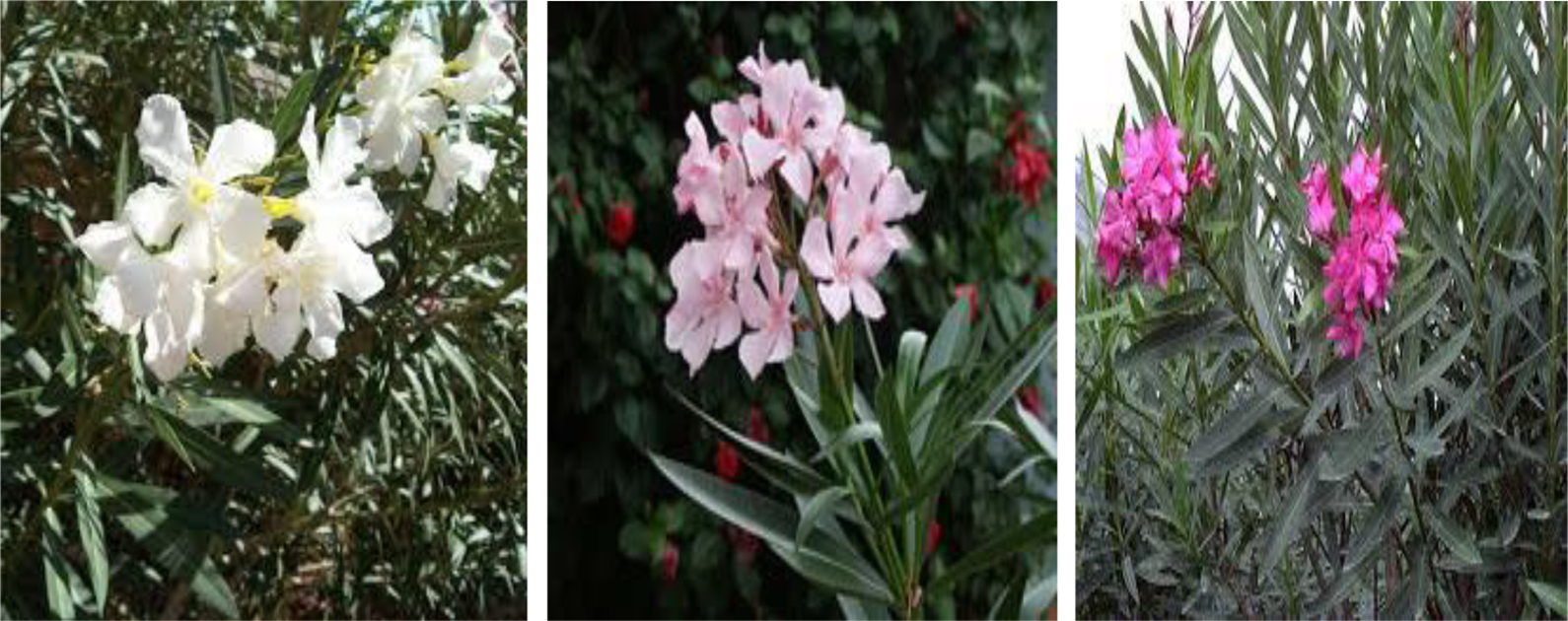
Nerium oleander (white, pink, and red colors flowers).
N. oleander has several pharmacological activities. Ethanolic and aqueous extracts from dried and fresh flowers and leaves of the plant showed significant antinociceptive activity in variable degrees against p-benzoquinone-induced abdominal contractions. In addition, ethanolic extracts of dried and fresh flowers revealed potent anti-inflammatory effects against carrageenan-induced hind paw edema in mice model. 2 The ethanol extracts from Oleander flowers against four important plants pathogenic fungi showed anti-mycotic activity using agar dilution bioassay. 3 The methanolic extract of the fresh leaves of N. oleander showed depressant effect in central nervous system of mice. 4 Although several pharmacological activities of N. oleander were reported, it has several toxicity effects on human and animal body.
N. oleander is well-known for its toxicity, it has potential toxic effects after ingestion, all parts of the plant contain several toxic compounds, such as oleandrin, oleandrigenin, and other cardiac glycosides. N. oleander with red flowers in the flowering stage produces more cardiac glycosides than shrub with white flowers. 5 Several toxic exposure of humans and different domestic animals to N. oleander in the different geographic regions were occurs. 6 Generally, animal poisoning occurs due to consumption of N. oleander toxic shrub by hungry animals or due to unplanned contamination of food with this plant. 7
The lethal doses of N. oleander leaves were recognized, which differ among animal species, such as sheep and rats (250 and 4000 mg/kg body weight (b.w.), respectively). 6,8 Therefore, the aim of this study was to show the toxicity effects of N. oleander on the animal and human body.
Method
The data of this review article were obtained from published articles, books, and conference papers in English until September 2019 from Medline/Pubmed, Scopus, Embase, and Google Scholar databases. To include all publications in this field, keywords such as N. oleander and toxicity were used.
N. oleander constituents
A pentacyclic triterpene, oleanderocioic acid, two flavonoid glycosides, such as quercetin and kaempferol, as well as cardenolide and oleandigoside were isolated from the leaves of N. oleander. 9 β-sitosterol and oleanolic acid were isolated as the active components from flowers of the plant. 10
Toxic properties of N. oleander
The toxicity of N. oleander has been found for years. All parts of the plant especially seeds and roots contain cardiac glycosides. 11 The structure of cardiac glycosides is similar to digitoxin of the foxglove plant. 11 Several studies have indicated that N. oleander may act as insecticides, pesticides, rodenticides, and antimicrobial agents. 11 Consumption of five N. oleander leaves can cause lethal poisoning. 11 However, it was reported that one N. oleander leaf had severe toxic effects in children. Controversially, ingestion of three leaves of N. oleander with a 7 years old child caused moderate poisoning with no complication. Mild toxicity was observed in an adult woman following consumption of five leaves of N. Oleander, without severe symptoms. Thus, determination of the fatal dose for N. oleander toxicity has not fully understood and more studies should be done to found the lethal doses of the plant. The severity of N. oleander toxicity is related to several factors including the concentration of toxin in ingested part of the plant, age, and health condition of the subject who consumed the plant. 11
Toxic mechanism of N. oleander
Cardiac glycosides component in N. oleander inhibits the “Na+-K+ ATPase pump” in the membrane of cardiomyocytes, resulting in an increase in intracellular Na+ concentration. Additionally, this increase changes the shift of Na+-Ca2+ channels, resulting in an elevation in intracellular Ca2+ and contraction force and also cardiac automaticity. 12 “Na+-K+ ATPase pump” inhibition changes the shift of K+, resulting in increased level of K+. 12 Hyperkalemia indicates the severity of toxicity in acute cardiac glycosides poisoning. 12
Toxic effects of N. oleander on lungs
Intramuscularly (IM) administration of N. oleander leaves extract (10 mL/kg) in both hind limbs of rats showed mononuclear cell infiltrates in the lung tissue section, most frequently around the blood vessel 3, 12, and 24 h after administration. Dilation and even collapse in some alveoli were observed in alveolar tissue 24 h after administration. Massive infiltration along with hemorrhage and extravasation of blood cells and severe negative changes were also observed in the study group. Alveoli, alveolar sacs, and broncus were observed in section of the control lung tissue. 13 The aqueous decoction of leaves extract of N. oleander leaves extract (10 mL/kg) induced histopathological changes in the Wistar rats lung tissues including alterations in the pulmonary tissue with disruption of bronchus mucosal folds. Also, alveolar cells with extreme widening of lumen of the bronchiole and vascular lesions have been observed. Inflammatory cells, especially neutrophils, were frequently found in the bronchoalveolar region. In addition, lung sections of the control group showed normal histological architecture and numerous clear alveoli with thin interalveolar septa and alveolar sacs. 14
The aqueous extracts of N. oleander flowers (11, 22, and 33 mg/kg, b.w.) induced severe congestion in blood vessels and edema around the esophagus in albino male mice, especially at the high dose of extract. 15 The aqueous leaves extract of N. oleander (10 mg/kg, b.w.) on healthy male New Zealand rabbits for 4-week treatment showed pathological changes, such as interstitial pneumonia, alveolar space hemorrhage, disappearance of pulmonary alveolus, thickening of the lung matrix, and alveolar septa, while in control group, there were no significant abnormalities observed in the lung tissue. 16 Orally administration of N. oleander leaves at lethal dose (110 mg/kg, b.w.) to native female goats induced interstitial hemorrhage in the lung 1 h after receiving the oleander and also caused congestion and edema in the lung of sheep. 17 Administration of N. oleander leaves (110 mg/kg, b.w.) induced varying degrees of congestion or hemorrhage in the lungs of sheep. 18 The results of the above studies indicated that leaves or flowers of N. oleander have toxic effects in the lung tissue of exposed animal, such as induced congestion in blood vessels, disruption of bronchus mucosal, induced inflammatory cells and neutrophils in the bronchoalveolar, and induced congestion or hemorrhage in the lung tissue. The toxic effect of N. oleander on the lung tissue of animal models was summarized in Table 1.
Toxic effects of N. oleander on lungs.

N. oleander: Nerium oleander; IM: intramuscular.
Toxic effects of N. oleander on liver
The results of Prussian blue iron-stained sections after 3, 6, and 12 h of N. oleander leaves extract (10 mL/kg, IM) administration showed extensive iron accumulation but in section after 12 h of administration, mild deposition in sinusoidal space was also observed particularly. Distinct bluish granules (ferritin) within hepatocytes 6 and 12 h after onset of acute phase response were observed. 13 The extracts of N. oleander flowers (33 mg/kg, b.w.) induced hydropic degenerations in the liver tissue. In addition, mononuclear cell infiltration in the portal spaces with scattered necrosis of hepatocytes was induced by plant flower extract. Congestion and hemorrhage in some cases were also observed. 15
Dried leaves of N. oleander (110 mg/kg, b.w.) induced lesions in the liver that caused fatty change and infiltration of inflammatory cells into the portal spaces with scattered necrosis of hepatocytes in female goats and male sheep. 6,17 In addition, mild bile duct hyperplasia was observed in two goats. 17
N. oleander leaves (110 mg/kg, b.w.) induced varying degrees of hemorrhage, degeneration and focal necrosis of hepatocytes, necrosis of hepatocytes, fatty degeneration, and infiltration of mononuclear inflammatory cells in liver. 18 Table 2 indicates the toxic effect of N. oleander on the liver tissue of animal models.
Toxic effects of N. oleander on liver.

N. oleander: Nerium oleander; IM: intramuscular.
Toxic effects of N. oleander on heart
Oral administration of 100 mg of N. oleander ethanolic extract showed diffuse mild interfascicular edema with congested vessels and many fragmentations of myofibrils in degenerated myocytes 14 days after treatment in heart muscles. In addition, 200 mg of N. oleander ethanolic extract showed moderate interfascicular edema with dilated congested vessels and few degenerated myocytes with focal striation loss and focal vacuolar degeneration in the heart muscles; 30 days treatments animals with 100 mg of N. oleander showed focal mild interfascicular edema with congested vessels and very few degenerated myocytes in the heart muscles, while 200 mg of N. oleander showed focal marked interfascicular edema with congested vessels and moderately degenerated myocytes with vacuolation of the muscle. 20
Oral administration of aqueous leaf extract of N. oleander for 28 days induced pathomorphological changes in the heart in male rabbits. Mild granular degeneration of myocytes, coagulative necrosis, fragmentation in the cardiac muscle, and loss of striations were observed in heart by photomicrograph. In addition, intra-sarcoplasmic vacuoles with myocytolysis were also observed in the heart samples in treated animals compared to the control group. 16 N. oleander flowers aqueous extracts (22 and 33 mg/kg, b.w.) showed congestion and hemorrhage, especially in the myocardium regions. In addition, varying degrees of coagulative necrosis of cardiac muscle cells that were associated with the infiltration of mononuclear inflammatory cells in heart sections were observed. 15
N. oleander (110 mg/kg, b.w.) induced congestion and severe hemorrhage especially in the subendocardial regions in the hearts of goats. Additionally, varying degrees of coagulative necrosis of cardiac muscle cells associated with infiltration of inflammatory cells were also observed. The mononuclear inflammatory cell infiltration into the endoneurium of nerve fascicles and hemorrhages in the left ventricular endocard was observed. 17
Administration of N. oleander leaves (110 mg/kg, b.w.) induced varying degrees of hemorrhage, myocardial degeneration, and necrosis in the heart of sheep. 18 An earlier study conducted by Aslani et al. 6 on the cardiotoxicity impact of N. Oleander (110 mg/kg, orally, single dose) in male sheep indicated that sinus bradycardia was seen as the first symptom in electrocardiogram (ECG) 0.5 h after receiving this plant. 6 Then, the sinus arrhythmia was observed. The second cardiac effect was moderate and consists of blockage of arterial/ventricular (AV) valve, sinus tachycardia, ST-segment depression, AV dissociation, ventricular tachycardia, and fibrillation. 6 Histopathological examination indicated degeneration and necrosis in the myocardium. 6 Botelho et al. investigated the cardiotoxic effect of N. oleander hydroalcoholic extract (150 and 300 mg/kg) in guinea pigs. 21 It was found that N. oleander caused death due to severe cardiac arrhythmias in some animals. In vitro studies indicated that N. oleander disturbed electromechanical function in the heart by sodium (Na+) and potassium (K+) pump inhibition, mitochondrial swelling, and the sarcoplasmic Ca2+ ATPase impairment. A non-blinded, placebo-controlled study was designed to investigate the protective effect of digoxin-specific Fab fragments (dsFab) against cardiotoxicity induced by N. Oleander in dogs. N. Oleander leaves (30 mg/kg, intravenous (IV)) caused dysrhythmias during 27 min of starting the administration. However, dsFab reversed to normal condition during the first minutes of injection. 22 Fattahi et al. indicated that N. oleander (100 mg/kg, orally) caused ventricular fibrillation in sheep, leading to death in two animals. However, pretreatment with garlic extract improved arrhythmia in five sheep. 23 Khordadmehr et al. investigated cardiac toxicity of N. oleander (10, 12.5, 15, and 20 mg/kg, orally) in Wistar rats and Balb/c mice. 24 Creatine kinase (CK) and troponin levels increased in mice and rat received N. oleander. Hyperemia, hemorrhage, and myofibroblasts were seen in the cardiac tissue of animals. Table 3 indicates the toxic effect of N. oleander on the heart tissue of animal models.
Toxic effects of N. oleander on heart.

N. oleander: Nerium oleander; AV: arterial/ventricular; Na+: sodium; K+: potassium; CK: creatine kinase.
Toxic effects of N. oleander on blood parameters
Oral administration of N. oleander alcoholic extract (100 and 200 mg of dried extract/kg) after 14 days significantly changed blood parameters including increased mean corpuscular hemoglobin (MCH) and decreased white blood cells (WBCs) at 200 mg of extract and also significantly decreased lymphocytes (%) at two dose of extracts. In addition, after 30 days of oral administration, mean corpuscular volume (MCV), WBCs, and platelet (PLT) count significantly elevated at 200 mg of extract. The percent of lymphocytes also significantly decreased at two dose of extracts. 20
The aqueous extracts from boiling air-dried leaves of N. oleander in 0.9% NaCl solution (1:1, w/v) significantly altered hematological parameters such as red blood cells (RBCs), hemoglobin (Hb), hematocrit, MCV, lymphocyte, neutrophil, monocyte, and eosinophil count in the groups of N. Oleander oral intake for 3 and 7 days compared to the control group. 25
The aqueous leaves extract of N. Oleander and flowers (25 mg/kg, b.w.) significantly increased WBCs, while decreased RBCs and Hb, after 2 and 4 weeks treatments in mice compared with the control group. 26
Intraperitoneal administration alkaloid extract of N. Oleander leaves (20 mg/kg) per day for a period of 30 days significantly decreases b.w. after 10, 20, and 30 days of experience in treated female mice compared with control group. Alkaloid extract of N. oleander also significantly decreased packed cell volume (PCV), mean platelet volume, MCH, and Hb, while significantly increased RBC distribution width, MCH concentration (MCHC), plateletcrit, PLT, and WBC in treated female mice compared to the control group. 27 The aqueous leaves extract of N. Oleander (10 mg/kg b.w.) once a day for 28 days significantly increased RBC and WBC counts and also mean Hb value in the treated rabbits compared to the control group. However, the PLTs count was decreased significantly in the treatment group compared to the control group. The percent of PCV value was noticeably higher in treated rabbits, although it was not statistically significant. 16
Table 4 indicates the toxic effect of N. Oleander on the blood parameters of animal models.
Toxic effects of N. oleander on blood parameter.

N. oleander: Nerium oleander; MCH: mean corpuscular hemoglobin; WBC: white blood cell; MCV: mean corpuscular volume; PLT: platelet; RBC: red blood cell; Hb: hemoglobin; HCT: hematocrit; PCV: packed cell volume; MPV: mean platelet volume; RDW: red blood cell distribution width; MCHC: mean corpuscular hemoglobin concentration; PCT: plateletcrit; IP: intraperitoneal.
Serum biochemical parameters
The toxic impact of N. oleander extract (100 and 200 mg of dried extract/kg, orally, for 14 and 30 days) was evaluated in mice. The findings indicated that interleukin 1 (IL-1), IL-6, tumor necrosis factor α (TNF-α), CK, and CK-MB were significantly increased at 200 mg of N. oleander ethanolic extract after 14 days of treatment, but C reactive protein (CRP) and lactate dehydrogenase (LDH) were significantly increased at 100 and 200 mg of N. oleander ethanolic extract. In addition, after 30 days of treatments, IL-6, TNF-α, CRP, aminotransferase (ALT), LDH, CK, and CK-MB levels were significantly increased at 100 and 200 mg of plant extract, while IL-1 was only significantly increased at 200 mg extract group compared to the control group. 20
The oral administration of aqueous extract of N. Oleander leaves and flowers (25 mg/kg, b.w.) significantly increased alanine aminotransferase, aspartate aminotransferase (AST), glutamic-pyruvate transaminase (GPT), and glutamyl oxaloacetic transaminase (GOT) after 2 and 4 weeks treatments in mice compared with the saline-treated control group. 26 These changes were depended on the time of treatments.
Serum calcium levels decreased but not significantly after 2 weeks oral administration of the N. oleander summer and winter leaf extracts compared to control rabbits, while in 4 weeks after treatment showed winter leaf extracts group decreased calcium levels significantly compared to the control group. The winter extract group was more toxic than the summer group that may be due to the presence of different active ingredient of the plant. The time of treatment was similar between different treated groups. 28
Serum K+ levels after 2 weeks significantly increase in summer and winter N. oleander leaf extracts compared to the control group, while there were no significant differences between summer and winter groups. Increased levels of K+ were depended on the time of treatment (2 and 4 weeks). 28
The serum levels of ALT significantly increased between the two summer and winter N. oleander leaf extracts compared to the control, while there was no significant increase differences between winter and summer groups. Additionally, serum levels of AST and alkaline phosphatase were not significantly changed between the summer and winter N. oleander leaf extracts compared to the control. 28
Administration of aqueous leaves extract of N. oleander (10 mL/kg, IM) significantly enhanced total iron content in the serum with maximum increase of 156.87% after 12 h and 100% rise was observed after 3 h, in male Wistar rats compared to control group. The serum ferritin was declined at 3 and 24 h of injection with 29% and 23%, respectively, which were not significant differences with control group. Serum hepcidin concentration greatly increased which reached a peak at 12 h compared with the control group while decreased 9.53% value after 24 h. 29
Administration of N. oleander leaves (110 mg/kg, b.w.) as lethal dose decreased serum glucose and urea concentration. Serum activity of enzymes such as ALT and AST was increased in experimental group compared to the control group. 18
Table 5 indicates the toxic effect of N. oleander on the serum biochemical parameters of animal models.
Serum biochemical parameter.

N. oleander: Nerium oleander; IL-1: interleukin 1; TNF-α: tumor necrosis factor α; CK: creatine kinase; CK-MB: creatine kinase MB; CRP: C reactive protein; LDH: lactate dehydrogenase; ALT: alanine aminotransferase; AST: aspartate aminotransferase; GPT: glutamic-pyruvate transaminase; GOT: glutamyl oxaloacetic transaminase; IM: intramuscular.
Clinical toxicity of N. oleander
Human poisoning due to N. oleander may be caused by accidental or intentional consumption, consumption for medicinal purpose, or criminal poisoning. Oleander poisoning has been observed in some countries, including Europe, United States, Asia, and Africa and also in Australia. 30 Few case report associated with N. oleander poisoning has been observed.
In this context, a case of N. oleander poisoning was reported by Osterloh et al. 31 They reported a 96 years old woman who died following consumption of N. oleander. However, Driggers et al. reported a survived 83 years old woman of N. oleander poisoning who ingested for suicide. 32
It was reported death of 58 years old Caucasian woman due to consumption of N. oleander for self-poisoning. The pathological evaluation indicated petechiae, edema, and congestion in tongue, gastric, and lung. 33 PBI-05204, a N. Oleander extract comprising oleandrin, blocked the “α-3 subunit of Na/K ATPase, FGF-2 export, Akt and p70S6K,” leading to alleviating the activity of mTOR. Grade 1 atrioventricular block was observed in 10 subjects and supraventricular tachycardia (grade II) in one patient. 34 N. oleander poisoning was reported in a 21 years old woman. She was admitted to hospital with vomiting, lightheadedness, and cardiac block. Electrocardiogram indicated P wave reversion in inferior and PR interval prolongation, with varying degree AV blocks. 35 Shumaik et al. presented a case report about self-poisoning with N. Oleander. 36 The main symptoms were bradycardia and sinoatrial nodal arrest inpatient. “Digoxin-specific Fab antibody fragments (Digibind®)” improved cardiac problems. It was also reported that a man was criminally administrated N. oleander roots extract for 8 weeks. The symptoms such as nausea, diarrhea, abdominal pain, and confusion were similar to acute toxicity. His clinical symptoms were moderate at the beginning, but elevated later. “Sinus tachycardia” with “diffuse ST depression” and inverted “T wave” were observed in ECG and also elevation in the levels of CK. 37
Conclusion
N. oleander poisoning commonly occurred in animal and human; however, the fatal cases due to this plant toxicity were reported. Children are very susceptible to the toxic effect of N. oleander. Accidental ingestion in children and use of the plant for suicide are two main causes of N. oleander poisoning in the world. The important clinical characteristic of N. oleander consists of vomiting, nausea, abdominal pain, diarrhea, arrhythmias, and hyperkalemia. The important toxic impact of oleander poisoning is cardiotoxicity (ventricular arrhythmia, tachycardia, and bradycardia). Electrocardiography indicates an elevated “PR interval,” a reduced “QRS-T interval,” and “T wave inversion.” Animal studies have also indicated that cardiac glycoside component, especially oleanderin, of this plant could disturb the normal heart function. Additionally, this plant has hepatotoxic, hematotoxic, and respiratory toxic effects. The lethal dose of this plant in the animal studies is not similar as some studies used dried leaves and others used green plant. Additionally, the amount of toxic glycoside in the plant varies according to the size of leaves, season, and other environmental parameters in which that plant has grown. However, Osterloh et al. 31 reported the lethal dose of oleander leaf for their patient was approximately 4 g, but more studies should be done for calculating exact lethal dose. The toxic effects of N. oleander are mostly related to its inhibitory effects on the “Na+-K+ ATPase pump” in the cellular membrane. However, the exact molecular mechanism involved in the toxicity of N. oleander is not clear. In recent years, digoxin-specific Fab antibody fragments are found as a suitable agent for dysrhythmias and hyperkalemia in acute poisoning with N. oleander. Additionally, animal studies suggested that plant with antioxidant activity could be suitable approach for ameliorating of cardiotoxicity induced by N. oleander. Overall, N. oleander is a toxic plant and should not be grown in gardens and public areas for protection of children and animals.
Limitation
Due to limited studies conducted on the N. oleander poisoning and also a low number of animal and human that poisoned with this plant ingestion, the present study could not reveal all aspects related to N. oleander such as lethal doses for human with different age and various animal species. Therefore, more experimental studies are needed to clear these.
