




Abstract
Epigenetic mutations caused by pollutants are possibly linked to many diseases. Benzo(a)pyrene (BaP) is one of the most representative air pollutants and has aroused wide concern because of its strong carcinogenicity. The reproductive toxicity induced by BaP has been identified, but little is known about the characteristics of the methylation changes induced by BaP. In this study, a methylated DNA immunoprecipitation sequencing method was used to detect the methylation of sperm DNA of rats exposed to BaP. Compared with the respective genes in normal rats, there were 3227 hypomethylated genes and 828 hypermethylated genes after BaP exposure. Gene ontology enrichment analysis reported that differentially methylated genes (DMGs) were enriched in the localization, single-multicellular organism process and plasma membrane. Kyoto Encyclopedia of Genes and Genomes pathway analysis showed that the DMGs were significantly enriched in the Ras signalling pathway, Rap1 signalling pathway, pancreatic secretion and neuroactive ligand–receptor interaction. DisGeNET disease spectrum analysis showed that DMGs were associated with infertility and certain genetic diseases. Further research needs to be done to explore whether these abnormal methylation are transgenerational.
Keywords
Introduction
Polycyclic aromatic hydrocarbons (PAHs) are toxic and lipid-soluble endocrine disruptors that are widely distributed in the environment. Exposure to PAHs has been linked to abnormal patterns of DNA methylation in the peripheral blood of healthy people. 1 Benzo(a)pyrene (BaP) is a typical representative of PAHs, mainly derived from the incomplete combustion of organic materials such as fossil fuels and wood. 2 At the same time, the BaP equivalent concentration is a reliable index for calculating the PAH pollution level. 3 BaP has aroused wide concern because of its high carcinogenicity. Current studies on BaP mainly focus on cancer and the respiratory and cardiovascular systems, 4 and DNA methylation has been identified as a possible link 5 ; however, related investigations of the reproductive system are relatively rare.
In recent years, a few articles on the influence of BaP on the mouse reproductive system have been found. Some studies reported that BaP could cause problems in the reproductive system of male rats, such as steroidogenesis and spermatogenesis. 6,7 BaP can induce the hypomethylation of DNA in the testis and can cause genetic mutation of the offspring of Xpc-deficient male mice, as well as changes in the methylation of the embryonic development-related genes LINE1-ORF2, SINEB1 and SINEB2. 8 The methylation stability of sperm is closely related to the growth, development and reproduction of offspring. Therefore, it is important to know what abnormal methylation are caused by environmental pollutants. However, only Knecht et al. have detected the global methylation alterations induced by BaP, which they demonstrated in zebrafish. 9 We are the first to perform methylated DNA immunoprecipitation sequencing (MeDIP-seq) to systematically compare and analyse the methylation status of the BaP exposure model genome on rats. Gene ontology (GO) analysis, Kyoto Encyclopedia of Genes and Genomes (KEGG) pathway analysis and DisGeNET disease analysis were carried out on genes with significant differences in methylation to determine the pathway of BaP.
Methods
Experimental animals and design
Healthy male Specific Pathogen Free (SPF) Sprague Dawley (SD) rats with a body weight ranging from 170 g to 190 g (5 weeks) were obtained from Beijing Weitong Lihua Laboratory Animal Technology Co., Ltd (China). The licence number was SCXK (Jing) 2012-0001. The animals were reared at the Central Laboratory of Henan Province Hospital of Traditional Chinese Medicine (licence number: SYXK (Yu) 2011-0002). The animals were reared in individually ventilated cage systems 10 in the following conditions: cage box temperature, 21–25°C; humidity, 38–60%; air exchange, 22 times/h; light and dark alternating every 12 h; free diet; and adaptive feeding for 1 week before the beginning of the formal experiment. Animal experiments and operations were carried out by the regulations of the ethics committee of the Henan Province Hospital of Traditional Chinese Medicine.
Chemicals
BaP (≥96% purity by high performance liquid chromatography (HPLC), 250 mg/bottle) was purchased from Sigma Chemical Company (St Louis, Missouri, USA), batch number: SlBP4938V. Dimethyl sulfoxide (purity ≥ 99%; DMSO) was purchased from Sinopharm Chemical Reagent Co., Ltd (Shanghai, China), batch number: 20131012, and 0.9% sodium chloride injection, 500 mL/bottle was purchased from Henan Kelun Pharmaceutical Co., Ltd (Henan, China) (approval no: Chinese medicine quasi-word; H51021158, product batch number: A16111604-1).
Experimental design
Rats were weighed, numbered according to body weight and then randomly divided into two groups (BaP group and control group, n = 9 per group) according to a random number table. The method of modelling referenced that of Reddy et al.’s 6,7 work. Solid BaP was diluted to 0.1 mg/mL by 0.5% of DMSO. Rats in the BaP group were exposed to 0.1 mL/100 g (body weight) by intraperitoneal injection, and the BaP concentration was 0.1 mg/(kg·day) every other day at 9:00 a.m. for 60 days. The rationale for choosing a 60-day experimental period is that a full spermatogenesis cycle takes about 55 days in rats. 11 Rats in the control group were injected intraperitoneally with 0.5% of DMSO at 0.1 mL/100 g (body weight). The body weight of the two groups of rats were recorded daily. After the experiment, all rats were fasted overnight, weighed, before being euthanized using diethyl ether anaesthesia. All rats were anaesthetized via the respiratory route by exposing them to ether for approximately 2 min in a transparent acrylic jar. After excising the epididymis, the blood was cleaned with aseptic saline. The epididymal tails were cut through by ophthalmic scissors, placed in 1-mL saline and fully shocked for 3 min. The sperm was fully released, and the solution became cloudy. Next, the solution was centrifuged at 4°C (3500 × g for 5 min). Sperm cells were collected after centrifugation and frozen at −80°C refrigeration in liquid nitrogen until use for detecting sperm DNA methylation. Then, all rats were killed by cervical dislocation.
DNA extraction and MeDIP-seq library preparation
DNA extraction and MeDIP-seq library preparation were performed according to the method of Rakyan et al. 12 We had to combine the sperm of every three rats for testing because the number of sperm cells we wanted to test was very small.
Sequencing
Sodium hydroxide (0.1 M) was used to denature the library, and single-stranded DNA molecules were generated. The sample with an 8 particulate matter (PM) concentration was loaded into the flow cell channel, and in situ amplification was performed using an HiSeq 3000/4000 PE cluster kit (# pe-410-1001, Illumina, USA). The sequencing was performed by the Illumina HiSeq 4000 platform on a 2 × 150 cycle according to the manufacturer’s instructions.
Data analysis
After the sequencing images were generated on the sequencing platform, the Off-Line Basecaller software (OLB V1.8) was used for image analysis and base invocation. After passing the Solexa CHASTITY quality filter, HISAT2 software (V2.1.0) was used to align the clean reads with the rat genome (UCSC RN5). Using MACS v2 with a q-value threshold of 10−5, the MeDIP enrichment area (peak) of each sample was determined statistically. The latest UCSC RefSeq database was used to annotate messenger RNA (mRNA)-related rich intermediate regions (peaks) with the nearest genes. The difference in differentially methylated regions (DMRs) between the two groups was statistically significant (cut-off: log2FC = 1.0, p value = 10−4). Using the UCSC RefSeq and multi-database integration database, the mRNA-related DMRs in the promoter were annotated to the nearest gene.
Bioinformatic analysis
GO analysis has been widely used in large-scale functional enrichment research. 13 GO enrichment analysis of differential methylation sites was performed. The number of genes contained in each GO category was counted, and the statistical significance of the gene enrichment in each GO category was calculated using a hypergeometric distribution test. In the three categories, items with a corresponding gene number greater than 2 in three categories were screened.
KEGG (www.genome.jp/kegg/pathway) is a knowledge base for the systematic analysis of gene function. 14 We also performed a KEGG enrichment pathway analysis between two groups (mapping annotated genes) and screened differential methylation sites with KEGG to enrich, analyse and determine the involvement of different methylation genes in cell signalling pathways.
DisGeNET (http://www.disgenet.org) is one of the largest sets of genes and variants involved in human diseases. The database integrates data from a collection of experts, Genome-wide association study (GWAS) catalogues, animal models and scientific literature and is a multipurpose platform that can be used for different research purposes, including the identification of the molecular basis for specific human diseases and their amalgamations, the analysis of the specificity of disease genes, the creation of a drug therapy hypothesis, the identification of adverse drug reactions, computational predictions, the validation of disease genes and performance evaluations of text mining methods. 15 We used DisGeNET to analyse the disease spectrum of significant DMGs.
Statistical analysis
The results were analysed by SPSS 19.0 and are represented as the means ± standard error of the mean. The level of gene expression was compared by the t-test and repeated at least three times. The value of p < 0.05 was considered statistically significant.
Results
MeDIP-seq results comparison
The mRNA-associated DMRs with statistical significance between the two groups were identified by diffReps (cut-off: log2FC = 1.0, p value = 10−4). The DMRs located within gene promoters (TSS − 2000 bp, TSS + 2000 bp) are selected. In total, 4055 genes showed significant differences between the two groups (log2-fold change ≥2) in the methylated peaks. A cluster analysis of differentially expressed methylated genes showed that there was a significant methylation pattern in the BaP exposure and normal samples, and the samples were divided into two different groups, including those from the BaP exposure and normal groups, as shown in Figure 1. Compared with the genes in the control group, 3227 genes were hypomethylated, and 828 genes were hypermethylated.

Hierarchical cluster analysis of significant DMGs between BaP-exposed and normal specimens. The DNA methylation of 4055 DMGs in each sample was analysed by hierarchical clustering. Each row is a separate DMG, and each column is a different sample. The colour scale from green to red indicates low to high DNA methylation, with β-values ranging from 0 (no methylation; green) to 4 (full methylation; red). DMGs: differentially methylated genes; BaP: benzo(a)pyrene.
GO analysis
The GO project provides a control vocabulary to describe the properties of genes and gene products in any organism (http://www.geneontology.org). To study the potential relationship between DMRs and genes, the GO enrichment analysis of DMGs was carried out to reveal the biological content of three categories: molecular function (MF), biological process (BP) and cell component (CC). In all hypomethylated genes, a total of 2248 significant GO enrichment items were selected with a significant p value <0.05. Among them, 1840 (81.8%) were mainly concentrated in the BP category, primarily focused on localization, single-multicellular organism process, regulation of biological quality, single-organism developmental process and developmental process; 182 (8%) were concentrated in the CC category, primarily focused on the plasma membrane part, neuron part and 226 (10%) were concentrated in the MF category, primarily focused on protein binding, receptor binding (Figure 2(a)). Detailed information is provided in Table S1. In all hypermethylated genes, a total of 1472 significant GO enrichment items were selected with a significant p value <0.05. Among them, 1209 (82.1%) were mainly concentrated in the BP category, primarily focused on the single-multicellular organism process, cell surface receptor signalling pathway, multicellular organism development, single-organism developmental process and system development; 103 (7.3%) were concentrated in the CC category, primarily focused on the extracellular region and 160 (10.8%) were concentrated in the MF category, primarily focused on protein binding and receptor binding (Figure 2(b)).
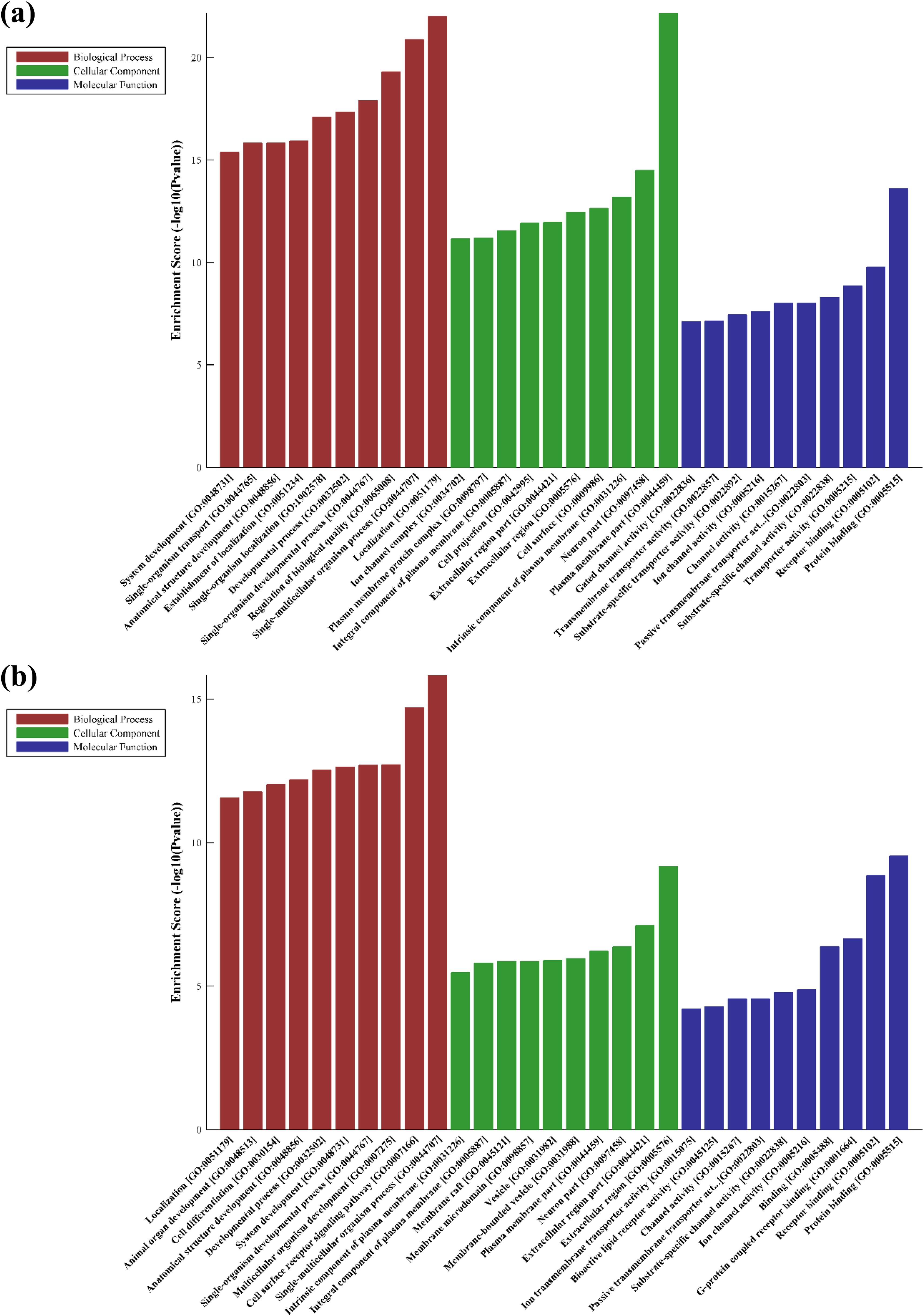
GO category analysis of (a) hypomethylated genes and (b) hypermethylated genes. Red represents biological process, green represents cell component and blue represents molecular function; FDR < 0.05, and the read number changes at least 2.0-fold. The results showed that the p value was less than 0.05 for GO annotations. GO: gene ontology; FDR: false discovery rate.
KEGG pathway analysis for DMGs
Based on the KEGG automatic annotation server, all the differential methylation genes were analysed by means of enrichment. A total of 79 pathways were enriched in all hypomethylated genes, and a total of 55 pathways were enriched in all hypermethylated genes. According to the values of false discovery rate (FDR) <0.01 and gene count >10, all differential hypermethylation genes were not enriched in the KEGG pathway. Notably, the gene with low methylation was enriched in 10 KEGG pathways, including the Ras signalling pathway (FDR = 4.4 × 10⁻⁴; gene count = 88), Rap1 signalling pathway (FDR = 9.4 × 10⁻⁴; gene count = 80), pancreatic secretion (FDR = 4.4 × 10⁻⁴; gene count = 44) and neuroactive ligand–receptor interaction (FDR = 4.4 × 10⁻⁴; gene count = 104). The specific enrichment results are presented in Figure 3.

Top 10 altered pathways sorted by the −log10 (p) value via KEGG pathway analysis. The top 10 KEGG pathways of differentially methylated genes in rats were exposed to 0.1 mg/(kg·day) BaP. The first 10 enriched KEGG pathways were filtered by the enrichment factor. The size and colour of the dots, respectively, indicate the number of hit differential methylated genes and the q-value of enrichment KEGG pathway. BaP: benzo(a)pyrene; KEGG: Kyoto Encyclopedia of Genes and Genomes.
Analysis of related diseases based on DisGeNET
All the DMGs were analysed in DisGeNET, and the top 10 related diseases are listed (Table 1). They are Hirschsprung disease; Van der Woude syndrome; popliteal pterygium syndrome; Waardenburg syndrome, type 4A; neuronal ceroid lipofuscinosis 6; generalized epilepsy with febrile seizures plus, type 1; cleft lip; adrenal hyperplasia, congenital, type 5; ichthyosis bullosa of Siemens and amyotrophic lateral sclerosis. We compared all the DMGs and the male infertility gene pool (288 genes), which is from the DisGeNET library, and found that 87 (30.2%) genes were anastomosed (Table 2) and that 28 (40.5%) genes were found to be identical to those of the 69 related genes in the female infertility gene pool (Table 3).
Top 10 related diseases analysed by DisGeNET.

Top 20 DMRs in rats exposed to BaP related to male infertility based on DisGeNET.
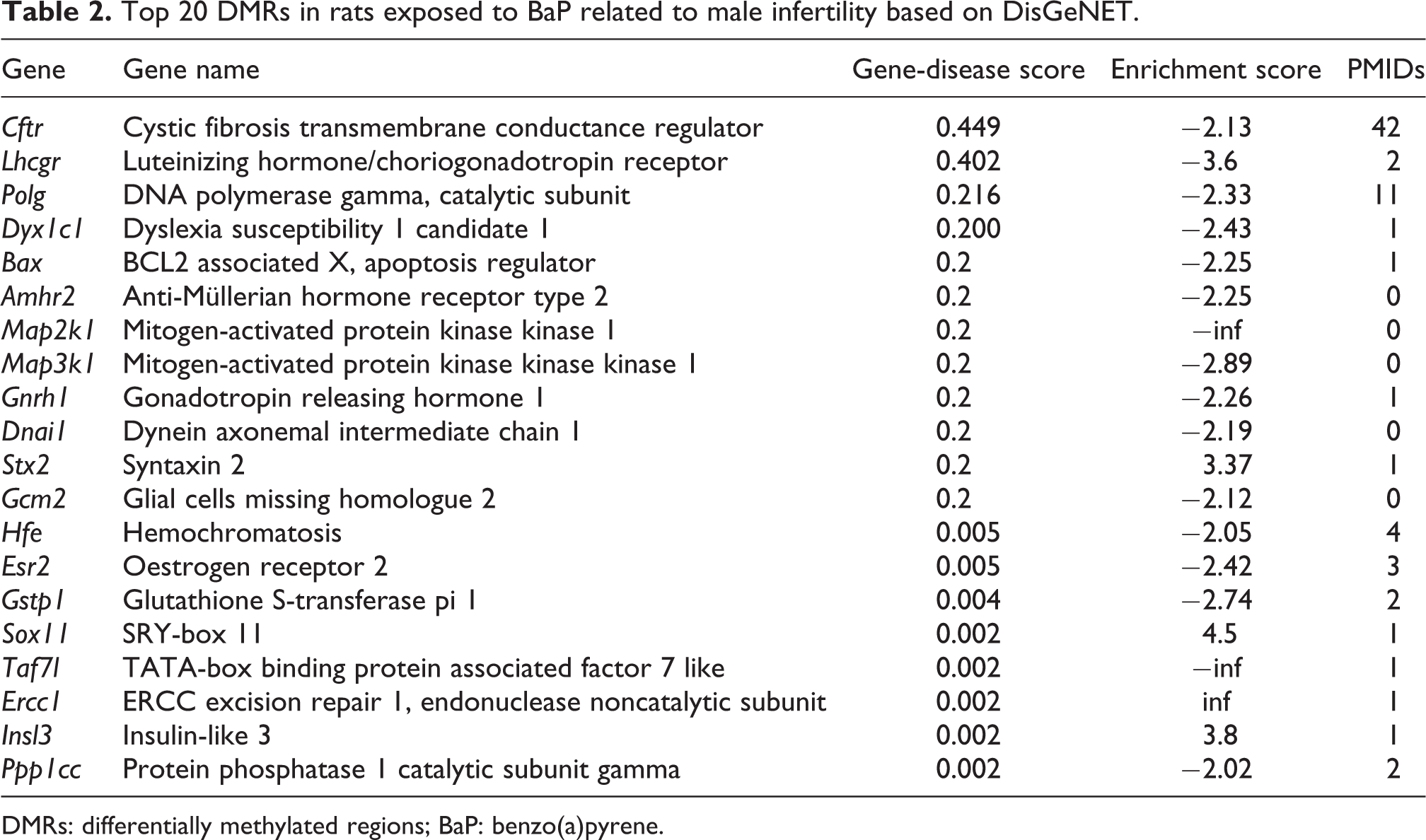
DMRs: differentially methylated regions; BaP: benzo(a)pyrene.
Top 10 DMRs in rats exposed to BaP related to female infertility based on DisGeNET.

DMRs: differentially methylated regions; BaP: benzo(a)pyrene.
Discussion
BaP is widely concerned for its strong carcinogenicity. In recent years, there have been many reports that BaP affects both male and female reproductive systems. At present, the mechanism of male reproductive toxicity caused by BaP is still unclear. For females, BaP exposure can disrupt steroid balance, affect the expression of ovarian oestrogen receptors and lead to premature ovarian failure, affect follicular growth, ovulation and luteal formation and have temporary adverse effects, which may lead to transient infertility. 16 For males, BaP has adverse effects on male reproductive function, which may be due at least in part to androgen deficiency and/or oxidative stress-related mechanisms. 6,7 It was found that BaP can increase apoptosis of Sertoli cells, [Ca2+](i) level and calmodulin expression and reduce gap junction intercell communication level and connexin 43 expression. 17 Similar studies have been done on male scallop Chlamys farreri and found that BaP affects steroid levels and induces gonadal toxicity at ambient concentrations. 18 Overall, BaP can cause damage to the male reproductive system, and its mechanism may be related to decreased sex hormone levels and increased apoptosis of reproductive cells.
In recent years, few articles have been written about the methylation caused by BaP. Toxic substances such as BaP can enter the blood through the respiratory tract and flow through the body’s organs with blood as the carrier. Changes in the methylation levels induced by BaP vary from organ to organ, most notably in the blood and liver, followed by the pancreas, lung, skin and bladder. 19 For the male reproductive system, a study showed that neonatal exposure to BaP may impair testosterone production and sperm count over time, possibly as a result of epigenetic regulation of stAR promoter regions. 20 We were also surprised to find that there were many stAR-related genes in our hypomethylated genes, such as stAR-related lipid transfer protein 3 (Stard 3).
However, it is recognized that BaP can cause abnormal methylation in the body. Moreover, these abnormal methylation can be passed on to future generations. Zebrafish embryos are exposed to BaP after fertilization until adulthood (F0), and the larvae of F0 and F2 showed hyperlocomotor activity, decreased heartbeat and mitochondrial function, and decreased overall DNA methylation level, which was similar to our results, resulting in transgenerational inheritance of neural behaviour and physiological defects. 9 Another study also found that BaP can induce testicular DNA hypomethylation and lead to heritable mutations in the offspring of Xpc-deficient male mice. 8 So, the potential impact of paternal exposure to BaP on offspring health deserves further study.
Although there are not many reports of reproductive disorders caused by methylation injury of BaP, we can find many reports of other environmental pollutants with regard to this and speculate on the mechanism of reproductive disorders caused by BaP. PM10 exposure in early pregnancy was associated with methylation of LIL1 and HSD11B2 in the placenta, suggesting that this methylation change may mediate PM-induced reproductive and developmental toxicity. 21 HSD11B2 participates in glucocorticoid metabolism and plays an important role in foetal growth and development. 22 Marsit et al. found that DNA methylation of HSD11B2 is negatively correlated with the expression of HSD11B2 gene in the placenta and the foetal growth index of newborn babies. 23 We were also surprised to find that HSD11B2 methylation was significantly downregulated (log2FC = −2.82, p value = 0.028). In line with this result, we hypothesized that methylation of the HSD11B2 promoter resulted in decreased HSD11B2 expression in the placenta and increased foetal cortisol levels, leading to foetal dysplasia. Leptin (LEP) is an energy-regulating hormone involved in foetal growth and development. Saenen et al. 24 found that LEP methylation in the placenta was negatively correlated with PM2.5 exposure in the middle of pregnancy, and LEP methylation in the placenta decreased as PM2.5 exposure increased. Breton et al. found that the methylation levels of DNMT1, DNMT3b, TET methylcytosine dioxygenase 2 and thymine DNA glycosylase (TDG) are associated with prenatal air pollution in varying degrees. 25 The methylation abnormalities of TDG (log2FC = −inf, p value = 0.002) and DNMT1 (log2FC = −2.25, p value = 0.027) were also found in our results. Interestingly, a few studies have found that the methylation of individual genes, such as the glucocorticoid receptor gene, is associated with severe depression and is not related to PM contamination exposure. 26
After the DisGeNET disease analysis, we listed the 10 most related diseases according to the score. Most of them are genetic or congenital diseases, and some are closely related to fertility. For example, Hirschsprung disease, a genetic disease characterized by a lack of ganglion cells in the colon, lower bowel spasms, faeces blocked in the proximal colon and proximal colon hypertrophy and expansion, is a common congenital intestinal disease in children. Abdalla and Zayed 27 reported that the disease may be related to Mowat Wilson’s syndrome and suspected that it was related to intracytoplasmic sperm injection as it can cross the selection of natural elimination and therefore poses a risk of transmitting epigenetic mutations to future generations. The SoxE group, as shown by the mammalian Y linkage sex-determination gene SRY, consists of Sox8, Sox9 and Sox10 and is involved in many human diseases, including XY reversal and Waardenburg–Hirschsprung disease type IV. Animal studies have confirmed that lack of Sox10 can cause Waardenburg–Hirschsprung disease and the ablation of Sox8 further inhibits the migration of intestinal neural crest stem cells. 28 Chaboissier et al. 29 confirmed that the loss of Sox8 exacerbates the sex-determination deficit in a heterozygous Sox9 mutant. Many Sox family members were also found in our results.
It is established that the Ras signalling pathway is a key regulator of spermatogonial proliferation. 30 The pathway contains many subpaths such as the mitogen-activated protein kinase (MAPK) pathway. The MAPK signalling pathway plays a vital role in the development of metazoans, including the inhibition of fate, differentiation, proliferation, survival, migration, growth and apoptosis. 31 At the same time, the MAPK pathway plays a crucial role in spermatogenesis and capacitation. 32 After the inhibition of the Ras/erk1/2 pathway by the inhibitor PD0325901, the proliferation of spermatogonia stem cells is inhibited, indicating that this pathway plays a vital role in the proliferation of spermatogenic cells. 33 The Ras-related protein 1 (Rap1) pathway is also closely related to spermatogenesis. The mRNA expression of Rap1A is stronger in the germ cells of azoospermia patients than in healthy ones. 34 In the process of spermatogenesis in adult rats, Rap1 protein is densely accumulated in the pachytene spermatocyte, and Rap1 may play an important role in the early stage of testis apoptosis induced by methoxyacetic acid. The synergistic action of NF-κB selectively depletes the function of primary spermatocytes. 35 Interference in the process of spermatogenetic Rap1 function can lead to contact damage between Sertoli and germ cells. The method of genetic modification was used to produce inactive RAP1 mutant mice, immature circular sperm cells from small lumens, the abnormal release of endogenous fine epithelium and a decrease in the number of sperm cells. 36 This sperm dysplasia is associated with impaired fertility, while transgenic males have severe infertility. Other studies have also confirmed the importance of Rap1 in sperm production. 37 –39
Interestingly, the pancreatic secretion pathway is also enriched, and the cystic fibrosis transmembrane conductance regulator (CFTR) gene is the apical Cl channel that is responsible for the anionic secretions from the lung, pancreas, male reproductive tract and other epithelial cells. 40 Mutations in this gene can lead to cystic fibrosis (CF), the most common autosomal recessive disease in Caucasian people. 41 Most patients with congenital bilateral absence of the vas deferens (CBAVD) have mutations in the 5T alleles and/or susceptible variants in intron 8 of CFTR. 42 Although CF is less common in the Chinese population, the Chinese population has its unique mutation spectrum of the CFTR gene, which also causes CBAVD. 43
At the same time, we also found that the neuroactive ligand–receptor interaction pathway was also enriched. Our understanding is that this pathway can regulate the nervous system function in the brain, 44 but many genes in this family are related to the hypothalamus and pituitary and therefore also have an extensive connection and reproductive function. Eustache et al. 45 conducted a similar study using phytoestrogen (genistein) and/or resistance to androgen food contaminants (vinclozolin) to expose male rats and reported a decrease in sperm motion parameters, litter size reduction and increased loss after implantation. The mRNAs were evaluated by a functional clustering analysis, and the results showed that many induced genes belong to the ‘neural activity ligand–receptor interaction’ family, including multiple actors associated with hormones (e.g. follicle stimulating hormone and its receptor). Our study also yielded similar results, such as luteinizing hormone/choriogonadotropin receptor, gonadotropin releasing hormone 1 and Follicle Stimulating Hormone Receptor (FSHR), but the enrichment score of FSHR was not greater than 2. Similarly, Carvan et al. 46 used methyl mercury (MeHg) to expose zebrafish, continuously observed the F1 and F2 generations and found a transgenerational epimutation in the F2 generation. The study of DMRs in the F2 generation after MeHg exposure revealed that the related genes were involved in the neuroactive ligand–receptor interaction and actin-cytoskeleton pathways. The role of cytoskeletal pathway is related to the observed neurobehavioural phenotype.
This study has several limitations. Although we made every effort to control for potential confounders, we were unable to observe the effect of BaP exposure on the offspring due to the conditions. We chose fewer samples. On the one hand, we had to combine the sperm of three rats for testing because the number of sperm cells we wanted to test was very small. On the other hand, due to financial reasons, we could not conduct an MeDIP analysis on many samples or conduct bisulphite sequencing Polymerase chain reaction (PCR) verification.
Conclusion
Although the reproductive toxicity of BaP has been confirmed, the specific mechanism remains unknown. In this study, the sperm DNA methylation levels of BaP-exposed and normal rats were compared by MeDIP-seq between the two groups. We conclude that BaP can cause significant changes in the DNA methylation of spermatozoa, mainly hypomethylation, and these changes are associated with embryonic development, reproductive system development and many genetic diseases. Further studies are needed to determine the specific pathways of BaP-induced epigenetic mutations in spermatozoa and whether they are transgenerational.
Footnotes
Author contributions
CM Zhang and ZX Sun are co-authors who contributed equally to this article.
Declaration of Conflicting Interests
The author(s) declared no potential conflicts of interest with respect to the research, authorship, and/or publication of this article.
Funding
The author(s) disclosed receipt of the following financial support for the research, authorship, and/or publication of this article: This work was supported by the National Natural Science Foundation of China (grant numbers 81573981 and 81603632), Key Scientific Research Projects of Henan Colleges and Universities (grant number 16A360003), Henan Province TCM Science Research Project (grant number 2016ZY2068) and Henan Doctoral Research Foundation (grant number BSJJ2015-11).
