




Abstract
Lead is a heavy metal that remains a persistent environmental toxin. Although there have been a substantial number of reviews published on the health effects of lead, these reviews have predominantly focused on recent publications and rarely look at older, more historical articles. Old documents on lead can provide useful insight in establishing the historical context of lead usage and its modes of toxicity. The objective of this review is to explore historical understandings and uses of lead prior to the 20th century. One hundred eighty-eight English language articles that were published before the year 1900 were included in this review. Major themes in historical documentation of lead toxicology include lead’s use in medical treatments, symptoms of lead poisoning, treatments for lead poisoning, occupational lead poisonings, and lead contamination in food and drinking water. The results of this review indicate that lead’s usage was widespread throughout the 19th century, and its toxic properties were well-known. Common symptoms of lead poisoning and suggested treatments were identified during this time period. This review provides important insight into the knowledge and uses of lead before the 20th century and can serve as a resource for researchers looking at the history of lead.
Keywords
Introduction
Lead is a toxic metal that remains an occupational and environmental hazard throughout the world. 1 Lead often enters the body through ingestion of lead-contaminated dust and inhalation of lead particles produced from the combustion of lead-containing materials. 1 The major sources of lead exposure include leaded gasoline, piped drinking water, ceramic glazes, soldering from canned foods, lead-based paints, and traditional medicines. 2 Lead accumulates throughout the body in blood, soft tissues (including the brain, renal cortex, and spleen), and bone. 2 Lead’s toxic effects are cumulative and affect multiple body systems. 1 Some of the impacts of high-level lead exposure include damage to nervous system function, hemoglobin synthesis, and kidney function. 1,3 Low levels of lead exposure are particularly a concern for its neurotoxic effects among children. 4,5 Children are particularly susceptible to the effects of lead, due to high levels of hand-to-mouth activity and higher rates of lead absorption compared to adults. 2 Although health organizations like the American Centre for Disease Control and Prevention have established guidelines for safe levels of lead exposure, evidence suggests that there is no safe level of lead. 1,2,4 The health effects of lead are irreversible. 1
The burden of disease from lead exposure remains high, particularly for low- and middle-income countries (LMICs). 1 Although lead is rarely perceived as a problem in high-income countries, the recent water contamination in Flint, Michigan, demonstrates that lead remains a topical issue in public health. 6 –8 Historically, work on noncommunicable diseases, including lead poisoning, have received less attention than communicable diseases. Historical accounts of lead are most often associated with chronic lead poisoning and saturnine gout in Ancient Rome, which has been controversially attributed to the fall of the Roman Empire. 9 Historical literature on lead is useful for understanding past occupational and environmental routes of exposures as well as clinical symptoms, treatments, and applications of lead. The objective of this article is to explore the medical history of lead and to understand the views and perceptions of lead prior to the 20th century. Reviews on lead often focus on more recent literature and do not have a targeted focus on documents prior to the 20th century. Although some articles have been written looking at the history of lead, these articles have not extensively explored the available literature nor characterized historical understandings of lead. This review is useful for researchers looking to explore the state of knowledge on lead prior to the 20th century as well as lead’s common uses.
Methods
A narrative review was conducted to explore the historical literature on lead. Articles were identified using PubMed and through the Simon Fraser University (SFU) library database. The SFU database contains several historical databases and journals providing access to journal articles preceding the 20th century. Articles included in this narrative review were limited to English language articles preceding the 20th century. Subject terms searched were “lead toxicity,” “lead poisoning,” “occupational lead poisoning,” “lead acetate,” “red lead,” and “white lead”. Additional articles were also identified through screening the references of articles included in this review. Articles were included in the review if they had a primary focus on lead poisoning or the use of lead. There were 188 articles identified that fit the inclusion criteria and were included in this review.
Results
Lead in the ancient world (second century B.C.E. to seventh century C.E.)
Nicander (Floruit (fl.) second century B.C.E.) has been credited as writing the earliest recorded account of lead poisoning during the second century B.C.E. 10 Dioscorides (circa (c.) 40 to (c.) 90 C.E.) also described a case of lead poisoning in the first century C.E. 11 Pliny wrote about the dangers of red lead and lead acetate. 12 Celsus (c. 25 B.C.E to c. 50 C.E.) also identified lead as a poison and proposed an antidote consisting of walnut juice combined with wine. 13 Galen (130 to c. 210 C.E.) previously stated that water transported to Rome through lead pipes was not suitable for consumption. 14 Galen also recommended that rain water should be used in the preparation of medicines, as opposed to water brought through lead pipes. 14 Vitruvius (c. 80 to c. 15 B.C.E.) wrote about the health implications of using water collected from lead pipes. 14 Aetius (c. 390 to 454 C.E.) also wrote about the dangers of collecting rain water from roofs, as roof tiles were often covered with lead. 14 Both Vitruvius and Pliny (23 to 79 C.E.) identified that the fumes from lead mining were poisonous; Vitruvius goes further to state that water near mines was also found to be harmful. 12,15 Pliny describes how the lining of copper pots with lead prevents the leaching of copper into food. 3 Marcus Cato (234 to 149 B.C.E.) and Columella (4 to c. 70 C.E.) also promoted the use of lead and lead-lined vessels. 16,17 Pliny, Marcus Cato, and Columella all endorsed the boiling down of grape syrup in lead vessels as part of wine production. 12,16,17 The addition of lead as a sweetener to wine was described by Pliny. 12 Pliny also described that heavy consumption of lead-sweeten wine could result in paralysis in the hands. 11 Similarly, Diodorus (90 to 30 B.C.E.) described these wines as capable of leading to pain in the nerves. 18 Paul of Aegina (c. 625 to c. 690 C.E.) described an epidemic of lead poisoning that occurred in Ancient Rome during the seventh century C.E. 19 Herodotus (c. 484 to c. 425 B.C.E.) describes that lead was used in the bridges of Babylon, and Diodorus Siculus mentions that lead was incorporated into the Hanging Gardens of Babylon. 17,20 Another ancient practice with lead commonly seen in Ancient Greece and Anatolia was a practice where molten lead was mixed with water and the forms and shapes produced would be examined to predict the future. 21,22 These practices were often conducted indoors with minimal ventilation.
Occupational exposures to lead in the 18th and 19th centuries
The National Observer reported that cases of lead poisoning were occurring in white lead factories and stated that the cases were due to workers not following the proper health and safety protocols. 23 White lead factories were a common source of occupational lead poisoning. 24 –27 Painters who worked with white lead were also susceptible to lead poisoning. 28 White lead has also been used for joints in cabinets and woodwork, making it a source of poisoning among carpenters. 29
Smith reported lead poisoning among a group of weavers in a cotton-mill, working with a dye that contained lead dichromate. 30 Symptoms included jaundice and a blue line on the gums. 30 Investigation into the poisonings led to a stronger regulation in the process of dying the yarns and the use of personal protective equipment among mill workers, ultimately ending all cases of lead poisoning. 30
Hodge looked at lead exposure and the impacts of lead poisoning among workers on a pottery. 31 Hodge noticed the dangers of lead exposure, particularly among workers whose job was to dip pottery into the lead glaze. 31 Murphy also reported several cases of lead poisoning among pottery workers. 32 Additional articles also identified lead poisoning as common among pottery workers. 33 –38
Working in glass staining was another occupation where lead poisoning was identified. 33 Glass cutting and glass polishing are also occupational sources of lead exposure. 39
An 1889 article reported a case of lead poisoning in a florist who would bite off the ends of tinfoil used to wrap bouquets of flowers. 40 The tinfoil used was found to be up to 80% lead (22). Plumbers were also commonly poisoned from lead. 26 Webb examined the increased instances in lead poisoning among miners in Derbyshire. 41
Workers involved in producing and finishing brass have also been identified as having symptoms of lead poisoning when the process included lead. 42
Ormrod identified that in rare cases, lead poisoning was identified in manufacturers of steel. 43 Ormrod identified that the source of this poisoning was likely that certain ores used for steel contain higher concentrations of lead, and that lead vapors from the smelting process were the route of entry among workers. 43
A suitcase maker who worked with a black glazed cloth showed symptoms of lead poisoning. 44 Tests on the material ultimately identified that the cloth was the source of lead.
Lead poisoning through drinking water in the 18th and 19th centuries
In 1889, an outbreak of lead poisoning occurred in Sheffield, United Kingdom, that was ultimately attributed to the use of lead pipes and the presence of dissolved lead in drinking water. 45,46 The entrance of lead into the waterways was associated with increased instances of sterility and spontaneous abortion. 43 In 1890, a series of reports on the Sheffield outbreak was published in BMJ. 47 –50 These reports examined who in the Sheffield population was impacted by lead poisoning and suggested measures to treat the contaminated water. 47 –50 Chalk was ultimately added to treat the lead-contaminated waters of Sheffield. 51
Another article cited a case of lead poisoning among a family in Philadelphia; the source of the lead was identified as lead pipes connected to hot water apparatus. 52 An article reported that conducting water through lead pipes was a dangerous source of lead poisoning, and that lining lead pipes with tin could actually enhance its toxicity. 53 Several articles cited concern about the entrance of lead within the water of pipes. 54 –60 Collyns reported on a family who experienced lead poisoning through their well water. 61 Additional articles identified lead poisoning from drinking water. 62 Kirker looked at the ability of fermentation by-products to breakdown lead in the waters of Sheffield, and that the breakdown of lead varied with the seasons. 63
Lead contamination in food sources in the 18th and 19th centuries
In 1878, a confectioner was charged with coloring candies with chromate of lead. 64 Contamination of confectionaries by lead was commonly found. 65 A newspaper article from Toronto reported that a popular soda water being sold was actually carbonated lake water that contained dissolved lead. 66 An 1879 article identified that cayenne pepper was often contaminated with red lead. 67 An 1869 report cited cases of lead poisoning from flour, originating from a miller who cast lead in his millstone to repair cracks and furrows. 68 Lead was reported to be used in dairies, particularly in the use of lead-lined vessels. 69 Lead contamination was a problem in the distillation of rum and in wine production where it was used as a sweetener. 14,59,69 Lead has been cited to easily mix with oily foods including butter and lard. 59 Cider wine was particularly seen as being a source of lead poisoning as lead was commonly used as a sweetener. 14,59 The washtubs that were used for making cider were also a source of lead if they contained white lead paint. 70 Another case of lead poisoning was identified by a patient who drank cider directly through lead piping. 71 One article explored a claim that lead acetate could be used to precipitate hops bitters in beer. 72 In 1883, Hoffman repeated the classical recipes for boiling down grape syrup and was able to extract 237 mg of lead per liter of syrup. 73 An 1874 article reproduced experiments claiming that aerated water contained trace amounts of lead. 74 Murrell investigated tinned meats as a source of lead poisoning but was unable to find any supporting evidence. 75 Norris explored cases of lead poisoning among individuals who consumed flour prepared by a miller who accidently added lead to the flour rather than alum. 76 One strange case of lead poisoning occurred from a chemist who confused black pepper for a combination of stannic oxide and lead, thus poisoning his food. 71 Gorham looked at the presence of lead acetate in vinegars. 77
A report from 1789 highlights the use of lead in kitchen utensils and earthenware containers, which may lead to the introduction of lead into the diet. 78 The author of this article also states that foods that are oily and high in fat are the best treatment for chronic lead poisoning, and that the daily use of butter and oil should be used by painters and lead workers. 78 Other articles identified lead poisoning from earthenware jars due to the storage of acidic foods dissolving the glaze. 79
Other sources of lead poisoning in the 18th and 19th centuries
An article from 1793 describes how many cosmetics may contain lead, as the recipes for these cosmetics often remain secret. 80 An 1877 article reported that some manufacturers of silk thread soak their thread in lead acetate, leading to a heavier (and therefore more expensive) fabric that releases lead vapors. 81
Symptoms of lead poisoning
In 1840, Henry Burton (1799–1849 C.E.) described the dark blue line along the gum line as a symptom of lead poisoning. 82 This symptom was subsequently referred to as Burton line. Fagge explored the physiological origins of Burton line. 83 Other articles have also identified Burton line as a symptom of lead poisoning. 66,84,85
Saturnine gout has been identified as commonly occurring among individuals who are chronically poisoned by lead. 86 Some authors have attributed lead-induced gout to the impact lead has on the kidneys. 86 Lorimer analyzed 107 cases of saturnine gout to identify its distinguishing symptoms. 85 Symptoms help to distinguish saturnine gout from other types of gout included albuminuria, arterial thickening, anemia, and arthritis. 85 Other authors also explored the prevalence and effects of saturnine gout. 87 –92
One article talked about the dermal absorption of lead among painters, leading to symptoms of lead poisoning including chronic intestinal pain and constipation, known as “painter’s colic.” 54 Other symptoms include joint pain and paralysis of extensor muscles of the arm. 54 Lead paralysis was a common symptom of lead poisoning. 93 Paralysis and neuritis were also identified as symptoms of lead poisoning. 94
Through 1885, 1890, and 1891, Oliver published a series of articles describing the acute and chronic symptoms of lead poisoning. 95 –99 Another common symptom alongside paralysis of the limbs was temporary loss of vision. 38 Fagge examined ileum tissue samples for discoloration from lead poisoning with varying success. 100 Brown explored symptoms of lead poisoning in children. 101 Brown recorded that the most common symptom of lead poisoning in children was anemia. 98 Burton line was more difficult to identify in children compared to adults. 101 Jeaffreson examined cases of lead-induced neuroretinitis. 102 Wadsworth identified a case of lead poisoning where the patient suffered from optic neuritis and ophthalmoplegia; these symptoms may have been exacerbated by a concurrent case of typhoid fever. 103 Mackenzie examined a case of lead-induced encephalopathy (Figure 1). 104

Lead poisoning cases admitted to the Royal Infirmary in Newcastle-on-Tyne during a 5 year period ending June 1889. Adapted from BMJ, 1885, 95 .
Criminal cases of lead poisoning in the 19th century
Lead acetate has previously been used in an attempt to fatally poison an individual. 105 No other articles were found that indicated lead was used for criminal poisonings.
Lead in the 19th century medical treatments
Lead styles have previously been used to treat blockages in lacrimal and nasal ducts due to their flexibility and ability to be formed into various sizes. 106 Emrys-Jones warned of the use of lead styles in the treatment of lachrymal obstructions due to its potential ability to contribute to necrosis. 107 One report also stated that lead acetate should not be used as an eyewash. 108 Pope reports of two fatal cases of lead poisoning where the consumption of lead plaster was used to induce abortion. 109
Lead acetate was commonly used in medical treatments. 110,111 Lead acetate was used in the treatment of cholera. 112 –117 Diarrhea was also commonly treated by lead acetate. 118 –120 Burridge cites multiple cases of using the consumption of lead acetate as a treatment for dysentery and other diarrheal disease. 121 Lead acetate has also been used to address pulmonary conditions and to treat typhoid pneumonia. 122 Dysentery was also a condition commonly treated by lead acetate. 112,115,116,122,123 Lead acetate has also been used to treat nosebleeds, abdominal swelling, and trachoma. 124 –126 Bronchitis and pneumonia have also been treated with lead acetate. 127 –129 Yellow fever is another condition treated by lead acetate. 130 Lead acetate was also used for uterine hemorrhage. 131 Another article identified the use of lead acetate to treat aortic aneurism. 132 Epilepsy was also treated by lead acetate. 133,134 Chorea is another condition that was treated with lead acetate. 135 The impact of lead acetate on the body was recorded to vary with dose. 136 One case of hydrophobia was relieved by lead acetate. 137 Heavy menstrual flow was also treated by injections of lead acetate. 138 Fatal poisoning by lead acetate was recorded in an individual being treated for tuberculosis. 139 –141 Additionally, a fatal case of peritonitis was recorded in an individual who was injected with lead acetate solution. 142 Laidlaw explored safe levels of lead for uterine hemorrhage. 143,144
Treatments of lead poisoning in the 19th century
As a treatment for lead colic, the inhalation of nitrate of amyl was suggested for pain relief, following successful use among several patients. 145 An article from 1822 suggests that Epsom salts be consumed to induce vomiting, followed by the consumption of large amounts of water after ingesting lead. 146 In 1873, three cases of lead poisoning were reported, and potassium iodide was administered three times a day to each patient. 147 An 1873 article outlined several methods to treat lead, including the use of chloroform for pain relief, sulfur as a purgative, and the administration of potassium iodide. 148 Additionally, the article suggested salt baths for dermal exposure to lead among lead workers. 148 Baths and massages have been suggested for treating chronic lead poisoning. 149 Potassium iodide has also been suggested by other authors as a treatment for lead poisoning. 91,149 –152 Other reports state that for acute consumption of lead salts, persulphuret of iron is the preferred treatment. 56,153 –156 Alternatively, sulfate of soda or sulfate of magnesia can be used. 153,154 Alderson and Pearsall treated a lead worker who was suffering from paralysis of the limbs and blindness with sulfate of magnesia and laudanum as well as ipecacuanha powder, leading to a perfect cure. 38 Henry Clutterbuck (1767–1856 C.E.) recommends that to treat paralysis due to lead, a mercury-based ointment be applied to the sites of paralysis. 157 Clutterbuck states multiple cases where this treatment was successful in relieving paralysis. 157 Fleming cited several treatments for lead poisoning, including a treatment of magnesium sulfate and sulfuric acid. 39 Iodide of potassium was also cited as an acceptable treatment. 39 For lead-induced paralysis, Fleming suggested a combination of scythian, iron, and phosphoric acid. 39 Creosote has also been used as treatment for accidental consumption of lead. 158 One article describes the ability of lead to be absorbed by the skin resulting in similar symptoms as those who have consumed the metal. 159 This article recommends the use of alum to treat mild cases of lead poisoning, and for lead smelters exposed to asthma, the forced air from lime kilns are suggested. 159
Lead manufacturing in the 19th century
Three articles were found that describe the process of manufacturing lead acetate. 160 –162 Descriptions of the manufacturing of red lead were also identified. 163 A significant number of articles described various patented and unpatented methods for producing white lead. 164 –172 An 1896 article describes the development of a machine to improve the process of white lead grinding. 173 An article from 1840 described the quality of white lead produced by Joseph Charless & Co., based in St Louis, Missouri. 174 An 1869 article described a method to test the purity of white lead. 175 Manufacturers of white lead had also produced tests to assess purity. 176 Wagner also provided strategies for testing the quality of white lead. 177 Other articles warned consumers that white lead comes in various grades containing various quantities of lead. 178 –180 Substitutes for white lead have also been suggested. 181,182
Additional publications on lead from the 18th and 19th centuries
Kirtland (1793–1877) provided several questions regarding the nature of lead and lead poisoning that are considered practical for individuals interested in the topic of lead. 183 Matteuci (1811–1868) explored the physical properties of lead acetate. 184 Wormley looked at different chemical properties of lead acetate. 185 An 1840 article classified the salts of lead as an irritating poison, meaning that it is a poison that leads to inflammation at the point of contact. 186 Case studies of animals experiencing lead poisoning were reported by Percival in 1774. One case of dogs facing lead poisoning due to being fed in a lead-lined trough was recorded. 155 Once the trough was replaced, the symptoms of lead poisoning disappeared. 155 Another case of lead poisoning was identified in cats that lived in a plumber’s house. The cats were found to walk through the plumber’s workshop and pick up lead on their feet, which was then licked off and consumed. 155 An 1889 article examined how lead-covered electrical cables degrade quickly when laid underground in troughs made of creosoted wood. 187 The article suggests that troughs should be well ventilated to prevent degradation. 187 Harrison looked at the chemical properties of white lead paint. 188 In 1893, Stone identified a newly discovered area containing lead near Saric, Mexico. 189 An 1859 article described a white lead factory based in Philadelphia. 190 A 1793 article described a source of red lead identified in Siberia. 191 An 1892 article looked at the quality of white lead in paint. 192 One article described the differences between red and white lead. 193 An 1894 article describes a court case between two white lead manufacturing companies regarding the quality of white lead produced by one of the companies. 194 Red lead was often used as a paint to protect iron and steel products. 195,196 The health effects of both red and white lead were outlined in an article from 1877. 197 Red lead was also identified as an ingredient used in making artificial rubies. 198 A summary of the major findings of this review organized by number of documents within each theme can be found in Figure 2.
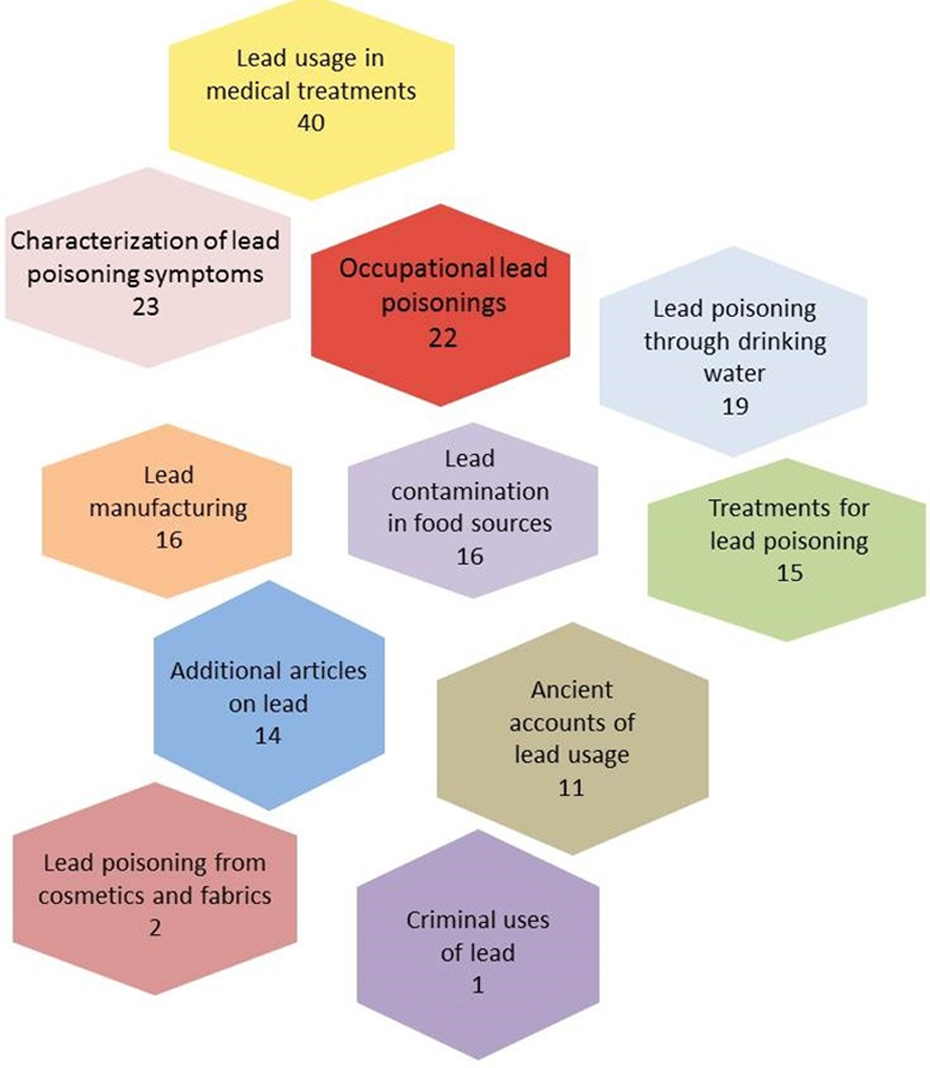
Summary of major themes identified in the lead narrative review categorized by number of documents. Adapted from Joanna Briggs Institute, 2015, 199 .
Discussion
Historical information on lead shows a vast array of knowledge and applications of this metal. While some writers from antiquity describe lead’s use in preparing wine and in construction, at the same time, many authors were aware of its toxic effects. An epidemic of lead poisoning was also described by one author, suggesting that many individuals were well aware of the negative health effects of lead.
Occupational exposures to lead were one of the major sources of lead poisoning in the 18th and 19th centuries. Some of the occupations that saw large numbers of lead poisoning are not surprising, such as white lead manufacturing, painting, and pottery work. Other instances of lead poisoning came from occupations not usually associated with lead, including weavers, suitcase makers, and a florist. The diversity of lead poisoning cases indicates that lead was pervasive throughout this time period. While lead has been drastically reduced from the environment (especially seen by the removal of lead from gasoline), lead remains a persistent environmental pollutant that continues to have negative population health consequences. 200 Occupational lead exposures remain a significant health problem today. Occupations including workers in lead manufacturing and smelting, glass manufacturing, battery manufacturing and recycling as well as car mechanics, and welders still face a significant exposure to lead. 201
Lead poisoning from water sources was a major problem historically. Several accounts of the use of lead-based pipes were seen from antiquity and well into the 19th century. The reoccurring issue of lead contamination through pipes shows the importance of replacing pipes with safer materials. Lead pipes began to be phased out of use in North America in the 1930s; water consumption is thought to still contribute to 10–20% of total lead intake in children. 202 The pervasiveness of the use of lead pipes for water and the negative health effects of low-level blood lead concentrations indicates that the removal of lead pipes from use should be a public health priority.
Lead poisoning from the contamination of food and alcohol was a significant issue, particularly in the 18th and 19th centuries. Food-containing vessels, particularly lead pottery that was lead-glazed, could often be a source of lead poisoning. Ciders and other alcohols could be a source of lead poisoning if the vessels used contained white lead paint, or if lead was used to illegally sweeten wines. A surprising find was that lead contamination was particularly an issue for commercially sold soda waters. As previously mentioned, water consumption remains a significant source of lead exposure. 202 Lead contamination of food remains a health issue, particularly for LMICs. 203 –208 Foods grown in lead-contaminated water also remain a persistent source of lead, indicating the importance of soil remediation in areas with high levels of lead pollution. 209 Additionally, hand-to-mouth activity remains a major route of lead exposure in children from the ingestion of lead-contaminated dust. 210 –212 Although the inhalation of lead particles has drastically reduced in the past decades with the removal of lead in gasoline, cars can still emit lead particles due to the presence of lead in engine parts and the quality fuels used. While the inhalation of lead particles has drastically decreased as a route of exposure, ingestion remains a significant concern.
Many early symptoms of lead poisoning were formally recognized and identified during the 19th century. Burton’s line, painter’s colic, and distinguishing saturnine gout were all found in sources during this time period. Early research in lead toxicity helped set the groundwork for future research.
Although many historical articles identified lead poisoning as toxic, its use in medical treatments was widespread. Lead, and particularly lead acetate, was often used in medical treatments. Lead was particularly used in the creation of flexible styles for duct issues. Lead acetate’s most common use was in diarrheal diseases including dysentery and cholera. Several other conditions were cited where lead acetate was used in medical treatment, suggesting that lead was used as a panacea throughout the 19th century. Due to the toxic nature of lead, its use in medicine is no longer relevant. Certain traditional medicines, including Ayurvedic medicines and some Asian folk remedies still used today have been identified as being heavily contaminated with lead. 201 One unique case of lead poisoning was found in an infant whose mother used lead-based nipple guards. 211 The presence of lead in traditional medicines remains a persistent health concern.
Many different treatments for lead poisoning were also suggested. The type of treatment varied depending on the route of exposure and if the lead poisoning was acute or chronic. For the accidental consumption of lead, vomiting was often induced to remove the poisoning, or creosote was used to absorb the lead. Baths were usually suggested for dermal exposure to lead. The most common treatment for lead poisoning found in the literature was potassium iodide. Currently, chelation therapy is used as a method to reduce blood lead levels and reduce symptoms of lead poisoning. 213,214 Common chelators currently used to relieve lead poisoning include succimer and sodium calcium EDTA. 214
Only one article was found that identified lead being used for criminal poisoning. Lead was likely not seen as a useful poison due to fatality occurring only at high doses as well as its distinctive symptoms.
Several articles also looked at the manufacturing and applications of red and white lead. Red lead was predominantly used as a protective layer for steel, while white lead was predominantly used for domestic painting. 193 Due to the negative health effects of lead paint, its use has been removed in high-income countries through regulation and removal, but its use remains common in LMICs. 215 Overall historical experiences with lead provide a rich source of information on its use and impacts on human health and reflect many common issues with lead currently faced by LMICs.
Limitations
There were three limitations to this review. The review was restricted to English language articles. Only including English language articles meant that the majority of articles originated from North America and Britain, reducing the overall breadth of the review. Articles were included based on their availability and access through the database used, meaning that articles lacking a full body text were not included. The review conducted was narrative, meaning that a systematic search of the literature did not occur and no specific methodology was used.
Conclusion
Significant insight can be gained from examining historical experiences with lead use and poisoning. The vast literature identified indicates that it was common knowledge that lead had toxic effects, but historically it was assumed that these effects only occurred at high levels of exposure. Lead was both an occupational hazard as identified by the numerous occupations where lead poisoning was experienced and a common environmental contaminant, as seen by the ubiquitous presence of lead in food, household items, and water carried through lead-based pipes. Lead remains an important occupational hazard in many different industries, and the contamination of food grown in polluted soils and the transport of water through lead-based pipes continues to be sources of lead poisoning. The most common route of entry for lead identified in the historical literature was through ingestion, which is in contrast to the inhalation of lead particles from leaded gasoline commonly seen in the 20th century. Although the inhalation of lead has recently decreased, vehicle emissions remain a source of lead pollution. Ingestion of lead particles remains a major source of lead poisoning that should continue to be addressed through public health initiatives. Outbreaks of lead poisoning from water carried through lead pipes were historically a major public health issue, indicating the importance of the transition away from lead pipes for the transport of water. The symptoms of lead poisoning were well documented throughout the 18th and 19th centuries, and several clinical symptoms that were characterized at this time remain important indicators of lead poisoning today. Numerous methods to treat chronic and acute lead poisoning were developed. Lead contamination of alternative medicines remains a key source of lead poisoning today. This article demonstrates that historical issues regarding lead poisoning reflect similar issues currently seen in LMICs and may provide useful information on how to mitigate this public health issue.
Footnotes
Declaration of Conflicting Interests
The author(s) declared no potential conflicts of interest with respect to the research, authorship, and/or publication of this article.
Funding
The author(s) received no financial support for the research, authorship, and/or publication of this article.