




Abstract
Photocopier machines are inevitable office equipment, but they are also sources of air pollution. Millions of people across the world are involved in the operation and maintenance of photocopiers. We aimed to evaluate the potential genotoxic effects of exposure to photocopiers in photocopier operators and maintenance personnel by Comet assay. This study involved 50 photocopier operators, 61 maintenance personnel and 52 controls. Both the photocopier exposed groups exhibited significantly increased DNA damage when compared to controls. Cumulative exposure to photocopiers was the most significant contributor for genotoxicity (p < 0.001). Genotoxicity among photocopier maintenance personnel may be due to the presence of carbon black, iron, silicon, magnetite and the high levels of other elements in the photocopier toners. Genotoxicity among photocopier operators might be due to exposure to high levels of particulate matter and volatile organic compounds emitted by photocopiers during operation. Research is essential to improve toner manufacturing processes and chemical composition of toners to reduce genotoxicity. Clean technologies are the need of the day to cut down on particulate matter and volatile organic compound emissions from photocopiers.
Introduction
Photocopier machines are inevitable office equipment in recent days of automation. Millions of workers earn a living through the photocopier industry across the world. The process of photocopying has also undergone a quantum shift in terms of technology, ease of operation, raw materials, output and versatility. 1 The changing landscape of technology has also fuelled the printing machinery and supplies industry with new products and innovation giving the market a significant boost. 2
Despite the advantages and commercial benefits of photocopiers, they are also sources of air pollution. During operation, photocopiers emit toner particles, toxic gases namely ozone, volatile organic compounds (VOCs), semi VOCs, nitrogen oxides, ammonia, small doses of UV light, elements like, silicon, sulphur and several metals such as titanium, iron, chromium, nickel, zinc, selenium, cadmium and arsenic, particulate matter, nanoparticles, paper particles and extremely low-frequency electromagnetic fields. 3 –15 These emissions are variable and depend on a host of poorly understood factors such as photocopier’s model, cartridge age, toner, electrostatic discharge, printer age, fuser temperature, page coverage, paper type, mode of operation, printing frequency and maintenance cycles. 11–12,16–17 A range of other materials in photocopy centres, such as presence of printed documents, cleaning solvent, office furniture, building materials, flooring materials and other office equipment may also influence the emissions. 6
Thus, millions of people who operate photocopiers for livelihoods may be exposed to photocopier emissions in indoor environments such as commercial photocopier units or offices across the world. Apart from the operators, thousands of people are also involved in the maintenance of photocopiers. In India, majority of the photocopier units are dependent on second hand reconditioned machines to cut start-up costs. Consequently, maintenance of these second hand machines is a costly and labour intensive affair. A large workforce is involved in the maintenance of these photocopiers. These personnel work in large service centres or make calls to different photocopier units/offices. Maintenance personnel are maximally exposed to toner powders during maintenance process rather than pollutants emitted during the photocopying process.
Toner is one of the major consumables used in photocopiers. The main components of the toners are polyester resin, carbon black, iron oxide and a few other elements. 18 Generally, chemically manufactured toners (bottom up approach) have a better quality and efficiency of printing, whereas mechanically prepared toners are cheaper and of poor quality. According to Gminski et al., workers manufacturing the powders and photocopier maintenance personnel come into direct contact with considerable amounts of toner powder, and thus belong to the population groups that have frequent high exposure to toner particles. 19 Photocopier operators, on the other hand, are more likely to be exposed to the emissions produced by printing or photocopying rather than to the toner powder itself. This difference in exposures among workers necessitates the study on variations of genotoxic potentials of pollutants in the two different working environments.
Earlier studies on photocopier workers report the incidence of siderosilicosis, granulomatous pneumonitis, mediastinal lymphadenopathy, sarcoidosis, sick building syndrome symptoms, respiratory diseases, nasal irritation, oxidative stress and toxicity among photocopier operators. 10,15,20 –25 Increased DNA damage and decreased DNA repair efficiency as evaluated via comet assay, chromosomal aberration, micronucleus and sister chromatid exchange 15,26 –28 have also been reported among photocopier workers. However, genotoxicity among people exposed to toners have not been studied till date.
Hence, the present study aimed to assess the potential genotoxic effects of photocopier exposure among maintenance personnel and to complement the previous findings by evaluating the potential genotoxic effects of the same among photocopier operators. Since the exposure of photocopier maintenance personnel and operators are different, we attempted to characterize the exposure undergone by the two groups of workers. To identify the genotoxic agent(s) among maintenance personnel, we characterized the physical and chemical composition of a few of the toners used in India. To distinguish the genotoxic agent(s) among photocopier operators, we characterized the indoor air quality in photocopier units and VOCs emitted by toners during photocopier operation.
Materials and methods
Study population and sample collection
The study was approved by the Human Ethical Committee of Avinashilingam Institute for Home Science and Higher Education for Women, Coimbatore (HEC.2009.14; HEC.2011.24).
Coimbatore is a tier II city with numerous educational institutions and business establishments. Therefore, hundreds of photocopier units operate in the city. All the subjects for the study were recruited from Coimbatore. The study objectives and sample collection procedure were explained in local language to the subjects who were invited to participate through personal door-to-door approach. Written informed consent was obtained from all the participants. The photocopier operators and maintenance personnel included in the study were occupationally exposed to photocopiers and toners on a routine basis for a minimum of 2 years. Control group included people with no occupational exposure to photocopiers. Subjects in the age group of 18–40 years were included in the study. Those with any systemic diseases were excluded.
An interview schedule was administered by the authors to compile personal, socio economic, occupational, smoking and general health details of the subjects. Occupational history included the types of toners used in their respective photocopier machines, total number of working hours/day, work days/week and years of service in photocopier industry. Based on these details, the cumulative hours of exposure was calculated. 1 The smoking details included the number of years of smoking, number of cigarettes smoked, current smoking status, based on which ever smokers and non-smokers were categorized, and pack-years were calculated. 29 Pack-years of smoking is calculated as: Average number of cigarettes per day/20 × number of years smoked. Anthropometric measurements and blood pressure were recorded. Combined exposure to cigarette smoke and photocopier emissions was calculated by adding the number of hours exposed to photocopier emissions/toners and the number of cigarettes smoked overall. Venous blood was collected in EDTA vacutainers from each subject and transported on ice to the laboratory. An aliquot of 100 µL of the collected blood was transferred to a cryovial and stored at −80°C with dimethyl sulfoxide (10%) as preservative for genotoxicity studies.
Comet assay
The alkaline comet assay was performed by the standard protocol. 30 For visualization of DNA damage, ethidium bromide stained slides were viewed using a 40× objective on a fluorescent microscope (Nikon, Japan). A camera was used to capture images from each slide. One hundred cells were scored for each sample (50 cells from each of 2 slides). Comet scoring was carried out by the semi-automated method using a free software, namely, Auto comet score (Tri Tek Corporation, Sumerduck, Virginia, USA) following the manufacturers guidelines.
Statistical analysis
Shapiro Wilk test was used to check for normal distribution of data. The χ 2 test and one-way analysis of variance were used to compare the demographic characteristics of the subjects. Non-normal data were compared by Kruskal–Wallis test with Mann–Whitney test as post hoc. Spearman’s correlation coefficients were calculated to assess relationship between genotoxicity indices and variables such as age, weight, height, smoking status, pack-years of smoking, cumulative exposure to photocopier emissions/toners and combined exposure to photocopiers/toners and cigarette smoke. Correlation was considered significant at p ≤ 0.05. Univariate linear regression analysis was conducted on significantly correlated variables, for the genotoxicity indices. The analyses were performed using SPSS version 19.
Characterization of toner samples
Samples of four popularly used toners were collected from refill packs available commercially. Morphology and particle size were studied using scanning electron microscopy. Elemental composition of toner powders was assessed by energy dispersive X-ray spectra (EDX). The toner samples were attached to double-sided tape applied to a carbon planchet and made conductive by coating with carbon by vacuum evaporation. Carbon coating was mandated by the sample characteristics (conductivity and size), operating environment (pressure) and analytical requirements (beam voltage and current). Elemental analysis of toner samples was performed using a JSM-6390 (JEOL, Japan), with an EDXA attachment (EDX Oxford Instrument, INCA PentaFET X3, Karunya University, Coimbatore).
The toner powders were studied by powder X-ray diffractometry using a Shimadzu XRD 6000 (Japan). The toners were dispersed onto zero-background silicon sample holders and then scanned from 4 to 90° 2θ, with a continuous scan and a dwell time of 0.6 s/step using copper K α radiation. The spectra were compared with the ICPDF database to identify the phases present in the toner.
Headspace Gas Chromatography Mass Spectrometry (GC-MS)
To identify the VOCs that would possibly emanate from toners, head space GC-MS was carried out (USEPA method 8260C) at the simulated fusion temperature (180–200°C) of photocopier machines. 31 One gram of toner was placed in a capped 20 mL sample vial and heated to 185°C for 20 min. After that, a 300 µL sample of the headspace gas (gas above the sample) was drawn into a syringe; 1 µL of the same sample was injected into the GC-MS column – DB-5MS capillary column (30 m × 0.25 mm, 0.25 μm; Agilent technologies Inc., Santa Clara, California, USA) It was ran using split mode (split ratio = 10:1). Helium carrier gas was programmed to maintain a constant flow rate of 1.5 mL/min. Oven was maintained at an initial isothermal period of 3 min at 70°C, then raised to 300°C at the rate of 10°C/min for 9.0 min for a total of 35 min. Mass analysis detector was used with the following conditions: ion source temperature 230°C, interface temperature 240°C, scan range 400–700 m/z, solvent cut time 3 min, MS start time 3 min – end time 35 min, ionization at −70 eV and scan speed of 2000. The peaks obtained were matched against computer library of mass spectra (NIST 11).
Results
Genotoxicity
In the present study, genotoxicity was assessed in a total of 163 individuals (men) including 52 controls, 50 photocopier operators and 61 photocopier maintenance personnel. No significant differences were observed between the demographics of three groups as shown in Table 1.
Demographic details.

The number of smokers in the three groups namely control (n = 25), photocopier operators (n = 15) and photocopier maintenance personnel (n = 28) were not significantly different (p > 0.05). The mean pack-years of smokers in the control group were 2.7 ± 5.9 (n = 25), photocopier operators were 2.35 ± 3.08 (n = 15) and maintenance personnel was 1.40 ± 1.8 (n = 28). Cumulative exposure to photocopiers among the photocopier operators and maintenance personnel is listed in Table 2.
Cumulative photocopier exposure.

Majority of the maintenance personnel had more than 10,000 h of exposure, whereas operators were equally distributed between both groups of exposure.
Per cent DNA in tail and olive tail moment were significantly higher among photocopier operators and photocopier maintenance personnel when compared to controls (Figures 1 and 2; p < 0.001). But the difference in the genotoxicity indices between photocopier operators and photocopier maintenance personnel did not reach statistical significance (p > 0.05).
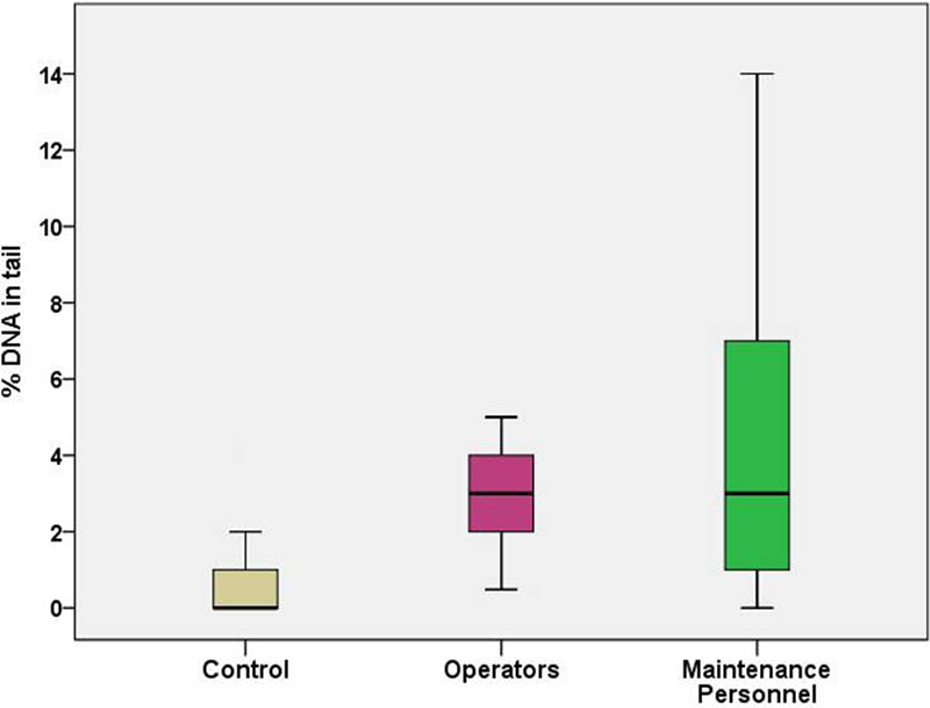
Per cent DNA in tail.

Olive tail moment.
Spearman’s correlation coefficients (ρ) were computed to assess the relationship between genotoxicity indices with age, body mass index, pack-years and cumulative exposure to photocopiers/toners. Cumulative exposure to photocopiers/toners was found to be strongly correlated with both the genotoxicity indices, that is, per cent DNA in tail (rho = 0.596) and olive tail moment (ρ = 0.568). The other factors such as age, body mass index, smoking status and pack-years of smokers did not significantly correlate with both the indices (Table 3).
Relationship between genotoxicity indices and independent variables.

Univariate linear regression analysis suggests that cumulative exposure is the only contributor for % DNA in tail. Significant regression equation was found F(1, 161) = 19.487 (p < 0.001) with an R 2 of 0.108 (Figure 3).

Per cent DNA in tail influenced by cumulative exposure to photocopiers.
Characterization of toners
Toner morphology and size
The morphology, particle size and composition of the toner particles as revealed by scanning electron microscopic are shown in Figure 4. The selected toner particles varied both in their shapes and sizes. The mean particles sizes of toners A, B, C and D were 9.0 ± 1.41 µm, 9.3 ± 0.67 µm, 4.0 ± 0.84 µm and 5.0 ± 0.71 µm, respectively. The particles in locally made or generic toners A, B and C appear irregularly shaped with rough edges. D is a sample of branded toner produced by a commercial photocopier manufacturer. It appears to contain smooth, round-shaped, uniform-sized agglomerates. The surface of all the toners was covered by nanosized iron-rich particles which show up as bright glossy grains at higher magnification.

SEM-EDX images of toner particles. SEM: scanning electron microscope; EDX: energy dispersive X-ray spectra.
The elemental composition as measured by scanning electron microscope (SEM)-EDX (Figure 5) showed branded toner D had the highest carbon content of about 58% in comparison to the locally made toners A, B and C that had a carbon content of 51–54%. Branded toner D had the least iron content of the four toners (24%). The silicon content was found to be least in branded toner D in comparison to generic toners A, B and C.

Element composition of toners.
X-ray diffraction pattern of the four toners shows (Figure 6) the presence of magnetite (Fe3O4) in all four toner powders.
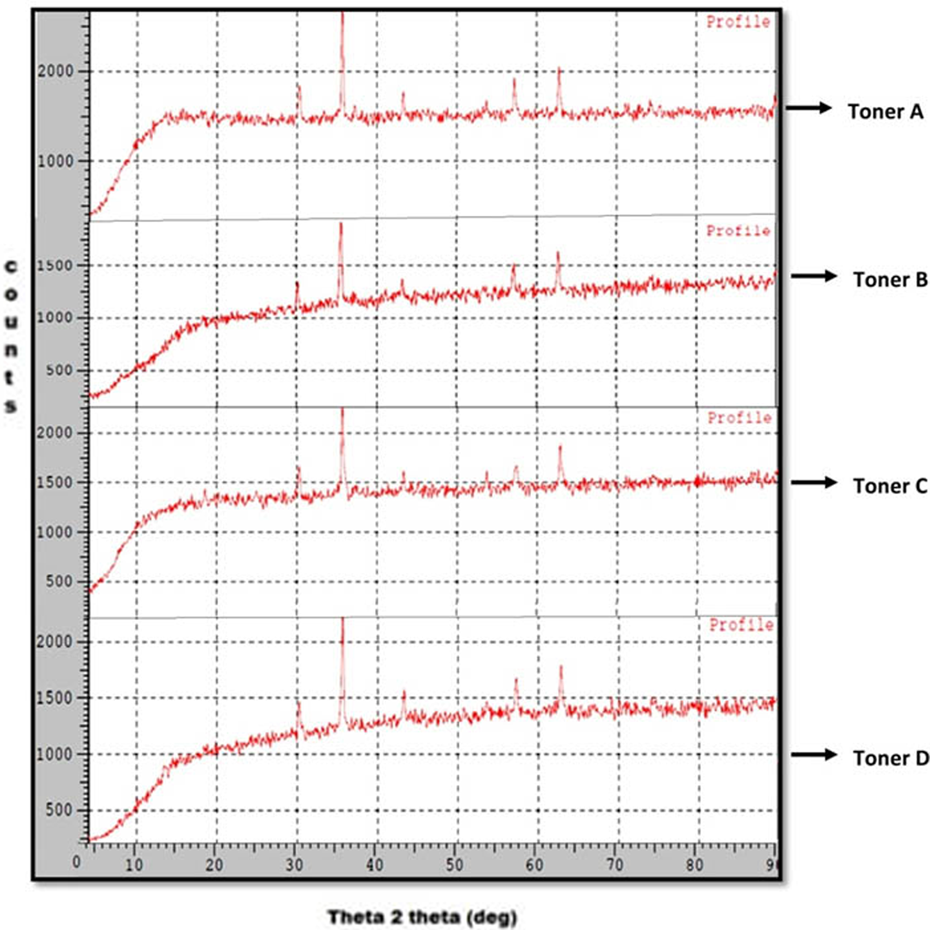
X-ray diffraction pattern of the four toners.
Head space GC-MS spectra of the toners A, B, C and D with their peaks and retention times are depicted in Figure 7(a), (b), (c) and (d), respectively. Table 4 enumerates the compounds that were identified by head space GC-MS in each of the four toner samples A, B, C and D. Compounds that had a matching quality of above 35% were compared against the computer library of mass spectra of NIST 11. In addition to these identified compounds, each sample also contained two or more significant peaks that could not be identified.

GC-MS spectra of (a) Toner A. (b) Toner B. (c) Toner C. (d) Toner D.
Compounds identified in toner samples by headspace GC-MS.

Discussion
The printing and photocopying industries have seen phenomenal growth in the last three decades due to the advent of computers in all walks of life. Millions are involved in activities such as operation and maintenance of photocopiers and manufacturing and packing toners. Occupational health hazards faced by the workers in photocopier industries are in focus currently.
Genotoxicity
In a previous study, we evaluated lung function, haematological status, oxidative stress and inflammatory status among photocopier operators. The results revealed that photocopier operators are prone to high oxidative stress and systemic inflammation. 1 The present study investigated the potential genotoxic effects of occupational exposure among photocopier operators and maintenance personnel using the comet assay. The photocopier operators and controls are from the same sample groups as those used in the previous study. Our results demonstrated that the genotoxic effect in maintenance personnel was similar to that in photocopier operators. This is the first attempt to study genotoxicity among maintenance personnel in the photocopier industry.
In the present study, % DNA in tail and olive tail moment were significantly higher among the photocopier operators and maintenance personnel when compared to controls. It is evident from these results, that both photocopier operation and maintenance are genotoxic (p < 0.001). Even though the two groups of workers are exposed to different combinations and levels of pollutants, the genotoxic potentials of the pollutants are similar. The significantly high genotoxicity among photocopier maintenance personnel suggests that toner exposure is as genotoxic as photocopier emissions.
Although comet assay is typically used to evaluate recent exposure, in the present study, cumulative exposure to photocopiers/toners was found to be the lone independent variable to influence genotoxicity (p < 0.001). This suggests that chronic exposure to both photocopiers operation and maintenance might lead to increased DNA damage. Kleinsorge et al. also reported a significant association between the time in months spent at work and DNA damage in lymphocytes and buccal cell with micronucleus among photocopier workers. 15
Number of pack-years smoked or smoking status did not influence genotoxicity parameters. Hence, in the present study, smoking was not a confounding factor. The results are in agreement with a meta-analysis by Hoffman et al. on 26 occupational exposure studies investigating genotoxicity. 32 Exposure to photocopiers may be modifying the risk associated with smoking due to more efficient DNA repair, enhanced detoxification or saturation of metabolic activation. 33 Other confounding factors such as passive smoking, indoor air pollution and antioxidant supplements were not significantly different between the groups.
Personal monitoring is the only way to evaluate individual exposure to pollutants. However, it could not be carried out in the present study due to the non-cooperation of the subjects. In order to understand the causative factors for genotoxicity among photocopier operators, we assessed emissions during photocopying process. Toner particle morphology, size and composition were assessed to study genotoxicity among photocopier maintenance personnel.
Photocopier toners – morphology, size and composition
In the present study, genotoxicity among the maintenance personnel was found to be influenced by their cumulative exposure to toners. Hence, we characterized the morphology, size and elemental composition of toners commonly available toners.
Four locally available toners (designated A, B, C and D) were characterized by SEM-EDX and XRD. The toner particle’s sizes ranged between 2 and 10 µm. All the toners bear nanosized iron particles on their surface. The irregular shape of the toners A, B and C suggests that these generic toners were manufactured through conventional mechanical pulverization techniques (top-down approach). In contrast, branded toner D with uniform-sized particles and smooth surface is suggestive of a chemical preparation (bottom up approach) such as polymerization/emulsion aggregation. The iron particles on the surface of toners – most probably magnetite – are smaller and numerous in generic toners A, B and C. In branded toner D, not only the size of the iron particles is bigger, but they are also of smooth morphology suggestive of chemical manufacture. Toners used in different parts of the world were also found to have similar morphology and size dimensions. 11,19,34,35
EDX spectra of the selected toners in the present study showed that carbon is in fact the most abundant element in the investigated monochrome toner materials with >50%. Carbon black particles are known to be genotoxic in in vitro and in vivo assay systems. 36 The proportion of iron was less (between 27% and 31%) in the mechanically produced toners compared to the chemically manufactured toner which had only 23%. Silicon was also lower in the chemically manufactured branded toner D, when compared to pulverized toners. The other elements constituted between 17% and 19%. In view of all the major components of toner being carbon based, the proportion of other elements is quite substantial. The relative amounts of other elements were not available through SEM-EDX. Toner studies in various countries showed that toners had considerable amount of iron (Fe), titanium, silicon, manganese, sulphur, tin, aluminium, zinc, magnesium, chromium, nickel, cobalt and copper. 10,37,38 This may hold true for the toners in the present study too.
XRD pattern of the toners showed the presence of magnetite in all the toners – signifying that magnetite is the component showing Fe-rich submicrometre-sized particles. Similar results were reported by Gminski et al. 19
In addition to toner’s chemical composition, 39 other physical properties, such as size, volume, shape and crystal structure of the toner particle, may also affect the toxicity of particles, whereby the effects of chemical composition may be enhanced, reduced or cancelled. 19,39
Khatri et al. also suggested that genotoxicity of toner particles may be different from nanoparticles emitted during photocopying process due to the difference in morphology, size and chemical composition. 25 The route of exposure may also determine the extent of genotoxicity. Exposure to toner powders may occur via dermal routes by direct skin or eye contact, respiration by inhalation or ingestion if toner powder is swallowed accidentally. 40 Among these routes of exposure, only one, namely inhalation, has been studied earlier in animals. 39,41–42 Maintenance personnel are involved in routine cleaning and refilling of cartridges. Hence, the principal route of exposure among maintenance personnel is by inhalation and dermal exposure. Detailed dosage-based studies on inhalation and dermal exposure to toners are necessary to establish their association with genotoxicity of toners.
At present, toners are classified as ‘granular bio-durable particles without known significant specific toxicity’. This status of toners is questionable in view of these results. Similar DNA damage among both the maintenance personnel and operators also suggests that genotoxicity of toners is similar to photocopier emissions. Hence, further studies on genotoxic potential of toners are essential.
Indoor air quality and photocopier emissions
Genotoxicity among photocopier operators was also found to be influenced by cumulative exposure to photocopier emissions in the present study. This highlights the hazardous nature of chronic photocopier emission exposure.
Earlier studies also found significantly higher genotoxicity among photocopier operators. 15,26 –28,43 However, Khatri et al. reported that photocopier emissions were not genotoxic. 25 In view of these contradictory results, we felt that the aforementioned studies lacked quantitative exposure assessment, had poor exposure histories of the individuals studied and did not pinpoint the actual exposure triggers leading to the observed genotoxic effects. To mitigate the drawbacks and study the effects on exposed individuals, we documented duration of exposure, smoking status and air quality levels within the photocopier units as a measure of exposure.
Indoor air quality in photocopier centres showed the presence of high levels of particulate matter (PM10 and PM2.5) in these workplaces during business hours. PM10 was nearly four times the permissible levels, whereas PM2.5 was double the allowed levels. 1 All the photocopier units we visited and collected air quality data had at least one wall replaced by a retractable shutter, which was open during business hours to allow customers to walk in. This arrangement made free flow of air possible throughout the business hours. In spite of such very good ventilation facilities, the amount of particulate matter found in these photocopier units suggests very high particle emission rates. Earlier studies also reported similar results. 44 –47
Several studies have also reported high levels of ultrafine particles/nanoparticles in photocopier units. 10,11,25,37,45 Toners are the primary contributors to particulate matter in photocopier units. 9 In the present study, the toner particles are also in the range of 2–10 µm. It is expected that the particles in photocopier emissions might be several fold smaller than toners, due to the breakdown during the photocopying process. However, the high amount of PM10, which is similar in size to toners, suggests dispersion of toners themselves. We speculate that the poor efficiency to adhere to paper, rough surface and irregular shape of the generic toners may be the reason for the high levels of PM10. We found that toners manufactured by the mechanical process (top-down approach) are preferentially used in the photocopier units utilizing second hand machines. Photocopy centres which purchased new machines were inclined to use toners prepared by the bottom up approach. Further investigations are required to characterize whether the type of toner influences the amount of hazardous emissions of PM10 and PM2.5.
Generally we would expect that fine or ultrafine particles (PM2.5 and PM0.1) to be more genotoxic due to their smaller size and different physico-chemical properties. In the present study, exposure to toner powders (in the range of 2–10 µm) were found to be as genotoxic as photocopier emissions (<PM2.5).
Ozone and VOCs are some of the earliest reported gaseous pollutants emitted from photocopiers. Intense research on methods to reduce emission of ozone has led to improved technologies that reduced exposures to such pollutants (e.g. ozone). 25 Our earlier results showed that the levels of air quality parameters namely carbon monoxide, NO2, ozone, sulphur dioxide, lead, arsenic, nickel, ammonia, benzene and benz(o)pyrene were within permissible limits in all the units. 1 Hence, only VOCs emissions from toner powders were determined by headspace GC-MS.
VOCs emissions in photocopying process are caused by heating up the drum and toner up to 160°C to compress toner on paper. 48,49 In the present study, toluene, olefins, alkyl ketones and halo non-olefins were common in all the mechanically prepared generic toners A, B and C. Apart from the above, generic toner A also contained a myriad of aromatic, aliphatic hydrocarbons and heterocyclic compounds. Generic toner B had fewer cycloalkanes, olefins, aliphatic hydrocarbons and heterocyclic hydrocarbons. Generic toner C contained a mixture of n-alkanes, cycloalkanes, olefins and aliphatic hydrocarbons. Branded toner D, manufactured by chemical synthesis, had a unique set of polycyclic aromatic hydrocarbons, cycloalkanes and alkyl ketones.
Earlier reports by various studies have also reported emissions of aliphatic hydrocarbons, cyclosiloxanes, aromatic hydrocarbons, halogenated non olefins and PAH from toners. 6,19,46,50 –52 Many of the VOCs identified by GC-MS, halogenated aliphatic hydrocarbons and PAH, are known to be genotoxic. 53–54 Thus, it is evident that all the toners – both generic and branded – release different hazardous organic compounds that include polycyclic aromatic hydrocarbons and VOCs such as aromatic, aliphatic and heterocyclic compounds as a by-product of xerographic process. Thus, genotoxicity among photocopier operators might be due to exposure to particulate matter and VOCs emitted by photocopiers during operation.
To conclude, both photocopier maintenance and operation are genotoxic. The findings of this bio-monitoring study suggest that the genotoxicity due to exposure to toners as well as photocopier emissions is directly influenced by the duration of exposure. Smoking is not a confounder in this study. Genotoxicity among photocopier maintenance personnel may be due to the presence of carbon black, iron, silicon, magnetite and the high levels of other elements in the photocopier toners. Genotoxicity among photocopier operators might be due to exposure to particulate matter and VOCs emitted by photocopiers during operation. Research is essential to enhance toner manufacturing processes and chemical composition of toners to minimize genotoxicity. Clean technologies are the need of the day to cut down on particulate matter and VOC emissions from photocopiers. The evidence of a genetic hazard related to photocopier emissions suggests the need for awareness programs to avoid housing photocopier units at residential premises, to improve ventilation in photocopier units and to practice the use of wearing protective gear among all photocopier workers.
Footnotes
Acknowledgement
We are grateful to the subjects who participated in the study. We gratefully acknowledge the contribution of Bureau Veritas, Chennai in carrying out the GC-MS Analysis.
Declaration of Conflicting Interests
The author(s) declared no potential conflicts of interest with respect to the research, authorship, and/or publication of this article.
Funding
The author(s) disclosed receipt of the following financial support for the research, authorship, and/or publication of this article: This work was supported by the Department of Science and Technology, Government of India – Women Scientist Fellowship (WOS-A/LS 188/2009) and Indian Council of Medical Research (No. 5/8/4-10/Env/2009-NCD-I), Government of India.