



Abstract
Low fertility in rice caused by Chilo suppressalis has led to the use of diazinon to control this pest. Residue of pesticide could penetrate products and also food which can affect public health. The aim of this research was to determine health risk assessment of organophosphorus (OP) pesticide in rice, a strategic crop in Iran. Ninety rice samples were collected from 30 points during harvesting seasons from Rasht Area, Guilan Province, Iran from which 30 samples were prepared. The concentration of diazinon, the most common pesticide used in the study area, was determined by high-performance liquid chromatography. The result indicated that the total average of diazinon in rice samples (31.91 mg/kg) is by far higher than the maximum residue limit recommended by the European Union. According to the results, EDAI was 0.051 mg/kg day, while health risk index in rice was 10.2. Results showed that there is a health risk associated with the lifetime consumption of rice polluted by OP pesticide in the study area.
Introduction
Pesticides encompass 881 chemical and/or biological substances all over the world. 1 –3 Pesticides such as insecticides, nematicides, herbicides, and fungicides are chemical substances extensively consumed versus plant pests and diseases, specifically in developing countries. 4,5 These substances are used to increase harvests and enhance the quality of productions. 6 –12 Pesticides play a key role in contaminating rivers, streams, drinking water sources, and aquatic ecosystems as non-point source pollution. 13 –16 Furthermore, pesticides can penetrate into plants and migrate to the edible parts of crops. Studying plant uptake models shows the entrance of these chemical substances into the food chain. 17 Residues of these compounds remain in crops and the environment due to their chemical and biological composition. 18 –20
In recent years, public concern about food pollution by pesticides has increased because of their biocide activity and possible risk to people who eat such foods. 11,21,22 A monitoring implement for determining human vulnerability to pesticide is the examination of pesticide residues in food. 23 Sixty percent of the world’s population consume rice grain and its chaff is used for feeding livestock during cold season. 24 –26 Rice is a staple food in developing countries who require great amounts of pesticide during its cultivation and growth. 5,27
It is obvious that human beings are subject to the consequences of pesticide residues by eating contaminated food. 28 –32 Some investigations illustrate that pesticide via polluted agricultural crops may cause toxicity. Moreover, it may be associated with chronic illnesses such as cancers, genetic mutation, and blood and reproductive disorders. 33 –36 These negative effects indicate that extensive studies on agricultural products are necessary.
Rasht is a township in the Southern part of the Caspian Sea and is in the center of Guilan Province. This area is located southeast of Anzali International Wetland and is the eastern part of the Anzali Wetland water basin. According to the Guilan Organization of Agriculture, most of Iran’s rice cultivation is undertaken in Rasht with 62,336 hectares. Furthermore, this statistics declares that about 6,00,000 liters of liquid pesticide and more than 10,00,000 kg of granule pesticide were used in rice fields in 2013. The most common pesticide used in rice fields is diazinon. Diazinon is an organophosphorus (OP) pesticide with medium resistance which may lead to physiological defects. 37 This pesticide is used against Chilo Suppressalis in rice fields. Statistics show that the most number of deaths from pesticide contamination is related to OP pesticide. Diazinon poses a risk to humans by affecting acetylcholinesterase enzyme. 38 –41
The objective of this research is to investigate health risk assessment of consuming rice as a main food in Northern Iran.
Material and methods
Sample collection
The study area is eastern part of Anzali International Wetland watershed. This part includes the rice fields of Rasht Township. The study area was divided into five main zones according to geographical aspects. The zones comprise north, south, east, west, and central parts. Each main zone was divided into six zones and three samples were collected from every zone and were mixed together for preparing a sample (Figure 1). Thirty rice samples were collected from the fields during harvesting seasons from August to mid-September 2014. Three mixed sub-samples were packed in a polyethylene bag, labeled, and stored at 4°C. Then the samples were transported to the Environmental Research Institute laboratory, Rasht. Also in laboratory, samples were stored in a refrigerator at 4°C until analyses.

Study area map showing location of sampling site.
Extraction and cleanup procedure
The samples were dried at ambient temperature and then shells were separated from rice grains. After that, samples were ground; each 5 g sample was watered for 2 h and placed in a centrifuge for 4 min. Then samples were put in a Soxhlet extractor and made up to a volume of 50 ml and extraction process was conducted using petroleum ether solvent for 4 h. After the solvent evaporated, the residue was dissolved in methanol. Finally 20 μl of each sample was injected to high-performance liquid chromatography (HPLC) three times.
HPLC analysis
HPLC system (HP-Agilent, Santa Clara, California, USA) was equipped with a diode array detector and a HPLC 2D ChemStation Software. A C18 Reverse Phase analytical column was used and maintained at 25°C in a column oven. The mobile phase, which was a combination of 80% methanol, 15% water, and 5% acetonitril was filtered and allowed to run at 0.8 ml/min flow rate. Prior to the HPLC analysis, the samples were passed through 254 nm filters and were manually injected (20 μl) into the HPLC system each time.
The distinction of the diazinon was carried out by reconciling retention times in samples to peak times in the original analytical standards. 42,43 A typical standard peak of diazinon is shown (Figure 2).

A typical standard peak of diazinon through HPLC. HPLC: high-performance liquid chromatography.
Human health risk assessment
In this study, human health risk assessment was performed based on one of most current organophosphate pesticide residue detected in rice. Health risk of diazinon to humans based on daily food intakes was estimated by the guideline recommended by United States Environmental Protection Agency. 43,44 Health risk index (HRI) was assessed using the following formula (equation 1):

where ADI is the acceptable daily intake and EADI is the estimated average daily intake which is described by formula 10,23,43,45,46 (equation 2):

where RPC is residual pesticide concentration (mg/kg), FCR is food consumption rate (kg/day), and BW is body weight (kg). According to a similar research in Iran, body weight of 70 kg was considered. When the HRI is more than 1, the food is considered a risk to the human. When the HRI is less than 1, the food is considered as safe for human health. 10,23
Statistical analysis
The data analyses were carried out with SPSS version 17. One sample t test analysis and one way analysis of variance (p > 0.05) were carried out via SPSS. Also Arc-GIS software version 10.2 was applied for site identifications.
Results
The results of diazinon analysis in rice samples showed that the maximum amount of diazinon concentration was recorded in the central zone which is the smallest area among all zones. Also the lowest amount of diazinon concentration was recorded in Western part of study area (Table 1). This result declares that more pesticide was used in center and south parts of this township by farmers.
The average of diazinon in rice samples for each zone.

MRL: maximum residue limit.
The average amount of diazinon in rice samples was 31.91 mg/kg. The concentration of OP residue in rice samples were reconciled to maximum residue limit (MRL) as recommended by the European Union (2011). MRL is the maximum amount of pesticide residue which is lawfully given clearance to remain in food. The results indicated that all samples analyzed for pesticide residue were contaminated by the pesticide. Comparing diazinon concentration in rice samples in the study area and MRL shows that the amounts of diazinon in all samples were by far higher than the permitted amount as recommended by the European Union.
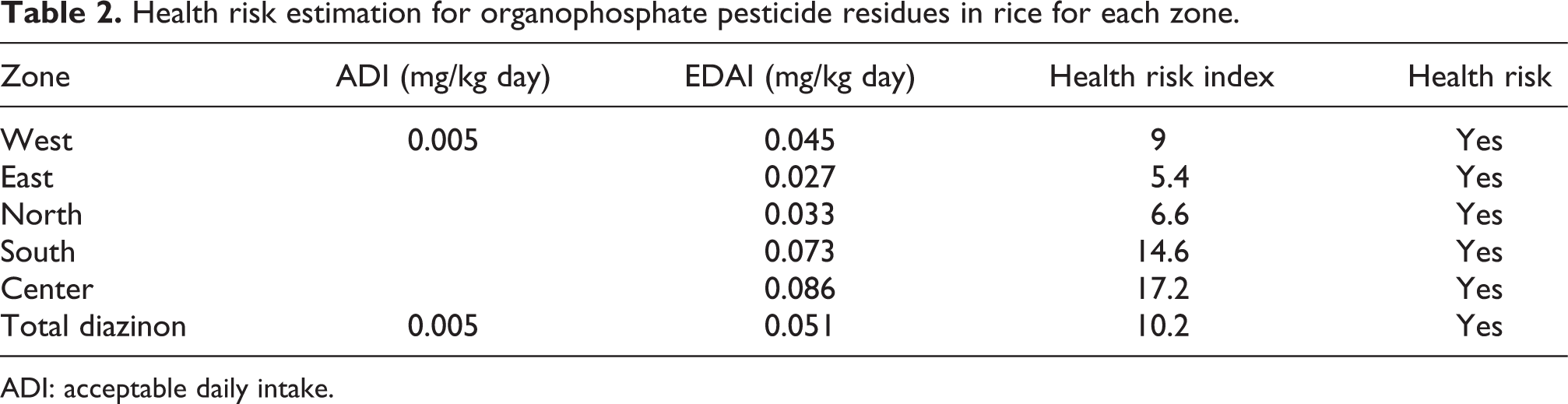
HRI was calculated for the estimation of risk effects of OP pesticides. HRI values of more than 1 indicated potential human health risk. Table 2 shows the estimated daily intake quantity of residue and its HRI in rice samples from each zone. These results show that in all five zones, the risk index is higher than 1 (Figure 3). Therefore, there is a health risk associated with the consumption of rice in each zone. The eastern and central zones of the study area have the lowest and highest health risk indices, respectively. The health risk indices in the east, north, west, south, and central zones are 5.4, 6.6, 9, 14.6, and 17.2, respectively. Also the total risk index of diazinon in rice in the study area was >1. Total EDAI for the study area was 0.051 mg/kg day, while HRI of rice in the eastern part of Anzali International Wetland watershed, north of Iran, was 10.2. Results showed that there is a health hazard associated with the lifetime consumption of rice polluted by OP pesticide in the study area.
Health risk estimation for organophosphate pesticide residues in rice for each zone.
ADI: acceptable daily intake.

Health risk of diazinon residue in rice for each zones.
Discussion
As presented in Table 1, diazinon concentrations for rice in this study were extremely higher than previously obtained data from Ghana. 23 In addition, diazinon was not found in any cereals, vegetables, and fruit samples in China. 47 Also the total average of this pesticide was by far higher than the OP pesticide in vegetables reported from Bangladesh. 43 The use of both granule and liquid forms of diazinon more than the permitted amounts in rice fields by farmers plays the most important roles in high risk value in the southern and central zones of the study area. In other zones, although farmers may use one form of diazinon, it is consumed in more than standard amounts.
HRI of diazinon in this study was from 2, 51 times greater than health indexes of OP studied in vegetables in Bangladesh. 42 Health hazard indices of OP pesticide residues in maize and cowpea in Ghana showed hazard indices for diazinon and all the pesticides analyzed had values of less than 1 except chlorfenvinphos. 23
The concentration of diazinon in this research was also much more than that of OP pesticide described in other research studies. 12,47,48,49 Comparison of these results with similar studies disclosed higher concentration of pesticides in Iranian agricultural products. 46,50,51,52
This study highlighted that OP pesticide contamination is exhibited in rice sample from the rice paddy in the Rasht Area, Guilan Province, Iran. Also the average amount of diazinon is much more than the European Union MRLs. The present research shows that rice from the Guilan province poses a potential risk to human health in Iran. Regular monitoring plan for OP pesticide residue in rice is necessary to prohibit and decrease the contamination in this area. This research evaluated health risk assessment of pesticide in rice for the first time in Guilan, Iran.
Footnotes
Acknowledgements
The authors wish to thank Science and Research Branch, Islamic Azad University (Tehran) and all people who have contributed in this project.
Declaration of Conflicting Interests
The author(s) declared no potential conflicts of interest with respect to the research, authorship, and/or publication of this article.
Funding
The author(s) received no financial support for the research, authorship, and/or publication of this article.