




Abstract
Poison centers advance knowledge in the field of toxicology through publication in peer-review journals. This investigation describes the pattern of poison center-related publications. Cases were poison center-related research published in peer-review journals during 1995–2014. These were identified through searching the PubMed database, reviewing the tables of contents of selected toxicology journals, and reviewing abstracts of various national and international meetings. The following variables for each publication were identified: year of publication, journal, type of publication (meeting abstract vs. other, i.e. full article or letter to the editor), and the country(ies) of the poison center(s) included in the research. Of the 3147 total publications, 62.1% were meeting abstracts. There were 263 publications in 1995–1999, 536 in 2000–2004, 999 in 2005–2009, and 1349 in 2010–2014. The publications were in 234 different journals. The journals in which the highest number of research was published were Clinical Toxicology (69.7%), Journal of Medical Toxicology (2.2%), and Veterinary and Human Toxicology (2.1%). The research was reported from 62 different countries. The countries with the highest number of publications were the United States (67.9%), United Kingdom (6.5%), Germany (3.9%), France (2.5%), and Italy (2.4%). The number of publications increased greatly over the 20 years. Although the publications were in a large number of journals, a high proportion of the publications were in one journal. While the research came from a large number of countries, the preponderance came from the United States.
Introduction
Poison centers are telephone consultation services, the primary purpose of which is to assist in the management of potentially adverse exposures to a wide variety of substances. In addition, they provide information on substances even when an exposure has not occurred. Another important activity of poison centers is to conduct research. This includes analyzing the types of calls that are received, 1 –3 identifying and evaluating new types of exposures, 4 –9 evaluating poison center activities and quality assurance, 10 –14 and conducting surveillance. 15 –17
It is important for poison centers and those using poison center information to advance the knowledge base of poison centers and toxicology. One way to do so is through publication of the research in peer-review journals. This allows the research to potentially reach a wide audience. One way to evaluate this activity is through bibliometric analysis, the application of statistical methods to scientific (peer-review) publications. Bibliometric analysis is increasingly used for the assessment of the status of research in particular areas and/or geographic regions. It is mainly quantitative but may be used to assess the qualitative nature of research activities. The analysis predominately uses bibliographic databases, which are intended for information retrieval and not necessarily for studies such as bibliometric analyses. 18,19
Various studies have conducted bibliometric analyses of the research activity in toxicology. 20 –25 However, review of the literature failed to identify any analyses that specifically examined poison center-related research. The intent of this investigation was to describe the pattern of poison center-related research published in peer-review journals over a recent 20-year period.
Methods
Case identification
Cases were poison center-related research published in peer-review journals during 1995–2014. Such publications were identified in several ways. A search was performed in PubMed (Medline) for the time period 1995–2014 using the following key words or phrases: “poison control,” “poison center,” “poison centers,” “poison centre,” “poison centres,” “poison information,” “Toxic Exposure Surveillance System,” “TESS,” “National Poison Data System,” and “NPDS.” The PubMed search included not just the publication titles but also the abstracts and authors’ affiliations. PubMed was chosen because the search engine is free and easy to access and use. All entries that appeared from the search then were evaluated to determine whether they met the study criteria.
Moreover, the tables of contents for 1995–2014 of the following journals were reviewed for articles potentially meeting the study criteria: Annals of Pharmacotherapy, Clinical Toxicology (formerly Journal of Toxicology-Clinical Toxicology), Human and Experimental Toxicology, Journal of Clinical Toxicology, Journal of Medical Toxicology, Journal of Pharmacy Technology, Journal of Toxicology and Environmental Chemistry, and Toxicological and Environmental Chemistry. These journals were chosen because they are toxicology related or were already known to publish poison center-related research. The list of journals is not expected to be conclusive.
The abstracts of various national and international meetings that were published in peer-review journals during 1995–2014 were reviewed to identify research that met the study criteria. These were the annual meeting abstracts of the North American Congress of Clinical Toxicology (NACCT; 1995–2014), the European Association of Poisons Centres and Clinical Toxicologists (EAPCCT; 2000–2014), the American College of Medical Toxicology (ACMT; 2013–2014), and Texas Geographic Information System (GIS) Day (2014). Abstracts were included in the study because previous investigations had indicated that many toxicology meeting abstracts are not followed by full publication of the research. 26,27 Thus, the meeting abstracts might provide the only published information on the research.
Finally, research that might meet the study criteria were identified through an ad hoc basis through being referred to the author by colleagues, media reports, or poison center-related electronic listservs.
Copies of all publications identified in this manner were obtained to verify that they actually met the study criteria.
Case criteria
Research studies were included in the study if they met the following criteria. They had to be published in peer-review journals (although the journals did not have to appear in PubMed). They had to include information collected by poison centers during their normal operations or through special activities that other poison centers might be able to replicate. They could include information from other sources, for example, hospital data or vital records, as long as they also included poison center-related information. They could be full articles, columns, meeting abstracts, letters to the editor, editorials, and annual reports. 1 –17,28 –30
Studies listed in PubMed that were published in languages other than English were included. 31,32 Research involving animal poison centers were included, 33,34 and this was because poison centers intended for humans also receive calls involving exposures to animals. 35,36
Case reports and small case series where any of the authors were affiliated with poison centers were excluded from the investigation. 37 This was because often it was difficult to determine whether poison centers were involved with the patient(s) or the information in the study.
If research presented as a meeting abstract was found to have been subsequently published as a full article, the abstract was excluded from the study to prevent duplication. If an article was initially electronically published ahead of print and then subsequently published in print, the print version of the article was included in the study since that was the version of the article most readers in the future would be able to identify.
It is acknowledged that the inclusion and exclusion criteria of this investigation are subjective and subject to author bias. Moreover, it is recognized that all published research that might meet the study criteria might not have been identified through the identification process. This is particularly true if the research is published in peer-review journals not included in PubMed.
For each item of the published research that met the study criteria, the following information was identified: year of publication, journal, type of publication (other than meeting abstract, i.e. full article or letter to the editor, vs. meeting abstract), and, if documented, the country or countries of the poison center(s) included in the research. For the published research documented to have involved US poison centers or their data, the state(s) of the poison center(s) included in the research also were documented, where available. In addition, for US research, it was noted whether the source of the poison center information was the individual poison center(s) (or databases that receive data from one or more poison centers) or the national database that collects information from all US poison centers, the National Poison Data System (NPDS), formerly the Toxic Exposure Surveillance System (TESS). (In the rest of the article, NPDS will refer to both TESS and NPDS.)
Data analysis
The distribution of the cases was determined for time period, type of publication, journal, and country where the poison center was located. For publications using data from the United States, the additional variables examined were the state where the poison center was located and whether the source of the data was the NPDS or individual poison centers. For the analysis of time period, for convenience, the 20 years were grouped into four 5-year periods: 1995–1999, 2000–2004, 2005–2009, and 2010–2014.
The Texas Department of State Health Services considers this research exempt from ethical review.
Results
During 1995–2014, 3147 total publications meeting the study criteria were identified, of which 1193 (37.9%) were publications other than meeting abstracts and 1954 (62.1%) were meeting abstracts. Table 1 presents the distribution of the publications by 5-year time period. The number of all types of publications increased from one time period to the next, although the increase was greater for meeting abstracts with the result that the proportion of the publications consisting of meeting abstracts increased over time.
Poison center-related research published in peer-review journals by time period.

a% Change from 1995–1999 to 2010–2014.
The research originating from poison centers was published in 234 different peer-review journals. The research was published in 22 different journals in 1995–1999, 71 journals in 2000–2004, 107 journals in 2005–2009, and 141 journals in 2010–2014. The peer-review journals in which the highest number of poison center-related research was published is presented in Table 2. The highest proportion of total research and research excluding meeting abstracts was published in Clinical Toxicology. Of the 1954 meeting abstracts, 1938 (99.2%) were published in Clinical Toxicology (abstracts for meetings of the NACCT and the EAPCCT), 14 (0.7%) in the Journal of Medical Toxicology (abstracts for meetings of the ACMT), and 2 (0.1%) in the Texas Public Health Journal (abstracts for meetings of the Texas GIS Day of the Department of State Health Services).
Poison center-related research by most common peer-review journals.
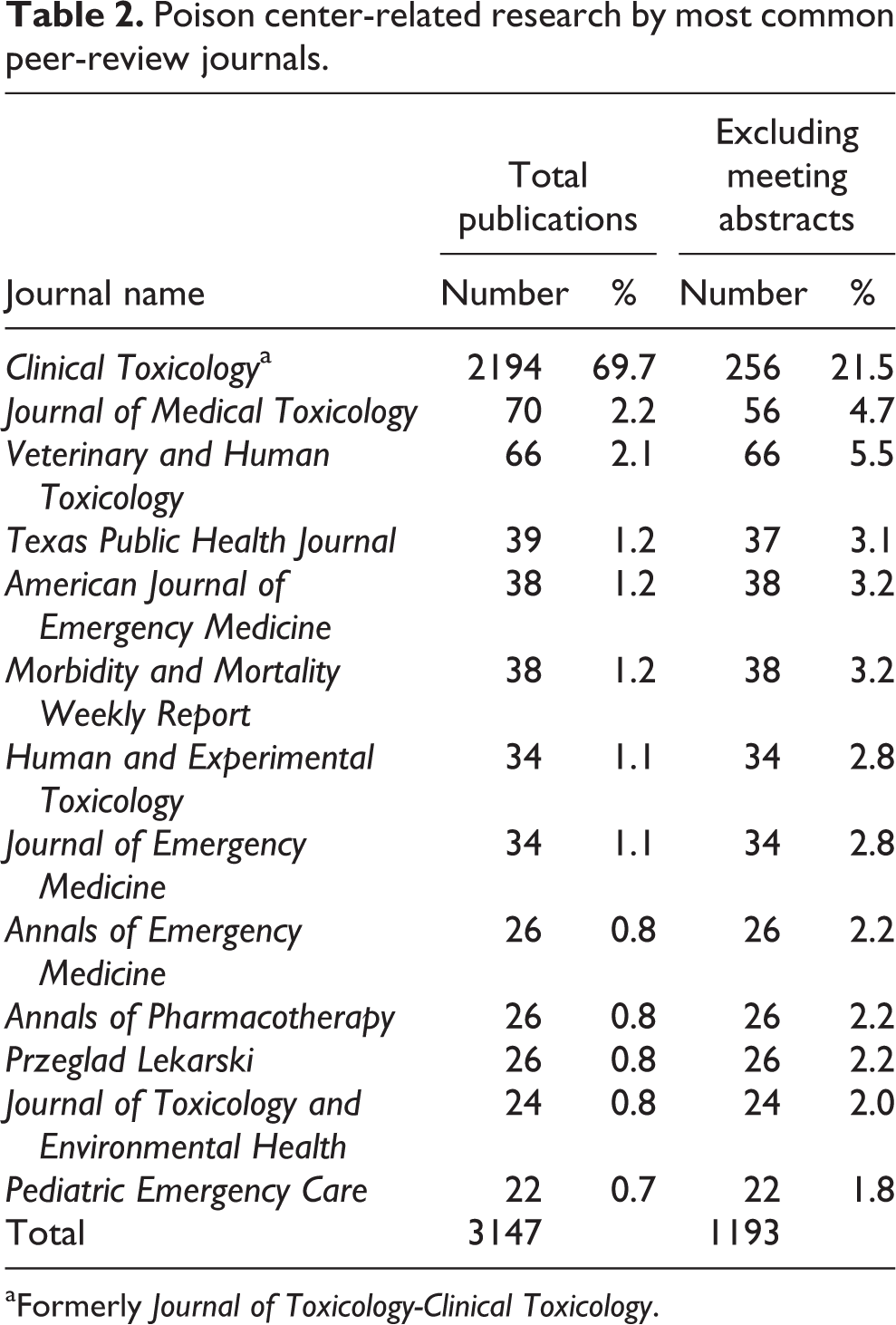
aFormerly Journal of Toxicology-Clinical Toxicology.
For those publications where the country where the poison center involved in the research could be identified, there were a total of 62 different countries. The publications involved 19 countries in 1995–1999, 31 countries in 2000–2004, 44 countries in 2005–2009, and 52 countries in 2010–2014. When the countries with the highest number of publications was examined (Table 3), the United States accounted for the majority of publications. This was true for publications other than meeting abstracts and for meeting abstracts. Of the 3104 total publications where the country was reported, 1033 (33.3%) involved countries other than the United States. The number of publications that involved countries other than the United States was 47 of 260 (18.1%) in 1995–1999, 168 of 527 (31.9%) in 2000–2004, 299 of 985 (30.4%) in 2005–2009, and 519 of 1332 (39.0%) in 2010–2014. (It should be noted that some publications involved poison centers from both the United States and other countries.)
Poison center-related research by most common countries where the poison centers were located.a

aA publication may involve more than one country.
Of the 2108 publications documented to have involved US poison centers or their data, 896 (42.5%) were publications other than meeting abstracts and 1212 (57.5%) were meeting abstracts. Table 4 shows the distribution of the publications by 5-year time period. The number of all types of publications increased from one time period to the next. However, the increase was greater for publications other than meeting abstracts, with the result that the proportion of the publications consisting of meeting abstracts decreased over time.
US poison center-related research published in peer-review journals by time period.

a% Change from 1995–1999 to 2010–2014.
Of the US publications, 492 (23.3%) included data from the NPDS and 1648 (78.2%) involved individual poison centers or other databases to which they provided data. (Thirty-six publications involved both the NPDS and individual poison centers.) Of the 492 publications involving the NPDS, 221 (44.9%) were meeting abstracts. Of the 1648 publications involving individual poison centers, 1008 (61.2%) were meeting abstracts.
The US publications involved poison centers in all 50 states and the District of Columbia. The publications involved 36 states in 1995–1999, 42 states in 2000–2004, 48 states in 2005–2009, and 49 states in 2010–2014. When the states with the highest number of publications were identified, the states with the most publications were Texas, California, New York, and Pennsylvania (Table 5).
US poison center-related research by most common states where the poison centers were located.a

aA publication may involve more than one state.
Discussion
The number of poison center-related publications in peer-review journals increased greatly over time, with the number reported in 2010–2014 being more than 400% higher than the number reported during 1995–1999. This might be expected as poison centers would have accumulated more data with which to conduct research and/or gained experience with research.
The majority of publications were meeting abstracts. Moreover, the proportion of publications that were meeting abstracts increased over time. However, some of this increase may be due to the fact that a portion of the abstracts from more recent meetings may subsequently be published as full articles in the future. This demonstrates the importance that meeting abstracts have in the dissemination of poison center-based research. Individuals conducting poison center-related research may want to examine published meeting abstracts for previous research on their topics of interest. In order for researchers to have access to meeting abstracts, it is useful if the meeting abstracts are published in peer-review journals. The NACCT and the EAPCCT, the two major toxicology meetings that might be of particular interest for researchers conducting poison center-related research, have published their meeting abstracts in a peer-review journal for a number of years. Organizations that currently do not publish their meeting abstracts in peer-review journals may want to try to do so in the future. For example, the author has worked with the Texas Public Health Journal so that abstracts from Texas meetings are published in that journal.
The poison center-related research was published in over 200 different journals. However, most of the research was published in a single journal, Clinical Toxicology. This might be expected considering that the abstracts of the annual meetings of the NACCT and the EAPCCT are published in the journal. However, even if meeting abstracts are excluded, the highest proportion of research was published in Clinical Toxicology. In spite of this fact, the majority of research other than meeting abstracts were published in other journals, and the number of different journals in which poison center-related research was published has been increasing over time. The journal with the second greatest number publications excluding abstracts, Veterinary and Human Toxicology, ceased publication in 2004. The journal with the third greatest number publications excluding abstracts, Journal of Medical Toxicology, started publication in 2005. Reasons for choosing to publish in a particular journal may include the prominence in the field of interest, impact factor, ease in getting an article accepted, and publication of previous articles on the topic.
The United States accounted for the majority of poison center-related publications. This is likely primarily due to there being 57 or more poison centers in the United States, 30 creating greater opportunity for research and publication. (Of note, while the number of poison centers in the United States declined from 67 in 1995 to 57 in 2013, 30 the number of poison center-related publications increased.) This might raise questions as to the applicability of research from poison centers in the United States to other countries, which might have different population demographics, customs, and access to and use of substances that might lead to contacting a poison center. However, publications were reported from 61 other countries. Moreover, both the number of countries producing poison center-related publications and the proportion of publications from outside of the United States increased over the 20-year period of the study.
Like worldwide poison center-related research, the majority of the US publications were meeting abstracts. However, unlike the worldwide publications, the proportion of US publications that were meeting abstracts decreased slightly over time.
Almost 25% of US publications used data from the NPDS. This suggests that the database is an important source of data for poison center-related research, which might be expected considering the amount of data contained in the database. The majority of NPDS publications were other than meeting abstracts, while the opposite was found for individual poison center publications. It may be that it is easier for research using NPDS data to be published or the researchers using NPDS data make a greater effort to publish their research.
All of the 50 states and the District of Columbia were represented in the US publications. Moreover, the number of states involved increased over time. However, all of the states were not equally represented in the publications. The states with the highest number of publications were Texas, California, New York, and Pennsylvania. These are all states with large populations, which would likely lead to large numbers of cases in their poison center databases with which to conduct research. In addition, all of these states have multiple poison centers, which might lead to greater resources for conducting research. Other factors that might affect the number of poison center-related publications by a state or poison center include a poison center being associated with an academic institution, having the staff and other resources to conduct research and having a greater inclination to conduct research.
This study is subject to various limitations. There might be disagreement with the case selection criteria, particularly the exclusion of case reports and small case series. However, the reasoning for the selection criteria is detailed in the study methodology. Moreover, some poison center-related publications in peer-review journals might have been missed. This is possible if the publications were in journals not included in PubMed or, if they were in PubMed, they did not include any of the key words or phrases in the articles’ titles, abstracts, or authors’ affiliations. Efforts might be made to get such journals added to PubMed. Alternately, such publications might be made known to the wider poison center-related research community by some other means, such as posting the publication citations on Web sites or organizations maintaining a listing of publications to which researchers can report their publications.
Another limitation was that it was not always possible to identify which country or state was involved in the poison center-related publication. This information usually was included in the study methodology, but this was not always the case.
In conclusion, the number of poison center-related publications has increased greatly over the last 20 years. Not only that, the number of countries, and states in the United States, involved in such publications have increased. However, the majority of such publications consist of meeting abstracts, and this has not changed greatly over time.
Footnotes
Declaration of Conflicting Interests
The author(s) declared no potential conflicts of interest with respect to the research, authorship, and/or publication of this article.
Funding
The author(s) received no financial support for the research, authorship, and/or publication of this article.