




Abstract
This review comprehensively summarizes the effects of more than 15 mostly used pesticides on male reproductive physiology, as recent experimental and epidemiological research have indicated their alarming impact on overall human health. Mechanisms have described that pesticide exposure damages spermatozoa, alter Sertoli or Leydig cell function, both in vitro and in vivo and thus affects semen quality. But, the literature suggests a need for more intricate research in those pesticides that are defined as mutagens or carcinogens and directly affect the hypothalamic–pituitary–gonadal axis. This literature review also proposes specific solutions to overcome these health effects.
Introduction
Classification of pesticides based on their chemical structure.
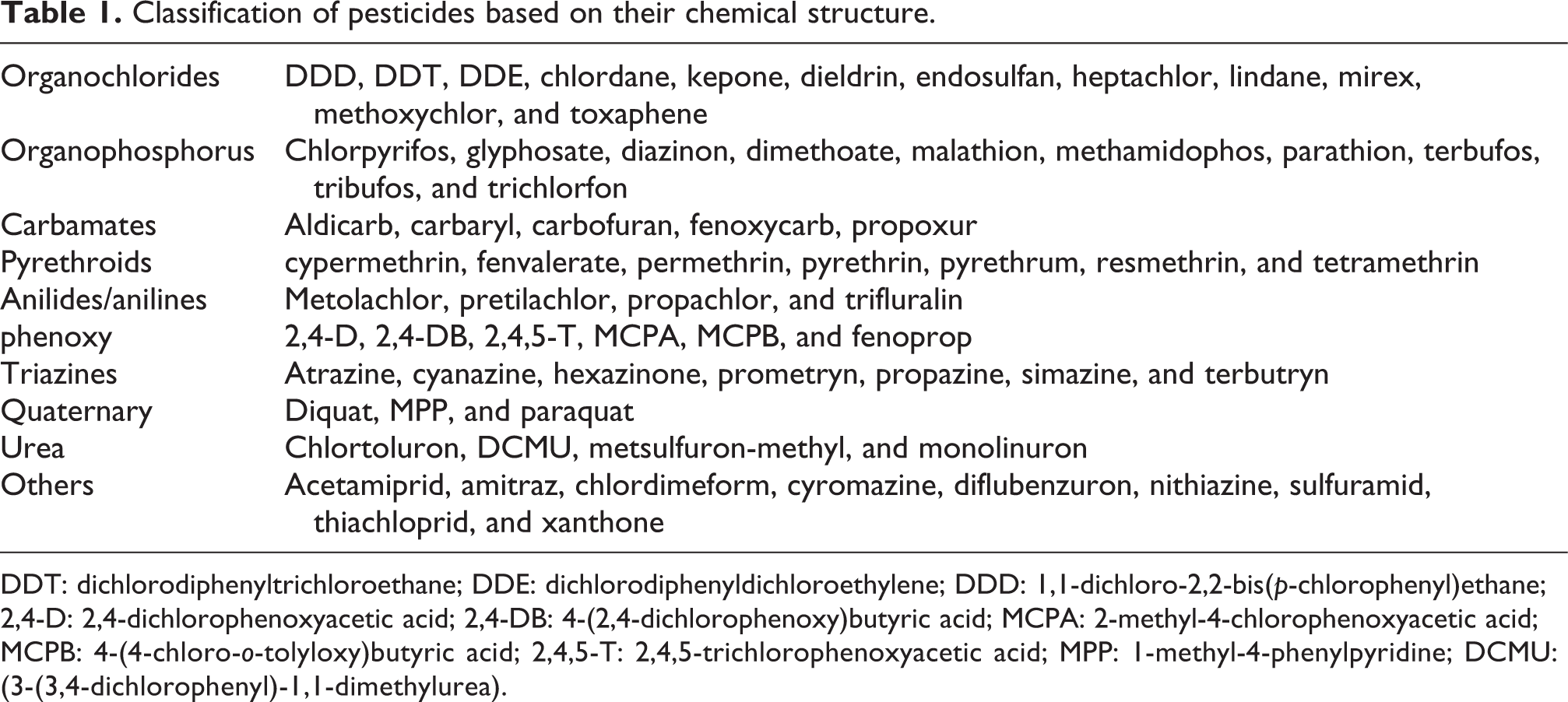
DDT: dichlorodiphenyltrichloroethane; DDE: dichlorodiphenyldichloroethylene; DDD: 1,1-dichloro-2,2-bis(p-chlorophenyl)ethane; 2,4-D: 2,4-dichlorophenoxyacetic acid; 2,4-DB: 4-(2,4-dichlorophenoxy)butyric acid; MCPA: 2-methyl-4-chlorophenoxyacetic acid; MCPB: 4-(4-chloro-o-tolyloxy)butyric acid; 2,4,5-T: 2,4,5-trichlorophenoxyacetic acid; MPP: 1-methyl-4-phenylpyridine; DCMU: (3-(3,4-dichlorophenyl)-1,1-dimethylurea).
Pesticide exposure pathways
Pesticides are used in 85% of homes in the United States, 8 but they or their residues can be found even on surfaces that have never been directly or peripherally treated. Persistent organic pollutants (POPs) introduced into the environment years ago are still around today, transported by human activity and through the food chain. Despite being banned in the United States (and many other countries) some 30 years ago, traces of these insecticides are still found in the homes and bodies of individuals in the Unites States who were not even alive when these products were used. 9 Chlorpyrifos (a nonpersistent organic pollutant) has also been found to accumulate on newly introduced surfaces, such as pillows, carpets, and soft toys, when brought into a treated area up to 2 weeks after application, even if applied according to manufacturer’s instructions. 10 In agricultural settings, work-to-home exposure, or a ‘take-home pathway’ has been identified as a key source of pesticide residues (primarily to organic pollutants) in children’s environment. 11 –15 Workers who are exposed on the job on a daily basis, whether as applicators or reentry workers, are likely to carry home pesticides on their shoes, clothes, skin, and vehicles. Most workers are not provided with adequate washing or changing facilities to remove residues and put on clean clothes before leaving the worksite. If these workers do not take basic precautions (e.g. removing work shoes outside the dwelling and showering before picking up a child), they may transfer residues to the indoor environment or directly to other household members. The primary routes by which pesticides enter the body are ingestion in food, soil, or water; inhalation, through the skin, and through the eyes. 16 Organochlorides (OCs) are absorbed through the lungs, stomach, and skin, and excreted only slowly, sometimes over a period of years (e.g. dichlorodiphenyltrichloroethane (DDT)). 10 Dietary ingestion is a significant source of exposure, especially for infants and children. 17 –19 The residue monitoring program conducted by the Food and Drug Administration in 2003 found measurable levels of pesticides in baby foods, including DDT (6% of samples), captan + tetrahydrophthalimide (a possible carcinogen; 9%), carbaryl (carbamate; 6%), endosulfan (9%), dimethoate (4%), malathion (3%), and chlorpyrifos (all organic pollutants; 2%). 20 Postnatally infants can be exposed to pesticides via breast-feeding. The POPs, despite having mostly been banned, are still found in breast milk because they are stored in body fat. 10 Postpartum weight loss increases the likelihood of the release of OCs into the breast milk. 8 There is some evidence that the maternal body burden is actually transferred to her children via breast-feeding, as the pesticide concentrations decrease with the more times a mother has breast-fed. 21 Fortunately, the benefits of breast-feeding still far outweigh the possibility of harm from pesticide transfer in breast milk and should be encouraged for all mothers regardless of exposure history. 21
Pesticides as EDC
Pesticides may act as endocrine disrupters and alter the hormonal homeostasis in both males and females and lead to subfertility. The term “endocrine disrupters” was introduced into literature with an article published in 1993 by Colborn et al. 22 An endocrine disrupter was defined by the U.S. Environmental Protection Agency as “an exogenous agent that interferes with the synthesis, secretion, transport, binding, action, or elimination of natural hormones in the body that are responsible for the maintenance of homeostasis, reproduction and developmental process.” 23 The group of endocrine-disrupting chemicals (EDC) includes pesticides and various synthetic substances such as polychlorinated biphenyls, polybrominated biphenyls, bisphenol-A, phthalates, and dioxins natural compounds such as phytoestrogens 24 are used as solvents, lubricants, plasticizers, cosmetics, and so on. They are usually small molecules (mass 1000 Da) and often have a phenolic moiety that probably mimics natural steroid hormones. 25 They contain chlorine or other halogens (bromine, iodine, or fluorine) with strong interaction and so they resist degradation. They usually have a long half-life and accumulate in the environment, sometimes remotely from the place they were produced. Substances banned even decades ago can still be found in the environment and in living organisms. In humans and animals, EDCs are stored in fatty tissue or they may be metabolized into more toxic compounds. The predominant sources of exposure are food, water, and air. The routes of exposure include ingestion, inhalation, and dermal absorption.
Natural hormones act in very low concentrations, similarly, can elicit adverse effects in low doses. Occasionally, the EDCs do not follow the classic dose–response effect and low doses may result in stronger effects than high doses. 26 Humans are exposed concomitantly to a large number of compounds. These substances may enhance and have a synergistic or antagonistic effect, and as cited above, some substances can be metabolized in more toxic products. 27 One of the reasons of the difficulty studying the damage after exposure to a single agent is this mixture of compounds which is accumulated in human organisms.
An issue of critical importance is the timing of exposure, since damage is age sensitive. The same dose can have different effects in fetuses, newborn, infants, or adults. Given the same doses, a developing organism (embryo or neonate) whose growth is highly controlled by the endocrine system is more vulnerable to EDCs, than an adult. 28,29 The damage incurred by the exposure may not be immediate and may only be manifested in adulthood or during aging. The consequences may be apparent even in subsequent generations, and the classic example is the cases of vaginal carcinoma in daughters of mothers who were exposed to diethylstilbestrol (DES) during their pregnancies. 30,31 The susceptibility of an individual may vary due to genetic polymorphism and so the results of the same exposure could be different.
Initially it was thought that EDCs act via nuclear hormone receptors (e.g. estrogen, progesterone, androgen, and thyroid receptors), but now it is believed that they act also via membrane, nonsteroid receptors (e.g. dopamine, serotonin, and norepinephrine receptors). Catecholamine hormones following synthesis are stored in granular vesicles intracellularly. Steroid hormones are not stored but readily synthesized following gonadotropin stimulation of the gonads and are usually found in the circulation bound by carrier proteins (only free hormones are biologically active). Once reaching their tissue targets steroid hormones exert their action by binding to different kinds of nuclear receptors. Explicit hormones bind specific receptors and individualized mechanisms follow by intracellular signaling (e.g. protein kinase-C activation or phosphatidylinositol turnover). Hormones are mostly catabolized in the liver. Consequently, EDCs can participate in most of the aforementioned pathways thereby changing hormone synthesis patterns, mimicking hormone function or blocking it by occupying the receptor site, modulating the number of the receptors and their affinities for specific molecules, and altering hormone clearance. 32,33 Sex hormones synthesis is regulated by the hypothalamic–pituitary–gonadal axis. Leutinizing hormone (LH) and follicle-stimulating hormone (FSH) are synthesized by the anterior pituitary under the influence of pulsatile secretion of gonadotropin-releasing hormone, released by the hypothalamus.
Several pesticides have been reported to act as estrogen agonists, for example, methoxychlor, endosulfan, toxaphene, kepone, DDT, fenarimol, alachlor, pentachrophenol, fenvalerate, and chlordecone. 34 –36 On the other hand, other pesticides such as vinclozolin, p,p-dichlorodiphenyldichloroethylene (DDE) and o,p-DDT may have antiandrogenic activity, or both estrogenic and antiandrogenic activity. 37,38 The fungicide methyl-2-benzimidazole carbamate decreases estradiol production in primary cultures of human ovarian granulosa. 39 Treatment of rats with heptachlor suppresses progesterone and estradiol concentrations in blood. 40 Progesterone concentrations also decrease during early pregnancy in the rabbit following exposure to the pesticide DDT. 41 DDT was found to be estrogenic, but its major metabolite DDE, has considerable antiandrogenic activity. 31 Furthermore, atrazine seems to have estrogenic and antiandrogenic properties and was suggested to reduce testicular testosterone in male rats exposed to it. 42 Lindane intercalates into the sperm membrane and may inhibit sperm responsiveness to progesterone in vitro. 43 Lindane also inhibits steroidogenesis by reducing steroidogenic acute regulatory (StAR) protein-mediated cholesterol transfer. 44 Neonatal exposure to either DES or flutamide also inhibited steroidogenesis and StAR protein expression in the fetal rat Leydig cell. 45 This protein mediates cholesterol passage through mitochondrial membranes and impaired expression results in decreased testosterone production in vitro. 46 Testosterone concentration is also reduced with azole fungicides (ketoconazole) due to impaired enzymatic activity of 17α-hydroxylase and 17,20-lyase. 47,48 In rats, fenarimol, a different fungicide, was found to cause a dose-related decrease in fertility. 49 In vitro studies of some pesticides such as fenarimol, prochloraz, imazalil, and dicofol indicate that these pesticides inhibit the conversion of androgens to estrogens through CYP 19 aromatase inhibition. 50 Rats treated with mancozeb demonstrate a decrease in the number of healthy follicles and an increase in the number of atretic follicles. 51 EDCs have also been associated with breast cancer, polycystic ovarian syndrome, and endometriosis in women, cryptorchidism, hypospadias, testicular and prostate cancer in men, and alteration in pituitary and thyroid gland functions. 25,52
Role of pesticides in male reproductive health
Potential toxic effects of more than 15 pesticides (i.e., atrazine, benomyl, carbaryl, endosulfan, malathion, and pyrethroids etc), those that cause alteration in sperm morphology, count, motility, as well as biochemical and endocrine disruptions, are discussed in this review.
Atrazine
Atrazine is widely used as a nonselective herbicide. It is a member of a family of chlorostriazine that is widely used as a nonselective herbicide. This is one of the top-selling products from a large chemical company. 53 It inhibits photosynthesis in plants and has some neuromuscular toxicity at high dose, including hamper in motor coordination, limb paralysis, respiratory distress, and hypothermia in laboratory animals. 54 Atrazine that is persistent in soil and water, for over 1 year is the most common contaminant of ground surface and river water. 54 Earlier studies had shown that atrazine cause the production of aromatase, an enzyme that converts androgens (male sex hormones) into estrogens (female sex hormones). Atrazine also indirectly influences on the pituitary–gonadal axis. There is a slower maturation of the gonadotrophic system, which is responsible for testosterone metabolism to its active metabolite 5-dihydrotestosterone in the anterior pituitary and prostate gland. 55 Kniewald et al. 56 evaluated the effects of atrazine by exposing adult rats with 60 and 120 mg/kg atrazine body weight twice a week over 60 days intraperitonially. Testicular sperm number in atrazine-treated groups decreased with the treatment time along with reduced sperm motility. 57 Histological studies showed that on exposure to atrazine, thickness of tunica albuginea was increased and edema had occurred in subcapsular and interstitial connective tissues. 55 Histological analysis of testicular tissues from treated rats showed cellular disorganization along with cell clusters of spermatocytes. Electron microscopic studies revealed vacuolated cytoplasm, reduced collagen fiber, irregular-shaped Leydig cells with unequal form and cisternae of rough endoplasmic reticulum were accentuated and softly widened. Leydig cells were degenerated and reduced in number on chronic exposure to atrazine. In Sertoli cell cytoplasm, atrazine treatment provoked degenerative changes. Atrazine also found to reduce the semen quality in atrazine-exposed workers. 57 Atrazine increases sperm abnormality, DNA disintegrity, and nuclear immaturity. These results led us to hypothesize that this herbicide could disrupt endocrine function of male reproduction. Moreover, these pathological effects were substantiated by the time. 55
Benomyl
Benomyl is an effective fungicide that has been in use for many years. 58 This chemical and its primary metabolite, carbendazim, are microtubule poisons that are relatively nontoxic to mammalian organs, except for the male reproductive system. Benomyl causes decreased testicular and epididymal weights and reduces epididymal sperm counts and fertility. 59 Hess and Nakai 60 evaluated its primary effects, at moderate to low doses, on the testis, where it causes sloughing of germ cells in a stage-dependent manner. Sloughing is caused by the effects on microtubules and intermediate filaments of the Sertoli cell. Carbendazim binds to tubulin subunits leading to severe decrease of microtubules in the Sertoli cells. 59 These effects spread to dividing germ cells and also lead to abnormal development of the head of elongating spermatids. Distortion of the spermatid nucleus was observed and the nuclei became irregular in shape, surrounded by dense aggregate of manchette microtubules. 59 At higher doses, it causes occlusion of the efferent ducts, blocking passage of sperm from the rete testis to the epididymis. The mechanism of occlusion appears to be related to fluid reabsorption, sperm stasis, followed by leukocyte chemotaxis, sperm granulomas, fibrosis, and often paves way for the formation of abnormal microcanals. The occlusion results in a rapid swelling of the testis and ultimately seminiferous tubular atrophy and infertility. Benomyl impeded the spermatogenesis by causing necrosis of cells in both mitotic and meiotic division and by preventing pachytene spermatocytes from completing the second meiosis. 59
Carbaryl
Carbaryl is a wide-spectrum carbamate insecticide. Studies at carbaryl manufacturing factories have shown that carbaryl exposure affects the quantity and quality of sperm produced by the workers. 61 It has been found that frequent exposure of workers to this chemical induced very low sperm counts as compared to a control group of unexposed workers. It has also been found in the same sperm samples that the number of sperm abnormalities was increased in workers who were being exposed to carbaryl. 61 Carbaryl exposure also showed to distort the shape of seminiferous tubules, disturbed spermatogenesis, accumulation of cellular mass in the lumen of tubules, edema of the interstitial spaces, and loss of sperms of varying degrees in testes. 62 Several studies showed that the effect of carbaryl results in sloughing of the germinal cell from the basement membrane, depressed spermatogenesis, loss of sperms, and degeneration of Leydig cells. In sections of seminiferous tubules, moderate to severe degenerative changes in spermatogenic cells and marked cell necrosis were found on exposure of carbaryl to high doses. 63
Carbofuran
Pant et al. reported that when carbofuran was administered orally to adult male rats at different doses chronically, a dose-dependent decrease was observed in the weight of epididymis, seminal vesicles, ventral prostate, and coagulating glands. 64 Decreased sperm motility, reduced epididymal sperm count along with increased morphological abnormalities in head, neck, and tail regions of spermatozoa were observed in rats exposed to higher doses of carbofuran. 64 Histological findings of these studies indicated that the toxicity of carbofuran on testes was dose dependent. Subacute exposure to carbofuran showed hyperplastic muscular layer, engorged blood vessels, congested with inflammatory cells and lymphocyte in male reproductive organs. 65 These alterations predominantly consisted of moderate edema, congestion, damage to Sertoli cells and germ cells, along with the accumulation of cellular debris and presence of giant cells in the lumen of a few seminiferous tubules which showed disturbed spermatogenesis with the higher doses of carbofuran. 64
Chlorpyrifos
Joshi et al. investigated the effects of subacute exposure of chlorpyrifos on rat testes at different doses in male rats of Wistar strain. 66 They reported marked reduction in epididymal and testicular sperm counts in exposed males and a decrease in serum testosterone concentration. Histopathological examination of testes showed mild to severe degenerative changes in seminiferous tubules at various dose levels. Fertility test also showed 85% negative results. 66 Chlorpyrifos has been reported to cause testicular toxicity by oxidative stress which was reversed by coadministration with ascorbic acid, a potent antioxidant used as a therapeutic agent. 67 On exposure to high dose of chlorpyrifos, the activity of testicular enzyme succinate dehydrogenase, glucose-6-phosphate dehydrogenase (G6PDH), and testicular content of sialic acid and cholesterol were found to be increased in experimental animals. 68
Endosulfan
Studies on endosulfan suggest that its exposure may delay sexual maturity and interfere with hormone synthesis in male children.
69
Jaiswal et al.
70
reported that pretreatment with 5-aminosalicylic acid (5-ASA) could significantly reduce sperm morphological abnormalities in endosulfan-treated rats. The number of abnormal sperm in the epididymis was markedly increased by endosulfan treatment, but pretreatment with 5-ASA kept these values close to normal. Treatment with 5-ASA at lower doses was more effective in reducing sperm-shape abnormality and sperm count. Changes in plasma testosterone levels were not found to significantly correlate with 5-ASA pretreatment but histopathological analysis of seminiferous tubules and Leydig cells showed significant protection from endosulfan-induced tissue damage such as necrosis. The population of Sertoli cell was increased and the lumen of the seminiferous tubules contained a greater number of spermatids. A corresponding increase in the number of Leydig cells was also reported. Rao et al. investigated the effects of
Dibromochloropropane
Dibromochloropropane (DBCP) is the most characterized agricultural chemical with respect to male reproductive toxicity (Table 2). Occupational exposure to DBCP was reported to produce oligospermia, germinal epithelium damage, genetic alterations in sperm (such as double Y bodies), male subfertility, increased rates of spontaneous abortions in azoospermia wives of exposed workers, hormonal imbalances, and altered sex ratio in offspring. 73 A follow-up study for 17 years on 15 workers exposed to DBCP revealed that sperm count recovery was evident within 36 to 45 months in 3 of the 9 azoospermic and in 3 of the 6 oligozoospermic men with no improvement thereafter. 74 Later Kahn and Whorton 75 reanalyzed these data and showed that all applicator groups had reduction in sperm counts in a dose-related manner and that reversibility was not a certainty. In another study on the male workers involved in manufacturing of DBCP has reported to have a high level of LH and FSH in their serum and reduced sperm counts. 76 DBCP is a small lipophilic halocarbon that readily passes from the blood through the blood–testis barrier to the Sertoli and germ cells. DBCP has been shown to metabolize to cytotoxic products in several target tissues. Metabolism of DBCP occurs largely in the liver via the microsomal cytochrome P450 system, where liver enzymes catalyze the biotransformation of DBCP to metabolites that are excreted in the bile and urine. DBCP is converted by glutathione S-transferases to a reactive, cytotoxic episulfonium ion in the testicular seminiferous tubules, and this metabolite can bind covalently to DNA, producing single-strand breaks. This pathophysiologic activity most likely accounts for DBCP’s specific toxicity during the spermatogenic cycle. 77
Key early warnings about and recognition of DBCP toxicity.

DBCP: dibromochloropropane.
2,4-Dichlorophenoxy acetic acid
Exposure of 2,4-dichlorophenoxy acetic acid (2,4-D) on 32 male farm sprayers after 4 days of sexual inactivity showed significantly high levels of asthenospermia, necrospermia, and teratospermia. Over time, asthenospermia and necrospermia diminished but the abnormal spermatozoa (teratospermia) continued. 78 Amer and Aly 79 analyzed the effects of 2,4-D along with its metabolite 2,4-dichlorophenol in mice testes, and an increase in the germ cells and sperm head abnormalities was observed after oral administration of 2,4-D consecutively for 3 and 5 days.
Dimethoate
Subchronic exposure of dimethoate on the testes of rats has reported to cause significant decrease in relative testicular weight. Histopathological examination of the treated rats revealed that dimethoate caused dose-dependent testicular damage characterized by moderate to severe seminiferous tubule degeneration as sloughing, atrophy, germ cell degeneration, and partial arrest of spermatogenesis. 80 Sperm viability, motility, and density were reported to have been reduced in dimethoate-treated mice. 81
Dioxin
Dioxins are a class of persistent polychlorinated aromatic hydrocarbons and some of the most potent environmental contaminants that induce a wide spectrum of toxic responses in experimental animals, including reproductive, developmental, and immunologic toxicities as well as carcinogenicity. 82 The 2,3,7,8 tetrachlorodibenzo-p-dioxin (TCDD) is a well-known dioxin, which is formed as an unwanted by-product in the manufacture of chlorinated hydrocarbons. 83 TCDD induces oxidative stress in the epididymis and epididymal sperm by decreasing the antioxidant enzymes through induction of reactive oxygen species. 84 Male rats exposed to TCDD display reduced fertility, delayed puberty, and altered reproductive organ weights. 85 TCDD-exposed male rats displayed decreased numbers of sperm and increased numbers of abnormal sperm in the epididymis. 86 TCDD induced changes in cauda epididymal sperm counts and decreased weights of androgen target tissues such as the seminal vesicle, epididymis, and prostate, which provide clear evidence of developmental toxicity. 87
Hexachlorocyclohexane
Toxic manifestations of hexachlorocyclohexane (HCH) has been reported on testes and sperm of rat when applied dermally for 120 days; it has been found that significant quantities of HCH and its isomers accumulate in testes as well as sperm of treated rats. HCH exposure also led to a decrease in serum testosterone levels, epididymal sperm count, sperm motility, and an increase in the percentage of abnormal sperm. 88
Lindane
Lindane, an organochlorine pesticide, has been reported to impair testicular functions and fertility. 89 Lindane has been directly linked with both reproductive and carcinogenic properties. It is shown that chronic administration of lindane results in endocrine disruption in birds as well as in mammals. Treatment with lindane disrupted testicular morphology, decreased spermatogenesis, inhibited testicular steroidogenesis, reduced plasma androgen concentrations, and impaired reproductive performances in males. 90 In male rats, chronic lindane exposure markedly reduce sperm counts and sperm motility. On exposure to lindane, apoptosis of germ cells were also reported. 91
Malathion
Chronic malathion administration in Wistar rats was reported to reduce weight of testes, epididymis, seminal vesicle, and ventral prostate. 92 Testicular and epididymal sperm density were decreased in the animals treated with malathion. Pre- and postfertility tests showed 80% negative results after treatment. Malathion also suppressed the serum level of testosterone. Coadministration of malathion-exposed sexually mature male Wistar rats with vitamins E and C has a protective effect on sperm counts, sperm motility, and abnormal sperm numbers but not on plasma FSH, LH, and testosterone levels. Degenerative changes in the seminiferous tubules were also observed in the rats that received malathion and supplemented with vitamins C and E, but milder histopathological changes were observed in the interstitial tissues. 93 Administration of malathion in immature rats showed an altered spermatogenesis by a decrease in the local production of testosterone. It has been reported that sublethal doses of malathion causes restriction of cellular proliferation of seminiferous epithelium, in terms of induction of programmed cell death. 94
Mancozeb
Mancozeb (Diathan-M) is an ethylene-bisdithiocarbamate fungicide used against a wide range of fungal diseases of field crops, fruits, and ornamentals. 95 Conversely, mancozeb was found to have toxic effects in a variety of experimental animals. 96 Mancozeb was also listed for male reproductive toxicity. Oral administration of this fungicide in male Wistar rats for 30 days resulted in the reduction of weight of testis, epididymis, seminal vesicle, and ventral prostate. Mancozeb treatment also brought about marked reduction in epididymis and testicular sperm counts in exposed males. Pre- and postfertility tests showed 80% negative results after treatment. 97 Some studies reported that in testis and epididymis of mancozeb-treated rats sialic acid and protein content decreases, while serum cholesterol level increases dose dependently. 98
Methoxychlor
Methoxychlor (MXC) is a chlorinated hydrocarbon pesticide currently used as a replacement for DDT 99 and has been categorized as weakly estrogenic. 100 The weights of the testis, epididymis, seminal vesicles, and ventral prostate were reported to decrease following MXC treatment in rats. The activities of antioxidant enzymes such as SOD, catalase, glutathione reductase, and glutathione peroxidase decreased in testes. 101 MXC administration resulted in a sequential reduction in the expression of StAR protein and activities of 3β-hydroxysteroid dehydrogenase (HSD), 17β-HSD with concomitant increase in the levels of hydrogen peroxide in the testis. 102 It was found that MXC had strong estrogenic and antiandrogenic effects. MXC and 2,2-bis-(p-hydroxyphenyl)-1,1,1-trichloroethane (HPTE) produces adverse effects acting through estrogen and androgen receptors. HPTE binds to sex steroid receptors with greater affinity to inhibit testosterone biosynthesis in Leydig cells by inhibiting cholesterol side-chain cleavage enzyme activity and cholesterol utilization. Earlier studies showed MXC was responsible for Leydig cell apoptosis by decreasing testosterone concentration. 103
Methyl parathion
Methyl parathion is an organophosphate (OP) insecticide that has been used in agriculture and domestic purposes for several years. In Wistar rats, body and testicular weights, epididimal sperm counts, and sperm motility were reported to decrease, while an increase in abnormal sperm morphology was observed. 104 In light histological investigations, necrosis and edema were observed in the seminiferous tubules and interstitial tissues. 105 It also showed a decrease in weights of epididymis and seminal vesicle; and pathomorphological alteration in ventral prostate, testicle degeneration were also reported. Spermatogenesis ceases in lumen of seminiferous tubule and sperm count decreases due to cellular disorder in the lumen. 106
Organophosphates
Organophosphates are among the most widely used synthetic insect pesticides. The widespread use of OPs has stimulated research into the possible existence of effects related with their reproductive toxic activity. 67 Ngoula et al. 107 investigated the effects of pirimiphos-methyl (0, 2-diethylamino-6-methylpirimidin-4-yl O,O-dimethyl phosphorothioate), an organophosphothioate pesticide, on male rat reproductive performances. Results from the study showed decrease in serum total protein, sperm density and motility, and fertility. Histological findings also indicated enlargement of interstitial space, inhibition of spermatogenesis, rarefaction of Leydig cells and edema in testes compared with control animals. The main toxic action of OPs is phosphorylation of proteins. Chemical changes in sperm nuclear proteins (protamines), which pack DNA during the last steps of spermatogenesis, is part of the cause to male reproductive toxicity. Diazinon showed chromatin alteration in sperm nuclei. 108
Pyrethroids
Yao and Wang 109 observed a new type of pesticides and because of their high performance and low toxicity, pyrethroid insecticides are widely used in place of organochlorine insecticides both in agriculture and at home. In the recent years, more and more evidence indicates that pyrethroid insecticides can reduce sperm count and motility, cause deformity of the sperm head, increase the count of abnormal sperm, damage sperm DNA and induce its aneuploidy rate, as well as affect sex hormone levels and produce reproductive toxicity. Testes of rat treated with pyrethroid for 2 weeks revealed that connective tissue stroma gets loosely attached around the seminiferous tubules, spermatogenic cells were decreased, and many spermatocytes were exfoliated in the lumen of some tubule. With the high dosages, these changes were exaggerated and Leydig cells were degenerated. 110 Meeker et al. 111 observed that reduced semen quality and increased sperm DNA damage in relation to urinary metabolites of pyrethroid insecticides. They have evaluated that pyrethroid exposure leads to deterioration of reduced semen quality and increased sperm DNA damage in relation to urinary metabolites of pyrethroid insecticides. 112
Multiple pesticide exposure
A study conducted among male workers who were exposed to various mixtures of pesticides such as DDT, benzene hexachloride, and endosulfan; organophosphorus pesticides, that is, malathion, methylparathion, dimethote, monocrotophos, phosphamidon, and quinalphos; synthetic pyrethroids such as fenvelrate and cypermethrin during mixing and spraying showed male-mediated adverse reproductive outcome such as abortion, stillbirths, neonatal deaths, congenital defects, and so on. 113 Studies of males exposed to DDT have found decrements in serum bioavailable testosterone levels 113 and reduced semen volume on ejaculation and reduced sperm counts. 114 Ben et al. 115 evaluated the reproductive toxicity of DDT in adult male rats exposed to 50 and 100 mg/kg body weight for 10 successive days. Administration of DDT led to reduction of testicular weight and the number as well as the percentage of motile spermatozoa in the epididymis. Testicular histological observations also revealed a marked loss of gametes in the lumen of seminiferous tubules. In DDT-treated rats, the seminal vesicles weights dropped, resulting from a decrease of testosterone production by testes, whereas serum LH and FSH increased after pesticide exposure. Hu and Wang 116 showed the joint toxicity of phoxim (Pho) and fenvalerate (Fen) on the spermatogenesis of male rats. Pho and Fen jointly impaired spermatogenesis in a dose- and time-dependent manner. Their joint action exhibited mainly as a synergistic effect, an additive effect and increased toxicity.
Pesticides and semen quality
Approximately 6% of adult males are thought to be infertile. 117 Male factors are responsible for at least 20% of cases of infertility. Male infertility is related to impaired semen quality and may be due to a variety of causes including genetic (Klinefelter’s syndrome), congenital (cryptorchidism), endocrine (hypogonadism), obstructive (vasectomy), infective (chlamydia), vascular (varicocele), neoplastic (carcinoma of the testis), lifestyle, and environmental (heat, drugs, pesticides, and irradiation) factors. Other causes include sexual dysfunction related to erection and ejaculation. 117,118 However, in many cases male infertility is regarded as idiopathic (40–75%), and no cause can be identified. Semen analysis is used to evaluate semen quality, which is taken as a surrogate measure of male infertility. The World Health Organization (WHO) has provided reference values for human semen characteristics. 119 There is evidence of regional variation in semen quality that may be an expression of gene polymorphisms, different climate, lifestyle, and exposure to magnetic fields or chemical substances such as pesticides. 120 –122 Seasonal variation has also been detected (decrease of sperm density and total sperm count during summer). 123,124 These factors, together with the variability in techniques and methodologies used, are reasons for some controversial results in studies that analyze semen quality changes overtime. Thus, the issue of a decline in semen quality overtime is equivocal. Following the publication of the meta-analysis conducted by Carlsen et al. 125 in 1992, demonstrating a decline in human semen quality over the last 50 years (mean sperm count from 113 millions/ml in 1940 to 66 millions/ml in 1990), numerous related studies have been published. Studies by Swan et al. had consistent results with those of Carlsen et al. 125 and supported that historical data on sperm density, despite large random error, are reliable. 126 However, Olsen et al. 127 reanalyzed the data used in a linear model to predict sperm quality deterioration in the last 50 years, advocate that the data are only robust during the last 20 years (1975–1995), in which other statistical models (quadratic, spline fit, and stairstep), except the linear model, suggest constant or slightly increasing sperm counts. Studies from Italy, Denmark, Canada, Tunisia, India, Poland, Israel, Scotland, Greece, and Germany suggest that there has been a decline or sperm parameters are impaired in young populations. 128 –138 Conversely, other reports from the United States, Japan, Korea, Sweden, Spain, Israel, and Czech Republic showed no significant evidence of deterioration in sperm quality. 139 –141 The materials and methods of the studies mentioned varied widely, as well as time period (one, two, or more decades), population sample (e.g. individuals in infertile relationship or fertile subjects who participated voluntarily) and the level of pollution in the various geographical regions (Table 2). Merzenich et al. 142 conclude that former meta-analyses of sperm count data show a global downward trend, but this conclusion should be interpreted with caution, because the included studies are of great heterogeneity. The geographic variation in semen quality may reflect different exposures to endocrine disrupters, such as pesticides. 57 Pesticides might have the ability to interrupt male fertility at several different sites in the reproductive pathway and by one or more mechanisms, as cited previously. Thus, they can interfere with the hypothalamopituitary axis that regulates, through the production of the gonadotrophins, FSH and LH, the function of Sertoli and Leydig cells, impairing spermatogenesis and steroidogenesis (Table 3).
Studies evaluating the association between exposure to pesticides and human sperm quality (studies with evidence of an association).

DBCP: dibromochloropropane; EDB: ethylene dibromide; 2,4-D: 2,4-dichlorophenoxyacetic acid; DDT: dichlorodiphenyltrichloroethane; DDE: dichlorodiphenyldichloroethylene; HCH: hexachlorocyclohexane; IVF: in vitro fertilization; OP: organophosphate; CS: cross-sectional study; CC: case control study; L: longitudinal study; R: retrospective study; P: pilot study.
Propositions to overcome these problems
Global thinking is needed to find out alternatives to pesticides to relieve the biosphere from the serious negative impacts of the pesticide. Farmer’s knowledge concerning the health dangers of pesticide is not sufficient to change behavior. Their overriding concern is crop damage that leads to economic loss, not health. Integrated pest management (IPM) field school training offers farmers available alternatives by concretely demonstrating the health, agricultural, environmental, and economic advantages of eliminating unnecessary pesticide use. 178 Ecological plant protection in accordance with the environment will be one of the most important factors in guaranteeing future human food. A three-pronged strategy to reduce health impacts include (i) a community-based process of education and provision of personal protective equipment to reduce exposure; (ii) educating farmers to enhance agroecosystem understanding and to reduce pesticide use; and (iii) policy intervention to restructure incentives and reduce availability of highly toxic insecticides. 179 Having sufficient pesticide regulatory measures are an important area of concern. It is reported that the United States has exported 3.2 billion pounds of pesticide products, an average rate of 45 tons/h. Nearly 65 million pounds of exported pesticide were either forbidden or severely restricted in the United States. There has been high rates of export of pesticides designated “extremely hazardous” by the WHO (89 million pounds) pesticides associated with cancer (170 million pounds) and pesticides associated with endocrine-disrupting effects (368 million pounds) mostly to developing countries. From public health and environmental protection perspectives, exports of hazardous pesticides remain unacceptably high. 180 Organic farming is the viable alternative in mitigating the harmful effects of pesticides. Organic produce contains fewer pesticide residues than either conventionally grown produce or produce grown using IPM techniques. It is estimated that 23, 47, and 73% of organic, IPM, and conventional farming samples, respectively, contain pesticide residues. Banned organochlorine compounds which are residual in soils accounted for 40% of pesticide detection in organic produce. The increasing use of alternate therapies that rely on organically grown foods has renewed interest in the relationship between agricultural methods and food quality. Studies suggest that there is higher nutrient content in organically grown crops with higher levels of ascorbic acid, lower levels of nitrate, and improved protein quality compared with conventionally grown food. 181
Conclusions
Exposure to pesticides lowers sperm levels well below the limit for male fertility. Although it is proved that pesticide exposure is associated with infertility (Table 4), there are not large-scale studies assessing their relationships to human infertility. The exact role of male-mediated toxicity on such adverse effects like abortions, congenital malformations, preterm delivery, and so on is not yet fully understood. The existing data on various endocrine disrupters and risk factors (malnutrition and infections which can exaggerates the risk) suggest a greater vulnerability of the population of developing or underdeveloped countries to reproductive hazards from exposure to these pesticides. 210,211 Thus, there is a need to constantly monitor both exposure and affect parameters such as congenital malformations, subnormal growth and development, testicular cancer, hypospadias, cryptorchidism, breast cancer, and so on and trend of semen quality in a given population and ethnic groups. The data are inadequate and need confirmation. Furthermore, the general public needs to be educated for vigilant use of these pesticides. The risk assessment to the human is absolutely necessary for the pesticides that have already proven to be toxic to the reproductive system in animal studies.
General mode of pesticide-induced disruption of male reproductive functions.

2,4-D: 2,4-dichlorophenoxyacetic acid; DDT: dichlorodiphenyltrichloroethane; HCH: hexachlorocyclohexane; HCB: hexachlorobenzene; H: herbicide; F: fungicide; I: insecticide.
Footnotes
Conflict of interest
The authors declared no conflicts of interest.
Funding
This research received no specific grant from any funding agency in the public, commercial, or not-for-profit sectors.