




Abstract
Serum Dickkopf-1(DKK-1) is elevated in many malignancies and is an important indicator of malignant potential. However, its significance in esophageal squamous cell cancer (ESCC) has not yet been clarified. We hypothesized a role for DKK-1 in patients with ESCC. The study consisted of 90 ESCC patients and 85 healthy controls. After diagnosis, the level of DKK-1 was measured in the serum samples by enzyme-linked immunosorbent assay and the levels of DKK-1 were much higher in the ESCC patients than in the healthy control group (p < 0.0001). For serum DKK-1, the sensitivity and specificity of the assay were 70 and 80%, respectively. The preoperative serum DKK-1 level was elevated in the ESCC patients. Although serum DKK-1 is not a specific biomarker for ESCC, it might be a useful marker for the diagnosis and treatment of ESCC.
Introduction
Esophageal squamous cell cancer (ESCC) adheres to the most disseminated and aggressive tumors of the gastrointestinal tract, and the incidence of new patients with ESCC is still increasing in the Western world, especially in Europe and the United States. 1 This malignancy is the sixth leading cause of cancer deaths worldwide, 2 accounting to 80% of ESCC cases. 3 Often, the mortality rate and frequency of ESCC are analogous, due to the relatively late stage of diagnosis and the swift clinical progression of the disease. 4 It is thus an obligation to discover new biomarkers, exclusively serum protein markers, to speed up the early designation and diagnosis of ESCC.
Peptides from the wingless (Wnt) signaling pathways are associated with the process of cancer. 5 –7 The Wnt pathways are regulated by multiple families of secreted glycoproteins, including Wnt antagonists, such as the soluble frizzled family receptors associated with receptor proteins and Dickkopf-1 (DKK-1).
Nowadays, data had shown the presence of DKK-1 expression in various cancers, suggesting a cancer-mediated modulation of Wnt activity. 5,8 –14
The DKK-1 gene encodes an extracellular Wnt inhibitor that blocks the formation of signaling receptor complexes at the plasma membrane. 15 DKK-1 behaves as a tumor suppressor and the loss of it may contribute to cancer development. Wnt signaling dysregulation has been involved in cancer. 6
A few researchers from several countries have reported that some ESCC biomarkers are highly expressed in serum samples and tissues. Although this suggests that DKK-1 may be secreted from tumor specimens, no research study has yet investigated serum DKK-1 expression levels in human ESCC. In this study, we determined the preoperative serum levels of DKK-1 in ESCC patients and healthy controls by enzyme-linked immunosorbent assay (ELISA).
Materials and methods
Serum levels were collected from 90 ESCC patients (57 male and 33 female; mean age, 53.6 ± 8.0 years (SD); range 39–75 years) and 85 healthy controls (55 male and 30 female; mean age, 55.2 ± 4.3 years (SD); range 40–70 years) after informed consent was obtained (Table 1). The diagnosis was identified by one senior pathologist.None of the patients received chemotherapy or radiation therapy. Abdominal ultrasound examination, a routine blood test, and a biochemistry test were performed for the healthy controls, and the results were within normal ranges. Sample preparation was renewed to the reference. 16 Preoperative blood samples were collected and stored according to the protocols approved by the Ethical Committee Board, Medical Faculty, Yuzuncu Yil University, Turkey, and all the blood samples were centrifuged to obtain serum samples, which were stored at −80°C until they were assayed.
The median levels of age and DKK-1 in all groups (mean ± SD).

DKK-1: Dickkopf-1.
Serum DKK-1 was detected using the DuoSet ELISA Development System (R&D System, Minneapolis, Minnesota, USA) according to the manufacturer’s instructions. Briefly, a rabbit polyclonal antibody against DKK-1 was coated onto a 96-well microplate and incubated overnight at room temperature. After washing, 300 µl of reagent diluent was added to each well and incubated at room temperature for 1 h. After further washing, 100 µl of serum or standard in the reagent diluent was added to each well and incubated for 2 h at room temperature. After washing, 100 µl of a biotinylated goat anti-human DKK-1 antibody diluted in reagent diluent (50 ng/ml) was added to each well and incubated for 2 h. After subsequent washing, 100 μl of the working solution (1:200) containing horseradish peroxidase (HRP)–streptavidin was added to each well and incubated for 20 min. After subsequent washing, 100 μl of substrate solution was added to each well for 20 min. The reaction was terminated by adding 50 µl of stop solution. Each well was assayed using a microplate reader at a wavelength of 450 nm.
For the healthy controls group, a single-sample Kolmogorov–Smirnov normality test, Shapiro Wilk tests, and histogram charts were drawn. The data includes average, SD, and median (minimum–maximum). The normal undistorted variables were given as frequencies and percentages. The t test, the Mann-Whitney U test (normal undistorted variables), and the chi-square tests were used for group comparisons of the independent samples. Samples with a significance of p < 0.05 were included. Analyses were performed using the SPSS (Statistical Package for the Social Sciences) 17.0 program.
Results
Preoperative serum DKK-1 levels of 90 ESCC patients and 85 controls were examined by ELISA technique. The DKK-1 concentrations in ESCC patients were significantly higher compared to those in healthy controls (p < 0.0001) (Table 1; Figures 1 and 2). The median DKK-1 levels in the healthy controls samples were 15.52 ng/ml (10–20 ng/ml). There was no meaningful difference in DKK-1 concentrations between the men and the women (13.1 ng/ml (9–15 ng/ml) vs. 14.3 ng/ml (13–16 ng/ml), respectively; p = 0.28). No correlation was found between DKK-1 levels and age (r = −0.17; p = 0.65). The 95th percentile of DKK-1 values for the healthy controls and the ESCC patient, 10 ng/ml and 20 ng/ml; respectively, was used as the cutoff value for the following analyses. In the ESCC patients, the median level of DKK-1 was 69.4 ng/ml (45–100 ng/ml). There was no significant difference between the men and the women (75.2 ng/ml (57–88 ng/ml) vs. 71.3 ng/ml (58–100 ng/ml), respectively; p < 0.31).

The graphical representation of controls.
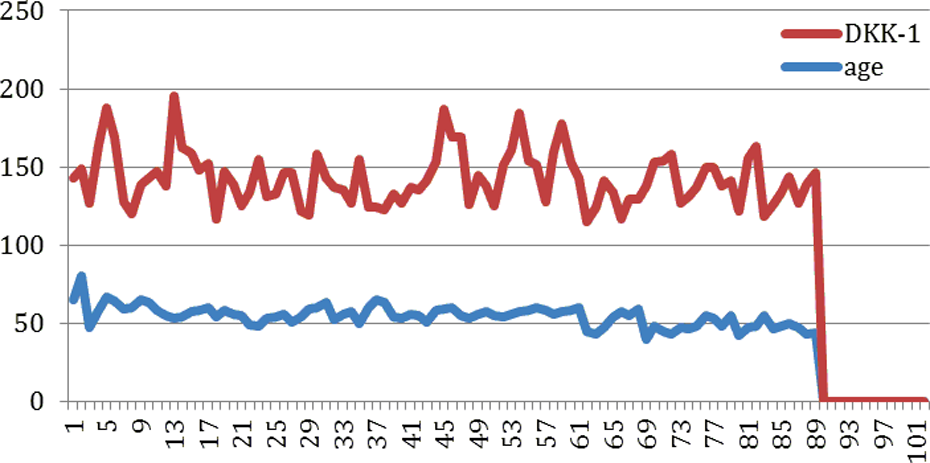
The graphical representation of patients.
Discussion
To improve the prognosis for ESCC patients, early detection (designation and diagnosis) of ESCC is crucial. Recently, carcinoembryonic antigen (CEA), cytokeratin 19 fragments (CYF-19), and squamous cell carcinoma-associated antigen (SCCAA) have been generally used as serum markers for the detection of ESCC. Due to low sensitivity and specificity of the designate of these markers, 17 the adjunct serum markers must be constant for early detection and diagnosis of ESCC. Therefore, there is an emerging need to find extensional novel biomarkers for clinical use. We investigated DKK-1 as a novel serologic marker as well as a target for ESCC.
DKK-1 is described as a negative regulator of the Wnt signaling pathway. The Wnt pathway performs a crucial role in the development and regulation of adult cell systems. The cellular duration mediated by Wnt signaling is comprised of proliferation, differentiation, survival, apoptosis, and cell motility. 18 The lack of regulation of these pathways can prevent tumorigenesis. 5 In ESCC, Wnt antagonists, negative regulators of Wnt signaling, have been downregulated, suggesting their function may play a crucial role in cancer progression. In addition, DKK-1 has been shown to be in a negative feedback loop in Wnt signaling and to be powerfully localized in a zone directly vicinal to the area where the Wnt signaling pathway is active. 16,19,20 These findings refer to a mechanism in the zone of the tumor and in the contiguous cells whereby Wnt pathway activation restricts itself through the entry of DKK-1, resulting in increased expression of DKK-1. Previous studies on hepatocellular carcinoma, 21 estrogen and progesterone receptor-negative (ER−/PR−) breast cancer, 22 and cervical, endometrial, 10 and kidney cancers 22 have shown that DKK-1 is predominantly expressed in cancer.
Although high levels of DKK-1 were found to be associated with ESCC in this study, this association may also occur in a majority of cohort studies. In this prospective investigation, we found that higher serum DKK-1 concentrations significantly increased in patients with ESCC. Further work is needed to confirm these findings and to investigate the DKK-1 mechanism involved in the development of ESCC.
Footnotes
Funding
This research received no specific grant from any funding agency in the public, commercial or not-for-profit sectors.