




Abstract
Septic arthritis and toxic synovitis are clinical conditions that can develop in association with various causes and involve symptoms such as pain, swelling, redness, sensitivity and restricted movement in the joint. A 42-year-old male presented to the emergency department with severe joint pain and nausea after injecting a 1-cc mixture of turpentine oil, eucalyptus oil, mint oil and thyme oil, which he purchased from an alternative medicine store, into his right knee with a syringe because of chronic knee pain. Ballottement and sensitivity were present at physical examination. Knee puncture yielded 60 cc of cloudy fluid. There was no growth in the material obtained. Improvement was observed following subsequent arthroscopic washing of the joint space and IV antibiotherapy, and the patient was discharged on day 21 of hospitalization with oral antibiotic and analgesic therapy. Intra-articular injection of foreign bodies into the knee joint space for therapeutic purposes, as in this case report, is a very rare occurrence, but may lead to potentially complicated arthritis.
Introduction
Turpentine oil, thyme oil, eucalyptus oil and mint oil are plant oils used for alternative therapies. 1 They are employed locally or orally to assist medical treatment in inflammatory, gastrointestinal, respiratory tract and various dermatological disorders. 1 But these substances are not used for therapeutic purposes by way of injection. This report describes a case of factitious arthritis arising as a result of self-administered intra-articular injection of a mixture of alternative therapy products manufactured for local and oral use by the patient.
Case
A 42-year-old male patient presented to the emergency department with pain and swelling in the right knee. There were no distinguishing characteristics in the patient’s history. He had been using analgesics for approximately 2 years due to chronic pain in the right knee diagnosed as osteoarthritis. As advised by relatives, the patient had injected a mixture of turpentine oil, thyme oil, eucalyptus oil and mint oil, intended for local use, into the right knee joint space with a syringe. Severe pain and swelling began in the right knee, and the patient was transferred from a peripheral hospital to our emergency department. The patient had no fever at physical examination, but sensitivity, swelling, elevated temperature, ballottement and restricted movement were present in the right knee (Figure 1). No pathological finding was determined at other system examinations. Day 1 laboratory values were C-reactive protein (CRP) 0.86 mg/dL and white blood cells (WBC) 12,600 U/L. Laboratory values on the day 2 were WBC 12,700 U/L, CRP 21 mg/dL and sedimentation 67 per hour. Computerized tomography of the knee revealed decreased density, which is thought to be secondary to edema in the muscle tissue around the knee joint and reticular densities in surrounding fat tissue (Figure 2). Puncture was performed and fluid was drawn off. Abundant leukocytes were observed in the fluid upon microscopic examination. Bacteria did not grow. The patient was hospitalized and started on empiric IV antibiotherapy. Arthroscopy and drainage were performed on the day 1 of hospitalization, and no aerobic or anaerobic bacteria growth was observed in the drainage material. There was no fever at subsequent monitoring. Arthroscopy and drainage were performed again on the day 9 of hospitalization. The patient improved and was discharged on day 21 with oral medication.
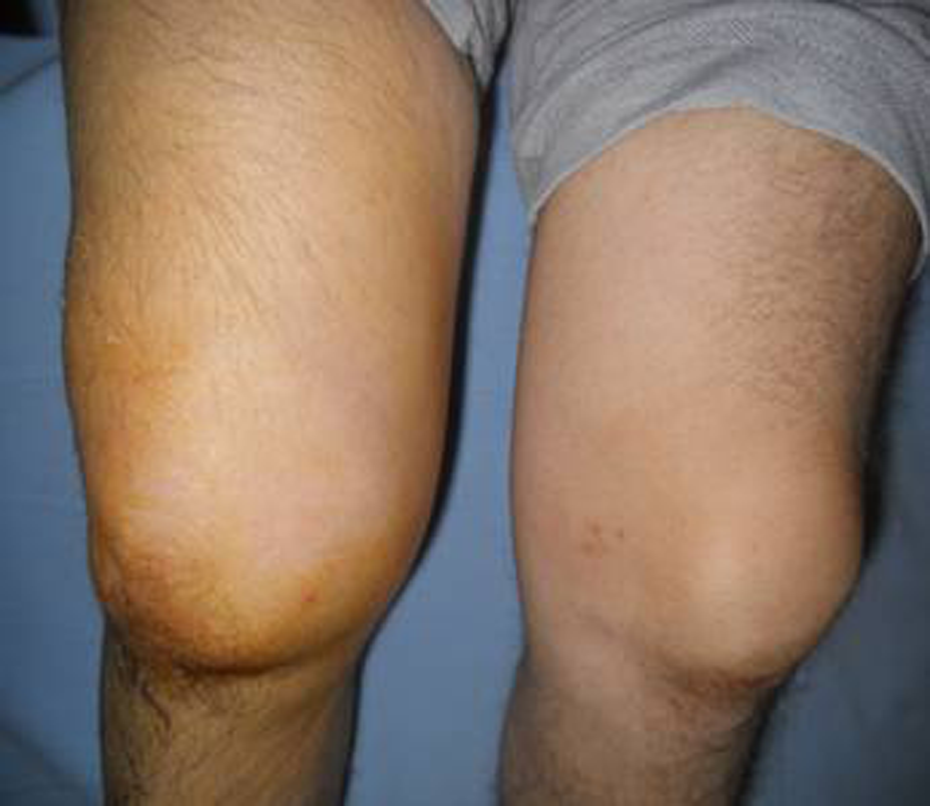
Swelling in the right knee after puncture.

Decreased density secondary to edema in the muscle tissue around the knee joint and reticular densities in surrounding fat tissue at computerized tomography.
Discussion
The most important possibility to be considered in differential diagnosis of acute pain in a single joint is septic arthritis. Contamination that may develop with the injection of a foreign substance into the joint space and infected materials that substance may contain can lead to septic arthritis. In septic arthritis, the joint can be seriously affected within a few days due to bacterial infection and inflammatory response developing inside the joint. 2 One potential cause to be considered in the differential diagnosis of acute pain in a single joint is toxic synovitis, a condition characterized by effusion in the joint and hypertrophy and nonspecific inflammation of the synovium. Although the etiology is unclear, cases of toxic synovitis have been reporting developing secondary to trauma. Diagnosis of toxic synovitis is generally made with the exclusion of other possible causes of joint damage. Differentiation from septic arthritis is both difficult and important. 3
The main causes of septic monoarthritis include trauma, gonococcal infections, acute osteoarthritis, gout and avascular necrosis. In most cases, bacteria can reach the synovial fluid through hematogenous spread. However, since synovial fluid contains no basement membrane, bacteria can easily enter the joint space. Today, intra-articular hyaluronic acid and corticosteroid therapy are used to treat osteoarthritis. 4 The literature contains publications regarding septic arthritis developing after intra-articular treatment. 5 But cases of septic arthritis developing in association with self-injection are very rare. 6 Similarly, the patient with osteoarthritis in our case is presented to the emergency department with pain and swelling within hours after self-injection.
Clinically, septic arthritis may be observed with joint pain, swelling and restricted movement in the joint and fever and, more rarely, sweating. Movement restriction may be active and passive and also complete restriction. 7 Early commencement of antibiotherapy with early diagnosis of septic arthritis is important if serious injury is not to be seen in the joint cartilage within a few days. 8 Carpenter et al. showed that anamnesis, physical examination and routine blood values are ineffective in differentiating septic arthritis from other forms, but that synovial fluid examination is useful. 9 In our case, too, considerable amounts of leukocyte were observed in the synovial fluid, but there was no growth in cultures. The fact that our patient’s symptoms began within a few hours and the lack of bacterial growth in the joint fluid suggested that the reaction was one to the foreign substance injected.
Injection of foreign substance into the joint space for therapeutic purposes is possible under some circumstances. Incorrect procedures associated with these injections for therapeutic purposes have been reported. There are no previous reports of substances applied for alternative medicinal purposes being administered intra-articularly, which is no where recommended. Arthritis developing in association with this procedure may be complicated and require long-term treatment.
Footnotes
Funding
This research received no specific grant from any funding agency in the public, commercial, or not-for-profit sectors.