




Abstract
Atropa belladonna L. is a plant long known to cause poisoning. But no cases of acute subdural hematoma resulting from such poisoning have been reported so far. Care must also be taken in terms of acute pancreatitis and rhabdomyolysis in cases of such poisoning. The plant may sometimes be mistaken for the Caucasian blueberry, V. arctostaphylos L. At least one anti-cholinesterase toxidrome finding was determined in all the nine cases of belladonna poisoning in this series. No elevated creatine kinase was reported in one case with acute subdural hematoma and hyperamylasemia.
Introduction
Atropa belladonna L. (fam: Solanaceae) is a perennial bushy herb. It is found across the northern Anatolia and grows among Fagus orientalis Lipsky and Picea orientalis L. woodlands and in shady places. 1 The berries are black, shiny and sweet and are consumed by animals that disperse the seeds in their droppings, even though the seeds contain toxic alkaloids, notably hyoscine (also called scopolamine), hyoscyamine and atropine.2,3 The berries also contain the tropane alkaloid atropine.4,5 The name ‘belladonna’ comes from the Italian, meaning ‘beautiful lady’, originating either from its use as a facial cosmetic, or, more probably, from its use to increase pupil size in women.6,7
The Caucasian blueberry, V. arctostaphylos L. (fam: Ericaceae), looks like Atropa belladonna L. It is a deciduous shrub and 1–6 m in length. The succulent fruits of all the Turkish species can be eaten, those of V. arctostaphylos being especially prized. 8
Cases
Nine patients were admitted to their local hospital and our university hospital, which serves as regional toxicology centre. They had suspected poisoning caused by consuming A. belladonna L. (Figures 1 and 2). They had consumed A. belladonna L. by mistake instead of blueberrys (Figure 3) during tourist excursions. One or more anti-cholinergic toxidrome findings—agitation, dry mucosa and tongue, tachycardia, urinary retention, hallucination, hyperthermia, dilated pupils and hypertension—were present in almost all patients. Computed tomography was performed on one patient due to loss of mental status and unilateral loss of strength. Tomography revealed acute subdural hematoma and shift in the left fronto-parietal region. That patient had a temperature of 38.8°C, blood pressure of 160/110 mmHg and respiration of 26/min. Pupils were dilated, with a Glasgow Coma Score (GCS) of 4 (E1M2V1) and IR −/−. The patient developed globe vesicle and hypoactive bowel sounds. The patient has multiple sclerosis and takes copaxone vials, fosamax and Ca-D vit.
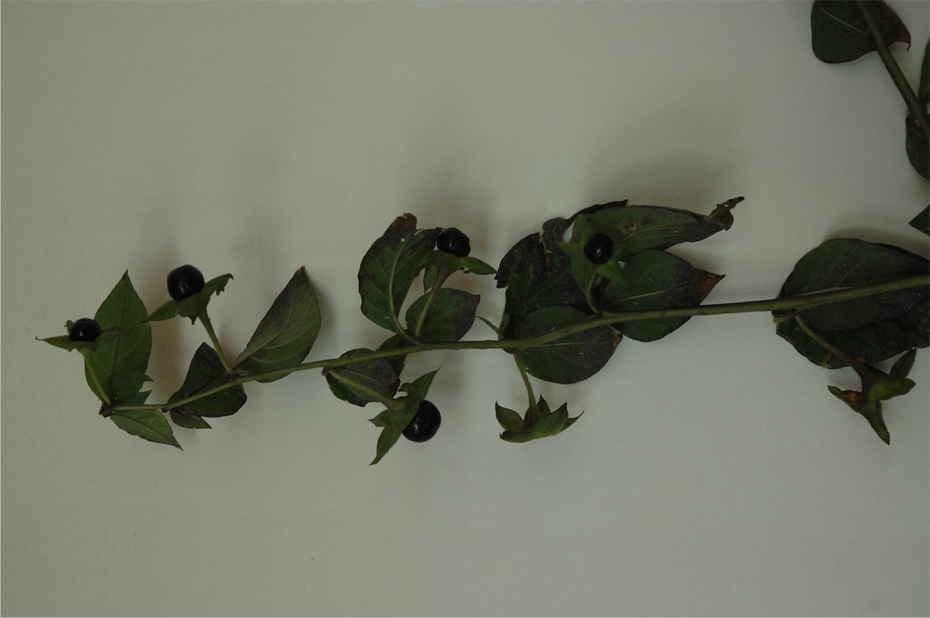
A. belladonna L.

A. belladonna L.

C. blueberry L.
The patient was taken for brain surgery. Holes were opened in the left frontal and parietal region using a burr and then widened and the hemorrhage was relieved. The dura was anastomosed to the bone and the layers closed in an anatomically compatible manner with the installation of two soft drains. The patient regained mental status on the first day postoperatively and was oriented and cooperative, IR was +/+, the pupils isocoric and GCS was 15. There were 4/5 paresis previously existing in the lower left extremity as MS sequelae. Hallucinations and agitations persisted intermittently for 3 days. The patient spent 6 days in an intensive care and 5 days on the ward, being discharged on day 11. The change in the laboratory values of this patient is shown in the Table 1.
Laboratory values after poisoning of A. belladonna

The other patients improved within 3 days and they were discharged. Some of them had altered mental status, hallucination and agitation. Stomach washing and activated charcoal was administered to patients with severe symptoms. Agitated patients were sedated with benzodiazepine. Anti-cholinesterase inhibitors, such as physostigmine, were not administered as these could not be obtained under emergency conditions.
Discussion
A. belladonna L. is frequently taken by adults for the purpose of suicide and to establish a hallucinogenic effect. Accidental consumption in adults is rare.9 A. belladonna L. contains hyoscyamine, atropine and scopolamine. Accidental ingestion of deadly nightshade berries can induce an anti-cholinergic toxidrome. However, not all the characteristics of anti-cholinergic toxidrome may be present in some cases of poisoning due to some plants having a hybrid form. 10 All anti-cholinergic toxidrome findings may be encountered in A. belladonna L. poisoning. Clinical manifestations are caused by central nervous system (CNS) effects, peripheral nervous system effects, or both. Common signs and symptoms include flushing, dry skin and mucous membranes, mydriasis with loss of accommodation, altered mental status and fever. Additional manifestations include sinus tachycardia, decreased bowel sounds, functional ileus, urinary retention, hypertension, tremulousness, and myoclonic jerking. Patients with central anti-cholinergic syndrome may present with ataxia, disorientation, short-term memory loss, confusion, hallucinations (visual, auditory), psychosis, agitated delirium, seizures (rare), coma, respiratory failure or cardiovascular collapse. Patients may present to the emergency department with a psychotic picture. Hypertension, convulsion and comatose state may be seen in serious cases.11,12
Treatment in anti-cholinergic poisoning is conservative. Patients require monitoring, and severe cases require intensive care monitoring. The use of activated charcoal is beneficial. Benzodiazepines are a good choice for sedation in the presence of agitation. Physostigmine may be useful in severe cases. Physostigmine reverses CNS and toxic effects of agents. Physostigmine can cause seizures and exaggerated parasympathetic responses, so atropine should be available to reverse its effects. Recommended doses in adults are 0.5–2 mg repeated every 20 min, slowly and intravenously over 1 min, or intramuscularly until response or an adverse reaction occurs. An additional 1–4 mg may be given every 30–60 min as needed to control symptoms. 11 Two of our cases exhibited severe anti-cholinergic symptoms. These patients were not administered physostigmine in the early period as it could not be obtained. Seven other cases were not sufficiently clinically severe to warrant physostigmine. The reason for the acute subdural hematoma in the patient concerned is unclear. It may be that the acute tachycardia and hypertension arising in such patients prepared the way.
Anti-cholinergic poisoning-related hyperamylasemia and rhabdomyolysis appear in the literature, but it is unclear whether the hyperamylasemia in our case was due to anti-cholinergic poisoning or to the anesthetic agents employed during surgery. It is also unclear whether the elevated creatine kinase in our case was due to poisoning or to anesthetic agents; however, one conclusion to be drawn from these cases is the need for care in terms of acute pancreatitis and rhabdomyolysis in cholinergic poisoning. 13
A. belladonna L. may sometimes be confused with the Caucasian blueberry L. and consumed in error. But no cases of acute subdural hematoma resulting from such poisoning have been reported. Care must also be taken in terms of acute pancreatitis and rhabdomyolysis in such poisoning.
Footnotes
This research received no specific grant from any funding agency in the public, commercial, or not-for-profit sectors.