




Abstract
The role of zinc (Zn) in anxiety, depression and psychosis was studied in rodents. Zn was administered at doses of 15 and 20 mg/kg intraperitoneally for 7 days. Both doses of Zn reduced the immobility time and increased the swimming time in the modified forced swim test. In the elevated plus maze test, increases in the number of open arm entries and time spent in the open arms were observed with both doses of Zn. In the amphetamine (1 and 2 mg/kg subcutaneously) induced locomotor activity test both doses of Zn produced reduction in the total movement time, mean velocity and stereotypic movements. Extrapyramidal symptoms such as catalepsy in animals are usually observed with conventional antipsychotic agents; but in the present study, Zn at doses of 15 and 20 mg/kg did not produce any cataleptic state in mice. The results of the present study demonstrated the anxiolytic, antidepressant and antipsychotic-like effects of Zn metal ion, which may be due to its N-methyl
Introduction
Zinc (Zn) metal ion is an essential mineral, mostly present in multivitamin preparations, needed to perform a variety of physiological roles as it acts as an antioxidant,
1
antiapoptotic,
2
anti-inflammatory,
3
and has neuromodulatory role.
4
In experimental animals, Zn deficiency during early brain development results in malformations, whereas deficiency in later brain development causes microscopic abnormalities and impairs subsequent function.
5
Large amounts of Zn released from vesicles by seizures or ischemia can kill postsynaptic neurons.
6
Tassabehji et al. observed that 2-month-old rats fed on Zn-deficient diet of less than 1 ppm for 3 weeks had anorexia, anhedonia, behaviour despair and increased anxiety-like behaviours in the light–dark model.
7
Zn is associated with its antagonistic action on N-methyl
Forced swimming test is the most widely used tool for assessing the antidepressant activity preclinically. The widespread use of this model is largely due to its ease of use, reliability across laboratories and ability to detect a broad spectrum of antidepressant agents. 18 The elevated plus maze (EPM) test is a rodent model of anxiety that is used extensively in the discovery of novel anxiolytic agents and to investigate the psychological and neurochemical basis of anxiety. Based on the spontaneous behaviour of the animal, the test provides a valid and reliable measure of anxiety in animals and for testing the antianxiety drugs. 19 Catalepsy in laboratory is defined as the failure to correct an externally imposed posture. When a normal animal is placed in an unusual posture, it will change its posture within seconds. A cataleptic animal, on the other hand, will maintain this posture for a prolonged period of time (several minutes or longer). Catalepsy is one of the behavioural tools mostly used by neuroscientist to study the behavioural mechanisms of neurochemical systems. 20
The role of Zn in psychiatric illness has not been fully elucidated therefore, the present study was an attempt to evaluate the behavioural responses in rodents to subacute Zn administration in anxiety, depression and psychosis models.
Materials and methods
Animals
The experimental study was carried out under controlled conditions. The present study used both mice and rats for behavioural tests based on the availability of instruments and suitability of the animals for particular models, for example rats were used for hyperlocomotor activity test using open field activity apparatus only, and the rest of the study was carried out using only mice. Fresh animals were used every time for the test and were not used again. Same sexes of animals were used for each test performed to avoid variation. Albino mice weighing 18–25 g and Wistar rats weighing about 200 g were procured from the Central Animal House Facility of Hamdard University, New Delhi, India, and acclimatized accordingly. The mice/rats were maintained on a 12-h light–dark cycle with free access to food. The mice/rats were maintained on pellet feed and water ad libitum during the whole duration of the study (7 days). The experimental protocol was approved by the Institutional Animal Ethics Committee (IAEC file No. 671) Jamia Hamdard (Hamdard University), New Delhi, India.
Drugs and dosing schedule
Animals were divided into different groups containing six animals each. Zinc chloride at the doses of 15 and 20 mg/kg was administered intraperitoneally (i.p.) as a single daily dose for 7 days (while 10 mg/kg dose was used as the lowest dose for the combination groups only) and 1 h before behaviour assessments on the seventh day. A preliminary test was conducted to determine the effective doses of Zn in the different models used; based on the observations, two doses of Zn were chosen and a lower dose was used in combination with the standard drug. Control animals received double distilled water as vehicle (ml/kg body weight). Diazepam (1 and 3 mg/kg i.p.), imipramine (15 and 30 mg/kg, i.p.), haloperidol (1 and 2 mg/kg orally (p.o.)) and amphetamine (1 and 2 mg/kg subcutaneously (s.c.)) were procured from Sigma–Aldrich, USA, and administered as a single daily dose for 7 days. All the behavioural observations were recorded between 9 a.m. and 5 p.m. on the seventh day.
Modified forced swim test in mice
The modified forced swim test (FST) was performed as described by Cryan et al. 18 In this test, all male (n = 6) mice aged 8–10 weeks were used, and the total test duration was 6 min. Mice were placed in cylinders (height 40 cm; diameter 15 cm) containing fresh water (temperature 22 ± 2°C) up to the height of 30 cm and allowed to swim for 15 min. This constituted the ‘pretest swim’. Twenty-four hours later, each mouse was reexposed to the swimming condition in a 6-min test session. The total duration of climbing, swimming and immobility was recorded for each animal in the last 4 min of the 6-min session. Increased duration in swimming and climbing and decreased immobility time was the measure for antidepressant activity.
EPM test in mice
The EPM test was performed as described by Lister 19 with slight modifications. In this test, all male (n = 6) mice aged 8–10 weeks were used and the test duration was 5 min. The instrument consists of 2 closed (5 × 30 × 5 cm) and 2 open (5 × 30 cm) wooden arms, adjoining with a central platform at an angle of 90°. Open arms were coloured white, while the closed arms were coloured black. The entire apparatus was elevated to a height of 40 cm and placed in a calm and quiet environment. The apparatus was cleaned each time after a mouse was put into it. The test consisted of placing a mouse in the centre of the apparatus (facing an enclosed arm) and allowing it to freely explore. The number of entries into the open arms and the time spent in these arms were scored for a 5-min test period. An entry was defined as placing all four paws within the boundaries of the arm. The total number of arm entries, open arm entries, closed arm entries and time spent in open arm were observed. An increase in the total number of open arm entries and time spent in open arm was the measure for anxiolytic activity.
Haloperidol-induced catalepsy in mice
Haloperidol-induced catalepsy is a widely employed method for screening antipsychotic drugs in rodents. In this test, all male (n = 6) mice aged 8–10 weeks were used, and the test was carried out for 5 min. This method is used to study the extrapyramidal symptoms of the antipsychotic drugs. Catalepsy was induced with haloperidol (2 mg/kg, p.o.) as described by Akhtar et al. 20 It was determined every hour up to 4 h using mice, by means of a standard bar test. The catalepsy was recorded as the time when the mice maintained an imposed position with the forelimbs extended and resting on a 4-cm bar (0.4 cm diameter). The total time was recorded for a period of 300 s during which each animal stayed in the bar (even if it climbed back).
Amphetamine-induced hyperlocomotor activity in rats
Inhibition of locomotor hyperactivity induced by dopaminergic drugs such as amphetamine has been a frequently used animal model to study antipsychotic drugs. Amphetamine administration results in dopamine release in rodents showing characteristic effects similar to that seen in schizophrenic patients. Locomotor activity in rats was recorded as described by Akhtar et al. 20 In this test, all male (n = 6) rats aged 10–12 weeks were used, the animals were given training before 24 h and the final test was performed for a 20-min duration. It was measured in an open-field activity apparatus consisting of a clear acrylic box (41 × 41 × 41 cm) and fitted with a photo-beam-frame located about 2.5 cm above the arena floor. The open-field apparatus was connected to a nearby computer running software (TruScan, v 2.01; Coulbourn Instruments, USA) that recorded the beam breaks to measure the various parameters selected during the activity. The rats were placed in the open field chamber 24 h prior to the test as an induction programme. On the experiment day, the apparatus was set up as per the standard operating procedure of the instrument and the required parameters to be assessed were selected from the computer software. Rats were placed in the open field and the recording session was started immediately. The total number of movements, total movement time, average distance moved, mean velocity, rest time, stereotype movements class 1 and class 2 were recorded for a period of 20 min. stereotype movement 1 is considered when the rat kept in the open field apparatus undergoes the total number of coordinate changes in less than ±0.999 beam spaces in X and Y dimension and back to original point that does not exceed 2 s. On the other hand, stereotype movement 2 is same as that of stereotypic movement 1 except that there is difference in the number of beam spaces. The open field apparatus was cleaned with ethanol each time a rat was placed in it to avoid any unwanted smell cues to the next rat to be placed.
Statistics
Statistical analysis was carried out using Graph pad prism 3.0 (Graph pad software San Diego, California). All results are expressed as the mean ± SEM. Data of groups were compared using analysis of variance (ANOVA), followed by Dunnett’s t test to identify the significance among groups. Values were considered statistically significant when p value <0.05.
Results
Effect of Zn administration on modified FST in mice
Zn (15 and 20 mg/kg), imipramine (30 mg/kg) and combination of Zn (10 mg/kg) with imipramine (15 mg/kg) reduced immobility time and increased the climbing time (F(4, 29) = 12.183, p < 0.05, ANOVA). Zn, imipramine and combined dose of Zn (10 mg/kg) with imipramine (15 mg/kg) showed significant increase in the swimming time in comparison to control (F(4, 29) = 17.21, p < 0.05, ANOVA; Figure 1).
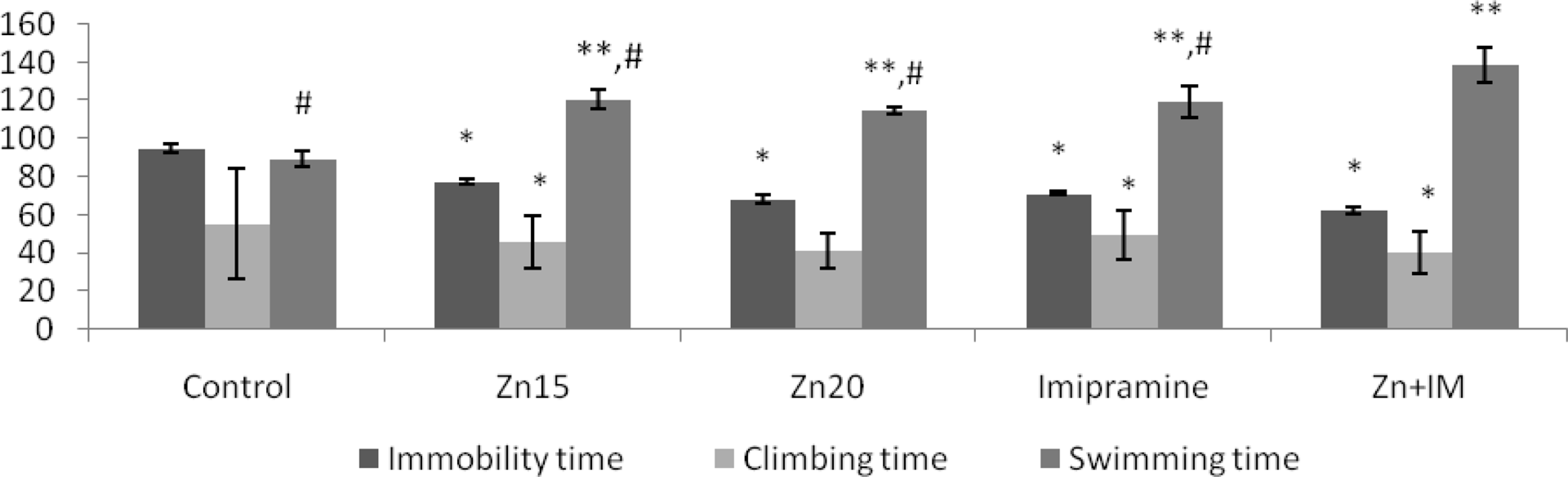
Effect of zinc administration on modified forced swimming test in mice. All values are expressed as mean ± SEM, analyzed by analysis of variance (ANOVA) followed by Dunnett’s t test. The p value <0.05 is considered significant. Each group consisted of six animals. *p < 0.05 versus control; **p < 0.01 versus control; # p < 0.05 versus Zn (10 mg/kg, intraperitoneally (i.p.)) + imipramine (15 mg/kg, i.p.).
Effect of Zn administration on EPM test in mice
Administration of Zn at the doses of 15 and 20 mg/kg increased the number of open arm entries and time spent in the open arms when compared to control (F(4, 29) = 8.50, p < 0.05, ANOVA). The effect was similar to that produced by diazepam (3 mg/kg). However, the effect of combined dose of Zn (10 mg/kg) and diazepam (1 mg/kg) showed maximum number of open arm entries and time spent in open arm (F(4, 29) = 10.13, p < 0.01, ANOVA; Figure 2).
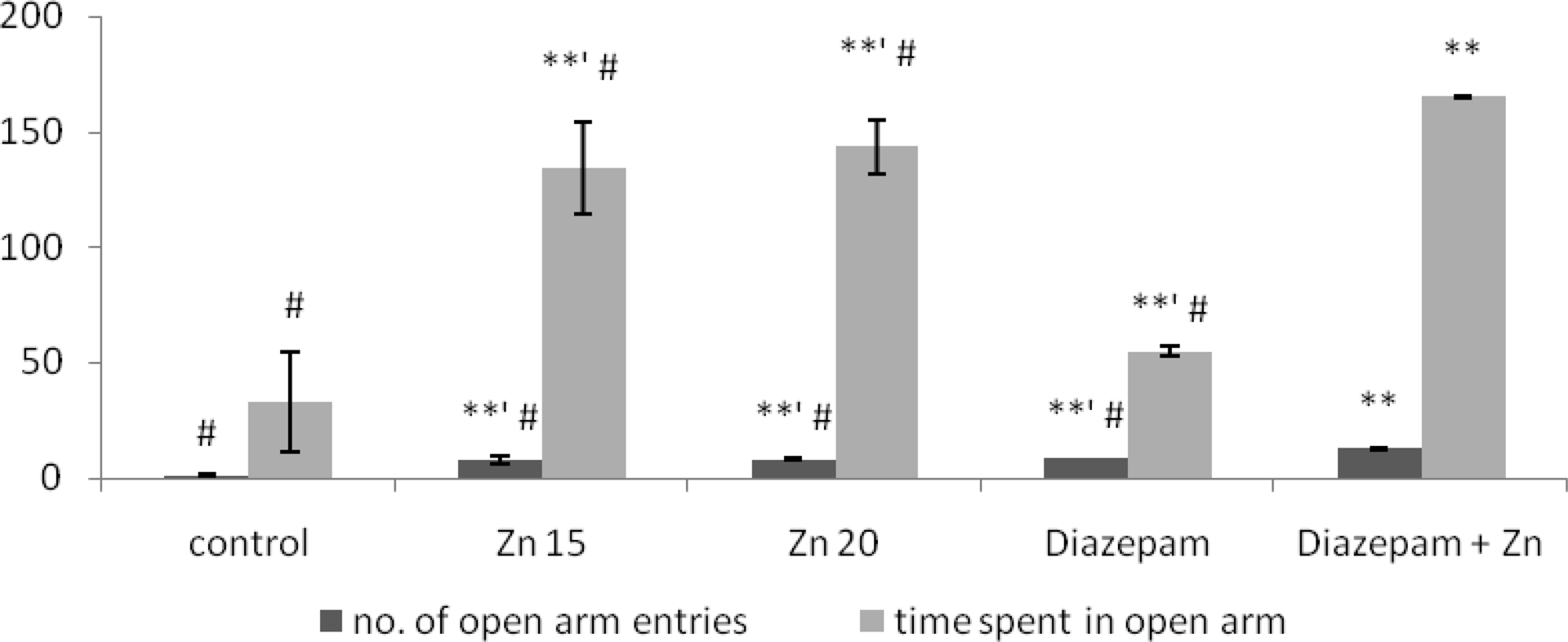
Effect of zinc administration on elevated plus maze test in mice. All values are expressed as mean ± SEM, analyzed by analysis of variance (ANOVA) followed by Dunnett’s t test. The p value <0.05 is considered significant. Each group consisted of six animals. *p < 0.05 versus control; **p < 0.01 versus control; # p < 0.05 versus diazepam (3 mg/kg, intraperitoneally (i.p.)) + Zn (10 mg/kg, i.p.).
Effect of Zn administration on locomotor activity in rats
Administration of amphetamine (2 mg/kg s.c.) showed significant increase in the number of total movements, mean velocity and stereotypic movements 1 and 2 with significant reduction in rest time in comparison to control (F(4, 29) = 2.49, p < 0.05, ANOVA). Administration of Zn (20 mg/kg), however, caused a significant reduction in the number of total movements in comparison to control, amphetamine and combination of amphetamine (2 mg/kg) and Zn (10 mg/kg (p < 0.01)), mean velocity, stereotypic movements 1 and 2 and increase in rest time in comparison to amphetamine and combined group of amphetamine (2 mg/kg) and Zn (10 mg/kg (F(4, 29) = 18.357, p < 0.05, ANOVA; Figure 3)).

Effect of zinc administration on amphetamine-induced locomotor activity in rats. All values are expressed as mean ± SEM, analyzed by analysis of variance (ANOVA) followed by Dunnett’s t test. The p value <0.05 is considered significant. Each group consisted of six animals.*p < 0.05 versus control; # p < 0.05 versus Zn (10 mg/kg, intraperitoneally (i.p.)) + amphetamine (2 mg/kg, subcutaneously (s.c.)); ## p < 0.01 versus Zn (10 mg/kg, i.p.) + amphetamine (2 mg/kg, s.c.); $ p < 0.05 versus amphetamine (2 mg/kg, s.c.).
Effect of Zn administration on haloperidol-induced catalepsy in mice
Haloperidol per se and combined dose of Zn (10 mg/kg) and haloperidol (1 mg/kg), but not Zn (15 and 20 mg/kg), produced catalepsy posttreatment in comparison to control (p < 0.01). The peak effect was observed at 2 h (Table 1).
Effect of zinc administration on haloperidol-induced catalepsy in micea

a All values are expressed as mean ± SEM, analyzed by ANOVA followed by Dunnett’s t test. The p value <0.05 is considered significant. Each group consisted of six animals.
b p < 0.01versus haloperidol (2 mg/kg, p.o.) + zinc (10 mg/kg, i.p.).
c p < 0.01 versus control.
Discussion
A large number of studies have demonstrated the role of NMDA receptor antagonists in anxiety and depression in animal models such as EPM test, FST, olfactory bulbectomy and tail suspension test.9,21 –26 Zn, an NMDA receptor antagonist, was studied in anxiety and depression models in the present study. The role of Zn was evaluated by studying its effect on modified FST at the doses of 15, 20 and 10 mg/kg (in combination with imipramine). Zn reduced the immobility time in a manner comparable to imipramine. The most significant result was observed with the combination of Zn (10 mg/kg) with imipramine (15 mg/kg), showing a significant reduction in immobility time. This is in accordance with the previous acute study where the synergistic effect of Zn was seen with various antidepressant agents. 27 Apart from decreasing the immobility time, Zn and imipramine significantly increased the swimming time as compared to the control. This finding suggest that the antidepressant action of Zn is related to its selective serotonin reuptake (SSR) inhibiting property similar to SSR inhibitor agents which also increase the swimming time and decrease the immobility time in modified FST,28,29 but its clinical properties have not yet been completely elucidated.
In the EPM test, Zn was seen to increase both the number of open arm entries and the time spent in open arms in a manner comparable to diazepam. The results were similar to the previous findings where Zn deficiency was one of the causes of anxiety-like behaviour.13,30 It was also seen that there was a slight potentiating effect when a lower dose of Zn (10 mg/kg) with diazepam (1 mg/kg) was given. This experimental evidence is perhaps the first of its kind, which gives an insight into the additive or synergistic effect of Zn with anxiolytic agents, diazepam in this case.
Except for a few studies,31,32 the role of Zn in schizophrenia has not been studied extensively. However, there were no animal studies that illustrated the role of Zn in the schizophrenic state. This study is the first of its kind where the role of Zn is linked with schizophrenia in animal models. Administration of Zn resulted in decreased stereotypic movements, mean velocity, distance travelled and increase in rest time in comparison with control. Moreover, Zn (10 mg/kg) when combined with amphetamine at doses of 2 and 1 mg/kg showed reduction in locomotor activity, along with decreased stereotypic movements. The results obtained in this study are consistent with the earlier study on thioperamide, a selective H3 receptor antagonist, which reduced the locomotor activity produced by amphetamine in a dose-dependent manner. 20 However, in the case of haloperidol-induced catalepsy, Zn neither produced nor potentiated catalepsy in mice, suggesting that the antipsychotic profile of Zn is devoid of D2 receptor blockade.
In conclusion, the results of the present study demonstrated the anxiolytic, antidepressant and antipsychotic-like profile of Zn metal ion in some rodent models of anxiety, depression and psychosis. These results are preliminary, as further research is required to confirm the exact role of Zn metal in the above-mentioned central nervous system disorders.
Footnotes
Funding
This research received no specific grant from any funding agency in the public, commercial, or not-for-profit sectors.