




Abstract
The aim of this study was to investigate the toxic effects of 2,3,7,8-tetrachlorodibenzo-p-dioxin (TCDD), a persistent environmental pollutant, on the percentage of T-cell subsets and B-lymphocyte and effectiveness of curcumin, β-myrcene (myrcene) and 1,8-cineole (cineol) on this toxicity in rats. Rats (n = 112) were divided randomly into 8 equal groups. One group was kept as control and given corn oil as carrier. TCDD was orally administered at the dose of 2 µg/kg/week. Curcumin, myrcene and cineol were orally administered by gavages at the doses of 100, 200 and 100 mg/kg/day, respectively, dissolved in corn oil with and without TCDD. The blood samples were taken from half of the rats on day 30 and from the rest on day 60 for the determination of lymphocyte subsets (CD3+, CD4+, CD8+, CD161+, CD45RA, CD4+CD25+ and total lymphocyte). The results indicated that although TCDD significantly (p < 0.05) decreased the percentage of CD3+, CD4+, CD161+, CD45RA, CD4+CD25+ and total lymphocyte, it caused a significant increase in the percentage of CD8+ cells. In contrast, curcumin, myrcene and cineol significantly decreased CD8+ cells levels but increased CD3+, CD4+, CD161+, CD45RA, CD4+CD25+ and total lymphocyte cells populations. The beneficial effects of curcumin, myrcene and cineol and the toxic effects of TCDD were increased at day 60 compared to day 30. In conclusion, curcumin, myrcene and cineol showed immunomodulatory effects and eliminated TCDD-induced immune suppressive effects in rats.
Introduction
2,3,7,8-tetrachlorodibenzo-p-dioxin (TCDD), the most toxic member of a large class of planar halogenated aromatic hydrocarbons including PCBs, PCDDs and PCDFs, is a persistent, widespread and highly toxic environmental compound. 1 It occurs as an unintentional byproduct of various industrial, combustion and natural process and can be detected in air, water, soil and some food. 2 Humans are exposed to TCDD and other dioxins compounds through the consumption of some food containing high concentration fat such as meat, dairy, fish and shellfish.1,2 TCDD has a broad range of toxic effects including wasting syndrome, thymic atrophy, lipolysis, reproductive toxicity, developmental toxicity, hepatotoxicty, carcinogenity and immune suppression.3,4 Although the direct cellular targets and specific immunotoxic mechanism of TCDD are unknown, The toxic effects of TCDD are elicited via its binding to aryl hydrocarbon receptor (AhR), a specific intracellular protein.5,6
The immune system is recognized as one of the most sensitive targets for toxicity of TCDD. Exposure of TCDD caused many toxic effects on immune system such as thymic involution, decreased host resistance to pathogens and tumors, suppresed lymphocyte development and maturation and suppressed adaptative immune responses, including antibody production, cytotoxic T lymphocyte activity and delayed hypersensivity responses.3,7 Huang and Koller 8 determined that the exposure of TCDD caused a decrease in the total percentage of CD4+ cells in the Long-Evans rats. Similarly, some studies reported that TCDD directly alters T and B lymphocyte functions in vitro.9,10
Curcumin is commonly used as a spice in curries, as a food additive and also as a dietary pigment. 11 It has several pharmacological effects including antioxidant, anti-inflammatory, antiviral, antimicrobial and antifungal activities. 12 Many researchers suggested that curcumin can modulate the proliferation and the activation of T cells. 13 In a study by Churchill et al., 14 curcumin treatment increased the proliferation of intestinal mucosal CD3+ T cells due to change in CD4+ T subsets in mice. In addition, curcumin can also influence the proliferation of B cells and B lymphocyte-mediated immune function. 13 Although many biological functions of curcumin have been identified, the molecular mechanisms underlying its actions remain largely unknown. β-myrcene (myrcene) is an acyclic monoterpene found in the essential oils of a large variety of plants such as lemongrass, hop, verbena, bay and others. 15 Myrcene is mainly used in the manufacturing of cosmetics fragranced products in shampoos, toilet soaps and detergents. It has antioxidant and antibacterial properties. 16 1,8-Cineole (cineol), also known as eucalyptol or cajeputol, is a colorless substance bearing a strong odor. This substance is present in large quantities in plants such as Rosmarinus officinalis and various species of the eucalyptus gender. 17 This compound was reported to have various pharmacological effects, such as smooth muscle relaxant, anti-inflammatory, antioxidant and hypotensive. 17
The aim of the current study was to investigate the toxic effects of TCDD on immune system in rats via the determination of T and B lymphocyte counts. We also investigated whether curcumin, myrcene and cineol can reduce the immunotoxic effects by TCDD in rats. To this end, we determined the percentages of T cells subsets (CD3+, CD4+, CD161+, CD45RA, CD4+CD25+) and B lymphocyte (CD45RA) in rats treated with TCDD, curcumin, myrcene and cineol.
Materials and methods
Chemicals
2,3,7,8-TCDD (purity >99%) was obtained from Accustandart, Inc. (New Haven, CT, USA). All other chemicals, including curcumin, β-myrcene and 1,8-cineole, were purchased from sigma Chemical Co. (St. Louis, MO, USA) and were of analytical grade or of the highest grade available.
Animals and treatment
Totally 112 healthy young adult female Wistar Albino rats (3–4 months old and 280−310 g in weight) were obtained from Experimental Animal Institute, Elazig, Turkey, in this experiment. Animals were housed in sterilized polypropylene rat cages, in 12-h light-dark cycle, at an ambient temperature of 21°C. Diet and drinking water from them were given ad libitum. Experiments were performed based on the animal ethics guidelines of Institutional Animals Ethics Committee, Fırat Unv., Elazig, Turkey.
Rats were randomly divided into 8 equal groups (n = 14 in each group). Group 1 (control), served as negative control and was given corn oil by gavages. In group 2 (TCDD group or positive control), TCDD, stock solution dissolved in acetone was diluted with corn oil, and then the acetone was evaporated under nitrogen before administration. TCDD was orally administered at the dose of 2 µg/kg/week by gavages. Our previous study 4 indicates that TCDD caused adverse effects in rats at the dose of 2 µg/kg/week subchronically. Rats in the groups 3, 4, 5 were orally treated with curcumin, myrcene and cineol, suspended in corn oil, at the doses of 100, 200 and 100 mg/kg/day, respectively. In the group 6, 7, 8, rats were treated with TCDD and curcumin (TCDD + curcumin group), myrcene (TCDD + myrcene group), cineol (TCDD + cineol group). Blood samples were taken on day 30 from seven animals in each group and then recollected on day 60 from remaining seven animals via left ventricle. Blood samples were taken to sterile EDTA tubes for flow cytometric analysis.
Flow cytometric analysis
The following monoclonal antibodies were used for flow cytometry; anti-rat- CD3+ (G4.18), CD4+ (OX35), CD8+ (OX-8), CD161+ (10/78), CD45RA (OX-1) and CD25+ (OX-39; BD PharMingen, San Deigo, CA, USA). For intracellular staining, cytofix/cytoperm fixation/permabilization solution kit (Becton Dickinson) was used according to the recommendations of manufacturer. Samples were analyzed on an EPICS XL-MCL flow cytometer (Beckman Coulter, Fullerton, CA, USA). The percentage of positive cells was calculated by comparison with appropriate isotype-matched antibody controls. The number of immunophenotyped T cells in specimen suspensions was calculated with the following equation: the number of isolated cells per ml × Total volume ml × ratio of T cell.
Statistical analysis
Results are expressed as mean ± SEM. The student t test was applied to determine statistically significant differences within time points. Cytokine and body weight levels were compared between treatments using one-way analysis of variance (ANOVA) and post hoc Duncan’s test. All analyses were carried out by SPSS statistical program ver. 12.0 (SPSS Corporation Inc., Chigago, IL, USA). Differences were considered as significant when p values were less than 0.05.
Results
The percentages of CD3+, CD4+, CD8+, CD161+, CD45RA, CD4+CD25+, total lymphocyte counts and CD4+/CD8+ ratio in rats administered TCDD, curcumin, myrcene and cineol during 30 days were given in Table 1. It was determined that in TCDD group, CD4+/CD8+ ratio and the percentages of CD3+, CD4+, CD161+, CD45RA, CD4+CD25+ and total lymphocyte were significantly (p < 0.05) decreased whereas CD8+ level was significantly increased compared with control and other groups. In general, curcumin, myrcene and cineol treatment significantly decreased the percentages of CD3+, CD4+, CD161+, CD45RA, CD4+CD25+, total lymphocyte and CD4+/CD8+ ratio while increased percentage of CD8+ compared with other groups. Additionally, it was shown that these substances when given together with TCDD brought the percentages of lymphocyte subsets (CD3+, CD4+, CD8+, CD161+, CD45RA, CD4+CD25+, CD4+/CD8+ and total lymphocyte) closer to the control level.
The percentage of lymphocyte subsets in rats 30 days after the drug administration

Abbreviation: TCDD, 2,3,7,8-tetracholorodibenzo-p-dioxins.
Note. Different letters a, b, c and d within the same row showed significant (p ≤ 0.05) differences between groups.
The percentages of CD3+, CD4+, CD8+, CD161+, CD45RA, CD4+CD25+, total lymphocyte and CD4+/CD8+ ratio on day 60 were given in Table 2. Similar to on day 30, TCDD treatment caused a significant decrease in CD4+/CD8+ ratio and the percentages of CD3+, CD4+, CD161+, CD45RA, CD4+CD25+ and total lymphocyte whereas increasing the percentage of CD8+. Additionally, it was shown that curcumin, myrcene and cineol significantly increased the percentages of CD3+, CD4+, CD161+, CD45RA, CD4+CD25+, total lymphocyte and CD4+/CD8+ ratio and decreased the percentage of CD8+. Besides, it was determined that in TCDD + curcumin, TCDD + myrcene and TCDD + cineol groups, the values of lymphocyte subsets were near to control groups and significantly different from TCDD group.
The percentage of lymphocyte subsets in rats drug-administered during 60 days
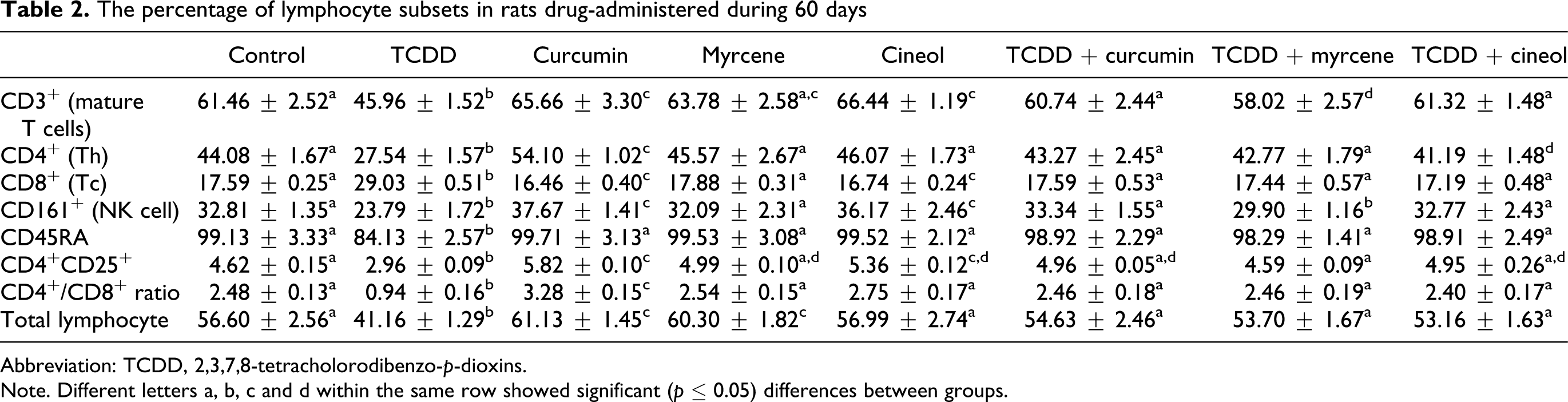
Abbreviation: TCDD, 2,3,7,8-tetracholorodibenzo-p-dioxins.
Note. Different letters a, b, c and d within the same row showed significant (p ≤ 0.05) differences between groups.
It was shown that the duration of drug administration significantly altered the percentage of lymphocyte subsets (Tables 1 and 2). In general, the toxic effects of TCDD on percentage of lymphocyte subsets were higher in rats treated with TCDD for 60 days compared with rats treated with TCDD for 30 days. However, this differentiation is not significant statistically. Similarly, the difference between the beneficial effects of curcumin, myrcene and cineol on days 30 and 60 was not significant. In the TCDD groups given curcumin, myrcene and cineol, the percentage of lymphocyte subsets was near to control groups by time.
Discussion
It was revealed that the toxic effects of TCDD on lymphocytes subsets play a critical role in determining both the nature and magnitude of subsequent immune responses. It was shown that TCDD treatment caused suppression of lymphocytes subsets formation and maturation in rats. On the other hand, curcumin, myrcene and cineol reversed the immunotoxic effects of TCDD when given together with TCDD.
CD3+ cells, surface antigen, found on thymocytes, peripheral T lymphocytes and dentric epidermal T cells.18,19 Our study showed that the percentage of CD3+ cells decreased with TCDD exposure. Therefore, it was thought that TCDD exposure leads to low mature T lymphocyte percentage and suppressed T-cells activation. These results are in agreement with previous studies which indicate that TCDD had strongly suppressed T-cells populations in rat.20,21 On the other hand, it was determined that the treatment of curcumin, myrcene and cineol prevents the toxic effects of TCDD on CD3+ cells and increased CD3+ cell percentage in rats. There are some studies about the curcumin’s effects on T-cells and these studies22,23 are in agreement with our study. There is no study about how myrcene and cineol affects the percentage of CD3+ cell, but it was claimed that other flavonoids positively affects T lymphocyte.24,25
CD4+ cells (T helper), produce some cytokines (interleukin-2 and interferon-gamma), have been shown to be important for systemic protection against a wide spectrum of intracellular pathogens. 26 It was revealed that TCDD treatment caused a decrease of CD4+ cell percentage. In this context, it was thought that the systemic protection in the body become weak. Similarly, Huang and Koller 8 determined that repeated and multiple dosing of TCDD decreased the percentage of CD4+ cells in rats. However, Oh et al. 27 showed that the percentage of T helper cells (CD4+) in waste incineration workers were higher than control groups. This disagreement between our study and that of Oh et al. 27 may be due to the high-dose TCDD exposure in our study. In the current study, it was found that curcumin, myrcene and cineol increased the percentage of CD4+ cells in rats and prevented the toxic effects of TCDD on CD4 cells. Similarly, previous studies Churchill et al. 14 and Cong et al. 28 confirmed our findings and showed that curcumin treatment increased the percentage of CD4+ cells, but there is no study about the effects of myrcene and cineol on CD4+ cells in rats.
CD8+ (T cytotoxic) cells are essential for the control of the intracellular amostigate stages, these cells kill target cells presenting antigens in the appropriate context. 26 Ernst et al. 29 claimed that the percentage of CD8+ cells was not affected in industrial workers after exposure to TCDD. Similarly, Huang and Koller 8 demonstrated that no significant change occurred in the CD8+ cell subpopulations after exposure to TCDD in rats. In contrast, in our study it was determined that TCDD caused an increase of CD8+ subpopulations in rats. The differentiations between our and other study may be due to the fact that the exposure time of TCDD is longer in our study than in the other studies. These results showed that the ability of cell killing was reduced with TCDD exposure. On the other hand, when curcumin, myrcene and cineol were given together with TCDD, the percentage of CD8+ cells decreased and the toxic effects of TCDD were prevented. Similarly, some studies showed that curcumin regulated the lymphocyte subpopulation as well as CD8+ cell.30,31 As far as we are aware, there is no study how myrcene and cineol effects CD8+ cell subpopulations.
Although there was no significant change in CD45RA, a B-cell specific marker, for 30-day exposure, the percentage of CD45RA significantly decreased with TCDD exposure for 60 days. Therefore it was thought that the B cell population and activation were reduced by TCDD. Walker et al. 32 demonstrated that the proportion of CD45RC significantly increased with TCDD at the doses of 3 µg/kg as in our study. Likewise, the other studies9,10 reported that TCDD directly alters B lymphocyte functions in vitro. Furthermore, in the present study, it was observed that the reduced percentage of CD45RA was increased when curcumin, myrecen and cineol were given together with TCDD. In this context, it was suggested that curcumin, myrcene and cineol modulates B-lymphocyte-mediated immune functions. Our findings confirmed the results of the study of Churchill et al., 14 in which mucosal B cells increased in mice treated with curcumin.
CD161+ cells, also known as natural killer (NK) cells, play a major role in the rejection of tumors and cells infected by viruses. They kill cells by releasing small cytoplasmic granules and cause the target cell to die by apoptosis. 33 CD161+ cells populations were decreased with TCDD exposure in rats. However, Ernst et al. 29 claimed that NK cells were not significantly affected in industrial workers exposed to high concentration of TCDD in chemical plants. This disagreement between our study and that of Ernst et al. 29 may be due to the longer exposure time in our study. In this context, it was suggested that TCDD exposure leads to the lack of the ability of killing in immune system. Additionally, it was observed that the toxic effects of TCDD on NK cells were prevented by curcumin, myrecen and cineol treatment, and these compounds caused the increase of percentage of CD161+ cells. Although no study on how cineol and myrcene affect NK cells in rats is present, there are few studies regarding curcumin and NK cells. As in our study, South et al. 34 determined that curcumin significantly increased the NK cells levels at the dose of 40 mg/kg in rats.
CD4+CD25+ cells play a crucial role in the prevention of organ-specific autoimmune disease and these cells possess immunosuppressive properties. 35 In our study, it was demonstrated that the percentages of CD4+CD25+ cells were decreased with exposure to TCDD. Previously, there was no study about the effects of TCDD on CD4+CD25+ cells. It suggested that the exposure of TCDD induced the suppression of immune system via a decrease in this cell percentage. Besides, the present study showed that the toxic effects of TCDD on CD4+CD25+ cells were prevented with treatment of curcumin, myrecen and cineol. Cong et al. 28 determined that curcumin modulated CD4+CD25+ cells in mice. This result of Cong et al.’s 28 study confirmed our findings. CD4+/CD8+ (Th/Tc) ratio demonstrated cytotoxic activity of immune systems. It was determined that the exposure of TCDD caused a decrease of CD4+/CD8+ ratio and reduced cytotoxic activity of immune system in rats. Additionally, the percentage of total lymphocyte was decreased with TCDD treatment. Our findings were supported by many previous studies.1,3,36 A previous study 37 clearly showed that curcumin has regulated lymphocyte cells and modulated immune system by changing the percentage of total lymphocyte populations. In our study, we observed that curcumin, myrecen and cineol treatment increased the total lymphocyte populations and CD4+/CD8+ ratio in rats. According to these results, curcumin, myrcene and cineol prevent the toxic effects of TCDD in terms of total lymphocyte populations and CD4+/CD8+ ratio.
Some previous studies indicate that the effects of TCDD on lymphocyte populations (CD3+, CD4+, CD161+, CD45RA, CD4+CD25+, CD4+/CD8+ and total lymphocyte) were exerted via their initial binding to AhR.38,39 Additionally, Kerkvliet’s study 3 for the first time demonstrated the requirement for the AhR to be expressed in T cells for TCDD to induce suppression of the T cell-mediated immune response. We found that all of immune systems cells evaluated in this study were negatively affected with TCDD treatment. As previous studies, we thought that these toxic effects of TCDD on lymphocyte subsets populations may be occurred to via directly binding to AhR receptor. Moreover, it was suggested that the protective effect of curcumin, myrcene and cineol on TCDD toxicity determined in the current study may be due to its binding ability to AhR, and a competition between TCDD and these compounds in terms of AhR binding.
Conclusion
The present study shows that (1) TCDD at the dose of 2 µg/kg/week, suppress immune function of lymphocyte subsets (CD3+, CD4+, CD8+, CD161+, CD45RA, CD4+CD25+, CD4+/CD8+ and total lymphocyte) in rats; (2) curcumin (100 mg/kg/day), cineol (100 mg/kg/day) and myrcene (200 mg/kg/day) had immunomudulatory activity and (3) these substances appears to have protective effects against the immuntoxicity induced by TCDD treatment. Furthermore, the highest protective effects were observed for curcumin, followed by cineol and myrcene. Thus, curcumin, cineol and myrcene may be useful as a new anti-TCDD immunotoxicity agent.
Footnotes
Acknowledgement and Funding
We acknowledge the support of TUBITAK (Scientific and Technical Research Council of the Turkish Republic) under grant 106O815.