




Abstract
The initial dispersal routes and subsequent exchange networks of Austronesian speaking populations in Island Southeast Asia (ISEA) and Near Oceania continue to be debated. Accurate and precise chronologies on pottery assemblages are key in clarifying these population movements and dynamics. Previous scholars have suggested red-slipped pottery may be a proxy for Malayo-Polynesian speakers’ presence, and Lapita pottery may be a proxy for Proto-Oceanic speakers. Under this premise, pottery assemblages found between eastern Indonesia and the Bismarck Archipelago have the potential to inform us about the arrivals and movements of new Austronesian languages to the region and their possible connections with Lapita peoples that voyaged into the Pacific. The generally poor resolution of the archaeological and radiocarbon record from this part of the Pacific calls for more research to settle the debate. Mololo Cave is a site in the Raja Ampat Islands off the western coast of New Guinea, containing the earliest reported pottery assemblages in the area, including red-slipped and plainware Lapitoid pottery. This paper presents 11 new radiocarbon dates and Mololo’s first two Bayesian age models to increase the robusticity of the date estimates at the site and enable chronological comparisons with similar pottery assemblages from the region. Most of the pottery sherds, including both red-slipped and Lapitoid pottery, emerge after 3090–2258 cal BP, potentially being as early as 3903–3420 cal BP. This chronological model provides critical information about the dispersal of pottery-making groups around the far western Pacific during the initial expansion of Austronesian languages into the region.
Keywords
Introduction
The study of the Mid-Holocene pottery trail from Southeast Asia, through Island Southeast Asia (ISEA) and leading to Near Oceania has the potential to clarify hotly debated regional population movements and dynamics. It is generally accepted that Austronesian-speaking groups were among the first pottery-bearing populations in ISEA and Near Oceania (Bellwood, 2017; Spriggs et al., 2025; Summerhayes, 2019), potentially alongside Austroasiatic populations in western ISEA (Blench, 2011). However, some scholars continue to debate the relationships between pottery, languages, and other cultural attributes (e.g. Denham, 2014; O’Connor, 2015; Piper, 2017; Spriggs, 2011) and the association between hypothesised Austronesian-speaking dispersal routes and different components of a ‘Neolithic package’ including pottery (e.g. Bellwood, 2017; Bulbeck, 2008). As such, the specific linguistic, social, cultural, and genetic impacts of regional Mid-Holocene human population dispersals remain contentious (Bellwood, 1984/1985, 2017; Blust, 1984/1985, 2019; Piper, 2017; Simanjuntak, 2017; Skoglund et al., 2016; Terrell, 2004).
Although notable archaeological research has been undertaken in some parts of Island Southeast Asia and in the Bismarck Archipelago of Papua New Guinea (e.g. Anggraeni et al., 2014; Azis et al., 2018; Bellwood, 1989, 2019a; Bellwood and Dizon, 2013; Carson et al., 2013; Hung, 2005; Kirch, 1997; Kirch et al., 2021; Summerhayes, 2000), there has been limited excavation and therefore a sparse radiocarbon record produced along one hypothesised dispersal route, between eastern Indonesia and western New Guinea. This paper attempts to establish the chronology for the first appearance of pottery along this route, using evidence from Mololo Cave in the Raja Ampat Islands off the western coast of New Guinea. Mololo is the earliest radiocarbon-dated site to report ceramics in West New Guinea (also known as West Papua or Indonesian Papua). The paper presents 11 new radiocarbon dates and the site’s first Bayesian age models, with 32 determinations. These results provide important date estimations for pottery along this under-researched dispersal corridor, broadly supporting the idea that the route was used by pottery-bearing groups moving into the region. However, comparisons between modelled chronologies at Mololo and other surrounding pottery-bearing sites illustrate that the region’s patchy radiocarbon record makes the identification of broader Mid-Holocene dispersal routes and interaction networks very complicated.
Background
Bellwood’s (1978, 1984/1985, 2017) association between ISEA’s ‘Neolithicization’ and the arrival and dispersal of Austronesian speakers has driven research in the region for the past 50 years. The Out of Taiwan hypothesis, which became linked with the farming/language dispersal model (Diamond and Bellwood, 2003), argues that Austronesian speakers travelled from Taiwan into ISEA c. 5500 cal BP bringing with them novel agricultural practices, animal domesticates, seafaring technology and other technological innovations like red-slipped and cord-marked pottery, polished stone adzes, shell artefacts, and bark cloth. According to this hypothesis, Austronesian speakers would have colonised ISEA by benefitting from the demographic advantages that their ‘Neolithic package’ would have conferred over local hunter-gatherer groups (Bellwood, 1978, 1984/1985, 2017).
Opposing the Out of Taiwan hypothesis, several authors have claimed that there is insufficient evidence to support the idea that the earliest Austronesian speakers in ISEA brought with them significantly different agricultural systems (i.e. grain agriculture) to local preexisting practices (i.e. horticulture and agroforestry; Denham, 2014; Denham and Donohue, 2022; Donohue and Denham, 2010; O’Connor, 2015). Alternatives to the Out of Taiwan model also note that there is limited coherence between the spatio-temporal distribution of domestic animal clades linked to the ‘Neolithic’ package and the hypothesised introgression route originating in Taiwan (Larson et al., 2007; Oskarsson et al., 2011; Piper, 2017; Sacks et al., 2013).
In contrast, the first appearance of ceramics can, at a very broad scale, be more securely associated with the arrival of Austronesian-speaking populations (Anderson, 2005; Bellwood, 2017; Spriggs, 2011). In the ethnographic record, red-slipped paddle and anvil pottery manufacture is strongly associated with the distribution of Austronesian languages (May and Tuckson, 2000). Often learned from an early age in natal communities (much like language), pottery manufacture around New Guinea is considered a relatively conservative practice that is not easily diffused except through marriage into a potting community (Gaffney, 2020). This association is further supported by the broad alignment between language distribution patterns, archaeological deposits and genomic evidence in ISEA and the New Guinea regions (Hung and Bellwood, 2024; Spriggs et al., 2025). Despite this, it is likely that pottery-making and Austronesian languages became interconnected with existing seaborne networks in ISEA, operated by non-Austronesian speaking groups. This is supported by the linguistic evidence for complex language shifts during the Mid-Late-Holocene integrating Austronesian and non-Austronesian elements (e.g. Gasser et al., 2024), and the presence of some non-Austronesian speaking pottery makers around mainland New Guinea (Gaffney et al., 2015; May and Tuckson, 2000). This means that there were broad patterns of association between pottery-making and Austronesian languages, but not necessarily an absolute one-to-one relationship.
The chronology of the arrival of the first Austronesian-speaking populations and regional dispersal routes is therefore best evaluated by radiocarbon dating the pottery record (Anderson, 2005; Bellwood, 2017; Simanjuntak, 2017; Spriggs, 1989, 2011). However, ISEA’s radiocarbon record has been constrained, among other factors, by the poor preservation of the organic material record (Piper, 2017), the reliance on small excavations in cave sites, making post-depositional disturbances harder to identify (Cochrane et al., 2021; Spriggs, 2003), prohibitive costs and a lack of local AMS radiocarbon facilities (The University of Arizona, 2025). Nonetheless, the gradual improvement of the regional radiocarbon record has prompted alternatives to the Out of Taiwan model, providing other hypotheses to explain the first arrivals and dispersals of Austronesian speakers into the region, including the Neolithic I and II model (Anderson, 2005) or the Western Migration Route hypothesis (Simanjuntak, 2017) (Figure 1).
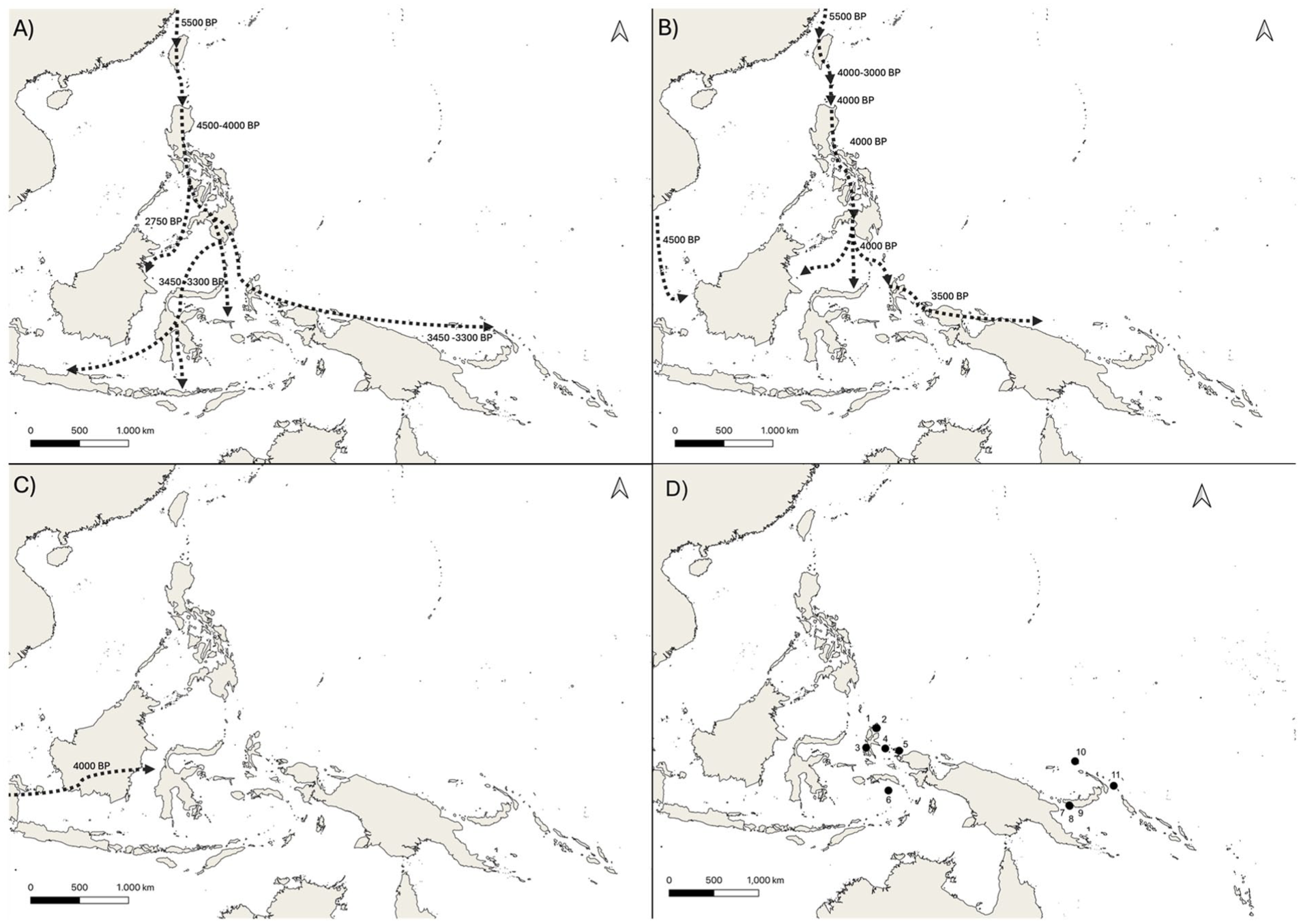
Regional map with hypothesised migration routes of Austronesian speaking pottery makers. The depicted arrows do not reflect the more nuanced population dynamics (i.e. back and forth movements). Given that the focus of this paper is on the region between ISEA and Near Oceania, there is no full depiction of the dispersals from Southeast Asia (Neolithic I and II (Anderson, 2005) and the Western Migration Route (Simanjuntak, 2017). (a) Out of Taiwan Hypothesis (Bellwood, 2017). (b) Neolithic I and II model (Anderson, 2005). (c) Western Migration Route (Simanjuntak, 2017). (d) Location of the discussed archaeological sites. 1.Aru Manara. 2. Tanjung Pinang. 3. Uattamdi 1. 4. Buwawansi 3 and 5. 5. Mololo Cave. 6. Pulau Ay (PA1). 7. Apalo (FOJ). 8. Makekur (FOH). 9. Paligmete (FNY). 10. Talepekemelai (ECA). 11. Kamgot (ERA).
In the most recent review of the regional ceramic record, Cochrane et al. (2021) assert that the current Austronesian dispersal hypotheses cannot be fully supported when the existing radiocarbon dates associated with pottery are assessed within a Bayesian chronological framework. According to their analyses, the low resolution of the regional radiocarbon record supports both a multi-route and multi-directional dispersal pattern, proposing another alternative to the Out of Taiwan Hypothesis (Bellwood, 2017). Nonetheless, the patterns of first pottery appearance remain unresolved in ISEA, as fundamental regions like East Borneo, which have important pottery deposits like Abu, still rely on large date estimation intervals (Plutniak et al., 2024). These imprecise chronologies limit the testing of the different proposed hypotheses on pottery dispersal in the region.
Cochrane et al. (2021) align their results with different genetic studies like Lipson et al. (2014), who argue for multiple movements from the north and the west of ISEA into this region, and Soares et al. (2016), who claim small intrusion waves from Mainland Southeast Asia into ISEA. Recent ancient genetic studies also indicate that different dispersal and admixture processes played out around the north of ISEA (e.g. northern Maluku) and the south (e.g. Nusa Tenggara), with the southern islands experiencing a slightly earlier dispersal via Mainland Southeast Asia (Oliveira et al., 2022). Whether this relates to a movement of pottery-producing Austroasiatic speakers or another language group is unclear. Moreover, eastward movements of Austronesian speakers into ISEA coincided with westward movements of Non-Austronesian (i.e. Papuan) language speakers from the New Guinea area (Purnomo et al., 2024).
Moving to Near Oceania, the study of Mid-Holocene pottery has targeted the long-standing question of Lapita origins (Summerhayes, 2019). Lapita is the earliest pottery known from eastern New Guinea and the Pacific Islands, characterised by a wide array of pots, plates and bowls, which include plainware, but also a distinctive dentate-stamped and lime-infilled component (Summerhayes, 2000). The oldest Lapita evidence has been found in the Bismarck Archipelago c. 3350 cal BP (Kirch and Hunt, 1988; Specht and Gosden, 1997; Summerhayes, 2001). Rieth and Athens (2019) have constrained the Lapita pottery first appearance to 3535–3234 cal BP, and Denham et al. (2012) to 3470–3250 cal BP employing two different Bayesian age models. Linguistic phylogenetic research indicates the earliest Lapita evidence coincides with the arrival of Austronesian speaking groups that diverged around the Bismarck Archipelago to become Proto-Oceanic speakers (Blust, 2019). This assumption suggests that pottery pre-dating the Lapita sites in the Bismarck Archipelago should be found on the routes connecting ISEA and the putative Lapita homeland.
Some of these early pottery sites are found in the Philippines, Mariana Islands (Hung et al., 2011), Banda Islands (Lape et al., 2018) and especially in Sulawesi (Anggraeni et al., 2014; Azis et al., 2018) between about 3500 and 3000 cal BP. These assemblages contain red slipped material as well as circle and pin stamped pottery with lime infilling, along with small components of dentate stamping (Carson et al., 2013). In contrast, pottery evidence, particularly lime-infilled dentate material, is notoriously lacking between eastern Indonesia and Papua New Guinea (Gaffney and Tanudirjo, 2024). The reasons behind the scarce regional pottery records, specifically around mainland New Guinea, could be varied, including a lack of systematic field research, a purposeful avoidance by the first Lapita potters, difficult landscapes for settlement or poor preservation of sites along a relatively exposed northern coastline (Azis et al., 2018; Summerhayes, 2019). These hypotheses cannot be fully tested until the lack of archaeological research between eastern Indonesia and the Bismarck Archipelago is overcome.
More work on radiocarbon dating and chronological modelling is needed to clarify the debated dispersal routes of the first Austronesian speakers in ISEA and to identify potential links with networks of Early Lapita pottery in Near Oceania. Given this critical need for enhanced chronological understanding of the area between eastern Indonesia and the Bismarck Archipelago, this paper presents the most up-to-date chronology to estimate pottery’s emergence in the Raja Ampat Islands of West New Guinea, strategically located at the interface of ISEA and the Pacific.
Mololo Cave (WAI-1 in the Raja Ampat Archaeological Project database) is a cave site on Waigeo Island in the Raja Ampat archipelago of Southwest Papua Province, Indonesia. The site is believed to have been occupied since the Late Pleistocene, >50,000 cal BP, to the Late-Holocene, c. 2000 cal BP (Gaffney et al., 2024). Mololo’s 2018–2019 archaeological excavations have yielded 156 ceramic sherds (Gaffney and Tanudirjo, 2024). There are a minimum of four different technical classes at the site. Class 1 pottery is a thick-walled globular pot with red slip on the interior and exterior of the rim. Class 2 is a thin-walled globular pot with an everted rim and a lack of red slip. Class 3 pottery might be related to Class 2, despite its different fabric, as it is also a thin-walled globular pot with everted rims and the absence of red slip. Class 4 pottery is characterised by a flat rim with circular impressions and shoulder carination. Class 4 is Lapitoid in appearance, meaning it lacks dentate-stamping and lime infill, but morphologically resembles plainware Lapita rim forms.
The cave’s location positions Mololo in the hypothesised Austronesian-speaking maritime networks between the Philippines, the Mariana Islands, central Indonesia and the Bismarck Archipelago c. 3500–3000 cal BP. Mololo Cave is the earliest archaeological site where red-slipped and incised pottery has been reported in West New Guinea. Following the site’s pottery classification by Gaffney and Tanudirjo (2024), the aim is to estimate the first appearance of red-slipped (Class 1) and possible Lapitoid pottery (Class 4) at the site.
Materials and methodology
Materials
Mololo Cave is subdivided into three archaeological areas (i.e. Area 1, Area 2, and Area 3; Gaffney, 2021). This paper solely focuses on Trench 1 (Area 1) and Trench 2 (Area 2), which are both 2 × 1 m trenches located in the lighter outer chamber of the cave. Area 3, located within the dark inner chamber, yielded little archaeological material (Gaffney, 2021). Trenches were excavated following lithological boundaries, constrained by 50 mm spits. Where possible, the material was recorded in situ with three-dimensional coordinates measured using a plumb bob and line level relative to a trench datum. All sediment was separated and numbered by lithological context, constrained by 0.5 m quadrants and dry sieved through a 2 mm mesh (full excavation procedures are outlined by Gaffney et al. (2024) (Figure 2).
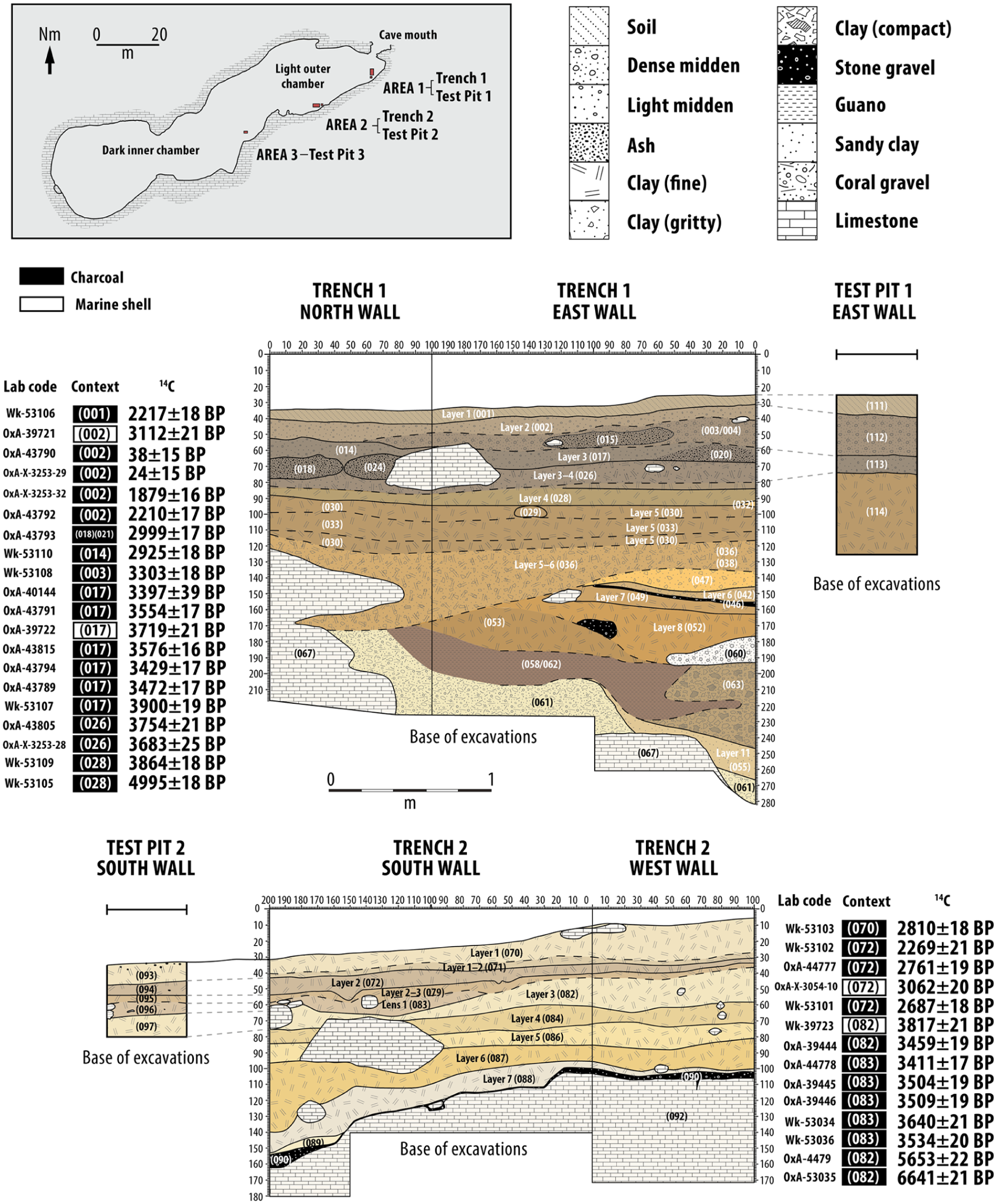
Mololo Cave plan site and stratigraphy for Trenches 1 and 2 showing the radiocarbon determinations used in the site’s new Bayesian age models.
Two types of pottery found at Mololo allow for chronological comparisons with surrounding sites. Mololo Cave’s Class 1 red-slipped and incised pottery parallels Neolithic and Metal Age red-slipped pottery from other parts of ISEA. Gaffney and Tanudirjo (2024) compare Mololo’s Class 1 pottery with Malukan material found at Uattamdi 1 on Kayoa Island (Bellwood et al., 2019c; Ono et al., 2021); at Aru Manara and Tanjung Pinang on Morotai Island (Bellwood, 2019; Ono et al., 2018); and at Buwawansi 3 and 5 on Gebe Island (Bellwood et al., 2019a). Gaffney and Tanudirjo (2024) define Mololo Cave’s Class 4 pottery as tentatively Lapitoid in appearance and could be provisionally compared to pottery sherds found in Uattamdi 1 on Kayoa Island in Maluku (Bellwood et al., 2019c), Talepakemalai on Mussau Island (Kirch et al., 2021), Makekur and Apalo in the Arawe Islands, Bismarck Archipelago (Summerhayes, 2000). Gaffney and Tanudirjo (2024) additionally describe Mololo’s Class 2 and 3 pottery styles. However, given that these typologies do not present clear similarities with pottery from surrounding sites, comments on these sherds are limited in this paper. Although pottery was recovered in both Trench 1 and Trench 2, pottery sherds diagnostic of formal classes were only recovered from Trench 1.
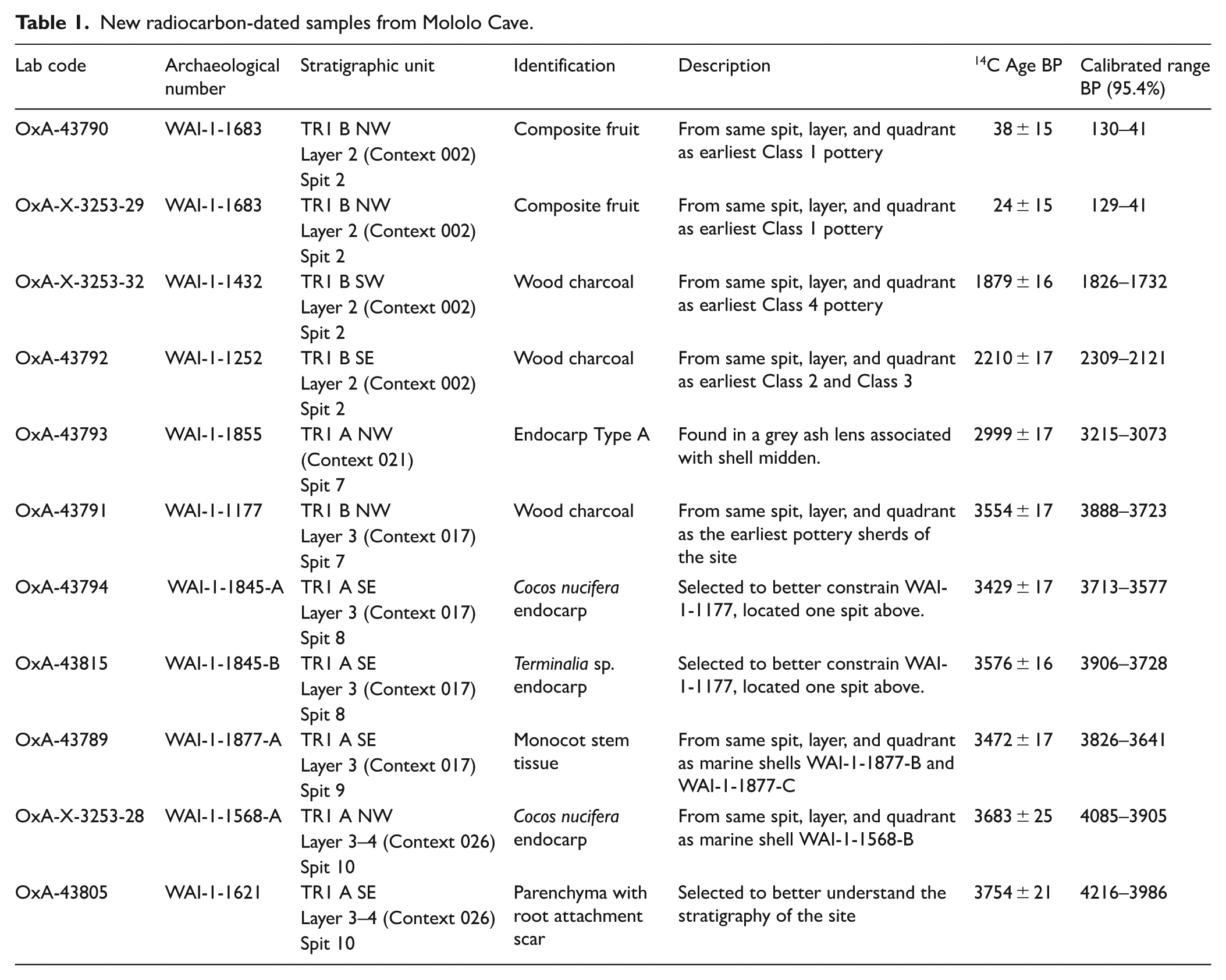
The 11 new radiocarbon dates presented here were measured from charred plant macrofossils (Table 1 and Figure 3). When possible, short-lived plant remains were selected to avoid the inbuilt age phenomenon (Dee and Ramsey, 2014). The stratigraphic association between pottery and radiocarbon-dated samples was defined when both were found in the same 0.5 × 0.5 m quadrant and derived from the same lithological context and spit. Where multiple datable specimens were available, the sample found closest to the pottery was selected. This approach was deemed the best way to estimate the age of the pottery, given a lack of charred remains directly adhering to the pottery, but it does not exclude the possibility of post-depositional movement of charcoal or pottery specimens. The new radiocarbon-dated samples were exclusively selected from Trench 1. This is because diagnostic pottery was solely recovered from this trench, and plant macrofossils were also better preserved, allowing for the identification of short-lived material for radiocarbon dating. However, Bayesian age models were produced individually for both Trench 1 and Trench 2, using new and previously published dates, incorporating stratigraphical information into each model.
New radiocarbon-dated samples from Mololo Cave.
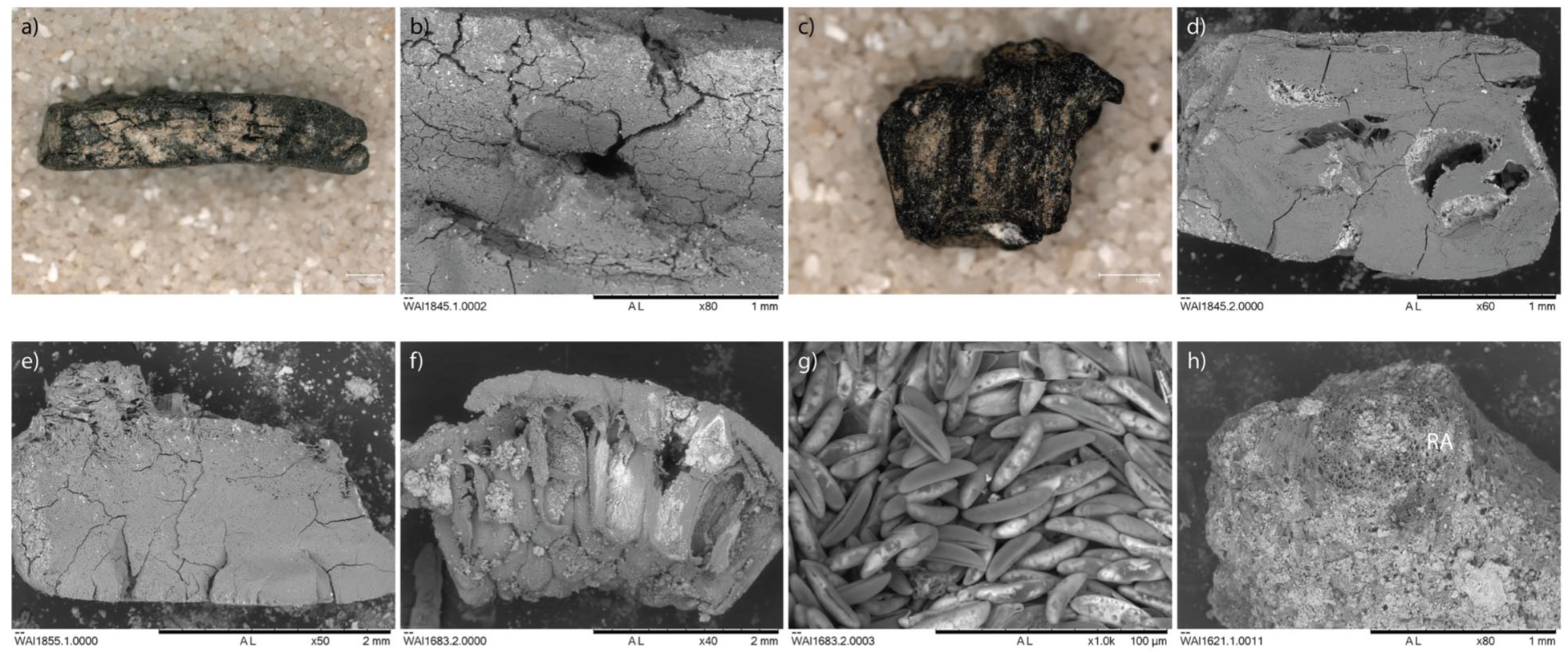
Examples of dated charred plant macrofossils; (a and b) Cocos nucifera endocarp fragment (WAI-1-1845-A); (c and d) Terminalia sp. endocarp fragment (WAI-1-1845-B); (e) Endocarp Type A fragment (WAI-1-1855); (f and g) Composite fruit, including close up of seeds (WAI-1-1683-A); (h) Parenchyma fragment with root attachment scar (RA; WAI-1-1621).
Methods
The charred plant macrofossil assemblage was analysed using light microscopy at the Palaeobotanical Laboratory, University of Oxford, with further identification undertaken on a Hitachi TM3000 scanning electron microscope housed in the Glyn Daniel Laboratory, University of Cambridge. Morphological and anatomical features were compared to modern reference material from northern Australia, Southeast Asia and the Pacific housed in archaeobotanical reference collections at the Australian National University, University of Queensland, University of Cambridge, and University College London.
Radiocarbon dating of charred plant macrofossils (including the remains of fruits, nuts, underground storage organs, and wood) at the Oxford Radiocarbon Accelerator Unit (ORAU) followed routine protocols described in Brock et al. (2010). The surface of the charcoal was scraped with a scalpel to remove all the visible (to the naked eye) adhered sediment, and where possible, the samples were cut c. 1–2 mm. The samples were pretreated with a series of acid (1M HCl, 80°C, 20 min), base (0.2M NaOH, 80°C, 20 min), and acid (1M HCl, 80°C, 2 h) chemical pretreatments as described in detail by Brock et al. (2010). Clean material was combusted in an elemental analyser connected to an IRMS (e.g. Sercon 20–22) operating in continuous flow mode and cryogenically collected prior to reaction with hydrogen over an iron catalyst to produce graphite. Samples were dated in a MICADAS at the University of Oxford, calculated following Stuiver and Polach (1977) and corrected for fractionation using an AMS derived δ13C. %C and stable isotope values given in this paper were produced using the IRMS using an in-house alanine reference. Internationally accepted stable isotope standards were not run alongside these samples, so they provide an indicative estimate of δ13C to identify potential contaminants only.
All the Bayesian age models presented in this paper have been built using OxCal v.4.4.4 (Bronk Ramsey, 2009a). Trench 1’s model has been built with nine new radiocarbon dates presented in this study and nine from Gaffney et al. (2024). Trench 2’s model has been built with 11 radiocarbon dates from Gaffney et al. (2024) and three radiocarbon dates from an excavation extension towards the north and south of Trench 2 in 2023. The remaining models have been built with radiocarbon dates from published literature (Supplemental Information).
To appropriately reflect Mololo’s low-latitude location, situated only 34 km south of the equator, the Northern (Reimer et al., 2020) and Southern (Hogg et al., 2020) Hemisphere atmospheric calibration curves have been mixed at 50% following Hogg et al. (2020). Note that this is different to the calibration used by Gaffney et al. (2024) and Gaffney and Tanudirjo (2024), who use a simple Northern Hemisphere curve. Differences between these two calibration methods are around 20 years, and are thus of low importance given the relatively low precision of our models or the calibrated ages presented previously. Marine20 (Heaton et al., 2020) is applied to model the chronology of marine origin remains, using the onsite value of ΔR of −129 ± 47 14C yr, based on paired marine shell and plant macrofossil samples (Gaffney, 2021). ΔR is the local variation from the global average of the marine reservoir age, which is the difference between the 14C atmospheric content and that from the surface of the ocean for any point in time (Alves et al., 2018; Petchey and Ulm, 2012).
Chronological model codes are presented in the supplementary information. Because the Bayesian age models run through an iterative Markov Chain Monte Carlo (MCMC) sampling, small and non-significant differences in the results might occur each time the codes are run (Bronk Ramsey, 2009a). Prior information is mostly provided by stratigraphy, and radiocarbon dates are placed within Phases defined by sedimentary contexts. Sedimentary contexts are coded based on a single context number system, with generic layers/features later applied to those contexts. These are arranged in a Sequence and separated by Boundaries (Bronk Ramsey, 2009a). Outlier models are used to identify and downweigh outliers. At Mololo Cave, a ‘General’ t-type Outlier Model (Bronk Ramsey, 2009b) has been used. This is flexible and allows samples to be both younger and older than expected. This was considered more appropriate than a ‘Charcoal Outlier Model’ (Bronk Ramsey, 2009b), which accounts only for the old-wood effect, as it is clear that vertical displacements at the site have resulted in some wood charcoal being much younger than expected (Gaffney, 2021; see also Figure 4). All the modelled date estimates are presented at 95.4% probability (Bronk Ramsey, 2009a). Unless otherwise stated, the models converged at >95%. Radiocarbon uncertainties are given with the F14C or BP uncalibrated dates.
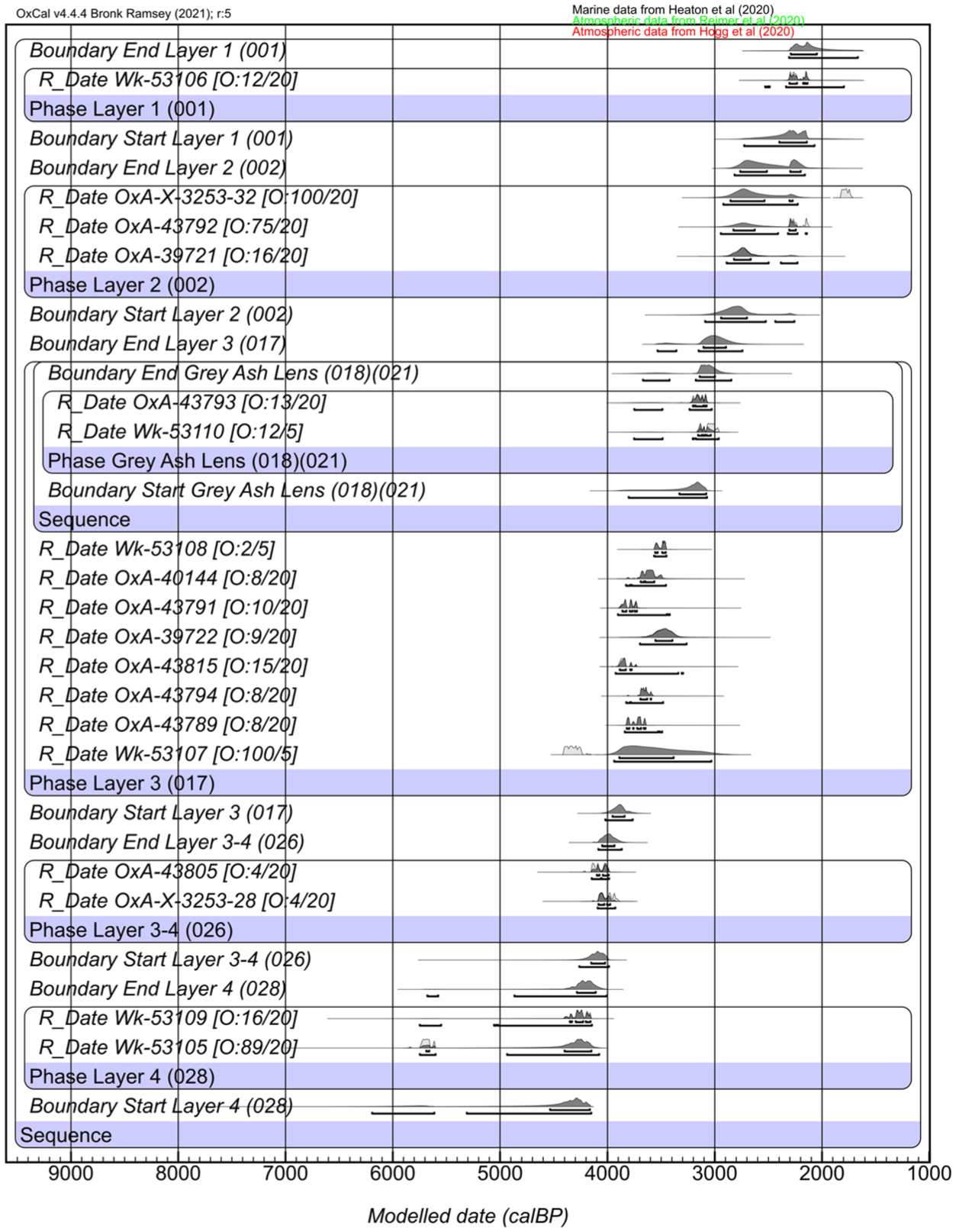
The Bayesian age model to estimate the date of the first pottery appearance at Mololo Cave’s Trench 1. The majority of the pottery sherds in Trench 1 have been found in Layer 2 (002) and a few undiagnostic pottery sherds have also been recovered from Layer 3 (017).
For the comparison with other sites in the broader region, models, as defined by the referred literature, have been rerun using published codes and/or images. The Uattamdi 1 model was rerun following the published Bayesian model (Fig. 5.5; Bellwood et al., 2019c) and radiocarbon dates (Table 1.1; Bellwood, 2019). Note the calibration difference with the original publication. Here, calibration is against a mixed curve (50%), IntCal20 (Reimer et al., 2020) and SHCal20 (Hogg et al., 2020), and Marine20 (Heaton et al., 2020). The Tanjung Pinang model has been built following the stratigraphy and radiocarbon dates already published (Table 1.1; Bellwood, 2019; Bellwood et al., 2019b). The ΔR (−102,11) was applied. Given the lack of a local estimation, this value has been calculated by averaging Wk-20350 and Wk-21068 (Petchey and Ulm, 2012). From the Pacific current directions (Gordon, 2005; Metzger and Hurlburt, 1996), it could be assumed that the marine current passing through northern Papua New Guinea is the same one bordering Morotai Island. However, a site-specific value would increase the accuracy of the estimations. A ‘General’ t-type Outlier model was used to allow samples to be both younger and older than expected (Bronk Ramsey, 2009b). The model for the Pulau Ay 1 site has been built following the published stratigraphy and radiocarbon dates (Lape et al., 2018). A ‘General’ t-type Outlier model was also used for this model (Bronk Ramsey, 2009b). The Talepekemelai (ECA) W200 and W250 Transect models reported in this study are reruns from published models (Tables 5.2 and 5.4 for the radiocarbon dates and Figures 5.4 and 5.7, respectively, for the Bayesian models) (Kirch et al., 2021). Note the calibration difference, here against a mixed curve (50%), IntCal20 (Reimer et al., 2020) and SHCal20 (Hogg et al., 2020) and Marine20 (Heaton et al., 2020). Finally, the Makekur model was a re-run from the preferred model in Hogg (2024), with a ∆R = 12 ± 60. The calibration is against a mixed atmospheric curve, 50% mix between IntCal20 and SHCal20 and the marine curve Marine20 (Heaton et al., 2020; Hogg et al., 2020; Reimer et al., 2020).
Results
Trench 1
To estimate the date of pottery deposition in Mololo Cave’s Trench 1, one multi-phased Bayesian age model has been built with 18 radiocarbon dates (nine from this study and nine from Gaffney et al. (2024) (Supplemental Information and Table 1) (Figure 4).
Figure 4 is a multi-phase Bayesian age model that estimates the chronological span for Layer 1 (Context 001), Layer 2 (002), Layer 3 (017), Layer 3/4 (026), Grey Ash Lens (018/021), and Layer 4 (028) in Trench 1. The model converged well (i.e. >95% convergence values), which implies that the MCMC analysis has provided a representative posterior distribution. The stratigraphy and selected samples are generally coherent according to the model, despite some vertical displacement that will be discussed in the following section.
Mololo’s Trench 1 model also estimates the ages of features like middens (023) and hearths (014, 024), which provide direct evidence of human activity at the site. The ages of these features have been estimated using single radiocarbon dates, since the radiocarbon samples found within these features have been integrated into Phases to define the stratigraphic units of the Bayesian model. Midden (003) has been dated to 3565–3451 cal BP (Wk-53108), hearth (014) is estimated to be 3752–2963 cal BP (Wk-53110), and hearth (024) has been modelled to be 3938–3032 cal BP (Wk-53107).
Trench 2
To estimate the date of the first pottery appearance at Mololo Cave’s Trench 2, a multi-phased Bayesian age model (Figure 5) has been built with 11 radiocarbon dates sourced from Gaffney et al. (2024) and three radiocarbon-dated samples from the 2023 excavation expansion (Supplemental Information).
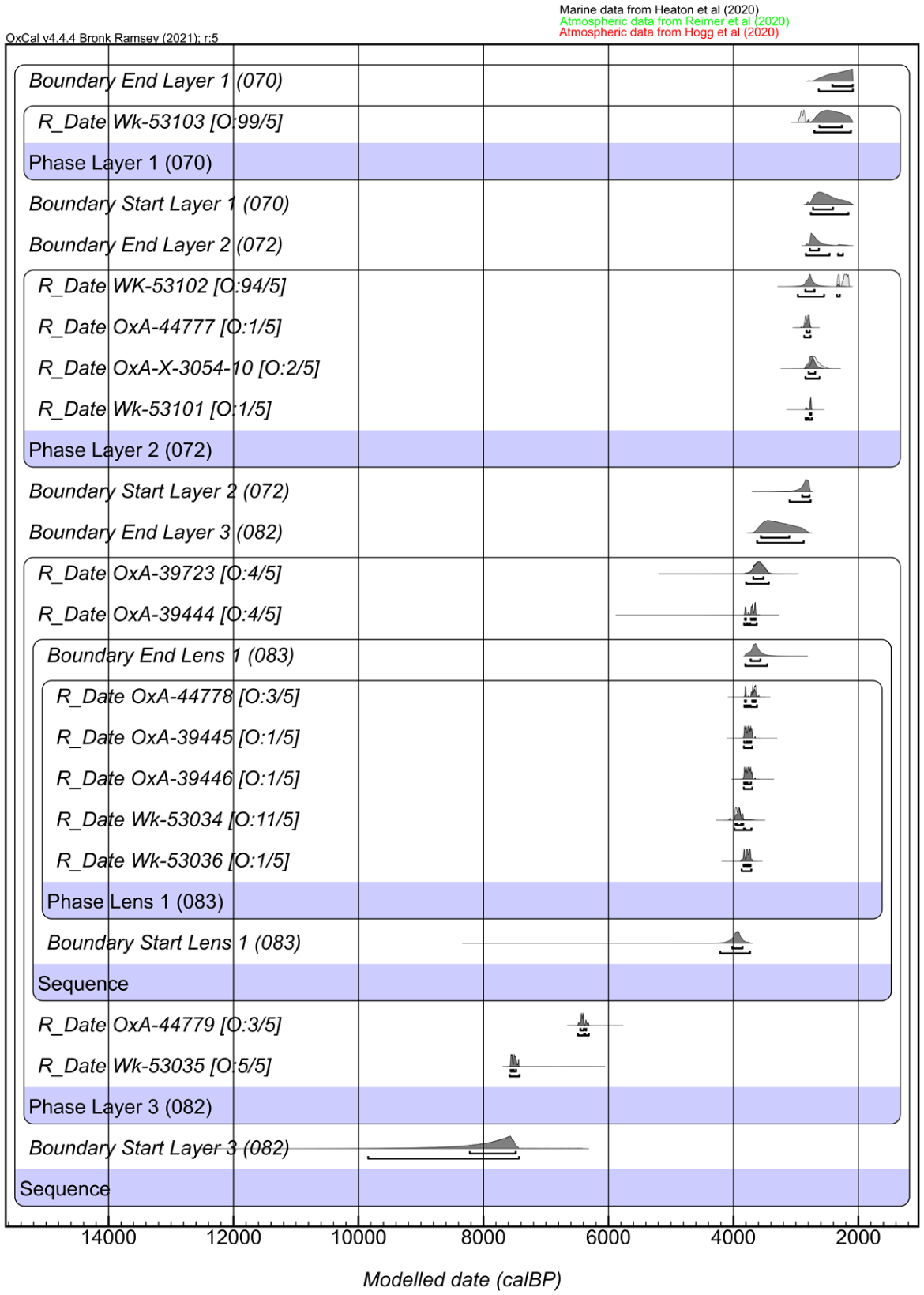
The Bayesian age model to estimate the date of the first pottery appearance at Mololo Cave’s Trench 2. The majority of the pottery sherds in Trench 2 appeared in Layer 2 (072).
Trench 2’s Bayesian model is well-converged (i.e. >95% convergence value), implying that the MCMC has provided a representative posterior distribution. The model confirms Gaffney’s (2021) assumption that Lens 1 (083) was deposited while Layer 3 (082) was still forming. When considering the parallel deposition of Layer 3 (082) and Lens 1 (083), which is reflected by including Lens 1 (083) into Layer 3 (082) in the model, Trench 2’s chronostratigraphy is coherent. The only exceptions are two potential inversions in Layer 1 (070) and Layer 2 (072).
Bayesian age model reruns from surrounding sites
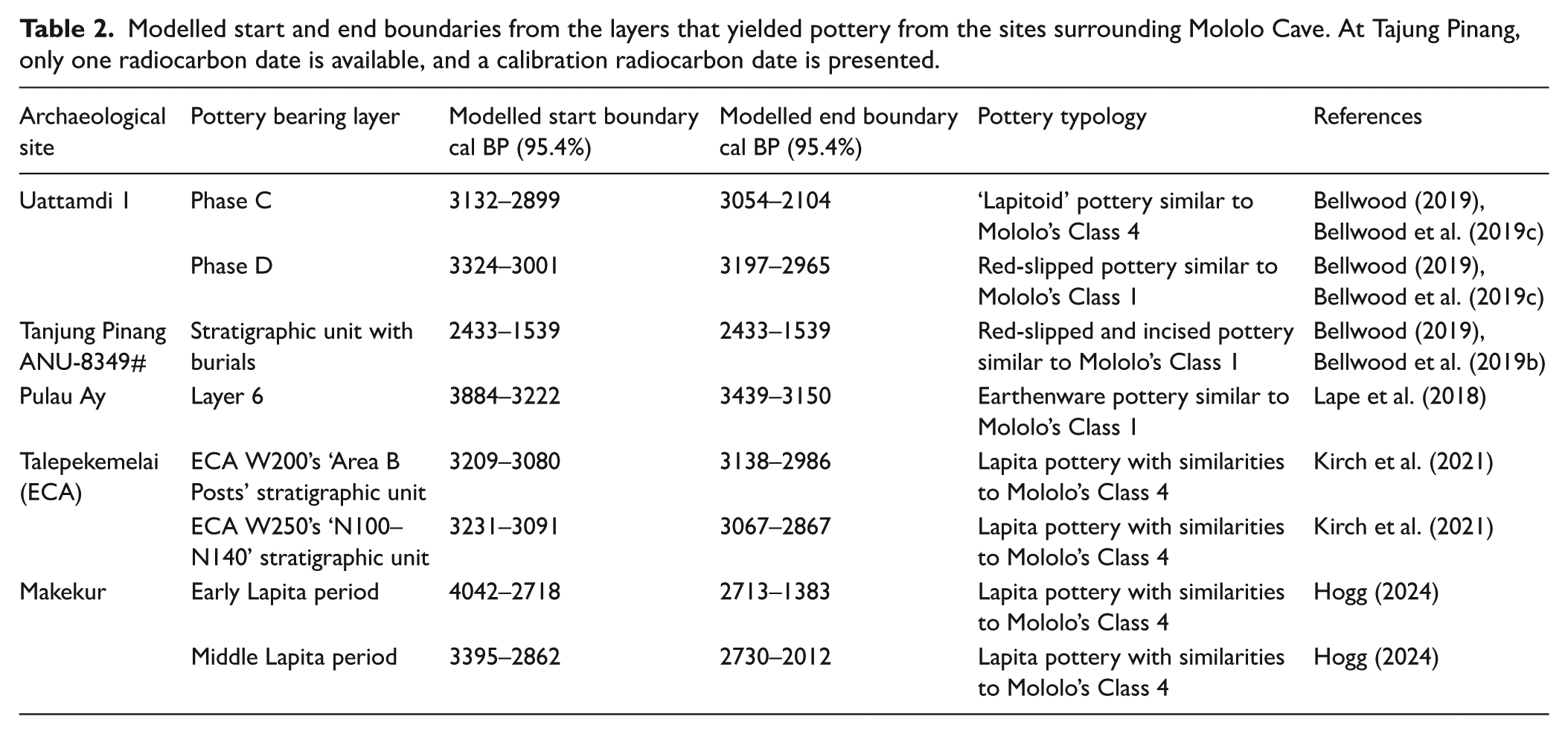
To make the chronological comparisons between Mololo and the surrounding sites, the start and end boundaries for the layers that yielded pottery in each site have been estimated from the rerun Bayesian models. These are reported in Table 2. The chronological comparison with Mololo Cave will be discussed in Figure 6 in the following section.
Modelled start and end boundaries from the layers that yielded pottery from the sites surrounding Mololo Cave. At Tajung Pinang, only one radiocarbon date is available, and a calibration radiocarbon date is presented.
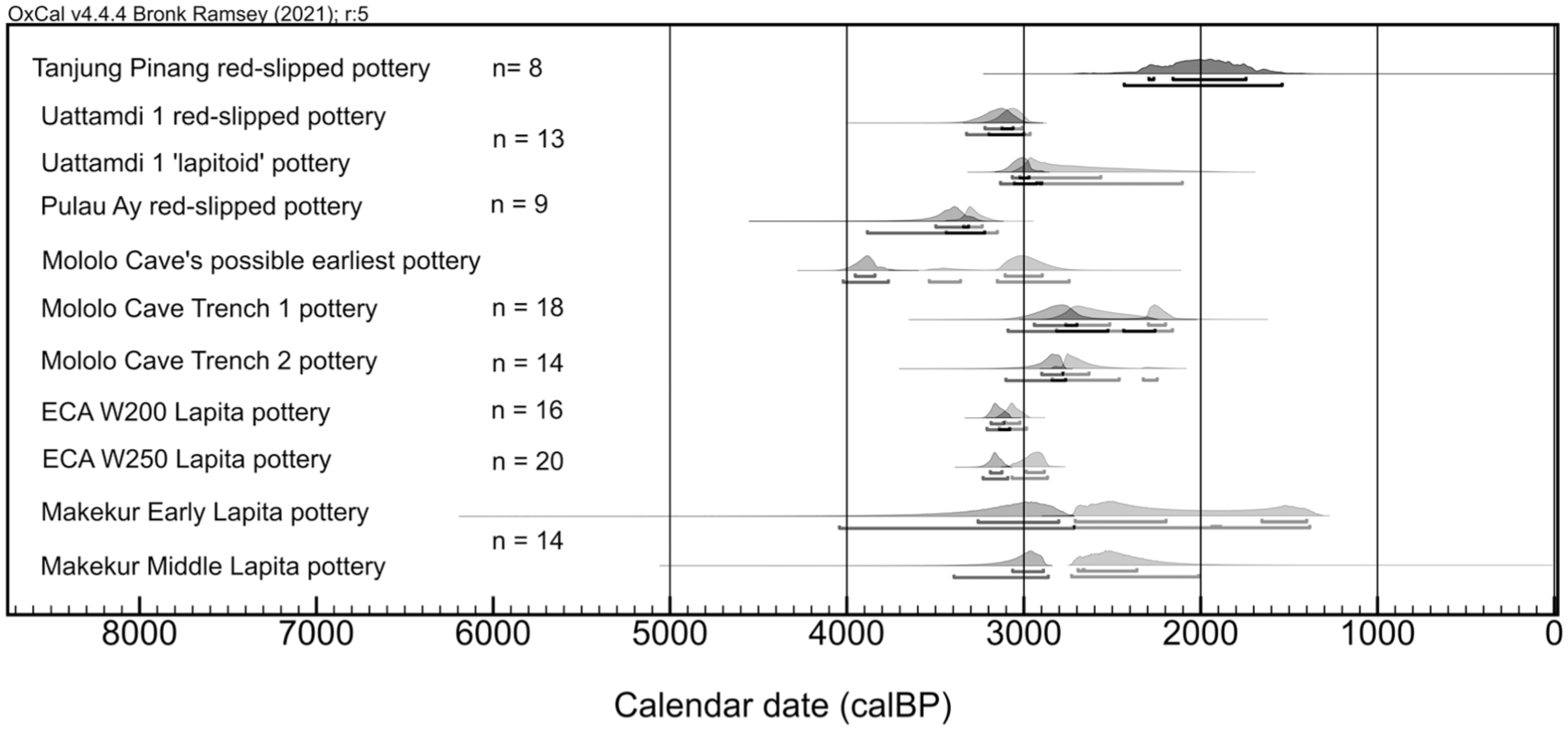
A chronological comparison of the first appearance of red-slipped and/or ‘lapitoid’ pottery at Mololo Cave, Uattamdi 1, Tanjung Pinang, Pulau Ay and Talepekemelai (ECA). The probability density functions are the start and end Boundaries of the stratigraphic unit where the pottery was found. At Tajung Pinang, only one radiocarbon date is available, and a calibration radiocarbon date is presented. At Mololo Cave, the earliest start and end boundaries of Trench 1 Layer 3 (017) were chosen to estimate the age of the possible earliest pottery sherds. The total number of radiocarbon dates used in each model is given for each site.
Discussion
Mololo Cave reports the earliest pottery deposits in West New Guinea. Mololo is also thus far the only site in the territory to use radiocarbon dates and Bayesian age models to estimate the first appearance of Mid-Holocene pottery. The aim of presenting new Bayesian age models for Mololo Cave was to increase the accuracy and precision of the previously ‘eyeballed’ chronological estimations (Gaffney and Tanudirjo, 2024) and enable quantitative comparisons with pottery chronologies from surrounding sites (following Bayliss, 2009). The new results for Mololo Cave presented in this paper, alongside the patchy regional radiocarbon record (most recently reviewed in Cochrane et al., 2021), allow us to critically evaluate the timing of Austronesian language dispersals and/or exchange networks involving Mid-Holocene pottery in the region (Figure 1).
Pottery depositional sequence at Mololo Cave
The age of the first pottery evidence at Mololo Cave is estimated from the two Bayesian age models presented for the site, one for each of the trenches (Figures 4 and 5). A model per trench was preferred over a general site-level one to include detailed stratigraphic information in the chronological estimations. In a Bayesian age model, the use of stratigraphic information as a prior can increase accuracy and precision as well as prevent statistical scatter, which could overestimate the boundaries and length of the archaeological event (Bayliss, 2009) (i.e. the first appearance of pottery at Mololo). The use of two individual Bayesian models was also intended to produce more accurate date estimations for Mololo’s Class 1 and Class 4 pottery styles, which were only collected from Trench 1 (Gaffney and Tanudirjo, 2024).
Trench 1
A Bayesian age model allows a quantitative estimation of the date of the start and end boundaries of each of the pre-defined stratigraphic units (Bronk Ramsey, 2009a; Figure 4). The newly modelled chronology for Trench 1 aligns with previous unmodelled estimations (Gaffney and Tanudirjo, 2024), and at the same time, estimates duration, increases precision and estimates uncertainties (Bayliss, 2009; Table 3).
New modelled chronology constraining the first pottery appearance at Mololo Cave.
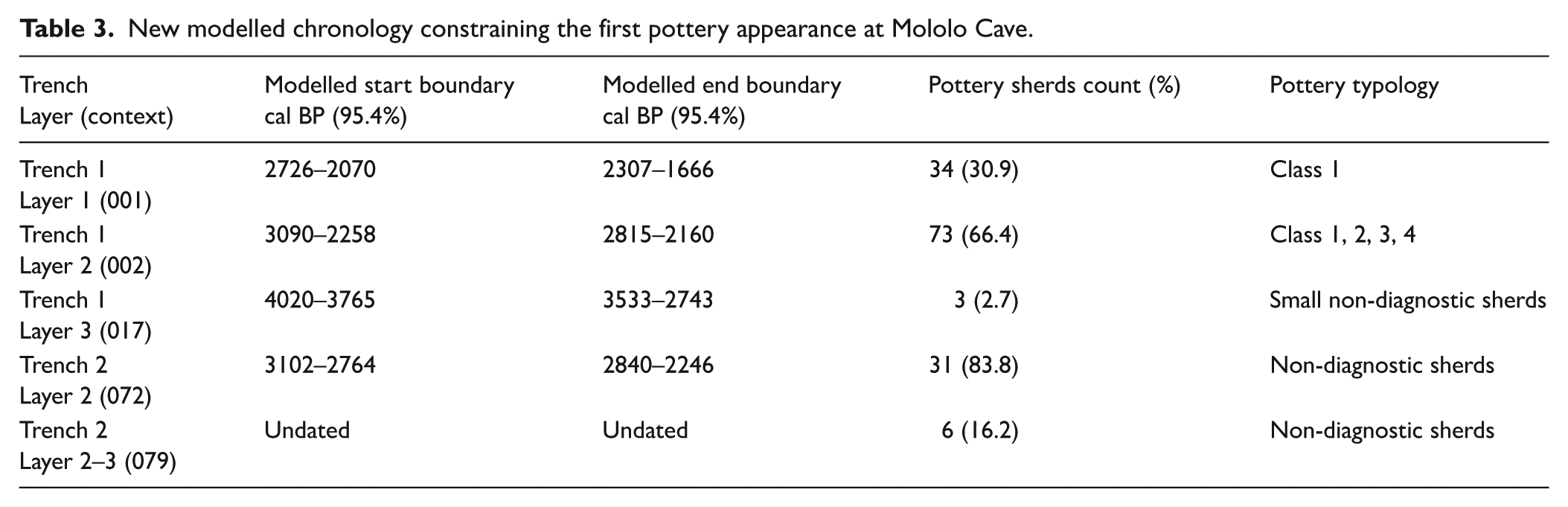
Three fragmentary plain-body sherds are the earliest evidence of pottery in Trench 1. The maximum estimate for the earliest deposition of non-diagnostic pottery is 4020–3765 cal BP (modelled start boundary for Layer 3 (017)). The lack of evidence for stratigraphic disturbance or modern introgressions, the coherence of the dated samples and good convergence of the Bayesian model phase corresponding to Layer 3 (017) suggest these earliest pottery sherds are in situ. Nevertheless, owing to the small size of the sherds (c. 2 g) and that they were recovered from the sieves (Gaffney and Tanudirjo, 2024), the possibility of this pottery resulting from more recent intrusions cannot be fully discounted without direct dating on the sherds themselves (Casanova et al., 2020, 2024).
The earliest sherds for each of the Mololo Cave’s four technical classes have been recovered from Spit 2, Layer 2 (002) (Gaffney and Tanudirjo, 2024). Unfortunately, despite the best efforts to contextualise each sample, the plant macrofossils found in closest stratigraphic association with the deepest pottery sherds from each technical class seem to have resulted from more recent vertical displacements. In consideration of this, pottery Class 2 and Class 3 (2920–2227 cal BP, OxA-X-3253-32), a possible vertical displacement from Layer 1 (001), appear to be as early as Class 4 (2943–2142 cal BP, OxA-43792). This Class 4, Lapitoid, sherd could be coherent with a Lapita chronology (Bedford, 2024). These interpretations are preliminary until more accurate and precise measurements are available. This situation is an example of the derived risks from estimating chronologies of pottery sherds with loose palaeobotanical material. As a broader assemblage, most of Mololo’s pottery was likely deposited between 3090–2258 cal BP (modelled start boundary for Layer 2 (002)) and 2815–2160 cal BP (modelled end boundary for Layer 2 (002)). Tentatively, OxA-43791, stratigraphically associated with the earliest but non-diagnostic pottery sherds in Trench 1, could extend this age estimate to 3903–3420 cal BP. Because the major difficulty stems from the challenges to identify non-spurious stratigraphic associations at the site, despite the best efforts to contextualise the material three-dimensionally, direct dating of the pottery sherds could be the only option to increase the accuracy and precision of the currently proposed chronologies (Casanova et al., 2020, 2024).
Trench 2
The age model from Trench 2 supports the pottery chronological estimates from Trench 1, although it contains scarcer material. Material evidence from this trench is included in the Late-Holocene pulse of activity in the cave and is characterised by oven stones and marine shells (Gaffney, 2021). These deposits have been defined as habitation and midden deposits from c. 3000 years ago, specifically proposed as cooking events dating from 4100–3900 cal BP to 2350–2150 cal BP (Gaffney and Tanudirjo, 2024). The pottery sherds at Trench 2 are not sufficiently diagnostic to be classified as specific technical classes. For instance, none of the sherds found in Trench 2 or Test Pit 2 retain rims or shoulder carinations (Gaffney and Tanudirjo, 2024).
The newly modelled dates for pottery appearance in Trench 2 are also coherent with the previous chronological estimates by Gaffney and Tanudirjo (2024). Ceramic sherds have solely been found in Layer 2 (072) (n = 31, 83.7%) (Gaffney and Tanudirjo, 2024), with a modelled start boundary of 3102–2764 cal BP and modelled end boundary 2840–2246 cal BP, and transitional Layer 2–3 (079) (n = 6, 16.2%), which is currently undated but appears to relate to a diffusion of material from Layer 2. Specifically, most of the sherds at Trench 2 (n = 29, 78.4%) seem to come from a single deposition event at the base of Spit 5 in Layer 2 (072) (Gaffney and Tanudirjo, 2024). The lowermost sherds recovered from Trench 2, Spit 6, Layer 2–3 (079) have yet to be dated. The three radiocarbon-dated samples from the most recent excavation extension in 2023 (i.e. OxA-44777, OxA-44778, OxA-44779) confirm the Mid-Holocene activity in this trench. Trench 2’s Bayesian age model suggests that deposition in this area of the cave was coherent, with fewer cases of vertical displacements compared to Trench 1. Nonetheless, direct dating on the pottery could be useful to target Trench 2’s earliest sherds from Spit 6, Layer 2–3 (079), increase the accuracy and precision of the current chronology, and clarify whether the pottery deposition in this area is a single deposition event or not, and how it possibly relates to the ceramic deposits in Trench 1. However, the direct dating approach needs to consider the possibility of low lipid contents in the pottery and these being subject to a possible marine reservoir effect (Leclerc et al., 2018).
The newly modelled results support the previous interpretation that pottery-bearing communities were using both Area 1 and Area 2 of Mololo Cave c. 3000 years ago. However, this attempt to better define when pottery first appeared at the site is still imprecise, owing to the intrusive nature of some of the radiocarbon-dated plant macrofossils. Mololo Cave’s case study illustrates the challenges of defining a secure chronostratigraphy to estimate the chronology for the initial pottery depositions in cave sites, which is one of the causes for the patchy radiocarbon record in the region. It highlights the benefit of collaboration between site excavators and radiocarbon specialists when building Bayesian age models, and demonstrates the need for detailed publication of site stratigraphy and radiocarbon quality assurance data to enable others to construct alternative models in the future.
Chronological comparisons to surrounding sites
One of the advantages of using Bayesian age models is the ability to statistically compare the chronology from different sites. Bayesian modelling allows the estimation of uncertainties and yields probability density functions for the age estimates (Bayliss, 2009). As such, the comparison of the date estimates between the first ceramic depositions at Mololo Cave and at sites with similar pottery assemblages allows us to assess how Austronesian-speaking populations moved material culture between eastern Indonesia and western Near Oceania.
To identify statistically significant differences between the date of initial pottery deposition at the different sites, such a comparison requires age estimates derived from secure radiocarbon dates and robust Bayesian age models (Bayliss, 2009; Bronk Ramsey, 2009a). However, due to the challenges encountered in building chronologies both at Mololo Cave and at a regional level, this section assesses how much can be inferred about regional Austronesian speaking dispersal routes. The comparison of Mololo Cave with other sites in the region is a useful illustration of how a patchy radiocarbon record can affect the identification of regional Mid-Holocene population movements and networks. As illustrated by Mololo Cave, the most reliable and robust Bayesian age models require detailed knowledge of the stratigraphy, the selected radiocarbon–dated samples (including considerations of their associations with the studied archaeological event, if indirectly dated), and the targeted archaeological events. This information is the robust prior information to then reliably estimate the age of the archaeological event in question (Bayliss, 2009, 2015).
Among the sites with pottery assemblages morpho-stylistically similar to those of Mololo Cave, only Uattamdi 1, Talepekemelai and Makekur include Bayesian age models designed with direct involvement from the excavators. Uattamdi 1 shelter (Kayoa Island) is one of the most prominent Mid-Holocene sites in ISEA, reporting both red-slipped and pottery sherds similar to Mololo’s Class 4 (Lapitoid) pottery (Bellwood et al., 2019c, Figure 5.5). Talepakemelai (ECA) in the Mussau Islands (Bismarck Archipelago) is among the earliest and largest sites with Lapita pottery, serving as a key reference in defining this pottery typology (Kirch et al., 2021). Makekur (FOH) in the Arawe Islands is one of the few sites with Early Lapita pottery that also has a continuation into the Middle Lapita period. Similar to Tapelekemelai, Makekur is one of the Lapita reference sites (Hogg, 2024; Kirch et al., 2021; Summerhayes, 2000, 2001, 2010). While the most reliable chronological estimations stem from Bayesian age models created by the excavators, it is important to note the uncertainties surrounding the date estimation of the earliest pottery emergence due to the absence of direct dates on the pottery sherds. Similar to the case of Mololo Cave, the Bayesian age models for Uattamdi 1, Talepekemelai and Makekur define the chronostratigraphy of their respective sites using radiocarbon dates on wood and charred or dried plant macrofossils, bone, tooth enamel, and marine shell samples found in spatial and stratigraphic association. Date estimation for the pottery deposits was derived from the modelled boundaries of the stratigraphic units. This limitation is evident in the reduced precision and accuracy acknowledged by the excavators regarding the date estimations of the deposition of sherds at Uattamdi 1, resembling Mololo Class 4 pottery-like sherds at Uattamdi 1 (Bellwood et al., 2019c). The advantage of the Talepekemelai and Makekur sites over Uattamdi 1 and Mololo is that they are open sites with fewer complications in the association between dated material and the pottery.
Bayesian age models can be built from the literature when a detailed stratigraphy and location of the radiocarbon-dated samples are reported in the original publications (Bayliss, 2009, 2015). This is the case for Tanjung Pinang and Pulau Ay. Tanjung Pinang (Bellwood, 2019; Bellwood et al., 2019b) is a rock shelter reporting red-slipped pottery with incised decorations similar to Mololo Cave’s Class 1 ceramics. Pulau Ay (PA1) is an open-air site with early earthenware pottery (Lape et al., 2018), also overlapping chronologically with Mololo’s possible earliest pottery sherds. However, this approach risks potential unknown oversights or biases when assessing the chronostratigraphy of the studied site or radiocarbon measurements.
Aru Manara and Apalo contain pottery assemblages overlapping respectively with Mololo Cave’s Class 1 and Class 4 pottery, and illustrate the complexities derived from building Bayesian age models just with the data from the literature. Aru Manara is a burial site from the Late Neolithic and the Early Metal Age of northern Maluku (Ono et al., 2018). However, other than the radiocarbon ages, little associated information is published. Of the thirteen samples, six are on human teeth, and it is unclear whether collagen or bioapatite was dated, noting that the latter is likely to underestimate the age (Bellwood et al., 2019c; Wood et al., 2016; Zazzo, 2014), and information on yield and C: N is not recorded to assess the accuracy of dates on collagen. Without δ13C and δ15N, it is not possible to assess whether the dates are affected by the marine reservoir effect (Alves et al., 2018), which is poorly defined for the region (Petchey et al., 2013).
Similarly, Apalo is a beachfront site on Kumbun Island in the Bismarck Archipelago with Early Lapita pottery sherds that were recovered within a complex horizontal stratigraphy (Specht et al., 2017; Summerhayes, 2000). In this case study, it is not easy to identify the stratigraphic prior information that would constrain the first pottery appearance at the site without further involvement of the excavators.
There are also archaeological sites that, for different reasons, do not have sufficient radiocarbon dates to build a statistically robust Bayesian age model (i.e. do not reach the minimum of five dates; Bronk Ramsey, 2009a). In this regional comparison, Buwawansi 3 and 5 sites, on Gebe Island, illustrate this situation. Buwawansi 3 and 5 belong to a larger rock shelter complex that was dated with six radiocarbon samples spanning several sites (Bellwood et al., 2019b). The lack of a clear stratigraphy, as suggested by the excavators, further limits the possibility of building a chronostratigraphy at the site level to estimate the date of the carinated pots, which are similar to Mololo Cave’s Class 1 pottery (Bellwood et al., 2019b; Gaffney and Tanudirjo, 2024).
Early Lapita pottery sites like Paligmete (FNY) and Kamgot (ERA) do not report sufficient radiocarbon dates to build Bayesian age models either. Paligmete (FNY) in Pililo island has reported five radiocarbon dates across five test pits (Gosden and Webb, 1994; Specht and Gosden, 1997; Summerhayes, 2000). Summerhayes (2001) urges caution with three of these radiocarbon dates, as there are signs of redeposition due to storm action. Given the limited radiocarbon dates and the signs of redeposition, a Bayesian age model for Paligmete has not been built for this chronological assessment. Kamgot (ERA) in Babase Island has reported four reliable radiocarbon dates (Summerhayes, 2001), which are not sufficient to build a Bayesian age model for the site.
Out of the 10 sites with pottery assemblages similar to Mololo Cave’s (Gaffney and Tanudirjo, 2024), Bayesian age models to estimate the age of the first pottery depositions in eastern Indonesia can only currently be built for Uattamdi 1 and Pulau Ay (PA1). Tanjung Pinang contains one radiocarbon date on human bone found close to ceramic fragments (Bellwood et al., 2019b). Further east, Lapita sites like Talepekemelai (ECA) and Makekur (FOH) can also provide important age constraints. In other words, the pottery chronology at Mololo Cave can only be quantitatively compared with these five surrounding sites. Bayesian age models cannot currently be built for the remaining three sites (i.e. Aru Manara, Apalo, Buwawansi 3 and 5) for the reasons argued above.
Beyond a rough estimate of when red-slipped pottery first appeared (Figure 6), the current radiocarbon record does not allow for a precise evaluation of when Austronesian-speaking populations moved into eastern Indonesia and West New Guinea. Given that the challenges primarily stem from identifying relevant stratigraphic associations between the radiocarbon-dated samples and the pottery deposits, the solution could be to directly radiocarbon-date the pottery sherds. When possible, directly radiocarbon dating the archaeological event of interest is deemed as best practice (Waterbolk, 1971). Compound-specific dating on lipid residues found in ceramics has proven potential to be a reliable method to build pottery chronologies (Casanova et al., 2020, 2024; Leclerc et al., 2018; Stott et al., 2003). There are likely to be challenges when dating lipids in tropical settings relating to low lipid content associated with poor preservation in tropical climates, and possible marine reservoir effects, although marine food was probably not stored in Lapita pottery (Leclerc et al., 2018). Methodological developments in this area could provide a more accurate way to evaluate the arrival of pottery makers to the region. However, given the added expense of this method, parallel efforts to continue site-level radiocarbon dating strategies and Bayesian age modelling are also necessary to advance the clarification of the pottery arrival chronology in the western Pacific.
Besides the chronological challenges, these kinds of comparisons should also consider the limitations of the archaeological record and taphonomic bias. As such, open-air and cave sites of heterogeneous sizes tend to be compared in the same models. However, Glover (1972, 1986) and Spriggs (2011) have argued that cave sites host more sporadic activities than open-air sites, which are usually harder to find in lower latitudes. Additionally, Gaffney and Tanudirjo (2024) suggest that pottery might differ functionally and stylistically between cave and open-air sites. Finally, we chose not to compare the newly modelled dates for the first pottery appearance at Mololo Cave to the regional-level analysis by Cochrane et al. (2021). Although their discussion is built on Bayesian age models also targeting the earliest pottery assemblages in ISEA and the Bismarck Archipelago, their Bayesian modelling at the island level ran into many of the same issues relating to confidently determining associations between radiocarbon samples and pottery. It would be challenging to include these island-level models in the same comparison with the site-specific Bayesian age models presented in this paper.
Conclusion
Mololo Cave has yielded the earliest pottery deposits in West New Guinea, a key region between eastern Indonesia and Near Oceania for studying the Mid-Late-Holocene population movements and maritime networks. If pottery can be used as an approximate proxy for the movement of Austronesian speakers, the reliable dating of overlapping pottery assemblages could help identify expanding population dynamics and temporal relationships between the respective sites. To achieve reliable conclusions, a chronology derived from secure radiocarbon dates and robust Bayesian age models is essential.
This paper updates the date estimations for the four different pottery technical classes found at Mololo Cave. The earliest sherds for each technical class were all recovered in Layer 2 (002) from Trench 1, with a modelled start boundary of 3090–2258 cal BP and a modelled end boundary of 2815–2160 cal BP. Mololo’s Class 1 is very similar to pottery sherds found in the nearby Uattamdi 1 site, but the dates are currently unclear due to the sherds occurring in different layers. Preliminarily, Class 2 and Class 3 pottery could have been deposited as early as Class 4, Lapitoid, sherds. Mololo’s Class 4 tentatively resembles outcurving Lapita pots and chronologically overlaps with Lapita pottery further east.
Despite the significant efforts to constrain the age of the earliest pottery sherds at Mololo Cave with stratigraphically associated radiocarbon samples, the site appears to follow the regional pattern of cave and rockshelter sites with a complex stratigraphy that makes it difficult to closely associate artefacts with datable material. As a result, 3090–2258 cal BP (i.e. the modelled start boundary of Layer 2 (002), the stratigraphic unit with the major pottery deposition) is currently the most reliable date estimate for the earliest deposition of pottery at Mololo Cave. Similar stratigraphic challenges exist in the 10 surrounding sites previously selected for comparison with Mololo due to their overlapping pottery deposits. Among these regional sites, based on the available radiocarbon data, reliable Bayesian age models can only be built for Uattamdi 1, Tanjung Pinang, and Pulau Ay, with Lapita sites like Talepekemelai and Makekur being important comparisons (Bellwood, 2019; Bellwood et al., 2019b, 2019c; Hogg, 2024; Kirch et al., 2021; Lape et al., 2018). Following the regional trend, challenges in defining the chronostratigraphy of these sites lead to significant errors in the date estimates, ultimately limiting the identification of population dynamics. The conclusions of this paper align with the literature in observing a regional trend of substantial variation in pottery date estimations due to stratigraphic challenges faced at regional sites. The way forward for understanding Mid-Holocene Austronesian speaker dispersal patterns may depend on higher-resolution chronologies derived from direct dating of the pottery sherds.
Supplemental Material
sj-pdf-1-hol-10.1177_09596836251407606 – Supplemental material for Bayesian chronological modelling for early pottery in the far western Pacific: Evidence from the Raja Ampat Islands of West New Guinea
Supplemental material, sj-pdf-1-hol-10.1177_09596836251407606 for Bayesian chronological modelling for early pottery in the far western Pacific: Evidence from the Raja Ampat Islands of West New Guinea by Silvia Tardaguila-Giacomozzi, Rachel Wood, Stephanie Anna Florin, Daud Tanudirjo, Abdul Razak Macap, Erlin Novita Idje Djami, Tristan Russell and Dylan Gaffney in The Holocene
Supplemental Material
sj-xlsx-2-hol-10.1177_09596836251407606 – Supplemental material for Bayesian chronological modelling for early pottery in the far western Pacific: Evidence from the Raja Ampat Islands of West New Guinea
Supplemental material, sj-xlsx-2-hol-10.1177_09596836251407606 for Bayesian chronological modelling for early pottery in the far western Pacific: Evidence from the Raja Ampat Islands of West New Guinea by Silvia Tardaguila-Giacomozzi, Rachel Wood, Stephanie Anna Florin, Daud Tanudirjo, Abdul Razak Macap, Erlin Novita Idje Djami, Tristan Russell and Dylan Gaffney in The Holocene
Footnotes
Acknowledgements
We thank the Warsambin and Lopintol communities who permitted excavation at Mololo Cave and supported fieldwork. Excavation assistants included Moses, Melkion, Olos, Nathanial, Otniel, Otto, Robert, Isak, Demianus, Demersis, Septinus, Peter, Yan, Fernandes and Paul. Fieldwork was carried out under Indonesian research permit 359/SIP/FRP/E5/Dit.KI/X/2018. We are also grateful to two anonymous reviewers for their helpful comments and constructive feedback.
Author contributions
Funding
The authors disclosed receipt of the following financial support for the research, authorship, and/or publication of this article: Fieldwork was funded by a National Geographic Explorer Grant, Evans Fund Fellowship, University of Cambridge School of the Humanities and Social Sciences Research Grant, Magdalene College Anthropology and Archaeology Fund, Leakey Foundation Research Grant. Initial radiocarbon dating was undertaken with the support of Royal Anthropological Institute Horniman and Sutasoma Awards, the Evans Fund and NRCF (NERC) Radiocarbon Fund. The new radiocarbon dating was undertaken with the support of the Clarendon Fund Scholarship, University of Oxford.
Ethical approval and informed consent statements
The Warsambin and Lopintol communities permitted excavation at Mololo Cave and supported fieldwork. Ethical approval was obtained from the Indonesian government (permit 359/SIP/FRP/E5/Dit.KI/X/2018). Separate permission was obtained from provincial (Papua Barat), regency (Kabupaten Raja Ampat), district (Distrik Teluk Mayalibit) and village level (Kampung Warsambin and Kampung Lopintol).

Data availability statement
All the data used in the paper are available via the Supplementary Information files.
Supplemental material
Supplemental material for this article is available online.
References
Supplementary Material
Please find the following supplemental material available below.
For Open Access articles published under a Creative Commons License, all supplemental material carries the same license as the article it is associated with.
For non-Open Access articles published, all supplemental material carries a non-exclusive license, and permission requests for re-use of supplemental material or any part of supplemental material shall be sent directly to the copyright owner as specified in the copyright notice associated with the article.
