




Abstract
Around 8200 years ago, the Storegga tsunami hit the west coast of South Norway. The physical extent of the tsunami has been well documented but the consequences of the event for contemporary societies have received little attention beyond broad generalizations and, more recently, demographic studies based on statistical modeling of radiocarbon dates. In this paper, we explore whether the different physical impacts of the Storrega tsunami could have initiated observed regional developments in lithic technology. We have analyzed lithic assemblages from 30 carefully selected Middle and Late Mesolithic sites (dated between c. 7500 and 5000 cal BC) spread across six designated “focus areas” along the coast of western South-Norway. We identified five blade production concepts in use during the Late Mesolithic and highlight potentially significant differences in their spatial and temporal distribution. Although neither the tsunami nor the environmental stresses experienced by Mesolithic communities appear to have prompted large breaks in traditional practices, we suggest that the event marks a point in time from where specific differences and modifications in lithic technology start developing at a local scale. We argue that sudden, yet transitory events such as the Storegga tsunami, may rupture the historical contingency of social networks and communication lines resulting in changing social contexts influencing material change.
Keywords
Introduction
Through consideration of long-term trends in lithic technology, this paper aims to provide new perspectives on the human impact of the massive Storegga tsunami that occurred ca. 6200 BC (8200 cal BP). We argue that changes do not necessarily need to be major or abrupt to signify a dramatic event impacting social life in the Mesolithic hunter-fisher-gatherer communities in western South-Norway.
The Storegga tsunami was triggered by the world’s largest known submarine landslide that occurred off the coast of Møre in western Norway c. 6200 BC (Figure 1). The impact and extent of the tsunami has been identified through distinct stratigraphic layers in lakes and bogs around the North Sea coast (e.g. Bondevik et al., 1997, 2003, 2012; Dawson et al., 1988, 1990; Dawson and Smith, 2000; Løvholt et al., 2017; Svendsen, 1985). Although a large-scale and dramatic event, recent numerical simulation of the tsunami’s peak run up in western Norway, shows that there were in fact great regional and local variations in the impact of the tsunami along the coast depending on topography, bathymetry, and proximity to the propagation center (Walker et al., 2024; Figure 1).
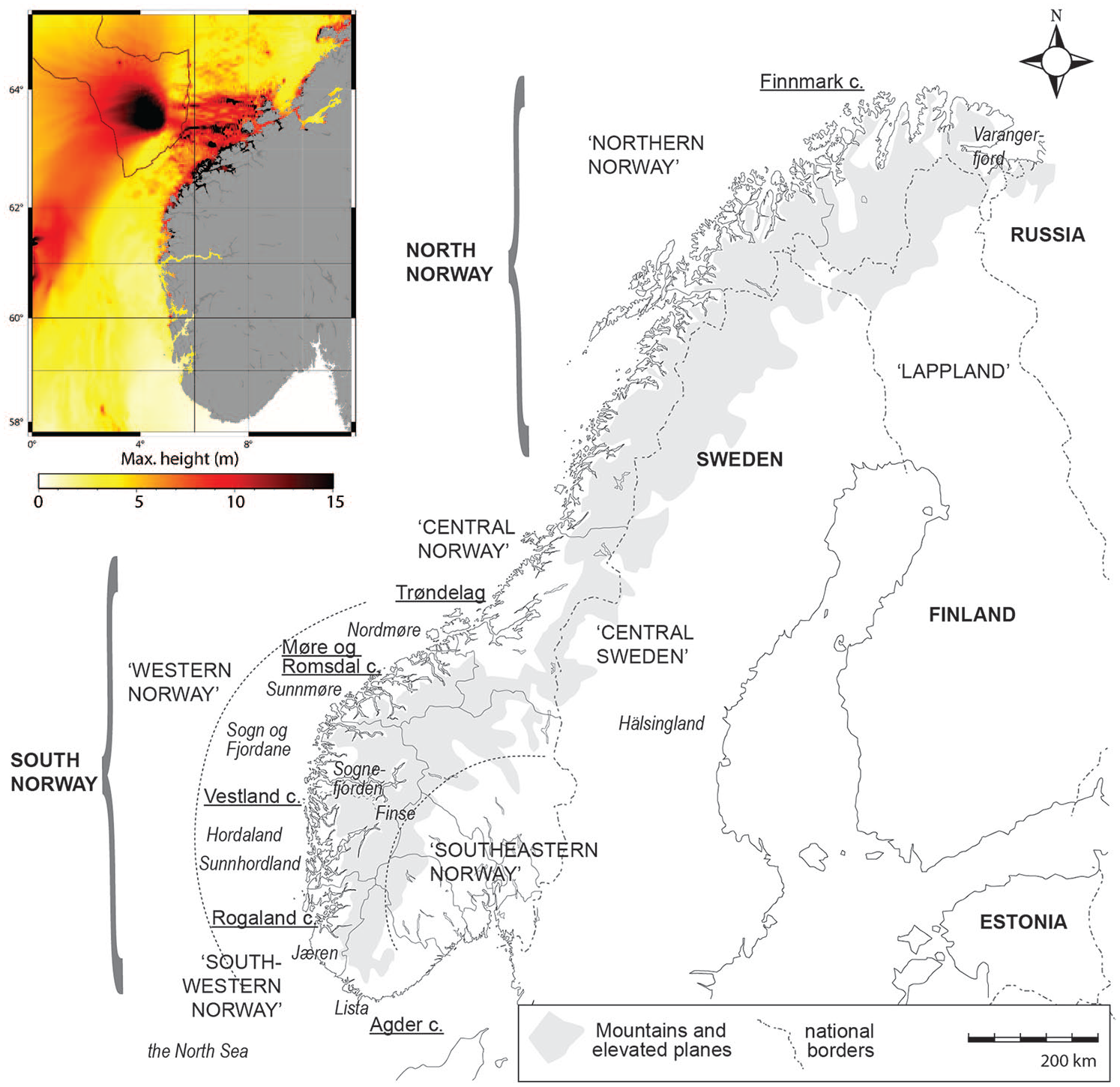
Map with area and placenames (narrow italic) and regions (quotation caps lock), counties (underlined regular font), nations (bold) used in text. Upper left corner shows model with maximum height of water attained during simulation of the Storegga tsunami (affected area marked with red line outside Møre; Ill.: Astrid J. Nyland and Steven Gibbons, NGI).
The tsunami occurred during the coldest phase of the 8.2 ka climatic cold event (Bondevik et al., 2012), which is among the best documented climate oscilliations in the Early and Mid-Holocene. Impact of abrupt climatic events and natural hazards such as tsunamis on prehistoric human societies is not conditioned solely by physical or ecological aspects. To understand any potential social impact of a crisis, factors determining the vulnerability or resilience of the affected communities must also be identified and considered (e.g. Barrios, 2017; Oliver-Smith, 1996; Nyland et al., 2021; Oliver-Smith, 1996). The society that experienced the tsunami and climate changes, in western Norway comprised highly marine orientated hunter-fisher-gatherers with settlements situated at, or close to, the contemporary shorelines (e.g. Bergsvik, 2001; Bjerck, 2008). Interpretations of impact leaves an image of a vulnerable society. That is, despite the paucity of detailed inter-regional archeological studies, the aftermath of the Storegga tsunami has been presumed to have been “catastrophic” and linked to demographic and cultural changes in several regions of Northern Europe (Sharrocks and Hill, 2024; Waddington and Wicks, 2017). However, seeing that the environmental effects of the Storegga tsunami and the 8.2 ka event varied greatly from region to region (cf. Alley et al., 1997; Alley and Agustsdottir, 2005; Antonsson and Seppä, 2007; Barber et al., 1999; Clarke et al., 2004; Kobashi et al., 2007; Nesje et al., 2005; Seppä et al., 2007, 2009; Thomas and Via, 2007; Veski et al., 2004; Walker et al., 2012), like the tsunami impacts, the experiences of these events would vary too. In fact, this would have created different local and regional social contexts for traditions to develop in (Nyland and Damlien, 2024; Walker et al., 2024). This has consequences for the material considered, and scope of units investigated.
With presumed varied local impact as premise, the scale of investigation is also necessary to consider if we are to enable identification of local responses to a tsunami encounter. That is, understanding causes for potential change or continuity, requires cross-regional comparative studies of developments in local areas over time. In western Norway, the Storegga tsunami coincides roughly with the chronological shift from the Middle to the Late Mesolithic, at c. 6500 BC. With few exceptions (e.g. Bergsvik and Olsen, 2003; Olsen and Alsaker, 1984; Skjelstad, 2003), the Middle and Late Mesolithic lithic material from the west coast of South Norway is normally synthesized as one “analytical unit” (Bjerck, 1986, 2008). This approach may in part be a result of the effects of the encroaching sea, that is, the marine Tapes transgression (c. 8000–6500 BC; Bjerck, 2008: 68) which present an obstacle to studies of lithic assemblages and sites from the Middle Mesolithic. Consequently, a detailed understanding of developments in lithic traditions on an intra-regional, or even local level, is lacking.
Our study includes the counties of Møre og Romsdal, Vestland and Rogaland, encompassing an area generally discussed in the literature as “western Norway.” The large geographical unit is divided here into six smaller study areas to acknowledge the value of investigations taking local variation in social context into account (Nyland and Damlien, 2024). We analyze lithic assemblages with the aim of identifying raw material exploitation and use, and blade production concepts 1 at Middle and Late Mesolithic sites (7500–5000 BC) within the six focus areas (Figure 2). Blades were the principal blanks for tool production in the Mesolithic of Norway, and indeed in Northern Europe (Bjerck, 2008). They were obtained through different production methods and core types varying in time and space (Kozlowski, 2009). Blade technology therefore provides a relevant focus for tracking continuity and change in cultural behavior, and for understanding material culture diversity.
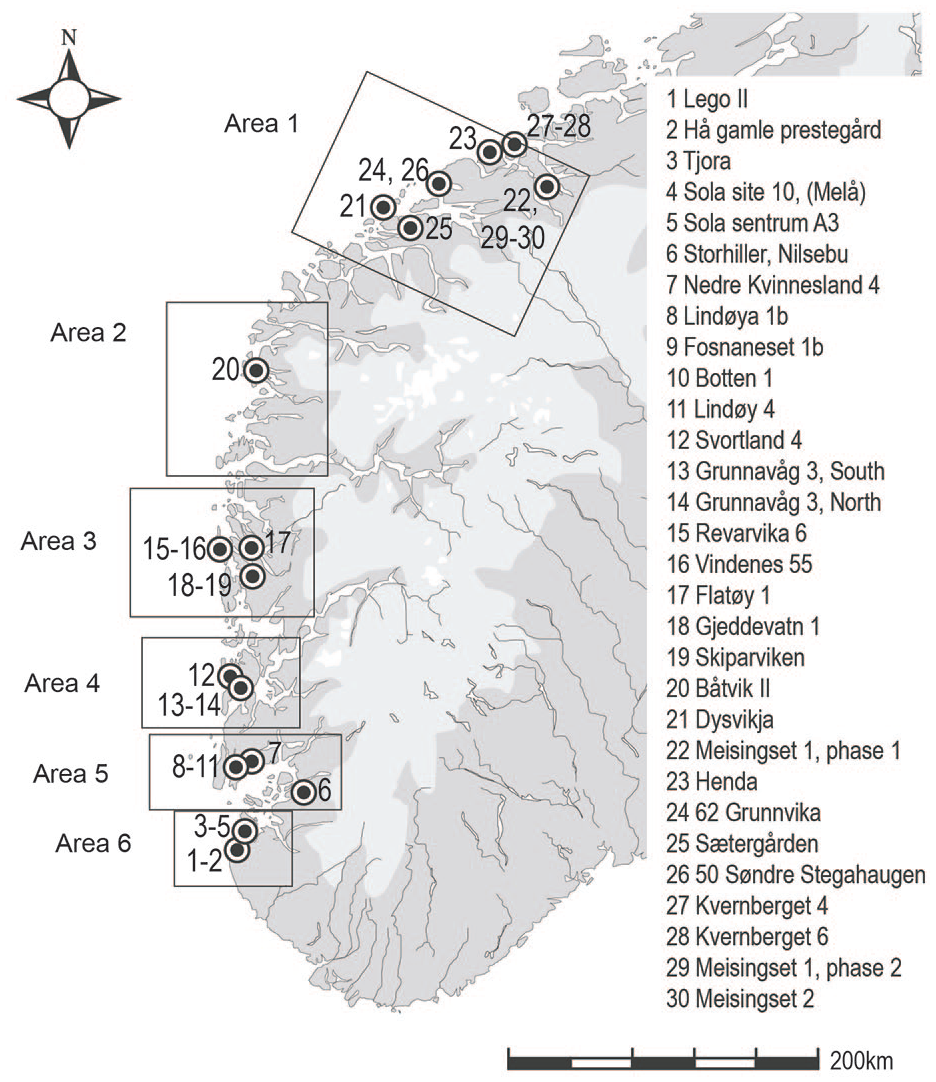
Map with marked focus areas and listed sites analyzed. (Ill.: Astrid J. Nyland).
The question of how and why material culture change is not novel. There are several theoretical and methodological approaches that address this issue. Some stress the evolutionary sides of cultural transmission as a primary driver (e.g. Eerkens and Lipo, 2007), whereas others place individual actors at the center of discussion (e.g. Dobres, 2000). Although the conditions under which knowledge and skills are sustained or transformed are of great importance when studying large-scale and long-term processes in the past (VanPool, 2008), decision-making and the actions and decisions of individuals within specific historical contexts (Eerkens and Lipo, 2007) are also of importance, since cultural transmission is both reflected in, and a result of, daily actions performed in public domains. Since certain mechanisms are fundamental to history, they can be used to put individual historical events and trends into a larger picture by creating links between events and process in a historical setting (Apel and Darmark, 2021; Sassaman and Holly, 2011). Several archeologists have emphasized the need to combine process and event in regional studies of prehistoric behavior change and transitions (e.g. Bar-Yosef, 1998, 2002; Roux, 2003; Tostevin, 2012), and how this combination have the potential to resolve certain common epistemological problems concerning lithic studies. Our approach is thus also inspired by practice theories embedded in the chaîne opératoire perspective (e.g. Leroi-Gourhan, 1993 [1964]; Pelegrin, 1990). It is central to our methodology that material culture, here: lithic blade technologies, are the manifestation of culturally transmitted knowledge, learned and shared among a group of people and passed between generations, thereby reflecting cultural traditions (e.g. Jordan, 2015; Schlanger, 2006).
When humans are concerned, securely linking cause and effect is, however, challenging. Different circumstances can result in similar actions, and the same circumstances may not be handled the same way by everyone. Processes of change may thus be erratic or unpredictable, actions do not necessarily follow as beads on a string but may grow or take flight along unpredictable paths (e.g. Deleuze, 2004; Ingold, 2007, 2013). Investigating practices over time may nevertheless be one way of identifying that different choices have been made in different regions due to divergent social circumstances. Whichever strategy for recovering after a catastrophic event is chosen, depending on what the force of impact did to the communities (a wipe-out or a big scare), this would affect all everyday practices, including stone tool technologies (Nyland and Damlien, 2024). This is what we have attempted and will expand on in this paper.
To contextualize the study, we start by outlining some central aspects of the employed methodology, followed by the status of knowledge of lithic technology in western Norway during the Middle and Late Mesolithic. We then present our data, methods, and results, where the data from this detailed technological analysis demonstrates both continuities, modification, and change in lithic technology of the Middle and Late Mesolithic in coastal western Norway. Our results provide the base on which we discuss potential culture historical implications of the coastal communities’ experiences with the Storegga tsunami.
Methodological aspects – technology as social traditions
In the chaîne opératoire approach, each artifact is perceived as an output of a distinctive set of operational sequences. In each sequence specific choices are made that can be understood as culturally derived traits. Through specific physical attribute analyses these may be identified (e.g. Pelegrin, 1990). The specific combinations of attributes and choices are hence testimonies of culturally or socially specific knowledge and know-how shared by a specific group (e.g. Apel, 2008; Damlien, 2016; Sørensen, 2012a). Due to the hierarchal organization of techniques, the operational chain provides both stability and flexibility (Leroi-Gourhan, 1993 [1964]). The craft tradition of the knapper provides stability at a conceptual level as knowledge of making tools are skills transferred between generations (Pelegrin, 1990; Stout, 2011). This does not mean that a technology is static, nor are all changes inevitable adjustments to optimize a technology or output. Members of a group or society will make context-specific choices at an operational level, for example, adjustments of technological elements related to preferred or available rock types, or individual expressions of the knapper. For a context-specific choice to become an integral part of a craft tradition, the changes must be accepted by the community and become an integrated part of a production concept (cf. Wenger, 1998). Consequently, studies of lithic technology provide grounds to explain material culture diversity, tracking temporal and spatial continuity and change in cultural traditions. That is, through the recording of physical attributes of artifacts, chaîne opératoire analysis can enable the identification of socially meaningful analytical units representing culturally transmitted knowledge embedded in social traditions.
Another central theoretical premise for our study is how social groups generate technological innovation through internal modifications, or alternatively, by borrowing from external groups (Lemmonier, 1993). A relevant question is thus whether there is preservation or modification of technological elements already present in a local tradition or are there new technological elements incorporated in an existing technical system representing discontinuity (Roux, 2003, 2013). Continuous transformations of technical elements can be seen as more or less autonomous parts of an evolving process and can appear more gradual, whereas discontinuous changes of a whole technological syntax that is, production concept are suggested to follow changes in society and can be slow or rapid (Roux, 2010:226). Discontinuous innovation, that is, a noticed break with tradition, can signal a particular historical or cultural scenario serving as a push-factor or tipping point (Roux, 2003). A broad scale social processes, or environmental events such as the Storegga tsunami is such a point. As argued by Roux and Courty (2013:191), historical dynamics occur on various temporal scales and can lead to growing diversity and the spread of technological elements, and even major population and/or social changes. With these premises as our point of departure, we consider the observed patterns of regional variation over time in lithic blade technologies to have great potential for discussing how the tsunami event may have impacted the coastal societies.
Current research status on Mesolithic lithic assemblages in western Norway
In western Norway, it was technological studies in the mid-1980s that gave rise to the division of the Early and Late Microblade 2 Tradition in the Middle and Late Mesolithic period respectively (Bjerck, 1986). This division is still acknowledged, but during the last 10 years, new knowledge about the Middle Mesolithic lithic technology in Norway has developed through several large-scale technological analysis (e.g. Damlien, 2016; Manninen et al., 2021; Sørensen et al., 2013). These have documented Middle Mesolithic blade production concepts, demonstrating how these are characterized by very regular blades made on conical and sub-conical cores with faceted platforms by means of pressure and indirect percussion techniques. There is in fact no specialized microblade production but the production of a variety of blade tools. The technology was introduced in the southern parts of the Scandinavian peninsula around 8300 BC, arriving via migrating groups from the northeast (e.g. Damlien, 2016; Manninen et al., 2021; Sørensen et al., 2013).
In western Norway, blade production from conical and sub-conical cores continues until the end of the Late Mesolithic (e.g. Bjerck et al., 2008:579). This contrasts with the situation in southeastern Norway, where conical core pressure blade technology was replaced by standardized microblade production from handle cores in the Late Mesolithic, c. 5600 BC (Eigeland, 2015; Fossum, 2020; Reitan, 2016; Solheim et al., 2020). The introduction of the handle core concept is considered a key component of the so-called Nøstvet techno-complex of southeastern Norway, and the timing of its appearance is prominent amongst Reitan’s (2016, 2022) argument for a significant revision to the traditional Nøstvet chronological framework. Solheim et al. (2020) downplay the influence of environmental factors as an explanation for the change from conical to handle core technology, and propose population shifts as a likely instigator of this technological development. The regional variation in blade production concepts during the Late Mesolithic implies variation in social networks and demographic trends.
Variation in material culture between the Middle and Late Mesolithic has long been acknowledged for western Norway (Ballin, 1999; Bjerck, 1983, 1986). In the last decades a large number of sites from the Middle and Late Mesolithic have been excavated in western Norway (Bergsvik et al., 2020). Yet there are still few recent comparative technological studies of Middle and Late Mesolithic lithic collections from western and central Norway (Bergsvik et al., 2020:93). Our quantitative analyses are thus an attempt to remedy this, identifying specific technological concepts on a local scale that is, focusing on six delimited areas over time. Patterns and trends can then be compared between areas and discussed in relation to our horizon event.
Material and methods
To identify any long-term trends in lithic technology during the Mesolithic of western Norway, we have investigated and defined the concepts of blade production at 30 sites dated to the Middle and Late Mesolithic periods within our six focus areas (area 1–6; Figure 2).
Sites included in this study were initially evaluated according to the following criteria: (1) sites should be dated to periods either before or after the tsunami (c. 7500–5000 BC), preferably by radiocarbon dates, and (2) sites should have well documented stratigraphy and chronologically coherent assemblages (Figure 3, Supplemental Material Table S1). Because of our criteria’s, low excavation activity in the area between Flensfjorden and southern Sunnmøre combined with sites being disturbed or missing due to the Tapes Transgression (Bergsvik et al. 2020), area 2 is only represented by one site. This is a weakness. The sites North and South of this area, however, demonstrate the tendencies we have observed. Moreover, our observed patterns of the use of different rock types were strengthened by the incorporation of data contained in Skjelstad’s (2003) study of raw material distributions found at Late Mesolithic sites within our study region (Supplemental Material Table S3).
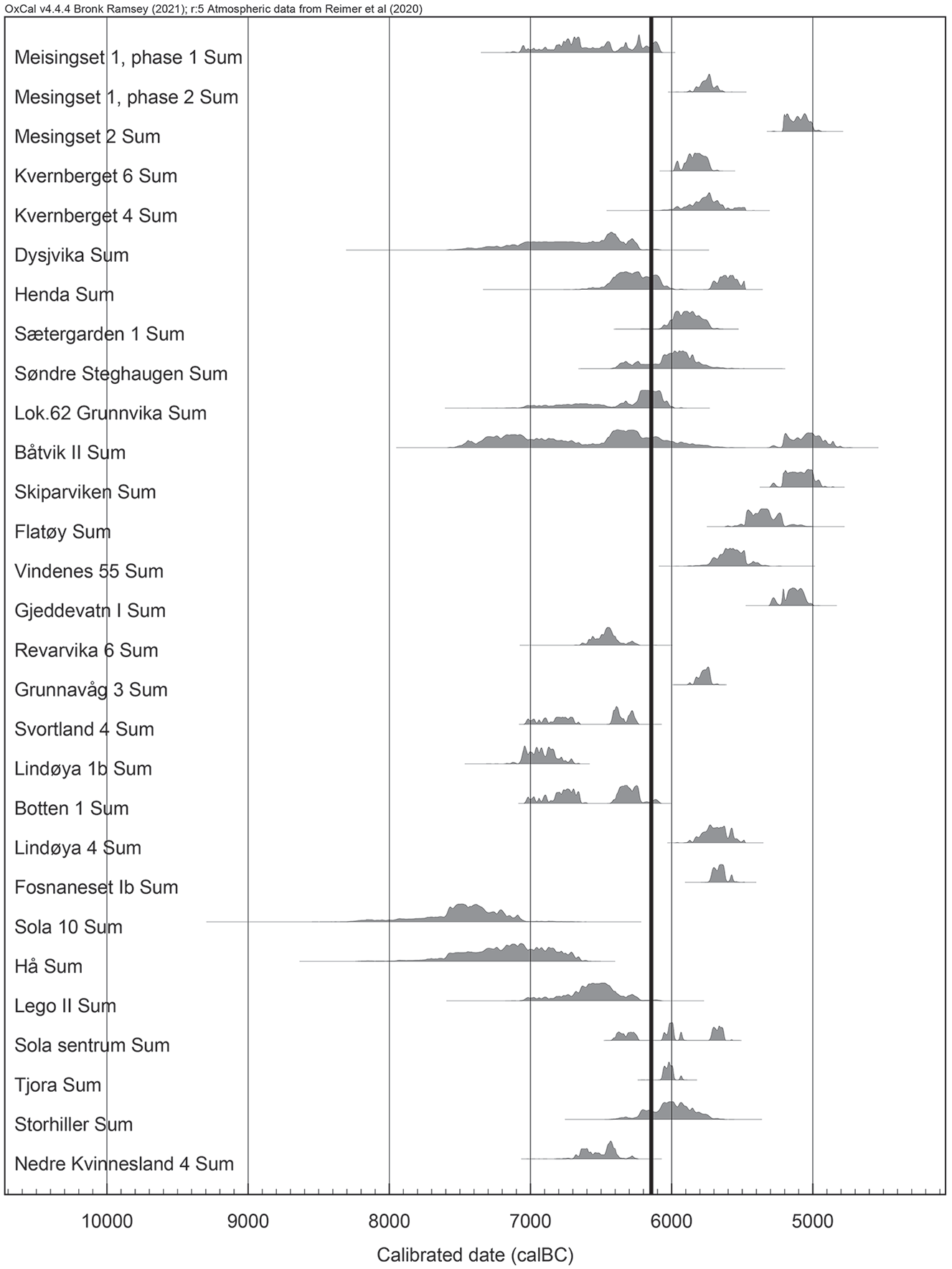
Summed probability distributions of radiocarbon dates from the analyzed sites. The time of the Storegga tsunami is marked. (Ill: Steinar Solheim and Hege Damlien).
Finding some interesting tendencies in our initial study, we needed to contextualize them and hence added a technological study of typologically relevant core assemblages from Sunnmøre, Vestland and Rogaland (Supplemental Material Table S5). The details of this study will be presented in a forthcoming paper (Damlien et al., in prep.), but where relevant, some of the results and tendencies are presented, to support our discussion.
The principal aim of the employed methodology is to reconstruct the conceptual and operative scheme of the blade production process. This necessitates a reconstruction of the operational chain observable in the archeological record from our selected sites (Eriksen, 2000; Inizan et al., 1999; Sørensen, 2012b). In our study, we focused on the first two stages: (1) raw material exploitation and use, and (2) production of blades, including evaluation of the cores they were produced from.
The initial sorting of the various rock types used in blade production was done macroscopically, primarily flint, quartzite, mylonite, and quartz. These rock types were further divided into sub-groups based on color, texture, inclusions and other visual differences and similarities 3 (Damlien, 2016:115).
In order to reconstruct the operational chain of blade production, a dynamical technological classification was employed (cf. Damlien, 2016; Sørensen, 2008; Sørensen et al., 2013). This is an analytical tool developed to describe and reconstruct one or several technological systems within a given lithic assemblage. The method includes an evaluation of the complete assemblages from all sites, and a classification of selected artifacts according to which stages of the production process and specific technical attributes could be observed (Supplemental Material Table S2). A basic premise for the attribute classification is that most of the changes undergone by a lithic artifact during various stages of its life are observable on that object in the form of several discrete attributes. The composition of attributes and their morphological variations are directly related to the method and technique employed by the knapper during production (Högberg, 2009:72; Inizan et al., 1999; Madsen, 1992; Sørensen, 2006b). The production method used is then inferred from the combination of measurements and technical and morphological signatures. Core and blade attributes which according to previous research (e.g. Inizan et al., 1999; Pelegrin, 2006, 2012; Sørensen, 2006a, 2006b, 2013), are suggested to be dependent of the blade production method used, were recorded.
The dynamical technological classification and attribute analysis 4 used here is developed especially for studies of Scandinavian Mesolithic lithic blade technologies (Sørensen, 2006a), and is therefore considered well suited for the research question addressed in this work. The attributes included in this study are both numeric, categorical, or continuous. 5 The analytical method is, however, primary qualitative. Although quantitative approaches have great potential and offer a complementary view of exploring diversity within prehistoric blade technologies (i.e. Damlien, 2015), quantitative analyses receive, in this paper, less attention. Instead, our study provides a first detailed qualitative description of the blade production concepts during the Middle and Late Mesolithic in western Norway including basic descriptive statistics.
Results from the technological analysis
The archeological data from Mesolithic sites suggest that despite dominating similarities in the overall lithic production concepts, it is possible to identify variation, both temporal and between our northernmost (Central Norway) and southernmost (Southwest Norway) research areas. Before we consider potential cultural-historical implications, we will describe and discuss details of identified chronological and regional trends in the use of different rock types through time, as well as five documented blade production concepts.
Raw material exploitation and use
Small to medium sized, oval-shaped flint pebbles collected from beach moraine deposits were the primary raw material used for the manufacture of blades in coastal western Norway during the Middle and Late Mesolithic periods. In Norway, there are no flint bearing chalk deposits like in for example southern Scandinavia. Flint pebbles are, however, found in varying quantities in moraine deposits along most of the coast (Berg-Hansen, 1999:255). Flint provenance is thus difficult to determine. The specific location of the exploited deposits of the numerous quartz, quartzite and mylonite veins along the coast are also unknown. The geography of western Norway attests to their availability, and together with their relatively low scale of use and distribution, an opportunistic procurement practice of local deposits has been suggested (Nyland, 2016). Overall, there does not appear to be a significant change in raw material exploitation patterns as a result of the Storegga tsunami. Some noteworthy variations (Table 1) are however, observed intra-regionally. While flint continues to dominate during the Late Mesolithic in the northernmost (area 1) and southern (areas 5 and 6) parts of our study area, we see an increase in the use of quartz, rock crystal and quartzite in the central portions of western Norway (areas 2, 3 and 4) after c. 6000 BC.
Specified frequency of flint in the analysed assemblages and the sites studied by Skjelstad (2003) in each of the six focus areas during the Middle and Late Mesolithic.

Our studies also show that different flint types were used for blade production, regardless of the size of the lithic inventory. In general, it appears people selected flint of “fine” to “medium fine” qualities, that is, elastic and brittle workability. The frequency of flint of fine quality is lower at Late Mesolithic sites (15%, n = 1785), compared to Middle Mesolithic sites (36%, n = 2785). Moreover, there seems to be temporal variation in on-site testing (i.e. removal of one or more flakes from a pebble to assess its quality) and initial preparation of beach-flint pebbles. At analyzed Middle Mesolithic sites, tested pieces comprise c. 19% (n = 601) of core assemblage, whereas they comprise only c. 4% (n = 1333) on Late Mesolithic sites. The frequency of cores discarded during the early stages of production is, also, higher on Middle Mesolithic sites compared to Late Mesolithic ones. The cores seem to have been primarily rejected because of lack of further potential. Relocations of the original front and/or platforms are also documented on the discarded platform cores. Furthermore, a relatively large number of bipolar cores are made on fragments of discarded conical and sub-conical cores, indicating shifting to bipolar technology in the final stage of production. The findings from our raw material analysis indicate that in the Late Mesolithic there was an increased economization of raw materials.
Blade production concepts
The majority of blades exhibit features diagnostic of platform-based knapping techniques (pressure, indirect and direct percussion). A smaller but prominent proportion of blades were observed to have been produced using the bipolar technique.
In the Middle Mesolithic, no indications of a separate microblade production strategy were detected. Blades dominate, and microblades comprise 44% of the total blade assemblage from all sites. In the Late Mesolithic, the frequency of microblades increases to 70% (Supplemental Material Table S4). On a broad scale our results confirm earlier observations concerning Late Mesolithic blade technology in western Norway. While an increased focus on standardized microblade production is evident (Bjerck, 1986, 2008), the resolution of our study allows us to highlight that there is in fact significant variation in blade width between sites, as well as intra-regionally, during the Late Mesolithic. Contrary to southeastern Norway where intentional production of macroblades is absent in the Nøstvet techno-complex (Eigeland, 2015:376), our results show that in Late Mesolithic western Norway macroblades comprised a notable part of tool blank production.
The frequency of different core types in Table 2, illustrates the presence of chronological variation in blade production concepts. 6
Frequency of different core types (precores, cores and core fragments), at Middle and Late Mesolithic sites.

Based on the analyzed blade and core assemblages, we identified five main blade production concepts (Figure 4): (1) blade production from conical and sub-conical cores by pressure and indirect percussion techniques; (2) microblade production from handle cores by pressure and direct percussion techniques; (3) production of blade-like flakes from small, rounded beach-flint pebbles; (4) production of blade-like flakes from bipolar cores; and (5) microblade production from wedge-shaped cores by pressure and direct percussion techniques. The five concepts are defined and described as follows:
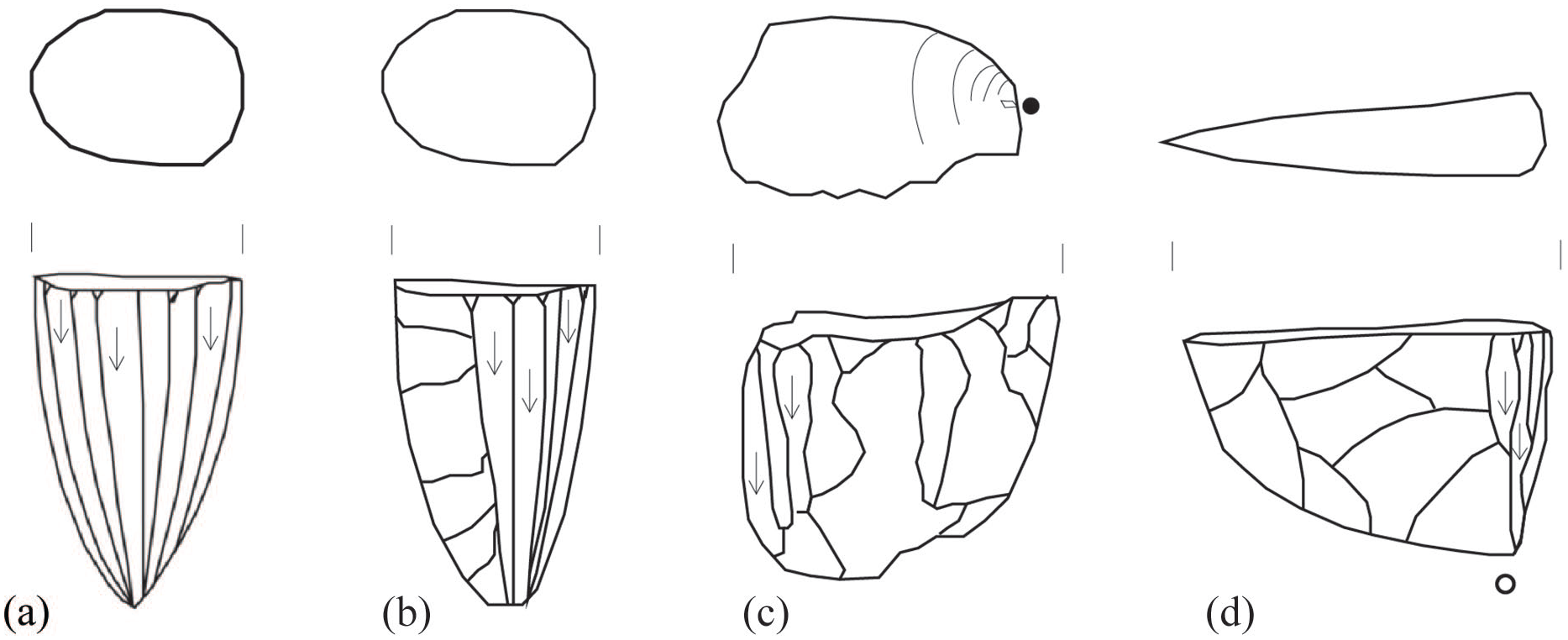
Schematic illustration of (a) conical core (drawn after Sørensen et al., 2013, Figure 1), (b) sub-conical core (drawn after Sørensen et al., 2013, Figure 1), (c) handle core (drawn after Vang-Petersen, 1993, Figure 20) and (d) wedge-shaped core (Morlan, 1976, Figure 1). Full circle = percussion bulb with platform remnant, open circle = percussion bulb with no platform remnant. Arrow = direction of blow of percussion. (Ill.: Hege Damlien).
Concept 1: Conical and Sub-Conical Cores
The concept is based on the production of regular blades from conical or sub-conical cores using pressure and indirect percussion techniques. The production concept is applied to both flint and other rock types. Cores are typically based on a shaped nodule whose form is carefully managed throughout the production process. In this concept blades are removed around parts, or the entire perimeter, of a circular or semi-circular platform. There is no indication of a separation between the macro- and micro-blade production in this concept, but rather a gradual reduction of the core from the widest to the narrowest blades. This is especially interesting, since specialized microblade production is traditionally seen as characteristic of Middle Mesolithic western Norway (e.g. Ballin, 1999; Bjerck, 1986, 2008).
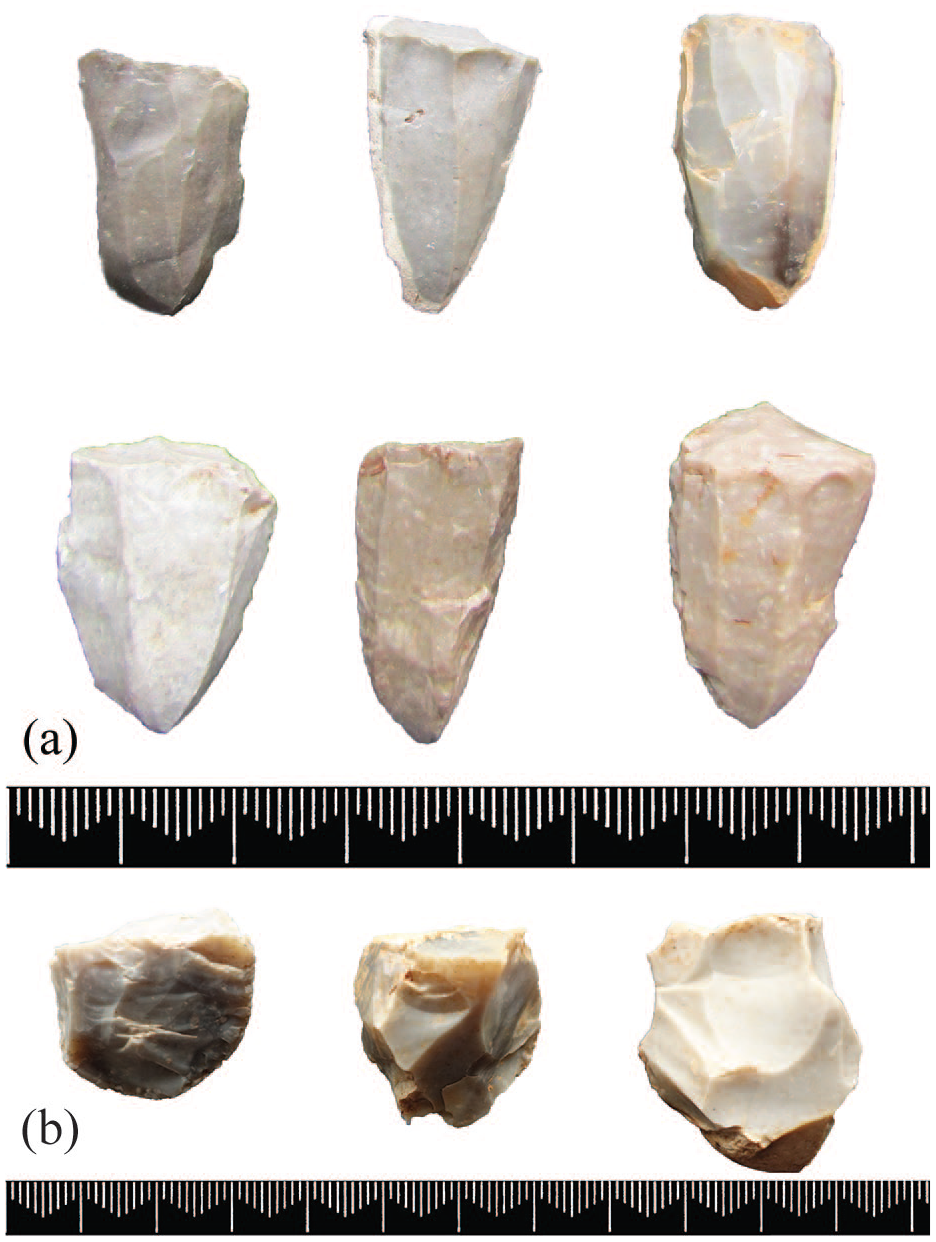
(a) Conical cores from the site Båtevik II, Flora (University Museum of Bergen). (b) Small pebble cores from the site A3 Sola sentrum, Sola (Museum of Archeology, Stavanger). (Photos and illustration: Hege Damlien).
Conical and sub-conical cores make up 22% of our Middle Mesolithic core types, and c. 11% of the analyzed Late Mesolithic cores. In the Late Mesolithic the conical core production concept displays continuation of several technological elements, but discrete differences have also been observed. Cresting, or the shaping of the core sides and front prior blade detachment, becomes a less common strategy for both core preparation and maintenance of core geometry. Moreover, careful preparation of the core platform edge as well as faceting of the platform surface of the cores also decreases in the Late Mesolithic. The observed trends in core preparation and rejuvenation strategies demonstrate that the execution of the conical core concept became less strict during the Late Mesolithic.
Concept 2: Handle cores
The handle core concept is based on the production of primarily microblades using pressure and direct percussion techniques (Eigeland, 2015). In our study, handle cores are based on either a thick, elongated flake (positive platform) or the remnant (i.e. non-flake) portion of a split pebble (negative platform; Figure 6). They possess a single, narrow “front” which bears the negative scars of microblades, or in the case of preforms, flake, removals. Handle cores based on a flake typically have the front located at the flake’s distal end with removals orientated from the ventral toward the dorsal surface. They generally have a profile somewhere along a triangular to trapezoidal continuum. From a conceptual perspective, the most distinguishing characteristic of handle core technology is the intended production of microblades of relatively uniform length throughout the exploitation of the core (Eigeland, 2015; Hertell and Tallavaara, 2011).
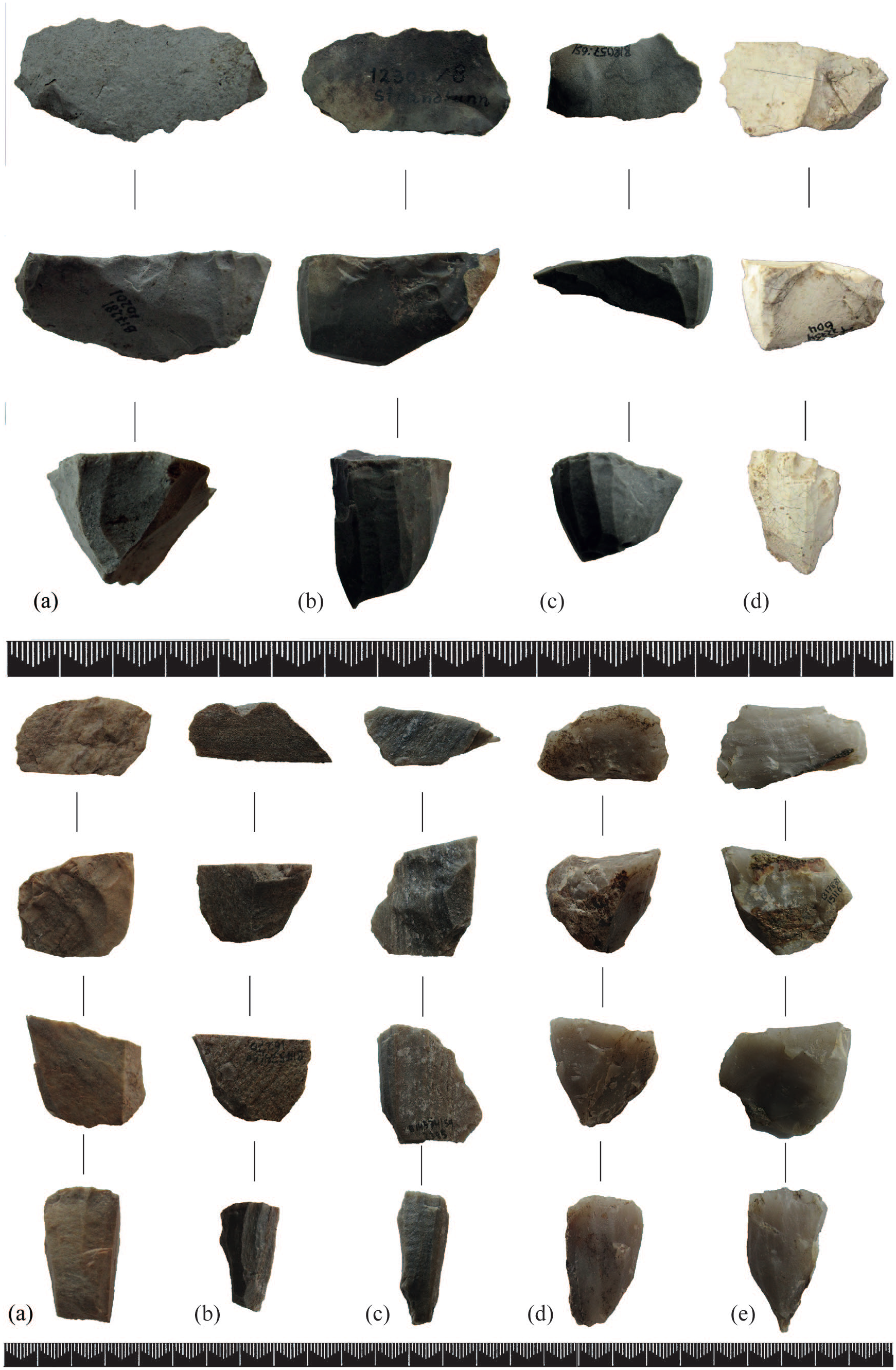
Top: Handle cores (top: platforms, middle: core sides, bottom: core fronts) of flint from the sites (a) Lok. 11, Sotra, (b) Lok 699 Normannslagen, Eidsfjord, (c) Lok 3, Sotra and (d) Lok 50 Nyhamna, Aukra (ac) University Museum of Bergen, (d) NTNU University Museum). Below: Wedge-shaped cores (top: platforms, middle: core sides, bottom: core fronts) of quartzite from the sites (a) Askevatnet 3, Askøy, (b–d) Nilsvikdalen lok. 7, Øygarden, and (e) Lok 11, Sotra (University Museum of Bergen). (Photos and illustration: Hege Damlien).
Twelve objects matching the idealized/classic morphology of handle cores (Eigeland, 2015; Sørensen, 2006a, 2006b) were documented amongst six of our studied site assemblages. The discovery of handle cores was surprising, and since the extent of this technology in western Norway has not been extensively researched, we conducted an additional study consisting of a database search, and sample analysis, of handle cores held in relevant museum collections. Our key finding was that handle core technology is more common in western South Norway than previously recognized (Damlien et al. (in prep.), see Supplemental Material Table S5 and discussion below). In area 2–4, Vestland and Sunnmøre, 23 additional handle cores or fragments of handle cores were identified at nine sites, four of which are dated to the Late Mesolithic. In Rogaland (area 5–6) 30 handle cores from 21 different localities have so far been confirmed. Unfortunately, many are poorly contexed having been collected by members of the public from extensive (and multi-phased) Stone Age settlements in the Jæren area. Examples recovered during archeological excavations indicate a Late Mesolithic date for handle core technology in Rogaland.
Concept 3: Pebble cores
This concept involves the production of blade-like flakes from small, rounded beach-flint pebbles (Figure 5b). The cores are in general small and unstandardized, measuring <3 cm. They are further characterized by the presence of flat, smooth platforms, and short, broad fronts with negatives from the removal of irregular blade-like flakes. More than 50% of the core sides are covered with cortex. The concept resembles the “pebble used as core” concept documented in Middle and Late Mesolithic southeast Norway (Eigeland, 2015:138, 373). It is possible that this class may consist of discarded preforms for other types of blade cores, most likely sub-conical cores. This matter can only be clarified through additional analysis, and we tentatively treat the objects included here as the result a distinct concept.
Pebble cores are found at four Middle Mesolithic sites in area 5–6 but primarily at sites from Nordhordland and southwards (area 3–6) from the Late Mesolithic.
Concept 4: bipolar cores
Concept 4 is the production of blade-like flakes using bipolar technology (i.e. hammer and anvil). Bipolar cores represent a distinct method whereby the core was worked by means of splitting and resplitting a block, which is supported against a hard anvil or hard surface and struck from above with a hard hammer (Andrefsky, 2005:28; Callahan, 1987:21). Bipolar cores are primarily distinguished by opposed, crushed edges, but there are variations (Figure 7). They are normally small, measuring <3 cm. The bipolar cores we found are mainly of flint, but cores of rock crystal and quartz are also common. It has long been established that the bipolar production concept was a common strategy for producing blade-like flakes during the Middle and Late Mesolithic periods in western Norway (Bjerck, 2008; Skjelstad, 2003). Though bipolar technology was not a particular focus of the current research, the results of our site assemblage analysis allow for a more nuanced understanding of the way the concept was employed. Most of the cores in our study seem to have been made on fragments of discarded conical and sub-conical cores. The strategy appears primarily to represent the last stage in the reduction process of platform cores.
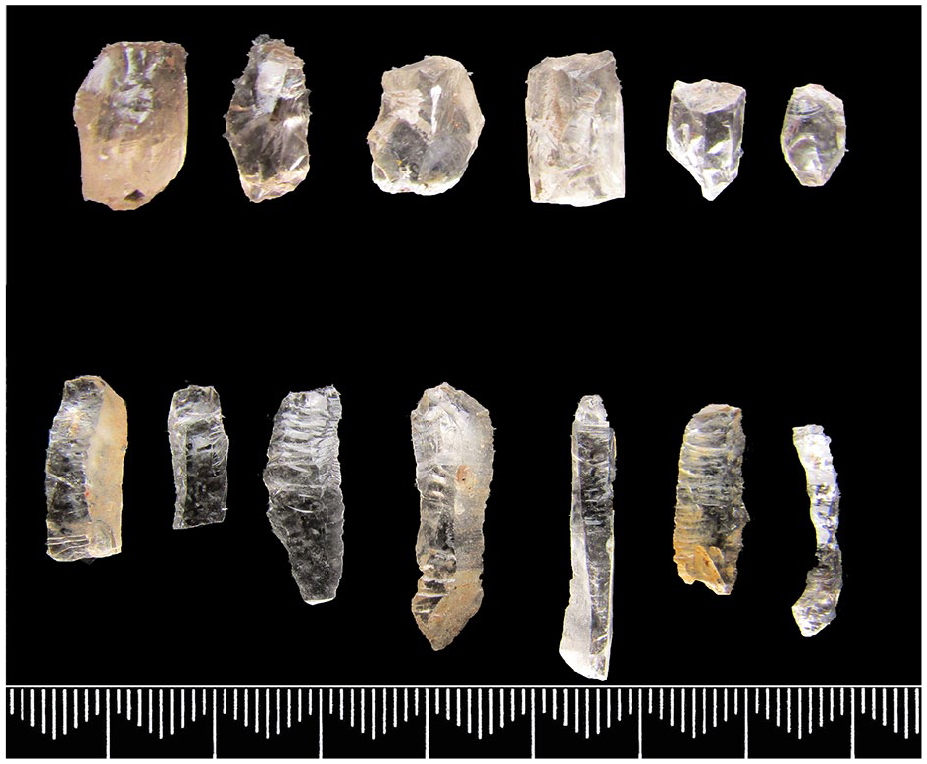
Bipolar cores (top) and blade-like flakes of rock crystal from the site Flatøy I, Alver (University Museum of Bergen). (Photos and illustration: Hege Damlien).
Bipolar cores comprise 52% of Middle Mesolithic core types, but the frequency varies between the areas. In the Late Mesolithic, the local and regional variations in blade production methods become increasingly evident. The use of bipolar technique increases to 66%, and bipolar technique becomes an important technological strategy (Table 2). The concept is particularly strong in our northernmost areas (area 1 and 2) and in northern Rogaland (area 5). In Hordaland (area 3–4) and southern parts of Rogaland (area 6), the frequency of bipolar cores decreases in the Late Mesolithic.
Concept 5: wedge-shaped cores
An additional blade production concept, based on the manufacture of microblades from narrow, single-fronted cores, was first observed during our review of cataloged handle core assemblages. In some instances, these pieces were described as “atypical handle cores.” A re-evaluation of selected site assemblages identified a single example of the wedge-shaped core concept amongst the Lindøya site 4 (area 5) assemblage. The wedge-shaped core concept displays many similarities with the handle core concept, both producing very regular and uniform microblades. There are, however, also distinct differences in the schema opératoire between the two. Whereas the ventral face of the flake used as core blank normally constitutes the handle core platform, on wedge-shaped cores blade fronts exploit the narrow margins of the flake.
In area 2–6 we documented the wedge-shaped core concept at 20 of our studied reference sites (Figure 6, Supplemental Material Table S5). In Hordaland (area 3–4), the wedge-shaped cores are mainly made of non-flint raw materials, whereas all but one in Rogaland are made of flint. Hence, the lithic assemblages in Rogaland and Hordaland demonstrate that both the wedge-shaped and handle core concepts were concurrent and used well into the Late Mesolithic.
Discussion
As expected, and according to the known outlined tendencies, the technological analysis did not identify major chronological breaks in lithic technology during the Middle to Late Mesolithic transition. We did, however, still find continuity, modification, and discontinuity in the technological practices; that is, we identified modification of raw material strategies and introduction of new production concepts. Below, we will comment on some of these identified tendencies before discussing them in light of the circumstances sat in motion by the havoc caused by the Storegga tsunami.
Local and regional modifications of raw material use and blade production concepts
Regional differences in lithic raw material use have long been acknowledged in Norwegian Mesolithic research (e.g. Bjerck, 2008). The general assumption is that whereas flint dominates in Middle Mesolithic western Norway, the use of other local rock types increases in the Late Mesolithic (Bjerck, 1983:120). Our results support the tendency of increased intra-regional variation as suggested by Skjelstad (2003) for this region and confirm the importance of flint during the Middle Mesolithic. In addition, we see that raw material usage patterns become increasingly locally distinguishable in the early part of the Late Mesolithic (Table 2), and that new blade production concepts enabled a more economical utilization of the raw materials.
The few studies of flint availability along paleoshorelines (Berg-Hansen, 1999; Eigeland, 2015; Johansen et al., 1969; Pettersen, 1986) indicate that it is reasonable to expect considerable variation in the amount, quality and size of material that were accessible along the Norwegian West coast. In the southern parts of Rogaland, Lista, and Agder, flint of good quality and size was available during the whole of the Mesolithic (Berg-Hansen, 1999). This is also reflected in the analyzed assemblages. In Sunnhordland and Nord-Rogaland (our area 4–5), the situation is different with less availability of flint in beach moraine deposits, and this may explain the observed variations in the use of flint in this area (Skjelstad, 2003). In the northern part of Møre og Romsdal (area 1), a systematic survey of flint availability along the paleoshorelines in outer coastal areas, undertaken by Pettersen (1986), found only small pebbles considered unsuitable for tool production. Pettersen (1986) argues that the observed distribution could be a result of an intensive collecting strategy, where the local Mesolithic communities emptied contemporary beaches of large flint pebbles. Skjelstad (2003) study of raw material use at Late Mesolithic settlement sites along the western coast, contradicts Pettersen’s findings, showing that small pebbles were primarily exploited for tool production in this area (1). Contrary to previous findings our study suggests that pebble size was not an important factor when selecting raw materials for tool production during the Middle and Late Mesolithic (Supplemental Material Figure S1). However, whereas flint pebbles, regardless of quality, were preferred to non-flint rock types in area 1, non-flint rock types were increasingly used in the Late Mesolithic in area 2. Systematic surveys of flint availability in area 2 are, however, still lacking. This illustrates that more systematic surveys of flint availability along the coast are needed, but also that the reasons for using different raw materials are complex.
The amount and character of available raw materials was clearly a factor in how flint pebbles were exploited, but our study also demonstrates a chronological difference. Compared to Middle Mesolithic sites, the frequency of discarded tested flint pebbles and core preforms are lower in Late Mesolithic assemblages. This may attest to a context of relatively good access to raw materials which allowed for the abandonment of materials less suited for tool production (Eigeland, 2015). Conversely, our findings from Late Mesolithic sites in area 1, indicate a scenario in which, once collected, flint pebbles are exhausted before being discarded. This either implies a change in availability, or as observed in the analyzed assemblages, a variation or decrease in the availability of high quality flint in the Late Mesolithic (Supplemental Material Table S6), resulting in a need to economize flint.
The modification of existing production concepts, or the use of multiple ones, can also reflect a desire to economize preferred raw materials. Though less prevalent, the conical core concept (1) endures into the Late Mesolithic and the flexibility seen in its execution can signal an adjustment to changes in the availability and character of the raw material, but also the transformation of a long- lasting and established technological tradition. Moreover, the appearance of a new potential concept, the production of blade-like flakes from small and rounded flint pebbles (3) displays similarities with the old production concept, but also reflects a less standardized but more effective reduction strategy to utilize small pebbles of varying qualities.
As mentioned, the use of bipolar technology (4) increases in Late Mesolithic western Norway, especially in the northern area (area 1–2). Bipolar technology is considered a “raw material economization strategy,” and adaptation to utilizing small pebbles, but also reduced access or availability of certain rock types are suggested as causes for the application of the technology (Thorsberg, 1985). At several of our analyzed sites, platform cores were reduced by bipolar technology toward their final stage of use, which could explain the decrease of conical cores in some of the areas. If we consider the use of bipolar technology from an economic perspective, the increased use of bipolar technology at Møre (area 1) could reflect that flint of suitable quality and size became less available in this area in the Late Mesolithic, yet the technology offered a way to exploit the preferred flint to the fullest. This may be one explanation of why flint continued to be the preferred raw material. Conversely, in the areas further south, the use of bipolar technology appears to decrease.
The increased regional variations in raw material exploitation and use, can indicate that different strategies to economize preferred raw materials were in play. One explanation is that the different technological concepts enabled people to adjust their technology and be economic when needed. The large between-site variation in these economic strategies could also indicate that many of these choices were context-specific due to restrictions set by raw material availability, and should be seen as internal modifications, that is, the novelty is introduced by reorganization technological elements already present in the local tradition.
In addition to regional and local modification of existing concepts, there is also the introduction of new production concepts in the Late Mesolithic. Like in eastern Norway, we observe an emphasis on standardized microblade production during the Late Mesolithic. The increased focus on standardized microblade production follows an interregional trend in Scandinavia at the transition to the Late Mesolithic. In other regions this technological development has been linked to the introduction of handle core technology. However, within our study area, standardization is achieved not solely through the adoption of new, specialized blade production concepts (i.e. handle cores and wedge-shaped cores) but also through the modification of a long established concept (the conical core concept). Based on the current evidence, it is unclear if modification of the conical core concept is due to technical considerations (i.e. size of available raw materials, evolution of knapping strategies) or changing social contexts for knowledge transmission.
Microblade production from handle and wedge-shaped cores is considered a raw material economizing strategy since it requires less rejuvenation of the core platform during production. The preferred blanks for handle cores are, however, considered to be thick, oblong flakes. According to Eigeland (2015) the glacially deposited flint pebbles found along the south Norwegian coast are not suited for use in association with handle core technology due to their varying form and quality. In our study region, the size and quality of flint pebbles do not appear to have restricted the execution of the handle core concept. We do, however, observe modifications of the original concept. Rather than strictly using flakes as core blanks, a relatively large portion of the handle cores are made on small split pebbles which required only minimal preparation of the sides and front to produce microblades. The introduction of handle core and wedge-shaped core technologies in western Norway, along with the modification of the conical core concept, is however, difficult to explain from a purely functional perspective and is likely to have been strongly influenced by socio-cultural phenomena.
Discontinuity in production concepts in Mesolithic western Norway
Handle core technology was a component of a technological tradition shared by hunter-gatherer groups in large parts of north-western Europe and Scandinavia during the Late Mesolithic (Eigeland, 2015:133; Knutsson, 1980:89, 1993:40; Olofsson, 1995, Sørensen, 2012a:240). Handle cores are thus associated with a technological tradition different than the established eastern conical core production concept. In Denmark handle core technology is introduced c. 7500 BC (Sørensen, 2012a), whereas it is more broadly implemented after 6500 BC in Sweden (Knutsson and Knutsson, 2012) and c. 5600 BC in southeast Norway (Eigeland, 2015; Reitan, 2016; Solheim et al., 2020). The status of the technology in western Norway has only occasionally been commented on (Bang-Andersen, 2008; Bjerck, 1987, 2008; Nygaard, 1989; Olofsson, 1995; Söderlind et al., 2023). Bang-Andersen (2008) provides the most extensive published review of the evidence for handle core technology in Rogaland in which a small number (i.e. 2) of what he deems to be genuine handle cores, along with likely handle core preforms, are used to refute the conventional opinion that the technology was absent from western Norway. Despite such finds, the general consensus still seems to be that the handle core concept was not a significant formal method used for blade production during the Mesolithic in western Norway (e.g. Bjerck, 1987:42). It is therefore noteworthy that a substantial number of handle cores and related types (keel-shaped cores) are recorded in the museum databases covering the west coast of Norway from Rogaland to Trøndelag (see also Söderlind et al., 2023).
Analysis of a selection of the 407 handle cores in total from 203 sites within our study area (Figure 8, Supplemental Material Table S5) reveals that there is significant variation amongst the artifacts encompassed within this group. Many cataloged handle cores do not exhibit characteristics of the handle core concept as described above. Rather their classification (as handle cores) appears to be based primarily on their approximately oblong form. Though research of the Rogaland handle core assemblage is still ongoing, it is estimated that over 50% of the currently registered examples are misclassified. Similarly, in area 2–4, Vestland up to Sunnmøre, of 20 analyzed sites with cataloged handle cores, handle cores were identified at only 9 of the sites. Furthermore, according to a technological definition, of the cataloged handle cores in area 2–4, 33 of the samples are not a result of the handle core technological tradition. Rather, they display similarities with the narrow-face or wedge-shaped core concept (e.g. Hertell and Tallavaara, 2011; Nielsen and Carrasco, forthcoming; Nielsen and Winther, 2021; Tabarev, 2012; Takakura, 2012), that is, our concept 5.
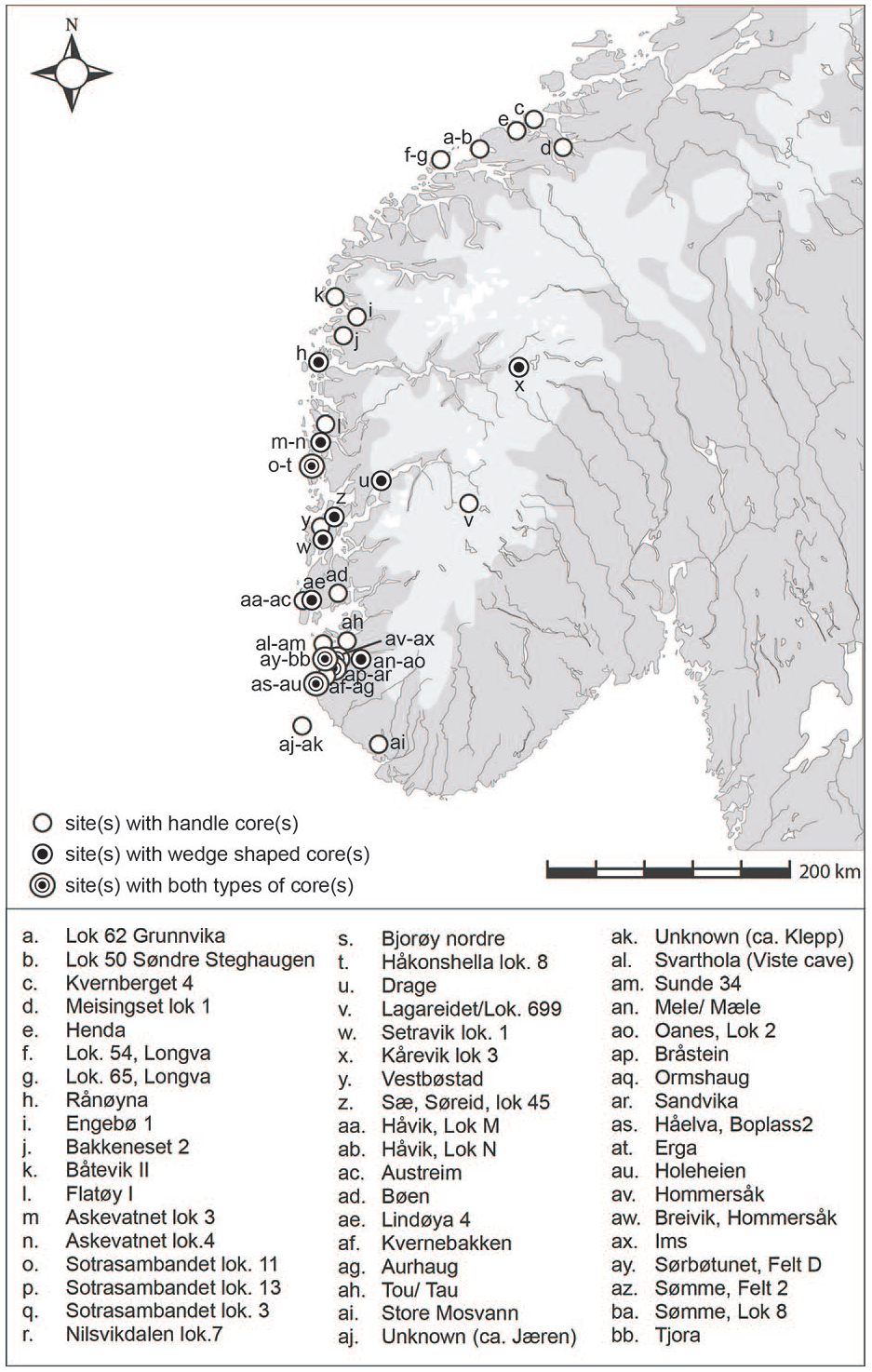
Map showing sites with handle cores and wedge-shaped cores documented in our sample analysis. (Ill.: Astrid J. Nyland).
Changing perspectives relating to the classification of “handle cores,” which includes consideration of pieces variously described as keel formed- flints/-scrapers/-cores, has long been acknowledged an obstacle to research (e.g. Eigeland, 2015; Jaksland, 2003:254; Mikkelsen, 1975:33; Sørensen, 2006:52; Söderlind, 2018:306-307; Söderlind et al., 2023:187). Our study may contribute to resolve some of the classificatory ambiguity surrounding handle cores in western Norway, but further research is needed to thoroughly explore the character, extent and timing of both the handle core and wedge-shaped concepts in our study region (see Damlien et al., in prep.).
Importantly, the handle core and wedge-shaped core production concepts are, normally, associated with two different technological traditions, that is, the Late Mesolithic Maglemosian techno-complex of northwestern Europe and the eastern technological tradition respectively. The wedge-shaped core concept has a wide spatiotemporal distribution and has been thoroughly defined by scholars both in terms of morphology and technology (Nielsen and Carrasco, forthcoming), especially through studies of Upper Paleolithic/Early Mesolithic assemblages from Siberia (Flenniken, 1987; Inizan, 2012; Tabarev, 1997, 2012) and northeastern Europe (Hertell and Tallavaara, 2011). The concept has been little discussed in a Scandinavian context but has recently been identified at late Middle Mesolithic sites in southeast Norway (7200–6100 BC; Nielsen and Carrasco, forthcoming). Nielsen and Carrasco suggest that the wedge-shaped cores in southeast Norway can be identified as local variants of the wedge-shaped cores within the eastern technological tradition that diffused into Scandinavia later than the conical core concept. The origin and development of the wedge-shaped core concept (5) in Norway are not clear, but since such have been identified at late Middle Mesolithic sites in southeast Norway (Nielsen and Carrasco, forthcoming), they actually predate the handle core concept (2) in this region.
Nevertheless, our results show that two new standardized concepts, the wedge-shaped (5) and handle core concept (2), were established alongside the conical core production concept (1) in the Late Mesolithic. These concepts, each associated with different technological traditions, were used to varying degrees within our study area to produce essentially the same product, that is, microblades. Yet, there is variation where the different concepts dominate. However, macroblades still comprise a substantial part of tool blank production. In the northern parts of the study area, blade production was achieved using bipolar cores (4), combined with the introduction of standardized production of microblades from handle cores (2). Wedge-shaped cores (5) have, however, not been documented here. In the southwest, production from small, rounded beach-flint pebbles (3), is more prominent. We interpret this as a growing divergence in local and regional technological and cultural traditions. As mentioned earlier, discontinuous innovation marks a break with tradition, thus signalizing particular historical or cultural scenarios (Roux, 2003). In our case, it can also indicate changes in the direction or intensity of communication networks. Direct and sustained interaction and communication plays a crucial role in transmission and maintenance of cultural knowledge (Cavalli-Sforza, 1986; Henrich, 2004; Jordan, 2015; Tostevin et al., 2007). Consequently, the developments we identify in the execution of crafts, such as handle cores, wedge-shapes cores, and the conical core concept, can be reflections of a disruption to social relations and transmission of culture-specific knowledge (Nyland and Damlien, 2024).
A time of crisis? Physical and social impact of the Storegga tsunami
What, then, may explain the patterns we have found? Returning to our point of departure for this paper, should the observed changes be considered in relation to the Storegga tsunami? In discussions of human-environment interactions, it is necessary to demonstrate a temporal co-variance between environmental and behavioral change (Solheim et al., 2020). It is, however, a challenge to demonstrate causality securely. Several studies that have inferred a demographic impact of the Storegga tsunami, and the 8.2 ka event based on modeling of radiocarbon dates. For example, a population collapse following the Storegga tsunami enhanced by the 8.2 ka event is suggested in Northern Britain, but no corresponding technological change is demonstrated (Waddington and Wicks, 2017; Wicks and Mithen, 2014). Sharrocks and Hill (2024) argue that the tsunami had a severe and potentially catastrophic impact, with direct mortality as well as long-term impacts on resource availability for “survivors” in Northumberland. Based on lithic studies from Guardbridge in Fife, Scotland, Ballin (2023) suggests that the tsunami may have deposited flint and silcrete pebbles several miles inland, offering additional lithic recourses of knappable pebbles which could be exploited by post-tsunami settlers. In western Norway, the marked decline in radiocarbon dates distribution started prior to c. 6000 BC, correspond to the cooling event, perhaps also to the tsunami (Bergsvik et al., 2021:12–13). Bergsvik et al. (2021) argue that although there might be a connection between these events and indications of a demographic decline, taphonomic problems due to the Tapes transgression are probably the most important reason for the lack of C14-dates from this period (see also Lundström, 2023 for similar arguments). In the inner Varangerfjord of Finnmark county in northern Norway though, Blankholm (2020) found that the combined effect of the Storegga tsunami and the 8.2 ka event on human life was minor, implying a high degree of resilience in the society.
The climatic 8.2 ka cold anomaly was first recognized in south Norway in lacustrine sediments and peat sequences and was first named “the Finse event” (Dahl et al., 2002; Dahl and Nesje, 1994, 1996; Nesje and Dahl, 2001). Geologists and climate researchers traced it as a two-step event; first a cold and moist phase characterized by readvancing glaciers followed by a cold and dry phase. The event is also documented in pollen records from western Norway showing among other things that the estimated tree cover in western Norway is at its highest during the Late Mesolithic (Bergsvik et al., 2021). The multiple datasets indicate that the negative effects of the 8.2 ka cold event in South Norway were relatively modest (Bjune et al., 2005; Eldevik et al., 2014; Seppä et al., 2009). Hence, there is no reason to suspect any widespread ecosystem collapse because of it (Lundström, 2023). Instead, given the regionally determined variation in physical impact of the tsunami and 8.2 ka event as demonstrated by several numerical simulation models of the Storegga tsunami (Løvholt et al., 2017; Walker et al., 2024), we should expect that the imprint and scale of human or social trauma would vary regionally and locally.
Parts of the west coast of Norway are located close to the Storegga tsunami propagation center (Figure 1). Although not possible to detect in the material, the tsunami probably temporarily ruined and disrupted shorelines and key coastal ecosystems’ components in western Norway. The geological evidence, that is, thick layers of mixed sand, gravel, and ripped up turf, found in sediment traps like lakes and bogs along the coast on both sides of the North Sea (Åstveit et al., 2016; Bondevik et al., 1998, 2005; Dawson et al., 1990; Prøsch-Danielsen, 2006; Walker et al., 2024) are evidence of brutal physical impact. This kind of immediate physical impact on the hunter-fisher-gatherers groups living along the coast might have been experienced as dramatic. Nevertheless, the tsunami did not cause people to change their shore bound settlement pattern (see Figure 5 in Walker et al., 2024). However, there seems to be regional variation in the location patterns, that is, a regional north/south division, concurring with our northern areas (1–3) and southern areas (4–6). In either region, neither the tsunami nor the 8.2 ka event seem to have deterred the coastal hunter-gatherers’ maritime way of life, at least not to any lasting or archeologically visible extent (Walker et al., 2024:13). However, studies of faunal and archeological remains from the rock shelters by the Hardanger Fjord in Hordaland indicate that activities, procurement strategies, and length of occupation changed significantly around 6100 BC (Bergsvik et al., 2016). Bergsvik et al. (2016) see this in relation to changes in the overall settlement pattern in Mesolithic western Norway, involving increased sedentism as well as changes in how the residential sites were used and how task group mobility was organized. The timing of this shift may perhaps be coincidental, but it is still curious.
As mentioned and demonstrated, there are no signs of dramatic changes in lithic technology just after the tsunami. The conical core production concept continued to be in use to the end of the Late Mesolithic throughout the study region. Although we can interpret this as a demonstration of continuity rather than a break in craft traditions after the tsunami, the modification of the concept might signal a disruption to social relations and transmission of culture-specific knowledge. The introduction of the handle core and wedge-shaped core concepts may testify such a scenario.
Catastrophic events can be woven into a society’s collective memories and practices in many ways. Depending on how a group deal with a catastrophic event, such as a tsunami, the event may be “the same,” but the degree of effect on traditions and practices may differ. A crucial event may become a so-called “zero point” (Cavalli, 2006:172), becoming “monumentalized” as a point in time where new traditions are born. Dramatic events may also be a moment in time that it is crucial to downplay and stress continuity and “times before” for the benefit of the society (Cavalli, 2006:173). The observed continuation of traditions, such as technological concepts, may indeed be an indication of such a strategy. As mentioned, the theoretical premise of the chaîne opératoire stress how there is social memory and identity in technological choices. We also adhere to notions that people do not just passively respond or adapt to natural conditions. Sometimes societies handle external threats by insisting on continuation of old traditions. This makes an identification of impact caused by all types of external threats challenging. A “resilient” society does not necessarily mean one that desires to bounce back to what came before (Riede and Sheets, 2020). Thus, we need to acknowledge the tsunami as primarily a social phenomenon that can open socioeconomic systems up to change or transform social order (e.g. Buren, 2001; Killen and Lebovic, 2014; Vollmer, 2013). This means that we may look elsewhere than to lithics in our search for what was affected by the tsunami encounter, and we should perhaps not expect major changes. Since the tsunami would influence the social context depending on the harshness of impact, we should expect regional variation in material developments in the times that followed. That is, in one area the wave may have wiped out the existing group forcing their neighbor to reorientate and change their networks and communication, while in others not. Lithic tool production, both practices and the availability and use of raw materials, are large parts of everyday life. Based on choices made in different social contexts, lithic production would most likely also have been affected. Hence, traditions and practices in the various regions may have started to move down different paths resulting in the observable cross-regional variation that only increases in material culture toward the end of the Late Mesolithic (e.g. Bjerck, 2008; Nyland, 2020).
Several technological studies have shown that major technological changes or breaks often associate with social or demographic changes (e.g. Damlien, 2016; Solheim et al., 2020). Furthermore, climatic and environmental events have also proven to have impact on the technological organization among groups (e.g. Manninen, 2014; Riede, 2008; Robinson et al., 2013; Tallavaara et al., 2010). It is, however, challenging to establish a direct link between the tsunami event and diversification in lithic technology. Although we acknowledge that there is no one to one relationship between climate/environmental and technological change, we argue that climatic/environmental events can have served as push-factors initiated social processes we see the effect of in the archeological record. After the tsunami event, in the first half of the Late Mesolithic, five production concepts, of which three are associated with different technological traditions, existed simultaneously within western Norway. As discussed, the spatial-temporal distribution of handle cores indicates that the concept expanded northwards from more flint abundant areas in southern parts of Scandinavia as part of demographic processes and/or network alliances between different hunter-gatherer groups (e.g. Eigeland, 2015; Knutsson et al., 2003). Combined with a negative deviation in radiocarbon dates evident at the time the handle core tradition is introduced c. 5600 BC (cf. Solheim et al., 2020), a demographic shift in the south-eastern population is proposed. In western and central Norway though, there is, so far, no reliable evidence of a similar demographic shift. Rather the continuation in conical core technology, although used in a modified form alongside the handle core and wedge-shaped core technologies, indicates different ongoing social processes. In areas 1–2, that is, the areas closest to the tsunami’s propagation center, there was increased economization of flint. Whereas in area 3, during the same period, there is an increase in the use of non-flint raw materials. The specific local differences indicate, the new strategies for exploiting and using rock types and enhanced modification of production concepts may therefore actually be demonstrations of tsunami impact.
Conclusion
The research community disagrees as to where potential social impact of a catastrophic event will show itself. What is the materiality of disaster? Whereas spatial-temporal similarities in lithic technology are often seen as indications of maintained social relations and knowledge transmission, variation or change express broken, or at least altered, social relations (Nyland and Damlien, 2024). In this paper, we have argued that it is possible to recognize social impact of the Storegga tsunami beyond identification of the physical wrecking of the coast and demographic fluctuations in models of summed C14-dates. We admit it is challenging as there is no “smoking gun” linking these. However, understanding more of this process is a matter of scale. The emergence of area-specific, new concepts and raw material use in the Late Mesolithic presented in this paper, are here considered a signal that the coastal societies were unequally affected. In areas where the tsunami devastated landscapes and killed off communities came a need to reorientate social networks. As people met and taught each other new techniques, the technology slowly changed. Where the tsunami had wrecked the coast, that is, hindered traditional raw material procurement temporarily, some traditions stuck, that is, were implemented into the production concepts and became part of that region or area’s chaîne operatoire. We therefore argue that changes do not have to be immediate nor revolutionary after a crisis, but may slowly develop, perhaps even unnoticed, over time (Nyland and Damlien, 2024).
Several researchers have argued for the presence of two social territories dividing the coast approximately where the Sognefjord starts in the Middle and Late Mesolithic (Bergsvik and Olsen, 2003; Olsen and Alsaker, 1984). The blade technology though, also indicates active and continuing lines of communication and social connection between the two main social territories throughout the period. The introduction of the handle core (2) and wedge-shaped (5) core technologies also implies inclusion of external impulses, new contact networks and changes in direction of communication within an even larger region. To have constantly maintained, intensive and extensive, interregional social networks is considered a “safety net” among Stone Age hunter-gatherers living in uncertain environments, that is, critical to survival in times of stress or crises (Whallon, 2006). Moreover, frequent and extensive exchange of information is a prerequisite for handling uncertain ecological conditions (e.g. Kelly, 1995). However, as pointed out by Damm (2012), individuals can be part of several interaction networks operating on different scales, extended in different directions, and grounded in different needs. While some networks were based on resource exchange, others may have been linked to marriage alliances, kinship, or based in shared ontology, world view, or language. Others may have been based on the transfer of technological knowledge in connection with specific crafts or raw materials.
Sudden and transitory events, such as the Storegga tsunami and climatic changes such as the 8.2 ka event, could have ruptured the historical contingency of social networks and communication lines of western and central Norway around 8200 cal BP. Although established social territories of the west coast were maintained, our studies revealed that regionally specific differences developed too. Costal oriented occupation and activity persisted regardless of the environmental stresses experienced by this society. In this, the Mesolithic communities demonstrate resilience to both climate change and geo-events. Indeed, the combined effects of the geo-events may have served as a trigger that gave incentive to intensify or extend the social networks in new directions beyond their current regions. Further research focusing on technological developments, like the emergence of the handle core (2) and wedge-shaped (5) core production concepts, is a future venue to pursue to increase our understanding of developing social strategies and networks of Mesolithic communities in western Norway.
Supplemental Material
sj-docx-1-hol-10.1177_09596836241274987 – Supplemental material for Lithic technology before and after the Storegga tsunami (8200 cal BP): Dissolving large-scale regional trends to identify social impact of crisis in western Norway
Supplemental material, sj-docx-1-hol-10.1177_09596836241274987 for Lithic technology before and after the Storegga tsunami (8200 cal BP): Dissolving large-scale regional trends to identify social impact of crisis in western Norway by Hege Damlien, Astrid J Nyland and James J Redmond in The Holocene
Footnotes
Acknowledgements
The authors would like to thank our colleagues at the Museum of Archeology in Stavanger, the University Museum in Bergen and the University Museum of Science in Trondheim for their guidance, discussions on lithics and sites, and for organizing and helping with practical details. We also wish to thank the two anonymous reviewers for their insightful comments and suggestions.
Author contributions
Funding
The author(s) disclosed receipt of the following financial support for the research, authorship, and/or publication of this article: The research has been funded by The Research Council of Norway (The Storegga tsunami c. 6150 BC – a wave of destruction or transformative disruption for a prehistoric society? FRIPRO-project no. 302858) and partially by the Museum of Archeology, University of Stavanger.

Supplemental material
Supplemental material for this article is available online.
Notes
References
Supplementary Material
Please find the following supplemental material available below.
For Open Access articles published under a Creative Commons License, all supplemental material carries the same license as the article it is associated with.
For non-Open Access articles published, all supplemental material carries a non-exclusive license, and permission requests for re-use of supplemental material or any part of supplemental material shall be sent directly to the copyright owner as specified in the copyright notice associated with the article.
