




Abstract
When Ötzi, the Iceman, was found in a gully in the Tisenjoch pass in the Tyrolean Alps in 1991, he was a huge surprise for the archaeological community. The lead initial investigator of the find argued that it was unique, preserved by serendipitous circumstances. It was hypothesised that the mummy with associated artefacts had been quickly covered by glacier ice and stayed buried until the melt-out in 1991. It is now more than 30 years since Ötzi appeared. In this paper, we take a closer look at how the find can be understood today, benefitting from increased knowledge gained from more than two decades of investigations of other glacial archaeological sites, and from previous palaeo-biological investigations of the find assemblage. In the light of radiocarbon dates from the gully and new glaciological evidence regarding mass balance, it is likely that Ötzi was not permanently buried in ice immediately after his death, but that the gully where he lay was repeatedly exposed over the next 1500 years. We discuss the nature of the ice covering the site, which is commonly described as a basally sliding glacier. Based on the available evidence, this ice is better understood as a non-moving, stationary field of snow and ice, frozen to the bedrock. The damaged artefacts found with Ötzi were probably broken by typical postdepositional processes on glacial archaeological sites, and not, as previously claimed, during conflict prior to Ötzi’s flight from the valley below.
Introduction
The ‘Iceman’ Ötzi was discovered in 1991. The upper part of a human body was seen protruding from the ice in a gully in the Tisenjoch pass on the Italian side of the Italian/Austrian border (Figures 1 and 2). Radiocarbon dates on tissue and bone gave an age range of 5300–5160 BP (Prinoth-Fornwagner and Niklaus, 1995). The discovery became a worldwide sensation. The mummy and the associated remains are possibly the best-studied and most extensively published archaeological find assemblage ever. The research is still ongoing and new details continue to emerge. Ötzi also became a catalyst for studies of the glacial history of the Alps during the Holocene (Kutschera et al., 2020).
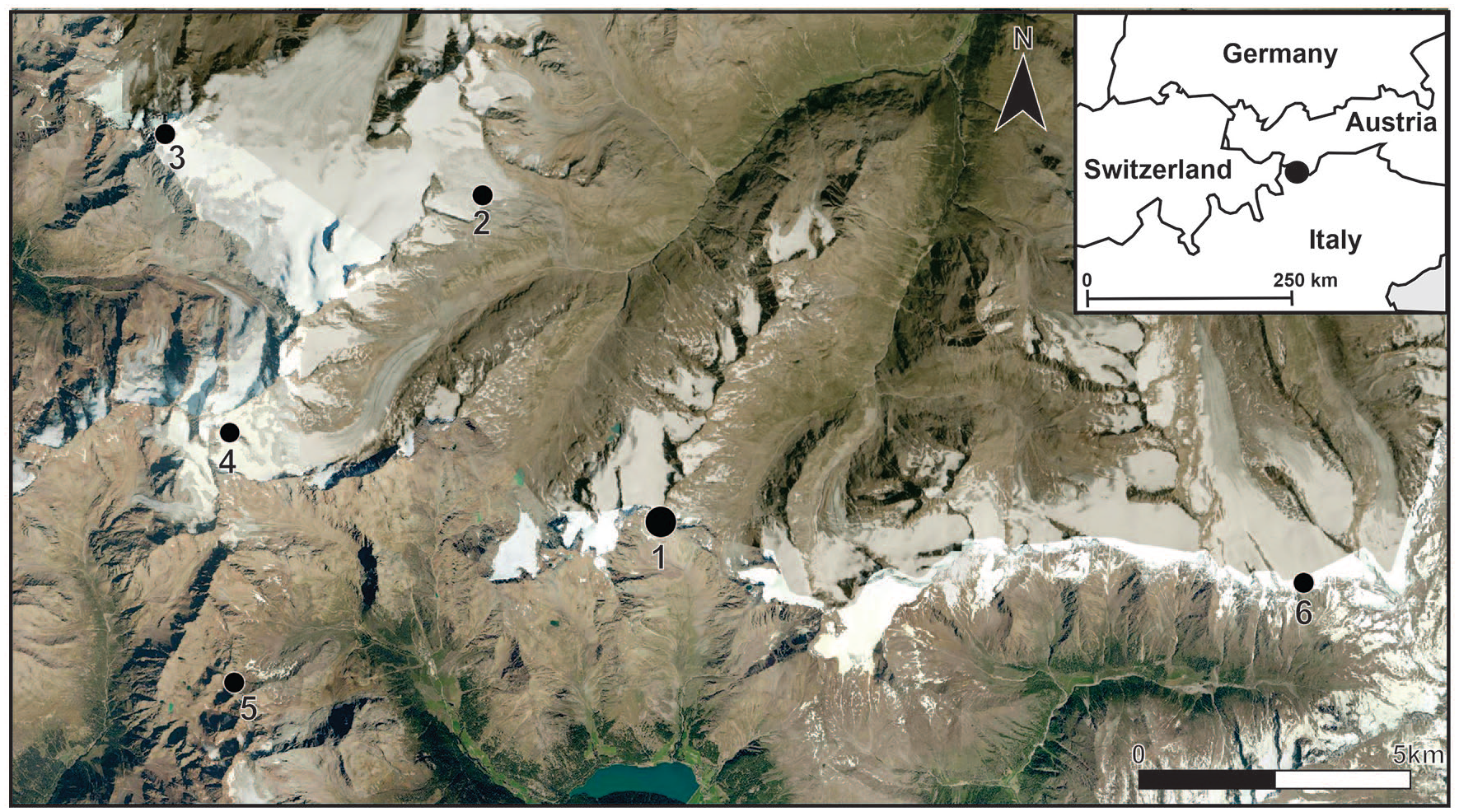
Orthophoto of the findspot in the Tisenjoch (1) and other locations mentioned in the text (2: Kesselwandferner, 3: Weißseespitze, 4: Hintereisferner, 5: Langgrubenjoch, 6: Gurgler Eisjoch). Orthophoto: Land Tirol – data.tirol.gv.at, attribution 4.0 International (CC BY 4.0)/geoland.at – Creative Commons Namensnennung 4.0 International (CC BY 4.0).
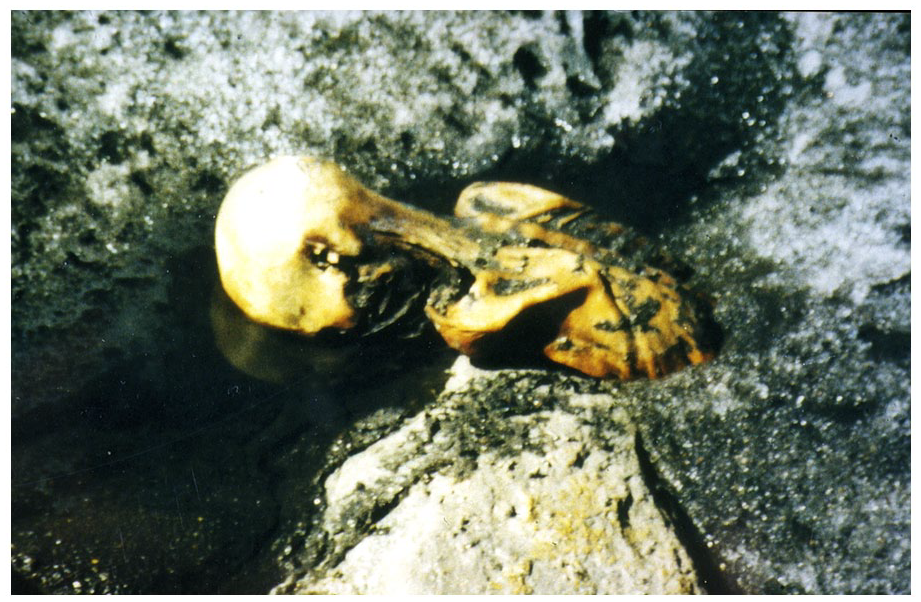
The upper body of Ötzi, protruding from the ice in the Tisenjoch pass on September 19, 1991. Photo: Helmut Simon. Used with kind permission from Erika Simon.
The original interpretation of how Ötzi ended up in the gully and was preserved by the ice was presented by archaeologist Spindler (1993). His view was that Ötzi had fled from the valley below with damaged and partly unfinished equipment and subsequently froze to death in the gully where his remains were found. The body and artefacts were quickly covered by ice and remained so encased, in the protective gully, below a moving glacier, until the find assemblage melted out in 1991 (Spindler, 1993). How else could the body and artefacts be so well preserved?
Ötzi appeared to be a surprising and odd find when he was discovered. Finds from the ice had been recovered and published in Norway decades before Ötzi’s discovery (Farbregd, 1972), but this was not well known outside Norway. Even in the Alps, archaeological discoveries were known from glaciated mountain passes prior to Ötzi (Meyer, 1992), but not understood as part of a larger phenomenon. Thus, when Ötzi appeared, he was an unexpected find for the archaeological community. From the start, it was believed that he was a unique find, preserved by special circumstances. The melt of the ice at the findspot and elsewhere in the Alps that summer was linked to an unusually warm summer and an influx of dust from the Sahara, which fell on the snow (Spindler, 1993; see also Spindler, 2009). At that time, the relevance of climate change to the long-term melting of high-elevation ice was not yet part of the discussion.
Not everyone agreed that the find circumstances were special. Archaeologist Werner Meyer predicted in 1992 based on already known finds in the Swiss Alps that:
It can be said with certainty that the finds from the Lötschenpass and the Theodulgletscher are hardly to be interpreted as unique exceptions, but rather as harbingers of further find assemblages, the discovery of which will be reserved for a future branch of science, the coming ‘glacial archaeology’. This discipline has yet to develop its methods and questions. Interdisciplinary and cross-border - these will be the essential characteristics. (Translation by authors)
It was a remarkable prediction of the birth of glacial archaeology, made a few years before the first mass melt-out of archaeological finds in the Yukon (in 1997, see Farnell et al., 2004), the Alps (Hafner, 2015; Ri, 1996) and Norway (Callanan, 2014; Pilø et al., 2018).
The first example of a new type of find will appear surprising or even odd. When more finds appear, however, the original discovery may be seen to fit a pattern not previously evident. Since Ötzi was found 30 years ago, glacial archaeology has developed as an archaeological discipline (Dixon et al., 2014), with its own methodology (Pilø et al., 2022) and a deeper understanding of the complexity of archaeological ice sites (Pilø et al., 2021). There are now hundreds of sites and thousands of finds. However, the ice mummy from Tisenjoch has not been perceived as part of the pattern. Similar finds sealed beneath moving glaciers are unknown elsewhere.
Human bodies have appeared from glacial ice in the Alps both before and after the discovery of Ötzi, but invariably on the surface of the lower part of temperate (warm-based) glaciers, not below the ice (e.g. Alterauge et al., 2015; Providoli et al., 2016; Reitmaier et al., 2015). Normally what happens after a fall into a crevasse is that the body will be transported downslope inside the glacial ice, only to appear in a very damaged state on the surface in the ablation zone (Ambach et al., 1992; Jouvet and Funk, 2014).
The time has come to reappraise the depositional and post-depositional history of Ötzi and the associated finds. We review the published evidence in light of the development of the subdiscipline of glacial archaeology over recent decades. We also look at the nature of the ice at the findspot: is there evidence for the presence of a basally sliding temperate glacier here? In sum: Are the find circumstances of Ötzi still rightly considered unique or can they be better explained by normal find circumstances observed on other glacial archaeological sites?
The discovery and subsequent excavation
Ötzi was discovered by Helmut and Erika Simon, two German mountain hikers, on 19 September 1991. The upper part of the body protruded from the ice in a small gully in the Tisenjoch at 3210 m. The authorities were informed, but bad weather delayed the recovery of the body until 23 September. A number of people visited the site to see the body before it was recovered. They stepped on fragile objects and removed several of the larger artefacts before their locations were noted. This was unfortunate and led to the destruction of important evidence regarding the site.
A reconstruction of where the artefacts were found was undertaken, based on interviews with people who had been at the site prior to the first proper investigation (Rastbichler Zissernig, 2006). It appeared that many of the larger artefacts, not directly associated with Ötzi’s body, were found resting on the stones along the sides of the gully or in a thin layer of dirty ice at the bottom of the gully (Figure 4). Thus, the natural conclusion was that the gully had been free of ice and snow when Ötzi died. However, it was puzzling that artefacts were found at some distance from the body, such as a quiver which was found 7 m away.
The site was investigated by archaeologists shortly after the find was made in 1991, but difficult weather conditions and the onset of winter quickly stopped the fieldwork (Lippert, 1992). An excavation of the gully was conducted in 1992 (Figure 3; Bagolini et al., 1995). A few more artefacts and several fragments were recovered, and many samples were collected, mainly from the dirty ice layer at the bottom of the gully. This dirty ice layer was covered by a stratum of clean ice without finds (Figure 4).
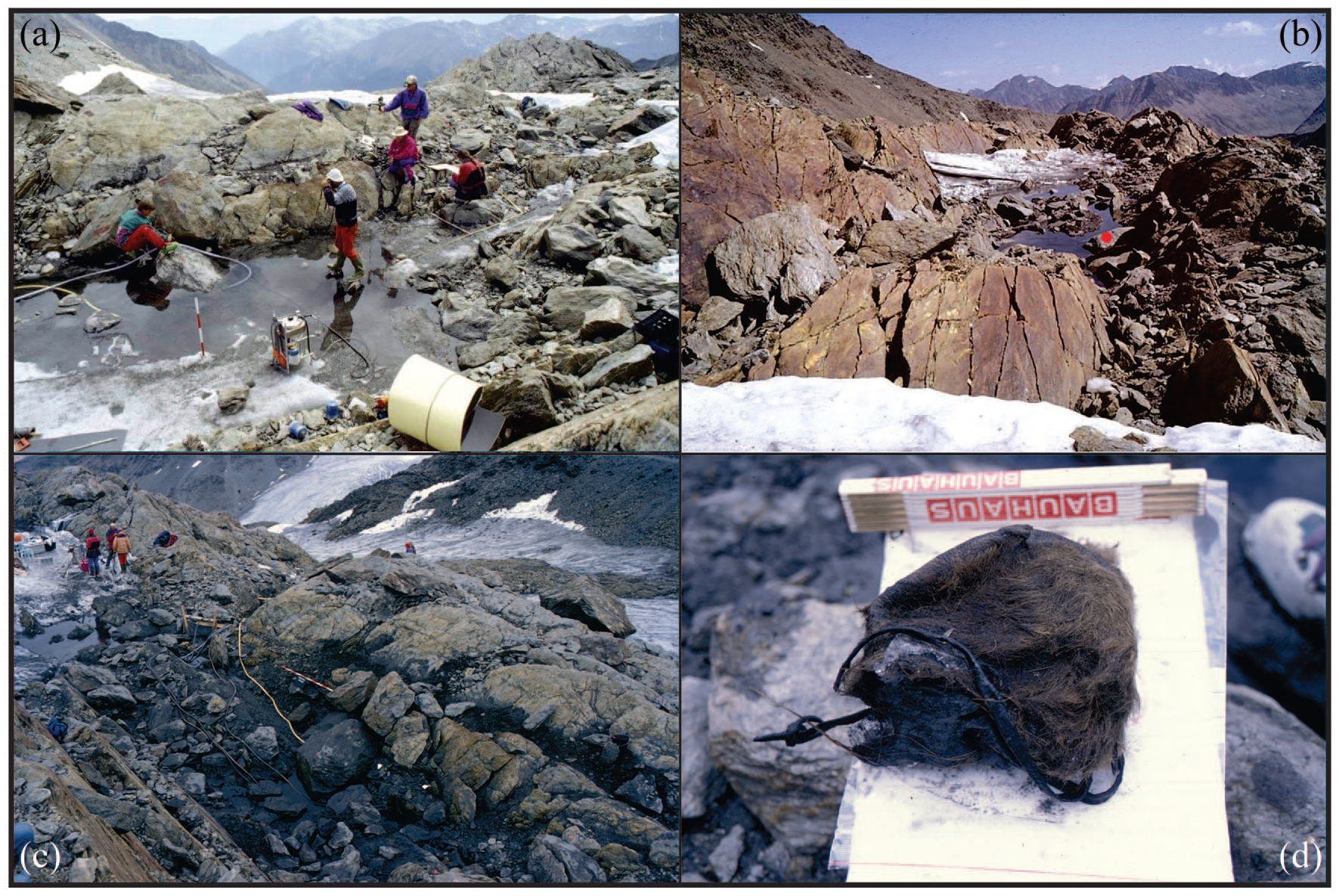
Photos from the 1992 excavation of the Ötzi findspot. (a) Overview of the findspot. The person to the left has his green boot on the stone on which the body of Ötzi was partly resting. © Amt für Archäologie, Autonome Provinz Bozen. Used with kind permission. (b) The gully from the west. Ötzi find spot marked with a red point. Photo: Walter Leitner, used with kind permission. (c) The gully from northwest, drained of ice and water. (d) Ötzi’s well-preserved fur hat, found in the dirty ice layer beneath the boulder on which the body rested. Photos (c and d) Andreas Lippert, used with kind permission.
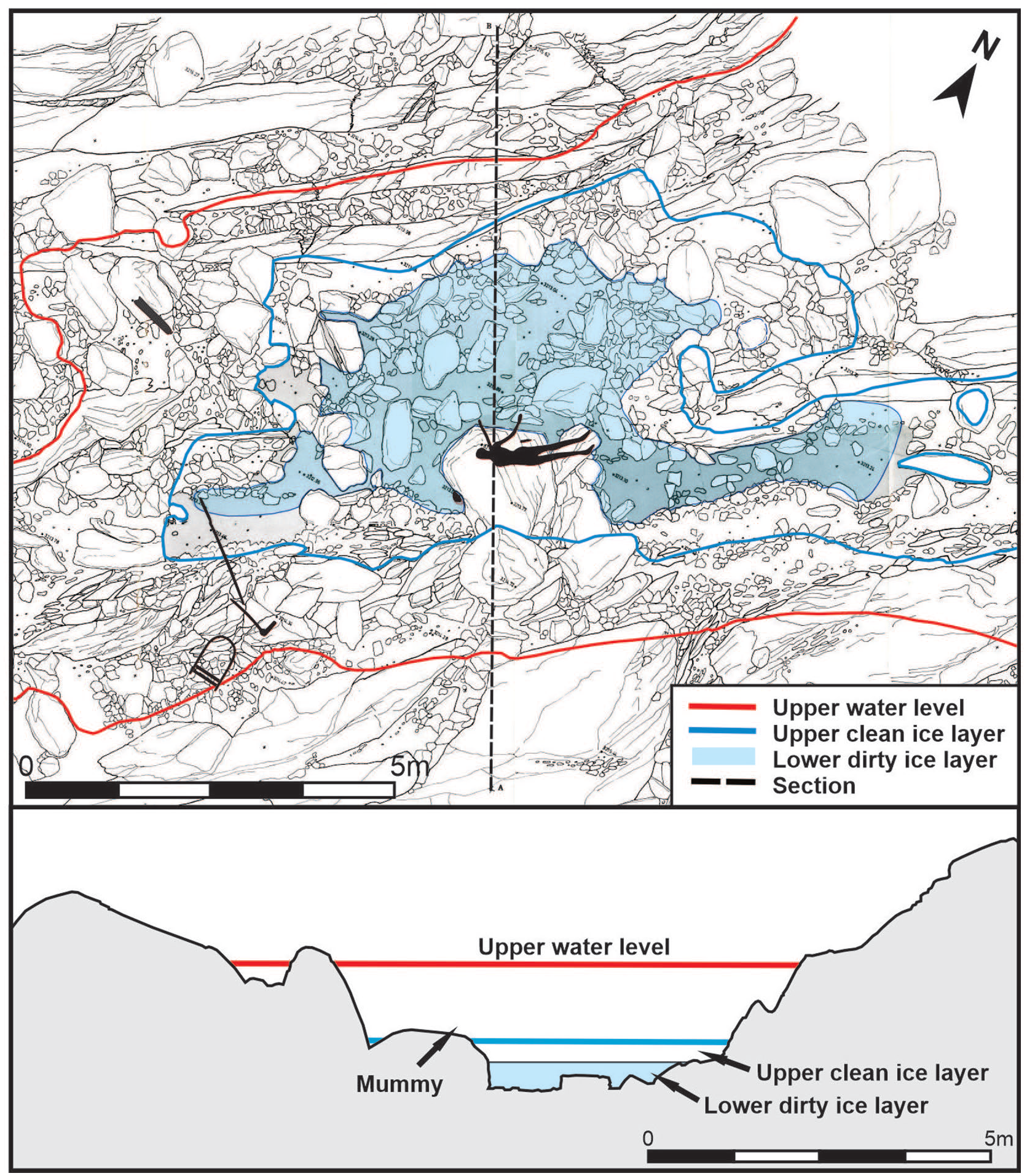
Above: Plan of the Ötzi find spot. Shown on the map of the excavation are the mummy with a flint dagger at the hip; a fur hat at the foot of the boulder where he lay; a quiver (upper left); and a bow, an axe and a backpack frame (lower left). Due to the activity of visitors to the site after the discovery and before the excavation, the position of the axe and backpack frame may be imprecise (Rastbichler Zissernig, 2006). Below: Profile section of the find spot. The gully collected meltwater, which had to be drained away. Based on plan and section in Bagolini et al. (1995).
The Ötzi disaster theory
The original interpretation by Spindler (also known as the disaster theory) was first presented in his book ‘Der Mann im Eis’ (1993). It was initially believed that Ötzi (interpreted as a shepherd) fled across the mountains from the valley to the south in the late summer or fall. Some of his equipment had been damaged in a violent encounter, and he had no time to repair it. Other objects were in an unfinished state, and again the theory was that there was no time to finish them before the flight. Ötzi died in a snow-free gully near the pass. Exposed on the surface, the body freeze-dried, which led to the exceptional preservation. A short time later, a glacier covered the area, and buried the body and the artefacts for more than five millennia, like in a time capsule. Ötzi and his artefacts were protected by the gully, so that the moving glacier did not crush them.
This interpretation of the depositional and post-depositional history of the find was not unanimously accepted by the scientific community at the time, and other possibilities have been suggested since, most notably by Klaus Oeggl and colleagues (e.g. Oeggl, 2003). However, the attractiveness of the story has made it the official Ötzi account to this day. On the homepage of the South Tyrol Museum of Archaeology (n.d.) (https://www.iceman.it/en/the-discovery/ (accessed 19 April 2022), it is stated: ‘The corpse lay in a 3-by-7-metre-wide gully and was thus protected from the destructive forces of the moving glacier. The rocky gully was probably free of ice when Ötzi died there. Subsequently, he must have been covered by snow and the glacier ice’. Moreover, the idea of Ötzi’s sudden and permanent burial in ice is still very much alive in palaeoclimatology, where it is used as a climate indicator (see below).
The idea that the Ötzi find represents an isolated incident saved by a series of serendipitous circumstances may also partly explain why no large-scale, systematic archaeological surveys have been conducted in the Tisenjoch pass post-1992. Only the findspot and its surroundings have been monitored. This seems to be the case even after an axe handle, radiocarbon-dated to 4816–4417 cal yr BP (OxCal 4.4 IntCal 20, 95.4% confidence), was discovered by a mountain hiker c. 50 m south-southeast of the Ötzi findspot (Kutschera et al., 2014; Oeggl and Spindler, 2000). Artefacts have also been discovered in other mountain passes nearby, and we will return to these finds and the context they provide for Ötzi at the end of the paper.
When and how were the body and the artefacts deposited?
The ‘disaster interpretation’ of the find was that Ötzi died in the gully where he was found. The fact that both the human remains and the artefacts were found lying on the ground, was taken as evidence that the gully was snow-free at the time of death. The season of death was believed to be late summer or fall. The basis for this conclusion was that a sloe fruit (Prunus spinosa) was found near the ice mummy, and sloes ripen in late summer. There were also minute pieces of grain stuck in Ötzi’s clothing, and it was believed that they ended up there during threshing (Spindler, 1993). Late summer or fall would also fit the interpretation of the snow-free gully at the time of death, and with the interpretation of Ötzi as a shepherd.
An important piece of evidence that this season of death could be incorrect appeared in 1998. Oeggl (2001) found pollen of hop hornbeam (Ostrya carpinifolia) in a sample from Ötzi’s gut. This type of pollen is produced in March and April in the valley, where Ötzi came from. Moreover, the presence of fresh leaves (containing chlorophyll) from maple (Acer pseudoplatanus) found with one of the birch bark containers (Rastbichler Zissernig, 2006) indicates that May/June is more likely (see discussion in Dickson, 2011). The situation is confounded by the variable altitudes in which the trees may have been growing. Even considering the windswept ridge where the find lay, the gully would very likely have been covered in snow in May/June, perhaps deep snow. The mass balance measurements on the nearby Hintereisferner from 1953 onwards indicate a maximum snow height between mid-May and the beginning of June (Strasser et al., 2018). The average snow height of Hintereisferner snow pit WJ (~3170 m) is between 1 and 2 m water equivalent (w.e.), that is, about 2–4 m of snow, with the maximum measured snow depth recorded at the long term snow pit exceeding 6 m. How could Ötzi have died down in the gully then?
As for all archaeological sites, including ice patches and glaciers, the find locations need not reflect the original pattern of deposition (Pilø et al., 2021) and this is also the case with the Ötzi find. The 1992 excavators of the site pointed to the possibility that the mummy and the finds had been displaced by the wind and by post-depositional thaw and refreezing processes (Bagolini et al., 1995). Due to the topography of the gully where the finds were made, it acted like a pool during the 1992 excavation (Figure 3, above right; Figure 4). This was presumably also the case during the depositional and post-depositional phase, and the recovered material from the gully reflects the situation (Egg, 2009). The body had been submerged in water for 1–3 months following the deposition, which had led to the loss of the epidermis and the hair (Bereuter et al., 1997). Studies of grasses present everywhere on artefacts and in bulk samples indicated that they had been floating in water (Acs et al., 2005). The same could be shown by fragments of an arrowshaft which had been displaced by meltwater (Oeggl, 2003). Repeated freezing and thawing cycles were also indicated by the presence of hairline fracture lines and cracks in Ötzi’s skull (Murphy et al., 2003) and studies of his collagen (Janko et al., 2010).
The disaster theory was challenged by Vanzetti et al. (2010). They claimed that Ötzi had died in the valley in the spring, been mummified by smoking, and transported up to the site in the autumn. According to these researchers, Ötzi was buried on a stone platform near the later findspot. They believed that the finds assemblage and stones were then moved by recurrent thaw and refreezing processes. The original Ötzi research group countered that the hypothesis did not fit the empirical evidence (Zink et al., 2011), but the discussion drew attention to the uncertainties associated with the depositional and post-depositional processes affecting the find.
In fact, the possibility of post-depositional damage and displacement to the artefacts was also recognised by Spindler (1993). He noted that the backpack frame emerged earlier from the ice than the mummy as it was lying at a higher level, and that it might have been damaged by sun and wind after melting out. Remains of a birch bark container were found outside the gully, and Spindler writes that these items were obviously moved by the wind after melting out of the ice.
The broken equipment
As just noted, some of the artefacts found with Ötzi were broken (such as the quiver, the backpack and one of the arrows), and pieces were missing. The initial explanation was that they were broken during a conflict or in the course of Ötzi’s subsequent flight to the mountains (Spindler, 1993).
Later, evidence showed that Ötzi had an arrowhead embedded in his shoulder, which is likely to have led to internal bleeding and death (Gostner and Vigl, 2002). A stab wound to Ötzi’s right hand is also documented (Nerlich et al., 2003). These discoveries have added support to the theory that a conflict was the background for Ötzi’s death in the gully (see also Gleirscher, 2014).
However, new information gained from other glacial archaeological sites suggests a different explanation for the broken equipment and missing pieces. Analyses of the Lendbreen and Langfonne ice patch sites in south Norway show how post-depositional processes affect artefacts lost on the surface of snow and ice (Pilø et al., 2020, 2021). The artefacts are usually displaced from their original locations, broken into pieces and/or scattered. These post-depositional processes leave distinctive signatures on the artefact assemblage.
Even at high elevation, snow and ice cover can melt away during very warm summers. Thus, most artefacts originally lost on the ice and snow of ice patches will eventually be re-exposed and wind up on the ground below. Some of the finds settle in the bases of hollows where snow and ice is more often retained over the summer, enhancing long-term artefact preservation. Artefacts that do not settle into hollows are more likely to be lost over time. The exposed artefacts gradually decompose and disappear, with wood and birch bark being the last materials to preserve. This typical taphonomic pattern is seen very clearly in the artefact distribution maps at Lendbreen, Norway (Pilø, 2018). Here, pieces of wood and birch bark surround the edges of a large hollow with more favourable preservation conditions, where textiles, rawhide and horse dung are preserved.
Once resting on the ground (typically rocks), the artefacts may also break into pieces due to ice and snow pressure. There is clear evidence of the presence of animals on the Tisenjoch site (Oeggl et al., 2005) and they may also have damaged the finds by trampling. During the melting process, meltwater and strong winds may disperse artefacts and artefact fragments (Pilø et al., 2021). It is also possible that humans moved or removed objects from the find in the immediate aftermath of Ötzi’s death (where is the arrow that hit Ötzi in the shoulder?) or at any later stage when the find spot was re-exposed (see below).
At the Lendbreen ice patch, fragments of a Bronze Age ski were found hundreds of metres apart (Finstad et al., 2018), as were the bones of a post-medieval horse. Many of the artefacts at Lendbreen have parts missing. This does not imply that people brought these items into the mountains in an already broken state. They were broken by post-depositional processes at the site. Ötzi and the state of his artefacts fit this general pattern well. The dispersed and partly broken equipment with missing pieces is likely the result of now well-established post-depositional processes on ice sites.
Ötzi died in the spring or early summer (see above) and therefore probably on the surface of the snow. When the snow and ice melted, his body and most of his equipment ended up in the gully underneath. The missing pieces either never made it into the gully or were transported away by meltwater or wind. Are there traces of artefacts that did not make it into the gully? There is evidence of this, even though the excavation in 1992 did not extend outside the gully. Only 2 days after the discovery of Ötzi, the remains of a birch bark vessel were found c.6 m southeast of where the bow and the copper axe lay (Rastbichler Zissernig, 2006), outside the gully. Additional pieces of birch bark were recovered here in 1994 (Rastbichler Zissernig, 2006; Sjøvold, 1995). The similarity to the Lendbreen find circumstances is striking. It was previously thought (Spindler, 1993) that the birch bark had been displaced during the very short period between melt-out and recovery in 1991, but in our view, it is equally likely that this happened over the course of the initial site formation.
A conclusion in line with the evidence, and in support of the work by Oeggl and colleagues, is that Ötzi died outside the gully, or more precisely above it, and his dead body most likely rested in/on the snows of spring or early summer. Most of the find assemblage later entered the gully as the snow and ice surrounding it melted away. Whether this happened the same year, later and/or in several steps is not known. At one or more times, the mummy and the artefacts were submerged in water. The breaking of Ötzi’s equipment and the loss of pieces were likely caused by post-depositional processes on the site.
The ‘glacier’ at and around the find spot
A central part of the original Ötzi story is that he died just as the climate was getting colder. Snow and ice covered his resting place a short time after he died, sealing it off from the environment. Otherwise, the original interpretation argues, the ice mummy and the artefacts would not have been preserved. It was argued that as the ice built up, a basally sliding (warm-based) temperate glacier developed over the find spot (Baroni and Orombelli, 1996). Since Ötzi was resting in stagnant ice in a protected gully, he was not directly influenced by the moving ice of the glacier. Only 5300 years later did the glacial ice melt and Ötzi reappeared.
This type of preservation is at odds with the way other finds from high-elevation ice are preserved. Archaeological finds from ice are mostly associated with stationary or semi-stationary basal ‘cold’ ice, that is, ice that does not move or only moves very slowly at the substratum. In Norway, this type of ice is found in isolated stationary ice patches and in non-moving ice fields along the top or sides of moving temperate glaciers (Pilø et al., 2022). ‘Cold ice’ also exists at the base of high altitude glaciers and ice caps, which are frozen to the permafrost ground below (Haeberli et al., 2004). Warm-based temperate glaciers yield only more recent finds due to their downhill movement and constant renewal of the ice; archaeological discoveries from such contexts normally do not date back more than 500 years (e.g. Providoli et al., 2016).
Since the discovery of Ötzi in 1991, no similar finds have appeared from gullies beneath moving glaciers, even though glaciers in the Alps have retreated substantially due to ongoing climate change. More recent human corpses and remains have emerged from the melting glaciers in the Alps and elsewhere (e.g. Hebda et al., 2017), but none earlier than c. 1600 CE. All the recent human remains have been found on the surface of glaciers, not below them. An artefact assemblage similar to Ötzi’s, but 500 years younger and without human remains, was discovered in the Schnidejoch pass in the Swiss Alps from 2003 onwards (Hafner, 2015). This find was associated with non-moving ‘cold’ ice in a slope just below the actual pass. There is a temperate glacier with moving ice here as well, but further downslope.
What is the evidence that there were temperate ice conditions with basally sliding ice at Ötzi’s findspot? Baroni and Orombelli (1996) stated that Ötzi was found at the upper edge of the accumulation area of an alpine glacier, and that he was preserved in stationary ice inside a gully, protected from the shearing flow of glacial ice. The excavators of the site state that the topography of the area surrounding the find spot is not advantageous to the development of a glacier, as there is no catchment area (Bagolini et al., 1995). The excavators also say that there was c. 20 m thick ice here around 1920 (Bagolini et al., 1995), but there is no reference to the source of this information, or where in the Tisenjoch this thickness was measured. An ice thickness of 20 m is commonly not sufficient to initiate basal sliding, as around 25–30 m is necessary to produce plastic, deformable ice at the base (e.g. Paterson, 1994).
We can constrain the glaciological conditions of the last 6000 years even in the absence of direct measurements or an ice core by analysing palaeorecords and comparison with measured data available from the late Little Ice Age onwards. The so called Little Ice Age (LIA) lasting from roughly 1250 CE to 1870 CE resulted in a maximum glacier size for the Holocene (Ivy-Ochs et al., 2009), with the mid-Holocene Optimum potentially being free of glaciers in the eastern Alps (Bohleber et al., 2020). Glacier states and conditions in the Eastern Alps during the Holocene, including the period from the death of Ötzi onwards, are constrained by the LIA maximum and the mid-Holocene glacier minimum. The latter might be quite similar to today’s conditions where ice at the summits is a transient feature and will melt in a few years (Fischer et al., 2022). Today, glacier mass balance and climate are within the range of the mid-Holocene temperature maximum (Fischer et al., 2022). Maximum and minimum glacier states and mass balance conditions therefore can be described by current and LIA states, the first directly measured, the latter reconstructed from historical documents.
Glaciological data that describe the specific setting of the findspot consist of historical maps, a glacier inventory for the late LIA, and several different sources of information for recent decades. The latter include data on glacier extent and elevation between 1969 and 2017 (Fischer et al., 2015; Hartl et al., 2022), ice thickness measurements (Fischer and Kuhn, 2013), time series of orthophotos taken at the end of summer, and mass balance data regarding the nearby glaciers Hintereisferner and Kesselwandferner (Strasser et al., 2018 and references herein). Additional data arise from dating the basal layer of the ice core drilled on the nearby summit of Weißseespitze (3500 m) complemented by the direct mass measurements starting in 2017 and historical maps of the last century.
In a first step, the changes in extent and volume were analysed from historical maps (~1870) and the glacier inventories (1969, 1997, 2006 and 2017; Fischer et al., 2015; Hartl et al., 2022). The topographic setting of the former glacier base was analysed from a high-resolution LiDAR digital elevation model of the now ice-free area. This topography is important for inferring past glacier dynamics. Past ice thickness was calculated using the difference of past ice surface elevation data and the bedrock DEM. This allows a more precise reconstruction of the spatial distribution of past ice thickness than the ground penetrating radar (GPR) data. Mass balance is generally influenced by local topographic effects (Charalampidis et al., 2018; Fischer, 2010), so the extrapolation of point mass balance from one location to another is not straight forward even over small spatial distances. The nearby glaciers Hintereisferner and Kesselwandferner have been monitored for their mass balance since 1952/53. Those time series are amongst the longest world-wide and provide valuable insights into mean and extremes of mass balance in the region. As the mass balance of the two glaciers differs despite a similar climatic setting, the two time series may serve to approximate the range of mass balances at the findspot (Kuhn et al., 1985).
The findspot in the now ice-free area (Figure 5a) is located close to the ridge, where foehn winds erode the snow. The topographic setting at the findspot is similar to Weißseespitze (Fischer et al., 2022): a rock ridge confines the glacier at its southern margin, and the exposure to foehn winds limits snow accumulation during precipitation events. Similar to the findspot, where the rock ridge is also snow free under the conditions displayed by the historical map published in 1878, historical maps and photographs at Weißseespitze confirm that the rock ridge did not develop an ice cover since 1870.
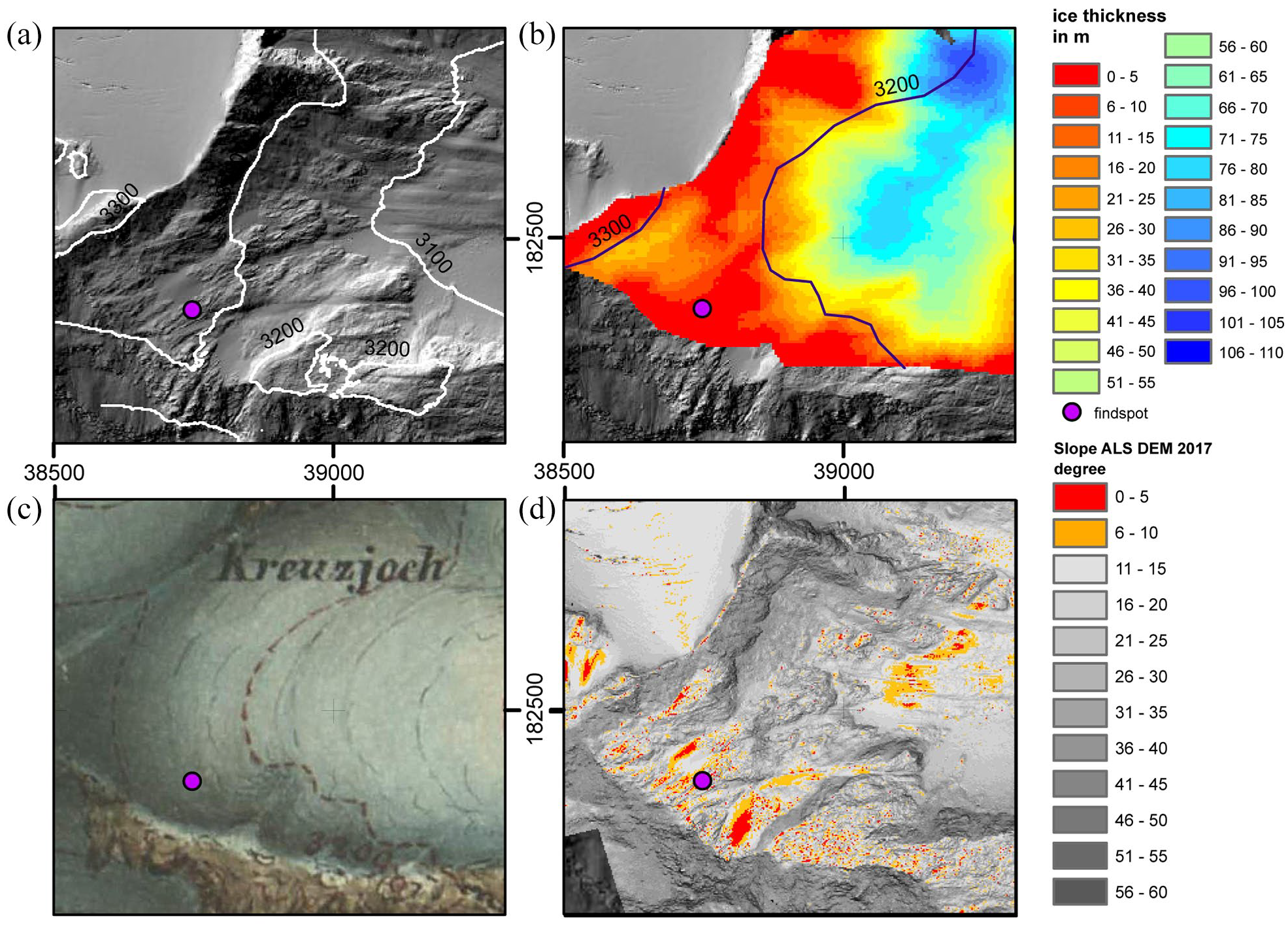
The (a) shaded relief of the ALS flight of 2021 (Terrain data Tyrol, 2021) has a resolution of 1 m pixel size and serves as detailed map of the glacier base at the finding spot. The digitised contour lines of the third survey (1870 onwards) represent the first available surface elevation data, which is used to reconstruct the ice thickness (map (b)) that is below 10 m in the vicinity of the finding location. Map (c) shows the glacier extent, located right in the vicinity of the finding location, with the firn/snow attached to the glacier margin being a common feature also observed today for distinct ice margins standing proud from the rock surface. This map is consistent with the time series at Weißseespitze, where the rock ridge never was ice covered as far back as data is available because of wind erosion. The low surface slope (d) also supports the lack of ice movement as neither ice thickness nor the surface slope foster basal or internal ice flow.
The map derived from the third federal survey (published in 1878) is the first map including all parts of the Austro-Hungarian empire showing contour lines of elevation on glaciers (Hofstätter, 1989). In this study part of the map was georeferenced to the orthophotos and by use of six control points indicated and labelled in the open government database orthophotos data set with a final RMS error of 63.7 m in the XY direction. The vertical uncertainty of historical maps can be astonishing low, as also the reanalysis of Haggrén et al. (2007) of the map of Hochjochferner dating from 1907 points out, with an uncertainty of 10 m in the accumulation area and 1–2 m in the ablation area. In our study, the contour lines of elevation at the glacier margins exceed the LiDAR measured altitudes by only 11.2 m in average for 14 data points with a minimum deviation of −1.4 m and a maximum of 24.1 m. The contour lines of the 1878 map with a spacing of 100 m have been used to reconstruct the gridded surface elevation of about 1870 by using the tool topo2raster of ArcGIS. The contour lines of elevation were digitised, and within the glacier margins of the historical map converted to a DEM with the ice thickness assumed to be 0 at the glacier margins. The volume then was calculated by subtracting the highly accurate LiDAR DEM representing the glacier base from the DEM of the historical glacier surface. The reconstructed grid of glacier thickness distribution (Figure 5b) indicates an ice thickness below 5 m at the findspot in about 1870, with a nominal accuracy of elevation information of 11.2 m, so that the maximum thickness would be about 16.2 m. This is too low for significant ice dynamics evolving, even considering the maximum horizontal and vertical uncertainties of the control points presented. Pushing the uncertainty to 20 m would not be sufficient for significant ice dynamics considering the low inclination of the surface. The maximum loss of more than 30 m of ice, firn and snow at Weißseespitze since 1893 supports this estimate.
At the Weißseespitze, the areas close to the snow and ice-free rock ridge show volume losses much lower than this maximum. The findspot has been close to the ice margin even at the end of the LIA maximum period (Figure 5c), so that an ice thickness larger than the uncertainty of the volume reconstruction can be excluded. The surface slope of the now ice-free area indicates local slopes lower than 10° (Figure 5d). At the upper margin of the glacier, basal sliding with potential liquid water channelled in gullies is very unlikely.
The time series of orthophotos at the end of summer between 1970 and 2020 illustrates the glacier retreat, but also the fluctuation of seasonal and multiannual snow patches at the findspot (Figure 6a–f). The mass balance at the respective elevation bands at Hintereisferner and Kesselwandferner allows a closer look at the dynamics of mass balance within the respective elevation bands of 3250–3200 m and 3200–3150 m, that is, lower and higher than the finding location (Figure 6g). Interannual variability is high for both glaciers, with mass gains of up to nearly 2 m w.e (about 4 m of densified snow) occurring during the first years of the record. The mass balance was positive or close to balance prior to 1991, with 1991, the year the find was made, being the first year of mass loss in this record. Similar melt events had been reported, but not measured also for other years, for example 1947. After the extreme melt of 2003, accumulation and ablation occur, with the specific conditions also affecting the volume changes (Figure 7). This illustrates that changing conditions as proposed in this study for the early decades after the deposition of the ice man and probably also later (see below) are possible in principle. The volume change data illustrates that the ice cover at the findspot was patchy and thin, and that the main ice body and therefore ice flow took place north and east of the findspot.
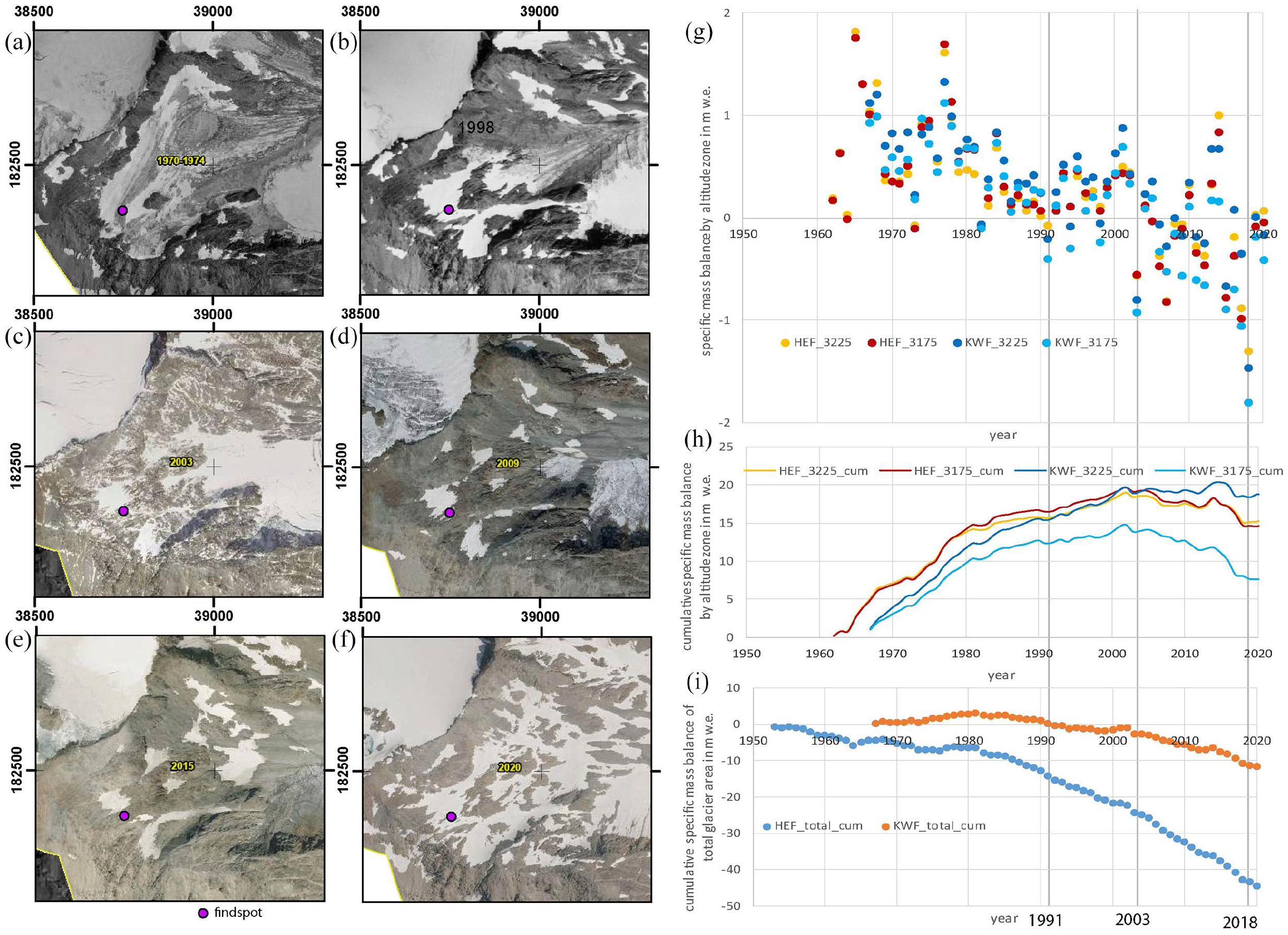
(a–f) the time series of orthophotos illustrate the fluctuation on the end-of season snow line at the findspot. This oscillation of mass balance around zero with the first major high elevation melt event is also reflected by the mass balance measurements of the nearby Hintereisferner (HEF) and Kesselwandferner (KWF) glaciers in the elevation bands about 3200 m. 1991, the year the find was made was the first year of the record shown where summer melt removed substantial mass at these elevations. (g) Annual specific mass balance in the 3225 m altitude zone ranging from 3200 to 3250 m (HEF yellow, KWF dark blue) and in the 3175 m altitude zone ranging from 3150 to 3200 m (HEF red, KWF light blue). (h) On both glaciers close to 3200 m, cumulative mass balance show increases of up to 20 m until about 2003. (i) The cumulative mass balance at the glaciers points out intensifying losses for the full period for Hintereisferner and Kesselwandferner, but at the altitude of the findspot, the transition towards mass losses happens much later than for the total glacier.
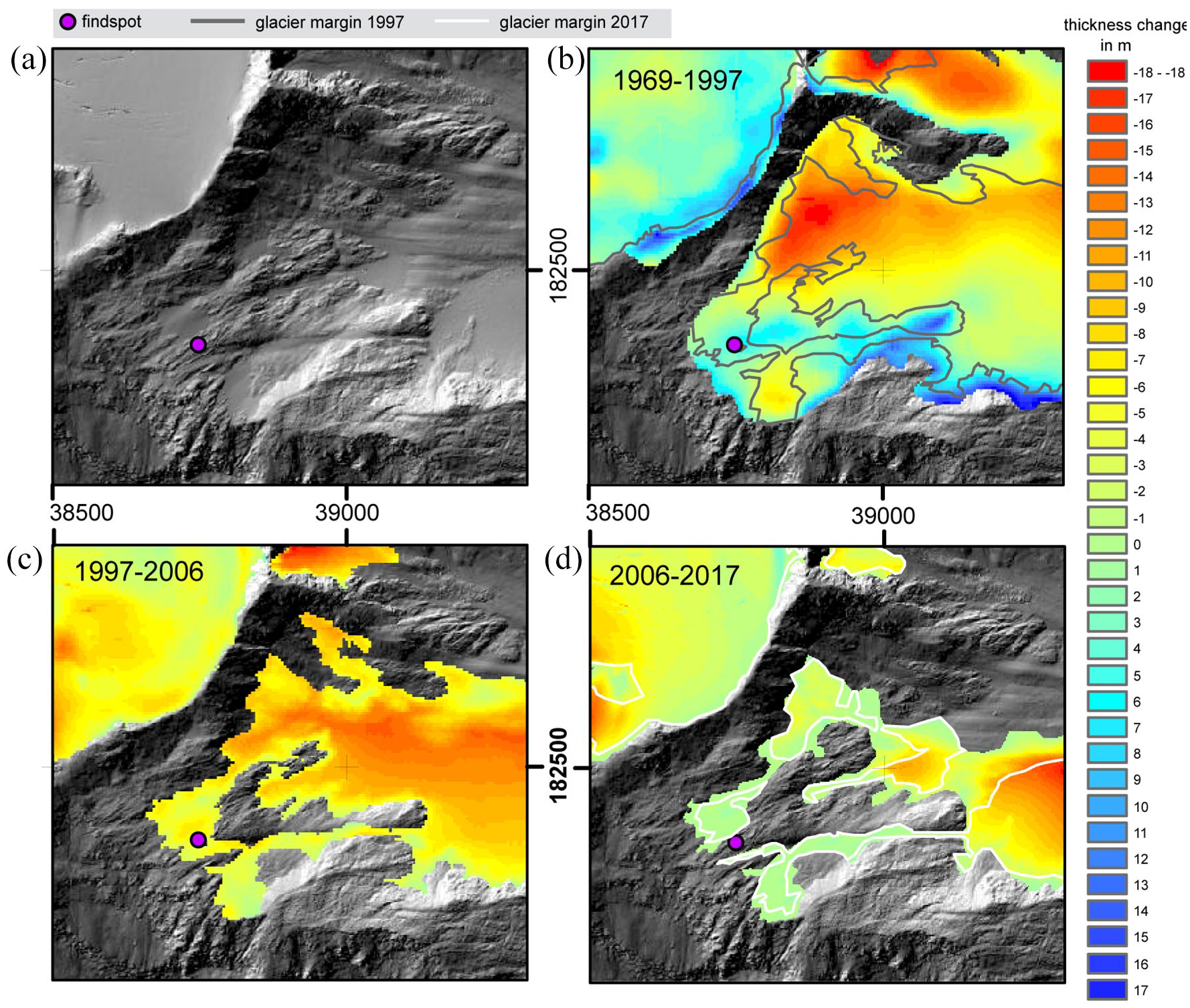
The different flow regimes and directions indicated in the shaded relief of the 1 m resolution LiDAR DEM of 2017 (a) are confirmed by the volume changes between 1969 and 1997 ((b); Fischer et al., 2015) indicating high losses at the deeper dynamic northern tributary and the shallow southern part of the ice body. The stagnant southern part of the ice body showed net volume gains at the findspot, confirmed by positive balances measured at the nearby glaciers Hintereisferner and Kesselwandferner in the same elevation zones. A shallow snow patch covering the findspot in 1997 resulted in mass losses close to the findspot in the period 1997–2006 (c), with zero mass loss at the findspot after 2006, and only minor changes in the remaining snow and ice filled gullies (d).
Permafrost maps from the Department of Geography, University of Zürich (https://geoserver.geo.uzh.ch/cryogis/wms), see Boeckli et al., 2012) show that the find spot is well inside the permafrost zone. Given the thin cover of ice/snow here, the ice/snow field would have been frozen to the bedrock with no movement; it was ‘cold ice’.
An aerial photo of the find spot from the early 1970s does not show visible signs of movement in the ice, such as crevasses, at the marked findspot (Figure 6a). The nearest traces of extension marks from ice movement are visible only c. 50 m further downslope to the east. Such traces of movement are not present around the Ötzi findspot itself, but there are possible traces of bedrock fluting here, including the gully where Ötzi was found. These traces probably date to the Younger Dryas/Early Holocene (Seguinot et al., 2018) when the area around the findspot was covered in ice and snow with the exceptions of narrow and steep arêtes and horns (Baroni and Orombelli, 1996). It is unlikely that the traces at the findspot are from a basally sliding glacier post-Ötzi, as they are situated at a right angle to the slope here. In essence, the gully where the find was discovered was probably made by a basally sliding temperate glacier prior to Ötzi’s death, but it was not covered by one afterwards.
The artefact distribution at the find area also makes it unlikely that the findspot was covered by a temperate, basally sliding glacier subsequent to Ötzi’s death. Several of the artefacts were recovered not deep inside the gully, but further up the rock ledges and stones of its sides – and even in the case of the birch bark vessel outside the gully. As mentioned, an axe handle about 500 years younger than Ötzi, was also found on the ground, about 50 m to the south-southeast (Supplemental Figure 1; Kutschera et al., 2014; Oeggl and Spindler, 2000). If a basally sliding glacier had developed here after the loss, the axe would not have survived lying on the open ground as it did.
Based on this discussion, it is likely that a non-moving perennial snow/ice field developed over Ötzi’s resting place. The find spot is described as an ice patch by Kutschera et al. (2017), and this may be correct, when the ice here was not attached to the glacier further downslope. Bohleber et al. (2020) call it an ice field, while Haeberli et al. (2004) describe it as ‘cold ice’ without significant basal sliding. About 100 m further downslope, this ice field became thicker, eventually developing into a basally sliding temperate glacier, which ground its way into the hillside. In the flat area where the find was discovered, a basal sliding temperate glacier is very unlikely to have developed after Ötzi died there.
Non-moving snow/ice fields of limited size, attached to glaciers, are quite similar to isolated ice patches in their short reaction time to changes in weather and climate. Such ice fields are smaller and thinner than glaciers. Small and thin ice fields are more prone than larger glaciers to rapid melt during shorter warming periods, due to their much lower volume. If Ötzi was buried beneath a ‘cold ice’ field of limited thickness, the body and the associated artefacts are more likely to have been repeatedly exposed to the environment. It would change the context of the Ötzi find from very special circumstances to quite ‘normal’ circumstances for high-elevation ice finds.
When was the find spot permanently sealed off?
The original interpretation of the find describes a single event with all the material found in the gully related to Ötzi (Spindler, 1993). He died in the autumn, was covered by snow, and remained in the ice until he melted out in 1991 (e.g. Haeberli et al., 2004). This observation has been used by glaciology studies as evidence for a sudden climatic cooling at the time of Ötzi’s death, with the ice at the find spot not melting back to pre-Ötzi levels before 1991. This interpretation started immediately after the find was made (Baroni and Orombelli, 1996) and has continued to the present (e.g. Bohleber et al., 2020; Gabrielli et al., 2016; Magny and Haas, 2004; Pfister and Wanner, 2021). However, as discussed above, there are serious doubts regarding rapid permanent ice cover of the gully (e.g. Egg, 2009; Oeggl, 2003). A time capsule in the ice, as first put forward by Spindler, would be a remarkable situation in glacial archaeology. Glacial archaeological sites tend to accumulate material over time, not preserve one single event only, and especially not in mountain passes, where there is often quite a lot of human and natural activity over time (Hafner, 2015; Pilø et al., 2020; Providoli et al., 2016). In a posthumously published paper, Spindler (2009; Spindler died in 2005) himself raised the possibility of a later exposure of the upper part of the body.
The 1992 excavation report is ambiguous in this regard. It states that some of the material at the bottom of the gully (such as charcoal and lithics) might be older than Ötzi (Bagolini et al., 1995). It also says that the material at the bottom cannot be younger than Ötzi as the gully had been covered in ice and snow since his death. At the same time, the report mentions that ice pressure and meltwater might have moved the objects in the gully.
If Ötzi and his equipment had been permanently buried by ice, like a time capsule (with no subsequent exposure), the radiocarbon-dated material from the bottom of the gully should not postdate the mummy. The available radiocarbon dates show that this is not the case. Material both earlier and later than Ötzi has been recovered from the floor of the gully, both from the dirty ice at the bottom and from the ground itself (Kutschera et al., 2014, table 2, 48 dates; see also Dickson, 2011). The material not related to Ötzi based on context and radiocarbon dates is mostly of natural origin (high-altitude mosses and grasses, leaves and needles, animal dung and a feather), but an exception to this is a piece of cut green alder, radiocarbon-dated to 2737–2429 cal yr BP (Kutschera et al., 2014, table 2; recalibrated with OxCal 4.4 IntCal 20, 95.4% confidence).
The radiocarbon dates clearly show that material was repeatedly added to the assemblage in the gully, also after Ötzi’s death (Figure 8). The simplest way to explain this is that the find spot was also repeatedly exposed, which is in line with archaeological evidence from other mountain pass sites (Hafner, 2015; Pilø et al., 2020). In theory, material later than Ötzi could have been preserved in ice above the gully (accepting, as argued above, that there was not sliding basal ice here), and only have melted into the gully in very recent times, just prior to Ötzi’s discovery. However, the presence of the dated samples in a dirty ice layer at the bottom of the gully, sealed beneath a layer of clean ice, makes this highly improbable. Based on the evidence of the radiocarbon-dated material, the gully started to collect material from c.7300 cal yr BP and continued until c.4000 cal yr BP, with one later find (the cut green alder).
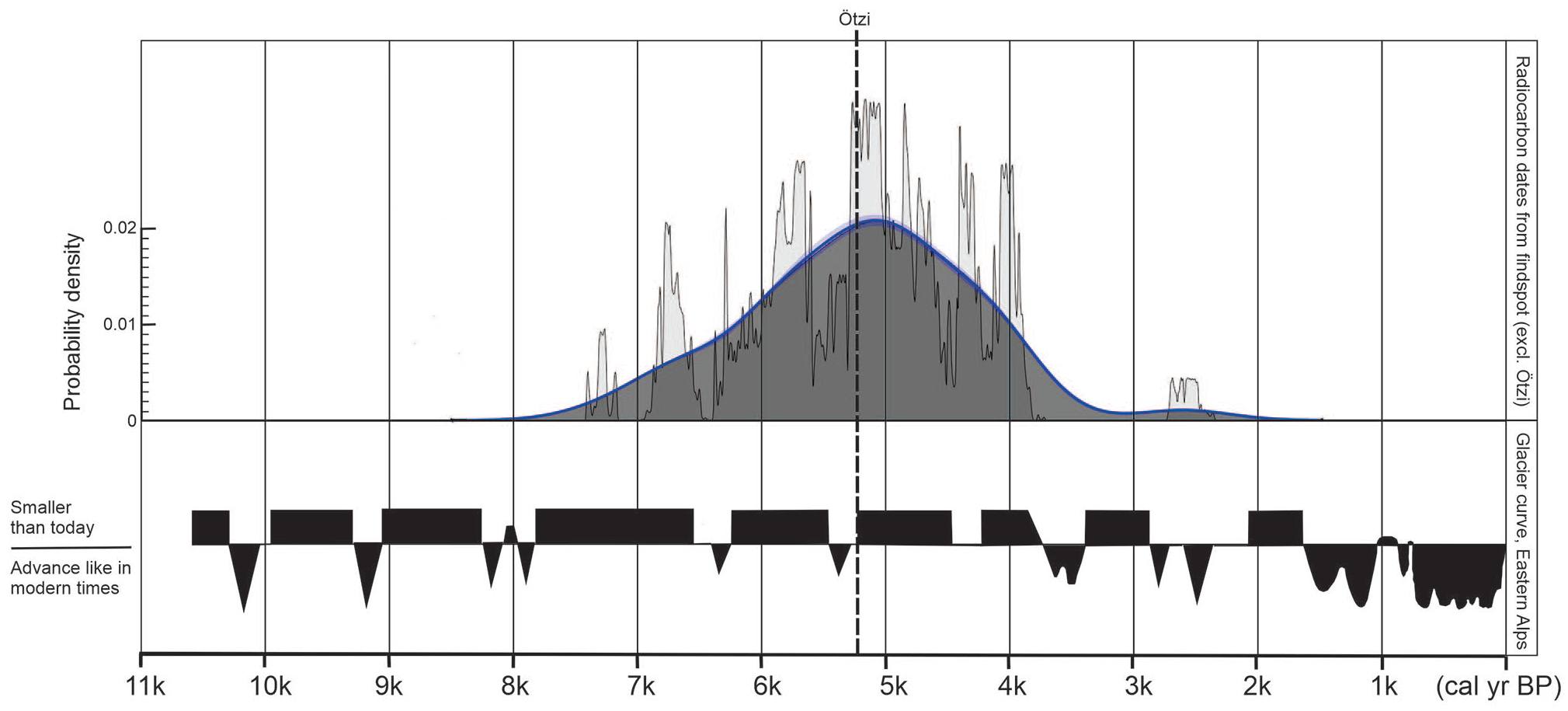
Mean kernel density model distribution dates of the non-Ötzi finds in the gully (based on dates in Kutschera et al., 2014, table 2, 48 dates), compared to the size of glacier tongues in the Eastern Alps (redrawn from Kutschera et al., 2017). Traditional summed radiocarbon plot in the background of the KDE curve.
Ice coring at two nearby high-altitude ice domes at Weißseespitze (Bohleber et al., 2020, 12 km NW of the Tisenjoch) and Ortles (Gabrielli et al., 2016; 37 km SW of the Tisenjoch) show that ice starts to build up there 6700 ± 400 cal yr BP (Ortles, 3859 m) and 5884 ± 739 cal yr BP (Weißseespitze, 3500 m), predating Ötzi’s death. This research identifies the start of neoglaciation in the region following the Holocene Thermal Maximum (e.g. Ivy-Ochs et al., 2009).
The build-up of ice in the Alps was not a continuous process, even following the Holocene Thermal Maximum. Climate conditions between 10,500 and 3300 cal yr BP were not favourable for significant glacier expansion except during rare short episodes (Ivy-Ochs et al., 2009). The most comprehensive glacial reconstruction for the eastern Alps in the Holocene shows that there is no internal ice deformation at the findspot following the deposition of Ötzi (Kutschera et al., 2017). Instead, the evidence indicates a comparatively ‘small ice’ situation at this date (Figure 8). Archaeological evidence from the Schnidejoch pass (270 km west of Tisenjoch), which can only be approached during times of small glaciers, suggests that there were three phases of minimal ice extent: 6800–6300 cal yr BP, 5700–4900 cal yr BP and 4900–4200 cal yr BP (Hafner, 2012). Ötzi’s death falls in the middle of the second minimal ice period. After 3300 cal yr BP, it became cooler and the warm periods were shorter. There was a marked glacier advance only much later than Ötzi, around 3000–2600 cal yr BP (Ivy-Ochs et al., 2009).
Figure 8 compares the regional glacier curve with a radiocarbon kernel density estimation (KDE) curve (Bronk Ramsey, 2017) for the dated material in the Ötzi gully. The KDE curve captures the distribution of radiocarbon dated events without the confounding effects of spurious peaks from the shape of the radiocarbon calibration curve. There is no clear link between the two curves, other than that the finds mostly stop around 3800 cal yr BP after decreasing in number, which coincides with a glacial advance, but this is 1500 years after Ötzi’s death (Figure 8). There is only one later dated find (the piece of cut green alder), which may indicate a later re-exposure as discussed above.
If Ötzi’s body and the associated artefacts were repeatedly exposed in the 1500 years following original deposition, why are they still remarkably well preserved? Recent results from glacial archaeology indicate that material from the ice need not break down as fast as previously believed (Pilø et al., 2021). We are beginning to understand that the combination of a cold, high-altitude environment with intermittent and short seasonal exposure prevents rapid destruction of organic material. Finds deteriorate but are not exposed one year and gone the next. It is thus not surprising that organic material from the gully (moss, grass, leaves, needles, animal dung and wood) predates Ötzi, some by more than 1000 years (Kutschera et al., 2014).
Ötzi’s fur cape was much better preserved beneath the body, as were his footwear and fur hat which were found in the ice at the bottom of the gully (Figure 3d). In fact, the fur cape had fallen into pieces, leaving his back naked when discovered in 1991. The skin on the back of Ötzi’s head had also flaked off, revealing cranial bone here. Tellingly, this is the highest point of the mummy. This evidence strongly suggests that the upper part of body was exposed on several occasions prior to the 1991 discovery. How many times such exposures happened and how long they lasted is difficult to ascertain based on the available evidence.
In summary, Ötzi was not buried in an ice time capsule for 5300 years. After first being encased in snow and ice within the gully (where earlier organic material had already accumulated), he was intermittently exposed during melting incidents. This led to damage to his body and artefacts. Intermittent exposure of the gully also led to the introduction of younger material to the find assemblage. Care is thus essential when assigning undated material in the gully to Ötzi (for instance the sloe fruit; see also Heiss and Oeggl, 2009). Moreover, Ötzi cannot be used as direct evidence for sudden climate cooling at the time of his death. As has been noted elsewhere, the link between glacial archaeological finds and glacier curves is complex (Pilø et al., 2018, 2021).
The regional context of Ötzi
It has often been emphasised that large parts of the Alps, and in particular the Ötztal Alps with the alpine valleys around the Iceman’s site, were archaeologically unexplored until the discovery of Ötzi in 1991. However, in 1992, just one year after the discovery, extensive archaeological surveys were initiated, both on the southern Italian side and on the northern Austrian side (Bagolini et al., 1995; Leitner, 1995). The aim was to increase knowledge of Ötzi’s background and to reconstruct the history of the alpine cultural landscape. Multidisciplinary research has continued since and has led to the discovery of numerous new archaeological sites that chronologically cover the entire Holocene (e.g. Kutschera et al., 2014; Putzer, 2019; Putzer et al., 2016; Putzer and Festi, 2014).
These sites are mainly seasonal campsites and ephemeral building structures that can be seen in the context of typical economic activities in the subalpine and alpine zones: Hunting and gathering, pastoralism and intra- and transalpine trade and mobility. Particularly well-studied examples are the two rock shelters ‘Hohle Stein’ near Vent/Austria and ‘Beilstein’ near Obergurgl/Austria (Leitner, 1995; Zanesco, 2012; Supplemental Figure 2), which were frequented repeatedly over many millennia (including the Neolithic). Such prehistoric campsites were integrated into a wide supra-regional network, in which the connecting high alpine passes played a particularly important role. Such passes allowed quick and easy passage (above the treeline) between individual valleys. The passes are usually situated above 2700 m and have therefore been glaciated or covered with ice for parts of their history. This ice has disappeared in many places in recent years.
The finds from the Tisenjoch fit a pattern with other glacial archaeological pass sites in the Alps (e.g. Curdy and Nicod, 2020; Hafner, 2015; Reitmaier, 2021). Several discoveries have been made at nearby mountain passes during the last 10–20 years. As in the case of Ötzi, the discoveries were accidental and only afterwards closely examined and monitored by professional archaeologists.
The Gurgler Eisjoch (3134 m), a connection between the Schnalstal/Pfossental and Gurglertal, is an important pass site. Here, a snowshoe from around 5800 BP, wooden objects, arrow shafts and leather finds from 6500 to 5800 BP as well as Iron Age and medieval artefacts were found in the vicinity of an ice patch (Steiner et al., 2016b; Supplemental Figure 2). From the Langgrubenjoch (3017 m) – a remote passage between the Matschertal and the Schnalstal valleys – a belt hook, pieces of clothing and human remains from around 4500/4300 BP were recovered together with large timbers from the Middle to Late Bronze Age, which were used there as roof shingles for a small building (Steiner, 2021; Steiner et al., 2016a; Supplemental Figure 2).
In the publications of these discoveries, the archaeological and historical background of the objects predominates. Specific taphonomic or glaciological information on the sites is missing thus far, but the situation seems very similar to the Ötzi site. A stationary ‘cold ice’ field at the highest point preserved the finds above a mobile warm-based temperate glacier. Probable post-depositional changes – for example, fractures – to wooden objects similar to those on Ötzi’s equipment are described for the Langgrubenjoch.
Today, not only the objects and the history of the Iceman allow a nuanced picture of his spatial and cultural entanglement in a complex prehistoric network. Numerous new sites also illustrate human presence and mobility in the Alpine region, especially between 6800 and 4500 BP. Ötzi has triggered a new and ground-breaking period in alpine archaeology, even though the Tisenjoch pass where he was found has itself remained relatively little investigated by archaeologists.
Conclusion
About 5300 years ago, Ötzi died in a high mountain pass in the Alps. It was originally argued that Ötzi fled to the mountains with broken equipment after a violent encounter, died in a gully in the Tisenjoch pass and was quickly covered by snow and ice. The ice in the protected gully was supposed to have preserved him like in a time capsule, sealed beneath a moving glacier.
Subsequent discoveries, such as the seasonality of plant remains from the find and the nature of Ötzi’s injuries, have since led to periodic reinterpretations of his demise and preservation. Moreover, archaeological knowledge of finds from glaciers and ice patches has grown substantially, especially over the last two decades. In result, it is now possible to see the circumstances of the mummy site in the Tisenjoch pass in a new light. Ötzi probably first lay on the snow where he died in spring/early summer. After some time, the snow and ice containing the body melted. Ötzi and most of his belongings slipped into a gully beneath, where the discovery was later made. The repositioning of and damage to the body and artefacts may have happened during one heavy melting situation, or during a series of smaller melting events. Snow and ice recovered the gully. Ötzi was eventually covered by a field of non-moving ‘cold ice’.
During hot summers, Ötzi and his artefacts were probably periodically exposed in the 1500 years following his death. This led to the deterioration of the most exposed parts of the body and further damage to the artefacts. At the same time, it allowed more recent material to enter the gully, where it ended up in the concentrated ‘dirty ice layer’ at the bottom. There is no clear evidence to support sudden climatic cooling at the time of Ötzi’s death. Neo-glaciation following the Holocene Thermal Maximum had begun earlier in the area and glacial advances in the region were variable thereafter. It was only c.3800 years ago that ice and snow finally sealed the gully off from its surroundings. Only at the end of the 20th century did the ice again melt back to a degree that re-exposed the body and its artefacts.
This re-interpretation of the depositional and post-depositional history of the Ötzi find is not the clear narrative provided by the original interpretation, which combined a series of serendipitous circumstances to preserve a unique moment of the past. Maybe this is why the original story is still being told, even after scientific publications (from 1995 onwards) have repeatedly indicated that it was unlikely.
Ötzi continues to be the most important archaeological find from ice, even after glacial archaeological finds have appeared in the thousands. However, the find circumstances are not as special as originally imagined. Artefacts of organic materials dating from the Neolithic to the Roman period have now been found in nearby passes. In addition, the find circumstances of Ötzi are quite normal for glacial archaeology. The chances of finding another prehistoric human body, in a similar topographical setting as the Tisenjoch, should therefore be higher than previously believed, since a string of special circumstances is not needed for the preservation of this type of find, and relevant locations are now affected by heavy melt events.
Supplemental Material
sj-jpg-1-hol-10.1177_09596836221126133 – Supplemental material for Ötzi, 30 years on: A reappraisal of the depositional and post-depositional history of the find
Supplemental material, sj-jpg-1-hol-10.1177_09596836221126133 for Ötzi, 30 years on: A reappraisal of the depositional and post-depositional history of the find by Lars Pilø, Thomas Reitmaier, Andrea Fischer, James H Barrett and Atle Nesje in The Holocene
Supplemental Material
sj-jpg-2-hol-10.1177_09596836221126133 – Supplemental material for Ötzi, 30 years on: A reappraisal of the depositional and post-depositional history of the find
Supplemental material, sj-jpg-2-hol-10.1177_09596836221126133 for Ötzi, 30 years on: A reappraisal of the depositional and post-depositional history of the find by Lars Pilø, Thomas Reitmaier, Andrea Fischer, James H Barrett and Atle Nesje in The Holocene
Footnotes
Funding
The author(s) disclosed receipt of the following financial support for the research, authorship, and/or publication of this article: This research was funded in part by the Austrian Science Fund (FWF), grant number P 34399-N. For the purpose of open access, the author has applied a CC BY public copyright licence to any Author Accepted Manuscript version arising from this submission. Additional funding for open access was provided by the Archaeological Service of the Canton of Grisons, Innlandet County Council, and the Norwegian University of Science and Technology.

Supplemental material
Supplemental material for this article is available online.
References
Supplementary Material
Please find the following supplemental material available below.
For Open Access articles published under a Creative Commons License, all supplemental material carries the same license as the article it is associated with.
For non-Open Access articles published, all supplemental material carries a non-exclusive license, and permission requests for re-use of supplemental material or any part of supplemental material shall be sent directly to the copyright owner as specified in the copyright notice associated with the article.


