




Abstract
The Holocene is defined by the impact of agricultural societies on their natural environments and resources, a paradigmatic shift triggered by the Agricultural Revolution. In Cantabrian Spain, the adoption of a sedentary economy (ca. 7000 cal yr BP) remains misunderstood, with contemporary Mesolithic and Neolithic sites apparently random dispersed. Energy Regimes, a time-independent and functional analysis of past societies, considers two cultures that cohabit and/or cooperate, based on their differential pattern of use of energy and resources, as well as on the variation in land-use strategies. We test and implement the framework of Energy Regimes through a targeted review, to examine the hunter-gatherer subsistence strategies in Cantabrian Spain. Archeological proxies such as demography, mobility, complexity of society, economy, and overexploitation of resources identified in 95 articles and books, allow us to apply Energy Regimes to reexamine transitions in hunter-gatherer societies. Neolithization in Cantabrian Spain is the result of a long process that started with the Solutrean cultural phase ca. 24,000 cal yr BP, during the Last Glacial Maximum. Hunter-gatherers developed onward novel subsistence strategies with subtle changes in energy use until the transition toward a sedentary economy. Energy Regimes provide new insights for other regional contexts where time-bounded analyses conceal the complexity of energy transition processes in Europe and beyond.
Keywords
Introduction
On the Iberian Peninsula, the Hunter-Gatherer regime mainly concerns Paleolithic and Mesolithic societies, and ends after the transition to the Neolithic, marked by the establishment of farming communities (Fano et al., 2015). Neolithization in Iberia is a long and complex process that seems to have expanded at different times and rates (Drake et al., 2017; García Puchol et al., 2018) and starting from diverse diffusion points (Bernabeu Aubán et al., 2015; Isern et al., 2014). The late adoption of agriculture in Cantabrian Spain, in Northern Iberia, is a widely accepted fact (Arias, 2007; Drake et al., 2017; Isern et al., 2014). In addition, no radical shift is detected between the Mesolithic and the Neolithic cultures (Cubas et al., 2016). Although such transitions can be considered as relatively quick in some places such as the Mediterranean coast (Lillios, 2019), it is also true that Mesolithic foragers coexisted with Neolithic farmers for a long period of time in other areas such as in Cantabrian Spain (Fano et al., 2015; Lillios, 2019). The model of an Agricultural Revolution is of interest to better understand historical, near-modern and future transitions. The global environmental crisis identified for the 21st century makes it necessary to better understand why people and their cultures have been undergoing transitions over history and what effects these changes have had on landscapes (Lindholm et al., 2020). Actually, following the Industrial Revolution and the rise in the use of fossil fuels, both climate and environment have undergone dramatic changes with implications for the sustainability of human societies (IPCC, 2021). Key questions arising include: What can we learn from past energy transitions triggered by human societies? Do such transitions provide with clues useful for better understanding the current energy transition toward a Low Carbon Society? This paper discusses the transition between the Hunter-Gatherer regime and the Agricultural regime in Cantabrian Spain, in the framework of Energy Regimes (ERs).
ERs describe human-environment interactions, based primarily on the resources and the energy source(s) used by any given society, adding to the more classic focus on human activities (Vlachogianni and Valavanidis, 2013). ERs are not dependent on time and cultural identities, so they can be useful to classify and compare archeological sites from different regions and different time periods, based on the subsistence strategies of societies and their impacts on the environment. The notion of ER has evolved through time, leading to the current widespread description of four regimes: Hunter-Gatherer, Agrarian, Industrial and Low Carbon (Burke, 2009; Fischer-Kowalski and Haberl, 2007; Goudsblom, 1992; Sieferle, 2001; Simmons, 2008; Valavanidis and Vlachogianni, 2013). Subsistence strategies are fundamental to describe the functioning of past societies (Feeney, 2019).
This paper focuses on examining the socioeconomic lifestyles of the hunter-gatherer populations of Cantabrian Spain along the end of the Pleistocene and early Holocene, from the Hunter-Gatherer (Standard Solar) regime and its subsequent transition toward the Agricultural (Agrarian Solar) regime. We prefer to use Standard and Agrarian Solar terms in this paper as they are directly linked to resources and energy sources. The Standard Solar regime characterizes a nomadic, migratory or semi-sedentary socioeconomic system which relies exclusively on the sun as energy source: the energy being harnessed through humans by eating either plants or animals that eat plants (Vlachogianni and Valavanidis, 2013). Human activities under this regime were thus determined by the availability of wild resources, as humans may also determine the resources availability by forest burning to manage the landscape (Ellis, 2015), but without plant nor animal domestication. Populations living on the Agrarian Solar regime manipulated and transformed the solar energy through agriculture, animal husbandry, and landscape management (Vlachogianni and Valavanidis, 2013).
One major ER transition in the history of Cantabrian Spain is the adoption of domesticated natural resources along the Neolithization. Within this process mutually opposing indicators of a rapid adoption of agriculture are put forward through a migratory/diffusionist model (Zilhão, 2001) and of a long evolutionary/gradualist vision (Jorge, 1999). More recent studies and alternative explanatory models are bringing new insights (Bernabeu Aubán et al., 2015; Drake et al., 2017; García Puchol et al., 2018; Isern et al., 2014). Nonetheless, questions remain regarding the Neolithization process in Cantabrian Spain, as a mosaic pattern of synchronous Mesolithic and Neolithic sites has emerged that is still poorly understood (Arias, 2007; Lillios, 2019).
The goals of this paper are: (1) to identify archeological proxies of ERs from a targeted review of 95 articles and books to examine the hunter-gatherer subsistence strategies in Cantabrian Spain, and (2) to apply ERs to the regional scale of Cantabrian Spain in order to reexamine transitions in hunter-gatherer societies in order to bring new insight on the Neolithization. Neolithic settlers brought tools and knowledge related to the exploitation of domesticated natural resources, but the shift toward food production couldn’t have expanded without the long-term development of both subsistence strategies and landscape exploitation by native populations (Alday, 2012). Consequently we hypothesize that the joint analyses of comprehensive information about the following processes can bring new insights in this discussion and help better understand the Neolithization process; archeological and cultural syntheses (Arias, 2007; Cubas et al., 2016; González Morales et al., 2004; Lillios, 2019), subsistence strategies of hunter-gatherer populations linked to climate changes (Alday and Soto, 2017; Arias and Fano, 2005; Peña-Chocarro et al., 2005b; Straus, 1991, 2009, 2018a, 2018b), palaeo-environmental processes influenced by human activities (Garcia-Amorena et al., 2008; Isturiz and Sánchez Goñi, 1990; López-Merino et al., 2010; Ramil Rego et al., 2016; Straus, 2018a), and ecological theories (Flannery, 1969; Kluiving and Hamel, 2016; van Den Biggelaar and Kluiving, 2015; Zeder, 2012). Here we present an interdisciplinary review of subsistence strategies between the Upper Paleolithic and the Early Neolithic in Cantabrian Spain in the framework of ERs. An evolutionary framework that can contribute to disentangle the subsistence strategies of hunter-gatherer populations within the Standard Solar regime, as well as the transitional stages toward their incipient adoption of domesticated natural resources.
Methodology
Definitions of study area and chronological framework
Our research is based on the Northern Atlantic coast of the Iberian Peninsula delineated by regional climate boundary conditions (AEMET and IM, 2011). The case study area is situated on a karstic limestone bed-rock (IGME and LNEG, 2015) and is spread across the regions, defined as NUTS-2 by the Nomenclature of Territorial Units for Statistics (Eurostat, 2020), of Asturias and Cantabria, as well as the westernmost part of the Basque Country (Biscay and Gipuzkoa) (Figure 1). Watershed basins, which are delimited by ridge lines and hydrographic regimes, have been used to define the study area. The global surface is ca. 20,000 km2 and fully within the Eurosiberian biogeographic region (Rivas-Martinez, 2007), and covers a dissected landscape marked by inner plains and high mountains (Mata Olmo and Sanz Herráiz, 2004) across short distances (Arias, 2007). It is located in between the Cantabrian Sea and the ridge line of the Cantabrian Mountains range and is often less than 50 km wide from the coast to the ridge line of the mountains (Straus, 2018a). The Bidasoa river in Biscay marks its eastern boundary while the Navia river in Asturias marks the western boundaries.
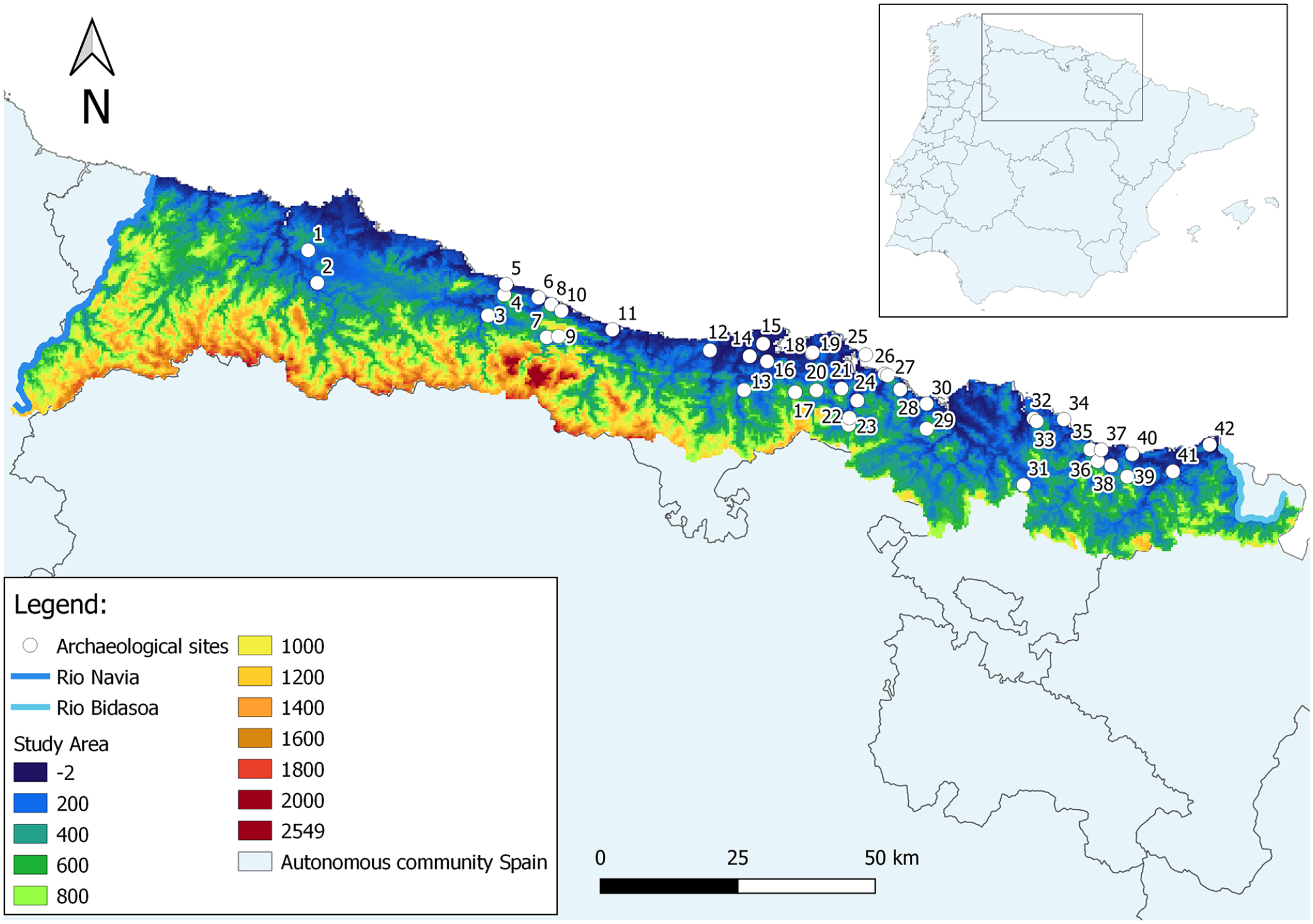
Map of the study area in Cantabrian Spain with main archeological sites. 1-La Paloma; 2-Las Caldas; 3-Los Azules; 4-Poza l’Egua; 5-Tito Bustillo; 6-Colomba; 7-Los Canes; 8-La Riera; 9-Arangas; 10-El Espinoso; 11- Mazaculos II; 12-Altamira; 13-El Portillo; 14-Barcenilla; 15-El Juyo; 16-Morín; 17-Rascaño; 18-La Garma A; 19-El Truchiro; 20-Cubio Redondo; 21-La Chora; 22-Tarrerón; 23-El Mirón; 24-Molino de Gasparín; 25-La Fragua; 26-La Trecha; 27-Arenillas; 28-Los Gitanos; 29-Arenaza; 30-Pico Ramos; 31-Bolinkoba; 32-Santimamiñe; 33-Kobaederra; 34-Lumentxa; 35-Ermittia; 36-Linatzeta; 37-Urtiaga; 38-Ekain; 39-Erralla; 40-Herriko Barra; 41-Marizulo; 42-J3.
This paper focuses on changes in subsistence strategies during climatic and/or cultural shifts and transitions, starting with the Solutrean cultural phase ca. 24.0k cal yr Before Present (BP) (Straus, 2005), and ending with the Neolithization process and its consolidation at ca. 6.3k cal yr BP (Fano et al., 2015). This almost 18k year time period encompasses the Solutrean and the Magdalenian phases during the Upper Paleolithic, the Epipaleolithic/Azilian phases, the Mesolithic/Asturian phases, and the Early Neolithic (Table 1). During this extended period of time, the climatic sequence was unstable, with multiple successions of cold/dry events and warm/wet periods (Rasmussen et al., 2014; Tarroso et al., 2016; Walker et al., 2012). Archeological studies in Cantabrian Spain widely use the Blytt-Sernander climatic nomenclature to refer to past climate evolution (Iversen, 1954; Mangerud et al., 1974), However, this nomenclature should be restricted to Northern Europe studies (Rasmussen et al., 2014). Therefore, we use Late Pleistocene (Roberts, 2014) and Holocene (Walker et al., 2012) chronozones to refer to climate evolution, from the Last Glacial Maximum (LGM), which saw the emergence of the Solutrean culture (Clark et al., 2019), to the Mid-Holocene, which continues after the end of the Neolithization (Straus, 2018a). The Pleistocene/Holocene transition abruptly occurred at the end of the Younger Dryas (YD) ca. 11.7k cal yr BP (Walker et al., 2012), marking the beginning of the current Holocene interglacial period, which witnesses profound shifts in human societies (Lillios, 2019; Roberts, 2014).
Chronological framework including the date from 24.0k cal yr BP to 4.5k cal yr BP, geological times, chronozones, cultural phases, and energy regimes.
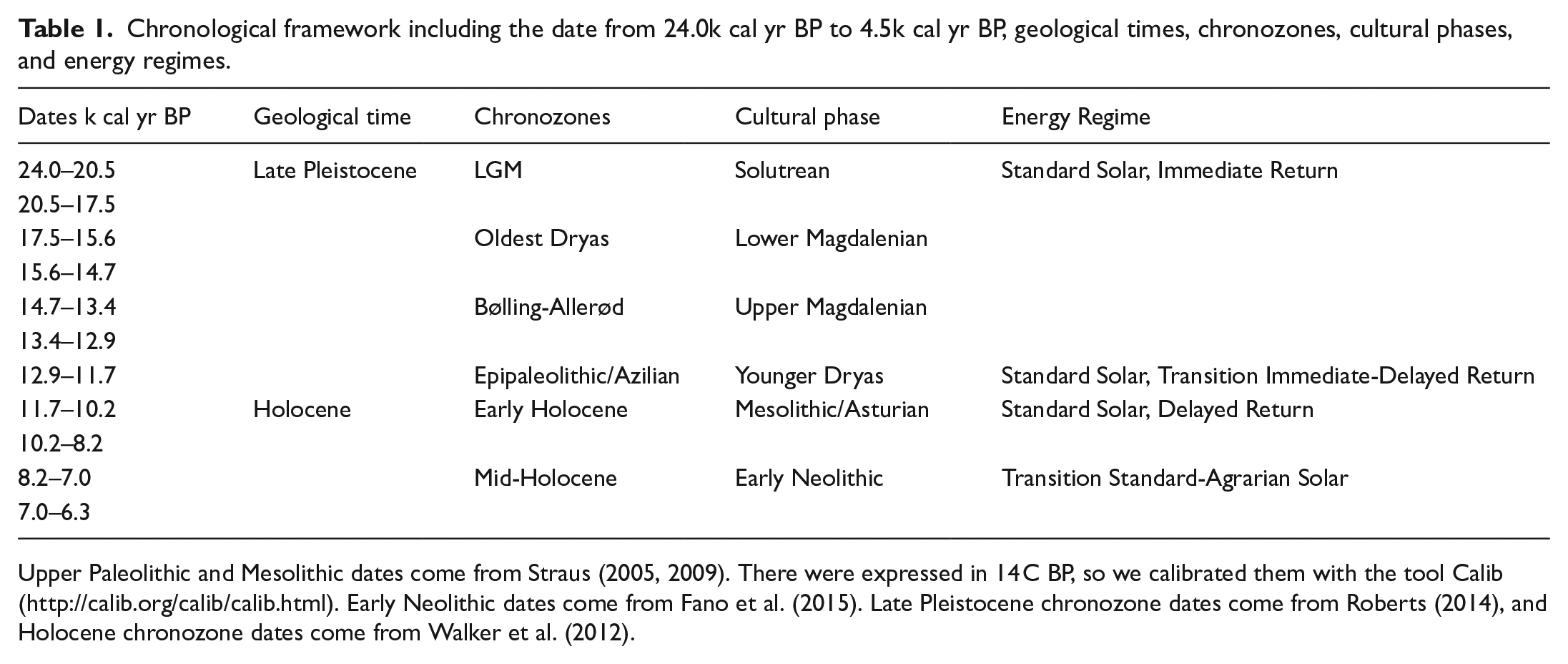
Upper Paleolithic and Mesolithic dates come from Straus (2005, 2009). There were expressed in 14 C BP, so we calibrated them with the tool Calib (http://calib.org/calib/calib.html). Early Neolithic dates come from Fano et al. (2015). Late Pleistocene chronozone dates come from Roberts (2014), and Holocene chronozone dates come from Walker et al. (2012).
New trends of subsistence intensification began as soon as the Solutrean period had begun, with situational specialization and overall diversification (Straus, 2009, 2018a; Straus and Clark, 1986). These changes might have occurred in response to the demographic pressures driven by population growth in glacial shelter during the LGM (Straus, 2005, 2018a). This trend continued through the Magdalenian, the Epipaleolithic and the Mesolithic cultural phases, for which the same main natural resources were exploited by human populations (Alday and Soto, 2017; Straus, 2018a), although some differences existed regarding climate trends (Straus, 1991) or local biotops (Fano, 2004). A certain continuity in subsistence strategies is also documented for the Early Neolithic period, in parallel with the expansion of productive economies such as agriculture and pastoralism (Cubas et al., 2016; Fano et al., 2015). Hence, the Neolithization process appears to be a long process in which both Mesolithic and Neolithic cultures cohabited for centuries (Arias, 2007; Lillios, 2019). The upper temporal boundary of the present study timescale is set immediately following the end of the Neolithization process ca.6.3k cal yr BP, when significant human and bio-physical changes occurred (Cubas et al., 2016; Fano et al., 2015). The expansion of domesticated natural resources, and hence the shift toward a sedentary economy, corresponds to the Standard-Agrarian Solar transition from the Standard Solar regime to the Agrarian Solar regime. In this paper, we consider the Standard Solar regime since the LGM and its subsequent transition.
Literature review
Search engines used for the identification of relevant literature were Google Scholar and ResearchGate. Keywords regarding the various relevant disciplines were identified in (a) a top-down approach for the definition of the study areas (Southwest Europe, Iberian Peninsula, Northern Spain, Cantabrian range, Asturias, Cantabria, Basque Country), (b) a chronology of a joint socio-cultural system (Upper Paleolithic, Mesolithic, Neolithic, Solutrean, Magdalenian, Epipaleolithic, Azilian, Asturian, Early Neolithic), and (c) an environmental perspective (Late Pleistocene, Holocene, Pleistocene/Holocene transition, Last Glacial Maximum, Early Holocene, Younger Dryas, 8.2 ka event). These space- and time-related keywords were then combined with thematic keywords (climate evolution, vegetation evolution, anthropic impact, archeology, subsistence strategies, economy, mobility, Neolithization, agriculture, hunter-gatherer, domestication, Agricultural Revolution).
Keyword search, including local literature, was performed in English, Spanish and French. From the large choice of publications detected, we selected (1) papers that explicitly addressed reviews on subsistence strategies, longer-term climate successions, cultural chronologies and ERs, and (2) the most recent publications. The following step consisted in expanding our search for literature using both backward and forward citation searching approaches (Hu et al., 2011). Backward citation searching was enacted by exploring the list of references presented in each paper originally identified. Forward citation searching has been conducted mainly on Google Scholar, which allowed us to consider the most recent and updated works (Figure 2).
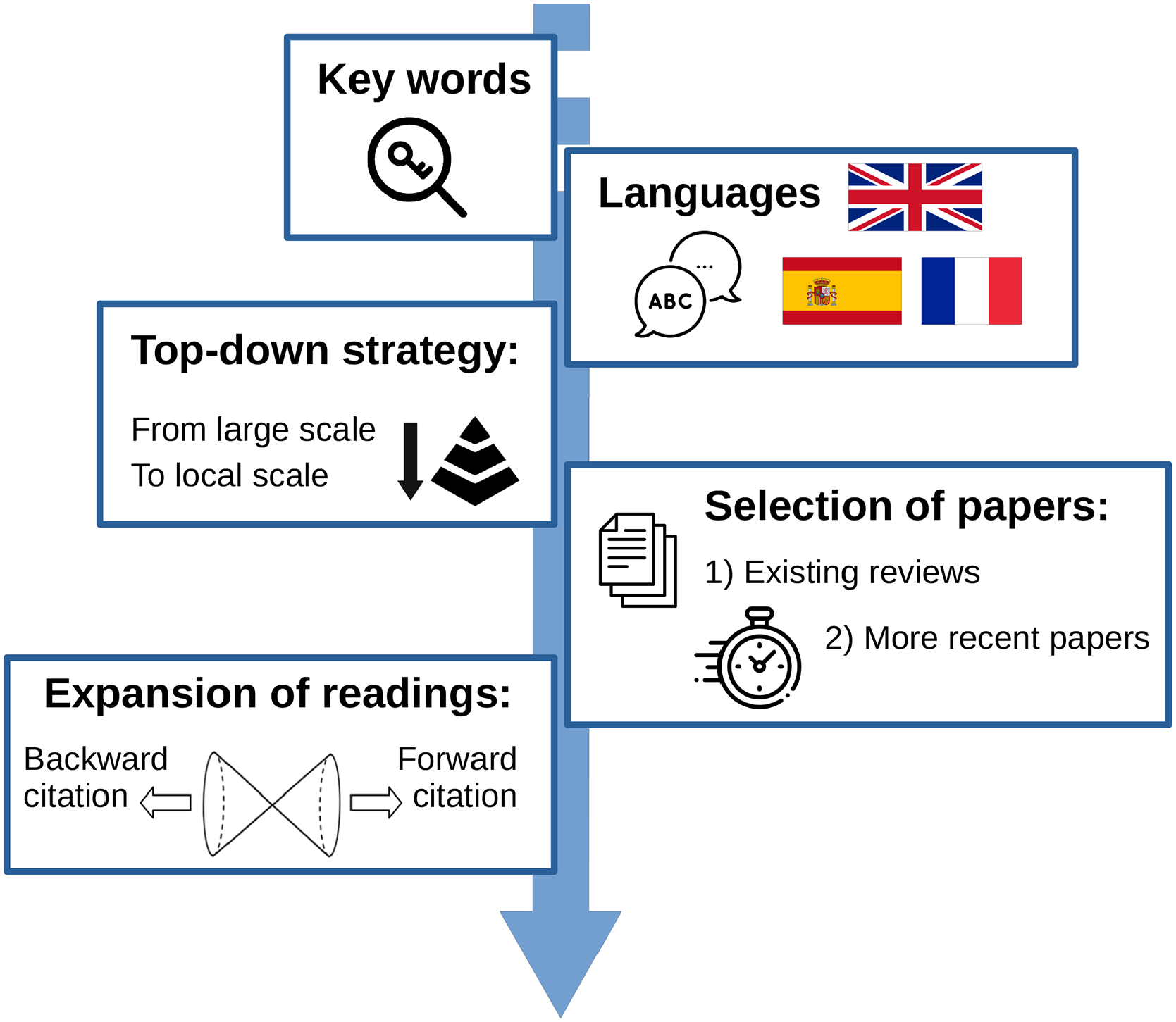
Strategy of the literature review: (1) keywords searching, (2) in English, French, and Spanish, (3) top-down strategy for both space and time scales, (4) Selection of existing reviews and more recent works, and (5) expansion of the readings by both backward and forward citations.
Cultural phases classify the literature review results into four categories: (1) Upper Paleolithic (Solutrean and Magdalenian), (2) Epipaleolithic/Azilian, (3) Mesolithic/Asturian, and (4) the Neolithization process and the Early Neolithic. These phases are generally based on archeological remains (e.g. lithic tool and ceramic typologies), which are not directly related to the lifestyles of human populations, and consequently not linked to the ERs that these populations lived in. Nonetheless, they provide a temporality that is widespread in Northern Spain and understandable in the fields of Archeology and Anthropology. This equally applies to the climatic succession proposed by Mangerud et al. (1974), which was initially established based on paleo-palynological records from Northern Europe (Walker et al., 2019). Both the cultural succession and the chronozones are largely used in Northern Spain. Therefore, we don’t aim to define these phases nor do we intend to improve precise timescale boundaries. Combining cultural and environmental time-scales (cf. Straus, 2018a) is the backbone in the discussion on ERs.
We purposely did not use each and every work we encountered, and elaborated on a synthetic review considering all disciplines with a primary focus on ERs. When necessary, radiocarbon dates (e.g. in Straus, 2005, 2009) have been calibrated into calendar date using the tool Calib (http://calib.org/calib/calib.html). Ultimately, this paper discusses changing landscapes within shifts in climate, human cultures and economies, plants, and animals in Cantabrian Spain in the transition from the Upper Paleolithic to the Neolithic period.
Results
Upper Paleolithic (Solutrean, 24.0–20.5k cal yr BP and Magdalenian, 20.5–13.4k cal yr BP)
Human populations in Western Europe were strongly impacted by the LGM. Populations were constrained to glacial refugia in Southern Europe (Tarroso et al., 2016; Wren and Burke, 2019) such as the coastal area of Atlantic Spain (Straus, 2012). During the LGM, the shore was ca. 5 –12 km further north of its current location (Straus, 2005, 2015), hence possible Upper Paleolithic coastal sites and lowland communication routes are underwater today (Grandal D’Anglade et al., 1997). The Solutrean culture emerged in this context (Table 1), as the product of an autochthonous and autonomous evolution from the previous Gravettian culture (Alcaraz-Castaño, 2007). The Solutrean is marked by an increase in population density (Clark et al., 2019; Straus, 2000a, 2000b), due to the migration from the north ca. 24k years ago (Clark, 2000). In consequence, situational specialization and overall diversification subsistence strategies developed (Freeman, 1973; Straus, 2009). Situational specification was marked by intensification of red deer hunting in coastal and valley lowlands on the one hand, and by intensification of the ibex hunting in the rocky mountains on the other (Straus, 2005, 2009). Overall diversification was marked by the broadening of marine mollusk gathering and fishing (Straus, 2005, 2009). Diet broadening has been attributed to the notable exploitation of marine resources as a response to demographic pressure on usual resources (Straus and Clark, 1986). But these resources, as well as small game and plants, were already exploited in earlier periods, although with a lesser intensity and smaller impact on the environment (Zeder, 2012). By opposition, Bailey and Milner (2002) state that Cantabrian Spain was not a “cultural cul-de-sac” and provided abundant resources to hunter-gatherers from the Solutrean onward, and that the changes in subsistence strategies are not due to demographic increase but to climate change and sea level rise.
Although there is no explicit evidence of migration pattern at a regional scale, there are signs of cultural contact visible in the geographic distribution of “exotic” tools and art typologies that are present in “foreign” regions (Alcaraz-Castaño et al., 2013; Straus, 2005). Nonetheless, the Solutrean populations in Cantabrian Spain seem to have adopted a “localism” mobility due to the specific landscape (i.e. short valleys and high relief) and the low mobility of the game and other resources (Clark et al., 2019). The Solutrean populations could schedule the exploitation of resources based on areas that have been profitable in the past (Straus, 1991), including expedition in mountain sites for specific resources (Straus, 2015). The local landscape exploitation could have been maintained by wide gathering networks, where human groups could meet and mate, exchange information and resources, and proceed to any other social and cultural activity (Straus, 1991, 2005).
The Lower Magdalenian started ca. 20,500 years ago (Straus, 2005), during the LGM (Table 1). The Lower Magdalenian started ca. 20,500 years ago (Straus, 2005), during the LGM (Table 1). The Lower Magdalenian (ca. 20.5–15.6k cal yr BP) is characterized by an acceleration of the specialization and diversification processes that started during the Solutrean (Straus, 2005, 2009). The territory was structured with ephemeral settlements and recurrent occupation such as seasonal and specialized activity regarding the time of the year (Álvarez-Alonso, 2014; Estévez and Vila, 2006; Freeman, 1973). The landscape was likely used on the basis of a multi-year cycle of territorial rotation (Álvarez-Alonso, 2014).
Starting from ca. 15.6k cal yr BP during the Oldest Dryas stadial, important changes in the Magdalenian behaviors led to a separation between Lower and Upper Magdalenian (Straus, 2009) (Table 1). The subsistence strategies were continuing the acceleration trend that started during the previous period (Straus, 2009), but a particular case of dog domestication seemed to occur from this period onward (Vigne, 2005). A warming trend started ca. 14.7k cal yr BP with the transition to the Bølling-Allerød interstadial. This trend led to the rise of the sea level, and subsequently to a loss of land in the coastal areas (Straus, 2005). But this loss was balanced by the retreat of the glaciers in the mountains, allowing the populations to settle in uplands (Straus, 2005). A higher mobility of the Magdalenian populations (Straus, 2015; Straus and González Morales, 2012) is suggested by the presence of art and tool artifacts from other European regions (Álvarez-Alonso, 2014), where similar symbols and objects were found (Straus, 2005), and by statistical analyses on lithic industries (Clark et al., 2019). Hence, a social and cultural network existed in the Magdalenian world (Estévez and Vila, 2006).
Epipaleolithic (Azilian, 13.4–10.2k cal yr BP)
In Cantabrian Spain, the Magdalinian/Azilian transition took place during a more humid and temperate phase of the Bølling-Allerød interstadial, ca. 13,400 years ago (Straus, 2015) (Table 1). Sites are also present at higher altitudes caused by the final deglaciation, with high mobility remaining for the Upper Magdalenian (Straus, 2005, 2015). The accelerations of specialization and diversification continued from the Upper Paleolithic (see part 3.1), based on the same faunas (Straus, 1991, 2005, 2009). A significant increase of marine mollusks in archeological contexts is apparent from the Azilian (Gutiérrez-Zugasti et al., 2015). For the first time, an apparent size reduction of shellfish in archeological context appeared (Gutiérrez Zugasti, 2011), and killing of young ungulates significantly increased (Marín-Arroyo, 2013; Straus, 2009). Both environmental causes (Bailey and Craighead, 2004) and overexploitation due to a demographic increase (Straus, 2009) have been proposed to explain these processes. However, globally the population decreased from the Upper Magdalenian onward (Clark et al., 2019). Then the population abruptly decreased again from the first half of the Azilian until the starting point of the Mesolithic (Clark et al., 2019).
This global demographic trend can be explained by the occurrence of the cold and dry YD (Table 1), interrupting the warming trend of the interstadial ca. 11.7k cal yr BP (Roberts, 2014). Apart from the decreasing population, there is no evidence of a major disruption in the cultural continuum during the YD (Straus, 2011, 2018a), but pollen and faunal records are too sparse to provide a high-resolution picture of past human activities, and hence, a possible cultural disruption in the YD might be undetected (Straus, 2018a).
The Azilian culture spanned both the YD and a following, warmer and wetter phase of the Early Holocene chronozone (Straus, 1985) (Table 1). This continuity is also apparent in subsistence strategies. Slight changes occurred, such as the replacement of some taxa by others due to the climate amelioration (e.g. bison replaced by auroch), and a small broadening of resources linked to the opportunities of the new environment (Straus, 1991, 2005, 2009). A majority of sites was present on the coast at the end of the Azilian, and acted as a precursor to the following Asturian Mesolithic culture (Straus, 2005).
Mesolithic (Asturian, 10.2–7.0k cal yr BP)
The Epipaleolithic-Mesolithic transition occurred ca. 10.2k cal yr BP (González Morales, 1995; Straus, 2005, 2009; Table 1). For the first time, there is a distinction between two cultural groups, mostly based on the lithic industries (Straus, 2009). The Asturian Mesolithic developed in Eastern Asturias and Western Cantabria, whilst the “eastern” Mesolithic appeared a few centuries earlier in eastern Cantabria and Basque Country (Straus, 2005, 2009, 2018a).
Asturian sites are mostly concentrated less than 3 km from the Early Holocene shore (Arias, 2007; Straus, 1991, 2018a), especially around inlets and estuaries (Straus, 2005, 2009). Sea level was 20–30 m below the current one, therefore the sites we observe on the coast today were a few kilometers inland during the Mesolithic, and the actual Asturian coastal sites, consisting of shell-middens at the mouth of caves (Straus, 2009) are supposedly now submerged under the ocean water (Fano et al., 2013). Inland sites are less numerous (Arias, 2005, 2007). Continuity in fauna exploitation and subsistence strategies from the Upper Paleolithic is attested (Straus, 2009), although marked by a progressive broadening of both terrestrial and marine resources, with the notable presence of pelagic taxa indicating the use of nets for fishing activity (Fano, 2004; Straus, 1991). The exploitation of marine mollusks reached its peak during the Mesolithic, as food and as materials for technological and symbolic crafting (Gutiérrez-Zugasti et al., 2015). Stable isotope analyses of human bones based on the concurrence of δ13C and δ15N (Schwarcz, 1991) indicate a mixed terrestrial and marine diet for coastal sites (Arias, 2005, 2007; Fano, 2004) and a mainly terrestrial diet for inland sites (Arias and Fano, 2005). an inland site diet based on meat and vegetables is suggested by oral pathology of one individual (Fano, 2004). The territorial behavior of inland populations is suggested by the presence of burials (Arias and Fano, 2003) and a decreasing mobility compared to the Upper Magdalenian and Azilian periods (Clark et al., 2019; Straus, 2018a). The size reduction of the exploited area is explained both by forest expansion that fragmented social groups, and more abundant environments allowing populations to sustain their needs with smaller territories (Lillios, 2019).
The “Eastern” Mesolithic settlement pattern is similar to the Asturian, with both inland sites and coastal shell-middens in estuaries and inlets (Straus, 2009, 2018a). Contact with the neighboring Upper Ebro valley is evidenced, with the notable presence of ornament materials from this region (Álvarez-Fernández, 2006), and foreign lithic tools on both sides (Tarriño, 2006, in Straus, 2009). The subsistence strategies are similar to the Asturian, with a noticeable variation in exploited taxa explained by the different biotopes between the two areas occupied by these cultures (Fano, 2004). The same diet pattern as the Asturian is confirmed by stable isotope analyses (Cubas et al., 2016; Fano, 2004; Lillios, 2019).
Limpet size reduction and killing of young ungulates are still attested for the both Mesolithic cultures (Fano, 2004). Overexploitation due to an increasing demography is one possible cause of both processes (Clark et al., 2019), although environmental drivers are proposed to explain the limpet size reduction (Cubas et al., 2016). The more territorial behavior, lower mobility, and a more general economy is explained by more abundant and predictable plant resources (Uzquiano, 1995; Zapata, 2000). A good understanding of ethology (knowledge of animal behavior) as well as a well-managed environment is suggested by the seasonality of site occupation and the profile of hunted faunas (Alday and Soto, 2017). Hence, Mesolithic societies were becoming more complex (Fano, 2004).
Both Mesolithic cultures spanned the abrupt and cold 8.2 ka event with no apparent disruption in the cultural continuum (Straus, 2018a). This event had major impacts on both hunter-gatherer and settled communities in Mediterranean Europe (Walker et al., 2012), as it is the case for the neighboring Ebro river basin where an “archeological silence” coincides with this aridity crisis (González-Sampériz et al., 2009). In response to this event, human populations moved from the South Ebro basin to the more humid mountains such as the Northwestern Ebro basin (González-Sampériz et al., 2009). Hence, in humid regions such as Cantabrian Spain, the 8.2 ka event had less impact than in the Mediterranean regions of the Iberian Peninsula, allowing the populations to stay.
Neolithization (7.0–6.3k cal yr BP)
The Neolithization occurred ca. 7.0k cal yr BP, during the climatic optimum of the Mid-Holocene phase (Mangerud et al., 1974) (Table 1). A relationship between agricultural activities and climate variation is suggested by archeological evidence, as natural changes in forests favored environment suitable for human settlements with a sedentary economy (Pérez-Obiol et al., 2011). The classic Neolithic “package” including the megalithism phenomenon, the use of ceramics, a new typology of stone tools, and domesticated plants and animals (Straus, 2005) becomes more and more disputed, as these elements were not necessary adopted at the same time by Mesolithic populations (Arias, 2007; Cubas et al., 2016; Lillios, 2019). Here we identify a continuity or change in Neolithic subsistence strategies with the previous cultural phases (Arias, 2007; Clark, 2000; Cubas et al., 2016; Lillios, 2019; Straus, 2009, 2018a).
The Neolithization entered Cantabrian Spain ca. 7.0k cal yr BP from the neighboring Upper Ebro Valley (Arias, 2007), where it started 500 years earlier ca. 7.5 k cal yr BP (Straus, 2009). Hence, agriculture and pastoralism were adopted in the warm and dry, but seasonal environment of the Upper Ebro Valley earlier than the cool, humid and densely forested Cantabrian Spain (Straus, 2009). Both Mesolithic and Neolithic cultures cohabited in a challenging mosaic pattern of sites for 100s of years during the Early Neolithic (Arias, 2007; Cubas et al., 2016). In consequence, at the same time a new sedentary economy and a continuity of hunter-gatherer subsistence strategies are attested (Cubas et al., 2016).
The Neolithic productive economy showed new subsistence strategies based on domestic resources. Cereal pollen have been identified from the second half of the eighth millenium cal BP onward (Cubas et al., 2016), although differentiation between pollen of cereals from pollen of wild grasses is questioned (Behre, 2007). Incontestable evidence of domestic crops have been identified from the middle of the seventh millenium cal BP (Cubas et al., 2016). These cereals are considered allochthonous (Peña-Chocarro et al., 2005a), but it is unclear if they have been introduced by foreign settlers (Cubas et al., 2016). Early pastoral practices have been detected ca. 7.3 k cal yr BP (López-Merino et al., 2010) and animal husbandry started during the seventh millenium cal BP, although the exploitation of wild fauna remains dominant (Cubas et al., 2016). Globally, archeological records show a trend toward the increasing proportion of livestock and a related decreasing proportion of wild fauna (Altuna and Mariezkurrena, 2009). Overall, mobility reduction, increase in territorial behavior and emergence of more complex societies are indicated by the first appearance of the megalithic phenomenon (Lillios, 2019).
Besides the appearance of a sedentary economy, hunter-gatherer subsistence strategies remained dominant (Arias, 2007; Cubas et al., 2016; Lillios, 2019; Straus, 2009). A long continuity in subsistence strategies from the Solutrean is indicated by both the occupation of specialized hunting sites (Altuna, 1980; Mariezkurrena and Altuna, 1995) and the exploitation of a large diversity of wild plants (Uzquiano, 2018; Zapata, 2000). Intensification of wild gathering in shell-middens (Arias, 2007) and the continuity in a diet mainly based on marine resources (Arias, 2012) are indicators of continuity from the Mesolithic subsistence strategies.
The continuity in these subsistence strategies, as well as the delayed adoption of the productive economy compared to the Upper Ebro Valley can partly be explained by the human adaptation to the ecological context of the region. The high variations in elevation and exposure of the local topography allowed a large variety of plants to develop, favoring the transhumance pastoralism of ovicaprines and cattle (Straus, 1991). Transhumance is a seasonal movement of livestock, which developed in continuation of the seasonal exploitation of the wild fauna migration routes by hunter-gatherers (Clark, 2000), such as fixed summer and winter pastures (Straus, 1991). Seasonal exploitation of fauna is first evidenced during the Magdalenian (Clark, 2000; Estévez and Vila, 2006; Straus, 1991), and is still documented during the Early Neolithic (Zapata, 2002).
Although significant impact of hunter-gatherer activities on the environment has been identified and assessed in Europe (Nikulina et al., 2022), intensive forest clearance (Garcia-Amorena et al., 2008) and fire regime change (Connor et al., 2019) in Cantabrian Spain begin with the expansion of agriculture and stock raising later during the Neolithic (Garcia-Amorena et al., 2008; Isturiz and Sánchez Goñi, 1990).
Discussion
Energy Regime indicators
A long-term perspective of subsistence strategies, based on different indicators related to ERs, will bring new insights on the Neolithization (Figure 3). These indicators, namely past demography, mobility patterns, economy, overexploitation of resources, and complexity of societies, have been identified from our targeted review and are discussed below.
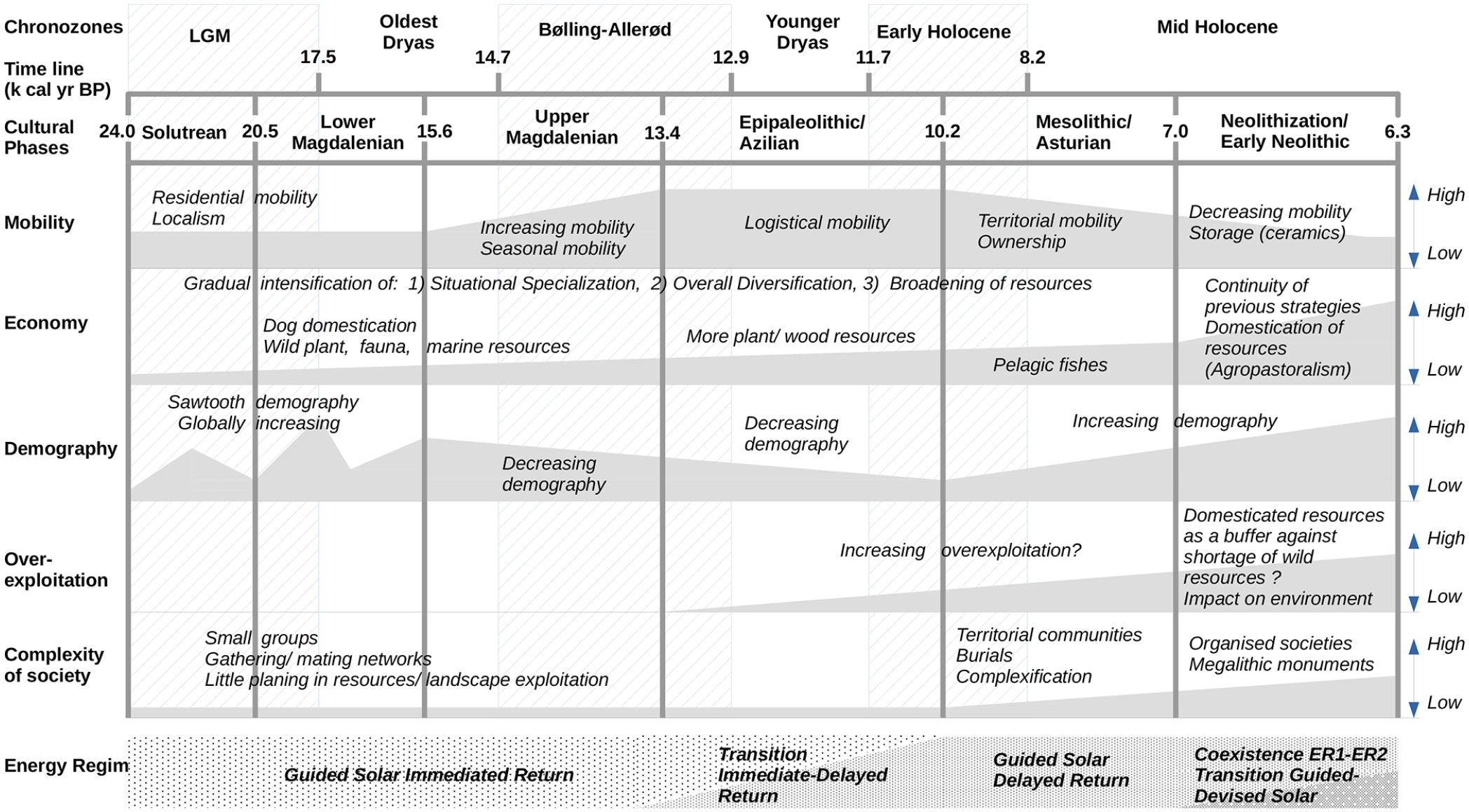
Schematic summary of the subsistence strategies in Cantabrian Spain from the Solutrean to the Neolithic. Both cultural and climatic time scales are represented and are nonlinear. Upper Paleolithic and Mesolithic dates come from Straus (2005, 2009), and the Early Neolithic and Neolithization dates come from Fano et al. (2015). Chronozone dates come from Roberts (2014) and Walker et al. (2012). The amount of each indicator (mobility, subsistence strategies, demography, overexploitation, and complexity of society) are qualitative.
Demography and mobility
Demography in Cantabrian Spain varied through time, mainly following climate variations; human population increased during warm and wet periods, and decreased during cold and dry events (Clark et al., 2019). One can expect that needs of energy and resources increased and decreased following the trends in demography. Availability of resources and energy also increased during warm/wet periods and decreased during cold/dry events. Consequently, one can argue that human population, and its demography, adapted to the availability of resources and energy.
Mobility of hunter-gatherers is essential to understand human subsistence strategies, as groups with different subsistence strategies move differently across the landscape (Jones, 2016, and references therein). The logistical mobility consists in a base camp from which groups of individuals will take short forays to obtain specialized resources. The camps do not frequently move and most often are situated at mid-range elevation, at the intersection to the widest possible patches of resources (Jones, 2016). By opposition, residential mobility consists in frequently moved based camps to exploit predictable resource patches, which is more frequent in seasonal environments. The sites are more often along the elevation gradient between lowlands and mountains, to access various resource patches (Jones, 2016).
For the whole Upper Palaolithic, residential mobility is preferred by hunter-gatherer populations (Jones, 2016). Statistical analyses of fauna assemblages in archeological contexts indicate that from the Azilian period hunter-gatherers adopted a logistical mobility (Jones, 2013, 2016). This change in mobility pattern from residential to logistical is explained by the abundant availability of the resources related to the climate amelioration of the Bölling-Allerød period. From this point onward, hunter-gatherers set their camp at the confluence of eco-zones where they could access different resources at different times of the year (Zeder, 2012). With time, hunter-gatherers became less mobile, which is consistent with the logistical mobility and the more territorial behavior that developed from the Mesolithic (Alday and Soto, 2017; Estévez and Vila, 2006). The shift from residential to logistical mobility shows different strategies of extraction of resources and energy from the environment. The source of energy and resources is identified by logistical societies, and their extraction is anticipated. When hunter-gatherers later adopted a more territorial behavior (during the Mesolithic), resources and energy were extracted from smaller areas by a given population. This can be interpreted as evidence of a first intensification of energy extraction from the environment.
Economy and overexploitation
The economy in Cantabrian Spain is marked by a gradual broadening of resources, attested from the Solutrean onward. Straus and Clark (1986) argued that a Broad Spectrum Revolution (BSR) might have occurred during the Solutrean in response to the harsh environmental conditions. The BSR is an ecological theory stating that when human use of energy and resources is not sustainable anymore, that is, when the environment is stressed either because of human pressure or climatic conditions, a broadening of resources will occur (Flannery, 1969). Another theory, the Diet Breadth Model, similarly explains that in an environment rich in resources, foragers will focus on a narrow range of prey having a high energy (i.e. calorie) return, while in a stressed environment with less resources such as during the LGM, they will broaden their hunting strategies to prey with lower energy return (Smith, 1983).
Both the BSR and the Diet Breadth Model are restrictive theories, interpreted as a human response to environmental or demographic pressure (Jones, 2016; Zeder, 2012). By opposition, the Niche Construction Theory (NCT) views humans not as passive and reactive to external stress, but as active participants to the broadening of resources as they make effort to construct their local environment (Zeder, 2012). NCT provides an alternative to the traditional statement that climate change is the driving factor for the development of hunter-gatherer’s subsistence strategies (van Den Biggelaar and Kluiving, 2015) by describing reciprocal interactions between nature and culture (Kluiving and Hamel, 2016). A rich and productive environment with various eco-zones of predictable resources would allow human populations to adopt a broad spectrum economy: it consists in an initiative, not in a response to a stressed environment (Jones, 2016; Zeder, 2012).
The Solutrean broadening of resources might be due to the exploitation of the changing environment by active hunter-gatherers (Zeder, 2012). Nevertheless, demographic pressure on resources (Straus, 2005) is constantly opposed to environmental causes (Bailey and Milner, 2002) to explain such broadening of resources. If environmental changes lowered the abundance of fauna, then this could have provoked a broadening of human diet (Jones, 2016), while at the same time a demographic increase occurred during the Solutrean (Clark et al., 2019). Could a complex interrelation between environmental changes, demographic pressure and shift in fauna abundance be responsible for the new subsistence strategies that developed during the Solutrean?
A second application of the BSR states that a broadening in subsistence strategies of hunter-gatherers, occurring because of human pressure on the environment, sets the basis for animal and plant domestication, eventually leading to the emergence of agriculture (Flannery, 1969). In this perspective, the Mesolithic would have been the end point of the subsistence strategies that were adopted during the Solutrean (Clark, 2000). However, archeological evidence show that no sudden broadening of resources is attested during the Mesolithic; instead, the broadening of resources is gradual through time, and hunter-gatherer economy continued after the first appearance of a sedentary economy (Cubas et al., 2016).
Upper Paleolithic, Epipaleolithic and Mesolithic plant consumption remains the “great unknown” due to the scarcity of plant and wood remains (Banh, 1984, in Straus, 1991, 2018b). Anthracological data collected in Upper Paleolithic archeological contexts suggest different strategies of wood resource exploitation from both pre-littoral mountain and coastal plain ecosystems (Uzquiano, 2014). These strategies tend to fade as more taxa appear through time, in relation to climate amelioration (Uzquiano, 2014). Plant consumption presumably became more frequent through time alongside climate amelioration and increase of vegetation cover (Cuenca-Bescós et al., 2009; Straus, 2018a). The absence of protective sedimentary archives (e.g. dry caves, wet bogs or permanent glacial ice) hampered the preservation of plant remains (Straus, 2018b). Hence, it remains challenging to have a complete overview of the economy (Alday and Soto, 2017), as plant consumption consists in a significant input of energy in both ethnographic studies of modern hunter-gatherers (Kelly, 1995) and in archeological studies of past hunter-gatherers (Clarke, 1976).
The case of overexploitation is also debated (Figure 3). Demographic pressure as soon as the Epipaleolithic is one possible cause of overexploitation (Jones, 2016; Straus, 2009), as well as environmental drivers (Bailey and Craighead, 2004). Gutiérrez Zugasti (2011) argues that signs of demographic pressure are more likely to occur at a later stage, during the Mesolithic. A combination of both causes is likely. Indeed, environmental factors are often secondary causes of resource depression after demographic pressure (Zeder, 2012).
There is no sudden shift in energy use during the Upper Paleolithic. More sources of energy appeared through time along the broadening of resources, and depending on the availability of resources and climate variations. From the Mesolithic, the first evidence of resource overexploitation indicates that human groups extracted more energy than the environment could provide. At the same time, the population increased and human groups adopted territorial behaviors. Hence, Mesolithic societies already lived on a non-sustainable energy regime.
Complexity of society
The territorial behavior of Mesolithic groups led to the development of the concept of “ownership” regarding both the resources and their locations (Zeder, 2012) (Figure 3). The notion of ownership and a territorial behavior are the precursors of the establishment of less mobile lifeways eventually leading to plant and animal domestication and finally agriculture (Rosenberg, 1990, 1998; Zeder, 2012). In this context, seasonal exploitation of the wild fauna migration routes by hunter-gatherers evolved to become transhumance pastoralism (Clark, 2000). Territories are hence well defined, well understood, and well exploited by their populations, and the energy return is sufficiently abundant to make it worth investing and defending them (Zeder, 2012). Such territorial behavior needed enough people to share local knowledge and to develop a local identity, which is consistent with the complexification of the Mesolithic world (Fano, 2004) and the increase of population (Clark et al., 2019). Socializing and trading with other groups became essential to organize buffers against shortages of resources and to maintain cultural and mating networks (Zeder, 2012). This complexification is synchronous with the demographic increase, territorial behavior and the appearance of resource overexploitation. With smaller territories and less resources, human groups needed to manage and master their territory to extract the maximum of energy from it by perfectly understanding its functioning. The use of energy also became more complex; indeed, the appearance of trading resources implies the appearance of fluxes of energy from one human group to another.
Applying Energy Regimes in Cantabrian Spain
ERs provide a common nomenclature that explores past land-use and human-environment interactions. Hunter-gatherers live on the Standard Solar regime until the transitional phase that leads to a productive economy. The Standard Solar regime is globally defined by the exploitation of wild resources, with two sub-categories of societies (Feeney, 2019; Woodburn, 1980): (1) Immediate Return societies, characterized by little planning and specific strategies, such as following the migration pattern of big mammals or coming back to sites that were profitable in the past (Woodburn, 1980); and (2) Delay Return societies, which are able to plan the exploitation of their environment (e.g. forest burning for a profitable future), with permanent sites that are used seasonally, and a generally more complex society where exchanges of resources and trading are a reliable subsistence strategy (Woodburn, 1980).
The Immediate Return coincides with the way of life of the Solutrean and Magdalenian populations (Figure 3). Residential mobility, lack of planning resource exploitation and absence of complex societal organization are indicators of these societies. The energy is opportunistically extracted from the environment. Starting from the Epipaleolithic, a shift toward logistical mobility occurred, indicating a better understanding of the environment and/or predictability of the resources. The energy sources are better identified but energy extraction is not yet improved. Hence, we interpret the Epipaleolithic as a transitional phase between Immediate Return and Delayed Return societies (Figure 3). Notable changes occurred during Mesolithic times, such as an increasing territorial behavior associated with a decreasing mobility. More complex societies appeared, marked by the presence of burials and separate communities that lived on different resources. Resources overexploitation under demographic pressure and environmental changes occurred, leading to the interpretation of a Delayed Return society for the Mesolithic (Figure 3). Energy sources are known and the landscape well managed, and energy extraction intensified on smaller territories.
Domestic resources and sedentary economies appeared at highest value during the Early Neolithic. First appearances of storage vessels are noticeable, the society becomes more complex with the development of the megalithic phenomenon, and with regional variations of economies, tools, funerary practices, etc. Nonetheless, the exploitation of wild resources remained largely dominant during that time, and hunter-gatherer life-ways coexisted for hundreds of years with productive communities. The Early Neolithic is then marked by both Standard Solar and Agrarian Solar regimes, indicating a transition between these two regimes (Figure 3). The sedentary economy allows people to concentrate energy on controlled resources, for example, cereals and livestock. It marks a new step in the intensification of energy use, over more restrictive areas than the ones exploited by hunter-gatherers. On a regional scale, these hot spots of concentrated energy (Neolithic sites) have then provided a complementary source of energy to the main hunter-gatherer regime (Mesolithic sites) in a given territory. However, they were also energy sinks, as sedentary populations would need enough energy to sustain their life and hard work within a small locality. Major shifts in past human societies are also identified for the Mesolithic and the early Neolithic from classical archeological proxies, including site distribution, lithic and bone industries, and subsistence activities (González Morales et al., 2004), although not described in a functional and ecological way. This provides more confidence in our interpretation.
Whilst the appearance of domesticated resources was abrupt, the transition toward productive economies was progressive. Indeed, by managing their landscape, Delayed Return societies are pre-adapted for the development of agriculture and pastoralism (Feeney, 2019). Productive economies needed planning and hard work along the year as morphologically domesticated cereals require more labor, but settlers benefited from increased reliability in harvest, increased yield, and from better control over their domesticated resources (Fuller et al., 2010). Produced resources were used as a buffer against shortage of wild resources in a well-organized society that included both Standard Solar and Agrarian Solar communities. The Standard-Agrarian transition has been stable for centuries (Arias, 2007) before shifting to a dominant productive economy later in the Neolithic or Chalcolithic periods (Cubas et al., 2016). Two possible drivers of the switch toward a dominant Agrarian Solar regime are (a) an environmental crisis due to overexploitation finally struck the populations, following increasing demography, and (b) an autonomous cultural evolution enhanced by the megalithic phenomena, which are very local and necessitated cooperation of a large number of peoples.
The ER-supported sequential development over six cultural phases in this paper is coherent with both the acculturation model (Jorge, 1999; Vicent García, 1997) and the migration model (Zilhão, 2001) of the Neolithization in Iberia. The spread of domesticated resources and productive economies necessitated both Neolithic newcomers and their knowledge (migration model), and local hunter-gatherers (acculturation model) who knew the landscape and where to best adapt the food production and pastoralism (Alday, 2012). Topography, flood areas, cycles of natural crops, unproductive lands, weather, etc. were necessary information that new settlers needed. The leap-frog model of the spread of the Neolithic (Bernabeu Aubán et al., 2015) is also coherent with our framework, as these leaps reflect a spread territory-by-territory from the Mediterranean coast, to the Lower Ebro Valley, to the Upper Ebro Valley, to the Basque Country and the Cantabrian range.
Why Mesolithic hunter-gatherers adopted the Neolithic subsistence strategies, and the mosaic pattern of the Neolithization, with both fully Mesolithic sites (Standard Solar regime) and fully Neolithic sites (Agrarian Solar regime) at the same time, is still challenging “classic” archeology (Arias, 2007; Lillios, 2019). From this perspective, ERs represent one solution. Archeological sites are easily attributed to one or another ER regarding the archeological evidence (e.g. presence or absence of domestic resources, ceramics, etc.). ERs are independent of time, hence association of sites that would be traditionally separated into different “boxes” such as the Mesolithic or Neolithic, is possible. As two ERs coexist, several groups of people are organized in a common, much larger society to exploit the environment in the most profitable way possible. Mobile hunter-gatherers can, for instance, exchange resources with a productive settlement, and even seasonally change their own activities, as part of a well-organized network of peoples that live on and manage the same territory. Hence, the energy sources, fluxes and sinks that appeared at a regional scale during the Mesolithic, is now becoming important.
ERs enable researchers to compare archeological sites across space and time. Our work does not aim at presenting case studies, but we can bring attention to the site of Ohalo II (Israel) occupied during the LGM, 23,000 cal yr BP. (Snir et al., 2015). While belonging to a local Epipaleolithic culture, evidences of small scale cultivation are unambiguous (large number of various edible grasses and cereals, sickle blades, grinding slab) (Snir et al., 2015). Similar finds did not appear before the Late Neolithic in Cantabrian Spain. One can argue that traditional cultural entities are meeting their limits in such comparison, while the functional framework of ER opens new opportunities.
Finally, we argue that adoption of domesticated resources and productive economies, associated with the Standard-Agrarian Solar energy transition, were not a “Revolution” as stated by the “Agricultural Revolution,” but instead a more natural choice that was occasionally and/or opportunistically adopted in due time by hunter-gatherers in contact with the Neolithic culture, after a long period of development and improvement of their landscape and resource management. Mesolithic and Neolithic populations not only cohabited, but mixed and even led to the foundations of new territorial and organized societies where the knowledge of both economies was necessary. From this long-term understanding of the subsistence strategies and the Neolithization, the “stack” of cultural phases is not the best framework to understand the functioning of past societies. Adding the long-term understanding of subsistence strategies in the framework of ERs to cultural phases does provide new insight to help identify and document the steps toward the Neolithization process with characteristic indicators (Figure 3).
Conclusion
In Cantabrian Spain from the Solutrean onward, opportunistic exploitation of wild resources by Immediate Return societies shows little evidence involving advanced planning as it is the case for later societies. With a warmer climate and more abundant and predictable resources, the populations started to plan and manage their environment, eventually becoming Delayed Return communities. Keeping on living on the same resources and the same subsistence strategies through time, they occasionally moved forward the next step in resource management: provoking exploitation, in contact with the Neolithic culture. There was neither an “Agricultural Revolution’’ nor a “Neolithic package” implied in the Neolithization process. The productive economy enabled control over resources and acted as a buffer against shortage of wild resources. However, questions remain open regarding the broadening of resources and resource overexploitation and the use of plant and wood resources. Hence, we ask whether these phenomena can be provoked by the interrelation of both demographic pressure and environmental change.
Energy Regimes provide the studies of subsistence strategies with more potential compared to classical chrono-archeological framework. The common nomenclature proposed by ERs and their independence in space and time show their use in other disciplines related to human-environment interactions as well as comparison with other case studies elsewhere in the World. At a later stage, the identification of ERs through an archeological database will be tested and compared to the qualitative model of ERs presented here. ERs define a fitting model as an alternative to the local and time-dependent stack of cultural phases common in archeology in order to keep track on the ongoing evolution of human societies and their profound shifts of energy use through time.
Footnotes
Acknowledgements
This research is included in TERRANOVA’s Work Package 2 (WP2): Exploring past environments and energy regimes, focusing on the reconstruction of past land-use strategies and energy regimes. The names of the Energy Regimes have been elaborated by Emily Vella from the Department of Archeology and Ancient History of the University of Uppsala, and member of TERRANOVA’s WP2. The results and interpretations of this work reflect the views only of the authors, and the European Union cannot be held responsible for any use which may be made of the information contained therein.
Funding
The author(s) disclosed receipt of the following financial support for the research, authorship, and/or publication of this article: The research presented in this paper has been undertaken within the project TERRANOVA: the European Landscape Learning Initiative, funded by the European Union’s Horizon 2020 research and innovation program, Marie Skłodowska-Curie Actions–Innovative Training Networks MSCA-ITN, under the grant agreement No 813904.
