




Abstract
In the regions of southern Scandinavia and northern Germany, within the Neolithic (c. 4100–1700 BCE), two episodes of intensified monumental burial construction are known: Funnel Beaker megaliths mainly from c. 3400–3100 BCE and Single Grave burial mounds from c. 2800–2500 BCE. So far, it remains unclear whether these boom phases of monumental construction were linked with phases of economic expansion, to phases of economic changes or to periods of economic crisis: do they precede and stimulate periods of economic growth? Or are they a social practice that results from social changes within the societies? To approach these research questions, we will use mainly information on the intensity of monumental construction phases, artefact depositions, environmental changes and changes in subsistence strategies as proxies for comparative studies. Our database comes from the southern Cimbrian Peninsula and adjacent areas. Being one of the most intensively archaeologically researched regions of Neolithic Europe, this region provides robust data sets. As a result, the study demonstrates that during the Funnel Beaker period, economy and ritual were closely interlinked, while disconnected in the Single Grave period.
Keywords
Context and research question
Transformation processes in different social domains of prehistoric societies include linkages between economically and ideologically driven activities. If so, the changing rate of monument construction might be taken as a medial indicator of ideological transformations in prehistoric societies. These are practices through which the prehistoric actors visibly portrayed and memorized their social conditions and perhaps their social and economic power in monumentality. Monuments are defined in our context as above-ground architecture that exists for a longer time and aided the transfer of ideological principles intergenerationally.
We will examine to what degree there were booms and busts of Neolithic monumentality and how they interrelate especially with the economic productivity of the societies and also with social changes.
For the centuries 4100–1700 BCE, we will investigate these questions with a focus on the well-researched southern Cimbrian Peninsula (Schleswig-Holstein) and also northeastern Germany (Mecklenburg-Western Pomerania), and other regions in northern Germany are also tackled. Large archaeological and palaeoecological Neolithic data sets are available from the southern Cimbrian Peninsula and western Mecklenburg in particular, because of the results of various recent and ongoing research projects 1 (Figure 1). In addition, in the three prehistoric phases examined – the middle Neolithic (MN), the younger Neolithic (YN) and the late Neolithic (LN) – we can observe the construction of monuments in socioculturally different backgrounds. Furthermore, different climate events and parts of Atlantic and continental climate components show considerable differences between 4500 and 1700 BCE.
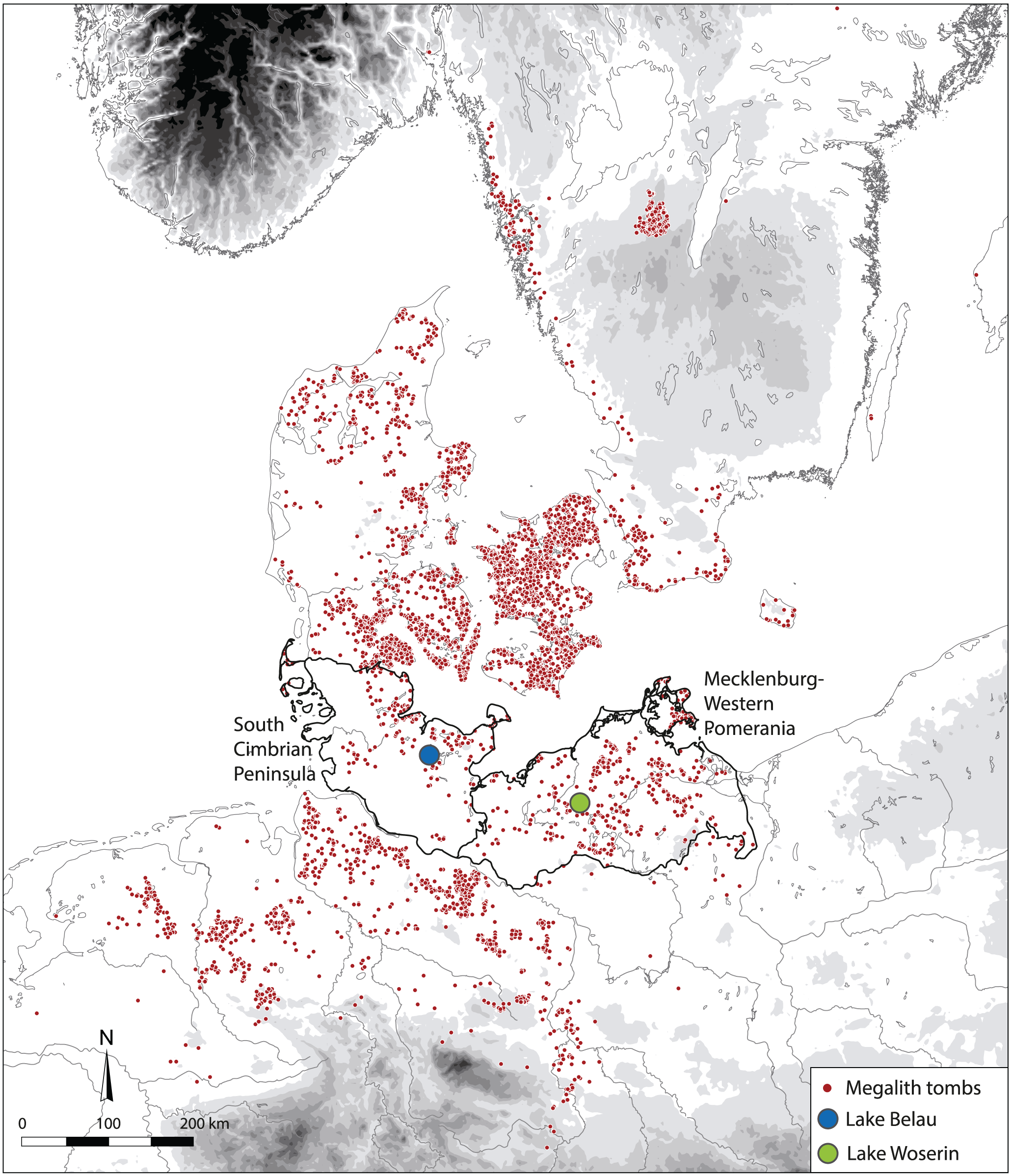
Distribution of megalith tombs in northern central Europe and southern Scandinavia in the 4th millennium BCE (after Fritsch et al., 2010, Figure 1).
Particularly important will be two research questions: were investments in monumental buildings an expression or manifestation of economic growth that was triggered by other social motifs? Or was it the other way round that monumental construction, which was triggered by social motifs, caused an increase in surplus products and thus led to changes in the economy?
There are historical examples for both scenarios: in the central Himalayas, a boom in the erection of certain memorial stones along paths, so-called Mani stones, only began with the introduction of the potato, which generated a larger surplus product (Von Fürer-Haimendorf, 1985). Contrariwise, the construction of megalithic tombs on Sumba, which was an inherently socially motivated activity, like social integration and levelling of wealth inequalities, resulted in an increased economic demand for energy, which triggered an increase in livestock farming (Adams, 2010; Gunawan, 2000; Jeuness and Denaire, 2017).
State of the art and study area
Numerous new studies are available on the northern German and southern Scandinavian Neolithic, which, based on new fieldwork in various projects, also attempt to quantify the archaeological remains. For the Neolithic in northern Germany, these include local and regional studies which aim, among other aspects, to reconstruct population numbers of domestic sites (Brozio, 2016; Hage, 2016) and also supraregional studies which investigate the quantity and concentration of monuments and also demographic and economic developments (Hinz et al., 2012; Holst, 2013; Müller, 2015; Weinelt, 2018; Whitehouse and Kirleis, 2014).
High-resolution palaeoecological and palaeoclimatological studies have been carried out for the Neolithic period for a long time, so a chronologically well-established environmental record is set by annually laminated lake sediments, which provide detailed information on the intensity of economic activities. These have revealed a series of events, enabled quantitative reconstructions of regional climate and environment and coincidences between climate and environmental changes. Thus, we are informed about climatic and vegetation developments in a high-resolution and qualitatively better way than is the case in many other regions, especially because of the investigations into annually laminated lake sediments (Dörfler et al., 2012; Dreibrodt et al., 2012; Dreibrodt and Wiethold, 2015; Feeser, 2014; Feeser and Dörfler, 2014, 2015; Feeser et al., 2016; Kalis and Meurers-Balke, 1998, 2001) and new marine investigations (Warden et al., 2017). Recent marine records from Skagerrak have, in particular, revealed two pronounced cooling events centring around 4000 BCE and 2200 BCE (Butruille et al., 2016; Rhode Krossa et al., 2015).
At least for the Neolithic, developments of subsistence economies have been reconstructed through new investigations based on the occurrence of animal bones at Neolithic domestic sites (Hinz, 2018), isotope studies of human burials (Terberger et al., 2018) and botanical macroremain analyses (Kirleis et al., 2012; Kirleis and Fischer, 2014). Furthermore, analyses of archaeobotanical data sets on the importance of plant use in the Neolithic, in the field of interplay between food intake and ritual deposition, are available (Brozio et al., 2014; Kirleis and Klooß, 2014). In social terms, a distinction has long been made and since refined between societies with prestige and status economies (Kristiansen, 1984), metal-using societies (Vandkilde, 2017) and the differentiation between cooperative and collective behaviour (Müller, 2010). Furthermore, three substudies are already available on the relationship between environmental development, economy and monumentality: the differences between regional developments in land opening and monumentality have been described in an empirical study (Feeser and Furholt, 2014), and correlations between climate events and quantities of material culture have been investigated (Müller, 2015). A further comparative study also described differences in economics, land opening and local biographies of monuments (Diers et al., 2014).
However, a comprehensive comparison of environmental, economic, architectural and material culture data has not yet been undertaken to evaluate the linkage between monumentality and economy in a diachronic perspective for the Neolithic.
Methods
Based on the existing studies and the new data collected within the project ‘Late Mesolithic and Neolithic Transformations on the Northern and Central European Plain’ in the CRC 1266 ‘Scales of Transformation’, we will discuss the relationship between monuments and economics. In relation to our research question, we approach ‘monuments’ as a cultural product and ‘human impact’ on the environment as an economic product.
Methodologically, rates of built monuments and rates of deposited archaeological objects are used as proxies to describe trends in architecture and in material culture. Rates of colluvial depositions and ratios of botanical macroremains are used to describe changes in subsistence economy. Rates of land opening were reconstructed using principal component analyses (PCAs) on palynological data, identifying eigenvectors that describe such developments. Therefore, proxy records for ritual development (monuments), for social representation (material culture), for economic development (archaeobotanical, geomorphological, archaeozoological and palynological data), for vegetation (palynological data) and for climate are compared to detect patterns and potential triggers of the development.
Of crucial importance for such a comparison is the chronological resolution. In the case of pollen analyses, the chronological classification of the data was carried out with the aid of modelled time-depth diagrams; in the case of all other data, the aoristic method was used to arrive at 100- or 50-year increments. With the help of the aoristic method, a method that is used successfully in criminological studies to calculate the probability that an event took place in a certain period (Ratcliffe, 2000, 2002; Ratcliffe and McCullagh, 1998), eventually longer periods of, for example, occupancy of sites are subdivided into 100-year steps or 50-year steps and result in a uniform statistical distribution of the probabilities of the individual objects and monuments (Mischka, 2004; Müller, 2015).
As a result, data from different archives are comparable on a similar temporal resolution. For the comparison of the diverse data from palaeoecological, palaeo-economic and archaeological records, the different values were standardized statistically as z-scores. Due to the different quality of the archives, a highest data collection density is observed for the southern Cimbrian Peninsula. These data are the core of our analysis, but will be supplemented by data from adjacent areas if necessary.
Monumentality
The reconstruction of the intensity of monument building activity through the Neolithic is based on available data from primary burials in single mounds and oldest assemblages in megaliths or non-megalithic long mounds. An interpolated relative index of the construction of new monuments is derived through the described aoristic evaluation according to the detailed chronology. 2
Values from the relative index obtained in this way can be extrapolated to the number of monuments known from the Archäologische Landesaufnahme Schleswig-Holstein (Archaeological State Survey) that in contrast to other areas of Germany covered nearly the whole southern Cimbrian Peninsula with fieldwalking and other types of surveys (Ahrens, 1966; Hingst, 1959; Kersten, 1939, 1951, 1981). Known undated burial mounds are differentiated according to the known (through excavations) relative temporal distribution of mounds to the different phases in periods between the Neolithic and the Middle Ages, a procedure that also Holst (2013) successfully used for Denmark. Thus, these monuments with more general dating categories were redistributed to the main periods according to the relative frequency of dated records within the main periods (Holst, 2013: 42–44).
The distribution of megalithic tombs in their temporal dimension is reported for the southern Cimbrian Peninsula, Lower Saxony and Mecklenburg-Western Pomerania (Hoika, 1999; Laux, 1991; Lorenz, 2012). As result, a total of 627 graves could thus be located with century-exact precision and then extrapolated to the whole number of known monuments (Supplemental material A, available online).
Artefact studies
Complementary evidence of economic as well as social aspects of the Neolithic societies is provided by the character of artefact types and categories, which are linked with specific purposes. These objects of material culture are associated via their contexts and functions either with utilitarian uses within economic production or/and with non-utilitarian meaning within the social and ritual sphere of the societies. Thus, the different quantity and sequences of artefact categories inform about economic and social aspects of societies. Stone axes (Schultrich, 2018; Zápotocký, 1992), stone adzes (Breske, 2017), metal objects (Klassen, 2004; Schultrich, 2019), flint daggers (Kühn, 1979; Willroth, 2002) and jewellery (Woltermann, 2012) in different find contexts like burials, hoards (Rech, 1979) or single finds (Rassmann, 1988) are available as data sets for such an analysis.
Therefore, our evaluation consists of the following components:
The quantification of economic productivity. The total curve of deposited hammer axes, adzes, flint daggers, metal objects and jewellery represents a minimal number of the production of objects.
The quantification of prestige and status items. The total curve of corresponding objects in graves represents a minimal number of objects that were used to display prestige or status.
The quantification of certain categories. The total curve for amber objects describes the specific value of this raw material for the societies; the total curve of metal objects represents the introduction of a new technology within the Neolithic economy.
The census of the objects is used as frequency values which, due to the typochronological assignment to the scientifically dated phases, again result in relative curves using the aoristic method (Supplemental material B, available online).
Subsistence economy
With the methodology described above, botanical macroremains (Supplemental material C, available online) are extrapolated using the aoristic approach. Due to the small amount of available data, not only those from the southern Cimbrian Peninsula and north-eastern Germany but also those from north-western Germany are integrated.
In the data considered below (Behre and Kucan, 1994; Brozio et al., 2019; Effenberger, 2018; Kirleis, 2019; Kirleis et al., 2012; Kroll, 1980, 1981), the focus is set upon crop growing for taphonomical and depositional reasons. The question of labour input into crop growing is particularly targeted. While high labour input and return per unit area but combined with low return per capita goes along with intensive gardening or horticulture, extensive crop growing on large arable fields with low labour input relates to low return per area unit but high return per capita (Van der Veen, 2005). Intensive and extensive subsistence regimes can be identified and separated by differing composition of the weed assemblages accompanying the crops. While annual weed species indicate intensive farming, the perennial species display extensive arable regimes. Since the archaeobotanical record shows interdependencies between certain cereals and particular weed species, to identify the differentiation in the subsistence regime, the relationship between hulled wheat (i.e. emmer plus spelt) and free-threshing barley is calculated and compared with the ratio between perennial and annual weed species. The result is a model that suggests a corresponding change between intensive and extensive agricultural aspects.
With respect to animal husbandry, the approach of Martin Hinz integrates a smoothed data set that was compiled by evidence from northern Germany and southern Scandinavia, since suitable archives for bone preservation are quite rare because of the acid soil conditions (Hinz, 2018). His calculations are used to express tendencies in animal husbandry.
Colluvial depositions and pollen analyses
Economies as reconstructed through botanical macroremains and archaeozoological remains, and colluvial layers form the basis for expression of human activity in the landscape. The dates of colluvial layers deposited are a compilation from the northern German states of Schleswig-Holstein, Mecklenburg-Western Pomerania and Brandenburg (Dreibrodt et al., 2010; Kappler et al., 2018; Müller, 1997).
Pollen data used for this study relate to two lakes (cf. Figure 1) with annually laminated sediments from northern Germany (Feeser et al., 2012). They are used to indicate the relative degree of land opening. The raw data on pollen and colluvial depositions and the methodological approaches are already published in detail and published also in this volume (Dörfler et al., 2012; Dreibrodt and Wiethold, 2015; Feeser et al., 2012; Feeser et al., this issue).
Combining the evidence
With the described methodological approach, we will compare the index sequences of mainly four different archives: the intensity of monument construction, the development of different categories of material culture, the ratio intensive–extensive agriculture and the sequence of land opening and colluvial layers. Consequently, an interpretation will be made based on the contrast of sociocultural models, so principally we compare the different proxy records.
Results
Monumentality
Southern Cimbrian Peninsula
From the southern Cimbrian Peninsula five, from Mecklenburg-Western Pomerania three and from eastern Lower Saxony five typologically assignable early non-megalithic long mounds, dated to c. 3800–3600 BCE (Müller et al., 2014), are known.
The Archäologische Landesaufnahme has revealed 958 long mounds, of which 27 can be identified as non-megalithic sites and 141 as those with megalithic burial chambers (Hoika cited after Rinne, 2011). Accordingly, roughly 154 non-megalithic long mounds are expected to have been erected on the southern Cimbrian Peninsula during c. 3800–3600 BCE.
As far as megalithic tombs are concerned, 172 sites are recorded that have been dated by excavation results; further detailed information is listed for 1021 additional sites based on field surveys. We can extrapolate the results to the 3212 megalithic tombs recorded by the state survey as well as to the megalithic long mounds. Of the 958 known long mounds, 84% certainly have megalithic structures due to the findings from 168 long mounds, so that we arrive at a total of 4016 candidates for megalithic tombs on the southern Cimbrian Peninsula.
Our record reveals a megalithic tomb boom c. 3500–3100 BCE (Figure 2), a development of monumentality that started with a gradual increase in early non-megalithic long mounds from c. 3800 BCE onwards, including the transformation from non-megalithic to megalithic monuments by the integration of a dolmen, like in Borgstedt LA 22 (Hage, 2016: 196) and expanded suddenly in the 31st century BCE.
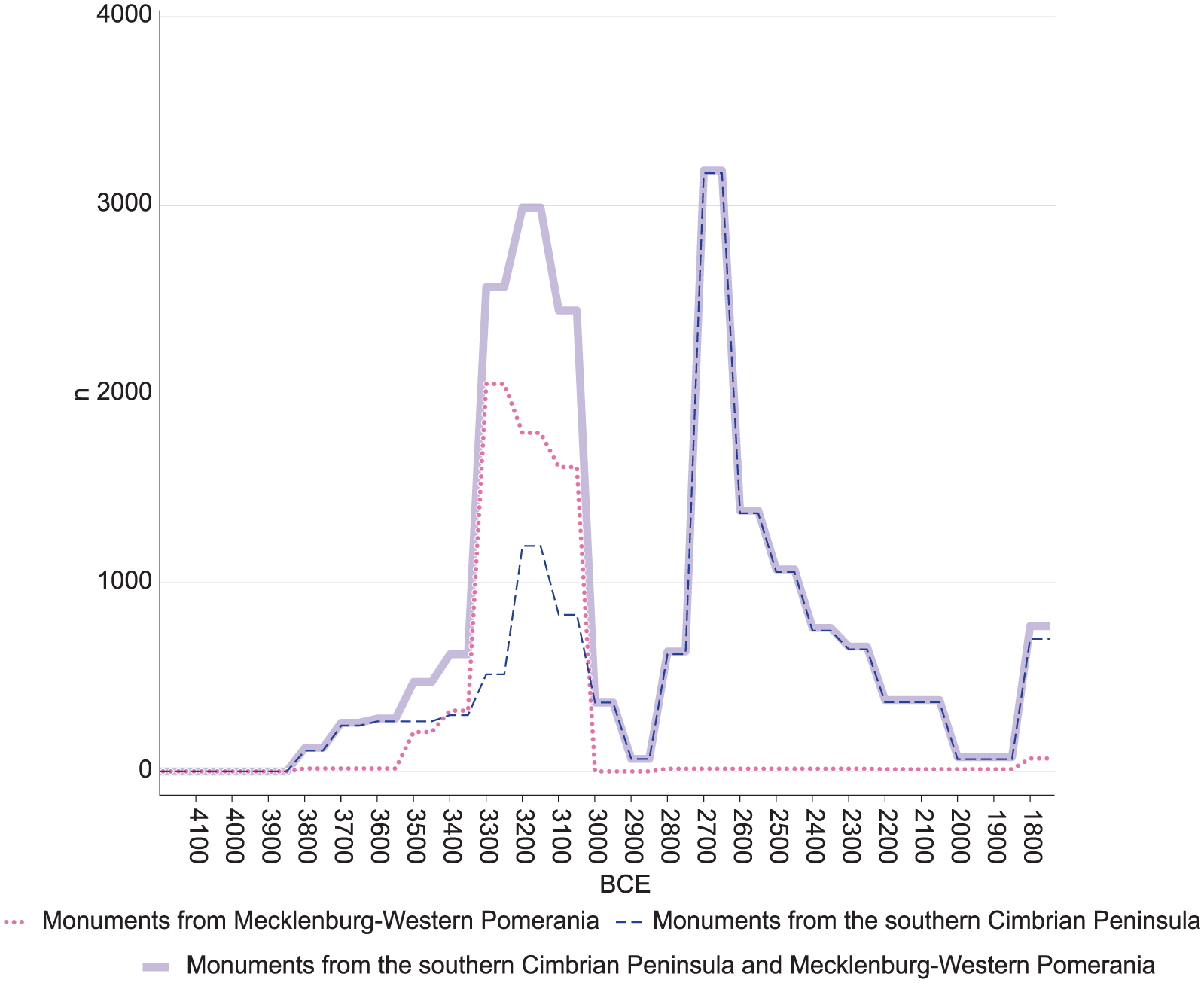
Graph of the intensity in monument construction on the southern Cimbrian Peninsula and in Mecklenburg-Western Pomerania c. 4100–1750 BCE (n = absolute number of projected monuments per 50 years).
Parallel to the megalithic tombs, flat tombs were erected (Kossian, 2005). Some of these graves were in fact later covered with small mounds, as the example of Flintbek demonstrates (Mischka, 2011). Nevertheless, the number of these known mounds above single Funnel Beaker (TRB) burials is, with 65 units, too small (Kossian, 2005: 206–207) to be properly considered in the statistics.
About 7200 out of the 18,653 burial mounds known via the state archaeological survey were probably erected during the YN (see also Schultrich, 2018: 12). We know of 167 excavated YN burial mounds with 197 burial contexts, of which 74 primary burials date to YN I (c. 2850–2600 BCE), 24 to YN II (c. 2600–2450 BCE) and 17 to YN III (c. 2450–2250 BCE). A continued construction phase of burial mounds is particularly evident during c. 2800–2500 BCE (cf. Figure 2).
From the LN period, only five burial mounds with corresponding primary burials are known on the southern Peninsula (Kühn, 1979; Schultrich, 2018). The total summed curve, which was converted into the number of all known monuments, delivers a significant result of two temporally definable ‘booms’ and ‘busts’ in the erection of monuments. According to our compilation, a boom in monumental construction started in the 29th century BCE until the 26th century. Similar patterns are reported from Denmark (Holst, 2013). A decrease in barrow construction is visible until 2000 BCE, when almost no further mounds were constructed.
Accordingly, there are two temporally delimited booms and busts in the erection of monuments during the Neolithic periods 3400–3100 BCE and 2800–2500 BCE. It can be noted that the absolute number of early Single Grave burials increases and even exceeds the megalithic construction rates.
Northeastern Germany
A comparable approach for the conversion of excavation-derived data into estimations of the total number of originally existing megalithic tombs and burial mounds (Rassmann and Schafferer, 2012), based on the available data from the state survey and calculations of the Priority Programme 1400, ‘Early Monumentality and Social Differentiation’ (Lorenz, 2012, 2018), also permits an overall calculation of megalith distribution patterns for Mecklenburg-Western Pomerania (cf. Figure 2). Here also, a megalithic boom is recorded; at the same time, a Single Grave period burial mound boom is less intense. The overall curve thus well matches the observations of developments on the southern Cimbrian Peninsula.
General observation
The spliced curve for the southern Cimbrian Peninsula and north-eastern Germany (cf. Figure 2) results in the following main features:
First forms of monumentality are developed around 3850 BCE with continuously increasing numbers until the 35th century BCE.
A boom which seems to occur within one century around 3400 BCE: the observable figures of monuments resulted in a six-fold increase in numbers, and also show a subsequent bust with an even steeper slope during the 31st century BCE.
Nearly monument-free centuries are observable from c. 3000–2800 BCE.
A steep increase in monumental activities occurs around 2800 BCE, a decrease starting anew in the 26th century BCE.
5 After 2100 BCE, the LN displays nearly no monumental activities – they start again in the 17th century BCE with the onset of the Bronze Age.
In conclusion, the reconstructed monumentality curves provide robust patterns against which trends of other variables of different domains can be compared.
Artefact studies
Within our studies, the simple summing of artefacts is considered to indicate an overview of the archaeological remains which were detected by archaeological survey. As in the southern Cimbrian Peninsula, a complete state archaeological survey exists; this is a region where artefact numbers are considered more representative than in regions without a state archaeological survey.
The compilation of artefacts (Figure 3) shows a steady increase in artefact numbers during 4300–2200 BCE, followed by a decrease during c. 2200–1900 BCE. Within the general increase during the 4th and 3rd millennia BCE, three peaks are observed: the first c. 3200 BCE, the second c. 2700 BCE and the third c. 2300 BCE. Boom and bust phases c. 3250–3050 BCE, 2800–2600 BCE and 2350–2200 BCE could be deduced from the record.
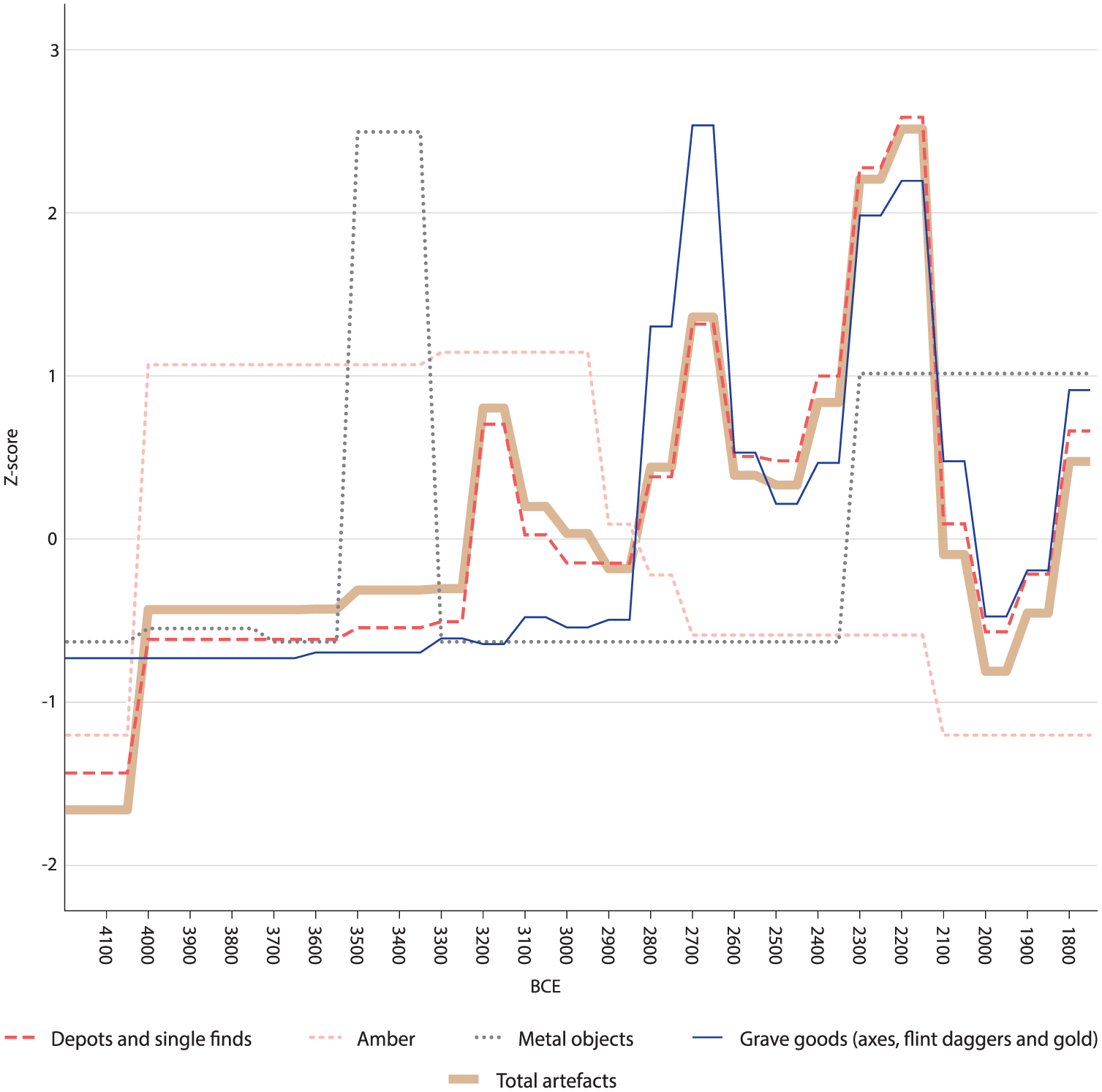
Graph of the relative frequency values of artefacts on the southern Cimbrian Peninsula 4100–1750 BCE (z-scores based on absolute numbers of projected artefacts per 50 years).
If artefacts from hoards and single finds are summed, similar courses are revealed, both in respect of the increase and decrease as well as in respect of the three peaks.
Taking objects into consideration that are associated with graves and which are of prestige/status character, significant differences are visible. While before 3000 BCE a smooth curve exists, peaks in prestige/status items exist c. 2800–2600 BCE and c. 2350–2150 BCE.
The use of metal during the main megalithic boom and its decrease afterwards might represent changes within the ‘foreign networks’; this might be due to the decreasing amber values in the 30th century BCE. The increase in metal artefacts in the 24th century BCE again supports the interpretation of an economically different formation after the end of the YN.
Consequently, three booms and busts in artefact deposition around 3250–3050 BCE, 2800–2600 BCE and 2350–2500 BCE are visible within a steadily increasing rate until the 22nd century BCE.
Subsistence economy
The cereal spectrum in northern Germany in the Funnel Beaker period (c. 4000–2800 BCE) comprises free-threshing barley and emmer as the main crops, followed to a minor extent by einkorn (Triticum monococcum) and free-threshing wheat (Triticum aestivum sl). The most striking change in cereal growing is observed around c. 2300 BCE when two newcomers occur, namely spelt (Triticum spelta, accepted as present only when glume bases allow for reliable identification) and hulled barley (Hordeum vulgare). Spelt indicates furthermore new exchange networks (Effenberger, 2017, 2018). The period in between (c. 2800–2300 BCE) and the phase after 1900 BCE must face a lack of empirical data because of missing suitable archaeological archives.
The sound background for the periods c. 4000–2800 and c. 2300–1900 BCE is down to the diachronic data on cereal and weed seeds and fruits. To infer tendencies towards intensive versus extensive agricultural practices, the ratios of emmer plus spelt/free-threshing barley and annual-perennial weeds are used (Figure 4). The ratio of free-threshing barley-emmer-spelt for the period 4000–3300 BCE is linked with the ratio of perennial to annual weeds. This indicates that free-threshing barley in this period may have been grown extensively. Emmer and annual weeds are present as well and show that intensive crop growing was an add-on to the dominant extensive system. In contrast, the ratio of emmer-spelt-free-threshing barley for the period 2300–1900 BCE goes along with the ratio of annual-perennial weeds. Thus, intensive agriculture is the practice applied to the hulled wheats emmer and spelt in the LN. From a methodological point of view, these data must be critically assessed because the LN assemblages lack the tiny seeds and fruits that dominate the perennial species, which may indicate a different stage of cereal processing after sieving (Fuller et al., 2014). However, the big caryopses of the annual Bromus species occur in both periods. To this extent, it can cautiously be concluded that an intensive agricultural regime was most probably applied to emmer and gained importance when spelt entered the crop spectrum in the LN.
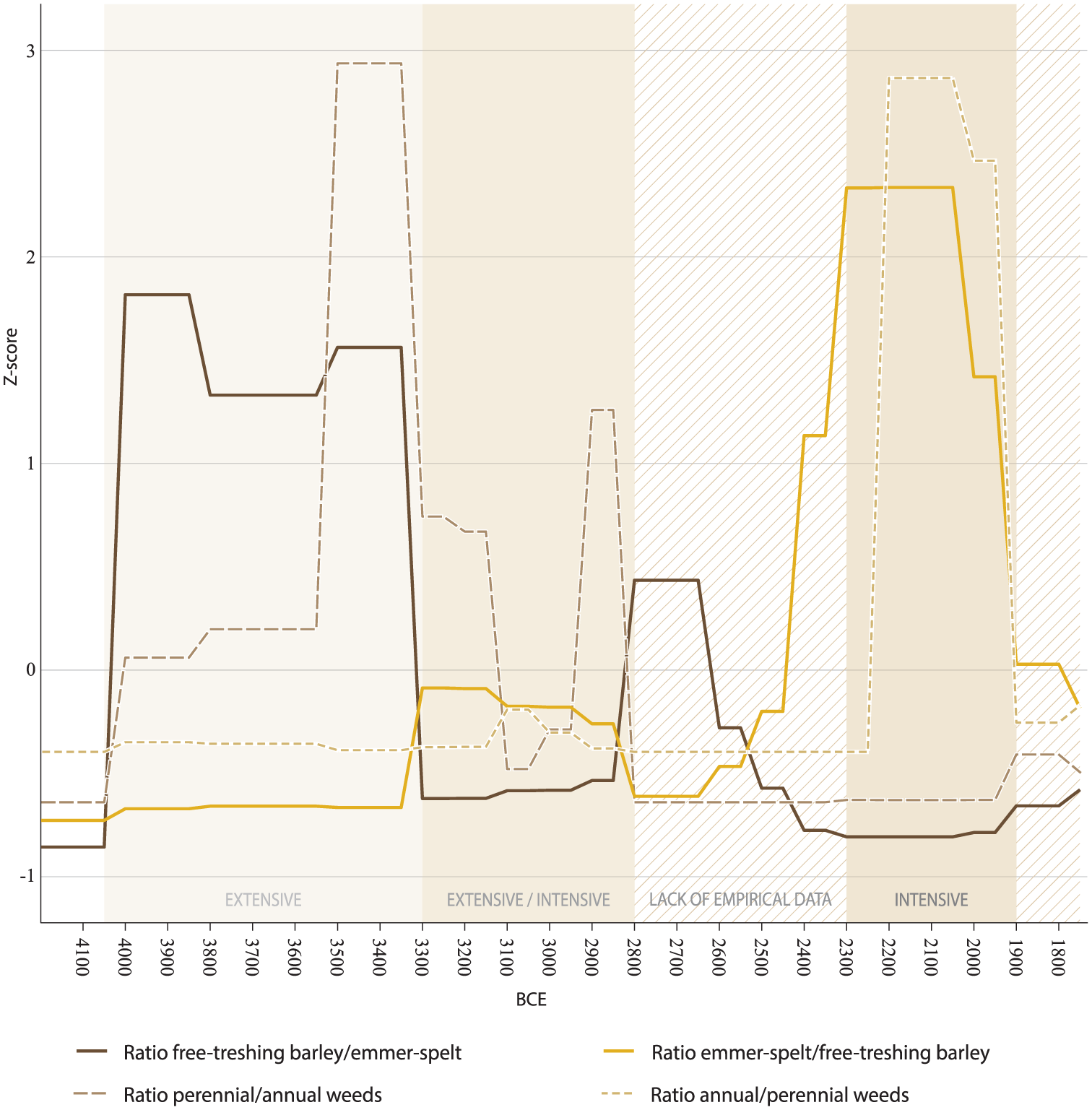
Graph on the trend of subsistence economy proxy records: intensive versus extensive agricultural practices in northern central Europe 4100–1750 BCE (z-scores based on ratios of absolute remains per 50 years).
Summing up, we are able to identify c. 4000–3300 BCE as a phase with a domination of extensive practices, c. 3300–2800 BCE as a phase with more or less balanced extensive and intensive agricultural practices and c. 2300–1900 BCE as a phase with a dominating intensive agriculture. Throughout the Neolithic, gathered plants contributed to daily nutrition. Hazelnuts and dried crab apples in particular are important staple fruits with high caloric impact. Only towards the LN, gathered plants lose importance (Knitter et al., this issue). However, such estimates are biased because of taphonomic and depositional characteristics, since charred cereal remains in general are better represented in subfossil plant assemblages than fruits because processing of hulled cereals in particular on a regular basis includes the use of fire while, for example, apples are consumed raw and can be stored without kiln drying – although the latter cannot be excluded. The picture is further blurred, since gathered plants had particular relevance in ritual activities and are often overrepresented in burial contexts (Kirleis and Klooß, 2014). Nevertheless, it can be observed that gathered plants are present throughout time but tend to lose importance towards the LN.
The development of animal husbandry (Hinz, 2018) displays a steady increase in domesticates c. 4000–3700 BCE from about 10–70% of the bone assemblages and a smooth increase from 70% to 90% c. 3400–3100 BCE, which obviously continues also in the 3rd millennium BCE. Otherwise, no clear tendencies are observed except in a reduction in the dominance of cattle in the domestic animal assemblages from c. 75% to 50% c. 4000–3400 BCE. Although, furthermore, different proportions of wild animals can be observed at domestic sites, hunting and fishing generally decrease in their importance for subsistence after the early Neolithic period (Hinz, 2018; Steffens, 2005).
Palynological and sedimentological proxy records
The palynological proxy (Figure 5) suggests different phases of land opening and reforestation: a steep increase c. 4200–3600 BCE, a boom c. 3600–3400 BCE with a high level until c. 3200 BCE and a bust c. 3100–3000 BCE, a small increase around c. 2900 BCE and a huge boom again c. 2200–1800 BCE. Differences are visible between the southern Cimbrian peninsula, where the high level of the boom lasts from c. 3500–3100 BCE, while in Mecklenburg-Western Pomerania, a steep bust around 3500 BCE is already visible, lasting until c. 3100 BCE.
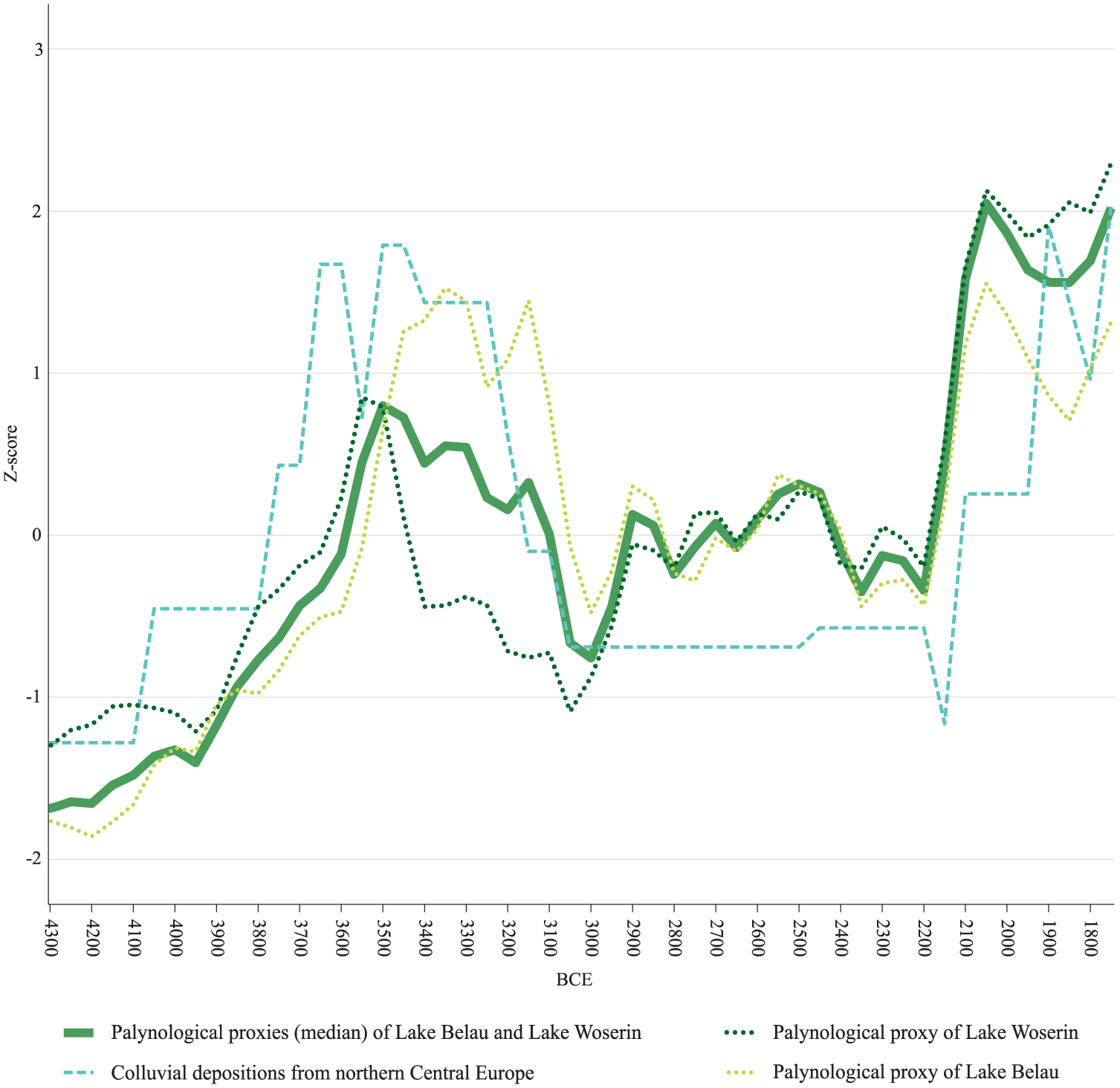
Diagram of palynological proxy records from the southern Cimbrian Peninsula and Mecklenburg-Western Pomerania and the ratio of colluvial layers from northern central Europe 4300–1750 BCE (z-scores based on absolute numbers of projected artefacts per 50 years).
The onset of forest clearings during the Funnel Beaker phase is clearly reflected by the incidence of soil erosion throughout the region. This is also visible in lake sediments of the Lake Belau region (Dreibrodt and Wiethold, 2015). Peaks of erosion occur in c. 3600 and 3500 cal BCE. Very little erosion is recorded c. 3000 cal BCE. A re-increase towards a lower level of erosion intensity occurs c. 2900 cal BCE followed by two peaks during the earliest Bronze Age/LN c. 1900 and 1700 cal BCE.
In general, the weighted number of colluvial layers indicates a pattern similar to the palynological curve: an increasing number c. 4100–3500 BCE, a decrease c. 3500–3100 BCE and a huge boom during c. 2100–1900 BCE. The smaller booms and busts of the 3rd millennium BCE, which are visible in the palynological record, are not reflected in the record of colluvial layers.
Combined results
For a joint evaluation time series of palynology, monumentality, subsistence economy and material culture, proxy records are compared (Figure 6). The comparison shows that prior to the high intensity of monument building activities (3400–3100 BCE) there was an increase in land opening from c. 4000 BCE that reached a first peak around 3500 BCE. This was going along with the establishment of extensive agriculture. Arable practices changed around 3300 BCE into a balanced system of intensive and extensive agricultural regimes. While obviously the first woodland clearances are also associated with the erection of early monuments, the peak of monumentality appeared after the establishment of a more open landscape around 3350 BCE and goes along with a shift to diversified agricultural practices, when extensive as well as intensive crop growing was carried out. The decrease in land opening after 3200 BCE is then reflected in the abrupt decrease in monument building activities about 100 years later. Parallel to the first boom in monumental architecture, an increase in material culture, but not in prestige/status objects, is visible. The overlap between the phase of the highest rate of land opening and the highest intensity of monument building activities is especially visible in the southern Cimbrian Peninsula.
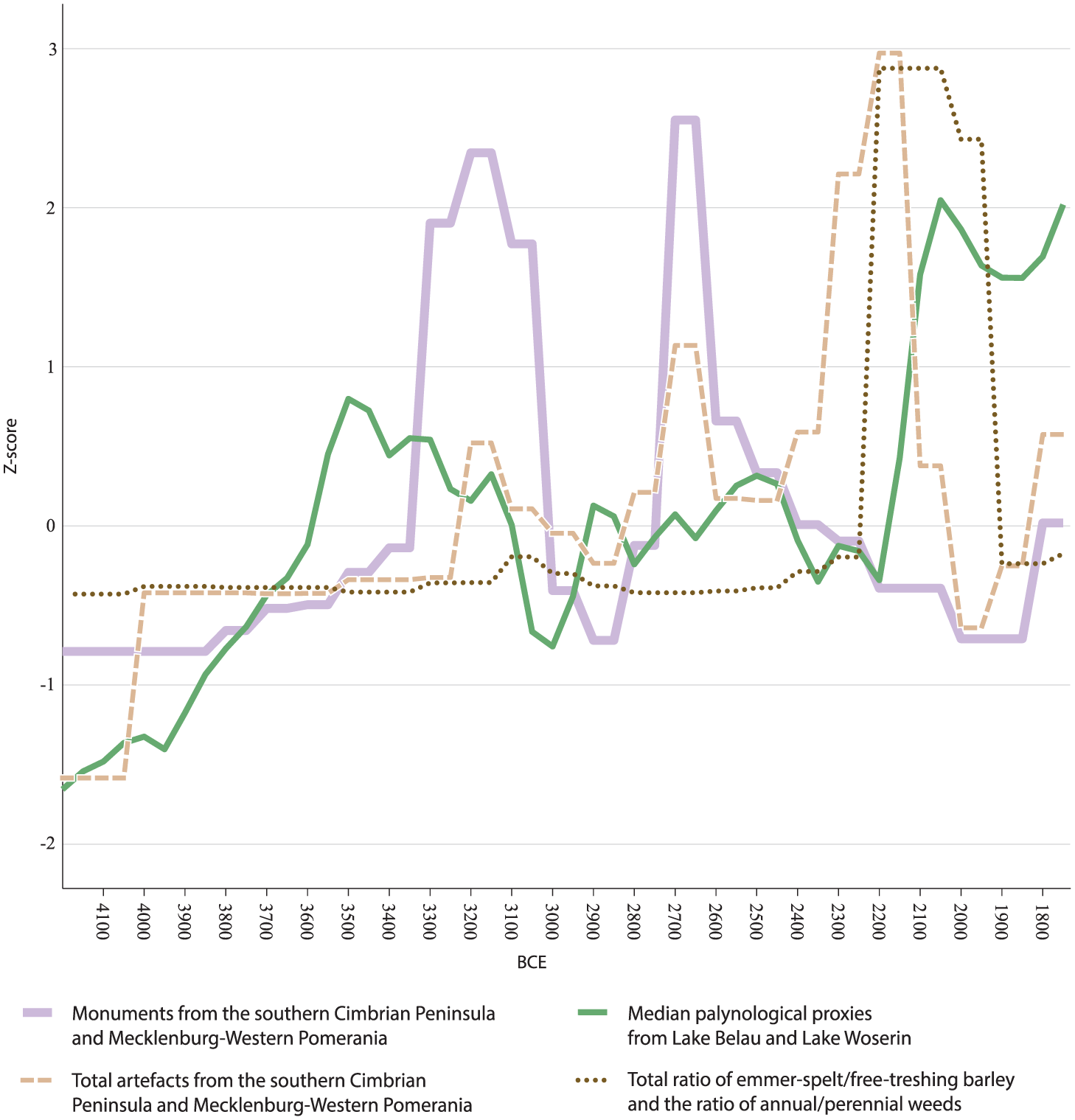
Compilation graph of the records of monumentality, artefacts, subsistence economy and the palynological proxy records for the regions southern Cimbrian Peninsula and Mecklenburg-Western Pomerania 4100–1750 BCE (z-scores based on absolute numbers of projected artefacts per 50 years).
After about 200 years without monumental building activities (associated also with reforestation processes), the next huge intensity of monumental building activities c. 2800–2500 BCE is not associated with a similar boom in land openings, but especially on the southern Cimbrian Peninsula with a rather smooth development. The phenomenon is again accompanied by an increase in the material culture proxy, but this time also a peak in status/prestige objects.
At the end of the second boom phase around 2500 BCE, land opening increased, while barrow building activities were reduced extremely. In contrast to further reduced monumental building activities until 1900 BCE, from 2400 BCE onwards, a huge increase in material objects and status/prestige objects is comparable to the provable dominance of intensive agriculture practices and a new boom in land opening.
In summary, the comparison of records from the 4100 and 1800 BCE spheres reveals the following:
a first boom in monumentality that is distinctly preceded by, but also linked with, land opening (MN).
a transformation phase with less monumental activities, a decrease in artefact production and reforestation processes (late MN).
a second boom in monumentality that is not linked with a boom in land opening, but to a boom in status/prestige objects (early YN).
a phase of huge land openings and the deposition of prestige/status objects, but no monumental activities (LN).
With the example of this LN period, a specific pattern becomes evident. During an increasing opening of the land and a decrease in the erection of the monuments, an increase in the material culture proxy is followed by a shift to new cereals, to diversification, around 2300 BCE, potentially going along with a new agrarian technique, possibly more intensive agriculture or different storage systems. With the beginning of the Bronze Age, subsequently, as in the first boom phase of monumentality, we can again see an increase in the material culture proxy, monumentality and an increasing opening of the land (Kneisel et al., this issue; Müller, 2015). While the first boom in monumentality could be linked also with the introduction of the animal-drawn plough and the increase in intensive agricultural practices, the Bronze Age boom is probably linked with the beginning and increasing importance of metal tools used both for utilitarian purposes and as non-utilitarian status markers.
Discussion
With the evaluation of different archives, from palaeo-environmental records to material culture, the intensity of monument building, artefact deposition, prestige and status representation can be viewed in connection with developments of the subsistence economy and of the human impact on the environment. Focusing on monumentality, five different phases have been identified and can now be better understood.
Increasing human impact and first monumental activities: 4100–3600 BCE
The transformation from foraging to horticultural practices is linked with the integration of husbandry and extensive horticultural practices from the 41st century BCE. The continuous opening of the landscape is associated with a steep increase in artefact production from the 41st century BCE, and first constructions of non-megalithic long mounds occur in the 39th and 38th centuries BCE. Accordingly, it was not monumental activities that triggered the changes, but rather transformations within the subsistence economy took place prior to first intensifications of monumental activities. In respect to our original research question, we might conclude for these centuries that it was not socially driven monument building activities that drove the economic development, but that it was the other way round. The economic changes furthered new social practices, which were expressed, for example, in the medium of the first burial mounds above ground.
The onset and organization of the cultural landscape during the early Neolithic I is well reflected by proxies of land use, woodland opening and human impact in the pollen data and the sediments and soils of the region. Interestingly, the early transformation from foraging to farming is also related to the North Atlantic Bond Event 4, with distinct regional manifestation in northern areas occurring here based on Skagerrak deepwater reconstructions around 4000–3800 BCE (Butruille et al., 2016), evidence well supported by high-resolution sedimentological evidence from Lake Belau (Dreibrodt et al., 2012; Zahrer et al., 2013). This may provide an alternative and natural cause for the coeval decline in arboreal pollen, thus challenging the human impact hypothesis (Weinelt, 2018) and claiming a modulating role of regional climate constraints on innovations within the subsistence economy and indirectly on monumental activities (Warden et al., 2017).
Megalithic boom and bust 3400–3100 BCE: Economic growth, monumental boom and diversity of objects
The first consolidation of an economic and cultural landscape is expressed by a relatively stable openness of the landscape and by monument building (cf. Figure 6). Especially from 3600 BCE onward, the boom in deforestation and woodland opening until c. 3200 BCE is impressive. A new economic system is established, especially also with innovations in the subsistence economy (tracking system and ploughing with the ard). With these further extensive arable practices, intensive crop growing gains importance and shows that a diversified agriculture is quite established from 3300 BCE onwards. This economic boom phase is parallel to a huge boom in monumental activities, but again this happened with a time delay. Again, it was economic intensification that drove the intensity of monumental activities. The increase in artefact production after 3300 BCE might be linked with the transformational process towards diversified agricultural practices. The lack of a bust in prestige/status items indicates that obviously cooperative practices (in contrast to later booms) characterize these MN communities.
Parallel to the development of economic growth, the development of a ritually and economically separated landscape takes place during this period (Brozio, 2016; Schülke, 2011). A sharp separation is also visible in the plant remains from the megalithic tombs, where gathered plants dominate, while the cultivars are of greatest importance at the domestic sites (Kirleis and Klooß, 2014).
In addition, the increase in the number of monuments is, on the one hand, associated with a quantitative increase in the number of primarily ceramic burial objects. The concurrent corresponding increase in the number of individuals per burial chamber is at the same time linked with an increase in the practice of collective burials (cf. Müller, 2010). On the other hand, an increase in the diversity of vessel shapes (Saev, 2015) as well as an increase in ornamentation (Lorenz, 2018) can be observed, which might be associated with an increasing differentiation of local groups within the Funnel Beaker North Group. In the increasingly competing groups, which begin to distinguish themselves from each other through the sets of ceramics, economic growth enables the increasing construction of monuments in which the necessary collaborative work symbolizes the economic possibilities and power of each group. This development is also linked with the new type of monument: the passage grave, which symbolizes the cooperative character even more by the separation of the collective burial chamber with a passage.
Transformation phase 3100–2800 BCE: Decreasing human impact, decreasing monumentality
While monumental building activities decreased abruptly, the passage graves, which already characterize the landscape, are intensively used for secondary burials during this phase. While at the beginning also maximal values are reached for MN depositions of material culture in the form of grave goods (Brozio, 2016), this decreases rapidly during the 31st century BCE. The ceramic vessels are characterized by a high diversity of shapes and decorations (Lorenz, 2018; Saev, 2015), whereas a decline in the economy is indicated by a decline in open lands (cf. Figure 6).
An increasing regional differentiation of social groups, due to social changes, in which weapons play a more prominent role (Müller, 2010), may be the trigger for the supraregionally visible economic decrease. Possibly, the necessary surplus for the construction of new monuments was no longer achieved or had to be used for other purposes. A decrease in agriculturally used fields that accompanied the societal ‘crisis’ is reflected in minima in pollen and in soil erosion proxies, backing the interpretation of the archaeological record. On the southern Cimbrian Peninsula, this is also visible in the return to a dispersed settlement pattern after the 31st century BCE.
Corded Ware burial mound boom 2800–2500 BCE: Decoupling of economic and social development
The boom in the construction of monuments (cf. Figure 2) triggered by communities connected with the Single Grave societies, like a northern variant of the European Corded Ware phenomenon, is at the same time connected with changes in the social organization, which is expressed by individual burials under burial mounds and a boom in axes as a symbol of a new ‘warrior ideology’. Moreover, hunting stations (Becker and Benecke, 2002), the use of agriculturally less sustainable soils (Feeser and Furholt, 2014) and hamlet-like domestic sites suggest smaller communities with possibly more mobile lifestyles that exist in a phase of sustained economy (Kristiansen, 1998). In this phase, the boom in monumentality is not to be understood as a reaction to economic growth, but as sociocultural change brought to the communities from outside. The necessary surplus for the explosive erection of the monuments could have been generated supraregionally by the development of new economic areas through a more extended pastoral economic component.
Increases in proxy values from both pollen data and soil erosion back the interpretation of archaeological data. The human impact intensity does not reach Funnel Beaker times maxima but is visible. Local finds of the formation of meadow soils (Lake Belau, Dreibrodt and Wiethold, 2015) instead of erosion might indicate a stronger than before maintenance of cattle breeding in northern European landscapes. Alternatively, an assumed higher mobility of the people with shorter durations of domestic site inhabitations could be deduced from the palaeo-environmental records.
Accordingly, the status which is expressed in single burial mounds and status is no longer linked with control or gain of local and regional subsistence economies. Social ideologies seem to be responsible for the monumental boom during these centuries, especially on the Cimbrian Peninsula. This second Neolithic boom in monumentality is followed by two centuries of less intensive monumental activities.
LN economic boom 2300–1800 BCE: Correlation of the deposition of status items and the economic development
In the LN, increasing land opening and the domination of intensive agricultural strategies correlate with high deposition rates of status symbols in the form of flint daggers and metal objects (cf. Figure 6). A development of supraregional metallurgy exchange systems is also observed (Klassen, 2004; Vandkilde, 2017). These new networks are archaeobotanically visible, since spelt and hulled barley appear as new cultivars and the cultivation of free-threshing wheat is now established (Effenberger, 2017, 2018). The increasing participation in the exchange systems may be one reason for the new economic growth within the communities in which new status symbols as a means of social differentiation were assigned a higher significance than investment in monumental architecture. A high variability and strong increases in pollen-based human impact values (c. 2200–1800 cal BC) and in the soil erosion proxy record (maximum c. 1900 BCE) mirror a dynamic change in society and economy within the landscapes. These changes probably occurred despite or because of considerable environmental stress produced by the occurrence of a further Bond event. A regional abrupt cooling of similar amplitude as the previous is well evidenced in the Skagerrak records (Butruille et al., 2016). To this extent, in contrast to the previous phase, climatic, economic and social developments go again hand in hand – but this time without monumental expression.
Conclusion
Our findings show that, during the megalithic Funnel Beaker period, economy and ritual were closely interlinked, while they were detached in the Single Grave period – a thesis that was first expressed by Kristiansen (1984).
The megaliths not only highlighted items of material production (flint axes and food-filled vessels) in their rituals, but their erection is also linked with the most productive soils and, as we have seen (cf. Figure 6), their quantity is dependent on the amount of surplus produced. We interpret this as a system in which the possibility to mobilize the workforce, that is, political power, is strongly dependent on the productivity of individuals or individual groups. As most anthropological studies suggest, the erection of a megalith is a collective endeavour (Adams, 2009, 2010), yet also contributes to prestige accumulation by those individuals who can mobilize. In the course of this, the consumptive act of megalith building and associated feasts serve as a social levelling mechanism, translating material surplus into prestige. In the 3rd millennium BCE, the Single Grave’s erection of grave mounds is no longer dependent on material production. Finds displayed are also now less strongly rooted in subsistence, but more in combat, with objects like battleaxes and maceheads, alcohol consumption, and beakers as predominant pottery forms in burials (Hübner, 2005; Klassen, 2005). These are symbols referring to socially prestigious activities within a specific status group. The display of such symbols and the mobilizing of a workforce for the erection of the graves and connected feasts are to a lesser degree than before dependent on the production and accumulation of surplus production but are probably also mobilized through the ability to be part of highly valued status groups, which is attractive. Surely, a material basis is also needed for this kind of value system, but it is probably one that is less dependent on the direct fertility of the local soils and individual or group-based productivity. It can, for example, be acquired by theft, raiding or tribute extractions, which are among more indirect forms of resource acquisition, made possible by the growing emphasis on warrior virtues.
Hence, the building activities of the non-megalithic Single Grave burial mounds do not reflect the regional material production rates. Still, the building boom in these monuments c. 2800–2500 BCE, that is, the beginning of this phenomenon, probably reflects the need to establish the new system through a widespread visibility of connected monuments in the landscape.
This is a factor that seems to get less pronounced in the LN period. Here, we see a resurgence of the interrelation between material productivity and ritual activities. This could be interpreted as the result of a long-term unfeasibility of the status economy system. Even if, within a system of violence-based competition, one’s own material productivity is less important than in the previous system, in the long run, those communities who do have a higher productivity will gain an advantage. Yet, as the landscape is now filled with mounds as visual landmarks and claims to land and resources are by and large established, depositions of prestigious artefacts take over the role of graves as an expression of social status in ritual activities in the LN period.
The study indicates first that in the Neolithic in the North German Plain there were political economies of different character. On the one hand, there are phases with dependencies between economic and ritual life in which ritual developments are embedded in economies and economies in which ritual developments are embedded. On the other hand, phases without dependencies between economic and ritual life, that is to say, status societies, can be observed.
Second, the study shows that different characteristics of transformation phases exist. Thus, changes in sociocultural diversity find expression in various media, such as monumental architecture or material culture, and are subject to constant change and intensity.
It has been shown that the earliest monuments in northern central Europe were erected during a period of economic upswing (3600–3100 BCE), which is reflected both in the archaeological record and in the palaeoecological data. The continuation of the Funnel Beaker Culture was largely based on the extension of arable land. The subsequent phase of grave use during the Single Grave Culture (about 2800–2500 cal BC) is less visible in the archives of the landscape. In addition to social changes in prehistory, changes in subsistence strategies, such as a gradual increase in the importance of livestock farming at the expense of arable land, could explain part of the muted human impact in landscape archives that occurred synchronously with the erection of prehistoric monuments in northern central Europe.
As a result, the answers to the research questions pursued here are different from period to period, from boom and bust phase to boom and bust phase. From a methodological point of view, only the close comparison of palaeoecological, economic and cultural records allowed the reaching of insights into the linkage between environment, economy and monumentality. Thus, further studies from other regions are necessary to evaluate the described variability in social and economic practices.
Supplemental Material
Supplemental_material_A – Supplemental material for Monuments and economies: What drove their variability in the middle-Holocene Neolithic?
Supplemental material, Supplemental_material_A for Monuments and economies: What drove their variability in the middle-Holocene Neolithic? by Jan Piet Brozio, Johannes Müller, Martin Furholt, Wiebke Kirleis, Stefan Dreibrodt, Ingo Feeser, Walter Dörfler, Mara Weinelt, Hendrik Raese and Annalena Bock in The Holocene
Supplemental Material
Supplemental_material_B – Supplemental material for Monuments and economies: What drove their variability in the middle-Holocene Neolithic?
Supplemental material, Supplemental_material_B for Monuments and economies: What drove their variability in the middle-Holocene Neolithic? by Jan Piet Brozio, Johannes Müller, Martin Furholt, Wiebke Kirleis, Stefan Dreibrodt, Ingo Feeser, Walter Dörfler, Mara Weinelt, Hendrik Raese and Annalena Bock in The Holocene
Supplemental Material
Supplemental_material_C – Supplemental material for Monuments and economies: What drove their variability in the middle-Holocene Neolithic?
Supplemental material, Supplemental_material_C for Monuments and economies: What drove their variability in the middle-Holocene Neolithic? by Jan Piet Brozio, Johannes Müller, Martin Furholt, Wiebke Kirleis, Stefan Dreibrodt, Ingo Feeser, Walter Dörfler, Mara Weinelt, Hendrik Raese and Annalena Bock in The Holocene
Footnotes
Acknowledgements
The authors thank Karin Winter and Carsten Reckweg for the revision of the graphics. Furthermore, they thank the anonymous reviewers for their valuable comments on the text. The research was conducted and financed in the context of the Collaborative Research Centre 1266 ‘Scales of Transformation: Human-environmental Interaction in Prehistoric and Archaic Societies’ of the German Research foundation (DFG, German Research Foundation – project number 2901391021 – SFB 1266).
Funding
The author(s) received the following financial support for the research, authorship and/or publication of this article: This study was funded by the Deutsche Forschungsgemeinschaft (DFG, German Research Foundation, Projektnummer 2901391021 – SFB1266).
Supplemental material
Supplemental material for this article is available online.
Notes

References
Supplementary Material
Please find the following supplemental material available below.
For Open Access articles published under a Creative Commons License, all supplemental material carries the same license as the article it is associated with.
For non-Open Access articles published, all supplemental material carries a non-exclusive license, and permission requests for re-use of supplemental material or any part of supplemental material shall be sent directly to the copyright owner as specified in the copyright notice associated with the article.
