




Abstract
Terrestrial cosmogenic nuclide dating has been widely used to estimate the surface exposure age of bedrock and boulder surfaces associated with deglaciation and Holocene glacier variations, but the effect of inherited age has been rarely directly addressed. In this study, small clasts, embedded in flute surfaces on two cirque glacier forelands in Jotunheimen, southern Norway and deposited within the last ~60 years, were used to test whether such clasts have the modern surface exposure age expected in the absence of inheritance. Two different approaches were taken involving dating of (1) a single clast of cobble size from the proglacial area of Austanbotnbreen, and (2) 75 clasts mostly of pebble size from the proglacial area of Storbreen crushed and treated as a single sample. 10Be surface exposure ages were 99 ± 98 and 368 ± 90 years, respectively, with 95% confidence (±2σ). It is concluded that (1) these small glaciers have eroded and deposited rock fragments with a cosmogenic zero or near-zero concentration, (2) the likelihood of inherited cosmogenic nuclide concentrations in similar rock fragments deposited by larger warm-based glaciers and ice sheets should be small, and (3) combining a large number of small rock particles into one sample rather than using single large clasts of boulder size may provide a viable alternative to the commonly perceived need for five or more independent estimates of exposure age per site.
Keywords
Introduction
In-situ produced terrestrial cosmogenic nuclides are increasingly being used to define the exposure ages of boulders and bedrock surfaces in areas formerly covered by glaciers and ice sheets. Results have been used to construct and enhance detailed chronologies of Holocene glacial and climatic variations (e.g. Cossart et al., 2012; Douglass et al., 2005; Ivy-Ochs et al., 2007; Jomelli et al., 2011; Kerschner et al., 2006; Licciardi et al., 2009; Matthews et al., 2008; Moran et al., 2016; Rodbell et al., 2009; Schaefer et al., 2009; Schimmelpfennig et al., 2012, 2014; Schindelwig et al., 2012; Shakesby et al., 2008; Winkler, 2009; Wirsig et al., 2016) and of earlier deglaciation events (e.g. Balco, 2011; Briner et al., 2005; Brook et al., 1995; Goehring et al., 2008; Heyman et al., 2011, 2016; Hughes et al., 2016; Ivy-Ochs et al., 1996; Kaplan et al., 2010; Kelly et al., 2004; Reuther, 2007; Stroeven et al., 2016). It cannot be assumed, however, that the timing of glacial variations is always accurately reflected in the surface exposure–age determinations.
Cosmogenic surface exposure dating is based on the accumulation of cosmogenic nuclides in bedrock and clasts on exposure to secondary cosmic rays (Balco et al., 2008; Dunai, 2010; Gosse and Phillips, 2001) near the Earth’s surface. There are uncertainties associated with the technique itself, which are well understood and are reflected in the statistical confidence intervals placed around surface exposure ages. There are also less easily determined geomorphological and other environmental uncertainties (e.g. Briner et al., 2003; Cerling and Craig, 1994; Cockburn and Summerfield, 2004; Fabel and Harbor, 1999; Hallet and Putkonen, 1994; Putkonen and Swanson, 2003; Reuther, 2007; Schildgen et al., 2005; Winkler and Matthews, 2010a), but a fundamental prerequisite for successful application of surface exposure dating to all types of rock surfaces is that any sampled material has ‘zero’ age on exposure (i.e. the material contains no inherited cosmogenic nuclides).
This zero-age assumption has been shown sometimes to be compromised in non-glacial contexts (e.g. Schmidt et al., 2011), but in glacial depositional contexts the situation is made more complex by a wide range of potential errors. These include misidentification, incorrect mapping and incorrect correlation of landforms; snow, sediment and vegetation shielding; post-depositional exhumation of shielded rock fragments by erosion of overlying sediment; other forms of post-depositional disturbance of the substrate by subaerial processes, including thawing of buried dead ice, frost-heaving and sorting (which may bring ‘young’ rock fragments to the ground surface); post-depositional weathering of rock surfaces (causing removal of surface layers of rock containing accumulated cosmogenic nuclides, which leads to dates that are too young); gravitational settling of boulders causing rotation and exposure of previously shielded surfaces containing an unrepresentatively small quantity of accumulated nuclides; introduction of ‘young’ or ‘old’ rock fragments transported by rock fall, snow avalanche or other mass-movement processes from surrounding slopes; and incomplete removal from dated rocks of inherited cosmogenic nuclides by glacial erosion.
Arguably the best way to test for this incomplete zeroing of cosmogenic nuclides is by applying surface exposure dating to rock fragments that are known to have been recently deposited by modern retreating glaciers. Although this type of natural field experiment has been attempted before (e.g. Davis et al., 1999; Putnam et al., 2012; Schaefer et al., 2009; Schimmelpfennig et al., 2014), these previous tests have (1) assumed that dating individual large boulders is the best means of avoiding the problems (particularly because of greater stability and the likelihood of avoiding shielding by a cover of snow), (2) involved sampling from recently deglacierised surfaces of poorly constrained exposure age and/or (3) inadequately controlled for all the other geomorphological uncertainties.
This short paper has three main aims: (1) to report 10Be exposure ages obtained from modern rock fragments deposited in the proglacial areas of two small glaciers in the Jotunheimen mountains of southern Norway, (2) to test whether glacial erosion successfully zeroed any pre-existing cosmogenic nuclide content of the rock fragments prior to their deposition and (3) to discuss the broader implications of the results for both surface exposure dating in glacial environments and the efficacy of erosion exhibited by small warm-based glaciers.
Study sites
The glaciers Austanbotnbreen (61°25′N, 7°47′E) and Storbreen (61°35′N, 8°10′E), numbered 2711 and 2636 in the Norwegian Glacier Inventory (Andreassen and Winsvold, 2012), are located, respectively, in the Hurrungane and Smørstabbtindane massifs of western Jotunheimen, southern Norway. Austanbotnbreen (Figure 1a) is a very small west-facing cirque glacier (area, 0.29 km2), which lies between 1628 and 2027 m a.s.l. Storbreen (Figure 1b) is one of the larger glaciers in Jotunheimen (area, 5.22 km2; altitudinal range, 1398–2079 m a.s.l.), has a north-easterly aspect and occupies a more complex cirque.
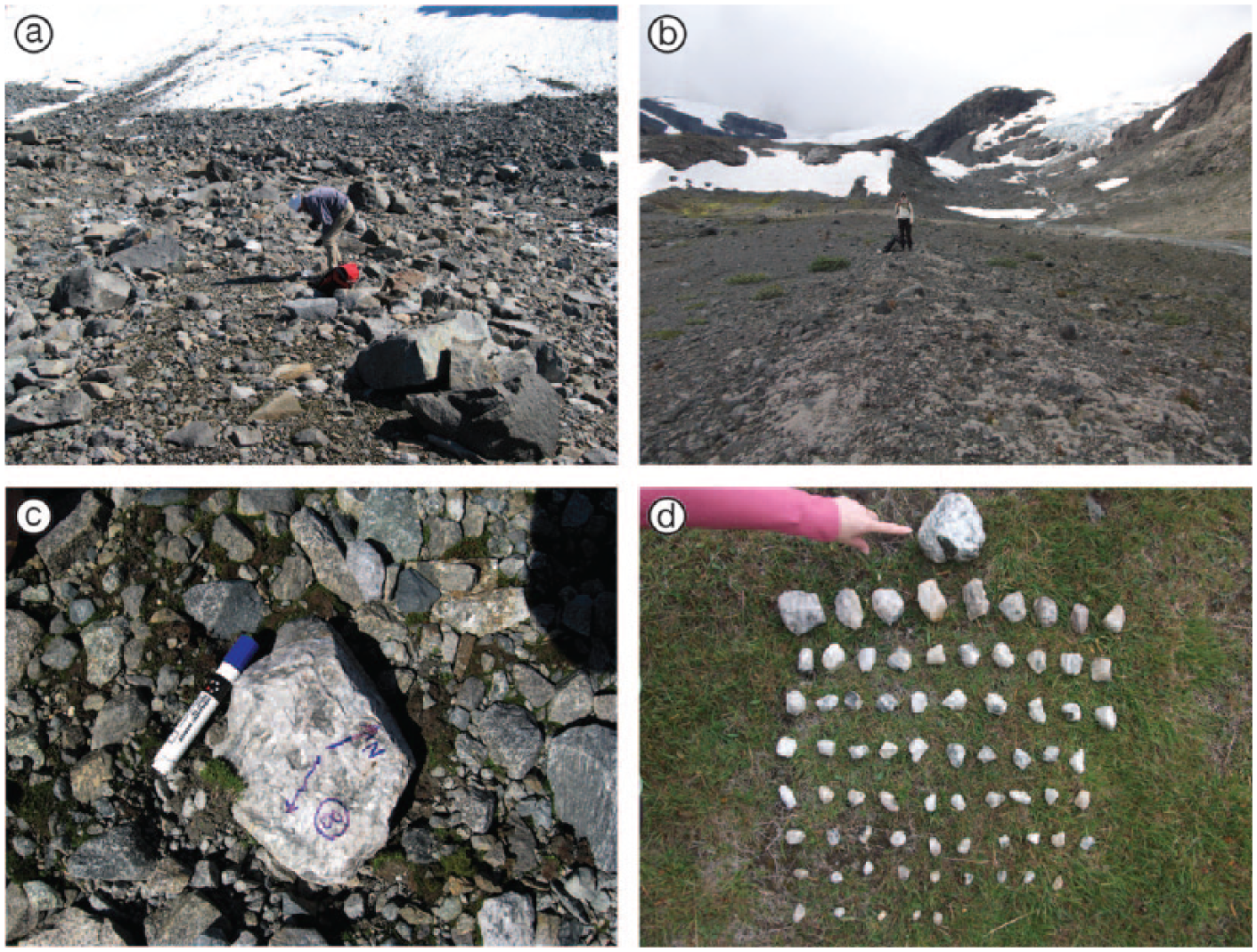
(a) The proglacial area of Austanbotnbreen showing the location of sample RS-8 in an area of fluted moraine about 50 m distal to a small push/dump moraine deposited c. AD 2000. (b) The proglacial area of Storbreen showing the location of the rock fragments comprising sample RS-40: Storbreen retreated from the foreground c. AD 1960; the figure is standing on a single flute. (c) Sample RS-8, of cobble size, embedded in situ in the surface of a flute at Austanbotnbreen. (d) The 75 rock fragments comprising sample RS-40 from Storbreen; these were collected from the area shown in (b) and arranged in order of size.
Both rank as small warm-based glaciers with frontal zones extending below the permafrost zone (Etzelmüller and Hagen, 2005; Lilleøren and Etzelmüller, 2011; Lilleøren et al., 2012). Their lower marginal zones, however, experience seasonal freezing onto the substrate (Hiemstra et al., 2015; Winkler and Matthews, 2010b) and discontinuous permafrost exists in their headwall rock faces (Hipp et al., 2014).
Annual monitoring of glacier front fluctuations at Storbreen since the beginning of the 20th century (accessible at http://glacier.nve.no/viewer/CI/en/nve) has enabled accurate dating of recent deglacierisation of the proglacial area (see the map in Matthews and Owen, 2008). Austanbotnbreen has not been monitored but terrain age is reasonably well known as recent reference points are provided by recessional moraines inferred to have been deposited in c. AD 1930 and 2000 by analogy with neighbouring Jotunheimen glaciers (cf. Hiemstra et al., 2015; Matthews and Winkler, 2011; Winkler and Matthews, 2010b).
Climatic data from the closest meteorological station (Sognefjell) to the study sites indicate a mean annual air temperature of −3.1°C (July mean, +5.7°C; January mean, −10.7°C) and a mean annual precipitation of 860 mm at an altitude of 1413 m a.s.l. (Aune, 1993; Førland, 1993). The bedrock geology of the region consists of pyroxene-granulite gneiss (Lutro and Tveten, 1996) with peridotite intrusions and veins of quartz–feldspar. Fragments of the latter were used for surface exposure dating.
Methodology
Field methods
The sampled quartz-rich rock fragments were embedded in the surfaces of flutes (fluted moraine), which are low, glacially streamlined (ice-moulded) ridges of deformable diamicton (till) oriented in the direction of glacier flow. Flutes are formed beneath relatively thin glacier snouts during phases of rapid glacier retreat (Andersen and Sollid, 1971; Benn, 1994; Benn and Evans, 1996, 2010). Sampling of clasts embedded in the surfaces of these subglacial depositional landforms therefore minimised the possibility of choosing supraglacially transported rock fragments, which are more likely to contain inherited cosmogenic nuclides through minimal or no erosion during glacial transport together with exposure to secondary cosmic rays before and during such transport.
Sample RS-8 comprised a single rock fragment, approximately 20 cm long (Figure 1c), collected in 2010 from the proglacial area of Austanbotnbreen. This was embedded in a flute about 100 m from the glacier and 50 m distal to the AD 2000 moraine. The terrain age here was estimated to be ~40 years. The maximum dip and orientation were marked with the clast in situ (Figure 1c).
Sample RS-40 consisted of 75 rock fragments (Figure 1d) collected in 2012 from flutes deglacierised between AD 1950 and 1970 on the Storbreen proglacial area. The average terrain age was therefore ~52 years (age range: 42–62 years). The size (long axis) and roundness (Powers, 1953) of each rock fragment were noted. The inclination to the horizon at both sites (RS-8 and RS-40) was measured at 20° bearing intervals in order to calculate topographic shielding from secondary cosmic ray incidence.
Laboratory methods
Rock samples were processed at the School of Geographical and Earth Sciences at Glasgow University (GU). For sample RS-40, all 75 clasts were crushed, the 0.25- to 0.5-mm fraction was homogenised, and a subsample separated using a sample splitter. Mineral separation was performed on the 0.25- to 0.5-mm fraction, including etching with HCl/HNO3, magnetic separation, flotation, and removal of residual feldspars with pyro-phosphoric acid. Quartz was purified by successive HF/HNO3 leaching and purity assessed by flame AAS measurement of Al; concentrations of <100 ppm Al are desired for optimal column chemistry yields.
Preparation of samples for Be measurement was carried out at the GU – Scottish Universities Environmental Research Centre (GU – SUERC) Cosmogenic Isotope Laboratory following procedures modified from Child et al. (2000). After adding Be carrier, clean quartz was dissolved in concentrated HF. Be was extracted from the solution, precipitated as Be(OH)2, oxidised to BeO, and mixtures of BeO and Nb (1:6) were pressed into copper targets. 10Be/9Be in these AMS targets were measured at the SUERC AMS laboratory (Xu et al., 2010). Process blanks, prepared with the samples, were used to subtract blank/background levels of 10Be.
Exposure-age calculations
10Be surface exposure ages were calculated using two different calculators. First, the Lm scaling model in the CRONUS-Earth online calculator (Balco et al., 2008; Wrapper script 2.3, Main calculator 2.1, constants 2.3, muons 1.1) was used with the western Norway sea-level high-latitude spallation-induced production rate of 4.16 ± 0.16 atoms g−1 a−1 (Goehring et al., 2012a, 2012b). The Lm scaling model is the time-dependent version of Lal (1991) and Stone (2000) scaling (St) based on time-variation in the dipole magnetic field intensity, as formulated by Nishiizumi et al. (1989). Second, ages were calculated using the CRONUScalc Web calculator (version 2.0; http://web1.ittc.ku.edu:8888/) using the default calibration dataset 10Be production rate of 3.92 ± 0.31 atoms g−1 a−1 and Lifton–Sato–Dunai (Sa) scaling, which is a time-dependent model based on equations from a nuclear physics model, incorporating dipole and non-dipole magnetic field fluctuations and solar modulation. The Sa scaling factor is based on atmospheric pressure, solar modulation, and a cutoff rigidity calculated using trajectory tracing. Nuclide-dependent scaling is implemented using cross-sections for the different reactions (Lifton et al., 2014; Marrero et al., 2016).
All current published 10Be production rate values overlap within their uncertainties (i.e. similar precision), and surface exposure ages calculated using one value are therefore not statistically different from those using another. The resulting central age value, however, depends on the production rate used (i.e. unknown accuracy), but this is irrelevant for our very young samples. The results discussed below are based on the western Norway production rate because of geographic proximity to our study sites.
For both exposure-age calculations, we assumed no atmospheric pressure anomalies, no significant erosion during exposure (ϵ = 0 mm a−1), no prior exposure and no temporal shielding (e.g. by snow, sediment, soil or vegetation). A density value of 2.7 g cm−3 was used for all samples. 10Be/9Be isotope ratios were normalised to the NIST SRM standard assuming a 10Be/9Be nominal value of 2.79 × 10⁻¹¹ and procedural blank corrected with a 10Be/9Be value of 1.24 ± 0.44 × 10⁻¹⁵. Propagated uncertainties include those in the counting statistics, the 10Be decay constant, and 10Be production rate.
Results
10Be concentrations and surface exposure ages using the two different calculators are summarised in Table 1 with 1σ uncertainty. The surface exposure age of sample RS-8 (99 ± 98 years at 2σ) does not differ significantly from the expected (known) age of 40 years whereas that of sample RS-40 (368 ± 90 years at 2σ) differs by >200 years from both the expected average age of 52 years for the sampled rock fragments and the expected age of 62 years for the oldest rock fragment.
Sample and laboratory data and calculated 10Be surface exposure ages (±1σ).
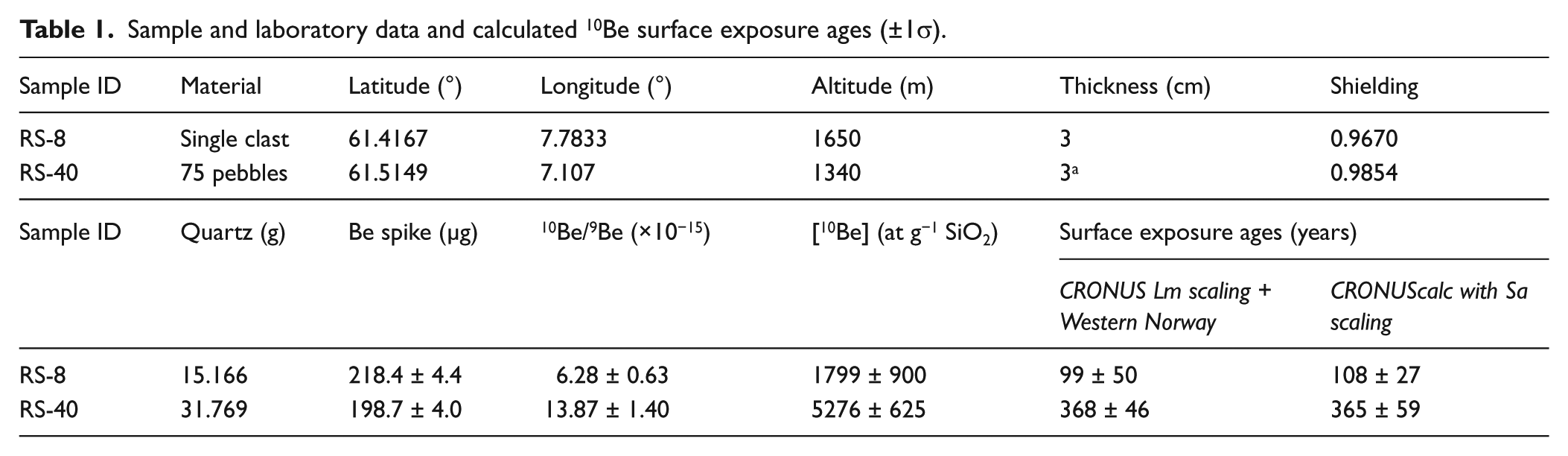
Average thickness.
Correction for snow shielding (Delunel et al., 2014; Schildgen et al., 2005) produces a noteworthy, though minor effect. An assumed 2-m-thick snow cover with a density of 0.2 g cm−3 lasting for 6 months each year at these sites would increase the surface exposure ages of samples RS-8 and RS-40 by 6% or 6 and 22 years, respectively. Crucially, the statistical significances of the differences between the measured and expected exposure ages therefore remain essentially unchanged.
Errors caused by sediment/soil shielding at these sites must be negligible because, assuming no post-depositional exhumation, the surface-embedded, dated rock fragments would have been exposed to cosmic rays almost immediately following deglacierisation. When first exposed, the flutes might have stood up to 0.5 m above the surrounding flat terrain but would have settled and stabilised within a few years following glacial retreat as a result of drainage and consolidation of the water-saturated sediments. Longer-term disturbance by mass movement and erosion, which can destabilise the slopes of much larger lateral and terminal moraines (cf. Hallet and Putkonen, 1994; Putkonen and O’Neal, 2006), does not affect very low-relief small-scale landforms like the flutes at the two glaciers studied. Within 5–10 years of glacial retreat, a stone pavement developed at Storbreen by several processes, including pervection (down-washing of sand and silt-sized particles), frost sorting (upheaval of relatively large clasts towards the ground surface), and deflation (removal of fine particles by wind) (Matthews and Vater, 2015). Thus, a built-in error of no more than 10 years can be inferred for stone pavement development. This pavement would have been further stabilised by the growth of a cryptogamic crust (mainly mosses) as is clearly seen around sample RS-8 in Figure 1c. The sparse vegetation cover is typical of the sites and demonstrates no need for correction for vegetation shielding.
The rock fragments comprising sample RS-40 were predominantly (86%) in the 2.0- to 5.0-cm range (Figure 2a). The modal roundness class was angular (50%) but a substantial proportion of fragments were sub-angular (37%) with small proportions (5% each) in the very angular and sub-rounded categories (Figure 2b). With limited time for weathering to cause clast rounding, a substantial presence of sub-angular with some sub-rounded clasts in the sediment confirms their eroded subglacial origin (see below).
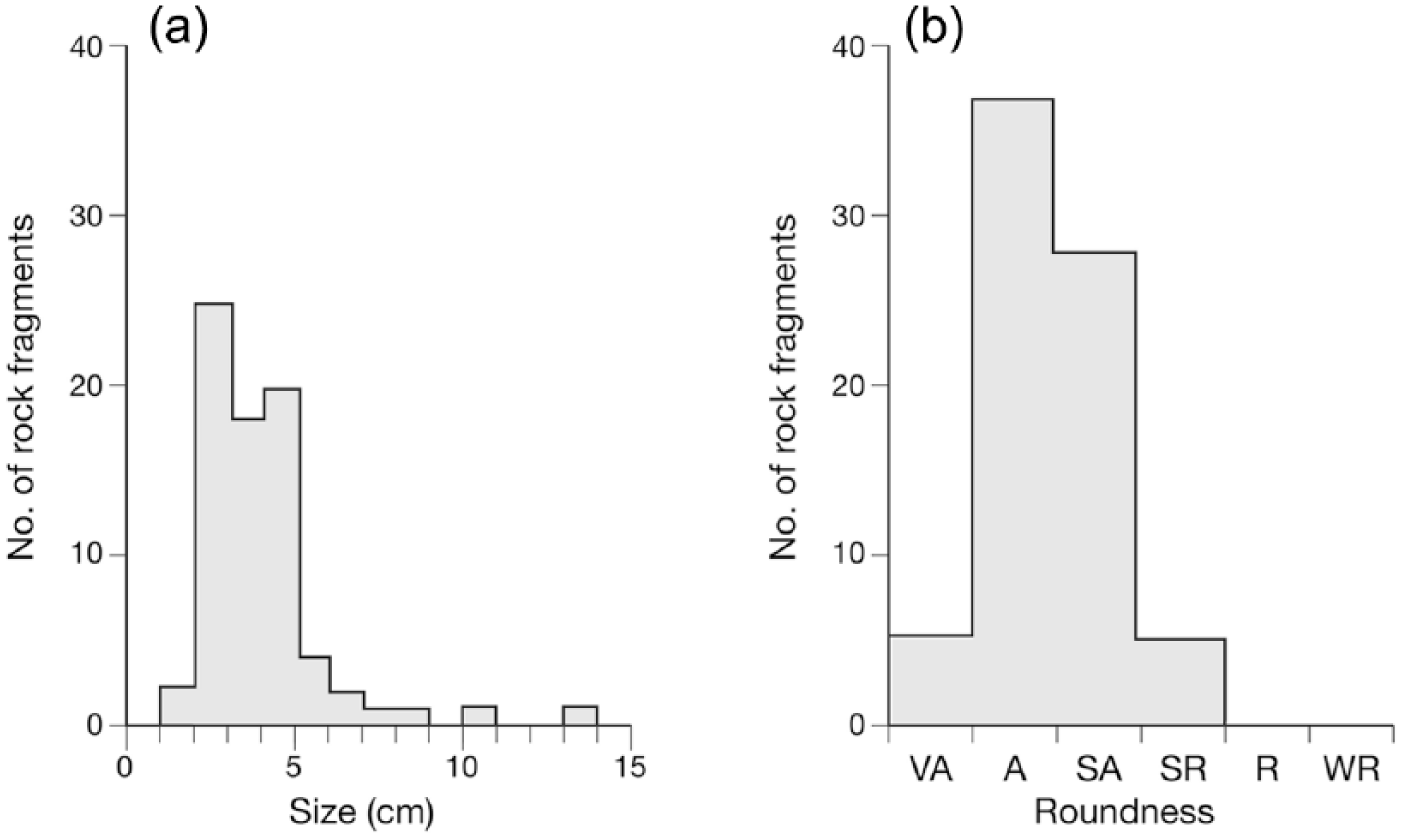
(a) Size and (b) roundness distributions of the rock fragments comprising sample RS-8 at Storbreen (roundness classes: VA, very angular; A, angular; SA, sub-angular; SR, sub-rounded; R, rounded; WR, well rounded).
Discussion
The results have implications for the likely scale of the inheritance factor associated with surface exposure ages in glacial environments, for the nature and efficacy of erosion by small glaciers, and for surface exposure dating rock fragment sampling strategy.
The problem of inheritance in surface exposure dating
Although acknowledged as a potentially important uncertainty, inheritance as a factor affecting surface exposure ages in glacial contexts has rarely been specifically investigated. Instead, a negligible effect has mostly been assumed except where obviously anomalous dates have been obtained. Where its impacts have been estimated, based on compilations of independently derived dates, they vary according to different authors. For example, Cockburn and Summerfield (2004) suggested that inheritance characterises 10–20% of moraine boulders compared with only 2% according to Putkonen and Swanson (2003). Heyman et al. (2011) concluded that it was undetectable for ages of >3.5 ka in boulders deposited by recent glaciers and only at a low frequency in boulders from palaeo-ice sheets, while Heyman et al. (2016) suggested that very large (tall) boulders were less prone to it than smaller ones.
That the single clast from the Austanbotnbreen proglacial area (RS-8) produced a modern exposure age does indeed suggest no measurable inherited terrestrial cosmogenic nuclide signal. For sample RS-40 from Storbreen, however, one or more of the small fragments must have contained an inherited signal, otherwise the exposure age would not have significantly exceeded the expected surface age of ~50 years. Nevertheless, the amount of inherited 10Be in the total sample must have been very low in order to produce the comparatively small difference in age of no more than ~300 years (or about 4300 10Be atoms g−1) between the measured and expected ages.
Our results for sample RS-40 therefore indicate that the chances of finding small subglacially transported rock fragments with an inherited cosmogenic signal on Storbreen glacier foreland are low. Surface exposure dating results for young samples from recently deglacierised proglacial areas and older ‘Little Ice Age’ moraines are available from a few other places (e.g. Davis et al., 1999; Putnam et al., 2012; Schaefer et al., 2009; Schimmelpfennig et al., 2014), and they substantiate this conclusion. Particularly instructive in this context are two 10Be exposure ages reported by Schimmelpfennig et al. (2014) for two post-‘Little Ice Age’ boulders deposited by Steingletscher (area, ~6 km2) in the Central Alps, Switzerland. One of these, located on terrain known to have been deglacierised in AD 1988, yielded an exposure age of 127 ± 16 years (±2σ analytical error; expressed as years before AD 2010) while the other, from an AD 1920 moraine yielded an age of 162 ± 20 years. In addition, they also reported 14 surface exposure ages from older parts of the glacier foreland, ranging up to about 600 years and arranged in chronological order according to known glacier retreat positions. On the foreland of Cameron Glacier in the Southern Alps, New Zealand, Putnam et al. (2012) obtained four 10Be ages from boulders in a moraine dated to about AD 1864 according to the glacier snout position shown in a painting from that year. Three of the surface exposure ages yielded a mean age of 180 ± 96 years BP (±2σ; expressed as years before AD 1950) while a fourth date of 407 ± 36 years BP was rejected as an outlier. Similarly, Schaefer et al. (2009), working at the relatively large Mueller Glacier (~22 km2), also in New Zealand, reported general correspondence in age between a moraine ridge dated historically to the mid- to late-1800s and three 10Be exposure ages ranging between 132 ± 17 and 185 ± 22 years.
Implications for the nature and efficacy of erosion by small glaciers
The low level of inherited 10Be signal in the dated Storbreen rock fragments has implications for the efficacy of erosion by small glaciers. Although we cannot determine whether the amount of inheritance was distributed between a few, many or all clasts, all the dated rock fragments must have been produced by the comminution of larger rock particles. Most of these are inferred to have been eroded from bedrock by quarrying during cirque enlargement, involving lowering of the glacier bed and undercutting and steepening of the headwall sufficiently to zero the cosmogenic signal in the source rock. Subglacial transport of the dated rock fragments is confirmed by their embedment in flutes. The high proportion of sub-angular with a smaller proportion of sub-rounded fragments, despite their relatively resistant quartz-rich composition, demonstrates some abrasion during subglacial transport (Boulton, 1978; Lukas et al., 2013) consistent with the short distance over which subglacial transport by small warm-based glaciers can produce considerable clast rounding (Drake, 1972; Humlum, 1985; Matthews, 1987).
At least five potential sources of clasts with inherited cosmogenic signals might apply to Storbreen and Austanbotnbreen. First, cosmogenic signals can survive in rock fragments beneath non-erosive, cold-based ice sheets (e.g. Fabel et al., 2002; Knudsen et al., 2015). Thus, conceivably, cosmogenic signals could have survived the Last (Weichselian) Glaciation in rocks beneath the present day glaciers and/or in their headwalls. Jotunheimen, however, was covered by and located close to the thickest part of the Fennoscandian Ice Sheet (Hughes et al., 2016; Mangerud et al., 2011; Stroeven et al., 2016) and, despite the existence of cold-based ice for some of the Weichselian, erosion by warm-based ice could have been sufficient at other times to remove existing cosmogenic signals.
The second potential source of inheritance is bedrock and diamictons overridden by the two glaciers after exposure to the atmosphere during the early-Holocene Thermal Maximum (HTM) when most if not all glaciers in southern Norway underwent complete wastage (Matthews and Dresser, 2008; Nesje, 2009; Nesje et al., 2000, 2008). Bedrock outcrops could have been exposed for up to 3000–4000 years in the HTM between late-Preboreal deglaciation and mid-Holocene neoglaciation, allowing a cosmogenic signal to build up. During this interval, cosmic rays are likely to have penetrated 2 m or more into the bedrock (Wirsig et al., 2016) and somewhat farther into unconsolidated sediment.
The third potential source of inheritance is bedrock in the headwall above the glacier surface, which would have been exposed throughout the Holocene. Rock fragments removed from these headwall areas fall onto glaciers in the accumulation zone and become deposited in the proglacial area either following supraglacial and englacial transport or, if sufficiently deeply buried beneath snow and ice, following subglacial transport. Above-glacier headwall sources are extensive at both Storbreen and the smaller Austanbotnbreen but might have been more influential at the latter, which has a very short headwall-to-snout distance (<750 m). If the headwalls were very unstable and had been shedding rock debris throughout the Holocene, however, this material might only have acquired a minimal cosmogenic signal because of rapid erosion and rapid burial in the glacier (or burial in talus slopes during glacier-free intervals).
The fourth potential source of inheritance is that of late-Holocene glacier fluctuations causing exposure, overriding, reworking and redeposition of rock fragments. Many decadal- to millennial-scale glacier fluctuations in this interval have been recognised in Jotunheimen (Matthews and Dresser, 2008; Matthews et al., 2000, 2005; Nesje, 2009), and the existence of previously deposited debris ‘recycled’ in ‘Little Ice Age’ lateral moraines has been proposed at Bødalsbreen, southern Norway (Burki et al., 2009). Such ‘recycling’ may well apply at other glacier forelands in southern Norway causing exposure of clasts to cosmic rays on many occasions prior to the ‘Little Ice Age’.
The fifth and final potential source of inheritance is the penetration of cosmic rays through thin glacier ice during flute formation prior to exposure of the dated clasts to the atmosphere. Inheritance build-up, however, would have been limited to the few decades when the flutes were forming beneath the rapidly retreating glacier.
The overall low level of inherited cosmogenic signals in proglacial rock fragments at Austanbotnbreen and particularly Storbreen indicates either that the actual bedrock sources lacked inherited signals or that glacier erosion had effectively removed them. This suggests that, despite the range of potential sources of inheritance, the degree of glacial erosion associated with small glaciers may be greater than hitherto supposed (cf. Delmas et al., 2009; Sanders et al., 2013; Wirsig et al., 2016; Xu et al., 2015). Furthermore, if it is accepted that the two small Norwegian glaciers have had sufficient eroding power to remove virtually all the inherited signal, it seems improbable that larger glaciers and ice-sheets would be incapable of doing likewise (unless cold-based). Hence, our results suggest that inherited cosmogenic nuclides would be unlikely to affect the surface exposure ages of clasts deposited by larger warm-based glaciers and ice sheets earlier in the Quaternary. This conclusion is consistent with the analyses of Putkonen and Swanson (2003) and Heyman et al. (2011, 2016) relating both to the dating of boulders and bedrock.
Implications for exposure-age sampling strategies
Owing to the variability of exposure ages, including anomalous ones, it is now standard practice to obtain multiple age estimates in order to obtain a single date from a site (Applegate et al., 2010, 2012; Heyman et al., 2011, 2016). Use of five age estimates, typically from five large boulders, seems to be a commonly adopted rule-of-thumb sample size. This can be viewed as an attempt to balance the desire for statistical validity against the high cost of dating even a single sampled boulder. A mean age obtained from five dates, however, would be regarded by statisticians as a small and unreliable sample size.
A much larger number of rock fragments amalgamated into a single age-estimation sample, as carried out at Storbreen, might provide a viable solution to this ubiquitous problem. This strategy reduces the chances of a single anomalous boulder having a disproportionate influence. Ensuring that each small rock fragment is in situ and genuinely representative of its terrain has, of course, its own problems. At Storbreen, the sampled small fragments were embedded in flute surfaces, and many were sub-angular or sub-rounded and by implication therefore modified by subglacial processes. Not only were these fragments as a whole affected by a low level of inheritance but also their combined surface exposure age was largely unaffected by the many geomorphological factors that can introduce errors in the ages of small rock fragments subject to much longer environmental histories and/or different geomorphological settings.
Thus, provided sufficient precautions are taken to avoid potentially unrepresentative fragments, use of a single age estimate from multiple small rock fragments, at least in circumstances involving only subglacially transported clasts, might provide a reliable exposure age. Large boulders do, however, reduce or eliminate any snow-shielding effect, which is important in any glacial environment with an appreciable long-lying snow cover. Adopting a multiple small rock fragment strategy to date Holocene or Pleistocene surfaces would therefore require accurate estimation of snow thickness, density and duration. If, however, the same multiple sample approach was applied to boulders rather than to small rock fragments, snow cover characteristics might not need to be determined.
Conclusion
10Be exposure ages of 99 ± 98 and 368 ± 90 years (±2σ; Lm scaling and western Norway production rate) were obtained from rock fragments embedded at the surfaces of flutes deposited within the last 60 years in the proglacial areas of two small warm-based cirque glaciers in southern Norway. The first date was obtained from a single cobble at Austanbotnbreen, whereas the second was obtained at Storbreen from 75 smaller rock fragments that were crushed and mixed prior to analysis.
Near-modern ages for the single dated clast and for the combined dated small proglacial rock fragments indicate a generally low level of inherited cosmogenic nuclides. This low inheritance was recorded despite probably higher values in source rocks in headwalls or in current subglacial locations exposed to the atmosphere earlier in the Holocene.
The near absence of an inherited signal in the dated fragments indicates either that glacial erosion removed most of the inherited cosmogenic signal that existed in the source rock or that such inherited signals never existed. This not only supports the validity of exposure-age dating in the context of small-glacier fluctuations but is also consistent with such glaciers being capable of considerable erosion over decadal to millennial timescales.
Larger warm-based glaciers and ice sheets can be expected to be even more efficient at removing inherited signals from subglacially eroded and transported clasts. The results imply, therefore, that surface exposure ages obtained from boulders subject to this transport route or from bedrock surfaces deglaciated a long time ago in the Quaternary are likely to have had their pre-deglaciation cosmogenic signals zeroed.
The results from Storbreen raise the interesting possibility of adopting a sampling strategy in which multiple small rock fragments rather than single boulders are used in future exposure-age dating applications. Such a strategy might prove a better one for exposure-age dating in glacial contexts, but to date there has been relatively little research effort devoted to the inheritance factor and how it might vary between materials, and between glacial depositional contexts. Given the increasing use of this dating approach and the widespread acceptance of assumptions about inheritance levels, it would be appropriate to divert some more funds and effort to direct testing of inheritance on different materials in different glacial contexts.
Footnotes
Acknowledgements
Rock samples were collected on the Swansea University Jotunheimen Research Expeditions 2010 and 2012. We thank Dr Amber Vater for assistance in the field, Siobhan O’Brian and Maria Miguens-Rodriguez for assistance with sample processing, Dr Dylan Rood for the AMS measurements, Anna Ratcliffe for preparing Figures 1 and 2 for publication, and Drs Stefan Winkler and Peter Wilson for commenting on the manuscript. RAS is grateful to the Quaternary Research Association for a contribution towards travel and subsistence costs to carry out field sampling and to the Jotunheimen Research Trust for a grant towards cosmogenic nuclide dating costs. This paper represents Jotunheimen Research Expeditions Contribution No. 202 (see  ).
).
Funding
The author(s) received no other financial support for the research, authorship and/or publication of this article.