




Abstract
Women’s participation in construction, wood and forestry has historically been low, and it remains a highly gender segregated industry. There has, nevertheless, been a slight upward trend in women’s participation in the labour market and an increase in women’s participatory structures within national and EU sectoral union organisations. The article assesses barriers and opportunities to the integration of women and aims to identify what unions might do to address these. Drawing on a survey of its members by the European Federation of Building and Woodworkers (EFBWW) on sector-specific solutions and obstacles to increasing women participation and addressing gender inequalities in the industry, the analysis reveals that measures are largely confined to top-down rule-based implementation. This includes relevant provisions in national legislation, aligning with European Union (EU) law and priorities, and improved upon by collective bargaining agreements, such as work-life balance and prevention of harassment at work. The article concludes that greater integration of women’s networks and participatory bodies into union activities and structures opens up opportunities for women to be more effectively included in social dialogue processes and for improving the accountability of union organisations. By establishing links with women working in the industry, this would facilitate a bottom-up approach.
Keywords
Introduction
Most future-oriented occupations, many of which are construction- and wood-related, are male-dominated, with an ageing workforce, giving impetus to the need for gender equality (EC, 2025). There are no other industries where the participation of women is as low and that are as gender segregated as construction, wood and forestry (ECSO, 2020). In the context of structural labour shortages, with construction occupations particularly affected, addressing this gender imbalance has become ever more relevant (European Labour Authority, 2022). The urgent need for technical and specialist knowledge for the green transition to zero energy building calls for greater inclusivity, especially considering women’s generally higher educational achievements and greater presence in sustainability-oriented courses (Clarke et al., 2019).
Gender equality in the construction, wood, and forestry industries has been on the agendas of policy makers and sectoral social partners for a long time, and the barriers to the entry, retention, and career progression of women are well known (Schiano-Phan et al., 2023). Construction unions at European, national and local levels have made significant attempts to improve gender representation, both within their own structures and through different initiatives (ETUI, 2021; Women can Build, 2020). However, women’s participation in these industries remains persistently low though it has risen slightly over the last 20 years both quantitively and qualitatively and there has been a noteworthy increase in women’s participatory structures within national and EU sectoral union organisations.
Our aim is to identify what issues are promoted by unions to tackle gender inequality in the construction, wood, and forestry industries in different European countries and what impact this has had. This confronts the question of whether there are limitations in union approaches to gender equality and, if so, how these might be improved. The analysis reveals that initiatives and policies reported by unions consist largely of top-down rule-based measures and implementation to address gender imbalance, driven by EU-level priorities and collective bargaining agreements on, for instance, work-life balance and harassment at work. We argue that emerging women’s participatory structures have been insufficiently integrated into union activities and social dialogue processes, constraining their ability to effectively influence decision-making and expand women’s agency.
The study draws on a survey designed in 2021 by the European Federation of Building and Woodworkers (EFBWW), covering the construction, wood, forestry and allied industries and trades, representing 77 affiliated unions in 36 countries and 1.5 million members, and a member organisation of the European Trade Union Confederation (ETUC). The survey was sent out to its national union affiliates, inquiring how gender equality has been addressed, and is in itself indicative of union approaches to improving gender inequality. The analysis of the survey findings is compared with the findings of a similar survey carried out 20 years ago by the European sectoral social partners, the EFBWW and its employer counterpart, FIEC (European Construction Industry Federation) (Clarke et al., 2005), introducing a longitudinal aspect.
The article begins by outlining the general approach to and constraints on union approaches to gender equality before seeking to establish the extent of gender segregation in the construction, wood and forestry industries, highlighting shortcomings in available statistics. Literature on gender equality in male-dominated industries is then reviewed, followed by the methodology. The survey findings are analysed to identify the measures construction unions across Europe promote to address gender imbalance and their limitations, as well as to provide insight into the nature and extent of dedicated women’s representation within the EFBWW and its affiliate unions. These findings are then evaluated in light of previous studies, including the 2005 survey, and of initiatives, activities, and women’s organisations and networks in the sector. Reflecting on the relationship between these measures and the role of women’s representative structures within unions, the article argues that top-down solutions driven by legal impetus need to be complemented by the integration of women’s participatory structures into union activities and the social dialogue process in order to strengthen their agency.
Union approaches to gender equality in construction, wood and forestry in Europe
It is important to distinguish between the substantive content of unions’ gender equality policies and demands, their subsequent effectiveness in terms of women labour market participation, and their inception and adoption as official policies and demands by the union as an organisation.
The activities of union organisations, such as the EFBWW, are characterised by a degree of institutionalisation, which means that their conception of regulation and their policies and demands are influenced by the European Union (EU) institutional context within which they operate (Hyman, 2005). Gender equality in the construction, wood and forestry industries is directly relevant to several strands of the current global and European policy agenda. For instance, the EU Gender Equality Strategy, updated in 2020 (European Commission, 2020), prioritises challenging gender stereotypes in society and supporting diversity in the workplace and the implementation of EU-rules on equal pay and work-life balance, and combats gender-based violence and harassment. This strategy argues in favour of gender mainstreaming and builds on existing EU legislation on equal pay, parental leave, Occupational Safety and Health (OSH), including of pregnant workers, part-time work and work-life balance for parents and carers. In an example of gender mainstreaming, the EU has increasingly linked the question of gender equality to the transition to a low-carbon society, including initiatives specific to the construction industry such as the Build-up Skills initiative. 1
At an organisational level, the relevance and legitimacy of union gender equality policies and demands often rely on either representative or participative democratic processes, the former designed to enhance the presence of women in the organisation’s decision-making bodies and among elected officials, the latter consisting in the creation of separate structures for women within the organisation. The two processes are connected to some extent, as, without adequate resources and institutional mechanisms, there are no guarantees that participative processes can produce effect on the organisation’s decision-making (Young, 1990) and run the risk of being purely tokenistic. As such, analysing the role of women’s structures within the union requires to go into the details of how these structures are set up and connected to the union’s decision-making procedures (Wright et al., 2023a).
Measuring the presence of women in construction, wood and forestry
Whilst this provides a general context for union approaches to gender equality, the specific context and the obstacles confronting women’s participation in the construction, wood, and forestry industries are in many respects unique. There are no other industries in Europe with participation rates of women as low, or levels of gender segregation as pronounced (ECSO, 2020).
Analysing the actual composition of the workforce across European countries is however challenging owing to variations in industry classifications across studies and national statistical systems. What is evident is that there has been a very modest increase in women’s participation in the construction sector over the past two decades. A 2020 European Construction Sector Observatory analysis indicates that women represent 10% of the total workforce, ranging from 16.4% in Luxembourg to 5.2% in Ireland, an increase on 2010, which saw an average total of 9.6% across EU countries plus the UK (ECSO, 2020). More recent Eurostat data extracted from the Labour Force Survey (LFS) (Eurostat, 2023) appear to support this upward trend, despite definitional uncertainties, recording a rise from 9.6% in 2017 to 11.4% in 2022 in the EU-27 countries plus Norway and Switzerland. 2
These country averages obscure variations across occupations, as they include professionals, people working on site and those in administrative roles. There has been an increase in the professions, with women representing, for instance, 46% of architects in Europe in 2022 compared to 36% in 2012 (ACE, 2023), whilst women represent only 2% of construction workers (CEDEFOP, 2023). Among construction operatives, the proportion of women remains consistently extremely low, at around 1.7% of construction tradespeople in the UK in 2023 (Construction News, 2023). Gender segregation also exists in growing sectors linked to the green transition, including the renewable energy sector, with women representing 35% of the workforce across the European Union, but performing primarily administrative and non-technical roles (EIGE, 2016). Key roles in the energy industry, such as metal workers, electricians, heating and cooling experts, insulation specialists, plumbers, are, however, overwhelmingly performed by male workers (Clancy and Feenstra, 2019).
Beyond construction statistics, distinguishing between industries and sectors can be difficult as available data recording gender distribution generally offer aggregated figures for manufacturing and group forestry with agriculture and fishing. Nevertheless, the difference in gender participation appears less stark in the agriculture, forestry and fishing industries with the participation of women reaching 31.3% in comparison to the construction industry (11.4%). 3 However, these figures obscure both the discrepancies between the different sectors within the industry and lack of data for many sectors. For instance, Eurostat data extracted from the LFS (Eurostat, 2023) record an average of 14.6% of women across the EU-27 in 2022 in Forestry, logging and related service activities, but national data are scarce and come with a low reliability warning.
This variability and the difficulties to disentangle where women’s participation in the industries occurs mean that for construction social partners to set targets for its increase is problematic. Beyond statistics, however, it is important to qualitatively understand the reasons for the extremely low participation of women in these industries, a subject that academic literature has examined extensively.
Addressing gender imbalances and segregation in male-dominated industries
Often overlooked, but an essential aspect for the effectiveness of any equality initiative, is the importance of addressing
Nevertheless, even where these structural obstacles are weak or non-existent, there are other well-established barriers to the participation of women in construction, wood and forestry industries.
The frequent
Prior to employment,
Finally, these industries are characterised by a comparatively
These interconnected impacts include ‘external’ ones, especially the
Furthermore, previous studies show the importance of enhancing women’s agency, with
Such a complex array of obstacles presents unions with issues that are perhaps beyond established equality policies to address. Though many, such as poor employment and working conditions, are shared by the male workforce, and hence part of unions’ general policies and demands, others, such as informal rules, difficulties in entering the sector, setbacks in career progression through maternity, and lack of appropriate PPE, are not. They require above all to be challenged both from above, that is top-down, and from below, bottom-up, which itself requires significant involvement of women, who directly experience such issues, in union activities and structures.
Methodology
As a main data source, the study relies on a survey questionnaire drafted by the EFBWW women’s network in 2020–21 and sent out to all 77 EFBWW national affiliates present in 36 countries. It is thus important to note that the survey was not conducted for academic research, and the authors were not involved in its design or administration. While perhaps a limitation of this article, this does make the survey at the same time a valuable source of evidence in its own right, offering insight into the issues that unions themselves prioritise when it comes to the inclusion of women.
The survey generated 25 responses from unions in 19 European countries. 4 While the sectoral coverage of the EFBWW is wide, this may not be the case for affiliates, which may represent one or many more industries, or certain very specific occupations, such as painters to give but one example, depending on the specificities of national union systems. The survey begins by asking general questions on the number of union members and the presence of women among them, the existence of women’s participatory structures, and the specific concerns that should be addressed in the relevant industries. It proceeds to inquire about details of specific measures tackling women’s needs in the relevant industries, particularly concerning health and safety prevention and working arrangements, asking respondents to specify whether these come from the law or collective bargaining agreements (CBAs). It further focusses on CBAs, prompting the respondents to mention specific clauses related to women or equal opportunities, including good practices on work-life balance or any other that are specifically helpful to women. The final section addresses harassment and violence in the workplace, querying respondents as to whether women associated with their union experience harassment and what measures are in place to prevent it, including in CBAs, as well as the status of implementation of the EU Framework on harassment and violence at work.
The survey responses were anonymised, with participants identified by their union organisation, and organised into a single dataset comprising quantitative information (mainly number of union members and the proportion of women among them, see table 2 below) and qualitative information (responses to open-ended survey questions, and information about respondents). A representative of the EFBWW, members of the EFBWW women’s network and respondents from specific countries were contacted to dig deeper into interesting results, with two additional rounds of feedback collected from Austria, Belgium, Croatia, Finland, Hungary, Italy, Latvia, the Netherlands, Spain, Sweden and Switzerland and included in the dataset, along with the terms of reference of the EFBWW women’s network as updated in 2024.
Coding framework.
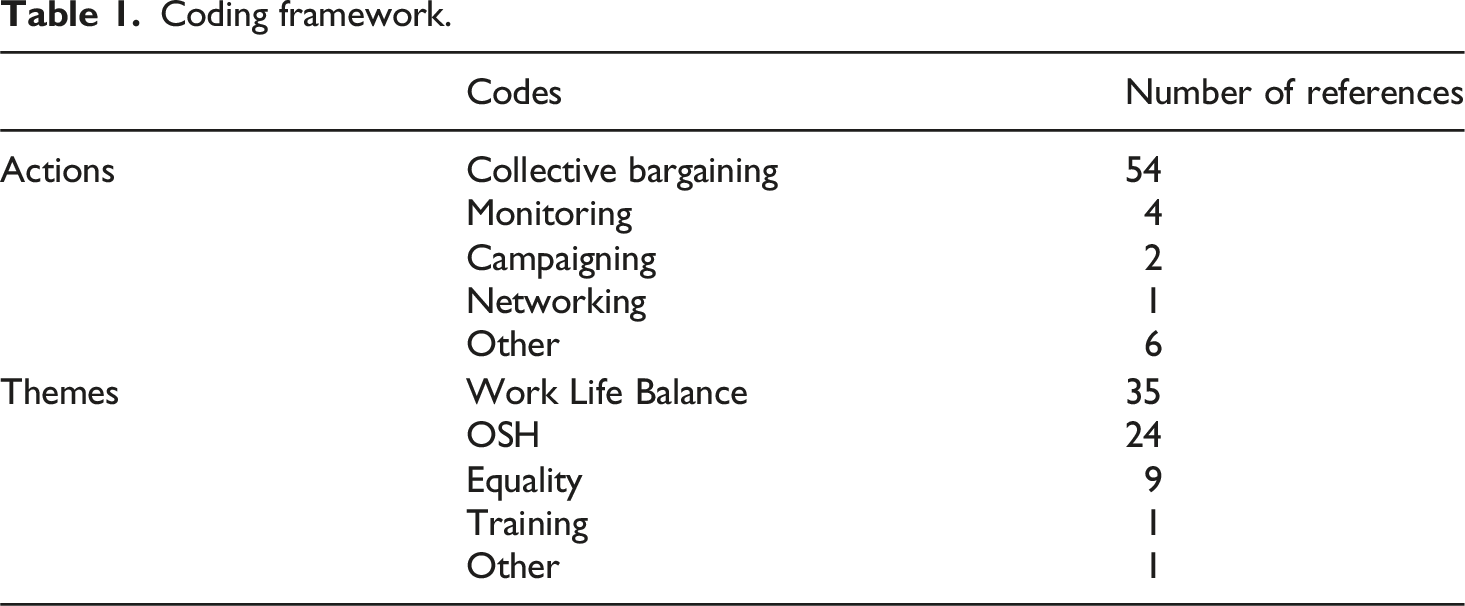
The analysis of the dataset is complemented by the collection of statistical data and a review of the relevant literature, largely focussing on Europe but also drawing on literature from further afield.
Adding a longitudinal dimension, the findings of the current survey are compared to the findings drawn out of another EFBWW survey carried out 20 years ago (Clarke et al., 2005). The two surveys are similar in their aim, as they investigate the presence of women in the relevant industries, including CBAs and practices that participate to their integration. However, they do vary in terms of respondents and scope. The previous questionnaire was sent out in 2003 to 50 EFBWW affiliates and 25 eastern European affiliates, as the survey took place prior to the EU enlargement process of 2004 onwards and generated 21 responses. The overlap between the two surveys covers 10 countries, 5 but only four individual unions responded to both surveys. In 2005, employer organisations also took part in the survey with the collaboration of FIEC, which distributed the questionnaire to 21 members of FIEC’s Vocational Training Working Group and generated 12 responses. Finally, in terms of sectoral scope, the 2005 survey focussed on construction and did not include the forestry and wood industries.
Union measures to address industry gender imbalances
The findings are organised in order of prevalence among the survey responses, from most common to least. They do not represent an exhaustive account of the legal or collectively bargained rules applicable in any given country, but simply the accounts of the respondents to the survey.
Improving working conditions – Focus on work-life balance
The 2005 study highlighted a very restrictive understanding of equality, with the most common measures cited as benefitting the inclusion of women in the industry being CBA clauses on maternity leave and maternity pay. Whereas no specific clauses relating to working time were found in 2005, work-life balance measures, either as a result of national legislation or CBAs, are by far the most common measure described by respondents to this new iteration of the survey. They address several issues beyond maternity leave and pay, though still focussing mostly on family-related duties.
In terms of
At the time of the survey, only four respondents reported provisions on
Flexible working time arrangements in these instances are seen as beneficial to women’s participation, though this is not necessarily the case in relation to part-time work as evident from a Swedish case revealed in the post-survey feedback. The CBA negotiated in 2017 by Målareförbundet, the Swedish Painters’ Union, foresees a 40-hour working week and excludes part-time work or other similar forms of employment. This provision is considered one of their most important to maintain, as members are attached to the benefits of full-time work. In their experience, women are increasingly interested in entering the painting sector later in life by retraining in vocational schools for adults, with many coming from more traditional women’s occupations such as healthcare. The painting profession is attractive because of the terms of employment, not only higher pay but the economic stability associated with full-time work. Normal working hours are between 7am and 4pm, the hours when childcare is most easily available. The commitment not to resort to flexible or part-time working hours, combined with a strong social welfare and childcare system, is in line with giving members full payment, predictable working hours, equal pay, and later in life also better and more equal pensions.
Although this contrasts with other survey responses, such developments are not surprising given the declining rate of part-time employment across Europe, the rarity of part-time employment in the construction sector, and the increasing rate of involuntary part-time employment (Eurostat 2025; Maestripieri 2023).
A lack of a career perspective
All the responses save one on training concern women in work and do not address issues around recruitment and career progression, which are crucial to women’s participation in the industry. On VET, the CBA for the building sector in Italy, requiring the bilateral system (Formedil and Building schools) to formulate specific training programmes to increase sectoral female employment, constitutes the only example. The absence of reference to specific training programmes in the surveys does not necessarily mean that these programmes do not exist. Indeed, in 2005, it was noted that many EU-funded projects, often involving social partners and concerned with encouraging women to join the industry and retaining those already present, including through training programmes, were noticeably absent from the survey responses (Clarke et al., 2005). These projects are often local, perhaps explaining their absence from respondents’ answers. A recent example of a similar EU-funded training programme called Women can build (2020), which took place between September 2017 to August 2020 in Spain, Italy, Portugal, Germany and France and involved social partners in some way, is never mentioned in the later survey, pointing to a similar disconnection between local practices and the activities of union officials at a national and European level.
Emergence of a gendered approach to occupational safety and health
Four specific recurring themes emerge from the 2021 survey results, marking an important change compared to 2005 where OSH was not addressed through a gendered lens. The first theme relates to the need to provide separate changing rooms and washrooms, and is mentioned by five participants respectively from Spain, Italy, Finland, Norway and Sweden, corresponding to a demand rather than existing rules or widespread practices. Accounts from Spain and Latvia mention the provision of adequate work uniforms for everyone, though the latter only reports on industry practice, not existing CBAs. Unsurprisingly, protection of pregnancy – a heavily regulated area – features highly on the OSH agenda with five accounts from Spain, Italy, the Netherlands, Finland, and Switzerland, including regarding implementation of prevention of risk to pregnancy, paid leave to attend pregnancy-related medical appointments, right to refuse overtime and obtain extra-breaks, and exclusion from carrying out certain tasks.
Finally, the prevention of sexual harassment appears in seven accounts respectively from the UK, Italy, Croatia, Austria, Finland, Sweden and Switzerland, including on the implementation of a zero-tolerance policy, training of shop stewards, support for lodging grievances, procedures for dealing with complaints in the workplace, provision of aid for legal and psychological counselling and awareness raising campaigns. Interestingly, the survey indicates a very low rate of implementation of the Framework agreement on harassment and violence at work negotiated by the European social partners (ETUC, 2007), with only the Italian union representatives providing concrete examples of implementation in CBAs at regional level.
Extent and nature of women’s representation
Women’s union membership
In terms of the number of women members, figures provided by respondents vary in terms of sector according to the organisations’ scope of representation, covering all three industries, exclusively construction, certain occupations such as painters, combining them in different ways, and including sectors outside of the EFBWW coverage. As a result, the figures for women members in the unions responding varied very greatly, from 28% of those members working in the construction and wood industries in Hungary to 0.6% in Italy. Similar variations are found in terms of women members in construction specific union figures, from 33% of members in Bulgaria to 0.7% in Belgium. The data also show that the size of the responding union organisations vary widely, from just 900 members in the Bulgarian construction union to 130,000 in one of the Italian unions. Finally, only the Croatian respondent acknowledges the possibility of gender segregation in terms of occupations in particular sectors, highlighting that women are found in ‘manufacturing construction occupations’ when working in construction.
Women’s representation within union structures
Several respondents call for a change in industry ‘culture and image’ as a necessary step to increasing the number of women, though such a change remains ill-defined and abstract, and therefore, none manage to articulate practical solutions or connect it to other existing measures. Consolidating women’s representation within the industry and within union structures contributes to addressing this need for change within the industry, with many respondents reporting such initiatives.
Women’s representation in union organisations.
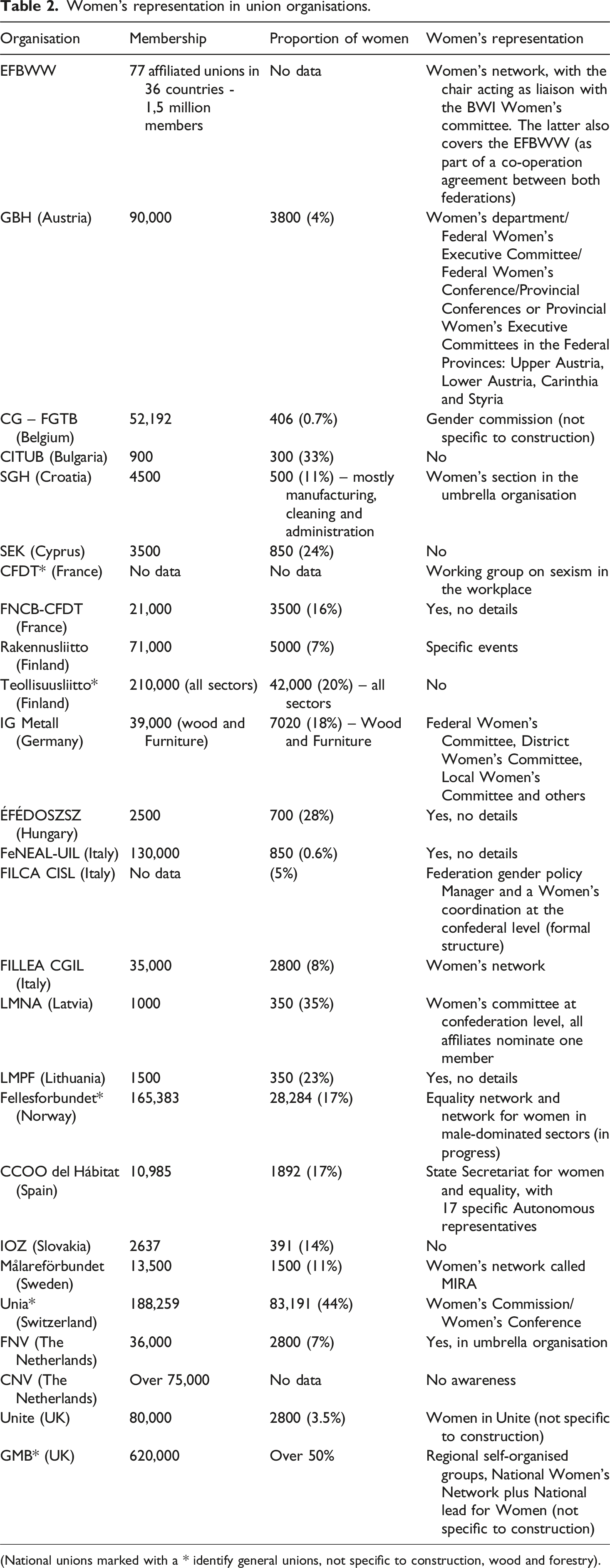
(National unions marked with a * identify general unions, not specific to construction, wood and forestry).
What is omitted from the survey responses
Some survey responses would be expected to refer to the results of activities stemming from women’s representative structures within the unions, but these are not explicitly connected in practice, as apparent from separate accounts given of these activities. This applies, for instance, with regard to surveys of women’s experiences within the industry and awareness campaigns carried out by some of the respondents, including the Finnish Construction Trade Union Rakennusliitto’s survey of women’s experiences of harassment among their members carried out in 2017, and subsequently followed by a campaign called Syrjintä on syvältä (Discrimination sucks) to raise awareness about harassment and help people recognise harassment and respond to it. Since the campaign, this theme has been part of the union’s shop stewards training in the form of discussions.
Similarly, data collected during the additional, post-survey feedback round reveal that between December 2022 and March 2023 the Swiss union, Unia, surveyed around 300 women in the building trades about their day-to-day experiences at work, including on hygiene conditions, work-life balance, discrimination, sexual harassment, and wages. Women from various building trades all over Switzerland discussed the survey results at a meeting in Bern on 22 April 2023, and subsequently organised a women’s strike on 14 June 2023, with thousands gathering in multiple cities across Switzerland (Unia, 2023), calling for hygiene facilities to be available onsite, an end to sexual harassment and violence and better pay for everyone.
Change has also taken place in the EFBWW as an organisation in recent years too. Since 2019, two female members were elected in the seven-person presidium and gender equality has become an integral part of the portfolio of political staff. During their Congress held in 2023, the EFBWW reiterated its commitment to gender equality with the adoption of a resolution on safe workplaces for all, including gender equality as one of the seven priorities of the strategic action plan for 2024–2028 (EFBWW, 2023). At the same Congress, however, the EFBWW women’s network, set up by the Executive Committee in 2010, was renamed ‘EFBWW Gender Network’, ‘in line with a broader focus on gender and diversity’. This is regarded as an ‘ad hoc working group’, not confined to women, meeting at least once a year, and working mainly online. The group ‘may not interfere or substitute the work of EFBWW statutory bodies and existing coordination groups’ and has a mission to bring forward gender issues, exchange affiliates’ experiences of gender policies, develop EFBWW gender policies, and represent EFBWW in the ETUC Gender Committee, as well as liaise with the Building Workers International’s (BWI) European Women’s Committee. In terms of governance, a ‘liaison’ person from one of the affiliates is key to bringing forward issues, building a network and representing EFBWW on the BWI’s European Women’s Committee.
Linking gender imbalances to women’s representative structures
Keeping track of the number of women in particular sectors and occupations constitutes an essential step in assessing the effectiveness of initiatives designed to address gender imbalances and segregation in male-dominated industries and in tailoring solutions to these sectors and occupations. The analysis of women’s participation in the construction, wood and forestry industries presented already highlights the need for more precise data broken down per country, occupation and sector, including longitudinal data on the transition from education to employment and retention. The findings confirm this need and further emphasise the challenges associated with varying sectoral definitions across Europe and the acute need for reliable and comparable data. The fact that most respondents keep track of the number of women among their members incidentally indicates the role that union organisations could play in collecting these data, an activity that potentially is or could be added to the portfolio of activities of their women’s representative structures.
A number of the initiatives reported in the findings address the barriers discussed in the literature review, including in relation to flexible working. However, this is clearly insufficient. Even though the comparison with the 2005 survey revealed positive changes, the focus of measures designed to increase the number of women in these industries remains relatively narrow, discussing rules and largely ignoring issues of implementation and monitoring. Thematically, only working conditions and OSH are discussed in the survey responses, noticeably leaving out recruitment, retention and career progression, as well as VET.
In terms of working conditions, findings overwhelmingly focus on family-friendly measures, in particular childcare-related leave and flexible working time arrangements, often originating from national legislation improved upon by collective bargaining. Such initiatives are characteristic of a top-down approach reliant on legal impetus, which constitutes but one way to tackle the low participation of women in the industries concerned (Wright and Conley, 2020). An alternative could be to focus as well on bottom-up initiatives that can enhance women’s agency. Coincidentally, the top-down measures almost exactly mirror existing EU law, which itself has addressed parental leave, part-time work and more recently work-life balance for parents and carers. In this regard, the example of the Swedish painters also demonstrates that the effectiveness and desirability of such measures can be contested on the ground and reflects a concern to combat involuntary part-time work, and its long-term consequences in terms of career opportunities, working conditions, and pay (Maestripieri, 2023).
In terms of OSH, evidence of a gendered perspective in line with global and EU policy advocating for gender mainstreaming (European Commission, 2020) is a new feature of this iteration of the survey. The presence of the classic theme of the protection of pregnancy is unsurprising, as it has been regulated by EU law since 1992. However, mentions of new themes such as separate changing rooms, various measures designed to protect workers against harassment and the provision of adequate work uniforms all signal positive developments, the last two aspects featuring prominently in the literature (Curtis et al., 2018; Wright, 2013, respectively). Interestingly, the few examples of surveys carried out by national unions among women working in the sector often bring up these themes, which illustrates the value of seeking out women workers’ own input and points toward the need for more inclusive and participative methods for research and policy design. Nevertheless, despite positive changes, there are many more ramifications of a gendered approach to OSH referred to in previous studies for which there was no response in the survey. These include the impacts of increased scrutiny (Galea et al., 2018) or slower career progression (Rosa et al., 2017), for instance, on women’s mental health (Curtis et al., 2018; Sang and Powell, 2013: 163) and on pay.
The absence of accounts of measures relating to VET, recruitment, retention and career advancement illustrates the fact that the issue of gender imbalance and segregation is not conceptualised longitudinally along the length of people’s careers, starting from education and training and going beyond simply recruitment. This remains a key aspect of the necessary holistic approach described earlier (Byrne et al., 2005 on VET; Dainty and Lingard, 2006; Fielden et al., 2000) and a means to address inequalities between and within occupations in these industries (French and Strachan, 2015).
It should also be noted that, even though the number of responses remains low and offers only limited variations across sectors and countries, the uniformity of answers and at times the lack of detail, for instance, on initiatives on the ground, are striking and constitute a relevant finding in and of itself. Accessing relevant, potentially illuminating examples of effective initiatives can admittedly be challenging, especially through a broad and top-down survey sent out to national union affiliates, as is evident in the result.
Finally, an important piece of the puzzle in the relevance and effectiveness of measures addressing gender imbalances and segregation is the creation and support of women’s participatory structures. The consistent increase in the number of women’s networks, committees, etc., embedded within national and European unions, is worth noting, although the variety of denominations used suggest a corresponding variety in terms of functioning, scope, sectoral remit, agenda, achievement, etc. The absence of information in this regard demonstrates the need for further research and indicates that surveys administered from the top-down and with a broad focus may not constitute an adequate approach in terms of research design. To analyse the effectiveness of such participatory structures, it is essential to understand them better and especially how they are integrated into unions’ broader structure and social dialogue processes (Wright et al., 2023a), including their formal and informal connections to the European and global women’s participatory structures. These connections represent a necessary piece in the puzzle to understand the degree of influence exercised by organisations such as the EFBWW over its affiliates and the coordinating role it plays on gender-related issues.
Furthermore, although these women’s structures are participative and remain separate from the unions’ main representative decision-making structures, they – perhaps surprisingly – resembleinternational unions’ representative decision-making structures. For example, the EFBWW women’s network is constituted of one representative per country, with just one network member then assuming responsibilities in the ETUC’s and BWI’s women’s committees. This calls into question the extent to which women’s perspectives and interests are adequately represented in such decision-making bodies. They do, nevertheless, retain important participatory status (Young, 1990), which together with the flexibility afforded by operating outside formal structures, potentially gives them room to become more inclusive and ‘transnational’ in character, understood as engaging with broader set of interests ‘beyond the international’, from members from multinational companies to spokespeople of grassroot initiatives, for example.
Conclusions and recommendations
Reflecting on the very small increase in the number of women present in the construction, wood and forestry industries, the article demonstrates that, even though the situation has improved slightly, the pace of change has been incredibly slow. This is true in quantitative terms, but also in qualitative terms as top-down rules complementing existing legislation continue to dominate solutions. In heavily male-dominated industries such as construction, wood and forestry, the effectiveness of reliance only on a top-down regulatory approach is questionable as rules, industry norms and structures developed over many decades can stand in the way of effective implementation.
The preceding analysis highlights a disconnect between the measures identified by unions as addressing gender-specific issues and the nature and extent of the role played by dedicated women’s representative structures within unions (including within the EFBWW itself). There is a lack of detailed data on the participation of women and of information about women’s participatory structures and the effectiveness of their role. The extent to which unions’ gender-related demands, policies and actions originate from or are shaped by these women’s structures is simply not reported. The authors conclude that this disconnect is linked to women’s low labour market participation and to gender inequalities in the construction, wood and forestry industries. Potential solutions to address challenges are narrowly focused on top-down rules, an approach that needs to be complemented by better integration of women’s input and bottom-up actions.
These conclusions may partly reflect the limitations of the study, in particular the design of the survey questions and the representativeness of the survey responses in terms of countries, sectors and expertise of respondents in relation to gender issues. This shortcoming highlights the importance of co-created research designs involving more inclusive and participatory elements, which would probably yield richer results and serve to triangulate findings of more traditional surveys, as well as provide insights on communication bottlenecks by bringing discrepancies in the data to light. It would additionally further support the role of women as agents of change.
In terms of policy, the range of measures to reduce gender imbalances and segregation need to be broader, expanding the focus to include OSH, working and employment conditions, VET, entry, retention and career progression. In this regard, women’s participatory structures could be capitalised on through better support and integration within the social dialogue process. And more resources are necessary to monitor and evaluate the implementation of relevant equality measures, including through existing women’s representatives and networks, periodic auditing and data gathering, all currently unsatisfactory.
Footnotes
Acknowledgement
The authors express their gratitude to the EFBWW for administering the initial survey and providing resources and assistance throughout the research process. They also wish to acknowledge the role of the Friedrich-Ebert-Stiftung, as financial partner, without whom this project would not have been possible.

Ethical considerations
This study was approved by the University of Westminster Research Ethics Committee, reference number: ETH2324-2230.
Funding
The authors disclosed receipt of the following financial support for the research, authorship, and/or publication of this article: The authors received financial support for the research, authorship, and/or publication of this article from the Friedrich-Ebert-Stiftung, No grant award number.
Declaration of conflicting interests
The authors declared no potential conflicts of interest with respect to the research, authorship, and/or publication of this article.