




Abstract
This special issue looks at the contributions of social dialogue and collective bargaining to creating, maintaining or reducing the risks associated with employment contracts of few hours, such as marginal part-time work, temporary agency work and zero-hour contracts. It additionally considers changes in welfare institutions with regard to the protection of these groups of workers. In this paper, we introduce the arguments on why and how working in marginal part-time jobs involves vulnerability, and on the differential roles collective bargaining and social protection may have on these jobs, depending in particular on which status (employees, workers or self-employed) they are associated to.
Keywords
Introduction
Contracts of few hours such as marginal part-time work (less than 15 weekly working hours), zero-hour contracts and temporary agency work are some of the fastest growing employment forms in both densely and less densely regulated European labour markets. Ample research has explored these employment forms and document the often insecure, unpredictable and fragmented employment situation of these workers across Europe (Beck et al., 2024; Ilsøe et al., 2019; Kalleberg 2011; Rubery et al., 2018; Standing 2011). Research suggests that the recent developments not only in marginal part-time work, zero-hour contracts and temporary agency work, but non-standard work more generally often challenge the foundation of most welfare and labour market institutions (Bosch, 2004; Rubery et al., 2018). However workers that are employed in marginal part-time jobs, zero-hour contracts and temporary agency work often have less coverage and may even be excluded from employment and social protection as the majority of labour market and social protection systems are built around the notion of the standard full-time open-ended contract due to their (Bosch, 2004; Rubery et al., 2018). This can lead to deteriorating employment conditions and the risk of reduced economic growth due to limited labour productivity (Atkinson 2015; Grimshaw et al., 2016; Kalleberg 2011; Spasova and Regazzoni, 2022). The last three decades of welfare retrenchment and labour market reforms that increasingly link social benefits to employment status and collective agreements in distinct welfare settlements may have contributed to the emerging regulatory grey zones within European labour market regulation and social protection (Bekker et al., 2025; Emmenegger et al., 2012; Greve, 2018; Natali et al., 2018; Spasova and Regazzoni, 2022). Some European governments and social partners may also have encouraged contracts of few hours by exempting such employment forms from social security contributions (Germany) or partially excluding them from the employment and social protection (Norway; Denmark) as well as indirectly state subsidising such employment forms (Ireland, the UK) (Larsen and Ilsøe, 2023; MacMahon et al., 2020; Neergaard, 2016; O’Sullivan et al., 2017; Rubery et al., 2018; Schulten and Schulze-Buschoff, 2015). In so doing, the welfare and industrial relations settlements may implicitly shape employers’ recruitment strategies and the adoption of a range of flexible employment contracts.
At the same time, the recent rise in contracts of few hours have triggered political and academic debate, not least during the COVID-19 pandemic, which exposed the various regulatory cracks within the existing labour market and social protection systems. In addition, the broad range of COVID-19 relief packages aiming to protect workers and companies in times of crisis often left non-standard workers, especially temporary agency workers and part-time workers on contracts with limited or no- guaranteed working hours with limited if any protection from the broader regulatory framework in the event of job loss, sickness, etc. (Bekker et al., 2025; Larsen and Ilsøe, 2023; OECD, 2020; Spasova and Regazzoni, 2022). Prior to the COVID-19 pandemic, policymakers and social partners had initiated a series of policy responses and adjustments to social protection and European labour market regulation to strengthen the rights of vulnerable workers at EU level and within member states – a process that has continued both during and after the COVID-19 pandemic. At EU-level, the European Commission launched its Pillar of Social Rights in April 2017 and has since then successfully initiated and adopted a series of new directives to strengthen the social protection and rights of vulnerable workers in the European labour market. These EU initiatives include amongst others the directive on transparent and predictable working conditions (2019), the minimum wage directive (2023) and most recently the platform directive (2024). At national level, national governments, trade unions and employers’ organisations have also developed a plethora of initiatives to improve wage and working conditions of vulnerable workers through legislation, social dialogue and collective agreements, but with important cross-country variations across Europe. For example, Finland, Germany and Ireland have restricted, or even in some instances banned, zero-hour contracts (Jaehrling and Kalina, 2020; Murphy et al., 2019). There are also examples of social partners in Denmark, France, Norway, the Netherlands and the UK utilising their opportunities for collective bargaining and social dialogue to strengthen the social rights of marginal part-time workers, zero-hour contract workers and temporary agency workers, but often with mixed results (Grimshaw et al., 2016; Ilsøe and Larsen, 2021; Keune and Pedaci, 2020).
This special issue offers new insights into how social dialogue and collective bargaining may contribute to create, maintain or reduce the risks often associated with employment contracts of few hours such as marginal part-time work, temporary agency work and zero-hour contracts. It examines not only the role of social dialogue and collective bargaining, but also recent changes in welfare institutions in terms of contributing to, or potential for shifting, the risks of inequality experienced by these groups of workers within the European labour markets. This focus on marginal part-time work has a double rationale: first, these are some of the most vulnerable workers often with limited, if any social protection from the broader regulatory framework and second, their varying status as employees or workers affects the role of social dialogue and collective bargaining, as these primarily cover employees and workers, not, for example, solo self-employed.
The main hypothesis is that social dialogue and collective bargaining are important tools to secure the social rights of marginal part-time workers and temporary agency workers, especially in light of the new European social agenda, welfare retrenchment and recent labour market reforms that increasingly make social protection contingent on employment status and collective agreements in distinct welfare settlements. Central to this special issue are questions such as: What are the main mechanisms triggering the rapid growth in contracts of few hours in some European countries and sectors? How do unions, employers and national governments react to this recent development? Do collective bargaining and social dialogue initiatives represent genuine alternatives to supplement or substitute the emerging gaps or are they primarily contributing to widening the gaps within European social and employment protection? These and related questions offer insights into the dynamics underlying the recent increase in certain forms of non-standard work, including the macro-oriented economic and institutional explanations as well as the workplace mechanisms to explain and document the rise in such employment forms (Biegert, 2014).
This special issue brings together international scholars within the fields of industrial relations, European social policy and sociology from selected European countries. Each has contributed with comparative country studies drawing on original empirical work as well as various strands of theoretical and analytical frameworks. This body of work highlights the distinct dimensions of European labour market regulation and social protection for employees with contracts of few hours in selected European countries.
Before introducing each contribution, we will first outline the recent developments in marginal part-time work, temporary agency work and zero-hour contracts as well as briefly engaging with the main debates within the literature on the role of collective bargaining and social dialogue in regulating social rights for non-standard workers.
Recent developments in temporary work and contracts of few hours
Recent developments in marginal part-time work and temporary agency work as a percentage of all workers aged 15–64 years in selected years and countries.
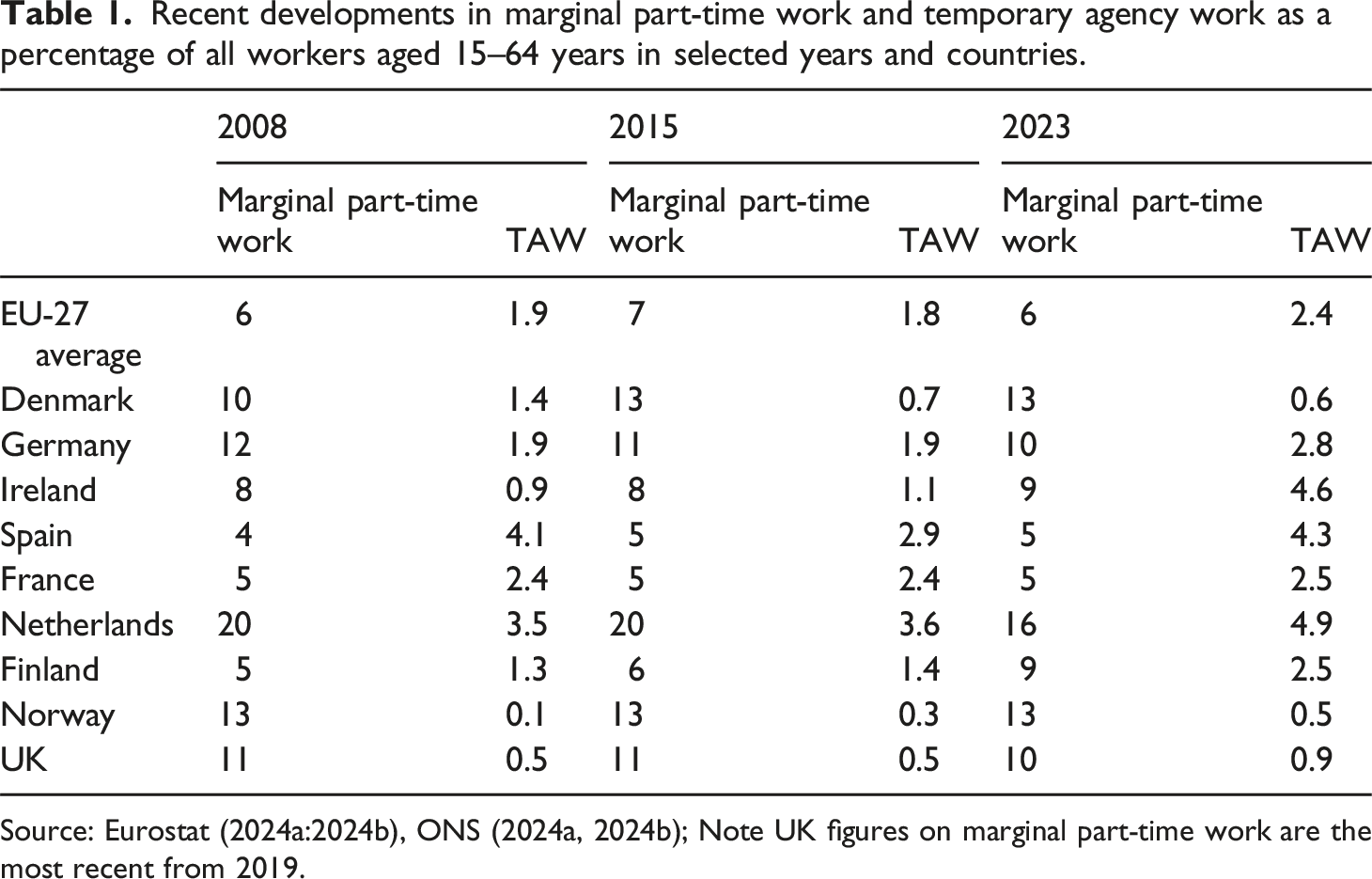
Source: Eurostat (2024a:2024b), ONS (2024a, 2024b); Note UK figures on marginal part-time work are the most recent from 2019.
National statistical accounts suggest that 5% of the workforce in Denmark and Finland are employed on zero-hour contracts compared to 3.5% in the UK (Larsen et al., 2022; ONS, 2024; Statistics Finland, 2019). Zero-hour contracts are particularly widespread within hospitality, entertainment and social care with, for example, up to 32% of all workers within hospitality holding a zero-hour contract in the UK (CIPD 2022; Martin et al., 2024). Marginal part-time work is also widespread in the hospitality sector not only in the UK, but elsewhere, accounting for up to 33% of the workforce within the Danish hospitality sector (Larsen et al., 2022; ONS, 2024). The highest proportions of temporary agency work are found within European manufacturing and construction (3%-EU-average), but with notable cross-country variations. The number of temporary agency workers within the manufacturing and construction sector is nearly three times as high as the EU-average in, for example, Spain (9%) and the Netherlands (8%), while twice as high as the EU-average in Ireland (6%) and France (6%). The German manufacturing and construction sector (3.4%) is somewhat in the middle and Denmark, Norway and the UK is below the EU-average for the sector (Eurostat, 2024b).
Most workers entering zero-hour contracts, marginal part-time work or temporary agency work are women, migrant workers and young people. Their decision to do so is often involuntary, although some also voluntarily accept a temporary job or to work reduced hours or on zero-hour contracts (Eurostat, 2024a, Eurostat, 2024b; Larsen and Ilsøe, 2023; Rasmussen et al., 2019). Recent Eurostat figures reveal that part-time work is an involuntary choice for around 19% of the European workforce, but this is especially true for temporary agency workers, where the share of people involuntarily accepting temporary jobs has increased from 38% in 2002 to 61% in 2023 (EU-27 average, Eurostat, 2024c, 2024d). National accounts of the main reasons for accepting zero-hour contracts indicate that 42% of such workers in Finland and 36% in the UK have voluntarily opted for a zero-hour contract, while the vast majority were unable to find a permanent job or their job opportunities were limited to zero-hour contracts (Martin et al., 2024; ONS, 2024; Statistics Finland, 2019). Although many may voluntarily accept marginal part-time work, temporary agency work or zero-hour contracts, research also documents that many are underemployed, struggle to make ends meet and often hold multiple jobs as a strategy to keep financially afloat (Beck et al., 2024; Larsen et al., 2022; Martin et al., 2024; ONS, 2024a). These statistics demonstrate that the employment practices of European companies are changing and that companies increasingly rely on such employment forms to secure flexibility at the workplace, as it enables them to swiftly adjust their workforce to changing economic cycles (Atkinson, 1987; Rubery et al., 2018).
Collective bargaining and regulating non-standard workers’ social rights
The rapid growth in contracts of few hours has attracted much academic attention in recent years and there is a growing body of literature analysing these trends, including the role of collective bargaining and social dialogue (Doellgast et al., 2018; Grimshaw et al., 2016; Keune and Pedaci, 2019; Rubery et al., 2018). Such accounts often study non-standard work more broadly and typically concentrate on national and sector level social dialogue and collective bargaining and point to important cross-national and inter-sectoral variations in how social partners address non-standard workers’ wage and working conditions (Grumbrell-McCormick, 2011; Keune and Pedaci, 2020; Larsen and Mailand, 2018; Oliver and Morelock, 2020). The various strands of literature suggest that social partner approaches to non-standard work, particularly in the case of trade unions, are often ambivalent and the rapid increase in non-standard work is rarely accompanied by increased institutional support within unions, workplace, collective bargaining and social dialogue institutions (Dorigatti et al., 2023; Grimshaw et al., 2016; Grumbrell-McCormick, 2011; Heery, 2009). Several accounts also seek to explain how and why trade unions and employers represent non-standard workers and seek to regulate their wage and working conditions through social dialogue and collective bargaining (Heery, 2009; Keune and Pedaci, 2019; Lindbeck and Snower, 1986; Meardi et al., 2021). These accounts illustrate that in sectors with higher proportions of non-standard work, social partners are more likely than elsewhere to negotiate non-standard work, but the bargaining results do not necessarily strengthen the protection of non-standard workers (Larsen and Mailand, 2018; Pulignano et al., 2015). Instead, collective bargaining on non-standard work, especially at workplace level, often prioritises protection of permanent staff and prevent downward pressures on wage and working conditions (Barton et al., 2021; Lindbeck and Snower, 1986). Studies in this vein further argue that the institutional context, the bargaining powers of unions and employers’ associations – not least the social dialogue and collective bargaining structures – are instrumental in shaping wage and working conditions of non-standard workers (Bosch and Weinkopf, 2013; García Calavia and Rigby, 2017; Garnero, 2021). However, competing arguments as to the role of collective bargaining and social dialogue characterise the literature.
The segmentation literature often considers high union densities combined with centralised bargaining systems and multi-employer bargaining as instrumental for lifting wage and working conditions of non-standard workers compared to more fragmented and decentralised bargaining systems (Garnero, 2021; Meardi et al., 2021; Polaiveja 2006; Rubery et al., 2005). In contrast, the insider-outsider theory by Linbeck and Snower, (1986) and later developed by Rueda (2007) argue that trade unions and collective bargaining contribute to labour market inequalities as statutory law or collective agreements mainly favour so-called insiders and often prevent certain groups’ access to the primary or core labour market (Linbeck and Snower, 1986; Meardi et al., 2021; Rueda, 2007). The literature on institutional dualism assumes that the institutional setting, such as collective bargaining institutions, can both hinder and contribute to labour market (in)equality since access to social benefits typically depends on various eligibility criteria such as employment status, contract length, working hours and membership (Bosch, 2004; Eamets et al., 2017; Palier and Thelen, 2010). These criteria tend to be developed and negotiated with the standard employment contract in mind, where especially trade unions often decide to protect and favour standard workers, leaving non-standard workers less protected (Bosch, 2004; Emmenegger et al., 2012; Grimshaw et al., 2017; Palier and Thelen, 2010). Concepts such as contractual flexibility or contractual security have been used in different ways within the literature to depict these nuances embedded in different employment contracts (Bernhardt and Krause, 2014; Eamets et al., 2017; Grimshaw et al., 2015; Ilsøe and Larsen, 2023). Contractual flexibility is often understood as the use of contracts deviating from what is considered the traditional standard employment contract (i.e. the full-time open-ended position with 30+ weekly working hours) that differ along three key dimensions: employment status (self-employed/employees), contract duration (temporary/open-ended contract) and guaranteed weekly working hours (Larsen and Ilsøe, 2023). Variations along these dimensions together with the broader institutional framework such as collective bargaining and social dialogue institutions are argued to shape the social rights of non-standard workers (Larsen and Ilsøe, 2023).
To advance our understanding of the role of collective bargaining and social dialogue in regulating and shaping the social rights of marginal part-time workers, temporary agency workers and zero-hour contracts, this special issue brings together contributions from a broad range of international scholars that draw on original empirical work and different analytical frameworks and theoretical inspirations. The contributions demonstrate the varying ways in which contractual flexibility plays out across different institutional settings using marginal part-time work, temporary agency work and zero-hour contracts as illustrative examples of variations along one of the three dimensions of contractual flexibility: ie. weekly working hours.
Contributions
The first article ‘Dualisation and part-time work in France, Germany and the UK: Accounting for within and between country differences in precarious work’, by Jill Rubery, Damian Grimshaw, Philippe Méhaut and Claudia Weinkopf examines the varying levels of protection of part-time work across distinct welfare and industrial relations regimes (France, Germany and the UK) with the main focus on exploring the extent to which social partners – trade unions, employers and legislators – are mitigating or creating labour market dualisation. The authors find marked cross-country and inter-sectoral variations in the scope and forms of part-time work along a proposed spectrum of precariousness. They seek to explain the variations through an analytical framework pointing to layers of social partner responses within the broader framework of welfare and labour market regulation and gender relations. They further call for a more nuanced approach on dualisation that depicts social partners’ initiatives – notably, trade union responses to precarious work that involve their active efforts to protect part-time workers through a dual strategy of supporting legislative means and novel forms of organising.
The second paper ‘Unions and precarious work: How power resources shape diverse strategies and outcomes’ is by Arjan Keizer, Mat Johnson, Trine P. Larsen, Bjarke Refslund and Damien Grimshaw. This paper draws on power resource theory in combination with segmentation literature to explore the ability of trade unions to tackle precarious work. It draws on illustrative company case studies from Denmark, Germany and the UK that each focus on union responses towards temporary agency work within manufacturing. The authors argue that varying dimensions of power resources interact with union strategies towards workers in precarious employment thereby shaping outcomes of both collective representation and labour market conditions. They find that trade unions need multiple forms of power, involving important interactions among and across different levels of power resources. They also find that the interactions between power resources and union strategies – specifically, the presence or absence of power resources across distinct institutional settings, appear pivotal to the strategies that trade unions can develop.
The third article ‘Bringing labour market flexibilization under control? Marginal work and collective regulation in the creative industries in the Netherlands’ by Wike Been and Maarten Keune examines the recent regulatory changes and developments in marginal part-time work vis a vis other forms of non-standard work within the Dutch cultural and creative industries. They apply a mixed-methods approach, combining longitudinal register data (2010–2018) with desk research of all sub-sectoral collective agreements in the Dutch cultural and creative industries covering the period of 2010–2018. They find that although the workforce of the creative sectors is highly educated, precarious employment is widespread and important variations exist as to the processes of flexibilisation and marginalisation between the different subsectors of the creative industries within the Netherlands. They further find examples of collective bargaining responses and innovative approaches that counteract the recent processes of dualisation within the sector. This is notable in areas where social partners align while specific actions tend to be postponed if they disagree.
The fourth paper ‘Permanently marginalized? Securing living hours among part-time workers in hotels and restaurants in Northern Europe’ by Anna Ilsøe, Trine P. Larsen, Lorraine Ryan, Sissel Trygstad, Kirstine Nergaard and Juliette MacMahon, builds on the concept of living hours and examines recent trends in marginal part-time work and social partner responses aiming to secure living hours for marginalised workers within the hospitality sector in Denmark, Ireland and Norway. Through in-depth case studies, the authors find that social partners, notably trade unions, have successfully pushed for new regulations to secure living hours with significant effect in all three countries, but often relying on different regulatory tools depending on the national institutional context. As expected, collective bargaining plays the largest role in Denmark, less so in Norway and is almost absent in Ireland. There appears to be a form of hierarchy of needs amongst social partners: in contexts with strong institutional frameworks, social partners prioritise working time whilst in settings with limited institutional strength the focus shifts to wages and income levels. This shift can lead to further dualisation in the labour market.
The fifth article ‘The varying national agenda in variable hours contract regulation: implications for the labour market regimes’ by Markku Sippola, Paul Jonker-Hoffren and Satu Ojala is a qualitative comparative paper examining the recent regulatory changes of variable hours contracts (zero-hour contracts and on-call contracts) in Finland and the Netherlands. Analytically, they draw on Streeck and Thelen’s (2005) concepts of institutional change and draw on data from legal texts and selected collective agreements covering the Finnish and Dutch retail, security and care sectors from 2012 to 2022. They find marked cross-country variations with respect to the development of statutory laws and the scope of collective agreements on zero-hour contracts and on-call contracts as well as the involvement of social partners in this process. The authors conclude that involving social partners in regulating wage and working conditions is pivotal and leaving labour market issues to legislative processes can rapidly challenge the very foundations of industrial relations models. They find that Finland – often classified as belonging to the Nordic industrial relations regime – is potentially transitioning towards a different industrial relations model.
Footnotes
Acknowledgements
This special issue draws on findings from different EU funded projects that have been accredited within the individual contributions. We would like to thank the commentators that used their time to read and provide feedback on earlier versions of the contributions when they were presented at a Copenhagen workshop in 2021 as well as special sessions at the ILERA conference hosted in Lund in 2021 and at the SASE conference hosted in Amsterdam (2022).
Declaration of conflicting interests
The author(s) declared no potential conflicts of interest with respect to the research, authorship, and/or publication of this article.
Funding
The author(s) received no financial support for the research, authorship, and/or publication of this article.
