




Abstract
This paper investigates the relationship between union organization, workplace representation, the quality of industrial relations and strike incidence, as well as the implications of the matters at stake in localized disputes. Strike incidence is found to be higher in establishments where union density is higher, and where workers are covered by mixed-level collective agreements and in flexible employment. Further, distrust is associated with increased strike incidence, and conversely for employee-focused strategies and heightened employee motivation. These results are robust to controls for possible endogeneity of union density and country (cluster) heterogeneity. In terms of outcomes, higher union density, works councils, profit sharing, and a machine/computer-driven work pace are associated with worker wins, while collective bargaining, firm profitability, and more frequent meetings with management are linked with more balanced agreements.
Keywords
Introduction
Although economic strikes have long been a central topic in industrial relations and labor economics, empirical interest in them has waned with their quantitative decline. The empirical literature has therefore remained dominated by single-country studies with small samples of firms, and by economic models that have been widely criticized for their restricted focus and neglect of behavioral factors (e.g., Godard, 1992).
One aim is to seek to narrow the gap in the literature by paying analytical attention to differences between countries in strike behavior and assessing the possible role of workplace and other institutions in moderating industrial conflict. This is undertaken by analysing the 2019 edition of the European Company Survey (ECS), which allows us to deploy additional explanatory variables and range beyond the standard focus on union organization (Kaufman, 2004; Jansen, 2014).
In the paper, we present in sequence the literature, the dataset, the model, the findings, and the conclusion.
Economic and other models of strikes and worker representation
Strike incidence
In addressing strikes one obvious theme has been worker organization, as a prerequisite of collective action. Organization has traditionally been linked to the presence of unions and the capacity to strike has been held to be increasing in union membership (Kaufman, 1982). Studies focusing on the organizational power of trade unions and strikes have reported that the association between union membership and strike incidence at the workplace may reflect the number of unions and union domination of workplace representation as well as the interplay between organizational resources and country-specific effects (Jansen, 2014; Addison and Teixeira. 2019b). Furthermore, the characteristics of national union systems (such as overall union density, decentralization, and the number of union confederations) may impact the effect of union organization upon strikes at firm level (Jansen, 2014).
There are a number of distinct economic theories of strike activity. 1 We focus here on the Pareto-optimal accident model of Hicks (1963) incorporating asymmetric and imperfect information. Hicks argued that the employer’s tendency to make concessions in wage bargaining and the union’s resistance to offering concessions are, respectively, directly and inversely related to the expected duration of a strike (see also Siebert and Addison, 1981). The key point is that if both parties are equally well informed about the other’s concession curve there will be no strike. The existence of strikes in the model is attributed to asymmetric information and incomplete information and hence miscalculation on the part of either or both sides as to the location and shape of the other’s concession curve, namely, to the difficulty in gathering information about the other side’s intentions.
In addition to the basic prediction of the union organization thesis that strikes should be higher where union density is higher, and the strike intensifying modifications suggested by union domination of workplace representative bodies, and possibly multiunionism, some predictions of the accident model are as follows. First, intervals or firms in which there are cheaper channels of communication should evince lower strike probability. Smaller firms should have a lower strike risk because it is easier for the parties to communicate. Here the contrast is with the greater number of communication links in large firms. Second, periods or firms in which there is less to communicate should exhibit lower strike probability. A case in point would be pay systems that reward workers by time rather than by piece, which place a lower strain on the communications apparatus. Third, an increase in the costs of striking should lead to reduced strike activity, insofar as both parties are affected, because of the inducement to acquire more information in these circumstances. Fourth, firms facing surprising deteriorations in bargaining power should confront a greater strike probability because the habitual allowance made for bargaining mistakes will be too small, while changes in payment systems and faster technical change may be expected to have the same effect.
Whether or not the predictions of this standard economic model are regarded as thin gruel, it is the case that such models have long been criticized for their restricted focus and neglect of behavioral factors. Well-known noneconomic studies explicitly examining the role of institutions and politics include the corporatist models of Korpi and Shalev (1979) and Crouch (1985) and (from a mixed economic-political science perspective) the work of Hibbs (1976). Each to varying degrees may be said to credit social democratic corporatism with holding out the promise of a reduction in strike activity. Even if falling short of providing a tight empirical explanation for strike activity, the strength of these and other such treatments in the sociological, institutional, and (mainstream) political tradition is that they illustrate the diversity of political, institutional, and legal factors that affect industrial relations.
Updated applications in this broader tradition include Hamann et al. (2013) and Jansen et al. (2017). The former study considers the increase in general strikes in 16 western European nations, 1980–2006, and their variation in incidence across countries. Key determinants identified by Hamann et al. are the degree of union inclusion or exclusion from government policy formation in conjunction with the composition of governments and the strength of governments. The latter study examines the extent to which job flexibility and job instability affect the willingness to strike, using Dutch survey data. While both flexible jobs and unstable jobs might be expected to be associated with a reduced propensity on the part of workers to participate in strikes, the key elements identified by Jansen et al. (2017) are interaction effects between these job types and other mobilizing factors such as job dissatisfaction and union membership.
Similar advances have also been recorded in more conventional economic applications such as the moderating effects of financial participation on conflict, which from an agency perspective may be expected to generate more favorable attitudes towards the company among workers with attendant benefits to firm performance. But the impact of financial participation may be contingent on the form that it takes. In examining the financial participation-collective conflict nexus in a large sample of French firms, Fakhfakh and Robinson (2019) find that employee share ownership rather than profit sharing schemes have the greatest effect on reducing, if not eliminating, industrial conflict while also transcending traditional incentive and motivational variables.
Workplace representation
Developments in contract theory and the model of collective voice partly deflect the criticism that economic models ignore behavioral factors. An efficiency case for unions as a commitment device was first advanced by Malcomson (1983) in discussing a situation in which demand shocks in the product market encourage the use of state contingent contracts to allocate risk between risk-averse employers and workers. Given the enforceability problem, the union role is to provide workers with more accurate information about the state of nature, armed with which they can enforce an efficient, state contingent contract by coordinating their actions through the vehicle of the union.
A more popular theoretical construct supportive of unionism is collective voice (Freeman and Medoff, 1984), perhaps the best-known aspect of which is the union role in providing information on worker preferences and sources of discontent. Collective voice may outperform individual voice for a variety of reasons. Substituting average preferences for marginal preferences and arbitraging them may be efficient: any reduction in quits will lower hiring and training costs and increase firm-specific capital. Fewer quits may also occasion less disruption in the functioning of work groups.
Although employer malfeasance can be deterred by a union with credible threat power, the solution necessarily poses its own potential hold-up problem. Subsequent development of the collective voice model has sought to accommodate rent seeking behavior. Freeman and Lazear (1995) argue that although codetermination (specifically, the institution of the works council and its joint governance power at the workplace) is the exemplar of collective voice, it will be underprovided by the market because institutions that give power to workers will affect the distribution as well as the size of the joint surplus. Two features of German works councils commend themselves to Freeman and Lazear in this regard: they cannot strike under a “peace obligation” or formally engage in bargaining over wages and other conditions unless authorized by the relevant industry-level or regional collective bargaining agreement.
The foregoing is arguably suggestive of a more positive role for works councils—via a potential decoupling of the factors that determine the size of the surplus from those that determine its distribution—than for unions or union workplace bodies, and indeed the works council entity has been increasingly credited with having a favorable impact on firm economic performance in German research (e.g., Mueller and Stegmeier, 2017; Addison et al., 2017). However, this outcome would seem to depend on a variety of moderating factors (e.g., sectoral collective bargaining). Moreover, cross-country research suggests that a distinction between types of works councils may also prove instructive (Addison and Teixeira, 2019a).
Finally, by way of qualification, Pohler and Luchak (2015) argue that the insights of the collective voice model are limited by its failure to recognize that both faces of unionism are rooted in the strength of the union itself, on which basis it is argued that union impact must be subject to the moderating effect of some third factor. Arguing that the stronger is a union the greater its ability to deliver a solid and consistent message of either competition or cooperation on the part of its membership, Pohler and Luchak propose that a management which signals a clear intention to cooperate meaningfully via an employee-focused business strategy, as indexed by one-sided or asymmetric investments in employees, will encourage the union to respond in kind to the mutual benefit of both. Using Canadian data, they link a measure of the strength of this intention to cooperate to industrial conflict. The interaction term between union density and this measure is strongly negative. Further, union density is more positively related to workplace conflict when the employee-focused strategy is low than when it is high.
Data
Our data were extracted from the fourth wave of the European Company Survey (ECS), with the two relevant responses—from management (the MM survey) and employee representative (the ER survey)—being supplied in a single file by the Eurofoundation research team. The two component surveys offer a detailed inquiry into a wide array of company/establishment policies and practices across all European Union countries and the United Kingdom, including the type and functioning of employee representation at plant level.
We have in practice three distinct original samples: sample A, made up of establishments with responses from management and the employee representative (1814 observations); sample B, comprising establishments with ER responses only (1246 observations); and sample C, containing establishments with MM responses only (20,063 observations). Our analysis will focus on the merged sample, A, as the key variables described below require information from both respondents. (At the end of this section, we will refer to some sensitivity exercises using samples A, B, and C.)
Management responses were obtained from a human resource manager, where the respondent is typically the most senior person in charge of human resources in the establishment. The ER respondent is a senior member of the leading employee representation present at the establishment. For various reasons, the number of original responses in the ER survey is lower than in the MM survey. Firstly, and most obviously, employee representation is not present in all workplaces. Secondly, it may be the case that management fails (or refuses) to identify the employee representative in question. Finally, the employee representative may fail or refuse to answer the questionnaire due to new rules on data privacy and security under the General Data Protection Regulation (GDPR). 2
The information on the type of workplace representation is based on the ER questionnaire and on a pre-defined grid that classifies employee representation as ERTYPE_A through ERTYPE_H (see Eurofound and Cedefop, 2020, Annex, pp. 151-153). Based on this grid an establishment is then defined as having a formal trade union (works council) body if the respondent—the ER interviewee—is a member of ERTYPE_A or ERTYPE_B (ERTYPE_C or ERTYPE_D). According to this rule, if there is a unique union (works council) representation at the workplace, then the respondent is necessarily from the union (works council); and if the union and works council agencies coexist at the workplace and the employee representative respondent is from former (latter) body, then the union (works council) is adjudged to be more influential and the corresponding status allocated. (Note that interviews are conducted with the employee representative who represents the largest number of employees in the establishment).
From the ER questionnaire, we also extracted information on establishment union density, as well as a variety of aspects related to employee representation, namely, the quality of information provided by and frequency of meetings with management, as described in Appendix Table 1. Observe in this context that in the interest of avoiding an excessive reduction in the estimation sample, we will in practice use only a restricted set of ER-based variables. That said, our key strike incidence variable is also taken from the ER Survey. Specifically, we generate the strike incidence variable based on question #65/actstrike, defined as a 1/0 dummy, taking the value of 1 if there has been a stoppage or strike in the establishment (since the beginning of 2016), 0 otherwise.
The 2019 ECS also contains a quite novel aspect, not contained in the previous surveys, namely, information on types of industrial action. Thus, in question #72/actreason, for the subset of establishments “threatened with industrial action over an issue that was specific to the establishment since the beginning of 2016,” the ER respondents were asked about both the reasons and the corresponding outcomes. For this disputes measure, therefore, the reported episodes of industrial action have the interesting property of being necessarily confined to the establishment. The reasons are grouped into six mutually exclusive categories: wages; planned restructuring resulting in closure of the establishment or staff reductions; pension and retirement rights; occupational health and safety; working time arrangements; and other. The outcomes (or destinations) were, in turn, coded into five mutually exclusive categories (question #73/actout): management (largely) met the demands of the employees; the employees (largely) dropped their demands; a balanced agreement was reached; the action ended or the threat was withdrawn, but the issue remained unresolved; and the action is still ongoing or the threat still stands. Following Campolieti (2021), we treat the fourth and fifth outcomes as a single category to obtain four separate outcomes, labeled a win, a loss, a compromise, and a censored or unresolved case, respectively. For the six reasons and four outcomes, the corresponding variables are coded as 1/0 dummies, as described in Appendix Table 1.
From the MM survey, we also extract the information required for the construction of our employee-focused business strategy variable. Specifically, we use question #57 and the items denoting the extent to which employees directly influenced management decisions on (a) the organization and efficiency of work processes, (b) training and skill development, and (c) working time arrangements, respectively.
Based on these three items, we then relied on the Cronbach alpha command in Stata to generate a three-item composite, an index intended to measure the extent to which management is favorable to enhanced employee influence in decision-making. Using MM survey question #58, an alternative again based on items (a) through (c), this time measuring the influence of employee representation in decision-making, is also provided.
Finally, the quality of industrial relations at the workplace is assessed by both the management and ER respondents. We are interested in the extent to which the two parties deviate in their assessment of the quality of industrial relations to obtain measures of distrust and a strained climate at the workplace. We define distrust as a 1/0 dummy, taking the value of 1 if there is no mutual trust, 0 otherwise. For its part, the strained climate dummy is set equal to 1 if there is no mutual agreement on there being a good climate, 0 otherwise. The former variable is based on questions #58/mantrust (the employee representation trusts management) and #52/ertrus (management trusts the employee representation), extracted from the ER and MM surveys, respectively. The latter variable is based on the relation between management and employees in general using questions #64/manrelat (the representative view) and #63/qwprel (management view), also from the ER and MM surveys, respectively.
Modeling
We use a logistic model to examine the determinants of strike incidence, which (omitting subscript i for establishment) is specified as follows

Beginning with the level of (establishment) union density, and as hypothesized in the previous section, we anticipate a positive relationship with strikes on the grounds that higher density enhances the capacity to strike. We preface our remarks on the role of formal workplace representation by noting that our estimation sample by construction comprises establishments with formal workplace representation. This means that the comparison drawn is necessarily restricted to establishments that have such representation (i.e., works councils and union bodies), and not between establishments with and without representation. Based on their higher consultative and participative stance, underscored by legal restrictions in some jurisdictions, we anticipate that works councils will be associated with a lower strike incidence than union bodies. 4
A second block of conditioning variables comprises profits, presence in export markets, and indicators of market competition. We may conjecture in these cases that increased market pressure might perhaps persuade workers to be more realistic in their demands, while accepting that the effect of the profit situation on strikes is arguably more difficult to predict. For example, the private information (asymmetric information) theory of wage bargaining might lead us to anticipate that a more favorable profit situation would reduce workers’ uncertainty regarding the firm’s willingness to pay higher wages, thereby increasing the relative attractiveness of a strike if not its duration (e.g., Cramton et al., 1999). It is also expected that recent reductions in the workforce and the increasingly common practice of linking pay to productivity might generate heightened worker dissatisfaction and a likely positive correlation with strike incidence. In contrast, policies aimed to encourage greater worker commitment are expected to moderate industrial action. For their part, machine-paced work and the presence of skill mismatches can be considered as aggravating factors. Finally, the subset of labor-management relations contains the distrust and strained climate variables described in the data section. They are taken as proxies for poor quality of industrial relations at the workplace and as such flagging greater uncertainty and higher strike incidence.
Information on profit sharing is also included in the set of control variables, as the presence of such schemes may reduce collective conflict (see Fakhfakh and Robinson, 2019). If, however, profit sharing is instead chiefly regarded as a means of effecting variable pay, the effect may be the opposite as greater tension may be the likely outcome. In this particular context, the content of information provided to workers by management turns out to be crucial, and for this reason the quality of information as perceived by the employee representative is also included in the set of regressors. Finally, a higher proportion of flexible contracts may enhance conflict given the difficulties associated with fixed contract renewals (e.g., Cramton et al., 1999). Whether this effect offsets a lower, in principle, willingness to participate in a strike among those workers without an open-ended contract worker than their counterparts with permanent contracts remains an empirical matter (see Jansen et al., 2017, reviewed earlier).
We also control for industry affiliation, establishment size, establishment age, and whether an establishment belongs to a single or a multiple establishment entity, among other establishment-level characteristics, whose definitions are fully provided in Appendix Table 1. In particular, industry dummies are intended to capture any sectoral imbalances in collective conflict, while establishment size may flag scale effects (with workers in large firms being relatively more effective in imposing strike costs on the employer) as well as effects stemming from more complicated communication channels.
Given the hypothesized role of union density on strike incidence, we also address the possible endogeneity of the argument within the framework of a multivalued treatment effects model. The concern is whether the included regressors in model (1) are correlated both with the level of union density (the treatment) and the outcome indicator (strike incidence). Failure to address this issue may result in biased results.
The multivalued implementation requires the specification of two models: firstly, a model for the (multiple) treatment; and, secondly, a model that explains strike incidence. For the latter, we assume a logistic framework, after model (1). For the treatment equation we assume a multinomial logistic in which we model the four potential treatments—very low union density, low density, medium density, and high union density—in a similar implementation as described for model (2) below. The selected observables are the same as in model (1), with the restriction that the country clusters and the collective agreements variables are only included in the treatment model. In other words, we assume that national idiosyncrasies are expected to be mostly reflected in trade union density heterogeneity rather than strike incidence. In practice, we use the teffect aipw command in Stata as described in Cattaneo et al. (2013).
Finally, given that the ER respondents are also asked in the 2019 ECS to offer an assessment of the last instance of industrial action or threat of industrial action over an issue specific to the establishment, we specify a multinomial model in which the different strike outcomes are explained using a common set of explanatory variables. As was described above, we aggregate the raw five separate outcomes into four to yield (again omitting subscript i for establishment)

We expect union density to be positively associated with the probability of a win, especially at the upper limits of union density. In turn, under the maintained hypothesis that dissonance may be a proxy for uncertainty, and that uncertainty enhances conflict (because in this case workers need to strike in order to learn about actual profitability or the employer concession rate), we expect mutual distrust between management and the employee representation body not to enhance conciliation or compromise. In the same vein, neither an insufficient provision of information to employees nor a low frequency of meetings with management is expected to be correlated with a balanced outcome. In turn, the existence of factors such as recent workforce reductions are unlikely to be associated with a favorable outcome for workers.
Findings
Logit model for strike incidence, marginal effects.
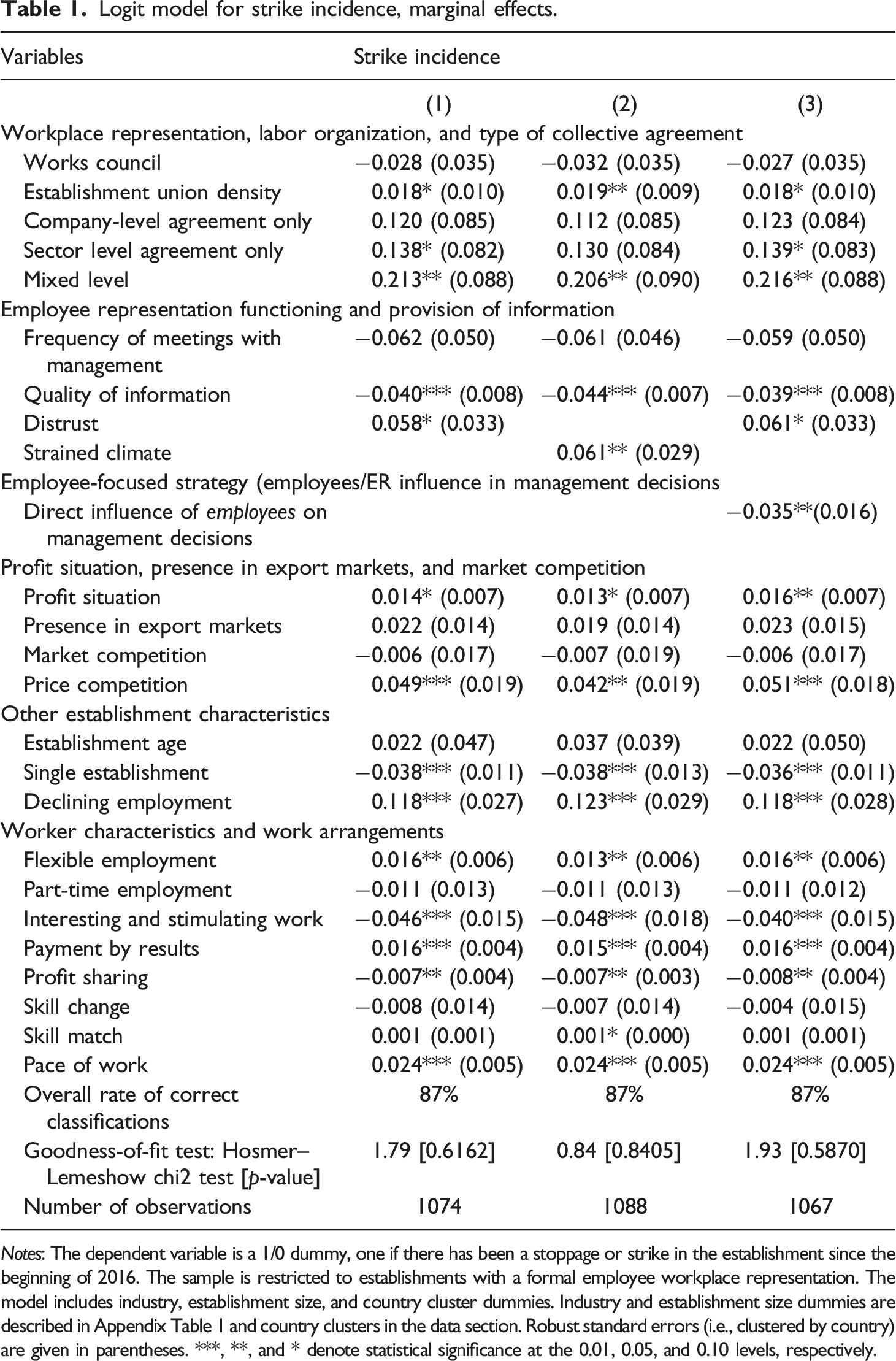
Notes: The dependent variable is a 1/0 dummy, one if there has been a stoppage or strike in the establishment since the beginning of 2016. The sample is restricted to establishments with a formal employee workplace representation. The model includes industry, establishment size, and country cluster dummies. Industry and establishment size dummies are described in Appendix Table 1 and country clusters in the data section. Robust standard errors (i.e., clustered by country) are given in parentheses. ***, **, and * denote statistical significance at the 0.01, 0.05, and 0.10 levels, respectively.
It can be seen from column (1) of the table that both union density and sector or mixed-level bargaining are associated with significantly higher strike incidence, at the 0.05 and 0.10 levels, respectively. Observe that mixed-level bargaining is associated with a 0.21 higher probability of strikes vis-à-vis the situation of no collective agreement (the reference group). In turn, a one-unit change in union density (equivalent to a 20 percentage point increase in union density) is associated with a smaller change in the probability of strikes of approximately 0.02 on average. A stronger (negative) association is reported for the quality of information and stimulating work environment arguments. There is though no obvious distinction between works council and union representation at the establishment level, while the quality of industrial relations climate (as proxied by the distrust variable) is positive and statistically significant at the 0.10 level.
As hypothesized in the modeling section, the marginal effect of the declining employment variable is highly statistically significant and large in magnitude, at 0.118. Highly significant but with a smaller positive marginal effect on strike incidence are the payment-by-results and price competition variables. Also highly significant but of opposite sign are variables denoting a single establishment and the share of workers with a profit sharing scheme. The share of flexible contract workers is positively signed and statistically significant at the 0.05 level, while the share of part-time employment is insignificant.
In sum, the economic model confirms our main hypotheses, regarding the positive implications for lower strike incidence of the quality of information provided to workers by management and worker commitment, and the negative ones of factors that increase uncertainty and/or tensions, such as a higher share of workers participating in performance pay schemes, declining employment, the pace of work, and a profit situation. It is also worthy of note that higher union density and higher share of flexible employment seem to lead to a higher strike incidence. This result is illustrated in Figure 1, where we plot the predicted probability of strikes for establishments with and without a flexible workforce (denoted by flexible = 1 and flexible = 0, respectively) for different levels of establishment union density. Strike incidence, union density, and flexible work. Notes: An establishment with a “flexible” workforce is defined as a 1/0 dummy, 1 if at least 30% of the workforce has a non-permanent (non-OEC) contract. Union density is set to 0, 1, 2, or 3, indicating that union density at establishment level is less than 20%, 20 to 40%, 40 to 60%, or at least 60%, respectively. The vertical bar indicates the 95% confidence interval around the marginal effect point estimate.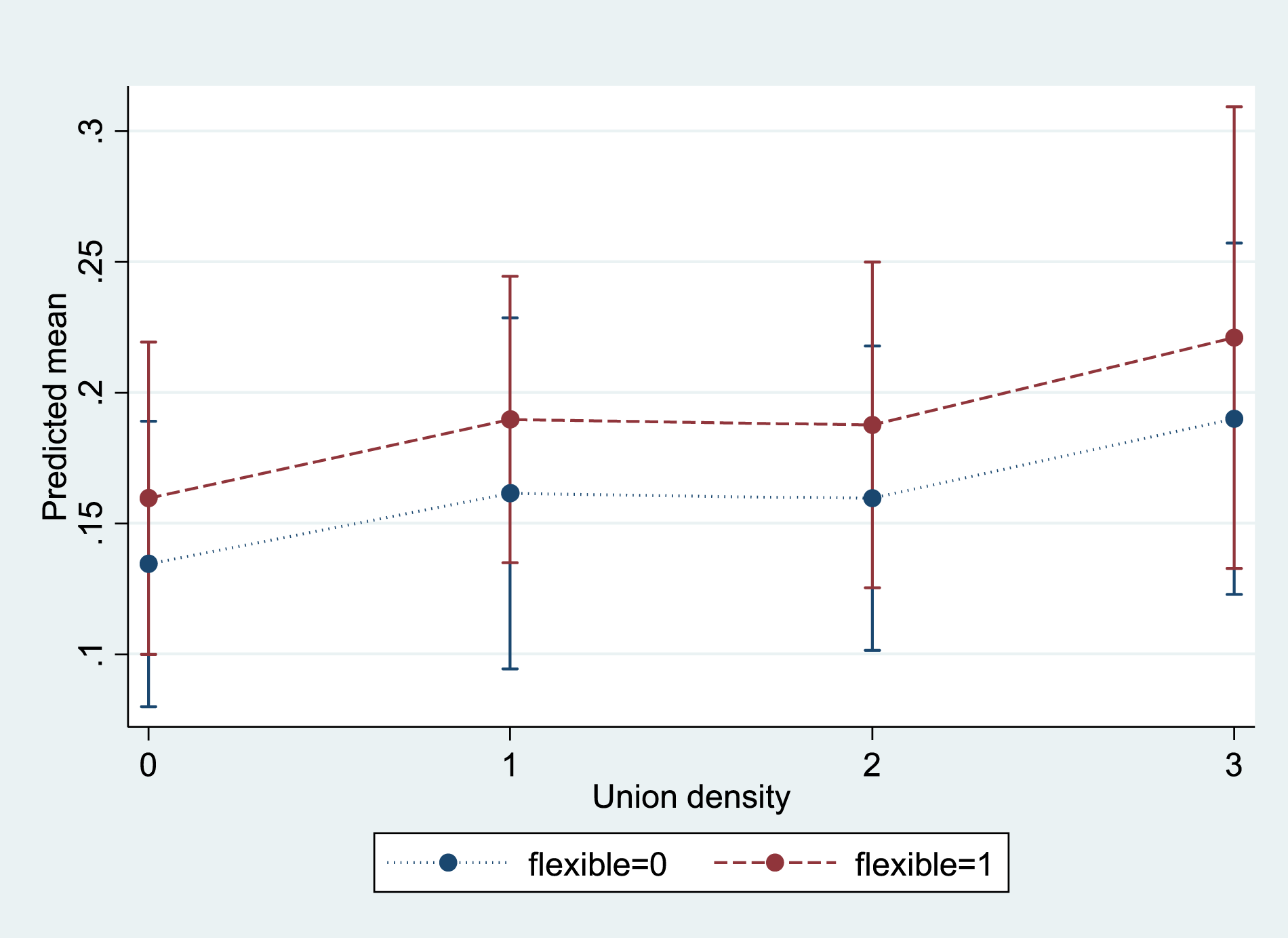
In column (2) of the table, we replace the distrust variable by the alternative strained climate measure. We confirm the result obtained in column (1) for distrust, although this time at the higher significance level of 0.05. Furthermore, our baseline findings are, with one important exception, insensitive to the particular indicator of industrial relations quality chosen. That one exception is the union density argument, which now achieves statistical significance at the 0.05 level.
One of the findings from columns (1) and (2) of Table 1 is that the marginal effects of union density are more significant than the type of workplace representation. We therefore exploit in column (3) the notion that management might be tempted to be more favorable to enhanced employee influence in decision-making to alleviate a conflictual relationship, especially in situations where trade union density is high. We test this hypothesis by introducing the employee-focused strategy variable discussed earlier. The result, in the form of a significantly negative marginal coefficient estimate of -0.035, is supportive of this expectation. According to the underlying hypothesis, we would also anticipate a higher absolute magnitude of the marginal effect to be associated with the highest levels of union density. This association is shown in Appendix Figure 1, where we plot the marginal effect of the employee-focused strategy variable on the probability of a strike across different union density groups. In line with our expectations, there is a downward sloping relationship. 5
As mentioned earlier, country heterogeneity in Table 1 is tackled by introducing, after van den Berg et al. (2013), five country subsets; namely, the Germanic, Scandinavian, French, Anglo-Saxon, and Transition clusters. Taking the French cluster as a default, we found in columns (1) through (3) evidence that strikes are significantly lower in the Germanic and Transition clusters by 13 and 30 percentage points, respectively (both at the 0.01 level). The Scandinavian cluster in turn is not statistically different from the French cluster. (We should also note that the use of an alternative country classification, based on Eurofound (2017), produces virtually the same results.) The suggestion seems therefore that in western Continental Europe, strikes are higher in situations where the prevalent workplace representation body is a union agency.
Finally, the model in Table 1 also controls for two establishment size dummies, flagging medium and large establishments, namely, establishments with 50 to 249 employees and with at least 250 employees, respectively (establishments with 10 to 49 employees constitute the default category). In line with our priors, both size categories have throughout a higher strike incidence of approximately 5 and 11 percentage points, respectively. Again, in the interests of parsimony, these results are not reported in the table, but they are available upon request.
Multivalued treatment effects model of strike incidence.
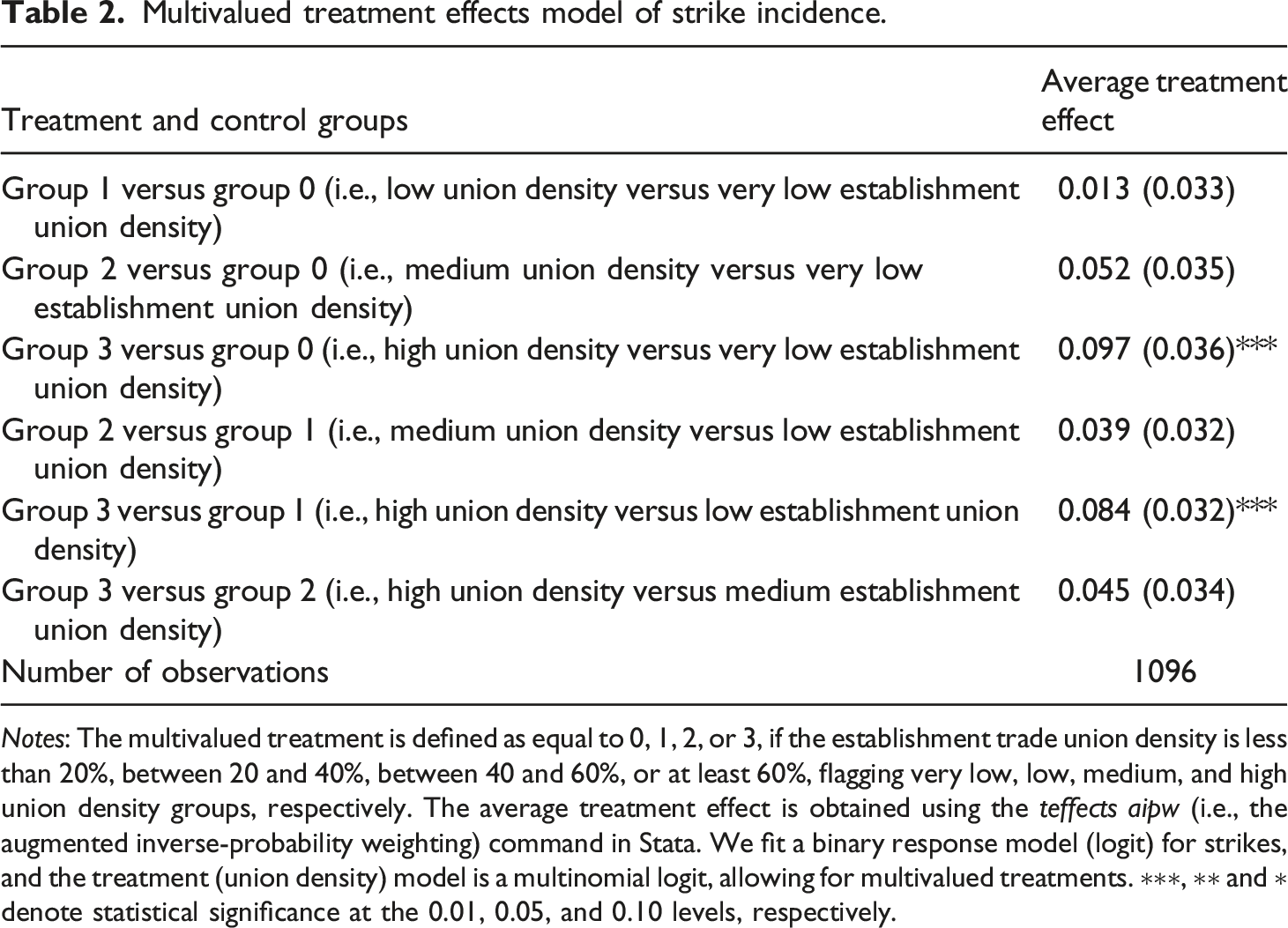
Notes: The multivalued treatment is defined as equal to 0, 1, 2, or 3, if the establishment trade union density is less than 20%, between 20 and 40%, between 40 and 60%, or at least 60%, flagging very low, low, medium, and high union density groups, respectively. The average treatment effect is obtained using the teffects aipw (i.e., the augmented inverse-probability weighting) command in Stata. We fit a binary response model (logit) for strikes, and the treatment (union density) model is a multinomial logit, allowing for multivalued treatments. ∗∗∗, ∗∗ and ∗ denote statistical significance at the 0.01, 0.05, and 0.10 levels, respectively.
As shown in the first row of column (1) of Table 2, there is no evidence of any statistically significant difference in strike incidence between group 1 and group 0; nor between groups 2 and 0, groups 2 and 1, and groups 3 and 2 (in the second, fourth, and last rows, respectively). However, it does matter whether an establishment is in groups 3 and 0 or in groups 3 and 1 (in the third and fifth rows). In these two cases, the average treatment effect is 0.097 and 0.084, respectively, which means that a trade union density of at least 60%, as opposed to less than 20%, is expected to increase the probability of strikes by approximately 10 and 8 percentage points. This is a large (and significant) effect, given that in the estimation sample the mean strike incidence is 17%. 6
The 2019 ECS Survey also offers a unique opportunity to link industrial action outcomes with the issues that are specific to the establishment. Given the set of possible outcomes (i.e., win, loss, compromise, and unresolved), our ability to find key determinants of each outcome rests ultimately on the richness of our dataset, that is, on the variability of establishment and workforce characteristics, type of workplace representation, and the quality of the dialogue between the parties.
Of particular interest is information on the specific reasons underpinning the observed industrial action events. For example, wage issues represent 33% of the total. It transpires that if wages are the reason for the strike, the unadjusted (i.e., not controlling for observables) shares of balanced and unresolved cases are 49% and 28%, respectively. These descriptive data suggest that a balanced settlement is somewhat more likely than an unresolved outcome if the dispute is about wages.
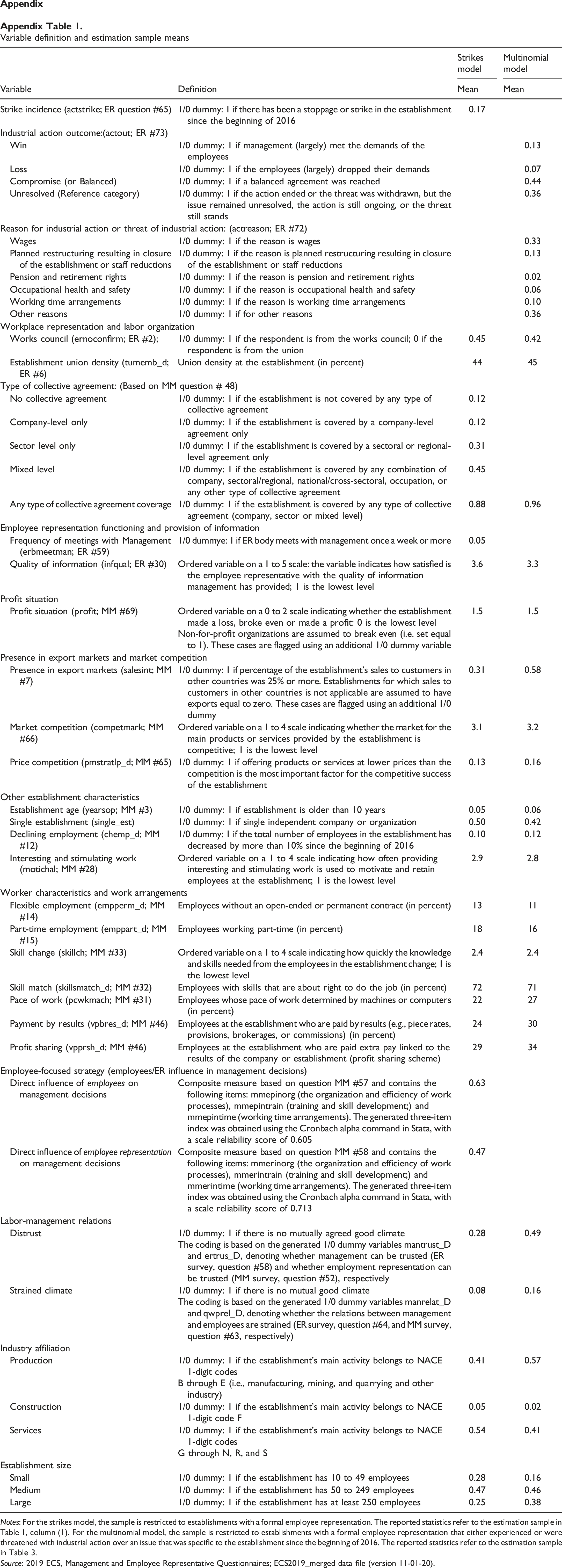
Despite the shrinkage of the estimation sample in our multinomial implementation, vis-à-vis the strike model in Table 1, all industry and establishment size groups are seemingly represented in both cases, while the means of the common included variables are approximately the same, as shown in the third and fourth columns of Appendix Table 1. Exceptions are the presence in export markets variable, indicators of industrial relations quality at the establishment, and the percentage of establishments covered by a collective agreement, the means of which are all are higher in the multinomial case. Not surprisingly, the multinomial sample has a higher percentage of large establishments (38% vs 25%).
Multinomial logit model for industrial action outcomes, marginal effects.
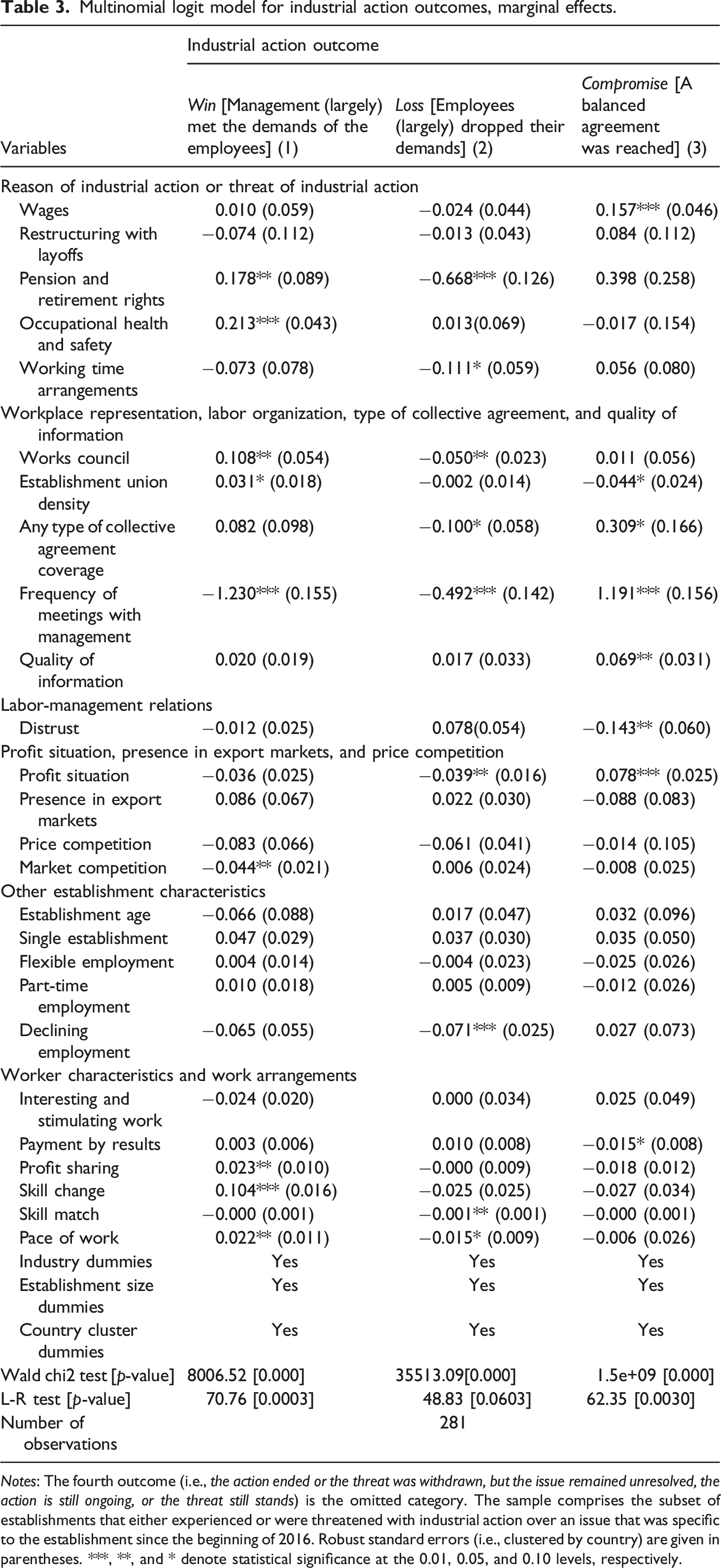
Notes: The fourth outcome (i.e., the action ended or the threat was withdrawn, but the issue remained unresolved, the action is still ongoing, or the threat still stands) is the omitted category. The sample comprises the subset of establishments that either experienced or were threatened with industrial action over an issue that was specific to the establishment since the beginning of 2016. Robust standard errors (i.e., clustered by country) are given in parentheses. ***, **, and * denote statistical significance at the 0.01, 0.05, and 0.10 levels, respectively.
Table 3 reports the marginal effects, computed at the sample means of the regressors. The first panel of the table contains the set of dummies denoting the reasons for the industrial action. For example, wage issues (vis-à-vis other issues, the omitted category) in the first row, increase the average probability of a balanced outcome by 0.157, representing a sizable 37 (=0.157/0.44) percent change. The Wald test at the base of the table comfortably rejects the null that the first term on the reasons of industrial action (i.e., wages) is zero in all three columns of the table. In turn, occupational health and safety issues are associated with a 0.213 higher probability of a win, while working time arrangements and pension and retirement rights are associated with a significantly lower probability of a loss.
In the second panel of the table, collective bargaining presence and the quality of information are each significantly associated with a compromise or balanced outcome. In the case of collective bargaining, it can be seen from column (3) that the marginal effect is quite sizable at 0.309, while the corresponding marginal effect in columns (1) and (2) is either much smaller or insignificant. Cet. par., in the presence of collective agreements, the average probability of compromise strongly increases and, equivalently, the probability of an abortive outcome strongly decreases. The quality of information is associated with a higher probability of a balanced outcome as well, although the magnitude of the relationship is smaller. As expected, the marginal effect of mutual distrust of −0.143, shown in the third column, is significant and sizable, indicating that distrust is strongly negatively associated with compromise. It is also an interesting finding that an increased frequency of meetings with management leads to a significantly higher likelihood of a compromise, while decreasing the likelihood of recording a win or a loss. There is, however, no confirmation that works councils per se are positively associated with a compromise and conciliation. Rather the data suggest that the institution leads to wins and a lower likelihood of a loss.
The role of the trade union density argument can also be examined in detail across the different types of industrial action outcomes. According to the reported marginal effect, a 1-unit rise in union density (approximately a 20 percentage point increase in union density) is associated with a 0.031 increase in the mean probability of a win. Using as an alternative four union density dummies (0, 1, 2, and 3, with 0 denoting the omitted group), we also found that the highest density level (of at least 60%) is most associated with a win. A similar exercise conducted for a balanced outcome shows in turn that the probability of compromise is the highest when union density is the lowest.
Finally, the marginal effects of the subset of regressors shown in the last three panels of Table 3 are often small and statistically insignificant. The relevant exceptions are profit sharing, profitability, market competition, declining employment, and the pace of skill change. The share of workers paid by results is not associated with compromise or balanced agreements, unlike higher profits, which are associated in almost equal measure with reduced worker losses and more compromise solutions. In promoting wins, a changing knowledge and skill base at the establishment clearly seems to favor employees. For its part, declining employment is associated with fewer disputes that result in workers having to drop their demands. Rather than indicating fewer employee losses, however, this latter result most probably reflects reduced uncertainty over bargaining outcomes in bleaker economic circumstances. In turn, greater market competition is unsurprisingly negatively associated with a win.
The outcomes of this multinomial exercise seem solidly associated with institutional aspects, namely, union density, collective bargaining, and the quality of information provided by management. Compromise is a not unlikely outcome in the presence of collective agreements, dialogue, and mutual trust.
Conclusions
Strike incidence was found to be elevated in establishments where union density is higher and where workers are covered by mixed-level collective agreements, but in aggregate there is nothing to suggest that a predominant works council per se significantly moderates strike incidence when compared with its union workplace counterpart. Yet the quality of industrial relations emphatically does matter. Equally, the quality of information supplied to employee representatives, an employee-focused strategy on the part of the firm, profit sharing, and the use of interesting and stimulating work to motivate and retain employees can materially reduce strike incidence. Factors such as declining employment, work pace, and payment by results have the expected positive directional impact on strike incidence. These results are robust to a multivalued treatment effect estimation and to the deployment of country clusters.
Turning to the outcomes of different types of localized strikes/threatened strikes, a distinction was drawn between subjectively assessed (by the worker side) worker “wins,” “losses,” and “compromises” or balanced agreements. Here the default comprised those bargaining situations where the outcome was unresolved.
Issues were found to be related to outcomes; for example, wage matters increase the average probability of a compromise being reached, while pension and retirement rights are clearly associated with a higher probability of a worker win. Among the other determinants of outcomes, mutual distrust and the share of workers on payment by results are associated with movements away from a compromise solution in favor of the default, and conversely in the cases of improved profitability and collective agreements. Both the frequency and quality of information exchange are positively associated with compromise. Finally, higher union density and works councils are associated with employee wins, but no suggestion that works councils per se play a moderating influence in the process of channeling worker concerns, although they do lead to a lower likelihood of losses.
Footnotes
Acknowledgements
The authors are greatly indebted to Gijs van Houten of the European Foundation for the Improvement of Living and Working Conditions (Eurofound) and Giovanni Russo of the European Agency for Vocational Education and Training (Cedefop) for kindly providing them with the ECS2019 merged data file. They are also grateful for the insightful comments from the Editor and the reviewers. Addison wishes to acknowledge research support from the Riegel and Emory HR Research Fellows program at the University of South Carolina. CeBER's research is funded by national funds through the agency of the Fundação para a Ciência e a Tecnologia (Foundation for Science and Technology) I.P., Project UIDB/05037/2020.
Declaration of conflicting interests
The author(s) declared no potential conflicts of interest with respect to the research, authorship, and/or publication of this article.
Funding
The author(s) disclosed receipt of the following financial support for the research, authorship, and/or publicationof this article: CeBER's research is funded by national funds through the agency of the Fundação para a Ciência e a Tecnologia (Foundation for Science and Technology) I.P., Project UIDB/05037/2020.

Notes
Appendix
Marginal effects of the employee-focused strategy by union density level. Notes: The employee-focused strategy variable measures the direct influence of employees on management decisions. Union density is set to 0, 1, 2, or 3, indicating that union density at establishment level is less than 20%, 20 to 40%, 40 to 60%, or at least 60%, respectively. The vertical bar indicates the 95% confidence interval around the marginal effect point estimate. Variable definition and estimation sample means Notes: For the strikes model, the sample is restricted to establishments with a formal employee representation. The reported statistics refer to the estimation sample in Table 1, column (1). For the multinomial model, the sample is restricted to establishments with a formal employee representation that either experienced or were threatened with industrial action over an issue that was specific to the establishment since the beginning of 2016. The reported statistics refer to the estimation sample in Table 3. Source: 2019 ECS, Management and Employee Representative Questionnaires; ECS2019_merged data file (version 11-01-20).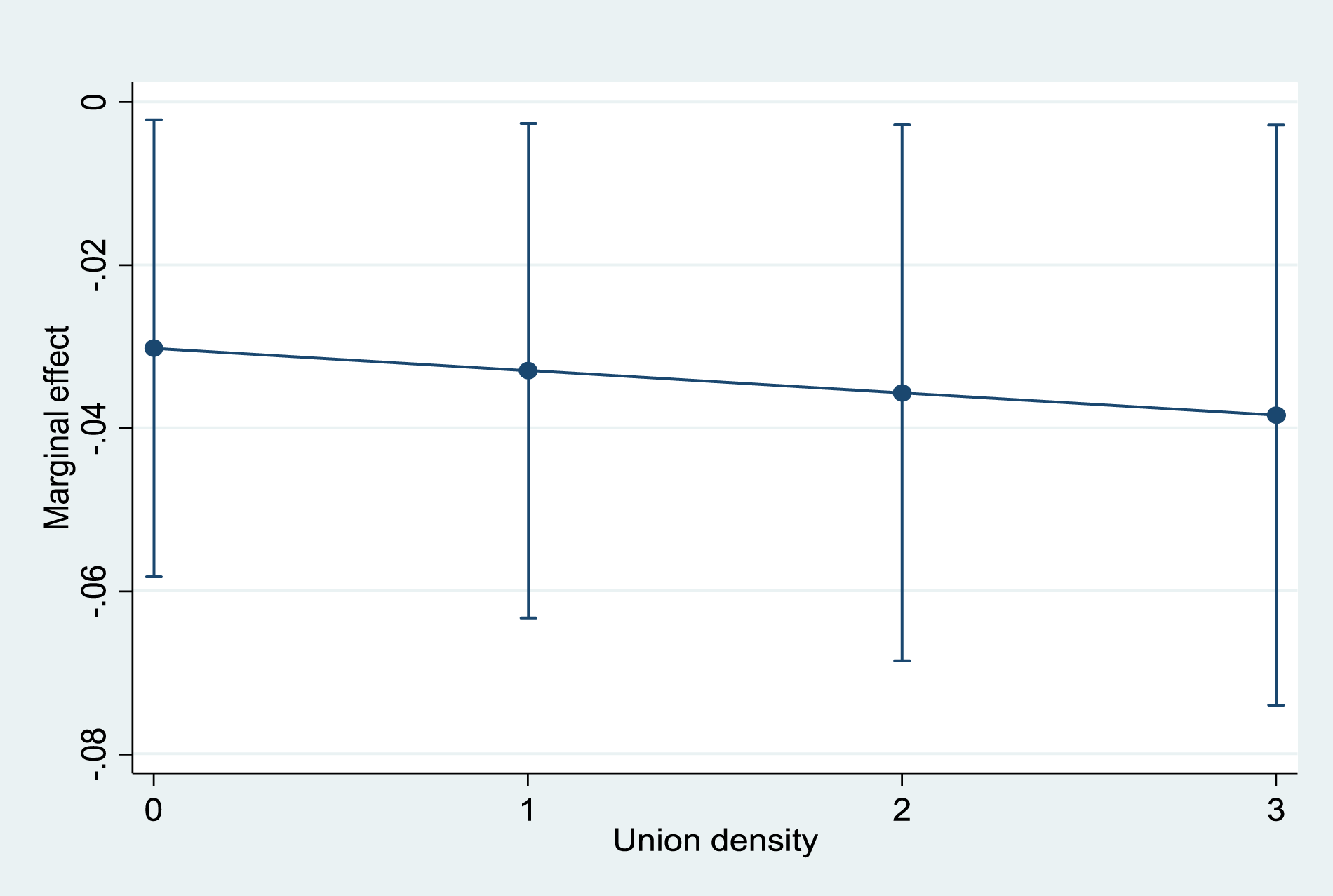
Variable
Definition
Strikes model
Multinomial model
Mean
Mean
Strike incidence (actstrike; ER question #65)
1/0 dummy: 1 if there has been a stoppage or strike in the establishment since the beginning of 2016
0.17
Industrial action outcome:(actout; ER #73)
Win
1/0 dummy: 1 if management (largely) met the demands of the employees
0.13
Loss
1/0 dummy: 1 if the employees (largely) dropped their demands
0.07
Compromise (or Balanced)
1/0 dummy: 1 if a balanced agreement was reached
0.44
Unresolved (Reference category)
1/0 dummy: 1 if the action ended or the threat was withdrawn, but the issue remained unresolved, the action is still ongoing, or the threat still stands
0.36
Reason for industrial action or threat of industrial action: (actreason; ER #72)
Wages
1/0 dummy: 1 if the reason is wages
0.33
Planned restructuring resulting in closure of the establishment or staff reductions
1/0 dummy: 1 if the reason is planned restructuring resulting in closure of the establishment or staff reductions
0.13
Pension and retirement rights
1/0 dummy: 1 if the reason is pension and retirement rights
0.02
Occupational health and safety
1/0 dummy: 1 if the reason is occupational health and safety
0.06
Working time arrangements
1/0 dummy: 1 if the reason is working time arrangements
0.10
Other reasons
1/0 dummy: 1 if for other reasons
0.36
Workplace representation and labor organization
Works council (ernoconfirm; ER #2);
1/0 dummy: 1 if the respondent is from the works council; 0 if the respondent is from the union
0.45
0.42
Establishment union density (tumemb_d; ER #6)
Union density at the establishment (in percent)
44
45
Type of collective agreement: (Based on MM question # 48)
No collective agreement
1/0 dummy: 1 if the establishment is not covered by any type of collective agreement
0.12
Company-level only
1/0 dummy: 1 if the establishment is covered by a company-level agreement only
0.12
Sector level only
1/0 dummy: 1 if the establishment is covered by a sectoral or regional-level agreement only
0.31
Mixed level
1/0 dummy: 1 if the establishment is covered by any combination of company, sectoral/regional, national/cross-sectoral, occupation, or any other type of collective agreement
0.45
Any type of collective agreement coverage
1/0 dummy: 1 if the establishment is covered by any type of collective agreement (company, sector or mixed level)
0.88
0.96
Employee representation functioning and provision of information
Frequency of meetings with Management (erbmeetman; ER #59)
1/0 dummye: 1 if ER body meets with management once a week or more
0.05
Quality of information (infqual; ER #30)
Ordered variable on a 1 to 5 scale: the variable indicates how satisfied is the employee representative with the quality of information management has provided; 1 is the lowest level
3.6
3.3
Profit situation
Profit situation (profit; MM #69)
Ordered variable on a 0 to 2 scale indicating whether the establishment made a loss, broke even or made a profit: 0 is the lowest level
1.5
1.5
Presence in export markets and market competition
Presence in export markets (salesint; MM #7)
1/0 dummy: 1 if percentage of the establishment's sales to customers in other countries was 25% or more. Establishments for which sales to customers in other countries is not applicable are assumed to have exports equal to zero. These cases are flagged using an additional 1/0 dummy
0.31
0.58
Market competition (competmark; MM #66)
Ordered variable on a 1 to 4 scale indicating whether the market for the main products or services provided by the establishment is competitive; 1 is the lowest level
3.1
3.2
Price competition (pmstratlp_d; MM #65)
1/0 dummy: 1 if offering products or services at lower prices than the competition is the most important factor for the competitive success of the establishment
0.13
0.16
Other establishment characteristics
Establishment age (yearsop; MM #3)
1/0 dummy: 1 if establishment is older than 10 years
0.05
0.06
Single establishment (single_est)
1/0 dummy: 1 if single independent company or organization
0.50
0.42
Declining employment (chemp_d; MM #12)
1/0 dummy: 1 if the total number of employees in the establishment has decreased by more than 10% since the beginning of 2016
0.10
0.12
Interesting and stimulating work (motichal; MM #28)
Ordered variable on a 1 to 4 scale indicating how often providing interesting and stimulating work is used to motivate and retain employees at the establishment; 1 is the lowest level
2.9
2.8
Worker characteristics and work arrangements
Flexible employment (empperm_d; MM #14)
Employees without an open-ended or permanent contract (in percent)
13
11
Part-time employment (emppart_d; MM #15)
Employees working part-time (in percent)
18
16
Skill change (skillch; MM #33)
Ordered variable on a 1 to 4 scale indicating how quickly the knowledge and skills needed from the employees in the establishment change; 1 is the lowest level
2.4
2.4
Skill match (skillsmatch_d; MM #32)
Employees with skills that are about right to do the job (in percent)
72
71
Pace of work (pcwkmach; MM #31)
Employees whose pace of work determined by machines or computers (in percent)
22
27
Payment by results (vpbres_d; MM #46)
Employees at the establishment who are paid by results (e.g., piece rates, provisions, brokerages, or commissions) (in percent)
24
30
Profit sharing (vpprsh_d; MM #46)
Employees at the establishment who are paid extra pay linked to the results of the company or establishment (profit sharing scheme)
29
34
Employee-focused strategy (employees/ER influence in management decisions)
Direct influence of employees on management decisions
Composite measure based on question MM #57 and contains the following items: mmepinorg (the organization and efficiency of work processes), mmepintrain (training and skill development;) and mmepintime (working time arrangements). The generated three-item index was obtained using the Cronbach alpha command in Stata, with a scale reliability score of 0.605
0.63
Direct influence of employee representation on management decisions
Composite measure based on question MM #58 and contains the following items: mmerinorg (the organization and efficiency of work processes), mmerintrain (training and skill development;) and mmerintime (working time arrangements). The generated three-item index was obtained using the Cronbach alpha command in Stata, with a scale reliability score of 0.713
0.47
Labor-management relations
Distrust
1/0 dummy: 1 if there is no mutually agreed good climate
0.28
0.49
Strained climate
1/0 dummy: 1 if there is no mutual good climate
0.08
0.16
Industry affiliation
Production
1/0 dummy: 1 if the establishment’s main activity belongs to NACE 1-digit codes
0.41
0.57
Construction
1/0 dummy: 1 if the establishment’s main activity belongs to NACE 1-digit code F
0.05
0.02
Services
1/0 dummy: 1 if the establishment’s main activity belongs to NACE 1-digit codes
0.54
0.41
Establishment size
Small
1/0 dummy: 1 if the establishment has 10 to 49 employees
0.28
0.16
Medium
1/0 dummy: 1 if the establishment has 50 to 249 employees
0.47
0.46
Large
1/0 dummy: 1 if the establishment has at least 250 employees
0.25
0.38