




Abstract
In the article, the regulatory trajectories of variable hours contracts (VHCs, denoting on-call contracts, and zero-hours contracts) are analysed in two countries, the Netherlands and Finland. The unity or disunity in social partners’ readiness for bringing the issue of VHCs to the agenda of collective bargaining has implications for the labour market regimes. From the institutional change perspective, the shared agenda in regulating the VHCs implies conversion of the labour market regime in the Netherlands. In Finland, layering was seen in the development of labour legislation, whereas the disregard of VHCs in collective bargaining implies drift. In Finland, the ‘legislative route’ of regulating conditions of labour may strengthen, undermining the negotiatory autonomy of social partners, earlier embedded in the structure of the Nordic labour market regime.
Introduction
This article contributes to the literature on the regulation of precarious, contingent arrangements of labour. We investigate the legislative and collective bargaining processes related to variable hours contracting in the Netherlands and Finland, over time. The extent to which such contracts are used in these two countries is still relatively small, while labour market parties in both countries have become aware of their potential harmful effects. In both Finland and the Netherlands, the trade unions have been conscious of the risks of the potential exploitation of labour in the face of variable hours contracts, but only in the Dutch case, also employers realised the harmful effects which could flow from the uncontrolled spread of this new contract type. We approached the regulation of these types of contracts as a reaction to feedback from the labour market and its institutions (labour unions, employers’ federations, and tri-/bi-partite deliberation bodies).
We adopt the term variable hours contracts (VHCs) instead of a widely used, but narrower concept of zero-hours contracts, the latter denoting employment contracts with no minimum number of working hours. In both countries, VHCs are contracts without a defined number of working hours. In the Netherlands, there are complementary arrangements, that is, the so-called ‘on-call agreements’, including ‘min-max contracts’ (which define a range of weekly/monthly working hours) and ‘on-call contracts’ (see Pöykkö, 2019: 47). For on-call contracts, there is a pre-agreement about a permanent contract after three temporary contracts, with certain restrictions (Rijksoverheid, 2021). In Finland, the term ‘zero-hours contracts’ is used colloquially rather than legally; the term ‘variable working hours’ is applied officially. The 2022 amendment of the Employment Contracts Act (Finlex, 2022) sets the condition for variable working hours, stating that VHCs are ‘a working hours arrangement in which the employee’s working hours, as a specified period, vary between a minimum and maximum amount under the employment contract, or a working hours arrangement in which the employee undertakes to perform work for the employer when separately asked to do so’. Employers are not supposed to agree on a lower level of working hours than ‘required by the employer’s labour need’ (Finlex, 2022.) The VHCs approved by the Finnish legislation are close to the Dutch definition of ‘min-max’ contracts, setting the number of working hours under relatively flexible conditions (EPSU, 2013).
Our research questions are as follows: 1. How has the scope for legal regulation and sectoral collective agreements (CAs) developed in the Netherlands and Finland in relation to VHCs in the 2010s, and 2. Do the regulatory trajectories of VHCs in these countries indicate ‘displacement, ‘layering’, ‘drift’, ‘conversion’ and ‘exhaustion’ of the labour market regime? In the following section, we introduce our research approach, after which we describe the countries’ labour regimes and institutional frameworks. Then, we introduce the data and method. After that, we analyse the regulatory development and CAs of the selected sectors, paying attention to the way VHCs became a policy problem in the countries. We also contrast the output of the policy processes of the two countries. Finally, we discuss the findings and draw conclusions.
Research approach
By tracing the labour market actors’ social dialogue about VHCs back in time, our analysis extends previous studies of the nexus between labour market regimes and the regulatory development of VHCs (e.g. Coenen et al., 2018). In general, trade unions can attempt to influence policymakers by organising campaigns to set up online petitions to lobby parliamentarians (Coderre-LaPalme and Greer, 2018: 271). For example, in the UK, the trade union Unite campaigned against exploitative zero-hour contracts by lobbying MPs and sharing personal stories of workers with such contracts (ibid.: 270). In Ireland, unions successfully campaigned for new legislation that manifested itself in the 2018 Employment Act. The Act introduced new ‘banded hours’ provision: workers with low hours became entitled to change their contract if they regularly worked higher than contracted hours (Macmahon et al., 2021: 273). In New Zealand, as a countermovement to radical neoliberal reforms in the 1990s, labour legislation was amended to tackle the impact of flexible work arrangements on precarious work (Campbell, 2019). The amendments did not abolish zero-hour agreements, but they guaranteed minimum working hours. Although inquiries about the legislative development of VHCs in the Netherlands and Finland exist (Eleveld, 2022; Pöykkö, 2019), there is no prior comprehensive analysis of the interplay between legislation and CAs concerning VHCs.
As a starting point of our research, we introduce the study by Streeck and Thelen (2005), which provides a formulated account of the continuities and discontinuities of institutional change (Baccaro and Howell, 2017: 10), being one of the seminal works of historical institutionalism (Capoccia, 2016). In line with this approach, we study the changing preferences of labour market actors undergoing institutional change, contrasting the trajectories of Dutch and Finnish collective agreements and corresponding labour legislation concerning VHCs.
To underline the gradual nature of the transformations of institutions, Streeck and Thelen (2005, 31) enumerate five modes of change, which they define ‘displacement’, ‘layering’, ‘drift’, ‘conversion’ and ‘exhaustion’. Displacement means ‘[s]lowly rising salience of subordinate relative to dominant institutions’, while a new logic of action is cultivated within an existing institutional setting. Layering occurs when ‘[new] elements attached to existing institutions gradually change their status and structure’. Drift denotes ‘[c]hange in institutional outcomes effected by (strategically) neglecting adaptation to changing circumstances’. In conversion, institutions undergo change by ‘[r]edeployment of old institutions to new purposes’. Lastly, exhaustion is simply ‘[g]radual breakdown (withering away) of institutions over time’. Any change is typically characterised by two or more of these modes occurring simultaneously or overlapping one another.
One could read Streeck and Thelen’s operationalisation of institutional change along two dimensions, first, as changes in the social policy or industrial relations practices, and second, as changes in the underlying logics. The interplay between the two dimensions subsequently determines the mode of institutional change. In this study, this interplay is studied within the context of labour market regime, which is constantly re-negotiated and thus subject to institutional change. We regard labour market regime as a social regime and institution, in line with Streeck and Thelen (2005: 12–13). They define regime as ‘…a set of rules stipulating expected behavior and “ruling out” behavior deemed to be undesirable. A regime is legitimate in the sense and to the extent that the expectations it represents are enforced by the society in which it is embedded’. We focus on ‘labour market regimes’, that is, the rules, rule makers and rule takers of labour market institutions of the two countries, contributing to formalising certain type of flexible employment into legislation and CAs.
Both the Netherlands and Finland are coordinated market economies with varying proportions between law and agreement (see Elvander, 2002). Besides scrutinising the policy process and the status of VHCs in labour law, we examine bargaining results manifested in the bipartite CAs in three industries: retail, security, and care. CAs are the outputs of a policy-subsystem in which there are many actors (Schmid et al., 2020). Traditionally, the output of the labour market regime has been in a certain ‘balance’ with the law. We consider the interplay between social dialogue practices and the underlying logics of the regimes as determinants of differentiated institutional change. The chosen industries are among those with the most widespread use of VHCs (see also O’Sullivan et al., 2020).
The labour market regimes of the Netherlands and Finland
Traditionally, the Netherlands has been seen as a representative of the Continental model of industrial relations, in which state regulation plays a central role (Trampusch, 2007). Having faced the challenges of a small, open economy, the Dutch government introduced more flexibility through the labour law in the 1990s (Karsten, 1997). Although Dutch union density is low compared to that in the Nordic countries, standing only at 14% in 2020, there are other similarities such as the autonomous bipartite Labour Foundation ‘STAR’ with strong powers, as well as company works councils, and the high CA coverage, standing at 76% in 2020 (Bevort, 2016; ICTWSS, 2020).
In the Nordic regime, including Finland, the ‘law and agreement’ institutions are traditionally intertwined, and labour market parties conclude CAs in a relatively autonomous manner (Due et al., 2000). In Finland, labour regulation is based on collective negotiations along with legislation. There is no such institutionalised bipartite national body like STAR to carry out social dialogue, although from the late 1960s, comprehensive incomes policy agreements have been negotiated between the government, employers, and centralised employee organisations (Jonker-Hoffrén, 2019). In 2007, the main employers’ confederation announced withdrawing from these centralised tripartite agreements, after which these parties have discussed policies only ‘one at a time’, often without conclusions (Lainá and Sippola, 2023). Meanwhile, trade unions still have strong legitimacy in Finland. In 2020, union density was at 59%, and CA coverage at 88% (ICTWSS, 2020).
The industrial relations systems of the Netherlands and Finland are fairly independent from the normal policy-making sphere. The CAs in these countries have a ‘semi-dispositive’ nature, and they can be used to deviate from the statutory law (Hotvedt et al., 2020: 25). Thus, the CAs provide what Hijzen et al. (2019) call ‘the customization within sectoral agreement’, enabling flexibility relative to statutory law, and diminishing the need for detailed regulation by the state. In line with Trif and Szabó (2022), there are a lot of ‘institutional resources’ embedded in this labour market structure.
VHCs in the Netherlands and Finland
VHCs may be used in a variety of contexts and can coexist with other forms of flexible employment, making them difficult to regulate via legislation or CAs. Thus, there is a significant variety of institutional and legal drivers (Broughton et al., 2016: 27) and responses. Adams and Prassl (2018: 6) regard Finland as allowing VHCs, the Netherlands as allowing but heavily regulating their use and few countries not even allowing them.
Percentages of VHC workers in Finland and the Netherlands.
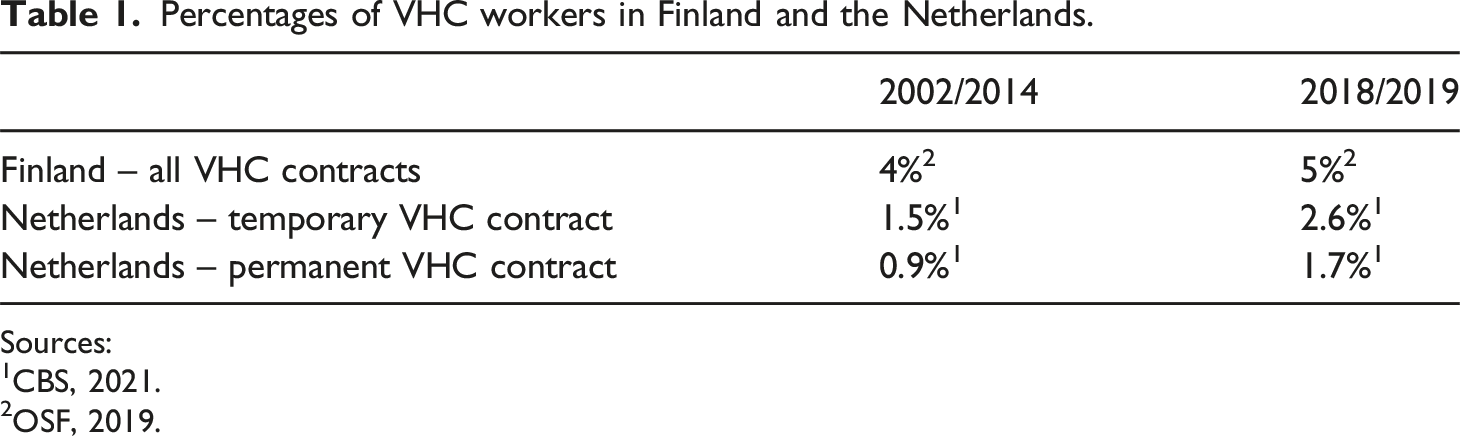
Sources:
Data and method
This article follows the ‘small n, most-similar-case methodology’ resembling what Mclaughlin and Wright (2018) used in their analysis of policy change in different national industrial relations contexts. Analysing a small number of cases over a prolonged period allows for ‘addressing […] key gaps in comparative industrial relations scholarship, such as illuminating the dynamic nature of policy change’ (Mclaughlin and Wright, 2018: 574). Finland and the Netherlands have institutional equivalence (Hall and Soskice, 2001: 39–40; Pöykkö, 2019: 46), which allows for systematic comparison. Both countries are open but coordinated economies with relatively autonomous labour market parties; CA coverage is high; there is a long tradition of tripartite negotiations involving the state in shaping of the labour market regime; finally, both countries have flexible labour markets with rapid implementation of new contract types. We scrutinise the turns of the introduction of a new employment contract type and the social partners’ role in this process.
The data consist of legal texts and CAs selected from the service industries retail, security, and care, in Finland and the Netherlands. The selection of sectors is based on earlier findings. Ndzi (2021) found that VHCs are used in sectors in which there are immediate labour demands and in which flexible contracts are used to adjust working hours, such as retail and health (O’Sullivan et al., 2020), and security sectors (Malander, 2018: 20). For example, at the security sector, working hours are difficult to determine in advance, and there can be a reserve of labour – guards – waiting to be called on in major incidents at short notice (Westregård, 2019: 111).
Collective agreements analysed in Finland and the Netherlands by sector.
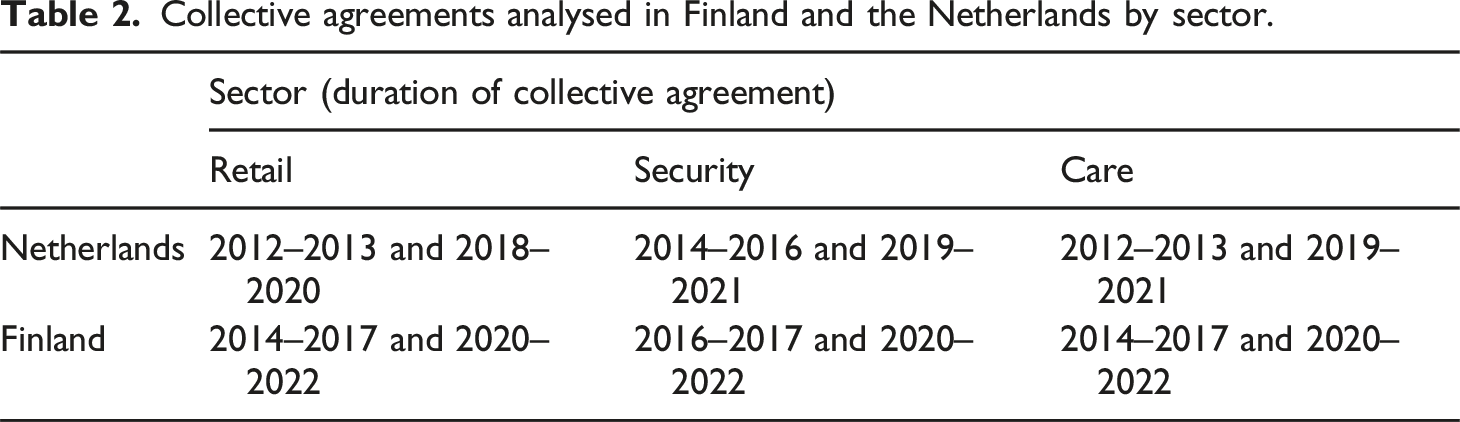
The sector-level CAs under investigation are as follows. First, the Dutch retail CA covers supermarket chains and members of the branch organisation for supermarkets. In turn, the Finnish retail sector agreement working in retail, wholesale, agency operations, kiosks, petrol stations, and machine renting activity, extended to cover employees of the whole sector.
The Dutch CA for the security sector is defined in scope through the membership of employers in the Dutch Association for Security Organisations. This CA has been extended to cover almost all employees in this sector and is valid for firms in the following subsectors: event and restaurant security, professional soccer, and crowd management. The Finnish security sector agreement between Service Union United and service sector employers concerns firms operating a security business, as well as individual workers employed as security officers.
The Dutch CA for care is confined to cover care and elderly homes, as well as home care organisations. The Dutch system of home care encompasses many functions (Plaisier et al., 2017). The Finnish private care CA covers thousands of undertakings of private social services businesses in Finland. The undertakings include kindergartens, mother-and-child homes, women’s shelters, facilities for substance abuse treatment, and shelter homes. The Dutch CAs were accessed through the website of Social Affairs and Employment (CAO Database, 2022), whereas the Finnish CAs were accessed through the websites of social partners.
The legislative documents covered in this study include, first, the Dutch Employment Contract section ‘Book 7, Title 10’ (accessed through the governments’ open resource of current law wetten.nl). The items considered in the Finnish legislation (accessed via the open Finlex.fi database) are the Laws on the Amendments to the Employment Contracts Act (377/2018, 744/2022). These amendments are based on the Employment Contracts Act (26.1.2001/55).
First, the documents were read, and provisions on working time and contract types were flagged. Any provision by the law and CAs that mentioned VHCs or other similar forms of work were examined. Second, the current VHC provisions set forth by law and by CAs were juxtaposed in a manner that allowed for a comparison of the VHC workers’ labour conditions in the two countries. In both countries, CAs play a role as semi-dispositive instruments.
The analysis tackles the interplay between CAs and labour legislation and considers the outcome as a manifestation of ‘change of rules’, which, in turn, has broad implications for the labour market regimes. Next, we present the analysis of this change of regulations (rules) in the context of VHCs. In the discussion, we return to considering the implications for regimes and institutional change.
Analysis
In the following, we present the findings country by country first. After that, we juxtapose the country cases. We start by framing the legal context of the countries as regards flexible employment in the 2010s and then proceed to the analysis of the selected CAs.
Development of the Dutch labour market regime considering VHCs
The Dutch legal regulation defines between the relationship between the civil law, and the CAs. Labour contracts are dealt with by the civil law code (Book 7: Title 10). Before 2015, CAs could deviate from the civil law based on certain exemption provisions regarding sick pay, for example. More recently, there have been regulatory changes, because by the beginning of the 2010s, it was observed that there was too much flexibility and too little security in the labour market.
The Dutch re-regulation of precarious employment, as well as VHCs, began in 2013. The Dutch social partners’ Labour Foundation (i.e. ‘Stichting van de Arbeid’, STAR), declared that the policy choices of the 1996 policy guide ‘Flexibility and Security’ (STAR, 1996) had resulted in unwanted consequences (STAR, 2013). In 2013, STAR called for finding alternative ways to create labour market flexibility and recommended measures to reduce the use of VHCs. These measures were supposed to be actively taken to CAs in sectoral bargaining. After that, the framing of VHCs as problematic types of contracts has consistently been anchored in the expressions of bi-partite, advisory institutions (STAR, 2013; STAR, 2014; SER, 2014; SER, 2016) and in the documentation of sectoral negotiations.
Aiming to restore the balance between flexibility and security, especially regarding income uncertainty in flexible labour (Kamerstukken, 2013), corrections were suggested by STAR. These corrections included the redefinition of VHC workers’ eligibility to sick pay, and were executed through the Law on Work and Security (‘Wet Werk and Zekerheid’, WWZ, 2015). As a result, Van Echtelt and Voogd-Hamelink (2017: 23–24) showed that in some sectors, the number of flexible contracts declined.
Moreover, the remaining problems in civil law after WWZ were again corrected with a further labour market reform in 2020. This ‘Law on the Balanced Labour Market’ (‘Wet Arbeidsmarkt in Balans’, WAB, Rijksoverheid, 2021; Lexology, 2020) focused on restricting the deviations that could be made by CAs to flexible workers’ legal provision (Civil Law, Book 7: Title 10). After WAB, VHCs can only be used if they are related to the intrinsic nature of the work regarding seasonal work. The use of VHCs necessitates agreeing on a deviation to Civil Law in the sectoral CAs. Such legislative trajectory has analogies to New Zealand, in which amendments to the labour law were introduced to guarantee minimum hours of VHCs, counterbalancing the radical labour reforms of the 1990s (Campbell, 2019).
The WAB also included clauses that concerned labour conditions for those having VHCs. The employer got obliged to provide the on-call workers the level of actualised average hours of the past 12 months (Pöykkö, 2019: 44). VHC workers also became entitled to sick pay within 4 weeks after the last employment contract (Pöykkö, 2019: 45).
Next, we analyse the VHC provisions of the Dutch CAs in retail, security, and care sectors, which are among the sectors that most frequently apply VHCs (Coenen et al., 2018). We focus on how the recommendations of the Social Accord of 2013 and the legal changes of 2015 and 2020 have ended up in the CAs.
Retail
The Dutch retail sector agreements discussed here have all been legally extended. The first CA from 2012/2013 listed articles applicable to various non-standard forms of work. However, VHC workers were not eligible for a large proportion of the benefits stipulated in these articles.
Interestingly, the CA for 2018/2019 does not mention VHCs. Thus, the work sites must adhere to the Civil Law described above, only allowing VHCs in case of situations that are incidental, or intrinsic by nature. Otherwise, VHCs are not allowed. Hence, the social partners in this sector have adapted to the renewed limits of VHC use.
Security
The 2012/2013 agreement for event security (part A) addressed the need for flexibility. The VHC workers in this sector signed a so-called ‘pre-agreement’ (‘gig’) contract, allowing ‘delayed performance of work’. These pre-agreements represented a type of ultimate VHC; very little was agreed on, and in fact, it was not an actual employment contract. According to this CA, for each gig the employee performed, a contract with a specific duration would be concluded. The pre-agreement explicitly stated that the normal rules (i.e. continued payment) regarding occupational disability or accidents were void for these ‘gig workers’. Holiday and other bonuses must be paid each time a contract ended. Furthermore, other social provisions regarding, for example, parental leave or other care leave were explicitly not applicable to VHC employees.
The 2019/2021 CA stresses the importance of the CA for competitiveness, both on wages and working time but also regarding the quality of work. The CA uses the option of deviating from the civil law provisions on ‘chained’ contracts, permitting up to six contracts with flexible working hours in 4 years, without the obligation of signing a permanent contract. In line with the renewed law, this deviation is possible because of the intrinsic flexible nature of the work in this sector. Over the years, the quality of work has gained prominence in the CAs and consequently, in the organising of work, but the use of VHCs is still held necessary.
Care for the disabled and elderly
The care sector CAs discussed here are for the periods 2012/2013 and 2018/2019, agreed on by major care sector employer organisations and trade unions. The agreements introduced a fair amount of change to labour conditions. The first CA for 2012/2013 exemplified the freedom to deviate from the civil law provisions regarding VHCs, with an explicit reference to the civil law provision and the related deviation. It however allowed an annual renegotiation of the employment contract based on average weekly working hours. VHC workers must be classified using a particular hourly wage scale based on their experience, skills, and the type of job. Paid holiday leave was available for employees working an average of 36+ hours per week.
The 2018/2019 agreement implemented many improvements to working conditions in the care sector, including elements of work-life balance and quality of work. VHCs remained possible because one of the labour unions opposed their total prohibition (Nursing.nl, 2018; NU’91, 2018). The works councils were given a central role in monitoring and analysing the use of VHCs and other forms of flexible labour. The work rosters and weekly working hours, as well as the organising of work more broadly, must be agreed in consultation with the works council and employees. The right to holidays was based on the hours worked. Comparing the two CAs, not only have the social partners in this sector considered the spirit of the law, they also have strengthened the institution of the works council in doing so.
In conclusion, the three sectors show that provisions enabling VHCs were successfully phased out. Furthermore, they show that in the process of bargaining, the actual organisation of work can be changed, and VHCs are not needed at all in all sectors. In terms of institutional change, the Dutch trajectory resembles conversion, where ‘institutions are not so much amended or allowed to decay as they are redirected to new goals, functions or purposes’ (Streeck and Thelen, 2005: 26). There are also features of displacement, since both the bipartite STAR and the CA parties rather strongly reacted to the need to increase protection of VHC workers by agreeing on needed actions.
Development of the Finnish labour market regime considering VHCs
Notwithstanding the strong labour market institutions, a Finnish (or Nordic) specialty has been the flexible use of contracts, accompanied by a compressed wage structure and generous re-distribution of income. The Finnish labour market can be characterised as being quite flexible and mobile, combined with relatively high insecurity of individual employment relationships (Rasmussen et al., 2019). The possible ‘policy legacy’ behind such flexibility relates to the hegemonic discourse of the ‘competitiveness of the state’, manifested in various ways since the 1990s (Heiskala and Luhtakallio, 2006).
In the 2010s, Finnish trade unions started advocating for stricter regulation of VHCs. The unions regarded the labour legislation as being insufficient for defending the ‘weaker party’ (worker) and advocated for the refusal of concluding VHC agreements (Muurinen, 2015: 2). The unions also proposed setting the minimum number of working hours to correspond with the actualised working hours in such a manner that an unfavourable agreement with an employee would not be possible. According to Muurinen (ibid.), the labour unions proposed legislative measures considering VHCs since they had not been able to secure the position of the worker via CAs. Worth noting, there was a campaign called ‘Operation Permanent Job’, initiated by the youth organisation of the Finnish Metalworkers’ Union, proposing 18-hour minimum agreements to replace zero-hour agreements. The campaign managed to collect 62,110 signatures for a petition addressed to the Finnish Parliament in 2015. Disappointingly, there was only a lame reaction by the Centre-Right government of that time, holding on to business organisations’ opinion.
Because of public debates, in 2018, the Parliament asked for social partners’ opinions on a further regulation of VHCs. Unlike trade union federations and confederations, almost all employer organisations signalled that any increased regulation would be a problem, opposite to the Dutch case. Only some employer associations representing care and services, in which VHCs are widespread, supported the regulation of VHCs.
Although the signals of the social partners were contradictory, the lawmakers indeed introduced new regulation against the wish of the employers’ organisations. The amendments to the Employment Contracts Act, concerning the VHCs, came into effect in June 2018. The amended law sought to restrict employer’s full discretion over the use of on-call labour. In case there was continuous need for labour, agreements on varying working hours could not be made (Finlex, 2018). Further, in the process of the ratification of the EU directive (2019/1152) on transparent and predictable working conditions (see Georgiou, 2022), another amendment to the Employment Contracts Act was made. The actual number of working hours of VHCs must be estimated every 12 months, and the contracted hours must be set to correspond with the real level (Finlex, 2022).
Moreover, the entitlement of VHC workers to health insurance compensation was improved. VHC workers became eligible for sick pay if the period of disablement falls within working hours (i) enumerated in the working roster, (ii) that are otherwise agreed, or (iii) if it is otherwise evident that the employee would have worked during those hours. Moreover, according to the amendments, if an employee with a VHC is dismissed, the salary paid during the term of notice must correspond to the average hours worked in the past 12 weeks (excluding on-call workers without agreed shifts) (Pöykkö, 2019: 50.).
Next, we analyse the Finnish CAs in the retail, security, and private social services sectors. Overall, there are very few references to VHCs in the agreements, probably related to the amendments to the Employment Contracts Act that were ratified between the bargaining rounds. The fact that the Finnish CAs were latecomers compared to the Dutch ones is a noteworthy issue per se.
Retail
The retail sector CAs for 2014/2017 and for 2020/2022 did not recognise VHCs as employment contract types at all. However, some of the conditions stipulated in the latter CA might apply to VHC workers. Based on the 2020/2022 agreement, if no exact number of working hours was specified in the contract, holiday pay was determined by the average (actualised) hours in the previous 12 weeks. Also, when setting up a working roster, the worker must be consulted, and the ‘inappropriate’ use of short hours must be avoided.
Security
The security CA 2016/2017 did not involve any clauses on VHCs, although some statements restricted the benefits of ‘on-call’ or ‘reserve’ employees. For example, the entitlement to sick pay presumed listing of the shifts on a working roster, indicating that not all VHC workers were included. Moreover, ‘reserve’ employees were not paid for being on call for emergency. However, such ‘reserve’ positions were only temporarily allowed, and the contracts were supposed to terminate if there was no work for three subsequent periods (each period lasting 3 weeks). Also, all part-time workers’ actualised working hours were supposed to be checked every 6 months, and notable changes made explicit in the employment contract.
The CA for 2020/2022 again considered ‘on-call’ or ‘reserve’ employees virtually without discussing VHCs. The CA allowed for regular part-time and on-call work. It remains unclear whether the clauses concerning part-time work involved VHC workers; the CA entailed the indication of minimum hours within a 3-week period, allowing fluctuations only above that number. The minimum must be set onto a new level if actual working hours differed from the contract by more than 5 hours. Annual holidays did not concern such part-time workers. Regarding sick pay, only the length of tenure affected the amount paid, not the type of contract. However, ‘reserve’ workers were entitled to sick pay only if shifts were recorded on the working roster; consequently, reserve VHC employees were not covered. Maternity leave presumed payments based on ‘regular working hours’, which again indicated that VHC workers or those in ‘reserve’ were not paid.
Care
The private social services CA has undergone the biggest change among the Finnish CAs under scrutiny. In the CA for 2014/2017, VHCs were not explicitly mentioned, although some clauses could be interpreted as covering VHC workers. As in the retail sector agreement, ‘inappropriately’ short, that is, fewer than four-hour weeks should be avoided.
Besides the provision of sick pay, the CA for private social services for 2020/2022 included clauses for the consolidation of working hours for workers with no minimum hours and on-call workers. If actual working hours exceeded the agreed hours, the CA necessitated setting the contracted hours to the new level, in line with the retail sector agreement. The CA allowed the employer some flexibility in calling on a VHC worker in case of sudden need. Both regular and VHC workers’ shifts must be explicitly listed while preparing the working rosters. To VHC workers, occasional shifts could be added afterwards, if the firm had no part-time workers doing similar work, who must be preferred; this principle is prescribed in the Employment Contracts Act.
In the Finnish case, correcting the shortcomings of VHCs rests on the legislation and not sectoral CAs. Using Streeck and Thelen’s (2005) terms, the case bears resemblance to layering. Even stronger than that, there are signs of drift evidenced in the negligence of VHC issues within the established collective bargaining system.
Juxtaposing the Dutch and Finnish collective agreements and legislation
Comparison of the provisions of Dutch and Finnish collective agreements and legislation concerning VHCs.
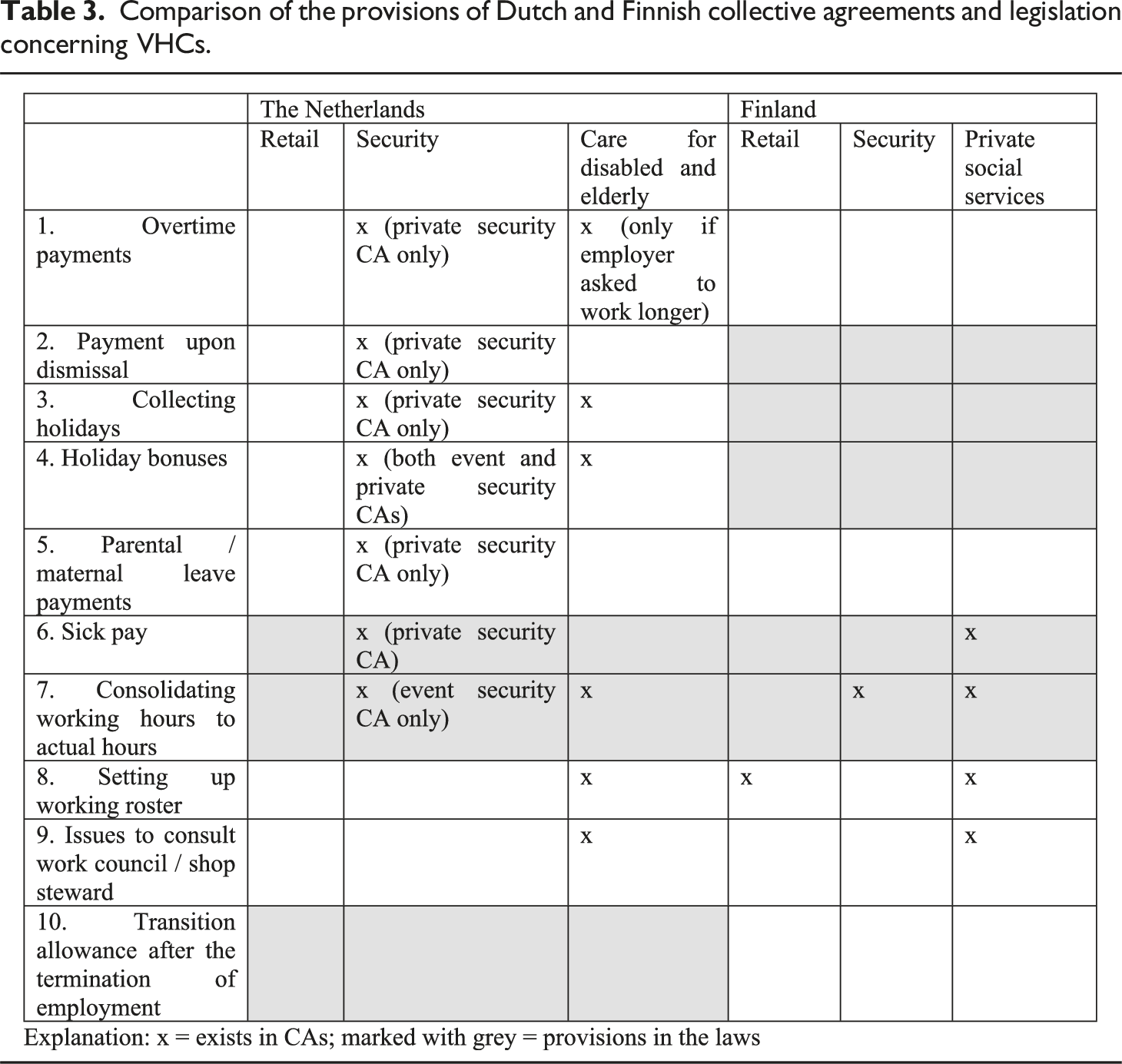
In the Netherlands, overall, there is increased effort to regulate VHCs for single sectors, most clearly seen in the security and care sectors in our study (see also SOVVT, 2018). In retail, the VHCs may become replaced by the new categories of ‘regular’ part-time work. The care sector, however, aims to find a better balance between security, flexibility, and quality of VHC work, assigning the task to the works councils.
The Finnish CAs, instead, resemble one another and share a cautious tone about VHCs. However, between the two bargaining rounds, the Finnish government introduced new legislation on contracts with ‘changing working hours’, even if a mutual understanding was not reached in the tripartite committee work regarding new legislation.
Our analysis was based on comparing the ‘most similar cases’ with sufficient functional equivalence. We systematically compared the national legislation and clauses of CAs of the two countries. Even if the cases were ‘most similar’, the national legislations have different historical trajectories and underlying principles, and CAs may differ in their form and significance as sources of regulation. In the Netherlands, there is an intricate feedback loop between CAs and statutory law, through their institutional embedding, making the Dutch CAs and law mutually complementary. In Finland, by contrast, they are rather supplementary: CAs take precedence over direct statutory regulation (Due et al., 2000).
Conclusion and discussion
Across industrialised countries, we have witnessed impaired labour market regulation and employee protection (Hyman, 2018) to the degree that workers are potentially running the risk of falling into precariousness, characterised by unfair contracts, spells of unemployment, deteriorating working conditions, poor prospects, and low income (Broughton et al., 2016). In this article, we evaluated the regulatory trajectories of VHCs in two countries, Finland and the Netherlands. Meanwhile, several other types of precarious employment are under negotiation in some countries, necessitating new policy responses (i.e. employment policies and regulation that can allow or restrict the uses of manpower). We addressed, how the shifting relationship between labour law and CAs can produce differentiated regulation-based and institutional outcomes in rather similar labour market regimes, depending on the involvement of labour market partners.
There were drastic differences between the Finnish and Dutch cases as regards the development of legal regulation, the scope of sectoral CAs in relation to VHCs, as well as the labour market parties’ contribution to the development. The Dutch labour bargaining process seems dynamic (cf. Adams and Prassl, 2018: 6) compared to Finland. The difference is made by the commitment of the body encompassing social partners, the STAR, to the social dialogue. There was a joint problem structuring as regards the need for rebalancing the labour market and taking steps to reduce excessive flexibility. The legal changes (WAB) targeted at replacing flexible contracts with permanent contracts, while emphasising the quality of work. Consequently, the Dutch institutions have managed to bring the use of VHCs down to a more sustainable level.
Instead in Finland, employers’ views have been emphasised in the sectoral bargaining. These views are based on the hegemonic discourse about the ‘competitive state’ demanding increased employer flexibility; the discourse subsumes labour’s notions of labour security and potential for exploitation. An unfortunate effect of such hegemony has been the sluggish incorporation of precarious workers’ issues into bargaining processes, as the case of VHCs shows. Meanwhile, the locus of CA negotiations has shifted towards local levels, leaving much less space for comprehensive agreements (Lainá and Sippola, 2023). Consequently, labour market parties have increasingly sought influence in unilateral arenas (see Ilsøe, 2017), pushing their policy goals into state legislation independently, without engaging themselves in tripartite or bilateral collaboration.
These developments have differentiated implications for the countries’ labour market regimes. In Streeck and Thelen’s (2005: 31) terms, the countries are undergoing different modes of institutional change, as evidenced by the analysis of VHC regulation. The Dutch VHC trajectory shows signs of displacement, but it appears to be closer to that of conversion, ‘redeploying “old” social dialogue institutions to new purposes’. The new purpose was to diminish the flexibility of the labour market, which was held detrimental to VHC workers. Consequently, some two thirds of the CAs concluded in 2021 considered the use of VHCs, as reported by the Ministry of Social Affairs and Work. These CAs often made references to the law stating that VHCs can only be used in exceptional circumstances (Ministerie van SZW, 2022: 111).
In Finland, layering was seen in the improved labour legislation, whereas the disregard of the VHCs in the collective bargain system implies drift, that is, ‘(strategical) neglect of adaptation to changing circumstances’ (Streeck and Thelen, 2005: 31). Such a reactionary tendency in relation to the contingent forms of labour constitutes a structural bias in the Finnish labour market regime (Bergholm and Sippola, 2022): even if there are active campaigns for part-time workers, zero-hours workers and migrants, improvements of their labour conditions are not actively incorporated into collective agreements.
The Finnish case, where the responsibility for VHC labour conditions is being shifted to (reactive) legislators and individual workers, resembles the Irish liberal labour market regime in which unions are weak. In Ireland, unions can influence labour conditions only in low paid sectors through statutory tripartite committees which themselves are under significant pressure (O’Sullivan et al., 2020). Even if Finland has been part of the Nordic labour market regime, it is increasingly shifting away from that tradition. Thus, Finland is heading towards more ‘liberalised’ labour regime using the term by Streeck and Thelen (2005: 30), allowing increased employer flexibility. Instead, the Netherlands is moving closer to the traditional Nordic regime fostering the security of the worker (i.e. ‘de-commodifying’, ibid., 32).
Our findings highlight the importance of involving labour market partners in the determination of workers’ rights. According to Streeck and Thelen (2005: 18), ‘the practical enactment of an institution is as much part of its reality as its formal structure’. The Dutch case underlines, how the continuation of the institution necessitates pragmatic decisions by social partners. Aiming to control the excessive use of the VHCs, the Dutch STAR agreed on a legislative change. Such commitment of central actors makes the institution ‘sticky’ and resistant to fundamental changes.
In the Finnish case, the VHCs were regulated by legislation in 2018 without a mutual understanding of social partners. Instead, the partners did not perceive marginal employment as their ‘problem’ (Streeck and Thelen, 2005: 19). While relying on the ‘legislative route’ in regulating non-standard employment, the Finnish case also highlights the need for other institutions to stand in when needed. Besides that the left-centrist government enacted restrictions on VHCs based on its government programme in 2022, it received support from EU level. The enforcement of the EU Directive 2019/1152 on Transparent and Predictable Working Conditions provided protection to a larger category of workers (Georgiou, 2022).
Traditionally, the Finnish (Nordic) model of industrial relations has leant on the relative autonomy of social partners to negotiate the conditions of labour. The mutual collaboration has aimed at steering the long-term industrial policy development together. Increasing regulation through legislation undermines the cornerstone of the Nordic industrial relations system: the negotiatory autonomy. The ‘legislative route’ changes the institution from outside. The changing political climate also contests the legitimacy of the existing labour market institution: the industrial relations realm may become contingent upon political junctures, resulting in erratic changes in labour regulations according to which coalition happens to be in power. For example, in June 2023, the new conservative-right government has proposed various legislative changes. The changes are rather hostile to workers’ rights, aiming at limiting workers’ right to strike, trade unions’ representation at workplaces, and even the national conciliator’s authority over CA disputes, as well as weakening redundancy protection and earnings-related unemployment benefit of the labour force. The proposed reforms may seriously affect not only the regime but also the quality of jobs that the unemployed job seekers must accept.
All in all, in the Netherlands, in the 2010s and early 2020s, the interplay between labour legislation, collective bargaining, and bipartite bodies has renewed the labour market institution by showing the ability to shape the conditions of VHC workers. In Finland, we see a derogating role of the issue of VHCs. The neglect of marginal employment issues in CAs has been replaced by legislative route, which remains reactive to the relative strength of political parties. The withdrawal instead of involvement of Finnish employers from the negotiations that earlier guaranteed the continuation of the regime, together with the right-wing government in 2023, even entail a risk of an exhaustive breakdown of the institution (Streeck and Thelen, 2005: 31). We conclude that leaving labour market issues to legislative processes can rapidly challenge the foundations of the regime. Finland, an earlier representative of the Nordic regime, may become another country undergoing a process of ‘severe undermining of national institutions’ under a ‘hostile government’ (see Trif and Szabó, 2022), including weakened employment conditions of precarious workers.
Footnotes
Declaration of conflicting interests
The author(s) declared no potential conflicts of interest with respect to the research, authorship, and/or publication of this article.
Funding
The author(s) received no financial support for the research, authorship, and/or publication of this article.

Appendix
Author biographies
Markku Sippola
Paul Jonker-Hoffrén is labour sociologist with a background in Public Policy and Policy Administration. His research interest includes changes in labour market relations systems, labour conflicts and labour processes. Currently he works in the Horizon2020 ReCreate -project, in which he studies the policy environment and labour processes of circular construction.
Satu Ojala, Assistant Professor in social policy at Tampere University, Finland, has studied precarious employment conditions in various research projects. For example, she participated in the project Future of Work – Opportunities and challenges for the Nordic models, funded by the the Nordic Council of Ministers (2017–2021). In the project, new non-standard forms of employment, such as on-call, zero-hour and marginal part-time contracts, were discussed in the Nordic labour market context.