




Abstract
Denmark and Sweden are small open economies that rely on exports for economic growth. At the same time, these countries have some of the largest public sectors in the world and a high wage equality. With extensive collective bargaining and strong unions in both private and public sectors, coordination of wage setting is crucial for balancing competitiveness and real wage increases. This paper investigates how coordination between public sector and private sector wage setting in the two countries is achieved. Like other studies, we find that agreements in the manufacturing export sector set the pattern for public sector wage bargaining. However, we also find that institutional differences have significant distributive implications for public sector employees. In Denmark, wage increase disparities between the public and private sectors are automatically adjusted according to formalized procedures. In Sweden, no automatic adjustment exists, and coordination is instead based on tightly coordinated bargaining practices by unions and public sector employers. Surprisingly, we find most public sub-sector variation of wage increases in Denmark, whereas wage structures in Sweden have been very stable. We argue that timing of bargaining, level of private sector wage flexibility and politicization of public sector bargaining are key drivers for these distributional differences.
Introduction
Denmark and Sweden are known for being small open economies with large public sectors and high living standards across sectors and occupations. This combination has recently been characterized as a balanced growth model in which both exports and internal demand (private and public) contribute to economic growth. Contrary to export-led growth models like Germany which has starved wages and thus internal demand to increase the cost competitiveness of the export sector (Baccaro and Pontusson, 2016), these countries seem to be able to do both. In this article, we ask how countries with large public sectors sustain competitive exporting companies. We argue that a piece to this puzzle is a tight coordination of wage bargaining in the export sector and the public sector. Only be making sure that public sector wage increases are kept in line with the export sector can the latter remain competitive not only in terms of unit labour costs but also in attracting qualified labour.
However, in the balanced growth model, wages in other sectors are not starved as in the export-led growth model, and this leads us to look at the coordination mechanisms between exposed and public sector bargaining. Studies of collective bargaining coordination usually focus on private sector developments (for exceptions, see Di Carlo, 2018; Johnston, 2016). However, as the public sector becomes increasingly important in the trade union landscape and manufacturing continues to decline, coordination between the two sectors is an ever more important – albeit under-researched – topic (Di Carlo, 2018). We analyse two Nordic countries, Denmark and Sweden, to show that institutional differences in these countries produce different processes and outcomes of public sector bargaining, despite the similarities of these countries.
Coordination between the sectors is by no means automatic or self-evident. In the export sector, international markets force bargaining parties to focus on competitiveness, which has often led to productivity-bargaining coalitions between capital and labour (Ibsen and Stamhus, 1993, Iversen, 1999, Swenson, 1991). Cross-sector wage restraint has been key to avoid negative wage externalities from wage developments in sheltered sectors, like the public sector. Conversely, in the public sector, strong trade unions have historically enjoyed relative high job security and employment expansion due to a growing welfare state. However, in recent decades, New Public Management policies, austerity policies and tax cuts have forced bargaining parties into distributive conflicts (Bach and Bordogna, 2016). For many public sector unions, bargaining coordination has deflated their power resources and locked in wage structures that are unfavourable to their members (Høgedahl, 2019). Given these different bargaining interests and situations, bargaining coordination between export and public sector is highly contested and potentially fragile. During the COVID-19 period, strikes erupted in a number of European countries among care personnel demanding equal pay (Vandaele, 2021). As Szabó (2020) shows, the public sectors have by fare become the hotbed of labour unrest in Europe.
Typically, studies of bargaining coordination explain the strength of coordination of bargaining around wage restraint in two ways. One strand focuses on the bargaining practices or power relations of the bargaining parties. For example, intra-confederate rules and practices may assign privilege to certain employer associations and unions, respectively, or assign veto power to confederations to make sure that a bargaining order is kept (Baccaro and Simoni, 2010, Soskice, 1990, Traxler and Brandl, 2012, Visser, 2016). In a similar vein, scholars have stressed both formal and informal power relations between cross-class coalitions (Iversen, 1999, Ibsen and Thelen, 2017, Swenson, 1991). These scholars identify material reasons why a cross-class coalition in manufacturing should rule other sectors due to the primacy of export companies for growth and employment. Another strand focuses more on political and non-political intervention into bargaining. In the former, we find the social pact literature and how governments try to cajole the bargaining parties into agreements with either positive or negative incentives (Avdagic et al., 2011). In the latter, we find scholars arguing that non-accommodating central banks deter sheltered sector unions from claiming inflationary wage increases beyond productivity increases (Iversen, 1999, Johnston, 2016).
The existing studies, all with great merit, have largely neglected the tension between coordination by formal administrative rules versus coordination by bargaining parties (Stokke, 1998; Ibsen, 2016). While this neglect was warranted in studies without specific focus on the public sector, it becomes problematic given the increasingly important interaction of strong public sector unions, fiscal discipline and the emphasis of export-led growth in most European countries. This paper argues that coordination between private and public sector wage development can be highly formalized and that the ways in which coordination is formalized significantly affect both bargaining processes and outcomes for the public sector. These more formal institutions are particularly relevant in small countries with large public sectors. Thus, like other studies, we find that agreements in the manufacturing export sector set the pattern for public sector wage bargaining. However, we also find that the institutionalization of this pattern-setting is different across the countries and that these differences have clear distributional implications for public sector employees.
In Denmark, wage development disparities between the public and private sectors are automatically adjusted according to a formalized procedure. In Sweden, no automatic adjustment exists, and coordination is based on tightly coordinated bargaining practices by unions and public sector employers. We find that these different systems have both capable of producing wage restraint in the public sector but with different distributional consequences. In Denmark, occupational unions find themselves locked into a set wage structure within the pattern set by the private sector. However, we find some sub-sector differences when different occupational groups fight over distribution of wages. Moreover, higher degrees of workplace bargaining in the private sector mean that manufacturing wages often adapt quicker to economic cycles producing periodical imbalances. In Sweden, occupational unions have also been able to go above the pattern on occasion to remedy low-wage groups from falling behind manufacturing. Sub-sector differences are smaller than in Denmark as each sub-sector follows manufacturing rather tightly. Interestingly, high degrees of workplace bargaining in the Swedish public sector have helped some occupational unions like nurses to get above-pattern wage increases.
The paper proceeds as follows. First, we describe how small open economies with extensive public sectors require coordination between the export sector and public sector wage bargaining. Second, we unpack the concept of bargaining coordination, the sources for coordination and the political and distributional issues arising from cross-sectoral bargaining coordination. Third, we analyse the institutions and wage outcomes of bargaining coordination in Denmark and Sweden. We also show the distributional struggles arising from the coordination focusing mainly on equal pay. Finally, the article ends with a discussion of the future of public sector wage bargaining.
Balanced growth and wage setting in the public sector
The Nordic countries are known as wealthy countries with high incomes per capita, equal distribution of incomes and welfare states with social security and high employment rates, secured through steady economic growth. They are all small open economies, embracing foreign trade and investment on international market terms. Small domestic markets have forced the Nordic countries to create growth, employment and wealth trough expansion into foreign markets. This strategy – export-oriented growth (EOG) – implies that the economies should have been able to export goods and services, where they have a comparative advantage. However, the Nordic countries are a particular type of growth model that has retained high wage levels and strong purchasing power as well as a large public sector (Baccaro and Pontusson, 2016, Ibsen and Knudsen, 2019). In 2020, Sweden (29% of total employment) and Denmark (28%) had the highest shares of those employed in the government sector among the EU Member States, whereas the lowest were found in Germany (11%), the Netherlands (12%), Italy and Luxembourg (both 14%) (Eurostat, 2023).
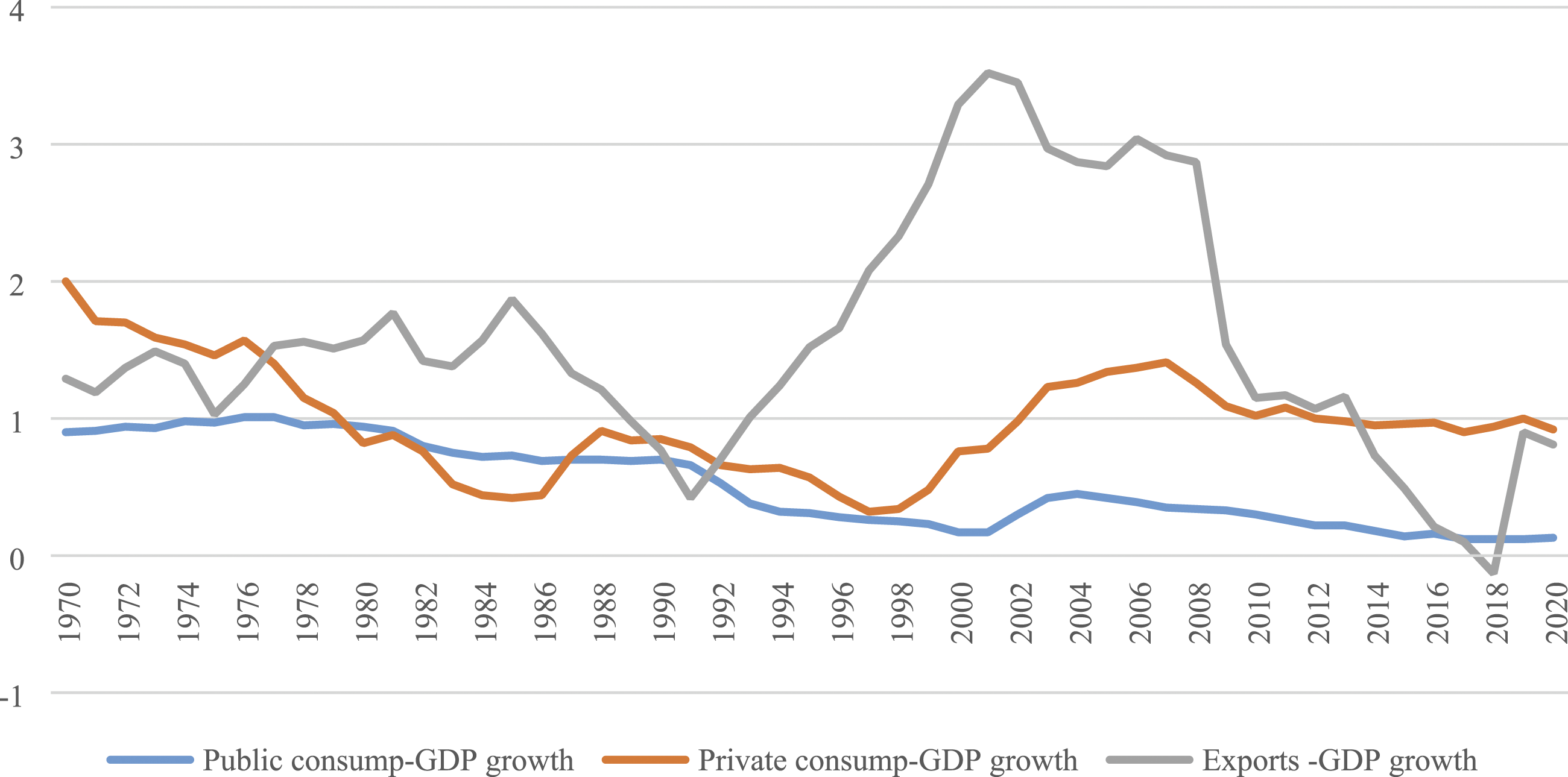
In Figures 1 and 2, we see not only how Denmark and Sweden rely on exports for growth since the 1970s but also how this is balanced because private and public consumption is important. We use 10-year moving averages to make the charts more legible. Public consumption, private consumption and export contributions to GDP growth (in %, 10-year moving averages), Denmark: 1970–2020. Source: AMECO database. Public consumption, private consumption and export contributions to GDP growth (in %, 10-year moving averages), Sweden: 1970–2020. Source: AMECO database.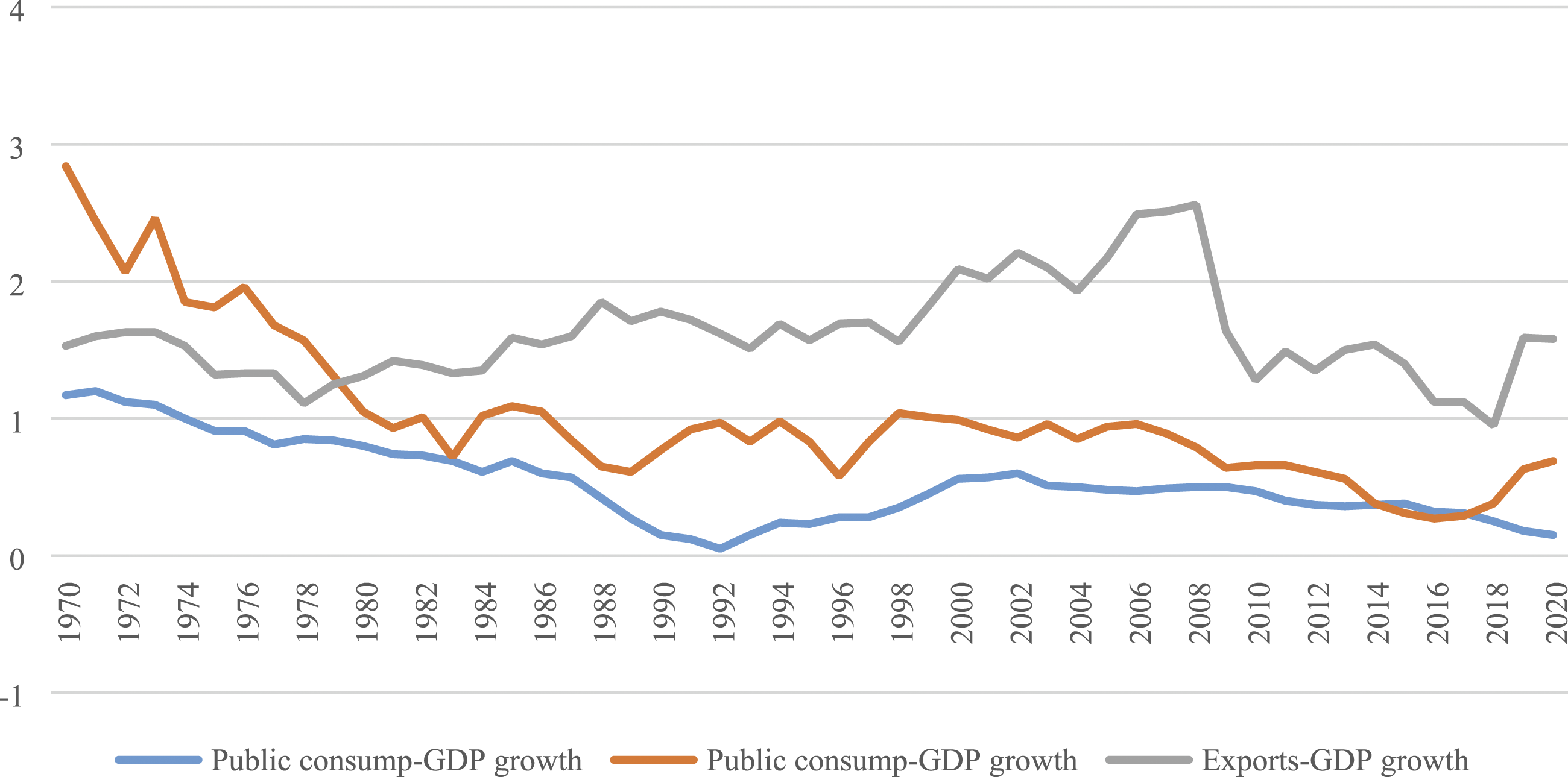
For decades, Denmark and Sweden suffered from current account deficits which crippled public finances. This led to a reorientation in both countries towards strengthening exports, dampening wage demands and increasing private savings. A high level of competitiveness was necessary if the strategy of increasing exports were to be successful. Net export had to be positive and this without subsidizing the export sector and barriers on import. In Denmark, this process was increasingly evident in the collective bargaining from late 1970s throughout the 1980s while Sweden saw major adjustments in the 1990s. In both countries, trade unions agreed that a focus on wage moderation and real wage increases was needed to restore economic balance but in different ways. However, trade unions in both Denmark and Sweden were – and are – too powerful across the private and public sectors to allow starvation of wages as seen in Germany. Specifically, public sector unions were wary that the new economic strategy would not turn the public sector into a ‘second-class labour market’.
The Nordic countries can in many ways be considered ‘coordinated market economies’ (Hall and Soskice, 2001), with strong employers’ organizations, strong unions negotiating collective agreements that provide high minimum wages – also for unskilled workers. Collective agreements thus ensure a compressed income distribution and steady real wage increases to stimulate private consumption. Moreover, Nordic countries have above-average-sized public sectors, which means that a large part of the economy is governed on political-administrative terms rather than pure market-coordination (Martin and Thelen, 2007). The balanced export-led growth model has contributed to funding the Nordics welfare states, especially after the Second World War. Public sector unions have grown and gradually acquired the same right to negotiate and settle collective agreements like their private sector colleagues, together with a right to strike slowly suppressing the civil servant employment. With full bargaining coverage, high membership densities and conflict-averse politicians, public sector trade unions demanded similar or better wage deals to make sure that their members were at least as well paid as private sector workers (Due and Madsen, 1996).
Confronted with increasing number of public employees as well as increasing public sector union bargaining power up until the 1990s, governments and public employer’s organizations in the Nordic countries found it necessary to develop a wage model that gave priority to the wage level in the exporting sector. Assuming that the wage level in the private competitive sector is – more or less – determined by the productivity level and collective bargaining coordination transmits manufacturing wage increases to the public sector, where the productivity level is lower, it follows that taxes – ceteris paribus – will rise. This effect is often called ‘the Baumol cost disease’ (Baumol and Bowen, 1966). Increased taxation might burden export companies and drive down their competitiveness. In addition, there is a limit to how much taxes can increase. Moreover, high wages in protected sectors like the public sector might dry up labour supply for exporting companies.
To avoid the ‘cost disease’, public authorities and shifting governments in Denmark and Sweden have tried to motivate management and employees in the public sector to enhance productivity through more effective production methods (e.g. digitalization) or cuts in the labour force. More importantly, however, a wave of cuts into public sector, including outsourcing and privatization, especially in Sweden, has moved the ‘cost disease’ elsewhere and – as argued by Thörnqvist (2007) – weakened public sector unions.
At the same time, the large public sectors work as a buffer for economic growth through three channels. First, as a large employer that pays good wages, the public sector sustains both public and private consumption during economic downturns. Jobs in the public sector are sticky – as are wages – making the private demand of public sector employees more stable (Martin and Thelen, 2007). Second, given that public sector wages constitute a very large share of the total wage bill in Denmark, public sector wages to some extent set limits to downward pressures on private sector wages. Thus, there are feedback effects going from public sector wages to private sector wages when employers in the two sectors compete for labour supply (Ibsen and Stamhus, 1993). Third, the public sector may work as a job buffer when private sector industries are phased out due to technological change or outsourcing (Iversen and Wren, 1998).
In sum, the strategy of balanced export-oriented growth implies coordinating the process of wage bargaining between the private and the public sector, so that enough qualified labour is available, and the unit labour cost level is competitive with international unit labour costs. However, starving off public sector wages is neither a political option with strong public sector unions and demands for extensive and universal public services nor an economic option due to the stabilizing effect of a large public sector on internal demand.
Institutions of wage coordination between public and private sector
Typically, studies of bargaining coordination explain the strength of coordination of bargaining around wage restraint in two ways. In the first strand focuses on the bargaining practices or power relations of the bargaining parties. For example, intra-confederate rules and practices may assign privilege to certain employer associations and unions, respectively, or assign veto power to confederations to make sure that a bargaining order is kept (Baccaro and Simoni, 2010, Soskice, 1990, Traxler and Brandl, 2012, Visser, 2016). Thus, whoever controls confederations will control the content of coordination. During the Fordist economy and especially in countries with industrial unionism, general workers’ unions could – by their numbers – control confederations and therefore push their agenda on other unions. If these unions had a manufacturing majority – which they often did – they could enforce pattern-setting by manufacturing.
In a similar vein, scholars have stressed formal and informal power relations between cross-class coalitions (Iversen, 1999, Ibsen and Thelen, 2017, Swenson, 1991). These scholars identify material reasons why a cross-class coalition in manufacturing should rule other sectors due to the primacy of export companies for growth and employment. Thus, in countries relying on exports for economic growth and labour supply, such coalitions can pursue common agenda of control over wage developments in sheltered sectors – with or without confederations. As noted by Ibsen (2016), the mechanisms of control by this cross-coalition may be more or less institutionalized and public mediation institutions may strengthen the pattern-setting force of manufacturing by only proposing settlements within the pattern.
Another strand focuses more on political and administrative intervention into bargaining. In the former, we find the social pact literature and how governments try to cajole the bargaining parties into agreements with either positive or negative incentives (Baccaro and Lim, 2007, Avdagic et al. 2011). Governments can promise pro-labour policies on, for example, taxation, welfare and pension in exchange for wage moderation. In the latter, we find scholars arguing that non-accommodating central banks deter sheltered sector unions from claiming inflationary wage increases beyond productivity increases (Iversen, 1999, Johnston, 2016). Independent central banks will therefore make unpopular choices, like adjust interest rates, to pursue low inflation targets. As such, they provide a functional equivalent to coordination by encompassing social partners, albeit one that has more ‘bite’ to workers who might suffer unemployment from the decisions of non-accommodating independent central banks (Hall and Franzese, 1998).
These approaches to coordination have their merits and are able to explain coordination in various contexts. However, none of them is particularly developed for the coordination between the export sector and the public sector. We argue that coordination between these two sectors may be highly formalized by government and/or public sector social partners and that the nature of formalization matters for how coordination works. Formalization relates to how budgetary control affects the growth of public sector wage sums. Another formalization relates to bargaining procedures that peg public employers´ bargaining targets to outcomes in the export sector. A third is post hoc re-regulation of public sector wages considering actual or projected private sector wage developments. Finally, there might be formal procedures that allow sub-national unit discretion or even workplaces over a certain sum or fraction of the wage sum. This is the equivalent to wage decentralization in the private sector.
We see these types of formalization as highly political instruments, that is, they can produce certain agreements and distribute wage increases among occupational groups. Coordination is done across public and private sectors but can also work across administrative levels (state, region and municipalities) and across occupational groups. Differential growth of wages across levels and occupations could spur wage militancy by groups that lag behind. This depends on the reference point of trade unions and their members, that is, who they compare their wages to (Elster, 1989). Thus, the size of the public sector wage pie might more or less determined by the private sector and public budget discipline, but the distribution of the pie might not be given and will be determined in political struggles. In the analysis, we will investigate wage developments in relation to wage developments in the export sector for both the public sector as a whole and sub-sectors of the public sector.
Denmark and Sweden compared
Sweden and Denmark are close to optimal for a most-similar case comparison of industrial relations systems (Stokke, 1998). They are both small open economies with similar business structures that face similar market challenges. Moreover, the two countries are usually lumped together in welfare and industrial relations typologies as they share many important characteristics including high union density, high bargaining coverage, universalist social democratic welfare states, country size and similar cultural backgrounds (Esping-Andersen, 1990). Lastly, both countries have converged onto a non-inflationary fiscal and monetary policy regime (Iversen and Pontusson, 2000, Johnston, 2016). Accordingly, we should be looking for the fine details in the institutions and strategies of actors when explaining differences in bargaining processes and outcomes.
The Nordic transformation from civil servant to collective bargaining systems
Trade Union Density by Sector, 2008 (in %).
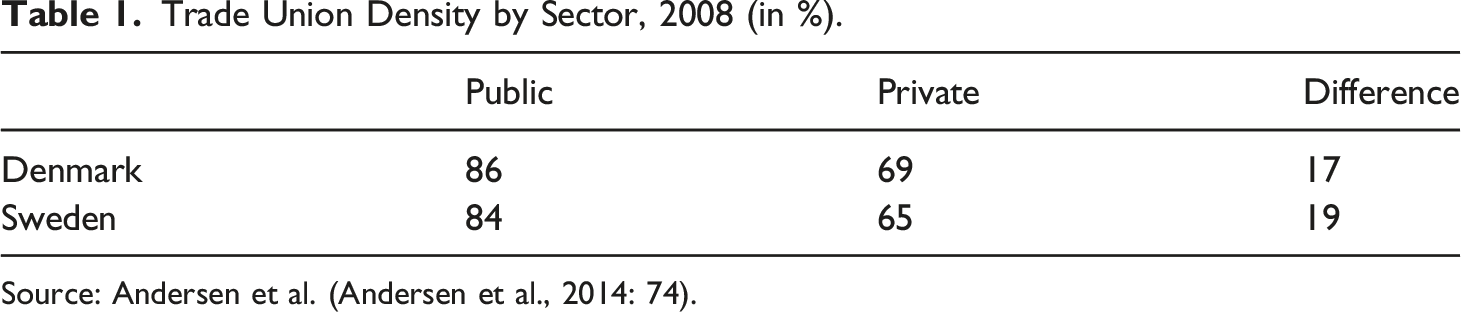
Source: Andersen et al. (Andersen et al., 2014: 74).
In all the Nordic countries, the general agreements concluded in the private sectors had no immediate effect on the public sectors since all public employees at that time were either civil servants or roustabouts (Høgedahl, 2019). Wages and working conditions for civil servants are based on law and not collective agreements; hence, no cross-sectional wage coordination was initially needed. However, during the establishment and expansion of the Nordic welfare system (see Gøsta-Andersen, 1990) in the 1950s and 1960s, a number of new public-sector professions like healthcare workers and pedagogues were employed on collective agreements and not as civil servants (Due and Madsen, 1996). In this process, trade unions and public employers (state, regions and municipalities) in the Nordic countries gradually adopted the principles of the general agreements concluded by the labour market partners in the private sector. Today, public sector employment based on collective agreement terms has largely suppressed the civil servant employment in the Nordic countries.
The transformation from a civil servant system to a public sector collective bargaining system brought about new challenges: • First, the coordination between the private export-led sector and public sector led not only to tensions between employers and employees but also internally between private and public-based trade unions (Swenson, 1991, Pontusson and Swenson, 2000). In Denmark and Sweden, a strong cross-class coalition in manufacturing has argued for public sector wage restraint to secure international competitiveness in terms of wages. • Second, new distributional implications for public sector employees emerged creating tensions between different groups of public sector employees mainly between blue colour and white colour workers and between male- and female-dominated professions.
Formal and informal institutions for cross-sectoral wage coordination
Different solutions to cross-sectoral coordination have all been established as a mean to combat wage drift and shelter the exporting industry (Høgedahl, 2019). In Denmark, the wage development disparities between the public and private sectors are automatically adjusted. In 1987, the public sector labour market parties in Denmark agreed upon a formal institution ‘The Regulation Agreement’ (RA) (reguleringsordningen) as a mean to secure parallelism in public and private wage development (Madsen and Due, 2008). RA is still today a part of the collective agreements between the public sector labour market partners and therefore up for negotiation in each public sector collective bargaining round. The logic behind the RA is two-folded; first, public sector wages must not surpass private sector wages to shelter the exporting private industries by maintaining international competitiveness. Second, the public sector must not develop into a secondary or low-quality labour market. Hence, RA works in two ways. If public sector wages surpass private sector wages, they will automatically be adjusted with 80 pct. towards the private sector level. Conversely, if public sector wages are lagging behind, they will equally be adjusted up with 80 pct.
RA has been a ‘hot potato’ for many years and especially after the economic crisis in 2008. Public and especially private employers have repeatedly stated that RA does not function as intended in terms of preventing the public sector take the lead as regards high wages (DA, 2016). According to the employers the wage statistics, which serves as the basis for calculating the wage development, does not exist in real time and the implementation of the regulation is therefore lagging behind. Due to the highly responsive local wage bargaining system in Denmark, private sector wages were quickly depressed in the wake of the crisis (Ibsen and Thelen, 2017). This is not the case for the public sector due to the centralized collective bargaining level where only around 10–15 pct. of the total wage pot is negotiated locally (Ibsen and Christensen, 2001). In public sector collective bargaining, the state will do the first collective agreement which sets the mark for the rest of the public sector – Regions and Municipalities. Since private - and public sector collective bargaining negotiations do not happen simultaneously but currently 1 year apart, RA is an important tool to secure wage coordination (Høgedahl, 2019).
In 2015 after a dramatic ending to the public sector collective bargaining round, the labour market partners at state level agreed to adjust the RA. A new ‘Private Sector Protection’ (Privatlønsværn) was introduced. The new agreement meant that if public sector wages surpass the private sector, they will automatically be adjusted with 100 pct. (and not 80 pct. as prior). Conversely, if public sector wages lagged behind private sector wages, the adjustment would remain 80 pct. This difference broke with the principle of equal adjustment that existed in the old RA-agreement. breaking with the tradition of an equal adjustment in the old agreement (Høgedahl, 2019). Not surprisingly, the ‘Private Sector Protection’ agreement was widely unpopular among public sector trade unions. Therefore, during the next public sector collective bargaining round in 2018, trade unions pushed hard for abolishing the ‘Private Sector Protection. After intense negotiations that nearly ended in an all-out industrial conflict involving most of the Danish public sector through strikes and lockouts, an agreement was concluded removing the Private Sector Protection (Høgedahl and Ibsen, 2019). The new agreement reintroduced the old RA where the adjustment is 80/80 pct. instead of 100/80 pct.
In contrast to Denmark, no automatic adjustment mechanism exists in Sweden. In 1997, social partner established a new bargaining regime based on the Industry Agreement (Industriavtalet). The agreement entailed a tight coordination around pattern bargaining in manufacturing. In 2000, a new National Mediation Office (Medlingsinstitutet) was also established to further ‘ensure sound wage developments’ by bringing wage developments across the economy in line with the exposed manufacturing sector (Ibsen, 2016). Henceforth, coordinated bargaining is guided by the so-called ‘industry norm’ in manufacturing (Elvander, 2002). In principle, the industry norm acts as a coordinating tool across industries and bargaining levels including the public sector. The industry negotiates first and sets the ‘mark’ in terms of wage levels guiding the other sectors. If there is a bargaining impasse in other sectors close to agreement expiration, there will typically be a notification of industrial action and the NMO convenes the parties. This only applies in areas with no independent negotiation agreement and mediation system. The NMO will only propose settlements that within the manufacturing norm, but it cannot compel the parties to take this proposal.
Coordinated bargaining steered by the industry norm is combined with different models of decentralized wage formation. While some industrial agreements are so-called ‘figureless’, others contain traditional wage scales or piece work (Kjellberg, 2019). Figureless agreements are most numerous in the public sector, and no blue-collar union has concluded such an agreement and there is none in the manufacturing industry. Interestingly, this makes some public sector agreements more flexible than some private sector agreements, and local bargaining relationships come into play when certain groups want to challenge wage hierarchies. For example, the nurses’ union (Vårdförbundet) and other white-collar public sector unions (teachers’ unions) opted for figureless agreements to increase their wages beyond the industry norm (Thörnqvist, 2007). It is important to note that industrial actions of any kind are not allowed at the local level in Sweden nor Denmark. However, in Sweden, especially nurses have a long tradition of using the threat of collective resignations if their demands are not fulfilled in local wage negotiations.
Another important institutional characteristic of the Swedish system is the autonomous organization of the public employers at the state level. In Denmark, the state employers are closely connected to central government and the lead negotiator at the state-level as traditionally been the Minister of Finance and since 2019 the Minister of Taxation. In Sweden, the independent government agency, The Swedish Agency for Government Employment (SAGE, Arbetsgivarverket), has been in charge of concluding collective agreements with their trade union counter parts for the past 25 years. SAGE takes decisions independently, and the minister of finance cannot intervene in the day-to-day operations of the agency. In Denmark, on the other hand the minister in charge of the employer function at the state level has the power to intervene directly in negotiations. This possibility does not exist in Sweden, as ‘ministerial rule’ is prohibited creating strong independent agencies (nominellt självständiga myndigheter).
SAGE functions much like a private employer organization with ‘member organizations’ and an internally democratic process for the governing bodies. SAGE has very strong ties and coordination with private employer organizations, mainly The Confederation of Swedish Enterprise (Svenskt Näringsliv) securing the ‘industry norm’ in the public sector (Høgedahl 2019). Before a collective bargaining round, SAGE will initially have a negotiation process with the political level setting the overall budget for the coming negotiations with their trade union counterparts (Arbetsgivarverket, 2014). At the local government level (municipalities and regions), the organizational differences are less stark, as both Local Government Denmark (Kommunernes Landsforening – KL) and Swedish Association of Local Authorities and Regions (Sveriges Komuner og Regioner – SALAR) are governed by politicians in local government.
Outcomes: Pattern-setting and wage structures
We have presented how the two countries differ in their institutionalization of inter-sectoral wage coordination. What are the effects on wage-setting outcomes of these different institutions? Specifically, how strong has pattern-setting been and what are the distributional consequences looking across sub-sectors of the public sector? In the following, we focus on nominal hourly wages and we do not take productivity or currency developments into account. Two issues will guide our analysis (cf. Di Carlo, 2018): (1) Nominal wage increases for sub-sectors of the public sector in a limited period may vary, but total public wage increases should be similar or below those of manufacturing. (2) Hourly wage levels of manufacturing should over time be higher than public sector wage levels.
Over time, the second proposition should follow from the first. However, since we focus on the post-1990s period, legacies from prior wage settlements might have pushed public sector wages above those of manufacturing. Before looking at wage outcomes, we note that both countries – as most European Union member states converged towards the low-inflation regime until the current inflation spell – save for wage-price spirals in Sweden in the late-1980s and early. In large part, this has been due to restrictive monetary policies and trade union embrace of wage restraint and focus on real wage increases.
For most of the period, the low-inflation regime has worked out for Nordic workers. With steady real wage increases, the legitimacy of wage restraint in the pursuit of export-led growth has made a lot of sense. In the period from 1994 to 2015, public sector workers have only experienced real wage losses in a few years. Indeed, the Danish and Swedish public sector workers have only experienced it in 4 years, respectively (Figure 3). Real hourly wage developments for public sector workers, 1994–2015. Source: World Bank; EU KLEMS (own calculations).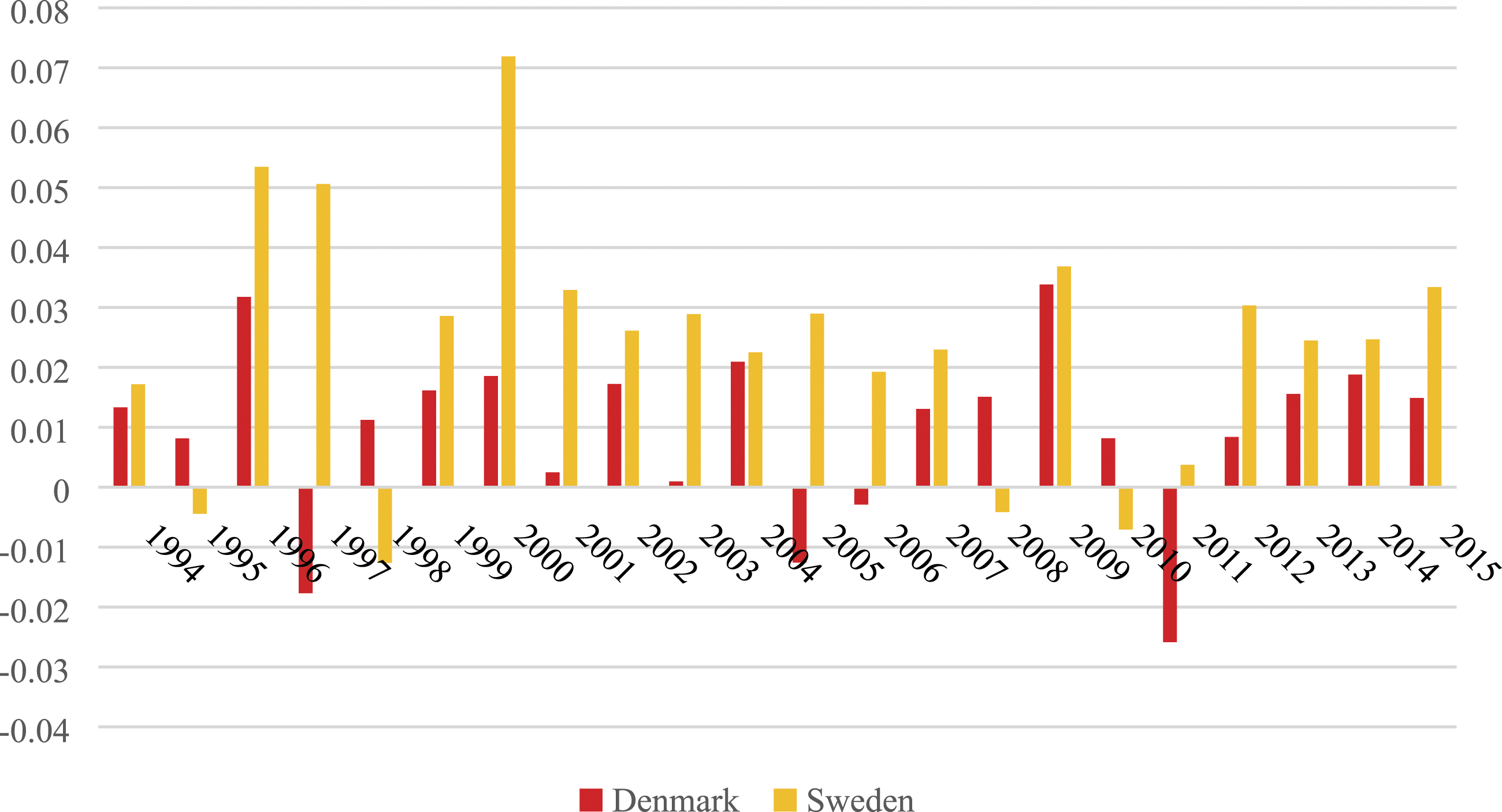
But how do public sector wage developments measure up to wage developments in manufacturing? Figure 4 shows wage increases from 1993 to 2015 in the two countries by sector. We index wages in 1993. While we should be careful about comparing increases across countries without taking productivity and exchange rates into account, it does seem like Sweden has experienced the highest nominal increases overall. More importantly, however, we see that manufacturing has had higher wage increases than the total public sector in both countries. We also observe that increases for public sub-sectors vary. Interestingly, increases seem to vary more in Denmark than in Sweden, indicating that sub-sectors in Denmark can deviate from the pattern if the overall public sector wage increases stat below those in manufacturing. This might be due to two things: (1) some occupational groups in these sub-sectors have been able to negotiate higher percentage increases than others and (2) the occupational composition in these sub-sectors has changed towards employees with longer education. We are not able to adjudicate between these two explanations but will discuss the distributional struggles in Danish bargaining rounds below. Hourly wage increases in selected sectors, 1993–2015 (index 1993=100). Source: EU KLEMS (own calculations).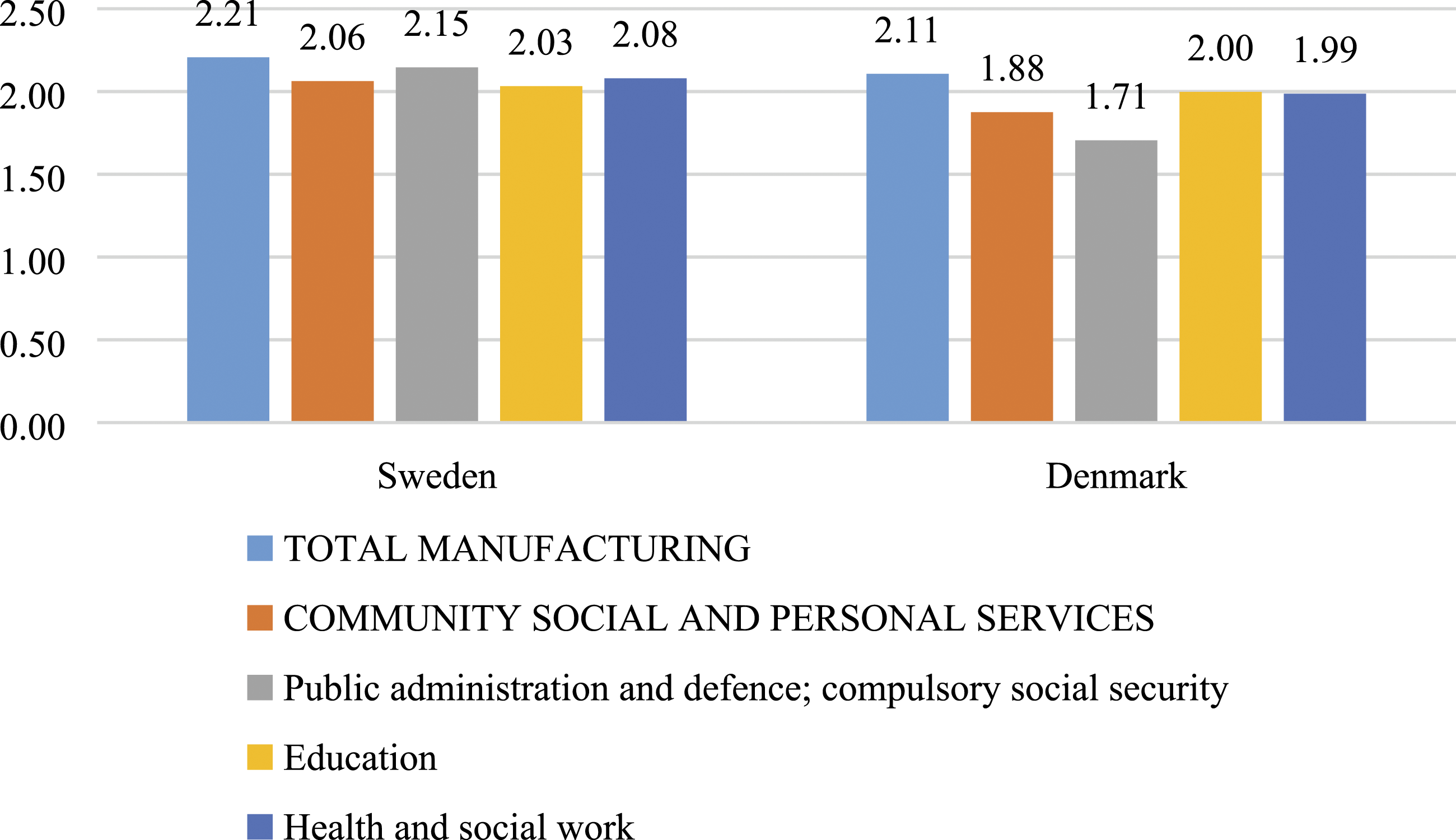
Looking at increases historically (see Appendix Figure A1 in supplementary material), increases in Sweden have been very coordinated and only in recent years (since mid-2000s), do we see some divergence in wage increases. In Denmark, the rank order of sectors changes over the period, indicating a more volatile bargaining system. Indeed, before the 2000s, ‘Health and social work’ outstripped manufacturing – perhaps owing to the slowing down of wage developments in manufacturing. This could be a sign of the more responsive local wage bargaining systems in the private sector of Denmark compared to Sweden and that Danish public sector wages are regulated with a lag.
Looking at the ratios of manufacturing hourly wages compared to the public sector and public sub-sector hourly wage levels in 2015, we observe that hourly wages in the public sector are remarkably like those of manufacturing (see Appendix Figure A2). This similarity is testament to the highly coordinated nature of the Nordic bargaining systems. Only in ‘Education’ and ‘Public administration and defence’ in Denmark, do we find ratios below one, but the differences are very small. Interestingly, Swedish ‘Education’ is the sub-sector trailing most behind manufacturing with the highest ratio of 1.32.
Looking at the historical development of ratios (see Appendix Figure A3), we again find interesting cross-national differences. The rank order of ratios in Sweden have been very stable since 1993, and in Sweden, even the ratios have been very stable. The rank order in Denmark changed as ‘Public administration and defence’ recuperated some of the wage differences compared to manufacturing. Again, this shows that distributional struggles can have an impact in Denmark. We also see that Danish manufacturing wage levels took off during the roaring 2000s until the financial crisis hit in 2008/2009. Again, we see this as a sign of the decentralized wage setting in the Danish private sector. Interestingly, the ratios have remained rather stable in Denmark since the financial crisis hit the public budgets in 2009. This seems to indicate that Danish governments have been very wary of controlling public sector wage increases in this period.
In sum, wage developments across the two countries suggest that pattern-setting by manufacturing seems to work best in Sweden, whereas Denmark has seen a more volatile wage structure. However, if policymakers and social partners are mostly worried about the total wage bill of the public sector, then both countries have managed to instil wage restraint around the manufacturing wage developments. We also find that public sector wages keep up with manufacturing wage levels very well, indicating that coordination is not only used to suppress public sector wages but also to retain egalitarian wages. While this evidence suggests rather consensual and balanced wage bargaining, our next sections will show the distributional politics around coordination and how various occupational groups in the public sector challenge how coordination works in praxis. This analysis underlines that bargaining coordination is not just a functional response to balanced export-led growth imperatives but a distributional struggle between social groups.
Distributional struggles of public sector employees
Distributional implications for public sector employees are also a consequence of a tight cross-sectoral coordination. The formalized coordination between private and public wage development at the Danish labour market – as described above – causes many conflicts. One of the consequences of the coordination is the threat of re-regulation of wages in the public sector. Another consequence is the perception that the wage hierarchy of the different working groups and professionals remains constant over time, leading groups at the bottom or in the middle of the hierarchy to contest their placement. Especially the nurses, the kindergarten teachers and the social and health assistants have revolted over their relative wage level. The result has been several strikes during the collective bargaining rounds in the public sector. The nurses conducted to strikes in the 1990s, and in 2008 the nurses, the kindergarten teachers and the social and health assistants went on strike (Høgedahl, 2019), with the purpose of a pay raise, higher than the one the other professionals in the public sector had obtained at the general collective bargaining round. Thus, this was an intra-sectoral struggle over the distribution of public sector wage increases.
Another conflict is that between public and private wage levels causing gender inequality. Female professionals in the public sector compare their education and wage level with comparable male group wage level in the private sector and claim that their wage level is too low. Danish nurses went on a 71 day strike during the summer of 2021 demanding equal pay with direct reference to the Public Service Act of 1969 and a wage structure that penalizes the pay of nurses. The strike ended when the Danish Parliament passed a law August 31 causing frustration among nurses.
The nurses’ union leads the equal pay claim, supported by the kindergarten teachers and the social and health assistants’ unions. However, not all public unions agree on this claims and strategy. Unions representing school teachers, office workers and the Danish Confederation of Professional Associations Danish disagree with the strategy to force the government to intervene in the shape of the wage structure and wage differentials on the Danish labour market. Normally, all unions in both the public and the private sector are strong opponents to the idea, that parliament and the government should regulate wages and working conditions (Høgedahl, 2019).
However, when it comes to gender inequality, some of the female-dominated unions argue that the bargaining model is not able to close the gender wage gap because of the coordination mechanism illustrated above. If the public unions carry out a strike, aiming to narrow the gender gap and the operation is successful, the coordination mechanism will correct the wage increases and the public employees have to’ ‘pay back’ their strike bonus, so that their wage development be in line with the wage increases in the private export sector. Consequently, this kind of wage policy and strategy is not an option for the public, female-dominated unions. They can only change their position in the wage hierarchy at the expense of other public employees, unless the government is willing to help them, and this has not been the case until now. However, on December 6, 2021, 3 months after the nurses strike had ended, the Danish Parliament concluded the yearly Finance Bill reserving exceptionally €13.500.000 for wages in the hospital sector. And, in 2023, the government in Denmark invited social partners to tripartite negotiations of extra funds to address wage imbalances before the 2024 bargaining round.
In Sweden, public sector unions likewise argue that strong coordination locks them into wage structures that are disadvantageous to them. In some bargaining rounds, this has led to calls for defections from the manufacturing pattern. Some of these calls – especially from municipal workers – stem from the heritage of the Swedish LO’s solidaristic wage bargaining. LO Sweden explicitly coordinates around a low wage strategy that should give supplementary nominal wage increases to low-wage workers or to redress gender wage gaps. In 2003 and 2008, these issues led to large strikes for the Swedish Municipal Workers’ Union and Swedish Association of Health Professionals, respectively (Medlingsinstitutet, 2010). The low-wage norm is based on the manufacturing norm plus a so-called z-factor (räknasnurra) (Ibsen and Thelen, 2017). Due to the large degree of decentralization in the Swedish public sector, Swedish nurses have used figureless agreements in order to secure extra pay increases in occupations and regions with labour shortages, while other professions like some municipal employees receive lower wage increases (Høgedahl, 2019). Although many Swedish nurses have seen real wage increases above the industry norm for the past 10 years, the gender pay-gab discussion is still highly relevant.
According to Erikson (2021), the reformation of the Swedish industrial relations system as described above means that norms and practices have become more formalized and thereby less flexible and less open to interpretation. The strong industry norm in particular appears to hinder gender-equality initiatives. Women-dominated sectors have in recent years intensified their criticism of industry being the norm setter for the wage level of the entire labour market. A similar argument has been put forward by Wegner and Teigin (2021) regarding the Norwegian case. Here, a clear hierarchy is expressed in which gender equality is subordinate to pattern bargaining favouring the exporting industry.
Discussion and conclusion
Denmark and Sweden are small countries that rely on balanced export-led growth and have extensive public sectors. Moreover, trade unions are strong in both countries, especially in the public sector. This combination demands a tight coordination between wage developments in the exporting companies and in the public sector. We find that both countries have succeeded with tight pattern-setting from the export sector to the public sector.
Two propositions guided our analysis: 1. Nominal wage increases for sub-sectors of the public sector in a limited period may vary, but total public wage increases should be similar or below those of manufacturing. 2. Hourly wage levels of manufacturing should over time be higher than public sector wage levels.
Looking at the period since 1993, we find that these propositions hold in Sweden, whereas the second proposition does not hold for Danish sub-sectors, ‘Education’ and ‘Public administration and defence’, which have higher hourly wages than manufacturing, although differences are very small. These differences might mask substantial wage differentiation at the individual level and should therefore be interpreted with caution. Likewise, developments over time may be due to compositional changes in the occupations for sectors, rather than collectively agreed wage increases. Nonetheless, the data does suggest that wage coordination across sectors is more stable and tighter in Sweden than in Denmark.
We find that coordination between export sector and the public sector comes with several challenges in Denmark and Sweden. The first challenge stems from the tension between the need for percentage parallelism in wage increases and the push from some occupations to change the wage structure. A tight coordination around a pattern-setting agreement – whether it be through the formal regulation mechanism in Denmark or the ‘Industry mark’ in Sweden – in theory does not preclude certain occupational groups in the public sector getting higher wage increases as long as the total public sector wage increase stays similar or below manufacturing. In Sweden, the internal LO coordination has broken down due to tensions between the Municipal Workers’ Union and IF Metall over how coordination could favour low-wage workers in the municipalities (Kjellberg, 2021).
However, in practice, public sector unions may struggle internally to agree on who gets the above pattern increases. Similarly, public sector employers may want to signal to their counterparts that above-pattern deals are off the table altogether to avoid wage-spirals. In recent decades, unions in the public sector have been able to agree on solidaristic wage strategies to favour especially female-dominated occupations. And, this strategy has even gained the support – like in 2017 – of male-dominated metalworking. In Denmark, unions have been less solidaristic with each other and have preferred to go-it-alone by confronting politicians.
The second challenge stems from the lag between knowing actual wage developments in the private sector and setting wages in the public sector. This challenge is further complicated by wage decentralization and highly market-responsive local wage deals. For example, private sector wages reacted immediately and significantly to the economic crisis in 2008/2009 in Denmark, whereas the public sector wages had already been negotiated at a relatively high level. This difference then had to be regulated in the next bargaining round, that is, public sector employees ‘owed’ wages to the employers. The opposite scenario plays out when export markets are booming. Volatile export markets may make wage coordination harder, although the margin of error is smaller due to the low-inflation regime since the 1990s. Swedish private sector bargaining is less decentralized than the Danish and might therefore be relatively easier to coordinate around. Clearly, there is a trade-off between wage flexibility and wage control.
The final challenge stems from deindustrialization and differential development of trade union density. The former means that service sector actors challenge the notion that manufacturing always sets the pattern. This discussion has been particularly loud in Sweden, where employers and trade unions are typically organized by industry. Increasingly, services are export-oriented which puts a question mark at the primacy of manufacturing as the key-bargaining area. The latter means that public sector unions have outgrown private sector unions, which changes the internal power relations in the union movement. The new union confederation in Denmark, Danish Trade Union Confederation, was a result of a merger between LO and FTF, the latter being primarily public sector occupational unions, and this has tilted the majority even more to the public sector. While there has been no merger in Sweden, the LO is also increasingly public sector focused. At present, the challenge to the export sector as the pattern-setter has calmed due to the economic recovery and positive real wage increases. However, another recession with wage freezes or even wage reductions might rekindle the challenge to pattern-setting.
Balanced export-led growth in countries with large public sectors and strong public sector unions requires a high degree of coordination between sectors. However, coordination ban be procured in several ways and is inherently a political process that can be more or less formalized. This paper has argued that Denmark and Sweden have formalized coordination in different ways that have effects on the distributional struggles and outcomes of collective bargaining. Sweden has a very tight coordination that procures parallelism between the sectors, whereas Denmark leaves more scope for sub-sector variation as long as the total public wage increases are similar to manufacturing. The more general implication of our finding is that studies of public sector bargaining should pay close attention to details and how an ensemble of institutions affects how coordination works in practice.
Supplemental Material
Supplemental Material - Public sector wage bargaining and the balanced growth model: Denmark and Sweden compared
Supplemental Material for Public Sector Wage Bargaining and the Balanced Growth Model: Denmark and Sweden Compared by Laust Høgedahl, Christian Lyhne Ibsen and Flemming Ibsen in European Journal of Industrial Relations.
Footnotes
Declaration of conflicting interests
The author(s) declared no potential conflicts of interest with respect to the research, authorship, and/or publication of this article.
Funding
The author(s) received no financial support for the research, authorship, and/or publication of this article.

Supplemental Material
Supplemental material for this article is available online.
Author biography
References
Supplementary Material
Please find the following supplemental material available below.
For Open Access articles published under a Creative Commons License, all supplemental material carries the same license as the article it is associated with.
For non-Open Access articles published, all supplemental material carries a non-exclusive license, and permission requests for re-use of supplemental material or any part of supplemental material shall be sent directly to the copyright owner as specified in the copyright notice associated with the article.
