




Abstract
The resurgence of debate around digitalisation and work has seen the role of unions in the ‘social shaping of technology’ attracting renewed interest. A key question concerns how far national institutions influence unions’ ability to shape digitalisation in particular sectors and workplaces. Using a multi-level analysis that emphasises the inter-relationships between institutions, union power, resources and agency, this article compares the role of two unions in the banking sector in Norway and the UK. Drawing on interviews with national officers and workplace representatives, it addresses their involvement in decision-making processes and ability to influence outcomes in relation to digital monitoring and surveillance. The research findings highlight the continued salience of ‘country effect’ as evidenced by the Norwegian union’s more prominent role in shaping better worker outcomes.
Introduction
Debates over the potential impact of digitalisation on employment have led to a renewed focus on technological change and how it can be shaped to produce different outcomes (Wajcman, 2017). Public policy, institutions and social actors influence, even if indirectly, the development and use of technology, and its impact on work (Lloyd and Payne, 2019; Howcroft and Taylor, 2022; Thompson, 2020). An emerging area of research is the contemporary role of trade unions and the extent to which they can shape digitalisation to achieve better outcomes for workers.
In many European countries, the context of union decline, deregulatory processes and eroding worker power (Baccaro and Howell, 2017) present major challenges for unions in influencing digitalisation. Given that unions have often struggled to engage with technology even in periods of relative strength (Deutsch, 1986), the present situation hardly gives cause for optimism (Martinez-Lucio et al., 2021; Murray et al., 2020). There are fears that unions could be further marginalised by the growth of platform and gig work, and the loss of jobs from unionised sectors (Doellgast and Wagner, 2022). On a positive note, some unions are successfully using digital tools for organising and engaging new groups of workers (Vandaele, 2018). There is less research, however, examining unions’ role in the implementation and use of digital technology in the workplace. The few available studies focus mainly on ‘Industry 4.0’ in engineering and automotives (Cirillo et al., 2020; Haipeter, 2020), while research in other parts of the economy is limited (Payne et al., 2023).
International comparisons are critical in examining ‘country effects’ and identifying factors that enable or constrain union influence in sectors and workplaces (Lloyd and Payne, 2019; Doellgast and Wagner, 2022). This article explores the impact of country differences in labour market-related regulations and institutions on unions’ ability to influence digitalisation in the banking sector. It adopts an analytical approach that emphasises the inter-relationships between institutions, union power, resources and agency at multiple levels in shaping outcomes (Gasparri and Tassinari, 2020; Lloyd and Payne, 2021). The impact of national institutions, along with the relative power and opportunities available to unions, are likely to be uneven across sectors (Bechter et al., 2012; Lloyd and Payne, 2016). A central question, therefore, is how far are unions able to influence digitalisation in specific sectors and workplaces when comparing countries with more or less conducive institutional environments, and what might this tell us about the conditions under which unions can make a difference.
As an early adopter of digital technologies, banking is an important sector to examine (Umans et al., 2018). As Bechter et al. (2012) note, internationalised sectors with few large companies and strong EU-level regulations may display more similarities in industrial relations structures than localised services. Banking tends to fit this category, with unionisation rates and collective bargaining coverage typically being much higher than in private services. We might, therefore, expect more convergence in union involvement in digitalisation. That said, recent studies have found national differences in unions’ ability to deal with bank restructuring associated with digitalisation, particularly around job losses and redundancy (Kirov and Thill, 2018; Kornelakis et al., 2022). However, current research has yet to examine banking unions’ ability to influence other work outcomes, such as new forms of digital monitoring and surveillance.
This article compares two banking unions in Norway and the UK – countries selected for their starkly contrasting institutional environments and union power resources. Norway is noted for its strong unions, enduring ‘tripartite’ model of social dialogue, and multi-level collective bargaining (Løken et al., 2013). There are strong institutional supports that bolster union organisation and co-determination mechanisms that include involvement in technical change. The UK is a neo-liberal economy with a lightly regulated labour market, where unions have suffered significant decline and marginalisation (Lloyd and Payne, 2016). Unions lack consultation and involvement rights over technology, except in cases involving collective redundancies, and have to rely on their own ability to make company and workplace agreements. While we would expect, therefore, a stronger role for unions in Norway, recent studies indicate sector matters. In hospitality and retail, there appears to be little joint workplace decision-making (Alsos and Trygstad, 2018), and unions’ role in digitalisation is weak, with some similarities to the UK (Payne et al., 2023).
The article addresses three research questions. First, how do the two banking unions attempt to influence decisions around the introduction and use of digital technologies? Second, to what extent are the unions effective in shaping outcomes? Third, how far does national institutional and regulatory context explain any differences found, focussing specifically on digital monitoring and surveillance? The study contributes to an analysis of ‘country effect’ and provides critical insights into the factors that support or hinder unions in shaping digitalisation.
The following section outlines the analytical framework and draws out relevant themes from current studies on union influence on digital technologies in the workplace. A brief overview of digitalisation in the banking sector and the industrial relations context in Norway and the UK is then provided. The methods section outlines the interviews with union officers and representatives in the two unions that formed the basis of the research. The findings are discussed, comparing union involvement in digitalisation and their impact on outcomes for workers. The discussion and conclusion consider the role of ‘country effect’, and highlight wider analytical and research implications emerging from the study.
Unions and digitalisation
Despite liberalisation and deregulation pressures (Baccaro and Howell, 2017), the persistence of distinctive national labour market institutions suggests there may still be a ‘country effect’ on unions’ ability to shape digitalisation (Lloyd and Payne, 2019). Unions have varied degrees of institutional power derived from national systems, including labour market regulation, corporate governance and public policy, shaped by struggles between the state, capital and labour (Refslund and Arnholtz, 2022; Wright, 2000). These country effects have been reflected in past evidence of stronger union involvement in technical change in Germany and Nordic workplaces, compared to neo-liberal countries which lack institutional supports and social dialogue (Deutsch, 1986).
The ability of unions to draw on strong national institutional supports to shape digitalisation, however, is likely to be variable across sectors and workplaces (Bechter et al., 2012). At the same time, unions in countries that lack a supportive environment may still be able to exert influence. Union power in different sectors and workplaces depends partly on the extent of these institutional supports but also on structural and associational power (Refslund and Arnholtz, 2022; Rego, 2022; Wright, 2000). Structural power is based primarily on workers’ labour market position and location within the organisation and value chain. Those less easily replaceable or working in areas of critical importance are seen as providing unions with greater structural power. Associational power derives from a union’s ability to organise and mobilise workers, which also links into their own strategic approach, capabilities and resources (Gasparri and Tassinari, 2020; Lévesque and Murray, 2010). The inter-relationships between these different forms of power are complex and varied.
Current research examining unions’ role in the implementation and use of digital technologies in traditional workplaces offers some insights into the relative importance of ‘country effect’. Primarily focused on Industry 4.0 in manufacturing, the emerging evidence suggests greater union involvement in countries with strong institutional and embedded forms of worker representation, such as Italy and Germany (Cirillo et al., 2020; Haipeter, 2020). Rutherford (2021) argues that greater union influence in Germany, compared with the US, reflects co-determination rules and strong associational power. Haipeter (2020), for example, points to the ability of German unions to partner with Works Councils to bring forward new agreements. The adaption of existing arrangements is also emphasised in Gasparri and Tassanari’s (2020:813) research, where Italian unions were found to be most effective in the sphere of collective bargaining when extending ‘already established institutions and practices’. Even with relatively conducive institutional environments, unions’ engagement at the workplace is variable across companies, ranging from the proactive to the defensive, and is often late in the process (Cirillo et al., 2020; Rego, 2022).
Existing studies on Industry 4.0 focus more on union involvement than identifying how unions affect work outcomes beyond that of potential job losses. One area where evidence is emerging concerns unions’ impact on digital monitoring and surveillance. Electronic performance monitoring is not new, and there are many examples where unions have successfully resisted or limited its use (Kiss and Mosco, 2005; Lloyd et al., 2010). However, digital tracking software, data analytics and algorithmic management provide management with an increasing set of tools that are more intrusive and which can be applied in a wider array of situations (Moore et al., 2018). Unions have been addressing their concerns through social dialogue at national and international levels, and have had some success in bringing forward collective agreements (Eurofound, 2020). Studies are also gradually emerging at the workplace, demonstrating that unions can restrict new forms of digital monitoring by building on existing agreements and approaches (Cirillo et al., 2020; Doellgast et al., 2023).
A number of themes emerge from the literature: the importance of established institutionalised structures at the workplace and unions’ ability to adapt these to address digitalisation; union representatives having sufficient knowledge and resources to understand and intervene in the process (Haipeter, 2020; Rutherford, 2021); and differences in company approach towards unions linked to their business models (Cirillo et al., 2020). Despite continued concerns about the late involvement of unions, there are indications that unions can draw on different forms of power to influence implementation and outcomes, including digital monitoring. However, with most research focused on a few sectors and countries, an important question is whether these themes have broader resonance.
Digitalisation in banking
Digital technologies have long been a feature of banking from the adoption of automated teller machines (ATMs) to the establishment of call centres and telephone banking in the 1980s (Taylor and Bain, 2001). As part of wider restructuring, many bank employees experienced deteriorating job quality, notwithstanding differences between countries, banks and groups of workers. Workers in countries with strong collective institutions were generally found to have fared better than in neoliberal countries (Lloyd et al., 2010; Regini et al., 1999). Even in the UK, however, some unions were able to reduce individual targets in call centres and restrict the use of disciplinary procedures for ‘under-performance’ (Taylor and Bain, 2001).
In recent years, the extension of online and mobile banking has enabled banks to remove most manual processing of cheques, bank transfers and cash handling (Andersen, 2020), and to accelerate branch closures. Robot process automation (RPA) and algorithmic decision-making are among the digital technologies that allow certain work processes to be automated, such as loan applications and security checks. These developments present similar challenges to unions as in previous periods of technical change, with expectations of major threats to employment and shifts in job tasks. One aspect that is different today is the potential for management to use new digital tools to extend and deepen monitoring and surveillance. In some cases, these can be ‘invisible’ and installed without workers’ knowledge, rendering them difficult for unions to detect and act against (Bråten et al., 2023: 6).
Contemporary studies in banking, although relatively few, find some differences in work outcomes. However, they are often unclear as to why they have come about and if unions have been involved. In some cases, branch workers are found to be undertaking more complex work, with a greater focus on customers (Dølvik et al., 2020; Värlander and Julien, 2010). Others report jobs becoming increasingly standardised, with reduced discretion and greater use of targets (Laaser, 2016; Perez and Martin, 2018). Work intensification is a common theme (Dølvik et al., 2020; NFU, 2018; Perez and Martin, 2018), alongside concerns surrounding the effects of enhanced forms of digital monitoring and surveillance (Lockwood, 2018; Murphy and Cullinane, 2021).
International comparative studies have uncovered country differences in unions’ ability to influence employment outcomes, suggesting the continued importance of institutional power. In France and Luxembourg, sectoral bargaining and forms of neo-corporatism have enabled banking unions to be more successful in resisting job cuts than in the UK (Kirov and Thill, 2018; Kornelakis et al., 2022). Perez and Martin (2018) go beyond job losses, touching upon the role of banking unions in the use of digital technologies at the workplace. They find evidence that French and Spanish unions are involved in managing the ‘consequences of innovation’, such as working time issues, albeit with little input into ‘upstream’ decision-making (2018: 226). While comparative research remains sparse, these studies echo some issues raised by Industry 4.0 research, but are not systematically focused on union influence in the workplace.
Sector context in Norway and the UK
There are substantial differences in the structure and industrial relations systems of the banking sector in Norway and the UK. Although banking is relatively concentrated in both countries, it is more so in Norway, where DNB, which is part-owned by the government, accounts for around 30% of the retail and corporate market (Norges Bank, 2022). Small savings banks comprise 45% of the retail and a third of the corporate market. Traditionally mutually owned, they are expected to support their local communities, with some forming two alliances – Sparebank and Eika – to share group services. In the UK, the big four commercial banks – HSBC, Lloyds Banking Group (LBG), NatWest and Barclays – account for approximately two-thirds of personal and business accounts. They operate alongside large and small banks, digital-only services, and building societies. In both countries, the long-term decline in the number of retail branches has accelerated over the last decade (Andersen, 2020; Booth, 2022), with banking employment falling by 16% in the UK and 7% in Norway between 2009 and 2019.
In Norway, industrial relations in banking are highly organised. Nearly all employers are members of the employers’ association, Finans Norge. Union density in finance stands at 58%, and 81% of workers are covered by collective bargaining (compared to private sector averages of 38% and 45%, respectively) (Nergaard, 2022). The Basic Agreements between Finans Norge and the unions, Finansforbundet (FFB) and Landsorganisasjonen i Norge (LO), along with the Working Environment Act, provide the regulatory framework for industrial relations, working conditions and rights to be consulted and involved in technological decisions. The Central (sector) Agreement covers pay and working conditions, while company agreements specify local wage supplements and build upon the Basic and Central agreements.
In the UK, there is no employer association that negotiates with workers or any sector bargaining. At just 19%, union density in finance is lower than the national average of 23% but substantially higher than in the private sector (13%). There are multiple and competing unions, many having emerged from company-based staff associations (Tailby et al., 2007). Collective bargaining coverage is 31% in finance, compared to 21% in the private sector (DBEIS, 2022), although most of the larger banks and building societies have collective agreements. Gall (2017: 17) argues that since the financial crisis ‘management dominance and union weakness’ have led to worsening terms and conditions of employment, despite a predominant model of union-management partnership. In Norway, banks are said to have fared relatively well. Relations between management and unions have traditionally been ‘consensual’ within a strongly institutionalised environment (Rolandsson, 2020: 77).
Notwithstanding some sectoral commonality (Bechter et al., 2012), differences in unions’ institutional power would still lead us to expect a significant country effect. Norwegian unions have a range of supports they can potentially draw on to influence digitalisation which are not available in the UK. Our analytical approach suggests that the ability of Norwegian unions to operationalise these supports will be linked to whether higher union membership is a reflection of strong associational power, and if this can be mobilised in relation to digitalisation.
Research method
A comparative study of two banking unions was undertaken – Finansforbundet (FFB) in Norway, and Accord in the UK. The unions were selected for comparison as they only organise in financial services, and neither is politically aligned. FFB is the main union organising in the sector in Norway with around 30,000 members and is part of the union confederation, Yrkesorganisasjonenes Sentralforbund (YS). The other union in the finance sector is Handel og Kontor (HK), part of the main confederation, LO, which, unlike YS, has strong associations with the Labour Party. The employer organisation, Finans Norge, makes it harder for HK to obtain recognition than FFB. Accord is affiliated to the Trades Union Congress, has around 23,000 members and primarily organises in Lloyds Banking Group (LBG) and TSB, a divestment. The two other unions organising in LBG are the general union, Unite, affiliated to the Labour Party, and BTU, which was derecognised in 2015.
The research was designed to explore union influence from the perspectives of those active within the union at different levels, using semi-structured interviews. The study specifically focused on digital technologies affecting workers in lower and intermediate-level jobs across the banks. Initial contact and agreements were made with national officers who provided lists of relevant individuals interested in participating in the research. Interviews were sought with national and regional officers, and with senior and workplace union representatives (reps) who covered a range of banking activities, such as retail, commercial and investment. Further contacts were made through interviewees to ensure that reps at different levels and areas of banking were covered, for example, call centres, branches and back offices.
Interviews.
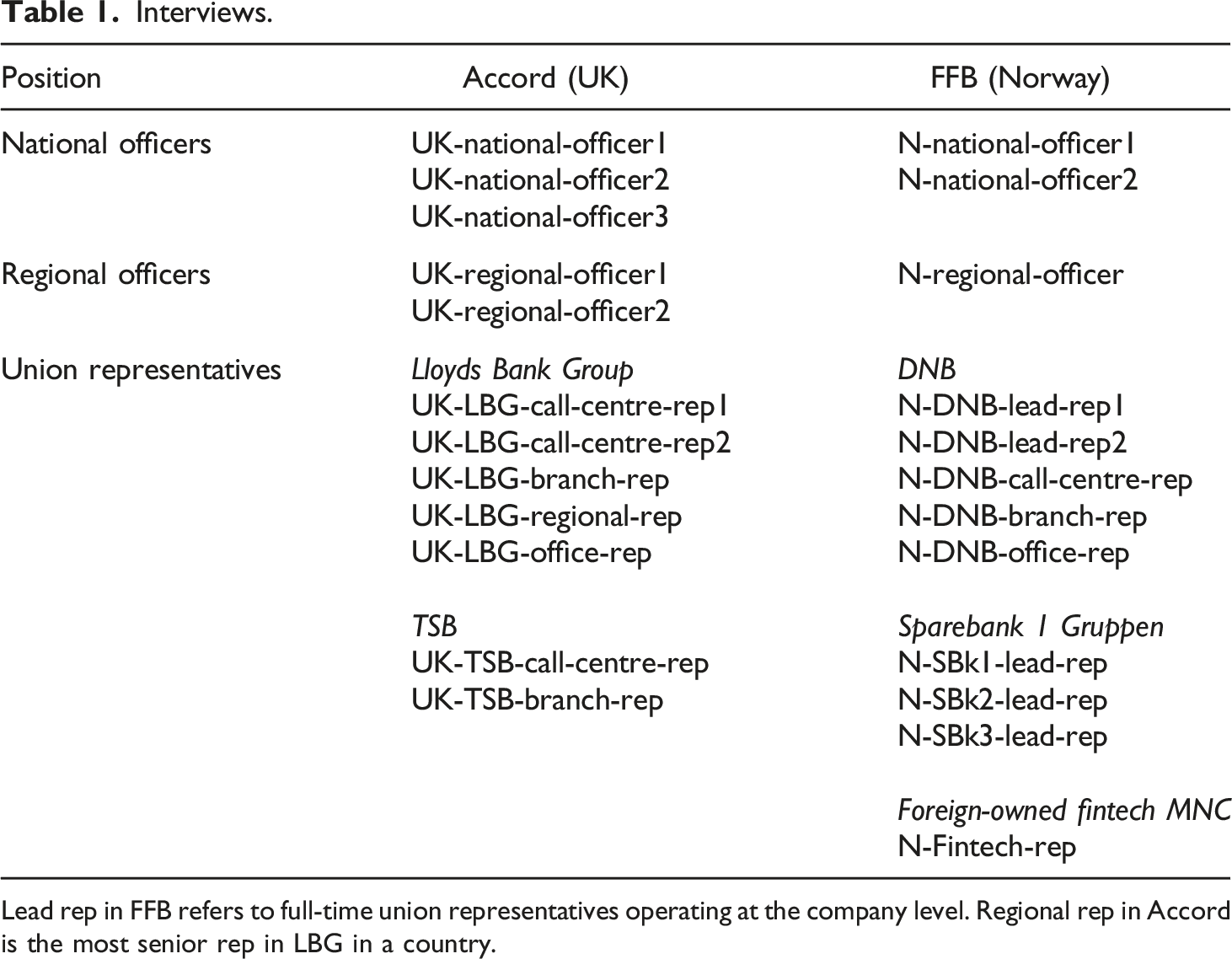
Lead rep in FFB refers to full-time union representatives operating at the company level. Regional rep in Accord is the most senior rep in LBG in a country.
Data were analysed primarily using a deductive approach, with interview transcripts coded according to themes and sub-themes derived from the interview schedules. Some codes were added as a result of patterns that emerged during data analysis, such as the role of data protection legislation and informal union-management relations. Similarities and differences were then identified within and across countries and used to address the core research questions. The next two sections discuss the primary mechanisms through which the two unions sought to influence digitalisation decisions, along with their ability to shape the use of monitoring and surveillance technologies.
Structures of influence
The two unions are different in their approach, organisation and structure. In Norway, FFB works with employers through the various formal mechanisms provided in legislation and collective agreements. The highest level of elected representatives and officers negotiates the main sector agreements with Finans Norge, while lead reps negotiate additional company-level agreements. In the UK, Accord has a broad strategy of informal partnership working which emphasises the importance of building relationships with senior managers. Negotiations and consultations with the banks are centralised and multi-union, led by senior national officers.
Clerical and customer service workers in call centres and branches are often highly unionised in both countries; union density can reach up to 90% in some workplaces, compared to relatively low levels among professional groups and in investment banking. FFB has significantly more resources than Accord, with an estimated 1 union rep per 27 members and 1 paid staff per 500 members, compared with corresponding ratios of 1 to 58 and 1 to 1150, respectively, in Accord. Reps also receive more time-off for union duties. In DNB, for example, there are nine full-time reps, covering around 10,000 members, while most senior Accord reps had time-off agreements of 20–40%. These differences reflect, in part, the role that union representatives play in the two unions. Lead reps in FFB are the main union actors in individual companies; most of those above the lowest level are involved in regular formal meetings with managers, and take on individual member cases. In Accord, national officers assume the main role in negotiations and consultations at company level, with regional officers typically involved in grievance and disciplinary cases. In many cases, there are no meetings between union reps and managers at the workplace.
In Norway, the lead FFB reps across the four banks were generally positive about relationships with employers. Several reps explained that this partly reflected the influence of the ‘national model’. As one commented: You have the organisation, you have the union, and then you have the government, and those are all agreeing on how to make the community the best…The management appreciate us, likes our views and likes the discussions, although we don't always agree. (N-DNB-branch-rep)
Representation on company boards was seen by all the union reps as critical to giving workers a voice and for the union to be involved in discussions around strategy and goals at an early stage. Most lead reps also stated it gave them ‘leverage’ with senior management. we could take the members’ and the union’s voice into the board that makes the biggest decisions, a future strategy for the next few years. (N-SBk3-lead-rep) I think it’s really important because that gives us a lot of leverage to the leaders in the company. (N-DNB-lead-rep2)
The Working Environment Act provides a strong basis for worker representatives’ rights in relation to information and consultation
1
over changes to work organisation and managerial mechanisms to control workers (Section 9-1 and 9-2). The finance sector collective agreements add to this through the right of union reps to be on project groups concerned with ‘information technology’, and to have a joint role in how personal data is stored and used. There is also a requirement for companies to make agreements on the use of systems for obtaining workload and volume statistics. Each company agreement establishes specific rights and processes that are enforceable by law. At DNB, a branch rep explained that high union membership rendered it ‘easy to make good agreements’, with the union having a veto over any form of worker measurement. A call centre rep also stressed the importance of the collective agreement: That’s the first thing, we go to [with management], ‘look, we have an agreement. This is not according to the agreement.’ So, the law is strong, but almost every agreement we have is even stronger. (N-DNB-call-centre-rep)
FFB reps across the banks explained they were always involved in big digital technology projects, in some cases at an early stage of planning, although smaller changes could sometimes be introduced without their knowledge: We have a big project where we need to buy a new big system. So as the union representative I am in that steering group… it’s the leader, top leaders [management] in the company. (N-SBk1-lead-rep)
There’s a lot of situations where we, according to the collective agreement, should have been involved a lot earlier… but they are getting better (N-Fintech-rep)
A key challenge is finding out when smaller-scale technology is being used which requires actively engaged first-line reps across all workplaces. The data suggests the union rep structure is highly organised in FFB with regular meetings feeding up through the different levels. Fortnightly and monthly meetings were reported among reps across the banks. There was some variability among first-line reps, both in their involvement in the union and their role in digital technology changes. More senior reps did not regard this as a major issue as the next level of union reps could ‘catch up’. It was considered relatively straightforward to resolve problems by referring to the collective agreement and the law and, if necessary, by escalating concerns within the company. We have to [say] ‘hey, wait a minute, we want to see what you're doing and the law requires it’… sometimes we have to go to top management and say ‘you have to tighten up your organisation’. (N-DNB-lead rep1)
In the UK, senior officers in Accord described the relationship with both banks as an ‘informal partnership’. A national officer stressed that the union would challenge management if any proposals ran counter to workers’ interests. The bank is a better place if it’s stronger, [we are] not standing in the way of progress… the counter-side to that is they know full well [we] will challenge them vigorously, when we think that challenge is right. (UK-national-officer3)
Accord has collective agreements with LBG and TSB, including provisions to negotiate and consult over job security and performance management, although there is nothing specifically around technology. The union officers emphasised the importance of the job security agreements in dealing with employment decline. Since the start of the Covid-19 pandemic, the union had been meeting weekly with management to discuss ways to mitigate job losses associated with branch closures and business restructuring. These meetings focused on redundancies and redeployment rather than influencing digitalisation processes.
Senior management also meet with national officers a few times a year to be briefed on business plans. Along with general consultation over employment policies, a union officer felt there was ‘an extraordinary level of engagement’, without which ‘it’d be rougher… more process-driven and numbers-driven’ (UK-national-officer1). Apart from regular meetings over potential job losses, however, there were no formal mechanisms for consultation around the use of technology. Although companies would generally inform the unions about larger digital technology projects, one officer acknowledged that union influence was limited: ‘I’m struggling to think of an event we have shaped in the technology space’ (UK-national-officer3). Another stated that the union provided ‘insights’ and would highlight ‘some potential downstream consequences’ for workers that management needed to consider when implementing new technology (UK-national-officer1). Overall, the view from union officers was that managers typically presented technology changes after decisions had been made. They won’t ask us, ‘Is it okay?’ Not quite that good. But they will... come up with what they want to do… sometimes I think it would be nicer to be involved a bit earlier. (UK-national-officer2)
As Accord focuses on centralised discussions with company management, there is little opportunity for workplace reps to be involved. Most reps felt they had no influence over digitalisation. No, we’re not consulted… Sometimes we will be given a heads-up [from the union]… that the bank is looking at a major change. But routine technology coming in… we wouldn’t tend to get notified. (UK-LBG-call-centre-rep1)
The data shows distinctive differences between the opportunities and processes available for the two unions to influence digital technology decisions. Although union interviewees in both countries emphasise relationship-building and cooperation, union involvement in Norway emerges as both more extensive and stronger. The next section examines whether this translates into different outcomes in relation to digital monitoring and surveillance.
Monitoring and surveillance
The use of digital technology to monitor workers was a major concern for both unions. FFB has actively resisted the introduction of technology that can be used to undermine privacy, intensify work, and identify ‘under-performers’. While Accord does not have the legal or collective agreement supports that FFB enjoys, it has also attempted to reduce new forms of monitoring. How successful have these unions been in improving worker outcomes in this area?
Norway has among the strongest data protection laws in the world, particularly in relation to video and audio recording. The only use of audio recording mentioned was for meetings with customers about investments, which is mandated by financial regulations. For other forms of monitoring that can identify individuals, such as number of calls taken, a local collective agreement is required. In many cases, union reps described how they had restricted the use of individual performance management at the local level. [when] they try to introduce public measuring, I make contact with the director and say… ‘there has to be a 100% agreement anonymously in the department for them to establish it’… [local managers] usually don’t dare to do anything else because they know the discussion will go above their head. (N-DNB-branch rep1)
Most FFB reps had made local agreements allowing managers to collect certain types of data and to measure group indicators. At SBk1, for example, the agreement enabled data to be collected on a team basis only. Similarly, at a DNB call centre, there were agreements about which data could be collected and its use, with the union exercising a ‘veto’. The union has said that we don’t want to count how many things each member does during a day... So, you’re making it less convenient to go to each separate member to take them and talk to them about how bad their work is. (N-DNB-call-centre-rep) ‘How many problems are you [dealing with] during one day? How many times have you been to the toilet… been out smoking or whatever?’ That’s one of the things we are working to stop. (N-SBk3-lead-rep)
At a DNB call centre, union reps had successfully reversed the use of a work management package which monitored workers against expected times for each task. The case was taken to the Data Inspectorate which ruled against the company. The union combined the legal case with a successful ‘name-and-shame’ campaign, with the national and international press widely reporting that employees only received ‘8 minutes for the toilet each day’ (N-DNB-lead rep1).
In UK call centres, the recording and monitoring of service transactions has been endemic for years, along with the use of the data to reward and discipline individual staff. Every single system that I log into, every customer interaction that I do, every refund that I do… is monitored and logged somewhere… it has been viewed in the past for colleagues that have gone down the disciplinary route. (UK-LBG-call-centre-rep1) There was a huge backlash against it, because they [branch staff] did see it as being Big Brother is listening to us. (UK-regional-officer2) It feels to me a bit of a sledgehammer to crack a nut. There may be a few people that don’t sell things very well perhaps, but now every single interaction is being recorded. (UK-national-officer2)
Union officers attempted to push-back against these changes, but had not received sufficient backing from the wider membership. Interviewees explained that some members felt that recordings offered protection against customer complaints. Nevertheless, the union was able to pressurise management to remove video recording of customer meetings following complaints from many staff. As one rep explained: ‘it’s now reverted back to recording them verbally instead of being filmed’ (UK-LBG-call-centre-rep1). In some cases, audio recording of calls in branches and bank offices were reduced following local rep intervention.
Accord reps typically had little role in the introduction of these forms of controls and focused instead on limiting their negative effects. One explained that they had been able to restrict who had access to the data and ensure it was only used for coaching rather than as a ‘stick’ (UK-LBG-regional-rep). Three reps covering call centres stated that they could not influence targets, but two of them claimed to be actively confronting managers if undue pressure was placed on workers. This could involve ‘a conversation’ with the manager and, if that failed, going ‘down the grievance route’ (UK-TSB-call-centre-rep1), in some cases on the grounds of excessive ‘stress’ (UK-LBG-call-centre-rep1).
In contrast to Norway, Accord’s ability to use data protection legislation to restrict surveillance appears more limited. A case of secret video recording of branch staff by ‘mystery customers’ at LBG was taken to the Information Commissioner’s Office as a breach of data protection law. Although the union felt they had a strong case, the Commissioner ruled against them. As one union officer exclaimed: ‘I was, like, “I can’t believe this,” you know, big business talks a lot louder than a relatively small trade union’ (UK-national-officer2). While the bank did draw back from covert recording, the union is concerned that digital surveillance will continue to creep forward as there are no limits in the collective agreement, and the law is relatively weak and opaque. Another issue that was noted is that if workers do not challenge surveillance, it can become normalised, such that ‘the accepted level has shifted’ (UK-regional-officer-1).
The findings indicate that attempts by management to extend recording in the UK have been opposed by Accord. Despite some limited success, the union is still faced with enhanced levels of surveillance. In Norway, FFB has been relatively successful in restricting forms of individual digital monitoring that can be linked to performance management, making it more difficult for managers to intensify work and pressurise individual workers.
Discussion
In exploring ‘country effect’, we first sought to uncover how FFB and Accord attempt to influence management decisions around digital technology given differences in their national institutional and regulatory contexts. Representation on the board, the Working Environment Act and collective agreements that contain rights to consultation over technological change are important elements of the Norwegian system. FFB were able to draw on these supports to secure significant involvement in digital change, with evidence of widespread engagement of union reps at company and workplace level. In the absence of a supportive institutional environment in the UK, Accord has to rely on voluntary collective bargaining and weak legislative provisions. Despite having collective agreements with the two banks, there are no formal agreements over technology and little involvement of workplace union representatives in its introduction and use.
Given these different processes, the next step was to examine the effectiveness of the unions in shaping work outcomes, focussing specifically on their ability to limit digital monitoring and surveillance. In the UK, call centres have a long-established reputation for using intensive control mechanisms, including the recording of calls (Taylor and Bain, 2001), whereas these have been relatively restricted in Norway (Eurofound, 2020). Accord focuses on trying to persuade management to refrain from extending monitoring on the grounds that it damages worker motivation and customer service.
In Norway, FFB has negotiated sector and company collective agreements, underpinned by legal protections in the Working Environment Act and data privacy legislation, that restrict the use of such monitoring and surveillance. These agreements offer enhanced rights to negotiate and, in some cases, a ‘veto’ over their use. Research in the IT sector indicates that Norwegian unions are not always able to achieve these enhanced agreements (Doellgast et al., 2023). In most of the banking cases in our study, outcomes emerge as substantially better in Norway than in the UK. Digital technologies, while often enabling individual data to be collected, were rarely used openly to measure worker performance. The recording of calls was also extremely limited.
Recent research across a range of sectors in Norway suggests limited resistance or concerns by union reps about the monitoring potential of digital technologies (Bråten et al., 2023). However, this was not reflected in our research, where the reps recognised the ‘invisible’ nature of data collection and the importance of challenging its use. While FFB could prevent overt control mechanisms being introduced, there was little evidence of union involvement in the design or selection of technologies in either country.
We can identify two main mechanisms through which institutional power contributes to country differences: first, formal rights and, second, the role of workplace representatives. In Norway, formal rights enable FFB to make strong sectoral agreements that lay the foundation for specific company and workplace agreements requiring union involvement in technological change. In the UK, despite Accord having collective agreements with the two banks, it lacks any formal rights and has to rely on its own resources if it is to try and influence digitalisation. These findings are broadly consistent with the view that neo-liberal economies will generally ‘encourage more employer discretion over technology adoption and associated restructuring decisions’ (Doellgast and Wagner, 2022: 444), compared with countries where unions have stronger institutional supports.
There are also country differences in the supports available for trade union representatives and the rights related to their role which impact on their respective levels of associational power. Union reps in Norway have co-determination rights which provide a basis for negotiation, consultation and involvement at different levels within a company, including over technology. In banking, reps had access to considerable resources, including significant facilities from employers in terms of time-off, along with training, legal and technical support from FFB. In contrast, Accord has no formal rights for union representatives to meet or consult with management. Time-off facilities were far more limited, as were union resources. The emphasis was on top-level interactions between Accord senior officers and company management rather than enhancing the role of workplace reps. Senior reps in FFB, therefore, have more time and capacity to engage with digital change. Workplace reps in FFB are also expected to negotiate local agreements and have regular meetings with management. This provides opportunities and incentives to develop their knowledge of digital technologies in order to engage in the process. In Accord, many workplace representatives have little role in relation to technology, which may partly reflect the lack of statutory rights or sectoral institutional supports for involving shop stewards in workplace changes.
In explaining why FFB has more involvement and influence in digital change than Accord, it is critical to look beyond national institutional and regulatory conditions and consider the relative power and capacity of unions within specific sectors and workplaces. In other sectors in Norway, such as hospitality and retail, unions have struggled to draw on national institutional supports to shape digitalisation (Alsos and Trygstad, 2018; Payne et al., 2023). In these sectors, workers lack structural power (Wright, 2000) due to their ease of substitutability and low skill requirements, and unions confront employers reluctant to involve them in technological change. In banking, unions have greater structural power due to a relatively skilled workforce and the sector’s critical role in the economy. FFB has a strong membership base, substantial resources and has been willing to use strike action on occasions (although not over technology). As well as structural power, it has a level of associational power that makes it difficult to ignore.
Despite similarities in members’ occupations, Accord might be said to have less structural power. It is a small union and is heavily reliant upon the support and success of the two banks where it has members, whereas FFB operates across the sector. Accord also faces strong competition from other unions and has never resorted to strike action. Notwithstanding an informal partnership approach that has delivered high union density, this has not translated into strong associational power. Nor has Accord developed the type of active workplace representative system that might enable more decentralised engagement with technological change.
These findings echo certain themes that were identified from other studies. In Norway, FFB has been able to adapt institutional arrangements to address the challenge of digitalisation in the workplace (Gasparri and Tassinari, 2020). Although this article does not specifically focus on knowledge and resources, strong workplace organisation and union reps having sufficient time and facilities to engage also emerge as important. Company differences in Norway were less apparent than in research examining other sectors (e.g. Cirillo et al., 2020) which may reflect the high degree of sectoral coordination. Some differences were found between the two banks in the UK, but more robust conclusions would require research involving a union operating across multiple banks. A theme that emerged that is not considered extensively in the wider literature concerns the relationship between formal and informal union engagement with management (for an exception, see Doellgast et al., 2023). Embedded and interrelated systems at multiple levels were found to be important in the Norwegian banks in dealing with digitalisation. This merits further research in other countries and sectors.
Conclusion
This article explores country differences in the ability of unions to shape digitalisation. Through a comparison of two unions in the banking sector in Norway and the UK, it finds evidence of a strong ‘country effect’ with greater union involvement and influence in Norway. The findings make an important contribution to analysing unions’ role in shaping digitalisation at the workplace and identifying factors that enable or constrain union influence.
By adopting a multi-level analysis that incorporates national institutions, union power and resources (Gasparri and Tassinari, 2020, Lloyd and Payne, 2021), the research demonstrates the inter-relationships between these different elements. At the national level, the strength of labour institutions and regulations in Norway derives from the long-term, embedded societal power of organised labour (Heiret, 2012), which has held up relatively well compared to many other European countries (Baccaro and Howell, 2017; Gumbrell-McCormick and Hyman, 2013). These provide an underpinning system of supports and protections for Norwegian unions and workers that are not available in the UK where unions have been weakened and marginalised over several decades. This ‘system’ means that Norwegian unions also have more financial resources available to them. Whether they are able to deploy these supports to influence digitalisation, however, depends on the organisational capacity and strength of unions in specific sectors and workplaces.
The research demonstrates that the Norwegian model of local collaborative working can be adapted to deal with digitalisation and exists beyond examples identified in its manufacturing sector (Dølvik and Steen, 2018; Lloyd and Payne, 2021; Rolandsson, 2020). It is possible that in other well-organised parts of the service sector in Norway, unions may also be able to influence digitalisation. The same might apply in other countries with supportive national institutions. Critical is effective workplace organisation and the ability to extend and adapt existing workplace and company arrangements, as with examples found in manufacturing (Cirillo et al., 2020; Gasparri and Tassinari, 2020; Haipeter, 2020). Further research would be needed to confirm these propositions.
The research challenges the view that national outcomes are converging (Baccaro and Howell, 2017) and underscores the continued salience of ‘country effect’. Institutions still matter for unions’ ability to shape technology outcomes. It also emphasises the importance of addressing the sector (Bechter et al., 2012) and the need for national institutional supports to be supplemented with strong union organisation and resourcing if they are to be effective. The lack of enabling institutional supports in the UK limits banking unions’ ability to influence decisions around the use of technology, although the question remains whether unions might secure more involvement by adopting a proactive ‘bottom-up’ approach.
This research is limited in that it focuses on two banking unions in Norway and the UK and addresses their influence on digitalisation outcomes only in relation to monitoring and surveillance. Further research is required to examine the role of other unions in banking as well as to extend this type of analysis to other countries and sectors. International comparative research certainly does not provide easy answers to the challenges unions face. By uncovering when and why unions make a difference, however, it remains vital in countering the pessimism that can easily overtake contemporary discussion of unions’ role in the social shaping of technology.
Footnotes
Acknowledgements
The authors would like to thank the Accord and Finansforbundet union officials and representatives for their involvement and contribution to the research project. Thanks are also due to Dr Secki Jose for assistance with the interviews, and the anonymous referees for their helpful comments.
Declaration of conflicting interests
The author(s) declared no potential conflicts of interest with respect to the research, authorship, and/or publication of this article.
Funding
The author(s) disclosed receipt of the following financial support for the research, authorship, and/or publication of this article: This work was supported by the Leverhulme Trust (RPG-275).
