




Abstract
The global expansion of the platform economy raised questions about where and by whom different forms of platform work are performed in Europe. This study focuses on microworking – that is, where an anonymous ‘crowd’ completes piecemeal digital work. Specifically, we address two questions about microworking in the EU-27: Where is microworking performed? Who is performing it? Based on the geolocation of 5,239 workers active on six prominent microworking platforms, we identify variation in the relative prevalence of microworking across the EU. Furthermore, we build on existing research to provide a more granular understanding of different classes of microworkers, in terms of diversity and (income) dependency. Four distinct classes of microworkers emerge through statistical modelling of eight relevant diversity and dependency indicators: age, gender, education, citizenship, experience, hours per week, personal income earned, household income. We label these classes Explorers, Enthusiasts, Supplementers, and Dependents. The identification of these emergent classes and varied prevalence of microworking across the EU, suggest the importance of heterogeneity to both the future study and regulation of microwork.
Introduction
The proliferation of digital labour platforms has brought the ‘gig’ or ‘platform economy’ into the public mainstream (Huws, 2016; Kenney and Zysman, 2016; Vallas and Schor, 2020). While platform economy proponents touted the collaborative and progressive potential of these new transformations and models (Kuek et al., 2015), researchers and legislators are increasingly concerned about the isolating and precarious working conditions many platform workers face (Aloisi, 2022; Bucher et al., 2021; Georgiou, 2022; Gray and Suri, 2019; Newlands, 2021). However, regulating platform work has proven less than straightforward, due in no small part to its poor fit within established legal frameworks (Garben, 2021). For example, current efforts seeking to redress the misspecification of worker relationships (European Commission, 2021) are complicated by the multijurisdictional nature of the platform economy. Citing insufficient awareness of where platform work is performed, by whom it is performed, and under what conditions (European Commission, 2021: 3), national authorities are at a particular disadvantage when identifying social security responsibilities and enforcing existing obligations covering participants, especially regarding geographically dispersed and largely hidden online forms of platform work (Borghi et al., 2021).
This is especially true of microwork, a form of platform work wherein digital labour requests are outsourced to an undefined pool of labourers. This paper considers a distinct form of microwork known as microtask, clickwork, or simplymicrowork (Berg et al., 2018; Duggan et al., 2019; Pap and Mako, 2020; Webster, 2016). This focus is important, as recent evidence suggests this work is the most frequent type of platform work (Piasna et al., 2022), though hidden from the public eye (Gray and Suri, 2019), in contrast to other forms of platform work, such as ride-hailing or delivery. In addition, even less is known about European microworkers compared to microworkers in other geographic regions, such as the United States and India (see Berg et al., 2018; Joyce et al., 2020). This study addresses questions of where and by whom microwork is performed in Europe. In doing so, this study identifies where microworking is relatively prevalent and provides a classification of workers based on several indicators describing the diversity and dependency of these workers in relation to microwork, seeking to make two important contributions. First, by locating where this work is performed, we demonstrate that the prevalence of microworking in Europe is neither uniformly distributed nor does it simply follow from the general population density. This suggests some geographical areas may be more conducive to microwork than others and highlights the contextual importance of geographic location to microworking. This is important because current regulation efforts are most often executed at the national level through national courts. As the EU proposes broader directives to improve platform working conditions, it remains a salient question of where and under what contexts these policies will need the most urgent translation.
Second, we present a classification of the diversity and dependency of microworkers, highlighting the heterogeneity characteristic of the workforce. Scholars have called for an increased investigation into the heterogeneity among workers across different forms of platform work, specifically microwork (Eurofound, 2018; Schor et al., 2020; Vallas and Schor, 2020). This is important as neglecting this heterogeneity may lead to the misspecification of the lived experiences of microworkers (Vallas and Schor, 2020) and inadequate understandings of divergent worker subjectivities (Lee, 2021). Explicitly, this study combines diversity indicators – age, gender, education, citizenship (Berg et al., 2018; Chen et al., 2019) – and dependency indicators – experience, personal income earned from microwork, and number of hours per week spent on microwork (Berg et al., 2018; Piasna and Drahokoupil, 2019; Schor et al., 2020) – identified in earlier work. We add to these indicators a contextual indicator in the form of household income, calculated to account for varying household averages across the EU. In contrast to earlier classification attempts, we statistically derive probability classes using Latent Class Analysis (LCA). Hence, we extend the scope and approach of earlier classifications (e.g., Dunn, 2020; Joyce et al., 2020). In doing so, we generate insight into the existence of different classes of microworkers within a heterogenous workforce, laying a foundation for further exploration of specific lived experiences of workers performing microwork.
Microwork in Europe
Microwork refers to the crowdsourced distribution of online tasks which APIs ‘unbundle’ into microtasks (Pesole et al., 2018), often including surveys and piecemeal work supporting AI development or on-demand operations; data sorting, labelling, or translation services – forms of work intimately tied to recent concerns regarding ‘ghost work’ and the hidden human labour platforms depend upon to fuel the broader AI enterprise (Duggan et al., 2019; Gray and Suri, 2019). Currently, the US and India field most platform work requests and workers, though participation in Europe has been rising steadily (Van Dijck, 2021). There are several significant efforts identifying where and by whom platform work, broadly defined, has been performed in Europe (Fabo et al., 2017; Huws et al., 2019; Pesole et al., 2018; Piasna and Drahokoupil, 2019; Urzi Brancati et al., 2020). However, rarely has microwork been the focus, decoupled from broad definitions of internet and platform work (see Berg et al., 2018; Joyce et al., 2020). By concentrating on microwork, this study furthers understanding of the individual context of different workers conducting this particular form of platform work in Europe.
Geographical densities of microworkers
Although microwork is often considered ‘placeless’ by design, as platforms build expansive international labour pools, Lehdonvirta (2016) argues that ‘in practice it is still performed by workers who live somewhere in the world, not in the metaphorical cloud’ (p.59). Understanding where microwork is conducted within the EU is thus important because workers in different nations are subject to different contexts – for example, the availability of platforms and local economic conditions. For example, some international platforms have historically prohibited account creation among workers in certain countries (e.g., Amazon Mechanical Turk), while the availability of smaller, regional platforms is often circumscribed by design, offering tasks in local or regional languages. Certain economic and legal contexts also limit platform availability, as local policies and regulations vary across the EU (see Donini et al., 2017; EU-OSHA, 2022).
In 2017, the European Commission’s Joint Research Centre (JRC) published a snapshot of 200 European and international labour platforms active in the EU and the United Kingdom (Fabo et al., 2017). They found the availability and selection of platforms (not limited to microworking) were consistently higher and broader in larger western EU countries (e.g., Germany, France, Spain) than in smaller states on the periphery (e.g., Portugal, Greece, Latvia). The JRC supported further exploration of digital platform labour, conducting two waves of the COLLEEM survey (Pesole et al., 2018; Urzi Brancati et al., 2020). Alongside the findings of Berg et al. (2018), that microwork is primarily an urban activity with 80% of workers globally coming from urban or suburban areas (p.31), the COLLEEM studies suggest microwork in Europe is a primarily urban form of employment, most prevalent in the larger economies of western Europe. However, using data from 14 surveys across 13 EU countries, Huws et al. (2019) counter the trend for western Europe to be the dominant region for platform work, highlighting central, eastern, and southern European countries (i.e., Czechia, Slovenia, Italy, Spain), where they find the highest levels of online income generation (a measure including consolidated forms of platform work), which they attribute to poverty (absolute versus relative national averages) (p.4). While subsequent studies contested Huws et al. (2019) (see Piasna and Drahokoupil, 2019: 18), the prevalence of microworking across Europe remains unclear. This study goes beyond earlier attempts by extending the scope to all EU-27 countries. For instance, Huws et al. (2019) and Piasna et al. (2022) included 13 and 14 countries, respectively. In addition, we focus specifically on microwork as opposed to Internet users earning money online (Piasna et al., 2022). Hence, we pose the following research question:
Where in Europe do we find the largest densities of microworkers?
Classifying microworkers
Efforts to classify platform workers have split four ways. Those that include multiple forms of platform work (Dunn, 2020; Pesole et al., 2018; Piasna et al., 2022; Schor et al., 2020; Urzi Brancati et al., 2020); those that focus on a particular form (Gray and Suri, 2019; Joyce et al., 2020); those that focus on platform dependency (Gray and Suri, 2019; Pesole et al., 2018; Piasna et al., 2022; Schor et al., 2020; Urzi Brancati et al., 2020); and those incorporating additional indicators of worker diversity (Dunn, 2020; Joyce et al., 2020).
Pesole et al. (2018) classified respondents in three categories: those earning 50% or more and/or working more than 20 h per week performed platform work as main or very significant job; those earning at least 25% of their income (but less than 50%) and/or working at least 10 h per week performed platform work as significant but not main work; those who did not earn at least 25% of their income nor worked at least 10 h per week performed not significant platform work (p.21). Analysing COLLEEM 2018 Survey data, across 16 EU countries, Urzi Brancati et al. (2020) categorized respondents according to ‘frequency, hours and income generated from platform work’ (p.3). They classified respondents into four categories: main platform workers, working more than 20 h per week or earning at least 50% of their income, at least monthly; secondary platform workers, working 10–19 h per week and earning between 25 and 50% of their income, at least monthly; marginal platform workers, working less than 10 hours per week and earning less than 25% of their income, at least monthly; and sporadic platform workers, working on digital labour platforms less than once a month over the last year.
Piasna et al. (2022) investigated use of the internet for income generation across the working populations of 14 EU countries (age 18–65), defining platform work as a ‘subset of internet work’ that ‘only includes work done on online labour platforms’ (p.13). They also categorized respondents into four categories. Internet workers included those who ‘provided internet work over the past 12 months’; platform workers, those internet workers ‘[carrying] out this work through a digital platform’; main platform workers, for whom platform work formed a ‘significant part of their working lives’, working more than 20 h per week or earning more than 50% of their income on digital labour platforms; and lastly, those having never done internet work (p.14).
These inclusive categorizations present mixed descriptive findings as platform work dependency increases: for all, the dependent population is smaller relative to the overall platform workforce; some find increased representation of foreign-born workers (Piasna et al., 2022), while others find the opposite (Urzi Brancati et al., 2020); all find fewer women than men at more dependent levels, but there are mixed results for the presence of older workers, especially older women (see Pesole et al., 2018; Piasna et al., 2022); and most find that education levels increase (Pesole et al., 2018; Urzi Brancati et al., 2020), though Piasna et al. (2022) find a decrease in education level among the most dependent platform workers.
Less common are holistic worker categorizations that include indicators of diversity, such as workers’ socio-demographics, motivations, or intentions. Dunn (2020) qualitatively considers themes of worker motivation and orientation, in addition to dependency indicators (e.g., financial precarity, hours worked), for workers across rideshare, task/delivery and online-freelance forms of platform work (p.238). Workers are then grouped into five categories – searchers, lifers, short-timers, long-rangers, and dabblers – with searchers identified as the most precarious group, involuntarily but heavily dependent upon platform work, working increased hours per week while seeking more permanent employment (p.239). Schor et al. (2020) investigate the explicit role of economic dependency in workers’ experiences, considering ‘platform experiences vary by the extent to which providers rely on the platform for their primary earnings’ (p.841). Based on interviews with workers providing different in-person services (i.e., housing exchange, ridesharing/hailing, general labour services), they present three categories of increasing dependency – supplemental earners, partially dependent earners, and dependent earners. Workers least dependent upon platform earnings for regular income or basic expenses reported higher levels of satisfaction and ‘better experiences’ (p.841), while those more reliant on their earnings felt less in control and ‘experience their situation as more precarious’ (p.843).
These categorizations form an important foundation for understanding heterogeneity among platform workers. Lee (2021) highlighted that ‘heterogeneity is salient for understanding divergent worker subjectivities’ (p. 1). For instance, economic and social impacts upon workers that are more financially dependent on gig work may be more severe or present greater anticipated work commitments than formally required or implied in microwork (Lee, 2021). Examples of classification efforts include the works of Gray and Suri (2019) and Joyce et al. (2020), both of which discuss specifically the form of crowdwork known as ‘microwork’. Gray and Suri (2019) interviewed workers in the US and India active on the crowdworking platform Amazon’s Mturk. Based on frequency and intensity of work, they categorize workers as experimentalists, working on platforms only briefly before leaving; regulars, reliably returning to platform work, though only for intermittent periods; and always-on, performing such work ‘as full-time jobs’ (pp.104-105). Joyce et al. (2020) explore platform dependency across differences in motivation, job quality, and access to social protections for workers from multiple countries, active across four ‘clickwork’ platforms. They make two distinctions, categorizing workers as work-dependent if they only work on platforms, or as non-dependent if they hold one or more additional jobs (p.168).
Building on these efforts, this study combines selected indicators of diversity and dependency identified in earlier research. Taken together, the eight indicators may provide a more holistic classification for furthering understanding of how European microworkers experience the conditions of this oft-problematized work (Vallas and Schor, 2020). Hence, we examine the following research question:
Method
Procedure and sample
Collection of geolocation and demographic data was conducted via a distributed survey posted to international digital labour platforms between 02 November and 20 December 2021, compliant with the university’s institutional review boards policy. General aims of the study were communicated to respondents via the initial instructions in the survey: ‘We are conducting research on platform work and are specifically interested in a) who in Europe is performing micro/crowdwork, and b) where is this done’. The survey included a ‘pinning-task’ where respondents could indicate where they were located on the map to their level of comfort. This pinning task was embedded in the survey (Chen et al., 2019; Gray et al., 2016; Kingsley et al., 2015), and self-reported geolocations were cross-checked with IP address geotags. Questionnaires also included various socioeconomic and demographic questions to identify different types of microworkers.
Our sampling strategy aimed at reaching as many diverse workers as possible. Therefore, we offered our survey on six widely used international platforms, consistently available across the 27 EU member states – that is, Amazon’s Mturk, Microworkers, Clickworker, Appen, Picoworker, and Toloka. The survey was offered as a survey task on these platforms, while also ‘hidden’ in image labelling and sentiment analyses tasks to reach a potentially more diverse pool of European workers. The survey was offered in English, the prevailing language of operation on the largest international platforms, used by platforms to manage platform functions and interactions. English is also the most common language in which tasks are supplied by requestors and completed by workers. In line with fair wage practices, the compensation rate was based on the estimated length of the survey (i.e., 6 minutes) (Aguinis et al., 2020; Silberman et al., 2018). Completion times averaged under five and a half minutes (315 s) across the different task vehicles, and workers were compensated €1,00 for completion, for a compensation rate of €11,40 per hour. Finally, the survey included attention checks and CAPTCHA validations to ensure response quality and reduce the risk of auto-completion.
Microworker demographics and relative density per country.
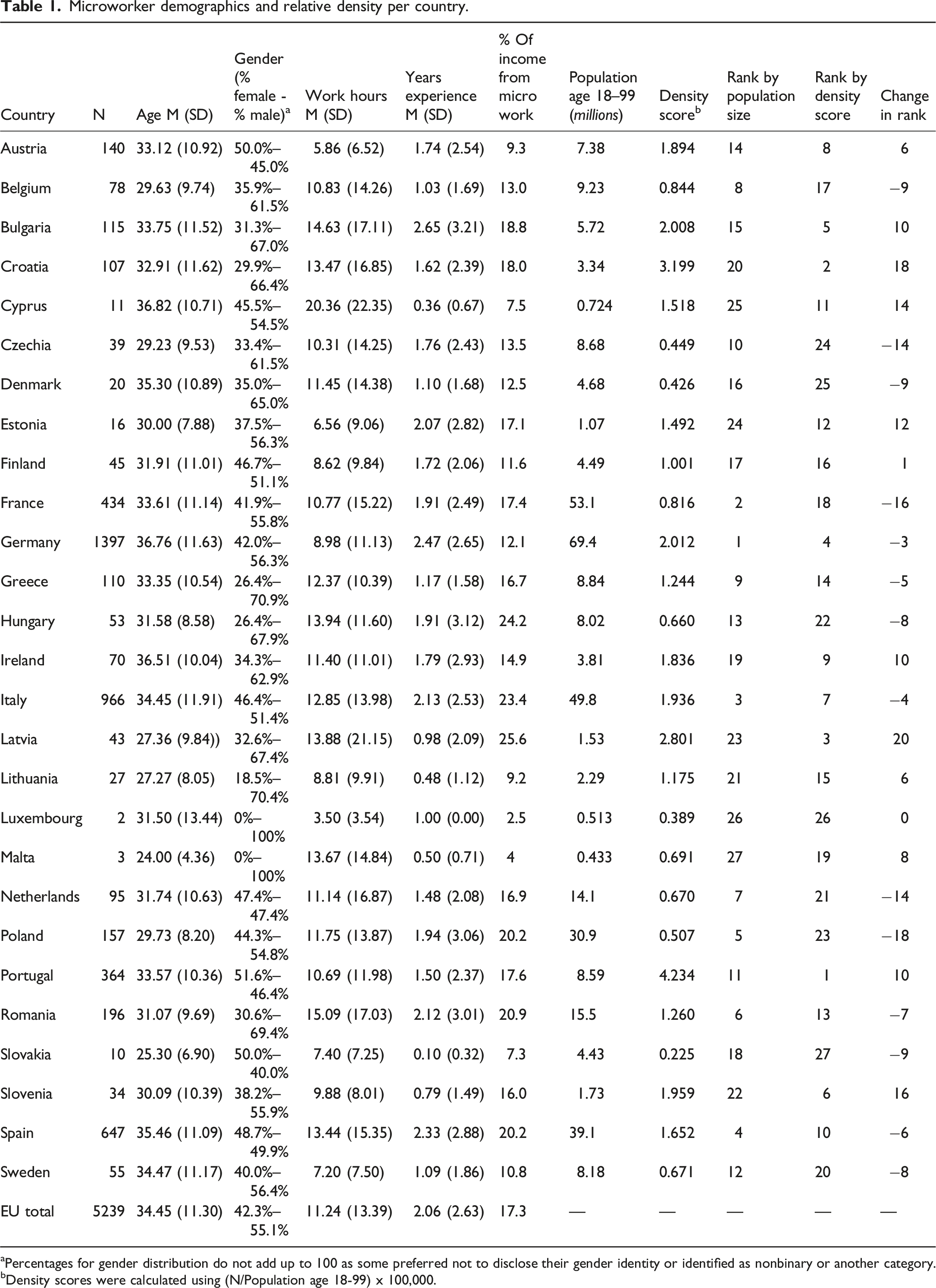
aPercentages for gender distribution do not add up to 100 as some preferred not to disclose their gender identity or identified as nonbinary or another category.
bDensity scores were calculated using (N/Population age 18-99) x 100,000.
Measurement and treatment
After signing the informed consent and completing the CAPTCHA, respondents were asked to pin their location on a map of Europe. Using Google Maps integration in the survey, respondents could indicate their location by dragging a pin to their location or typing their location in the search field of the map. Respondents were asked to indicate their age, their average weekly hours spent working through digital platforms, and the percentage of their personal income derived from platform work, in addition to the number of years they worked through online labour platforms. These questions were used as continuous indicators to identify latent classes of workers.
Several categorical variables were also included in the questionnaire, relevant to identifying latent work types. As aforementioned, extant research suggests this type of work is often conducted by individuals experiencing some distance from traditional labour markets (Joyce et al., 2020); individuals with lower levels of education, individuals without citizenship status in their country of residence (Urzi Brancati et al., 2020). We used a binary indicator splitting high school graduates (0) and individuals with more advanced qualifications (1) – for example, college and professional qualifications. Respondents could also indicate whether they held a citizenship status in their country of residence and work (1) or not (0). Furthermore, another critical indicator of worker type might be the overall household income, as individuals from households with relatively low incomes could represent workers more dependent on platform work. Since average household incomes differ substantially across EU member states, we used Eurostat data 1 to create a country balanced binary income indicating whether a respondent’s household income was above (1) or below (0) their respective country’s national average. Finally, we used a binary indicator for gender, female (1) male (0).
Analytical approach
Our study explores unobserved subgroups of microworkers based on diversity and dependency indicators. We use Latent Class Analysis (LCA) as an inductive technique to uncover latent classes of workers. Specifically, we estimate a mixture model of LCA (Spurk et al., 2020) in Mplus (Muthén and Muthén, 2017) on a set of four continuous observed indicators (i.e., age, platform work experience in years, average weekly hours spent working on platforms, percentage of personal income derived from platform work) and four binary indicators (i.e., citizenship status, gender, household income, and education level). Models were estimated using a full information maximum likelihood estimator. The purpose of the LCA is to categorize microworkers into classes using the observed items that best distinguish between classes (Nylund et al., 2007). Specifically, we sought to identify a) how many and which profiles are in the data, b) what predicts class membership, and c) how prevalent is each class. Generally, LCA is used to explore population heterogeneity by identifying homogeneous subpopulations – that is, latent classes – sharing a similar pattern. By estimating probabilities of observed responses conditional on class membership, the analysis demonstrates a posterior probability for each microworker to belong to a latent class.
We began by testing the assumption that there is only one group (class) of microworkers. Subsequently, we systematically estimated models using two, three, four, and five different classes, seeking the best solution (Asparouhov and Muthén, 2014; Vermunt and Magidson, 2002). Solutions are compared based on fit statistics (i.e., Bayesian information criterion (BIC) and Akaike’s information criterion (AIC)) and theoretical interpretability. Generally, for goodness of fit statistics, lower relative BIC and AIC values indicate an improved model fit (Nylund et al., 2007). However, a class with superior fit statistics might not be helpful if it lacks theoretical sense (Weller et al., 2020). In addition, we inspect the likelihood-based tests – that is, the Vuong–Lo–Mendell–Rubin adjusted likelihood ratio test (VLMR-LRT) and the bootstrapped likelihood ratio test (BLRT) – which provide a p-value indicating whether adding a class leads to significant model improvement. In short, these tests compare the model fit between two nested class models – that is, a model with three classes to a model with four classes. A non-significant p-value for a k-class solution thus supports the k-1 class solution (see Nylund-Gibson and Choi, 2018).
Results
RQ1: where in Europe do we find the largest densities of microworkers?
Our first aim is to provide more insight into where microwork is conducted within the European Union. Unsurprisingly, population sizes of the respective countries are also represented in the number of microworkers. Complementing the absolute numbers, the relative density of microworking in the EU is provided in Table 1. We calculated relative density of microworkers per 100,000 using Eurostat population data ([DEMO_PJAN]) for the age range of our survey (18–99) rather than working population (limited to 75 and below) or total population (includes 0–17). We provide separate country rank orders – one based on population size, the other on density score. Most interesting is the difference between these rankings, as it informs us about whether microwork is particularly prevalent or rare relative to the population size.
We find that countries with relatively low population-based rankings consistently rank higher when considering density of microworking. Comparing the density of microworking to the general population density, positive changes (+) in rank scores indicate more microworkers are represented than would be expected based on population size, and negative scores (−) indicate fewer workers than expected. Where there is no change (0), microworking density follows as expected based on population size. Notably, only one country (Germany) is present in the top five of both rank orders. In order of population size, the top five countries are Germany, France, Italy, Spain and Poland. When ranking in order of density of microworking the top five countries become Portugal, Croatia, Latvia, Germany, and Bulgaria. Of particular interest, while Latvia climbs to the top five, Poland slips to the bottom five with large positive and negative changes in rank, respectively.
Moreover, Portugal (n = 364) seems slightly overrepresented relative to their population, as countries with equal population sizes (approximately 10 million inhabitants) were less well-represented in our sample – for example, Sweden (n = 55), Czechia (n = 39), Greece (n = 110), and Hungary (n = 53) (see Table 1). Reported scores represent an admittedly coarse but unique effort to identify where microworking is prevalent within the EU-27.
RQ2: What different groups of microworkers can be identified according to indicators of diversity (age, gender, education, citizenship) and dependency (household income, experience microworking, number of hours of microwork per week, personal income earned from microwork)?
Fit statistics and classification coefficients.
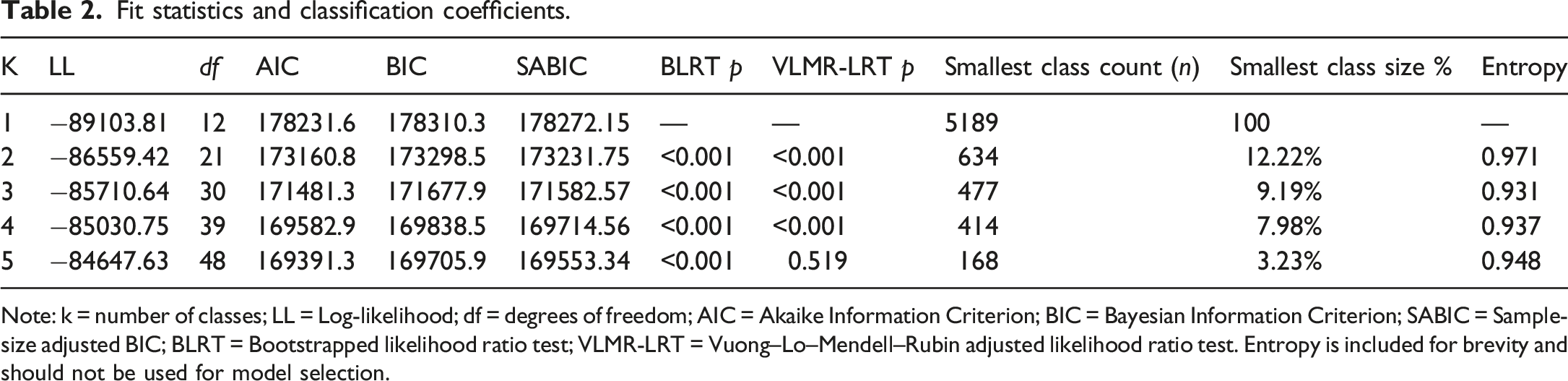
Note: k = number of classes; LL = Log-likelihood; df = degrees of freedom; AIC = Akaike Information Criterion; BIC = Bayesian Information Criterion; SABIC = Sample-size adjusted BIC; BLRT = Bootstrapped likelihood ratio test; VLMR-LRT = Vuong–Lo–Mendell–Rubin adjusted likelihood ratio test. Entropy is included for brevity and should not be used for model selection.
Classification probabilities: Worker types 4-class model.
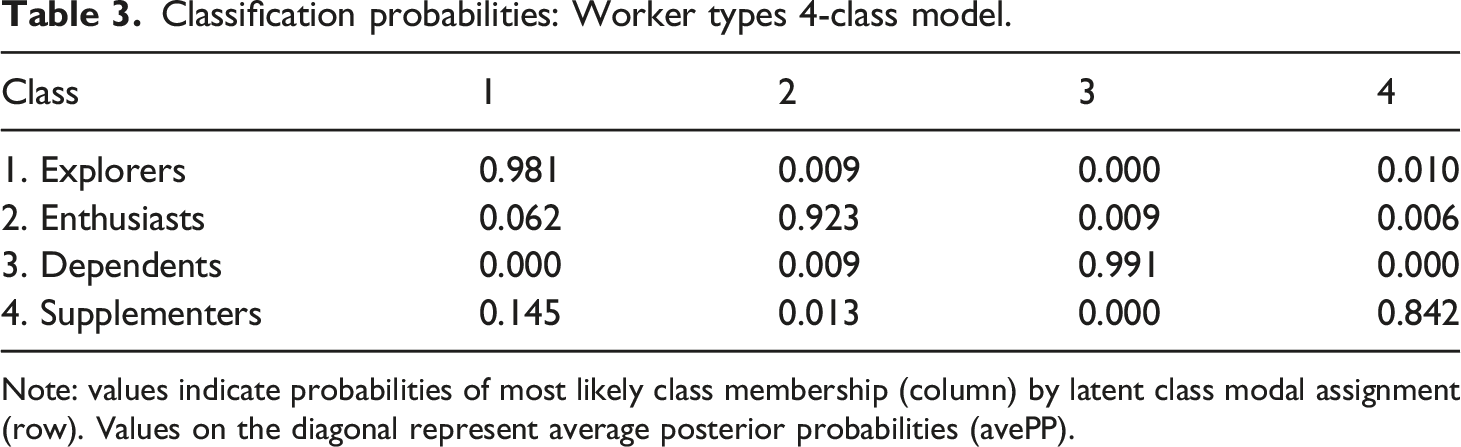
Note: values indicate probabilities of most likely class membership (column) by latent class modal assignment (row). Values on the diagonal represent average posterior probabilities (avePP).
Class description
Averages for class indicators are provided in Figure 1. The largest class accounted for 73.48% of the sample (n = 3850). Defining characteristics of this class include little experience with microwork, low average hours spent conducting microwork, and minimal contributions from microwork to personal income. Finally, workers in this class were more likely to be relatively young. Based on these characteristics, we label this class explorers. Latent marginal means and probabilities across classes.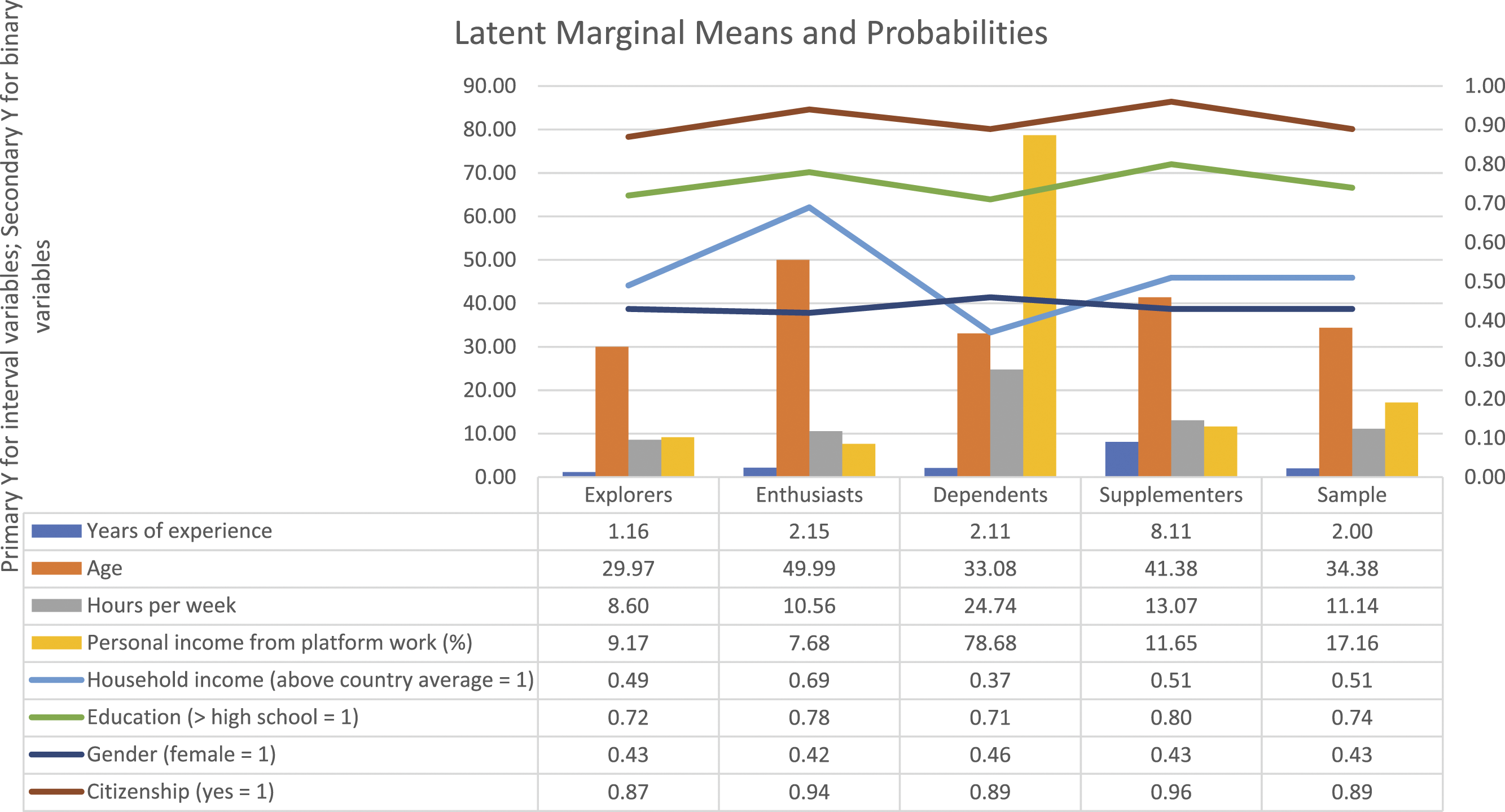
The next largest class accounted for 10.46% of the sample (n = 548). Like explorers, this class only recently started working through digital labour platforms. However, dissimilar to explorers, this class was more likely to have above-average household incomes and be relatively old. We refer to this class as enthusiasts, as individuals in this class seem not to rely on microwork for income.
The third biggest class accounted for 8.08% of the sample (n = 423). Characterized by considerable experience microworking, these individuals are well-educated and most likely to hold citizenship in their country of residence and work. We refer to this class as supplementers, for the fair amount of personal income they generate microworking, though household incomes are lower than those of the enthusiasts class. Given their tenure, supplementers may have a more structural need to engage microwork.
Finally, the smallest class accounted for 7.98% of the sample (n = 418). Comparatively, individuals in this class report lowest household incomes, most hours spent on platforms, and depend on microwork for a relatively high percentage of their income. As such, we refer to this class as dependents. Overall, these class descriptions demonstrate substantial variance between groups relative to diversity and dependence on microwork.
Discussion
We surveyed microworkers across the EU-27 to identify where microwork was most prevalent and, pulling from a fragmented pool of indicators, provide a coherent classification of types of microworkers. The results demonstrate that, across Europe, geographical distribution of microworkers does not necessarily follow general population distribution. Furthermore, our classification of microworkers indicates that most can be viewed as explorers, while the smallest cohort can be classified as dependents. Next, we discuss the implications of these findings.
Relative density and geographic contexts
Our findings suggest that the prevalence of microworking is both uneven across the EU and does not necessarily follow the general population density. Regarding absolute response numbers, our findings support historical associations of microworking with larger European economies (Berg et al., 2018; Fabo et al., 2017; Pesole et al., 2018; Urzi Brancati et al., 2020). Considering relative density of microworkers, the results are more surprising, as countries with relatively smaller populations (e.g., Portugal, Croatia) are more densely represented among microworkers than countries with much larger populations (e.g., Poland, France). This finding is more in line with previous studies positing a higher prevalence of crowdworking among the smaller countries of Central and Eastern Europe (Huws et al., 2019; Piasna and Drahokoupil, 2019).
Altogether, this suggests that while larger EU countries boast higher numbers of microworkers in absolute terms, this is not indicative of the prevalence of microworking within a particular population. Rather, increased densities of microworkers found across smaller countries indicates higher prevalence of microworking within these populations, carrying particular consequences for scholars and policymakers. As EU policies look to better regulate platform working, national level transposition is a critical factor in the impact upon workers and their lived experiences. The findings highlight a need to look closely at how varying geographic contexts, such as regional or local employment markets, availability, and institutional regulatory contexts impact the prevalence of microworking across the European Union.
Relationship type classification
Considering diversity and dependency among microworkers, our findings show that inexperienced explorers constitute the largest class of workers. Importantly, the smallest class is most dependent upon microwork. Labour sociology and industrial relations literature have focused on understanding the precarity of platform working conditions, suggesting considerable variation across European labour markets (Cini et al., 2021; Wood et al., 2019). Our findings indicate novel points of comparison, identifying high- and low-density areas relevant to understanding platform labour processes, especially regarding the subcategory of hidden online microwork. Research has compared labour issues related to worker representation, worker mobilization, and working conditions across countries such as Poland and Italy (Muszynski et al., 2022), the United Kingdom and Luxembourg (Kornelakis et al., 2022), Italy and the UK (Cini et al., 2021), and France and Italy (Borghi et al., 2021). Our findings highlight opportunities to target comparisons between areas of low and high microworking prevalence (e.g., Poland and Portugal) and expand their scope, considering the EU in terms of broader labour processes.
Specifically, our findings demonstrate that labour markets of countries with relatively smaller populations such as Portugal, Croatia, and Bulgaria, seemingly foster higher prevalence of microworking, indicated by the highest relative densities of workers. Interestingly, microwork is less prevalent among workers in countries with relatively larger populations, such as Poland, the Netherlands, and Romania. Further comparisons between macroeconomic and labour market conditions and platform economy characteristics across these countries seem particularly fruitful. Comparisons between such regions where workers are overrepresented versus underrepresented offer important opportunities for theory building around platform working conditions and the lived experiences of platform workers (Borghi et al., 2021; Cini et al., 2021; Muszynski et al., 2022).
Furthermore, our classification of workers emphasizes the importance of diversity and dependency for understanding variation in workers, specifically supporting contextual understanding of workers’ heterogeneity (Vallas and Schor, 2020). We identified four classes of workers – explorers, enthusiasts, supplementers, and dependents – varied in their individual characteristics and dependency upon microwork. Our findings indicate the smallest class – dependents – have the highest dependency upon microwork. Subsequently, the precarity of working conditions for microwork (Berg et al., 2018; Graham et al., 2020; Wood et al., 2019) may be most consequential for this group (Lee, 2021). Comparatively, explorers – the largest class – seem less dependent on microwork, considering their limited tenure, relatively low working hours, and lack of income dependency. Such diminished dependency may render the majority of microworkers less vulnerable to precarity. Hence, status quo working conditions perpetuate, inhibiting efforts at mobilization and representation for the highly dependent and vulnerable minority (Borghi et al., 2021; Cini et al., 2021). This is in line with research suggesting that high worker turnover, characterized by workers ‘likely to do one or two jobs and leave’ (Gray and Suri, 2019: 103), reinforces platforms’ current modus operandi of favouring exit over voice to resolve worker concerns (Gegenhuber et al., 2021).
Notably, our classification builds on earlier categorizations by combining indicators from previous studies and utilizing statistical modelling (Berg et al., 2018; Huws et al., 2019). Though the explorer class is sizeable (almost 74%), this is comparable to earlier classification attempts. For instance, studying global microwork, Berg et al. (2018) found that 60% of workers on Clickworker and Microworkers had less than 1 year of platform working experience (p. 37). Gray and Suri’s (2019) seminal work on ghostwork claims ‘the vast majority of people start out as experimentalists’, defining this group as ‘those who come to a platform but leave shortly thereafter, for a variety of reasons’ (p. 104). Gray has gone on to claim experimentalists constitute nearly 70% of worker populations on crowdworking platforms (The Graduate Center CUNY, 2021, 23:59).
Our findings also provide important insights into further understanding the heterogeneity of platform work, particularly relevant for regulatory initiatives currently under EU consideration. Current initiatives cite the difficulties national authorities face stemming from insufficient awareness of where and by whom platform work is performed (COM(2021)762, European Commission, 2021). National authorities are particularly disadvantaged regarding cross-border platform work (i.e., microwork), when attempting to take such policy actions as identifying social security responsibilities and enforcing existing obligations (European Commission, 2021: 3). Identifying how the prevalence of one form of platform work varies within the EU highlights the need to further investigate other forms of platform work independently, attending to the importance of geographical contexts such as local and regional employment markets, and institutional regulatory factors. In presenting a classification rooted in workers’ diversity and dependency upon microwork, this study refines understanding of the heterogeneity of microworkers.
Gray and Suri (2019) detailed how microworking platforms are designed to anonymize workers, obscuring their individual contributions to a broader community. Such accounts are important as microworkers ‘face the looming consequences of the scarce efficacy of labour protection resulting from a combination of deliberate attempts to circumvent employment legislation with the aim of cost-cutting and the ambiguity of certain regulations and laws’ (Aloisi, 2022: 6-7). Further emphasis on where and by whom microwork is conducted enhances the ability of EU institutions to deliver stronger policy agenda prioritizing and directing efforts towards high density crowdworking areas and those workers with greater dependency upon such work.
Limitations and future research
No study is without limitations, and this study is no exception. One caveat to our research concerns the selection of indicators. Our typology is not a comprehensive classification system, as using socio-economic indicators is but one way to classify workers. However, our findings suggest several particularly relevant future research paths to further refining and extending understanding of microworking relationships. First, the differentiation between our identified classes is relatively small, indicating additional types of indicators ought to be considered to enhance relevant distinctions. This may entail including indicators of psychological states and traits, wellbeing, or occurrence of significant life events (e.g., an accident, being laid off, experiencing a pandemic). As our efforts built upon previous socio-economic indicator selections, it is reasonable to propose other relevant classifications may build upon previous work identifying personality traits or behaviours relevant to lived experiences of platform workers (e.g., Ashford et al., 2018).
Additionally, we recognize design limitations. The difficulty of accurately and reliably surveying active platform workers is well-documented (see Newman et al., 2021; Pesole et al., 2018; Piasna, 2021). Because the pool of microworking platforms is quite fragmented, it is not possible to survey all relevant platforms. We purposefully limited our selection to prominent international platforms, widely accessible across the EU, recognizing this is only a fraction of relevant platforms in operation. Future research could consider more targeted approaches, canvassing specific suites of platforms operating in a specific country or region of the EU, or focussing on regional and local platforms. Future research may also explore how classification of workers differs across countries and platforms. However, such an approach would benefit from a stratified sampling technique, ensuring sufficient responses per region, country, or platform to enable statistical inferences about cross-context classification differences. Lastly, despite our efforts to clearly establish the focus and context of our questioning, individual interpretations of questions cannot be wholly prevented. As such, there is always the possibility that respondents related limited rather than comprehensive microworking experiences. Future research may find value in investigating different classes of workers on specific platforms, isolating experiences, and contributing to such fields as fair work studies (e.g., Graham et al., 2020) and platform benchmarks.
Footnotes
Declaration of conflicting interests
The authors declared no potential conflicts of interest with respect to the research, authorship, and/or publication of this article.
Funding
The authors disclosed receipt of the following financial support for the research, authorship, and/or publication of this article: This project has received funding from the European Research Council (ERC) under the European Union’s Horizon 2020 research and innovation programme (grant agreement n° 101003134)
Ethical approval
This study was approved by the Erasmus University Rotterdam Ethical Review Committee (approval n° ETH2122-0078)
