




Abstract
Crowdwork is commonly described as an extremely isolating and anonymous form of work. Contrary to this, the article examines platforms’ managerial strategies to engineer so-called crowd communities. The results show that platforms assume either more controlled or lose strategies, which results in lower or higher crowdworker interaction, respectively. None of the communication spaces, however, seem to enhance labour power. While to some extent breaking the sociotechnical isolation of the crowd, the article suggests that crowd interaction serves to scale and outsource managerial tasks to the online workers in a highly rationalized work regime. Where it arises the self-organization is largely a self-regulation and reflects crowdworkers’ efforts to cope with the work system. Overall, the findings suggest that platforms develop more diverse and complex managerial systems than often assumed.
Introduction
Crowdwork is a striking example for work not necessarily being replaced but reorganized through technological innovation. It describes the outsourcing of single paid tasks to an anonymous mass of dispersed individuals via an online platform. This ‘crowd’ performs the jobs entirely online through platforms’ digital interfaces. They are neither employed nor do they need to know the company they work for. 1
Literature has commonly described crowdwork as a highly isolating form of work due to the geographical dispersion of the crowd and the sociotechnical configuration of the platform (Irani, 2015a, 2015b). At the same time, however, platforms themselves increasingly invest efforts into reconnecting their crowds through forums and other infrastructures for interaction – with the goal to build so-called crowd communities. The ‘community manager’ emerges as a new job profile and ‘community building’ as a central management strategy that is so far largely unstudied.
The article examines two research questions: First, which concrete technological and organizational practices stand behind platforms’ community-building strategies (RQ1)? Second, how do crowdworkers interact with these strategies (RQ2)? Two assumptions inform the research questions. Both refer to the problems that managers, as the representatives of capital within the company, also face in traditional employment regimes. They are core elements of the labour process debate, which represents the theoretical framework of this article (Smith, 2006; Thompson, 1989). It examines the historical trends in the organization of work and production as a political process. As the debate is a multidisciplinary one, the article is informed by and respectively seeks to contribute to literature from different disciplines, including labour sociology, critical managerial studies and organizational studies.
First, the research questions depart from the classical problem of the indeterminacy of labour, based on Marx’ labour theory of value. Managers only buy the mere capacity to work when hiring workers but need to transform it into actually spent and value-adding labour, by means of consent and control. The article assumes that platforms face specific challenges as they need to mobilize and transform the labour of a highly anonymous and mobile crowd (Smith, 2006). The bodies of work cannot be directly controlled due to the crowd’s formal and physical autonomy. Instead, it is governed through one common digital infrastructure with only few staff members at its backend.
Second, labour process literature highlights the dialectical relationship between managerial strategies and workers’ behaviours. Managements face a thin line between retaining too much or too little control and granting too little or too much autonomy, respectively. Too much control may trigger conflict. Indirect control, ideally, promotes ‘responsible autonomy’ (Ackroyd and Thompson, 1999: 58) that is functional to attain the firm’s production targets: workers self-organize to develop ‘angles and fiddles’ (Edwards, 1986: 42f.) and help themselves with the work system as they find it. Workers’ behaviours are, however, not only the product of managerial systems as they develop practices also independent of them.
Against this theoretical background, one could expect that platform managers face a dilemma. On the one hand, platforms may shift autonomy to the crowd in order to mobilize consent, fill managerial gaps and appropriate additional resources, which all serves to secure the labour process. Therefore, they need to reduce control and provide rather open communication spaces to open up the space for decentral interaction and self-organization. This may, however, lead to undesired dynamics, such as waves of critical comments, or the strengthening of labour voice and power (hypothesis 1). Conversely, managements may choose to retain a certain degree of control to prevent such ‘irresponsible autonomy’ and engineer certain productive behaviours, for instance peer collaboration and control. This may, however, put the self-organization and higher interaction of the crowd at risk (hypothesis 2).
The data are based on interviews with platforms that organize a variety of simple and complex tasks as well as with crowdworkers active on these platforms. Moreover, the article also analyses the communication spaces of five platforms. The findings show that, for one thing, crowdworkers retain autonomy over whether and how to interact. After all, in this specific work model, they enter the labour process with a high degree of voluntariness as well as formal and physical autonomy. When choosing to interact, self-organization is indeed higher where less control is retained by the platform. Nevertheless, the potential dilemma seems non-existent as in the empirical data the self-organization turns out to be largely a self-regulation. None of the communication spaces significantly enhanced labour voice or power. While breaking to some extent the sociotechnical isolation of the crowd, the article suggests that such company-based worker forums outsource managerial tasks to the online workers. By turning them into co- and self-managers, crowdworkers’ additional resources can be captured and conflict soothed.
The findings contribute to the ongoing labour process debate and apply the central question of how workers are controlled and managed to secure the exploitation of their labour to a new model of digital work. Crowdwork must be perceived as testing ground for new forms of work organization and performance management that may enter other fields of employment. The results show that platforms develop work regimes that are more complex than often assumed. Thereby, they make managerial choices and undergo organizational learning. Overall, this highlights their role as company-like actor while being a market-based infrastructure. Moreover, understanding the social organization of work is important as it shapes the working conditions, the subjectivities of work and ultimately workers’ scope for action and resistance (Edwards, 1986).
The next section reviews the relevant literature. The third section presents the methodology. Thereafter, the research findings are reviewed: fourth section examines platforms’ community-building strategies (RQ1) and fifth section examines crowdworkers’ use of community spaces (RQ2). Thereafter, conclusions and implications are drawn.
Literature review
Crowdwork as a new form of work
Crowdwork can be defined as a triangular ‘sociotechnical work system’ (Kittur et al., 2013: 2): clients source concrete tasks ranging from simple data categorization to designs or complex scientific analyses through online platforms. Platforms, in return, outsource the production of these digital goods and services to an undefined, generally large group of registered individuals. Unlike localized gig work, such as rides and deliveries, the tasks are performed remotely and through platforms’ digital interfaces.
Literature on crowdwork has early on challenged platforms’ notion of being a neutral intermediary between equal transaction partners who meet on their markets. Scholars have pointed to the power asymmetries and class relations enshrined within their digital infrastructures and terms and conditions (Fieseler et al., 2019; Kingsley et al., 2015). Moreover, within this intermediary position and hidden behind the digital architecture, platforms organize (and mystify) the labour process: they define the task size and can limit the content; they determine the payment mode, regulate the access to tasks and organize performance control; ultimately they also define who can communicate with whom (see De Stefano, 2015; Zogaj and Bretschneider, 2014). Platforms may also be designed as marketplaces where clients perform many of these tasks. Nevertheless, their algorithms and interfaces govern the possibilities for action and the working conditions.
The algorithmic management of work relations is often described as novelty. Thereby, research has mostly focused on platforms such as the Amazon platform Mechanical Turk that organizes simple routine and support work as ‘microtasks’ (Bergvall-Kåreborn and Howcroft, 2014; Irani, 2015a, 2015b; Lehdonvirta, 2016). The managerial system on such microwork platforms is frequently described as a ‘digital Taylorism’ (Bergvall-Kåreborn and Howcroft, 2019; Kittur et al., 2013). This suggests a digitally intensified division and objectification of – what seems to be new – ‘knowledge work’ and is sometimes referred to as a ‘new type of industrialization’ (for instance Boes et al., 2017: 155). By fragmenting information-processing work into extremely standardized, fault-tolerant tasks, workers’ knowledge can be extracted and codified into software prescripts (see Brown et al., 2011). Moreover, it is assumed that work can be fully controlled by all-encompassing algorithms. Few studies examine how platforms organize more complex, often contest-based work (Boudreau and Lakhani, 2013; Gandini, 2016). Moreover, the crucial question of how platforms mobilize the voluntary commitment and performance of a highly mobile and anonymous crowd to secure the transformation of their labour is understudied. First studies suggest that aside from rigid control and standardization, platforms’ managerial systems may be more diverse and control more subtle than often assumed (Gerber and Krzywdzinski, 2019). In particular, ranking and reputation systems and gamification increasingly receive attention (Gandini, 2016; Vakharia and Lease, 2013; Zogaj and Bretschneider, 2014).
Crowds versus communities
Within academia, the question of what makes a workforce or an online network a community is a hotly debated one. Haythornthwaite (2011) distinguishes between crowds and communities as lightweight and heavyweight forms of organizing. Thereafter, crowds consist of many, mostly anonymous contributors who individually move towards the same goal but disperse as the event ends. Communities, conversely, consist of fewer and usually identifiable contributors, who develop shared practices over time and are committed to each other by possessing some common characteristics (e.g. common location or organization). Research suggests that communities can and do emerge online, for instance in online games, open source projects and even work contexts (Baym, 1995; Cohen and Richards, 2015; Preece and Maloney-Krichmar, 2005; Richards, 2008).
Communities in the context of crowdwork have received little attention. On the contrary, as the name reveals, the idea of an anonymous mass of ad hoc assembled contributors lies at its very heart. Literature on crowdwork almost exclusively highlights the individualization and anonymity of the online workers (Aytes, 2012; Flecker and Schönauer, 2016). This results not only from the geographical dispersion and lack of common work structures (e.g. worksite, working hours, employer) but also from its sociotechnical configuration. With regards to the Amazon platform Mechanical Turk, scholars argue that platforms render human labour invisible and turn it into a flexible on-demand cloud service (Irani, 2015a, 2015b; Lehdonvirta, 2016). The idea of a community is additionally challenged by the crowds’ extreme heterogeneity as regards socio-demographic characteristics, motives and activity levels (Berg et al., 2018).
To what extent stable relations and commitments, common interests and mutual identification can develop amongst crowdworkers is an open question. According to Pongratz (2018), the different terminologies (e.g. talents, creatives or experts) across platforms obscure commonalities. Some authors point to crowdworkers’ attempts for self-organization through external forums (e.g. Turkernation, Dynamo) or engage in action-oriented research to identify how common solidarities and collective action can be promoted (Graham and Woodcock, 2018; Salehi et al., 2015).
Central to this article’s research questions is the increasing propagation of community by platforms themselves, in particular by platforms that organize more complex tasks. Thereafter, peer communication (chats, forums), interpersonal relationships (profiles, rankings, networks) and incentives for collaboration (badges, awards) are integral governance mechanisms (Gandini, 2016; Vakharia and Lease, 2013; Zogaj and Bretschneider, 2014). Previous literature on globalized work processes highlights that ‘engineering’ organizational identities and cultures supplements direct control with indirect control: it strives at regulating performance by constructing ‘social’, ‘ideological’ or ‘normative’ regimes to govern behaviour (Alvesson and Kärreman, 2004; Thompson and Findlay, 1999). ‘Community engineering’ may then also emerge as a management technique of indirect control within platform-based online work. Research on platforms’ community strategies is, however, missing. Moreover, nothing is known about how crowdworkers deal with managerial demands for interaction and collaboration in a context of isolation and competition.
Management strategies and labour autonomy
Insights on how crowdworkers interact with platforms’ managerial strategies can be drawn from literature on organizational behaviour and misbehaviour (see Ackroyd and Thompson, 1999; Edwards, 1986). Thereafter, there is scope for worker autonomy, self-organization and resistance in every work regime. Understanding the specific work organization is, however, central to infer individual or collective coping strategies and forms of resistance. Ackroyd and Thompson (1999) distinguish between ‘responsible autonomy’ that is granted by managements as a main alternative to direct control and ‘irresponsible autonomy’ that is developed by the workers in the everyday experiences at work and micropolitics of groups. Even within rigid managerial systems, workers’ behaviours cannot simply be engineered. They develop informal norms and hierarchies (e.g. gossiping, rules for newcomers) or forms of individual or collective recalcitrance and misbehaviour (e.g. absenteeism, rule bending and sabotage) both in response to and independent of management strategies (Ackroyd and Thompson, 1999; Edwards, 1986).
A growing body of literature on labour movements and worker power has examined the role of Internet communication technologies for workers’ self-organization, misbehaviour and even resistance. External forums, Facebook groups or work blogs are presented as spaces to seek emotional support, to vent complaints and form oppositional networks (Cohen and Richards, 2015; Richards, 2008). The sarcasm and humour or critical discourses that emerge are identified by some authors as forms of misbehaviour and even ‘creative resistance’ (Schoneboom, 2007). Da Cunha and Orlikowski (2008), conversely, show how these spaces can also be functional to managements: instead of taking collective action they serve to vent and soothe anger and thereby promote a ‘collective catharsis’.
Research on crowdwork has so far treated labour as being on the receiving end of management practices. Studies on the platform-mediated but locally fixed service work via Uber or Deliveroo show that, despite the rigid control, workers develop practices to outsmart the App-based management (Ivanova et al., 2018; Lee et al., 2015; Rosenblatt and Stark, 2016). Similar empirical research is needed as regards online platform labour.
Data and methods
The article is based on two kinds of data collection: first, 32 interviews with representatives of platforms and crowdworkers and second, an analysis of the community spaces of five platforms. The article distinguishes between ‘microtask’ and ‘macrotask’ platforms but recognizes that, for other research questions, a more differentiated typology may be needed. It is based on the different skill complexities required that shape how platforms structure the labour process.
Microtasks can be defined as routine support tasks or as tasks that do not require specific knowledge (e.g. picture categorization, lead data verification, short text writing, app testing). The nature of these tasks allows them to be disassembled into short standardized and clearly defined ‘microtasks’ that can be completed within seconds or minutes. They are usually remunerated with a few cents or euros per task. The goal is to rapidly complete a large quantity of work. Several crowdworkers can work simultaneously without the need to interact.
Macrotasks, conversely, are complex tasks that require specific, usually professional knowledge and a high degree of creativity (e.g. designs, software programming, product innovation, scientific problem-solving). They cannot be broken into pieces and are usually organized as multi-day or multi-week projects. The focus is on the quality rather than quantity of work: usually the goal is to crowdsource the best amongst many good solutions. Instead of a first-come-first-serve competition like on microtask platforms, competition on macrotask platforms is more subjective: one crowdworker is selected for a job either upfront (e.g. on marketplaces like Upwork, Fiverr) or ex-post (e.g. on contest platforms like 99designs, CrowdMed). In particular, jobs that require ‘crowd wisdom’ to identify the best or most popular submission (e.g. designs) are organized as ‘crowd contests’ to generate multiple proposals, out of which the client, a jury or the community can then select the winner(s). To attract these higher skills and mostly professional freelancers, remuneration is much higher than for microtasks. On marketplaces payment is bilaterally negotiated between client and freelancer. In crowd contests, payment is entirely uncertain: prize money can vary from hundreds to thousands of euros but only one or a few contestants win.
Interviews with platforms and crowdworkers
In total, 19 single interviews were conducted with staff from 15 platforms. Field access was difficult and about 60 companies were initially contacted via email and phone. All are start-ups, with the company size varying between less than 10 and more than 100 staff members. The sample also contains a mix of younger (founded between 2010 and 2015) and older (founded between 2005 and 2010) platforms. The interviews lasted between 1 and 2 h and were mostly conducted with staff from community management, sales or operations. Interviewees from smaller platforms were also the CEOs and founders. In order to ensure sensitivity to country-or task-related characteristics, platforms were selected that organize a variety of tasks (microtasks/macrotasks) and operate under different institutional regimes (Germany/US). No country-related differences in platform strategies were, however, observed. Due to the need for anonymization, the article uses the abbreviations Pmicro1 to Pmicro7 for microtask platforms and Pmacro1 to Pmacro8 for macrotask platforms when quoting interviewees.
In addition, 13 interviews were conducted with crowdworkers. The questions centred on their motives, activity levels, their perception of the working conditions and coping mechanisms. The sample reflects the heterogeneity of the crowd. It was selected along a balance of criteria that emerged as relevant in the platform interviews (microtasks/macrotasks, high/low use of technology, strong/weak community building) and a balance of demographic backgrounds (different ages, genders and countries from Global North and Global South). The interviews were conducted in person or via phone and lasted between 1 and 2 h. Contact was established either via the platforms or directly through the platform forums and social media (Facebook, LinkedIn). Interviewees received compensation of €13/US$15 per hour.
Analysis of community spaces
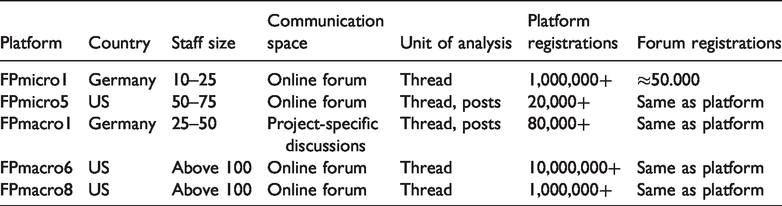
Table 1 provides an overview of the five platforms whose community spaces were observed. Relevant numbers are anonymized. Moreover, the abbreviation FPmicro1 to FPmacro8 is used to differentiate it from the data gained through interviews. The choice of platforms is based on the interviews and indications that they invest great efforts in community building. The sample is sensitive to task- and country-related particularities (micro/macro; Germany/US). Their crowds are, however, truly global. Access was established by simply registering as a crowdworker to the platform.
Key figures of platforms for content analysis (n = 5).
First, platforms’ technical infrastructures of community building (Technical infrastructures of community interaction section) were analysed through an exploratory approach. All communication and interaction paths that could be observed or were revealed by the interviews were collected (e.g. forums, on-site threads, like function, profiles) for each platform. Subsequently, they were clustered by function (e.g. self-help, visibility, peer control, ranking) and centrality to the work process (e.g. reputation points, job access).
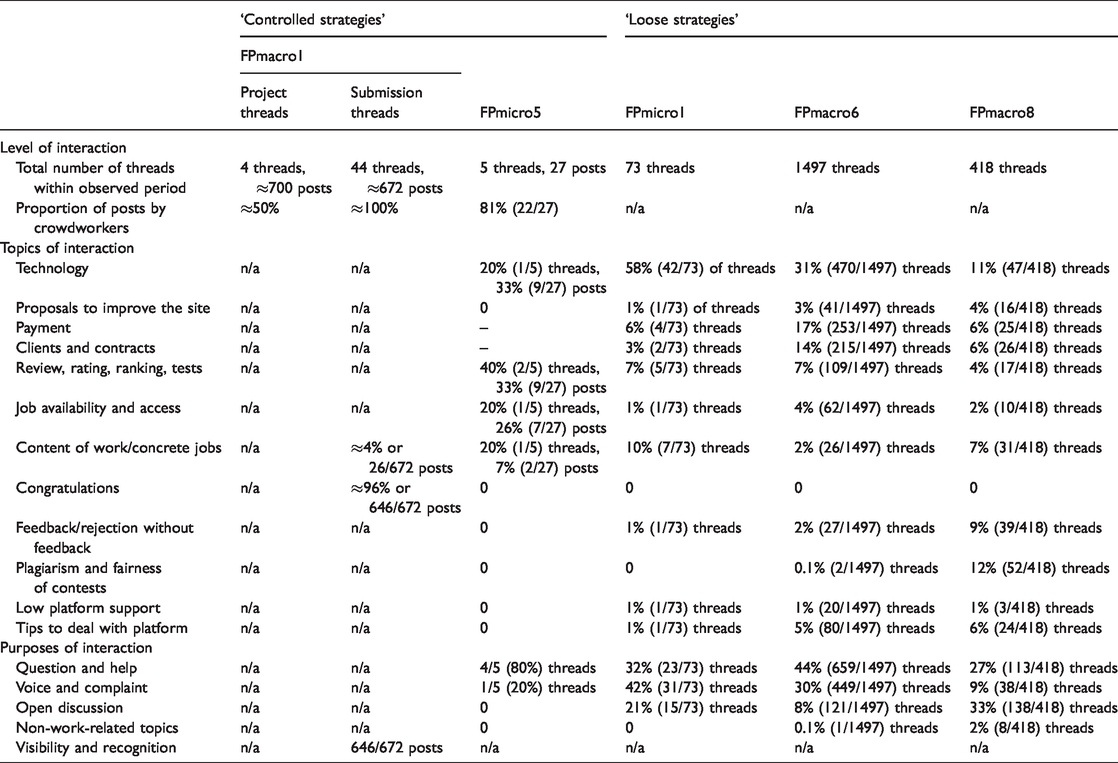
Second, a non-participatory observation was conducted to study the interaction amongst crowdworkers (Use of official community spaces section) and role of platform moderators within these spaces (Moderation of community interaction section). In order to assess the quantity of interaction and because automated data read-outs are normally prohibited, all threads in which activity took place in the period of 1 August 2017 until 1 September 2017 were manually counted and thematically clustered. 2 The period was randomly chosen and for reproducibility the analysis was repeated from 1 February to 7 February 2018. The thread was chosen as common unit of analysis due to great differences in the volume of interaction: while activity is so low in some forums that all posts could be counted, other forums have hundreds to thousands of active threads with a manually almost uncountable number of posts. In addition, due to the limits of the quantitative analysis and to assess the quality of interaction, the course of discussion was observed in single threads. Threads were chosen that discussed relevant aspects of working conditions (e.g. payment, rankings, task rejection) or that emerged as interesting broader discussions (e.g. motivation, background). For less active forums (FPmicro5), it was possible to read nearly all posts in the period of observation. Table 2 summarizes the data. The topics and purposes of interaction were manually clustered.
Data collection from analysis of forums and discussion threads.
A number of limitations highlight the usefulness of complementary interviews. First, all observed communication spaces are official platform spaces, in contrast to external, self-organized spaces (e.g. Reddit, Facebook, WhatsApp). Crowdworkers’ use of them will most likely reflect this. Second, some forums have language-specific groups that could not be analysed (15 on FPmicro1 but only three active; 14 on FPmicro5 but only three active; 52 on FPmacro8 but inactive during observation). Third, FPmacro1 is a special case. It does not have a forum but many-to-many communication takes place in discussion threads on the platform itself: either underneath the briefings for specific projects (henceforth called ‘project threads’) or underneath single submissions (henceforth called ‘submission threads’). Only the discussion threads of open projects visible to all platform members could be observed while private contests are only accessible for high ranked crowdworkers. Quantitative data are therefore mostly not available (see Table 2). The platform was nevertheless included as it invests great community-building efforts and represents a typical contest platform.
A key difficulty is relating the communication activity to the overall crowd size. Only FPmicro1 provides exact numbers, as it requires extra registration to its forum. For all others, everyone who is registered on the platform has access. Registration numbers are, however, inflated and include one-time registrations or inactivity. The actual number of members participating in these communication spaces is thus expected to be much lower. Nevertheless, participation seems to vary from some ten thousands (FPmicro1, FPmicro5, FPmacro1) to millions of members (FPmacro6, FPmacro8) (see Table 1).
Finally, literature highlights the advantages and challenges of qualitative research in internet-mediated social interaction, including ethical dilemmas (Hewson, 2007). The author chose non-participatory observation to avoid altering the interaction. Neither the platform nor crowdworkers were informed. To reduce the ethical implications and harm to individuals, none of the user names or postings are revealed in its original wording.
Platform strategies of community building
Contrary to the common picture of human labour being turned invisible and mute behind the algorithmic infrastructure of the platform, the strong emphasis of almost all interviewed representatives on ‘community building’ was surprising. This section discusses the empirical findings with regards to the first research question: which concrete technological and organizational practices stand behind platforms’ so-called ‘community-building’ strategies? Literature underlines the importance of looking at the specific work organization to ‘infer the forms that possible protest may take’ (Edwards, 1986: 112). Two aspects were identified as relevant: first, the design of the technical infrastructure that indirectly governs whether and how individuals can interact; second, the involvement of platform staff through an active moderation to complement and possibly fill the gaps of the former.
Technical infrastructures of community interaction
Community building, first of all, means that the space for communication and other forms of interaction must be enabled by the technical infrastructure. Aside from direct emails to support staff, private messages and chats, most of the examined platforms provide openly visible many-to-many communication spaces such as discussion forums. Differences could, however, be observed between microtask and macrotask platforms as regards their sociotechnical complexity.
Microtask platforms typically organize interaction through separate forums (Pmicro1, Pmicro2, Pmicro4, Pmicro5, Pmicro6). The forums are relatively simple. FPmicro1 and FPmicro5, for instance, are structured into few, usually very functional sub-groups, such as language-specific groups, general information groups or task specific groups, within which threads are sorted by latest activity. Participation is voluntary and entirely disconnected from the work on the actual platform: access to tasks is neither affected nor does one gain enhanced visibility from high activity. On FPmicro5, every user has the same status and no activity rates are displayed. FPmicro1’s forum is slightly more sophisticated as some gamification mechanisms are used: posts can be rated on a five-star scale and members climb a ladder up to becoming a ‘moderator’ with five stars. The primary purpose for this ranking is, however, to check the credibility of comments.
The technical infrastructure of macrotask platforms is more complex. Contest platforms usually provide many-to-many communication spaces in the form of open discussion threads on the actual platform site itself (Pmacro1, Pmacro2, Pmacro3, Pmacro4, Pmacro7, Pmacro8). On FPmacro 1, for instance, project and submission threads provide highly structured and defined communication paths: they consist of a linear sequence of topic-bound comments with no option to open new thematic threads. Conversely, macrotask platforms that allocate buyers and sellers but let them negotiate the production process bilaterally organize many-to-many communication mostly in the form of separate forums (Pmacro5, Pmacro6, Pmacro8). Yet, the forums of FPmacro6 and FPmacro8 are technically more sophisticated than FPmicro1 and FPmicro5. Users are, for instance, less anonymous as they interact through their platform profiles.
Central on all macrotask platforms are the personalized profiles, which (unlike on microtask platforms) give the individual high visibility and require a ‘subjectification of work’ (Pongratz and Voß, 2003). These personal portfolios usually do not only display performance-related information (e.g. own work, success score, skills, customer reviews) but also social information (e.g. experience, response speed, interests and other self-descriptions). FPmacro1 has the most extensive profile, which allows users to follow and ‘like’ each other’s work or share comments: It works a bit like Facebook. […] Here you have your badges. Here you see that [name] can access the top layer and has been recognized for outstanding ideas. A lot of other creatives can connect with [name] and see ‘oh that’s somebody I want to be more in contact with’. [She] is extremely active in giving other creatives feedback and constantly encouraging people. […] That is kind of boosting social status on the platform. [She] earns [points] for each interaction, so when [she] gives feedback on an idea, ranks an idea, submits ideas or creates a team. (Pmacro1)
The different technical infrastructures reflect that community building is functional to all platforms but for distinct reasons. On microtask platforms, the simple forums external to the actual work site reflect the specific, taylorist-like labour process in which decentral communication and coordination is not necessary for the immediate production process. The forums fill the gaps of the highly rationalized work regime and are a very effective way to manage a large crowd with few platform staff: crowdworkers can seek help on their own responsibility when having a work-related question either from platform staff or other crowdworkers. Managerial work can either be scaled or outsourced entirely to the crowd itself. According to one of FPmicro1’s community managers: After the forum was launched, the number of queries to our support staff decreased. […] If someone has a problem he goes to the forum and looks if someone else had the same question before [] instead of us receiving five or twenty emails about the same problem which we have to reply to individually. (Pmicro1) A key factor is how many likes other designers are giving. [It] provides a sense of community. It gives a lot of people pride around the good quality of work that is coming on to the platform. And it can also help to figure out who the good designers are. (Pmacro8)
Moderation of community interaction
Across the different task complexities and labour processes, great differences could be observed as regards the active participation of platform staff within ongoing discussions: while some invest a lot in moderation (FPmicro5, FPmacro1) others rely more (FPmicro1, FPmacro6) or exclusively (FPmacro8) on the crowds’ self-organization.
During the period of observation, two platforms actively steered discussions. On FPmicro5, explicitly labelled staff moderators visibly participated in every discussion thread and responded to nearly every post within a short period of time. According to a staff member, this is because the company wants to identify sources of complaints early on and be available for its crowdworkers: We definitely want to make sure that they feel like they are part of our business and that they have somebody they can talk to. From what I have heard about Uber […] a lot of the drivers have been really frustrated trying to talk to people at Uber. (Pmicro5)
In stark contrast, FPmacro8 was almost entirely absent in its communication spaces during the period of observation. Official platform moderators are generally only active in specifically labelled ‘announcements’ and ‘webinars’ categories, where they share important news (e.g. ‘changes to levels’, ‘scam alerts’) and provide a standardized training. In the rest of the forum, the platform relies entirely on the crowds’ self-organization and according to a staff member only gets feedback from a smaller handpicked group of freelancers.
FPmicro1 and FPmacro6 are somewhat in the middle of the continuum. During the period of observation, official platform moderators replied regularly to work-related questions (e.g. ‘Unable to submit’, ‘Help with a client’) or commented in the ‘coffee corner’ and ‘small talk’ groups. Sometimes platform staff reminded users of the forum rules, for instance, when crowdworkers asked peers for better paid platform alternatives (FPmicro1) or whether or not one is allowed to ask other members to ‘like’ their feedback (FPmacro6). Yet, on both forums, platform staff was absent in many central discussions, for instance, about bugged work material, dramatic drops in performance scores or unclear task descriptions. As a result, there was no question-and-reply dynamic focused on platform staff like on FPmicro5 or FPmacro1. Both platforms, however, rely on moderation through crowdworkers, which they promote through gamification (see Technical infrastructures of community interaction section).
Choice of strategy: Controlled or loose community building?
What emerges is a complex picture with no uniform managerial strategy as to why and how community building is to be achieved. On the one hand, the results suggest that the technical infrastructure – comparable to the design of shopfloor processes – is an important indicator to infer the role of crowd interaction in the labour and production process: internal communication paths that are directly integrated on the actual work platform and guide interaction more narrowly indicate a subsumption to the actual labour and production process; conversely, external communication paths serve as efficient source of (self-)help and are rather openly designed. On the other hand, this does not mean that platforms do not care about what is being discussed in their external forums or conversely do not promote self-organization where interaction becomes part of the labour and production process. Platforms seem to decide differently as to which degree they actively steer interaction to prompt certain functional behaviours. This points to the importance of managerial choice and presumably also organizational trial-and-error processes driving these strategies.
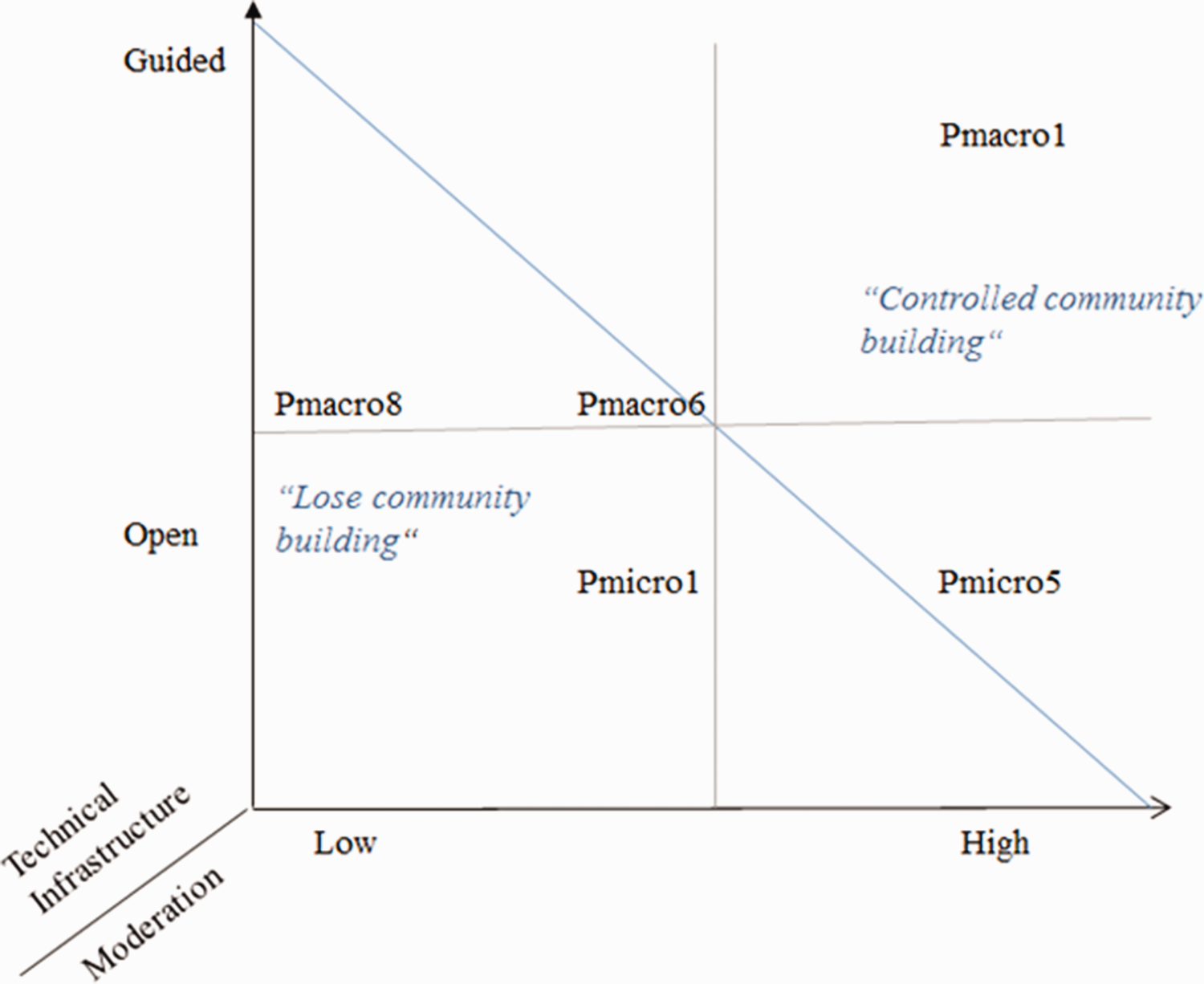
Figure 1 plots the findings within the matrix of technical infrastructure (open/guided) and moderation (low/high). As a result, although reality is of course less clear-cut, for analytical reasons the article derives loose and controlled community building as two managerial choices of strategy.
Strategies of community building.
The results suggest that strategies are chosen irrespective of the task character, institutional context, size of platform staff or size of the community (see Table 1). Instead, the article attributes the choice of strategy to the control dilemma proposed by literature of the labour process debate (see Management strategies and labour autonomy section). Platforms may either pursue a loose community building that is steered towards a high degree of self-organization but risks irresponsible autonomy and undesired side-effects. Conversely, they may pursue controlled community building to engineer specific behaviour and secure functional outcomes but risk a sluggish crowd in return.
To what extent managerial strategies shape the behaviour of crowdworkers and whether this potential dilemma translates into practice is discussed in the following section. So far, the findings contribute to the literature on labour platforms by underlining the necessity to understand them as company-like actors that heavily shape the working conditions rather than digital infrastructures that intermediate only. They organize different labour processes and make organizational choices as regards their managerial strategies. Thereby, more complex work regimes emerge than is often assumed within literature that has too narrowly focused on the despotic work regime of Amazon platform Mechanical Turk. Moreover, the results indicate that the crowds’ interaction is not really ‘free labour’ that is ‘voluntarily given and (…) enjoyed’ (Terranova, 2000: 33) but required either directly (e.g. through reputation points) or indirectly (e.g. due to information asymmetries and rationalized management).
Crowdworkers’ interaction with community strategies
To approach the second research question as to how crowdworkers interact under these two managerial strategies (RQ2), this section discusses, first, the empirical findings of the non-participatory observation. Since the findings could largely be reproduced in the second period of observation only quantitative findings from the first observation are discussed. Table 2 summarizes the data. The findings are, second, complemented with insights from the interviews with crowdworkers. After all, the observed spaces are official platform sites and may reflect expected behaviour while misbehaviour is not ‘posted’.
Use of official community spaces
As regards activity in terms of quantity, the volume of interaction was lower on platforms with controlled strategies. On FPmicro5, only a total of five active threads and 27 posts could be counted in the month of observation with 19% of posts written by platform moderators. On FPmacro1, assessing the level of activity quantitatively is particularly difficult as interaction is fragmented along numerous forms (threads and likes) and threads (projects, submissions and profiles). Within the period of observation, communication could only be analysed in four out of 13 projects as nine projects were closed projects and only accessible to those who were invited or held a certain rank. Within the four threads of the open projects, almost 700 posts could be counted – nearly half of them, however, being written by official platform guides. In the 44 submission threads, around 670 posts could be counted. Nearly, all posts were written by crowdworkers. However, they were usually only brief congratulations to winners. Conversely, on platforms that follow loose strategies a higher level of interaction could be observed. In the month of observation, a total of 73 active threads could be counted on FPmicro1, 418 active threads on FPmacro8 and 1497 active threads on FPmacro6. Within each thread, some ten to hundreds of posts were written, totalling several hundred up to ten thousands of single posts in the period of examination. The lower activity on FPmicro5 and FPmacro1 correlates in part with the much smaller registration numbers (see Table 1) but is insufficient to explain the differences alone, as the comparison between FPmicro5 and FPmicro1 indicates.
As regards the content of interaction, in all cases discussions mostly centred on functional, work-related questions and complaints. On FPmicro5, the most active discussions in the period of observation centred on a new software to facilitate work that workers had to pay for (20% threads) as well as on the rating system and ‘recurring issues with reviewers’ (20% threads). Questions about low job availability (20% threads) or the content of certain jobs were also raised (20% threads). On FPmacro1, interaction was surprisingly limited too despite the high number of postings. Within the submission threads that were observed the majority of posts (about 96%) were simply short compliments for good work and congratulations for prizes (e.g. ‘Congrats, great work!’). This reflects the incentivization through reputation points for ‘community engagement’ (see Technical infrastructures of community interaction section). Within the project threads, where nearly half of the posts were written by official platform ‘guides’, crowdworkers typically posted concrete project-related questions, for example ‘Can I still upload proposals?’.
Complaints were also voiced in the ‘controlled’ communication spaces of FPmicro5 and FPmacro1. On FPmicro5, a person protested about ‘being ranked down for following instructions’. A platform moderator intervened immediately by promising staff to look into this. No further discussion or waves of collective criticism developed. This shows well how complaints or grievances are reported but pacified by platform moderators through immediate intervention and clarification or redirection into bilateral communication. Also on FPmacro1, complaints were voiced and reflected the intense competition on this contest platform. Typically cheating, abuse of community voting and plagiarism were addressed, as illustrated by this post: ‘My ranking went up and then suddenly dropped. I have the impression that many people at this stage try to kick out good ideas. You should not allow ratings to be changed’ (crowdworker FPmacro1). Also on FPmacro1 such posts did not trigger greater waves of criticism.
In the ‘loose’ forums, the range of topics and functions of interaction were broader and provide good insights into the frictions within platforms’ work processes. One main topic on all three was technology (FPmicro1 58%; FPmacro6 31%; FPmacro8 11%). This includes primarily the (dis)functionality of the platform, for instance problems in loading the site, working from certain devices or seeing and uploading information (e.g. ‘how do I see my feedback’). Sometimes improvements were proposed, such as features that allow freelancers to see when clients viewed proposals or ‘auto-respond options’ when clients in different time zones send messages in the middle of the night.
Another relevant topic were rankings and performance scores (FPmicro1 7%; FPmacro6 7%; FPmacro8 4%). On the microtask platform FPmicro1, many discussions dealt with ranking scores and qualification tests to access better paid jobs, wrongful rejections of jobs, flawed test tasks or long activation periods after qualification tests. Complaints were frequent and addressed the arbitrariness and intransparency: A week ago my score was 90%. [Now] it is reduced to 20%. […] I complaint several times and today received the response that I am blocked for bad work. But until now my rating was always high. This was the only feedback for me. So my work must have been good. (crowdworker FPmicro1) Is it correct that a design needs to have many likes? I heard that more likes for your work means more visibility and better chances to get direct projects with clients. If yes, how can I get more likes? (crowdworker FPmacro8)
Payment issues were also frequently discussed, ranging from billing errors and tax settings to complaints about delayed payment, non-payment and low payment rates (FPmacro6 17%; FPmicro1 6%; FPmacro8 6%). Freelancers also more broadly discussed whether there should be a minimum payment rate, whether freelancers are responsible for not accepting low payments or how more money can be made: ‘I have only been here for a month. I try to make some additional income but it is not going so well yet. Do you have recommendations how I can get more jobs and higher pay?’ (crowdworker FPmicro1).
In the forums of the high-skill platforms FPmacro6 and FPmacro8, payment issues were particularly crucial and often linked to discussions about clients and contracts (FPmacro6 14%; FPmacro8 6%). Freelancers asked for advice about what to do with clients who are rude, who do not reply anymore, constantly reject work or change what they want. They complained about long waiting times for job acceptance or prize money, warned each other of malicious clients and feared the impact on their job scores, for instance: The client agreed to pay the full amount after the review phase but only paid half and then stopped replying. What can I do without my job success score being negatively affected? [FPmacro6] should warn us about clients with histories of not ending jobs! (crowdworker FPmacro6)
Here and there, also non-work-related topics were discussed in the relatively open forums of FPmicro1, FPmacro6 and FPmacro8: users chatted about books and music, the designs they like or find terrible, the food they eat or the songs they listen to in order to be creative, the places they work from and the clothes they wear when working from home. They discussed the advantages and disadvantages of freelancer life, unpredictable working hours and intense workloads: ‘I am so overworked with projects and deadlines that sometimes I don’t sleep for two days in order to get it all done. How do you deal with this?’ (crowdworker FPmacro8).
Overall, the findings from all five cases suggest that platforms’ official communication spaces are first and foremost used for platform- and task-related questions and help (FPmacro1 n/a; FPmicro5 80%; FPmacro6 44%; FPmicro1 32%; FPmacro8 27%) as well as to voice complaints – (FPmacro1 n/a; FPmicro1 42%; FPmacro6 30%; FPmicro5 20%; Fpmacro8 9%) – irrespective of the managerial strategy. Differences could, however, be observed as regards the degree of self-organization. On FPmicro5 and FPmacro1, the findings indicate that rather than interacting with each other, crowdworkers use the communication spaces to contact the platform for information and to report problems. Therefore, there is a strong question-and-reply dynamic amongst crowdworkers and the platform. In the loose forums of FPmicro1, FPmacro6 and FPmacro8, conversely, communication goes beyond the functional question-and-reply (FPmicro5, FPmacro1) or visibility (FPmacro1) purposes. In many instances, crowdworkers share experiences and knowledge (FPmacro8 33%; FPmicro1 21%; FPmacro6 8%) to navigate within the insecure, intransparent and asymmetrical work regime.
This suggest that the degree to which self-organization takes place depends on the degree of control that platforms retain over the communication and interaction spaces. In none of the cases, however, self-reinforcing dynamics of labour voice, greater waves of criticism or other forms of collectively ‘hyping each other up’ were observed. This partly confirms the initial hypotheses but at the same time refutes the expected control dilemma. Rather than turning into ‘irresponsible autonomy’, a form of self-organization emerges that is highly beneficial to platform managements as it implies an efficient self-help and self-regulation. This seems to confirm Edwards’ (1986) old argument according to which ‘organizing has always primarily been around improving conditions with no clear view of altering social structures’ (138).
Between responsible and irresponsible labour autonomy
Observing crowdworker interaction with managerial strategies in the official company spaces alone is limited as labour autonomy and misbehaviour may also express itself in non-written forms such as absenteeism (see Management strategies and labour autonomy section). The interviews with single crowdworkers therefore provide complementary evidence. Interviewees were, amongst others, asked whether they felt like they were part of a community or whether they communicated with other crowdworkers and for what purposes. Three types of responses can be summarized:
First and foremost, online workers retain autonomy over whether and how to use platforms’ communication channels. On FPmacro1, the strong engineering of desired behaviours and outcomes seems to result for instance in a very strategic use: I understand why [FPmicro1] wants us to collaborate, to rate and comment […] it is part of the product they sell […]. So I did this collaboration once to show them that I am engaged. And usually I look at 20 submissions that are either really good or bad, formulate a short comment and then that’s it. I consider this as part of my work. I only do this because I know they want me to. (crowdworker FPmacro1)
Individual exit can be both useful and harmful for the platform. On the one hand, getting rid of critics is more useful than having them build up collective opposition (Edwards, 1986). On the other hand, platforms rely on network effects: having problems and complaints being reported in order to act upon them may be more useful in the long run to keep the crowd and decide the run for monopolization in its favour.
Second, many highlighted the usefulness of forums and other decentral, peer-to-peer communication channels to find information when needed. One crowdworker started to appreciate the fact that one can just read along and profit from the debates of others: ‘Usually I don’t feel like participating in the forum. Sometimes I have a look and read along […] sometimes they write about where else to find jobs and other platforms. That’s quite interesting’ (crowdworker FPmicro1).
Another crowdworker poignantly described the consequences of not having the technological options for peer-to-peer communication: If I get stuck on [Pmicro6] I just stop working […] nobody can help me, there is no community to help each other. [Pmicro5] is great because there if a project manager does not answer you can talk to the others. And many times they are nice and help you out. There are some that have been working for 5 or 7 years and they have a lot of experience. (crowdworker Pmicro5 and Pmicro6)
Some interviewees stated that the communication and interaction spaces rendered the platform more human: Through the forum […] people are involved in the platform. [] I would not have stayed long if there had been complete anonymity. […] With [staff name] I had a lot of interaction especially at the beginning. They don’t hide behind the platform and say ‘we are an online platform you cannot reach us’. […] Of course they are only humans and fallible too. But they don’t say ‘take it or leave’. (crowdworker FPmicro1)
Third, the interviews also revealed practices and attitudes that can be categorized as forms of misbehaviour, from simply not being useful up to being harmful to platform managements. One freelancer, for instance, who earns 75% of his monthly income with design contests stated to actively avoid asking questions and sharing information in the forum to not help others: ‘I always respond directly to the platform or client if I have any questions with the project because I don’t necessarily want to help other people with it. […] Maybe it is a bit selfish’ (crowdworker Pmacro2).
In particular controlled strategies, then, may fail in engineering collaborative behaviours in a context of competition. For instance, interviewees active on FPmacro1 described that ‘people comment on every single post just to get the money for the feedback award’. This matches the findings that crowdworkers post hundreds of ‘congratulations’ within submission threads only to be seen and collect reputation points (see Technical infrastructures of community interaction section). The strong incentive system designed to promote collaboration is taken to a dysfunctional extreme and may undermine managements’ attempts to appropriate workers’ subjectivities. Moreover, interviewees reported informal practices such as ‘voting rituals’ and ‘like networks’, which distort the community voting and ranking systems: It is hard to enter as a newcomer because there are networks that give each other good ratings. A kind of community within the community. I was also contacted when I joined and am in touch with people who have been on the platform for a long time. (crowdworker FPmacro1)
Overall, the findings underline the dialectical dynamics of management strategies that were already pointed out by previous literature of organizational (mis)behaviour (see Management strategies and labour autonomy section). Platforms’ community-building strategies emerge as indirect forms of control that strive to produce certain forms of functional behaviour. At the same time, especially in the highly flexible and dispersed online labour, the subjects of work sustain a high degree of autonomy. Crowdworkers develop mostly individual but sometimes also collective practices to cope and navigate within the managerial system as they find it. In some instances, they thereby re-appropriate these managerial strategies. The findings provide first indications that the more controlled these managerial systems become the more harmful their workaround strategies. Further research is needed to confirm and deepen these results.
Conclusion
Crowdwork is commonly portrayed as a highly isolating form of work in which workers are not only geographically dispersed but also individualized through the digital work regime of the platform. The article challenges this one-sided representation and argues that, in addition to direct control and standardization, platforms invest increasing efforts in community engineering as an element of indirect control.
The article, first, identifies two approaches as distinct managerial choices to each engineer a specific useful behaviour. Loose community building aims to activate the self-help and self-regulation of the crowd and provides rather open, unmanaged spaces for communication and interaction. Controlled community building, conversely, steers interaction through a highly structured technical design and/or strong platform moderation to prompt specific behaviours. Second, the article observes how crowdworkers use and interact within these differently structured communication spaces. To this end, a mix of methodological approaches was crucial.
The results suggest that, above all else, irrespective of the managerial strategy and type of crowdwork, many choose indifference, absenteeism or exit as individual coping strategies rather than contacting their peers. After all, interaction costs unpaid extra time and takes place in a context of competition. Where crowdworkers do decide to use platforms’ communication spaces, their usage seems to reflect the different managerial strategies. The findings show that self-organization is higher where platforms retain less control and vice versa. This confirms in part both initial hypotheses. At the same time, the expected control dilemma turned out to be non-existent. In the period of observation, not even in the very open and unmanaged communication spaces did crowdworker interaction develop a life of its own. Being aware that drawing generalizations from single periods of observation is always limited, the findings suggest that self-organization mostly serves to reduce friction in the work process, to cope with the sociotechnical work regime and division of labour. Low control does not necessarily translate into labour voice, enhanced labour power or other practices of irresponsible autonomy that are harmful to platform managements. Too much control, conversely, may cause dysfunctional misbehaviour, as indicated by interviewees’ accounts of informal like networks or excessive posting to receive reputation points.
Where successfully engineering interaction, platforms can capture the crowds’ enhanced work capacities. Not only is unpaid labour spent to find and share information, to report and solve problems. Also subjective knowledge (e.g. individual experiences) and immaterial resources (e.g. emotional labour) are appropriated to fill the gaps of the rationalized and digitalized managerial system: for instance, when advising each other on how to deal with clients and when listening to frustration. Rather than voluntary and unwitting ‘free labour’ (Terranova, 2000), however, this reflects conscious efforts to cope with the highly rationalized work regime.
The implications for labour seem bleak. Although online workers may not be the mute codes within the software anymore, the communication spaces also do not seem to enhance digital workers’ power. The exchange of complaints is limited and in fact very functional for platforms. Complaints and grievances are articulated and emotional support sought, but in none of the cases this seems to result in self-organization for collective action. This seems to confirm the thesis by Da Cunha and Orlikowski (2008) according to which company-based worker forums serve as a ‘collective catharsis’. Particularly loose strategies, then, seem highly beneficial to platform managements. Left alone to help itself, the crowd’s self-organization is predominantly a form of decentralized self-regulation. Further research is needed to investigate whether informal worker forums (e.g. TurkerNation, Reddit or Facebook groups) can promise more substantial opportunities for self-organization and collective action for online workers. To the knowledge of the author, however, this does not seem to be the case yet.
The article contributes to a growing body of literature on platform labour and points to the current gaps within theory development as regards the emerging work and governance regimes. Central assumptions of the multidisciplinary labour process debate are applied to this new model of work – an attempt that will hopefully be taken up by research. The article highlights that more complex managerial regimes and forms of control emerge than often assumed as managements must mobilize performance and transform the labour of a highly mobile and independent workforce. Furthermore, indirect control strategies such as community building highlight that platforms are more than digital intermediaries but that within this interface position they perform company-like functions. Future research should examine the long-term development of platforms’ managerial regimes and reflect on their relevance for other fields of employment. Moreover, more empirical research is needed to study online workers’ forms of protest and scope for labour power.
Footnotes
Declaration of Conflicting Interests
The author(s) declared no potential conflicts of interest with respect to the research, authorship, and/or publication of this article.
Funding
The author(s) disclosed receipt of the following financial support for the research, authorship, and/or publication of this article: The data collection and funding of the author took place in the context of the 3-year research project “Between digital bohemia and precarity. Work and perfomence in the crowd.” (2016-2019), funded by the Thyssen Foundation and led by Prof. Dr. Martin Krzywdzinski.
