




Abstract
This article undertakes a cross-national comparison of the aerospace sectors in two ‘liberal’ countries, the UK and Australia, examining how several multinational firms engage with engineering skill institutions: regulation of entry to profession, entry-level and ongoing training. The paper empirically demonstrates and theoretically argues that the social partners and employment protection institutions can in certain contexts play an important role in professional skill development. Institutional legacy matters, shaping multinational responses and providing distinct resources for various actors including unions. Tension between existing skill institutions (‘country’ or ‘sector’ effects) and the capacity of multinationals (MNCs) to shape practices are addressed. Both country cases demonstrate how MNCs may be able to shape practices in such a way that they create ‘MNC’ effects, defined as a combination of large firm/subsidiary, and ‘corporate’ effects, that affect engineering skill development for other firms.
Keywords
Introduction
Multinational companies (MNCs) and their role in intermediate skill formation systems have received attention in recent years. Several studies address whether and how these firms shape, avoid or capture skill institutions and resources (Crouch et al., 2009; Jürgens and Krzywdzinski, 2016; Phelps, 2008; Tregaskis and Almond, 2017). These studies contribute to the central puzzles at the heart of vocational education and training (VET) research: who provides, who pays, who controls and what are the linkages between VET and the general education system (Busemeyer and Trampusch, 2012)? Less attention has been paid to the role of MNCs in professional skill formation systems, and work on professional skill systems is argued to be underdeveloped (Sako, 2017). This study addresses this gap, mobilising and extending one of the few professional skill institution frameworks by Sako (2017), and exploring the capacity of MNCs to reshape practices around professional skill development. MNCs displaying the capacity to shape practices may be able to create distinct firm operating conditions, which could create informal institutions or weak ‘sector effects’ (Bechter et al., 2012).
This paper contributes to these debates in two ways. First, the paper deploys Sako’s (2017) framework through a comparison of two countries usually considered to be ‘most similar’, the UK and Australia, and extends the framework to include employment protection institutions and the role of the social partners. The role of employment protection institutions and social partners appear tied to each country’s historical legacy and shape institutions such as regulation of entry to the profession. These institutions can also provide actors such as unions with resources (Rigby and García Calavia, 2018) through professional skill development activities.
The second contribution theorises and empirically demonstrates the role of multinationals in professional skill development. The paper adopts an analysis focussed on the interaction between ‘country’ and ‘sector’ effects (Bechter et al., 2012) and a proposed ‘MNC’ effect, defined by drawing on two important debates. First, the importance of firm characteristics such as size in VET systems (Benassi et al., 2021; Ryan et al., 2006, 2007; Thelen and Busemeyer, 2012), often referred to as ‘large firm’ effects. Second, the concept of ‘corporate’ effects (Delbridge et al., 2011): the role of headquarters in shaping workplace practices in their subsidiaries. The paper addresses the question of how ‘MNC’ effects interact with country or sector effects in relation to engineering skill development, centring an important puzzle, ‘who controls’, by examining whether MNCs abide by, or seek to avoid or shape practices around professional skill development.
The paper is structured as follows. First, the existing literature is reviewed, addressing professional skill systems, country/sector effects and the role of both social partners and MNCs. Second, the research methods are detailed. Third, the two country cases are outlined and compared, with a discussion of the scope of the paper’s results. Finally the conclusion, where the contributions, and their impacts for practice are discussed.
‘Country effects’ on professional skill systems
Research on professional skill formation systems and how they differ from VET systems is sparse. Sako (2017) is one of the few addressing how understandings of VET systems could be modified, proposing a typology of professional skill institutions: education and practical training; license to practice; who enforces standards, and the ethical code. She divides professionals into four categories: independent, state-sponsored, organisational and knowledge professionals. While the typology is an important starting point, several questions remain unaddressed. First, the typology makes no reference to the impact of variations between countries, or subnational variations such as sector. Second, there is no reference to the role of employment protection institutions, even though these have been found to influence firm likelihood to invest in ongoing training and development (e.g. Lloyd, 1999). The only reference to the social partners is the role of governments in licensing for state-sponsored professionals.
Such questions are front and centre in accounts of VET systems, where significant variation has been identified in the role of social partners at a country level, particularly between ‘liberal’ and ‘coordinated’ countries. Variations are often explained via differences in national trajectories of industrialisation, patterns of state intervention and the institutionalisation of labour relations (Trampusch, 2010). Liberal countries include the UK, the US, Australia, Canada and New Zealand, which have typically had weaker, more decentralised vocational education systems, where firm investment is dependent on collective bargaining agreements (Bosch and Charest, 2008). While VET systems have typically been weaker in liberal countries, their decline has been supported by a shift towards a private ordering of employment relations (Colvin and Darbishire, 2013) where firms are able to determine employment practices individually, reducing the role of social partners. Some authors argue therefore that in liberal countries, firms choose not to organise VET collectively and instead invest in firm-specific on-the-job training, while workers tend to train via higher education (Hall and Soskice, 2001), with skill development coordinated via the market (Ashton et al., 2000). Other accounts question this assumption, such as Benassi et al. (2021) who position the UK as a quasi-market with the government taking a more central role.
In comparison, coordinated countries such as Germany are collectively organised; firms play a central role (Busemeyer and Trampusch, 2012) alongside multiple public and private stakeholders including unions and governments (Emmenegger et al., 2019). A third set of countries including France are classified as operating a school-based VET model, supported by colleges or training schools and overseen by various levels of government (Benassi et al., 2021). To understand why firms and other stakeholders choose to organise skill development in these distinct ways, many studies address one or more neuralgic points of conflict (Busemeyer and Trampusch, 2012): who provides training, who pays for training, who controls training (the tension between firm autonomy and public oversight) and what are the linkages between VET and the general education system?
The institutions for professional skill systems are likely to differ from VET systems in distinct ways. For one, in VET systems the stakeholders for entry-level training include firms, colleges or trade schools, regional/national government representatives, employer associations, unions or tripartite bodies (Emmenegger et al., 2019). For professional skill systems, the primary actor will be universities. In liberal countries arguments about market coordination indicate a lack of firm engagement with higher education, resulting in skill gaps, mismatches or shortages (Ashton et al., 2000). Firms direct much of the ongoing training, a greater share of which is often received by higher-skilled, as compared to lower-skilled workers (Harcourt and Wood, 2007).
Sako’s (2017) framework also points to the role of regulating entry to a profession. In VET systems this institution would be equivalent to skill certification and standardisation (Busemeyer and Trampusch, 2012). In both professional and trade occupations, entry to a profession can be regulated via licensing or certification. Licensing occurs where governments regulate entry into an occupation, and it is illegal for anyone not licensed to perform occupational tasks (Kleiner, 2000). Certification is enforced via collective bargaining agreements, is voluntarist and involves a certification body certifying occupational practitioners who demonstrate competence to a pre-prescribed level (Kleiner, 2000). Only licensing restricts supply of labour to an occupation (Kleiner, 2000). For intermediate occupations, licensing and certification have been found to work in tandem with other institutions such as training, collective bargaining and pay (Lloyd and Payne, 2018).
Employment protection institutions control how easily firms can hire or fire workers. The link between employment protection and VET training has often centred around the role of social partners. Governments play a central role via legislation restricting redundancies, or welfare benefits such as unemployment insurance that protect workers from the financial risks of redundancy (e.g. Bosch and Charest, 2008). Some explicitly support VET systems via worker retraining (e.g. Kristensen and Morgan, 2012), while unions play a role through collective bargaining agreements that restrict redundancies. In liberal countries, employment protections tend to be weaker for both trades and professional occupations. Lloyd (1999) argues that lower levels of employment protection in the UK, as compared to France, influence UK aerospace firms stopping or heavily reducing training during recession periods, not hiring apprentices and losing skilled workers through compulsory redundancies. The study indicates that engineers and managers have increased turnover, and lower morale. In the French case, stronger employment regulation leads to aerospace firms investing in higher levels of entry and ongoing training including during recession periods (Lloyd, 1999). These findings indicate that levels of employment protection may shape the involvement of the social partners, and raise questions around whether employment protection influences firm investment in professional skill development in a similar way to VET.
In summary, work on VET systems and occupations indicate that ‘country effects’ are likely to shape professional skill systems, particularly in relation to the role played by social partners. Many existing accounts suggest that in liberal countries firms will be the central actor for ongoing training as Sako’s (2017) framework indicates, while universities will operate using market or quasi-market coordination. However, questions remain about the role of the social partners, particularly governments and unions, alongside other stakeholders such as universities and certification bodies. Finally, how can the role of MNCs be understood within professional skill systems? A number of authors have critiqued a focus on country to the exclusion of subnational effects, with several pointing to the importance of sector (Bechter et al., 2012; Crouch et al., 2009; Crouch, 2005). One of the causes for ‘sector’ effects, a term employed to explain a convergence of IR practices across countries by sector, is the presence of ‘large dominating multinationals’, alongside product and labour markets, distinct workforces, skill requirements, work practices and economic contexts (Bechter et al., 2012: 187; 194). Large dominating MNCs may structure the sector through their influence on both competitor and supply chain firm behaviour. The following section outlines these arguments, alongside the importance of firm characteristics, centring the question of the capacity of MNCs to shape, drive or avoid practices and institutions in intermediate and potentially professional skill systems.
Towards MNC effects
How then can the role of MNCs in professional skill systems be understood, and where do the lines distinguishing ‘MNC’ effects from ‘sector’ effects caused by MNCs emerge (Bechter et al., 2012)? The first important point to note is that MNCs benefit from two distinct effects distinguished in the literature. The first is firm characteristics, namely, size, influencing their capacity to access and shape VET skill systems. Within the VET debates, MNC subsidiaries are often categorised as large firms, who are able to strategically engage with a number of institutional arenas including skills, to achieve their strategic goals. While small firms are more reliant on, but less able to shape the resources produced (Benassi et al., 2021), large firms are argued to find it easier to shape resources, making even collective VET systems more (large) firm-centric (Thelen and Busemeyer, 2012). The German VET system’s drift towards a more firm-centric model is described by Thelen and Busemeyer (2012) as being led by large automotive manufacturers, many of which are subsidiaries of the automotive MNCs dominating the sector. Crouch et al. (2009) provide another account, where Ikea avoids the Swedish school-based VET system by creating their own internal training programmes, though this avoidance does not lead to broader sector effects.
Accounts of the contributions of large firms to apprenticeship in the UK across multiple sectors also group MNC subsidiaries alongside large national firms (Ryan et al., 2006, 2007). These accounts demonstrate the interaction between ‘sector’ effects and firm behaviour. The authors argue that large firms in certain sectors such as engineering choose to oversee and invest in apprenticeships as opposed to firm-specific training, retaining control over training content and delivery (Ryan et al., 2007), and spend between £40,000 and £60,000 per apprentice, a significantly higher investment than in other sectors (Ryan et al., 2006). These accounts demonstrate the thin boundary between ‘large firm’ and ‘sector’ effects. Ryan et al. (2007) argue their findings are driven in part by sector conditions, where the external supply of labour is limited and skill requirements are high. Tregaskis and Almond (2017) echo some of these sentiments in their study of MNC subsidiaries in similar sectors (aerospace and engineering) in the UK who are able to influence policy and shape sector skill institutions by participating in local skill networks. Some of these efforts can be understood as ‘sector’ effects, such as creating new VET qualifications in collaboration with other actors, or converting firm training programs in ‘future skill’ areas such as composites materials into a collective VET resource (Tregaskis and Almond, 2017).
Accounts of ‘large firm’ effects therefore indicate that some large MNC subsidiaries are able to shape, or avoid VET institutions, in ways that create sector effects. Unlike national large firms, MNCs also are influenced by interaction with, and the role of MNC headquarters, explicitly theorised by Delbridge et al. (2011) as ‘corporate’ effects: the ‘significance of the parent corporation in influencing workplace level relationships and practices’ (p. 499). Corporate effects may interact with ‘country of origin’ (Ferner, 1997), where the country of origin institutions or practices influence how headquarters seeks to influence workplace practices/relationships in the subsidiary. Several accounts outline how US headquartered MNCs, as one example, often seek to avoid more collective IR practices, which can result in ‘sector’ effects when scaled up. In one such example, Royle (2006) demonstrates how McDonalds’ avoidance of collective agreements in the Italian fast food sector results in its competitor Autogrill also violating sectoral agreements through declining working conditions and pay. Other accounts of ‘corporate’ effects include automotive manufacturers attempting to shape VET practices in subsidiary countries in line with their country of origin. These include working with colleges and training providers in adapted dual-system approaches for German MNC subsidiaries, or adopting substantial firm-specific training for Japanese MNC subsidiaries (Jürgens and Krzywdzinski, 2016; Tasli-Karabulut and Keizer, 2020).
In extreme examples, some authors have argued MNC subsidiaries are able to ‘capture’ and ‘exert disproportionate influence’ over local institutions including government funding, labour markets and skill agendas. Phelps (2008) argues in his study that several multinationals in the UK and US operating across various high technology sectors including aerospace are able to ‘tilt local training strategies towards their individual needs’ (Phelps, 2008: 468). Other accounts of sectors such as advanced manufacturing, where a small number of MNCs dominate, and head up complex global supply chains, demonstrate an extension of MNC control into supply chain firms. In one such example, Gaddi (2020) demonstrates how foreign automotive manufacturers are able to drive lean manufacturing, just in time production, and Industry 4.0 practices into Italian suppliers. Suppliers must provide their customers access to real time or daily production data, resulting in work intensification and reduced union bargaining capacity (ibid).
Therefore, when looking across the existing strands of research and considering the question of the role of MNCs within professional skill systems, we propose the potential for ‘MNC’ effects: a combination of what have been termed ‘large firm’ and ‘corporate’ effects. These combined provide MNC subsidiaries with the potential capacity to shape and in extreme cases capture resources produced including skill, to avoid certain practices related to collective bargaining or training and to drive practices into their supply chains. However, MNC capacity to wield such control over training is closely interlinked with sector effects, particularly their sectoral dominance, and skill requirements. Whether MNC effects remain at the level of the firm, or are scaled up into sector effects, and the conditions when this occurs is important. This study theoretically and empirically addresses the question of what role MNCs play in professional skill systems, alongside the role of the social partners, other stakeholders and employment protection institutions in two liberal country cases, the UK and Australia.
Methods
The study is a ‘close pair’ comparison (Strauss, 1998), analysing similarities and differences in engineering skill institutions between two ‘most similar’ country cases (Locke and Thelen, 1995). The selection of the UK and Australia is on the basis that liberal countries have the potential to have stronger professional skill systems due to their reliance on higher education (Hall and Soskice, 2001), and greater likelihood for firms to invest in ongoing training for higher skill workers (Harcourt and Wood, 2007). The sector, aerospace, is highly skilled, has a high dependence on R&D and technical innovation and is dominated by a small number of MNCs. At a sector level, previous studies have demonstrated that large engineering firms are more likely to engage with VET training such as apprenticeships (Ryan et al., 2006, 2007) and have made attempts to shape VET provision (Tregaskis and Almond, 2017). Firms who engage with VET systems are more likely to engage with professional skill systems, while the dominance of MNCs at a sector level is likely to amplify any ‘MNC’ effects. Therefore, the sector selection is an ‘influential case’ to study the role of MNCs in professional skill systems and to observe interactions between what we have termed ‘MNC’ and ‘sector’ effects (Bechter et al., 2012).
As of 2019, the UK aerospace sector contributed £31.8 billion GDP in exports, and directly employs 114,000 workers (Hawkings and Hamilton, 2020). The Australian sector is smaller than the UK, with the latest figures (2017) putting contributions at $2billion AUD in exports, and direct employment at 13,396 workers (Rynne et al., 2019). While there are no sectoral figures of professional engineers in either country, engineering is the main sector professional occupation, and is selected on this basis. According to Sako’s (2017) framework, professional engineers are organisational professionals, requiring both initial and on-the-job training, and likely to be regulated via certification and not licensing.
Between 2015 and 2017, 76 semi-structured interviews were conducted, 45 in the UK and 31 in Australia. The research design focuses on seven multinational subsidiaries (UK: 4, AU: 3). One is a matched case, with two subsidiaries of a UK headquartered defence contractor (Defence Org UK; AU) studied, one in the UK and one in Australia. The remaining four firms are matched via product. There are two aircraft manufacturers: a French headquartered MNC subsidiary in the UK (Flight Ltd) and a US headquartered MNC subsidiary in Australia (Wings Corp). There are two French headquartered systems manufacturers, one in the UK (Software Ltd UK) and one in Australia (Systems Corp AU). The final firm is a UK headquartered engine manufacturer, with a subsidiary in the UK (Engines Ltd). Interviews have been conducted in England and Victoria, due to these being the largest respective aerospace hubs at the time of research, with HR and Engineering Managers (UK: 10, Australia: 11) and where possible engineers (UK: 16, Australia: 2). Access to engineers is more limited in the Australian case and is one of the limitations of the study. For one of the multinationals, union representative data is used in place of engineers, and there may be differences in the accounts of engineers versus union representatives. Finally, there are interviews with a variety of sector stakeholders including unions, employer/trade associations, skill bodies, universities and government (UK: 19, Australia: 18).
Identifying the MNCs and key actors in the skill formation system involved a sector mapping exercise, followed by snowball sampling. All interviews have been recorded and transcribed unless otherwise requested by the interviewee. Data analysis includes phases of thematic coding, followed by process mapping of the interactions between the MNCs and other actors interviewed. Documents including industry reports and various internal documents supplied by interviewees have been used for triangulation.
Australia
Employment protection and regulation of entry to profession
All three MNCs studied have sites in Victoria, Australia, one of the largest aerospace manufacturing hubs in Australia, and have purchased or established their subsidiaries in the last 50 years. This has involved adapting to the Australian arbitration system for industrial relations, where employment protection and regulation of entry to profession (e.g. certification) are negotiated between each subsidiary and unions at a workplace level, through enterprise bargaining agreements (EBAs). EBA breaches are ‘arbitrated’ by the federal government through the Fair Work Commission (FWC). The system is complex and time consuming, with each firm negotiating multiple EBAs per site (e.g. trades vs professionals).
The EBA process can be challenging, and all three MNCs draw on the expertise of the sector employer association. Wings Corp, the US headquartered MNC is the only firm that has attempted to avoid or undermine parts of the EBA process. In one redundancy in recent years, Wings Corp only gave affected engineers 4 weeks notice. Other terms and conditions in the EBA relating to overtime, holidays and pay have been ignored, and one union representative reported managers targeting union representatives during redundancies by misusing aptitude rankings. Senior union negotiators argued that: ‘[managers are] messengers for others from other parts of the world … doing their own thing but HR defend them: “We know that we can't do it under the EBA but we need to do it because that's what the business wants”’ A14, Trade Union, Australia
While the trades union has taken Wings Corp to the FWC for similar breeches, the engineers’ union has not. An engineers’ representative explained it can be difficult to get engineers to report EBA breeches due to ‘this mentality, you complain, you don’t progress’.
In Victoria, professional engineering has historically been regulated via certification (e.g. chartership) overseen by the sole professional engineering body (PEB). However, in 2018, the Victorian Government passed the ‘Engineers Registration Bill’ requiring licensing for engineers, unopposed by the MNCs and supported by both the PEB and engineers’ union. This bill requires registration of engineers, using a new title, registered engineer. For the engineers’ Union, this new registration requirement has provided them with the opportunity and resources for revitalisation: A lot of the complaints we get from our members about [the PEB], is that they don't advocate for or represent them in the workplace. We're trying to do that on top of the registration programme…We want companies to pay for [licencing], give people time to complete the continuous professional development required’ A3, Trade Union, Australia
The union has begun to develop registration services including continuous professional development (CPD) and is negotiating with a number of firms via the EBA process to pay registration costs.
Entry-level and ongoing training
The primary actors for entry-level and ongoing engineering training are the three MNCs, a handful of universities and to a lesser degree the Victorian government. Union involvement is low in shaping training content and delivery. They play a role in CPD linked to registration in part because their role is legitimised through the inclusion of clauses linked to training in the EBA, including outlining degree requirements, and the need for ongoing training and progression. For entry-level training, all three MNCs have cultivated relationships with several universities, often stemming from innovation relationships where the MNC is providing funding for applied research projects. These relationships are used to recruit engineers with skill sets in emerging areas such as new manufacturing technologies or composites. The MNCs are also able to use these relationships to shape entry-level training. In Wings Corp and Systems Corp, subsidiary managers meet with programme leaders to provide feedback on course content and curricula and participate in course delivery. All three MNCs provide scholarship/internship opportunities: ‘Our senior managers are working closely with universities to adjust or contribute to course offerings, doing projects, lecturing or providing information on mission critical systems… [or] Industry Based Learning internships’ A12, HR manager, Systems Corp, Australia
Australian universities are under pressure to attract students and demonstrate employability from their programmes and courses. Within this context, these relationships with MNCs are actively encouraged as part of an industry engagement strategy, and universities seek to meet the needs of industry in entry-level and ongoing training.
For ongoing training and development, all three MNCs invest heavily in in-house training through graduate and talent management programmes. For Defence Org, these courses are designed and managed at the subsidiary level. For the other two MNCs, Wings Corp and Systems Corp, ongoing training is a mixture of subsidiary level courses, and those managed by corporate headquarters. At Wings Corp, headquarters managed programmes are designed and overseen by a leadership training centre in the US, and trainers fly into the Australian subsidiary once a year to deliver them. Engineers identified as talent are also given the opportunity to complete courses at universities the firm has a close relationship with: [The leadership centre] do anything from the most senior executive leadership training and exec coaching all the way through to project management, … [they] come to Australia on an annual basis … we'll plug into university programs, some of our folks are doing PhD’s that are then co-supervised and supported by the company … [or] MBAs A6, Engineering Director, Wings Corp Australia
Systems Corp also draws on a mixture of subsidiary level training and courses managed by the MNC ‘university’, an online training portfolio managed in France by headquarters. Engineers across countries above a certain level have to undertake specific training courses to support international mobility: any of the Systems Corp University courses that we want to put people on, management courses, contract negotiation, project management, system engineering … the idea is that you get consistency in skill levels … when you do an international move A7, HR Director, Systems Corp, Australia
Another important shift for Wings Corp and Systems Corp has been that headquarters have become more involved in managing the more strategic ‘innovation plus skills’ relationships developed by their subsidiaries with Australian universities. These relationships, focusing on future innovation and skill needs are being assimilated into each MNC’s global innovation strategy. Systems Corp headquarters has started managing two such relationships relatively recently, but Wings Corp headquarters has been more involved for several years.
In the Australian case, the social partners particularly the union and both federal and state governments play a central role in relation to employment protection, and regulation of entry to profession. Employment protection involves the union via EBA negotiations, and the federal government through the FWA, though there is some evidence that one MNC (Wings Corp) is avoiding some of these constraints. For regulation of entry to profession, the Victorian state government has been more legislatively interventionist. The engineers’ union has used this legislation to support revitalisation, offering registration services and negotiating in EBAs for firms to pay registration costs.
For entry-level and ongoing training, all three MNCs demonstrate ‘large firm’ effects in how they shape entry-level training provision at universities. ‘Corporate’ effects emerge for Wings Corp and Systems Corp for ongoing training, and for entry-level training via headquarters managing important ‘innovation plus skills’ relationships. These ‘large firm’/‘corporate’ effects shape training at the practice level and demonstrate potential to influence entry-level training for other firms recruiting from these universities. In the one case of avoidance, if other firms mirror adoption of these practices, there is potential for institutional drift, undermining employment protection institutions.
The UK
Employment protection and regulation of entry to profession
The four MNCs have subsidiaries in either the southwest or midlands regions of England, where the majority of UK aerospace activity takes place. In the UK, bargaining agreements are decentralised and are often tied to manufacturing operations. Software Ltd has no manufacturing operations as it only recruits professional engineers and is currently not unionised. The other MNCs have agreements covering their manufacturing operations that are negotiated between managers and the industry union who represents shopfloor workers and professional engineers. Engineers working within manufacturing operations tend to be union members, but find the union ‘a shopfloor organisation’ that ‘doesn’t yield any real benefit’ (B22 Process engineer, Flight Ltd). The National Union Officer argued this was because of higher union density on the shopfloor, with white collar staff like engineers only being 50–70% organised while ‘the shopfloor representatives, they’ve got industrial strength and they’re 100% organised’. Across the three MNCs with bargaining agreements, each firm has space to negotiate, resulting in varying but low levels of employment protection, while the union has no options to resolve disputes beyond strikes.
There is far greater uniformity across the four MNCs in terms of regulation of entry to profession which occurs through certification (chartership). The voluntarist legacy of successive UK governments has involved advocating chartership over licensing. Three PEBs serve the sector: the Royal Aeronautics Society, the Institute of Mechanical Engineers and the Institute of Engineering and Technology (IET). While none of the MNCs has tried to influence Chartership standards, all promote certification within their sites. Software Ltd has a relationship with one PEB, IET, but the other MNCs have working relationships with several. One engineering director at Defence Org UK described having professional registration boards within the firm ‘that work with 6 or 8 key professional institutes that are particularly important to us’. These efforts are reflected in engineers’ accounts, as all but one is a PEB member.
The PEBs often jointly accredit the MNCs’ graduate programmes to make things ‘less onerous’:
You’ve got Flight Ltd, Engines Ltd, Defence Corp etc. They will have a graduate programme… We look at the programme they have set out, talk to people already on the scheme, to mentors, to HR. We make sure there’s enough within that scheme that, at the end of it, the engineers are able to apply for professional registration
B8, PEB representative, UK
One MNC, Flight Ltd, has also begun to drive chartership into its supply chain firms:
We’re trying to get to the SME community and Flight Ltd have offered to help put some mentors into those companies, people to help those companies develop the infrastructure and the personal support that’s needed to help their young Engineers achieve Chartership
B2, Regional PEB representative, UK
This voluntarist initiative is being trialled at one subsidiary who is working their local PEB branch, supporting engineers working for supply chain SMEs to become chartered.
Entry-level and ongoing training
The primary actors involved in entry-level and ongoing training are the MNCs, universities and the UK government through the Aerospace Growth Partnership (AGP), part of the government’s industrial strategy. The union plays little to no role in entry-level or ongoing training for professional engineers, in part because their involvement is not seen as legitimate. All four MNCs have developed relationships with universities, though the content of these relationships varies. For Software Ltd, these relationships are managed by the subsidiary and are purely skills based, supporting recruitment, while for the other MNCs, these relationships started with applied research funding and have been expanded to include skills. MNC managers shape entry-level training through feedback around the curricula, contributing to course content, offering internship programmes and allowing postgraduate students to work on applied research projects:
We have a representative from Defence Org, and Flight Ltd on the external advisory panel of the [research] institute… They [the multinationals] can advise you also on the teaching program, modules, syllabus … providing your graduates with the appropriate skills, which then means they have preferential treatment when they apply for jobs’
B36, University, UK
For universities in England, there has been increasing pressure to demonstrate student employability and research impact, and these relationships with MNCs are seen as a measure of success in both.
The UK government’s role in engineering skill development outside of higher education funding occurs via the AGP, which plays an important role in funding for VET. However, only one programme has emerged targeting entry-level/ongoing training for engineers. This scheme provides bursaries for new aerodynamics masters, certified by the sector PEB. Flight Ltd and Defence Org have participated, securing bursaries for several of their engineers. Some sector representatives have critiqued the program as ‘myopic on CEng and MSc’, arguing it ignores the needs of smaller firms.
For ongoing training, all four MNCs invest significantly in in-house training via graduate and talent management programmes. Software Ltd and Defence Org UK manage this at a subsidiary level. The other two MNCs, Flight Ltd and Engines Ltd, offer a mixture of subsidiary level courses and those managed by headquarters. For Flight Ltd, the training managed via headquarters is designed by the MNC leadership university:
We’ve got our own leadership university… which is being inaugurated very shortly based in France. Its responsible for all aspects of leadership development. Right across the company, programmes for first line management right through to programmes for high potential and talents within the organisation.
B14 HR Director, Flight Ltd, UK
Engines Ltd, a UK headquartered firm has developed a portfolio of technical and leadership training programmes that are designed in-house and delivered across its subsidiaries via outsourced training partners. The Training Director described resistance at subsidiary levels when the MNC implemented this approach but mostly within European subsidiaries such as Germany, Denmark and France, as opposed to in the UK:
Europe, it was always a big challenge because they were very reluctant to let go of site-based stuff… Much more [resistance] around how you work with an outsourced training partner than [content of ] courses. And the French case particularly was difficult because of their social arrangements [the training levy]
B41, Training Director, Engines Ltd, UK
Three of the MNCs, Flight Ltd, Engines Ltd and Defence Org UK (though more recently) manage the more strategic ‘innovation plus skills’ relationships developed with English universities via headquarters as part of their global innovation strategy.
In the English case, the social partners play a more limited role in relation to employment protection and regulation of entry to profession. The voluntarist legacy of successive UK governments means low levels of employment protection continue as reported in previous studies (e.g. Lloyd, 1999), and that certification is encouraged over licensing. The union plays a traditional role in employment protection, for a limited number of engineers, typically those in manufacturing operations. As a result, there is less hard regulation constraining the four MNCs. Instead, the four MNCs promote chartership as a form of soft regulation to their engineers, shaping practices around regulation of entry to the profession. There is also one example, the case of Flight Ltd, where an MNC is driving these practices into their supply chain, creating localised or weak ‘sector’ effects (Bechter et al., 2012).
For entry-level and ongoing training, all three MNCs demonstrate ‘large firm’ effects in the way that they have been able to shape entry-level training provision at universities. ‘Corporate’ effects emerge for Engines Ltd and Flight Ltd for ongoing training and include Defence Org UK for entry-level training via the management of important ‘innovation plus skills’ relationships via headquarters. The AGP is another arena where MNCs have shaped entry-level/ongoing training via one bursary scheme that meets the needs of MNCs, but not smaller firms. The efforts of the MNCs therefore shape training provision at a practice level and demonstrate potential to influence entry-level training for other firms recruiting engineers from these universities.
Comparing across the two cases: Emergence of firm effects?
When we compare across the two country cases, and the response of the MNCs studied, there are two distinct contributions that emerge. The first contribution addresses questions on the role of the social partners, and employment protection in professional skill systems, that are absent from Sako’s (2017) framework. Employment protection institutions vary even across ‘most similar’ cases and appear to interact with regulation of entry to profession institutions, in part due to the role of governments. The Australian federal and state governments have been more interventionist historically through arbitration and licensing, while the UK government has historically been voluntarist, encouraging soft forms of regulation, and weak employment protection (e.g. Lloyd, 1999).
Employment protection institutions may also legitimise and support union involvement with other professional skill institutions, such as in the Australian case where these create resources (Rigby and García Calavia, 2018) for revitalisation. As a result, the professionals union is now an actor in regulating entry to the engineering profession, using traditional mechanisms (EBAs) to negotiate with firms to cover the costs. In contrast, in the UK case, the union plays a traditional role in negotiating relatively low levels of employment protection, with minimal institutional resources. The MNCs retain far greater autonomy in negotiations around employment protection, and promote chartership in partnership with other stakeholders (e.g. PEBs). Comparing the cases, clear differences emerge around the neuralgic point of conflict ‘who controls’ (Busemeyer and Trampusch, 2012). There is greater public oversight in the Australian case, while the MNCs retain more firm autonomy in the UK case. Therefore, this study’s first contribution emerges from testing and extending Sako’s (2017) framework, by empirically demonstrating that the social partners (unions and government) play an important role in regulation of entry to the profession, and that institutions such as employment protection may interact with these in certain contexts for professional skill formation.
The study’s second contribution refines theorisation of the role of the MNC in professional skill development, particularly the interaction between ‘MNC’ and ‘sector’ effects (Bechter et al., 2012). ‘Sector’ effects can be seen in both cases in relation to high skill requirements driven by the sector’s high dependence on R&D and technological innovation. These ‘sector’ effects shape how firms behave in relation to engineering skill development, encouraging the expansion of their innovation relationships with universities. Similarly, ‘sector’ effects influence the strength of ‘MNC’ effects. As the aerospace sector has a pyramidal structure, and a relatively small number of MNCs dominate and head up supply chains, this is a context where ‘MNC’ effects are likely to be stronger than in other sectors and more likely to scale up into sector effects.
All but one of the MNCs studied appear to wield ‘large firm’ effects, where firms have been found to tilt VET training systems to become more ‘firm-centric’ (Thelen and Busemeyer, 2012). In both cases, this effect is present for professional skill development, particularly in the relationships developed between MNCs and universities. As such, this extends previous work on large engineering firms in the UK who participated in apprenticeship training at higher than expected levels (Ryan et al., 2006, 2007), by demonstrating similar high levels of engagement with universities. In both country cases, firms move beyond the expected provision of training for engineers who they employ (Sako, 2017) to shape training for engineering students pre-hiring. In doing so, the MNC subsidiaries studied are able to shape practices around entry-level training for engineers, in ways that smaller firms cannot (Benassi et al., 2021), and their activities, while at the practice level, have implications for other firms hiring engineering students from participating universities. The capacity of the MNC subsidiaries studied to shape entry-level training in ways that create weak sector effects echoes research by Tregaskis and Almond (2017) on the role of MNCs in VET systems. A similar blurring of lines between ‘large firm’ and ‘sector’ effects is also seen in the UK case around regulation of entry to the profession, with one firm driving chartership practices out into their supply chain, creating ‘sector’ effects, albeit weak and localised ones (Bechter et al., 2012).
The second type of effect that both cases empirically demonstrate is that of ‘corporate’ effects (Delbridge et al., 2011), some of which are driven by country of origin (Ferner, 1997). The case of Wings Corp echoes a number of studies in industrial relations about MNCs, particularly those headquartered in the US attempting to avoid collective bargaining and employment protection institutions (e.g. Royle, 2006), and how avoidance practices can be scaled up into ‘sector’ effects if other firms are influenced to avoid institutions. However, in both cases, corporate effects also shape entry-level and ongoing skill development in some MNCs. Several MNCs are choosing to manage their most important innovation plus skills relationships with universities via headquarters as part of their global innovation strategy, using funding to shape applied research and skill outputs. These relationships are often used to access additional training for engineers identified as talent and are complemented by a number of MNCs in both cases implementing ongoing training for engineers that is overseen by headquarters and delivered via the subsidiary. This is a phenomenon likely to affect professional more than intermediate or trade occupations, in part because engineers are more likely to move into project or team management or be identified as technical talent. While this shift towards headquarters managing some training programmes is seen across MNCs headquartered in several countries, how the MNCs choose to manage these training programmes (e.g. internal versus outsourced delivery) appears to be driven in some cases by country of origin. Therefore the proposed ‘MNC’ effects also address the neuralgic point on conflict of ‘who controls’ (Busemeyer and Trampusch, 2012). In both country cases, the MNCs studied retain autonomy around entry-level and ongoing training, with conflict and tension emerging instead around subsidiary autonomy versus headquarters oversight.
Figure 1 demonstrates both contributions. The role of the social partners is linked to employment protection and regulation of entry to profession. ‘MNC’ effects are shown to include a mixture of ‘large firm’ and ‘corporate’ effects that shape practice outcomes related to professional skill development. Where these ‘MNC’ effects are strengthened or supported by sector conditions as in the aerospace sector, some practices that emerge are scaled up into weak sector effects. Professional skill systems, the social partners and MNC effects.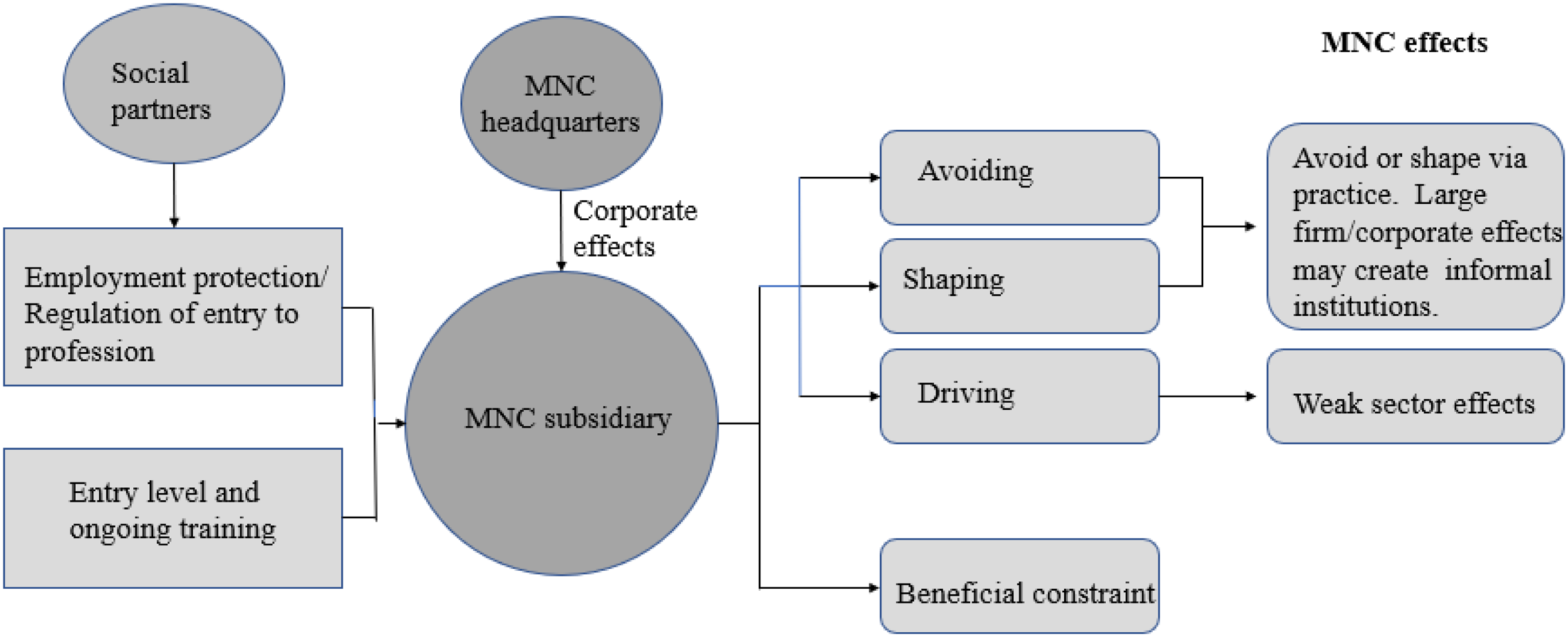
Conclusion
Empirically and theoretically, this paper argues that MNCs can play an important role in professional skill systems. MNC capacity to avoid, shape or drive practices related to professional skill development will be influenced by the role of the social partners and institutions related to employment protection. In highly skilled sectors like aerospace, firms are more likely to engage with other actors (e.g. universities and government) to capture or shape entry-level and ongoing training. The cases demonstrate the thin line between ‘sector’ (Bechter et al., 2012) and ‘MNC’ effects and how these interact. This interaction enables MNCs and their subsidiaries to create distinct conditions for engineering skill development, in ways that influence practices and resources for other firms in the sector. This extends theoretical work both on professional skill formation systems (Sako, 2017), and on ‘country’, ‘sector’ (Bechter et al., 2012) and ‘corporate’ (Delbridge et al., 2011) effects. The institutional legacy, or ‘country’ and ‘sector’ effects demonstrated in each case also have implications for IR actors such as unions in relation to renewal efforts. Despite an absence of traditional IR actors, and institutions in frameworks of professional skill development (Sako, 2017), this paper demonstrates the continued importance of legacies of government intervention and employment protection institutions in shaping institutional resources available for unions (Rigby and García Calavia, 2018) to experiment with.
This study has broader implications when considering how policy initiatives are developed and targeted, particularly around future skills, skill gaps, shortages or mismatches driven by innovation or new technology. This study demonstrates how MNCs have capacity to shape professional skill development. Whether they do so for their own benefit or for the benefit of all firms in the sector is an important question. Some MNC subsidiaries focus on their subsidiary needs, while others operate in a more collective or inclusive way that results in the creation of resources that can be accessed by supply chain firms. In countries such as the UK, where others have argued there are a lack of resources for smaller firms (Benassi et al., 2021), MNCs may have a role to play in producing resources related to professional skill development.
Footnotes
Acknowledgements
I would like to thank Christian Lévesque and Marco Hauptmeier for their comments on earlier drafts of this manuscript, and the editor and two reviewers for their reviews, all of which have significantly improved and strengthened this paper. Any errors of course remain my own.
Declaration of conflicting interests
The author(s) declared no potential conflicts of interest with respect to the research, authorship, and/or publication of this article.
Funding
The author(s) disclosed receipt of the following financial support for the research, authorship, and/or publication of this article: This work was supported by the Economic and Social Research Council (ES/J500197/1).