




Abstract
Leadership in complementary schools is an under-researched area. This article aims to address this gap in the literature by reporting on a study which focused on Brazilian complementary schools in the United Kingdom. Distributed leadership was initially adopted as a theoretical framework to analyse the relationship between leadership style and professional development provision. The data were collected via an online questionnaire and individual semi-structured interviews with leaders, as well as focus group interviews with teachers and teaching assistants. We report here on one of the schools and argue that the contextual constraints in which it operates led to high levels of collaboration between leaders, teachers and teaching assistants. Consequently, a Community of Practice (CoP) has developed. We discuss the benefits this CoP brings to the school and suggest that conscious efforts be made to cultivate this social unit of learning to ensure the professional development of teachers in complementary schools.
Introduction
Complementary schools have existed in the United Kingdom since the 1960s (Wei, 2006). These schools are created by migrant groups to preserve their linguistic and/or cultural heritage as a complement to the formal education offered by their host society (Keating et al., 2013). The first complementary schools offered services to Afro-Caribbean heritage children and specifically addressed their cultural needs. The late 1970s and early 1980s saw the beginning of complementary schools that focused on religious traditions of Muslim families from Asia and Africa. Around the same time, several other migrant communities started complementary schools to preserve their linguistic and cultural heritage, such as the Brazilian schools, which are the focus of the study reported here.
Brazilian emigration became significant in the mid-1980s. The United Kingdom, presently the European country with the highest number of Brazilian migrants (MRE, 2016), has witnessed the growth of Brazilian complementary schools from 1 in 1997 to 18 in 2016 (Souza, 2016). In examining how innovations were institutionalized in one of these schools, Souza and Gomes (2016) found that the role of leader was taken up by parents, as in the Chinese schools studied by Thorpe (2011), and that changes in the school leadership had an impact on how school innovations were implemented. In this way, their study reinforces Thorpe’s (2010) call for a better understanding of leadership in complementary schools in view of their educational, linguistic and cultural aims. This understanding is even more important when we consider that these schools are largely volunteer led, face great challenges in recruiting qualified and experienced staff and have limited resources for offering professional development to their staff (John Lyon’s Charity, 2012; Nwulu, 2015).
Having presented the background context for exploring leadership and professional development in complementary schools in the United Kingdom, we outline our study’s theoretical background: distributed leadership and Communities of Practice (CoPs). This brief overview is followed by a description of our study. We then present the findings related to the impact of leadership on the professional development of teachers based on the data related to one Brazilian complementary school. We conclude by suggesting that conscious efforts be made to cultivate CoPs in this context.
Theoretical framework
The leader’s role in education involves tasks in leadership, management and administration (Dimmock, 1999 in Adams et al., 2017). We focus on leadership, more specifically on the improvement of staff. We start this section by discussing a leadership type introduced in the beginning of the 21st century and which continues to be influential within educational policy and practice: distributed leadership (Harris and DeFlaminis, 2016). We then consider CoPs, a theory which helped to explain our findings.
Distributed leadership is a conceptual framework introduced by Spillane et al. (2001). They advocate that, to understand school leadership, it is necessary to do an in-depth analysis of the leaders’ practices which focuses on how and why they do what they do. As explained by Spillane et al. (2001: 23), ‘[t]he interdependence of the individual and the environment shows how human activity – as distributed in the interactive web of actors, artifacts, and the situation – is the appropriate unit of analysis for studying practice’. In addition, ‘[a]ctors develop common understandings and draw on cultural, social, and historical norms in order to think and act’ (Spillane et al., 2001: 23). As indicated, there are two core elements of distributed leadership: interactions and practice (Harris and DeFlaminis, 2016). Practice results from the interactions of school leaders with other individuals and with aspects of the social context in which they act (Spillane et al., 2015). In this way, distributed leadership enables an understanding of leadership as collective practice (Gronn and DeFlaminis, 2016).
We note, however, that Gronn (2009), who was once a proponent of distributed leadership, points out that some leadership activities are accomplished collectively, and others are performed alone. Consequently, he advocates that the understanding of leadership should move from being distributed to being hybrid. In his own words, ‘hybrid is not intended to define a new type of leader but is employed as a more advantageous means of characterizing situations’ (Gronn, 2009: 384). After all, as stated by Gronn and DeFlaminis (2016), a focus on multiple leadership (the distributed leadership perspective) is as arbitrary as a focus on one leader (the traditional perspective). Instead of this polarity, they call for an identification of the many possibilities that exist between the two forms of leadership. Their argument is that ‘instead of being distributed, leadership is configured’ (Gronn and DeFlaminis, 2016: 169). In this way, leadership comprises an arrangement of different elements in specific ways (Gronn, 2009). As a result, Gronn and DeFlaminis (2016) argue that the unit of analysis should move from a focus on people to arrangements which involve degrees of individualism and collectivism, informal and formal structures as well as constant and fluid degrees of membership with both continuity and discontinuity through time.
Although distributed leadership’s focus on people cannot be denied, Spillane et al.’s (2015: 24) description of leadership as involving ‘the identification, acquisition, allocation, coordination, and use of the social, material, and cultural resources necessary to establish the conditions for the possibility of teaching and learning’ seems to address the leadership configurations posed by the defenders of hybrid leadership (e.g. Gronn, 2009; Gronn and DeFlaminis, 2016).
Teacher leadership is a model of distributed leadership with a specific focus on teaching staff in (formal or informal) roles of leadership and who work collaboratively (Muijs and Harris, 2006). This team-oriented perspective highlights collaboration as a relevant aspect to be developed and integrated into the organizational structure of schools. So much so that the importance of shared actions, processes and commitment has led some researchers (e.g. Hallinger and Heck, 2010; Heck and Hallinger, 2010) to consider it a type of leadership in itself: collaborative leadership.
Collaborative leadership, however, emphasizes broad participation in decision-making by all members of staff, that is, leaders, teachers, administrators (Heck and Hallinger, 2010), as well as parents and students (Hallinger and Heck, 2010). We, instead, focus our study only on leaders and teachers. We are interested, for example, in the redistribution of power and realignment of authority under a teacher leadership model (Muijs and Harris, 2006). Implications of teachers’ empowerment on school relationships are that (1) the distinctions between leaders and followers become blurred, (2) the division of labour is shared more widely and (3) the possibility of becoming leaders is available to all teaching staff (Gronn, 2000). Nonetheless, these implications of teacher leadership, as a development of distributed leadership, have been criticized. Harris and DeFlaminis’ (2016) literature review indicates that teacher leadership may reinforce an unequal distribution of power: it can lead teachers to be exploited into doing more work and it could be just another way of delivering top-down policies and of standardizing practice.
We acknowledge these risks of distributed leadership, especially in the shape of teacher leadership. However, it is noteworthy that authority is not settled. Instead, authority results from ongoing interactions which influence the ways in which power is legitimized within an organization (Woods, 2016). Woods (2016) presents five types of social authority. They are (1) rational authority, (2) communal authority, (3) exchange, (4) democratic legitimation and (5) interior authority. Rational authority can be based on organizational hierarchy and individuals’ expertise. Communal authority is based on individuals’ close ties embedded in social relationships. Exchange relates to leadership through associative relationships and rational agreement, which is a feature of networks. Democratic legitimation results from participation, dialogue and consent. Interior authority is a personal engagement which is developed through social process. In short, authority is negotiated, as are the roles in distributed leadership.
We note that the social interactions in which teachers participate allow them not only to negotiate power and roles but also to exchange knowledge and experience. Thus, in this article, we advocate the cultivation of CoPs by complementary schools. After all, CoPs are ‘groups of people who share a concern or a passion for something they do and learn how to do it better as they interact regularly’ (Wenger-Trayner and Wenger-Trayner, 2015: 1).
The theory of CoPs was originally developed from a study of apprenticeships (Lave and Wenger, 1991), but it has since been extended to encompass learning in any organization (Wenger, 1998). Instead of an individual endeavour, CoP theory sees learning as a ‘socially constituted experience of meaning-making’ (Farnsworth et al., 2016: 142). As newcomers develop expertise through participating in a CoP, their understanding and experience of ‘meaning’ within the community becomes a way of ‘being’, which impacts on their identity (Farnsworth et al., 2016). Meaning within CoPs may still be contested (Nagy and Burch, 2009) and some CoPs are dysfunctional (Wenger, 2010), but this is balanced by the experience of agency and sense-making within CoPs (Wenger, 2010). CoP theory links to distributed leadership in that sharing power and responsibility more widely through distributing leadership enables greater engagement at all levels within a community, thus creating more opportunities for participation and learning.
The study
This article draws on data collected for a small-scale study entitled Leadership development and challenges in complementary schools. This study (RDG/16/16) was funded by BELMAS, the British Educational Leadership, Management and Administration Society. Data gathering took place between September 2016 and July 2017, after ethical approval was given by the University’s Research Ethics Committee. For this approval, a participant’s information sheet with details about the study, such as the purpose, benefits, funding and findings dissemination as well as participants’ confidentiality and withdrawal rights, was provided. Participants signed a consent form, agreeing to the use of the interview data in publications, and all participants have been anonymized in this article.
With the aim of being an exploratory pilot study, the research focused on complementary schools linked to Brazilians, the largest Latin American migrant group in the United Kingdom (McIlwaine et al., 2010). At the time of the data collection, Associação Brasileira de Iniciativas Educacionais no Reino Unido (ABRIR), the Brazilian Association for Educational Projects in the United Kingdom, listed 18 Brazilian complementary schools. All the schools were first accessed using the email contact displayed on ABRIR’s website.
This project had four main objectives: (1) to understand how leadership is defined and developed in complementary schools; (2) to explore the leadership challenges faced by complementary schools; (3) to examine possible ways of dealing with these challenges; and (4) to develop appropriate strategies to improve leadership in complementary schools.
A mixed-methods approach was adopted to address these four objectives in three phases: (1) an online questionnaire, (2) individual semi-structured interviews and (3) focus group interviews. The online questionnaire aimed to develop a profile of the schools and included questions on leaders’ activities, challenges, skills and background. Fourteen of the 18 complementary school leaders (i.e. directors) responded, as illustrated in Table 1.
Profile of the Brazilian complementary schools in the United Kingdom.
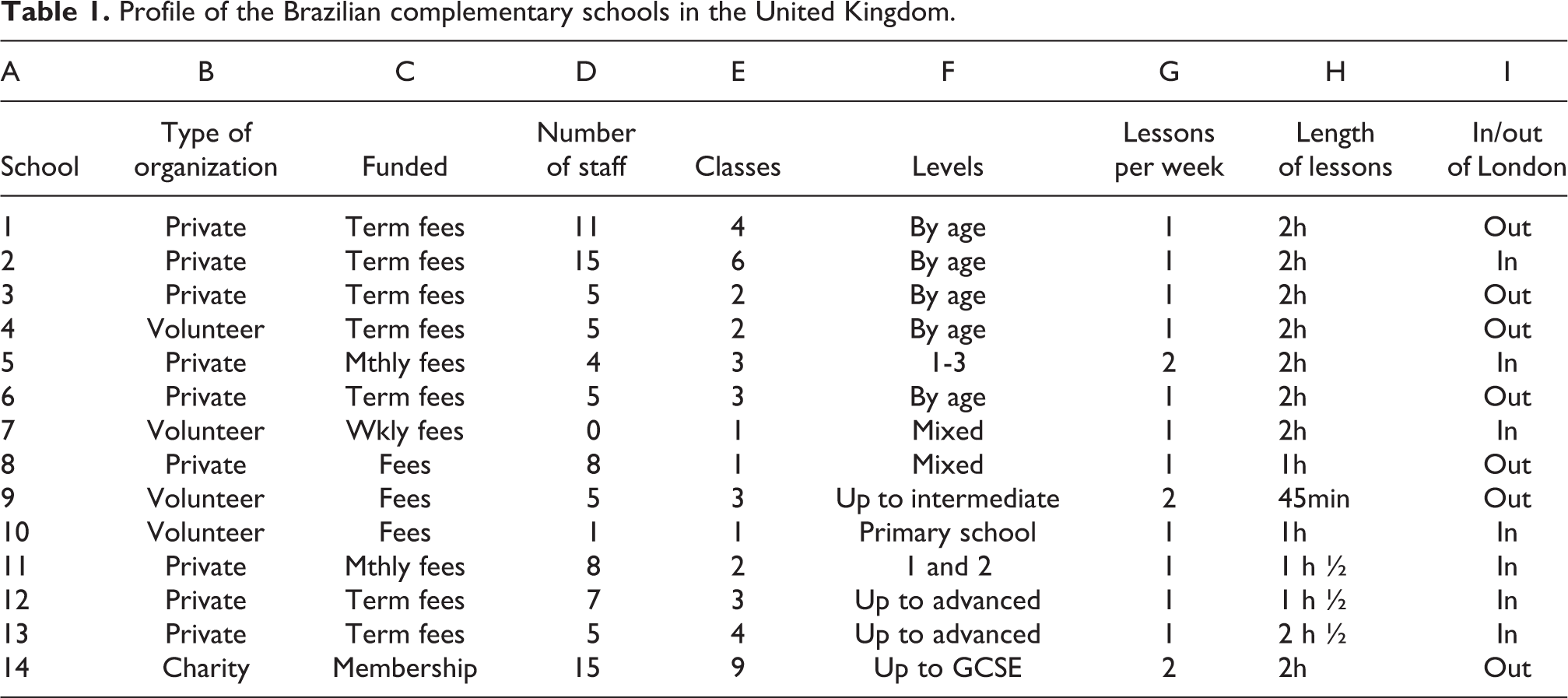
Based on the online questionnaire data, leaders of 3 of the 18 schools were invited for the individual semi-structured interviews. Size and location were the criteria used for selecting the schools for this second phase of the study. Consequently, we had a leader from a large school (61–80 pupils), a medium school (21–40 pupils) and a small school (1–20 pupils). Two of the schools were in London and one was out of London. In this way, the concentration of this group of migrants and their complementary schools in the English capital (ONS, 2013; Souza, 2016) was reflected in the sample. These interviews aimed to access the leaders’ views of the contextual challenges they face and included questions on their role, priorities, staff motivation, financial management, strengths and challenges.
In the third phase of the study, separate focus group interviews were conducted with the teachers and the teaching assistants (TAs) of the same three selected schools. The school directors provided access to their teachers and TAs who were invited to participate in the study via email. As discussed, leadership involves the work of many individuals, whether formally or informally designated as leaders. Thus, the issues that teachers and TAs considered relevant in improving the leaders’ performance and their ways of supporting the activities of the complementary schools were explored in this last set of interviews. The questions covered their role in the school, motivation and decision-making and their perceptions of the leader.
The data analysis identified key themes from the questionnaires and interviews. These then led to the theoretical frameworks which seemed most appropriate to the data (rather than the other way round). The thematic analysis indicated, among other issues, that teachers’ professional development is a topic of concern for the leaders and teachers in Brazilian complementary schools. This concern is aligned with the challenges for recruiting qualified and experienced teachers and offering them professional development, as mentioned in the Introduction. As a consequence, this article explores the impact of leadership on the professional development of teachers with a focus on the large-sized school in our study. This school, which we have given the pseudonym of Araponga – a Brazilian bird, is located in London.
Findings
Our theoretical discussion highlighted three issues related to distributed leadership: contextual aspects, developmental practices and power relations. More specifically, contextual aspects are the social, cultural and material resources available to leaders. Developmental practices, in turn, refer to the leaders’ provision of support, intellectual stimulus and behavioural modelling. Power relationships comprise the negotiations of power and authority that take place between the leader and the teachers. These issues are reflected in the three subsections we use to present our findings about the Brazilian complementary school in our study,
Contextual aspects
We acknowledge that the specific ways in which different resources are arranged in a given context shape distributed leadership (Gronn, 2009; Gronn and DeFlamnis, 2016). Thus, we reflect on the situation of the Brazilian complementary school in our study.
Brazilian migrants live mainly in London, but also in greater London and other parts of the United Kingdom (Evans et al., 2015). In consequence of the numbers of Brazilians in this country, a variety of services catering for their social and cultural needs have sprung up (Souza, 2010). Services related to the accommodation, beauty and food industry, for example, are easily found in many regions of the United Kingdom. So are services related to cultural aspects such as sports, dance, music and other types of artistic expression. In other words, a rich set of social and cultural resources are available to individuals with links to the Portuguese language and Brazilian culture. However, material resources are not as abundant. Over 64% of the schools reported fundraising to be one of their biggest challenges, including Araponga, our focus school.
Araponga is a large Brazilian school in the United Kingdom, founded within the last 20 years and with 6 different classes. In total, the school has six teachers and seven TAs. Their lessons are delivered on Saturdays in 2-hour long sessions.
Although Brazilian complementary school leaders tend to be volunteers and charge fees only to cover expenses as well as teachers’ and TAs’ salaries, the Araponga school leader uses some of the income generated to remunerate her own work. Additionally, attending complementary schools is an optional activity, therefore there is some uncertainty about enrolment numbers. The leader illustrates well the financial constraints this situation generates: At the end of the term, I don’t know who is going to come back. Consequently, I’ve already started many terms without any money to pay the teachers until the end of the term. Sometimes I had enough for the first month only.
Developmental practices
Spillane et al. (2015) also raise the importance of contextual aspects, such as the ones described in the previous section, on the leaders’ practices. The Brazilian complementary school in this study illustrates this link between context and practice well, as we describe in this section.
The limited offer of professional development for teachers of community languages has been raised by a number of researchers (e.g. Anderson, 2008; Issa and Williams, 2009). The teaching of Portuguese is not different. As discussed by Dorneles and Souza (2016), the offer of teacher training courses with a specific focus on Portuguese as a Heritage Language is rare. Some languages, such as Chinese and Arabic, have courses offered regularly by at least one British university in the United Kingdom, whereas professional development for teachers of Portuguese in complementary schools has been offered a few times but with no continuity.
This situation has an impact on the developmental practices of the school leaders in this study. Leading learning and teaching as well as ensuring effective classroom practice were listed top of the challenges faced by over 71% of the leaders. Additionally, 57% of the Brazilian complementary school leaders reported not having a background in education.
The leader of the Araponga school is a director with administrative responsibilities only. Despite not having any teaching qualifications nor responsibilities, she has attended training on multilingualism and on the leadership of complementary schools in the United Kingdom. However, as she explains, not having been trained as a teacher makes her feel that she ‘cannot give [her teachers] the support that [she] would like to give [them]’. Hence, she relies on aiming to hire teachers who have a background in teaching.
The leader recognizes the difference in the type of knowledge she and her teachers have in relation to teaching. However, it seems important to highlight, as this leader does, that these teachers don’t know how to deal with a child that doesn’t speak Portuguese at home, whose parents don’t speak to them [in Portuguese], that arrive here [in the school] speaking English. The teachers [think] that Portuguese [can be] taught [here in the same way it is taught] in Brazil.
Nevertheless, the leader empowers her teachers by discussing her reliance on their knowledge. She also tries to compensate for her limitations by involving her teachers in training offered by external institutions. The teachers are supported with encouragement to attend for their own learning purposes, not only for the school. This leader emphasized this aspect of self-development because she cannot always provide her teachers with financial support for professional development.
This intellectual stimulus offered by the leader seems to be closely linked to behaviour modelling on her part. As the following quote illustrates, her longer life and migration experience ensure a position of power and of being a role model to the teachers, in addition to her committed working ethos. They respect me because they know I have been in London for many years, they see how serious I am in everything I do. trains [the new teachers], provides all the support on how things have to be done: the content to be covered for each group, the lessons, then planning. The [new teachers] do everything and then they send it all to [her] by email and [she] checks if everything is ok, she says what she thinks is good, what is not, what has to be changed.
Power relationships
The developmental practices described above point to a team-oriented perspective where collaboration is paramount and power is distributed (Muijs and Harris, 2006), as discussed in our theoretical framework. Moreover, those developmental practices show that rational authority (i.e. authority based on organizational hierarchy and/or individuals’ expertise) is in play at this school. The leader acknowledges her lack of training and experience in education and explicitly values her teachers’ professional background. Relying heavily on the work of the more experienced teacher to guide the new staff members is one of the ways in which this is done. The senior teacher’s role is recognized by the other teachers, as explained by Teacher 2: If anyone has a problem, they turn to [Teacher 5] because [she] is the one with the experience during [our] meeting[s], it is [Teacher 5] who ends up conducting it. We usually have meetings every end of term to develop the theme for the next term. And [the leader] goes through item by item of what will be done.
There is also a recognition that the flexibility on the part of the leader only goes so far, as Teacher 4 exemplifies: There are few things that, you see, at the end of the day, [the leader] is the owner of the school. What about the choir? Nobody wanted the choir. That was a torture. But we had to do it!
Although she has established clear, strict administrative and organizational expectations, the leader shows openness in listening to the teachers on other occasions. The decision to stop the school termly assemblies is a case in point, as the leader herself explains: The teachers were the ones who asked me to stop it. They didn’t want the school assemblies at the end of the term because they had to spend the whole term rehearsing the children and it affected the lessons. I had to put my hands up and say ‘You’re right!’
At times the leader came across as being authoritarian, but she said she welcomed open constructive criticisms. Furthermore, she appears to invest in a communal type of authority (i.e. authority based on individuals’ social relationships). As illustrated below, close ties are developed between the leader, her teachers and TAs through social relationships: The end of the year dinner parties! [We] meet out for coffee! There is the Christmas Dinner and we are invited to her birthday parties. (TAs focus group)
This communal type of authority is negotiated between the teachers and the TAs. TA-3 describes having built strong trust and collaboration between her and the teacher with whom she works. This positive relationship is evident in the freedom and the confidence the TA said she has in relation to contributing to lesson planning. It is a relationship that has developed over time. It is also possible to identify interior authority (that is, authority based on personal engagement) being negotiated, as Teacher 5 explains: [My role to support the other teachers] became clear to me. But it was not something that [the leader] made clear, like ‘Look […] from now on you have this new position’. No. It was a role that I took […] It came naturally.
Discussion and conclusion
In this article, we illustrate the impact of leadership on the professional development of teachers and TAs working in a Brazilian complementary school. As discussed here and elsewhere (e.g. Souza and Gomes, 2016; Thorpe, 2011), the leadership roles in this type of school are mostly taken up by parents or by individuals with strong identity and emotional links to their migrant groups. Complementary schools result from grassroots movements of migrant communities who long for their linguistic and cultural heritage to be transmitted to their children. Issues of identity formation through participation in community are core to these schools and the activities they organize. It means that leaders, teachers and TAs are willing to commit to working in these contexts, despite the limited financial and teaching resources at their disposal.
The personal commitment of the parties involved in running the activities offered by complementary schools is, thus, closely linked to the organic development of an ethos of collaboration. Collaboration also becomes a strategy to overcome the contextual constraints they experience. This is how the leader of Araponga school is able to run her school successfully without adequate training in Education nor in Business. Nevertheless, the school faces challenges in relation to its access to social, cultural and material resources (i.e. its contextual aspects). Due to the considerable number of Brazilian migrants in the United Kingdom, there is a variety of services that cater for this group. However, there is no financial support available for these activities. Neither is there continuous pedagogical support for leaders nor for the teaching staff of the Brazilian complementary schools in the United Kingdom.
For these reasons, the Araponga leader adopts a leadership model of distributed leadership. The adoption of this model has implications for the professional development support, intellectual stimulus and behaviour modelling provided to the teaching staff. This leader’s limited training plays an important part in the strategies she adopts for her developmental practices. She creates space for teachers to draw on their knowledge and experience and create a CoP (Lave and Wenger, 1991), where members support each other and are encouraged to exchange expertise and attend external training. The commitment to the school and the seriousness of this work is modelled by the leader. In addition, her experience as a migrant mother who raises multilingual and multicultural children is coupled with her 8 years of leading the school, developing knowledge on bilingualism and attending the few training courses offered in the United Kingdom on the governance of complementary schools.
The negotiation of power and authority is a relevant aspect in distributed leadership. In the Araponga school, it was possible to identify the negotiation of four types of social authority (Woods, 2016) taking place: rational, communal and interior authority as well as democratic legitimation. More specifically, the school had a hierarchical organization where individuals’ expertise was recognized. Authority was negotiated through the different social relationships within the team (leader-teacher-TA and friends). Teacher leadership resulted from the personal engagement of individual teachers. Leader and teacher leaderships were legitimized through consent by the other teaching staff who participated in dialogues about teaching.
In short, the leader reported to have some success in motivating her staff and leading change. In spite of this, there are indications of limitations on how far leadership is really distributed in this school: some teachers seem to be more empowered than others. However, this imbalance is not necessarily negative nor surprising within a CoP, as its framework involves ‘different forms and levels of membership and participation’ (St Clair, 2008: 24). It is more important to understand that CoPs are social units of learning, where members engage in joint activities in the production of shared resources (i.e. concepts, tools and artefacts) (Wenger, 2000). The Araponga school CoP has been developed spontaneously and informally, as is characteristic of these types of processes (Mitchell, 2013). However, ‘the value of the CoP concept can be very limited when at least its most basic conceptual frameworks are not explored’ (Pyrko et al., 2017: 405). Therefore, we conclude this article by suggesting that complementary schools make conscious efforts to cultivate their CoPs and improve the opportunities their teachers have to acquire and enhance their skills, knowledge and attitudes for improving their practice.
Footnotes
Declaration of conflicting interests
The author(s) declared no potential conflicts of interest with respect to the research, authorship, and/or publication of this article.
Funding
The author(s) disclosed receipt of the following financial support for the research, authorship, and/or publication of this article: This research was supported by the British Educational Leadership Management and Administration Society (BELMAS) via a research grant [Grant Number: RDG/16/16].
