




Abstract
While the effects of the platform economy on work are mainly studied through the lens of gig or cloud workers, many more employees are likely to be affected in non-platform firms or sectors. We discuss the mechanisms of platform economy’s impact on the employment relationships and indirect effect on employment trends. Platform firms enter the service economy with business models that put existing service providers under pressure and advance a platform model of employment relationship. However, their transformative force is limited by three factors: employment regulations, access to welfare provisions and the employment relations at legacy firms. We examine the case of Amazon logistics in the US, Germany and the UK and find that the employment contract, as a legal institution, prevents the dissemination of independent contracting as the preferred employment model. Moreover, the welfare state has a paradoxical effect on platform work: universal welfare and liberal employment law facilitate the rise of precarious work.
Keywords
Introduction
In this paper, we investigate the effects of platform companies on work using the case study of Amazon logistics. In most of the literature on the impact of platform companies on work, the focus is narrowly defined to gig and cloud workers. Gig workers are freelance workers who perform location-based services for customers, mediated by a platform company, which act as an intermediary in two- or multi-sided markets that use data analytics to connect customers and service delivery (Kenney and Zysman, 2017). Cloud work, on the other hand, refers to all work relationships that are web-based. A rapidly increasing body of literature analyses how platform companies directly affect employment relationships. The major focus in that strand of literature is on quantifying the size of gig work and analysing the conditions of these employment relationships and mobilization efforts by gig workers (Huws et al., 2017; Katz and Krueger, 2019; Wood, 2021).
However, the effects of platform companies on work are much more likely to be felt through their indirect impact on employment relationships in other, non-platform companies or in entire sectors. Platform companies interact directly with sectors in the real economy. The transport firm Uber puts pressure on the taxi industry and has, more recently, become involved in logistics. AirBnB organizes alternative ways to travel and impacts hotels, guesthouses and travel agencies. Google maps offers a free navigation service and competes with physical maps and navigation providers. Booking.com has circumvented traditional travel agencies. Finally, Amazon has not only expanded into online shopping, but is also the epitome of the logistics revolution in retail (Allen, 1997). Platform companies thereby force other companies to adjust to this new competition.
So far, platform companies have been highly successful in sectors in which innovation in service deliveries has stalled and productivity is low. For instance, taxi sector regulation has limited access and reduced competitive pressure in many countries, making Uber an attractive alternative for both drivers and customers (Chen et al., 2019). It is, however, likely that platforms and platform companies will become an important feature for the reorganization of manufacturing companies and high-productivity services. Global value chains and supplier relations in manufacturing and digital services are all potential targets for new forms of platform-mediated reorganization (Davis, 2016; Weil, 2014; Yeung and Coe, 2014). In this paper, we pursue the question of how the entry of a platform company in an established industry affects work in that industry. Contributing to the literature on comparative political economy and employment relations, we argue that the disruptive force of platform companies stems from the pressure put on other, non-platform companies in the sector to adjust. Platform companies, thereby, intensify the ongoing process of fissuring work by focusing on the model of independent contractors as the new employment relationship and reinforcing subcontracting trends (Weil, 2019). However, platform companies are also constrained by employment regulation, welfare provisions and employment relationships at legacy firms.
The rest of the paper is structured as follows: In the first section, the characteristics of platform companies are briefly explained. The next section provides a review of the literature on new work arrangements. Section three analyses the employment model of platform companies and introduces the research questions and hypotheses. After outlining our methodology and case selection in the fourth section, we explain Amazon’s approach towards logistics and investigate the effect of Amazon’s entry into the logistics sector on employment relations using the three case studies of the United States, Germany and the United Kingdom.
The emergence of platform companies
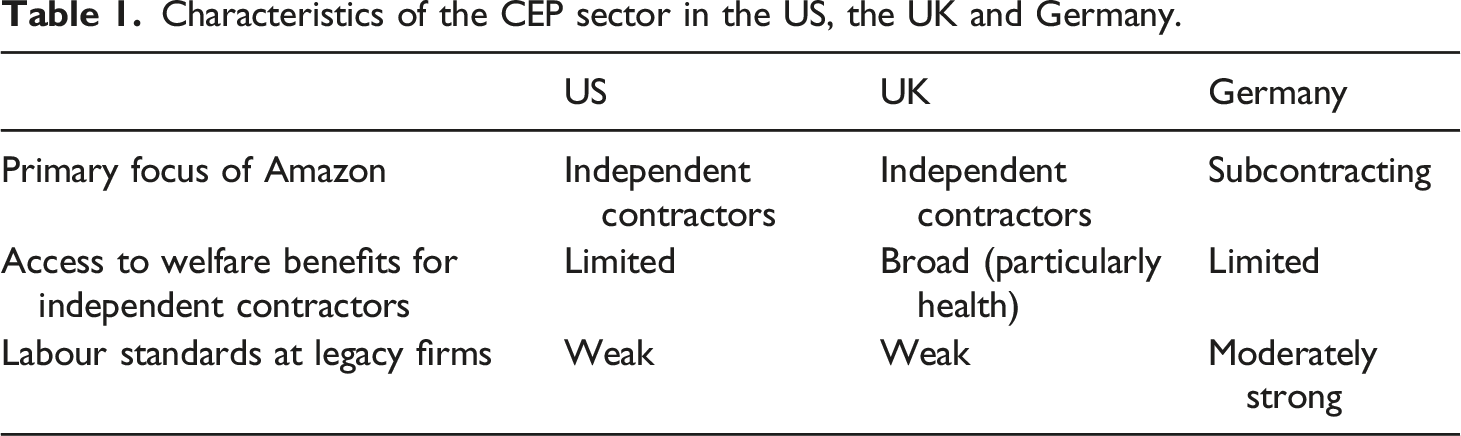
Characteristics of the CEP sector in the US, the UK and Germany.
The most widely applied definition of platform companies was provided by Rochet and Tirole (2003), who defined platforms as intermediaries in two- or multi-sided markets. This definition is, however, rather wide in its scope and does not adequately capture the variety of platforms. Gawer (2014) added an engineering design perspective with an emphasis on innovation and differentiated and conceptualized platforms as ‘evolving organizations or meta-organizations that (1) federate and coordinate constitutive agents who can innovate and compete; (2) create value by generating and harnessing economies of scope in supply or/and in demand; and (3) entail a modular technological architecture composed of a core and a periphery’. (cf. Gawer, 2014: p.1239). Further differentiating between internal, supply chain and industrial platforms, the author emphasized the organizational variety of platforms. Focusing on the value creation process of platforms, Cusumano et al. (2019) differentiated between transaction, whose main purpose is to facilitate transactions, and innovation platforms, which are the operating systems where innovation occurs. In a similar vein, Van Dijck et al. (2018) distinguish between sectoral and infrastructural platforms to illustrate a hierarchy between platforms. Infrastructural platforms, such as iOS or Android, jointly build an ecosystem or an infrastructural core, on top of which sectoral platforms, such as social media and e-commerce platforms, are built. All these definitions have a mutual emphasis on (1) the hybridity and (2) the relational structure of platforms (Schüßler et al., 2021). Most companies, such as the big tech firms Google, Amazon or Facebook that are considered to be platforms, are not archetypal ones but rather hybrid ones, as they do not have a pure platform business model but rather operate a substantial platform component. Moreover, platforms are deeply relational structures and unfold their potential in relation to other actors, which is underlined by the key features of platforms: network effects and platform ecosystems.
Platforms aim to attract as many participants as possible into their platform ecosystem, which ‘comprises the platform’s sponsors plus all providers of complements that make the platform more valuable to consumers’ (Jacobides et al., 2018: p.2257f). Platform ecosystems take a hub and spoke form with a variety of actors, who are connected to the central platform via shared or open source technologies (Gawer, 2014). The attraction of a platform ecosystem, in turn, depends on demand economies of scale, which are also known as network effects (WEF, 2019). These network effects can either be positive or negative and of a direct or an indirect nature. Positive, direct or same-side network effects occur when the benefit for a participant in a platform ecosystem depends on the number of users that are already part of the same side of that ecosystem, thus characterizing a preference for volume. An example for direct network effects are social media platforms. Indirect or cross-side network effects, on the other hand, reflect reciprocal relationships on the platform, so the attraction of the ecosystem for participant A depends on the number of participants B on the other side of that ecosystem. Thus, indirect network effects, represented, for instance, by the number of sellers and customers on Amazon Marketplace, characterize a preference for variety (Gawer, 2014; Jacobides et al., 2018). Second, they commodify the flow of information converted into data points. In order to reap and reproduce these network effects, platform companies harness enormous amounts of data. The power of network effects can be explained by the different growth of cost and value. When the size of a network increases, its relational value grows exponentially, but the cost of maintaining the network does not grow at the same speed. This is why network effects often result in winner-take-all dynamics. Once a platform company has a specific network size in the market, it becomes increasingly difficult for competing firms to catch up, due to the exponential growth of value exceeding maintenance costs (Kenney et al., 2021). Third, value creation depends on the active participation of platform users (value co-creation). Platforms create value by enabling and coordinating the transactions of independent parties. In fact, value is created from users and co-created with users and increases with indirect network effects, leading to a virtuous cycle of growth. This value co-creation process is particularly strong in the case of social media platforms. Users share their data with the platform company, which uses this data to generate ad revenue. As users are not paid for their data contribution, but rather remunerated by being offered the platform service for free, the platform company’s value capture widely exceeds its value creation (Lanier, 2013).
The employment model of platform companies
The employment model of platform companies is part and parcel of the shift towards more fragmented employment relationships. Weil (2014) describes workplace fissuring as a process that lifts companies away from their responsibility towards their workers and makes their employment more insecure. Hyman (2018) traces labour market insecurity back to the entry of temporary work agencies in the late 1960s, when companies found new ways of dealing with fluctuations in the market and had to adjust their workforce to these fluctuations. Temporary work was complemented by extensive subcontracting, both along the supply chain but also within firms. Companies started to outsource the auxiliary functions of their organizations, canteens, security and building maintenance to external service providers. These service providers, as they were no longer part of the lead firm’s business, did not participate in productivity advances or profitability, and pay and conditions for auxiliary services remained stagnant as outsourcing proceeded.
Davis (2016) coined the extensive use of subcontracting Nikefication. Subcontracting goes hand-in-hand with the rise of a new theory of firms as a nexus of contracts, rather than the managerial enterprise as advocated by Chandler (1977). The entry of platform companies pushes the reorganization of firms further as they introduce independent contractors as a new model of employment. Independent contractors ultimately free firms from their responsibility towards workers and shift all economic risks to the freelance contractor (Vallas, 2019; Ravenelle, 2019). As self-employed workers, they enjoy less social protection than dependently employed workers (Schüßler et al., 2021). The introduction of independent contracting as a new, preferred employment model finally aggravates a shift from careers to jobs and now tasks as the dominant labour pattern (Davis, 2016; Schüßler and Kirchner, 2020). After a century of rising standard employment relationships, we now enter an era of new casualization and informal employment within the industrialized modern economies of the OECD. Platform companies are further characterized by extreme polarization within the firm. Highly skilled, genius workers within platform companies are highly protected, well paid and have large benefit packages, which they have to trade against restrictive, non-compete clauses. The distinction between the core employees of platform companies themselves and the independent contractors they aim to lure to work for them is part of an increasing divide between high-productivity Frontier work and what have been coined last mile jobs (Autor and Salomons, 2018).
A growing body of literature focuses on the direct employment effects of platform companies (Huws et al., 2017; Katz and Krueger, 2019; Wood, 2021). Central to this literature strand is the question of the size and conditions of platform work arrangements, which are often labelled ‘gig work’. However, platform work receives disproportional attention in the academic debate when its size is taken into consideration. In most European countries and the United States, less than 1–2% of the adult population earn at least half their income through platform work (Schor, 2021). The major reasons for the attention devoted to platform work are the strong growth rates, especially in the delivery sector (Online Labour Index, 2020). Platform work arrangements are not limited to location-specific service work but also include online medium-skilled microtasks as well as highly skilled freelance contracting. The majority of platform work arrangements are, however, location-specific independent contracting, which is not only the focus in this paper, but also the subject of most publications devoted to that topic.
Associated in general with low wages, long working hours or high stress (Huws et al., 2017; Riso, 2019), recent research highlights greater heterogeneity among location-specific platform workers, particularly among those who rely on these work arrangements as their main source of income as well as those who have other jobs on the side (Schor, 2021). In contrast to research on the size of platform work and its direct effects on employment, that is, the dissemination of gig work arrangements, research on indirect employment effects of platform work is, with a few exceptions, rather scarce (Derenoncourt et al., 2021). These indirect employment effects include the question of how the market entrance of a platform company alters employment relationships, not only at other non-platform companies but also in a sector as a whole.
The logistic sector in particular is increasingly important for platform companies, as the expansion of Amazon, or other online retailers with similar logistic operations, has shown. The logistics sector is also subject to a profound digital transformation with severe repercussions on employment conditions. This transformation has been sparked by the introduction of new technologies, including predictive analytics or telematics, and software, such as traceability software or route optimization algorithms (Zanker, 2018). How exactly employment relationships are affected is not clear, as studies on this topic are still rather scarce, the exception being the work by Pulignano et al. (2020), who analysed the adoption of new technologies in warehouses in Germany, the Netherlands and Belgium, for instance. Combining the perspectives on the digital transformation and national constraints, Doerflinger et al. (2021) identified distinct production regimes with different employment conditions shaped by national institutions.
The aim of this paper is to bring these perspectives together and analyse how the entry of Amazon in the logistics sector alters employment relationships in that sector. Focusing on on-location, last mile delivery employment relationships, we argue that three contextual factors can limit the casualization of work due to the rise of platform companies.
First, the diffusion of the platform employment model is moderated by different regulatory and institutional contexts. In countries with stricter employment regulations, the dissemination of independent contractors faces more obstacles. Thelen (2018) analysed, in one of the first studies on this topic in a case study on Uber, the different constraints that emerged when the company launched its services in the United States, Sweden and Germany. While Uber did not face many obstacles when launching its services in the United States, the company was banned in Germany due to the fact that the employment model of independent contractors is not compatible with German labour law. In Sweden, national constraints did not include employment legislation but rather concerned the question of tax contributions, which, once resolved, allowed Uber to operate relatively freely in the Swedish market.
The challenge of Uber in Europe, at the European Court of Justice and with the many restrictions in EU member states, points to the effects of existing market regulations for platform companies (Bowcott, 2017). Strict regulation of services in Europe point to the potential of higher value capture through disruptive business models. On the other hand, these different regulatory and institutional contexts define the speed and strategy of platform companies: The European market is big and, therefore, a testing ground for all platform companies. We therefore expect a variety of roll-out strategies from platform companies in different countries as well as different institutional obstacles for the use of independent contractors by platform companies.
Second, access to welfare provisions might facilitate further casualization. In many countries, welfare provisions, and in particular, health care, are tied to the employment relationship. Welfare provisions for the self-employed vary substantially across the OECD. Workers might not be willing to engage in casual work, if the costs are too high and welfare benefits are tied to the employment relationship. The employment model of platform companies prefers independent contractors over an employment relationship. Access to welfare provisions is restricted and often not universal. If health care is bound to the existence of an employment contract, independent contracting becomes less attractive as the risks associated with it are higher.
Third, the employment relations at legacy firms in the transport sector limit the employment model of platform companies. The transport and logistics sector has traditionally been dominated by state-owned companies for postal services (Zanker, 2018). Their employment relations were heavily regulated and often highly unionized. The use of independent contractors as a core component of platform business models runs counter to this traditional employment model. With the opening up of the transport sector to private competitors, new patterns of industrial relations have emerged. We assume that the degree to which platform companies can pursue strategies to employ independent contractors is shaped by the market structure and the position of legacy firms.
Methodology and case selection
In order to answer the research question of how the entry of a platform company in an established industry affects work in that industry, we adopt a comparative case study approach to investigate the market entrance of Amazon logistics in the United States, Germany and the United Kingdom. The case selection is primarily driven by Amazon’s presence in these countries. These three countries constitute the largest markets for Amazon (Statista, 2021b). As the company started its logistics operation only a couple of years ago, its presence in most other countries is still small. To make meaningful comparisons, we focused on those markets where Amazon has gained the most significant market shares. The three countries are also well suited for a comparable analysis due to their classification as coordinated (Germany) and liberal (UK, US) market economies (Hall and Soskice, 2001). Obtaining data on the effect Amazon’s market entrance has had in the logistics sector is very challenging, as the company does not disclose precise employment data. For this reason, we relied in our comparative case study design on three data sources:
In a first step, we conducted an extensive, secondary, literature research into the development of last mile logistics operations in the United States, Germany and the United Kingdom since Amazon entered the market. For this purpose, we focused on academic journals, newspaper articles and industry magazines that reported on the status-quo of the logistics sector and the effect of Amazon’s market entrance over the last 6 years.
Secondly, we conducted expert interviews with representatives from companies, industry associations and trade unions between October 2019 and March 2020. The goal of these interviews was to gain further information on the digital transformation of the logistics sector, the impact of Amazon’s market entrance and the strategic positioning of the respective actors.
Finally, we collected data on self-employed couriers and messengers as a proxy for the dissemination of independent contracting in the logistics sector. For the United States, we relied on data from the Contingent Worker Survey, which is a supplement to the Current Population Survey, but this only provided two data points, for 2005 and 2017. In the case of Germany, we relied on the Mikrozensus, which also provided only two data points, 2010 and 2018. For the United Kingdom, we retrieved data from the Office of National Statistics, which was more comprehensive and provided observations for every year from 2010 to 2019. The data was seasonally adjusted to remove a seasonal component and so made more useful comparisons.
The effects of Amazon on employment in the CEP sector
Initially founded in 1995 as an online bookseller, Amazon started to expand its operations quickly. Three years after launching its website, Amazon began to expand its choice of products, started to sell music, videos and electronics and became an online retailer (Ritala et al., 2014). Amazon’s business strategy was characterized by aggressively expanding and diversifying its product offerings. In 1998, it had already expanded geographically and launched its website in Germany, the United Kingdom and India. Amazon is known for an aggressive expansion strategy, a particular strong focus on data-driven management and a demanding workplace culture that marks a contrast to rival big tech companies such as Google (Kantor and Streitfeld, 2015). Consequences are high worker turnover, not only inside its warehouses but also in its headquarters. Originally, Bezos planned to name his company relentless.com, which still links to Amazon’s website (Stone, 2013; Dumaine, 2020).
Today, Amazon is not only the largest online retailer worldwide, but also on track to surpass Walmart as the world’s leading retailer, and accounts for an ever-increasing revenue share in other industries, such as logistics or cloud services. Amazon became the fourth most valuable company in the world in 2020, while its market capitalization has increased in the last 7 years from $200 billion to $1.7 trillion (Statista, 2021b).
Amazon’s approach towards logistics
A central pillar of Amazon’s business activities are its logistics operations. Central here is the courier, express and parcels market (CEP) that can be differentiated from other sectors in the delivery market by the lower weight of parcels (up to 30 kg) and faster delivery. Moreover, the market is segmented by business-to-business (B2B), business-to-consumer (B2C) and consumer-to-consumer (C2C) delivery (Dieke et al., 2019). Amazon operates primarily in the B2C segment, but has also increasingly begun to deliver goods in the B2B segment with the launch of its B2B platform, Amazon Business, in 2015.
Amazon has several advantages over its competitors in the logistics sector. First, the company incentivized its third-party vendors to use Amazon logistics for package delivery by offering Prime status, guaranteeing faster delivery to ‘Fulfilment by Amazon’ participants, thereby guaranteeing a strong package volume and creating its own demand. Second, unlike its competitors in the logistics sector, Amazon also operates a retail platform. Coupling the retail and logistics segments gives Amazon the advantage of using its transaction sales data to optimize its logistics operations. Having information on the volume of orders for specific products, time and date gives Amazon the opportunity to make their warehouse operations and route planning for the last mile more efficient (Kenney and Zysman, 2017). In terms of employment, Amazon relies on a mix of subcontractors and independent contractors. Amazon argues that the reason they have entered the last mile, after controlling the less cost-intensive parts of the supply chain and logistics operations, is the discontent felt over how FedEx, USPS and UPS handled Amazon’s package volume in the winter of 2013 and the company’s conviction of being able to develop a more cost-efficient and faster delivery service (Solomon, 2020).
In 2015, Amazon launched its Amazon Flex programme, a crowdsourced delivery model. Amazon Flex operates only in densely populated areas and works on the idea of contracting last mile delivery out to self-employed drivers, who are allowed to work between one and 4 hours a day. After completing an online course, participants of the Flex programme can bid to deliver Amazon orders via an app. This kind of employment model, that is, individuals shifted to piecework, fits in well with the trend towards the Uberization of work (Davis, 2015). The Amazon Flex programme sparked a variety of criticism, as the drivers, obliged to use their own vehicles, received a substantially lower net income than the advertised $18–25 an hour, after maintenance costs, insurance and fuel were taken into account (Weil, 2019). According to experts, the Flex programme is, however, not an employment model that can be applied on a large scale, as it is more difficult to ensure a high-quality delivery service by relying on self-employed drivers for only small shifts. Amazon’s focus on customer satisfaction, in conjunction with its attempts to expand next day and even same day delivery, prohibits it from relying on Amazon Flex as its primary employment model (Duggan, 2018).
By entering the logistics sector and by using new employment models, Amazon has caused a dramatic upheaval in the package delivery sector. The following section investigates the development of the CEP sector and the impact of Amazon’s market entrance in the United States, Germany and the United Kingdom.
United States
In 2018, the CEP market in the United States was estimated to be $90 billion worth and expected to grow by 5% annually in the coming years (Beroe, 2019). This surge in market size is primarily driven by strong growth in the B2C delivery segment, which reflects the increase in e-commerce transactions. For decades, the CEP market in the United States was dominated by the US Postal Service (USPS), which is an independent agency of the government’s executive branch with a monopoly on specific postal services. Initiated by the liberalization of the postal sector, more private companies, such as FedEx, started to enter the market. Today, USPS, UPS and FedEx, as third-party logistics providers, are the largest companies in the CEP market, each of them with a revenue of about $70 billion. (Statista, 2019).
In 2019, only 7 years after expanding its logistics operations, Amazon managed to handle a parcel volume of 2.5 billion per year. The percentage of the company’s last mile shipments increased between 2016 and 2019 from 8% to 46%. Even though FedEx and USPS still surpass this number with 3 and 4.7 billion parcels, respectively, it is expected that Amazon logistics will surpass its competitors by 2022, if it maintains its current growth rate (Cosgrove, 2019).
Until the 1980s, the CEP sector was characterized by relatively stable employment relationships with only modest degrees of outsourcing (Weil, 2019). The first company that began to break with this employment model was FedEx. In 1985, FedEx created a subsidiary called FedEx Ground to handle its small package business. FedEx Ground relied on subcontractors and classified its employees as independent contractors, thereby relieving itself from obligations, such as worker compensations or unemployment insurance contributions. The classification of employees as independent contractors sparked considerable criticism and was heavily litigated in court. The liberalization of employment relations also disseminated to USPS and UPS, which started to increasingly rely on subcontractors (Weil, 2019).
The market entrance of Amazon and the dissemination of its employment practices were a further continuation of the subcontracting processes that existed before. It is estimated that Amazon employs around 270,000 workers to maintain its logistics operation in the United States (Lee and Nilsson, 2020). How this number is distributed between employees at warehouses and those in its last mile operations is, however, unknown, as the company is notoriously secretive about providing information on its operations.
For its last mile delivery activities, Amazon relies on its crowdsourced delivery model, Amazon Flex, and, to a greater extent, on subcontractor companies, resembling the employment model pushed forward by FedEx (Ingram and Kent, 2019). These companies contract drivers directly or further subcontract their operations, thereby relieving Amazon from responsibility for the drivers who deliver their packages. This allows the company to substantially lower their costs. In order to guarantee better monitoring, whilst maintaining the advantages of a subcontractor model, Amazon launched its Delivery Service Partner (DSP) programme in 2018 that encourages eligible individuals to start their own delivery business. Amazon provides vans, insurance and loans for interested subcontractors, who have to deliver exclusively for Amazon. In contrast to Amazon Flex, which targets single drivers for instant deliveries, DSP more closely resembles the classic subcontractor model of companies such as FedEx. Even though crowdsourcing delivery via Amazon Flex is part of the business strategy, direct subcontracting via DSP or hiring small logistics companies takes a stronger role in the expansion of Amazon’s logistics activities.
Germany
Driven by the strong growth in the B2C delivery segment, the CEP market’s revenues in Germany doubled between 2010 and 2018 from €10 billion to roughly €20 billion (Statista, 2019a). The dominating market player is the German Post, which has operated under the trade name DPDHL, after acquiring the courier DHL in 2002. Similar to the United States, the German postal sector was highly regulated until liberalization processes began in the mid-1980s. Liberalization started in 1984 with the opening of the express mail market to other companies, followed by lifting the German Post’s monopoly for courier and cross-border mail (Brandt, 2007). DPDHL, the now privatized, former state-run, postal company is the dominant market player in the CEP market, with a market share of more than 50%. In the B2C segment, relevant competitors are Hermes, a wholly owned subsidiary of German online retailer Otto, DPD, a subsidiary of the French Post, and GLS, a subsidiary of the Royal Mail.
Amazon recently started to build its own delivery network for the last mile, which poses a significant threat for its competitors. In 2019, Amazon generated a revenue of $12 billion in Germany with its online store in the B2C segment, almost three times as much as the second closest competitor, Otto, and controls 50% of the German e-commerce market (EcommerceDB, 2020a, EcommerceDB, 2020b).
Employment relations in the German CEP market are characterized by a large low-wage sector and some comparatively better-paid jobs distributed across very few companies, such as DPDHL, in the B2C delivery segment, and UPS, in the B2B delivery segment (Zanker, 2018). DPDHL is deeply embedded in the social partnership model due to its status as a former state-run company. Historically, it has relatively stable employment relations, is bound by collective agreements and offers relatively high pay for the sector. However, since the liberalization of the CEP market and the increasing growth of new competitors, such as Hermes, DPD or GLS, the market has become subject to dualization and the formerly stable employment relations have deteriorated (Zanker, 2018). Employment in the CEP market has become split between better-paid jobs, for all those who were directly employed by one of the big logistics companies, and unstable, low-paid jobs for subcontractors. Companies, such as Hermes, DPD or GLS, rely primarily on subcontractors and have caused a downgrading of employment relations.
Amazon has tested different employment models (Nicolai, 2019). For instance, in 2019, it announced it would directly hire 200 drivers in Munich. Amazon offered €12.80 per hour, which is above what competitors such as Hermes offer, but still considerably lower than what DPDHL pays its employees (Sawall, 2019). This decision to hire direct employees stands in stark contrast to the strategy in other countries, where Amazon relies entirely on subcontractors. Plans to expand the hiring of direct employees in other cities have not yet been disclosed. In summary, Amazon relies primarily on subcontractors and has adapted its employment model to an institutional setting that has strong legislative barriers towards the dissemination of fully independent contracting. In addition, a new law, that was introduced in November 2019 and specifically aimed at the CEP sector, has made firms liable if subcontractors fail to pay social security contributions for their employees.
United Kingdom
In 2019, the CEP market in the United Kingdom generated a revenue of £12.6 billion, an increase of 62% since 2014. Due to the strong increase in e-commerce transactions, high growth rates are expected to be achieved in the future (Allen et al., 2018). The dominant market player is Royal Mail, which, in 2017, controlled around 50% of the CEP market and for decades has operated a monopoly on letter and parcel delivery (Statista, 2017; Brandt, 2007).
Launched in 2012, Amazon logistics heavily invested in its warehousing network and today operates 17 fulfilment centres and a variety of distribution and sorting centres (Amazon, 2020). In 2019, the company generated a revenue of £7.4 billion with its online store, almost twice as much as its biggest e-commerce competitor, Tesco (EcommerceDB, 2020a). The strongest disruption in the CEP market occurred in 2020, however, with the launch of Shipping with Amazon (SWA). SWA offers the delivery of packages to sellers who do not engage on the platform, thereby building its own delivery network that goes beyond the subsidiary status that Amazon logistics occupies in other countries as an in-house delivery service for Amazon packages. Before its full launch in the United Kingdom, SWA had not previously been applied on a large scale (Dawson, 2020). Between 2017 and 2020, Amazon logistics managed to more than double its market share from 7% to 15% (Dawson, 2021; Statista, 2017).
The CEP market in the United Kingdom was dominated by Royal Mail for decades, which offered, as a state-run enterprise, stable employment relationships with relatively high pay. Due to liberalization and the market entrance of new players, such as Hermes or Yodel, employment deteriorated and subcontracting now prevails, as these companies premise their business model almost entirely on self-employed workers. The employment status of independent contractor is being increasingly challenged in court. In 2019, Hermes offered its drivers a self-employment plus status that grants holiday pay (Harris, 2019). Royal Mail has only a small number of independent contractors employed at their subsidiary, eCourier, employing drivers directly, offering relatively high wages for the sector and containing the highest percentage of unionized workers (Moss, 2019; Business Matters, 2019).
Amazon does not employ drivers directly, but rather uses subcontractors, who can be single-owner operators or larger logistics providers (BBC, 2018; Tims, 2019). Moreover, Amazon relies on its DSP programme and on Amazon Flex drivers working on zero-hour contracts, which are widely disseminated in the CEP market (Tims, 2019). Employment conditions in the CEP market in the United Kingdom have been widely criticized: the reliance on independent subcontractors on zero-hour contracts, unpaid overtime, tight delivery targets and salaries below the living wage have all been subject to several investigations (Booth et al., 2016).
In sum, we can see from the case studies that Amazon used its digital platform to generate new business models for the backbone of their system, such as the logistics chain, which is closely related to different worlds of employment standards and working conditions. Rather than just matching buyers and sellers on Amazon Marketplace, Amazon aims to take advantage of the lower logistical efficiency of the traditional CEP companies and manipulate them with new distribution networks, different labour standards and new kinds of employment. As the CEP market used to be run by public service providers, which were privatized and liberalized before Amazon entered the market, there was still scope for cost cutting and efficiency gains. Amazon’s market entrance in last mile logistics operations did not represent a total rupture, but rather reinforced outsourcing trends that existed before. In all three countries, the company relies on subcontractors. However, there are differences as to what extent fully independent contracting is applied as an employment model. In the United States, and particularly in the United Kingdom, Amazon experimented with employment models, such as Amazon Flex and Amazon Delivery Service Partner, and operates a considerably larger fleet of truly self-employed couriers and messengers. In Germany, on the other hand, stricter laws against bogus self-employment prevent the dissemination of independent contracting as the main employment model promoted by platform companies (Table 1).
The postal service firms in all three countries played a role for the restructuring of the industries. USPS and Royal Mail suffered from the deregulation of the sector and could not protect labour standards. The German postal service firm DPDHL had better market protection and can still provide a better standard of jobs despite private sector competition.
Independent contracting in the CEP sector
The take-up of independent contracting in the CEP sector varied considerably between the three countries. One indicator for this is the evolution of self-employment rates, both overall and for the CEP sector (Figures 1 and 2). Self-employment as a percentage of employment in Germany, the United States and the United Kingdom between 2001 and 2019. Source: Organisation for Economic Co-operation and Development (OECD). Self-employment as a percentage of employment in the courier and messenger workforce in Germany, the United States and the United Kingdom between 2001 and 2019. Source: Bureau of Labour Statistics Current Population Survey, Contingent Worker Supplement (BLS Current Population Survey, 2020); Destatis Microcensus; Office for National Statistics.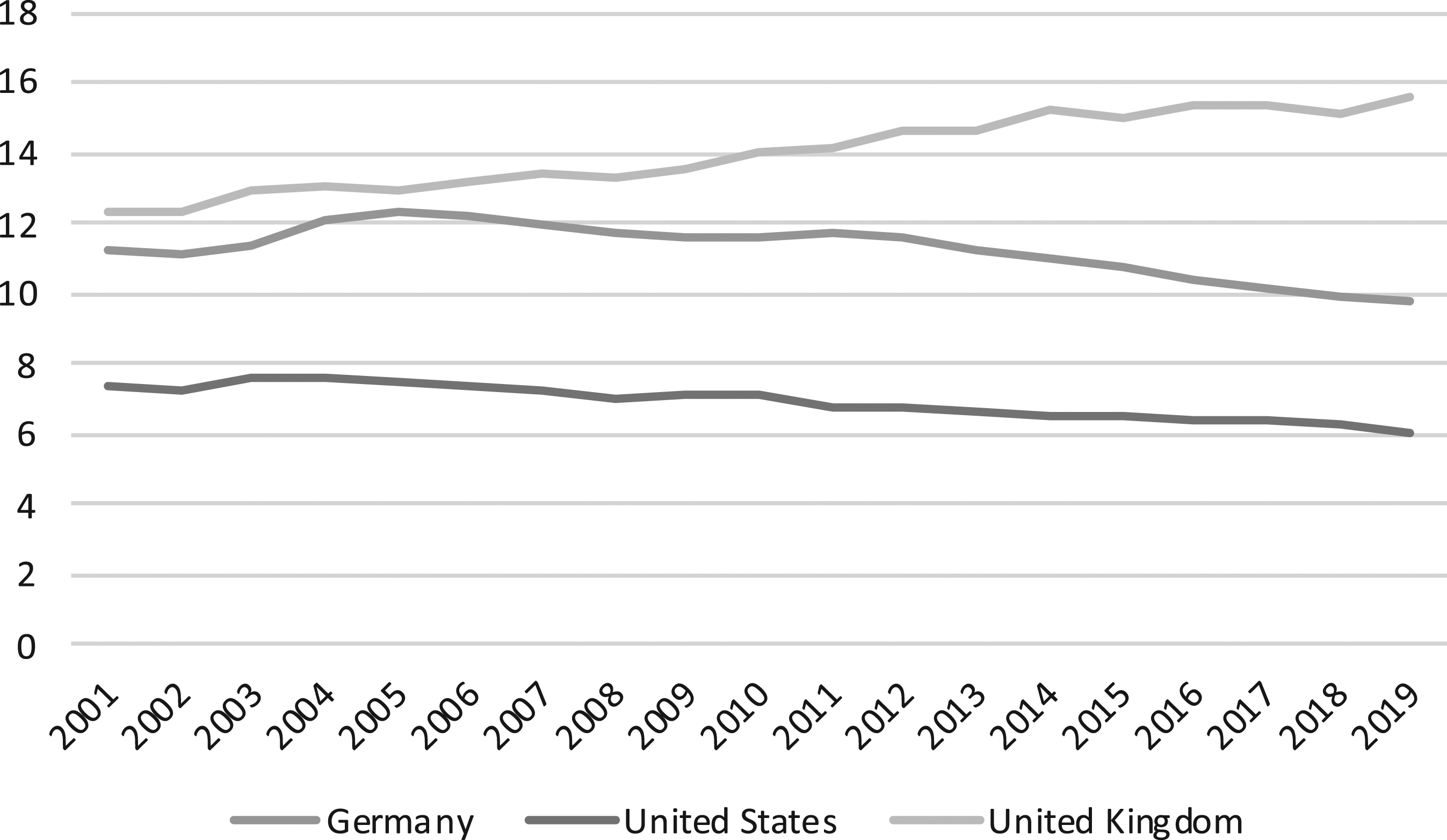
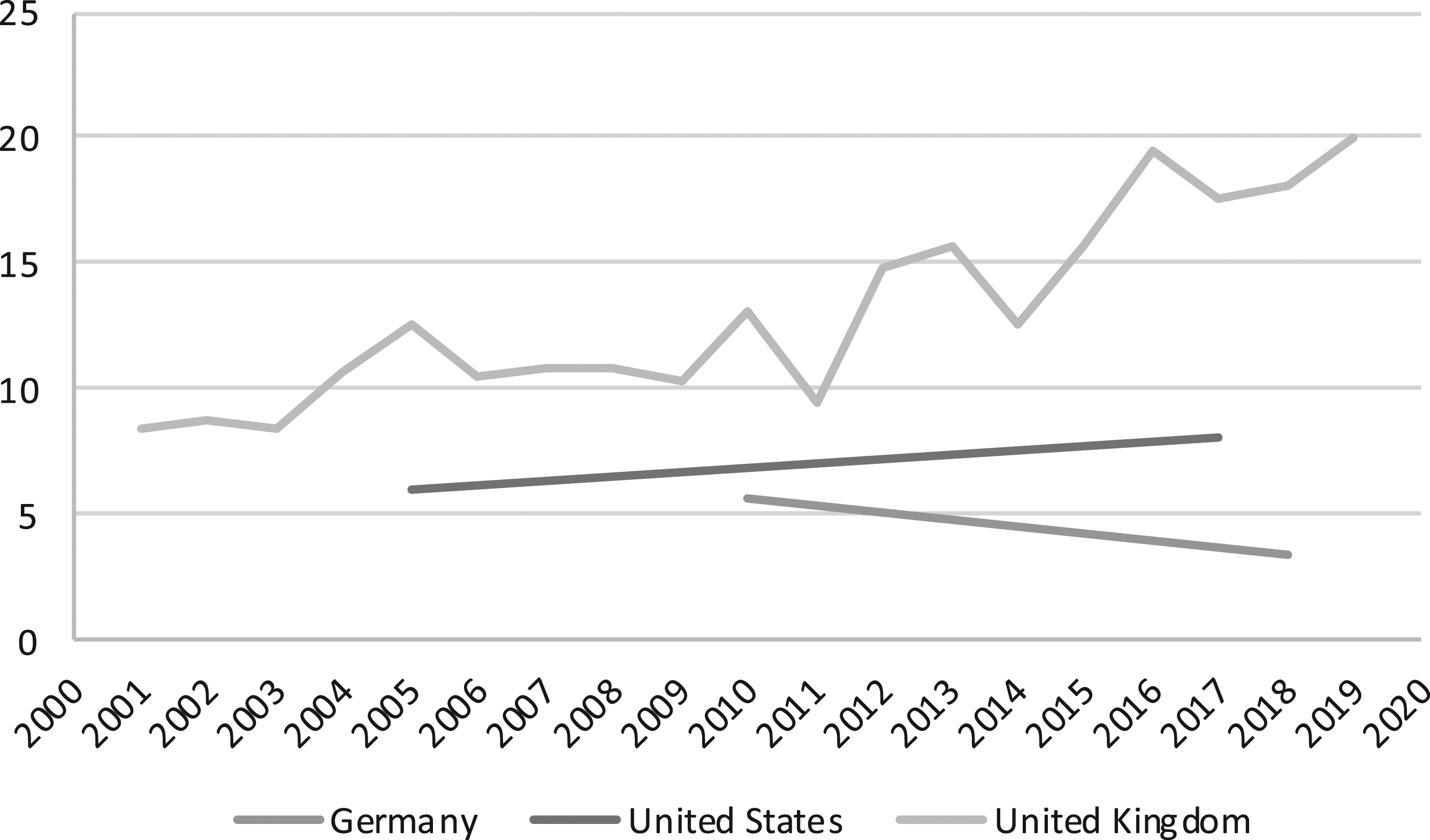
In the United States, the percentage of self-employment decreased slightly from 7.1% to 6.1% between 2010 and 2019 (Figure 1). However, contrasting the overall trend in self-employment, the percentage of self-employed couriers and messengers increased from 6% in 2005 to 8.1% in 2017 (Figure 2). Independent contracting in the United States is much lower than often assumed in the political debate. There are several reasons that explain the comparatively low number of self-employed workers in the United States. These are discussed in more depth by Katz and Krueger (2019). First, self-employment was particularly prevalent in the agriculture sector, which has declined substantially over the last few years. Second, the contingent worker survey covers only full-time self-employed workers.
Self-employment as a percentage of employment in Germany is relatively stable and decreased slightly from 11.6% in 2010 to 9.9% in 2018 (Figure 1). In contrast, self-employment among couriers and messengers is substantially lower and decreased from 5.7% in 2010 to 3.4% in 2018 (Figure 2). One of the main reasons for the low number of self-employed couriers and messengers is strict employee protection laws against bogus self-employment, regulating its scope. Due to legislative barriers aimed at preventing bogus self-employment, companies in the CEP sector largely rely on classic subcontracting, as it is considerably cheaper than directly employing couriers. This illustrates a certain resilience towards the independent contractor employment model promoted by platform companies and a contradiction to a further Uberization of the labour market.
In comparison to the United States and Germany, self-employment in the United Kingdom is substantially higher and increased slightly from 14% in 2010 to 15.6% in 2019 (Figure 1). The increase of self-employed couriers and messengers has been particularly strong, increasing from 13.1% in 2010 to 20% in 2019 (Figure 2). The United Kingdom thus presents a very favourable setting for the employment model of platform companies. More liberal labour laws are the reason for the greater dissemination of self-employment in comparison to Germany, which makes the difference to the United States, as a similarly liberal market economy, even more surprising. An explanation for this is universal health insurance. Since health care is not tied to an employment contract, but rather universally provided, independent of employment, it is more attractive to be self-employed in the United Kingdom than in the United States.
The platform effect on work
We argue in this paper that the platform economy has a much broader transformative effect, which goes beyond the gig economy. Platform companies are technologically driven, and as business innovators move up and down the value chain in order to reorganize existing markets with new digital business models. Their preferred employment model for non-core services is the independent contractor model, as it matches the strengths of platforms to market participants.
It is important to recognize the role model effect of platforms for the reorganization of other parts of manufacturing and services in the economy. In-house platforms allow complex manufacturing supply chains to be organized as a marketplace. Supply chain platforms are organized similarly to e-commerce platforms, with the lead company controlling a network of decentralized logistics operations. Extreme forms of subcontracting (Nikefication) can be assembled and reassembled easily by using platforms. The platform effect therefore goes far beyond gig work but should be conceptualized as a tool for organizational restructuring in all firms, not just platform firms. The extent to which the platform effect takes hold depends on the resilience of employment relations in legacy firms and the protection of those institutions by policies.
The two takeaway points from the comparative case study is to highlight the role of welfare state provisions and employment regulation. The UK welfare state is liberal and lean but at the same time more universal than other liberal welfare states. The NHS provides free health care for everyone, which facilitates self-employment to a larger extent than in those countries where health care is insurance based. Universal access to welfare benefits is a key predictor for accommodating platform business models in Europe, as we found in a separate study (Sieker, 2021). This also includes access to pensions and social benefits. Welfare states can therefore be more or less accommodating to independent contracting.
Second, regulation of employment matters for labour standards and the diffusion of independent contracting. As the German example shows, employment laws make a difference for the proliferation of platform-based organizational models, which combine vertical integration with highly fissured work practices. The protection of labour standards in legacy firms matter for the business models of competitors and the role of labour. As companies also compete over workers and have to ensure a reliable service, a pool of better-trained workers might opt for better employment conditions at legacy firms. Only where the traditional postal services have been outcompeted by private competitors are they not able to protect their labour standards. Moreover, forcing firms to internalise some of the costs of subcontracting and fissuring make extreme forms of precarious labour less attractive.
Platform firms have already made many inroads in other sectors. The example of Amazon in logistics can be complemented by the effects of Facebook for the media industry, Google and Apple for the education sector, or Uber for the passenger transportation sector. Not all sectoral platforms pursue the dissemination of independent contractors as an employment model. But platforms are inherently drawn towards contractors, as the platform business model is based on spot-market trading and alien to long-term contracting.
While the platform effect will continue to disseminate into established industries, policies and institutions will shape the process. The policy toolbox includes the access to welfare provisions, regulation and the support for legacy firms. Regarding the role of the welfare state, we can observe a paradox of universal welfare provisions. Universal social benefits are often argued as an appropriate response to the rise of platform work. It seems that universal welfare provisions facilitate independent contracting, as the benefits are not tied to the employment relationship. Rather than responding to the needs of a precarious workforce, universal welfare might be a cause for the further precariousness of work.
Footnotes
Declaration of conflicting interests
The author(s) declared no potential conflicts of interest with respect to the research, authorship, and/or publication of this article.
Funding
The author(s) disclosed receipt of the following financial support for the research, authorship, and/or publication of this article: Grant by the Federal Ministry of Labour and Social Affairs, Germany, No. DKI.00.00003.19.