




Abstract
The greater insight and deeper understanding generated by slow comparative international research is beyond doubt. However, there are times when researchers need to ‘quicken up’, most notably when engaged in ‘real-time’ social science that is directly responsive to policy initiatives by the (supranational) state and/or new business strategies and employment practices developed by (multi-national) employers. This is a particular challenge for scholars working with European trade union federations, especially when they are drawn into political campaigns and/or European policy debates. Such engagement often calls for a (quick) step from slow (typically qualitative) to fast (predominantly quantitative) research, using statistics for activism in order to build evidence for representation that can pass the test of science as well as the test of action. The evidence is necessarily ‘thin’ but nonetheless sufficient, on occasion, to warrant collective action.
Keywords
Introduction
The manifesto for ‘slow’ comparative research on work and employment (Almond and Connolly, 2020) is a public declaration that will no doubt resonate with industrial relations researchers as both activist-scholars and university employees. Comparative international research that is little more than a series of flying overseas visits – or what Bate (1997: 1150) derides as ‘jet-plane ethnography’ that produces ‘quick description’ rather than ‘thick description’ – is surely anathema to the activist-scholar who is concerned with ‘not only what trade unions are, but what they might become, and how’ (Hyman, 2001: 225, original emphasis). The slow process of access to the ‘common sense’ of relevant actors demands immersion in the societies, industrial sectors and organizations subject to theoretical and empirical scrutiny, which clearly favours emancipatory and participatory action research approaches (Almond and Connolly, 2020: 69–70). In fact, the very act of incorporating participatory social action into one’s research slows down the research process (Cancian, 1993: 96). Unfortunately, in the modern-day (neoliberal) university, going slow runs counter to ‘the current drama of get-rich-quick research activity’ (Stewart and Martínez Lucio, 2017: 552, original emphasis). As a university employee, regardless of whether or not one is involved in activism beyond the academy, the pressure to ‘publish or perish’, and only in ‘high ranking’ journals, has created a highly competitive, often toxic environment (Smyth, 2017) where the majority of academic staff now claim they have insufficient time to undertake the research they need to ‘get ahead’ (Times Higher Education, 04/02/2016 and 08/02/2018). Nonetheless, being a ‘slow professor’ (Berg and Seeber, 2016) is surely more appealing than a ‘fast food professor’ (Marinetto, 2018: 1015).
The proficiency of slow professors is the culmination of an ‘intimate knowledge of several thousand concrete cases in their area of expertise’ (Flyvbjerg, 2006: 222), where the cases in question are not simply countries, sectors and organizations, but everything from the ‘politics of everyday’ and people’s experiences at work (Courpasson, 2017) to the ‘politics of opportunity’ and the ability of social movements to transform social relationships (McAdam et al., 2001). Slow comparativism ‘supports the organic engagement of researchers within different national contexts’ (Almond and Connolly, 2020: 70) and this context-dependent knowledge and experience, typically accumulated over many years of idiographic research, is ‘at the very heart of expert activity’ (Flyvbjerg, 2006: 222). That said, there are often times when even slow research has to ‘quicken up’. In particular, when activist-scholars are engaged in ‘real-time’ social science that is directly responsive to public issues, they must: accommodate the schedules of policy-making not the ideal working conditions of scholarship. This usually means deploying in new contexts knowledge that academics have already developed, or quickly preparing new analyses of existing data … This sort of real time social science depends on longer-term research projects already underway and on the development of social science expertise through careers of scholars who learn about issues even when they are not immediately the focus of public attention (Calhoun, 2009: 300).
For academics working with European Trade Union Federations (ETUFs), the timing of when to quicken up is largely determined by the policy-making process, when opportunities arise to respond to policy proposals at the national and especially the international level (i.e. the agenda defined by the institutions of the European Union) (Hyman and Gumbrell-McCormick, 2020: 262). Such opportunities are not simply given and must always be created, but the formal status of ETUFs as social partners in the European social dialogue presents both on-going opportunities and transformative moments for activist scholarship. The more challenging question is how to quicken up. How do we build expert (slow comparative) knowledge and respond to the (real-time) opportunities for activism that present themselves from time to time? If close contact can be maintained with our trade union partner(s), founded on trust and a shared commitment to social transformation, then it is much easier to execute the very tight turns that animate the rhythm of ‘slow, slow, quick, quick, slow research’ when dancing with our research partners to the tune of policy makers. With solid (slow) foundations in place, built not only on trust and commitment but also social scientific expertise, it is possible to generate evidence that can be used to bolster the representation of workers’ interests in relatively short (quick) order.
Proponents of participatory action research and other slow qualitative research designs often downplay the utility of fast(er) quantitative data (e.g. Brook and Darlington, 2013: 240). Such data is typically equated with a positivist (nomothetic) research strategy of ‘thin comparativism’ whereby standardized questions are posed to as many respondents as possible (e.g. via a questionnaire survey) in order to maximize the comparability of respondents and establish relationships (correlation) between variables. To be sure, ‘in divorcing variables from the socio-cultural-political contexts in which their concrete meaning is interpreted and realized by actors, cross-sectional research often fails to understand how phenomena or issues are socially constructed’ (Almond and Connolly, 2020: 64). Nonetheless, ‘the use of statistics is part of the repertoire of contention and a major resource for contemporary mobilizations … to be strong one must ally oneself, and statistics is a primary cement of such alliances’ (Bruno et al., 2014: 200 and 213). Statactivism – a portmanteau word used to denote the mobilization of statistics – involves a denunciation of certain representations of reality (e.g. official data on the violation of workers’ rights), seizes on elements not often taken into account (e.g. undeclared work) and creates equivalency among disparate conditions in order to bond together emerging social categories (e.g. false or bogusly ‘self-employed’ workers). As such, these social (statistical) categories ‘form the basis for individual and collective identity’ (Porter, 1995: 42).
The generic use of statistics as a tool for struggle, especially for ETUFs when representing the collective interests of member organizations vis-à-vis the supranational state, international employer associations and multi-national employers (MNCs), is discussed in the following section. The specific use of statistics to ‘quicken up’ slow research is then demonstrated in relation to policy debates in the European transport sector, based on more than 20 years of slow comparative research with different transport sectors of the European Transport Workers’ Federation (ETF). The deep foundations of slow research provide a springboard for much quicker, real-time research when the occasion arises. Moreover, contrary to the assumption that, in theory, ‘one could use evidence-based principles to promote workers’ interests against those of the management, but “in theory” is where this idea is likely to be destined to remain’ (Morrell and Learmonth, 2015: 525), quick research with the ETF has utilized a framework that draws on such principles to generate ‘evidence for representation’ (EfR) in double-quick time.
Using the authority of ‘facts’ without forgetting their statistical construction, the statactivist can ‘uncover the lies that [management and the state] proffer’ (Bruno et al., 2014: 208). In a subsequent section, two particular examples of such mendacity are addressed by way of illustration: first, an assurance by the European Community Shipowners’ Associations (ECSA) that there was no intention on the part of its members to increase the number of non-EU nationals on intra-EU regular passenger and ferry services (CEC, 1999: 17) after the ECSA ‘sank’ a proposed manning Directive (CEC, 1998) designed to protect seafarers’ terms and conditions of employment; and secondly, claims made by the European Commission that, despite the ‘mis-application of the social rules in road transport’ (e.g. driving, working and resting time requirements), in the bus and coach sector at least, existing regulations ‘ensure both fair working conditions for drivers and fair competition between operators’, such that ‘there does not appear to be a requirement for any further labour market policies to address these problems’ (Commission Staff Working Document, 2017: 56–7 and 87). Quick research can promptly dispel such duplicity, although disclosure (denouncing a certain state of reality) and affirmation (creating equivalency among disparate conditions to cement emerging social categories) (Bruno et al., 2014: 200) does not necessarily provoke collective action.
Statactivism and evidence for representation with European trade union federations
The (mis)use of statistics is widely associated with the exercise of power, especially by the state (Porter, 1995: 43) and in particular the neoliberal state in its quest to foster market competition (Bruno et al., 2014: 201). Conversely, statistics have long been used to not only describe the lives of working people, but to demonstrate the relationship between employment and social conditions with a view to their improvement (e.g. Booth, 1892). Actors gain power from the data that supports their policy agenda, at the same time as these data give power to their policy agenda. Power in any social context is not just about position but also purpose. With the necessary savoir-faire, the statactivist can mobilize data as a tool for struggle during political fights and, in certain cases, ‘as a means of emancipation’ (Bruno et al., 2014: 199).
The dual role of statistics is to represent and criticize reality, albeit a synthetic representation of reality but nonetheless one that can create a shared reading of social and economic conditions. This is especially important for ETUFs as ‘meta-organizations’ (i.e. an association of associations) as their members are not individuals (e.g. transport workers) but collective organizations (e.g. national transport unions) (Hyman and Gumbrell-McCormick, 2020: 225). If it can be demonstrated that workers in different European countries share common interests, express shared grievances and experience similar forms of exploitation, possibly at the hands of the same MNC, then quantifying these outcomes of a Single European Market ‘necessarily implicates statistical categories and statactivism, helping to define the subject that serves as receptacle for the desire for and praxis of emancipation’ (Bruno et al., 2014: 210). Social categories need to be defined in order to be defended, exploitation needs to be exposed before it can be ended. To be sure, evidence is not answers – data must always be interpreted in context and there is no guarantee that research evidence will yield a warrant for action – but the simple fact that ‘another number is possible’ creates a shared reading of reality that, at a minimum, will strengthen the ETUF’s ‘force of argument’ and, on occasion, the ‘argument of force’.
Organizations that have other organizations as members typically lack hierarchical authority or the power to sanction members. For ETUFs, consensus is therefore sought through a process of ‘deliberative democracy’ (Hyman and Gumbrell-McCormick, 2020), because: ‘When policies are adopted deliberately – after sufficient discussion, debate, and the sifting of reasons and evidence, including from experts – they are more likely to be policies that people are prepared to live with’ (Keohane et al., 2009: 8, emphasis added). Collective reasoned reflection is essential to ensure that policies are understood internally at all levels – from rank-and-file members to national union officials to the permanent secretariat of the ETUF – and sufficiently robust to withstand the critique of external interlocutors such as MNCs, European employer associations and the European institutions (e.g. Commission, Council and Parliament). As recognized social partners, when ETUFs participate in sector social dialogue committees and the European policy-making process, they are expected to present robust evidence that can withstand the scrutiny of peer review and benchmarking against other studies (Smismans, 2015: 22). Indeed, it is axiomatic that any data that challenges capital(ism) will always be questioned in terms of rigour and objectivity (Porter, 1995: 5–6; and Stewart and Martínez Lucio, 2017: 540). Statactivism delivers on both rigour and relevance, generating statistical and other forms of evidence for representation that challenges EU policies and the business and employment strategies of employers, in real time, in order to protect and promote the interests of workers.
The ETF, in common with other ETUFs, has long been embedded in the European social dialogue and oriented towards the ‘logic of influence’ (Dølvik, 1997) whereby union organizations adapt their aims and methods to the decision-making processes through which they seek to represent their members. Transport unions in Europe were divided on whether the Comité syndicales des transports dans la Communauté européenne (CSTCE), established in 1958 and commonly known (or derided) as the ‘Brussels Committee’, should simply service the various Joint Committees established by the European Commission for joint consultation or whether it should function as an international trade union federation for transport workers that could organize political campaigns, support members embroiled in conflict with employers and/or the nation state, and possibly even coordinate industrial action across member states. Movement in the latter direction was signalled by the creation of the Fédération Syndicale des Travailleurs des Transports Européens (FST) in 1996, and most notably by incorporation into the regional structure of the International Transport Workers’ Federation (ITF) in 1999 as the ETF. For example, with the support of the ITF, the ETF was able to organize an effective campaign of political and industrial action by dockworkers against employer and Commission proposals to liberalize the port services market (Turnbull, 2006b, 2010b). In hindsight, however, it is evident that mobilization on this scale is rare and might best be described as a sporadic interruption of the more normal technocratic character of international and specifically European trade unionism (Gentile, 2016: 122). For other ETF transport sectors, a more diplomatic approach has prevailed, characterized by social dialogue with European employer associations and lobbying the European institutions (cf. Hyman and Gumbrell-McCormick, 2020: 268). 1
With labour diplomacy comes a more bureaucratic meta-organization, running the risk that ‘internationalism from above’ might ‘marry efficiency to impotence’, leading to a suppression of both political alternatives and mobilization capacity (Hyman, 2005: 145). That said, domination is manifest in control over the means of knowledge production as well as material production, and evidence (the force of argument) invariably comes before action (the argument of force). Through statactivism, evidence can establish the foundations if not the focus for action. Mobilizations take place around social indicators (e.g. real wage levels, the prevalence of zero hours contracts, accident and injury rates, etc.), which requires both an ‘authority of facts’ and the utilization of politically accountable forms of knowledge. Such knowledge, as depicted in Figure 1, might be used to make public and legitimate (or illegitimate) a common practice not yet brought to light, to deconstruct and de-legitimize existing statistical indicators, or to institutionalize new social categories. For example, the extensive hiring of pilots on ‘self-employment’ contracts by several low-cost airlines, most notably Ryanair (Harvey and Turnbull, 2015, 2020), was not widely appreciated prior to the publication of a report commissioned by the European Cockpit Association that involved national case studies and a survey of more than 6600 European pilots (Jorens et al., 2015).
2
Initially, the Commission referred to this practice as a new ‘business model’ but eventually acknowledged that such hiring practices constitute a form of ‘bogus’ or ‘false self-employment’ (Turnbull, 2020). Evidence for representation.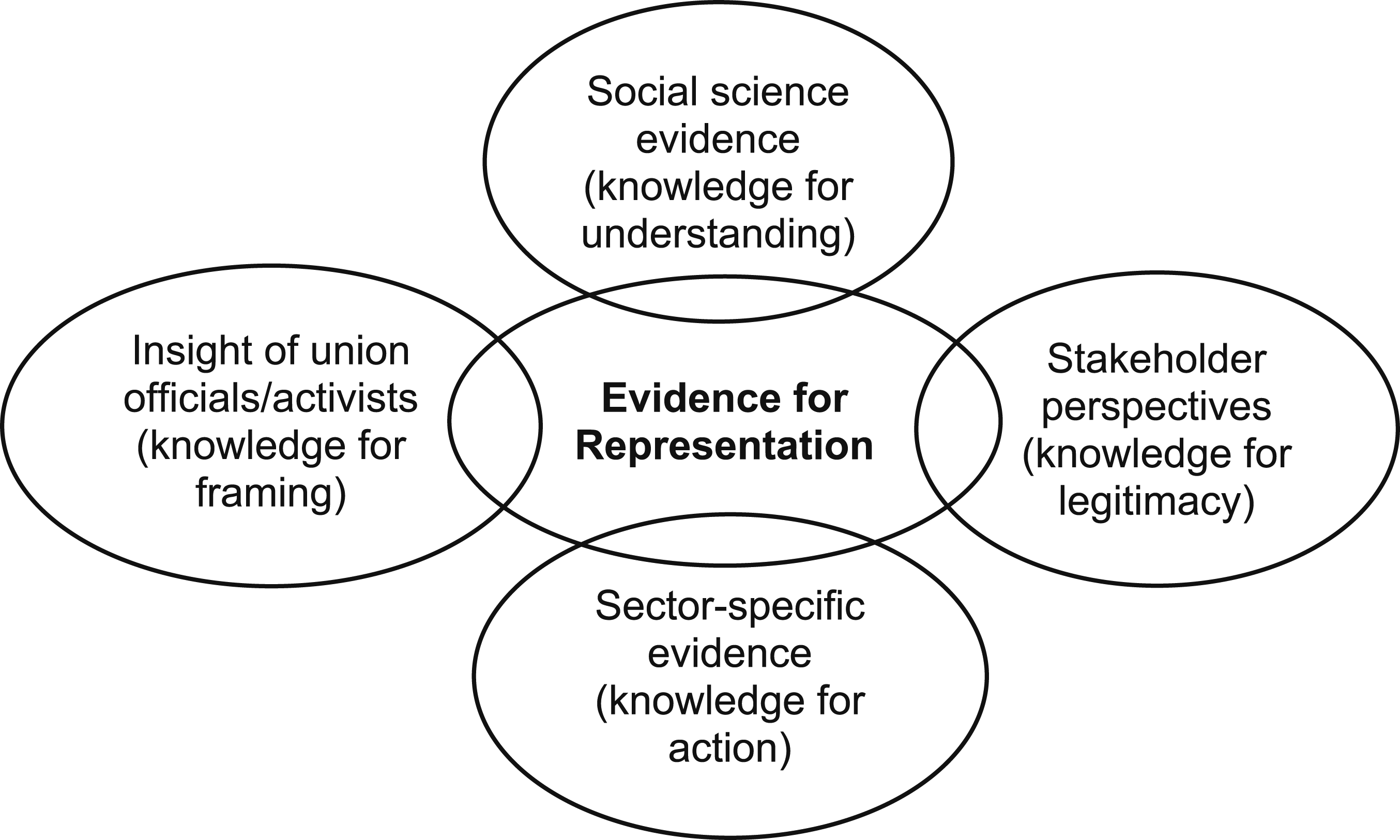
The four different types of knowledge depicted in Figure 1 are interdependent and thereby equally important for effective representation. While the mantra of evidence-based policy-making is ‘what works’, the normative foundation of EfR is ‘what’s right’ (i.e. socially just). Armed with knowledge for understanding, the statactivist can ‘do the research right’ (i.e. according to the rigours of social scientific methods) as ‘it requires institutional or personal credibility even to produce impersonal numbers’ (Porter, 1995: 214). More importantly, the power of social scientific evidence resides not only in more ‘objective’ empirical data but ‘knowledge for understanding’. Theoretical interventions – ‘deploying in new contexts knowledge that academics have already developed’ (Calhoun, 2009: 300) – can function as a form of political practice precisely because problems are always in need of a theoretical explanation as well as a practical solution. Hence, the importance of combining social scientific evidence with sector-specific (context-dependent) evidence in order to translate this knowledge into action.
Crucially, this is not a unidirectional diffusion of ‘expert knowledge’ – or what Burawoy (2005: 10–11) labels ‘professional sociology’ – rather a dialectic interaction of mutual education. EfR involves a critical engagement between the researcher and the research partner, the co-production of research with as opposed to research on or for. EfR is critical in the sense of avoiding the subordination of academic work to the immediate interests and demands of political organizations such as ETUFs – a danger inherent to what Burawoy (2005: 9–11) has classified as ‘policy sociology’. By retaining the independence needed for the proper development of scholarly reflection, the statactivist can proactively engage in support of workers’ struggles for democracy, equality, decent work, fair pay, etc. Critical engagement ‘expands the role of the sociologist into the furnace of action itself and the grounding of ideas within the movement itself’ (Lambert, 2008: 98, original emphasis). Doing things right (the test of science) is the foundation for doing the right thing (the test of action).
Working with ETUFs, the statactivist is engaged with an expert community that understands the significance of statistical significance, given that the typical professional international trade union official today is a graduate with language skills who, having spent some time as a researcher in a national labour movement, has progressed to an international federation (Hyman, 2005: 147). Equally important, as diplomats engaged in political lobbying and social dialogue with European employer associations, the modern-day secretariats of ETUFs are well-versed in dealing with a variety of different stakeholders. They appreciate the importance of understanding the interests of employers and policymakers if they are to generate legitimate knowledge in the eyes of external interlocutors, especially as these stakeholders have the power to make certain ideas (appear) universal (e.g. ‘freedom of access’ to a single market or what constitutes ‘fair competition’ and a ‘level playing field’) (ETF, 2019: 15). The appeal of numbers is especially compelling for bureaucratic officials of the European Commission, who lack the mandate of a popular election: ‘A decision made by the numbers … has at least the appearance of being fair and impersonal’ (Porter, 1995: 8). EfR thereby generates both statistical and practical confidence in a ‘shared reading’ of the research evidence, making public issues out of private problems in accordance with the precepts of ‘organic public sociology’ (Burawoy, 2005: 7–9). At a minimum, stakeholders must acknowledge that workers have a case and there is a case to answer.
Knowledge for framing is also central to EfR, as international solidarity ultimately rests on ‘an active strategy by union leaders and activists to enhance knowledge, understanding and identification of common interests cross-nationally’ (Hyman, 2005: 149). Variously described as ‘organic intellectuals’ or ‘political entrepreneurs’ who possess ‘the vision to explore transnational strategies and the leadership skills to convince their constituency’ (Greer and Hauptmeier, 2008: 80), this is the group of collaborators ‘who can take the lead in co-analysis, who are motivated to appropriate the project, and who engage in some sort of critical reflexivity and conceptual production upon their own practices’ (Arribas Lozano, 2018: 106). Meta-organizations need to connect the secretariat of the federation to the rank-and-file members of affiliated unions, via union officials and activists who not only draw on shared trade union identities and familiar ideas about union action, but who move cognitively and physically outside their spatial origins and are open to new repertoires of contention. They continue to be linked to national and local place and the social networks that inhabit that space, but they frame knowledge (research evidence) as not simply a threat but an opportunity to externalize conflict and forge new and/or stronger alliances with their counterparts in other countries (Tarrow, 2005). As ‘practical theorists’, union officials engage with activist-scholars in a form of ‘critical sociology’ (Burawoy, 2005: 10–11) that reflects on the normative as well as the descriptive foundations of the research, on political as well as academic accountability (i.e. the ‘test of action’ as well as the ‘test of science’), on ‘what matters’ (to the workers) as well as ‘what’s interesting’ (to the researcher).
EfR offers a way for comparative industrial relations researchers to reconcile the long-standing dilemma of how to combine idiographic and nomothetic research methods (cf. Hyman, 2001). The co-production of knowledge and the combination of different forms of knowledge depicted in Figure 1 is clearly attuned to slow (idiographic) research, building long-term relationships with the ETUF and its members, engaging with and understanding the interests of different stakeholders, and learning about relevant issues even when they are not at the top of the policy agenda. In this way, researchers come to appreciate that interrelationships between different societal elements renders the experience of every national trade union movement (more or less) unique. But without common variables, there is only difference. Thus, as Hyman (2001: 210) notes, ‘Formulating and “testing” explanatory generalizations are necessary, and reciprocally conditioning, elements in comparative research. In the process, we may attain a deeper and more sensitive understanding of difference in similarity and similarity in difference’.
In this regard, EfR is equally well-suited to faster (nomothetic) approaches. For example, questionnaires can be readily and rapidly developed and distributed with the assistance of both the ETUF’s secretariat and national union officials/activists. More importantly, through co-production of the questionnaire, survey questions will ‘speak to’ respondents and enable the ETUF and its affiliates to ‘speak for’ their respective members: questionnaires can encourage respondents to express their interests, articulate personal claims and reflect on shared grievances, which in turn can be presented as a collective and coherent political claim. Even if fast questionnaire survey research does nothing more than record empirical events and establish correlation between variables, this might be sufficient to put workers’ interests (the case to answer) on the policy agenda. With EfR, the statactivist can go much further, drawing on different forms of knowledge to look beyond the observable and investigate the causal mechanisms behind the empirical world of quantifiable events. In the world of international transport, where both capital and labour are highly mobile, these mechanisms are played out in a Single European Market that allows capital to exploit labour via regulatory ‘spaces of exception’ (Lillie, 2010) and digital platforms that not only give firms access to more data but also a dominant market position and potential control over the rules of what is supposed to be a ‘level playing field’ for competition (Srnicek, 2017: 47).
Lies, damned lies and statactivism
Slow, slow comparativism – ports, civil aviation and … maritime
Slow research on the CSTCE began in 1995, prior to the creation of the FST, as part of a 3-year project on the comparative economic performance of European ports (Barton and Turnbull, 2002). At the time, the CSTCE/FST was a rather peripheral player on the waterfront as there was no European sector social dialogue committee for port transport and many dockworker trade unions objected to making financial contributions to what they regarded as an ineffective European Comité, especially when they were active in the ITF. However, the policy context changed dramatically in 2000 when the ETF received a document from the European Commission with a series of questions that were clearly designed to ‘test the water’ for plans to liberalize the port services market. The author was asked to write a response for the Dockers’ Section of the ETF, to be submitted to the Commission following a review of the document by affiliated dockworker trade unions. Research with the ETF continued throughout the ensuing ‘war on Europe’s waterfront’ (Turnbull, 2006b), including subsequent participation as an official delegate of the ETF at a series of six workshops organized by the Commission to determine future EU ports policy (Turnbull, 2010b). The latter involved quickly drafting responses in the name of the ETF to Commission position papers issued less than 10 days before each workshop.
Around this time, attention turned to a participatory action research project with the Civil Aviation Section of the ETF as part of a long-term study of the Single European Aviation Market (SEAM) and ‘social dumping’ by low-cost airlines (Turnbull, 2010a). This research involved a combination of case studies and questionnaire surveys of aviation workers (Harvey and Turnbull, 2012, 2014), culminating in a 2-day workshop for all stakeholders 3 and a joint declaration by the social partners on the threats posed by ‘flags of convenience’ (FoCs). Registering a ship in a more ‘convenient’ country in order to avoid taxes and labour standards in the owner’s country is a long-standing and widespread practice in the maritime industry (Lillie, 2010) and was now a feature of the SEAM. For the ETF and the Association of European Airlines, at issue was a low-cost business model that distorted social conditions and competition, posing a threat to ‘comparatively decent employment’ in European civil aviation: the social partners feared a similar fate to shipping, where ‘the past permissive attitude towards the use of flags of convenience has been devastating to industry and employment alike’. 4 For example, at the turn of the millennium, non-EU nationals constituted only 2–3 per cent of the crew on-board regular short-sea services between EU member states and most services were carried out by ships under member states’ flags; a decade later, around 1-in-5 crew were hired from third countries (ECORYS, 2009: v).
Although the maritime industry was not the immediate focus of research with the ETF, it was still possible, if not inevitable, to learn indirectly about shipping as a result of the emergence of FoCs in civil aviation and directly as a consequence of the close cooperation between maritime and dockworker trade unions within the ITF and ETF. In 2010, the ETF launched a campaign for ‘Fair and Safe Ferries for All’ (Umney, 2012) combining port-based vessel inspection (supported by national dockworker trade unions) and political lobbying for a Directive that would make the ITF’s ‘Athens Policy’ a reality. With similar wording to the Commission’s proposed Common Policy on Manning of Regular Passenger and Ferry Services (CEC, 1998), which was vehemently opposed and ultimately scuppered by the ECSA in 2004, the ITF’s Athens Policy states that: ‘the crews of vessels engaged in European ferry trades, including non-European vessels, shall be covered by European conditions of employment which are regulated through national collective bargaining agreements held by the appropriate ITF European affiliates’. 5 When the Political Secretary of the ETF Dockers’ Section transferred to the Maritime Section, we entered into correspondence on how to bring new (statistical) evidence to bear on FoCs and social dumping, in particular with respect to: ‘the terms and conditions applied to crew members on-board ships trading between European countries and then prolonging their trade to non-European Southern Mediterranean countries’ (email from the ETF, 18 September 2012).
Quick statactivism – short-sea shipping
Accurate and comparable data on seafarers is scarce (EC, 2020: 11), especially when shipping lines operate under a FoC in the ‘spaces of exception’ (Lillie, 2010) on routes between EU and non-EU countries, where seafarers ‘fall between the cracks’ (EC, 2020: 18) or ‘loopholes’ in existing EU regulations (ETF, 2019: 3) and policy makers and other stakeholders are ‘deprived of key information that would normally be used to identify problems’ (EC, 2020: 11). Shipping lines are of course in full possession of the necessary evidence, but they use their considerable financial, technical and other resources to ‘set an agenda that corresponds to their needs’ (EC, 2020: 17), which includes with-holding information on crewing and labour costs (EC, 2020: 14). For its part, the ETF has limited internal research capacity
6
and is therefore reliant on national unions and the commitment of activist-scholars who can generate the necessary (statistical) evidence for representation. To this end, as part of its work programme for 2013–17, it was agreed with the ETF’s Maritime Transport Section (MTS) to undertake a 5-month (quick) research project in order to: identify all ferry routes and vessels in the western Mediterranean; determine whether terms and conditions of the crew differ depending on the nationalities of seafarers; and analyse the recurrent practice of reflagging to cheaper flags with less stringent conditions.
Data on shipping is available from a variety of sources, creating the potential for new analysis of existing data. The annual market report published by Shippax provides a comprehensive list of all cruise, ferry, ro-ro and high-speed vessel trading worldwide. 7 From this database it was possible to identify all short-sea services in the western Mediterranean and for each vessel record the operator(s), flag and flag changes from 2003 onwards. These data were combined with and cross-checked against Sea-web, an online database of currently more than 200,000 vessels that is continuously updated. 8 Access to the Sea-web database was secured via the Dockers’ Secretary of the ITF and involved initial training to use the database at the Federation’s HQ in London. Although our main concern was to extract data on vessels trading between EU member states and then extending their services to the Maghreb countries, we also included island cabotage as a ‘control group’ as these vessels are known to be flagged and operated by EU member states and crewed predominantly by EU seafarers. This yielded a total population of 116 vessels sailing from either France, Italy or Spain to non-EU countries and 227 vessels on island cabotage (Thomas and Turnbull, 2021).
As expected, on island cabotage almost all the vessels (96%) sailed under their national flag. In contrast, on ferry routes to non-EU countries there were 33 different operators under 59 registered owners, with almost 30% sailing under a FoC. There was clear evidence of flagging out, as less than a third of the vessels flew the flag of France, Italy or Spain and yet more than 40% of vessels were under French, Italian or Spanish ownership. Moreover, between 2003 and 2012, almost 1-in-5 vessels had re-registered under a more convenient flag, allowing the operator to employ seafarers on inferior terms and conditions of employment. These data exposed the fallacy of the ECSA’s earlier claim that its members had no intention of flagging out. Amongst the group of vessels flying a FoC, an average of six vessels per annum changed flag, just one of several indicators of ‘regime shopping’ in an open market.
Deficiencies and detentions per vessel, EU (European union) to non-EU routes (2003–2012).
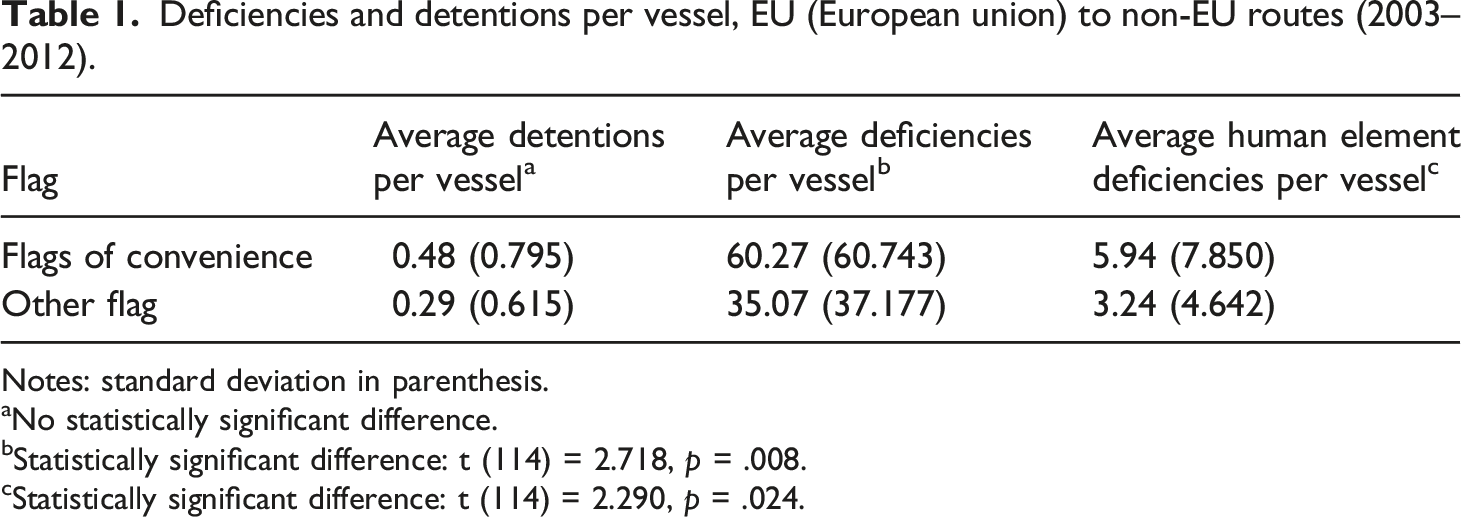
Notes: standard deviation in parenthesis.
aNo statistically significant difference.
bStatistically significant difference: t (114) = 2.718, p = .008.
cStatistically significant difference: t (114) = 2.290, p = .024.
When these initial results were presented to the MTS Steering Committee established to co-produce the research, attention focused on incomplete crew data, both in terms of the nationality of seafarers and whether they were covered either by an EU collective agreement, the ITF-IMEC (International Maritime Employers’ Council) collective agreement that sets out seafarers’ wages and working conditions on board FoC vessels in international trade, or no legally binding collective agreement. It was therefore agreed to design a questionnaire that national union officials, activists and vessel inspectors would complete, covering every vessel on EU to non-EU routes and a representative sample of vessels on island cabotage. For each vessel, data was requested on crew composition and nationalities, compliance with the ITF’s standard manning policy and other international regulations, deficiencies (as per the Paris MoU) and the (in)effectiveness of recording/reporting procedures, coverage of collective bargaining agreements (if any), and terms and conditions on-board benchmarked against the ITF-IMEC collective agreement. The statistical results were once again significant – FoC vessels fell well short of the standards on EU-flagged vessels – but far from complete. While questionnaire data was returned for almost every vessel on island cabotage, for trades to non-EU countries questionnaires were returned for 79% of vessels calling at Italian ports, 73% of vessels calling at Spanish ports, and only 17% of vessels calling at French ports. Moreover, returned questionnaires were often incomplete, with missing responses to specific questions.
The absence of statistical data highlighted the need for further action, not simply the collection of more systematic evidence for representation to ensure a shared reading of reality based on the authority of comprehensive facts, but targeted vessel inspection and union organizing. To this end, the next stage of statactivism involved importing the data into a live Excel file that could be regularly updated when vessels changed flag, hired a different crew of convenience, called at different ports, etc. Variables were colour coded to enable union officials, activists and vessel inspectors to readily identify the shipping lines and/or vessels with non-EU crews, those with a preponderance of previous detentions and deficiencies, or no collective agreement. By also colour coding the ports where these vessels called most often, inspection/union organizing could then be targeted at the ‘worst offenders’, albeit only in those ports where dockworkers are both willing and able to refuse to un/load a vessel until deficiencies are rectified and demands are satisfied.
Although the data was used to support political action at the supranational level – specifically the removal of various exemptions in EU secondary legislation that excluded certain seafarers from their scope 11 – industrial action at the national level was muted. The ETF had previously called for ‘industrial actions with a view to support our legitimate political demands’ (Philippe Alfonso, Political Secretary, MTS News Online, 20 September 2010), but the MTS Steering Committee made it clear that it would be left to ‘individual unions to look at industrial actions’ (MTS Minutes, June 2012). As a result, the meta-organizational politics of the ETF and ITF, specifically long-standing differences between national dockworker unions (Gentile, 2016), effectively curtailed the option of port-based inspection backed by dockworkers. The main dockworker trade unions in France (Fédération nationale des ports et docks) and Spain (Coordinadora) are not affiliated to the ETF. Dockworkers in Italy are affiliated to the ETF, but the dockworkers’ cooperatives (compagnie portuale) are now private companies, and their workforce is consequently more vulnerable to dismissal in the event of (secondary) industrial action. Union organization in the Maghreb ports is much weaker, but more importantly any coordinated union action targeting vessels sailing between EU and non-EU countries falls under the remit of the ITF’s Fair Practices Committee, a joint committee of seafarers’ and dockers’ unions that runs the ITF campaign against FoCs. The ITF had already made it clear that, at the height of the Arab Spring, it was ‘not appropriate’ to involve ITF Inspectors and union representatives from the Maghreb countries in the questionnaire survey of vessels sailing between EU and non-EU countries (email from ITF Maritime Section, 31 January 2013). It may be axiomatic that when we describe we prescribe, but prescription is not permission – making an issue more visible does not necessarily make industrial action any more viable.
Quick statactivism – long-distance bus and coaches
Ports are places where land and sea transport intersect. As with shipping, knowledge of the road transport sector was accumulated over the years by osmosis. Then, in 2009, a project to promote social dialogue in the ports of Bulgaria and Romania (Turnbull, 2006a), jointly funded by the International Labour Organization and European Commission, was extended to include road haulage. Research with road transport unions continued with a project to promote the employment of women in the transport sector (Turnbull, 2013) and participation in the ETF’s Education for Valuable Employment (EVE) project, led by the Political Secretary of the Road Transport Section (RTS). 12 When policymakers proposed changes to existing EU driving and rest time regulations as part of the first Mobility Package (MP1) 13 in May 2017, the ETF was already in the process of collecting evidence for road haulage (ETF, 2018). It was agreed to gather comparable evidence for drivers engaged in international bus and coach services, a sub-sector that the Commission characterised as under-performing, with a ‘patchwork of rules’ that creates ‘a high administrative burden’ and restrictions on market access that ‘limit competition between operators and against other modes’ (EC, 2017: 3). The ETF’s starting point, in contrast, was not the regulatory burden or ‘red tape’ (réglementation) that Jean-Claude Junker’s Commission was committed to reducing (EC, 2014: 2), rather poor enforcement of existing rules (régulation). Statistics were required to demonstrate this point.
Member states are required to organize a system of appropriate and regular vehicle checks for all categories of road transport (Directive 2006/22/EC, Art.2). States provide detailed statistics on controls of compliance (e.g. number of vehicles checked at the roadside and at company premises) but information on the implementation of the Road Transport Working Time Directive (2002/15/EC), which lays down the rules on the organization of the working time of mobile workers, is patchy at best. For the review period 2015–16, for example, seven member states failed to submit a report and only seven member states provided detailed statistics on controls and their outcomes. Member states are also obliged to undertake not less than six one-week concerted roadside checks per year with at least one other member state. Again, not all member states provide information on coordinated checks and only 15 states met the required number of checks during the relevant review period for the ETF project (Commission Staff Working Document, 2018: 13).
Total offences for bus and truck inspections, 2016.
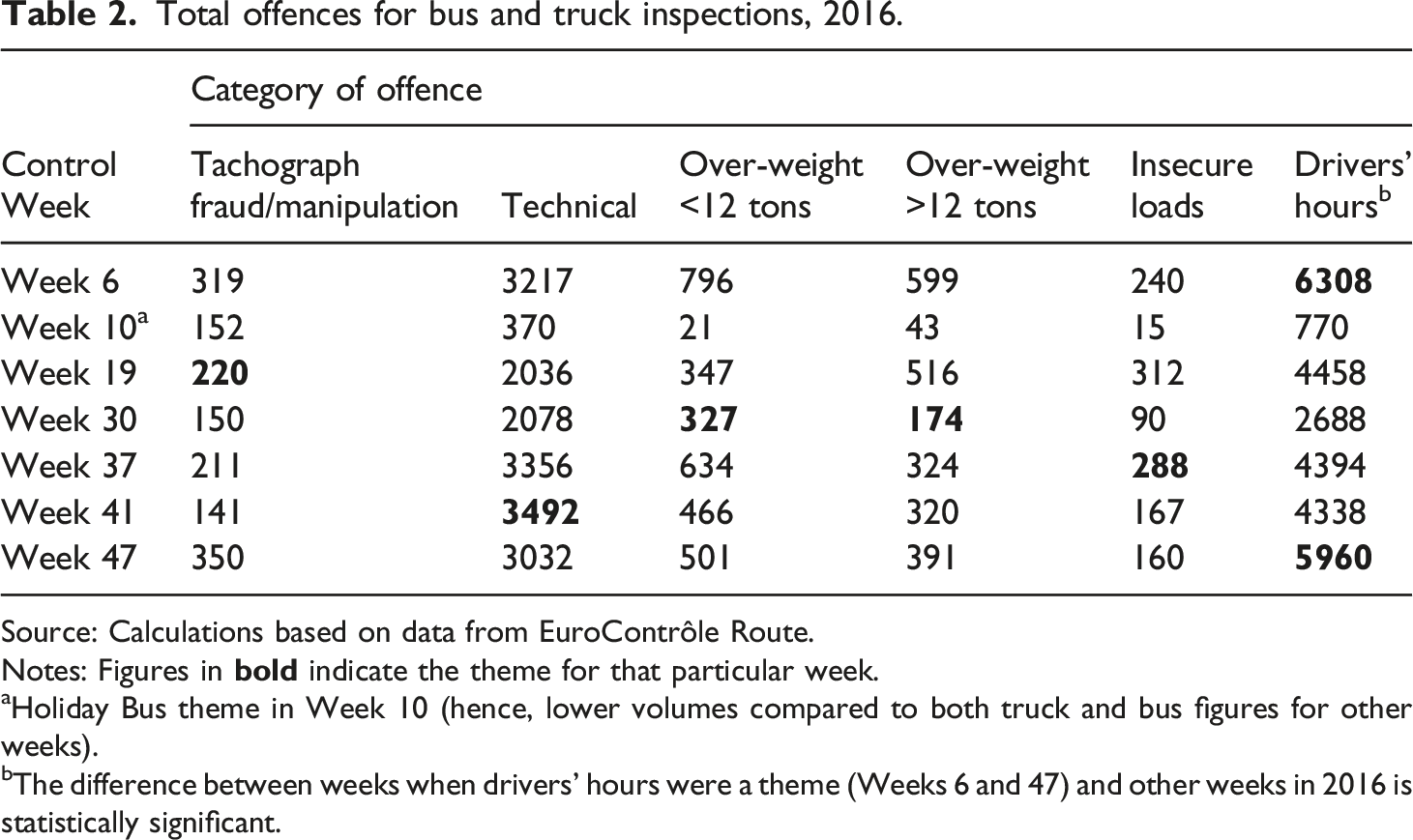
Source: Calculations based on data from EuroContrôle Route.
Notes: Figures in
aHoliday Bus theme in Week 10 (hence, lower volumes compared to both truck and bus figures for other weeks).
bThe difference between weeks when drivers’ hours were a theme (Weeks 6 and 47) and other weeks in 2016 is statistically significant.
As the tachograph is the most effective way to enforce drivers’ hours, these two concerns are closely related. However, proposals for the utilization of advanced vehicle technology would have to wait for Mobility Package 3 (MP3), to be published in May 2018. The ETF wanted (quick) data before the publication of MP3 in order to demonstrate the routine violation of driving and rest time regulations and to highlight the structural problems created by opening the market. Mobility Package 2 (MP2), published in November 2017, proposed further measures to open access to the bus and coach market, a sector already dominated by just a handful of ‘lean platforms’ (Srnicek, 2017: 49–50) such as FlixBus. These companies rely not only on market access (e.g. liberalization of the German bus market in 2013 that opened the roads to FlixBus) but also network effects: ‘the more numerous the users who use the platform, the more valuable that platform becomes for everyone else … [resulting in] … a natural tendency towards monopolisation’ (Srnicek, 2017: 45). Witness the merger of FlixBus and MeinFernbus, which created a company with a domestic market share of over 70%. Further consolidation – with megabus, Postbus and Eurolines – resulted in a company not only with a dominant position in Germany (over 90% of the market) but by far the largest route network across Europe and, most recently, expansion into the US market. The driver of market domination is low prices (e.g. FlixBus offered EUR€1 tickets for its new international services announced in December 2015), made possible by sub-contracting all services to ‘partner’ bus companies. FlixBus controls the platform, providing the administration and permissions required to operate long-distance and international services, but the company neither owns any coaches nor employs any drivers.
During initial meetings of the RTS Steering Committee established to oversee the project, as well as focus group meetings with activist-drivers from Belgium and the Netherlands, it was clear that sub-contracting was associated with sub-standard terms and conditions of employment and routine violation of driving and rest time regulations. Notwithstanding the veracity of insights proffered by union officials and activists on this new social category of drivers, it is important to recognize that when stakeholders represent their members’ interests to the Commission, they are advised that ‘it is important to distinguish evidence from opinions’ (EC, 2009: 20). An online questionnaire survey was therefore developed, focussing on objective (time-based) measures for driving, breaks and daily/weekly rest, in accordance with Directive 2002/15/EC, as well as any work activities performed during designated rest periods. As drivers experience very different levels of remuneration, working time and work intensity during high (summer) and low (winter) seasons, which tends to be exacerbated for sub-contractors, data was sought for different times of the year and different categories of drivers. Non-probability (purposive) sampling was used to target unionized drivers via national transport unions and non-union drivers via online forums where participants log-on to ‘compare notes’ on different operators. The survey returned 696 responses (630 men and 66 women), from 17 EU member states. 15 More than a third of the total sample were non-union members. Most respondents were directly employed by either operators or ‘partner’ bus companies (sub-contractors), and 1-in-7 respondents were hired via an agency or on a short-term contract (typically 6–12 months). 16
Employers’ provision of benefits: full-time versus agency/temporary drivers (%).
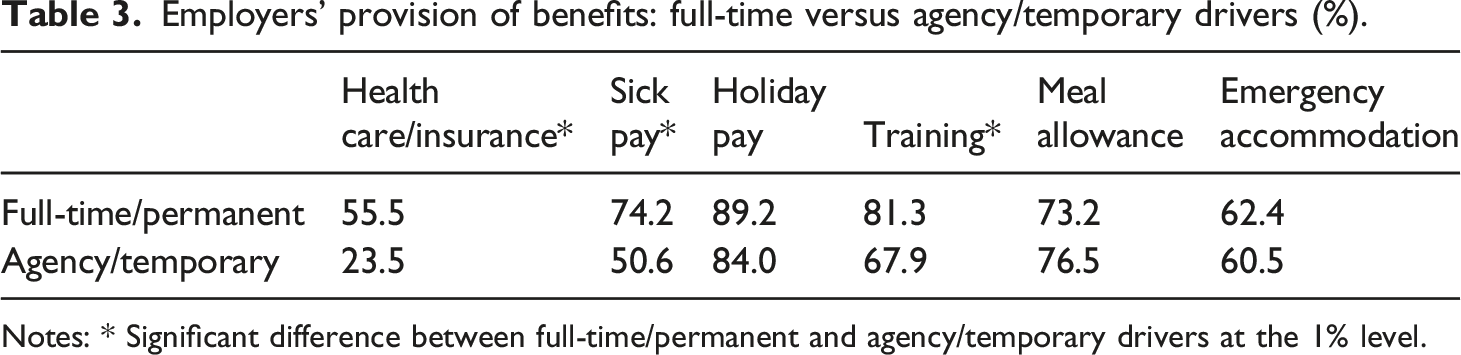
Notes: * Significant difference between full-time/permanent and agency/temporary drivers at the 1% level.
Working during rest time.
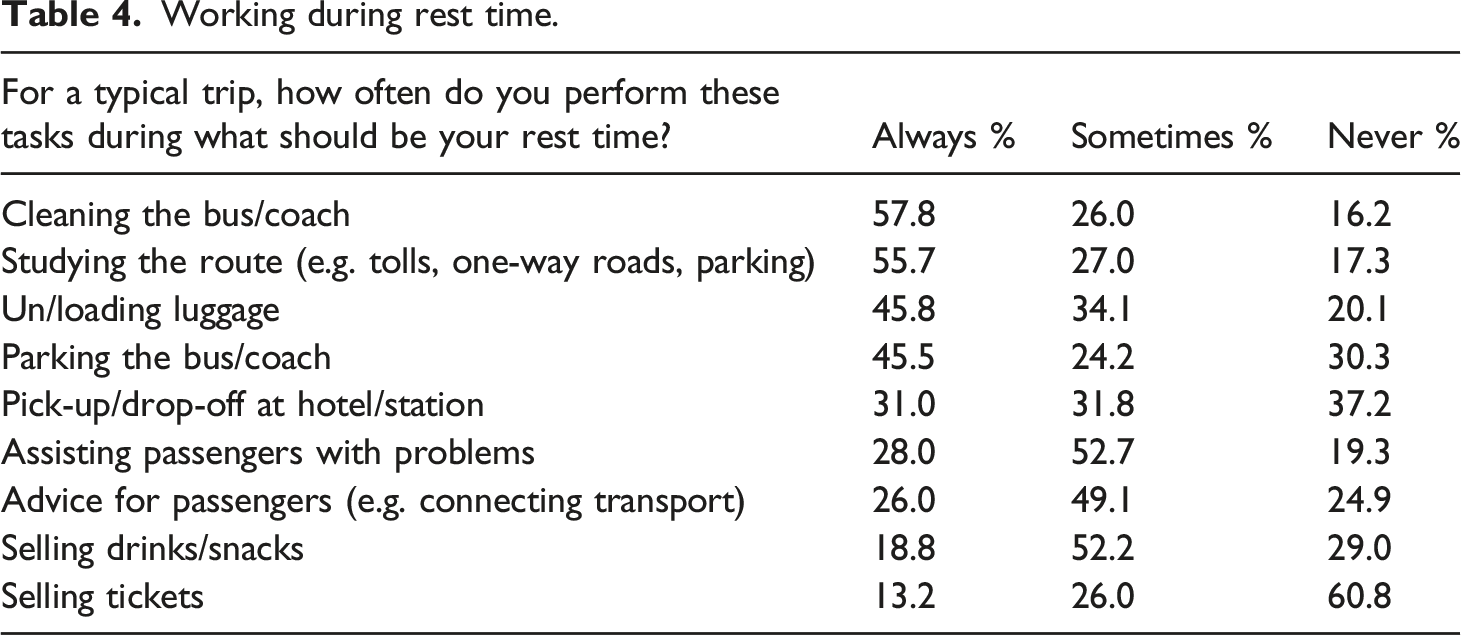
The evidence co-produced with the ETF demonstrated that, in clear violation of European driving and rest time regulations, international bus and coach drivers routinely work excessive hours, much of this time is unrecorded and certainly unremunerated, and their work is intensified as a result of additional (typically unpaid) activities that systematically eat into their daily and weekly rest time. The report based on the project (Turnbull, 2018) was published by the ETF in April 2018 and officially launched at a meeting of the European Parliament the following month to coincide with the final Mobility Package (MP3). Under the ordinary legislative (co-decision) procedure, the ETF relies on national transport unions to lobby European Council members, whereas the Federation can address MEPs both directly and indirectly (via national unions) to build a network of support across different political groups in the European Parliament that cross-cut national party lines. The success of this political (legislative) campaign was signalled by the ‘road not travelled’ (i.e. stalling many of the proposals most likely to have a particularly adverse impact on drivers’ terms and conditions of employment), and by expediting the more widespread introduction of the latest generation of tachographs. The smart tacho automatically registers the vehicle every 3 hours of accumulated driving time as well as the location of passenger pick-up/drop-off. The latter is considered by law to be working time, but our data clearly demonstrated that these and other activities are often not remunerated. The ETF expects the latest EU Regulation (2020/1054) on maximum daily and weekly driving times, minimum breaks and weekly rest periods to curb the practice of paying drivers only for their driving time rather than their entire working activity.
Conclusion
Comparative industrial relations research is an iterative process driven not only by the confrontation between idiographic and nomothetic methods (Hyman, 2001) but also the (temporal) interaction between slow and fast research. In the neoliberal university, all academic staff are now expected to ‘quicken up’, but for activist-scholars working with the labour movement a ‘quickstep’ (fast research) that passes the test of action as well as the test of science is only possible when founded on many years of slow research. The latter ensures a deep understanding of industrial relations in different countries, sectors and workplaces, access to key informants, and the ability to act quickly by mobilizing the necessary intellectual, human and data resources when opportunities arise.
No doubt cynics might still ask what fast research adds to our existing knowledge of industrial relations in Europe? After all, neither project reported here revealed anything about the working lives of seafarers and drivers that the ETF and national transport unions were not already aware of. Except that this was no longer a matter of ‘opinion’ but rather statistically significant evidence – ‘facts that stick’ – and the evidence pointed to systemic features (or more accurately failures) of the market that drive down workers’ terms and conditions of employment. The playing field was not level, competition was not fair. Shipping lines exploited spaces of exception in order to exploit seafarers. Lean platforms exploited their monopoly power in order to exploit drivers. Slower ethnographic research with individual seafarers and drivers would no doubt generate ‘thicker’ and more compelling stories of the hardships of their daily working lives, based on their own personal experiences. Except that now they know their experience is shared by many others, and sharing that knowledge makes them part of a much larger community of knowing. To be sure, the comparison might be necessarily ‘thin’, but it can still prove sufficient to cement new social categories with a different interpretation of the present and vision for the future.
Statactivism involves the (re)interpretation of existing data as well as the collection of new evidence for representation, which is all the more telling when variables are based on widely recognized measures such as technical or human element deficiencies in shipping or driving and rest times in road passenger transport. Clearly, it is not sufficient simply to establish a statistically significant relationship between the flag of a vessel sailing in European waters and seafarers’ terms and conditions of employment, or the systematic under-recording of driving time on European roads and undeclared work during the official rest periods of bus and coach drivers. Nonetheless, correlation – the case to answer – cannot simply be discounted. This is especially important for ETUFs in terms of political engagement with supranational institutions, as demonstrated by legislative (in)action when research data is used to bolster the force of argument. In contrast, it is far more problematic for ETUFs, as meta-organizations, to use aggregate data to persuade member unions to engage in a particular course of national political and/or industrial action.
Fast(er) research is evidently more attuned to generalization across countries and social categories, whereas slow(er) research is more attuned to the variegated impact of global neoliberalism and a holistic understanding of a particular time and place (Almond and Connolly, 2020: 65–6). EfR is a way to resolve this temporal and methodological dilemma: by drawing on a variety of knowledge (Figure 1), it is equally well-suited to fast(er) or slow(er) research. Consequently, EfR offers recourse in those ‘moments of confrontation between a general research problematic on one hand, and what occurs at a local level on the other’, especially in the moments of real-time social science when researchers need to ‘find a means of dancing between the requirement for some degree of meta-comparability (a thematic unity across countries) and societal specifics at a more granular level’ (Almond and Connolly, 2020: 67). As comparative international scholars, maybe we should all learn to dance slow, slow, quick, quick, slow.
Footnotes
Acknowledgements
I am indebted to the Secretariat of the ETF and all the national transport union officials and activist with whom I have danced over the years.
Funding
The author(s) received no financial support for the research, authorship, and/or publication of this article.