




Abstract
The paper addresses the endurance of sector collective bargaining despite many announcements of its demise. Bourdieusian social theory is used to interpret collective bargaining as a dominated social field that is distinct and relatively autonomous from other economic, political and transnational fields. Empirically, we trace the trajectories of German and Italian metal sector’s collective bargaining fields. In Germany, field agents contributed to a continuing erosion of collective bargaining, regional differentiation of membership strategies, and a reorientation of dominated employers’ associations towards their members. In Italy, some field agents resisted supranational and national liberalization demands and contributed to the adaptation and innovation of bargaining practices and hence, to the preliminary re-stabilization and re-balancing of collective bargaining between industry and company level.
Keywords
Introduction
In the last two decades, the literature on industrial relations and collective bargaining in advanced capitalist democracies has been dominated by institutionalist theories that emphasize the distinctiveness of national political economies (Hall, 2014; Hall and Soskice, 2001). Liberalization theories have challenged this position, arguing that a shift in the power-balance in favour of financial capital owners and employers have led to common trajectories of liberalization, at the end of which even different national institutions result in greater employer discretion (Baccaro and Howell, 2017; Benassi and Dorigatti, 2018). A third group of scholars occupies a middle ground between institutionalist and comparative political economy theories (CPEs). This group argues that neither institutional continuity nor all-encompassing liberalization processes are likely outcomes of globalization (Hassel, 2014; Thelen, 2014). In her study of the largest Coordinated Market Economy (CME), Germany, Hassel (2014) shows that coordination and liberalization are two sides of the same coin in the process of corporate restructuring. Export oriented firms seek to cooperate with core workers and their union representatives to exploit the institutional advantages of coordination (e.g. a frictionless production process). This in turn sharpens insider–outsider divisions by cost cutting through liberalization at the fringes of the labour market (e.g. the services sector).
These three groups of scholars differ in terms of the strength they assign to the forces of institutions and actors in shaping the trajectories of continuity and change of employment institutions. Hall and Soskice assume business firms to organize their strategies around existing market or non-market institutions of industrial relations, skill formation, corporate finance, and others. Scholars of liberalization theory (LT) and dualization theorists (DTs), meanwhile, regard power (im-)balances between employers, unions, and the state as decisive in explaining outcomes. Besides these differences, scholars share a common – even though not necessarily explicit – understanding of collective actors’ rationality. Similar to classic corporatist arguments, they attribute to collective actors (i.e. employers’ associations, firms, unions, etc.) a more ‘rational’ behaviour than to individual actors (e.g. workers with their multitude of needs and interests) in creating public goods such as collective wage agreements (Offe and Wiesenthal, 1980; Streeck, 1991). Collective actors are assumed to follow functional complementaries (Hall and Soskice, 2001), use discretionary power to promote or oppose liberalization trends (Benassi and Dorigatti, 2018) or forge inter-class alliances to respond to economic shocks (Hassel, 2014).
However, employer associations’ responses to liberalization trends, in particular, do not always fit neatly into explanations suggested by conventional theorizing and call for a more context-sensitive analytical approach that takes account of gradual institutional transformation (Streeck and Thelen, 2005). German employer organizations’ representatives within and across branches, for instance, have been found to vary widely in terms of how they perceive and evaluate the introduction of employers’ associations whose members do not fall under the purview of a collective agreement (Behrens and Helfen, 2019). This finding deviates from the Varieties of Capitalism theory’s (VoC) argument that employers in CMEs continue to support multi-employer collective bargaining because of their embeddedness in functional complementary configurations. Contrary to LT, meanwhile, employers in Mediterranean countries have barely promoted the dismantling of sector collective bargaining but exhibit heterogeneous preferences vis-à-vis liberalization (Bulfone and Alfonso, 2020). And dualization scholars, while pointing to diverging collective bargaining agents’ interests and practices at the systems’ core and periphery, do not problematize the dialectics between a field’s objective power relations – which appears to somehow mechanically drive dualization – and agents’ subjective contributions to these changes.
In this paper, we seek to address these puzzles by adopting and applying Bourdieu’s social theory with which he attempted to conceptualize the interplay between social structures and human action or, in other words, between objective and subjective forces that contribute to the re-production or change of social relations and practices. Social agents most often do not consciously calculate according to explicit rational and economic criteria. Instead, the perceptions, interests, and behaviour of agents are assumed to be generated by social fields. A social field is defined as a historically created, relatively autonomous social space of power positions and area of activity in which field agents have achieved a certain degree of social closure, shared assumptions about what is at stake and the related belief (illusio) that the game is worth playing (Bourdieu and Wacquant, 1992: 98). Agents follow field-specific logics and acquired dispositions (habitus) and the meaning of rationality itself is assumed to vary by specific fields. The state of collective bargaining fields is therefore decisive in determining the possibilities and limitations of their reproduction or change.
In empirical terms, this article traces the trajectories of German and Italian collective bargaining fields in the metal sector from 2000 to 2018 and asks: How can the resilience of sector collective bargaining fields be explained against the backdrop of severe attacks they have received from other social fields, such as politics, economy, and the European Union (EU)? In the aftermath of Germany’s reunification, from the late 1990s until the early 2000s, multi-employer collective bargaining was considered by political and economic agents as a major culprit when it came to explain why Germany had become ‘the sick man of Europe’ (Sinn, 2003) and hence, faced the announcement of harsh measures if field agents were not able to reform the system themselves. Italian collective bargaining agents, meanwhile, faced more severe challenges by national and EU politics as well as by transnationalized economic fields than their German counterparts since the financial and economic crisis from 2008 onwards. The article starts by explaining a social field perspective (SFP) and its potential for analysing the reproduction or change of collective bargaining. Next, the methodological approach will be outlined. The ensuing section depicts empirical evidence on the trajectories of German and Italian collective bargaining fields. The final section presents a critical assessment of the added value and limitations of SFP in light of the empirical evidence.
Collective bargaining from an SFP
SFP is based on Bourdieu’s notions of social field, capital and habitus. The specific dispositions and interests of agents are seen as presupposed and produced by historically delimited social fields (Bourdieu and Wacquant, 1992: 115). Collective bargaining agents are viewed as operating according to an implicit and situated logic of rationality – a practical sense – and incorporated dispositions (i.e. habitus, see below) that are assumed to contribute to the reproduction or transformation of the field’s specific institutions and practices (Bourdieu, 1990). Even though Bourdieu devoted much of his research to reveal economic, cultural, social and symbolic power relations that reinforce social inequality (in particular: Bourdieu, 1986), his theory of social field, capital and habitus can also be used to explain societal change not just reproduction (Boyer, 2014).
In Western Europe, the genesis of collective bargaining fields is closely linked to the emergence of national social welfare states. From World War II onwards, the nation state has served as an overarching power structure that embedded all social fields, such as, for instance, economic, political-administrative, or collective bargaining fields. Although industrial relations fields (and collective bargaining subfields) and economic fields are interrelated and interdependent, they follow different logics and exhibit distinct beliefs and interests in the field. Agents in collective bargaining fields share the belief that class conflicts can and should be mediated by negotiations and compromise rather than the free reign of economic competition. They share what Bourdieu called an illusio (lat. ludus, the game) and agree that the game of collective bargaining is worth playing. Economic capital (in industrial relations research conventionally referred to as a form of structural power) does matter in collective bargaining fields, but it is translated according to field-specific logics and power relations.
The conception of symbolic power, as suggested by Bourdieu, represents a specific form of domination that modifies Weber’s (1978) emphasis on the legitimation of power (Swartz, 2013). Bourdieu’s theory stresses the active role that symbolic forms play as resources that reflect, constitute, maintain, and change social hierarchies. Symbolic power is understood as the categories of perception, the schemata of classification, that is, essentially the words, the names which construct social reality as much as they express it, [and that] are the stake par excellence of political struggle, which is a struggle to impose the legitimate principle of vision and division. (Bourdieu, 1989: 20)
Despite influences stemming from European and global fields, nation states are still important fields of power where symbolic struggles take place over the definition and legitimacy of collective bargaining fields, and increasingly less of transnationalized economic fields. While contested, however, symbolic power is also often misrecognized as taken-for-granted, as natural order of things.
Field theory assumes that society and social inequality are largely produced and reproduced at the level of practices. Practices are understood as shared routines of behaviour or customary rules (Bourdieu, 1977: 16); and social fields shape these practices that guide and enable human activity. Collective bargaining practices therefore follow field-specific logics of action embedded within particular power relations and shared understandings of cooperation and negotiation between organized employers and labour. The field’s practices also inform agents on how to orient their actions, to relate to the familiar and to adapt to new situations, that is, they contribute to the genesis of a field-specific habitus, a system of durable dispositions or a ‘structured structure’. However, habitus also functions as structuring structures, that is, as principles which generate and organise practices and representations that can be objectively adapted to their outcomes without presupposing a conscious aiming at ends or an express mastery of the operations necessary in order to attain them. (Bourdieu, 1990: 53)
Habitus constrains but does not determine thought and action. We assume that agents’ reflection on and awareness of their habitus varies with (shifting) power relations and the state of the social field, as it happens in collective bargaining.
Bourdieu was keen to develop his social theory in very close interaction with his empirical studies. In his critique of theoretical reasoning (Bourdieu, 1990) and other pieces he repeatedly expressed his contempt for ‘scholastic, theoretical reasoning’ and what he referred to as ‘scholastic epistemocentrism’ (Bourdieu, 2000b). At the same time, however, Bourdieu was well aware of the fruitfulness and added value of his theoretical conceptions of social field, capital and habitus. In Bourdieu and Wacquant (1992: 104f.), he argues that the analysis of a social field involves three necessary and interconnected research steps, that is, the reconstruction of the relation of the field vis-á-vis the field of power, the objective power relations between field agents, and their field-specific habitus (Bourdieu and Wacquant, 1992: 104f.). In drawing on Bourdieu’s conception of a field as a structured system of forces, Boyer (2014) suggests a set of five interrelated forces that needs to be reconstructed in order to evaluate a field’s equilibrium or tendency to change. We draw on this very useful framework to analyse collective bargaining fields (see Figure 1).
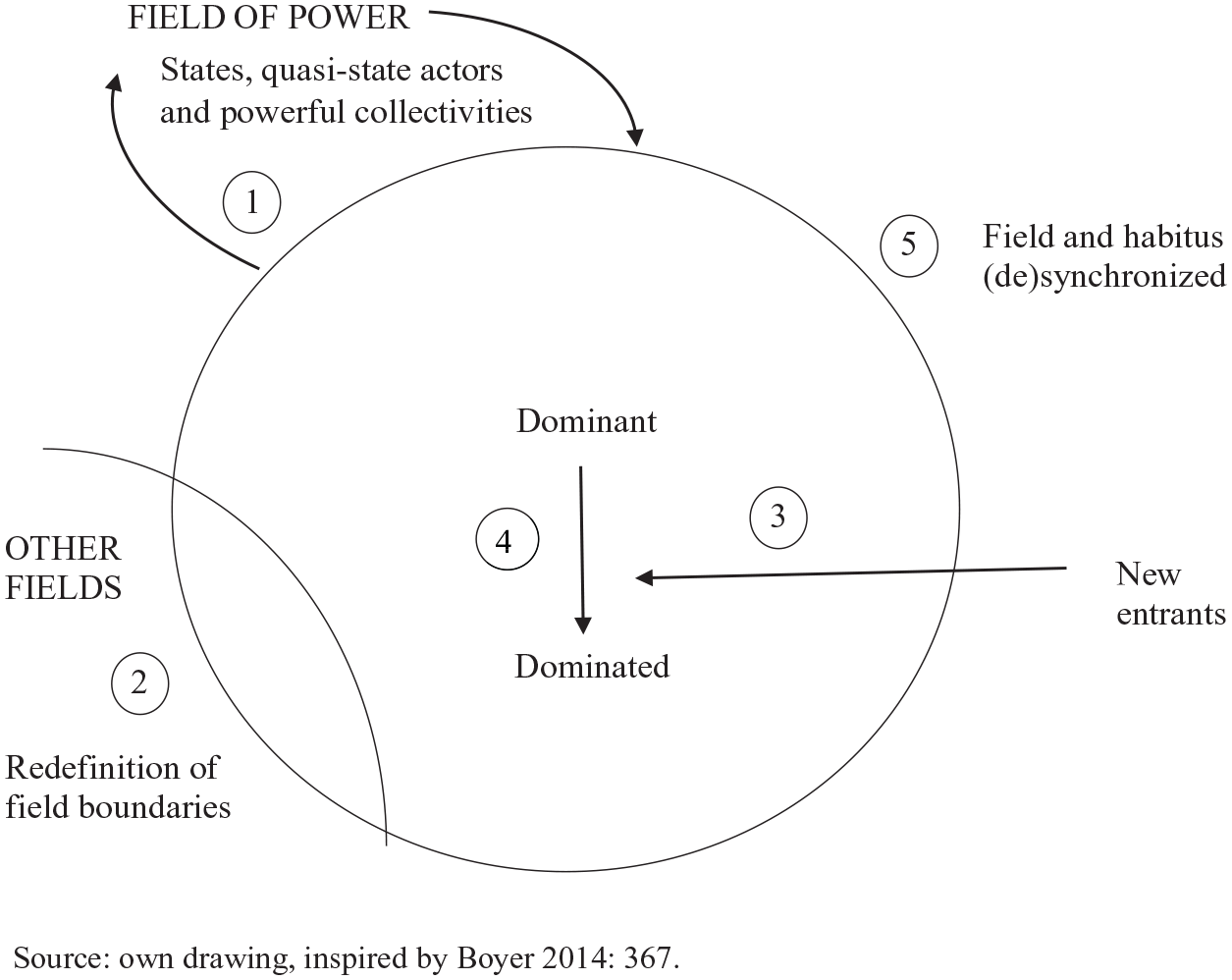
Forces of the reproduction and change of collective bargaining fields.
The first force (1) relates to the interactions between collective bargaining fields and the fields of power at different spatial scales. A field of power is understood as an arena of struggle among different fields (e.g. economic field, political-administrative fields, etc.) and their most powerful agents, respectively, for the right to dominate throughout the social order (Swartz, 2013). The relative autonomy of the collective bargaining field vis-à-vis fields of power is therefore decisive in determining the field’s (speed of) transformation or reproduction.
A second force (2) relates to the (re)definition of frontiers between social fields under the effect of internal struggles (Bourdieu, 2000a). The move towards a redefinition of collective bargaining fields is especially related to the growing influence of both transnationalized economic fields, which have put pressure on national wages and wage setting institutions, and political-administrative fields, which have called into question the effectiveness and governability of collective bargaining institutions. However, these fields do not directly impact on the perceptions, thought, and behaviour of collective bargaining agents, but are translated according to the field’s own logics and practices.
The third force (3) relates to the entry of new agents who – if powerful enough – are likely to change field-specific rules and practices, whereas less-powerful intruders are more likely to adapt themselves to the field’s doxa (taken-for-granted rules, norms and values). The fourth force (4) directs our attention within the social field and is linked to the fact that the dominant field agents have a certain ability and interest to maintain field structures and practices or to set ‘the speed of transformation’ (Bourdieu, 2000a, cited in Boyer, 2008: 364). In relatively intact (stable) fields of collective bargaining dominant agents are assumed to reproduce the structures and practices of the field in order to reinforce their position. By contrast, in more contested fields, agents might invent new categories and practices to add to the attractiveness of the field and defend the field’s autonomy. Every effort aimed at organizing collective action with the aim to change a field’s basic features, however, has to reckon with what Bourdieu (1990: 59) called the hysteresis effect of the habitus. This concept refers to the ‘structural lag between opportunities and the dispositions to grasp them which is the cause of missed opportunities’ (Bourdieu, 1990). The final force (5) refers to the synchronization or desynchronization of the field and the field-specific habitus, respectively. Even if we assume that agents can become aware of their dispositions and interests within relatively stable field structures in which habitus and field synchronize, they are more likely to deliberately create new and innovative practices if habitus and field desynchronize. In the latter case, field-external logics (such as from the economic field) are likely to become more attractive and meaningful in relation to the field’s own logic and practices.
Case selection and research methodology
We chose German and Italian collective bargaining fields in the metal sector for a paired comparison because both countries have a strong tradition of industry-level collective bargaining. They largely differ in terms of their symbolic reputation within national and European fields of power and in relation to their economic positions in the metal sector since the last financial and economic crisis (Pernicka et al., 2019). In both countries, collective bargaining takes place within national boundaries, whereas economic fields in the metal sector have become European and even global. The proliferation of global value chains and vertical disintegration involving cross-border restructuring have intensified the pressures on national wages and collective bargaining institutions.
As outlined, we conceive of collective bargaining fields as material and symbolic power structures featuring specific forms of capital that are structured by, and have a structuring effect on, collective bargaining agents’ perceptions, interests and behaviours. Social and political forms of power (or capital, which is used interchangeably) stand out in terms of their effectiveness and relevance, and have been operationalised as follows: (1) social capital relates to the whole array of interpersonal, cooperative relationships of fields agents based on a shared understanding, shared norms and values, shared identities and solidarity that contribute to the effective functioning of groups. Our notion of social capital goes beyond associational power as conceived of by industrial relation scholars as the worker’s ability to form collective organisations such as trade unions (Wright, 2000). Social capital captures the social relations between and within groups of workers, employers and their representatives, and their effective use in individual and collective action. (2) Political capital is understood as a specific form of social power that, in a narrow sense, includes the recognition of collective agreements and collective bargaining agents by their respective interlocutors and their members and constituencies. As already mentioned, we also consider symbolic power as a form of political power, and symbolic struggles take place, among other issues, over the legitimate form of setting wages and conditions (e.g. collective bargaining or individual market competition), and the means of struggle within collective bargaining fields (e.g. negotiation and bargaining, strike action, lock out). (3) Institutional capital, meanwhile, is considered as a secondary form of political power, in which past struggles temporarily crystallise, such as the legal framework for collective bargaining or the institutionalised spatial scale (level) at which collective bargaining takes place.
In comparison to the forms of power, wage setting practices and habitus were more difficult to operationalize. In order to capture and interpret the state and development of collective bargaining practices, we asked our interview partners to describe a usual collective bargaining round and to asses it, if possible, in the course of developments since the early 2000s. Schemes of perceptions, interests and worldviews (habitus) were captured by asking interviewees about their biographical and professional trajectory and their assessment of the role that their own organization and its main interlocutor (employers’ association or trade union) (should) play in collective bargaining. To reconstruct the power relations within the field and capture the field’s structuring effects we used existing literature and secondary data on the economic positions of the countries’ metal sectors, collective bargaining coverage, the number of collective agreements in the sector, membership densities of trade unions and employers’ associations. In addition, we conducted 40 in-depth interviews of 60–120 minutes in the years 2017 and 2018. We interviewed representatives from trade unions and employers’ associations in Germany, especially IG Metall and the employers’ association, Gesamtmetall, and their regional organizations, respectively. In Italy, we interviewed representatives from the metal sector unions FIOM-CGIL and FIM-CISL and from two regional organizations of the employers’ associations Confindustria, from the national metal sector association Federmeccanica, as well as academic experts on economic and social policy issues (for an overview see online Appendix). The interviews were fully transcribed in the original language and coded in an iterative process. Our empirical findings are presented along the five forces of reproduction and change. We begin with focussing on the European field of power (force 1) and its interactions with German and Italian collective bargaining fields, and continue with empirical findings on the national trajectories of collective bargaining fields.
Empirical findings
The EU field of power challenged the Italian collective bargaining field during the financial and economic crisis from 2008 onwards while the German model of industrial relations was held in high esteem. The economic positions of the two countries’ metal sectors reflect (but do not dictate) these different symbolic positions. Germany’s overwhelming economic dominance clearly stands out. Before the 2008 financial crisis, the European metal industry could be characterized – very broadly – as a duopoly structure with a ‘Franco-Italian’ cluster and a ‘German’ cluster. In the post-crisis economic order, it was transformed into a monopoly structure with Germany as the only dominant agent (Interview 37). In contrast to Germany, Italy’s metal industry faced a radical transformation. Still generating almost half of the value added and comprising more than 40% of the employees of Italy’s manufacturing sector, the metal sector has suffered dramatic losses since 2008. Many medium-sized to large enterprises that maintained or gained international competitiveness had formerly drawn on local supply chains organized in industrial districts. Now they have outsourced entire stages of production to international partners (Interviews 28, 29). Meanwhile, the low net equity base of many small enterprises limited their capacity to invest in machines, production systems, and management processes. Due to the large Italian sovereign debt and the credit spread between Italian and German Treasury bonds, capital cost increased significantly and made investment more difficult and risky (Interview 23).
Even if the relative economic power positions of German and Italian metal sectors can be explained by different factors such as the macroeconomic imbalances within the Eurozone caused by a relatively restrictive one-size-fits-all monetary policy of the European Central Bank (ECB) (Höpner and Lutter, 2014) or the innovation capacities of a country’s metal industry, collective wage-setting mechanisms were singled out as the major culprit. Italy, unlike other countries such as Portugal or Greece, has never been subjected to a memorandum of understanding by the Troika. However, in 2011, the ECB sent a ‘secret letter’ to the Italian government, demanding, among other reform measures, a further decentralization of the bargaining system (Recchia, 2017: 459). Differences in the reputation of industrial relations models are also mirrored in the EU’s policy responses to the financial and economic crisis. For instance, the EU’s economic governance regime set nominal wage-related targets that evaluated, in an asymmetric way, how different collective bargaining institutions contributed to macroeconomic imbalances. While the Italian model and others were accused of generating ‘excessive’ inflation, the German model of ‘wage moderation’ and its deflationary effects remained widely unmentioned (Koll, 2013). The EU’s explicit economic policies correspond more closely to orthodox economic emphasis on market supply. It openly supported national governments advocating fiscal discipline and wage restraints while weakening national (left-leaning) governments, parliaments and trade unions (Erne, 2015). The European Commission recommended that unit labour cost increases within the Eurozone should converge in alignment with ‘best practice’ wage coordination models in north-western European countries, especially Germany (Schulten and Müller, 2015). Every year between 2011 and 2017, the European Commission requested that Italy implement wage-setting reforms to align wages to productivity, while during the same time Germany received only two such requests to bring its wages in line with productivity (2012/13; 2017/18) and to stimulate domestic demand via wage growth (2013/14).
Germany
Collective bargaining field’s boundaries vis-à-vis fields of power (force 1) and other social fields (force 2)
In Germany, the principle of collective bargaining autonomy grants collective bargaining actors the right to bargain and agree on employment conditions without state interference. Employers’ associations and trade unions valued this principle very highly.
In the aftermath of the economic crisis (2008), the collective bargaining field and its agents gained in approval by the public and in the German political field because of their contribution to a quick recovery, which was celebrated as a revival of German corporatism (‘crisis corporatism’, Dribbusch, 2012). In 2014, a law was passed with the intention of strengthening collective bargaining autonomy. The currently high symbolic power position that the German collective bargaining field occupies in national and European fields of power is, however, only a temporary result of struggles over the legitimacy of collective bargaining practices and its functions. The 1990s were marked by an economic recession and constantly rising unemployment (Bispinck and Dribbusch, 2011: 24). Germany was considered the ‘sick man of Europe’ (Sinn, 2003). Many politicians and employers believed that rigidities in collective agreements were a major cause of Germany’s bad economic performance. The Association of German Industry (BDI) heavily attacked the collective bargaining policies of the member associations of the Federal Association of German Employers’ Associations (BDA) and trade unions, calling for a break-up of the ‘collective bargaining cartel’ (Weitbrecht and D’Antonio, 2017: 473). In 2003, the German government threatened to introduce statutory opening clauses to collective agreements should the social partners not agree on reforms themselves (Bispinck and Dribbusch, 2011: 30). Interrelated with these threats of intervention from the political field, several developments point to the intrusion of economic logic into the German collective bargaining field, challenging the field’s scale and scope. Collective bargaining coverage in the metal industry declined substantially and derogations from the sectoral collective agreement became widespread by the end of the 1990s (Haipeter and Lehndorff, 2015: 54ff).
Against this background of the field’s contested legitimacy and effectiveness, employers’ associations and trade unions adopted various measures to introduce, at the same time, flexibility and control into collective bargaining institutions. In 2004, they concluded a collective agreement (‘Pforzheim Accord’) to reintegrate local derogations into sectoral level collective bargaining; this indicated a change from disorganized to organized decentralization of collective bargaining (Traxler, 1995). While these measures reflect the shrinking scope of the collective bargaining field, they also point to the capacity of field agents to maintain autonomy and to re-stabilize field-specific practices. The erosion of bargaining coverage slowed down. While between 1991 and 2004 the proportion of employees covered by a collective agreement in the metal industry (including only establishments with more than 20 employees) fell from 70% to 53%, from 2004 to 2018 the loss was only six percentage points (from 53% to 47%) (calculations based on Gesamtmetall, 2019) However, the field could not be substantially re-extended despite explicit efforts by the collective bargaining parties (Interviews 15, 18).
The impact of the field on the behaviour of companies might extend beyond the purview of the collective agreement. For example, an employers’ representative estimated that the regulations of the collective agreement would have an impact on about 80% of all employment relationships (Interview 5). Some companies who were not members concluded so-called recognition agreements, and a number of companies without any collective agreement exhibited a strong orientation towards the collectively agreed employment conditions (at least concerning wages) (Interviews 4, 5, 10). Even if this pattern had also been attributed to a shortage of specialized, skilled workers in the metal sector (Interviews 4, 5), the collective agreement served as a benchmark for workers and employers and can therefore be interpreted, at least partially, as an effect of the collective bargaining field rather than as the mere result of market competition.
Entry of new agents (force 3)
German companies are not only firmly integrated into international value chains, they are also interesting objects of investment for foreign-owned companies whose management has not yet been exposed to the ‘taken-for-granted’ norms and practices of collective bargaining fields (Interview 4). Some interviewees pointed out that foreign-owned as well as some newly founded companies did not adhere to principles of German social partnership because their managers had different mind-sets: It was customary to be a member of an employers’ association. That was what you did. As a business man, you were a member of the shooting association and of the employers’ association. All was well. It’s not like this today. (Interview 7).
The decline of collective bargaining coverage went hand in hand with massive membership losses of the employers’ association. Between 1990 and 2004, Gesamtmetall’s regional associations lost almost half of their members (Gesamtmetall, 2019). This, in turn fostered the rise of new agents in the industrial relations field affecting the (sub)field of collective bargaining; since 2005, the national employers’ association Gesamtmetall has allowed so-called ‘OT-associations’ (Ohne-Tarif, without collective agreement) under its roof. This alternative allowed companies to escape sectoral collective agreement without having to leave the employer association altogether. OT-associations can therefore be interpreted as a means to stabilize the subfield of employers’ associations but also as an employer strategy to put pressure on trade unions in collective bargaining rounds by the threatening of companies to ‘switch’ their membership (Haipeter, 2016).
Field internal power relations (force 4)
The entry of these new agents and members exiting the employers’ association have had an impact on the collective bargaining field’s internal power relations. Between 1990 and 2018, Gesamtmetall’s ‘T-associations’ (with collective agreement) lost 64% of their member firms. However, while the decrease was 52% between 1990 and 2005, the decline slowed down between 2005 and 2018 to ‘only’ 24% (calculations based on Gesamtmetall, 2019). New members in employers’ associations, however, are almost exclusively recruited in the associations not bound by collective agreements (Gesamtmetall, 2019, Interview 4). The IG Metall’s membership, on the other hand, grew slowly between 2010 and 2016, and stabilized since then.
Power relations within the field have effects on bargaining practices. According to employer representatives, it is in the end IG Metall that de facto usually determines which regional bargaining district will set the pattern in the collective bargaining rounds (Interview 2).
Since 1991, nine of the pilot agreements in the metal industry were concluded in Baden-Wurttemberg, and only four in North Rhine-Westphalia (followed by Bavaria and Lower Saxony with two each; Gesamtmetall, 2013, own research). Despite a higher overall union density in North Rhine-Westphalia, the IG Metall’s strength in the large automobile companies in Baden-Wurttemberg, coupled with the economic capital of these companies, regularly led to relatively high wage increases in collective bargaining rounds, which caused growing opposition from employers’ associations and their members in economically weaker regions (e.g. Interview 5) – possibly contributing to a further erosion of the associations’ membership.
(De-)Synchronization of habitus and field (force 5)
Agents may become aware of their habitual perceptions and dispositions – and thus potentially be able to transform them – especially in times of perceived crisis. Some employers’ associations and the IG Metall introduced new practices of membership participation in recent years to address the shrinking bargaining coverage. While practices within the more centrally organized IG Metall seem to differ less between regions, we found evidence on the employers’ side for a regional differentiation of their views on potential OT association members and their membership strategies. A representative of a more dominant regional employers’ association in terms of its economically powerful members felt almost affronted by OT-members: ‘If they are pressured by IG Metall, put simply, it is their problem, because they are no longer a member of our association’ (Interview 4). Representatives of smaller, more dominated, employers’ associations, on the contrary, showed more sympathy for companies reluctant to apply the collective agreement (Interview 10). Different perceptions and dispositions might also shape the way in which different regional employers’ associations organize membership participation. Regional associations in a more dominated position seem to make greater effort to ensure membership participation (e.g. when preparing for a collective bargaining round, Interviews 5, 10) and consent (e.g. to adopt the ‘pilot agreement’ that sets the standards for the other regional employers’ associations) than associations in a more dominant position. Despite the changes in membership involvement, employers’ associations and trade unions have come to perceive the collective bargaining practices in the metal industry as relatively stable. Habitualized practices of powerful agents in the field might unintentionally reaffirm the field’s boundaries between insiders and outsiders and hence reproduce collective bargaining fields’ exclusiveness. While dominated regional employers’ associations have begun to reorient and adapt their schemes of perception, evaluation and behaviour towards their members, the habitus of dominant agents is still synchronized with field structures and practices and hence possibly contributing to the field’s further erosion, precisely by reproducing bargaining practices and outcomes.
Italy
Collective bargaining fields’ boundaries vis-à-vis fields of power (force 1) and other social fields (force 2)
Due to the absence of a detailed labour legislation, the inherent tension between (1) collective bargaining autonomy, (2) the questions of the representativeness of trade unions as well as of the scope of collective agreements, and (3) the individual right to fair pay in Italy has never been legally settled. Rather, it has led to field dynamics that have given way to a changing balance between centralized and decentralized modes of collective bargaining. In addition, labour and constitutional courts have referred to collective sector agreements as the appropriate benchmark for ‘fair pay’ and hence created a de facto erga omnes extension mechanism (Petrella, 2011). Sector-level collective bargaining coverage is deemed to be high, at 80% of employees (Visser, 2019), but firm-level agreements in the metal sector only cover 40% of employees (Fondazione Giuseppe Di Vittorio, 2016).
Italian governments have engaged more directly in the industrial relations field than their German counterparts. It was particularly the tripartite framework agreement of 1993 that represented a major change by institutionalizing the two-tier system of collective bargaining, the aim of which was to initiate a coordinated form of decentralization. However, the industrial relations system lacked the ability to autonomously organize a structured, coordinated system of bargaining. From 2001 onwards, conflicts began to arise against the background of union pluralism. The most powerful confederation CGIL frequently opposed measures and laws issued by the Berlusconi-led centre-right governments (Pedersini and Regini, 2013: 1), as well as a new framework agreement on collective bargaining signed by the other unions and employer associations in 2009. In this period, the CGIL-affiliated FIOM metalworker union repeatedly refused to sign national sectoral agreements.
Subsequently however, the centre-left Renzi government introduced, with the 2016 budget, tax incentives for productivity, bonuses and company-level welfare provisions, to incentivise firm-level bargaining. The measures were prepared by a group of economist advisers (called ‘control booth’, Interview 24), with social partners’ consultation. The metal industry collective agreement signed in November 2016 was the first to use the new incentives (Ambra and Carrieri, 2017).
Entry of new agents (force 3)
More than 25 years after the conclusion of the 1993 framework agreement, the number of national collective agreements with doubtful representativeness and efficacy has been continuously rising. Recent studies estimate that the number of national collective agreements has risen from roughly 400 to more than 860 in 2017 (Muri and Nizzi, 2017). A vast majority of private sector employees continues to lack access to second-level bargaining, be it at firm or at territorial level. Scholars define the current situation by using the terms ‘disorganized’, ‘fragmentation’, ‘uncontrolled decentralisation’ or ‘chaotic’ (Meardi, 2014; Recchia, 2017).
The severe conflicts and divisions of 2009–2011 brought the industrial relations system to the brink of collapse. It was especially in the metal sector where inter-union divisions and the tensions between social partners culminated in a conflict that was about to dismantle the entire system of collective bargaining (Carrieri and Feltrin, 2016: 113–122). This is particularly attributable to the decision taken by Fiat Chrysler Automobiles to leave the national employers’ association Federmeccanica (which is part of Confindustria). The company introduced a single-employer collective agreement detached from the national metal sector agreement. Furthermore, attempts were made to expand certain issues of the agreement to a network of Fiat supplier firms that had formally remained under Federmeccanica membership, which was classified by trade unionists as another effort to expand the scope of single-employer agreements to the detriment of the national agreement (Interview 29). When FIOM, the largest metalworkers’ union, refused to sign the agreement, Fiat used article 19 of the 1970’s Workers’ Statute in order to expel FIOM from the company plants. FIOM proceeded against this decision before the constitutional court. In 2013, the court ordered the readmission of FIOM representatives in the plants. Yet, it confirmed the legality of the firm’s decision to introduce a separate company agreement instead of applying the national collective agreement (Interview 29).
Field internal power relations (force 4)
Starting from 2009, ongoing conflicts and the critical economic situation had made it more difficult to conclude agreements that included the signature of FIOM. Against this background, it could not be taken for granted that in November 2016, a sectoral agreement (valid for the following 3 years) was signed by Federmeccanica and the three major trade unions FIOM, FIM and UILM. Representatives on both sides stressed that the whole bargaining process was jeopardized by the concrete possibility of a failure (Interview 22, 23, 25). Yet, there are different interpretations regarding the impact of Fiat’s leaving the bargaining community. While a representative of Federmeccanica did not attribute a major importance to it (Interview 23), a FIOM representative insisted on the significance of this event. He referred to the risk of a future bargaining system based on competition and wage dumping. In various statements, FIOM representatives defined the Fiat case and the history of separate agreements as a ‘wound’ in the industrial relations’ system as well as in the inter-union relations (Interviews 25, 29). FIOM experienced the past 15 years as an attack on its representativeness. The fact that the 2016 collective agreement became effective only after being voted on by 350,000 metal workers in almost 6,000 companies (approved with an 80% majority) was referred to as a major reason for FIOM to sign the contract, since this procedure had strengthened its recognition deriving from its mobilizing power and its commitment to democracy, after the separate agreements of the previous years had not been put to a vote (Interview 25).
(De-)Synchronization of habitus and field (force 5)
In late 2017, bargaining partners seemed to be well aware of the fundamental fragility of the agreement. In several statements, they referred to this ongoing period as an ‘experiment’, as the ‘delicate phase’ of prove and implementation (Interviews 22, 23, 26). With regard to the metal industry, field agents have adapted their dispositions and practices to the new frame, the new type of governance strongly connected to the European field of power. Many innovations contained in the 2016 agreement dealt with shaping industrial relations at the firm level, such as ‘company welfare’ measures concerning additional health care, pension funds, or guaranteeing, for the first time, the right to training for all workers (Interviews 23, 25, 26).
All three trade unions and the employers’ association were interested in re-establishing ‘representativeness’ in their field (Carrieri and Feltrin, 2016). But this common interest, the shared belief in the value of the field, was linked to different positions within the field. The trade unions, especially FIOM, felt it was important to maintain the first level as the symbol of a collective agreement that aims at guaranteeing more or less equal conditions for all workers covered (Interviews 27, 29). The employers’ association Federmeccanica wanted to strengthen the national level as an instrument to modernize the production system that had lost enormous capacities and was considered uncompetitive because of technological evolution as well as insufficient managerial knowledge and competences (Interviews 22, 23, 38). This is one reason why the employers’ association labelled the efforts to implement the collective agreement as ‘commitment’ (Federmeccanica, 2018). This indicated a novel approach to industrial relations, based on enhancement of competences and participation at all levels (Interviews 23, 25).
The 2016 metal industry agreement can be seen as a further step in the attempt, undertaken by the major interest organizations, to stabilize the field, to reorder the practices from their central position in the national field (Leonardi et al., 2018). Their position as central actors had been challenged, on the one hand, by the proliferation of smaller business organizations and unions. On the other hand, like the production system, the industrial relations system is also being fragmented and segmented, according to firm size, technological development, and the enormous regional differences in economic development and infrastructure. Support for autonomy had now shifted into a largely shared understanding that modernizing the production system required collective agency, that is to say, a radical cultural change (Interviews 22, 23). However, this could further fragment the field and result in fewer companies and employees benefitting from collective bargaining. Many small firms might offer only minimal economic and legal guarantees to their workers (Interview 38).
In conclusion, the November 2016 agreement offered very low wage increases and reflects the weak economic and symbolic power position of Italian collective bargaining agents in (trans)national economic and power fields. The two-tier bargaining process could be renovated due to a transformation of the field-specific practices. Employers’ associations and trade unions faced a deep legitimacy crisis. The crisis could be overcome by organized decentralization and by establishing elements such as the right to training for all workers at the central level, and thus defied the field-external pressures towards single-employer bargaining.
Discussion and conclusion
In applying Bourdieu’s social theory, we proposed an SFP which allows to evaluate if a collective bargaining field is geared more towards social reproduction or change. While existing theories of institutional continuity and change explain variations in industrial relations’ agents’ behaviour by recourse to external forces’ impulsion and collective actors’ responses, SFP posits the historical emergence of distinctive and relatively autonomous collective bargaining fields whose forces impinge on agents ‘from the inside’. SFP thus emphasizes the social closure of collective bargaining fields and the genesis of a field-specific practical sense and incorporated dispositions. However, contrary to more recent variants of systems theory and their assertion of a social system’s capacity for self-reproduction (Rogowski, 2000), SFP highlights the importance of hierarchical forms of social integration (besides functional forms) and cultural domination in contemporary societies. Contingent on the collective bargaining field’s autonomy vis-á-vis the field of power, and on the field agents’ power position agents develop an interest in the reproduction or transformation of the field’s institutions and practices. Even though SFP shares with liberalization theories the assertion that economic and social power imbalances matter, the collective bargaining field’s specific structures and habitus are viewed as largely autonomous from other fields, and therefore might remain intact even if functional complementaries are eroded. Our analysis of the trajectories of German and Italian collective bargaining fields from the early 2000s until 2018 underscores the role that power relations within the field (collective bargaining) and its subfields (e.g. employer associations’ fields) as well as the overall fields of power on various spatial scales (e.g. national, transnational, EU) play in influencing agents’ subjective dispositions, interests and behaviour.
SFP also shares important insights of dualization theory on the German collective bargaining’s field trajectory, that is, a dualization of employment relations structures, rules and practices in corporatist economies. However, contrary to dualization theory with its emphasis on macro-social forces or collective actors’ rationale in a particular socio-economic setting, SFP is more sensitive to the subjective side of actor’s contributions to an increasingly dualized institutional landscape, and therefore, might be better equipped to grasp the space of possibilities and limitations for future developments. Even if many German employers favoured liberalization – as demonstrated by disorganized decentralization until the early 2000s – employers’ associations and unions eventually developed an interest in and could re-establish sector collective bargaining and at least to some extent retain employers’ associational membership and interest in coordination in the metal sector. The configuration of power relations between trade unions and employers’ associations in economically strong regions however, has increased tensions within the latter’s regional subfields. While dominant agents’ habitus is in sync with field structures, a desynchronization of habitus has occurred at the field’s fringes. As a consequence, dominant employers’ associations have maintained collective bargaining practices and contribute to the field’s closure and further erosion while dominated actors and trade unions have – so far in vain – mobilized resources to re-extend the field.
Neither VoC nor LT can convincingly explain why Italian unions and employer organizations, despite deep intra-union divisions and the exit of a major player (Fiat), could re-establish a national collective agreement. More recent studies point to the importance of encompassing sectoral bargaining for small firms as a decisive explanation (Bulfone and Alfonso, 2020). This resonates with our own findings on the limited capacity of small enterprises to invest in machines, production systems, and management processes, and employer associations’ intention to overcome fragmentation and dualization processes within both, economic and collective bargaining fields. Paolucci and Galetto (2020), meanwhile observe that ‘continuous pressures to decentralize contribute to widen within-countries differences’ (Paolucci and Galetto, 2020: 177), a finding that can be interpreted as increasing differentiation and social closure of collective bargaining fields against the background of transnationalized economic fields of the sectors compared in their article, that is, chemical and metalworking sectors. Yet, all three trade unions (FIOM/FIM/UILM) and the employers’ association (Federmeccanica) were interested in re-establishing representativeness in their field albeit this common interest was linked to different positions within the field. Whereas unions felt it was important to maintain the first level as the symbol of a collective agreement that aims at guaranteeing more or less equal conditions for all workers covered; Federmeccanica wanted to strengthen the national level as an instrument to modernize the production system.
We applied SFP to take a closer look into gradual institutional transformation (Streeck and Thelen, 2005) and its objective (material and symbolic power) and subjective entanglements in collective bargaining fields. However, there are also limitations of the framework, which especially relate to its large complexity. The complete application of a Bourdieusian approach would require an analysis of the objective power relations and subjective dispositions in social space (positions and trajectories of individual actors and their habitus), in employment relations fields (positions of individual associational representatives and their field specific habitus) as well as an analysis of the objective relations between social fields within the field of power (dominant and dominated social fields in social space). In addition, a detailed description and analysis of historical developments over a period of almost 20 years in two countries’ collective bargaining fields and their interactions with other relevant social fields would clearly exceed the available space of a single journal article. Similarly, it is likely that other sectors’ collective bargaining subfields and agents experience different dynamics, for example, with more disruption in sectors with stronger new entrants. In this article, we therefore decided to focus on those objective relations of force and subjective phenomena that are considered as decisive for the continuity or change of collective bargaining fields.
Supplemental Material
sj-pdf-1-ejd-10.1177_0959680121998478 – Supplemental material for Forces of reproduction and change in collective bargaining: A social field perspective
Supplemental material, sj-pdf-1-ejd-10.1177_0959680121998478 for Forces of reproduction and change in collective bargaining: A social field perspective by Susanne Pernicka, Vera Glassner, Nele Dittmar and Klaus Neundlinger in European Journal of Industrial Relations
Footnotes
Acknowledgements
The authors would like to thank the two anonymous reviewers as well as the journal’s editor for their very helpful comments and suggestions on previous versions of the paper.
Funding
The author(s) disclosed receipt of the following financial support for the research, authorship, and/or publication of this article: The research underlying this paper was conducted within a Research Unit (FOR 1539: Horizontal Europeanisation: An emerging social entity between national and global scales), funded by the German Research Foundation (DFG) and the Austrian Science Fund (FWF).
Supplemental material
Supplemental material for this article is available online.
Author biographies
References
Supplementary Material
Please find the following supplemental material available below.
For Open Access articles published under a Creative Commons License, all supplemental material carries the same license as the article it is associated with.
For non-Open Access articles published, all supplemental material carries a non-exclusive license, and permission requests for re-use of supplemental material or any part of supplemental material shall be sent directly to the copyright owner as specified in the copyright notice associated with the article.
