




Abstract
This article highlights the importance of organizational resources and individual capabilities for interactions and relationships among social partners in European sectoral social dialogue committees (SSDCs). We use an actor-centred approach to investigate work programme setting in the hospital and metalworking SSDCs. Our research reveals differences in how European social partner organizations coordinate and integrate members in SSDCs. In hospital, European Union (EU)-social partners build bridges that span otherwise separate actors or groups. The findings suggest that the absence of bridging efforts can lead to the dominance of a few actors. In metalworking, small cohesive groups are more effective in forming close networks and determining work programmes. While work programmes in hospital represent issues which are on national agendas, in metalworking, they focus mainly on EU policy areas.
Keywords
Introduction
This article is about the role of trade unions and employer organizations – social partners – as critical actors in the shaping of social dialogue practices and policies in European sectoral social dialogue committees (SSDCs). SSDCs are the fora where national and European social partner organizations and their representatives (in the following, SSDC actors) engage in social dialogue to develop and influence work and employment related policies at European Union (EU) level (European Commission, 1998). We use an actor-centred approach to investigate how organizational resources and individual capabilities affect the interactions among SSDC actors and the selection of policies they choose to tackle in SSDCs. Organizational resources and individual capabilities are assumed to influence both actors’ capacity to interact in SSDCs and their interaction practices. Considerable research has been devoted to factors fostering or hampering effective engagement of SSDC actors in social dialogue (e.g. Dufresne et al., 2006; Leisink, 2002; Marginson, 2005). Variation in engagement has been attributed to structural factors, such as variations in the characteristics and organizational resources of corporate actors (e.g. Keller and Sörries, 1998; Léonard et al., 2011; Weber, 2010). However, while the functionality of these factors for European dialogue outcomes has been subject to research (e.g. De Boer et al., 2005; Keller and Weber, 2011; Léonard, 2008), little is known about these factors as a source for facilitating interactions and dialogue among actors in SSDCs.
We open the ‘black box’ of SSDCs by investigating how organizational resources and individual capabilities affect interactions among SSDC actors and influence the selection of policies to include in work programmes. The objectives are (1) to identify (core) SSDC actors, (2) to establish how variations in the resources and capabilities of SSDC actors affect their interacting practices and the joint work programmes and (3) to investigate the role of EU-social partner organizations in facilitating interactions among SSDC actors.
This research analyses two SSDCs, hospital and metalworking, which represent a service and a manufacturing sector. Both SSDCs are characterized by a similar age and a similar number of joint texts produced: up to 2018, hospitals (established 2006) have concluded 14 joint texts and metalworking (established 2008), 13 joint texts (European Commission, 2020). Furthermore, both SSDCs show similar EU-social partner structures, with capital and labour being represented by one umbrella organization at EU level. The study comprises a representative sample of five countries, Germany, Italy, Poland, Sweden and the UK to account for differences in industrial relations systems (European Commission, 2009), and to reflect the importance of different national systems when investigating SSDC (Keller, 2005; Perin and Léonard, 2016; Weber, 2010).
Previous research mainly focused on the outcomes of social dialogue in SSDCs while internal processes were generally overlooked (Degryse and Pochet, 2011; Eurofound, 2009a; Perin and Léonard, 2016). We aim to fill this gap by investigating the process of work programme setting in the hospital and metalworking SSDC. We argue that work programmes prepare the ground for SSDC outcomes, but in addition, that the placing of policies on or off the work programme is an important part of the strategic political process which allows SSDC actors to determine which policies are dealt with in SSDCs (Princen, 2011). Organizational resources and individual capabilities are assumed to influence both actors’ capacity and practices of interactions within SSDCs. Investigating how SSDC actors interact is important to understand both how SSDCs facilitate interaction and how interaction practices influence the selection of policies to include in work programmes.
The article proceeds as follows. In the ‘SSDC actors and interactions’ section, we outline the actors and functioning of SSDCs. We use an actor-centred approach to analyse work programme setting in the two SSDCs. In the ‘Data analysis and interpretation: hospital and metalworking SSDC’ section, we introduce the research method and present the analysis and interpretation of the data collected for the hospital and metalworking SSDCs. The ‘Conclusion’ section concludes.
SSDC actors and interactions
SSDCs represent a multi-level and multi-national network of actors. The actors involved in bipartite social dialogue in SSDCs are national sectoral social partner organizations affiliated to a sectoral umbrella organization at EU level (in the following: EU-social partner organization) and their respective representatives (European Commission, 1998). The EU-social partner organizations (cf. Appendix, Table 2) are coordinating SSDCs. Tables 3 and 4 in the Appendix list all national sectoral social partner organizations in the EU-28. In the hospital sector, in total 55 out of 156 trade unions and 10 out of 35 employers’ organizations are a member of EPSU and HOSPEEM. In the metalworking sector, 59 out of 97 trade unions are affiliated to industriAll and, in total, 14 out of 74 employers’ organizations are members of CEEMET. These figures illustrate that not all national sectoral organizations are members of EU-social partner organizations. Moreover, among those member organizations, not all actively participate in SSDCs (Léonard et al., 2011). In the period between 2014 and 2018, on average, 14 trade unions and 12 employers’ organizations participated in hospital SSDC meetings, and 8 trade unions and 13 employers’ organizations in metalworking SSDC meetings (cf. Appendix, Tables 3 and 4). The discrepancy in the overall number of national social partner organizations and the number of those affiliated to EU-social partner organizations is explained by institutional contexts (Traxler, 2004), national social partners’ interest in paying the fees and delegating power to EU-social partner organizations (Streeck and Schmitter, 1991), and available resources (Keller, 2008).
The organizational resources of national social partner organizations matter for influence in SSDC at the EU level (Klüver, 2010). In addition, the characteristics of national actors (Beyers, 2002), their perceived influence (Binderkrantz and Rasmussen, 2015) and frequent participation in meetings are also important (Weber, 2010). Therefore, larger, resourceful organizations (Murhem, 2008) frequently interacting in SSDC networks have greater relative influence and more likely have the capacity to shape work programme setting processes and outcomes (Dür and Mateo, 2010). Individual capabilities also matter for the shaping of interactions among SSDC actors. We define individual capabilities as both the pre-existing and tacit knowledge acquired by individual social partner representatives as a result of participation in SSDC meetings (Gollbach and Schulten, 2000). While organizational resources and individual capabilities are assumed to influence the capacity of actors to interact in SSDCs, the EU-social partner organizations, that is to say, their officers, play an important role in coordinating interactions between actors to reach consensus on policy choices. Consensus among SSDC actors is the customary mode in which decisions are made in SSDCs (Streeck, 1994). Consensus or agreement on policy choices in work programme setting results from the interactions of SSDC actors. Since not all members of EU-social partner organizations participate in meetings, these officers act as a bridge, facilitating interactions between the national and SSDC level. Consensus on policies to include in the work programme is the result of the various interactions between actors at multiple levels. We use an actor-centred approach to investigate the selection of policy choices (Scharpf, 1997) that takes into account the role of structure and resources in facilitating interactions among networks of actors (Coleman, 1988). Of special interest are interactions among only loosely connected actors (Burt, 2000).
Social relationships among actors are the result of frequent interactions in SSDCs and allow actors to gain influence over the outcomes of actions. SSDC actors use their social relations to gain access to information and to build trust. Repeated interaction between actors enforces norms of exchange, reduces uncertainty and facilitates the emergence of cooperation and trust (Coleman, 1988). The strength of social relationships among SSDC actors depends on the frequency and intensity of interactions (Granovetter, 1973). Actors often hold positions or functions in SSDC and in EU-social partner organizations, such as chairperson or board member, which provide both themselves and their social partner organization with access to information not otherwise available. Carrying out these functions allows them to influence decisions and to have their policy choices considered in work programmes (Princen, 2011).
The EU-social partner officers play a crucial role in integrating actors and coordinating interactions among them in SSDCs. Strong relationships among a few (core) actors can bring about less desirable outcomes, such as the promotion of policies that serve only some actors’ needs (Portes, 1998), but this outcome can be mitigated by the EU-social partner officers. Generally, EU-social partner officers share information and interact with national member organizations, meaning that information is also shared with those member organizations not participating in SSDC meetings, thus making work programme setting more inclusive.
Data analysis and interpretation: hospital and metalworking SSDC
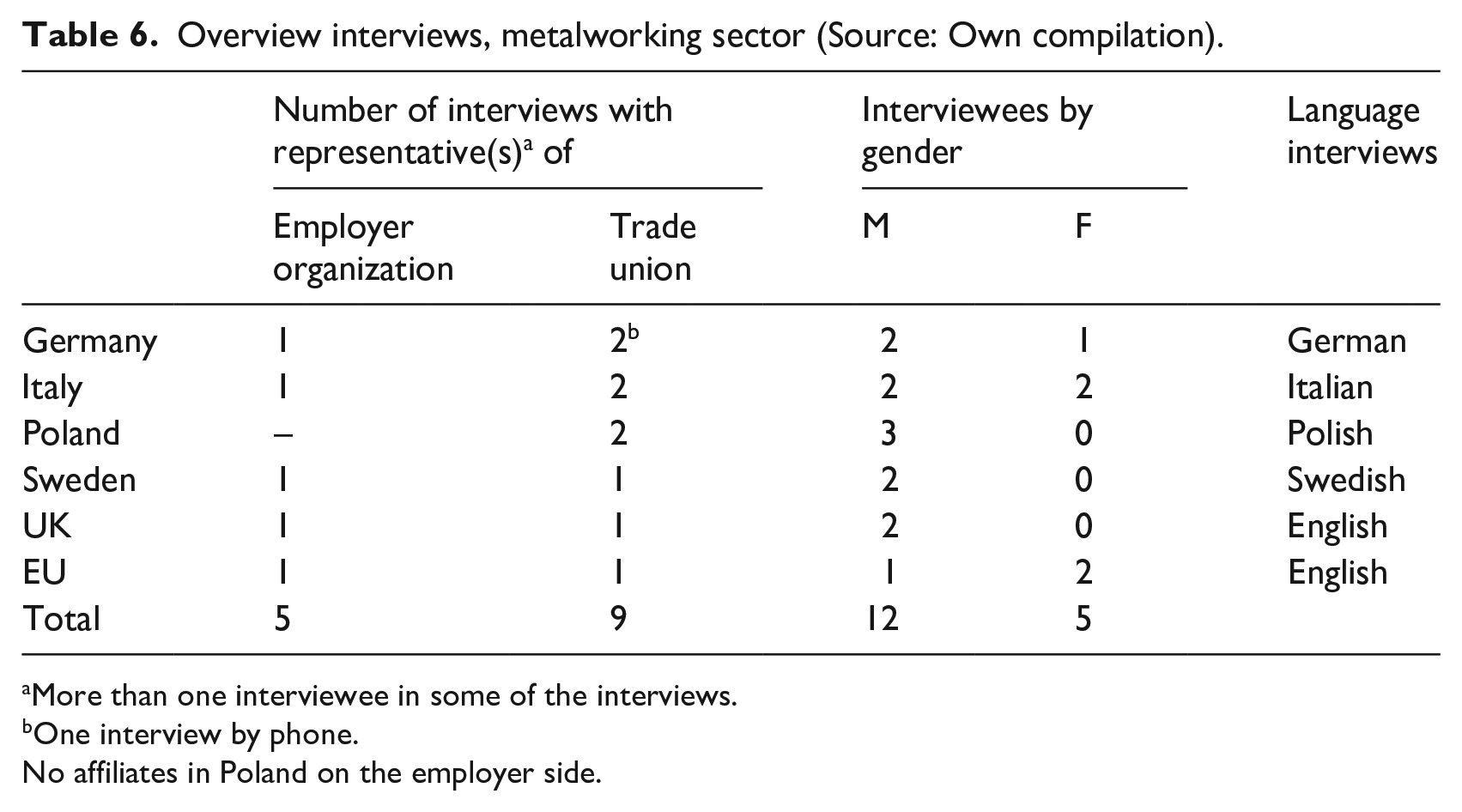
We adopt a cross-sector and cross-country approach (e.g. Katzenstein, 1987) to research the influence of organizational resources and individual capabilities on interaction among SSDC actors and how the interaction practices influence work programmes. The empirical evidence presented in the ‘Data analysis and interpretation: hospital and metalworking SSDC’ section is based on primary and secondary data sources. From December 2016 to January 2018, the authors conducted a total of 35 semi-structured interviews in the metalworking and hospital sectors with trade unions and employer organizations in five countries (Germany, Italy, Poland, Sweden and UK) and the EU-social partner organizations (cf. Appendix, Tables 5 and 6). In addition, data were collected by observing SSDC meetings and analysing the work programmes of both SSDCs. We applied qualitative content analysis (Mayring, 2004) to analyse the interview data and checks for reliability and validity were completed by comparing the interview data with the participant observations and document analysis. Our original empirical data were further complemented by data based on Eurofound’s studies on the representativeness of European sectoral social partner organizations (2009, 2010, 2018).
Work programmes in the hospital and metalworking SSDCs
Work programmes let SSDC actors know the purpose of meetings, the specific policies to be discussed and desired outcomes to be achieved in a specific time-period. Guidelines for the structure and formal characteristics of work programmes are set out by the European Commission (2015). Work programmes should include realistic topics, the timing of envisaged actions and the pursued outcomes taking into account the EU’s political and strategic orientation and the European Commission’s annual work programme (European Commission, 2015). The rules of procedures of SSDCs set out whether annual, biannual or multiannual work programmes should apply and the Commission supports one plenary meeting and a maximum of three working group meetings annually (European Commission, 2017). Although the European Commission is not directly involved in SSDCs, it facilitates dialogue by providing organizational, financial and policy support.
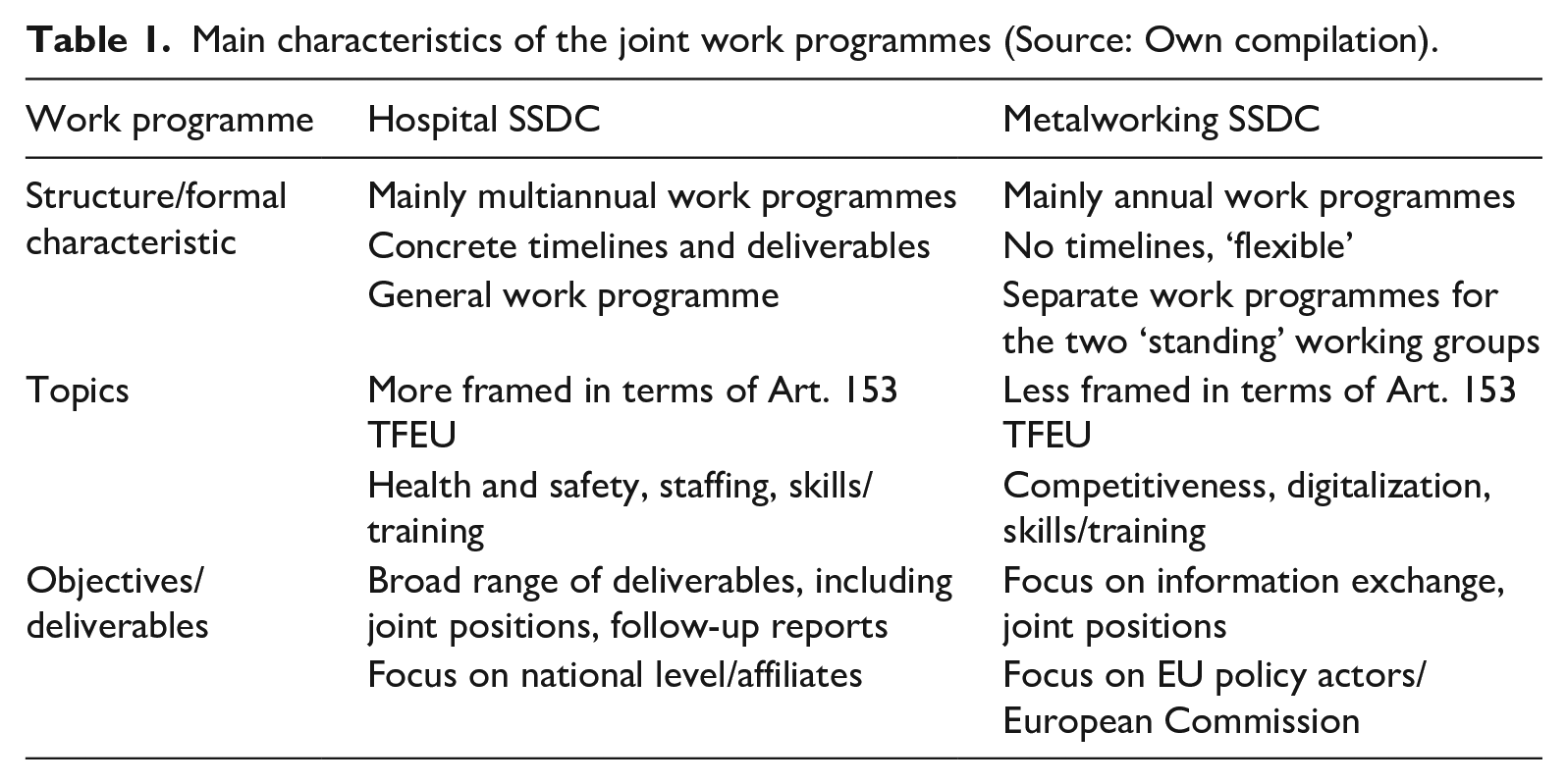
In accordance with the rules of procedure in the hospital SSDC, work programmes (cf. Supplementary Material for the work programmes analysed) are multiannual and based on policy issues jointly agreed by trade unions and employers. Furthermore, the work programme takes account of the different ways hospital and health care services are provided in the member states (EPSU and HOSPEEM, 2006). The work programmes should be regularly evaluated and updated and implemented in a flexible way to effectively respond to changing situations and policy agendas using ad hoc working groups (EPSU and HOSPEEM, 2006). Usually, the implementation of the work programme is carried out by SSDC actors in two working groups and one plenary meeting with the thematic focus of working groups changing in accordance with the work programme policies to be implemented. Since 2011, the work programmes have defined clear steps and a specific time frame for each of the actions envisaged. Therefore, we consider the design of the work programmes in hospitals as an example of good practice.
In the metalworking SSDC, the rules of procedure state that the SSDC will adopt the biannual work programme in the plenary meeting and implement it in a flexible way by establishing ad hoc working groups if felt necessary by CEEMET and EMF (since 2012 industriAll; CEEMET and EMF, 2008). Furthermore, the social partners will regularly review, evaluate and update their work programmes (CEEMET and EMF, 2008). In practice, however, the work programmes are mostly annual and in contrast to the hospital SSDC, the rules and procedures for the metalworking SSDC do not specify criteria for policy choices, specific timings for envisaged actions or the pursued outcomes. Instead the policies included in the work programmes correspond with the SSDC’s meeting structure. The implementation of the work programme is organized in two working groups (‘Education and Training’ and ‘Competitiveness and Employment’), with specific work programmes and one plenary meeting. The two working groups are of a rather permanent nature and deal with the same or similar topics over time. Consequently, the working group structure promotes interactions among a relatively small group of actors within, but not across, working groups. This is different to the hospital SSDC, where a clear thematic and functional differentiation between meetings and actors does not exist. The plenary meeting in particular in the metalworking sector can be regarded as a high-profile political forum where top-level social partner officers meet to decide on work programmes and policy responses to EU initiatives.
Key issues included in work programmes of the hospital SSDCs for many years have been recruitment and retention of the health workforce; continuous professional development and life-long learning; and occupational health and safety at work. Our interviews confirmed that these topics are considered the most important challenges social partners in the hospital sector face. Interviewees in the metalworking sector considered policies to strengthen the competitiveness of the sector, and address the impact of digitalization on the sector and vocational education and training to be most important. With the exception of the Polish, all interviewees confirmed that topics such as digitalization and skills and training are a high priority for their country. Topics of particular importance to the metalworking SSDC are EU industrial policies to promote competitiveness and economic growth. Another source for policy choices is Article 153 of the Treaty on the Functioning of the European Union (TFEU) promoting information and consultation rights, health and safety and equality in the workplace. Long-standing topics such as health and safety are tackled in both the metalworking and the hospital SSDCs together with more recent topics of migration and the integration of migrants into the labour market. Brexit and the future relationship between the EU and the UK, especially in terms of immigration and trade, were also mentioned in interviews, particularly in the UK hospital sector where interviewees referred to difficulties in recruiting and retaining EU health staff. Similarly, in the metalworking SSDC, interviewees from the UK and Germany referred to the major challenge of ensuring highly integrated metal industry supply-chains remain effective post-Brexit.
Up to 2018, the hospital SSDC has produced 14 joint texts and the metalworking SSDC 13 (European Commission, 2020). With regard to objectives or deliverables set out in the work programmes, there is seldom reference to the European Commission’s typology of texts, including agreements in accordance with Article 139(2), process-oriented texts and joint opinions and tools (Weber, 2010: 491). In the available work programmes, only joint statements are mentioned in both SSDCs although some references can be found when follow-up reports or evaluations of existing joint texts are tackled in the hospital SSDC. Overall, the hospital work programmes mention a broader range of other deliverables (e.g. reports), whereas the work programmes in the metalworking SSDC focus on exchange of opinions and the identification of areas of mutual interests to provide input to EU institutions and increase awareness among SSDC actors. The much more ‘flexible’ work programmes in the metalworking SSDC might allow for frequent short-term reaction towards EU policies, whereas the much more detailed and long-term work programmes in the hospital SSDC allow for developing more considered joint action over time. Accordingly, the texts produced by the metalworking SSDC (10 out of 13 texts are joint opinions or declarations, and there are no agreements, frameworks of action, guidelines, or follow-up reports, however two tools) indicate that their work programme policies and activities are to a great extent directed towards gaining access to EU policymakers and their attention. In contrast, the topics and deliverables included in the hospital SSDC work programme are more directed at the national level, national affiliates and long-term programmes. This is reflected in the texts produced (one agreement implemented by Council decision, one framework of actions, two guidelines, three follow-up reports and one tool).
The differences in work programmes are summarized in Table 1. In the next step, we investigate the actors involved, the interactions among SSDC actors and the role of EU-social partner organization officers in work programme setting.
Main characteristics of the joint work programmes (Source: Own compilation).
Organizational resources and individual capabilities of SSDC actors
Organizational resources (made) available for EU-level sectoral dialogue differ depending on the size of sectors and sectoral employment. SSDC actors from large countries represent a significant share of European sectoral employment and membership in EU-social partner organizations (Eurofound, 2009b, 2010, 2018). In 2015, the metalworking sector in Germany employed one-third of total sectoral employment in the EU, with France, Italy and the UK together representing a further third, and Central Eastern European countries approximately one-fourth. Sectoral employment in the hospital sector is highest in larger countries, with France, Germany and the UK accounting for two-thirds of total sectoral employment in the EU (cf. Tables 3 and 4 in the Appendix). According to the interviewees, SSDC actors from Germany and the UK are sufficiently resourced to participate in both working group meetings and the plenary meeting. Nordic countries like Sweden pool resources regionally in order to represent their members in SSDCs, while social partners in Italy and Poland report problems in making adequate levels of financial and human resources available for participation. In the hospital sector, the two Italian trade unions (out of 19 unions) affiliated to EPSU employ a rota system to allow for more flexibility with SSDC participation and cost saving. During the period of our study, no trade union in Poland was affiliated to EPSU due to resource constraints.
Tables 3 and 4 in the Appendix show that not all national sectoral social partner organizations are affiliated to EU-social partner organizations, with employer organizations even less likely to be affiliated, and that not all SSDC actors actively and frequently participate in SSDCs. Generally, resourceful actors from countries representing a significant share of sectoral employment are affiliated to EU-social partner organizations and do participate in SSDCs. In contrast, actors from countries representing a low proportion of relative sectoral employment are missing because they either are not affiliated to EU-social partner organizations (e.g. employer organizations) or are absent from meetings in Brussels (e.g. trade unions). According to our data, trade unions in the hospital sector participate more in SSDCs than those in the metalworking sector, but on the employer side there are no significant differences (Eurofound, 2009b, 2010, 2018). Interviewees also highlighted the importance of both trade unions and employer organizations from one country participating in SSDCs since this facilitated joint discussions and a commitment to follow-up on policies at the national level. In both sectors, no Polish employer organizations are affiliated to EU-social partner organizations. The absence of a national counterpart in social dialogue is another possible factor explaining disengagement in SSDCs (e.g. Poland).
Our analysis revealed that persons representing social partner organizations in SSDCs differ in their individual capability and with regard to their functional role and influence inside their organization. Interviewees drew attention to the fact that not all SSDC actors are equipped with a mandate or are ‘senior’ enough to take decisions in the SSDC. Based on our interview data, social partner representatives are, for example, trade union/employer organization officers who are in some cases involved in sectoral bargaining at the national level, international officers responsible for the representation of an organization at the European level in several sectors, or experts on specific issues within an organization (e.g. health and safety experts). Depending on their role, they more or less frequently participate in SSDC meetings and differ in their capacity to influence policy choices. Both working group and plenary meetings represent formal opportunities to interact and to build relationships with SSDC actors from different countries. Trade union/employer organization officers and international officers tend to participate in both working group and plenary meetings, while experts usually join working group meetings on specific topics. Well-resourced social partner organizations are often able to utilize the knowledge and experience of multiple actors by sending their officers and experts to meetings to further the interests of their members. Different to the hospital SSDC, the plenary meeting of the metalworking SSDC is more ‘political’ insofar as senior officials represent participating organizations. However, as the representation varies across meetings, interactions and relationship building among the SSDC actors are undermined.
The ability to effectively understand and communicate in the English language is another factor identified as important for interaction in SSDCs (Eurofound, 2007). Lack of sufficient language skills were more frequently reported for trade union officers than international officers and experts participating in SSDCs. To overcome language barriers, the European Commission provides interpreter services to enable engagement in SSDCs. Language is less of a barrier for participation in northern European countries than in southern European and Central Eastern European countries. This factor may be explained by the practice of organizations in these countries to send senior officers who may not speak English to European-level meetings. Continuity of participation and overcoming language barriers are prerequisites for SSDC actors to become familiar at first hand with distinct foreign industrial relations systems (Gollbach and Schulten, 2000). Interviewees emphasized the importance of these factors for interaction and to establish relationships among actors. Overall, variations in the capabilities of SSDC actors are explained by their role within an organization, frequency of participation, knowledge about foreign industrial relations and dialogue styles and ability to communicate in English.
Core actors are SSDC actors representing a significant share of European sectoral employment that are also well-resourced allowing them to frequently participate in SSDCs. They contribute with their resources to the work of SSDCs by preparing sector/industry reports, writing up reports in English, conducting surveys, and sharing expertise and examples of good practice (e.g. Germany, Sweden and the UK). Core actors usually hold representative functions in EU-social partner organizations. Such functions ensure greater influence through privileged access to information and involvement in the selection of policies for work programmes. Trade union interviewees in particular referred to Germany, the UK and Scandinavia as influential in steering the debate. On the employer side in the metalworking sector, SSDC actors, such as France, Germany, Italy and the UK were seen as vital in setting work programmes for social dialogue. Our interviews highlight that core actors more likely get noticed in meetings than actors at the ‘periphery of committees’ (Eurofound, 2009a: 48).
Generally, actors who cannot afford or prefer not to be actively engaged in working group and plenary meetings participate via the respective EU-social partner officer. This form of indirect participation in SSDCs is based on interactions between EU-social partner officers and the actors at the national level. The EU-social partner officers act as a bridge between the SSDC and national level to facilitate and coordinate interactions between the core groups and less well integrated members.
Interactions among actors in work programme setting
Hospital SSDC
Based on our analysis, SSDC actors are involved to different degrees and at different stages of the work programme setting process. The core actors identified in the ‘Organizational resources and individual capabilities of SSDC actors’ section are usually involved in the work programme setting process. Generally, members of the core group are the core SSDC actors who hold representative functions in EPSU and HOSPEEM. Strong relationships among these actors are the result of frequent interactions that provide them with information about others’ preferences and trustworthiness. To be trusted, SSDC actors are expected to share relevant information openly and engage in good faith in the work programme setting process. Interviewees highlighted that problem-solving is the ultimate aim of interactions among core actors with trust built up in core actors from their history in matching support for an issue debated in the SSDC by also promoting and implementing it at the national level. While core actors play an active role in defining work programme items, the EU-social partner officer is the person who represents the EU-social partner organization in this process and governs the interactions between different actors (both between national SSDC actors and EU-social partner organizations) to reach consensus on the work programme.
EU-social partner officers act as a bridge between the national and the EU level by integrating SSDC actors not directly involved or rather loosely connected to the SSDC. They integrate members at the national level by exchanging information and gathering their views. We find evidence of intensive interactions between the EU-social partner officers and loosely connected SSDC actors aimed at integrating all potential actors into the work programme setting process. The ability of national SSDC actors to cooperate in the absence of strong relationships is explained by their trust in the EU-social partner organization. As a result of the input by all SSDC actors, the draft work programme will be revised and in the next step debated between the EU-social partner officers (i.e. between EPSU and HOSPEEM) to identify and prioritize policies to end up with a viable work programme. Usually, EPSU and HOSPEEM separately develop a (draft) work programme prepared by a core group. The joint work programme proposal will then be debated in SSDC meetings and adjusted until consensus is reached among all SSDC actors. The decision on the final work programme is usually taken in the plenary meeting. Interviewees mentioned that it is necessary to seek general approval from the European Commission, as the provider of relevant funding and infrastructure to implement the work programme.
Strong relationships between a cohesive group of core SSDC actors characterized by frequent interactions and trust between actors allow them to pursue shared goals (Coleman, 1988). To ensure access to information and interaction between strong and loosely integrated actors, EU-social partner officers provide a bridge across otherwise divided SSDC actors. We conclude from our data that this bridging interaction should be seen as a potential resource of EU-social partner officers that they can capitalize on to integrate all SSDC actors into the work programme setting process (Patulny and Svendsen, 2007). By integrating all actors into work programme setting, EU-social partner officers limit core actors in their ability to use their relationships to determine work programmes. However, despite EU-social partner officers’ bridging efforts in the hospital SSDC, actors in Italy and Poland often see work programmes as either not reflecting national needs or being too ambitious.
Metalworking SSDC
For the metalworking SSDC, the core actors, which are the most represented on the executive committees of the EU-social partner organizations, select the work programme topics and the EU-social partner officers coordinate the work programme setting process. Their role in this process includes frequent interactions and exchange between themselves and core members of their organizations (industriAll and CEEMET). Data collected in interviews indicate that individual actors play a greater role in the metalworking, than in the hospital SSDC. German SSDC actors play an essential role, not only representing the country with the largest share in EU employment in this sector, but also accounting for the largest proportion of membership in industriAll and CEEMET. According to interviewees, SSDC actors can be grouped according to their economic and political weight, with the Nordic countries – according to our interviewees – placed below the four ‘heavy weights’: Germany, France, Italy and the UK. In the metalworking sector, frequency of interactions depends upon the economic and political weight of SSDC actors acting as a signal for the influence of relationships on policy choices (Burt, 2000).
Generally, the work programme setting process is initiated by the executive committees of industriAll and CEEMET. On the trade unions side, the choice of topics is coordinated by interactions and exchange of information between the industriAll officer and, as reported in interviews, unions in large, economically important countries or representing major employers in Europe. On the employers’ side, the CEEMET officer consults with core actors and individual businesses at an early stage of the work programme setting process to ensure that no issue is included that might be problematic for members. Thus, interactions about preferred work programme objectives occur mainly between a small cohesive group characterized by comparatively homogeneous interests and control over resources and the EU-social partner officer. Although strong ties among cohesive SSDC actors are associated with stability, they are a source of rigidity that suppresses interactions with actors outside this network (Burt, 2000). Regarding work programme deliverables, interviewees stated that generally the interest of the employers, but especially those in Sweden and the UK, is to prevent regulatory frameworks in work programmes they neither want nor are able to implement at the national level. Final decision-making on work programmes is delegated to the executive committee of industriAll and CEEMET and is usually rubberstamped by SSDC actors in the plenary meeting.
The analysis of work programme setting in the hospital and metalworking sector reveals different interaction patterns used by SSDC actors to leverage their resources. In the metalworking SSDC, small cohesive groups are more effective in forming close networks and determining work programmes. SSDC actors with common interests create ‘power’ relationships that reinforce the existing influence of prominent actors in the setting of the work programme (Olson, 1965). In contrast, work programme setting in the hospital SSDC is more inclusive when EU-social partner officers build bridges that span otherwise separate SSDC actors or groups. Overall, work programme setting represents an initial crucial veto point (Immergut, 1992) where SSDC actors exercise their power, either to support policy topics or to prevent policies from being tackled in SSDCs (Peters, 1994).
Conclusion
We use an actor-centred approach to investigate how organizational resources and individual capabilities influence actors’ capacity to interact in the hospital and metalworking SSDC. Our data suggest that SSDC actors are constrained in their actions by organizational resources and individual capabilities. First, core actors represent a significant share of sectoral employment, and are sufficiently well-resourced to frequently participate in SSDCs. They often hold representative functions in EU-social partner organizations, providing them with information that promotes action and interaction in the work programme setting. Second, there is evidence that organizational resources and individual capabilities influence actors’ capacity to interact in SSDCs and their interaction practices. Frequent interactions between SSDC actors can facilitate cooperation but strong relationships among core actors can constrain interactions with non-core actors. In the metalworking SSDC strong relationships exist within a small group of core actors which can trigger exclusion from decision-making in the absence of interactions between groups. Third, the study highlights the importance of EU-social partner officers in coordinating interactions between groups of SSDC actors where they can act as brokers by providing a ‘bridge’ across otherwise divided or loosely integrated SSDC actors. Our study uncovers extensive bridging interactions in the hospital SSDC but this form of action is less developed in the metalworking SSDC.
Furthermore, the policies included in work programmes differ between the hospital and metalworking SSDC. In the hospital sector, they reflect issues which are on the national agendas of social partner organizations (e.g. health and safety policies) and the texts produced include guidelines and obligations that demand national level follow-up and commitment. For example in 2009, SSDC actors produced a framework agreement on the prevention from sharp injuries that has been transformed into a legally binding EU directive in 2010 (Degryse and Pochet, 2011; Tricart, 2019). In contrast, an important objective of work programme setting in the metalworking SSDC is awareness-raising among SSDC actors about sectoral (EU) policy priorities. The topics addressed in work programmes in metalworking are aimed at securing global industrial competitiveness, for example, digitalization and skills for successful digital transformation, and are directed towards the European Commission to influence policy making. The texts produced in metalworking are thus of a rather non-binding character that do not give rise to obligations at the national level.
Differences in the policies included in work programmes in the hospital and metalworking SSDCs are reflected in the different forms of interactions among SSDC actors. We find interactions between individual actors to be of greater relevance in the metalworking SSDC compared to the hospital SSDC where collective interactions among actors coordinated by the EU-social partner officers are of greater relevance. In the metalworking SSDC, debates on work programmes occur mainly at the EU level among core SSDC actors, while interactions in the hospital SSDC are extended to actors rather loosely integrated into SSDCs. The absence of EU-social partner officers’ bridging efforts, even more so in combination with strong relationships among core SSDC actors, creates risks that can lead to the dominance of a few actors. The more collective interaction practices in the hospital SSDC support the inclusion of many actors and the identification of policy choices that are relevant and actionable to social partners. Such an inclusive approach may facilitate collaboration and consensus on texts that demand follow-up and commitment at the national level. The benefit of the interaction practices in the metalworking SSDCs is in providing actors with access to a targeted audience to raise awareness about sectoral priorities.
British trade unions and employer organizations represent a significant share in sectoral employment in the EU and are core actors in the hospital and metalworking SSDCs. Despite the UK leaving the EU, British social partners will remain members of European social partner organizations and continue to serve on executive committees, boards and participate in committees and networks. They remain engaged at the EU level to sustain the commitments in the trade agreement and to address transnational challenges in partnership with European social partner organizations.
Supplemental Material
sj-pdf-1-ejd-10.1177_09596801211000012 – Supplemental material for Opening the black box: Actors and interactions shaping European sectoral social dialogue
Supplemental material, sj-pdf-1-ejd-10.1177_09596801211000012 for Opening the black box: Actors and interactions shaping European sectoral social dialogue by Barbara Bechter, Sabrina Weber, Manuela Galetto, Bengt Larsson and Thomas Prosser in European Journal of Industrial Relations
Footnotes
Appendix
Overview interviews, metalworking sector (Source: Own compilation).
| Number of interviews with representative(s) a of | Interviewees by gender | Language interviews | |||
|---|---|---|---|---|---|
| Employer organization | Trade union | M | F | ||
| Germany | 1 | 2 b | 2 | 1 | German |
| Italy | 1 | 2 | 2 | 2 | Italian |
| Poland | – | 2 | 3 | 0 | Polish |
| Sweden | 1 | 1 | 2 | 0 | Swedish |
| UK | 1 | 1 | 2 | 0 | English |
| EU | 1 | 1 | 1 | 2 | English |
| Total | 5 | 9 | 12 | 5 | |
More than one interviewee in some of the interviews.
One interview by phone.
No affiliates in Poland on the employer side.
Acknowledgements
The authors would like to thank the anonymous reviewers and the editor for their valuable comments and advice. They are deeply indebted to their interviewees for their time and valuable insights.
Funding
The authors disclosed receipt of the following financial support for the research, authorship, and/or publication of this article: This research received funding from the European Commission, DG Employment, Social Affairs and Inclusion (Improving expertise in the field of industrial relations; Project VP/2016/0092).

Supplemental material
Supplemental material for this article is available online.
Author biographies
References
Supplementary Material
Please find the following supplemental material available below.
For Open Access articles published under a Creative Commons License, all supplemental material carries the same license as the article it is associated with.
For non-Open Access articles published, all supplemental material carries a non-exclusive license, and permission requests for re-use of supplemental material or any part of supplemental material shall be sent directly to the copyright owner as specified in the copyright notice associated with the article.
