




Abstract
Few contemporary studies of change in industrial relations use Carter Goodrich’s classic concept of the ‘frontier of control’ (FoC), especially in cross-national comparative research. Our study maps FoC struggles in two public transport organizations in the UK and the Republic of Ireland. Qualitative methods generate significant insights into complex day-to-day workplace control patterns in these two cases. Despite changes in the frontier of control in both organizations over time, it is observed that employment relations in the Irish case are more cooperative than in the British. The frontier of control still matters, because workplace control regimes shape managerial ability to secure worker consent and are always potentially contestable terrains.
Introduction
The classic concept of the ‘frontier of control’ (FoC) explored by Carter Goodrich in 1920 remains highly relevant for industrial relations today. Goodrich analysed whether management or workers (unions) controlled details of work organization at the point of production/service delivery. His study framed workplace struggle over day-to-day workplace practices (discipline, recruitment, work allocation) as a fluid and imprecise borderline between worker autonomy and managerial authority (Goodrich, 1920). The FoC is inherent in all employment relationships because of labour power indeterminacy, ‘structured antagonism’ (Edwards, 1986, 2018) and manager–worker conflicts over workplace control. However, it is likely to be more visible and explicit in some contexts, such as when workers are collectively organized and unionized, than others.
Many contemporary studies of industrial relations and the labour process (such as Cooke, 2006; Geary and Dobbins, 2001; Jenkins et al., 2010; Mulholland, 2004) use the FoC implicitly by examining workplace control, conflict and resistance, but without directly referring to the concept. There are exceptions (Brown et al., 2005; Clark and Thompson, 2014; Taylor and Bain, 2001; Taylor and Moore, 2015), but few contemporary empirical studies explicitly apply the FoC to map how different elements such as recruitment or discipline are negotiated daily in employment relationships.
In proposing explicit use of the concept, we offer three contributions. First, we map the FoC in the day-to-day negotiated order of the effort bargain at a rail company in the UK and a bus company in the Republic of Ireland. Second, we uncover external contextual forces less salient in classic FoC studies. Specifically, the cases suggest that widespread public sector marketization has not resolved FoC struggles or the problem of managerial negotiation of order over the effort bargain. Third, we compare FoC struggles in public sector urban transport in two European countries, since cross-country comparative research reveals how local and national contextual differences and similarities shape FoC struggles.
The research question is: how do FoC struggles unfold in the British and Irish public transport sectors? Below, we present a brief review of implicit and more explicit FoC studies and identify three broad themes to structure the case findings. We then introduce the cases, their country-contexts and methods. Next, we map the FoC in the two countries under six more specific themes relating to the negotiation of workplace order: collective control, discipline, work/scheduling, recruitment, managerial change and marketization. Finally, we summarize the implications and how the FoC can be used in future research.
Frontier of control research
Classic FoC studies
Employment relationships embed ‘deep unrest’ (Goodrich, 1920), or ‘structured antagonism’ (Edwards, 1986, 2018) because of contradictions between worker and employer control preferences, together with mutual dependence for survival. Classic empirical studies of the FoC stem from the highly influential study of UK workplace struggles, predominantly in factories and mines, by Goodrich (1920). Subsequently, Edwards and Scullion (1982) studied the FoC in seven UK factories. One prevalent theme arising from such classic studies is how multiple internal and external contextual conditions shape whether observable conflict surfaces. FoC struggles have ‘relative autonomy’ (Edwards, 1986) from external forces distant from immediate production or service delivery points. External forces partly shape workplace struggles, but their influence varies by context and internal factors. For example, Edwards and Scullion (1982) trace different conflict–cooperation patterns, although some factories operated in similar product markets, locations and the same firms.
A second interlinking key theme in classic FoC studies is potential worker resistance. Hyman (1975) argues that the FoC concept encourages a collective workers’ movement towards more humane working conditions by emphasizing the necessity and feasibility of effective organization and worker agency. He notes that historically, workers’ control struggles (in the UK context) have typically been reactive, to defend specific material interests, rather than pursuing industrial democracy as an end in itself. Batstone (1988) identifies contextual factors shaping collective worker control, for example, union capacity to enforce collective sanctions on employers and worker positioning at the point of production or service delivery.
A third central theme in classic FoC studies is ‘detailed’ workplace control – whether management or workers control specific details of work organization (Edwards, 1986, 2018; Goodrich, 1920; Hyman, 1975, 1987). Conversely, higher-level ‘general’ control signals whether employees generally accept capitalist authority and are committed to broader organizational objectives, notably surplus value creation. Managers seeking enhanced general control may implement more subtle, less obvious, control strategies and devolve to workers some autonomy over immediate work tasks where this serves broader productive ends (Edwards, 1986, 2018). This echoes Friedman’s notion (1977) of ‘responsible autonomy’ control strategies, which ‘soften’ or obscure exploitative capital–labour relations by deploying fewer obvious direct managerial control mechanisms and conceding somewhat greater employee discretion at task level.
Goodrich (1920) and Edwards and Scullion (1982) mainly examine detailed worker control over discipline, recruitment, work allocation, overtime and promotion. In unionized workplaces, detailed control may be subject to joint regulation through collective agreements or joint consultation over management of change (Batstone, 1988). Indeed, Goodrich (1920: 186) emphasized that collective worker (union) control over the frontier could most influentially encompass bargaining and joint consultation over management of work organization and production: ‘Bargaining over the conditions of change is far more important in the present labor situation than a mere opposition to change’.
Contemporary FoC studies
Contemporary empirical studies referring explicitly to the FoC concept are rare, and examine single countries only. They explore the broad themes evident in classic studies: internal and external contextual forces, potential worker resistance and detailed control. Brown et al. (2005) examine how ‘networked’ organizational structures and virtual teams shaped the FoC in an Australian government department. Clark and Thompson (2014) identify a shift towards management control; in a National Health Service (NHS) trust, but health care assistant resistance (mainly absence) persisted. Taylor and Bain (2001), in an influential study of call centres, analyse how unions challenged managerial frontiers of control, shaped by intensified financial sector competition and subsequent work intensification. Taylor and Moore (2015) demonstrate how unionized British Airways employees defended their FoC from managerial incursions. Campbell and Haiven (2012) briefly refer to the ‘frontier of professional control’ and outline three specific union disputes in Canada.
Various contemporary studies analysing workplace control, conflict and resistance, apply the FoC concept more implicitly. Cooke (2006) focusses on three NHS trusts where managers distant from wards applied ‘seagull management’, through work intensification and tightened control. Examining the Irish subsidiary of a US pharmaceutical company, Geary and Dobbins (2001) find that teamwork enhanced workers’ autonomy somewhat, but work intensification constrained employee empowerment. Mulholland (2004) unpicks conflict and collective worker resistance in an Irish call centre. Jenkins et al. (2010) study a call centre where normative controls, the negotiated nature of emotional management, and somewhat greater worker discretion, stimulated higher employee satisfaction.
Although contemporary studies analyse comprehensively the nature of work and control, more empirical studies are nevertheless required that explicitly conceptualize and map daily struggles over FoC elements affecting the ‘negotiation of order’ (Strauss, 1978). By empirically mapping the FoC in British and Irish urban public transport, our research offers cross-country comparative insights into day-to-day effort bargain negotiations. The next section introduces the cases, their contexts and data collection methods.
Case context and methods
Context
Our research addresses a need for more comparative methodologies to enhance generalization in workplace control studies (Burawoy, 2013; Hyman, 2001). Although analysing only two organizations, our study may be complemented by future comparative FoC research. To maintain confidentially, pseudonyms are used for organizations and respondents. Our British case, ‘RailCo’ employs around 17,500 employees. The main unions in the sector are the ‘all-grades’ RMT, the drivers’ union ASLEF and TSSA for white-collar staff and other transport workers. In the Irish case, ‘BusCo’ has around 3500 employees. The main unions in the sector are the general union SIPTU, the transport union NBRU, the British-based general union Unite and TSSA. RailCo train drivers and BusCo bus drivers are the main focus of our study, but interviews with other grades were crucial for comparing how grade tensions and power imbalances constrain FoC struggles.
The cases provide additional insights to studies of FoC struggles in more contemporary industries, including call centres, airlines and healthcare, by focussing on more traditional ‘blue-collar’ and male-dominated work. The cases are also important because FoC struggles tend to be more observable in unionized contexts (Batstone, 1988), and public transport drivers potentially possess greater collective power given their position at the point of service delivery (influencing whether or not transport services operate). Furthermore, we study public sector organizations in two countries where private sector competitiveness and performance principles have been pursued; entailing the encroachment of marketization (Mori, 2017) and new public management (NPM).
Offering quite well-paid, secure and unionized employment relationships in countries which display increased non-standard, often non-union, contracts (O’Sullivan et al., 2017), BusCo and RailCo are still arguably relatively attractive potential employers. However, standard employment relationships affected by marketization still involve structural power imbalances and negative worker experiences, thus examining control patterns in these settings remains pertinent (Findlay and Thompson, 2017). Although analysing identical occupations would enable closer comparison, analysing two analogous occupations reveals how job differences can shape control patterns.
Country contexts are important. In 1987, Ireland took a less adversarial path compared to Thatcher’s confrontational neo-liberal revolution in Britain, adopting a more consensual ‘social partnership’ model (Regan, 2017). Whether Irish social partnership granted real employee/union influence, notably at workplace level, is debated (Bach and Stroleny, 2013; Dobbins and Dundon, 2016; Doherty, 2011; Hickland and Dundon, 2016). Nonetheless, it was softer and more pluralistic than Thatcher’s assault on union power in the 1980s. Yet, in the aftermath of the 2008 financial crisis, imposition of austerity and public sector cutbacks culminated in the collapse of Irish social partnership in 2009, with some centre-right politicians even blaming it for Ireland’s economic ills (a convenient scapegoat perhaps to obscure the origins of the crisis in a bloated and poorly regulated financial sector, whose bubble eventually burst). Social partnership thus became a maligned brand (Doherty, 2011). Union power and coverage in Ireland at workplace and national levels have been declining (Dobbins and Dundon, 2016), and no statutory rights to trade union recognition or collective bargaining exists to enhance institutional support (Dobbins et al., 2020). However, Irish union power is still arguably more robust than Britain, where Thatcher’s legacy was reinforced by the draconian Trade Union Act (2016), further constraining union activity.
Methods
Data collection comprised semi-structured interviews, ethnographic non-participant observation and documents (union newsletters and collective agreements). Interviews took place at RailCo between August and December 2016 and at BusCo between January and August 2017. After securing access to initial respondents, a non-probability snowball approach was applied where interviewees (acting as gatekeepers) suggested other potential respondents. At RailCo, we interviewed 13 current or former managers, 13 union officials or executive members, 26 workplace union representatives and 12 lay members; at BusCo, 10 managers, 8 union officials or executive members, 31 workplace union representatives and 20 lay members.
Supplementary ethnographic diary notes revealed unarticulated features and furnished deeper understanding of ‘messy realities’ regarding workplace control (Burawoy, 2013; Law, 2004). RailCo observations provided comparative insights into the activities of station staff and drivers, thereby indicating potential disruptive power and customer interaction levels. Potential isolation from colleagues, depot culture and driver interaction were revealed in informal discussions and union meetings.
Visiting ‘union clinics’ in seven BusCo garages offered rich ethnographic data about workplace cultures (including union relations) and representative, driver and manager daily interactions. Workplace/company and individual issues arising were revealed during garage visits, as well as by attending union meetings. Ethnography also involved observing drivers on different routes, garnering useful comparative insights into job demands, potential disruptive power and passenger interaction.
Data were interpreted through cross-country comparative realist thematic analysis (Sayer, 1992). Potential intermeshing contextual forces shaping comparative FoC dynamics were identified. Finally, empirical insights were organized under six interconnecting contextual themes, relating to the broad focus of existing FoC studies on internal and external contextual forces, potential for worker resistance and direct control over work organization at the point of service delivery.
Findings
We now map struggles over the FoC in each case under six specific overlapping themes shaping the negotiation of order around the effort bargain: collective control, discipline, work allocation and scheduling, recruitment, managerial change and marketization.
Collective control
Unions negotiate with RailCo and BusCo managers over changes to working conditions and have established numerous collective agreements (e.g. over discipline, recruitment and work allocation policies). Notwithstanding, in recent years, the FoC has shifted from unions towards management in both cases, but more so at RailCo. Its workplace regime often seems a hotbed of generalized discontent, and union disputes are common. Strike action is prevented sometimes, but negotiations often collapse in a prevailing climate of mistrust: ‘policies are often introduced without meaningful union consultation and existing collective agreements are breached, or applied without considering context’ (union representative).
While clashes often occur between BusCo managers and representatives, bargained compromise or union participation in joint consultation over workplace change is more prevalent than at RailCo. Strike action materializes periodically, but less often than at RailCo. In both cases, multi-union rivalry aids managerial control. Power imbalances between RailCo drivers and station staff exacerbate matters: ‘managing drivers is always harder than station staff because they have more power to say I’m not doing this, which has such an impact’ (train manager).
Drivers are the most powerful RailCo grade because trains need drivers to run and drivers develop specialist skills/knowledge that cannot be replaced during strikes. Therefore, drivers can still wield considerable power at the point of service delivery. In contrast, stations can still function with lower staffing numbers (subject to a minimum) and office staff sometimes replace striking station staff: the parent organization ‘have been very successful in training people throughout RailCo to do basic jobs, loads of people can be station workers’ (former senior manager).
Observing train drivers spending most of their shift alone in small cabs illuminated potential driver isolation. However, a train manager stated: Drivers are by far the most tribal workers. The job by nature makes them stick together. They’re alone in a cab, 4 hours a time. You hear a lot of ‘me and my train’, ‘what you did to my train’. There’s strong sense of ownership because it’s only them and this frigging train and the only people understanding what they go through are drivers.
RMT appears more strike-prone than the majority driver union ASLEF. Unions sometimes strike together, but more often separately. A union representative explained why this is problematic: Say one union organizes action, drivers can avoid striking by transferring unions, limiting worker power. For example, if we organize all-grade strike action, but some drivers perceive the dispute as an exclusive station staff issue they can transfer.
BusCo union rivalry, observed during garage visits and union meetings, varies by garage, but is arguably more intense day-to-day than at RailCo. A noteworthy difference is that NBRU stems from a breakaway from SIPTU in 1963, and driver membership in both unions is almost equal, while RMT–ASLEF membership ratios among drivers are approximately 40:60. However, during disputes, BusCo unions have a potential power advantage by generally striking together. Furthermore, BusCo does not employ ‘station staff’, thus grade tensions are less evident. While SIPTU represents clerical workers whose service delivery position is arguably less powerful than RailCo station staff, very few all-grade issues arise; pay being a rare example.
Discipline
Managerial application of discipline has become firmer in both cases, but more so at RailCo, despite variation in managerial strategies. For instance, a train manager described her ‘off the record’ custom and practice: I tell representatives, we can talk about this off the record, see if we can help this person, or stop it exploding and creating lots of unnecessary work. I might say, that member swore at me, if you have a word we’ll keep it off the record.
This specific depot includes more than ten managers applying variable styles. One driver referred to another manager who regularly punishes drivers and ensures that managers enforce her planned punishments when she is away.
RailCo employees discussed how even more lenient managers now feel obliged to apply significantly harder disciplinary stances on attendance and punctuality. Workers explained how normally punctual colleagues are now ‘booked’ for occasional lateness. A union representative outlined how a driver was issued a disciplinary warning after an ‘accident on the way to work’ when the manager could have applied the ‘accident at work’ procedure and discounted it from attendance policies. Strikes have been organized over breaches of the attendance collective agreement. Despite firmer RailCo discipline, drivers creatively resist disciplinary enforcement. One driver reported that: a driver came into the depot unable to wear shoes that day, he wore white trainers and was sent home. The following day, all drivers in the depot wore white trainers, they weren’t going to send everyone home were they?
At BusCo, a senior manager observed: ‘there has to be flexibility. Not you scratch my back and I’ll scratch yours, but there must be a little bit of leeway between managers and representatives’. Yet he admitted differences in garage-level management styles: Some managers play ball with representatives and some don’t, the guy is guilty and would be straight against him. Whereas another manager would say, this guy is guilty but we’ll give him another chance. So it’s really down to management styles, everybody has a rule book to follow, but they’re only guidelines. Some stick rigidly to them, others don’t.
This senior manager overturns garage manager decisions he perceives unfair (example below), despite manager backlash: I’ve had a letter from SIPTU, we’ve got an Attendance Control Programme and once you go over 12 days absence in a year, you’re put in it. This manager put in a woman, she had just gone over it with 13 days, but 5 of those were attributed to an accident.
Despite variations in managerial style, reciprocal and informal relations seem comparatively more ingrained at BusCo than RailCo. For example, one garage manager enforces attendance control policies for scattered absences, not illnesses or injuries, but evokes her knowledge of individual driver circumstances to manage attendance and decide whether to discipline drivers. Furthermore, a driver displayed the ‘out of service’ scroll without contacting the controller: a potentially sackable offence. The garage manager and representative highlighted the severity of the issue in a meeting with the driver, but discretion was applied because the driver was relatively new and had not committed the offence previously. Furthermore, in contrast to tougher RailCo punctuality stances, a BusCo garage manager stated: ‘we recently had a driver late bringing the bus back for the next driver. He was so apologetic. We were worried that something had happened to him because he’s like a watch. I wouldn’t discipline him for that, he’s never late’.
Disciplinary issues vary between cases. For instance, discipline can be enforced over accidents, which are more common at BusCo than RailCo, where trains have standalone tracks. A collective agreement prevents BusCo managers from explicitly using bus CCTV against drivers, but some representatives claimed that managers use the footage to frame their questions during meetings with drivers. RailCo union disputes over driver dismissal and breaches of the collective discipline agreement are common, whereas a BusCo union representative claimed that ‘it’s very difficult to get sacked here’. However, RailCo drivers are often reinstated following strikes, strike threats or employment tribunals.
Work allocation and scheduling
One consequence of tighter managerial control at RailCo is that drivers feel managers are much more reluctant to help them now even when they would reciprocate favours (informal ‘give-and-take’). One example mentioned was permitting a day off at short notice. Employees explained how greater reciprocity would benefit everyone because RailCo’s fragile network requires employee cooperation. If no ‘rostered vacancy’ exists when RailCo drivers are recruited, they become ‘pool’ drivers and are allocated shifts on a weekly basis, until a rostered position becomes available. Drivers following a roster know their shifts and rest days months ahead. Drivers who are part of an informal shift ‘syndicate’ can secure some detailed control over working patterns: Rather than every driver wanting to swap duties, the syndicate man asks what we want, earlies, lates, middles and then swaps them to suit. We can also request particular days off. All depots I know have one, but some operate by different rules. (Union representative)
RailCo’s syndicate policy, agreed by managers and unions, benefits both parties. Managers are freed from coordinating constant shift swaps. Moreover, one representative explained that in his depot where worker–manager relations are hostile, the syndicate man sometimes asks drivers for short-notice shift amendments (e.g. because of staff-shortages) in return for future favours. However, RailCo syndicates have drawbacks, including waiting lists (based on seniority), less notice of exact shift patterns, no guarantees of being able to change shifts and one representative referred to alleged favouritism in some depots. Some have fixed-link systems instead, where drivers apply for their preferred link of shifts (waiting lists based on seniority apply). However, several respondents argued that fixed-links give managers more flexibility than syndicates and provide less driver control over shifts.
Informally accommodating driver requests seems more prevalent at BusCo. For example, observation illustrated a manager noting in her diary that a driver needed additional time off during a busy period because of his wife’s pregnancy. A garage representative referred to a manager accommodating a driver unable to work particular shifts for personal reasons. Another manager agreed to try and adjust a driver’s shift, but only after discussing poor attendance. Ethnography also illustrated managers refusing requests; for example, a day off the following day, but the representative and employee accepted the explanation that cover was unavailable. A garage manager explained that when he started, he strongly opposed a garage norm whereby employees left post-it notes on his desk to request days off. Employees now engage in face-to-face communication and a representative claimed that he is far more approachable than the previous manager. ‘Employees ring me with personal problems, I try to help them. I’m a counsellor, a shrink, a friend. I think I know when people are genuine or not’.
RailCo route schedules are not usually subject to FoC struggles, because they rarely change in ways that affect drivers. Yet when services were expanded in 2016, unions secured a collective agreement that they would employ part-time drivers rather than incorporating night shifts into existing driver rosters. However, some drivers would have worked night shifts for additional pay. Furthermore, unions argued that expanding RailCo services was announced before union consultation over staffing arrangements.
BusCo route scheduling is often subject to joint consultation involving unions: ‘drivers view scheduling as crucial. Representatives and managers often negotiate particular schedule changes’ (union representative). Route schedules are regularly modified to reflect factors shaping passenger demand on particular routes, including new shopping centres, new housing estates, school holidays or late-running buses. More than one garage manager admitted that implementing schedule changes depends on union cooperation. Managers sometimes forfeit some detailed control over other garage- or individual-level matters to secure accepted schedules. Approximately, 900 drivers are ‘spare’ with no specific route or shifts. Unions recently secured a collective agreement guaranteeing spare drivers at least 24 hours’ notice of shifts. If drivers leave, are long-term sick or transfer garages, or if BusCo introduces new routes, available shifts and routes are advertised every 6–8 weeks. Available routes are allocated on seniority, whereby ‘marked in’ drivers often choose better routes or shifts, leaving ‘spares’ with the worst.
Recruitment
Under the collective agreement, full-time RailCo drivers are usually recruited internally from stations and are therefore often accustomed to unionization before becoming drivers. Workers may remain RMT members after becoming drivers, transfer to dominant driver union ASLEF or pay dual membership. Under the collective agreement, drivers progress from pool drivers (discussed previously) to rostered positions based on seniority. Minimum pool driver numbers for each depot were agreed in 2009, but unions recently called for their review, arguing that depots were understaffed. Excepting finishing late after incidents, collective agreements (and European Working Time legislation) prevent drivers working overtime. This potentially encourages more recruitment and higher union membership levels.
However, some drivers disapprove: according to one, ‘overtime like I had on stations would be nice’. When (as previously discussed) RailCo recruited part-time drivers externally to extend services, some representatives feared that such drivers would not be accustomed to unionization and that regularly recruiting part-time drivers externally might also initiate greater external recruitment of full-time drivers. Furthermore, part-time driver career progression arrangements triggered conflict. Unlike other staff, part-time drivers were initially forced to wait 18 months before applying for full-time positions. Strike action was called off when this career progression restriction was removed.
It is far less likely at BusCo that other grades such as clerical staff become drivers. There was no driver recruitment between 2008 and 2013 following the financial crisis. Under the collective agreement, BusCo advertised part-time driver positions in 2013. Drivers can work overtime, but recruiting part-time drivers is usually cheaper than paying existing drivers overtime rates and overtime is restricted by Working Time regulations. It was agreed that part-time drivers work four late night duties per week, before progressing to 5-day weeks with varying shifts (spare rosters). Similar external recruitment strategies have been implemented since. The seniority-based system for progressing from ‘spare’ driver to ‘marked in’ (discussed above) has been agreed between unions and managers and does not seem to create driver divisions. Nevertheless, a driver complained that ‘planning around unpredictable shifts is a nightmare. It will be years before a route becomes available and I’m senior enough to get marked in. Before the financial crisis it took about 4–5 years, it now takes 10–12’. Furthermore, a manager felt that this well-established system does not always match routes with the best driver, since some routes require specific customer interaction skills.
Managerial change
More external managerial recruitment in recent years was evidently crucial in changing control patterns at RailCo. Employees argued that ‘old school’ managers who have progressed internally through the ranks possess considerable job knowledge and are generally more conducive to informal reciprocal relations and accommodating collective agreements than externally recruited managers. One driver complained: ‘before, managers generally had very broad knowledge. Now you’ve got people telling you to do things who don’t know what they’re doing and sometimes don’t realize possible ramifications’. Another added that ‘in our depot there’s a manager who’s been a driver, he understands where we’re coming from. He helps us, we help him. If he asks me to start a bit earlier I will because I know he’ll return the favour’. Union representatives perceived managerial inexperience as rupturing employee–manager relations: ‘when I started, train managers went through all the steps and knew everything, there was less hostility’.
One train manager confirmed this observation: ‘that I’ve come from the graduate scheme is more significant than being a manager’. Another claimed that RailCo values external experience, and reaching senior management level may require working elsewhere first. More trustworthy ‘old school’ managers appreciating mutual reciprocity are now sprinkled thinly. Another manager agreed that driving experience could enable positive informal relations between train managers and drivers. But, some ‘old school’ RailCo managers are not perceived as ‘good’ managers, because styles, personalities and attitudes vary. Likewise, a train manager without driving experience explained how she builds driver trust, yet suggests most managers do not: I’ve done really simple things to build trust. If I’ve made a mistake, everybody knows. I think people are fed up of managers finger-wagging when they can’t even put their hand up if they make a mistake.
BusCo managers (including senior management) are usually recruited internally. Two senior managers regularly negotiating with unions have conductor and driver experience. Some drivers stated that promotion to senior or garage manager positions from clerical grades can be problematic. That said, another union representative described a generally cooperative relationship with a former clerk who was now garage manager, as they had worked together for years. Nonetheless, with years of BusCo experience, most managers are accustomed to collective agreements and developed norms; for example, employment contracts stipulate compulsory union membership: As a senior manager said, ‘you must be in a union, they’re responsible for collective agreements’. Despite this, around 100 BusCo employees (mainly clerical) are non-union. Unions and managers sought legal advice, and a manager reported that ‘the legal advice was, it’s a constitutional right to be non-union, regardless of employment contract terms’.
Researchers observed another firmly ingrained mutually reinforced tradition, Thursday ‘union clinics’, where union representatives share collective or individual workplace information with members and foster solidarity during disputes. Managers meet drivers about individual issues like attendance or accidents on Thursdays, and most drivers request representation. A set day to deal with issues benefits all parties. Notwithstanding, representatives referred to a manager who breaches union agreements by discussing individual issues with drivers without a union representative present.
Marketization
Marketization has intensified in both organizations in recent years, but arguably more so in the British case, which regularly discloses information about service and infrastructure modernization to improve service quality and deliver customer value for money. Despite union resistance, RailCo was part-privatized in 2003 until 2010. During the privatization dispute, unions secured a collective agreement that workers could be redeployed or leave with voluntary redundancy, but not made compulsory redundant. Respondents explained how partial privatization was a financial catastrophe. Government subsidies have decreased since 2013 and union representatives feared this reflected government intentions to privatize RailCo completely in future. Managers referred to intense cost-cutting pressures currently shaping operations. For instance, a manager was placed in a difficult position after expressing optimism to an employee that their reasonable request for salary advancement would be approved, but it was rejected. Moreover, managers are now more pressurized to account for low overtime costs meticulously.
RailCo union representatives identified stringent cost-cutting measures as a prime factor disturbing collective agreements and traditional informal custom and practice. For instance, understaffing to cut labour costs affects worker ability to take leave, pursue career development and act as union representatives at disciplinary hearings. Employees and representatives recognize funding constraints and that management hands are tied to some extent. Nevertheless, they argue that reducing managerial project bonuses and executive salaries, and bringing sub-contracted services (such as cleaning and maintenance) back in-house would yield substantial savings. Crucially, workers and representatives viewed enhanced mutual reciprocity as feasible and necessary despite financial constraints. They also believed that the parent organization should press for more government funding.
At BusCo, modernization has been partially implemented; for example, electronic ticketing and real-time bus stop schedule screens, but is less salient than at RailCo. Finances deteriorated during the 2008 financial crisis and subsequent recession, heralding cost-cutting strategies, such as staffing cuts (voluntary and compulsory redundancies), reduced overtime payments and extending split-shifts from 12 to 13 hours. Government funding has decreased since 2008, but less than at RailCo. According to a senior manager, ‘our financial position is OK at the moment. The last two, three or four annual reports show we’re making a profit. But we always have to be wary of things down the road’.
A significant external force shifting the FoC at BusCo and intensifying marketization is the National Transport Authority (NTA), established in 2009. As a senior manager put it: We can’t do anything without NTA approval. Even if we want to change a particular route timetable by 5 minutes. To be fair to them, approvals tend to come quickly, it’s not like there’s a huge bureaucratic chain, but it’s something that wasn’t there 10 years ago.
Union representatives explained that greater external control by the NTA creates company- and garage-level tensions. For example, it obstructs negotiations with garage managers over issues like scheduling. There is also enhanced pressure to meet performance targets under the NTA service contract, triggering closer monitoring of absence, driver performance and accidents. Indeed, BusCo awards good attendance and safe driving bonuses: ‘before the NTA, government issued passenger accident claims cheques and you had a slap on the hand. There’s so much more to it now, lots of forms, it goes on your file’.
Observation showed garage managers using advanced technology to identify late-running buses, since efficiency has become extremely important to meet NTA targets. In the words of a garage manager: ‘if buses are always late it needs sorting because we have NTA targets to meet. It might not be the drivers’ fault, schedules might need changing’.
Marketization escalated recently when the NTA imposed competitive tendering for a tenth of routes. This was mitigated by a collective agreement protecting the working conditions of drivers transferred to the private company and promising that employees will not bear any legacy costs. Nonetheless, union representatives feared further privatization proposals.
We have mapped FoC struggles at the two companies under six specific themes. In both cases, bargaining and conflict occur, and the frontier has evidently shifted more towards management in recent years, but less so at BusCo. Here, control patterns appear to encompass denser reciprocal relations and informal custom and practice, accommodating comparatively more detailed union and worker control at the point of service delivery. More robust collective bargaining and joint consultation over change seems to institutionalize and accommodate conflict, and secure consent and cooperation, to a greater extent than at RailCo.
Discussion and conclusion
We have revisited Goodrich’s classic concept of the FoC by comparing struggles in public sector urban transport in Britain and Ireland. The FoC concept adds value both analytically and empirically. Our research offers three contributions. First, we explicitly map how different FoC themes are negotiated during day-to-day effort bargaining (Baldamus, 1961). Implicit and more explicit contemporary FoC studies analyse the nature of work and control (Clark and Thompson, 2014; Cooke, 2006; Geary and Dobbins, 2001; Jenkins et al., 2010; Mulholland, 2004; Taylor and Bain, 2001; Taylor and Moore, 2015). However, many contemporary studies lack deeper-rooted analysis and observational detail of the day-to-day minutiae of workplace effort bargaining; especially those embracing a depoliticized HRM approach (Godard, 2020); more empirical studies are required to reveal knowledge about daily effort bargain encounters. Mapping the FoC remains relevant today to analyse the implications of/not sharing some detailed control with workers (and unions) over workplace rules, company practices and policies (Hyman, 1975, 2016) and to examine how internal and external forces mediate this (Edwards, 2018; Edwards and Scullion, 1982).
For instance, more explicitly mapping the FoC contributes to understanding that all employment relationships and attendant effort bargains are underpinned by ‘structured antagonism’ (Edwards, 1986, 2018), not only in strongly unionized ones like we have researched. The FoC (the effort bargain and structured antagonism) are conceptual tools which can be used to reveal the negotiation of order; for example, regarding discipline. A recent example is studies of front-line manager discretion over work organization (López-Cotarelo, 2018), which illustrate that in today’s context of increased marketization and tighter senior management control over workplace regimes, line managers still retain some ‘relative autonomy’ to engage in reciprocal informal custom and practice to negotiate worker consent. Put simply, line managers must often secure some cooperation or even basic compliance to ensure that work gets done. Furthermore, many contemporary studies observe that internal promotion opportunities motivate employees (Barrena-Martínez et al., 2019), but the FoC concept can illustrate how internally recruited managers influence day-to-day worker cooperation. The BusCo case indicates that internally recruited managers, accustomed to informal reciprocal relations and formal collective agreements, can potentially manufacture greater worker consent at the point of service delivery. This indicates that if managers are externally recruited, protecting existing workplace norms and custom and practice is important.
Our second contribution is to reveal important external contextual forces less salient in classic FoC studies (Edwards and Scullion, 1982; Goodrich, 1920). Specifically, our cases suggest that decades of marketization and implementation of NPM in the public sector have not resolved or removed FoC issues. Indeed, public sector rationalization and so-called modernization strategies may actually complicate and constrain managerial capacity to resolve FoC struggles and negotiate worker consent. Explicitly mapping the FoC can illustrate the extent to which widely implemented principles and organizational strategies fail to secure worker cooperation in the public sector, and also in other sectors.
Third, comparing and contrasting FoC struggles in two national urban transport organizations adds to existing single-country FoC studies, by identifying potential local and national contextual factors influencing variances in control patterns. Our research also contributes to scholarship on workplace struggle in public sector urban transport undertakings in Europe (Gordon and Upchurch, 2012). Regarding contextual variables, larger size often correlates with more fully developed bureaucracy and stricter formal rule application (Edwards and Scullion, 1982). RailCo is significantly larger than BusCo.
Management style and competence also matter greatly. The findings, summarized in Table 1, suggest that BusCo management are relatively more competent at ‘good industrial relations’ and organizing (not transgressing) structural tensions, and there was less evidence of mismanagement or managerial abuse (Fox, 1985; Hodson, 2001; Purcell, 1981). Batstone (1986: 41) challenged the orthodox assumption that bad industrial relations was the main cause of poor productivity. The reverse was more accurate, he argued: ‘lack of sophistication in management organisation’ regarding both labour relations and more technical production aspects not only directly caused low productivity, ‘but also exacerbated industrial relations problems’. Relatively sophisticated managerial work organization may explain why BusCo conflict, though undoubtedly present, is more institutionalized and contained than at RailCo. Paradoxically, it may also be affirmed that BusCo managers are enhancing their ‘general control’ and securing greater employee consent, by accommodating and sharing somewhat greater ‘detailed control’ with unions (Edwards, 1986).
Comparing FoC struggles at BusCo and RailCo.
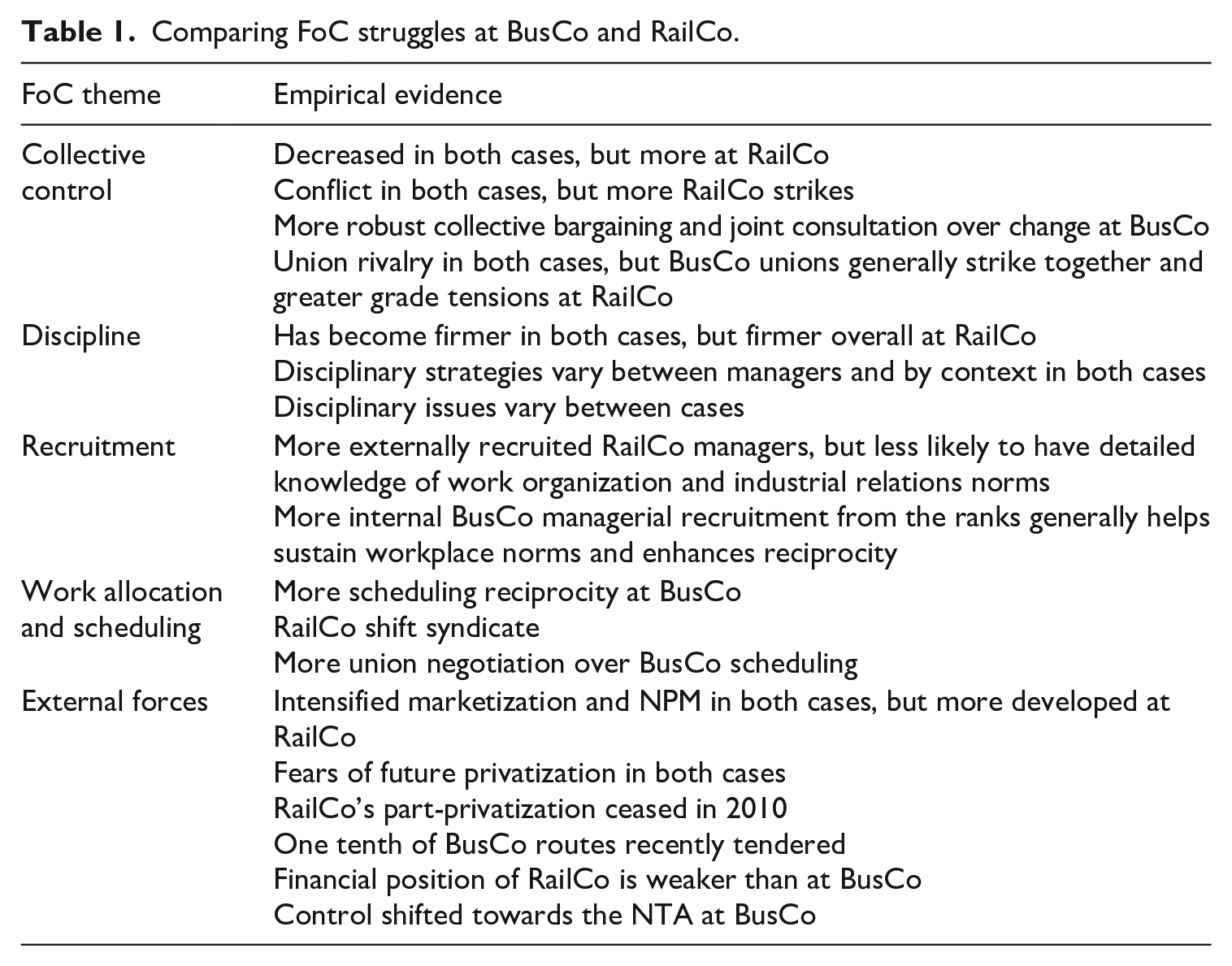
Historical national contexts and institutional pathways located within the wider system of capitalist accumulation have partly shaped FoC struggles at organizations like BusCo and RailCo. More consensual Irish employment relations (with social partnership between 1987 and 2009), contrasts with Thatcherite anti-union class antagonism in the UK, arguably providing more fertile conditions, generally but not always, for somewhat less antagonistic management control strategies. Our research shows that comparatively softer marketization in Ireland can help unions retain somewhat greater control over details of work organization than in the UK. Notwithstanding, although Irish unions seem to be in a relatively better position than British unions today, the Irish labour movement is weaker than it once was and there are limited institutional protections and supports for collective employment relations (Dobbins et al., 2020; Doherty, 2011; Regan, 2017).
To conclude, our article maps the FoC at our British and Irish companies to advance understanding of day-to-day negotiated order in two public transport organizations subject to varying degrees of marketization. Unionized contexts, where the FoC tends to be more observable, have declined significantly in both countries, with expanding non-union and precarious employment patterns posing major challenges for unions and society generally (Keune and Pedaci, 2019). Relatedly, shifts from traditional industrial sectors examined in classic FoC studies (factories, mines) to service sector work, complicates and potentially partly obscures the FoC over work organization, as managers also seek to control emotional labour and customer interaction (Jenkins et al., 2010; Taylor and Moore, 2015).
That said, contemporary changes in political economy create important new directions and opportunities for explicit FoC studies that may better reveal the frontier in contexts where it seems obscured. For example, qualitative methods (semi-structured interviews, ethnographic observation) could be utilized to map different FoC aspects in non-union service organizations, the gig economy and so forth. More insidious workplace control mechanisms (customer ratings, emotional labour) and less observable worker resistance could be analysed. Moreover, applying the FoC across different national contexts could enhance knowledge about the extent that country or sector differences influence workplace industrial relations and how internal factors (including managerial styles, employee voice and organization size) foment different control patterns.
Footnotes
Acknowledgements
The authors express gratitude to Richard Hyman and the anonymous reviewers who provided helpful feedback. They also thank all the people who kindly participated in the research case studies.
Funding
The author(s) received no financial support for the research, authorship and/or publication of this article.