




Abstract
We examine why and when proactive personality is beneficial for innovative behavior at work. Based on a survey among 166 employees working in 35 departments of a large municipality in the Netherlands we show that an increase in task conflicts explains the positive relation between a proactive personality and innovative employee behavior. This process is moderated by job autonomy in such a way that the relationship between proactive personality and task conflict is particularly strong under low compared with high autonomy. The present research contributes to the discussion on the potential benefits of task conflict for change processes and highlights the importance of examining the interplay between personality and work context for understanding innovation practices.
In an uncertain and economically challenging world, organizations have to enact changes constantly. To meet these needs for structural changes, organizations are increasingly dependent on emergent bottom-up change processes involving informal and voluntary change action of employees. This refers to micro-level processes of change in a slow evolution of individual jobs that eventually leads to more comprehensive change within the organization (e.g., Armenakis & Bedeian, 1999; Beer & Walton, 1990; Kuipers et al., 2014). The success of these change processes depends on employees taking personal responsibility for change and their quick anticipation on possibilities to change and innovate (Ghitulescu, 2013). Consequently, organizations increasingly stimulate change-oriented behavior, to make sure that employees revise existing psychological schemata and participate in the remake of their work and organizational practices (e.g., Hornung & Rousseau, 2007; Wollmann, 2000). In the context of bottom-up change processes, innovative employee behavior is an important work outcome (De Dreu, 2006; see also West, 2002). Employees, however, differ in their natural tendency toward taking action; proactive people will take action to actualize benevolent situations or to signal possible problem areas, whereas more cautious people will wait for information and opportunities to act upon (Liao, 2015).
Generally, proactive personality is considered a unique personality construct (Fuller & Marler, 2009) and is defined as a person’s disposition toward taking action to influence their environment (Bateman & Crant, 1993). A growing body of research demonstrates the importance of proactive personality for desirable individual work outcomes (i.e., salary, promotions, and career satisfaction; Seibert, Crant, & Kraimer, 1999) as well as organizational outcomes (i.e., productivity; Kirkman & Rosen, 1999).
Despite this abundance of research, there is still a lack of understanding of the interpersonal processes and relational dynamics through which proactive personality can be beneficial for such work outcomes (N. Li, Liang, & Crant, 2010; see also Thompson, 2005). Kurt Lewin (1935) already noted that behavior is the result of the interaction between personal dispositions and the environment. In line with this notion it has been argued that also for predicting innovative behavior it is important to take the combination of individual and work contextual factors into account (Crant, 2000; W. D. Li, Fay, Frese, Harms, & Gao, 2014; Parker, Williams, & Turner, 2006).
The present study seeks to provide insights in emergent bottom-up change processes, by including personal dispositions and work characteristics in the investigation of the mechanisms that elicit innovative work behavior, which is vital for the required organizational changes. The first contribution of our study is that we investigate how proactive personality may affect innovative behavior through the experience of interpersonal conflict—a process that begins when an individual perceives differences and opposition between itself and another individual about interests and resources, beliefs, values, or practices that matter to them (De Dreu & Gelfand, 2008). Second, this study adopts a contingency approach by investigating the moderating role of employees’ level of job autonomy on the linkage between proactive personality and innovation practices. As Hornung and Rousseau (2007, p. 403) already noted: “Autonomy on the job is perhaps the central work characteristic in shaping worker attitudes, motivation, and behavior” and its relevance for proactivity and change processes has been highlighted frequently (W. D. Li et al., 2014; Parker et al., 2006). The present study seeks to further build upon this work.
Proactive Personalities and Innovative Behavior
Proactive personality is per definition about the motivation to respond to, or change one’s environment (Bateman & Crant, 1993). As such, the concept of proactivity finds its basis in theories stressing that personality, environment, and behavior influence each other constantly (see Fuller & Marler, 2009, for a discussion). A recent meta-analysis demonstrates that—although positively related to general personality traits such as conscientiousness, extraversion and openness to experience, and negatively to neuroticism—proactive personality can be meaningfully distinguished from the Big Five personality traits collectively (Spitzmuller, Sin, Howe, & Fatimah, 2015).
More general, motivation for change among individual change agents depends on the recognition of the need for change combined with the belief of self-efficacy—the belief that by making a difference one-self organizational change is possible (Armenakis, Harris, & Mossholder, 1993). In line with this, proactive personality has its foundations in theoretical notions about personal initiative defined as a self-starting and persistent pursuit of goals (Frese & Fay, 2001) as well as notions about the confidence people have in carrying out such a role (role breadth self-efficacy; Parker, 1998; see also Hornung & Rousseau, 2007).
In the integrative model of the antecedents and consequences of proactive behaviors, Crant (2000) makes a clear distinction between proactive personality and innovative behaviors such as challenging the status quo and innovation. Innovative behavior is defined as the intertwined and discontinuous combination of intentional idea generation, idea promotion, and idea implementation to benefit performance within a work role, work group, or organization (Van der Vegt & Janssen, 2003; see also, West & Farr, 1989).
Proactivity may be considered an important predictor for innovative behavior among employees. For instance, previous work demonstrates that dispositional proactivity is positively associated with idea generation (Kim, Hon, & Crant, 2009). Another study among MBA applicants shows that proactive personality is positively related to bringing about constructive change (Bateman & Crant, 1993). Furthermore, Seibert, Kraimer, and Crant (2001) demonstrate that proactive personalities among employees are positively related to supervisor ratings of innovativeness 2 years later. Finally, and given the perseverance of proactive people (Crant, 2000), proactive people may be particularly effective in advertising their ideas and generating wide support, which arguably promotes successful idea realization (cf. Schwaab, Postmes, Van Beest, & Spears, 2007).
Theoretically, these findings may be explained by the idea that proactive personality is positively related to the motivation to take initiative and act in given situations (Fuller & Marler, 2009). As such, proactive employees will more often come up with original ideas, and will be more motivated to make sure those ideas are enacted. The first aim of this study is to replicate these findings in the context of a large municipality in the Netherlands, focusing on the departments responsible for implementing new policies. We hypothesize that proactive personality is positively associated with innovative behavior (Hypothesis 1).
Moving beyond previous studies on proactive personalities and innovative behavior, the current study also addresses why and when proactive personality is beneficial for innovation. Despite the fact that several studies showed that proactivity may be beneficial for innovative behavior (Bateman & Crant, 1993; Kim et al., 2009; Van der Vegt & Janssen, 2003; West & Farr, 1989; Seibert et al., 2001), there is a lack of understanding of how precisely interpersonal processes and relational dynamics may explain the benefits of proactive personalities for job performance (N. Li et al., 2010; W. D. Li et al., 2014; see Thompson, 2005). The present work extends previous findings on the proactive personality–innovative behavior link in two ways. First, we demonstrate how proactive personalities may be positively related to constructive interpersonal conflict and as a consequence to innovative work behavior. Second, and as discussed below, we show that this positive relationship between proactivity and constructive conflict is especially strong when perceived job autonomy is relatively low.
Proactive Personalities and Interpersonal Conflict
We propose that while proactive people take action to influence their environment (Grant & Ashford, 2008), they may encounter conflicts with other employees who feel obstructed or hindered by other’s proactive action or who are not convinced these changes are worthwhile. That is, a potential explanation for why a proactive personality is beneficial for work outcomes may lie in an increase of intensive work relations. Proactive employees display more approaching behaviors, identify opportunities for change, and are assertive and action oriented. Less proactive employees on the other hand tend to display inhibition and merely adapt to their environment. For instance, it has been found that a proactive personality generally is associated with increased network building (Thompson, 2005) and leader–member exchange (N. Li et al., 2010). Previous work also shows that an important prerequisite of successful innovative behavior is the propensity to identify opportunities (Bateman & Crant, 1993), and showing assertiveness at work or expressing voice (Crant, 2000; Grant & Ashford, 2008). These are all work behaviors that may be important for bringing about innovation.
Behaviors such as expressing voice, although important for innovative behavior, at the same time may lead to increased (perceptions of) opposition of others and therefore to more conflict with coworkers (Leung Lee, Diefendorff, Kim, & Bian, 2014). Indeed, people who have a natural disposition toward actively shaping their work environment are more likely to run into conflicts and disagreements with other team members (Janssen, 2003). For example, when proactive people posit ideas on how to change or improve the task, these ideas can be met, for example, by resistance from those who suspect ulterior (i.e., personal gain) motives rather than task innovation (Westaby, Pfaff, & Redding, 2014). Thus, considering that proactive employees are more assertive, outspoken, and generally have approach instead of withdrawal tendencies, they are more prone to meet opposition from coworkers when they take work-related action (Crant, 2000). We therefore hypothesize that proactive personality will be positively associated with the experience of interpersonal conflict (Hypothesis 2).
Interpersonal Conflict and Innovation
There has been considerable debate as to whether conflict may be detrimental or beneficial for work-related outcomes (De Dreu, 2006; De Dreu & Weingart, 2003; De Wit, Greer, & Jehn, 2012; Jehn, 1995, 1997; Tjosvold, 2008; see also O’Neill, Allen, & Hastings, 2013). This debate has particularly concentrated on the role of task conflict. Task conflict refers to disagreements about the content and outcomes of the tasks parties are working on, for instance conflicts about resources or interpretations of facts. Traditionally, task conflict has been contrasted with relationship conflict, referring to interpersonal tensions and personality clashes (De Dreu & Weingart, 2003; Giebels & Janssen, 2005; Jehn, 1995; Jehn & Mannix, 2001; Rispens, Greer, & Jehn, 2007). Underlying this distinction is the basic premise that the different ideas and viewpoints associated with task conflict could improve team performance, while tensions and resentments associated with relationship conflict are detrimental for work performance (Jehn, 1995; O’Neill et al., 2013).
In the past decade, however, four meta-analytic studies have not been able to paint a clear picture, particularly with respect to task conflict (De Dreu & Weingart, 2003; De Wit et al., 2012; Hülsheger, Anderson, & Salgado, 2009; O’Neill et al., 2013). While the detrimental effects of relationship conflict have been overwhelmingly confirmed, task conflict has shown negative, no relationship and—under certain circumstances—positive relationships with team outcomes. One explanation offered for these different findings is that the positive potential of task conflict relies heavily on the circumstances, such as the type of teams involved, whether it co-occurs with relationship conflict, or what has been the precise criterion measure (De Wit et al., 2012). It has also been explained by differences in methodology, such as the method of analysis and the way the key (outcome) variables have been operationalized.
Both notions are arguably relevant for our study, because most research focused on the effects of conflict on work performance, while other outcome variables have been relatively underexplored (O’Neill et al., 2013). Importantly, the constructive side of conflict has been primarily found in the area of innovation and creativity (see, e.g., De Dreu & Nijstad, 2008) such as decision quality (De Wit et al., 2012), and innovative work behavior (De Dreu, 2006). Therefore, we expect that task conflict may be beneficial for innovation (De Dreu, 2006), particularly when it prevents premature consensus and stimulates critical thinking (e.g., Amason, 1996; Jehn, 1995; Pelled, Eisenhardt, & Xin, 1999; Tjosvold, 2008; Van de Vliert & De Dreu, 1994). Thus, we predict that there will be a positive association between task (but not relationship) conflict and employee innovative behavior (Hypothesis 3).
People with a proactive personality will take more initiative (Fuller & Marler, 2009) and are more likely to come up with task-related ideas which are prerequisites for innovative behavior. We think that the heightened level of task conflicts proactive individuals experience may explain this relationship. Because proactive individuals are talkative, outgoing, and share many ideas for improvement, they are also more likely to run into opposition from others on these opinions and ideas (i.e., task conflicts). That is, others may react negatively to the ideas, they may also come up with suggestions to refine the idea, or they may actively oppose or ridicule the suggestions (Westaby et al., 2014). Having these debates will give proactive individuals information about, for example, organizational constraints and generally informs them about what colleagues think of the idea; it will help proactive individuals to weed out poor ideas, fine-tune potentially good ideas, and generate broader support for their ideas. This arguably helps realizing their ideas, and aids effective implementation. To formulate this formally, we expect task conflict to mediate the relationship between proactive personality and innovative behavior (Hypothesis 4).
The Moderating Role of Job Autonomy
Past research clearly demonstrates the importance of taking the work context into account when looking at organizational processes. Job autonomy—also sometimes called job control (Ohly & Fritz, 2009)—refers to the degree to which the task provides substantial freedom, independence, and discretion in scheduling the work and in determining the procedures to be used in carrying it out (Hackman & Oldham, 1980). A high level of job autonomy allows employees to decide how to perform their work (Fried, Hollenbeck, Slowik, Tiegs, & Ben-David, 1999; Troyer, Mueller, & Osinsky, 2000) and has been found to be an important predictor of proactive outcomes, including suggesting improvements (Axtel, Holman, Unsworth, Wall, & Waterson, 2000), presumably because of a higher perceived controllability of one’s tasks (Parker et al., 2006).
However, there is also reason to believe that job autonomy may affect the proactivity–conflict–innovative behavior relationship by influencing the likelihood that proactive behaviors will result in conflict. We expect that when proactive employees work in an environment in which they have low freedom to decide when and how to do their work, proactive action is likely to raise task conflicts with coworkers. The more proactive people are restricted by, for example, rules and procedures, or when social relations are key to goal pursuit (Westaby et al., 2014), the higher the likelihood that venting their new ideas will result in conflicts with other organizational members (cf. Jehn & Bendersky, 2003). For example, the new ideas may meet resistance because coworkers assume the ideas are not compatible with existing practices, or they may simply fear the consequences these alterations might have for themselves. Instead, when autonomous proactive employees are actively innovating their work (e.g., changing routines), it is less likely that they meet resistance from coworkers, because they can immediately change things themselves (Frese, Teng, & Wijnen, 1999).
Thus, we propose that the extent to which proactive employees actually do run into conflicts with their colleagues is dependent on the level of autonomy they experience in executing their work tasks. Specifically, we predict that job autonomy will have a moderating effect on the relationship between proactive personality and task conflict such that low compared with high levels of autonomy intensify this association (Hypothesis 5).
Up to now, we have suggested that job autonomy moderates the relationship between proactive personality and task conflict (Hypothesis 5)—since task conflict is less likely to occur when employees work autonomous (Jehn & Bendersky, 2003). It is therefore likely that job autonomy also moderates the strength of the mediator function of task conflict for the relationship between proactive personality and innovation as formulated in Hypothesis 4. Our final hypothesis therefore postulates that job autonomy moderates the positive indirect effect of proactive personality on innovative behavior (through task conflict), in such a way that the indirect effect of proactive personality through task conflict on innovative behavior will be stronger among employees in relatively low autonomous jobs than among employees in high autonomous jobs. Specially, we expect that task conflict mediates the indirect effect only when job autonomy is low but not when it is high (Hypothesis 6). Thus, we expect that the entire proactivity–conflict–innovation connection is fueled by low rather than high job autonomy. Figure 1 graphically illustrates the proposed research model.
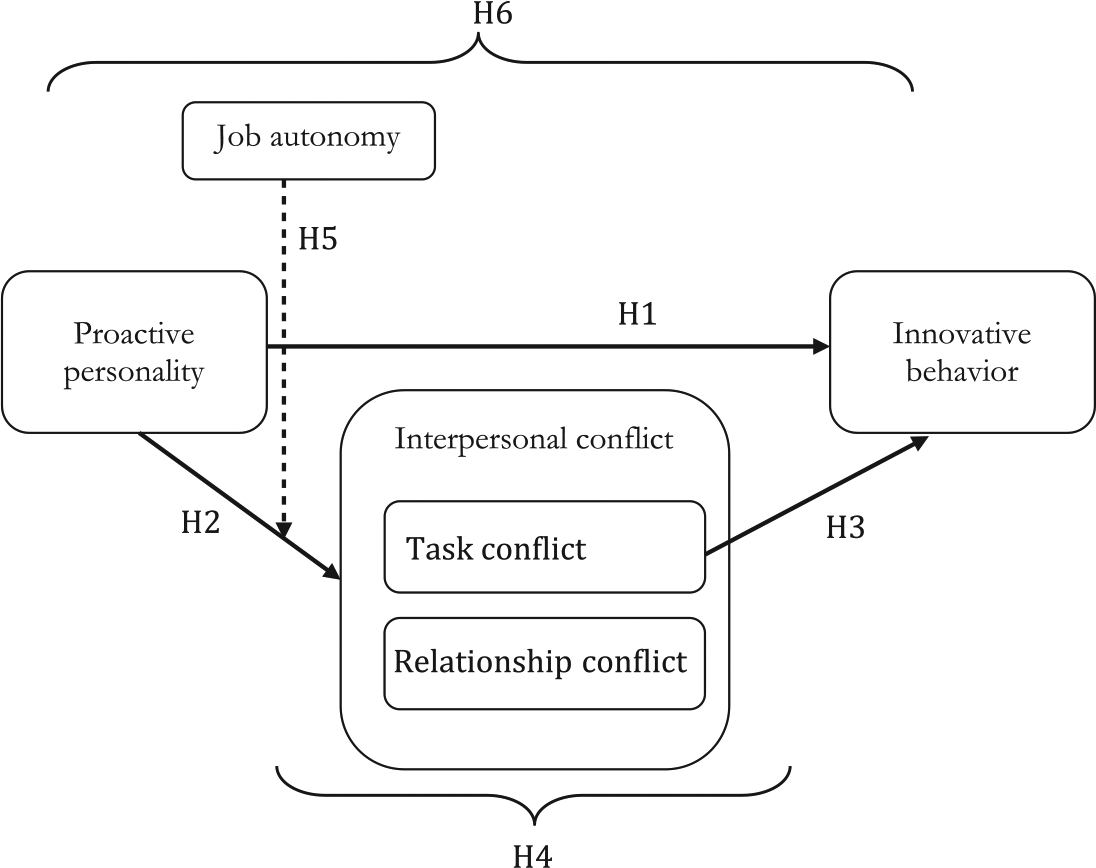
The proposed research model.
Method
Sample and Procedure
We tested these hypotheses in a field study conducted in a large municipality in the Netherlands. The study is based on 564 questionnaires distributed among 35 different work units, mostly involving financial, personnel, and administrative matters. These work units support the city council and are mainly responsible for the implementation of new policies. Such tasks have become increasingly demanding over the years; these have to do with rapidly growing technology and legislation, an increasing pressure for cost efficiency, as well as a general increase and diversity of their customers who are more demanding of services than ever. As such, the scope of their innovations primarily involves ideas related to improvement in daily work processes and work designs (Axtel et al., 2000; see also Van der Vegt & Janssen, 2003).
Unit meetings were scheduled and during these meetings a research associate explained the research topic and (the informed consent) procedure. The study was portrayed as a research project on “general work conditions aiming at improving their personnel recruitment and selection services.” At the end of each meeting, questionnaires were distributed. Confidentiality boxes were placed where participants could anonymously return their questionnaires and leave their names in a second box. We also explicitly informed participants that the individual responses would not be shared with the management. Pilot testing revealed that filling out the questionnaire would take up to a maximum of 30 minutes.
Eventually 166 completed questionnaires were returned, resulting in a response rate of 34%. Out of the sample of 166 respondents, 51% were male. The mean age was 45 years (range 21–63 years). Thirty-two percent of the respondents completed a secondary vocational education and 60% completed higher education. See Table 2 for a demographic breakdown of those in the analyzed sample (N = 166).
Measures
Proactive Personality
Because we are primarily interested in the aspect of proactivity directed at affecting change (see, Grant & Ashford, 2008) we have used the 10-item version of Bateman and Crant’s (1993) proactive personality scale. An example item is “when I see something I don’t like, I do something about it.” (1 = totally disagree to 7 = totally agree; Cronbach’s α = .89).
Conflict
Task and relationship conflict were measured using eight items (four items in each scale) adapted from Jehn’s (1995) intra team conflict scale. Respondents indicated how often they “had disagreements with other team members (task conflict)” or “had personal incongruities with other team members” (1 = never to 7 = always; Cronbach’s αs = .92 and .91, respectively).
Innovative Behavior
Employees’ individual innovative behavior was measured with an instrument developed by Janssen (2000; see also Van der Vegt & Janssen, 2003) reflecting the three aspects of idea generation, idea promotion, and idea realization at work, measured with three items each. Respondents, for example, indicated how often they “created new ideas for improvement,” “made important organizational members enthusiastic for innovative ideas,” and “transformed innovative ideas into useful applications.” The response format was a 7-point scale ranging from 1 (never) to 7 (always). Cronbach’s α of the scale was .94.
Job Autonomy
The extent to which employees experience job autonomy was measured with Parker et al.’s (2006) nine-item scale. Respondents indicated, for example, to what extent they could themselves decide, arrange, or get involved in different aspects of their work (1 = not at all to 7 = always; Cronbach’s α = .90). 1
Control Variables
To rule out spurious relations, we controlled for age and gender.
To examine whether proactive personality, conflict, employee innovative behavior, and job autonomy captured different constructs, we conducted a series of confirmatory factor analyses (using the statistical program AMOS). We tested and compared seven different models with the baseline model including the five proposed factors: proactive personality, task conflict, relationship conflict, employee innovative behavior, and job autonomy (see Table 1). The hypothesized baseline model fitted well—χ2(582) = 914.25, p < .01; root mean square error of approximation (RMSEA) = .06; comparative fit index (CFI) = .92; normed fit index (NFI) = .81. The factor loadings of the items for proactive personality, task conflict, relationship conflict, innovative behavior, and job autonomy ranged between .48 and .92. In addition, the hypothesized five-factor model fitted the data significantly better than the models with fewer factors. These results support the discriminant validity of our variables.
Confirmatory Factor Analysis of Proactive Personality, Conflict, Employee Innovative Behavior, and Job Autonomy.
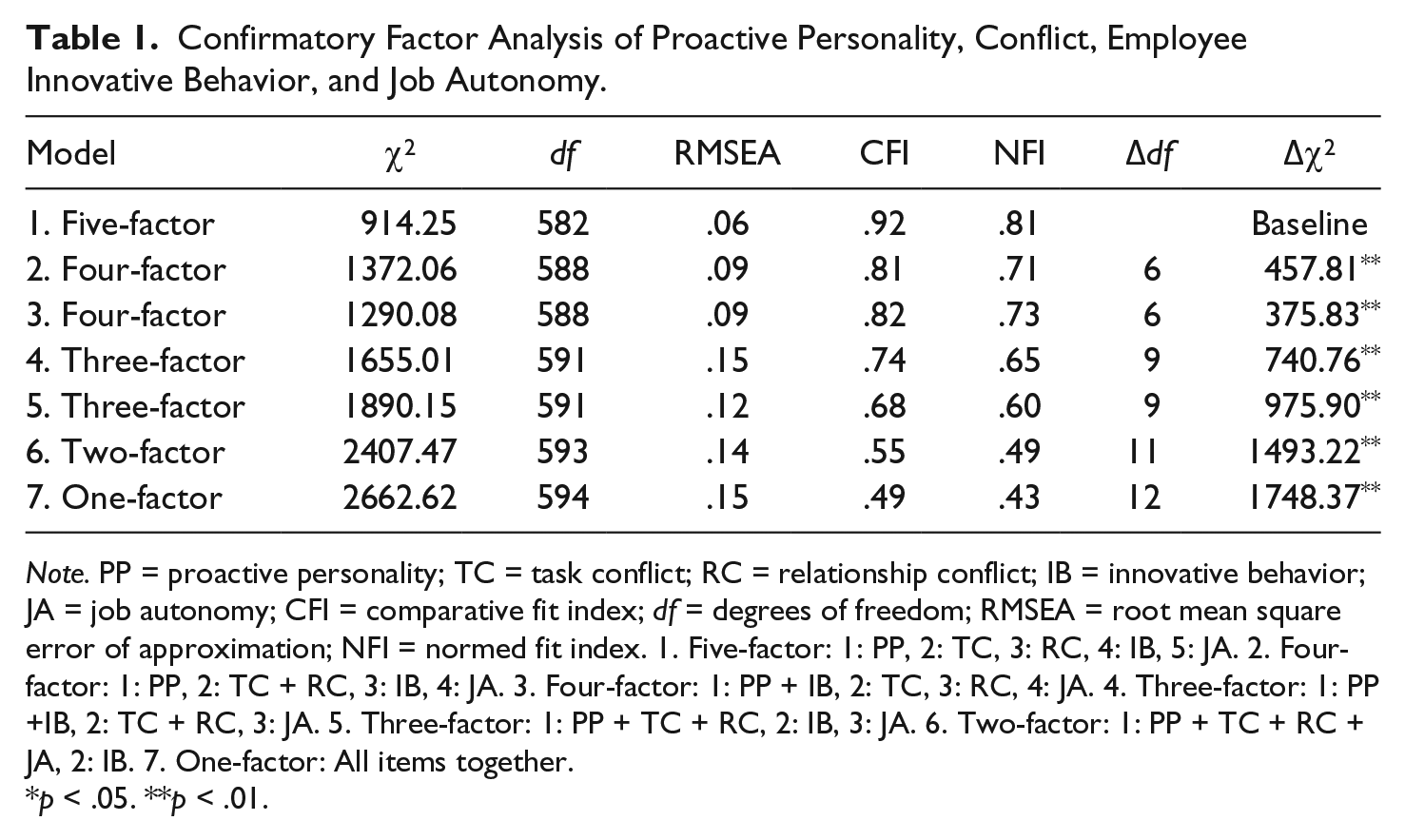
Note. PP = proactive personality; TC = task conflict; RC = relationship conflict; IB = innovative behavior; JA = job autonomy; CFI = comparative fit index; df = degrees of freedom; RMSEA = root mean square error of approximation; NFI = normed fit index. 1. Five-factor: 1: PP, 2: TC, 3: RC, 4: IB, 5: JA. 2. Four-factor: 1: PP, 2: TC + RC, 3: IB, 4: JA. 3. Four-factor: 1: PP + IB, 2: TC, 3: RC, 4: JA. 4. Three-factor: 1: PP +IB, 2: TC + RC, 3: JA. 5. Three-factor: 1: PP + TC + RC, 2: IB, 3: JA. 6. Two-factor: 1: PP + TC + RC + JA, 2: IB. 7. One-factor: All items together.
p < .05. **p < .01.
Results
Table 2 shows the means, standard deviations, and correlations of the variables. In line with our theoretical framework, proactive personality was positively related to task conflict (r = .26, p < .01) and innovative behavior (r = .58, p < .01). We also found that more task conflict goes together with more innovative work behavior (r = .36, p < .01).
Means, Standard Deviations, and Correlations Between Study Variables.
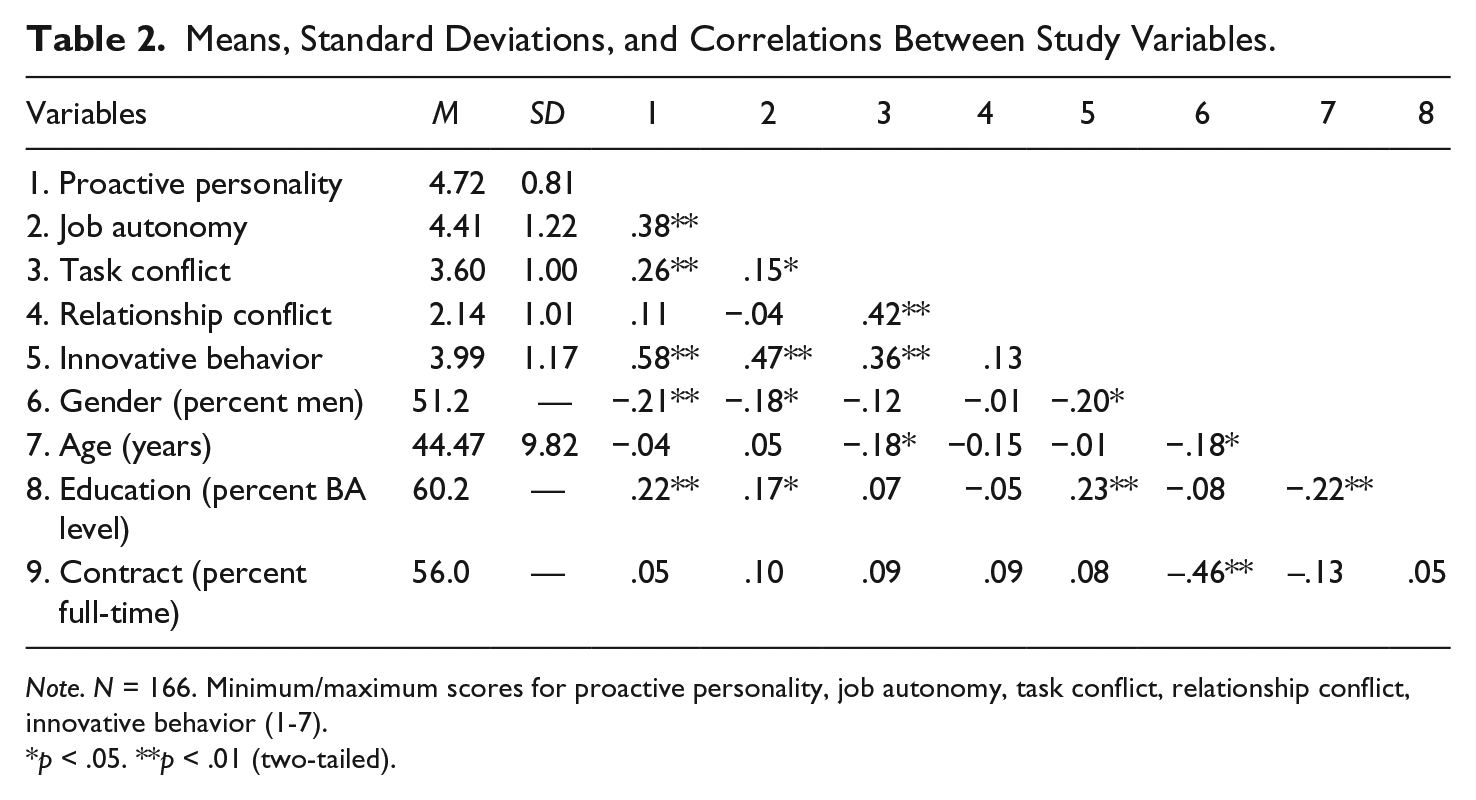
Note. N = 166. Minimum/maximum scores for proactive personality, job autonomy, task conflict, relationship conflict, innovative behavior (1-7).
p < .05. **p < .01 (two-tailed).
Since the data set consists of employees nested in 35 departments (M = 4.72 employees, range: 1-14) the intraclass correlations (the proportion of the total amount of variance in the data between the departments, ICC1, Bliese, 2000) were calculated for proactive personality, conflict (task and relationship) and job autonomy. Seventeen percent of the variation in proactive personality was explained by the department level, F(34, 131) = 1.94, p < .01; the within-group agreement within departments on the other independent variables ranged from 3% to 9 %—respectively: task conflict F(34, 130) = 1.35, p = .12; relationship conflict F(34, 130) = 0.87, p = .68. To test the compositional effect of proactive personality on innovative behavior a multilevel analysis is conducted with proactive personality on the individual level and aggregated to the department level as independent variables (Goldstein, 2011). The analysis reveals that innovative behavior is significantly related to proactive personality on the individual level, Β = .49, SE = 0.07, t(129.62) = 6.67, p < .01, but not on the department level, Β = .31, SE = 0.17, t(78.30) = 1.79, p = .08. This means that there are no significant differences between different departments of the effect of proactive personality on innovative behavior. This result justifies testing the different hypotheses at the individual level.
Hypotheses 1 to 4 represent together a simple mediation model, in which the effect of proactive personality on innovative behavior is mediated by interpersonal conflicts (positive indirect effect). To investigate the indirect (mediation) effect (Hypothesis 4) we applied the procedure suggested by MacKinnon, Fairchild, and Fritz (2007), using the bootstrap method (Shrout & Bolger, 2002) with an SPSS application (PROCESS, Model 4) provided by Preacher and Hayes (2004). Shrout and Bolger (2002) recommend using the bootstrap method to assess mediation with moderate sample sizes, such as/which is the case in the current study (also see Hayes, 2013).
As can be seen in Table 3, and as expected in Hypothesis 1, the results indicate as expected a positive relationship between proactive personality and employee’s innovative behavior—c path: Β = .81, SE = 0.09, t(163) = 8.66, p < .01; a similar result is found for the estimate when controlling for interpersonal (task and relationship) conflict—c′ path: Β = .87, SE = 0.09, t(163) = 9.52, p < .01. We also found a significant relationship between proactive personality and the occurrence of interpersonal task conflict but not relationship conflict—a path: Β = .30, SE = 0.09, t(163) = 3.54, p < .01 versus Β = −.03, SE = 0.10, t(163) = −0.31, p = .76. Thus, Hypothesis 2 was confirmed with regard to task conflict but not to relationship conflict. Supporting Hypothesis 3, innovative behavior is significantly related to task conflict—b path: Β = .21, SE = 0.08, t(163) = 2.51, p < .01, but not to relationship conflict—b path: Β = −.00, SE = 0.08, t(163) = −0.04, p = .97. Based on these outcomes, we only tested mediation for task conflict and we included relationship conflict as a control variable in the analyses. The lower part of Table 3 shows that the results of the bootstrap confirmed Hypothesis 4. Specifically, the bootstrapped 95% confidence interval [CI] around the unstandardized indirect effect (Β = .06, SE = 0.04) did not include zero [.01, .17], thus supporting the mediation effect of task conflict in the relationship between proactive personality and employee’s innovative work behavior.
Results of Mediation Analysis.
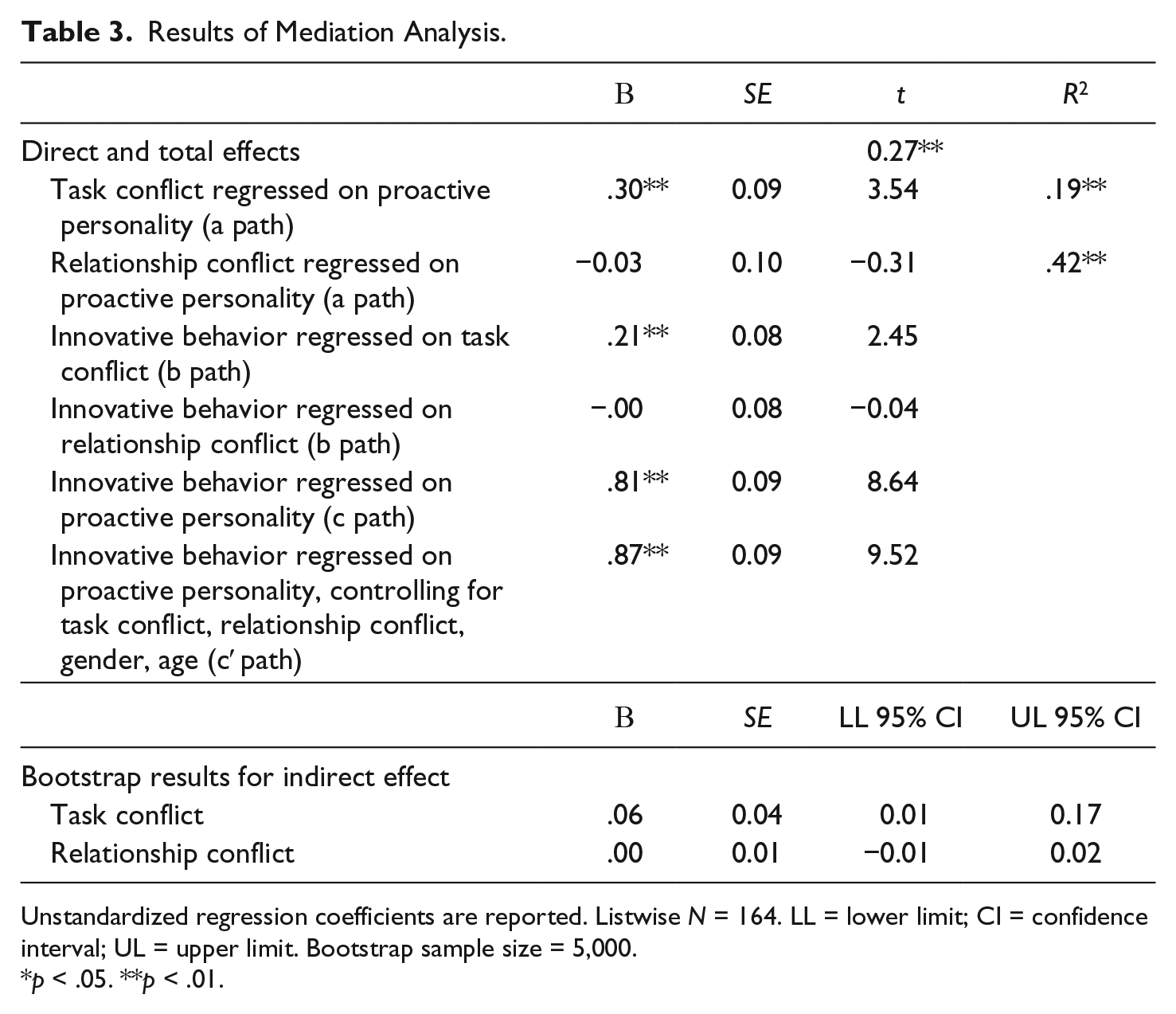
Unstandardized regression coefficients are reported. Listwise N = 164. LL = lower limit; CI = confidence interval; UL = upper limit. Bootstrap sample size = 5,000.
p < .05. **p < .01.
Next, we tested whether job autonomy interacts with proactivity in predicting task conflict and innovative behavior (Hypotheses 5), by entering the interaction terms of job autonomy and with proactive personality, after centering the values of these terms as recommended by Aiken and West (1991). Finally, to test the moderated mediation effects (Hypothesis 6) we followed the procedure described by Muller, Judd, and Yzerbyt (2005), testing the possibility that the mediation effect is gender-contingent. We used PROCESS, Model 7, provided by Preacher and Hayes (2004).
Table 4 (upper part) reveals that, consistent with our prediction in Hypothesis 5, job autonomy significantly influenced the generally positive association between proactive personality and task conflict—Β = −.13, SE = 0.06, t(163) = −2.08, p < .05. To further examine the effect of job autonomy on the link between proactive personality and task conflict we graphically illustrated the interaction using a procedure similar to the one recommended by Stone and Hollenbeck (1989). Specifically, we plotted two slopes of the moderating variable: one at one SD below the mean, and one at 1 SD above the mean. Figure 2 shows that when the autonomy of employees is relatively low (−1 SD), task conflicts increase with the enhancement of proactive personality. Under the condition of high autonomy (+1 SD) the link between proactive personality and task conflicts is largely invariant: proactive as well as nonproactive employees perceive the same level of task conflicts.
Results of Moderated Mediation Analyses.
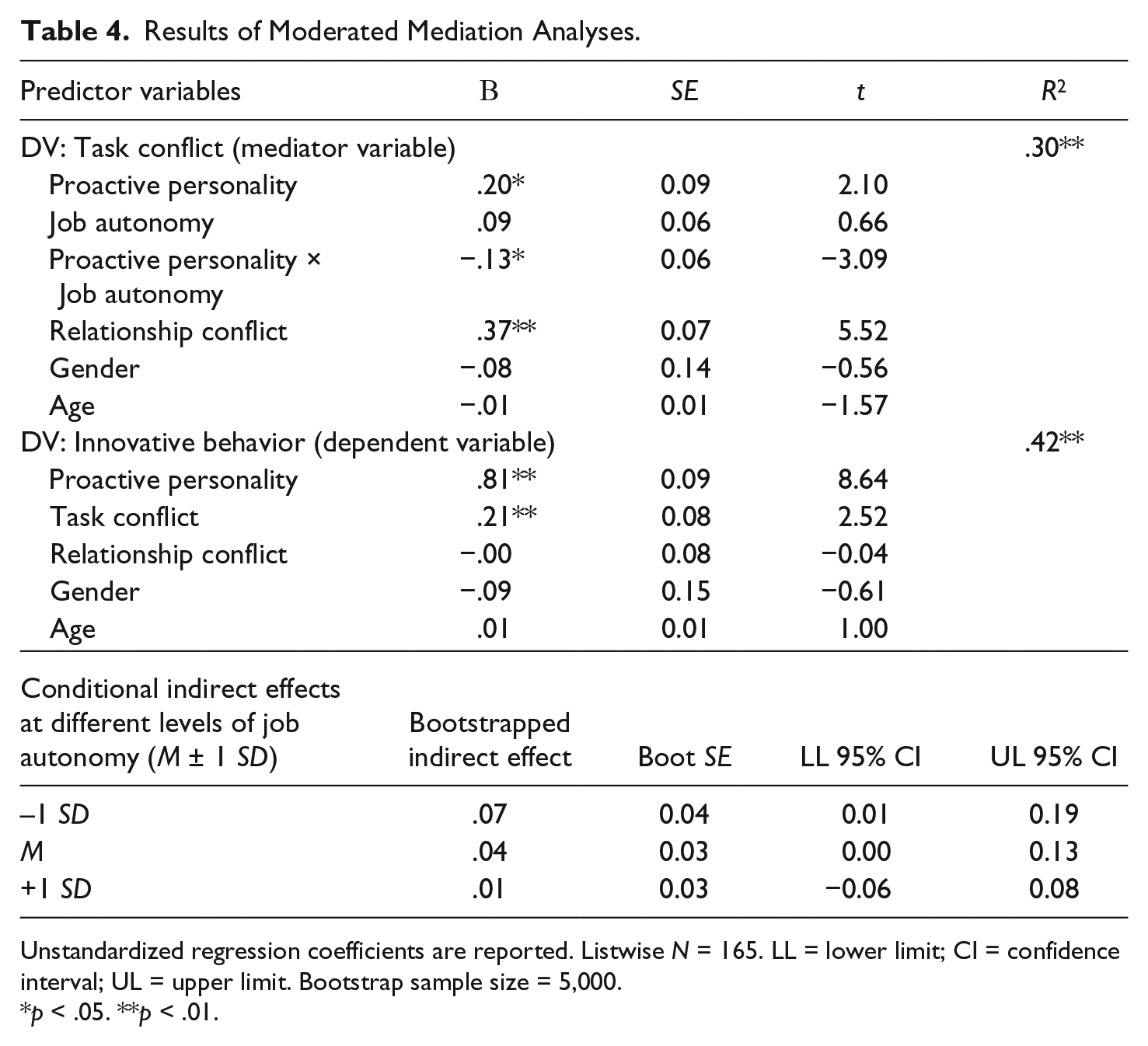
Unstandardized regression coefficients are reported. Listwise N = 165. LL = lower limit; CI = confidence interval; UL = upper limit. Bootstrap sample size = 5,000.
p < .05. **p < .01.
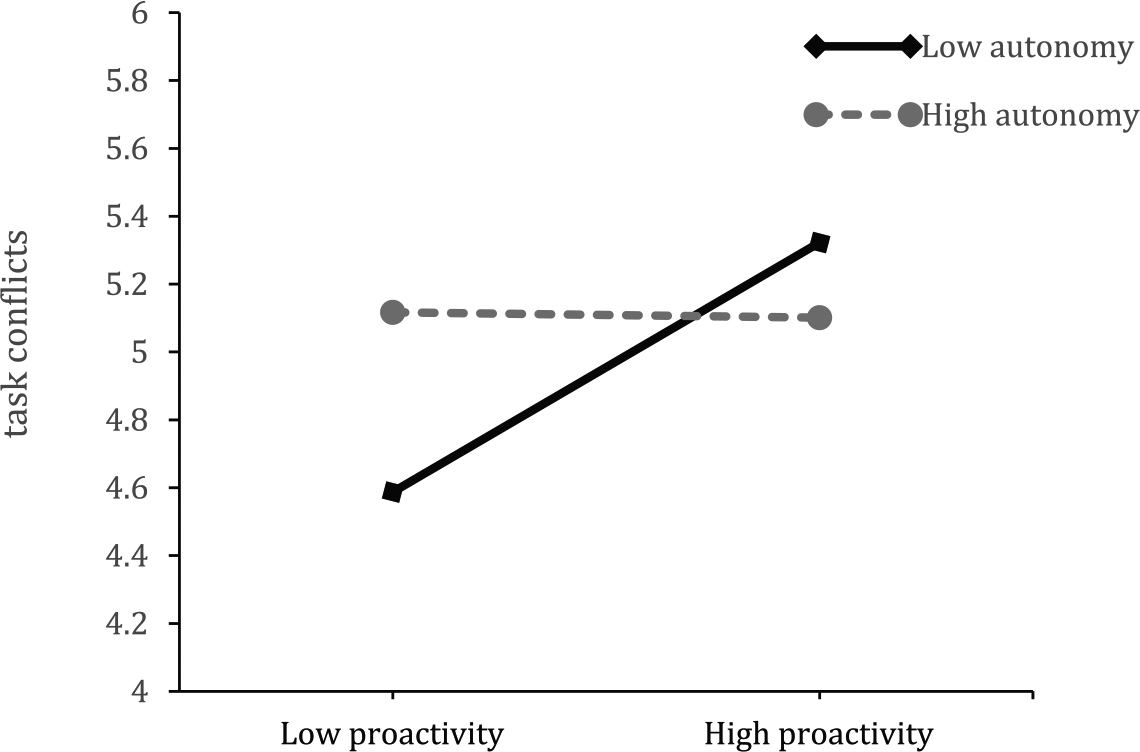
The association between proactive personality and task conflict as a function of job autonomy: curves for two different levels of the moderator (−1 SD [low] and +1 SD [high] autonomy).
Furthermore, in Hypothesis 6 we expected that job autonomy moderates the positive and indirect effect of proactive personality on innovation (through the perception of task conflict), such that task conflict has an indirect effect only when job autonomy is low and not when it is high. We investigated the conditional indirect effect of proactivity on innovation (through task conflict) at three values of job autonomy: at the mean, at 1 SD below, and at 1 SD above the mean. The results in Table 4 (lower part), show that the conditional indirect effect was significant at the low (Β = .07, SE = 0.04, bootstrap 95% CI = [0.01, 0.19]) and average levels (Β = .04, SE = 0.03, bootstrap 95% CI = [0.00, 0.13]), but not at high levels (Β = −.01, SE = 0.03, bootstrap 95% CI = [−0.06, 0.08]) of job autonomy. These results confirm Hypothesis 6.
Discussion
To successfully cope with dynamic environments, organizations increasingly rely on change-oriented employee behavior to drive bottom-up change processes and adaptation (Hornung & Rousseau, 2007). The current study aimed at gaining a better understanding of such processes, by focusing on the relationship between proactive personality, interpersonal conflicts, and innovative work behavior in the context of autonomy on the job. As such, it is part of recent work addressing the relational dynamics that may be responsible for the positive effect of employees’ proactive personality for work outcomes like change and innovation.
Our research was directed at innovativeness at work and shows that proactive individuals consider themselves as more successful in realizing innovation as a result of elevated task-related conflict interactions with their fellow coworkers. Such conflicts are arguably characterized by resistance or criticism from coworkers who are afraid of the uncertainty and change associated with new ideas or circumstances proposed or effectuated by proactive individuals or from rather straightforward interference with one’s own goals or self-interests (Van de Vliert, 1997). Clearly, proactivity may reveal divergent interests and viewpoints, as well as incompatible preferences between coworkers giving rise to interpersonal task conflict.
As the occurrence of task-related conflicts may likely stimulate proactive employees to sharpen and shape their ideas and proposals in interaction with others, they may not only produce better quality ideas but also ultimately generate wider acceptance for their actions from their fellow workers. This is particularly important because successful idea promotion, and ultimately idea realization, goes beyond more narrowly defined individual creativity, primarily aimed at idea generation. Generally, work innovation is considered a much broader concept concerned with the generation of possible alternatives, selection from among those alternatives, and implementation of the chosen alternatives (Anderson, De Dreu, & Nijstad, 2004; Unsworth, 2001). As such, our research points at the crucial role task-related disputes play for innovation processes. Or, as Tjosvold (2008, p. 21) put it: “Through conflict, conventional thinking is challenged, threats and opportunities identified, and new solutions forged.”
Additionally, we demonstrated that the proactivity–conflict–innovation process is actually aided by low instead of high job autonomy. This is in line with the conflict literature that states that employees are likely to raise task conflicts with coworkers in a work context where they are reliant on others (Jehn & Bendersky, 2003). It also suggests that job autonomy may fulfill a rather paradoxical role for innovation processes. On one hand, research—including our own—clearly reveals a direct positive relationship between job autonomy and innovation. This is likely due to autonomous employees experiencing more freedom regarding what to do, when to do it, and how to do it (Grant & Ashford, 2008) and because such feelings of freedom increase self-efficacy and mastery orientations (Crant, 2000). On the other hand, our research shows that the connection between proactivity, conflict, and innovation is intensified under conditions of low rather than high autonomy. This implies that both high and low autonomy may aid innovation processes, but via different pathways. At higher levels of autonomy, the innovation process may be more of an individual process where (proactive) employees come up with new ideas and implement them, whereas under conditions of lower autonomy, proactive employees may come to innovation through increased task conflicts with coworkers. 2
To date, the literature has taken different approaches to the concept of proactivity. While some studies focused on proactive personality, stressing individual differences in assertiveness and self-activation (Frese, Kring, Soose, & Zempel, 1996), others have focused on proactive behaviors such as career management and innovation (e.g., Parker et al., 2006). Crant (2000) integrated these different aspects into one model stressing the importance of distinguishing between antecedents and consequences of proactive behavior. Our research underlines this importance as we showed that the relationship between proactive personality and innovation can be explained by an increase in task-related disputes, particularly when employees have low instead of high job autonomy.
Our organizational dynamic approach toward the relationship between proactive personality and innovation concentrated on interpersonal conflict processes. While being assertive and outspoken arguably evokes interpersonal conflicts with coworkers, this has—as far as we know—not been studied before. As personality factors are rather underexplored within the conflict domain as well, our finding that proactive personality and the occurrence of disputes are closely intertwined is an important contribution of our work. Furthermore, our findings show that this concerns task-related and not relationship conflicts. As task conflict focuses on content and includes differences in viewpoints, ideas, and opinions, they are clearly the more likely result of attempts to influence one’s work environment. Moreover, it is likely that such task-related issues are more easily handled constructively (Behfar, Peterson, Mannix, & Trochim, 2008).
Although we theorized proactive individuals to be constructive conflict managers we did not include explicit behavioral measures in our research. Previous research, however, clearly suggests that proactive individuals seek more feedback (e.g., Ashford, Blatt, & VandeWalle, 2003), are more focused on relationship building (Wanberg, & Kammeyer-Mueller, 2000), and are generally better able to deal with stressful circumstances (Kinicki & Latack, 1990; see also, Crant, 2000). It is thus likely that once conflicts arise particularly proactive individuals are likely to actively deal with the conflicts at hand in a constructive way. This points at a relationship between proactive personality, conflict management strategies, and resilience as well. Interestingly, previous research demonstrates that resilience of employees is positively related to the acceptance—but not to the evaluation—of organizational change (Wanberg & Banas, 2000). A follow-up question for future research therefore would be to expand the process model with conflict management strategies and resilience measures as well.
Generally, proactive individuals may encounter higher levels of task conflict exactly because the task domain is something they can influence. It may, for example, be easier to change something in the work domain than with regard to personal opinions and beliefs. These content-related issues may be regarded as better to control and involve a higher likelihood of success when pursuing them. Indeed, control appraisals have been frequently associated with proactivity (e.g., Frese & Fay, 2001).
Another explanation may be that proactive individuals are more likely to label any interpersonal incongruity in terms of task-related features. That is, personal skills such as perspective taking and stress invulnerability also may make proactive individuals more likely to frame a dispute as task-related instead of more relational. This might be particularly relevant as previous research pointed at a relationship between proactive personality and organizational citizenship behavior (N. Li et al., 2010) and therefore participating in a research project might have particularly attracted proactive employees. In addition to involving less proactive individuals, future research might also want to focus on employees being confronted with proactive coworkers. It might well be that they experience the issues following proactive actions as more personally threatening and therefore more relational than their proactive counterparts.
Furthermore, as we mostly found moderate levels of conflict in the current research, an important question is what happens when conflict levels are high. Particularly when almost every proactive act encounters resistance, and thus conflict levels are very high, such processes may also work out negatively for innovative power. Indeed, De Dreu (2006) demonstrated that not only under low levels but also under very high levels of conflict innovativeness was impaired. Similarly, Farh, Lee, and Farh (2010) found that particularly high (but not moderate) levels of conflict hindered creativity and task functioning. This is not surprising, as dealing with interpersonal conflicts is usually demanding, taxing, and time-consuming specifically when people engage in the suppression of experienced emotions (Bono & Vey, 2005; Grandey, 2000). However, considering the previous discussion, this may be less so for proactive individuals. In fact, this may explain why we did not find such a curvilinear relationship between task conflict and innovativeness. 3 It might therefore be particularly interesting to include the perspective of fellow workers being confronted with other’s proactive acts in future research.
A limitation of our research is that it includes solely self-reported data. It is thus important to consider the threat of common method variance (CMV). However, as Spector (2006) noted, small interconstruct correlations often counter the idea that CMV is a universal inflator of correlation. In our study, correlations among the self-reported variables were rather modest, ranging from −.04 to .58. Moreover, CMV leads to an attenuation of the interaction term, which makes interaction effects more difficult to find. This implies that finding interaction effects in data with possible CMV “should be taken as strong evidence that an interaction effect exists” (Siemsen, Roth, & Oliveira, 2010, p. 470). However, we cannot completely rule out CMV as a problem, and future research should try to include responses from other sources, such as supervisors, as well as behavioral observations. Yet both have been engaged with criticism as well. For example, supervisory judgments may be associated with issues of impression management (e.g., “of course, my subordinates are proactive/innovative”), while behavioral observations may involve observational biases (e.g., employees may behave more proactively when they are being observed; Parker et al., 2006, p. 644).
A related limitation of the current work is that we used cross-sectional data to test our model, from which we cannot infer causal relationships. Other models could be thought of as well; most notably ones that involve job autonomy as an antecedent of proactivity (Ohly & Fritz, 2009; Parker et al., 2006) or as a predictor of innovative behavior (Van der Vegt & Janssen, 2003). Rightly, W. D. Li et al. (2014) assumed and found that reciprocal relationships between proactive personality and work characteristics develop over time. Another limitation we would like to mention is that we were not able to rule out possible effects of variables such as (past) performance or factors at the unit level, such as unit size.
Practical Implications
This study offers several managerial implications. For organizational change to take place, organizations need individual agents supporting and advocating change independently from whether the organizational culture in general is perceived as supportive or not (Oreg, Vakola, & Armenakis, 2011). Proactive employees striving for change against the opinion of others may therefore be an important asset for managers who want to instigate change in their organization. However, managers should understand that with an increased emphasis on proactivity on the job, they might also be confronted with higher levels of interpersonal conflicts between coworkers in the workplace. It is important to note that these conflicts—especially when they are task-related—are important for driving organizational change.
Furthermore, we speculate that while proactive individuals may consider these conflicts a challenge, and—as a result of their proactivity—may be able to handle them constructively, this may not be the case for less proactive coworkers. These coworkers may feel overwhelmed with or even threatened by the proactive actions of their colleagues, and this in turn may have negative consequences. In the context of change processes, it may therefore be important to create a constructive conflict climate and support for people in coping with conflict, especially those who might not feel comfortable with them. This is not evident. Coping with conflict among team members is one of the toughest challenges for practicing managers (Bradley, Postlethwaite, Klotz, Hamdani, & Brown, 2012).
Our findings furthermore suggest that job autonomy might be a double-edged sword. Where job autonomy is usually considered a positive force, our research points at a possible downside when it means that proactive employees are working not only in freedom but also in isolation. Especially for proactive employees, it may be important to overcome organizational constraints and social resistance as a “reality check” and to gain broader support for their ideas. As such, managers should not only pay attention to stimulating idea generation and task conflict but also to fostering the constructive exchange of ideas. Research clearly shows that the benefits of task conflict particularly manifest themselves when organizations are able to foster a climate of psychological safety (Bradley et al., 2012). There are ample ways to do this: not only by publically stimulating employees to speak out freely and by embracing differences of opinion and diversity but also by offering more targeted help such as conflict management courses or team coaching sessions.
Conclusion
The findings of this study provide insights into how leaders of organizational change efforts can create a work context that encourages proactive employees to actively participate in change processes and engage in innovative behavior that supports the organizational change in a broader perspective. Despite the need for experimental or longitudinal designs to examine the dynamic relationships between proactive personality, task conflict, and innovative actions, our research further underpins the notion that proactive personality and conflict can be seen as an integral part of innovation processes and show that change processes reveal themselves in a contextual manner (Pettigrew, 1990).
Footnotes
Acknowledgements
We would like to thank Geke Rook for her help in collecting the data.
Declaration of Conflicting Interests
The author(s) declared no potential conflicts of interest with respect to the research, authorship, and/or publication of this article.
Funding
The author(s) received no financial support for the research, authorship, and/or publication of this article.