




Abstract
How far, in what ways and on what issues do trade unions in Europe cooperate cross-nationally? Three important structural factors may explain differences in cooperation: national industrial relations contexts, sectoral contexts and unions’ organizational resources. We examine transnational union cooperation at sectoral level, and test the explanatory value of these three factors. We address cooperation in five broad sectors, using a Europe-wide questionnaire-based survey of trade union activities. We find that sectoral differences explain more of the variation in levels of transnational cooperation than do industrial relations regimes when controlling for resources, whereas both sectors and regimes influence which issues are seen as important for current and future cooperation. In addition, small trade unions engage in much less transnational cooperation than large ones.
Introduction
Trade unions play important roles not only nationally but also at the European level, in defending and developing working conditions and addressing social issues. However, according to Lehndorff et al. (2017: 30) European issues have become difficult for trade unions to address. Economic crises have reduced their transnational engagement and increased their national focus, adding new difficulties to those already existing: different institutional and economic contexts, scarcity of economic and personnel resources, linguistic and cultural differences and low interest in European issues and activities among members (Furåker and Bengtsson, 2013; Gumbrell-McCormick and Hyman, 2013; Henning, 2015; Larsson, 2012).
Withdrawal to the national arena is not a good option for trade unions, because they also face difficulties there. Throughout Europe, they have experienced declining membership density, reduced scope for contentious action and diminished power resulting from austerity policies and the decentralization of collective bargaining (Kelly, 2015; Lehndorff et al., 2017; Marginson, 2015; Müller, 2016). They also face new challenges such as flexible contracts, digital or platform work and bogus self-employment, all of which transcend the national arena (Arrowsmith and Pulignano, 2013; Degryse, 2016; Pedersini and Pallini, 2016).
Although the prospect of trade union cooperation looks bleak, there have been achievements, and there are also continuing initiatives to strengthen transnational cooperation (Müller, 2016; Perin and Léonard, 2016; Prosser, 2016; Rhodes, 2015). Our objective is to map existing transnational trade union cooperation in Europe, and to explore the issues (by which we refer to quite broad areas of cooperation such as wages, working time, recruitment) that unions in different sectors and countries consider important for the future. The theoretical point of departure is that transnational cooperation is influenced not only by union resources, but also by structural factors such as differences in sectoral and national industrial relations (Bechter et al., 2012; Bechter and Brandl, 2015).
Our empirical basis is a Europe-wide questionnaire on the activities and viewpoints of trade unions in five sectors: metals and mining, construction, transportation, healthcare, banking and finance. This approach allowed us to cover many organizations, testing different explanatory models statistically and achieving greater generalizability compared to case study research. Nevertheless, the approach also has limitations because the level of detail is lower than in case study research. For instance, because the level of analysis is at the organizational level, we sent the survey to senior trade unionists, and consequently, we have no information on lower level cooperation (for example in EWCs) or rank-and-file attitudes towards cooperation. Our contribution is thus to add to existing qualitative research by statistically testing explanations that are often discussed but seldom tested systematically, and rarely through quantitative analyses.
Previous research and theoretical assumptions
Trade union cooperation comprises a varied set of activities with different goals (Larsson, 2012). They range from loose bilateral contacts strengthening national strategies (Müller, 2016; Traxler et al., 2008), to the work in European organizations at sectoral and cross-sectoral levels: the European Trade Union Federations (ETUFs) and the ETUC, through which national unions have access to EU policy consultation and negotiations with employer organizations in social dialogue (Degryse and Pochet, 2011; Müller and Platzer, 2017; Perin and Léonard, 2016; Prosser, 2016).
Previous comparative research on trade union cooperation has uncovered variations in engagement in cooperative activities (Furåker and Lovén Seldén, 2013; Larsson, 2014, 2015; Mitchell, 2007). This may be explained by factors such as variations in the unions’ interests, ideology, resources and power as well as by differences in their political and economic contexts (Busemeyer et al., 2008; Hyman, 2001; Lehndorff et al., 2017; Léonard et al., 2012). We focus here on theoretical assumptions relating to differences in national industrial relations systems, sectoral contexts and organizational resources.
Industrial relations regimes
There are great divergences in industrial relations and the challenges that trade unions face in different countries (Gumbrell-McCormick and Hyman, 2013; Henning, 2015; Lehndorff et al., 2017). However, it is common to identify a smaller set of industrial relations regimes, roughly overlapping with geographical areas. Our classification distinguishes between five regimes (Van Rie et al., 2016; Visser et al., 2009): The Nordic countries constitute a regime of organized corporatism, with high union and employer density, coordinated collective bargaining, high autonomy from the state and strong influence by social partners on state policy. Most Southern European countries constitute a polarized/state-centred regime, with fragmented and often conflictual partner relations, low levels of union and employer density and high levels of state intervention. Central Western European countries belong to a social partnership regime, with moderate union density, high bargaining coverage, relatively autonomous partners and low levels of conflict. Together with Ireland, Malta and Cyprus, the UK belongs to a liberal pluralist Anglophone regime, with low union density and fragmented trade union organization, decentralized bargaining and low levels of state intervention. Finally, most Central Eastern European (CEE) countries belong to a heterogeneous transitional regime, with weak and fragmented social partners, decentralized bargaining, little autonomy of social partners and a strong and active state focused on transition to a market economy.
There are, of course, within-regime heterogeneities, and these may even be increasing. However, if the regime concept still has validity, the overall differences will likely affect the issues on which trade unions cooperate and the form of their cooperation, because industrial relations contexts may be expected to affect both trade union power resources (structural, organizational and institutional) and their interest in participating in cooperation. Previous research confirms that differences exist between unions in different parts of Europe. Continental and (particularly) Southern trade unions have shown greater preference for contentious action than Nordic unions (Larsson, 2014). Unions in Southern, CEE and some Continental countries tend to have more European integrationist approaches, with higher expectations from the ETUC and ETUFs than British and Nordic unions, which tend to be more sceptical and nationally oriented (Larsson, 2015; Mitchell, 2007; Müller and Platzer, 2017). Nordic unions have been reluctant to develop supranational wage policies and regulations (Busemeyer et al., 2008; Gumbrell-McCormick and Hyman, 2013). Moreover, while there is increasing support among many trade unions in Europe for statutory minimum wages at the European level, this is equally strongly rejected by Nordic unions (Furåker, 2017; Furåker and Bengtsson, 2013; Furåker and Lovén Seldén, 2013).
Sectoral regimes
A problem with regime typologies is that they disguise variation within regimes and countries. Indeed, Bechter et al. (2012) show there is more diversity in industrial relations across sectors within countries than within sectors in the EU 27. Thus, sectoral (economic) context may influence industrial relations more strongly than national (political) contexts (Bechter and Brandl, 2015). There is also an important sectoral element in trade union organizations and their bargaining and negotiations at both the national and European levels (Müller and Platzer, 2017; Rhodes, 2015; Van Rie et al., 2016: 215).
The concept of ‘sectoral regimes’ indicates that different sectors vary in terms of production processes and work organization, partly because of variations in degree of exposure to international competition and barriers to relocation (Bechter et al., 2012; Erne, 2008). Whereas manufacturing is highly exposed to international competition and possesses a high degree of production location transferability, public and private (personal) services are less exposed and have less production location transferability. As a consequence, they are under less external pressure to engage in cross-border cooperation (Bechter et al., 2012; Glassner and Pochet, 2011: 13).
The importance of differences between sectors has been confirmed in comparative research on transnational trade union cooperation in Europe (Furåker and Bengtsson, 2013; Larsson, 2012). Trade unions in manufacturing not only cooperate more closely than those in the services sector (or professional unions), but also have more positive attitudes towards future cooperation. Hence, there are sectoral differences in the most common forms of transnational trade union cooperation, such as exchange of information on collective agreements and participation in demonstrations and strikes. There are also sectoral differences in terms of the obstacles to transnational cooperation that trade unions regard as important (Larsson, 2012).
Organizational size and resources
Variations in cooperation may also be explained by organizational characteristics. Participation in European-level organization and networks is costly in terms of both financial and personnel resources (Henning, 2015; Larsson, 2012). The number of members (size) seems a reasonable if very rough proxy for financial means, staff levels and other facilities, though personal connections, mobilizing capacity for industrial action, political alliances and influence are also affected by other factors (Gumbrell-McCormick and Hyman, 2013: 30–31). With larger numbers, specialized staff can be employed in international or policy development offices, which affects the opportunities to remain current and lobby in connection with national and EU policy developments (Müller and Platzer, 2017: 291).
Previous studies have shown that trade union size influences the intensity of their cooperation. Although attitudes towards cooperation do not differ greatly between unions of different sizes, large organizations tend to cooperate more and to have greater capacity to engage in joint activities (Furåker and Bengtsson, 2013; Larsson, 2014, 2015).
It is mainly for analytical reasons that we have presented the three factors above separately to explain the variations in trade union cooperation: they are not mutually exclusive. Trade union resources are related to variations in national and sectoral industrial relations. Unions in manufacturing traditionally have strong national organizations compared with unions in the services sector and professional unions (Bieler and Lindberg, 2011: 223), and there are even greater differences in resources among trade unions in different countries. Differences are particularly strong between large and small countries and those with high union density (the Nordic countries and Belgium), and others with very low union density. Consequently, although there is stronger support for European-level activities among CEE and Southern trade unions, many have less organizational capacity than unions in the Central and Nordic countries. Thus, they participate less and have less influence, particularly following the economic crisis (Henning, 2015; Larsson, 2015; Lehndorff et al., 2017). This indicates that integrated theoretical perspectives are relevant in understanding trade union cooperation.
Methods and materials
The data were collected through a questionnaire distributed in 2015–2016 to 602 trade unions in 36 European countries. We targeted unions in six main sectors according to an established typology (Crouch, 1999): mining (extractive), metals, construction (productive/transformative), transportation (distributive), healthcare and banking and finance (public and private services). This selection was designed to achieve a high level of variation in aspects identified as important for sectoral trade union cooperation: production processes, work organization, possibilities for relocation and exposure to international competition. Since the aim was to analyse the organization-level activities, we chose to target central union representatives with a broad knowledge of the different forms of cooperation, rather than rank-and-file members.
The survey was sent to senior representatives of 602 unions. To improve the response rate, we used a mixed-mode survey approach, in which the first two waves were Internet based, and a third wave was postal (Fan and Yan, 2010). There were 221 responses, an overall response rate of 37 percent (see Table A1 in the Supplemental Material online). The highest rate was in the Nordic countries (62%), and the lowest in the Anglophone countries (18%). The respondents were either union leaders or those delegated by them to complete the questionnaire: two-thirds were general secretaries, presidents or vice presidents and 17 percent were international secretaries or correspondents.
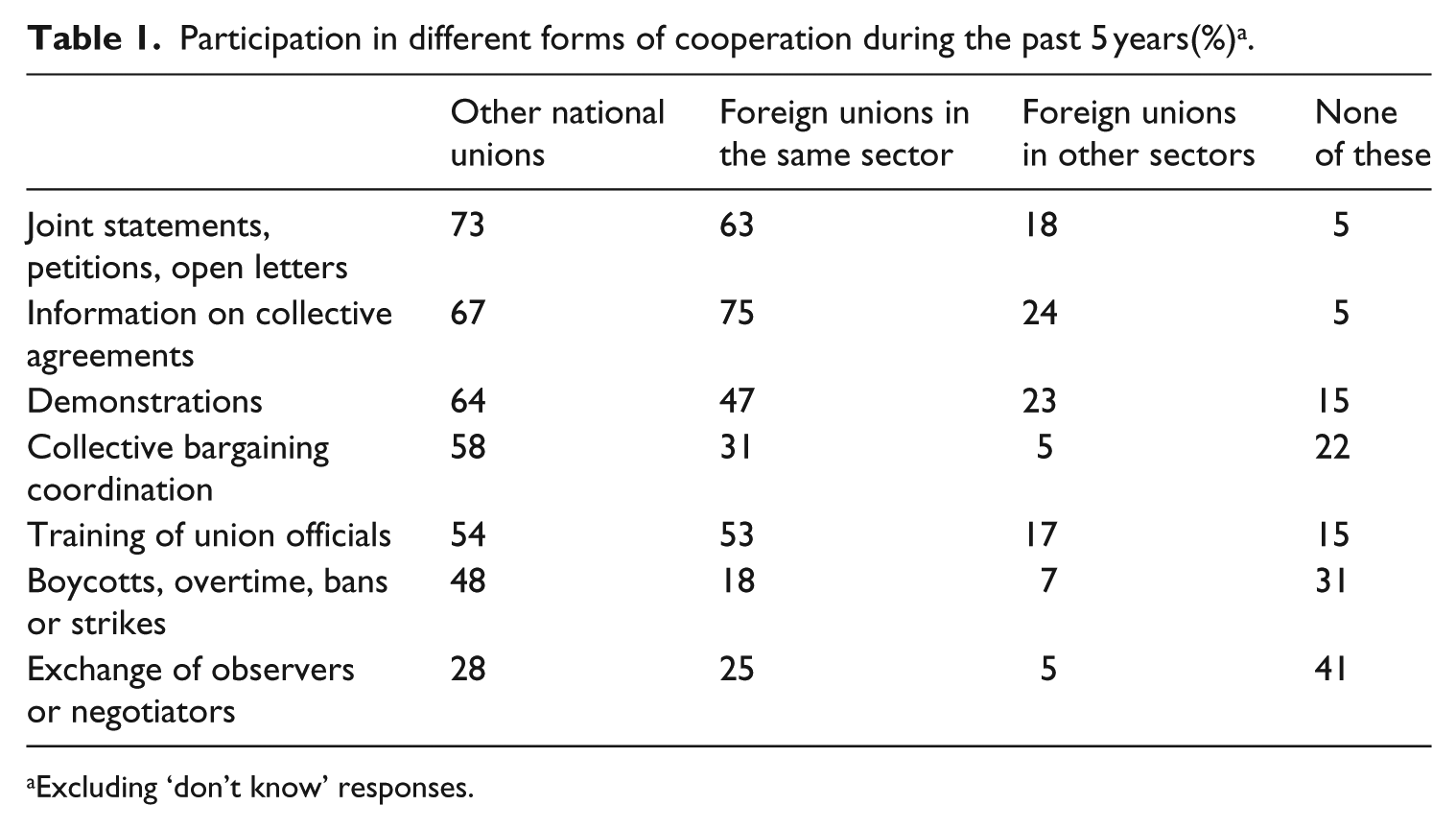
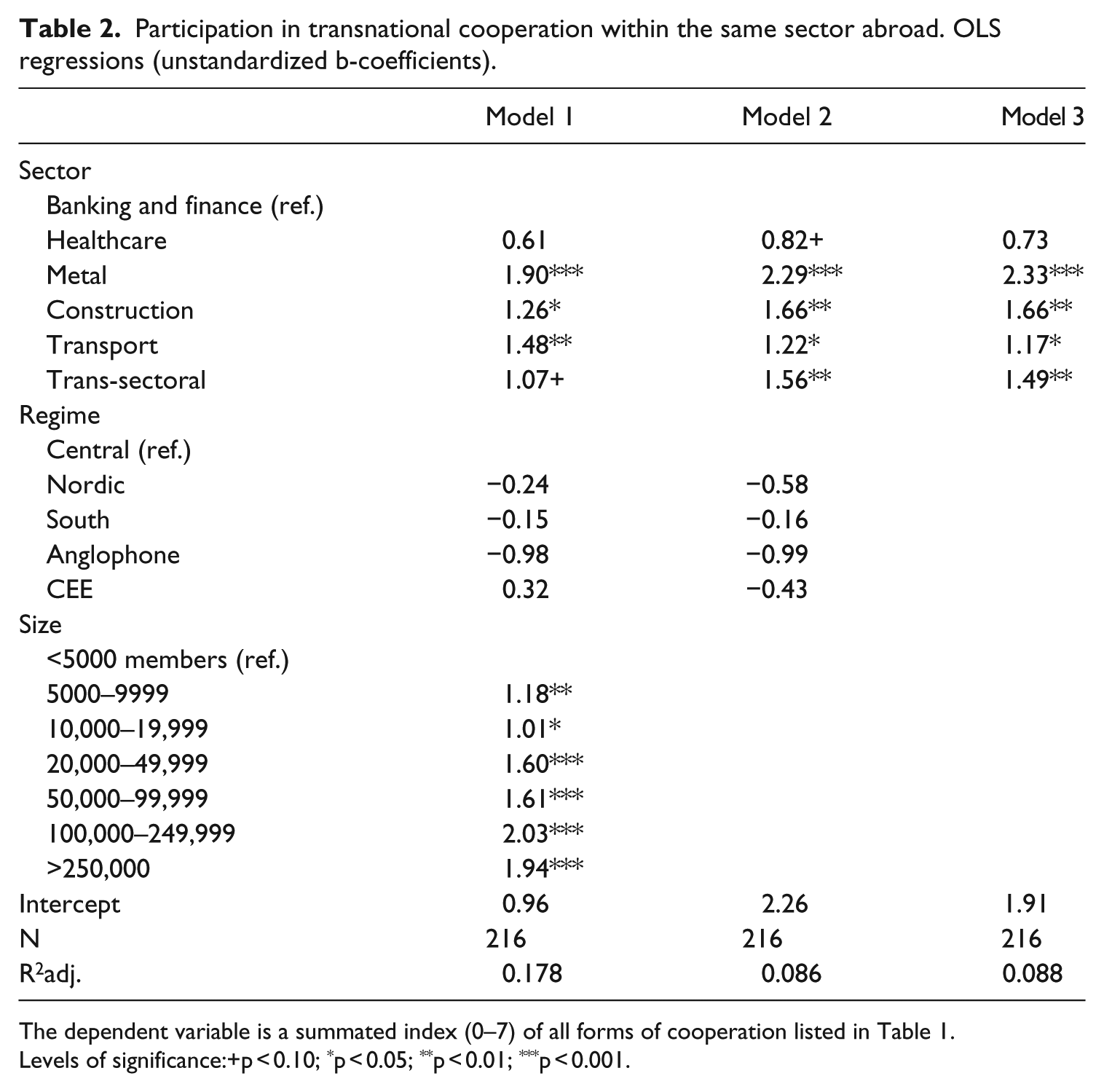
In the next section, we first present some background descriptive results on existing cooperation, its development and organization. We then analyse responses to three sets of questions. The first addresses the extent to which the union had participated in seven forms of cooperation, listed in Table 1, during the preceding 5 years. This set is also analysed using ordinary least squares (OLS) linear regression to assess correlations with sector, regime and size of the organization (Table 2). We created an index (0–7) of responses to all seven items, measuring the extent to which a trade union has participated in various forms of cooperation; its Kuder–Richardson 20 (KR-20) coefficient (analogous to Cronbach’s alpha) was 0.716, indicating high internal consistency. However, it should be noted that this index only indicates the prevalence of different forms of cooperation, and provides no information about their frequency or quality. The reason for focusing or prevalence is that the some forms of cooperation, such as in collective bargaining processes, occur only at fixed periods, whereas contentious action is more sporadic while exchange of information and writing joint statements may be more frequent.
Participation in different forms of cooperation during the past 5 years(%) a .
Excluding ‘don’t know’ responses.
Participation in transnational cooperation within the same sector abroad. OLS regressions (unstandardized b-coefficients).
The dependent variable is a summated index (0–7) of all forms of cooperation listed in Table 1.
Levels of significance:+p < 0.10;
p < 0.05;
p < 0.01;
p < 0.001.
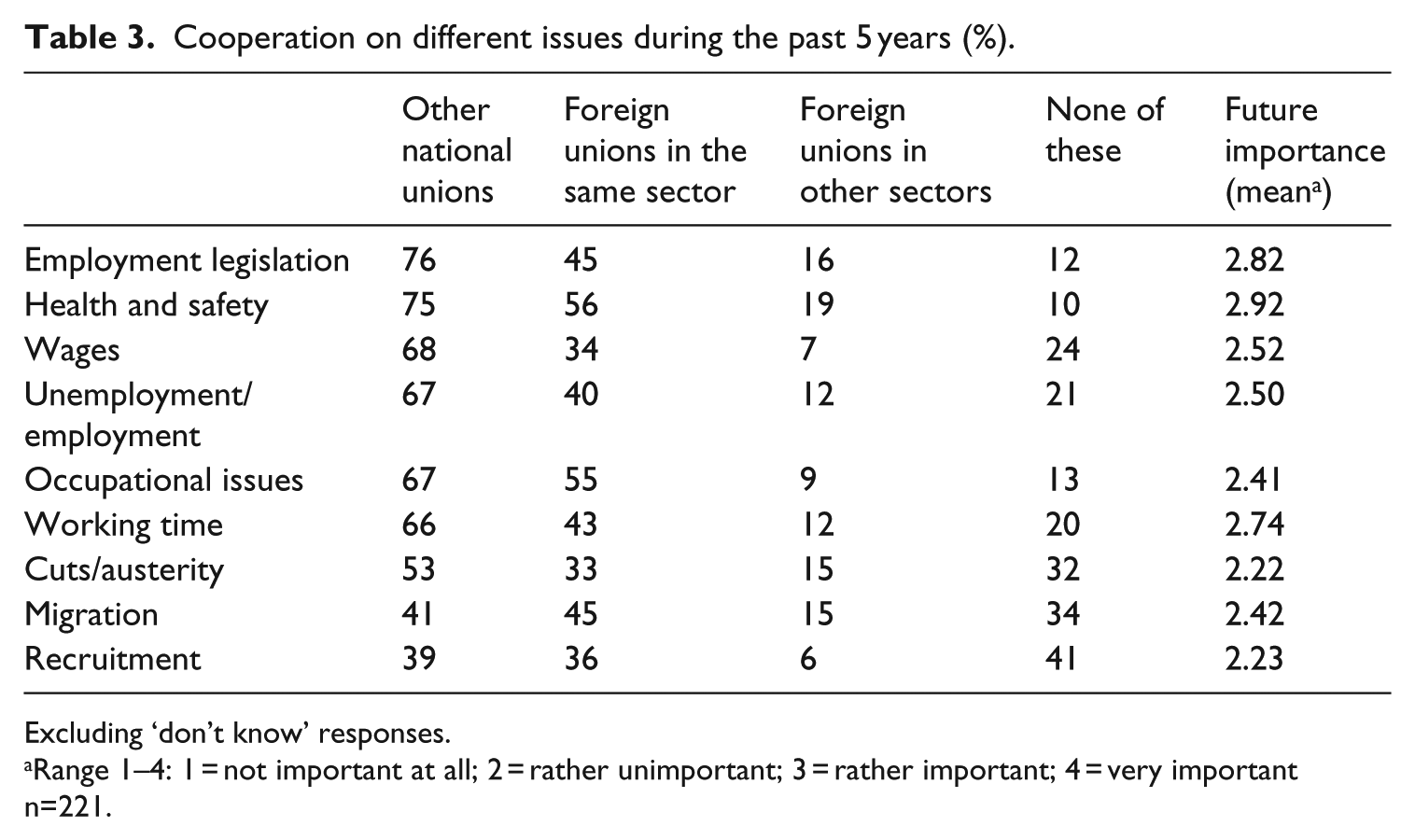
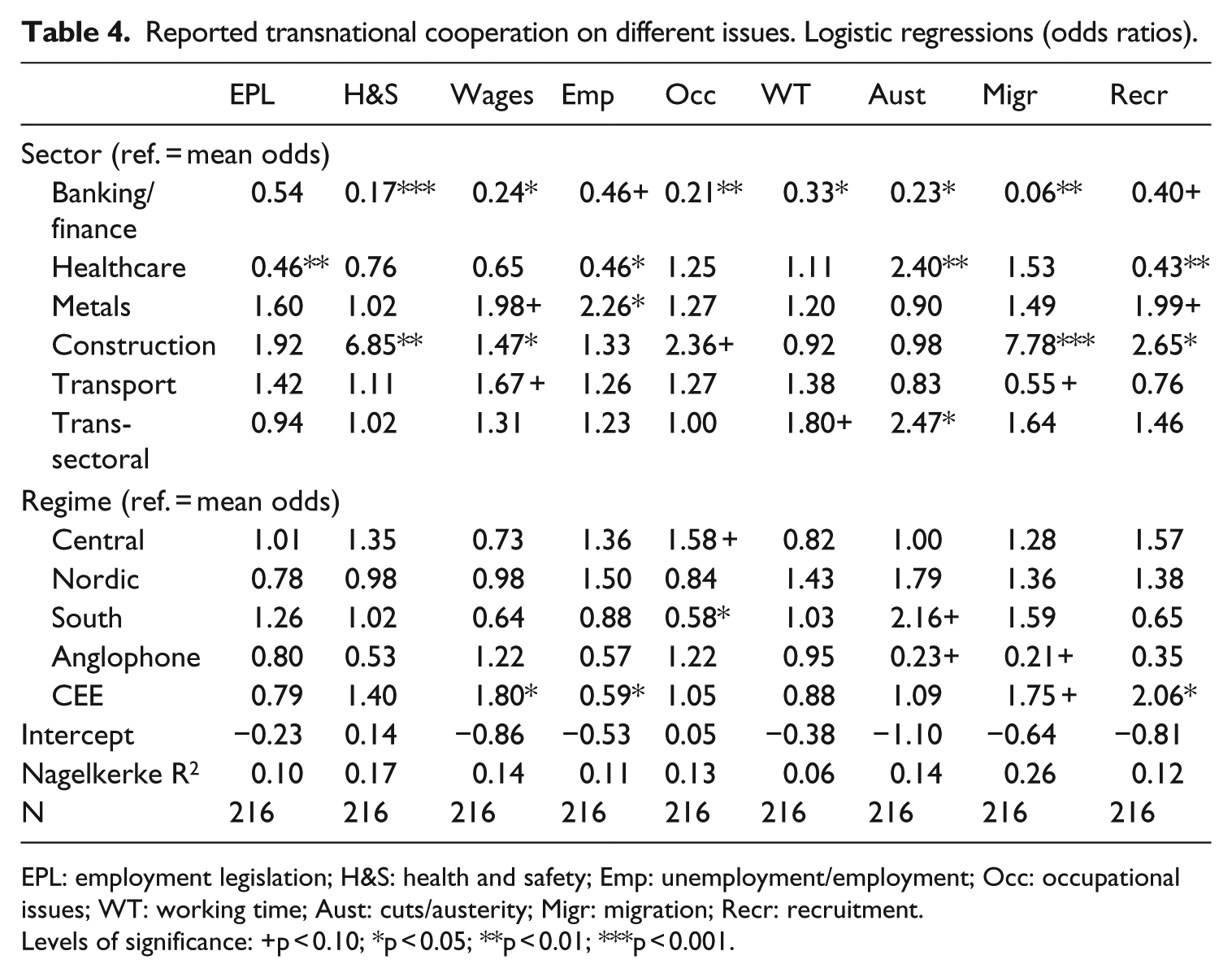
The second and third sets of questions asked whether the responding organizations cooperate on the nine issues listed in Table 3, and to what extent they find these issues important for future cooperation. The issues were chosen to capture the core themes and newer challenges posed by the financial crisis and increased migration. Again, percentages of positive responses were calculated, and regression analyses performed. In contrast to the analysis of the first set of questions, an index construction did not seem reasonable to test the effect of the regime, sector and size variables in analysing these issues. Therefore, the effects of regime and sector were analysed through nine separate logistic regressions, presented in the form of odds ratios in relation to mean odds (Table 4). To evaluate the overall explanatory power of the three background variables, we also performed calculations of model fit in terms of differences in log likelihoods between models relative to a baseline model (Table A2 in Supplemental Material online). Finally, for the third set of questions, concerning the importance of various issues for future cooperation, we performed nine OLS regressions to assess the effect of sector, regime and size of the organization (Table 5).
Cooperation on different issues during the past 5 years (%).
Excluding ‘don’t know’ responses.
Range 1–4: 1 = not important at all; 2 = rather unimportant; 3 = rather important; 4 = very important n=221.
Reported transnational cooperation on different issues. Logistic regressions (odds ratios).
EPL: employment legislation; H&S: health and safety; Emp: unemployment/employment; Occ: occupational issues; WT: working time; Aust: cuts/austerity; Migr: migration; Recr: recruitment.
Levels of significance: +p < 0.10;
p < 0.05;
p < 0.01;
p < 0.001.
Importance of different issues in future cooperation. OLS regressions (unstandardized b-coefficients when controlling for size).
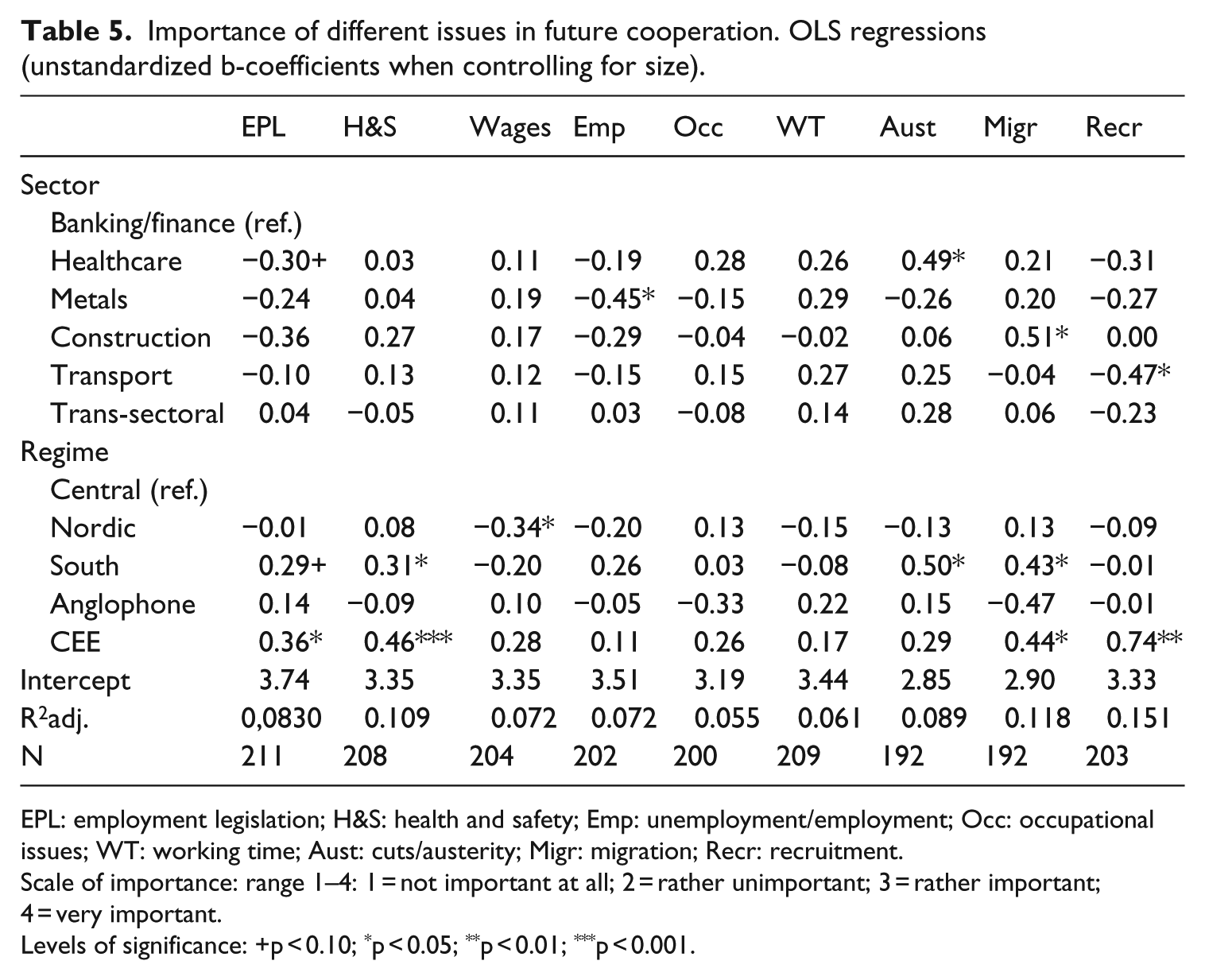
EPL: employment legislation; H&S: health and safety; Emp: unemployment/employment; Occ: occupational issues; WT: working time; Aust: cuts/austerity; Migr: migration; Recr: recruitment.
Scale of importance: range 1–4: 1 = not important at all; 2 = rather unimportant; 3 = rather important; 4 = very important.
Levels of significance: +p < 0.10;
p < 0.05;
p < 0.01;
p < 0.001.
The independent variables in the regressions are industrial relations regime, sector and size of the organization. Following the classification of industrial relations regimes discussed above, we assigned unions to one of the five country groups indicated. For details of country clusters, see Table A1.
Six categories were used in the sector-analyses: banking and finance (n = 22), healthcare (58), transportation (51), construction (21), metals (including mining; 30) and trans-sectoral (37). The last two classes differ from the original selection of sectors, and were created for pragmatic reasons. It was impossible to retain the distinction between metals and mining, because the same trade unions covered both industries in many countries. Similarly, the trans-sectoral category was created because many trade unions reported that they had members in more than one of the specified sectors. The latter category is not a sector of its own; therefore the analysis covers five sectors with a separate category for trans-sectoral unions with members in two or more of these five sectors.
We used size as a proxy for trade union resources, based on self-reported number of members in response to an item with the following seven alternatives: fewer than 5000 (n = 63), 5000–9999 (29), 10,000–19,999 (25), 20,000–49,999 (27), 50,000–99,999 (25), 100,000–249,999 (30) and 250,000 or more (21).
Results
Before testing our theoretical assumptions, we present some background results regarding respondents’ views on transnational trade union cooperation in Europe. First, we asked whether cooperation through different confederal levels had changed in importance over the previous 10 years. Although all types of confederations seem to have become more important over time the sectoral ETUFs have gained most in importance; over 58 percent of the unions stated that their importance has increased. This is higher than the perceived increase in importance of their national confederation (48%), the ETUC (33%), the Global Union Federations (47%) and the International Trade Union Confederation (22%).
The results indicate that the crisis had ambiguous effects on sectoral-level cooperation: over 60 percent of respondents agreed that it had made unions more protectionist, but over 70 percent stated that it had increased their own cooperation with other unions in Europe (Bengtsson and Vulkan, 2018). Over 40 percent reported that their unions desire more transnational cooperation in the future, and 74 percent stated that they would prefer more transnational cooperation in their sector rather than within their own countries. However, because of the low response rate, these figures must be interpreted cautiously, as the non-respondents may have included disproportionately large numbers of unions with little interest in European cooperation.
Regarding existing and future cooperation, there were substantial variations in the activities reported. Below, we first present descriptive statistics concerning the reported forms and issues of cooperation, both within countries and transnationally in Europe. We then address the effects of regimes, sectors and resources on these variables.
Participation in different forms of cooperation
Table 1 indicates two general tendencies: sectoral trade unions cooperate to a somewhat greater extent within their countries than transnationally, and transnational cooperation appears to be largely within sectors. However, some forms of cooperation occur primarily within countries, whereas others are almost as prevalent transnationally. The former category includes contentious forms of action such as boycotts, strikes and demonstrations, but also the coordination of collective bargaining, which remains a highly nation-based industrial relations activity. The other forms are all softer activities based on dissemination of information and learning, which seem to have been transnationalized to a higher degree through exchange of information, joint education/training, exchange of observers or negotiators in collective bargaining and preparation of joint statements. These latter activities are to a high degree conducted within the ETUFs and the ETUC, for which previous research has reported significant levels of cooperation (Degryse and Pochet, 2011; Glassner and Pochet, 2011; Larsson, 2012; Müller, 2016).
We now consider the extent to which variations in cooperation depend on industrial relations regime, sector and size. For this, we examine the OLS regressions with the index of the seven forms of transnational within-sector cooperation as the dependent variable. This conceals some of the variation in forms of cooperation, but our analyses of each specific form showed no new information in relation to previous research at the cross-sectoral level (Larsson, 2014). We thus chose to analyse the general level of cooperation. The regression results in Table 2 indicate that size is consistently, significantly and positively related to transnational, within-sector cooperation. Having established this, we can address the effects of regime and sector. All three models indicate that between-sector differences influence cooperation. Generally, unions in the services sectors are involved in fewer forms of cooperation than those in other sectors, while those in the metals sector are involved in the most. Effects of industrial relations regimes are not significant when sector and size are controlled for.
Several other results are noteworthy. Controlling for size changes the effects of sector. To elucidate the reasons for this, we analysed correlations between size, regime and sector separately. The results show that sector has weaker significance for transnational cooperation between construction and trans-sectoral unions in the full model, because many unions in these sectors are relatively large. The opposite is the case for transportation, which has a large proportion of small unions. Thus, keeping the size effect constant allows more detailed analysis of sectoral effects. For unions of similar size, those in metals and mining and transportation cooperate to a higher degree than the trans-sectoral and construction unions. This, and the even lower degrees of cooperation in services, confirms the theoretical basis of the sectoral regime concept: that differences in exposure to international competition and production location transferability affect unions’ engagement in cooperation.
We performed similar regressions on factors influencing an index based on within-country trade union cooperation, which revealed very small effects. Thus, between-sector differences largely affect engagement in transnational cooperation, and generally have little effect on within-country cooperation.
Issues on which trade unions cooperate transnationally
In Table 3, we present descriptive results showing the extent to which unions reported cooperation on nine different issues, nationally and transnationally. There is also a column presenting means indicating how important they found the issue to be in future cooperation. The results confirm some of the above findings: the higher prevalence of national compared to transnational cooperation, and the general within-sector limitation of the latter. The findings also confirm that most unions engage in some cooperation, either national or transnational, on all the issues, although the prevalence of cooperation varies according to the issue.
There are three exceptions to the tendency for national cooperation to be more common than (within-sector) transnational cooperation. More unions cooperate transnationally than nationally on migration, while similar proportions cooperate nationally and transnationally on recruitment of members and on occupational issues. The last column gives some information on the importance of these issues for future cooperation. The general tendency is that the issues on which unions already cooperate to a considerable extent are most important for the future. However, there are some notable exceptions. First, the very wide and diverse category of occupational issues seems to be given less importance for the future than expected from existing levels of cooperation. Second, the two core trade union issues, wages and working hours, are ranked more important for future cooperation than indicated by existing levels of cooperation, which could be a reaction to the consequences of the financial crisis when many unions had to make wage and working time reductions (Dribbusch et al., 2017; Müller and Platzer, 2017).
Table 4 shows the effects of industrial relations regime, sector and size (proxy for resources) on trade union cooperation on the nine issues. The results are presented in the form of odds ratios in relation to the mean in models. In these analyses the size variable was removed after analyses showed a significant, consistent effect on all nine issues: small trade unions engage in much less transnational cooperation than large ones. From these analyses, it is obvious that sector and size have greater explanatory value than regime. Indeed, for most issues, the regime effects are so small that they do not warrant further comment. For further details, see Table A2 in the Supplemental Material online on changes in the log likelihoods However, the inclusion of regime modestly improves the fit of the baseline model for cooperation on the issues of wages and recruitment, in both cases because unions in CEE countries report significantly higher levels of transnational cooperation than the mean, which probably has to do with the importance of these issues in these countries.
These results confirm previous analyses showing that unions in the services sector generally cooperate less than unions in the other sectors. This is particularly true for banking and finance, in which trade unions cooperate to a significantly lower degree than others on all issues except employment protection legislation (EPL). Cooperation scores for unions in the healthcare sector are generally closer to the means, but below average for several issues. However, an exception is that public sector unions (together with trans-sectoral unions) reported the highest degrees of cooperation on public service cuts and austerity measures.
Table 4 also indicates that several other issues are particularly important in specific sectors. Unions in the construction sector have a particularly strong tendency to cooperate on health and safety and migration issues, but also have more than mean tendencies to cooperate on recruitment and occupational issues. In addition, transportation unions reportedly have particularly little cooperation on migration, while metals sector unions have relatively frequent cooperation on employment issues.
Finally, we performed OLS regressions indicating the importance of these nine issues in future cooperation (Table 5). As shown in previous research, the systematic effects of organizational resources (size) that we obtain when analysing existing cooperation disappear when we analyse ideas about the future (Larsson, 2014). What future cooperation is considered important is obviously quite different from what can be maintained. There were some obvious sectoral effects on the issues that are seen as important for the future: unions in construction put particular emphasis on health and safety, whereas those in healthcare emphasized public services cuts and austerity measures. However, of more interest are the regime differences, which indicate tension between trade unions in the Central and Nordic countries on one hand and those in the Southern and CEE countries on the other; employment legislation, migration and cuts and austerity measures are seen as more important for future cooperation by the latter. In addition, the issue of wages is seen as particularly important by unions in CEE countries, whereas unions in the Nordic countries minimize this issue which might lead towards EU minimum wage legislation. In addition, cooperation on recruitment of members is strongly emphasized by the CEE unions.
Conclusion
Theories of differences in trade unionism and industrial relations in Europe have largely focused on nationally based models and varieties of trade unionism or regimes and clusters of industrial relations (Caprile et al., 2018; Gumbrell-McCormick and Hyman, 2013; Hyman, 2001; Visser et al., 2009). As a reaction to these classifications that loosely correspond to geographical regions in Europe, Bechter and Brandl (2015) have suggested that sectoral (economic) contexts may be a more accurate basis for comparative industrial relations analyses at the European level. Both these approaches seem relevant to existing variations in the extent, form and issues of trade union cooperation at sectoral level in Europe. This is partly because the challenges facing trade unions vary by sector and industrial relations regimes (Gumbrell-McCormick and Hyman, 2013; Lehndorff et al., 2017). But is also because trade union structural power (bargaining strength and workplace influence), organizational power (membership density, financial resources and staffing) and institutional power (bargaining power and political influence), vary not only between countries, but also between sectors (Bieler and Lindberg, 2011: 223; Caprile et al., 2018; Kelly, 2015; Visser et al., 2009).
Our aim was to test the explanatory relevance of national industrial relations regimes and sectoral regimes for analysis of variations in transnational trade union cooperation, while controlling for union resources (size). However, before presenting the main conclusions from these analyses, we will recapitulate some results from a more descriptive effort to map existing trade union cooperation and some of the respondents’ attitudes towards its development.
As discussed in the ‘Introduction’, trade unions in Europe face many challenges that transcend the national level. In many countries, they have also lost power resources in the national arena. However, this study shows quite strong transnational engagement at the European sectoral level. Although there is some acknowledgement of renationalization tendencies because of the financial crisis, many trade unions want to increase their cooperation across Europe, and many see developing cooperation across borders within their sector as more important than enhancing cross-sectoral cooperation within their own country. In addition, although our analyses provide no data on frequencies or quality of this cooperation, the prevalence of various forms of transnational cooperation is quite high, even compared with national-level cooperation. There is still less transnational cooperation on more contentious forms of action such as demonstrations and strikes, or on the core activity of collective bargaining: issues that are tightly anchored at the national level. However, on softer forms of cooperation, such as information exchange, joint training, exchange of observers in bargaining and production of joint statements, there is a high prevalence of transnational cooperation, even in the post-crisis years.
Turning to the theoretical question discussed above, the first main conclusion is that sectoral differences explain more of the variation in levels of transnational cooperation and issues of cooperation than do industrial relations regimes. These overall results thus support the theoretical claims of Bechter et al. (2012) and Bechter and Brandl (2015) that sectoral (economic) contexts may be more important than national (political) contexts in comparative industrial relations analyses at the European level. Notably, however, this is only the case for transnational cooperation, whereas there are far fewer differences between sectors when union cooperation within their own countries is analysed.
However, these conclusions mainly concern overall levels of cooperation in all its forms. By focusing on specific forms of cooperation, we can confirm previous findings that there are effects of industrial relations regimes on preferences for different forms of joint action. Continental, and particularly Southern, trade unions show greater preference for contentious action than do the Nordic unions (Larsson, 2014). CEE countries more strongly favour cooperation on education of union officials, while Central unions stress the importance of joint statements. Anglophone and Nordic unions are somewhat more restrained in their support for cooperation.
In addition, the overall results of our analyses of the issues important for future cooperation seem to confirm the previous results, pointing to the importance of cooperation for European trade unions in industrial relations regimes with more fragmented and weaker partner relations, particularly those in CEE countries, but also in Southern Europe, compared with the Central and Northern countries with well-developed and organized partner relations at sectoral level (Larsson, 2015). Trade unions in CEE and Southern countries put more emphasis on future cooperation over core issues such as wages and working conditions than do unions in the Nordic and Central countries.
The second main conclusion is that among the five sectors studied there is the least cooperation in services (banking and finance, and healthcare and the most in the manufacturing (metal) sector. Regarding the issues of cooperation and the unions’ evaluation of the importance of different issues in future cooperation, there appear to be several sector-specific patterns. Unions in the healthcare sector and trans-sectoral unions have particularly strong tendencies to cooperate on issues related to cuts in public services, which they also find more important for the future than unions in other sectors. Unions in metals (including mining) have a strong tendency to cooperate over employment and also to emphasize its importance for the future. Construction unions prioritize cooperation over health and safety and migration compared to the other sectors.
A third main conclusion is that organizational resources (size) are strongly, significantly and positively related to the extent of transnational cooperation. As discussed in the ‘Introduction’, there have been some initiatives to strengthen the capacity of the social partners at the European and national levels. Such factors have been shown to be important at the sectoral level for trade union cooperation to produce the desired results (Bechter et al., 2017; Perin and Léonard, 2016; Prosser, 2016). From our results, it is obvious that capacity-building is of great importance not only for social dialogue effectiveness and engagement but also for trade union engagement in transnational cooperation in Europe more generally, to coordinate national strategies through bilateral and multilateral cooperation from below.
Supplemental Material
Supplemental_online_material_Table_A1_and_A2 – Supplemental material for Patterns of transnational trade union cooperation in Europe: The effect of regimes, sectors and resources
Supplemental material, Supplemental_online_material_Table_A1_and_A2 for Patterns of transnational trade union cooperation in Europe: The effect of regimes, sectors and resources by Patrik Vulkan and Bengt Larsson in European Journal of Industrial Relations
Footnotes
Acknowledgements
The authors thank the two anonymous reviewers for helpful comments on a previous version. The survey was developed and data collected with help from the project members: Bengt Furåker, Mattias Bengtsson and Kristina Lovén Seldén.
Funding
The author(s) disclosed receipt of the following financial support for the research, authorship, and/or publication of this article: The research on which this article is based was financed by the Riksbankens Jubileumsfond (RJ, Swedish Foundation for Humanities and Social Sciences), Grant P13-0776:1.
Supplemental Material
Supplemental material for this article is available online.
Author biographies
References
Supplementary Material
Please find the following supplemental material available below.
For Open Access articles published under a Creative Commons License, all supplemental material carries the same license as the article it is associated with.
For non-Open Access articles published, all supplemental material carries a non-exclusive license, and permission requests for re-use of supplemental material or any part of supplemental material shall be sent directly to the copyright owner as specified in the copyright notice associated with the article.
