




Abstract
This network analysis of trade union cooperation in Europe uses survey data and interviews to map and analyze transnational cooperation networks in the metal, construction, transportation, and healthcare sectors. The study examines the extent to which sectoral and regional clustering tendencies exist in these networks and whether there are differences between the sectors with regard to structure, density, and central actors. The results show that networks of regular bilateral cooperation tend to stay within the sectors, and that there are tendencies toward regional clustering in all sectors. Unions in the Nordic and southern regions of Europe have a strong intraregional focus in bilateral cooperation, whereas unions in CEE and CWE countries have a greater share of interregional partners. Unions in the CWE region cluster at the core of all the networks, and German unions are the main brokers between other regions, which tend to cluster in more peripheral offshoots.
Introduction
Transnational trade union cooperation in Europe is driven from below and above. From below, national unions need to share information, coordinate strategies, and join forces because companies and labor markets transcend national industrial relations institutions (Erne, 2008; Marginson and Sisson, 2004; Seeliger, 2019). In addition, national unions are pressed to cooperate transnationally because of decreasing power resources on the national level (Baccaro and Howell, 2017; Herman, 2017; Kelly, 2015; Lehndorff et al., 2017).
From above, transnational trade union cooperation is encouraged by the European Commission as an integrated part of the EU’s multilevel governance system, through the European-level arenas for social dialogue and consultation (Rhodes, 2015). These consultations and dialogue activities are coordinated by the joint European organizations on cross-sectoral and sectoral levels: the European Trade Union Confederation (ETUC) and the European Trade Union Federations (ETUFs) (Marginson and Sisson, 2004; Traxler et al., 2008). Because these meta-organizations have some resources and capacities of their own, they may also be seen as driving transnational trade union cooperation from above, while simultaneously aggregating and channeling from-below initiatives.
Central theoretical approaches in studies of the institutionalized arenas of cooperation from above are those of (multilevel) industrial relations (and governance) institutions (Keune and Marginson, 2013; Marginson and Sisson, 2004; Rhodes, 2015). Some of the from-below activities are approached through social movement approaches (Erne, 2008; Gajewska, 2009). Connected to both is an emphasis on power resources and strategic action (Gumbrell-McCormick and Hyman, 2013: 30ff.; Lehndorff et al., 2017; Pernicka et al., 2017; Seeliger, 2019). The importance of transnational networks are often discussed in this connection. However, the methods of social network analysis are seldom used. The network concept is rather used quite loosely to refer to cooperation in case studies or on specific issues; in research on cross-border bargaining networks (Erne, 2008; Hammer, 2010; Pulignano, 2009; Thomas, 2013), or on cooperation in European Works Councils (EWCs) (Arrowsmith and Marginson, 2006; Bernaciak, 2010; Meardi, 2012).
This study is an explorative social network analysis of transnational inter-organizational cooperation between trade unions in Europe. The aim is to map and compare such networks in the metal, construction, transportation, and healthcare sectors in a broad sense. 1 The guiding questions for the analysis are the following: (1) To what extent are there sectoral or sub-sectoral and regional clustering tendencies in trade union networks in Europe? (2) Are there differences in network integration between these sectors, and what patterns may we see regarding who are the central actors and main brokers between clusters?
The study has a mixed-methods design. We use quantitative survey data to map networks (n ties = 487), and qualitative interview data (n interviews = 29) to validate results and understand the structure of the networks. Since our data do not cover the full network, but only strong ties, we will not apply advanced network measures. However, since network studies are scarce in this field, the study contributes to existing research on trade union cooperation by adding new knowledge and validating previous results based mainly on qualitative case studies.
The article begins with a clarification of what we mean by transnational trade union cooperation networks, before discussing what is known from previous research. The results are introduced with a description of the multiplexity and sectoriality of trade union networks. We then analyze similarities between the sectors in terms of regional clustering tendencies and the balance between intra- and interregional cooperation structures. Following this, we discuss the densities, core actors, and main brokers of the sectors. The article ends with a general discussion on conclusions drawn from the results in connection to previous research.
Theoretical conceptualizations and previous research
Before discussing previous research, some conceptual issues need to be clarified. First, our focus is on inter-organizational rather than interpersonal networks. We define trade unions as the main actors (nodes), not individual unionists. Both approaches are legitimate, and empirically such networks are vertically nested because of the organizational relation between representatives and their unions (cf. Brailly et al., 2016). In fact, the capacity to build and maintain personal networks is an important facilitator of transnational cooperation between unions (Larsson, 2012).
Second, the network relations (ties) between trade unions are approached as multiplex, meaning that different relations are overlapping. Unions cooperate on many activities: information exchange and learning; collective bargaining, demonstrations, and strikes; negotiations with European employer organizations; and lobbying toward the EU or on a national level (Dufresne, 2002; Vulkan and Larsson, 2018). The concept of cooperation may empirically cover any or all of these activities.
Third, inter-organizational networks are institutionalized to different degrees, and they exist both directly between trade unions and within confederations. Theoretically, we may speak of four forms of cooperation structure signifying different degrees of institutionalization (cf. Müller and Platzer, 2017: 294; Müller et al., 2010): (1) Establishment of contact and exchanges of information in bi- or multilateral communication networks, with national unions still acting independently. (2) Identification of common interests and the formation of coordination networks, enabling unions to coordinate their individual actions. (3) Development of joint activities on a case-by-case basis in cooperation networks. (4) Formation of a supranational meta-organization with a mandate to decide and act on behalf of its member unions (cf. Ahrne and Brunsson, 2008).
Even though all these forms exist in European trade union cooperation (cf. Glassner and Pochet, 2011), they are separable only analytically. Empirically they are difficult to untangle because of the multiplexity of relations, and because ‘the joint efforts to build formalized supranational structures for coordination contribute to creating corresponding informal structures (e.g. trust) as a by-product’ (Traxler and Mermet, 2003: 237). As an effect, informal communication networks, more formal coordination and cooperation networks, and concertation through the ETUC and the ETUFs are mutually supportive, so that bottom-up and top-down processes connect in a multilevel structure (cf. Keune and Marginson, 2013; Marginson and Sisson, 2004).
Previous research on sectoral trade union networks
Much research exists on trade union cooperation as organized through the ETUC, ETUFs, and EWCs. However, the network concept is most explicitly used in research on coordination of collective bargaining in border regions (Marginson and Sisson, 2004; Traxler et al., 2008). This research, which does not use social network methods, has a tendency to focus on the metal sector, in which such coordination is strongly developed because of its transnationally competitive context (Glassner and Pusch, 2013; Magnusson and Murhem, 2009). Even so, we believe this research provides important information on networking between unions in other sectors as well. We will therefore discuss the development of such networks based on from-below coordination and from-above organization, and then move on to explicit social network studies.
An early example of from-below coordination across neighboring countries with high market integration and similar industrial relations was the DACH initiative in metal and manufacturing in Germany, Austria, and Switzerland. This initiative started in the 1960s as an informal communication network to increase mutual understanding on bargaining practices, but developed into a coordination network, and became a forum for interest coordination within the meta-organization EMF, the European Metal Workers Confederation 2 (Traxler et al., 2008). During the 1990s, the German union IG Metall also established such networks with Polish, Austrian, Czech, Hungarian, Slovakian, and Slovenian unions, the so-called Vienna Memorandum Group. At the end of the 1990s, IG Metall had developed such regional networks with unions in no fewer than 14 neighboring countries (Gollbach and Schulten, 2000).
Another region with a long history of union cooperation in the metal sector is the Nordic countries. Already in the 1970s, their cooperation developed into the meta-organization Nordiska Metall, later integrated into the EMF and in 2006 merged into the Nordic cross-manufacturing federation Industrianställda i Norden. The Nordic cooperation focused on wage bargaining but also on industrial polices, health and safety, and support to Baltic unions. Over the years, the coordination of strategies within the EMF (later IndustriALL Europe) grew more focused, and the Nordic unions became a major actor through their joint strategies. Notably, they developed strong bonds to other important unions in the sector, particularly IG Metall (Andersen, 2006; Magnusson and Murhem, 2009).
These two cases illustrate the regional structure of networking from below at the beginning of 2000, with the strongest coordination networks centered in Germany and the Nordic countries (Marginson and Sisson, 2004: 112ff.). Unions from southern Europe were said to be less involved, and Anglophone unions quite detached. The cases also show different developments. The Nordics formalized cooperation into a meta-organization, from which links to other areas of Europe were brokered. The continental cooperation developed as networks connected to a core broker, the German IG Metall, on the basis of the latter’s resources and function as a ‘wage anchor’ in neighboring countries (Glassner and Pusch, 2013). In other sectors, German unions had a similar position, since ‘regional collective bargaining co-operation agreements have mainly originated in Germany’ (Dufresne, 2002: 12). An example is the German construction union IG BAU, agreeing on coordination with unions in Italy, Switzerland, Austria, Poland, the Netherlands, and Belgium in the 1990s.
To understand the interconnection between these from-below developments and from-above organized cooperation, we must turn to the ETUFs, which have worked to strengthen European collective bargaining coordination within their sectors (Glassner and Pusch, 2013; Marginson, 2005). In 1993, the EMF developed a joint bargaining policy for metalworkers in Europe. This was followed by their 1998 coordination rule, and attempts to establish bi- and multilateral collective bargaining networks on a regional basis, in northwestern European countries with Germany as a center, but also in the Scandinavian countries and in the Pyrenees region of France, in Spain, and in Portugal (Gollbach and Schulten, 2000). Other ETUFs took inspiration and created similar structures; examples relevant to this article include ETUFs in construction (EFBWW), public services (EPSU), transportation (ETF), and private services (UNI Europa). These initiatives encouraged exchange and coordination through collective bargaining conferences, seminars, and training events, and by establishing virtual networks of contacts and information on collective bargaining outcomes (Glassner and Pochet, 2011; Müller et al., 2010; Pulignano, 2009).
Nordin’s (2009, 2010, 2011) social network analyses of the metal sector based on self-reported cross-national ties in 2008–2009 add further details to the picture. He focused on cooperation in general, rather than on collective bargaining only, and thus detected networks stretching beyond border regions. However, he still found tendencies of regional clustering in a network consisting of three overlapping cores (Nordin, 2010). The main core, centered around Germany, also included unions from Belgium, Spain, and the UK. The Nordic countries made up a second core, and the third consisted of stronger unions in the Central and Eastern European (CEE) countries together with Germany and Austria. The third core was thus partly based on the Vienna Memorandum Group, which in itself was initiated by IG Metall, but which obviously had developed further after the eastern enlargement (Landgraf and Mansfeldová, 2015).
When analyzing the centrality of the actors, IG Metall was unsurprisingly at the top, followed by some Nordic, UK, and Continental and Western European (CWE) unions (NL, AT, BE). There were also a few centrally placed unions from southern Europe (FR, PT). The unions in the CEE countries were generally more marginal because of tendencies of fragmentation and because they mainly connected with each other. In addition, Nordin (2009) found a higher within-density than between-density for all the regional groups of the EMF. The central group (AT, DE, CH) had both the highest within-density and highest between-density; that is, many connections outside of their region. The lowest densities were found in the southeastern (BA, BG, CR, KO, MK, RO, RMSE) and southwestern (FR, PT, ES) groups. Nordin (2009) also showed that degree centrality correlated with member fees paid to the EMF, showing that large unions had a more central position than small unions. This result indicates that resource-strong actors were brokers in the network, and that resource-weaker actors tried to link with them. An exception was the Nordic unions, which had a more central position in the network than their size accounted for, which was explained by their joint power through the Nordic meta-organizations (Nordin, 2011).
The metal sector has been a forerunner in the development of transnational cooperation. Unions in manufacturing generally, and in the metal sector particularly, cooperate more intensively than those in the services sectors, with construction and transportation lying somewhere in between (Furåker and Bengtsson, 2013; Glassner and Pusch, 2013; Magnusson and Murhem, 2009; Vulkan and Larsson, 2018). This is explained by the fact that manufacturing is more exposed to competition and has a higher degree of production location transferability than the services sectors (Bechter et al., 2012; Glassner and Pochet, 2011: 13). In addition, manufacturing unions are traditionally more resourceful than services unions (e.g. Bieler and Lindberg, 2011: 223), and resources are decisive for cooperation (Vulkan and Larsson, 2018). However, because of the challenges of labour mobility – posting of workers in construction, cross-border operations in transportation, and cross-border recruitment in healthcare – and since EU policies affect all of the studied sectors, unions in the other sectors are also pressed to cooperate transnationally.
Based on this review, a number of things seem important to explore further. First, a comparative approach could expand the knowledge from the metal sector to distinguish between sector-specific patterns and general tendencies in trade union cooperation in Europe. Thus, the first empirical question we tackle is what current sectoral or sub-sectoral and regional clustering tendencies we find when comparing the metal, construction, transportation, and healthcare sectors. In connection to this, we also elaborate on the balance between intra- and interregional cooperation, as discussed by Nordin (2009). Following this, the second set of empirical questions, which relate to the idea of the metal sector as a forerunner in cooperation, concern whether differences exist between the sector networks in density, and whether there are sectoral similarities in the regional affiliation of the central actors and main brokers between the clusters in the networks.
Methodological approach and materials
This study is an explorative, mixed-methods network analysis. The exploratory approach implies that we did not formulate specific hypotheses to be tested with statistical measures (De Nooy et al., 2018: 6ff.). Quantitative survey data were used to map patterns of cooperation ties between the trade unions. Qualitative interviews added information about how the unions cooperate and validated the quantitative results (Hollstein, 2014).
The quantitative data were collected through a questionnaire to 602 unions in 36 European countries in 2015–2016. We targeted unions in mining, metals, construction, transportation, healthcare, and banking and finance to cover the main sectors of established typologies: extractive, productive/transformative, distributive, and public and private services. Since the unit of analysis is organizations, we sent the questionnaire to top-level representatives. In total, we received responses from 221 unions (37%), 66% of which were answered by secretaries-general, presidents, or vice presidents; 17% by international secretaries; and the rest by other high-level officials.
The survey covered questions on transnational cooperation. We used an open-ended question for surveying networks: ‘Please rank 3-5 trade unions in other European countries with which your organization has regular bilateral cooperation’ – an approach inspired by previous research studying cooperation networks in Europe (Huhe et al., 2018). The network question was preceded by others giving a context to the respondents. These questions concerned what arenas of cooperation were important; what forms of cooperation they had participated in over the last five years; and what issues they had focused on in their cooperation (cf. Vulkan and Larsson, 2018).
After deleting answers that were illegible or incorrect (for example listing ETUFs rather than national unions), our dataset consists of 487 ties connecting 311 unions. This is not a full network, which has some implications for the analyses. First, by limiting the number of partners to three to five, we have data only on the strong ties of regular cooperation. This limitation reduces the variation in density between the sectors, which is why we use density measures with caution. Second, since only 118 respondents gave usable responses, there are many missing cases, even if these responses linked 311 unions. However, the number of missing links is smaller than the number of missing cases. Some responses are correct reports of the non-existence of regular bilateral transnational cooperation, since these trade unions cooperated mainly within their ETUF, and had no regular bilateral partner. Another weakness is that response rates were different between regions, with the UK and Ireland being the worst cases (for details, see Vulkan and Larsson, 2018).
The network analysis was performed with the open-source software Gephi (Bastian et al., 2009). For illustrating network spatialization, we used the ForceAtlas2 algorithm (Jacomy et al., 2014). Some additional methodological choices are worth noting: First, the mining and metal sectors were merged since they are often organized in the same union. Second, while banking and finance is included in the overall analysis, we exclude it from the sectoral comparison because of a relatively small n. Third, although the networks are weighted, we chose to graph them unweighted to increase readability. Finally, we also included Nordic confederations (NN) in the graphs of national unions, since some respondents reported them as a direct cooperation partner.
The qualitative material consists of 29 interviews with 34 centrally placed union representatives, performed 2015–2016. The selection aimed to achieve a variation in sectors and regions corresponding to the survey. We targeted unions in the five sectors in five countries from different regions in Europe (DE, SE, IT, UK, CZ). Given that union organization and sectoral congruence differ between countries (Léonard et al., 2012), we did not expect to arrive at identical numbers for each country, even though that was our ambition. We had some non-responses and also recommendations to contact other organizations, so we extended to more countries, sectors and also some confederations in CEE countries. We ended up interviewing representatives from four German (DE) unions, seven Swedish (SE) and one joint Nordic (Nord) unions, five Italian (IT) unions, three UK unions, three Czech unions (CZ), three Hungarian unions (HU), two Latvian unions (LV), and one Lithuanian union (L). The interviewees represented unions in healthcare (7), construction (5), metal (5), banking and finance (5), and transportation (3), as well as other sectors or confederations (4).
All interviewees had top-level or international secretary (or similar) positions. All had experience of cooperation within the ETUFs or ETUC, and from direct transnational trade union cooperation. In this article, we only quote interviews from the metal, construction, transportation, and healthcare sectors. The quotations are from verbatim transcriptions, in some cases translated into English from Swedish and German. They are slightly edited to increase readability. For research ethical reasons, only countries and sectors are indicated, not the specific names of trade unions.
Results
Before presenting the sectoral networks, we will briefly discuss what kinds of transnational cooperation trade unions reported in the survey and interviews. The most frequent form was sharing information on collective agreements, which 75% in the survey had taken part in, within their sector. This was followed by joint statements, petitions, or open letters (63%), joint training of union officials (53%), demonstrations (47%), coordination of collective bargaining (31%), exchange of observers or negotiators in bargaining (25%), and supporting boycotts, overtime bans, or strikes (18%). These figures illustrate the multiplexity of the cooperation networks, and that bottom-up and top-down processes interconnect, since some forms are typically concerted by the ETUFs whereas others are from-below organized activities (cf. Vulkan and Larsson, 2018).
The interviews indicate that the strong inter-organizational ties we will graph are only a stable core of a wider network of weak, interpersonal ties used for specific issues or problems at hand. As stated by an Italian unionist, their union establishes contacts ‘according to the needs’ when a problem or issue arises. Thus, their union had sporadic exchange with countries as far away as Denmark and Poland (#29 IT). Since the ETUFs create arenas to meet with unions all over Europe, a network graph of weak ties would cover most of Europe. The following quotation from a somewhat peripheral organization illustrates the difference between the potentiality in weak ties and the actual cooperation through strong ties: [With some] countries, our cooperation is only a few emails [from] time to time, when there’s a need. […] We have more or less at least one person in every country [that] we can write or phone to ask some questions. But, the reality is that, like every trade union, we are very busy on the national level, so there are not a lot of international questions we are involved in. (#12 LV)
Also the strong ties vary widely. A German respondent described how they have general meetings at the chairperson level once a year with some unions, whereas with others they meet at lower levels several times per year, discussing specific topics. With a few select partners, they even had a steady working group to develop joint strategies on industrial policy (#11 DE). As previous research shows, the issues and intensity of cooperation vary not only between sectors and regimes but also within, depending on resources and interests (Bengtsson and Vulkan, 2018; Vulkan and Larsson, 2018). The joint interest to cooperate may thus vary with different bilateral partners – as illustrated by one Swedish representative: With the Germans, [cooperation] is mainly about politics, economy, industrial policy […] With the French [and] the Dutch, it is a lot more related to companies, company issues, restructuring, and so on. The British: that may actually be a little of everything, it can be anything from organizing to broader political issues […] The Spanish: you can say that it’s very much the social agenda. (#2 SE)
The results of the survey showed a strong intra-sectoral tendency in transnational trade union cooperation (Vulkan and Larsson, 2018). This tendency is even more accentuated in the analysis of the survey network question, which focused on the main partners. When producing a graph over the whole network data set (not shown), the five sectors formed relatively isolated components, easily decoupled by removing just a few nodes. The inter-sectoral bridges consisted mainly of cross-sectoral unions that organize workers in more than one of the sectors.
Clusters and regions
We will now analyze the sector networks in Figures 1–4. We find a tendency toward regional clustering, in line with Nordin’s (2010) results from the metal sector. This tendency is most obvious in the metal sector (Figure 1). The majority of the southern (green 3 ), the Nordic (blue), and the CEE (orange) unions may be found in more peripheral clustering offshoots connected to a central core consisting of CWE unions (deep pink). However, there are also some direct interconnections between the three less-central clusters. As we had low response rates from unions from the British Isles (grey), we cannot say anything substantial about their clustering tendencies for any of the sectors.
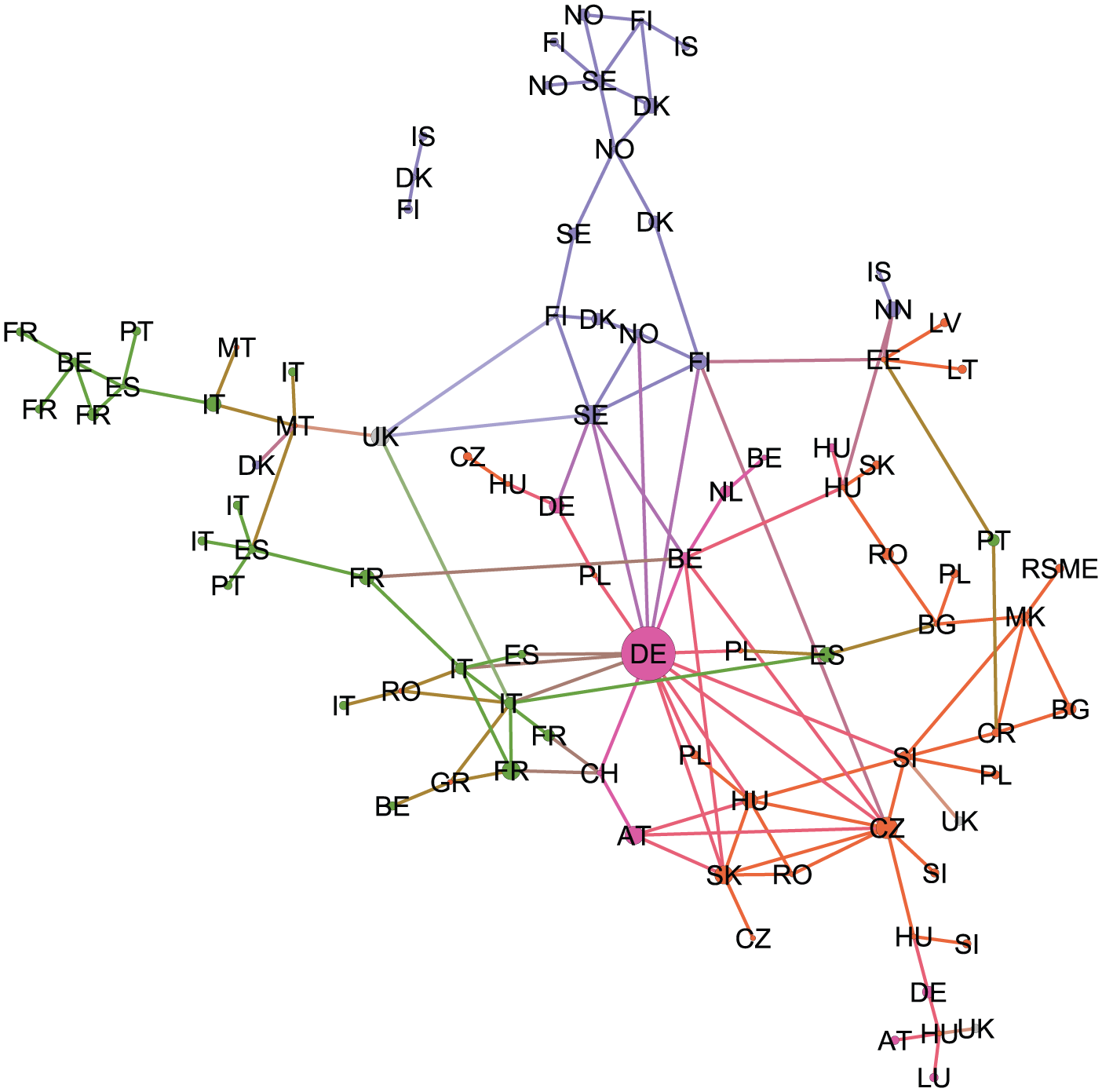
Metal sector network.
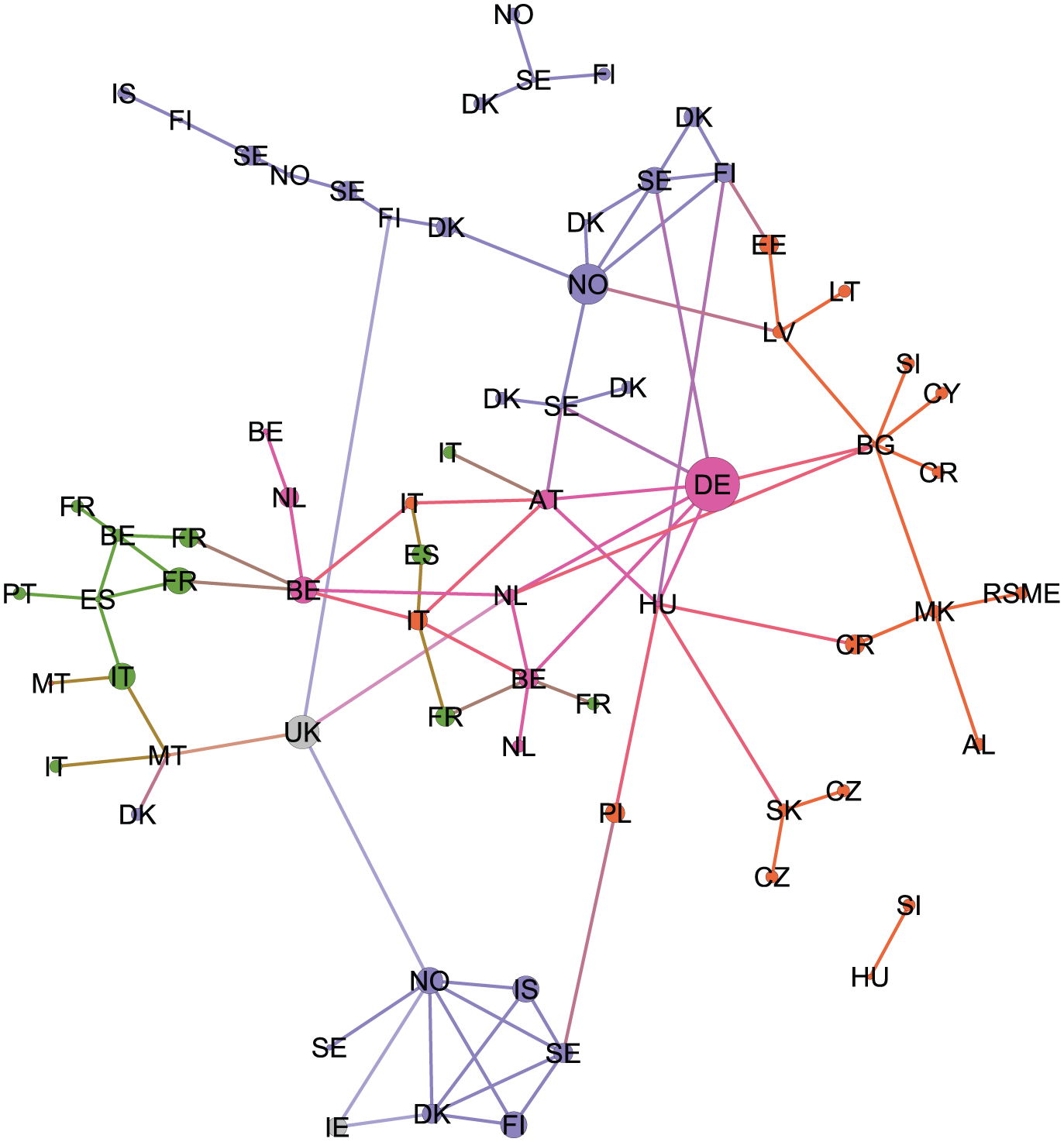
Construction sector network.
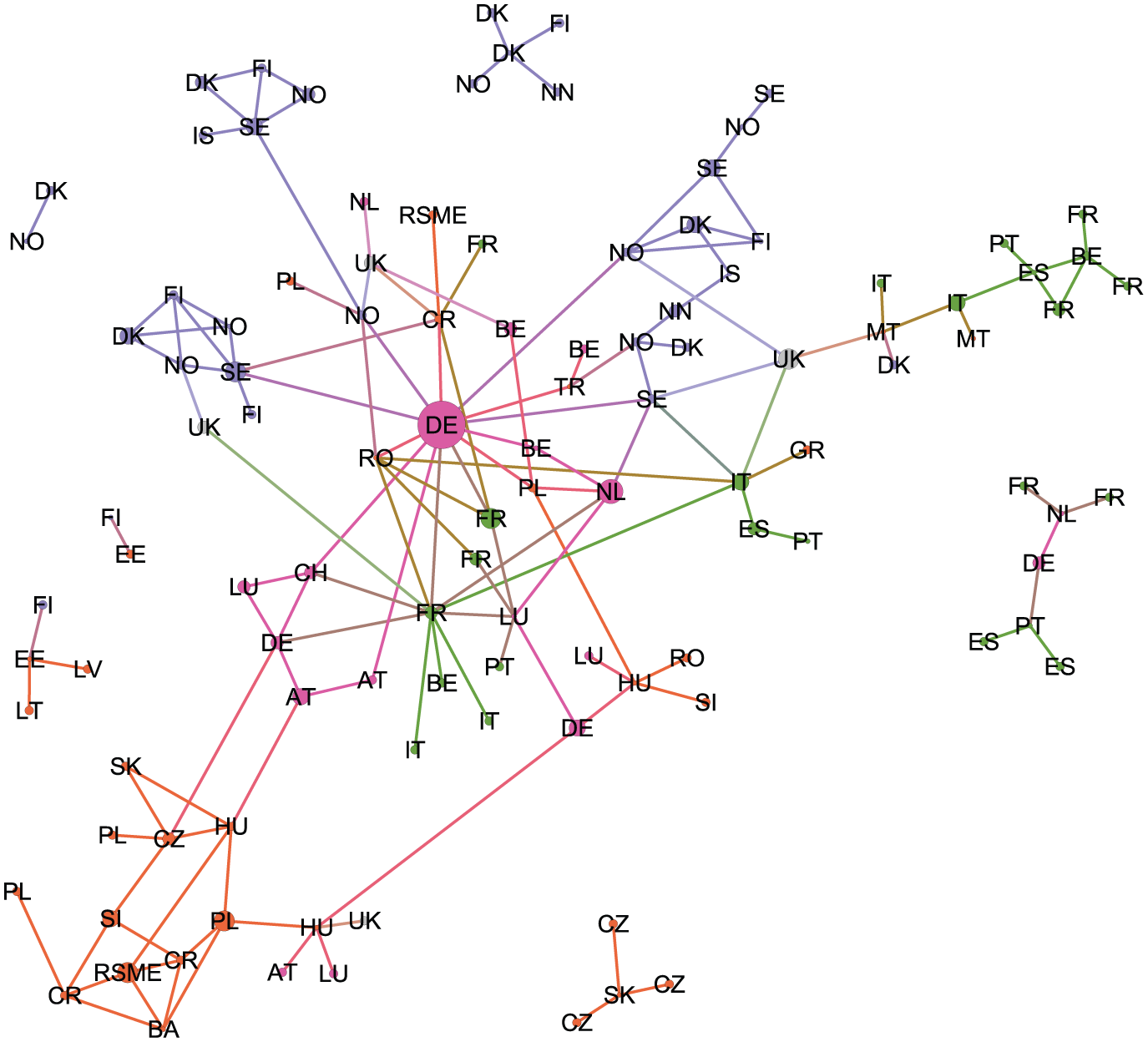
Transport sector network.
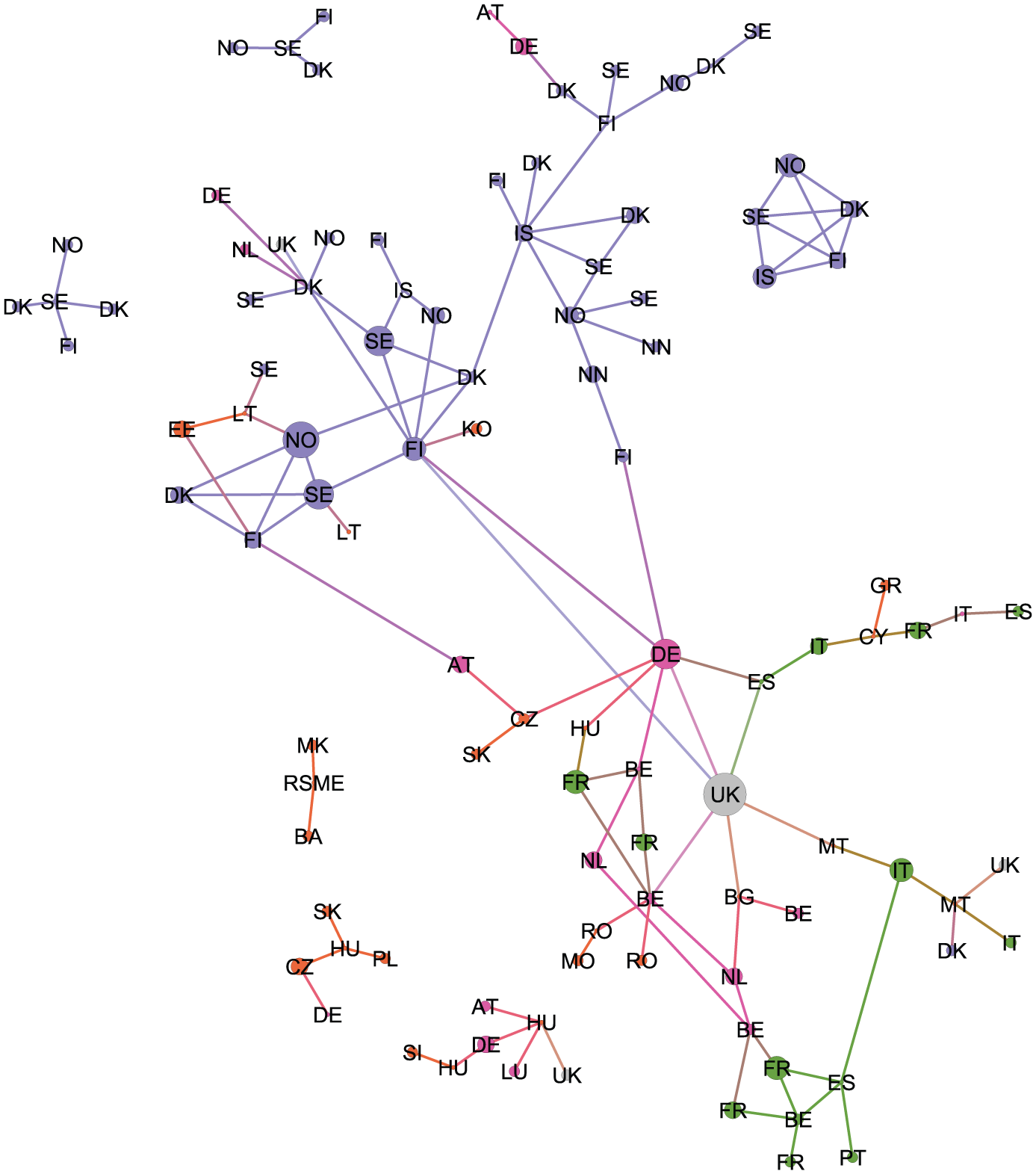
Healthcare sector network.
There are similar if somewhat messier structures in the other sectors. In construction (Figure 2) the Nordic unions are in two separate clusters, and in transportation (Figure 3) the Nordic, southern, and CEE unions are all split in different clusters. However, the tendency of the CWE unions to cluster at the center of the network, with unions from other regions more peripheral, recurs. The healthcare sector (Figure 4) is the sector in which regional clustering is least obvious. Still, this sector has a few, mainly Nordic clusters, and one cluster connecting CWE, southern, and some CEE trade unions. The healthcare network is thus made up of two quite separate components, bridged by German and UK unions. Furthermore, there are more isolated cliques in transportation and healthcare compared to metal and construction. These isolated cliques are not only an effect of missing cases, but also due to the greater fragmentation in occupational and sub-sectoral unions in these sectors. In addition, these isolated components consist mainly of unions from one region, which supports the overall tendency of regional clustering.
The existence of a regional clustering tendency was confirmed by the interviews. It was most obvious in the metal sector, in which IndustriAll Europe actually groups its member organizations into regions. However, such regionalized structures were said to exist in other sectors as well, but with varying formal organization and strength. In construction, an Italian unionist gave the following picture: Europe is more or less divided in areas: We have the Nordic part; the Nordic federation in the EFBWW […] Then we have a predominant area, in the center of Europe – I mean Germany, Austria, and Switzerland […] And, some years ago, maybe nine, ten years, we established a sort of coordination group within the southern Europe area. It is composed of Italy, Spain, Portugal, and Belgium – who wants to be with us. We meet regularly five, six times per year. And, yeah, we have a sort of coordination. (#29 IT)
One grouping missing from the list in this quotation is the extended Vicegrad group, presented in the following way by a Czech unionist: We have a smaller group called V6: […] Germany, Poland, Slovakia, Hungary, Austria, and the Czech Republic […] Also Swiss trade unions are interested in joining this group. So, this is the group from Central Europe […] And there is an agreement that all representatives from this group meet once a year at least, and we inform each other about trade union activities in these countries and discuss different topics within our sectors. (#18 CZ)
As compared to the more-organized groups in the metal sector, the groups strengthening the intraregional network structure in other sectors seem to have been built more from below, if in relation to the ETUF structures. An example of this was given by an Italian trade union in the hospital sector, talking about their informal group: We have a […] Mediterranean group. This is a self-organized network by the trade unions in Portugal, Spain, Italy, Greece, and France. Not part of the group but part of its work [are] Cyprus, Malta, and Israel […] I say it is self-organized because the meetings are paid for by the trade unions […] We work together in terms of web-networking or meeting once a year. We exchange all the information that we need on all the sectors [within EPSU]. (#27 IT)
Being initiated from below and informal, such structures do not always develop that strongly. According to representatives from some CEE countries, the Vicegrad structure is not as important in the healthcare sector as are the direct cross-border contacts and the links to Germany and Austria. Similarly, according to interviews with Italian representatives in healthcare, the activity in the above-mentioned group is not very intense.
As discussed in previous research, the regional structures in the Nordic countries are particularly institutionalized because of their joint meta-organizations. These meta-organizations are used to strengthen intraregional information exchange and activities, and to coordinate strategies in European-level activities. These organizations also create trust that facilitates direct, bilateral cooperation from below, and have a brokerage function in collaboration with important trade unions in other European countries. From the interviews, this brokering seems to be most developed in the metal sector: [Industrianställda i Norden, IN] has a formal arrangement with the Germans, in that our chairmen […] meet the leaders of the German federations […] We have meetings […] at […] international secretary-level, with the British [and] with the French. Not so much [with] the Spanish yet, and not so much [with] Italians, but on and off […] [With Eastern Europe] it is also a bit more ad hoc, and happens especially in connection with meetings [in] IndustriAll Europe. (#2 SE)
In addition, the Nordic confederations have relations with the Baltic States, whose federations may have observers at the IN meetings. As stated in interviews, this strength in organized regional cooperation is an explanation for both the Nordics’ tight internal clustering tendencies and their ability to have influence in the ETUFs. The Nordics arrive at the meetings with strong joint preparations compared to other regional groupings.
Intra- and interregional cooperation structures
To verify the tendency toward regional clustering, we analyzed the intra- and cross-regional links for all five regions in all five sectors (Table 1). This analysis confirmed a strong intraregional tendency in the Nordic and southern regions, since well over 50% of their outgoing links were to unions within their own region. However, for CEE unions, 50% of the outgoing links are to unions in other regions, and for the CWE region, the figure is 55%. The fact that CWE unions not only show a high degree of interregional outgoing links, but also are the number one target for outgoing links from all other regions, confirms that CWE unions dominate the central (brokering) positions in the core of the networks.
Intra- and cross-regional ties (n ties = 487).
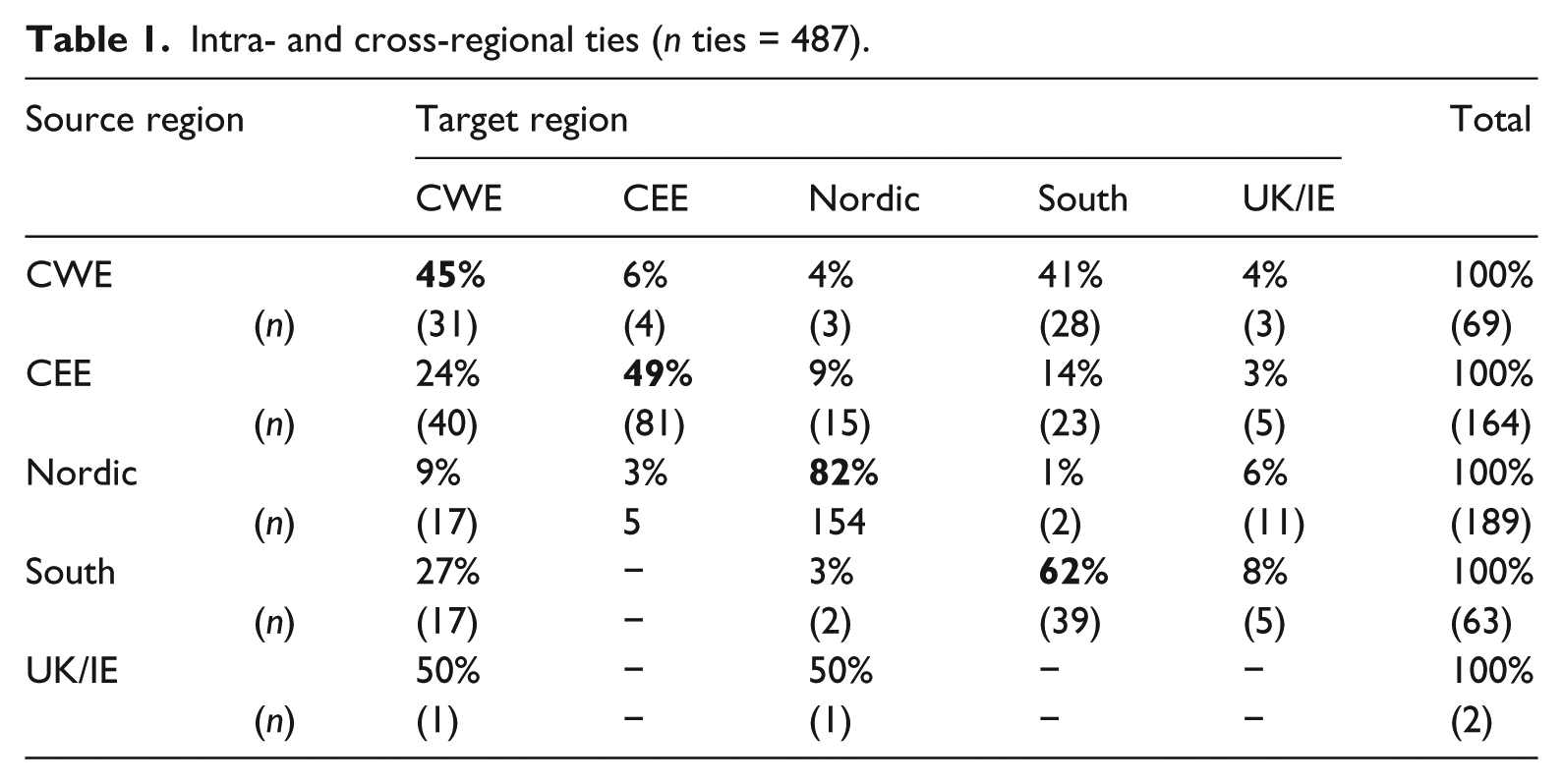
In addition, Table 1 illustrates that the interconnectedness between unions in the CWE countries and in southern Europe is not only dense, but also mutual in that each region has the other region as the second in rank, in terms of outgoing links. The Nordic region is the most isolated and oriented mainly toward the CWE and UK unions. As for the CEE region, its relatively peripheral position is illustrated by its quite high proportion of outgoing links but low score in terms of incoming links from other regions.
Since the analysis in Table 1 covers all the sectors, we also performed specific analyses to see whether the patterns are similar when the sectors are studied individually. The results (not shown) support the conclusion that in all the sectors, the Nordic region has the strongest tendency to mainly have stable cooperation within its own region. The southern region also has this tendency, though it is slightly weaker. As for the CWE and CEE regions, we find an opposite tendency, that they (with some exceptions – the transportation sector for the CWE, and the construction sector for the CEE) tend to have a higher proportion of their most important cooperation links going to unions outside of their own region.
Density, core actors, and brokers
We now turn to the questions regarding differences in density between the sectors, and patterns in who are the central actors and main brokers between clusters. The networks in Figures 1–4 seem to indicate a difference between (1) the metal and construction sectors and (2) transportation and healthcare. The former have fewer isolated islands (cliques or components) and appear more integrated than the latter. These ocular differences are supported by density measures (undirected), which rank from highest in construction (0.039) and metal (0.033) to significantly lower in transportation (0.024) and healthcare (0.023). Similarly, modularity measures show comparably lower values for metal (0.636) and construction (0.654), compared to transportation (0.722) and healthcare (0.783), indicating that the former are less compartmentalized into separate sub-networks.
These figures indicate that sectoral differences exist, but the differences may not seem that great. However, as noted in the methods section, the delimitation of the number of links to report decreases potential differences. By turning to the interviews, we find indications that point to greater differences. This is most explicitly illustrated in the Swedish interviews. In the healthcare and transportation sectors, the representatives mainly talk about other Nordic unions and only mention a few other partners in Germany, the UK, and the Baltics, with the latter being more of receivers of support than partners in a mutual exchange. In addition, most of the cooperation in these sectors is discussed in connection to the work in their ETUFs and other European organizations (professional ones in healthcare). In contrast, in the metal and construction sectors, the direct bilateral connections outside of the Nordic region are said to be both many and important, even though they of course also mention their Nordic partners. As illustrations, we have long lists of partners from the interviews, with representatives from both the metal sector (see quote above) and the construction sector, as in this example: [We have] a number of bilateral contacts, and the last […] 2 to 3 years, it has been intensified very much and focused mainly on Germany, the Netherlands, Belgium, France, Spain, Italy, Austria, and Ukraine, and then I have not included that it is already intensive in the Nordic countries, […] I actually forgot to say England, […] and the Baltics. (#18 SE)
We find some support for such sectoral differences from the other countries’ interviews as well. The bilateral relations in the metal and construction sectors are said to be many and strong. Whereas, for instance from Italy and the UK, there are reports from the hospital sector of fewer direct bilateral contacts outside of the ETUFs and professional associations: ‘We don’t really have [bilateral relations] […] To be honest the majority is through EPSU’ (#15 UK). However, there are exceptions, as can be seen from Figure 4, in which another UK union is an important partner for many unions. Also a German union has a similar, very central position in healthcare, as illustrated by this quotation: We work together, separate, with […] for example Switzerland and Austria; we traditionally work together with the unions from UK or with the French unions; or with the Austrian unions and the Netherlands […] And, people from Poland or from the Czech Republic or Romania are coming to [us] and would like to inform [themselves about] what do we do to organize our membership, what do we do in collective bargaining. (#9 DE)
With this quotation, we also touch upon the last aspect of the network structures to discuss in relation to the graphs: the central actors and important brokers between the regional clusters. From the graphs (Figures 1–4) we note that the major actor in the central core is the German unions – which was also confirmed in all sectors by betweenness-centrality analyses. The sizes of the nodes – determined by the number of incoming ties – show that they are a dominant actor, not only by being in the center of the core, but by brokering many links between the three more peripheral regional clusters, consisting of the Nordic, southern, and CEE unions. This result was expected from previous research and confirmed in many of the interviews. The healthcare sector, however, deviates somewhat from this general tendency, since a UK union also has a similar, very central position, and with an even greater number of incoming ties, and high betweenness centrality.
There are also a number of minor brokers, connecting not all of the peripheral regional clusters but bridging two of them. These minor brokers are also important positions in the structure. UK unions hold these positions, connecting the Nordic and southern clusters. As part of the core CWE group, unions from Austria, Belgium, and the Netherlands also have brokering positions between the more marginal clusters, as do, in some instances, a few unions from the three more peripheral regions.
Discussion and conclusions
This article has explored transnational trade union cooperation on the sectoral level in Europe through social network analysis. Cooperation was defined in a wide and multiplex sense, as exchanging information, coordinating action, bargaining, and social dialogue strategies. Only the metal sector has previously been studied with such an approach (Nordin, 2009, 2010, 2011). Our comparative approach encompassing the metal, construction, transportation, and healthcare sectors both extends and details that research, thus bringing a higher level of comparability and generalizability to it. Here we will discuss the main results of our analyses and draw some conclusions in connection to previous research.
First, our analyses confirm that networks of strong (regular) bilateral cooperation between unions have a tendency to be concentrated within the sectors – in the wide sense used here – as indicated in previous studies (Vulkan and Larsson, 2018). The reason is a combination of from-below interest coordination and from-above organization. Even though challenges and interests of trade unions vary (Gumbrell-McCormick and Hyman, 2013), as do organizational bases and sectoral congruence across Europe (Léonard et al., 2012), shared interests exist because of the economic and organizational context of these sectors (Bechter et al., 2012). In addition, the European Sectoral Social Dialogue and the ETUFs function as both multi-cooperation arenas and platforms for making contacts and building trust for direct inter-organizational networking.
Second, the mapping and analysis of the networks show strong tendencies of regional clustering in all sectors. Based on a region typology separating the British Isles and the Nordic, southern, CWE, and CEE countries, we found a general tendency of regular bilateral trade union cooperation to focus on partners within the same region. This result confirms tendencies found both in qualitative research of trade union networking (Gollbach and Schulten, 2000; Magnusson and Murhem, 2009; Marginson and Sisson, 2004: 112ff.), and in Nordin’s (2009, 2010, 2011) studies of the metal sector.
Several reasons may explain these regional clustering tendencies. A central one is that countries within the same region are neighbors, with joint border regions and geographical proximity. However, in connection to that reason, institutional, organizational, and cultural similarities and differences exist in and between regions. As discussed in previous research, important factors that further or hinder trade union cooperation are similarities and differences in many factors: industrial relations (Larsson, 2012; Visser et al., 2009), economic and political contexts and challenges (Gumbrell-McCormick and Hyman, 2013), trade union resources (Lehndorff et al., 2017; cf. Vulkan and Larsson, 2018), and cultural aspects such as language, traditions, and ideology (Hyman, 2001; Larsson, 2017). As all of these factors tend to vary to some extent with regions in Europe, they are difficult to untangle in discussing the causes for regional clustering in trade union cooperation.
Third, we found some general differences between the regions in terms of the intra- versus interregionality of their networking. The Nordic unions tended to be most intraregionally focused, with a strong majority of their links going to other Nordic unions. The southern European unions also had quite a strong tendency toward an intraregional focus in their cooperation. CWE and CEE unions had more of a 50/50 balance in intra- and interregional cooperation, with more developed links to other regions, compared to the Nordic and southern unions.
Connecting the overall regionality and the intra- and interregional balances to the historical developments discussed in previous research, we find both path-dependency and change. The intraregional focus in the Nordic countries relates to their long history of cooperation and of being somewhat reluctant Europeans (Seeliger, 2019: 211, 224; cf. Larsson, 2014, 2015), but also to their staffed Nordic meta-organizations at cross-sectoral and sectoral levels (Magnusson and Murhem, 2009). The southern and CEE network clusters seem to have developed more slowly, or later and in connection with the eastern enlargement of the EU in the case of CEE unions, and have not reached the same intensity of cooperation. This result is partly because of the greater fragmentation of trade unions in these regions, and their tendency to be more dependent on the European trade union organizations in their cooperation (Larsson, 2015; Léonard et al., 2012; Seeliger, 2019: 211ff.). As for the CWE unions, they developed cooperative networks early on in interregional border regions. They cluster at the core of the overall sector networks, and they are the number one region for interregional links going out from the other regional clusters. Partly their development results from their resources and influential position in Europe, and partly because cooperation networks tend to concentrate around border regions, and CWE countries jointly border all the other regions in Europe (Gollbach and Schulten, 2000; Traxler et al., 2008).
Fourth, we found both regional and sectoral variation in networking. Our studies confirm, through both qualitative and qualitative data, previous research indicating that cooperation density is high within the metal sector (Furåker and Bengtsson, 2013; Glassner and Pusch, 2013; Magnusson and Murhem, 2009; Vulkan and Larsson, 2018). The results indicate that the construction sector is just as integrated in terms of networking, whereas transportation and healthcare have lower levels of transnational networking integration. However, the lower densities found in the latter sectors have much to do with the greater fragmentation in terms of occupational or sub-sectoral unions in these sectors, creating isolated cliques in the network structure. As regards the regional variation, a recurrent feature is that the CWE unions tend to cluster at the core of the network, whereas unions from the other regions tend to cluster more peripherally, as offshoots from the central core.
Finally, we confirm some of the results from Nordin (2009, 2010, 2011) and other previous research regarding centrally placed actors and main brokers between the regional clusters. Quite unsurprisingly, German trade unions occupy the central position of the CWE core in all sectors, and are thus ‘the center of gravity,’ not only for cross-border bargaining networks, but in transnational cooperation more generally (Traxler et al., 2008: 222; cf. Seeliger, 2019: 172ff.). German unions are not only very important and potentially influential actors, but also the main brokers between the other, more peripheral regional clusters. However, we also have other central brokers. In the hospital sector, one UK union has a similar position, and in all sectors there were a set of secondary brokers, connecting two or more of the peripheral regions of the network directly. These are also large unions with strong resources and significant influence in European-level cooperation through the ETUFs.
To conclude, this study of the regional clustering tendencies, sectoral variation, and central actors and brokers in transnational trade union cooperation confirms, generalizes, and elaborates on what is known from previous research on collective bargaining networks (Glassner and Pusch, 2013; Gollbach and Schulten, 2000; Marginson and Sisson, 2004; Traxler et al., 2008) and Nordin’s (2009, 2010, 2011) network analysis of the metal sector. Even so, more research from a social network approach is needed to further verify and detail these results and conclusions, and to explore and elaborate on the actual effects of such network structures on the national and European levels. The network approach is methodologically challenging, not least because of the difficulties in assembling enough network data to perform advanced statistical analyses that go beyond the quite modest explorative approach of this study. However, as suggested by Meardi (2012), such studies may help us explore alliances indirectly affecting the practices of peripheral actors and clusters, and showing that the Europeanization of trade union activities has much more to it than the outcomes of institutionalized social dialogue. Also, qualitative and mixed-method studies that go beyond the single case study are needed to explain how and why trade unions network in Europe, and what effects that networking has on the national and European levels.
Footnotes
Acknowledgements
The data were collected with help from the project members: Bengt Furåker, Mattias Bengtsson, and Kristina Lovén Seldén. We want to thank the anonymous reviewers for constructive comments.
Declaration of conflicting interests
The authors declared no potential conflicts of interest with respect to the research, authorship, and/or publication of this article.
Funding
This research was funded by the Swedish Foundation for Humanities and Social Sciences (Riksbankens Jubileumsfond), Grant P13-0776:1.
