




Abstract
Many assume that women and workers in female-dominated workplaces will have better access to flexible working arrangements. Some use this as justification for the low wages found in these workplaces. Yet, empirical results are mixed. I explore this question by examining workers’ access to schedule control across 27 European countries, and find no discernible gender differences in access to schedule control when individual and company-level characteristics are taken into account. However, working in female-dominated jobs and/or sectors significantly reduces access to schedule control for both men and women. This ‘women’s work penalty’ in female-dominated sectors varies across Europe but nowhere was the access better compared to sectors where both genders are equally represented. This raises concerns regarding the lack of favourable working conditions, in addition to low pay found in female-dominated workplaces.
Keywords
Introduction
An increasing number of companies are providing their workforces with flexible working arrangements, that is giving more control over when and where they work, and many governments are providing workers with the right to request flexible working (Hegewisch, 2009). Much of the discussion on flexible working has asked whether it allows workers a better work-life balance. Flexible working can do so by allowing workers to adapt their work demands to the demands of their family (Golden, 2001; Jacobs and Gerson, 2004; Lott, 2015). Since women tend to have primary responsibility for care and domestic tasks (Eurofound, 2013), it is assumed that women will request and benefit most from such arrangements. Some scholars argue that the persisting gender wage gap may be explained by the fact that women trade off access to flexible working for additional pay (Goldin, 2014). Others go on to justify the lower pay in female-dominated jobs through their better access to flexible working arrangements and other favourable working conditions (Filer, 1985).
If this is true, and flexible working arrangements are provided to workers who demand and need them most, women and female-dominated workplaces should have better access. Yet, the results of studies examining gender differences in access to schedule control (e.g. Golden, 2009; Kelly and Kalev, 2006; Swanberg et al., 2005), and those examining how female-dominated workplaces and occupations fare in providing workers with flexible working arrangements (e.g. Adler, 1993; Glass, 1990; Glauber, 2011; Minnotte et al., 2010; Wood et al., 2003) are rather mixed. In addition, most studies focus on the proportion of women in the company or the occupation, leaving out sectoral variations or variations in job positions. Furthermore, most have been based in the United States, using data from the 1990s or earlier. This raises the question whether similar patterns can be found in Europe, with different institutional and normative structures. We could also expect a variation across Europe, given the diverse contexts in different countries. The use of schedule control has increased in Europe over the past couple of decades and increasingly the work-life balance demands of workers are gaining greater attention. Thus, an examination of recent data is necessary.
This article focuses on workers’ access to schedule control, using data from 27 European countries from the 2010 European Working Conditions Survey (EWCS). These data are matched with the EU Labour Force Survey to examine whether women and workers in female-dominated workplaces have better access to schedule control, and whether this depends on the country. The next section examines the definition of flexible working and the theories that explain gender differences in its provision, and the relevance of country contexts. In the third section, the data and methods are examined. This is followed by the analysis, results, and finally some discussion and policy implications.
Definitions and theory
Defining flexible working and schedule control
The concept of flexible working builds on the model developed by Karasek (1979) but focuses on control over where and when work is done rather than how it is done (Kelly and Moen, 2007). I focus here on schedule control that is providing workers with the ability to alter their schedule. This includes flexitime; control over the starting and ending times of work and working-time autonomy (the ability to determine work hours and schedules).
Work–family border or boundary theory (Clark, 2000) and boundary management theory (Kossek et al., 2006) suggest that having control over one’s schedule can facilitate the integration of work and domestic roles. Schedule control provides workers with the flexibility in the time border between work and family domains, allowing workers to adapt the timing of work around family demands (Clark, 2000). Given that fixed 9 to 5 working hours and family schedule demands (such as school pick-up times) are often incompatible, control over when to work may help resolve such conflicts. Control over time borders may also allow families to use ‘tag-team parenting’ to extend family time, sharing care for children without reducing working hours of either parent (Craig and Powell, 2012). Thus, a large number of studies have shown that schedule control relieves workers’ work–family conflicts (e.g. Allen et al., 2013; Kelly et al., 2014).
One reason why employers may be more willing to provide schedule control to address work–family issues is because it may increase performance outcomes. Schedule control can be used as a part of high-involvement systems (Wood and De Menezes, 2010) or high-performance strategies, which allow workers more discretion and influence over their work to help increase performance (Appelbaum, 2000). Performance enhancement can be enabled through a decrease in sickness and absenteeism and an increase in motivation and loyalty (De Menezes and Kelliher, 2011), and also because workers increase their work intensity and working hours when using schedule control (Kelliher and Anderson, 2010; Lott and Chung, 2016). This increase in work intensity can happen through the gift exchange dynamic that is, workers work harder to reciprocate for the gift of control over their work their employers have given them; or because workers are better able to work harder and longer due to being able to work when they want; or because of employer enforcement of work intensity through the back door.
Access to flexible working arrangements and gender
Who receives access to flexible working arrangements will depend on the company’s main purpose for introducing the policy. Swanberg et al. (2005) discuss three reasons: the principles of need, equity and equality. According to the first principle, those with the most family demands, such as workers with care responsibilities, are most likely to benefit. Given that women still take the bulk of responsibility for care and household work (Bianchi et al., 2000; Eurofound, 2013), when the principle of need determines flexible working provision, we can expect that women will have more access to flexible working arrangements compared to men (H1a). Previous studies show some evidence that workers with more family demands (Golden, 2009) and women are more likely to request and access schedule control (Allen, 2001; Golden, 2008; Kelly et al., 2011).
In addition to the gender of the individual worker, the gender composition of the workplace is important. Constituent theory argues that female-dominated organizations are more likely to have increased internal pressure for the firm to be responsive to work–family issues and make flexible working more available for workers (Goodstein, 1994). The dominant gender of a workplace may also influence how far flexible working is normalized within the company. Studies have shown that workers can face ‘flexibility stigma’ (Williams et al., 2013) when using family-friendly arrangements, because this deviates from the image of the ‘ideal worker’ who is totally committed to work (Acker, 1990; Williams, 1999). American data indicate that in female-dominated occupations, flexible working becomes more of a norm than an exception, especially for women, because of the gendered assumptions employers have towards their roles as caregivers (Minnotte et al., 2010). On the other hand, male-dominated occupations and sectors may be especially prejudiced against workers using such arrangements (Cech and Blair-Loy, 2014). There is also evidence that for men in male-dominated occupations there may be a further ‘femininity stigma’, as the use of family-friendly arrangements deviates from the image of the man as provider rather than carer (Cha and Grady, 2014; Williams et al., 2013). This can explain why many studies have shown a positive relationship between the proportion of women in the workplace and the provision of schedule control and other flexible working arrangements (Bardoel et al., 1999; Den Dulk et al., 2013; Wood et al., 2003). In sum, we can expect that workers, especially women, in female-dominated workplaces are more likely to have access to schedule control (H2a).
According to the principle of equity, employers will grant more access to those who are likely to increase work intensity or hours, or contribute to the performance outcomes for the organization through flexible working (Swanberg et al., 2005). With fewer competing demands coming from the family or household, men are more likely to increase their work intensity compared to women when using schedule control (Lott and Chung, 2016). Even if they do not do so, the gendered assumptions accorded to women and their care roles mean that men are more likely to be perceived as willing to contribute to the organization (Acker, 1990). In addition, when flexible working arrangements are used as a part of a high-performance strategy, its use may not carry a ‘flexibility stigma’. The ability to use these arrangements may in fact enforce the ‘ideal worker’ image, given the performance enhancing goals it aims to achieve and the increase in work intensity that can result, especially for higher occupational groups (Cech and Blair-Loy, 2014). Furthermore, men are generally rewarded better than women in terms of working conditions and pay (Eurofound, 2007; Schieman et al., 2013). This can explain why employers are more likely to accept men’s requests for flexible working (Brescoll et al., 2013) even when requested for care purposes (Munsch, 2016). In this respect, when the principle of equity determines schedule control provision, we can expect women to have less access to schedule control compared to men (H1b). A number of studies have indeed shown that this is the case (e.g. CIPD, 2012; Golden, 2009; Plantenga and Remery, 2009).
Likewise, male-dominated workplaces may have better access to schedule control. According to dual labour market theories (Schwander and Häusermann, 2013), women are more likely to be in a secondary market with poorer working conditions and higher turnover, in which employers do not usually invest. In addition to their relatively weak position in the labour market, feminist and gender theorists argue that women’s labour is generally valued less, and accordingly that work done in female-dominated workplaces will be considered of lower value (Acker, 1990; Anker, 1997). In Europe, women still tend to occupy low-wage sectors and low-status occupations with lower pay (Bettio and Verashchagina, 2009). Employers in these sectors may be less inclined to adopt high-performance strategies and provide flexible working arrangements. Just as workers in female-dominated workplaces experience a pay penalty (Cohen and Huffman, 2003), they may also face a ‘women’s work penalty’ in their access to flexible working arrangements. When looking at job autonomy in a broader sense (e.g. individual controls over the conceptual aspect of the work, ‘flexibility’ and ‘unsupervised breaks’), studies using US data have shown that increased feminization of occupations leads to reduced levels of autonomy (Adler, 1993; Glass, 1990; Jaffee, 1989). Given the gendered nature of organizations and the advantages in career progression and promotion that accrue to men (Acker, 1990), men may experience ‘glass escalator’ advantages (Williams, 2013), gaining promotion faster and attaining positions of power in female-dominated workplaces. For this reason, the ‘women’s work penalty’ in access to flexible working arrangements may not apply to men; several studies show that the ‘women’s work penalty’ is more evident for women in these workplaces (Cohen and Huffman, 2003; Glass, 1990; Jaffee, 1989). Thus, we can expect that workers, especially women, in female-dominated workplaces are less likely to have access to schedule control (H2b).
Variance across countries
The relationship between gender and workplace gender dominance and access to schedule control may depend on the country (H3). Cross-national variance in occupational sex segregation (Charles, 1992), the gender pay gap (Mandel and Semyonov, 2005) and motherhood penalties (Budig et al., 2012), and the role national policies play in this variance are well documented. In addition to the direct impact of national policies, institutional theories (DiMaggio and Powell, 1983) argue that national institutions can shape corporate culture and policies, which can influence who has access to flexible working arrangement indirectly. More specifically, national family policies have been shown to explain workers’ access to schedule control and the access gap between different groups of workers (Chung, 2017; Den Dulk et al., 2013). Workers in countries with generous family policies are more likely to have access to schedule control; yet, this positive effect is stronger for certain groups of workers: those in higher occupations, or working in the public sector and in large companies. Furthermore, it has been shown that the influence of schedule control on individuals’ perception of time adequacy between work and family life depends on the gender of the worker and on the national context (Lott, 2015). As indicated, most studies on the gender gap and gender dominance of the workplace and its relation to access to schedule control are based on studies in the United States, with an institutional context very different from Europe. Even within Europe, there are large differences in the institutional contexts and employment regimes (Esping-Andersen, 1990; Hall and Soskice, 2001), more specifically in relation to family policy configurations (Korpi et al., 2013). The variance also exists in relation to working-time regimes: the extent to which countries differ in the working hours patterns observed for men and women across different life stages (Anxo et al., 2007), in their use of employer-oriented as against employee-oriented working-time flexibility (Chung and Tijdens, 2013), the flexibility in the number of hours worked as well as the gender discrepancy (Figart and Mutari, 2000). Furthermore, there are differences across countries in the extent to which working time and work-life balance arrangements are discussed in collective agreements (Eurofound, 2017). In this article, given the lack of existing theoretical assumptions about cross-national differences, I do not set out concrete hypotheses regarding why these exist. My concern is to see whether the relative access of women and workers in female-dominated workplaces to schedule control is significantly different across countries.
Data and methods
To examine access to schedule control I use the fifth wave of the EWCS from the European Foundation (http://eurofound.europa.eu/european-working-conditions-surveys-ewcs). This provides information on a number of dimensions of working conditions for workers across Europe. Individuals across 34 countries were included in the survey: the European Union (EU) 27 plus Albania, Croatia, Kosovo, Montenegro, Norway, Republic of Macedonia and Turkey. The survey used face-to-face interviews at the respondent’s home in the first half of 2010. A random stratified sampling procedure was used, where a representative sample was gathered of those aged 15 years or over and in employment (minimum 1 hour a week using the International Labour Organization (ILO) definition) at the time of the survey. Of the total sample, I restrict the analysis to the EU 27 and those in dependent employment, and further exclude those in the armed forces and in agriculture and fisheries, given the distinctive nature of these jobs.
My dependent variable is schedule control, measured through the question ‘How are your working-time arrangements set?’ Workers could answer as follows:
They are set by the company/organization with no possibility for changes
You can choose between several fixed working schedules determined by the company/organization
You can adapt your working hours within certain limits (e.g. flexitime)
Your working hours are entirely determined by yourself.
Those who answered either 3 or 4 to this question are considered to have schedule control, without distinguishing between the two. The latter group, considered here as those with working-time autonomy, is very small, especially when restricting the sample to dependent employees. Responses 3 and 4 are phrased rather broadly, meaning different interpretations are possible. However, the first two responses refer less ambiguously to fixed schedules. Thus, I assume that respondents who selected answer 3 or 4 capture those with access to different types of schedule control, also encompassing those with informal agreements. However, as a robustness check, I later also examined the access to flexitime, excluding working-time autonomy from the analysis. Note that the data measure the access a worker has to schedule control, rather than its actual use.
The main independent variable is gender and the gender dominance of the job and workplace. Gender is coded with men as the reference category and women coded 1. Gender dominance of the job post is measured through the following variable: ‘At your place of work are workers with the same job title as you …’:
Mostly men
Mostly women
More or less equal numbers of men and women
Nobody else has the same job title.
Two dummies are made from this question, one to represent a mostly female and another to represent a mostly male jobs (reference group: equal number of men and women and nobody else has the same job title). In addition, national averages of the proportion of women in each occupation and sector are derived from the EU Labour Force Survey, and then matched with the EWCS data set. These indicators provide information on the extent to which one gender dominates the occupation or sector. The International Standard Classification of Occupations 2008 (ISCO-08) 1-digit code is used to categorize occupational levels of workers into eight different occupational groupings and based on the 21 European Classification of Economic Activities (NACE) Rev. 2 categories, with sectors condensed into 10 categories; for details see online Appendix, accessible at: http://wafproject.org/research-outputs/papers/chungejir2018/. Based on previous studies (Glauber, 2011), I expect a non-linear relationship between the gender dominance of the occupations and sectors and access to schedule control. Thus, two dummies are used to indicate a male- and female-dominated occupation/sector (with 60% or more men or women, respectively) with the reference category being an equally represented occupation/sector (40–60% men and women).
Based on previous studies (Chung, 2017; Wiß, 2017), individual characteristics included in the model as controls are as follows: education level (lower secondary and below, upper secondary and tertiary or above); age; whether in a supervisory role; occupational skill level (four categories based on ILO definitions: high, medium, lower medium (reference) and elementary skills); working hours: part-time (below 32), full-time (reference), and long hours (48+); and contract type (open ended and others); whether the respondent lives with a child under the age of 18 years; a pre-school child (<6 years); a young child (<12 years) or a partner. Organization-level characteristics include establishment size, whether the company is in the public sector or not, existence of an employee representative, gender of the direct supervisor and perceived manager support. Details of the operationalization of the variables and their descriptive statistics are in the online Appendix.
Modelling techniques
I use a two-level multilevel regression model. A multilevel modelling technique is used when individuals are considered to be nested within countries, to account for country-level clustered errors (Hox, 2002). Several models are examined. The first only includes gender without other variables, to examine the gender differences in workers’ access to schedule control. I then add the gender dominance of the workplace variables, and other control variables step by step. I run the final model for men and women separately to see how gender dominance of workplaces has different influences for men and women, in order to address in H2a and H2b. Next, I run random slopes models to see whether the influence of gender and the gender dominance of the workplace on workers’ access to schedule control varies across countries, using STATA 15.0, meqrlogit.
Results
Descriptive analysis
As Figure 1 shows, approximately 23 percent of all men in our sample and 22 percent of women have access to schedule control. There are very large variations across Europe. Northern countries (Sweden, the Netherlands, Denmark and to some extent Finland) are forerunners in workers’ access to schedule control. Some continental countries, including Germany and Austria, are not far behind. On the other hand, the Southern countries and some Eastern countries, such as Cyprus, Bulgaria, Greece, Portugal, Lithuania, and Spain provide little schedule control. The gender gap does not map clearly into the conventional regime clusters. However, at first glance, with the exception of Sweden, the Netherlands, the United Kingdom and Estonia, men generally have more access to schedule control.
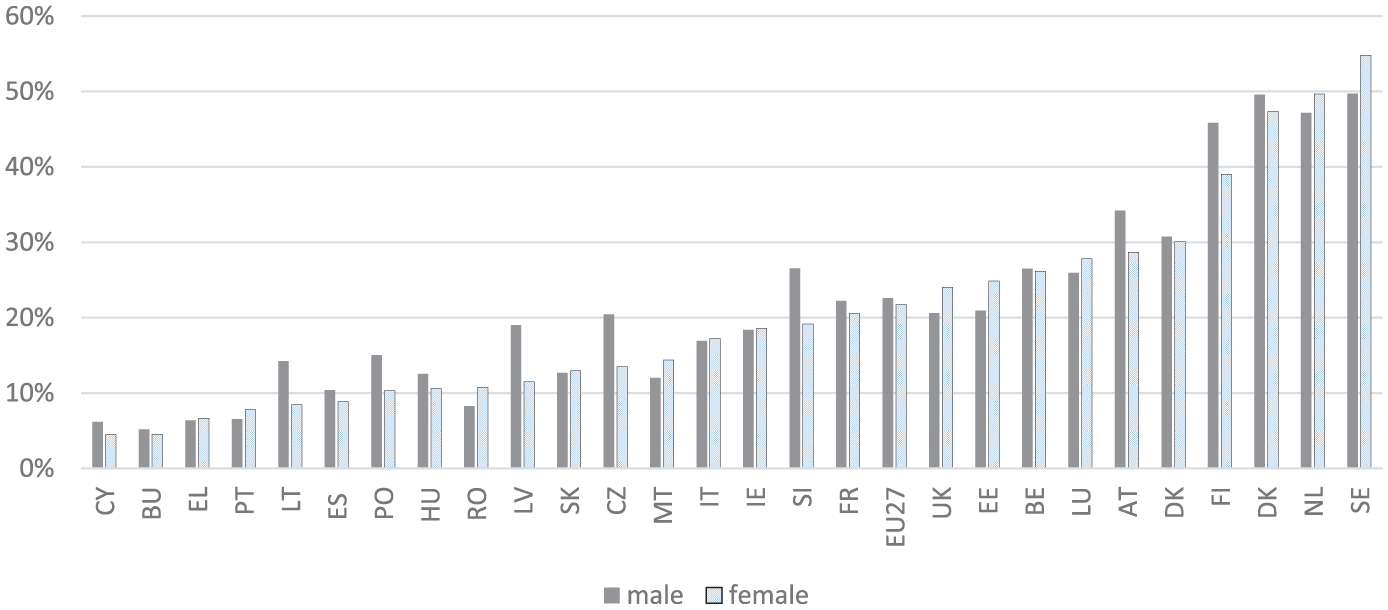
Access to flexible schedules across 27 European countries for men and women, 2010 (weighted averages).
Gender, gender dominance of the workplace and access to schedule control
In the first model, I examine the gender differences in the access to schedule control when no other variables are taken into account. As shown in Model 1-1, and mirroring what was found in Figure 1, there is a small gender gap and men on average have better access to schedule control. However, when gender dominance of the workplace is taken into account, the gender of the worker becomes insignificant (Model 1-2), indicating that rather than the gender of the worker it is the gender dominance of the workplace that matters. When various individual and company-level variables are taken into account (Model 1-3), again there are no gender differences in access to schedule control, especially once other factors are controlled for. This entails rejecting both H1a and H1b. Turning to gender dominance of the workplace, workers in job posts, occupations and sectors with roughly equal proportions of men and women (40–60%) are most likely to have access to schedule control. Male dominance somewhat reduces workers’ access to schedule control (about 0.9 times as likely). However, those in workplaces which are female dominated are the least likely to have access to schedule control (about 0.7 times as likely for the female-dominated jobs and almost half as likely for female-dominated sectors) partially confirming H2b. Female-dominated occupations seem to be about equally represented occupations in access to schedule control when other individual and company-level characteristics are taken into account.
H2a and H2b suggested that gender dominance of the job, occupation or sector may have different impacts for men and women. Modelling for men and women separately (Table 1 Models 1-4 and 1-5) shows that working in male-dominated jobs entails lower access to schedule control for men, but not for women. Similarly, the reduced access to schedule control in male-dominated sectors can only be seen for men. This provides evidence that there may be some sort of ‘flexibility stigma’ in male-dominated jobs and sectors but only for men. On the other hand, the lower likelihood of access to schedule control in male-dominated occupations can only be seen for women, contradicting what has been found for job posts and sectors. However, female-dominated sectors and jobs are bad for both men and women. Having reverse-coded the variables (online Appendix Table A-2), I find that female-dominated jobs and sectors are also significantly worse compared to male-dominated ones. This is true especially for women, while for men, female-dominated sectors were just as bad as male-dominated ones. This partially supports hypothesis H2b. Full models with control variables can be found in the online Appendix Tables A-1.
Explaining access to schedule control across Europe (odds ratios).
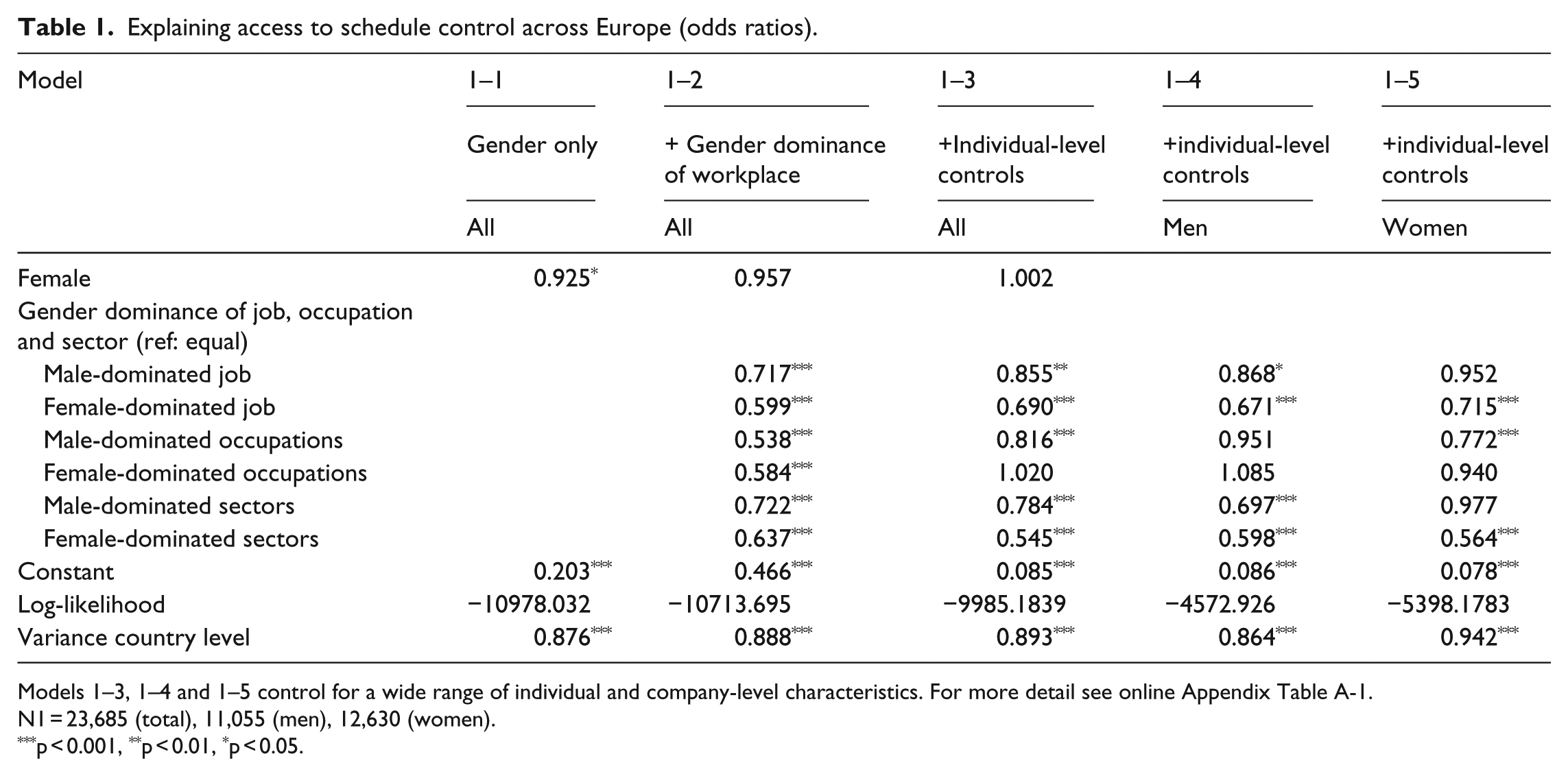
Models 1–3, 1–4 and 1–5 control for a wide range of individual and company-level characteristics. For more detail see online Appendix Table A-1.
N1 = 23,685 (total), 11,055 (men), 12,630 (women).
p < 0.001, **p < 0.01, *p < 0.05.
These results seem contradictory, with different relationships for female-dominated jobs and sectors versus that for female-dominated occupation. This may be because occupational levels prove more important in representing the skill levels of the job than is the gender dominance of the occupation. Previous studies (e.g. Chung, 2017; Wiß, 2017) show that the occupational level of the worker (in terms of high as against low skill) is the most important determinant explaining access to flexible working arrangements. Thus, the fact that many of higher level jobs, such as (associate) professionals, are female dominated or have equally representation may explain the contradictory findings in the previous models. To test for this, I ran the model excluding gender dominance of the occupation from the model replacing it with occupational level (ISCO-08 1-digit categories). Examining the results in Table 2, we can see that occupational levels are indeed one of the most important factors explaining access to schedule control. Managers are up to 3.5 times more likely to have access than service and sales workers (the reference group), while (associate) professionals are about 2.5 times more likely. There is a very clear link between the skill level of the occupation and access to schedule control, with the exception of elementary occupations where the likelihood is at par with service and sales workers, despite being a lower skill occupation. This division across occupational groups is starker for men. For the other gender dominance variables, their directions and significance do not change even when occupational level variables are replaced. Again female-dominated jobs and sectors are worst in terms of access to schedule control for both men and women, while male-dominated sectors are only bad for men. One difference from the previous model is that male-dominated job posts do not seem to be significantly worse in their access to schedule control even for men, when occupational levels are controlled for, further supporting hypothesis H2b.
Explaining access to schedule control across Europe (odds ratios); model replacing gender dominance of occupations with ISCO-08 1-digit occupational levels.
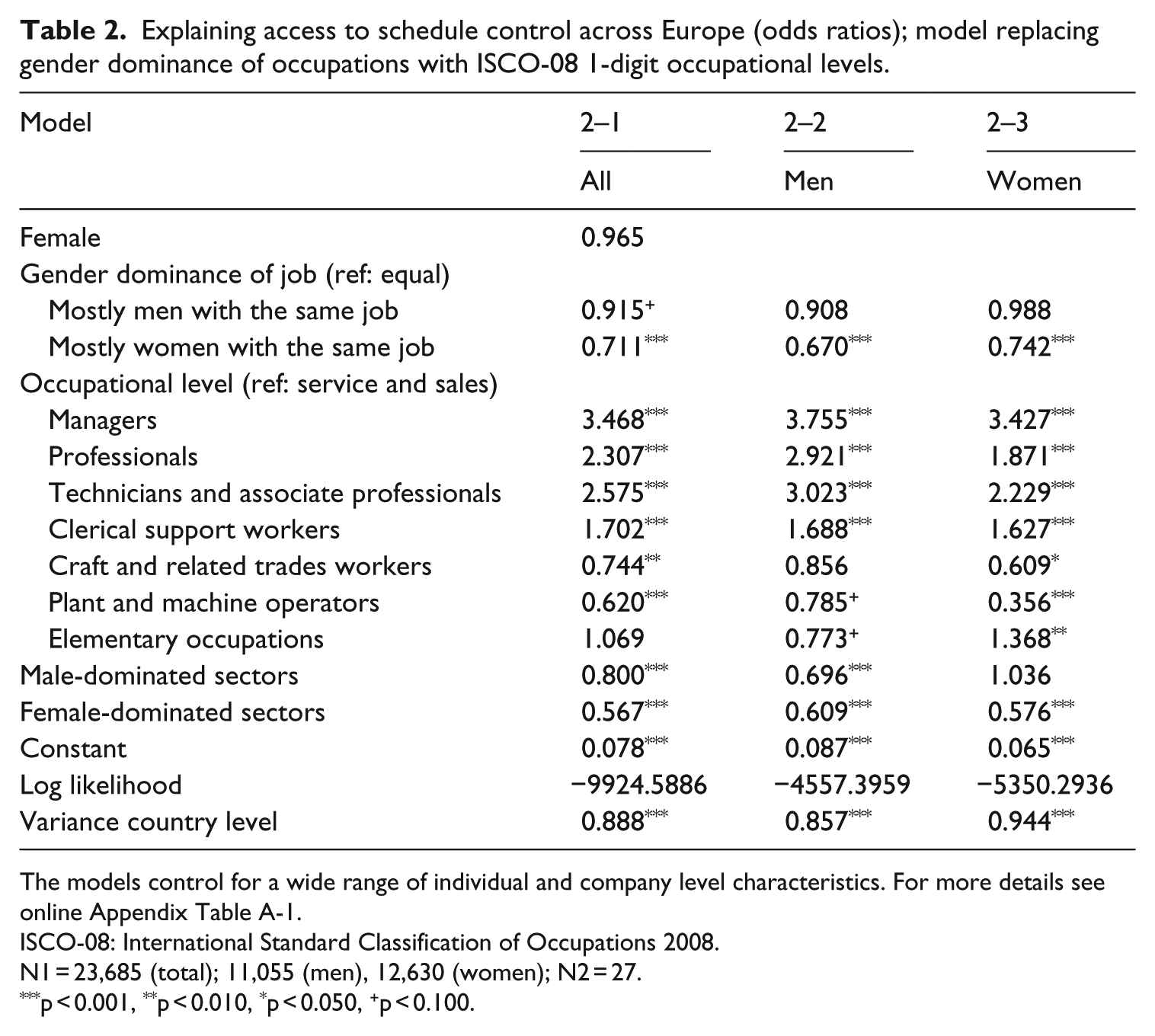
The models control for a wide range of individual and company level characteristics. For more details see online Appendix Table A-1.
ISCO-08: International Standard Classification of Occupations 2008.
N1 = 23,685 (total); 11,055 (men), 12,630 (women); N2 = 27.
p < 0.001, **p < 0.010, *p < 0.050, +p < 0.100.
Cross-national variation
The third hypothesis expected a cross-national variance in how the gender dominance of workplaces influences access to schedule control. To check for this, I ran random slopes models to see whether gender and gender dominance of the workplace variables varied significantly across countries in explaining access. The result shows that the influence of gender (variance = 0.019, p > 0.100), gender dominance of the job post (male job variance = 0.004, p > 0.100; female job variance = 0.030, p > 0.100) and occupation (male occupations variance = 0.000, p > 0.100, female occupations variance = 0.043, p > 0.100) did not vary significantly across different countries (full results available upon request). Although access to schedule control when working in a male-dominated sector did not vary across countries (variance = 0.100, p > 0.100), workers’ relative access when working in a female-dominated sector varied significantly across countries (variance = 0.133, p < 0.05), although no clear patterns emerged mirroring country clusters found in previous studies. As Figure 2 shows, in countries such as Germany, Spain and to a certain extent Slovakia, the effect of working in female-dominated sectors was much worse than the European average. In Spain, for example, working in sectors where men and women are equally represented meant that you are three time more likely to have access to schedule control compared to those working in female-dominated sectors. On the other hand, in the Baltic countries, and to some extent Hungary, the relative access by workers to schedule control in female-dominated sectors was not as bad as the European average. However, even for these countries, access in female-dominated sectors was at best similar to sectors where both genders were equally represented, and in no country was access better for workers in female-dominated sectors. Even when ISCO 1-digit occupational levels are included in the model, the influence of working in a female-dominated sector is the only factor that varies significantly across countries (variance = 0.125, p = 0.051), and again in all countries female-dominated sectors generally fared worse than those where both genders were equally represented.
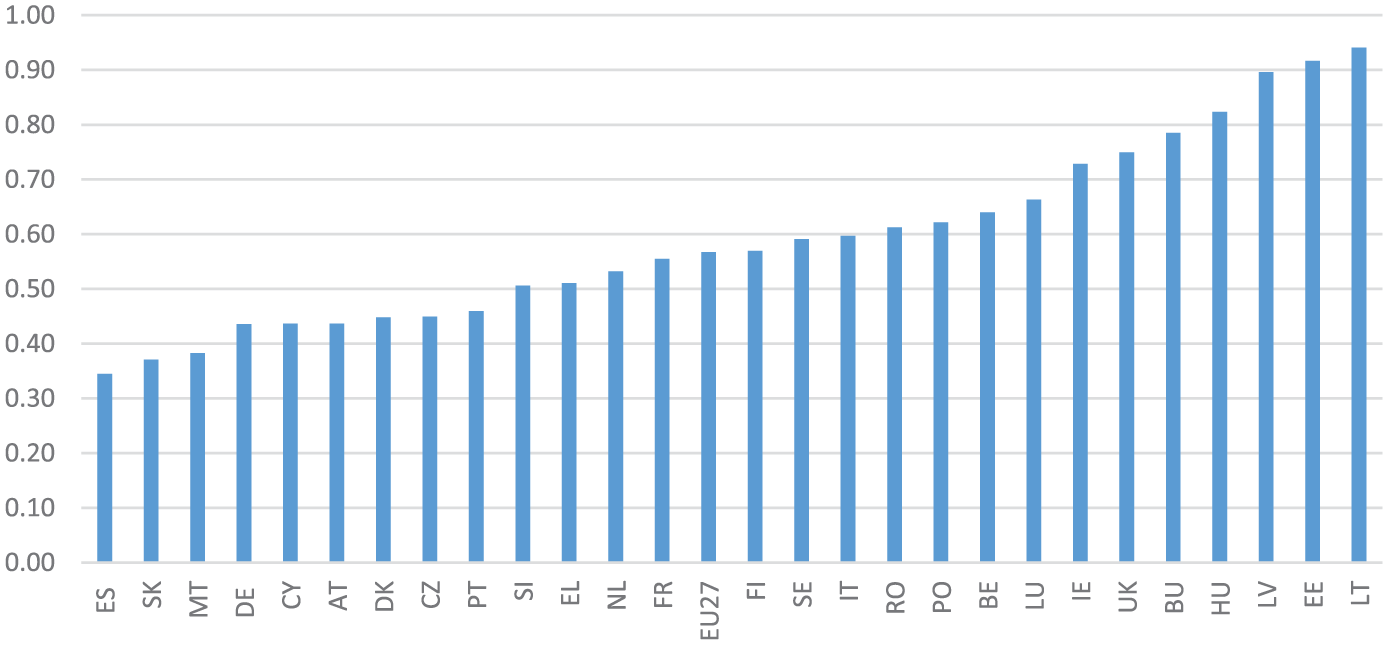
Relative access in female-dominated sectors to schedule control compared to sectors with equal representation, 2010 (odds ratios).
Robustness checks
I ran a series of robustness checks to see whether the choices made in the design of the article influenced the results presented above (all tables available in the online appendix). First, I checked whether the inclusion of working-time autonomy as a part of schedule control influenced the results, by removing working-time autonomy from the schedule control definition and from the analysis sample. As Table A-3 shows, the results do not change. Second, I examined whether not controlling for public sector changes the results since in many countries, the public sector is female dominated. Thus, the influence of working in female-dominated workplaces may be underestimated by including the public sector as a control variable. Having re-modelled the analysis excluding the public sector as a control (Table A-4), female-dominated sectors and job do seem to be even worse in the provision of schedule control but not to a large degree, and the results remain relatively stable.
Some may argue that these results are found because it is more difficult to implement schedule control in typically female-dominated sectors such as education, healthcare and social services due to the nature of the work carried out in these sectors. However, when examining the education sector across Europe, this explanation seems to hold limited validity. As Appendix Figure A-1 shows, in countries such as Sweden and Denmark, 55 and 54 percent of workers have access to schedule control in the education sector, respectively, comparable to other sectors in these countries. Furthermore, what constitutes as a female-dominated job and sector varies across countries; for example, education is a gender-neutral sector in Denmark and Luxembourg, while ‘women’s work penalty’ remains relatively stable. Thus, the nature of the work alone cannot explain the ‘women’s work penalty’ found in this article.
Conclusion and discussion
Flexible working is used increasingly by both employees and employers, on the one hand to address work-life balance demands, and on the other as a means to increase productivity. These distinct rationales have implications for our understanding of how gender and the gender dominance of the workplace may impact worker’s access to it. Recent European data show that once individual and company-level characteristics are taken into account, there were no clear gender differences in access. However, gender dominance in the workplace played a role in who has access to schedule control. Men working in mostly male-dominated jobs and sectors had limited access compared to men working in jobs and sectors where an equal number of men and women are represented. For women, working in male-dominated jobs and sectors was no worse than working in gender-neutral jobs and sectors. However, working in jobs and sectors where women were overrepresented decreased the likelihood of access to schedule control for both men and women. The ‘women’s work penalty’ for working in female-dominated jobs was stable across countries. Although ‘women’s work penalty’ in female-dominated sectors varied across countries, in none was access better than in sectors where both genders were equally represented.
The results of this article confirm the conclusions of previous scholars using American data (Adler, 1993; Glass, 1990; Jaffee, 1989), where typically female jobs (occupations) were less likely to gain investment from employers in terms of improved working conditions and workers in these jobs were less likely to be given control or autonomy over their work. This article extends these findings to the case for schedule control in Europe, and for the sectoral contexts. Accordingly, there is little evidence that female-dominated workplaces are better in the provision of schedule control.
Interestingly, some evidence of the femininity stigma (Cech and Blair-Loy, 2014; Williams et al., 2013) was found in Europe: where male-dominated jobs and sectors can negatively affect access to schedule control for men yet not for women. This may be related to the different types of jobs being done by women and men in male-dominated sectors: women working in construction, manufacturing and transport may be white-collar workers whose schedule control access policies may be different. However, this result still holds when the model controls for occupations (see Table 2), meaning that the difference in the type of job done by the two genders cannot be the sole reason. It could be that when women work in male-dominated sectors and occupations/jobs, they are more likely to have access to schedule control gifted by their employers, but not provided to their male colleagues, as an exception to the rule. Employers may allow such use since it might not entail much cost if it is provided to a small group of workers. On the other hand, in female-dominated jobs and sectors, when employers provide family-friendly schedule control to their workers it may involve a much higher cost and problems for managing the workforce, since it is likely to be demanded by and provided for a larger group of workers.
There are several reasons why gender-neutral workplaces are best in providing schedule control. First, as noted by previous scholars (Glauber, 2011), many higher ranking occupations have neutral gender compositions, which may affect the results. Similarly, gender-neutral sectors, such as finance and real estate, and for some countries, public administration, are also those where schedule control may be implemented more easily, and it may be easier to implement high-performance strategies. However, it is also likely that these sectors and jobs are where employers’ willingness to invest in their workers, trust that these arrangements can lead to better performance outcomes, and demands for such policies coexist. This may be the best environment for family-friendly policies to develop.
In sum, the results show that female-dominated workplaces are generally worse off in providing access to flexible working arrangements, more specifically schedule control. Based on the results of this study, the application of ‘women’s work penalty’ can be extended from gender wage gaps to other desirable working conditions. This provides empirical evidence to reject the commonly accepted assumption that women have better access to flexible working arrangements and that female-dominated workplaces are better in providing them. Accordingly, it also puts into question the theory of compensating differentials: that the low wages found in female-dominated workplaces can be justified through the better provision of family-friendly arrangements. Female-dominated workplaces not only have low wages, but also have worse working conditions.
The main policy implication of this paper is that the group of population that may be in most need of flexible work arrangements may be unable to gain access to it (see also, Chung, 2018; Swanberg et al., 2005). Policy makers should thus aim to ensure better access to the much needed schedule control in these female-dominated jobs and sectors. An introduction of a legal right to request flexible working can help, but only when workers have a genuine right and real protection from possible negative consequences stemming from its use (see also, TUC, 2017). The recent policy proposal by the European Commission (2017) regarding work-life balance, where employers are encouraged to provide justification for rejecting flexible working applications and workers are protected against layoffs and discrimination when working flexibly, is a welcome step in the right direction. Enabling companies and managers to understand the true value of flexible working through campaigns and training could also help. Flexible working has been shown to help women maintain their labour market positions after childbirth, and can help tackle the persisting gender wage gap (Chung and Van der Horst, 2018). The expected gains from staff maintenance and recruitment alone could offset the costs involved when introducing these policies.
More investigation is thus needed to explain why female-dominated workplaces do worse in providing access to schedule control. Based on previous literature, we can expect this phenomenon to be explained by the lack of trust employers have towards workers in these workplaces and their expectation that the flexibility would be used to avoid work, rather than to improve performance. Future studies should explore this issue further and should also examine whether there are women’s work penalties found for other family-friendly arrangements. There is evidence that this is the case also for workers’ ability to take time off during working hours for personal reasons (Chung, 2018). However, more evidence is needed to tackle the persistent and harmful assumption behind compensating differentials, that somehow lower wages in female-dominated workplaces can be justified by better working conditions.
Footnotes
Funding
The author(s) disclosed receipt of the following financial support for the research, authorship, and/or publication of this article: This research was supported by the Economic and Social Research Council Future Research Leader Scheme, grant ES/K009699/1.