




Abstract
Germany was one of only seven EU member states without a statutory minimum wage before its new legislation took effect in January 2015. We explore the consequences for wage structure, employment and companies. The new wage floor brought significant increases for low-paid employees, with limited observable negative employment effects thus far. To explain these benign outcomes, we refer to institutionalist and behavioural theories and discuss a number of other adjustment channels for companies. Preliminary evidence suggests that companies in sectors highly affected have responded by reducing working hours and/or increasing work intensity and prices. Some have cut special payments and non-wage benefits, reduced labour turnover and attempted to absorb higher wages by hiring more qualified staff. Non-compliance may also constitute an adjustment channel.
Introduction
A statutory minimum wage of €8.50 per hour took effect in Germany in January 2015: the most important labour market reform since the Agenda 2010 programme of the Schröder government in the early 2000s. It covers all employees, except for youths under 18 years, apprentices, trainees and/or interns, the long-term unemployed in their first 6 months after starting a new job and non-profit and/or voluntary workers. In addition, for a transition period until the end of 2017, wages below the statutory minimum are allowed in sectors with collectively agreed minima that are made generally binding by government decree. This applies to meat processing, hairdressing, agriculture, temporary agency work, textiles and clothing and industrial laundries. The minimum wage for newspaper delivery staff is also set below the statutory level until the end of 2017. Sectoral minima covered by these transitional provisions must reach €8.50 per hour by January 2017.
Measured by the Kaitz index, which defines the relationship between the minimum and median wage, the new German minimum in 2015 (48%) was currently roughly equal to the United Kingdom (49%) and the Netherlands (46%). At the top, France had an index of 62 % at the bottom, Spain’s was 37 percent (OECD, 2016). 1 However, when the United Kingdom introduced its minimum wage in 1999, the Kaitz index was only 42 % thus, the bite of the German minimum wage at its introduction can be considered relatively high. Similarly, the share of employees affected by the new minimum wage was also high, around 4 million jobs were previously paid below €8.50 (gross) per hour, or 11.3 percent of all jobs (Mindestlohnkommission, 2016a). In the United Kingdom, when the minimum wage was introduced the coverage was 5.3 percent (Low Pay Commission (LPC), 2001). The Low Pay Commission (LPC) took a conservative approach in setting the initial rate, in order to minimize possible job losses while still making a difference to the low-paid. As subsequent research showed that the estimated coverage of 8 percent was in reality lower, and as little or no evidence emerged of any adverse impact on growth, inflation or employment, the LPC concluded that there was scope for a substantial increase in the minimum (Butcher, 2012). Although the UK minimum wage was generally considered a model in the debate in Germany, there are institutional differences and the initial level was not decided by an independent commission such as the LPC.
The initial level of €8.50 per hour was set by the new Christian Democratic Union–Social Democratic Party of Germany (CDU-SPD) coalition government. It allows a single person employed full-time to earn an income at roughly subsistence level. An independent Mindestlohnkommission (Minimum Wage Commission) was established to make subsequent adjustments to the minimum wage. Six of its members (three each) are nominated by the BDA (Bundesvereinigung der Deutschen Arbeitgeberverbände, Confederation of German Employers’ Associations) and by the DGB (Deutscher Gewerkschaftsbund, German Trade Union Confederation), and the independent chair is appointed based on their joint proposal. There are two additional academic advisory members without voting rights. The commission decides on adjustments to the minimum wage every 2 years. In June 2016, its first uprating decision raised the statutory minimum to €8.84 (gross) per hour, effective from January 2017. The Mindestlohngesetz (Minimum Wage Act) requires the commission, when adjusting the minimum wage, to make an overall assessment of the level which is ‘suitable to contribute to an appropriate protection of workers, enable fair and functioning conditions of competition and avoid jeopardising employment’. In addition, increases in the minimum wage should be guided by previous increases in collectively negotiated pay rates.
Unlike most European countries, Germany had no statutorily enforced minimum wages until the late 1990s, when minima based on collective agreements were made legally binding for all employers and employees in a number of sectors. The DGB called for the introduction of a national minimum wage in 2006 and campaigned for a level of €7.50 per hour, a demand that was raised to €8.50 in 2010; this was adopted by the government as its introductory rate in 2015. The statutory minimum wage was introduced against the backdrop of the erosion of membership in both trade unions and employers’ organizations and the decline in the coverage of sectoral collective agreements (Ellguth and Kohaut, 2014). Its introduction was part of a legislative package that was aimed at increasing coverage by collective agreement and facilitating the process of making collective agreements generally binding (Bosch, 2015).
The public debate on the introduction of the statutory minimum wage focused on fairness issues, while discussion among economists mainly centred on the expected employment effects. Critics argued, partly on the basis of ex-ante micro simulations, that the new minimum wage would have significant negative effects on employment (Arni et al., 2014; Knabe et al., 2014). These simulations typically assumed perfect competition and perfect information among employees and employers. However, supporters of a statutory minimum wage highlighted the importance of stopping the growth of the low-wage sector, the expected positive effects on wages and consumption and the anticipated reduction in the number of Aufstocker (‘topper-uppers’) whose income from employment is insufficient to cover their subsistence and who receive supplementary benefit payments to top up their income to the subsistence level. At the introduction of the minimum wage, these had comprised some 1.3 million workers in the low-wage segment of the labour market (Deutscher Bundestag, 2014; Schulten and Horn, 2014).
From a theoretical perspective, the employment effects of a minimum wage can be negative, positive or neutral. Standard neo-classical theory predicts employment losses in a perfectly competitive labour market if the minimum is set above the market-clearing wage, which should always be the case since current wage levels would be appropriate. The monopsony model claims that labour markets are imperfect. Transaction costs such as search, information or mobility costs may allow employers to exploit their bargaining power and set wages below market-clearing rates. In such a case, labour market outcomes might be inefficient, resulting in lower wages and lower employment levels than in a competitive framework. Minimum wages would thus increase wages and employment levels and promote the efficiency of the labour market (Borjas, 2015; Manning, 2003).
The existing international empirical evidence on the employment effects of the minimum wage paints a mixed picture. While research by and in the tradition of Card and Krueger (1994, 1995) has found neutral and positive employment effects, that by and in the tradition of Neumark and Wascher (1992, 2008) has suggested negative effects. Two extensive quantitative meta-studies conclude that minimum wages produce no significant employment effects (Belman and Wolfson, 2014; Doucouliagos and Stanley, 2009). The British LPC also conclude, from 15 years of research, that the national minimum wage ‘has led to higher than average wage increases for the lowest paid, with little evidence of adverse effects on employment or the economy’ (LPC, 2015: xiii). As far as negative employment effects have been observed, these often refer to young employees (Belman and Wolfson, 2014; Neumark and Wascher, 2008).
In the industrial relations literature, several authors have pointed out that an exclusive focus on employment outcomes fails to tell the full story of minimum wage effects (Metcalf, 2008; Schmitt, 2015). Institutionalist and behavioural theories (Hirsch et al., 2015; Lester, 1960, 1964; Schmitt, 2015) suggest that employment adjustments are only one channel that companies can use to adapt to increased labour costs. These approaches reject the assumptions of the standard neo-classical labour market model, and emphasize imperfectly competitive, institutionally segmented and socially embedded labour markets, as well as the importance of internal labour markets. Thus, increased wage costs from the minimum wage lead to adaptions of firm behaviour that affect employees, consumers, owners and other agents. The LPC (2015) and OECD (2015) have identified various channels that allow companies to adapt to higher wages at the bottom of the wage distribution without necessarily cutting employment. We address both the employment effects of the German minimum wage and other adjustment channels, although it is still too early to provide evidence based on causal inference, a range of already available data allow a first empirical assessment.
The next section provides a brief overview of the various data sources used in this article. To assess the potential effect of the minimum wage, we take stock of the groups that earned below €8.50 per hour before the introduction of the minimum wage, and then present evidence on its effect on pay. We describe the impact on employment for different subgroups in the labour market, followed by a discussion on several parameters that provide alternative adjustment channels and that facilitate an understanding of the limited employment effects that have thus far been observed. Finally, we provide a summary of the findings and a conclusion.
Data
Analyses of the German minimum wage can draw on a wide range of data sources (Mindestlohnkommission, 2016a). In this article, we use official statistics obtained from Destatis (the Federal Statistical Office) and the Bundesagentur für Arbeit (Federal Employment Agency). The former provides three sources on earnings and working time that are the main reference points for our findings: first, the Structure of Earnings Survey 2014 (Verdienststrukturerhebung, VSE), a mandatory survey administered to approximately 60,000 companies. It provides detailed cross-sectional data on earnings and working time for approximately 1 million employment relationships. It is conducted every 4 years, most recently in April 2014. Second, a voluntary follow-up Earnings Survey (Verdiensterhebung, VE) was conducted in April 2015 to collect basic earnings and working time data for the period immediately after the introduction of the statutory minimum wage; it covers a subset of the VSE sample including approximately 6000 companies and 70,000 employees. Destatis also provides data from the Quarterly Earnings Statistics (Vierteljährliche Verdiensterhebung, VVE). Through this mandatory survey, longitudinal data on earnings and working time are collected from 40,000 companies. Although it covers only companies with more than 10 employees (more than 5 in some sectors) and is not as detailed as the VSE, it is the best source to analyse current wage trends because the information is up-to-date and highly comparable. For the employment analyses, we use administrative data from the Bundesagentur für Arbeit, which comprise all employment relationships in Germany.
For the analysis of adjustment channels, we draw on representative panel surveys undertaken by the research unit of the Bundesagentur für Arbeit. We use results from the IAB Betriebspanel (Institute for Employment Research Establishment Panel), a representative annual panel survey of 16,000 companies across all industries. For 2014 and particularly 2015, a minimum wage questionnaire module was included in the survey to identify companies affected by the legislation and to evaluate reactions to the new minimum wage, in particular the self-reported measures that companies have taken or planned. We also report results from the German Socio-Economic Panel (SOEP), an annual panel survey of approximately 16,000 households. Data for 2015 were collected in spring, mostly in April 2015. In all available statistics and surveys, no direct information on hourly wages could be obtained. Hourly wages were thus calculated using the available information on working hours and earned income.
Incidence and distribution of jobs paid below €8.50 in 2014 and 2015
The impact of the minimum wage varies significantly across regions, socio-economic groups and industries, depending on the share of employees who previously earned less than the new minimum (see Table 1). According to the VSE, 11.3 percent of all jobs covered by the new law (a total of almost 4 million) were paid below €8.50 in 2014. More than 25 years after unification, there remain significant structural differences between West and East Germany, which are also reflected in the pay levels: while just under 10 percent of all jobs in West Germany paid an hourly wage below €8.50 in 2014, the share was more than double that in East Germany.
Jobs paying below €8.50 per hour in April 2014 and April 2015.
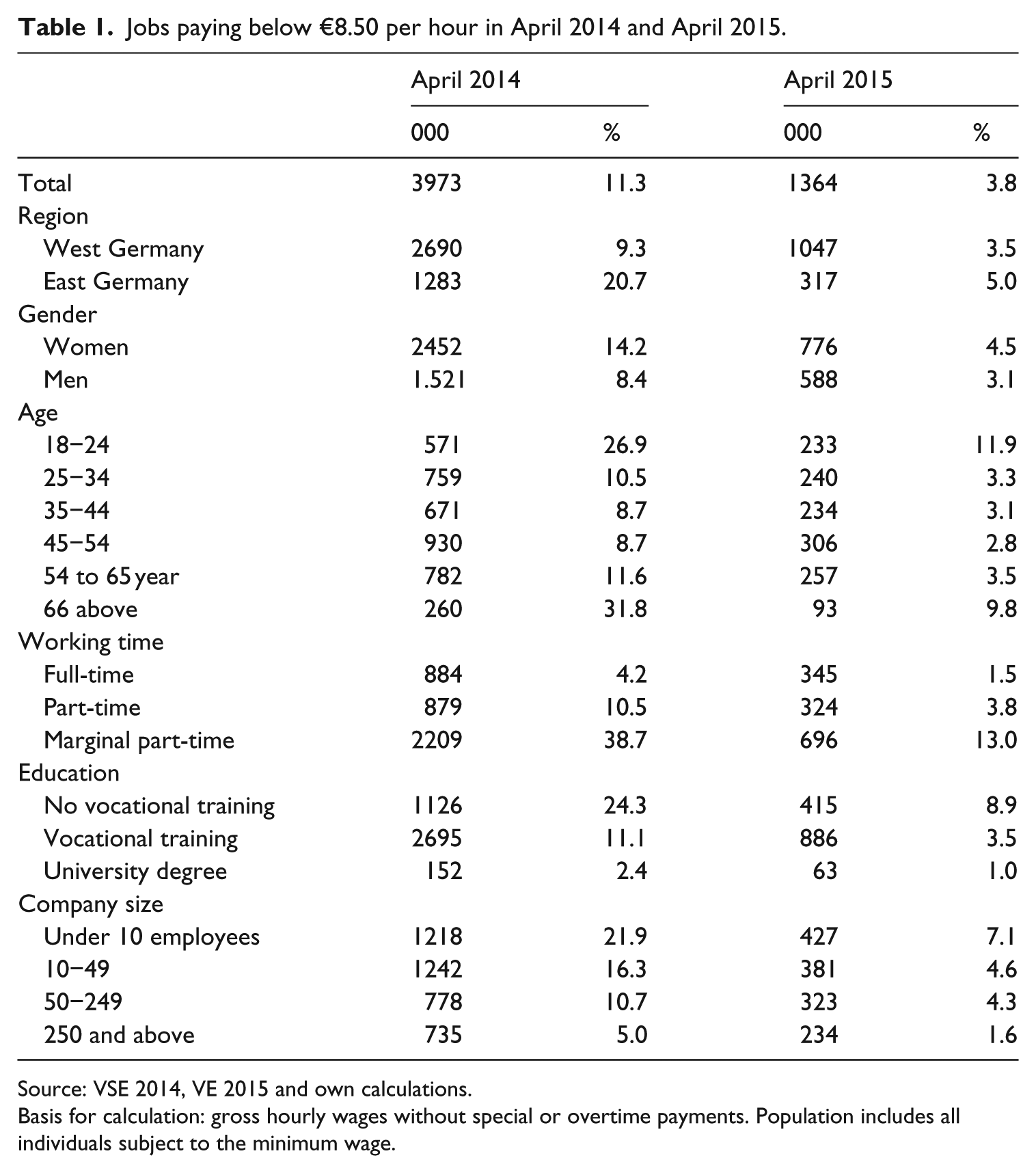
Source: VSE 2014, VE 2015 and own calculations.
Basis for calculation: gross hourly wages without special or overtime payments. Population includes all individuals subject to the minimum wage.
In terms of socio-demographics, there was an above-average prevalence of wages below €8.50 among female employees, low-skilled workers and individuals without vocational training, workers in smaller businesses and employees in marginal part-time work (‘mini jobs’). The latter is a specific form of employment, introduced in 2003, in which employees can earn €450 per month free of income tax and social security contributions; however, they receive no health insurance and only optional pension insurance. There were 7.6 million such jobs in 2014, and while approximately one-third of these were held in addition to regular employment that is subject to social insurance, most were held by people who do not have another job. 2 In April 2015, a few months after the new statutory minimum wage came into effect, the number of jobs below €8.50 per hour had fallen to approximately 1.4 million. The composition of those earning less than the statutory minimum wage was similar to that in April 2014, yet at a lower level, hence the groups benefited roughly equally in relative terms.
The risk of low-skilled employees receiving low wages is particularly high. However, because of the high proportion of German employees with vocational training, this constituted the largest share of those earning less than €8.50 per hour in 2014. Almost the same applies to the regional structure: the low pay incidence in East Germany is higher, but the large majority of the low-paid are in West Germany.
A sectoral perspective is also important to understand minimum wage dynamics. As in other countries, low-wage sectors were found mostly in services (Bosch and Weinkopf, 2010). A particularly high proportion of workers earning less than €8.50 per hour before the introduction of the statutory minimum existed in taxi operation, betting and gambling, hotels and restaurants, accommodation, private security and call centres. In absolute figures, hotels and restaurants, together with retail, had the highest total number of employees affected by the minimum wage. To analyse wage and employment effects further, we contrasted the aggregate development in the 20 sectors with the highest incidence of jobs earning less than €8.50 per hour in 2014 (see Mindestlohnkommission, 2016a: 43, for a list of this) with changes in the rest of the economy.
Wage effects
The introduction of the minimum wage led to significant increases in earnings across sectors and groups of employees with a high incidence of hourly wages below € 8.50 in 2014 (Amlinger et al., 2016). The VVE shows an overall increase of 2.5 percent between 2014 and 2015 in gross hourly wages of full- and part-time employees across Germany. Wages for groups with a high share of jobs below the minimum wage increased above average. In East Germany, wages rose by 4.0 percent, and wages in the 20 industries with the highest share of employees with hourly wages below €8.50 in 2014 by 7.1 percent. Unskilled workers in these industries received wage increases of 13.0 percent (Mindestlohnkommission, 2016a: 48).
However, these figures for the year-to-year changes may underestimate minimum-wage-induced increases resulting from anticipatory adjustments that had already taken place in 2014. Using the IAB Betriebspanel, Bellmann et al. (2015) point out that approximately 7 percent of companies reported that they increased wages below €8.50 before the official introduction of the statutory minimum wage. In another employer survey, Gürtzgen et al. (2016) reported that €8.50 was most often stated as the hourly wage for new hires in 2014, again indicating anticipatory adjustments.
The introduction of the minimum wage also affected wages that had been above €8.50 before the new wage threshold came into effect. There are indications of spill-over effects in which the introduction of the minimum wage led to increases in wages above the minimum. Such effects usually occur if the distance between different employment or wage groups on the wage scale is maintained, for instance, for motivational reasons (Falk et al., 2006; Grossman, 1983). In the IAB Betriebspanel, 14 percent of companies that had employees with an hourly wage below €8.50 in 2014 stated that they also increased wages above this level as a result of the new statutory minimum. A comparison of the wage distribution curves of the years 2014 and 2015 also suggests (on the basis of descriptive analysis) the existence of a spill-over effect that reaches wages of up to approximately €13 (Mindestlohnkommission, 2016a: 56).
At the same time, a highly populated wage bracket formed at or just above the level of the minimum wage (Figure 1). This concentration of hourly wages at the statutory minimum level is the result of the upwards movement of most wages of the 4.0 million employees who were paid below the minimum wage before its introduction. Taking a 10-cent bracket of centred on €8.50 (from €8.45 to €8.54), 1.9 million jobs were paid at the minimum wage level in April 2015, compared to approximately 400,000 in 2014.
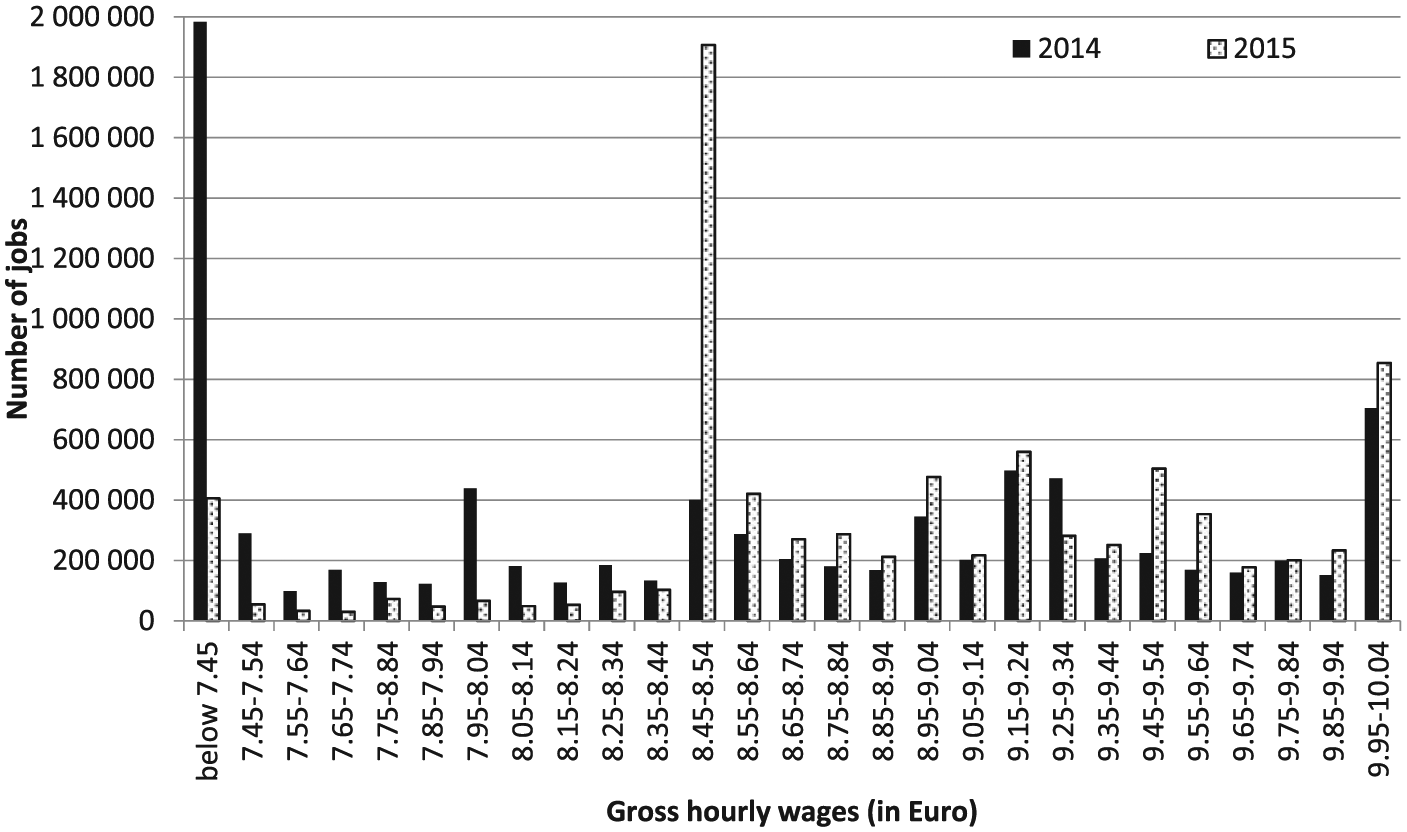
Distribution of jobs based on hourly wages (April 2014 and April 2015).
While the introduction of the minimum wage led to increases, the reduction in the number of workers receiving supplementary benefit payments despite being employed (‘topper uppers’) did not meet expectations. Our calculations based on administrative data from the Bundesagentur für Arbeit show that in 2015, after the introduction of the minimum wage, their number declined by 4.4 percent, which is more than the average annual decrease of 1.4 percent during the years 2012 to 2014, but less than was hoped for.
Comparative findings underline the limited impact of minimum wages for reducing poverty (OECD, 2015). According to Bruckmeier and Wiemers (2014), the reason for the limited effect is that, in addition to low wages, other factors are also crucial for determining the need for supplementary benefits, first and foremost among them the prevalence of part-time work, the existence of dependants in the household and rent as a share of household expenditure.
Employment effects
At the end of 2014, the employment level in Germany (including self-employed) was at a historic high of just under 43 million, and unemployment was at its lowest level since unification. The introduction of the minimum wage thus occurred in a generally positive economic environment.
Compared to the previous year, overall employment (not including self-employment) increased by 462,000 employees, or 1.4 percent, to 34 million in April 2015, 4 months after the introduction of the minimum wage (Table 2). Employment growth in East Germany was less than half of that in West Germany. Marginal part-time employment and the number of employees aged between 18 and 24 years both decreased, the latter only slightly. How far the decline in younger employees reflected the introduction of the minimum wage rather than demographic changes (Destatis, 2015; Fuchs, 2015) cannot be determined on the basis of existing data and requires further research. But contrary to expectations from theories assuming perfectly competitive labour markets, employment in the 20 industries with the highest share of employees with an hourly wage below €8.50 in 2014 grew more strongly than in industries less affected. Employment data for April 2016, 16 months after the introduction of the minimum wage, largely confirm the trends observed in 2015.
Change in employment from 12 months previously.
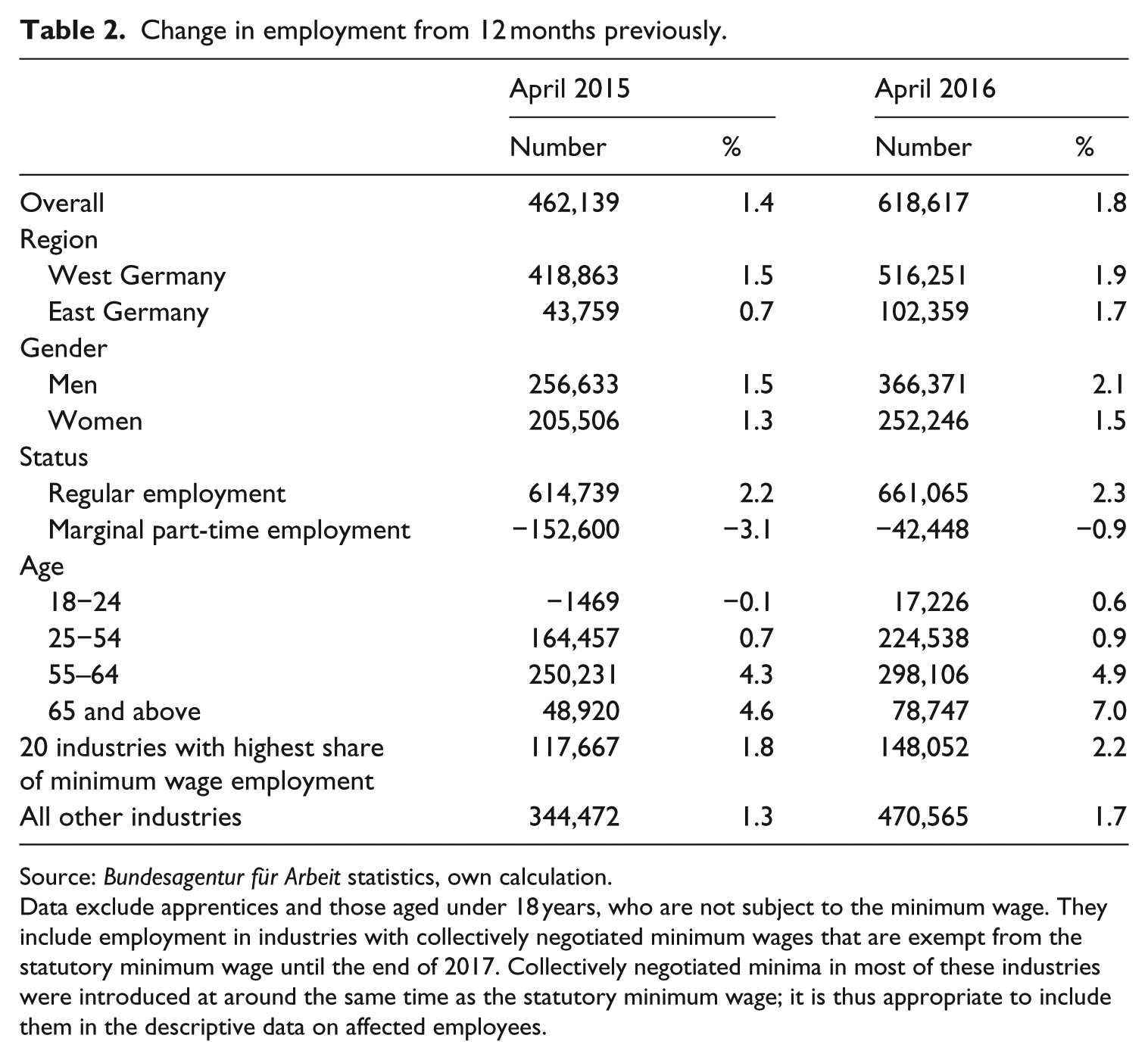
Source: Bundesagentur für Arbeit statistics, own calculation.
Data exclude apprentices and those aged under 18 years, who are not subject to the minimum wage. They include employment in industries with collectively negotiated minimum wages that are exempt from the statutory minimum wage until the end of 2017. Collectively negotiated minima in most of these industries were introduced at around the same time as the statutory minimum wage; it is thus appropriate to include them in the descriptive data on affected employees.
The decline in marginal part-time employment and the higher increase in employment in industries with a high share of minimum wage employees are the clearest indications in the descriptive data of a possible minimum wage effect. Marginal part-time work fell by 153,000 employees (−3.1%), a noticeable acceleration of the average decline of 0.2 percent in the years between 2010 and 2014. The major part of this decline occurred at the beginning of 2015, when the minimum wage was introduced (Mindestlohnkommission, 2016a). New rules were introduced for the mandatory documentation of working time for marginal part-time work alongside the minimum wage, which made marginal part-time work less attractive for employers over and above the introduction of the minimum wage itself. Approximately half of the job losses in marginal part-time work constituted transitions into regular employment, the latter being largely not covered by the new rules for working time documentation, and the other half led to unemployment or inactivity (vom Berge et al., 2016).
As noted, in the industries with the highest share of employees earning €8.50 per hour or less in 2014, employment increased above average in 2015. This reflects higher growth rates for regular employment on one hand, and slightly stronger rates of decline in marginal part-time work on the other. Both trends occurred at the end of 2014, coinciding with the introduction of the minimum wage. Part of the greater dynamism in regular employment growth can be explained by the transition from marginal part-time work to regular employment, as described above. However, even after taking this transition into account, a difference in employment growth remains. One possible explanation for the remaining growth differential, unconnected to the minimum wage, could be that the industries highly affected grew faster than the rest of the economy at that specific point in the business cycle because of domestic consumption growth, as all these industries belong to the service sector. Another possible explanation, which treats the minimum wage as a causal factor, could lie in labour supply effects as identified in the monopsony model of the labour market. In this context, a minimum wage increases low wages and thereby brings them closer to the employees’ productivity levels. This, in turn, allows employers in industries with a high share of minimum wage employees to fill vacancies and increase employment.
The few causal econometric analyses so far of the effects of the introduction of the minimum wage on employment replicate the ambiguities of the descriptive evidence. Garloff (2016) indicates stronger growth of regular full-time employment in regions with a large share of employees with wages below the minimum wage level than in regions with a smaller share. This supports the monopsony hypothesis that the minimum wage had a positive effect on regular employment. In contrast, using data from the IAB Betriebspanel, Bossler and Gerner (2016) identify a negative employment effect of 1.9 percent in establishments that had at least one employee with an hourly wage below €8.50 in 2014. This effect is driven mainly by the fact that establishments that were unaffected by the minimum wage increased their employment, while establishments that were affected by it held their employment constant. These authors estimate that approximately 60,000 additional jobs (mostly in marginal part-time employment) could have been created but for the introduction of the minimum wage.
Despite the lack of certainty about causality and the actual reasons behind employment changes, the data presented and the existing studies show robust short-term employment growth, and suggest that negative employment effects of the minimum wage occurred at most in limited areas of the labour market, such as marginal part-time work. Since increased wage costs from the minimum wage have not resulted in major employment adjustments thus far, what alternative channels were used to adapt?
Non-employment adjustment channels
As pointed out in the introduction, institutionalist and behavioural theories suggest that employment adjustments are only one channel that companies can use to adapt to increased labour costs. We identify several adjustment channels that are most likely to have played a significant role in the German case.
Working time and work intensity
Changes in working time and work intensity are a widely discussed adjustment channel. Schmitt (2015) emphasizes that while a minimum wage does not increase the cost of (hiring) additional workers, it raises the cost of each hour of work performed by a low-wage worker. Thus, companies may react to increased wages by reducing working hours and, sometimes simultaneously in the case of a constant workload, by raising work intensity. International evidence on this topic is mixed (Belman and Wolfson, 2014; LPC, 2016; Neumark and Wascher, 2008; Schmitt, 2015).
For Germany, data from the SOEP allow us to distinguish between individuals who earned less from those who earned more than €8.50 per hour before the statutory minimum wage was introduced. For full-time employees who earned less than €8.50 before the minimum wage was introduced, there was a considerable decrease in average weekly working hours – approximately 21 % a similar reduction occurred for part-time workers who earned below the threshold. However, there were considerably smaller or even no cuts in working hours for the higher-income groups and for marginal part-time work (Mindestlohnkommission, 2016a: 110). The extent to which the decrease in hours led to higher work intensity cannot be determined at this point.
Other descriptive analyses on the German minimum wage support our findings regarding reductions in working time. Wanger and Weber (2016) focus on marginal part-time jobs, using official data. They found a reduction in weekly working hours and interpreted this as a reaction of employers to avoid higher contributions to social insurance. Furthermore, the VVE indicated a negative correlation between the regional bite of the minimum wage and the average weekly working time of unskilled workers (Holtemöller, 2016). Our findings correspond to establishment-level survey data as well. In the IAB Betriebspanel, almost one in four companies directly affected by the minimum wage stated that work hours have been reduced or the workload has been increased following its introduction (Bellmann et al., 2016), making this the most reported adjustment channel. In the Commission’s consultation with stakeholders, the federal employer association of the hotel and restaurant industry, as well as that for hairdressers, highlighted that some of their member firms reduced their hours of operation. In particular, the less intensive hours with lower turnover were cut back (Mindestlohnkommission, 2016b).
Prices
Companies can also try to pass on additional labour costs to customers in the form of higher prices for goods and services. International surveys by Belman and Wolfson (2014) and Lemos (2008) conclude that minimum wages lead to pay rises in specific sectors that employ a higher share of employees who are covered by the minimum wage, while the impact on aggregate price levels is negligible.
Using official data on consumer prices from Destatis, we find a similar pattern for Germany. Consumer prices as a whole rose by merely 0.3 percent between 2014 and 2015, but they increased above the average rate in many sectors that were particularly affected by the statutory minimum wage (Mindestlohnkommission, 2016a: 119).
In Table 3, we highlight the price changes of some of the products and services related to these sectors. Taxi services, books, newspapers and magazines became more expensive, as did restaurants, cafés and hotels. Additionally, differences between East and West Germany become evident. This especially applies to prices for taxi services. 3 Given that prices remained almost constant overall, the increases in the affected sectors can be considered to be significant.
Price changes for selected products and services, 2014–2015.
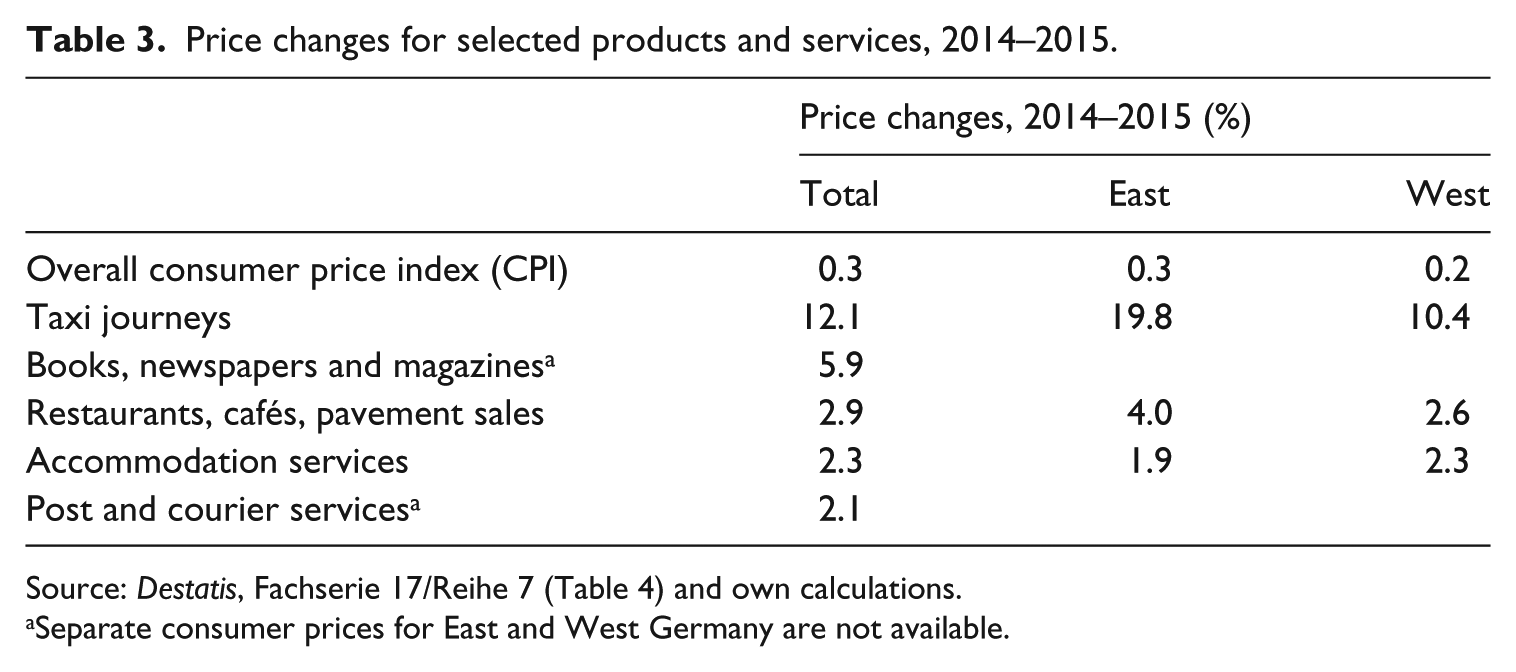
Source: Destatis, Fachserie 17/Reihe 7 (Table 4) and own calculations.
Separate consumer prices for East and West Germany are not available.
Increased productivity
Higher wage costs can also be compensated by improved productivity, keeping costs per unit stable. Increased productivity can be achieved by a number of measures that range from increased employee qualifications to the substitution of labour by capital. From a more behaviourally focused point of view, such as the wage-effort theory (Akerlof and Yellen, 1990), minimum wages can also influence workers’ efforts and lead to an increase in their productivity. International empirical evidence indicates that this productivity increase may indeed be an adjustment channel used by employers in low-wage sectors (Bernini and Riley, 2016; Riley and Bondibene, 2015; Rizov et al., 2016).
For Germany, we have little evidence on this topic to date. Establishment data suggest that companies affected by the minimum wage have rarely opted for strategies to increase productivity. According to the IAB Betriebspanel, only 1.5 percent of companies with at least one employee who earned less than €8.50 before 2015 reported that they had increased training, and another 2.1 percent that they planned to do so in the future. Only 1.4 percent of the companies affected reported that they had replaced employees by machines, and 1.1 percent that they intended to do so in the future (Bellmann et al., 2016). In the long run, productivity-increasing adjustment strategies may play a more prominent role because, according to the results from another employer survey, employers’ requirement levels for candidates have increased for jobs in the minimum wage range (Gürtzgen et al., 2016). Hence, over time, companies may opt to increase productivity by recruiting more qualified staff, which will eventually upgrade the skill profiles of their entire workforce, even without increased training for existing staff.
Reduced turnover
Sectors with low wages are often associated with high job turnover rates and with low levels of job satisfaction (Lane, 2000). In friction models, a higher minimum wage makes it easier for employers to recruit and retain employees, which lowers turnover costs and thus compensates at least partially for the increased labour costs (Dube et al., 2014; Schmitt, 2015). Indeed, several panel studies and case studies have found evidence that a minimum wage reduces job turnover (see Dube et al., 2014, and Schmitt, 2015 for references).
For Germany, relevant evidence has thus far been limited to the results presented by Bossler und Gerner (2016). They find a reduction in the churning rate (the employment neutral turnover rate) of approximately 2.9 percentage points.
Reductions in special payments and non-wage benefits
Employers may react to the minimum wage by reducing non-wage benefits, including allowances in kind and special payments, such as holiday or Christmas allowances. Both Metcalf (2008) and Schmitt (2015) report that there is little evidence that this occurs. In particular, they argue that the potential for this channel may be limited, as low-wage jobs rarely provide such non-wage benefits, particularly special payments.
This is also true for Germany. Low-wage jobs – in particular, marginal part-time employment – only rarely provide special payments. According to the data from the IAB Betriebspanel, 6.1 percent of the companies affected by the minimum wage said that they reduced special payments. This was particularly true for companies that were not covered by collective agreements, as they had more degrees of freedom to adjust such payments. A total of 7.1 percent of these companies reduced special payments, in contrast to under 2 percent of the companies that were covered by sectoral or company-level agreements.
Non-compliance
According to Schmitt (2015) and Metcalf (2008), non-compliance can also explain why only limited employment effects are discernible so far. If companies fail to increase wages below €8.50 to the new threshold, follow-up effects on employment cannot be expected. Research on the extent of non-compliance is difficult by nature, and monitoring and enforcing the minimum wage are challenging tasks (Benassi, 2011; Croucher and White, 2007; Ipsos Mori, 2012).
There are at least three different sources of information on non-compliance: first, the results from monitoring and enforcement activities; second, findings from official or survey data about earnings below the statutory minimum wage; and third, evidence from qualitative research.
In Germany, the FKS (Finanzkontrolle Schwarzbeit, Financial Monitoring Unit for Illicit Employment), a special unit within the Generalzolldirektion (Customs Authority), is responsible for monitoring the minimum wage (Mindestlohnkommission, 2016a). Its controls are part of employer inspections which focus mainly on activities in the shadow economy. In 2015, a total of 43,637 employers were screened, and only 705 preliminary proceedings were initiated for non-compliance with the new statutory minimum wage. This moderate number is the result of an emphasis by the authorities on information rather than on sanctions during much of the year 2015. The trade unions strongly criticized this preference and – from their point of view – the insufficient monitoring of employers in low-wage sectors (Mindestlohnkommission, 2016b: 33).
Results from official and survey data on earnings are available for April 2015, 4 months after the introduction of the minimum wage. According to the Destatis earnings survey, 3 to 4 percent (1.0 to 1.4 million) of all jobs were still paid less than the minimum wage in April 2015; additionally, 13 percent of marginal part-time jobs were paid below the new minimum wage threshold (see Table 1 above). Pusch and Seifert (2017) used SOEP data for roughly the same time period to evaluate marginal part-time employees, and found a significantly higher incidence of hourly wages below €8.50, approximately 50 percent. The differences can be partly explained by the different data source and the different specifications of the data used.
Qualitative evidence on typical patterns of non-compliance observed in 2015 are detailed by the Generalzolldirektion: insufficient or fraudulent documentation of working hours, exclusion from working time of stand-by times or empty loads and the unlawful compensation of working hours with vouchers or benefits in kind (Mindestlohnkommission, 2016a).
The incidence of wages below the statutory minimum can partly be explained by both the legal exemptions for industries that were allowed to pay (lower) sectoral minima until the end of 2017 and by measurement inaccuracies. Based on the available information, the extent of both factors and, inversely, the extent of non-compliance, are difficult to estimate. However, rather than being a permanent adjustment channel, non-compliance may be the result of slow implementation and the initial uncertainty of employers. There might be a transitional period during which employees earn below the new statutory wage floor because of a lack of knowledge or sluggish implementation. In the United Kingdom, the share of employees who still earned below the minimum wage declined from 5 percent to, approximately, 2 percent in its first year and fell further to 1 percent after 4 years (LPC, 2000, 2005). The experience with sector-specific minimum wages in Germany since the late 1990s also hints at lagged implementation, as the number of violations that have been detected by the customs authorities has decreased over time (Böhlke and Schulten, 2014).
Conclusion
This article has provided empirical evidence on the first effects of the new German minimum wage introduced in January 2015. Although the level of €8.50 was relatively moderate by current international standards, its coverage was rather high. There is clear evidence that the introduction of the new minimum wage led to changes in the wage structure: hourly wages increased significantly in regions, socio-economic groups and sectors where a high share of employees earned less than €8.50 before 2015. This was the case for employees in East Germany, those in marginal part-time jobs, individuals without vocational training, workers in smaller businesses and women.
An assessment of the available evidence suggests that employment effects have thus far been limited. Regular employment has continued to grow, especially in the sectors that have been strongly affected by the minimum wage; the number of marginal part-time jobs decreased slightly. There are several possible reasons for the absence of a significant negative impact on employment. First, the German economy was performing strongly at the time the minimum wage was introduced; this may have especially benefited the service industries, where low-wage jobs had increased substantially. Second, the transitional provisions for specific sectors with collectively agreed minima below the new wage threshold, part of the low-wage workforce was exempted from the statutory minimum, giving these sectors additional time to adjust to the new wage floor. Third, in terms of theoretical argument, the minimum wage may to a certain extent have corrected the monopsony power of employers and reduced the gap between wages and productivity, thus increasing employment. Finally, minimum wages may affect employment rates over time rather than immediately (Sorkin, 2015).
However, institutionalist and behavioural theories and empirical findings from other countries offer an additional explanation: employment adjustments are only one channel that companies can use to adapt to increased labour costs. A broad range of other mechanisms may be at least as relevant. Certainly, the evidence presented can provide only a first picture of a complex issue. Nonetheless, the empirical findings suggest that the following adjustment channels are highly relevant. The most frequently reported channel in Germany includes changes to working time and work intensity. Second, consumer prices saw above-average increases in some of the industries that were particularly affected by the statutory minimum wage, but there was no discernible effect on the overall consumer price index. Third, special payments and non-wage benefits were occasionally reduced. Fourth, non-compliance with the statutory minimum wage may be considered an adjustment channel. Fifth, labour turnover decreased; and sixth, companies may have attempted to absorb higher wages by hiring more qualified staff for vacancies at the minimum wage level.
Against the backdrop of the debate about minimum wage coordination at the EU level (Fernández-Macías and Vacas-Soriano, 2016; Schulten, 2008, 2012), our findings on the effects of the new statutory minimum wage in Europe’s largest economy may also influence the general debate about the desirability of general minimum wages at European level. However, to improve our understanding of minimum wage effects in Germany and the relevance, mechanisms and interdependences of adjustment channels, each of these channels merits further investigation and additional research based on richer and more detailed datasets.
Footnotes
Acknowledgements
We would like to thank the editor and two anonymous referees for their valuable comments. The views expressed in this article are those of the authors and do not necessarily represent those of the Minimum Wage Commission.
Funding
The author(s) received no financial support for the research, authorship and/or publication of this article.