




Abstract
Sexual scripting theory, a widely used tool in sexuality research, was originally developed by Gagnon and Simon to illuminate the social nature of sexual practices and identity construction. Later, they sought to develop the theory further to align with a social constructionist perspective. However, vestiges of individualism and cognitivism haunt sexual scripting theory largely due to the use of the symbolic interactionist concept of performance. To address this, we draw on the performance–performativity approach in critical discursive psychology that develops the notion of performance from a discursive perspective and offers a way of extending sexual scripting theory that offers a truly social explication of sexual identity construction. We provide a practical illustration of this extended theorising, drawing on data from a project about young people’s online engagement with pornography. We demonstrate how developing the notion of sexual scripts as discursive resources that enable the performance of sexual identities allows us to illuminate the social and situated nature of identity construction. This framework enhances understanding of the process of sexual identity construction and provides a valuable tool for studying how broader sexual scripts that are sociohistorically specific provide a scaffolding for the ways an individual can construct sexual identities. Overall, this paper offers a valuable contribution to discursive scholarship in psychology by presenting a nuanced analytical framework that coheres with a constructionist, performative view of identity.
Keywords
Sexual scripting theory was introduced by sociologists Gagnon and Simon (1973) in their book Sexual Conduct: The Social Sources of Human Sexuality, where they proposed a more encompassing social conceptualisation of sexuality than those that dominated at the time. Sexual scripting theory has since been widely taken up, crossing disciplinary and epistemological boundaries. It has been used within cognitive, positivist, and social constructionist frameworks, sometimes departing from its initial theoretical impetus and original purpose of providing a social understanding of sexuality (Frith & Kitzinger, 2001).
Gagnon and Simon’s (1973) original aim—which they continued to develop in subsequent iterations of the theory—was to theorise how people’s sexual beliefs, desires, and practices are shaped by cultural norms, social expectations, and interpersonal relationships. This aim of illuminating the social dimension of sexuality included an understanding of sexual identities as developed in relation to personal and sociocultural factors (Simon & Gagnon, 1984, 2003). This understanding was expanded in their later work, which conceptualised sexual identity as an interactional accomplishment, that is, as socially constructed. However, critics argue that this aim still needs to be fully realised and that vestiges of social cognitivism remain (Brickell, 2006; Frith & Kitzinger, 2001).
To address this limitation—and realise Simon and Gagnon’s intention of aligning their theory with a social constructionist perspective—we propose putting sexual scripting theory in conversation with critical discursive psychology to study sexual identity construction as an irreducibly socially embedded process. Critical discursive psychology combines “principles from both wider (conversation analytically inspired) discursive psychology and post-structuralist Foucauldian-inspired Discourse Analysis conversation” (Locke & Budds, 2020, p. 235). This methodology is useful because it focuses both on interpersonal interactions (micro level) and the broader sociocultural meanings shaping sexuality (macro level). Specifically, we draw on Morison and Macleod’s (2013a, 2013b, 2015) performance–performativity approach (explicated further below), which offers a useful conceptual framework for understanding the processes through which identities are constructed, claimed, contested, and performed. As such, our conceptual framework is footed in an overarching constructionist understanding of language as a form of social action and the approach we offer in this paper takes a performative view of identity (Taylor, 2006, 2015) in which “people’s identities are also understood to be performative: constructed and enacted in their talk” (Taylor & Littleton, 2006, p. 24).
Of course, (critical) discursive psychology is just one methodology that can be used in sexuality research and, like all methodologies, it has its limitations. Moreover, departures from Simon and Gagnon’s (2003) original aims are not necessarily problematic, as the theorists asserted: “A scripting approach, at best, is not a terminal point but merely a beginning, a way of charting what must remain a complex and changing landscape of uses and meanings” (p. 496). What is problematic, however, is the general failure to flag subsequent developments as departures from the original purpose and theoretical underpinnings of the sexual scripting theory.
As the theory has increasingly been taken up in new ways, researchers largely neglect to engage with theoretical issues and to be explicit about the underlying epistemological and theoretical assumptions of their work. This lapse can create confusion and incongruence between the theoretical orientation researchers claim to adopt and their actual application of the theory. As observed by Frith and Kitzinger (2001) in this journal more than two decades ago: “Although the terminology of ‘sexual scripts’ is now commonplace in (especially feminist) psychological writing on sexuality, its underlying theory is often far less apparent” (p. 211). This observation remains true as researchers still often neglect to address how sexual scripting theory’s theoretical underpinnings relate to their application, or how they have deviated from these.
Therefore, in the interests of theoretical specificity, we begin with a brief overview of Gagnon and Simon’s (1973) work on sexual scripting theory, explaining its key tenets and including some of its promises and pitfalls. We then turn to our engagement with the theory through critical discursive psychology, providing some background in the broad area of discourse analysis that inspires our discursive approach to sexual scripting theory. We end with a demonstration of our approach by applying it to data drawn from a project on youth engagement with pornography.
A brief overview of sexual scripting theory
Gagnon and Simon (1973) developed sexual scripting theory to account for the social nature of sexual behaviour. The theory responds to biologically deterministic and individualising conceptions of sexuality: the prevailing common-sense view in sexuality research of sex as simply “natural” and related to instincts, as well as the prevailing psychological explanations of sexuality as determined by internal drives. Instead, the theorists maintained, “individual desires are linked to social meanings” and these meanings are implicated in “the process of creation of the [sexual] self,” which occurs in a social world in which “we bargain for our identities” (Simon & Gagnon, 1984, p. 53).
Their core argument was that sexual behaviour is not purely instinctual or psychological, but “socially acquired” (Simon & Gagnon, 2003, p. 492). To illuminate the process of acquisition, Gagnon and Simon (1973) initially turned to social learning theory in which socialisation involves “learning the culture” through various sociocultural sources, such as families, media messages, peer interactions, and personal experiences. Accordingly, they proposed that the shared sociocultural beliefs, expectations, and sexual norms of a particular time and place are learned via socialisation and, in this way, the social produces and shapes sexual behaviour (Wiederman, 2015).
Later, inspired by new theoretical developments in sexuality studies, the theorists sought to cut ties with social cognitive notions of social learning. Turning to social constructionist theory in the form of ethnomethodology and symbolic interactionism, they proposed a view of human sexuality as “thoroughly symbolic,” fashioned through a process of sexual meaning making (Plummer, 2005, p. xii). The influence of symbolic interactionist theory is evident in their later articulation of sexual scripting theory as they drew on the dramaturgical (or theatrical) metaphors in Kenneth Burke’s and Erving Goffman’s work (Jackson & Scott, 2010). Working on the premise that social “roles are meaningless in themselves and take on meaning only in relationship to the enactment of related roles” (Simon & Gagnon, 1986, p. 110), they theorised sexual behaviour and interaction as akin to the “staging of a drama,” with scripts specifying and ordering roles and the relationships among them. Accordingly, they envisaged people as “actors following ‘sexual scripts’—the normative cultural contexts that give sex its meaning, and enable us to distinguish appropriate partners and to know what to do with them once we select them” (Kimmel, 2007, p. xi). The aim was to theorise sexual identity construction as an interactional accomplishment that one does (an aim that was not fully attained, as we explain later).
This thinking continued to shape Simon and Gagnon’s (1984) later work. Throughout the 1980s, they continued to develop sexual scripting theory to be more attuned to the social than the psychological, as envisaged in social constructionism. This subsequent theoretical work resulted in theoretical concepts that they called the cultural scenario and sexual scripts. The concept of the cultural scenario can be understood as the “staging of a drama” or play. That is, the broad social backdrop or setting—comprising social systems and structures—granting meaning to sexual practices and setting the parameters of what is culturally recognisable and acceptable. Hence, they argue that:
All institutions and institutionalised arrangements can be seen as systems of signs and symbols through which the requirements and the practice of specific roles are given. The enactment of virtually all roles must either directly or indirectly reflect the contents of appropriate cultural scenarios. (Simon & Gagnon, 1984, p. 53)
As such, cultural scenarios represent the broader collective framework based on mutual, historically specific cultural understandings of social roles, including the accepted sexual norms, beliefs, and values of a particular culture or society. These shared norms, beliefs, and values set the parameters for what is considered desirable or acceptable sexual conduct in a given time and place and in this sense shape individual sexual experiences. Thus, while one may experience sex as profoundly personal and idiosyncratic, Simon and Gagnon (1984) maintain that these “instructions make most of us far more committed and rehearsed . . . than we realise” (pp. 53–54).
The second theoretical concept, the sexual script, is based on the premise that social interactions, including those related to sex, are guided by “an operating syntax” (Simon & Gagnon, 1984, p. 53) or system. Sexual scripts, therefore, have also been described as “patterned constellations of language and action, convention and expectation” (Brickell, 2006, p. 95). Given its origin in the dramaturgical metaphor, the concept of the sexual script can usefully be thought of as operating much like a theatrical script used in a drama or play to structure the action on stage regarding plot and characters, their relationships, motivations, and so on. As Simon and Gagnon (1984) explained, the sexual script is a metaphor that provides a way to think about how sexual practices, interactions, and identities are produced in daily social life.
The theorists provided further explanation of their use of the term “script” concerning sexuality, specifying two critical dimensions of the concept, the interpersonal and intrapsychic, as follows:
One [dimension] deals with the external, the interpersonal—the script as the organization of mutually shared conventions that allows two or more actors to participate in a complex act involving mutual dependence. The second [dimension] deals with the internal, the intrapsychic, the motivational elements that produce arousal or at least a commitment to the activity. (Gagnon & Simon, 1973, p. 14)
This explanation shows the distinction between the “external” world of “shared conventions,” denoted by interpersonal scripts, and the “internal” world of sensemaking, denoted by intrapsychic scripts. Interpersonal scripts were proposed to describe how patterns of socially acceptable conduct guide interactions with other social actors (e.g., sexual partners), and negotiation occurs between actors to meet these expectations. Intrapsychic scripts were proposed to denote the process of constructing mental representations to make sense of one’s experiences, including one’s own and others’ behaviour. This process of meaning-making is termed “internal rehearsal” (Simon & Gagnon, 1984, p. 53) and is theorised as occurring in relation to cultural mores and values, as well as personal desires and fantasies.
By elaborating on the notion of the script in this way, the theorists sought to offer a means of showing how social and individual meanings of sex guide sexual conduct and relations—owing to a reflective social actor, rather than the biologically driven subject of behaviourism or psychically compelled self of psychodynamic theory. However, in doing so, elements of individualism and cognitivism were retained—some of the problems of symbolic interactionism that later gender and sexuality theorists have highlighted (e.g., Brickell, 2006; Butler, 1990). Thus, Simon and Gagnon’s (1984) later attempt to theorise the socially constructed nature of sexuality and sexual identities via symbolic interactionism and ethnomethodology is only partially successful in that it does not wholly align with social constructionist conceptualisations of identity as they had intended, as we explain further below.
Performance: The pitfall and promise of sexual scripting theory
Reflecting on the development of their theory, Simon and Gagnon (2003, p. 494) maintained that their “evolution in thinking could be described as moving from a social learning position towards a social constructionist position” (p. 494). However, it may be that the scholars were limited to some extent by the reigning psychologising discourses of the time. Discursive psychologists Frith and Kitzinger (2001) argued that “notwithstanding claims made for script theory as a form of social constructionism, it incorporates individualistic and cognitive assumptions that ignore the social context” (p. 209) and thus remains “rooted in individualistic cognitive assumptions typical of mainstream psychology” (p. 211).
The incorporation of symbolic interactionist concepts gave sexual scripting theory a more social reading than its earlier formulation, but it ultimately represents a psychosocial perspective, viewing sexual identity construction as having a social component while retaining the individual mind—internal reflection on experience—as the explanatory root of behaviour. Consequently, scripts are commonly conceptualised as residing “inside people’s heads (as cognitions)” (Frith & Kitzinger, 2001, p. 212) and referred to as internal guides, blueprints, maps, cognitive models, heuristics, internal states or schemas, mental processes, and so on.
To remove “‘scripts’ from inside the heads” of speakers and align with a social constructionist perspective, Frith and Kitzinger (2001) proposed drawing on discursive psychology to focus on “the social function of talk” (p. 228; e.g., consenting, reputational maintenance, minimising accountability, etc.), focussing on turn-by-turn interaction in situ. Departing from the way that sexual scripts are conventionally understood, as preexisting “cognitive maps” or even “shared understandings” of sex that are employed by speakers, Frith and Kitzinger (2001) used a discursive psychology approach to explore how sexual scripts can be understood “as a participant resource (i.e., as used by research participants to achieve certain interactional goals)” (p. 217).
Frith and Kitzinger’s (2001) work offers a good example of how discursive methodology can be used to advance sexual scripting theory. However, we wish to deal with a more fundamental issue at the heart of the theory’s lingering cognitivism: the usage of the concept of performance (the dramaturgical metaphor discussed above). We consider the current conceptualisation of this concept to be a pitfall of sexual scripting theory. However, if harnessed appropriately, it holds much promise for investigating sexual identity construction in a manner consistent with a constructionist understanding of identity.
The dramaturgical metaphor in symbolic interactionism implies an intentional actor behind the performance, and by incorporating this concept, sexual scripting theory maintains the internal “cognitive self” as the locus of explanation (Brickell, 2006). This is a conception of a “true self” behind the performance who oversees and directs the performance and acting self, and equates to the humanist conception of the autonomous and sovereign subject questioned by social constructionists (Brickell, 2006) or the “prior and volitional subject” rejected by poststructuralists (Butler, 1991, p. 24). Nevertheless, the concept of performance and the reflexive presentation of self it invokes is an essential aspect of sexual identity construction and one that is not always captured in discursive work (Nentwich & Morison, 2018).
To capitalise on and develop this aspect of the theory, we turn to more recent theorising in gender and sexuality studies that has grappled with the tensions between performance (as derived from symbolic interactionism) and the performative view of identity construction taken by social constructionists that derives from Foucauldian theorisation of subject formation as discursively constituted (Brickell, 2006; Morison & Macleod, 2013a, 2013b, 2015). To extend sexual scripting theory to align with a social constructionist view of identity, we look to critical discursive psychology, specifically the performativity–performance approach proposed by Morison and Macleod (2013a, 2015). As we discuss further in the following section, this theory-method offers a theoretical and methodological basis for amplifying the constructionist aspects of the theory without losing the reflexive, agentic subject allowed by the notion of performance in sexual scripting theory.
Developing sexual scripting theory through critical discursive psychology
Critical discursive psychology is one of several approaches to discursive research that share a social constructionist epistemology, as shown in Figure 1. This theory-method arose in the late 1990s to address the problem of agency in discursive work, particularly Foucauldian-inspired methods (Locke & Budds, 2020; Wetherell, 1998). This line of thinking, as we discuss further below, has provided a valuable avenue for critical scholars interested in drawing on and developing the notion of identity performance, forming the basis for later work around the concept of performance, such as the performativity–performance approach that we draw on (Morison & Macleod, 2013a, 2015). In the remainder of this section, we explain this background before turning to the performativity–performance approach and how it can be used to extend and apply sexual scripting theory.
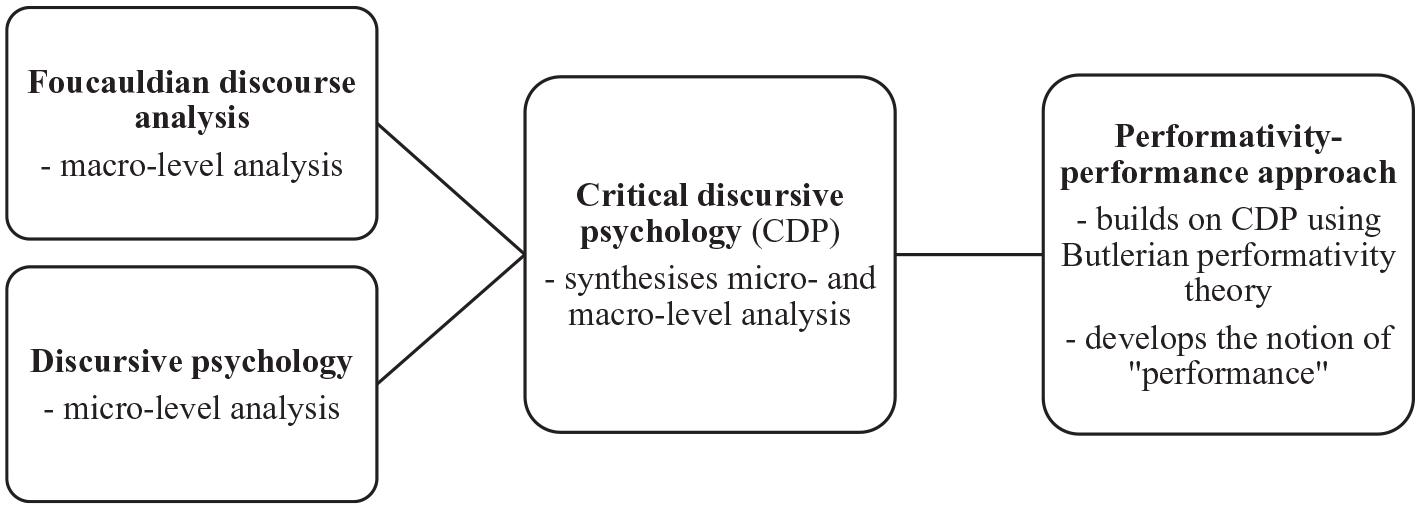
Overview of discursive approaches.
Critical discursive psychology, sexual identity, and agency
Critical discursive psychology takes a performative view of language as constituting social identities through speech acts in interactions (Burr, 2015; Locke & Budds, 2020). In line with a social constructionist perspective, identities are theorised as fashioned wholly in and through discourses as “distinctive ways of talking about objects and events in the world” (Edley, 2001, p. 202). Each discourse makes particular identity positions, or ways of being, possible (Nentwich & Morison, 2018). For example, a developmental discourse offers the positions of “typical, risk-prone teenager,” “vulnerable child,” and “good/bad parent.” This understanding of identity construction contrasts with understandings of selfhood evident in social learning theory, symbolic interactionism, and other social theories that retain elements of individualism and cognitivism in identity formation to some degree.
Although critical discursive psychology shares a social constructionist epistemology with other discursive approaches, it diverges from poststructuralist Foucauldian-inspired approaches with respect to the subject’s agency within discourse (Burr, 2015; Nentwich & Morison, 2018). The performative view of identity derived from Foucault’s radically social notion of the self as, in a sense, “spoken by discourse” has been critiqued for (seemingly) affording more agency to discourse than to the people who draw on them, sparking debates about the agency of social subjects in identity construction (e.g., see Benhabib et al., 1995). The main concern is the degree to which the subject is determined by the discursive formations in which they are positioned. The question is, to what extent are social actors simply “stuck” in discourse (determinism) or able to actively and intentionally use discourse (voluntarism) to construct identities (Morison & Macleod, 2013a)? In this regard, there are two main issues with poststructuralist and Foucauldian-inspired discursive approaches.
The first issue is the notion that discourse determines subject positions and, by extension, people’s identities. The implication is that identities are predetermined (Wetherell, 1998). The poststructuralist subject, following Foucault, is “always already” positioned and subjected to preexisting discourse. From this perspective, there is very little agency accorded to individuals in identity construction; they may simply claim, accept, or reject the positions offered by discourse (Taylor, 2015).
Moreover, the process of identity construction is also tightly constrained. There are a limited number of discourses available for this purpose, some more powerful than others. Regarding sexual identity, for example, Burr (2015) explains that “the discourses of sexuality on offer in our present society offer a limited menu for the manufacture of sexual identity . . . [Moreover,] well-established discourses in particular call on us to identify ourselves with respect to them” (p. 124). The problem this perspective raises is that if identity is simply a discursive product, then the agentic self and the individual are merely illusory—at best constructions—over which one has little control (Burr, 2015). This view of identity has been decried as “a form of determining where, depressingly, subjects [are] inextricably locked into oppressive relations of power but unable to change them” (Lloyd, 2007, p. 57).
This leads us to the second related issue, which stems from the proposition of the self as “merely” a discursive effect. The poststructuralist conception of identity refutes a commonsense, psychological understanding of talk as an expression of identity by a social subject who preexists the performance of self. This perspective “cut[s] all moorings from the individual and adopt[s] a more radical stance towards the re-conceptualization of selves and identities in which social relatedness completely precedes individuality, interiority and lived experiences” (Smith & Sparkes, 2008, p. 24). Rather than the origin or producer of discourses, the discursively constituted subject is “simply” an effect of these (Taylor, 2015). For instance, Butler’s (1990, p. 25) Foucauldian-influenced performativity theory asserts that “there is no doer behind the deed” and, hence, no self without discourse.
This perspective has been called the “death of the subject” or, more disparagingly, “the dissolution of the subject into yet ‘another position in language’” (Benhabib, 1995, p. 20). Critics of this perspective contended that with the disappearance of the subject, one loses notions of “intentionality, accountability, self-reflexivity, and autonomy” (Benhabib, 1995, p. 20). Some argued, therefore, for retaining a prediscursive subject who speaks the discourse and intentionally negotiates between various subject positions (Morison & Macleod, 2015)—the psychological self that haunts sexual scripting theory.
It is to this tension—between being positioned (determinism) and positioning oneself (voluntarism) as some have described it—that critical discursive psychology responds. Offering a third way between these standpoints, Wetherell (1998) proposed an approach in which identities are both conferred and actively claimed and contested, though remaining in the bounds of discourse and without reintroducing the prediscursive subject. Wetherell initially called this a “synthetic approach” to analysis to capture her aims of synthesising or combining a “top-down” or macrolevel perspective—as in (Foucauldian) discourse analysis—with a “bottom-up” or microlevel perspective of talk in interaction—as in traditional conversation analysis-inspired discursive psychology (Locke & Budds, 2020). The value of this synthetic approach is summed up well by Locke and Budds (2020) as follows:
By combining the micro-analytic elements of Discursive Psychology that pay attention to how discourse and interaction is a form of “social action” with the broader “macro” elements of socio-cultural and historical contexts of the discourse typically seen in Post-Structuralist approaches, [Critical Discursive Psychology] provides a dual-reading of data and can offer a more complete analytic picture of the topic under investigation. (p. 237)
The “dual reading” offered by critical discursive psychology allows researchers to consider how broader, sociohistorically specific discourses provide scaffolding for how an individual can construct sexual identities (Beres, 2014; Locke & Budds, 2020).
Responding to the debates about agency, critical discursive psychology pioneers Edley and Wetherell (1997) proposed a model of the social subject as “simultaneously the slave and the master of discourse,” positing that since “people are simultaneously the products and the producers of discourse[, we] are both constrained and enabled by language” (p. 206). This theorisation of identity construction allows for a view of the subject as discursively constrained but also active, reflexive, and agentic (Taylor, 2006; Taylor & Littleton, 2006). This development elaborates on the Foucauldian notion of discursive constraint; speakers are considered both restricted and enabled by available discourses (Nentwich & Morison, 2018). Therefore, although available discourses delimit possibilities, they can be strategically negotiated, resisted, and rejected (Edley & Wetherell, 1997).
As such, discourses are considered “building blocks” of talk (Edley, 2001) or “discursive resources” (Taylor & Littleton, 2006) that can be actively and reflexively drawn on by speakers in interactively useful ways and to their own ends (e.g., exonerating, discrediting, resisting). This process may also involve “identity work”: negotiating the positions offered by available discourses—taking up, resisting, or conferring positions—to present oneself in ways that are beneficial in the immediate discursive context (Taylor & Littleton, 2006). Positions can be “conferred and actively claimed or contested within interactions” (Nentwich & Morison, 2018, p. 217). This makes critical discursive psychology ideal for studying identity construction.
Importantly, critical discursive psychology’s theorisation of active identity work highlights the reflexive character of talk and identity construction. It offers an agentic subject that both is positioned by discourse and reflexively “interacts, negotiates, thinks back, and plans forward across multiple instances of talk” (Nentwich & Morison, 2018, p. 217), strategically positioning oneself and others in relation to power. It follows that a speaker is actively engaged in the ongoing project of identity work, which is inherently social because it is resourced and constrained by the larger social meanings that exist in the social and cultural context (Taylor & Littleton, 2006). In this way, critical discursive psychology potentially offers a way to understand and examine sexual identity construction, investigating how wider, “big” discourses provide cultural scaffolding for the active and reflexive creation of sexual identities (Beres, 2014; Locke & Budds, 2020).
Of particular use in this regard is the performance–performativity approach, which explicitly develops the dramaturgical metaphor of performance via critical discursive psychology to highlight “how [identity] performances are discursively constrained, in the sense of both restricting what is sayable or doable, but also enabling deviations or improvisations” (Morison & Macleod, 2015, p. 35). In the following section, we explain how this approach to critical discursive psychology enables an understanding of sexual identity construction as an active process informed by broader socio-cultural understandings.
The performance–performativity approach and sexual identity construction
Like critical discursive psychology more broadly, the performativity–performance approach is synthetic, providing a dual analytical lens (Morison & Macleod, 2013a), as summarised in Table 1. This approach is distinct in that it combines the analytical concepts of performance (Bamberg, 2012) and identity work (Taylor & Littleton, 2006) derived from recent theorising in critical discursive psychology with Butlerian performativity theory (Butler, 1990). This theory-method was specifically developed in response to questions of agency in Butlerian theory but essentially seeks to reconcile the tension between discourse determinism and voluntarism, as described above, by capitalising on critical discursive psychology’s allowance of a reflexive, agentic subject. Importantly, it is helpful for our purposes because of its explicit development of the dramaturgical metaphor of performance and theorisation of the notion of a script as a discursive resource enabling the performance of sexual identities (Morison & Macleod, 2013a, 2015). The core analytical concepts (and procedures) of the performativity–performance approach are summarised in Table 1.
Overview of core analytical concepts and procedures.
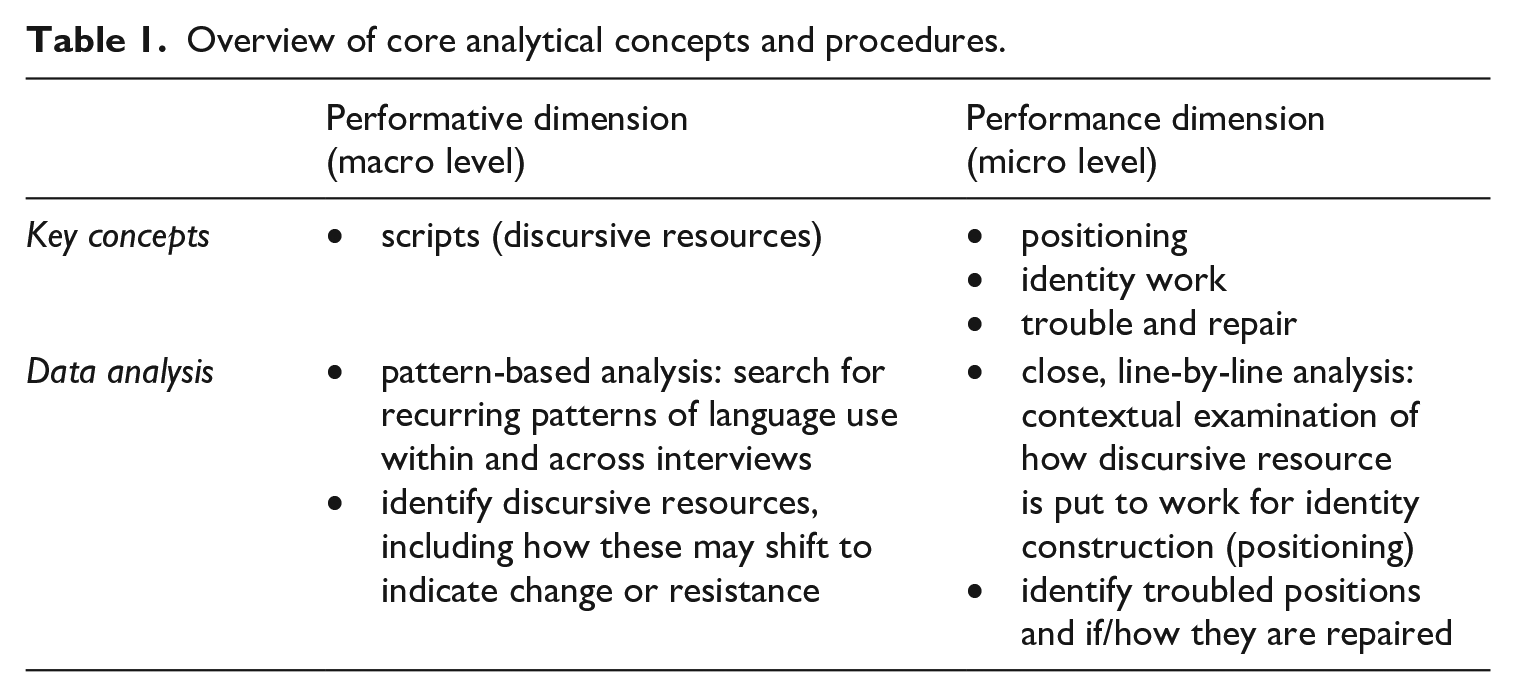
As Table 1 shows, at the macro level, discursive resources are theorised as scripts. Scripts are socially established ways of speaking that determine what can be said about a topic and comprise “prevailing sociocultural understandings (sets of meanings, metaphors, representations, images, stories, statements, and so forth) present in society’s language practices and in the particular context in which [talk] is situated” (Morison & Macleod, 2015, p. 9). In this sense, a script is essentially understood in much the same way as the more commonly used notion of an interpretative repertoire: a “relatively coherent way . . . of talking about objects and events in the world” (Edley, 2001, p. 198) or “a culturally familiar and habitual link of argument comprised of recognizable themes, commonplaces and tropes” (Wetherell, 1998, p. 400).
However, the term script is favoured and purposefully used by Morison and Macleod (2015) to invoke the dramaturgical metaphor of performance to highlight how identity “performances are discursively constrained, in the sense of both restricting what is sayable or doable, but also enabling deviations or improvisations” (p. 35). This aspect (performance) is captured at the micro level, scripts are understood as used or put to work in talk to accomplish different discursive purposes, highlighting speakers’ discursive manoeuvring and improvisation related to dis/preferred identities. Researchers, therefore, attend to how speakers draw on scripts in interviews or other interactions to do identity work by positioning themselves or others in particular ways (Nentwich & Morison, 2018).
Therefore, the performativity–performance approach considers both the macro and micropolitics of interactions: illuminating how the broader discursive context enables and constrains talk, as well as how available social meanings are taken up, resisted, or re/negotiated in identity work (Morison & Macleod, 2013b), in line with critical discursive psychology’s interest in how the available discursive resources are put to work amid “the play of power” (Taylor, 2015, p. 14). In this vein, the approach also attends to the ways that particular identity performances within specific contexts may “trouble” or challenge sanctioned sexual scripts, as we demonstrate in our analysis below, and how such instances of momentary resistance may cumulatively shift sociocultural norms over time (Morison & Macleod, 2013a, 2015).
Therefore, drawing on the performativity–performance approach, sexual identity construction can be understood as enacted or performed in line with complex sociocultural meanings as well as improvised upon and changed. We conceptualise a sexual script as a discursive resource for sexual identity construction, that both delineates what is sayable and doable regarding sexuality in a specific context and can also be used actively and reflexively in the performance of sexual identities in ways that reinforce or resist existing norms and associated power relations. We consider sexual scripting as performed in relation to power and involving improvisation by an active and reflexive social subject who is aware of the potential effects of utterances, and who negotiates and improvises upon existing scripts and other discursive resources in ways that serve a purpose in specific interactions (Locke & Budds, 2020; Morison & Macleod, 2013b; Nentwich & Morison, 2018).
Bringing sexual scripting theory into conversation with the performativity–performance approach offers a way to realise the promise of sexual scripting theory’s dramaturgical metaphor of performance, and the agency it promises, without its individualist and cognitivist baggage. This critical discursive approach is consistent with the original intention of using the concept of performance to theorise sexual identity as “dramatic, performed, improvised, created through all the arts and skills of symbolic interpretation and presentation” (Plummer, 2005, p. xiv). It aligns with an understanding of scripts—and the social expectations about sex they maintain—as pregiven and known to some extent, but also changeable as they vary across time and place (Gagnon & Simon, 2005). Added to this, the performativity approach brings explicit attention to the intricate intertwinement of sociocultural and interpersonal power dynamics. This focused examination of power dynamics has not yet been fully incorporated into other adaptations and applications of sexual scripting theory (Beres, 2014; Brickell, 2006).
In our final section, we show using a performativity–performance approach to sexual scripting allows us to investigate how sexual scripts are used in situ to establish distinct sexual identities while also highlighting the micro and macropolitics of sexual identity production.
Using a critical discursive approach to investigate sexual identity construction: An example
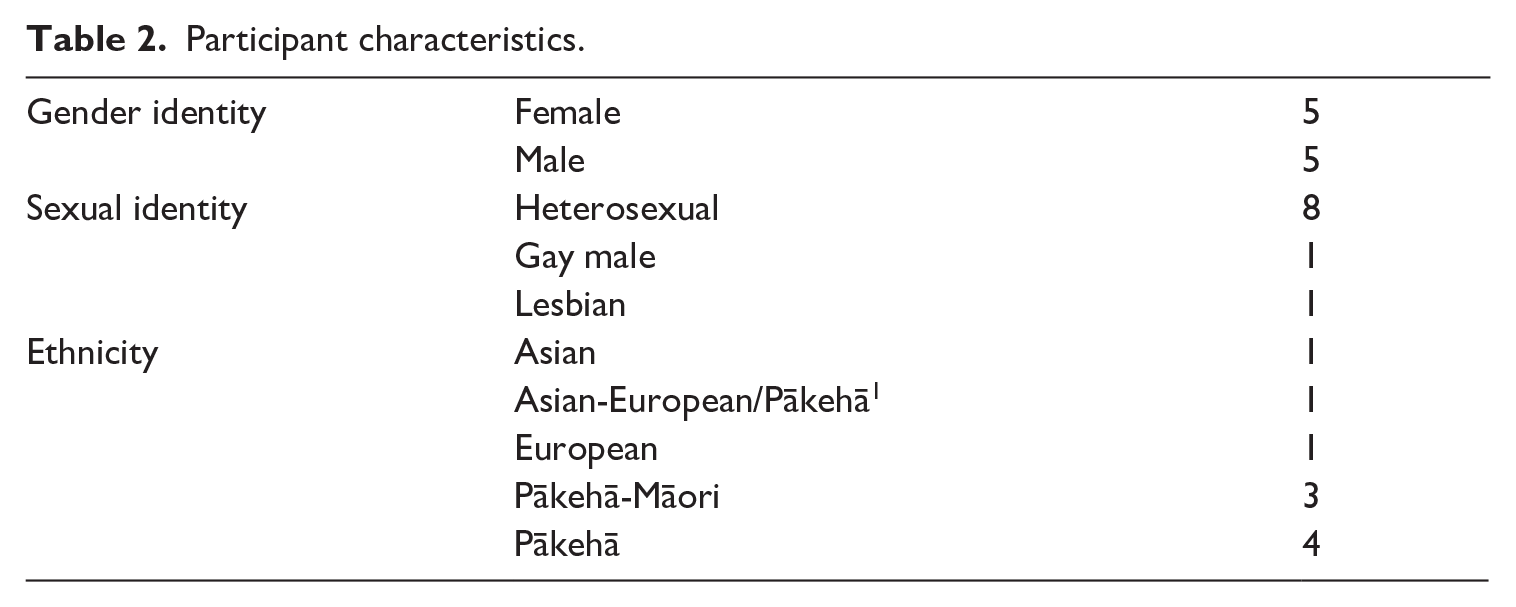
To demonstrate the application of sexual scripting theory via the performativity–performance approach, we draw on data from a larger research project on youth engagement with online pornography conducted in the North Island of Aotearoa, New Zealand (see Healy-Cullen et al., 2022, 2023). The data were generated in interviews with 10 young people aged 16 to 18 years old, recruited from nine different types of high school (coeducational, single sex, rural, urban, etc.). As shown in Table 2, the participant group comprised an equal number of young women and men, with the majority identifying as heterosexual. Half of the group belongs to ethnic minority groups and the other half to the country’s dominant ethnic groups of European or New Zealand European (also referred to as Pākehā).
Participant characteristics.
Participants were asked about their understanding of what constitutes pornography and invited to share their views about young people engaging with pornography online and whether or how adults should intervene. Our examples demonstrate how, in their talk about youth engagement with pornography online, the participants constructed resistant sexual identities, performing “smart” sexual identities (Naezer & Ringrose, 2018) in opposition to the dominant innocent child script. This script is founded upon an understanding of childhood derived from developmental psychology (Ngabaza & Shefer, 2022). It positions young people as sexually immature adolescents who, due to their developmental stage, lack the capacity to evaluate media critically and are thus incapable of navigating sexual content (Bragg & Buckingham, 2009; Robinson & Davies, 2018). They are consequently seen as inherently susceptible and particularly at risk of being harmed by pornography, necessitating adult intervention (Healy-Cullen & Morison, 2023).
The analysis below demonstrates how our participants resisted this positioning and the limitations it places on their sexual agency. We follow the analytical process set out by Morison and Macleod (2013a, 2015), as summarised in Table 1. The first step involved identifying common scripts by discerning recurring patterns of language use and any shifts in these within and across transcripts. The second step entailed considering how scripts are used in sexual identity construction, including any instances where specific identities were challenged or “troubled.” This is achieved as speakers resist dominant scripts, challenging them by modifying or repurposing them or drawing on alternative scripts (Morison & Macleod, 2013b; Taylor, 2006).
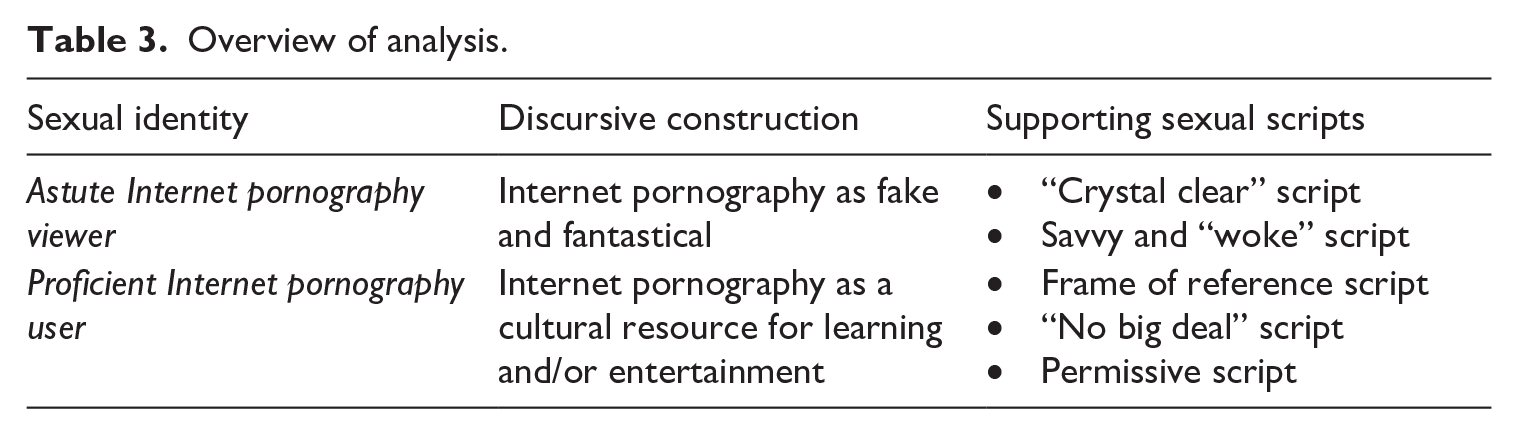
The participants constructed agentic sexual identities by drawing on alternative sexual scripts and positioning themselves as (a) an astute pornography viewer and/or (b) a proficient pornography user. Table 3 provides an overview of the analysis.
Overview of analysis.
Resistant sexual identity 1: The astute pornography viewer
Opposing the innocent child script’s position of the hapless victim of pornography, the participants negotiated the position of the astute pornography viewer who is knowledgeable about pornography and able to discern that it portrays sex in contrived and unrealistic ways. For example, they spoke about different genres of pornography available online and critiqued these, as shown in the following extracts where participants discuss problematic representations of lesbian and gay pornography, drawing on two alternative sexual scripts: the “crystal clear script” and the “savvy and ‘woke’ script.”
Tristian (16, male, gay, Asian):
It’s all really, um, sanitised and fake and it’s the two buff guys thing that’s not really good. I haven’t seen anything that I think is actually real, yet anyway . . . . It really was really crystal clear: that’s not how it [really] is.
Liane (17, female, queer, Pākehā):
Um, it’s just not at all accurate. It’s (.) especially like you go on Pornhub, and you see like “Two hot girls scissoring” and it’s, like, that seems (A) very uncomfortable and (B) like, no one’s going to get satisfaction out of that! And it’s twisted the public’s perception of how lesbian women have sex.
Here, the speakers challenge common hetero-gendered representations of sexual minorities in pornography and, in doing so, enact the identity of an astute pornography viewer. Drawing on the “crystal clear script,” they declare that these portrayals are “not at all accurate” (Liane) and “not how it really is” (Tristian), thereby positioning themselves as fully aware that online pornography is an inaccurate reflection of reality. They, therefore, resist the way adults commonly position teenagers as inherently unable to distinguish between “real sex” versus “porn sex” (Byron et al., 2021).
Moreover, the speakers demonstrate their ability to recognise not only artifice in pornography but also an underlying agenda, as they criticise mainstream lesbian and gay pornography as purposeful misrepresentations (“twisted,” “sanitised,” “fake”). Drawing on a “savvy and ‘woke’ script,” they present themselves as both knowledgeable and aware of possible negative implications of certain representations for sexual minorities. This is evident in the reference to “twisting public perception” (Liane) and implied in the judgement of some portrayals of gay men as “not really good” (Tristian).
Resistant sexual identity 2: The proficient pornography user
The proficient pornography user was another resistant sexual identity we identified. Participants commonly constructed pornography as a tool that (some) young people are capable of proficiently using for their own purposes, particularly for learning about sex, without the disastrous consequences adults envisage (e.g., addiction, trauma). Participants drew on a “no big deal script” to construct pornography as banal and serving a valid purpose in their lives. As part of this, they constructed pornography as a learning tool using a “frame of reference script.” Using these alternative sexual scripts, they minimised the supposed risks of viewing pornography and enabled resistance to the script of risk and harm that dominates discussions of young people viewing pornography (Spišák, 2020). The following extract illustrates how the “no big deal script” was drawn on in relation to concerns about the impact of pornography on young people, allowing the participants to negotiate the resistant sexual identity of the proficient pornography user.
Danielle (18, female, heterosexual, Pākehā):
I guess parents kind of miss the whole thing where it’s, like (.) Internet porn is a massive industry, and it’s, like, porn stars are famous. . . . I follow heaps of porn stars on Instagram, not because I watch them, but ’cause they’re, like, famous people. . . . There’s not, like, a deeper meaning behind it when young people are watching it. But I feel like parents, they want their kids, to be, like, being safe and knowledgeable. So obviously they’d want their kids being taught about it. . . . Yeah, I don’t know. I didn’t really think about it very deeply. I was just like, “Yeah kind of, that’s a lot, and I’ll just leave it now.” Like, that kind of thing [laughter].
Drawing on the “no big deal script,” pornography is rendered part of the broader media landscape that youth are familiar with and viewing pornography as mere entertainment. Arguing that there is “no deeper meaning” to viewing pornography beyond enjoyment and asserting that she “didn’t really think about it [pornography] very deeply,” Danielle uses this script to minimise concerns of risk and harm. Moreover, she describes pornography as something she can use for her purposes (entertainment) and easily set aside. Though she admits to being overwhelmed by pornography (“that’s a lot”) at times, this is ultimately rendered as something she could easily manage alone, without negative repercussions. Danielle thus positions herself as a proficient pornography user, able to navigate online pornography adeptly.
Interestingly, this position is partly enabled by being young and familiar with popular culture and how pornography fits into this. Rather than “an innocent little child,” Danielle presents herself as smart and knowledgeable. Parents, in contrast, are positioned as lacking up-to-date knowledge or information and being mistakenly concerned about the negative consequences of pornography (“miss the whole thing”). This challenge to adult authority is lessened by the acknowledgement of parents’ good intentions. However, Danielle ultimately positions herself as not needing “to be taught” about pornography by adults, defying the widespread harm and risk script that informs public concern about the media’s harmful effects on youth (Spišák, 2020).
A “frame of reference script” was also drawn on to trivialise and normalise youth viewing pornography, as participants constructed pornography as a learning tool and valuable source of sexual information, as shown in international research (Litsou et al., 2020; Scarcelli, 2015). In this way, speakers positioned themselves as learners, as shown in the following extracts.
Amelia (16, female, heterosexual, Pākehā):
Like, if you are going to have sex, then you kind of need to learn how to actually do it! So [laughter] even though it’s not a very good representation, it’s really the only way you can get visuals on how to do it.
Adam (17, male, heterosexual, Pākehā): “Watching porn is like, ‘Sure, that’s how I learned about sex.’ That’s normal. Like, that’s basically how I learned what happens, and what I want, and what women want.”
Again resisting the risk and harm script, these extracts show how the “frame of reference script” works along with the “no big deal script” to minimise the significance of young people watching pornography. This minimisation is underscored by Adam’s nonchalant turn of phrase and Amelia’s laughter. Constructing pornography as the most effective source of practical information about sex (“really the only way,” Amelia; “how I learned what happens,” Adam) recasts young people’s engagement with pornography as practical and commonsense rather than harmful or problematic. In addition, Amelia shows her astuteness about the “realness” of pornography by conceding that it is “not a very good representation.” Depicting pornography as a limited but necessary medium for learning about sex, she positions herself as a proficient pornography user, capable of discerningly using pornography to her own ends. Amelia’s description echoes young people’s dissatisfaction with available sex education reported in qualitative studies across the world (Allen, 2008; Goldstein, 2020; Jearey-Graham & Macleod, 2015).
Thus, in summary, our analysis shows how a performance–performativity approach enabled us to apply sexual scripting theory to explore how sexual scripts are employed as discursive resources to support identity work (i.e., smart sexual selves). It underscores speakers’ agency in sexual identity construction, including their capacity for resistance, illuminating power relations in the process of identity construction. The resistant identity work we highlighted disrupts infantilising and disempowering constructions of teenagers to varying degrees as the speakers work to construct alternative, agentic positions for themselves as young people. While the vulnerable, “innocent little child” may be sidelined from discussions of youth engagement with pornography and subject to restrictions on their online activity, the capable and “smart” teenager may have their views and competence recognised and included in conversations about the issue and be trusted to navigate the online landscape with less adult intervention.
Concluding comments and future trajectories
Our aim in this paper was to fulfil Simon and Gagnon’s (1986) objective of aligning sexual scripting theory with a social constructionist perspective by grappling with the source of the lingering individualism and cognitivism that haunts it. We showed that this problem is related to the dramaturgical metaphor of performance, which limits the theory but also offers a potential point for theoretical development. To this end, we drew on theoretical work in critical discursive psychology on the notion of performance, namely the performativity–performance approach proposed by Morison and Macleod (2013a, 2013b, 2015). We showed how this approach allows for the development and application of sexual scripting theory that coheres with a constructionist, performative view of identity, offering a truly social explication of sexual identity construction without recourse to the inner machinations of a prediscursive, voluntaristic subject.
Therefore, putting sexual scripting theory in conversation with the performativity–performance approach offers an agentic account of sexual identity construction (Morison & Macleod, 2013b), which does away with the remnants of individualist and cognitivist logics that haunts sexual scripting theory. Thus, we can capitalise on the dramaturgical metaphor of performance, envisaging a speaker who actively constructs an identity within discursive constraints, thereby remaining true to the performative understanding of subject construction (Morison & Macleod, 2015).
The theoretical insights and the methodological approach we offer in this article represent a scholarly contribution to the evolution of sexual scripting theory that we hope will be useful for sexuality scholars interested in examining identity performance in ways that consider broader societal discourses, and performers’ agency to manoeuvre within the constraints of culturally available scripts. We hope that this article will not be read as a fractious commentary of other applications of sexual scripting theory, but rather be read as an invitation to scholars from various disciplines and perspectives to join the dialogue on the methodological usefulness of this theory.
Footnotes
Funding
The authors received no financial support for the research, authorship, and/or publication of this article.
